Antenova Ltd. has developed a new positioning antenna that it says can pinpoint a location to within centimeters in the GNSS bands. Antenova is a manufacturer of antennas and RF antenna modules for machine-to-machine and the internet of things.
Antenova will be showing samples of the Raptor antenna at the Consumer Electronics Show, being held Jan. 8-11 in Las Vegas, in booth #2220 in the Westgate hall.
The Raptor antenna utilizes the L2 1200-MHz satellite band that recently became available for civilian use.
The addition of the L2 frequency band combines multi-band satellite signal reception and GNSS correction data. This helps to mitigate position errors, greatly improving accuracy, especially in urban areas, the company said.
As well as improving tracking, the L2 band is beneficial for UAVs, drones, autonomous vehicles, agriculture, grid mapping and other emerging applications, Antenova added.
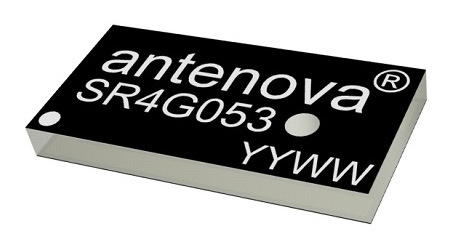
The antenna is the latest addition to Antenova’s lamiiANT range of rigid FR4 antennas which are designed for easy insertion onto a printed circuit board (PCB).
The antenna itself is very small. It is a GPS single-feed antenna in surface mount (SMD) form, measuring 16.0 x 8.0 x 1.6 millimeters, suitable for small PCBs within all kinds of small electronic devices.
“This is an outstanding antenna, because it achieves the same precision as a much larger, heavier ceramic patch antenna, but in a very compact SMD part,” said Colin Newman, CEO of Antenova. “A ceramic antenna would need to be 35 x 35 millimeters to achieve a similar level of accuracy and performance.” Raptor is supplied in tape and reel for ease in high-volume manufacturing applications.
U-blox has launched the LARA-R3121, a new module comprising a single-mode LTE Category 1 modem and a GNSS positioning engine specifically designed for Internet of Things (IoT) and machine-to-machine (M2M) devices.
The LARA-R3121 is designed for IoT applications including smart utility metering, connected health and patient monitoring, smart buildings, security and video surveillance, smart payment and point-of-sale (POS) systems, as well as wearable devices, such as action cameras.
“Most IoT modules on the market use LTE modem technology, developed by handset-focused silicon vendors. They may not provide the best fit for IoT applications, because they focus on features targeted at Tier 1 handset makers, limited by short life cycles. The LARA-R3121 is different with features and qualifications crafted for the industrial markets,” said Andreas Thiel, u-blox co-founder and executive VP, Cellular Products and IC Design. “This is the only cellular module comprising a LTE Cat 1 modem and a GNSS engine, with complete module hardware and software all developed by a single supplier. With our focus on the IoT market, we bring an ‘IoT first’ approach to silicon design.”
The LARA-R3121 is supplied in the small 24 x 26 mm LARA LGA form factor for compact IoT devices. This standardized package enables straightforward automated manufacturing and is pin-compatible with the u-blox LARA-R2 series, which supports multimode LTE Cat 1 with 2G/3G fallback.
LARA-R3121 module by u-blox.
According to the company, it is a landmark in u-blox’s long-term strategy to create modules based on the UBX-R3 LTE modem technology platform, an internally developed, flexible, software-defined modem architecture specifically designed for IoT and M2M.
The essential modem, positioning and module components of the LARA-R3121 are developed in-house, allowing for freedom for innovative feature development, for enabling end-to-end security and giving full control of product quality, while ensuring the long term product availability required by many IoT applications. Because modem and GNSS technologies were all developed in-house, u-blox is also able to provide unparalleled technical support for developers.
The LARA-R3121 features FOTA, providing customers with a solution to issue firmware over the air updates. It also benefits from end-to-end security features, such as secure boot, secure transport layer, secure authentication, secure interfaces and APIs. Like other cellular modules from u-blox, it complies with a nested architecture, which allows for easy migration, and future-proof, seamless mechanical scalability across cellular technologies.
As a single mode, LTE-only device, LARA-R3121 takes advantage of the fact that LTE networks are becoming universally available. Increasingly, products do not require fallback to 3G or 2G, which means that non-essential components can be removed, reducing cost and power consumption.
The 10 Mbits downstream and 5 Mbits upstream maximum throughput of LTE Cat 1 provides data rates sufficient for good quality video streaming.
Iridium Communications Inc. has introduced its Satellite Time and Location (STL) service, an alternative or complement to traditional indoor and outdoor location-based technologies, and declared it ready for use. STL’s position, navigation and timing (PNT) technology is deployed through Iridium’s 66 cross-linked, low-earth orbit satellite constellation.
Through Iridium satellites and in GNSS receivers, STL technology can work to verify GPS, GLONASS, Galileo and other navigation services, and also can serve as an alternative for those services when GPS signals are degraded or unavailable. STL also can provide an alternative source of time when testing GPS signals.
Iridium is working with Satelles, a division of iKare Corporation, as its primary technology partner. Satelles enables Iridium’s paging channels to reach small, low-cost receivers in nearly any environment, the company says in a news release.
“We think STL can help solve an important and growing problem for governments and businesses, and serve as a platform for continued innovation,” says Matt Desch, chief executive officer at Iridium. “With STL, we are introducing a global capability that is already in space, technologically ready for use and is independent of any particular location technology. The team at Satelles has been able to leverage the unique capabilities that our network offers to create a solution that can ultimately be integrated into almost any kind of platform, including other Iridium machine-to-machine devices, heavy machinery, automobiles and even the power grid, to name a few. Once implemented, STL could revolutionize the way the world’s largest, global companies and governments operate and manage cyber security.”
In a chipset about the size of a postage stamp, the technology can be embedded into many devices. STL’s signal strength may make spoofing GPS systems more difficult, the company says. STL transmits its signals through Iridium’s satellite constellation to deliver a unique code to each position on the ground that can be independently authenticated, which allows operation or access only if the user is in the location expected.
“Commercial users are now able to use STL to deliver trustworthy timing solutions for critical infrastructure, such as LTE networks, transactional data centers and the power grid,” says Greg Gutt, president and chief technology officer of Satelles. “Military and government users can also acquire these commercial off-the-shelf solutions for the Department of Defense and other government applications. In addition to enhancing the security and resiliency of GPS, STL technology can be embedded into servers anywhere in the world to geo-fence data and applications, providing trusted time and location data as an independent factor for end-point authentication.”
The STL solution has been successfully demonstrated across multiple sectors, including military, academia and commercial applications. The technology is available today and will be supported by Iridium NEXT, the Iridium’s next-generation global satellite constellation, which is scheduled for completion by late 2017, the company says.
Trackimo, a U.S.-based IoT (Internet of Things) solution provider enabling worldwide connectivity for M2M (Machine to Machine) devices, showcases its tracking devices at the Association for Unmanned Vehicles Systems International’s Xponential show, held May 2-5 in New Orleans.
Trackimo’s technology integrates GPS, GSM, an accelerometer and sensors that provide smart data. Cellular network signaling manages the devices and dispatches information to systems and apps.
Trackimo covers both consumer and businesses sectors including fleet tracking and logistics management solutions, customizable and scalable IoT platform, remote gateways and consumer tracking devices.
ORBCOMM Inc., a global provider of machine-to-machine (M2M) and Internet of Things (IoT) solutions, has added to its fleet management portfolio.
Announced at the Mobile World Congress (MWC) are the new cellular-only SkyWave IDP-782 device and the viaFleet web application for tracking, monitoring and managing trucks, railcars and other mobile assets. MWC is being held Feb. 22-25 in Barcelona, Spain.
By leveraging ORBCOMM’s fleet management solutions, fleet operators can reduce fuel costs, optimize travel routes, monitor driver behavior, minimize idle times and ensure cargo and driver security, the company said.
ORBCOMM’s cellular-only SkyWave IDP-782 device is designed for vehicle tracking and driver monitoring applications specifically for areas where cellular coverage is widely available. This device provides customers the same functionality and flexibility as the dual-mode version at a more economical cost for cellular-only applications.
ORBCOMM’s comprehensive viaFleet application enables fleet operators to see the location of mobile assets in real-time, monitor driver behavior, streamline vehicle maintenance schedules, communicate with drivers and much more. With an intuitive, easy-to-use graphical interface, the viaFleet application works with the IDP-782 to display the location of assets on a map in real time, tracks asset movements with breadcrumb reports, and supports advanced reporting capabilities on speeding events, dwelling times, geofence access and asset health, allowing customers to significantly improve operational efficiencies and productivity.
In addition, ORBCOMM recently introduced several other innovative wireless solutions. These products and services enhance ORBCOMM’s M2M and IoT solutions portfolio, which span from device to dashboard, for system integrators, end user customers and Original Equipment Manufacturers (OEMs) across a wide variety of industries.
The ORBCOMM OGi modem, which has a footprint smaller than a credit card, is the smallest and lowest cost IDP modem built to date and is targeted for mission-critical applications that require low latency. The versatile modem’s design provides customers with unrivaled ease of use, flexibility and quality of service based on their unique application needs, including message size, delivery speed, geographic coverage and regulatory requirements. Both ORBCOMM’s OG2 and OGi modems use the same electrical and application interfaces, including the connectors, power input and programming environment. This interchangeable format enables OEM customers to plug-n-play satellite connectivity utilizing the ORBCOMM VHF network or the Inmarsat L-band network without the need to redesign their M2M solutions.
The ORBCOMMconnect subscriber management portal gives ORBCOMM customers complete comprehensive control over wireless services and connected devices, while reducing the complexity of managing and integrating multiple connectivity offerings. Customers can access three satellite and seven Tier One cellular networks in one comprehensive platform, optimizing M2M and IoT service delivery and subscriber management, enabling better business planning and helping to reduce and control costs.
ORBCOMMmobile is a mobile app that integrates with ORBCOMM’s M2M and IoT applications, including ORBCOMM’s cold chain monitoring solution and the ORBCOMMconnect portal. ORBCOMM’s mobile app runs on both iOS and Android devices to facilitate easy access to ORBCOMM solutions and technology in real-time and remotely outside of the traditional office environment.
ORBCOMM Enterprise Connect is an end-to-end 4G xLTE wireless failover solution for distributed enterprise, financial, hospitality and retail locations that need reliable, high-bandwidth WAN connectivity for M2M and IoT applications. The solution works with integrated routers from industry-leading hardware manufacturers as a back-up to existing broadband connections in the event of a primary network communications failure. The affordable turn-key solution combines world-class connectivity, hardware, management capabilities along with network and deployment support. ORBCOMM Enterprise Connect allows both large and small enterprises to conduct business efficiently and reduces risks of downtime, reduced productivity, lost revenue and customer experience issues.
To learn more about ORBCOMM’s latest innovations, visit Booth G11 in Hall 8.0 at Mobile World Congress.
Automotive and transportation companies are supporting the GSMA Embedded SIM Specification to help accelerate the growth of the connected car market, according to the GSMA.
Automakers. The interoperable specification has been backed by international brands including General Motors, Jaguar Land Rover, Renault Nissan, Scania and Volvo Cars, and will enable automakers to remotely provision connectivity over the air to vehicles with an operator of their choice.
It will help to deliver a range of in-vehicle services such as real-time navigation, infotainment, insurance and breakdown services, as well as telematics and remote diagnostics. The use of the specification will also help to quickly connect vehicles with local operators, regardless of where the cars are manufactured.
Mobile Operators. To date, 22 mobile operators worldwide have commercially launched solutions based on the GSMA Embedded SIM Specification. New operators to launch commercial solutions include AIS, América Móvil, KPN, MTN, Rogers Wireless, Swisscom, Taiwan Mobile, Telenor, TIM as well as members of the Bridge Alliance and the Global M2M Association.
The adoption of an interoperable specification will reduce fragmentation and help the industry to take advantage of the Internet of Things, an addressable market estimated to be worth US$1.1 trillion by 2020 according to Machina Research4. Bell Canada, Deutsche Telekom, Etisalat, Indosat, NTT DOCOMO, Orange, Tele2, Telefónica Brasil, Telefónica Group, TeliaSonera and Vodafone have already made commercial solutions available to the market.
“The GSMA Embedded SIM Specification has progressed from the first availability of commercial solutions to industry adoption in a very short space of time. The automotive sector is set for huge growth and it is clear that a common, global standard will help mobile operators to provide scalable, reliable and secure connectivity to vehicles regardless of location,” said Alex Sinclair, Chief Technology Officer, GSMA. “This approach will help car manufacturers offer any type of in-car connected service through a single SIM, which can be provisioned with the profile of a mobile operator once the car is shipped, as well as at the end of a contract, without the SIM needing to be changed.”
The connected car market is set for exponential growth. Gartner Research has forecast that one in five vehicles will have some form of wireless network connection by 2020, equating to more than 250 million connected vehicles in service.
Additionally, Machina Research estimates that the total number of connections in the connected car market will grow at a CAGR of 31 per cent from 182 million in 2015 to 693 million in 2020.
Analyst house Berg Insight also notes that in-vehicle embedded telematics systems shipped 1.9 million units in 2014, a figure that is expected to reach 15 million by 20203.
“Jaguar Land Rover is putting connectivity at the heart of its vehicles to deliver a range of safety, security, convenience and infotainment features for our customers. The GSMA Embedded SIM Specification allows Jaguar Land Rover to reduce manufacturing complexity, adapt to changing regulatory frameworks and work with the best mobile operators, on a country-specific or regional basis, improving the customer offering to deliver the next generation of connected services over the lifetime of our vehicles,” said Mike Bell, Global Connected Car Director, Jaguar Land Rover.
“The GSMA Embedded SIM Specification solves a number of fundamental issues in auto manufacturing principally in-market localisation and lifecycle management that enable us to provide an efficient, robust and global product,” said Fredrik Callenryd, Senior Business Strategy Manager, Scania CV AB.
“The Renault – Nissan Alliance is a global industry innovator for technology for mainstream and mass-market consumers. Supporting the GSMA Embedded SIM Specification will help sustain our innovations by enforcing a reliable and stabilized solution and enable us to offer more flexible and agile solutions. We will be able to offer our customers ease of use and a high quality of service which are Renault – Nissan’s main objectives,” commented Alexandre Corjon, Renault-Nissan Alliance Global VP, Electrics Electronics & Systems Engineering.
GSMA Intelligence research highlights that 76 percent of global M2M connections are now serviced by mobile operators that are deploying or are committed to the GSMA solution, underscoring the momentum behind the specification.
GSMA Connected Living Programme at Mobile World Congress 2016
The GSMA’s Connected Living Programme will showcase the GSMA Embedded SIM Specification at Mobile World Congress, Feb. 22-25 in Barcelona. There will be a number of live demonstrations of the specification in the GSMA Innovation City located at Stands 3A11 and 3A31 in Hall 3, Fira Gran Via, including scenarios from Bridge Alliance and the Global M2M Association.
There will also be a number of workshops, seminars and presentations highlighting the impact of the GSMA Embedded SIM Specification on the international market.
The GSM Association (GSMA), formed in 1995, is an association of mobile operators and related companies devoted to supporting the standardizing, deployment and promotion of the GSM mobile telephone system. It represents the interests of mobile operators worldwide, uniting nearly 800 of the world’s operators with 250 companies in the broader mobile ecosystem.
CEVA Inc. has introduced the Dragonfly reference platform to accelerate the design of low-data-rate machine-to-machine (M2M) and Internet of Things (IoT) communication applications, including standalone wearables, smart grid, surveillance systems, asset tracking, remote monitoring systems, connected cars and smart utilities.
The Dragonfly multifunction platform is enabled by the recently announced CEVA-XC5 and CEVA-XC8 digital signal processor (DSP) cores and accompanied by the hardware and software components required to rapidly design machine-type communications (MTC) systems.
The platform supports GPS, Wi-Fi and other IoT-related communications standard set to be deployed for M2M communication as well as existing and emerging LTE MTC releases and LPWAN standards such as LoRa, SiGFox and Ingenu. LTE MTC — LTE Advanced for machine-type communications — significantly increases battery life, reduces device complexity, and enhances coverage for low data rate machine-type communications.
At Mobile World Congress 2016, CEVA will demonstrate the Dragonfly reference platform running LTE Cat-0 and GPS concurrently on its silicon-based development platform together with test and measurement equipment from Keysight Technologies and a GNSS simulator from Galileo Satellite Navigation. Mobile World Congress takes place in Barcelona, Spain, Feb. 22-25. CEVA is located in Hall 6, Stand A50.
Dragonfly offers system developers a flexible platform that allows for optimal hardware/software system partitioning, combining a low-power vector communication DSP with a range of hardware co-processors. Such partitioning enables the software flexibility essential for upgradability and long service life of typical M2M devices, while delivering the power efficiency required to support extended battery life of up to 10 years.
As an example, for CEVA licensees developing M2M systems incorporating LTE Cat-1 or Cat-0 today, these systems can be easily upgraded to support LTE Cat-M or other future standards when available. The DSP can also be used to implement proprietary features for specific device use cases, such as seamless indoor and outdoor positioning concurrently with Wi-Fi 802.11n or LTE Cat-0, in a highly efficient manner.
“Our Dragonfly reference platform brings together all of the essential hardware, software and system integration components required by customers developing low-power machine-type communication solutions, in a highly cost and power efficient manner,” said Michael Boukaya, vice president and general manager, Wireless Business Unit at CEVA. “We have leveraged our deep expertise in low-power baseband processing and complemented it with a range of software offerings to deliver a platform that is highly customizable and flexible for developing a broad range of IoT and M2M products, quickly and efficiently.”
The Dragonfly reference platform includes the vector communications DSP and all the required co-processors and interfaces, together with software application layers and libraries, RTOS and drivers for MTC systems design. These hardware and software components are available for LTE MTC, Wi-Fi and GNSS standards. Also included is a 500-MHz silicon-based development system that includes all of these components together with RF front ends and a host interface.
Aeris is partnering with Isotrak Ltd. to provide improved cellular connectivity and data analytics for Isotrak’s global customers.
By leveraging Aeris’ machine-optimized and patented AerCore IoT and M2M network, AerPort connectivity platform and AerVoyance IoT and M2M analytics platform, Isotrak has added advanced capabilities to its 3iS FleetVision solution, part of its real-time ATMSi (Active Transport Management System) fleet management system. Isotrak can now provide business intelligence data to provide retailers and manufacturers with a full view of their transportation ecosystem — including their own fleets as well as those of third-party suppliers.
The collaboration between Aeris and Isotrak will provide customers with a reliable mobile network optimized to meet the demands that IoT/M2M solutions for fleet management creates, while providing actionable visibility and measurement into the performance of vehicles and drivers through data analytics. Isotrak’s integrated supply-chain solutions depend on accessing near real-time data with robust alerting and reporting capabilities, which Aeris is able to deliver through its carrier-agnostic network.
“Our fleet management system provides data for a total vision of a fleet manager’s transportation ecosystem. We wanted to ensure reliable connectivity services and data insights no matter where our customers are located,” said Jason Price, sales and marketing director with Isotrak. “By leveraging Aeris’ expertise in IoT network solutions, we are able to quickly provide a robust, global solution that goes well beyond improved connectivity and competitive rate plans to offer customers real-time, useful information at their fingertips to help improve their cost structure.”
Aeris’ global support of major cellular technology standards, such as GSM, CDMA and LTE, enables partners like Isotrak to offer customers flexibility and the potential for growth throughout the globe, the companies said.
“The inherent security built into the Aeris system gives companies like Isotrak peace of mind, and the speed of onboarding, even with a private virtual network, provides a competitive advantage,” said Mohsen Mohseninia, vice president for international market development at Aeris. “We can deliver technology that can be quickly deployed and will show immediate value while also helping to reduce the time to market for new products and services.”
LAS VEGAS — About 30,000 attendees sweltered in Las Vegas for CTIA’s Super Mobility show this past week. Attendance was flat from last year, but the exhibit floor and meeting rooms bustled. The energy of the show focused on M2M and Internet of Things (IoT). In past years, the connected vehicle was a highlight, but not so this year. Wearable technology was scant. Those looking for the big product introductions of the past were disappointed. However, CTIA’s keynote speakers added focus and vision into the show, reminding us of the drive and vigor that built the industry.
In the past, the network operators (we once called them carriers) and device manufacturers owned the CTIA show, where they made their biggest product reveals. This year, AT&T had a flurry of announcements, including a partnership with car manufacturer Jaguar Land Rover North America. AT&T will supply connectivity to the cars for features such as Wi-Fi hotspots, connected navigation and a suite of apps. Customers will be able to share wireless data between phones, tablets and vehicles on its Mobile Share Value plan for an additional 10 dollars per month access fee. AT&T previously signed agreements with Audi, BMW, GM, Ford, Tesla, Nissan, Volvo and Subaru.
AT&T and Telogis announced a collaboration to offer solutions for companies with mobile workforces, a combination of AT&T’s network and Telogis’ telematics, compliance and navigation fleet solutions. AT&T was showing off ZTE Mobley, AT&T’s first plug-in vehicle Wi-Fi hotspot, which has just appeared in stores. Smaller announcements from AT&T included the formation of a dedicated smart city organization and a personal security app that provides live, OnStar-type professional monitoring (video and audio).
Verizon unveiled Go90, a streaming-video, social media service that works across carriers. Go90 is a free, ad-based service accessed only on a mobile phone and focused on short clips, viral videos and a social element, with crowdsourced recommendations and the ability to join groups. Go90 is targeted at Millennials, people younger than 30 years old. Although this seems like a minor announcement, obtaining the loyalty of Millennials and Generation Z (those still in their teens) is critical. With two-thirds of Millennials considering smartphones as their most important device for video, the strategy behind Go90 makes sense.
New Sprint CEO Marcelo Claure is never boring and used his time at the podium to continue trash- talking the competition. With cocky confidence, he pronounced that under his leadership, Sprint will enjoy “one of the biggest turnarounds in telecom history.” In July, Claure used Twitter to declare T-Mobile’s aggressive “uncarrrier” promotion to be “bullshit and a fake show.” He continued his rant at CTIA. “We spent the first year cutting AT&T or Verizon’s bills in half, which was fun. We’ve moved on today to offering all the DirecTV customers the choice to not be stuck with AT&T.”
One of the most pressing industry issues is spectrum. With wireless data forecast to grow ten-fold by the end of 2020, the industry is concerned that the 2016 spectrum auction will not be sufficient. Keynotes appealed for more spectrum to enable the U.S. to lead in 5G, just as it led in 4G. U.S. company-run operating systems are currently on nine out of ten smartphones, worldwide. FCC Chief Tom Wheeler was at CTIA to give assurances that the spectrum auction slated for March 2016 will be successful and occur as scheduled. He countered CTIA’s CEO Meredith Baker’s assertion that the FCC has no added plans beyond this auction for freeing up spectrum.
Freetel mobile products of Japan was one of several international companies participating in CTIA this year.
Location Players, M2M, IoT
TeleCommunication Systems (TCS), a stalwart of location-based services, beefed up its indoor location capabilities with the purchase of Loctronix. The platform, Sensorvision, aggregates and integrates location-positioning technologies, like Bluetooth, beacons and Wi-Fi, as well as content, such as mapping. Sensorvision is currently in beta testing and is aimed at wireless operators. With more stringent rules for 911, including indoor location requirements, TCS is positioned for both public safety and commercial needs. What’s next? In five years, Michael Mathews of TCS predicts, “We’ll be talking about the huge amount of information available from the road and the great impact on apps, including vehicles that are informing other cars of their actions, such as when they initiate traction control or start windshield wipers.”
u-blox, the maker of wireless and positioning modules and chips, announced a portfolio of new LTE low data rate cellular modules for IoT and M2M applications in the industrial and automotive markets. The portfolio consists of multi mode, multi carrier and of LTE only modules specific for large North American carriers. u-blox expects LTE Cat. 1 technology to become the future norm for M2M applications. And when asked about long-term success, Sven Etzold of u-box says, “The challenge for our industry is picking the right partners and being part of successful consortia. We need to partner with the right network operators and play with sensors’ companies.”
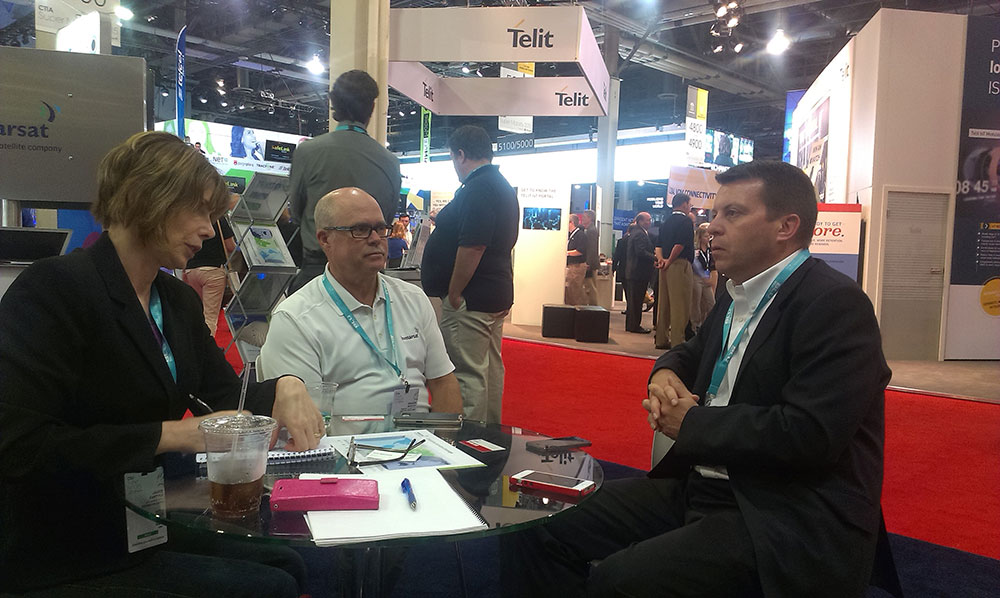
Janice visits with Chuck Moseley (center) and Don Wigglesworth (right) of Inmarsat.
Inmarsat unveiled its new machine-to-machine (M2M) and its IoT strategy, the “Internet of Everywhere.” The company is increasing use of VARs and OEMs to enable solutions that will provide more visibility and control of mobile assets throughout the world. “We are empowering existing and prospective VAR partners to offer unparalleled worldwide connectivity to their M2M and IoT customers through a single network and a single SIM,” said David Wigglesworth of Inmarsat. The company’s dedicated M2M services are IsatData Pro, a low-data-rate messaging service, and BGAN M2M, a two-way IP data service for monitoring and control of assets that require higher bandwidth capabilities.
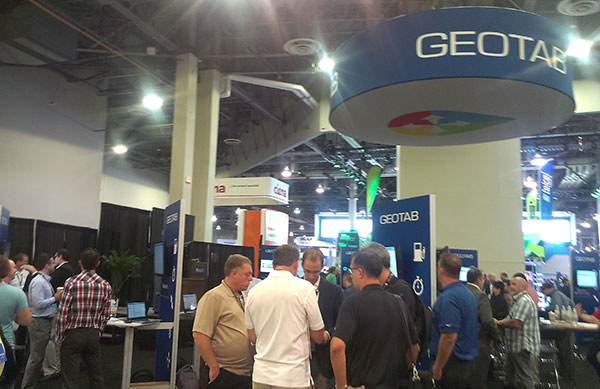
Geotab, with one of the exhibit floor’s most crowded booths, showcased the development platform of a small form-factor GPS tracking device. The Geotab GO7 device plugs directly into a vehicle’s OBDII port. Developers create applications that are available on the Geotab Marketplace. The booth was crammed with developers who offer M2M and IoT solutions.
Geotab’s booth was crowded with developers interested in the Geotab Marketplace for M2M and IoT solutions.
Microsoft’s Start-Up Alley contained interesting ventures from the Microsoft Accelerator. One young company, Parknav, offered an app for finding parking spaces based on predictive modeling, and not sensors. Users are guided to street blocks with the highest probability of available parking spaces. The app uses a number of sources, including number of parking spaces, traffic flow and undisclosed data. Parknav enables searches for free, paid and permit parking in 30 cities in Germany and a few cities in the U.S.
On a charitable note, Jimmy Whales of Wikipedia fame was at CTIA to promote his phone business, a Sprint-based MVNO cellular service. Like Wikipedia, The People’s Operator (TPO) is not a profit driven enterprise. Ten percent of a subscriber’s monthly bill goes to a charity of her choosing, and 25 percent of the company’s profits are donated to non-profits. In talking about Wikipedia, Whales cited China’s current ban of the website. Wikipedia has recently made changes to its website that make it impossible for censors to ban specific Wikipedia pages, although the entire site can be blocked, as it currently is in China.
I have parting advice for the organizers of CTIA. This year’s show was disrupted by competing events that included the iPhone 6 announcement in Cupertino. Shame on Apple, who is a member of the CTIA board. Also, CTIA had organized a virtual co-conferencing with Internationale Funkausstellung Berlin (IFA), one of the largest trade shows for consumer electronics and home appliances. The IFA event was held in Berlin the prior week and stole attention from CTIA. It isn’t all about location. Timing matters.
PodsystemM2M, which specializes in multi-network data solutions for the M2M and Internet of Things (IoT) industries, announced a new partnership program for providers of M2M and IoT hardware and software that aims to fast track solutions to market by providing tried and tested components for companies looking to develop end-to-end solutions. The announcement was made at CTIA Super Mobility 2015, held in Las Vegas Sept. 8-11.
The program has the support of software solutions providers Gurtam, Betaar3 and Gosafe, who provide hardware for fleet management solutions. The aim is to create a community in each sector enabling developers to choose the best components for their product and get advice from M2M experts. The first sector covered is GPS tracking for fleet management and logistics.
Gurtam provides a powerful fleet intelligence software platform called Wialon, which allows GPS tracking solution companies to deliver a feature-rich and cost-effective service to end-user fleets globally. The platform is used by more than 650 solution providers on five continents.
Betaar3 is a global provider of mobile workforce solutions for service-based businesses of all sizes delivered as software-as-a-service (SaaS).
Gosafe develops and distributes GPS fleet management products including hardware and software solutions that utilize existing wireless network infrastructures to provide web-based vertical applications to commercial customers as well as consumers. Gosafe’s products are sold in more than 100 countries.
“We are excited to partner with Podsystem and be in a position to recommend them as a connectivity provider with an excellent track record for reliable service and outstanding customer experience,” Gurtam Managing Director Sergei Leuchanka said in a press release. “Choices for connectivity are vast, but not many providers can boast the same level of staff dedication and technical capabilities that many of our customers in North America have come to expect from Podsystem.”
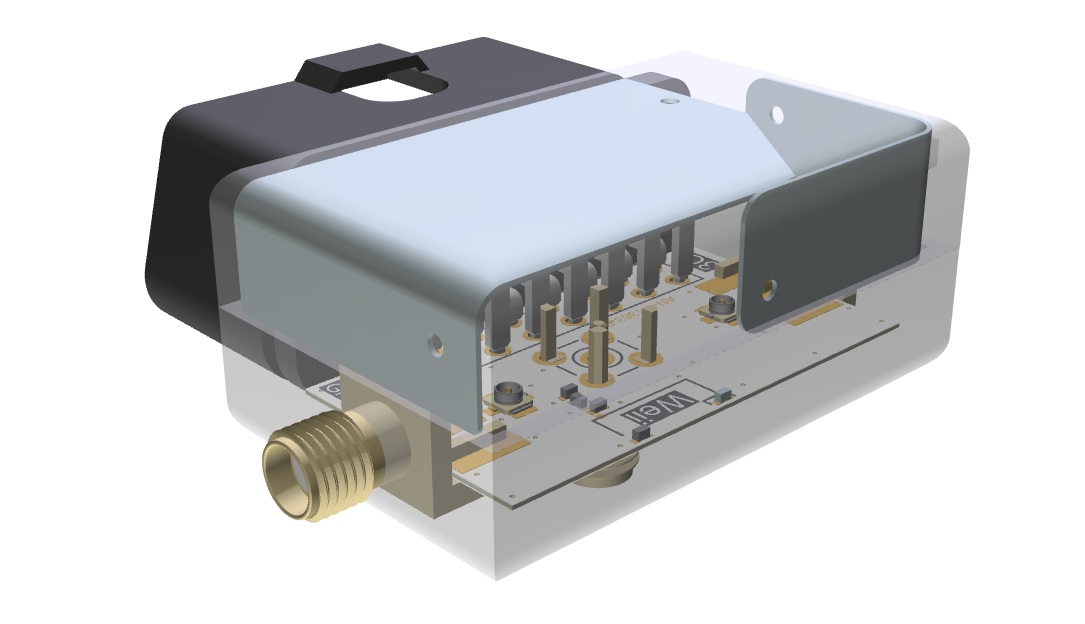
The Antenova ODB (on-board devices) design fully assembled.
Antenova Ltd., manufacturer of antennas and RF antenna modules for M2M and the Internet of Things, has built a model design for on-board devices (OBD) and vehicle telematics, which the company will be showing at CTIA Supermobility 2015.
The OBD design uses three new antennas inside an OBD housing to link to GNSS satellite, Bluetooth and a terrestrial network, while obtaining optimum performance from all three antennas simultaneously. The design also features a new small GNSS RF module to fix location, which Antenova is showing for the first time.
Antenova is using the latest antennas from it product ranges in the OBD design:
the Armata 3G FPC antenna for penta-band frequencies which operates at 824-960 MHz and 1710-2170 MHz
a new GNSS antenna named Bentoni operating at 1559-1609 MHZ,
the tiny Weii PCB-mounted antenna, which provides a Bluetooth connection at 2.4GHZ.
All three are new antennas Antenova released this year.
The new GPS/GNSS module (Antenova part number M10578) is a complete receiver that provides accurate location tracking for OBDs. It uses the latest MediaTek chipset with an additional LNA to give added performance when mounted under dashboards and out of line of sight with the sky.
Antenova’s product designers recently introduced the concept of “Design For Integration” (DFI), which considers how the RF antenna will operate when it is embedded with a manufacturer’s product. Antenova’s antennas are always used within a customer’s design, so they are designed to provide superior RF performance from within the device, and to make the integration of the RF elements easier for the designer. In addition to this, Antenova provides its customers with technical support during the design, integration and testing phases.
“We are demonstrating how a design for an OBD can give great performance, even when new antennas are added to an existing design,” explained Colin Newman, Antenova’s managing director. “OBD devices are growing fast in popularity, and the design of the RF components is critical to the overall performance of a device. In particular, Antenova’s engineers have invested many years in designing antennas that work effectively in very small spaces, whilst maintaining the efficiency of the antenna.”
Antenova offers a range of antennas for Bluetooth, ZigBee, Wi-Fi, ISM, 802.11, 3G, GSM, GPRS, Edge, UMTS, WCDMA, LTE, GLONASS, BeiDou and Gallileo.
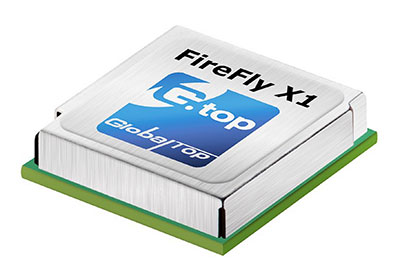
GlobalTop Technology has launched FireFly X1, a tiny Mediatek-based multi-GNSS module. With a compact size of 9.0 x 9.5 x 2.1 millimeters, it’s one of the smallest multi-GNSS modules in the industry, the company said.
“Compact size and low-power consumption will be the key [unique selling points] for the next generation of M2M Devices,” said Sam Khan, vice CEO of GlobalTop Technology. “After a comprehensive market study, we found that small size was one of the most important factors for companies when it came to GNSS module selection; other key factors included power consumption, TTFF, positioning accuracy, additional interfaces as well as quality and longevity of the module. I am proud to say that FireFly X1 delivers perfectly on all these criteria.”
According to Khan, the FireFly X1 was designed with “sophisticated engineering and an entirely new set of ultra-compact quality components to reach this miniature size, while adding more features and interfaces at the same time.” It uses the latest MT3333 engine with full support for GPS, QZSS, GLONASS and BeiDou, and is Galileo ready.
Tracking of up to two constellations simultaneously, and relying on the latest Mediatek firmware, it can provide positioning accuracy of up to 1.8 m CEP. Enabling EASY (self-generated orbit prediction), AGPS (ephermis file injection) and SBAS further enhances position accuracy.
Despite a smaller size, FireFly X1 incorporates a complete set of high-quality components, including TCXO, RTC Crystal, SMPS, SAW Filter and an additional LNA to provide reliable performance.
FireFly X1 combines miniature size with flexible multi-interface connectivity options such as SPI and I²C that can simplify a user’s design, and is designed for M2M devices relying on low-cost MCUs that offer limited serial interfaces.
GlobalTop’s free customization service further expands the capability of FireFly X1 with features such as custom NMEA output sentence, distance calculation, geofencing, magnetic variation and last- position-retention. Advanced users can also customize the basic parameters of the module, including baud rate, update rate, internal logger settings, DGPS mode, 3D Fix, 1 PPS timing, and more.
All modules are produced at GlobalTop’s in-house ISO 9001:2008 certified manufacturing facility, with 100 percent unit testing and complete quality control, allowing for a consistent annual yield rate of 99.98 percent.
Samples and Evaluation Kits for FireFly X1 are now available. Please contact us or your local distributor for more information.