Tag: M2M

  • Tallysman Wraps Antennas in Armored Cable for Precision Ag, M2M

    Tallysman Wraps Antennas in Armored Cable for Precision Ag, M2M

    This photo shows the corrugated conduit covering the RG174 cable with Tallysman’s TW2410 antenna.
    This photo shows the corrugated conduit covering the RG174 cable with Tallysman’s TW2410 antenna.

    Tallysman’s enclosed antennas now come with optional armored corrugated cable. The standard RG174 cable is encased in a corrugated conduit of tough plastic, which maintains its functionality between the temperatures of -40 to +150C.

    The extra protection increases the resilience of the antenna for use in precision agriculture, machine-to-machine, and other rugged applications.

    Tallysman is a manufacturer of high-performance, high-quality products for a wide range of GNSS applications.

  • Vodafone MachineLink 3G Plus Advances M2M Adoption

    NetComm Wireless Limited and Vodafone have added the Vodafone MachineLink 3G Plus to the Integrated M2M Terminals range, offering an alternative for unconnected machines that need a larger selection of interface options. Developed by NetComm Wireless to facilitate the uptake of Machine-to-Machine (M2M) across a multitude of industries globally, the Vodafone MachineLink 3G Plus enables M2M connectivity in areas such as healthcare, agriculture, vending, point of payment and energy.

    The Vodafone MachineLink 3G Plus is a 3G penta-band modem and router with built-in GPS. It is compatible with Vodafone or Vodafone M2M partner networks worldwide, and the Vodafone M2M Global Platform. The device supports multiple communication protocols and interface options with features including Ethernet, Serial (RS232/422/485), I/O and USB 2.0 ports. Designed for flexible customization, the Vodafone MachineLink 3G Plus features an embedded Software Development Kit (SDK) and open source Linux OS to support unique business functions.

    Vodafone’s second annual M2M Adoption Barometer found that M2M adoption has grown more than 80%, with more than one-fifth of companies actively using the technology. The Vodafone MachineLink 3G Plus is expected to advance this growth by allowing businesses to upgrade from legacy serial connectivity to IP connectivity with access to a broader range of connection choices.

    “The Vodafone MachineLink 3G Plus is the second bespoke product developed for Vodafone which gives businesses the ability to select the best solution for their individual applications. It presents a tremendous opportunity for businesses that need extra options to connect and manage valuable assets,” saidDavid Stewart, CEO and managing director, NetComm Wireless.

  • Wi2Wi Offers GNSS Module for M2M and Wearable Markets

    Wi2Wi Corporation is releasing the W2SG0021i, a miniature GNSS module based on the CSR SiRFStarV chip.

    The W2SG0021i is a high-sensitivity, low-power stand-alone receiver designed for portable applications. It can concurrently track multiple satellite constellations (GPS, GLONASS, BDS, SBAS, and is Galileo-ready) and has ultra-fast time-to-first-fix, a small form factor, and high receive sensitivity for a broad spectrum of OEM products, including machine-to-machine (M2M) and consumer wearables.

    The module provides precision commercial-grade GNSS location identification over -40C to +85C. Measuring 7 x 7 millimeters, the W2SG0021i addresses the need for a cost-effective and high-performance GNSS module for major markets worldwide, the company said.

    M2M and wearable markets require GNSS modules with high position accuracy, low power, and very small form factor, said Wi2Wi CTO and vice president of engineering Tony Fardanesh. Wi2Wi pushes these limits in its GNSS, Wi-Fi, and Bluetooth solutions, he said.

    Precision location features and the small form factor of W2SG0021i enable Wi2Wi to penetrate into the GNSS market globally.  Wi2Wi continues to invest in the research and development of high-precision connectivity solutions, timing devices and frequency controllers to the global customer base, said CEO Hans Black.

    The W2SG0021i samples and development kit will be available in Q1 2015.

    Wi2Wi designs, manufactures and markets miniaturized embedded wireless connectivity solutions (incorporating both hardware and software), high-precision timing devices, and frequency controllers for premium industrial/medical, avionics, home automation and government markets.


  • Trimble Acquires Nexala to Expand Rail Transport Role

    On Dec. 1, Trimble acquired privately held Nexala, a provider of enterprise solutions for the rail transport industry, headquartered in Dublin, Ireland. Financial terms were not disclosed.

    Nexala’s enterprise solutions manage the lifecycle of rail transport vehicles from operation through maintenance and repair. The Nexala enterprise solutions complement Trimble’s existing portfolio of rail solutions, enabling Trimble to address the broader railway workflow — from initial greenfield track alignment planning to managing the maintenance of locomotives in a repair depot.

    Trimble’s existing railway solutions leverage the spectrum of Trimble technology for track and structure construction and maintenance — including construction machine control systems, Building Information Modeling (BIM) software and highly precise track measurement systems — to enable high-quality railway construction on time and budget. On the operations side, Trimble’s fleet mobility solutions, RFID reading technology and Positive Train Control (PTC) mapping systems enable productive and safe operation of passenger and freight railroads. The addition of Nexala will accelerate Trimble’s ability to deliver more complete solutions for both railway infrastructure managers and transport operators.

    Nexala provides an integrated suite of on premise and software as a service (SaaS) solutions for large transport operators and global train and component manufacturers. The solutions include:

    Engineering Maintenance Management (E2M):  The Nexala E2M system is an enterprise-wide engineering, asset and maintenance management system. E2M is designed to control assets, manage stock, streamline procurement, schedule workshop operations and plan maintenance in order to achieve optimum asset availability and labor utilization.

    Real-time Remote Diagnostic Monitoring (R2M):  The Nexala R2M system combines shore-based software and on-train equipment to deliver fault alerts as they occur for effective condition-based maintenance. Communicating with the maintenance depots in real-time, the system allows for efficient fault diagnostics and work scheduling by the maintenance team. In addition, by analyzing irregularities of individual components and their behaviors across the entire fleet, the R2M system allows maintenance actions to be performed to avoid future failures.

    In-Service Performance Planning and Management (P2M):  The Nexala P2M system uses timetable, actual vehicle location and real-time diagnostics information to help identify the root cause of delays and plan journeys for optimum timetable adherence. Through a combination of journey planning and improved driver awareness, it also is used to maximize energy/fuel efficiency and manage driver behavior. The P2M system also provides the operations teams with in-service recommendations when fleet failures occur to reduce delays and penalties. P2M is also available as an on-board cab advisory system for drivers.

    Component Condition Monitoring (C2M):  Nexala’s C2M suite combines trackside and handheld measuring devices with software analytics to proactively monitor wheels, brakes, pantographs and key components for wear and defects. By detecting and analyzing anomalies, it provides predictive advice of maintenance requirements and automates maintenance planning.

    “Many of the largest railways in the world rely on Trimble solutions to plan, build and maintain their track and structures. With the addition of Nexala, we also offer rail vehicle lifecycle management solutions for passenger and freight train operators. Trimble can now provide innovative solutions for both the track infrastructure and the train assets that ride on it,” said Ron Bisio, general manager of Trimble’s Railway Solutions Business. “Our fundamental focus is to provide solutions that drive agility, improve efficiency and provide better visibility into railway operations to maximize productivity.”

    “We are very excited to join Trimble. I believe the addition of Nexala’s solutions to Trimble’s portfolio extends our collective ability to deliver more powerful and robust rail solutions,” said Karl O’Connell, CEO of Nexala. “In addition, Nexala can leverage Trimble’s international footprint to extend our company’s global reach with a team that shares our passion for innovation in the rail transport industry. As part of Trimble, our commitment to our customers remains unchanged as we continue to deliver best-in-class solutions and services.”

    The Nexala business will be reported in Trimble’s Engineering and Construction Segment.

    Nexala is a leader in rail transport vehicle lifecycle management solutions. Nexala’s solutions allow companies to plan for the future, improve operational efficiencies, manage their service levels, and to reduce their costs while at the same time ensuring that the service they provide is maintained to the highest level. Nexala has operations in Ireland, United Kingdom, France, Belgium and North America. Nexala’s customers include Southwest Trains, Eurostar, SNCF, Irish Rail, the Go-Ahead group, Abellio, Siemens Transportation, Alstom and Greater Anglia among others.

  • Azuga, Verizon Wireless to Provide Wireless M2M Services

    Azuga Fleet, a cloud-based, rewards-driven GPS fleet tracking and driver behavior solution, is collaborating with Verizon Wireless. Verizon will serve as the official wireless network provider for Azuga Fleet, providing reliable performance and real time updates to fleet managers from the field in order to further increase efficiencies in the fleet industry through machine-to-machine (M2M) technologies.

    “We chose Verizon Wireless to make Azuga Fleet’s technology even more accessible, simpler and reliable for fleet managers to utilize,” said Vice President and General Manager of Azuga Fleet, Ananth Rani. “Azuga will be expanding its roadmap to encompass products related to IoT (Internet of Things) 2015 and we look forward to working with Verizon as we develop these and bring them to market.”

    “By working together and combining our superior and most reliable network with Azuga Fleet’s unique driver behavior and rewards solution technology we will further increase fleet efficiencies and promote safer driving behaviors,” said Verizon Wireless Region President Lauren Love-Wright. “This new service is a simple and quick solution for any fleet manager to rapidly deploy GPS fleet tracking and driver behavior solutions.”

    The teamwork between Verizon Wireless and Azuga Fleet directly benefits customers, especially those who face limited network service in various parts of the country. The bundled solution will provide Verizon Wireless coverage to all existing and future Azuga Fleet customers, giving fleet managers the high-speed reliability they need for accurate, real-time reporting.

    Verizon Wireless’ M2M services, including secure mobility, device provisioning and troubleshooting, are designed to provide the highest level of customer support to Azuga’s customers. This, coupled with the cloud-based, rewards-driven, plug-and-play technology, will save Azuga Fleet customers money, increase overall productivity, enhance company cultures, and keep drivers safe at 70 cents per day per vehicle.

  • Buddy Launches Platform to Access Connected Device Data

    Buddy Platform, Inc., has launched its new platform that hosts and manages data generated by any connected device, enabling measurement of a device from the moment it’s turned on throughout its entire lifecycle. This data, often referred to as “telemetry data,” conveys information about the performance and usage of the device, and is now accessible from any common BI tool.

    Buddy helps answer the question, “How is this device being used?” and “Is it performing like we designed it to?”. Buddy is live with customers in industries such as aviation, automotive (connected cars), retail, connected home, consumer electronics and embedded silicon.

    While most connected or “Internet of Things” devices have functionality to enable control or monitoring (such as from a mobile app), relatively few are making performance and usage data accessible for analysis. By giving product management, engineering and support teams access to this data, and the insights that are derived from it, organizations can dramatically increase their ability to build better products and support the customers of these products in-market.

    “Now that devices as varied as door locks, light bulbs, kiosks and cars are all becoming connected, there’s a huge amount of data that can give manufacturers exactly the information they need to support and improve their products,” said David McLauchlan, CEO of Buddy Platform. “Device manufacturers are not cloud infrastructure companies. They’ve built technology into their products to control the device, but haven’t built the infrastructure to access and use the device’s telemetry data to improve the product and delight customers. Buddy makes it fast and easy to access those insights and immediately understand more deeply how customers are using these kinds of IoT devices.”

    Adding to the challenge is that the regulatory environment for data storage is becoming more complex. Various countries are enacting legislation that specifies how and where personal data may be stored.

    Buddy works by hosting a series of regionally sandboxed, global BuddyAPI endpoints to which devices can send their raw telemetry data. This data is pushed into a secure storage infrastructure called BuddyVault, whereupon it is then managed, queried and exposed back to the customer in any form they wish with BuddyView. This may take the form of integrations into common business intelligence tools, or as raw APIs that can be plugged into any customer or M2M scenario.

    With the addition of a few lines of code, the Buddy Platform offers a low overhead solution for extracting telemetry data from a device, and can make an unprecedented amount of device performance data broadly accessible to an organization, including:

    • How is this device being used? Is it performing like we designed it to, is it working as expected?
    • What error codes is my device reporting, and how is that affecting the customer experience?
    • How many of my devices are being used?
    • Where are they?
    • When are they used and how often?
    • Are they on or off?
    • How are my devices communicating with one another? If not, what’s not working?
    • How are my devices performing with connected ecosystems like smart homes or industrial infrastructure?

    Buddy uses standard technologies including REST service over HTTPS, which means any device with Internet connectivity can use Buddy. There are no agents, no heavy runtime to install, and the platform offers access managed, queried subsets of the data, which are available via completely customized JSON APIs.

  • Telit Introduces Jupiter SL869-V2S GPS Module

    Telit Introduces Jupiter SL869-V2S GPS Module

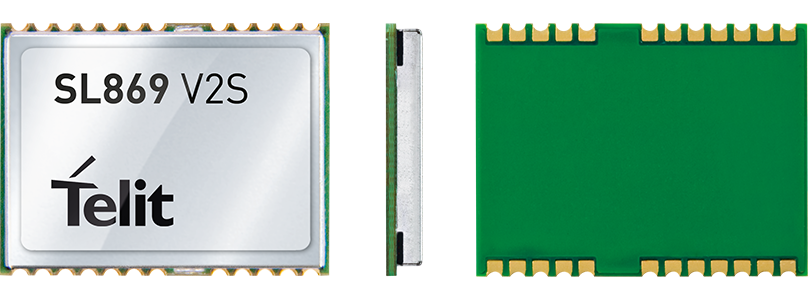
    The Jupiter SL869-V2S GPS module. Photo: Telit Wireless Solutions
    The Jupiter SL869-V2S GPS module. Photo: Telit Wireless Solutions

    Telit Wireless Solutions, a global provider of high-quality machine-to-machine (M2M) modules and services, today debuted the Jupiter SL869-V2S GPS module, designed for easy migration between a full-GNSS solution for top-ranked applications and a simple GPS-only solution for less demanding applications.

    The Jupiter SL869 V2S supports GPS as well as QZSS constellations and is ROM based. Geo-location data is delivered using NMEA protocol through a standard UART port. It supports ephemeris file injection (A-GPS) as well as Satellite Based Augmentation System (SBAS) for increased position accuracy. Its onboard software engine is able to locally predict ephemeris three days in advance starting from ephemeris data broadcast by GNSS satellites, received by the module and stored in the host flash memory.

    Key benefits include:

    • Pin-to-pin compatibility with JN3/xL869 family
    • Same protocol used in SL869 V2
    • Straightforward migration between full-GNSS solutions and GPS-only solutions
    • SBAS support, for increased position accuracy
    • Assisted GPS

    The SL869 V2S can replace the JN3, SL869 or SL869 V2 — allowing customers to design once and interchangeably mount the appropriate solution depending on the required features. The xL869 is Telit’s GNSS unified form-factor family, which allows customers to select among different GNSS technologies and feature sets. Modules in this family are offered in a 16 x 12.2 mm, 24-pad, LCC package.

    “The new SL869 V2S module is designed to be easily swapped with other xL869 modules for enhanced simplicity and scalability,” said Taneli Tuurnala, CEO of Telit GNSS Solutions. “It is an ideal example of how buying a module from Telit enables our customers to avert the need to keep track of the latest chipset technology on their own. We keep them on top of the best available technology, pre-packaged in a module that is easy to replace as needed, without having to redesign their entire application to stay up to date.”


  • Rohde & Schwarz Joins M2M Alliance

    On April 1, Rohde & Schwarz joined the M2M Alliance, the largest association for the machine-to-machine sector.

    “The advanced networking between people and machines and among machines themselves is completely changing our lives. It is opening up entirely new fields of application for our wireless test solutions,” said Jörg Köpp, who is responsible for the M2M/NFC market segment at Rohde & Schwarz. “With our commitment to the M2M Alliance, we want to promote this future-oriented technology worldwide.”

    “We are very pleased to welcome Rohde & Schwarz to the M2M Alliance and gain a wireless specialist that has stood for quality and innovation in wireless communications technology for 80 years,” said Eric Schneider, first chairman of the M2M Alliance. “The company’s wireless test solution expertise and comprehensive portfolio make it an asset to the entire M2M industry.”

    The reliability and security of mobile and wireless technologies are crucial to the success and acceptance of M2M applications. There are many industries where wireless applications have not previously played a role, but now even household appliance manufacturers, for example, are facing the challenge of integrating wireless components into their products. They need to verify that these components function correctly and obtain any necessary certification.

    Rohde & Schwarz supports these users by providing T&M equipment for almost all mobile, wireless and positioning technologies, from LTE/LTE-Advanced, UMTS/HSPA(+), CDMA2000, Bluetooth and WLAN wireless Internet access to GPS/Galileo. Rohde & Schwarz also offers specific test solutions for eCall and vehicle-to-vehicle communications. Solutions for secure M2M communications and monitoring of associated networks round out the portfolio.

  • Parsec Antennas Designed for Telit Mini GPS Receiver

    Parsec Antennas Designed for Telit Mini GPS Receiver

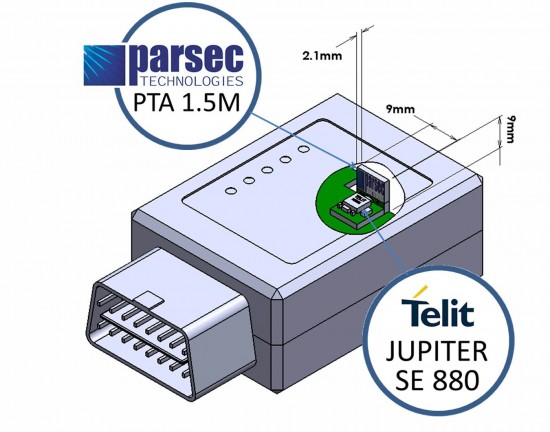
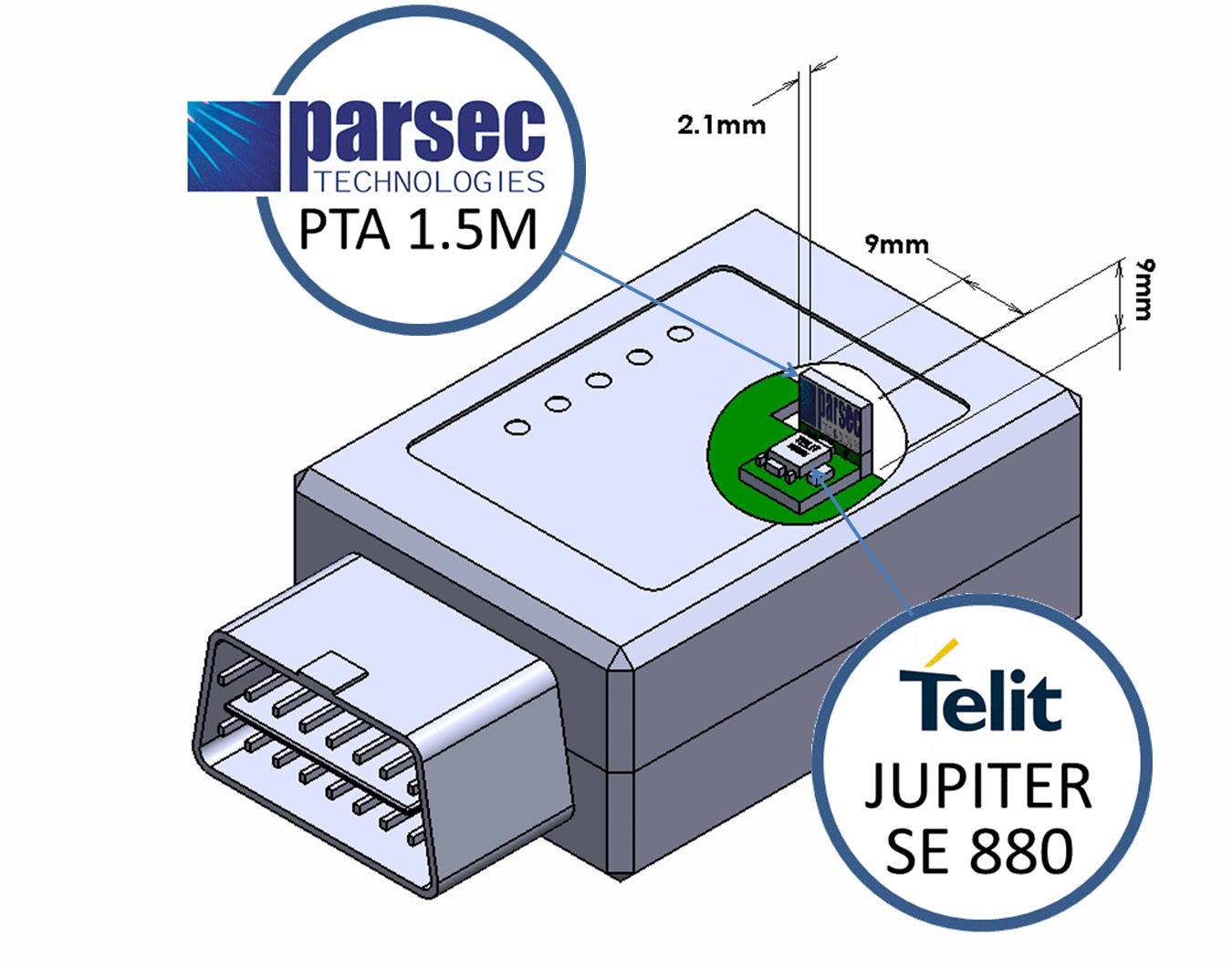
    Telit Wireless Solutions and Parsec Technologies today announced that a combination of the companies’ technologies results in a low profile  companion solution for GPS receiver and antenna. For host devices able to accommodate higher volumetric symmetry, assembly of the components can be made to fit a 6 x 16 x 8 millimeter volume. A flat component arrangement can yield an ultra-low-profile volume of 6 x 16  x 2.4 millimeters.

    ParsecTelitFig1 OBD“Receivers combining the Parsec PTA/PT Family and Telit’s Jupiter SE880 modules deliver good user experience in finished LBS (location-based services) critical products without sacrificing design flexibility, ease of implementation or cost,” said Michael A. Neenan, CEO and founder of Parsec Technologies, Inc. “The combination is ‘bullet-proof’ in providing a rewarding design experience making RF work reliably, passing end-product regulatory compliance testing without re-test.”

    “Miniaturization is a major enabler of new application areas for positioning and M2M,” said Taneli Tuurnala, Vice President and Head of GNSS Division of Telit Wireless Solutions. “With the Parsec antennas, the complete receiver features the industry’s ‘smallest landed footprint,’ making it suitable for use in wearable electronics, UBI devices or adapters for the mobile computing industry.”

    Along with miniaturization, the receiver outperforms top traditional designs, handling a loss of 10 dB or greater in GPS signal reaching, for example, the typical OBD port under a vehicle’s dashboard where many usage-based insurance (UBI) dataloggers are installed. The PTA1.5M active antenna delivers the ultra-sensitive Jupiter SE880 micro receiver over 15 dB of additional gain in the operating frequency range. Both companies are making available complete application notes to simplify the engineering effort for system integrators.

    The miniature 4.7 x 4.7 millimeter LGA (Land Grid Array), SiRFstarIV-based Jupiter SE880 receiver module employs heterogeneous 3D integrated technology to achieve best-in-class performance in all dimensions critical for regular or size-constrained GPS applications. Its RF front-end employs spatially calibrated waveguide-quality radio paths inside the three-dimensional space of its architecture, reducing parasitic impedances characteristic of traditional 2-D RF designs. Inside, a multi-filter system includes not only the traditional SAW filters typical in GPS receiver designs but also a 2.4-GHz notch-filter capable of nullifying the jamming effects of high-energy radio devices such as Wi-Fi hot-spots, Bluetooth systems, cordless phones, and others, which greatly affect a GPS receiver’s ability to resolve timid satellite signals in the hostile radio environment where they need to operate.

    The PTA1.5M, with a gain of 15dB, and PTA1.5x2M, with a gain of 30dB, are tiny GNSS active antenna modules capable of receiving signals down to -192 dBm with frequency centered at 1575.42 (±1.023) MHz. Either model delivers a radiated efficiency greater than 60% when mated to the Jupiter SE880 receiver. Parsec’s PT1233D LNA also has the highest available IP3 at low voltage, helping eliminate interference. Both PTA1.5M and PTA1.5x2M can incorporate the antenna element, an optional SAW filter, the cascadable PT1233D LNA, matching and passives components, on a low cost, easy to integrate 10×16 mm single sided PCBA with “back side” copper clad ground plane. The height of the PTA1.5M and PTA1.5x2M modules vary according to application, allowing their use in even the smallest form factors including Intel’s M.2 Next Generation Form Factor (NGFF) module (23x30x2.4 mm, LxWxH).

  • Telit Chosen as Representative of Italian Tech Industry for Galileo

    Telit Wireless Solutions has been selected among various applicant members of the Italian Technology Industry as one of the nation’s key representatives in the global roll-out of Europe’s Galileo satellite positioning system. The selection reflects the high degree of credibility demonstrated by the Italian government in the strategic plan proposed by Telit to accelerate global adoption of the Galileo technology, Telit said.

    Telit is a global enabler of machine-to-machine (M2M) communications providing cellular, short range and positioning module products. Telit’s positioning technology R&D center is an integral part of the company’s R&D function headquartered in Trieste, Italy.

    Telit also received a grant to execute its proposed strategic plan. The grant offers Telit the opportunity to accelerate its activities in development of projects for the positioning technology market. It bolsters human and financial resources required to enable Telit to quickly advance in this market area and achieve leadership in product performance with services to match. This achievement is likely not only to enhance the company’s competitiveness but is also provide measurable boost for the Italian economy, concretely contributing tangible progress in the strategic and very high growth segment of m2m.

    The inclusion of positioning expertise stems from the company’s mergers and acquisitions over the past few years, which have made it a leading designer and manufacturer of innovative GNSS solutions for OEM applications, from personal and asset tracking to automotive solutions. Telit has sold millions of high-performance GPS modules sold worldwide.

    Galileo is Europe’s global navigation satellite system, designed to provide a highly accurate, guaranteed global positioning service under civilian control. It is inter-operable with GPS and GLONASS, the U.S. and Russian global satellite navigation systems. By offering dual frequencies as standard, Galileo delivers real-time positioning accuracy down to the meter range. It ensures availability of the service under all but the most extreme circumstances and informs users within seconds of any satellite failure, making it suitable for safety-critical applications such as guiding cars, running trains and landing aircraft. A range of services will be extended as the system is built up from initial operational capacity (IOC) to reach the Full Operational Capability (FOC) by this decade’s end. The fully deployed Galileo system consists of 30 satellites (27 operational + 3 active spares), positioned in three circular Medium Earth Orbit (MEO) planes at 23 222 km altitude above the Earth, and at an inclination of the orbital planes of 56 degrees to the equator.

    “Achievement of a leading position in now in Galileo technology not only boosts Telit’s global stance and strength, and consequently that of the Italian technology industry but also extends the reach of our leadership in positioning which already includes two decades of pioneering work in GPS in the United States,” said Dominikus Hierl, chief marketing officer at Telit Wireless Solutions. “The planned work-force expansions in support of this new effort will create extraordinary value-add, not only in terms of project acceleration but also in innovation, vision and new relationships for Telit.”

  • u-blox Introduces High-Performance Parallel GPS/GLONASS Module

    Swiss u-blox introduces the surface-mount MAX-M5Q, a compact satellite positioning module that supports GPS and GLONASS, as well as Japanese QZSS satellite GNSS systems. High-performance GPS/GLONASS parallel operation is also supported to enhance positioning speed and accuracy.

    Designed for use in rugged environments and wide temperature range, MAX-M5Q is intended for industrial machine-to-machine (M2M) applications as well as Russia’s ERA-GLONASS emergency call system. MAX-M5Q enhances positioning in poor GNSS satellite visibility conditions as well as in high latitude and polar regions, u-blox said.

    “With parallel GPS/GLONASS operation, MAX-M5Q is able to track all 50 and more U.S. and Russian satellites to deliver incomparable speed, accuracy, and positional availability,” said Thomas Nigg, vice president of Product Marketing at u-blox, “Its compact size and high-reliability makes it an ideal positioning solution for mobile resource management and ERA-GLONASS emergency call applications.”

    With dimensions of 9.7 x 10.1 x 2.5 mm, MAX-M5Q is the newest member of u-blox’ MAX GNSS LCC module series. Additional features include autonomous A-GPS that reduces warm start TTFF by as much as 90%, and an embedded data logger which can store location information to internal Flash memory for up to 16 hours at 15 second intervals.

  • Sprint Selects Telit as Module Provider, Approves CDMA 1xRTT M2M Module

    Telit Wireless Solutions, provider of high-quality machine-to-machine (M2M) modules, services and solutions, has announced approval by Sprint for its CE910-DUAL cellular M2M module. A dual-band CDMA 1xRTT module, the CE910-DUAL allows Sprint M2M Solutions customers to deploy a wide range of M2M applications benefiting from reliable connectivity over Sprint’s nationwide network while enabling cost-sensitive business plans.

    The CE910-DUAL packs high value features in its ultra-compact 28.2 x 28.2 x 2.04 mm Land Grid Array (LGA) package. USB 2.0 full-speed support and a rich set of drivers make it ideal for embedded applications requiring easy integration to platforms based on the latest desktop and mobile operating systems such as Windows and Linux. Full-duplex data rate of 153.6 Kpbs and extended operating temperature range of -30°C to +85°C make it a suitable platform for mobile and fixed applications such as vending, point-of-sale (POS), tracking,  smart metering, and telematics devices.

    “Sprint plans to maintain our CDMA 1xRTT network capability for the long term as part of our overall Network Vision strategy,” said Wayne Ward, vice president, M2M Group, Sprint. “We have been working with Telit for several years as a Sprint preferred provider and one of the leading module suppliers to the M2M industry and believe their xE910 form factor makes it easy for customers to deploy on either the EV-DO or 1xRTT CDMA Sprint networks.”

    “With this approval, the cost-effectiveness, reliability and functionality of the CE910-DUAL module are accessible to Sprint M2M and Telit customers along with outstanding support and network connectivity from one of the nation’s top-rated cellular networks,” said Mike Ueland, senior vice president and general manager of Telit Wireless Solutions North America.

    Part of the xE910 form factor family, the CE910-DUAL protects investments by offering complete compatibility with the DE910-DUAL, a Sprint-approved companion product for EV-DO Rev. A applications.