Tag: market research

  • Mobile Location-Based Advertising Will Be Worth 6.5B Euros in 2017

    According to a new research report from the analyst firm Berg Insight, the total value of the global real-time mobile location-based advertising and marketing (LBA) market will grow from €526 million in 2012 at a compound annual growth rate (CAGR) of 65 percent to €6.5 billion in 2017. This will then correspond to 32.8 percent of all mobile advertising and marketing. This means that location-based advertising and marketing will represent around 5 percent of digital advertising, or more than 1 percent of the total global ad spend for all media. SMS, mobile search and coupons are today important high-volume LBA formats.

    The ability to precisely target prospective customers using real-time location is currently one of the most promising additions to the advertising toolbox, Berg Insight said. “Key drivers for LBA include the growing adoption of both outdoor and indoor location technologies, as well as the increasing consumer acceptance of location-based services in general,” said Rickard Andersson, Telecom Analyst, Berg Insight. Location targeting in combination with other contextual and behavioral segmentation greatly enhances the relevance of mobile advertising. “Major brands are so far the main spenders, but LBA has also opened the mobile channel for small local merchants. Local businesses can extend their marketing initiatives with mobile components such as location-sensitive coupons using online self-services, while big box retailers leverage enterprise LBA solutions for conquesting and to combat showrooming,” Andersson said.

    The LBA value chain is still forming and there are a large number of players involved in the ecosystem, Berg Insight said. Since the value chain is fragmented and the industry has not yet reached maturity, many different roles are involved. Companies range from LBA specialists such as Verve, Placecast and xAd, to LBS players including Telmap, Telenav and Waze, and operators such as AT&T, SFR and the new UK joint venture Weve.

    There is, furthermore, an abundance of location-aware applications and media that serve geo-targeted ads, with examples such as Foursquare, Shopkick and SCVNGR. Other stakeholders include coupons and deals providers including Vouchercloud, Yowza!! and COUPIES, search solutions such as Yell and Yelp, and proximity marketing providers like Proxama, NeoMedia and Scanbuy. A number of traditional mobile advertising players are also active in the LBA space, for example Millennial Media, Madvertise and Nexage, as well as major digital and telecom players such as Google, Apple and Facebook.
  • CrowdOptic, LBMA Research Focus-Aware Mobility for Events

    CrowdOptic, a maker of crowd-powered mobile applications for live events, and the Location Based Marketing Association (LBMA) have joined forces to develop and promote new focus-aware mobile technology for fans at live events.

    Part of LBMA’s mandate is to foster research, innovation and pilot projects that push the boundaries of place-based marketing. Through this initiative, LBMA has partnered with several top-tier global brands carefully selected from among LBMA’s large network of marketing affiliates to introduce the new technology to consumers. The technology will be introduced in a series of test launches at major entertainment events throughout the summer, before making it widely to marketers in the fall, the association said.

    Focus awareness combines traditional GPS-location awareness with data on where mobile users are aiming their smartphones. Focus-based technology enables new kinds of apps in which users aim their phones to engage with one another as they watch events simultaneously — for example to connect, chat or vote on the shared subject of focus. Focus-awareness also allows marketers to chart the shifting momentum in crowds.

    The partnership comes as demand grows among LBMA’s network for mechanisms to enhance context-awareness in mobile. Marketers want to know how many phones are engaged with their apps as events are happening (heat), who those users are, where they are looking, and how the crowd’s engagement is dynamically changing moment to moment — all capabilities of CrowdOptic’s technology.

    “Our vision of the future is new apps that dynamically adapt based on knowing what activities people in a crowd are watching and engaging in, as well as joining people with shared interests together, right there in the moment,” said Asif Khan, founder and president of LBMA.

    “Focus is an emerging mobile category that will play a significant role in the next generation of location services,” said Brent Iadarola, Global Research Director of Mobile & Wireless Communications at Frost & Sullivan. “In contrast to augmented reality, which combines location and mobile Internet search to provide information on landmarks in static environments, focus-based services enable the tracking and tagging of objects (or individuals) in moving or dynamic environments. By enabling mobile users to point their phones at moving objects or people to access real-time information about their subject of interest, this area of technology in which CrowdOptic is a pioneer clearly presents some very unique and lucrative avenues for hyper-targeted marketing promotions, advertising, and mobile coupons.”

    CrowdOptic is in use around the world in apps that enable users to “aim their phone” to act or interact — whether to discuss, report or discover other people based on their shared focus.  The company powers a range of applications which vary from finding friends in a crowd, to aiming a phone to vote, to aiming to alternate views of a live broadcast, to aiming to connect with athletes and celebrities at live events.  The technology works both through an app and anytime without an app, by historically mining the standard metadata tags embedded in shared photo images. The mechanisms used to acquire context beyond location include continuous streams of GPS, compass and triangulation algorithms illuminating common points of focus between mobile users.

    The LBMA will begin to introduce these projects which leverage the CrowdOptic platform for top global brands beginning in the summer of 2013.

    About LBMA – http://thelbma.com/

    The Location Based Marketing Association is an international group dedicated to fostering research, education and collaborative innovation at the intersection of people, places, and media. Our goal is simple: To educate, share best practices, establish guidelines for growth and to promote the services of member companies to brands and other content-related providers. The over 600 members of the LBMA include retailers, restaurant chains, agencies, advertisers, media buyers, software and services providers, and wireless companies.

    About CrowdOptic – www.crowdoptic.com

  • Berg Insight: LBS Revenues in Europe to Reach €825M by 2017

    Berg Insight: LBS Revenues in Europe to Reach €825M by 2017

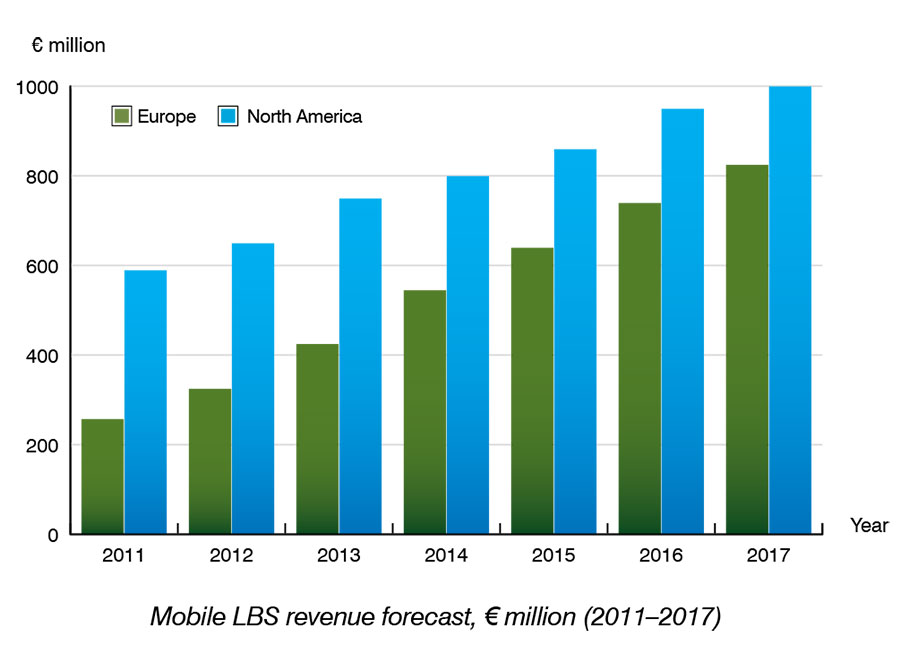
    According to a new research report by Berg Insight, mobile location-based service (LBS) revenues in Europe are forecast to grow from €325 million in 2012 at a compound annual growth rate (CAGR) of 20.5 percent to reach €825 million in 2017.

    The North American LBS market is forecast to grow at a CAGR of 9.2 percent from US $835 million in 2012 to reach US $1,295 million in 2017. Berg Insight estimates that 40 percent of all mobile subscribers in Europe use some kind of location-enhanced application on a regular basis. In North America, the larger installed base of GPS-enabled handsets and smartphones has enabled higher uptake of LBS.

    Berg Insight estimates that about 50 percent of all mobile subscribers in the region now access LBS at least monthly. Local search, social networking and navigation services are the top application categories in terms of number of active users. Mobile workforce management services that aim to improve operational efficiency for businesses are also gaining traction in new industry segments.Berg-LBS-report

    “Smartphones are the most important enabler for LBS adoption in general. The installed base of smartphones in Europe has now reached 45 percent of total handsets and already surpassed 55 percent in North America,” said André Malm, Senior Analyst, Berg Insight. He adds that besides differences in smartphone adoption, there are other regional differences. “Mobile operators still play a more central role in North America than in Europe, marketing branded services to both consumer and enterprise customers.”

    However, the operators’ central role in the LBS ecosystem is now being challenged by the smartphone ecosystems that bundle key LBS and give developers access to location data and distribution channels in the form of on-device app stores. Mobile operators are therefore showing renewed interest in offering network-based bulk location data for advertising and analytics, as well as new services such as secure authentication and fraud management.

    A brochure on the report can be downloaded here.

  • Report Looks at Indoor Location Positioning and Mobile Markets

    In December 2011, Grizzly Analytics released its first comprehensive report on indoor location positioning technology, predicting that indoor location services were ready to revolutionize the mobile market. The five months that followed have shown how true this was, with new initiatives announced on a regular basis and numerous demonstrations at industry conferences, Grizzly Analytics says.

    In a fully revised and updated 163-page report, Grizzly Analytics gives an up-to-date analysis and comprehensive overview of indoor location positioning R&D. Included is information on the research activity of all the major mobile companies — Google, Microsoft, Samsung, Apple, Nokia, RIM, Cisco, Qualcomm, Broadcom, STMicroElectronics, Sony Ericsson and others — and also more than 30 start-up companies that are actively bringing indoor location services to market.

    “These technologies are poised to revolutionize smartphone usage by enabling GPS-style mapping, navigation, local search, check-ins, location-sharing and other location-based services to work indoors in malls, megastores, offices, airports, casinos and other big indoor places,” according to a statement by Grizzly Analytics. “Indoor location will also transform commerce, enabling searching for items on store shelves, sending deals and promotions to nearby customers, advertisements for nearby stores in malls, and more. Location services are also entering the enterprise, with indoor asset tracking, employee search, and more.

    “In this updated technology trend report, Indoor Location Positioning: Research Pipelines, Start-ups and Predictions, Grizzly Analytics answers the questions you have about this new technology. What approaches are being researched by different companies? Which companies have mature research? What are the gaps in each company’s research that they are likely to fill by acquiring start-up companies? Which start-up companies are likely to be acquired or to emerge successful in the market? What areas of technology are not yet addressed by start-ups, and remain open to new entrepreneurs and investors?”

    A related report, Indoor Location Solutions and Services: Challenges, Opportunities and Market Outlook, is also available from Research and Markets.

  • Tablets and Cameras to Be Major GPS and LBS Markets by 2017

    Despite relatively stunted growth thus far, the tablet and camera markets are forecast to be the next major market for location-based services and GPS IC penetration.

    ABI Research’s latest Report, “Location Applications for Tablets, eReaders, Digital Cameras & Handheld Gaming,” forecasts the uptake of LBS and how it will affect the adoption of location technologies. The tablet market has largely been dominated by Apple and its GPS/Modem strategy. GPS shipments are forecast to reach 37 million in 2012, yet it is still much less than had been previously anticipated. There has been mixed news of late, with the launch of Google’s Nexus 7 and Apple’s iPad mini. Wi-Fi location is a standard feature across all major tablets and while it is complementary, it does act as a barrier to GPS integration.

    Senior analyst Patrick Connolly said, “When we look at the adoption of applications on tablets, it is forecast to largely mirror that of smartphones, with a focus on local search, social, enterprise, navigation, and ambient intelligence.” Android will lead the way, as ubiquitous location becomes a necessary component.

    The camera market has huge potential, with geotagging a clear driver. With more than 30 GPS-enabled cameras on the market, shipments are expected to break 10 million in 2013, and a second wave of new applications emerging around tracking, maps and points of interest, and dead-reckoning. As an industry, there needs to be a complete overhaul of how cameras are designed, to find a way to leverage the photography revolution occurring on smartphones. ABI Research has forecast that this will open the door to GPS, alternative location, and LBS in future.

    The launch of the Sony Vita was expected to kick-start the location-based gaming (LBG) industry, featuring Wi-Fi location as standard, and an optional GPS/modem module. Practice director Dominique Bonte said, “Irrespective of limited device sales, location-based gaming and community applications still have fundamental barriers concerning critical mass and where and how the device is used. As a result, LBG is expected to initially flourish on smartphones, with GPS forecast to remain subdued on gaming devices.”

    These findings are part of ABI Research’s Location Based Services which includes Research Reports, Market Data, and Insights.

  • Juniper: Augmented Reality Apps Could Mean $300M in 2013

    A new report from Juniper Research has found that with brands and retailers increasingly keen to deploy augmented reality (AR) capabilities within their apps and marketing materials, AR applications will generate close to $300 million in revenues globally in 2013.

    The report found that while the traditional pay-per-download payment model would continue to account for the largest share of revenues in the medium term, the scale of retailer engagement with AR suggested that ad spend had upscaled dramatically in 2012 and was poised for further strong growth next year.

    Crucially, it also found that many retailers now perceived AR as a key means of increasing engagement with consumers, both as a means of providing additional product information or in the form of branded virtual games and activities.

    Consumer Expectations Not Yet Met. The report cautioned that while lack of consumer awareness of AR remained a key hurdle which needed to be overcome, it was by no means the only barrier to growth. It argued that technological limitations of AR-enablers such as the phone camera, GPS, digital compasses and marker-less tracking meant that in many cases, the AR experience was failing to live up to consumer expectations.

    The report claimed that even some higher-end smartphone cameras lacked sufficient sensitivity to trigger an AR experience unless light conditions were optimal. Furthermore, the need to recalibrate digital compasses — allied to poor in-building functionality of GPS – means that under certain circumstances the level of location accuracy would not be sufficient for many potential corporate applications. As a result, the report stated that enterprise adoption would be limited in the medium term.

    Other key findings from the report include:

    • More than 2.5 billion AR apps to be downloaded to smartphones and tablets each year by 2017, with games accounting for the largest share of downloads.
    • AR is increasingly being deployed in prototype wearable devices, with Google Glass the most high-profile innovation.

    The “Augmenting Reality: Enhancing Mobile” white paper is available to download from the Juniper website together with further details of the full study, “Mobile Augmented Reality: Entertainment, LBS & Retail Strategies 2012-2017.” Juniper Research provides research and analytical services to the global hi-tech communications sector, providing consultancy, analyst reports and industry commentary.

  • ABI Research: In-Car Nav Market Bottoms out at $22 Billion, New Services Key to Rebound

    ​The total in-car navigation market has been in continual decline for the last three years, but ABI Research believes it has now reached its lowest ebb. While pure navigation is unlikely to reach the highs of 2008 again, the overall market is reaching a revenue plateau, creating a solid platform on which connected in-car services can bring a new generation of revenue growth, the market research firm concluded.

    Senior analyst Patrick Connolly stated,” When we look at the decline from 2008 to 2011, there is a perfect storm of economic conditions, low-cost/free smartphone navigation, the decline of PNDs, and falling car sales. The market is forecast to reach a low of $22 billion this year, before fluctuating around the $22-$24 billion mark, as a new period of growth for factory-fitted solutions, coupled with smartphone solutions, will take in-car navigation towards saturation point in many regions by 2017.”

    Factory-fitted solutions will bring new revenue opportunities, especially for PND manufacturers, ABI Research said. But the real growth opportunity will be the additional revenues that in-car connectivity will bring. Companies are fighting for a near-30 million connected car platform market in 2017, with many of the winners and losers decided over the next two years.

    Practice director Dominique Bonte added, “The opportunity is there to leverage navigation, to bring a host of new services around driver performance, infotainment, car diagnostics, and insurance.”

    These findings are part of ABI Research’s GPS & GNSS Research Service, which includes additional Competitive Analyses, Vendor Matrices, Market Data, and Insights. In ABI Research’s quarterly service, “GPS&GNSS”, all forms of in-car navigation are considered, including factory fitted, aftermarket, PNDs, and smartphones.

  • GSA Releases 2012 SatNav Market Report

    The European GNSS Agency (GSA) has published its second Global Satellite Navigation System (GNSS) Market Report, providing key information to entrepreneurs in the satellite navigation sector.

    GNSS market forecasting is of great interest to private and public GNSS stakeholders, for business and strategic planning and policymaking, according to the GSA. According to the 2012 GSA Market Monitoring Report, the worldwide GNSS market is growing fast and the total market size is expected to increase at an average of 13 percent per year until 2016.

    The total enabled GNSS market size is expected to stabilise in the latter half of the decade due to market saturation, price erosion and platform convergence. Global shipments of GNSS devices are lower than previously forecasted up until 2015 yet are forecasted to continue growing to over 1.1 billion units per year.

    Expanding coverage. Following up on the first GNSS Market Report published in 2010, the GSA’s 2012 Report includes an analysis of two new sectors: maritime and surveying. Relevant examples from EU research projects have also been included for each sector.

    2012 Report Highlights

    Road and location-based services (LBS) still in the lead. Road and LBS dominate GNSS device sales (54% and 44% respectively). LBS constitutes 87% of the total GNSS market in terms of units sold and GNSS penetration in smartphones is set to increase from 30% today to almost 100% in 2020. For road navigation, traditional Personal Navigation Devices (PNDs) will gradually disappear from the European market yet remain present in other regions in the form of low cost OEM products. Smartphones and in-vehicle devices will be the preferred means of navigation.

    Commercial aviation use will grow. In the Aviation sector, the segment that will see the greatest growth in terms of GNSS equipment revenues will be Commercial Aviation, surpassing general and business aviation by 2018.

    GNSS use in agriculture continues to rise. In agriculture the current positive growth trend will continue; low cost precision agriculture solutions based on EGNOS are driving GNSS adoption by farmers in Europe.

    Surveying: a growing opportunity. In surveying, the construction segment is dominating the market in terms of units and value. North America is leading in terms of market penetration but the other regions will catch up by 2020 as GNSS is rapidly replacing the traditional surveying and mapping methods in Europe and around the world.

    Safer seas with GNSS. In the open sea segment, shipments of search-and-rescue (SAR) beacons will exceed those of other categories making the SAR segment the largest in terms of shipments and second largest in terms of market size.

    The 2012 GSA Market Monitoring Report can be downloaded for free.

  • The Economics of Disruption: $96 Billion Annually at Risk

    The Economics of Disruption: $96 Billion Annually at Risk

    The Economic Benefits of Commercial GPS Use in the United States and the Costs of Potential Disruption” was presented by Nam D. Pham, Ph.D., of NDP Consulting, during a June 21 webinar sponsored by the Coalition to Save Our GPS.

    The author stated that his study concentrated on GPS use in precision agriculture, construction, and surveying. It explicitly does not encompass GPS use in aviation, nor in the consumer sector, nor in timing or financial infrastructure.

    The report states: “The direct economic benefits of GPS technology on commercial GPS users are estimated to be over $67.6 billion per year in the United States. In addition, GPS technology creates direct and indirect positive spillover effects, such as emission reductions from fuel savings, health and safety gains in the work place, time savings, job creation, higher tax revenues, and improved public safety and national defense. Today, there are more than 3.3 million jobs that rely on GPS technology, including approximately 130,000 jobs in GPS manufacturing industries and 3.2 million in the downstream commercial GPS-intensive industries. The commercial GPS adoption rate is growing and expected to continue growing across industries as high financial returns have been demonstrated. Consequently, GPS technology will create $122.4 billion benefits per year and will directly affect more than 5.8 million jobs in the downstream commercial GPS-intensive industries when penetration of GPS technology reaches 100 percent.

    Further, “the GPS industry directly creates jobs and economic activities, which spur economic growth. Evidence shows that innovative industries, such as the GPS industry, create both high- and low-skilled jobs during economic expansions and downturns, pay their employees higher-than-national-average wages, raise output and sales per employee, increase U.S. competitiveness, which is reflected in increased exports and reduced U.S. trade deficits, and spend large sums on R&D and capital investment. In addition to creating these direct economic benefits, innovative industries create productivity benefits to the downstream industries, including increased sales, profits, and investment returns. Empirical studies have shown sustained productivity benefits support further growth and job creation in downstream industries and the U.S. economy as a whole.”

    Finally, “The direct economic costs of full GPS disruption to commercial GPS users and GPS manufacturers are estimated to be $96 billion per year in the United States, the equivalent of 0.7 percent of the U.S. economy. This annual total cost is the sum of $87.2 billion and $8.8 billion imposed on commercial GPS users and commercial GPS manufacturers, respectively. GPS user costs consist of $67.6 billion per year in foregone GPS benefits — increased productivity and input cost savings — and another $19.6 billion book value of investment losses in GPS equipment. GPS manufacturer costs consist of $8.3 billion per year in foregone commercial GPS equipment sales and an additional $0.55 billion per year in R&D spending and associated costs to attempt to mitigate the so-called LightSquared Problem.Systemn

    “If the operation of LightSquared will disrupt 50 percent of commercial GPS equipment, the direct economic impacts are expected to be $48.3 billion per year. Except the R&D spending and the opportunity cost of R&D spending performed by GPS manufacturers to find attempt to mitigate interference, direct economic costs to commercial GPS users and foregone GPS equipment sales are assumed to be half of total direct costs under the scenario of 100 percent degradation. In addition to direct economic impacts, there are other forgone direct and indirect economic and social benefits that are threatened by the LightSquared Problem. On the macroeconomic level, GPS disruption would reduce productivity and, consequently, hinder the competitiveness of GPS downstream users.”

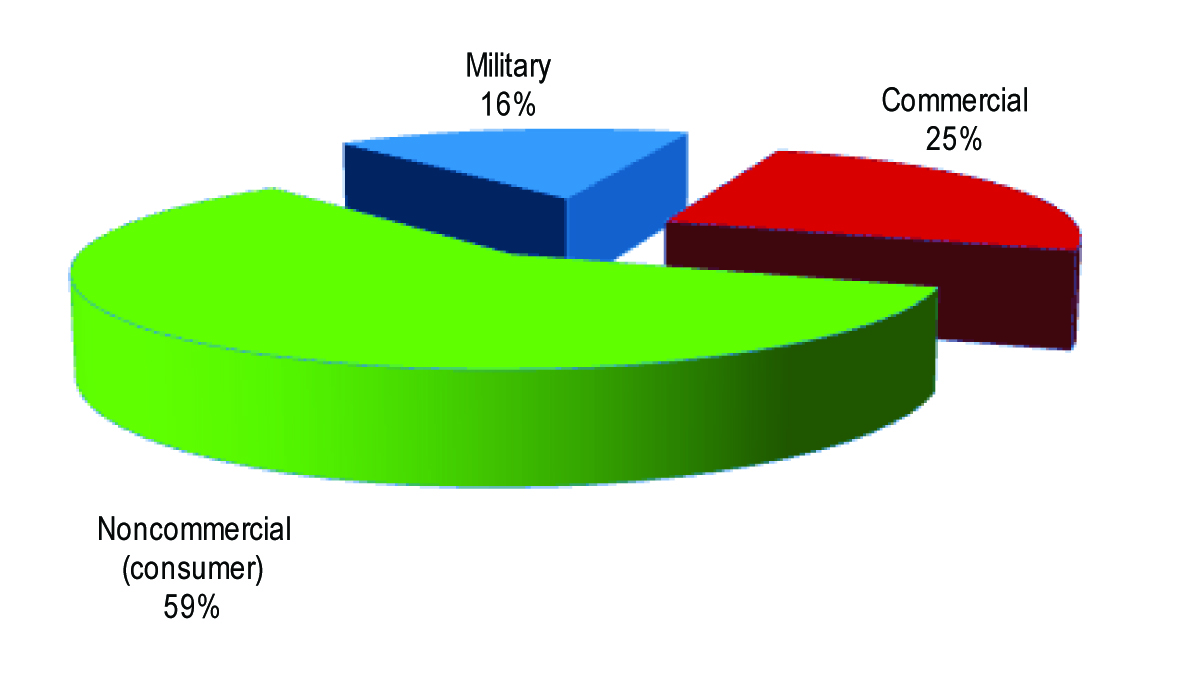
    figure1
    Figure 1. Revenue shares of GPS equipment in North America, 2005–2010, according to Bone, Dominique and Stuart Carlaw, 2009, “Global Navigation Satellite Positioning Solutions,” ABI Research; and authors’ estimates.


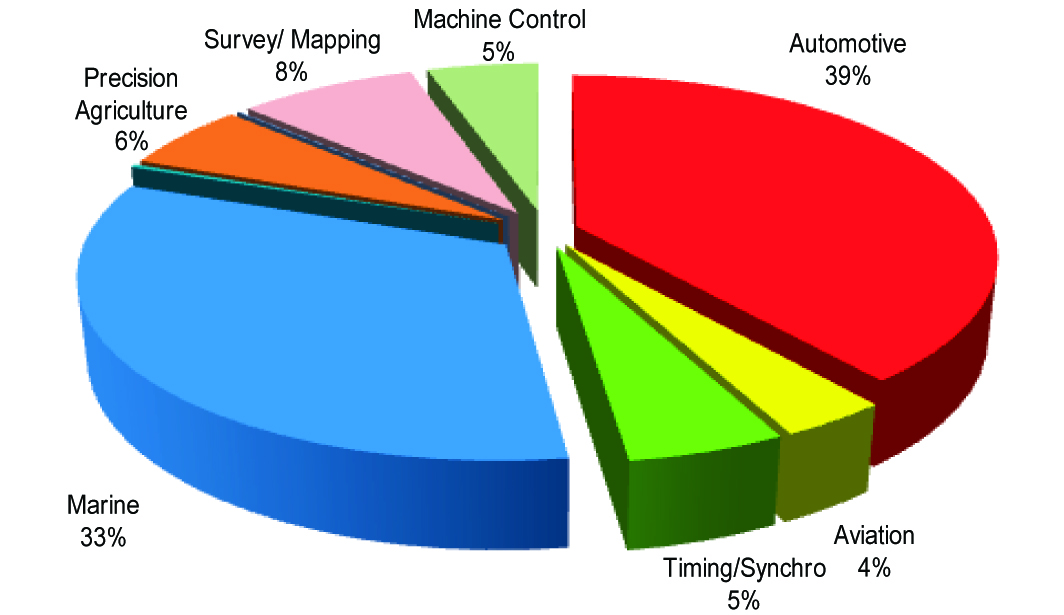
    figure2
    Figure 2. Commercial GPS equipment revenues in North America, 2005–2010, according to Bone, Dominique and Stuart Carlaw, 2009, “Global Navigation Satellite Positioning Solutions,” ABI Research; and authors’ estimates.


  • GSA Releases First GNSS Market Monitoring Report

    The European GNSS Agency (GSA) has published a 2010 GNSS Market Monitoring report, providing key information in support of entrepreneurship in the satellite navigation sector.

    GNSS market forecasting is of great interest to private and public GNSS stakeholders, for business and strategic planning and policymaking, said the GSA. According to the new report, the market for GNSS will grow significantly over the next decade, at a compound annual growth rate (CAGR) of 11 percent, reaching €165 billion for the core GNSS market in 2020. Delivery of GNSS devices will exceed one billion per year by 2020.

    “This Report confirms that the market potential of GNSS is significant,” said Gian Gherardo Calini, head of the GSA Market Development Department. “The information should be useful to researchers, market players and decision makers who want to grasp the GNSS market opportunities today and tomorrow.”

    Report Highlights

    Road leads the way: The report shows that the road transport sector is still the leading GNSS segment, accounting for more than 50% of market share. The penetration of receivers in road vehicles, today at 30%, will exceed 80% over the next decade. However, after a period of fast growth, market saturation and competition in the form of ‘smartphones’, often equipped with free navigation capabilities, have resulted in a slowdown in the car-based navigation market.

    Price erosion has been high, driven by declining costs and strong competition. Vendors are using innovation as a differentiator resulting in ‘converged’ products with both communication and multimedia functionalities. Some Personal Navigation Device (PND) vendors are also tapping into new distribution channels, including car dealerships and smartphone application stores.

    GNSS for road transport: The road transport sector is facing major challenges, such as the demand for increasing safety and for reduced congestion and pollution. These problems are particularly acute in highly populated zones, including big cities and suburban areas. GNSS represents a powerful tool for improving road transport. Not only does it help get drivers where they want to go more quickly and efficiently, but it also promises fairer road-pricing schemes, for example, to automatically charge drivers for the use of road infrastructure.

    GNSS in your hands. Mobile location-based services (LBS) are taking off as progress is being made in different areas. More and more mobile phones now have GNSS capabilities, the result of both increasing consumer and developer awareness and an improvement in navigation services and performance.

    All major mobile phone operating system vendors now provide application programming interfaces (API) with location functions. In 2009, in the UK, France and Germany, 5 out of the 10 best-selling iPhone applications were related to navigation or location-based applications. Also, 30% of Android developers’ contest winners used location capabilities in their applications.

    A promising future for location-based services.
    The integration of accurate hand-held positioning signal receivers, within mobile telephones, personal digital assistants (PDAs), mp3 players, portable computers, even digital cameras and video devices, brings GNSS services directly to individuals, making possible a fundamental transformation of the way we work and play. The penetration of GNSS in mobile phones is therefore expected to increase very quickly, from some 20% today to above 50% within the next five years.

    The GSA says Galileo in the future and EGNOS today open up new and exciting prospects for economic growth, benefiting citizens, businesses and governments throughout the EU and beyond.

    Just the beginning. The GSA underlines that the GNSS Market Monitoring process is ongoing and future reports are planned to update information presented in this first report and to cover other sectors. The Agency welcomes stakeholder contributions.

    The 2010 GSA Market Monitoring Report can be downloaded free.