Tag: navigation

  • Prime Meridian on the move

    Pre-GPS techniques actually responsible for the Greenwich shift

    By Stephen Malys, John H. Seago , Nikolaos K. Pavlis, P. Kenneth Seidelmann and George H. Kaplan

    The historical prime meridian runs through a telescope established in 1851 by Sir George Airy at the Royal Observatory at Greenwich, England. It was adopted as an international standard as the prime meridian for zero longitude in 1884 during the International Meridian Conference held in Washington, D.C.

    The observatory’s line in the pavement is a major tourist attraction, but the prime meridian used by satellite navigation systems is located 102 meters east of that historic location (see Figure 1).

    Some people mistakenly thought that GPS, or the earlier Navy Navigation Satellite System (Transit), was responsible for this offset. But research, recently published in the Journal of Geodesy, concludes that the zero longitude used by GPS arrived at its current location in 1984, before GPS existed as an operational system.

    The orientation of the World Geodetic System 1984 (WGS 84), and therefore the direction of the prime meridian associated with WGS 84, was established when the U.S. Defense Mapping Agency (now part of the National Geospatial-Intelligence Agency) adopted the orientation of an international scientific standard known as BTS 84, the BIH Terrestrial System 1984.

    The Bureau International de l’Heure (BIH) was a predecessor to the International Earth Rotation and Reference Systems Service (IERS). Unlike previous terrestrial systems of reference used by the BIH, the BTS 84 was not established by tracking stars with optical telescopes.

    BTS 84. BTS 84 was created using geodetic techniques known as satellite laser ranging, lunar laser ranging and very long baseline interferometry. While satellite Doppler tracking (Transit) data was included in the BIH process, this data type did not contribute to or constrain the orientation of BTS 84.

    When an optical instrument is leveled, even to the highest accuracy achievable, its orientation is controlled by the gravity field’s vertical direction at that particular location.

    The astronomical zenith, or “up” direction realized by a telescope, is perpendicular to the gravity equipotential (level) surface locally, and therefore is in general deflected from the geodetic zenith that is perpendicular to our best-fitting global ellipsoid model of the Earth due to small irregularities of the gravity field (hence the term deflection of the vertical, DoV).

    As a consequence, the astronomical meridian plane at an arbitrary location on the Earth does not necessarily contain the center of mass of the Earth (FIGURE 2).
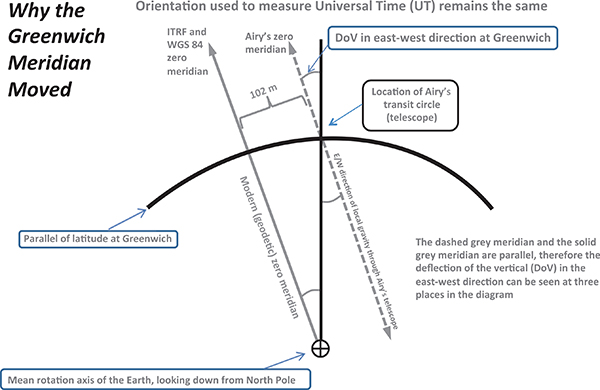
    FIGURE 2. Geometry showing why the Greenwich meridian moved.  Source: Stephen Malys, John H. Seago , Nikolaos K. Pavlis, P. Kenneth Seidelmann and George H. Kaplan
    FIGURE 2. Geometry showing why the Greenwich meridian moved.

    Astronomical Time. When optical systems were finally retired from Earth-orientation service by the BIH in 1984, the BIH continued the measurement series for Earth’s rotation by modern geodetic techniques, but required continuity in the determinations. These measurements included those for astronomical time, UT1.

    Requiring continuity in UT1 was equivalent to requiring that the plane of the prime meridian keep its orientation, relative to the celestial sphere, as a function of time. But now — for the first time — there was also a requirement to pass this plane through the center of mass of the Earth.That requirement, along with the DoV at Greenwich, moved the trace of the prime meridian on the Earth’s surface in the vicinity of Greenwich by 102 meters to the east of Airy’s telescope (Figure 2).

    Journey to the Center of the Earth.Thanks to satellite-tracking techniques, we now know the location of the center of mass of the Earth with an accuracy of about 1 centimeter in three dimensions — about the size of a U.S. dime.

    In 1984, its location was known with an accuracy of about 1 meter. When Airy set up his special telescope (called a transit circle), knowledge of the size, shape and center of mass of the Earth was limited to several hundred meters.

    The trace of the historical astronomical prime meridian established by Airy’s instrument, and the location of zero longitude indicated by GPS receivers, are both consistent with their own conventions, and their offset from each other does not imply an error in either determination.


    Stephen Malys and Nikolaos K. Pavlis work for the National Geospatial-Intelligence Agency.

    John H. Seago is with Analytical Graphics, Inc.

    P. Kenneth Seidelmann is a member of the Astronomy Department, University of Virginia.

    George H. Kaplan is a contractor with the United States Naval Observatory.
  • Volvo goes HERE


    Volvo Cars has chosen HERE to power connected navigation for the next-generation in-car control system for new and future Volvo models as part of a multi-year agreement between the two companies.

    Volvo’s in-car system, Sensus, offers customers a fully connected experience and incorporates advanced maps and services enabled by the HERE location cloud to provide drivers with smart guidance in and out of the car.

    The first model featuring the new Sensus system is the XC90, Volvo’s luxury SUV that started shipping earlier this year.


  • Second Toulouse Symposium on Navigation and Timing Planned

    The Ecole Nationale de l’Aviation Civile (ENAC) and the French Space Agency’s “Satellite Positioning and Timing” Technical Skills Community (CNES CCT PDS) will hold the second edition of the International Technical Symposium on Navigation and Timing on Nov. 16-17, 2015, at the ENAC premises in Toulouse, France.

    The event is based on the following key elements:

    • Technical presentations on hot topics related to navigation and timing.
    • All presentations given by invited international guest speakers recognized worldwide for their expertise.
    • Round tables to facilitate discussions between the audience and the guest speakers.

    Registration to this symposium is free of charge. The number of seats is limited, so register as early as possible.

    Program

    This year, the symposium is composed of three sessions: “Positioning in Challenging Environments” , “GNSS Signals and System Design” and “Air Navigation.”

    Invited guest speakers are:

    Martin Haueis – Head of Localisation and Data Management, Daimler AG, Germany
    Christopher J. Hegarty – Director for CNS Engineering and Spectrum, MITRE Corporation, USA
    Mikael Mabilleau – Navigation Services Manager, Egis Avia, France
    Mitch Narins (Invited) – Chief Systems Engineer for Navigation Programs, Federal Aviation Authority, USA
    Oscar Pozzobon – Founder and Technical Director, Qascom, Italy
    Mark L. Psiaki – Professor, Cornell University, USA
    John F. Raquet – Director of the Autonomy and Navigation Technology (ANT) Center, US Air Force Institute of Technology, USA
    Lionel Ries – Head of the Navigation/Location Signals Dept, CNES, France
    Francis Soualle – Navigation System Engineer, Airbus Defence and Space, Germany
    Morton Stakkeland – Development Engineer, Indra Navia, Norway
    A. J. Van Dierendonck – AJ Systems, USA
    Lauri Wirola – System Architect, HERE, Finland
    Zheng Yao – Ass. Professor, Tsinghua University, China

    The full program can be downloaded.

    For more information, including preferred hotels and directions to come to ENAC, visit the event website.

  • ION Co-Locates ITM, PTTI Conferences for 2016

    Two of the Institute of Navigation’s (ION’s) conferences — the International Technical Meeting (ITM) and the Precise Time and Time Interval (PTTI) Meeting — will be co-located for 2016. One registration fee gives attendees access to both technical events and a commercial exhibit. The co-located conferences will take place Jan. 25-28, 2016, at the Hyatt Regency Monterey in Monterey, Calif.

    Abstracts are due Oct. 2, 2015. Submission requirements have changed, and depend on the session the abstract is submitted for. Review the call for abstracts for more information.

    This year’s joint ITM/PTTI Plenary Session is “Autonomous Vehicles – Beyond the Navigation Technology.” The session will address issues outside of navigation technology, including legal issues, regulatory challenges, transitional periods, markets enabled by autonomous operation and similar topics beyond the core navigation technology.

    ITM is ION’s winter meeting, which features peer-reviewed technical papers related to positioning, navigation and timing, and includes the ION Fellows and Annual Awards presentations.

    PTTI is the annual technical conference designed to disseminate and coordinate PTTI information at the user level, review present and future PTTI requirements, inform government and industry engineers, technicians and managers regarding precise time and frequency technology and its problems, and provide an opportunity for an active exchange of new technology associated with PTTI.

    The co-located 2016 ITM and PTTI meetings will feature a technical exhibit and showcase of products and services related to positioning, navigation and timing. For more information on exhibiting, contact ION or go to www.ion.org.

  • OriginGPS Unveils Multi-GNSS Module with Antenna for Wearables

    OriginGPS Unveils Multi-GNSS Module with Antenna for Wearables

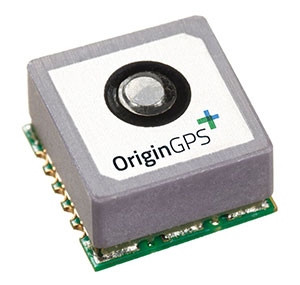
    The Multi Micro Hornet by OriginGPS was designed small with wearables in mind.
    The Multi Micro Hornet by OriginGPS was designed small with wearables in mind.

    OriginGPS has launched the Multi Micro Hornet, a tiny fully integrated multiple constellation antenna module. The innovative architecture packs functionality and high-quality components in a small space to improve wearables’ fashion and function, the company said.

    “A recent study by the European Global Navigation Satellite Systems Agency (GSA) showed that multi-constellation is becoming a standard feature in today’s user equipment,” said Gal Jacobi, CEO of OriginGPS. “Developers of wearables need modules with these features in the smallest size possible to be competitive in a market the GSA predicts will reach 14 million by 2023.”

    GPS World reported on the GSA market report in its April issue, and held a webinar on the report on April 16, which can be viewed for free.

    The Multi Micro Hornet is designed for devices that require a small form factor, low power consumption, and high sensitivity. In keeping with the company’s “Mini + Mighty” corporate mantra, OriginGPS has reduced the total volume in size by over 68 percent of other GNSS antenna modules without sacrificing performance, the company claims.

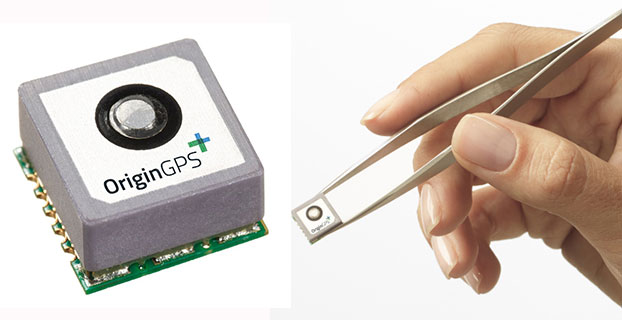
    The Multi Micro Hornet by OriginGPS.
    The Multi Micro Hornet by OriginGPS.

    The Multi Micro Hornet has features that will improve the navigation experience of wearables and other Internet of Things devices, including:

    • Small size, high performance: Despite its miniature outline of 10 x 10 mm and height of 5.9 mm, the Multi Micro Hornet module offers superior sensitivity and outstanding performance, achieving rapid Time To First Fix (TTFF) of less than one second, accuracy within as little as one meter, and sensitivity at -165 dBm by tracking both GPS and GLONASS constellations simultaneously.
    • High sensitivity and noise immunity: The Multi Micro Hornet continues to leverage OriginGPS’ patented and proprietary Noise Free Zone NFZ technology to ensure high sensitivity and noise immunity even under marginal signal conditions.
    • Reduced power consumption without compromising connectivity: It detects changes in context, temperature, and satellite signals to achieve a state of near continuous availability. By opportunistically updating its internal fine time, frequency and satellite ephemeris data, the Multi Micro Hornet is able to stay connected while consuming mere microwatts of battery power.
    • An intelligent design that shortens time to market: The Hornet family of GPS / GNSS antenna modules integrates a GNSS receiver and patch antenna in a single module. As a cornerstone of the OriginGPS portfolio, the Multi Micro Hornet’s pin-to-pin compatibility with the Micro and Nano Hornet modules ensures a seamless migration from GPS to GNSS and gives developers the ability to create new product offerings in the shortest time to market while minimizing costly design risks. Developers can connect it to a power source on a single layer PCB and be off and running.

    Additionally, the Multi Micro Hornet module combines OriginGPS’ proprietary low-profile GPS+GLONASS antenna with a dual-stage LNA, RF LDO, SAW filter, TCXO, RTC crystal and RF shield with SiRFstarV GNSS system on chip.

  • Spectracom Shows Off Rugged Product Line at AUVSI Show

    Spectracom displayed its precise positioning, navigation and timing solutions that leverage GPS/GNSS signals while at Unmanned Systems 2015, held May 4-7 in Atlanta. Capabilities for unmanned aerial systems (UAS) include precision references, signal generation, reception, synchronization, distribution, test/validation, simulation, integration, interference, detection/mitigation, real-time embedded and technical/support services.

  • New Report on Global Military GPS/GNSS Market Looks at Next Decade

    Reportstack has announced a new report on The Global Military GPS/GNSS Market 2013-2023.  This report offers the reader detailed analysis of the global military GPS/GNSS  market over the next 10 years, alongside potential market opportunities to enter the industry, using detailed market size forecasts, Reportstack said.

    A satellite navigation system provides GPS positioning from a global perspective, and is therefore of utmost importance for modern-day military operations, which rely on accurate real-time data on hostile forces in order to carry out precision attacks, Reportstack said. It is here that GPS/GNSS devices assume an important role, as they are imperative to transfer signals from these satellites back to earth.

    The U.S. is the highest spender on military GPS/GNSS navigation, and is responsible for 42.9% of the global military GNSS devices market. Others major spenders in this sector include Russia, the UK, China and India. In July 2013, India launched the IRNSS-1A, the first of seven satellite constellation to be deployed under the Indian Regional Navigation Satellite System (IRNSS) program to be completed between 2015-2016. And China’s BeiDou is scheduled to be operational by 2020.

    Another factor driving the market is the integration of satellite navigation technology with other navigation systems, such as the inertial navigation system (INS) and gyro, as GPS devices are to be used in order to decipher data correctly, Reportstack said.

    The increasing demand for satellite navigation and communications is driven primarily by the desire of militaries to monitor more areas and derive accurate information by a range of GNSS receivers/sensors in the shortest time possible. Major military aircraft and helicopters are dependent on GPS embedded INS systems for effective navigation. Similarly, naval vessels and guided munitions are increasingly relying on the collaboration of laser, gyro, INS, and satellite navigation technologies to derive accurate real time data.

    Furthermore, it has been observed that the usage of standard positioning services/open service receivers, which use unencrypted signal for non-combat purposes has increased, and is expected to drive demand and encourage expenditure, Reportstack said. The military GPS/GNSS technology is expanding its horizon beyond the basic characteristics of navigation and tracking. The use of GPS, in conjunction with a number of software applications, has expanded its use in military operations. A number of new technologies are now embedded with GPS receivers to produce a more sophisticated military tool.

    Recently, a Swiss-based company developed a device called GPS Log Book based on u-blox technology. The new device has extended the scope of GPS technology to the administrative side of military operations. It provides an easy way for military drivers to automatically keep an accurate travel log book which can be securely accessed later from anywhere via a web interface. Information logged includes route, speed, and distance traveled. It also keeps a close record of fuel used by the vehicle, based on the distance traveled at various speed levels.

    The advent of Differential GPS (DGPS), an enhancement to GPS, which provides improved location accuracy, from the 15-meter nominal GPS accuracy to approximately 10 cm, has further expanded the scope of GPS in missile technology. The intercontinental ballistic missiles, which are capable of hitting targets across thousands of miles navigation, use inertial navigation with DGPS receivers. The advent of DGPS is expected to be one of the most significant steps in accurate missile targeting for militaries across regions.

    The companies mentioned in this report are Northrop Grumman, Raytheon, Rockwell Collins , Lockheed Martin, ITT Exelis, Thales, and BAE Systems. More details and table of contents about this report can be found by visiting The Global Military GPS/GNSS Market 2013-2023 report.

  • ORBCOMM, Savi Announce Strategic LBS Partnership

    ORBCOMM Inc., and Savi Technology have announced a strategic relationship to provide advanced location-based monitoring solutions to government and commercial markets.

    ORBCOMM is a global provider of machine-to-machine (M2M) solutions, and Savi Technology is a provider of sensor-based analytics and radio-frequency identification (RFID) solutions.

    ORBCOMM and Savi have submitted a proposal in response to the U.S. Army RFID IV project, which will provide both ISO18000-7 RFID tags and a suite of satellite solutions for military logistics support. ORBCOMM’s GlobalTrak division has been a leading player in providing military Enhanced-In-Transit-Visibility (EITV) solutions to the government market since 2008, and Savi has been a market leader in military RFID solutions, enabling it to offer vast market experience with the right blend of technology platforms for this proposal.

    “The combination of ORBCOMM’s satellite expertise and broad network service portfolio with Savi’s state-of-the-art RFID technology offers a full spectrum of innovative monitoring solutions to our collective market base with focus on our government and international customers,” said Marc Eisenberg, Chief Executive Officer of ORBCOMM. “Although RFID and satellite tracking have traditionally been divergent technologies, the synergy of these solutions within a common operating environment creates a seamless transition from infrastructure to wireless-based location services for tracking and monitoring high-value assets.”

    “By bringing two market leaders with highly complementary technologies together, we have created a best-of-breed solution for our customers in both government and commercial markets,” said Bill Clark, chief executive officer of Savi Technology. “This relationship will support Savi’s operational analytics capabilities by providing additional ways to collect critical data and deliver timely and reliable operational intelligence to our customers. We look forward to partnering with ORBCOMM on RFID IV and other global opportunities in the near future.”

  • UK Switches on eLoran for Backup in the English Channel

    The General Lighthouse Authorities of the UK and Ireland (GLA) have announced that ships in the Port of Dover, its approaches and part of the Dover Strait can now use eLoran radio navigation technology as a backup to satnav systems like GPS and Galileo. What is considered the world’s busiest shipping route is the first to deploy eLoran to counter jammers and space weather, the GLA said in a statement.

    The ground-based eLoran system provides alternative position and timing signals for improved navigational safety. The Dover area, the world’s busiest shipping lane, is the first in the world to achieve this initial operational capability (IOC) for shipping companies operating both passenger and cargo services.

    Today’s announcement represents the first of up to seven eLoran installations to be implemented along the East Coast of the United Kingdom. The Thames Estuary and approaches up to Tilbury, the Humber Estuary and approaches, and the ports of Middlesbrough, Grangemouth and Aberdeen will all benefit from new installations, and the prototype service at Harwich and Felixstowe will be upgraded, the GLA said.

    Although primarily intended as a maritime aid to navigation, eLoran could become a cost-effective backup for a wide range of applications that are becoming increasingly reliant on the position and timing information provided by satellite systems.

    “Our primary concern at the GLA is for the safety of mariners,” said Captain Ian McNaught, Chief Executive of Trinity House. “But signals from eLoran transmitters could also provide essential backup to telecommunications, smart grid and high frequency trading systems vulnerable to jamming by natural or deliberate means. We encourage ship owners and mariners to assess eLoran in this region and provide feedback to the GLA on its performance.”

    P&O Ferries has installed an eLoran receiver on its new vessel Spirit of Britain. She will be based at Dover and is one of the largest passenger ships the busy Dover/Calais route has ever seen.

    “Accurate real-time positional information is essential for the safe navigation of ships with modern electronic charts,” Captain Simon Richardson, head of Safety Management at P&O Ferries, said. “Satellite navigation systems are vulnerable to degradation of signal strength and our ships have also experienced occasional loss of signal. We welcome the development of a robust alternative to provide redundancy in real-time positional information and we see eLoran as the most effective solution to countering the problem.”

    Commenting on the announcement Stephen Hammond, Minister for Shipping, said, “I congratulate the General Lighthouse Authorities on this initiative that seeks to improve navigational safety in what is the busiest shipping channel in the world, through the development and deployment of technology. I look forward to receiving reports of its effectiveness.”

  • Magellan Truck GPS Navigator Helps Truckers Plan Routes, Drive Safely

    Magellan Truck GPS Navigator Helps Truckers Plan Routes, Drive Safely

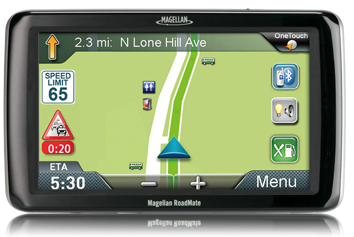
    Photo: MagellanMagellan, maker of innovative GPS devices for vehicles, outdoor and mobile navigation, today announced the newest addition to its Magellan RoadMate Commercial GPS family for truckers and commercial drivers providing improved safety and productivity before, during and after their on-the-road trips. The compliance-ready Magellan RoadMate Commercial 9270T-LM GPS device is specifically designed for the needs of truckers including an extra-large GPS display, customizable truck-specific routing, hands-free communication, and trip logging.

    To prepare for their trips, truck drivers can use the Magellan RoadMate Commercial 9270T-LM to set up customizable routes based on the height, weight, width, and length of the vehicle, as well as applicable hazmat restrictions. Multi-destination routing allows drivers to plan their stops and optimize routes to help them save time and gas, Magellan said.

    While on-the-road, the Magellan RoadMate Commercial 9270T-LM helps drivers navigate on an extra-wide 7-inch high-definition touchscreen display that adjusts color and contrast for easy night-viewing. The large display also makes maps and other content easy to read when the GPS Navigator is mounted in large vehicles with deep dashboards. The integrated Bluetooth wireless technology, when paired with a compatible Bluetooth phone, enables drivers to safely talk hands-free while keeping their eyes on the road.

    At the end of their trip, the Magellan RoadMate Commercial 9270T-LM facilitates preparing required compliance reports including hours and state mileage for IFTA fuel records. A comprehensive log of trip information by each driver is retained in the Magellan GPS device for easy exporting into reports.

    “We expanded our family of Magellan RoadMate Commercial GPS Navigators to further meet the unique navigation needs of commercial and truck drivers who need a comprehensive solution to efficiently perform their jobs from the initial trip planning stage to their on-the-road requirements and managing required log reporting after their trip,” said Stig Pedersen, Associate Vice President of Product Management for Magellan. “The Magellan RoadMate Commercial series of GPS Navigators are designed to make drivers’ jobs safer and less stressful plus improve productivity, reduce costs and ultimately increase profits.”

    The Magellan RoadMate Commercial 9270T-LM functions as an “information dashboard” that not only navigates, but provides elevation and truck speed limit warnings. The 9270T-LM GPS device includes several valuable safety and convenience features:

    • Highway Lane Assist that shows realistic highway signs and guides truck drivers towards the correct lane when approaching complex highway interchanges and exits;
    • Free Lifetime Traffic Alerts that help drivers avoid traffic incidents on their route by offering an alternative solution;
    • Spoken Street Name guidance that announces the street name and gives turn-by-turn directions;
    • Highway Exit Points-of-Interest and a Truck Stop Directory help drivers find services including gas stations, restaurants, ATMs, rest areas and showers, truck services, Wi-Fi availability;
    • OneTouch lets truckers bookmark and assign a button to their favorite destinations or searches for faster access;
    • Heavy-duty extended windshield mount, designed for deep dashboards, is included to provide fully-adjustable, personalized comfort and safe viewing;
    • An A/V input for easy connection to external devices such as the Magellan Wireless Back-up Camera or a DVD player;
    • Free downloadable Lifetime Map Updates keep the pre-loaded maps of the United States, Canada and Puerto Rico up-to-date.

    The Magellan RoadMate Commercial GPS family now includes two models — the new 7-inch Magellan RoadMate Commercial 9270T-LM ($399.99 MSRP) and the 5-inch Magellan RoadMate Commercial 5190T ($379.99 MSRP). Both models are available in June at truck stops and through Magellan’s consumer electronics and online partners.

  • Galileo Masters Competition Seeks Innovative Satellite Nav Applications

    The European Satellite Navigation Competition (ESNC) — also known as the Galileo Masters — is looking for applications based on satellite navigation that use the technology in a new and innovative way. The deadline for entering is June 30.

    No matter whether you are an individual or a team from a company, research institute, university, or start-up, what counts is your idea, say organizers.

    The competition began in 2004 with three partner regions. Since then, the ESNC has grown into a global network of innovation and expertise, say organizers. In 2010, 23 regions competed against one another, 548 participants registered, and the 357 ideas turned in were evaluated by 186 experts. Many of the ideas submitted in previous years have been implemented and successfully launched into the market, according to the Galileo Masters team: "The key to our success is close collaboration with regional, institutional, and industrial partners with whom we share one common goal: promoting innovation and entrepreneurial spirit on Europe’s GNSS markets."

    Ideas can be submitted via an online form.

    The ESNC 2011 offers special topic prizes:

    New regions to enter the competition this year include Catalonia, Estonia, Latvia, Macedonia, and Medjimurje.

    The ESNC International Kick-Off Conference will be held on May 11 and is hosted by the Institute of Engineering and Technology (IET) in London.