Tag: Nearmap

  • Aerial imagery assists telecom service providers

    Providing high-speed internet access to businesses and residences is a highly active and expanding field. It closely involves geographic information systems (GIS) to efficiently achieve fiber to the home (FTTH) or fiber to the premises (FTTP), the installation and use of optical fiber from a central point directly to individual buildings such as residences, apartment buildings and businesses for high-speed internet access.

    A free webinar on Jan. 18 will cover — among several other related topics — the integration of high-accuracy aerial imagery into this process. David K. Nelson, GISP, a GIS manager in telecommunications for Black & Veatch, will make the presentation. It will be complemented by a talk on how to “Plan Virtually, Manage Efficiently with High-Definition (HD) Aerial Maps” by imagery provider Nearmap, and one on use of HD aerial imagery for city storm-water management.

    Photo: Black & Veatch
    David Nelson, GIS manager, telecom, for Black & Veatch

    Nelson is responsible for developing GIS solutions for projects with the Black & Veatch’s telecommunications division. With over 13 years of experience in public and private sectors, Nelson is a visionary for adopting and enabling geospatial technologies and location content that drive operational efficiency. His presentation will cover such topics as GIS-centric approach for all projects; file-based vs. data-based transition; geospatial archives of all data; and integration with other technology platforms.

    In a case study, he will take webinar attendees through a FTTH project design and execution example.

    Black & Veatch is an engineering, consulting and construction company with more than 100 offices worldwide, specializing in infrastructure development in power, oil and gas, water, telecommunications, government, mining, data centers, smart cities and banking and finance markets.
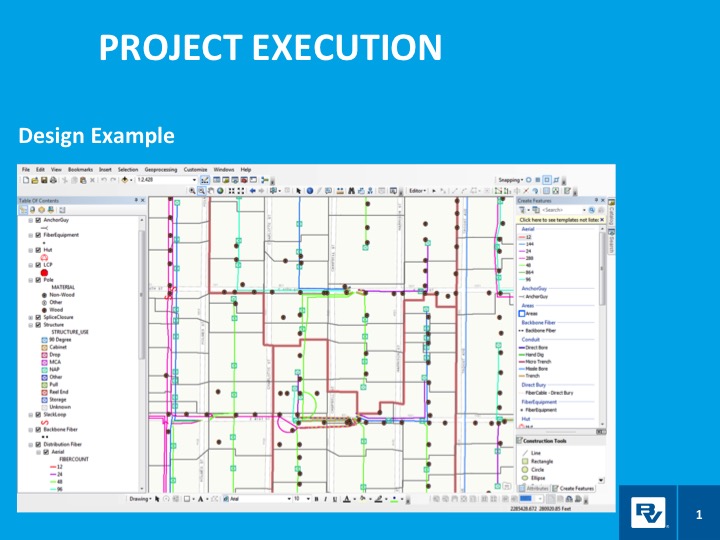
    FTTH project: fiber to the home. (Image: Black & Veatch)
    FTTH project: fiber to the home. (Image: Black & Veatch)

    The annual Black & Veatch Strategic Directions: Smart Cities & Utilities Report explores progress made across the smart city and smart utility landscape. This year’s report examines how modern, digital infrastructure is being used to optimize operations and create a sustainable future for our cities and utilities.

    “From urban mobility to the proliferation of electric vehicles, transportation is changing rapidly, inviting opportunity in how people and goods move across cities. The next generation of wireless technology is upon us, further encouraging connectivity and enabling smart cities in myriad ways. Grid modernization continues as utilities work to create a customer-centric grid through a combination of smart devices, distributed energy and communications.”

    Read more about the free webinar: “Truth on the Ground is Best Seen from the Air: How aerial imagery is propelling government and commercial organizations to higher levels of operational efficiency.”

    Advances in aerial imagery including high-resolution maps and a streamlined process to capture, manage and deliver imagery in the cloud is transforming the way governments and businesses operate. With Aerial photography and instant access to current 2.8-in. GSD aerial views, Black and Veatch has increased efficiency in their telecommunications projects including assessment of ground conditions, construction and asset management. In Indiana, The City of Carmel’s Engineering Department has applied aerial imagery to enhance planning, operations and storm water management.

    In this webinar, you will:

    • Learn about the latest advances in aerial imagery including how imagery is supporting a variety of government and business applications today
    • See real-world use cases of imagery in telecommunication, engineering and city government to improve operational efficiency
    • Understand how imagery can be used standalone and within GIS and CAD products
    • See the latest demos of Nearmap imagery including vertical, panorama and oblique views


  • High-quality aerial imagery brings city added $60K; webinar shows how

    Located in low, gently rolling hills just north of Indianapolis, Carmel, Indiana is one of the fastest-growing communities in the country. It has nearly tripled in population since 2000 and now numbers 91,000 inhabitants.

    Considering the growth expected for 2017 and 2018, the City of Carmel needed a visual tool better able to manage the city’s expansion projects across several government departments.

    After years of using low-resolution aerial imagery provided by the county, the City of Carmel realized it needed something better for analyzing and displaying accurate information.

    The Carmel Storm Water Department turned to Nearmap to provide high-quality aerial images that are frequently updated to integrate with its existing applications, including ArcMap and ArcGIS.

    Nearmap now supplies the city with high-resolution imagery that aids data accuracy, verifies customer claims, educates developers, enforces compliance, and prepares presentations for internal government meetings. As an unexpected bonus, since implementing Nearmap, the department has collected $60,000 more in revenue in 2017.

    Shane Burnham, a GIS technician, and John Thomas, storm water administrator, both with the City of Carmel Engineering Department, will give a presentation on the city’s use of aerial imagery in a webinar on Thursday, January 18.  The webinar is free, but attendees must pre-register.

    Burnham provides GIS services for City of Carmel’s Engineering and Planning departments. He serves as departmental Cityworks Administrator and asset management specialist and has published custom GIS web applications during his career. Thomas focuses on impervious surface analysis using aerial imagery and GIS data in support of storm water administration and billing.

    Truth on the Ground is Best Seen from the Air: How aerial imagery is propelling government and commercial organizations to higher levels of operational efficiency” will also feature speakers from Black & Veatch, an engineering, consulting and construction company with more than 100 offices worldwide, specializing in infrastructure development in power, oil and gas, water, telecommunications, government, mining, data centers, smart cities and banking and finance markets; and from Nearmap, an international provider of high resolution aerial imagery.

    Carmel Courthouse. (Photo: City of Carmel, Indiana.)
    Carmel Courthouse. (Photo: City of Carmel, Indiana.)

    Carmel was named Number 1 among Niche’s “Best Places to Live in 2017”. Niche is a website that analyzes public data sets and reviews to produce rankings, report cards, and profiles for every K-12 school, college, and neighborhood in the U.S.

    More about the free webinar:

    Advances in aerial imagery including high-resolution maps and a streamlined process to capture, manage and deliver imagery in the cloud is transforming the way governments and businesses operate. In this webinar, you will:

    • Learn about the latest advances in aerial imagery including how imagery is supporting a variety of government and business applications today.
    • See real-world use cases of imagery in telecommunication, engineering and city government to improve operational efficiency.
    • Understand how imagery can be used standalone and within GIS and CAD products.
    • See the latest demos of Nearmap imagery including vertical, panorama and oblique views.
  • Expert Opinions: How will autonomous traffic safety issues affect the GNSS industry?

    Expert Opinions: How will autonomous traffic safety issues affect the GNSS industry?

    Q: How will safety issues raised by increasing autonomous traffic — in the air and on roads — affect the GNSS industry?


    Sanchit Agarwal, VP, Field Operations, Nearmap

    A: Due to increasing autonomous traffic, the GNSS industry will have to adopt the concepts of collective tracking mechanisms in the shared ecosystem. Inherently, all the cars/drones (rovers) will have the sensors to track the traffic “on-the-fly” and make intelligent navigation decisions, but in case of any system malfunction, the collective tracking of devices can facilitate “social” interactions between the rovers. This will serve as an added layer of security in case an autonomous social member goes rogue!


    Zak M. Kassas, Assistant Professor, University of California, Riverside

    A: Future autonomous vehicles will demand full situational awareness and extremely reliable, accurate and secure navigation systems. GNSS will not meet the stringent demands of these autonomous vehicles. To address the inevitable situations where GNSS signals become unusable (due to attenuation or interference) or untrustworthy (due to spoofing), receivers should be coupled with sensors such as IMUs, lidar and cameras, and exploit the plenitude of ambient signals of opportunity such as cellular, digital TV and Wi-Fi.


    Jonathan Auld, VP of Engineering and Safety Critical Systems, Novatel

    A: Safety issues raised by increasing autonomous automotive and airborne traffic will escalate the product development standards and performance requirements of GNSS software, hardware, and correction services used. The GNSS industry is challenged to increase accuracy on lower cost platforms by utilizing multi-frequency, multi-constellation, sensor fusion and precise point positioning. To be able to rely on GNSS in auto-guidance applications, the industry also needs to incorporate GNSS integrity functionalities into our products.

  • Nearmap expert joins Aug. 31 mapping and UAV webinar

    Tony Agresta of Nearmap has joined the panel of speakers on the Aug. 31 webinar, “Integrated Technologies for Industrial Positioning.”

    Tony Agresta, Nearmap

    The webinar is free (register here) and focuses on applications in the electric utility/telecom sector, such as site inspections, drones and geographic information systems (GIS) mapping in general. Participants will learn how to maximize reach and capabilities using various sensors and technologies integrated with GPS aboard unmanned autonomous vehicle (UAV) platforms.

    Agresta leads the U.S. marketing effort including customer use cases for Nearmap across industries.

    Nearmap provides instant access to high resolution aerial imagery including ortho, oblique and now 3D — at scale. Today, this imagery is used for site locate analysis, planning and tracking change over time. The webinar presentation will review the different forms of imagery, how they are captured, managed and delivered in the cloud and used inside ESRI and AutoDesk.

    Nearmap provides cloud-based subscription access to up-to-date 2-D orthomosaic aerial imagery. Using its patented HyperCamera2 technology, Nearmap is applying the same access model to the oblique aerial imagery market.

    Screen capture from a Nearmap 3D fly-through of Austin, Texas, rendered from Nearmap oblique Imagery.

    Because this new camera system provides a high degree of overlap from different angles, Nearmap can reconstruct the real world in stunning detail, producing not only high-resolution orthomosaic and oblique imagery, but also surface and terrain models, natural-color point clouds and textured 3-D meshes.

    Other Speakers on the Panel

    Jeff Fagerman, Lidar USA

    Jeff Fagerman. Fagerman, a professional surveyor and certified photogrammetrist, is founder and owner of Lidar USA. He holds a master’s degree in photogrammetry from Purdue University. During his tenure with Intergraph from 1985 to 1999, he worked as a photogrammetric software developer on that company’s innovative photogrammetric workstations. In 1999, he started Fagerman Technologies, now known as Lidar USA. In 2010, the main corporate focus became mobile lidar aboard UAVs.

    Lidar USA provides solutions for GIS, surveying, civil engineering, agriculture, forensics, BIM, heritage mapping — all things 3D and beyond. In addition to UAV-based mapping and surveying, the company has developed ground—based lidar, building an economical mobile mapping system called ScanLook, incorporating scanning, imaging, and navigation. The company has provided client services in survey/mapping, agriculture, law enforcement, military, archaeology, and education.

    Chris Lund, Honeywell

    Chris Lund, Honeywell Corporation. Lund will focus on inertial sensors as the centerpiece of any robust industrial positioning solution. Given they can’t be interfered with, inertial sensors are the glue that binds the information from all the other sensors together to reveal the desired insights and maximize operator uptime/efficiency.

    Lund is a senior director of product marketing for Honeywell’s Navigation and Sensor business. He has experience running product lines for inertial measurement units as well as for surface and marine navigators. Previously, he had engineering roles as a researcher, project lead and technical manager. Lund has an M.S. in the management of technology. He has been working on navigation-related technologies since the late 90s, holds multiple patents, and has co-authored several conference papers and presentations.

    Derrick Reish, LTI

    Derrick Reish, Laser Technology Inc. (LTI). (LTI) started working with the U.S. government more than 30 years ago by designing lasers that measured distances between two planes in-flight for a de-icing exercise. The company then won a contract with NASA to build a custom laser that could measure both distances and speeds for space docking missions. Its first professional measurement device was a hand-held reflector-less total station launched the GPS laser offset sector.

    LTI addresses real world needs and applications, including forestry, mining, utilities and surveying, among others. The company focuses on facilitating data collection and GPS/GNSS mapping for professionals, with innovative solutions aboard Android and UAV platforms.

    Register here for the free Aug. 31 webinar.

  • Nearmap delivers new 3-D content and oblique imagery

    Nearmap has announced a national survey program providing true, high-resolution oblique imagery and derivative 3-D products.

    Nearmap provides cloud-based subscription access to up-to-date 2-D orthomosaic aerial imagery. Using its patented HyperCamera2 technology, Nearmap is applying the same access model to the oblique aerial imagery market.

    Because this new camera system provides a high degree of overlap from different angles, Nearmap can reconstruct the real world in stunning detail, producing not only high-resolution orthomosaic and oblique imagery, but also surface and terrain models, natural-color point clouds and textured 3-D meshes.

    “This level of detail and scale of coverage of oblique imagery has never been available as a ready-to-use service for commercial and government needs until now,” said Patrick Quigley, senior vice president and general manager, U.S. of Nearmap. “The HyperCamera2 process maps reality, by capturing the tops, sides and view angles of locations, buildings and objects, providing specific details of what’s exactly on the ground.

    Screen capture from a Nearmap 3D fly-through of Austin, Texas, rendered from Nearmap oblique Imagery.
    Screen capture from a Nearmap 3D fly-through of Austin, Texas, rendered from Nearmap oblique Imagery.

    Users will be able to immerse themselves in 3-D textured mesh models, improving analysis and design activities. They can see different elevations and line of sight using the 3-D information.

    These features become important in many use cases, including airport or utility planning, or to determine the best location for a crane before a construction project. Other applications include wireless telecommunications network modeling, solar panel design, tactical resource deployment, real estate development promotion, property valuation, insurance underwriting and smart cities.

    “3-D brings a whole new aspect of mapping reality to both commercial and government organizations,” said Rob Newman, CEO and managing director of Nearmap. “This new service will help industries plan, design, estimate, communicate and execute their plans — everything from major construction projects to solar installations on homes and businesses.”

    Beginning in April, Nearmap has already surveyed oblique images in Las Vegas; Indianapolis; Austin, Texas; Omaha, Nebraska; Phoenix; Seattle; Denver; Kansas City, Kansas; Chicago and New York, and continues to add new areas.

    By the end of 2017, Nearmap plans to complete surveying the largest urban areas covering more than half of the U.S. population — about 150 million people.

    Nearmap imagery will be refreshed up to three times per year in these coverage areas — with three orthomosaic captures incorporating one oblique capture. Nearmap’s orthomosaic imagery already covers nearly 70 percent of the U.S. population dating back to 2014. “This gives our customers the aerial imagery services they need for their businesses and projects,” Quigley said.

    Nearmap’s oblique imagery can be accessed in the MapBrowser interface or integrated into a customer’s own web application using Nearmap’s industry-standard API. Digital surface modeling is also available for export into GIS / CAD tools, including Esri’s ArcGIS Pro. Nearmap will soon enable similar access to the 3-D products.

  • Esri UC: nearmap Partners with Esri on High-Resolution Imagery

    Aerial imagery and visual analytics company nearmap (NEA) is collaborating with Esri to provide timely, high-resolution imagery for use with Esri’s suite of software. Through the Esri ArcGIS Marketplace, users will be able to instantly access up-to-date imagery captured at better than 2.8 inch GSD. In addition, a nearmap add-in for ArcGIS gives Esri users the flexibility to access current or historic imagery, arming businesses with powerful information to make informed planning and prospecting decisions.

    Esri professionals attending the Esri User Conference this week at the San Diego Convention Center will have the opportunity to see a live demo of nearmap technology in Booth 2701.

    “Esri has revolutionized the GIS industry from a thought leadership and technology standpoint,” said Simon Crowther, CEO of nearmap. “nearmap’s business partner relationship with Esri will make nearmap’s time and money saving features available to Esri users through the online ArcGIS Marketplace. We hope this is the first of many initiatives we can introduce to the Esri community.”

    nearmap’s innovative hardware and software solutions have transformed hundreds of industries including solar, construction, insurance, transportation and government. nearmap expanded to encompass U.S. urban areas in October 2014 and already has captured more than 50 percent of the U.S. population. Imagery is updated at the unprecedented frequency of a minimum of three times per year for all capture areas and as much as six times yearly in major urban areas.

    “nearmap’s incredible high-resolution, up-to-date imagery will be invaluable for organizations managing assets in industries such as solar, construction, insurance and local government,” said Lawrie Jordan, Esri’s Director of Imagery. “The ability to quickly roll back time and look at change is a unique benefit. Our users will have access to this imagery much faster and simpler now that it is accessible in the ArcGIS platform through the ArcGIS Marketplace.”

    Clear imagery combined with the ability to document change over time has already disrupted the geospatial industry. In the United States the government, solar, construction and insurance industries have quickly leveraged the power of nearmap to transform the way business is done.

    Clark County has already been using the new Esri integration capability. “The clear image quality and quantity of flights per year will help Clark County’s Tax, Building and GIS Departments work more accurately and efficiently,” said Brian Bolduc, GISMO/IT Clark County senior programmer analyst.