
By Oliver Kühn, Skobbler
Not so long ago, paper maps were a necessity in many walks of life. Today, they are increasingly a nostalgic novelty, to coin a term.
It’s not difficult to understand why digital maps replaced their paper brethren. Digital maps are more accurate, more adaptable, and most importantly, in an increasingly real-time environment, much faster at making the appropriate updates and amends.
Now, however, digital mapping finds itself at a crossroads. Crowdsourced navigation platforms like OpenStreetMap — affectionately referred to as the “Wikipedia of maps” — are forcing digital maps and the map-building process to evolve significantly. As a result, the future of mapping is now in the hands of location enthusiasts and everyday map users. These people are redefining what a map is, how data is sourced and utilized, and how much it can cost to harness that information both efficiently and effectively. Those of us who have been in this space for years can see the writing on the wall.
Some, however, are eager to write off crowdsourced mapping. Corporate digital map providers, for instance, often refer dismissively to these mapping platforms as “hobby maps.” Nevertheless, they recognize the potential for change such innovation brings and are vulnerable to it.
What potential? Consider the benefits attainable through a crowdsourced approach, in the following sections.
Scalability
As with any process, cost is critical. It is particularly core to building a digital map. Truth be told, the fewer dollars ultimately spent on a map’s construction, the more its long-term operational preservation and, through that, scalability can be ensured. Despite massive innovation in our field, collecting data and creating a usable international digital map is far from cost-effective or efficient today. Candidly, it is one of the clunkier processes in technology, perhaps because it appears compulsory.
Look no further than Google, which spends billions of dollars a year to maintain its platform, yet we marvel at the huge scope of its operation. In truth, it is an effort in dire need of real streamlining. Google, via its recent acquisition of Waze, along with Navteq, TeleAtlas, and the like, leverage laser-enabled cars and high-tech backpacks that are astoundingly inefficient from a pricing standpoint, costing hundreds of thousands of dollars. Nokia’s Map Mobiles, for example, are each outfitted with more than $25,000 of computing equipment.
To think this is sustainable in the long term, on an international level, is wrong. It will inevitably cripple a map’s quality and viability, with corporate providers choosing to limit global detail and upkeep to balance costs.
For crowdsourced map platforms, this problem does not exist. They can and are scaling rapidly, without the exorbitant costs corporate players are used to — and tired of. These costs secondarily manifest in mapping service usage fees for third parties, as well as subscription costs for consumer navigaton products. For either use case (business-to-business or business-to-consumer) crowdsourcing delivers cost benefits traditional players cannot match. Again, this leads directly to scalability, with crowdsourcing the most enduring maps option.
Detail
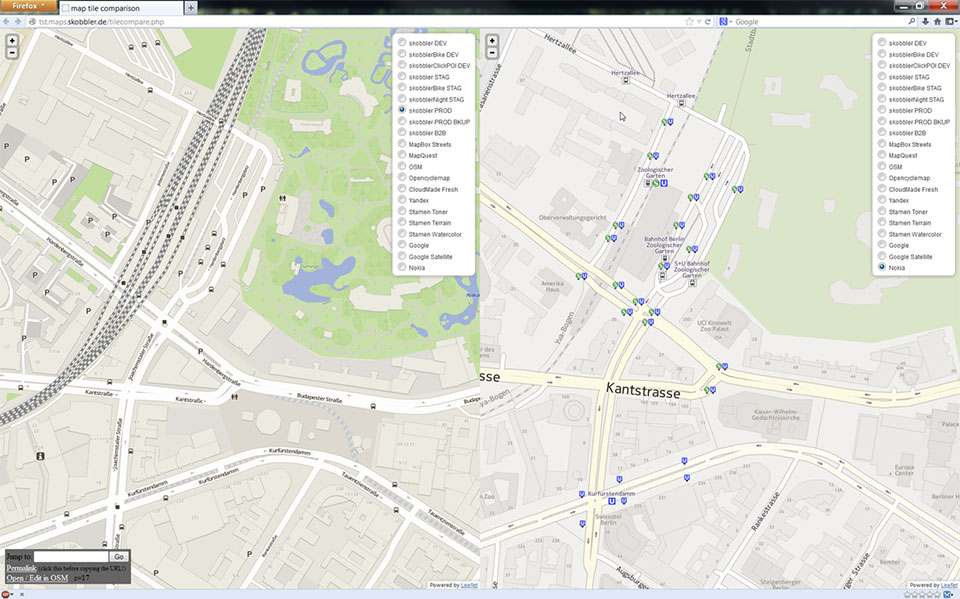
Crowdsourced mapping services and platforms like OpenStreetMap are more than just cost-efficienct tools to coax scale. As a crowdsourced dataset built using more than a million dedicated mappers, OpenStreetMap inherently delivers benefits above and beyond those obtained from corporate map providers like TeleAtlas and Navteq.
The most visible benefit is the unrivaled map quality. With an army of contributors, the data dynamically and constantly evolves — just as places do. Locations are rarely fixed or stable. They change and progress over time. No other service or platform can immediately provide developers with the real-time, on-the-ground granularity of a crowdsourced map. Google and the others are trying, but the costs they incur will ultimately be too taxing to maintain detail.
Firsthand influence carries equal weight. Mappers who edit an open-source map have often had personal interactions with a place or locale. They know places intimately, and this makes their contributions detailed, rich, and hyperlocal. More companies and developers are looking to OpenStreetMap for this reason: they want to future-proof their services and products, making sure that they always have the best and most up-to-date data. Only a platform like OpenStreetMap can do this. Corporate map providers are painfully aware of it, too.
Flexibility
Google owns Google Maps, and TeleAtlas owns its TomTom platform. Not surprisingly, this affects what a third party, whether an automotive company or a travel brand, can and cannot do with the service. It is essentially a copyrighted product like an MP3, an audio digital file. So, Google can limit the way you visually render and showcase its platform. Needless to say, this can be suffocating for those interested in building their own unique services. This is what makes crowdsourced mapping such a significant development for those interested in integrating additional data with a digital map. Do with OpenStreetMap what you will, visually or design-wise; there are absolutely no limitations. Every map can be made unique and rendered differently. This also speaks to the flexibility of crowdsourcing more generally.
Beyond design, crowdsourced maps can harness the data to build completely new maps that cater to a specific concept, creating thematic maps for different uses, such as walking, hiking, bicycling, routes for those with disabilities, and more. More traditional digital maps lack this flexibility; it affords possibilities to source non-traditional location data to build even more accurate maps.
The Future — Through Cars
Despite the fact that crowdsourced maps are forcing digital mapping to adopt a more scalable, cost-efficient, detailed, flexible andaltogether long-term approach, digital mapping definitely has room to grow.
One of the most exciting opportunities for crowdsourced maps specifically, and digital maps generally, lies in car user data, which is just coming into its own. Cars are obviously one of the largest travel tools utilized by individuals on a daily basis, and, with the advent of the connected car, the data that they collect via internal/external sensors has grown more nuanced, granular, and specific over the years.
Cars are simply getting smarter, with sensors capable of providing everything from weather conditions to speed-zone information.
Making this information available in the cloud and combining it with data available via crowdsourced mapping platforms produces remarkable possibilities for innovation.
Imagine adding road-condition data, as just one example, to crowdsourced mapping services. By marrying a crowdsourced map with crowdsourced car-sensor data, the map’s overall utility multiplies immeasurably.
To avoid missteps that have positioned companies like Google to spend billions on building a digital mapping service — unsustainable long-term figures — we must always look to embrace that which is cutting-edge. We find that today in crowdsourced mapping platforms, as they enable us to maintain, update, and enrich maps as never before. We must also consider the limitations of the cutting edge and understand how to improve the latest innovation (car-sensor data, and more) before the once cutting edge becomes the next paper map, so to speak. This is key to evolving maps for the better and for the future.
Oliver Kühn has an MBA from the University of Cologne, Germany. He has 10 years of location-based service experience and was Head of Product Management Special Projects at navigation systems specialist Navigon AG (acquired by Garmin). In late 2008, he co-founded skobbler GmbH, being responsible for business development and legal matters. He is also a board member of the OpenStreetMap Foundation.

