Tag: PPP

  • Innovation: Instantaneous centimeter-level multi-frequency precise point positioning

    Innovation: Instantaneous centimeter-level multi-frequency precise point positioning

    More Is Better

    The technique of precise point positioning (PPP) is making inroads in the positioning industry. However, one issue hampering its more widespread adoption is the convergence time required for the carrier-phase ambiguities to be fully resolved so that the 10-centimeter-accuracy threshold can be surpassed. By using a multi-system, multi-carrier-frequency approach, instantaneous centimeter-level PPP can be achieved.

    Innovation Insights with Richard Langley
    Innovation Insights with Richard Langley

    CARRIER PHASE. It’s one of the two main measurement types or observables used by all GNSS receivers. Fundamentally, it is the instantaneous phase of a GNSS signal’s carrier, an electromagnetic wave of fixed amplitude and frequency (when transmitted), which is (optionally) modulated by a ranging code and a navigation message. It’s measured in radians, degrees or cycles and can be converted to a biased measure of the range between the receiver and satellite antennas by multiplying the value in cycles by the wavelength of the carrier in meters. The other GNSS observable is the phase of the ranging code. Initially measured in code chips or units of time, it is converted to a biased measure of the receiver-satellite range by multiplying it by the speed of light. This value is then typically called the code measurement or the pseudorange. The carrier phase is much more precise than the pseudorange by something like a factor of 100. So, while pseudoranges can be measured to a precision of tens of centimeters, carrier phases can be measured to millimeters or better.

    Most GNSS receivers use pseudorange measurements to determine their position. In fact, this is the standard approach to satellite-based positioning that was introduced by GPS in the 1970s. While carrier-phase measurements, or rather their time-rate-of-change, are used for precise velocity determination, it wasn’t originally recognized that carrier-phase measurements could be used for position determination, too. The problem with the carrier phase as a measure of the range is that it has an initially unknown and potentially huge bias. This is because when a receiver starts tracking a signal’s carrier, it doesn’t know the exact number of cycles of the carrier wave stretching all the way from the satellite to the receiver. Hence, carrier-phase measurements are ambiguous as a result of this initial bias. If this ambiguity can be resolved, then carrier-phase measurements can be used for very precise positioning — positioning at the centimeter level or even better.

    Over the years, various techniques have been developed to use carrier-phase measurements for positioning, most notably in differential positioning where one or more reference stations are used to position a user receiver or rover. But the technique of precise point positioning, which only requires direct uncombined measurements from the user receiver, is being actively developed and is making inroads in the positioning industry. However, one continuing issue hampering its more widespread adoption is the convergence time required for the carrier-phase ambiguities to be fully resolved so that the 10-centimeter-accuracy threshold can be surpassed. Research by the authors of this month’s article shows that by using a multi-system, multi-carrier-frequency approach, instantaneous centimeter-level PPP can be achieved. They call their technique Optimal Estimation using Uncombined Four-frequency Signals or OEUFS for short. Those of us who remember a smattering of our high-school French will agree that it is quite an eggceptional technique.


    Instantaneous centimeter-level positioning used to be synonymous with the single-baseline real-time kinematic (RTK) technique. The rover was constrained to be within a few kilometers of the base station to ensure that errors would remain spatially correlated. Modeling error sources using a regional network of stations later allowed users to retain this level of accuracy within the area of network coverage. A global network of reference stations enabled the determination of precise satellite orbit and clock products, paving the way for precise point positioning (PPP).

    Global centimeter-level accuracy can be achieved with PPP, at the cost of a long convergence time, often measured in hours. An additional layer of corrections, including satellite code (pseudorange) and carrier-phase biases, has enabled PPP with ambiguity resolution (PPP-AR). While an improvement in convergence time can be obtained, PPP-AR still cannot compete with RTK or network RTK in terms of time to first fix. Only by providing precise atmospheric information to PPP users, in the form of zenith tropospheric and slant ionospheric delays, can instantaneous centimeter-level accuracy be obtained. This approach led to a unification of PPP and RTK, often referred to as PPP-RTK. This scalable approach has allowed PPP users to obtain accurate positioning globally, while achieving rapid convergence when located within the regional reference network boundaries.

    The modernization of GNSS includes satellites transmitting signals on multiple frequencies. The 12 GPS Block IIF satellites currently in orbit already broadcast the L5 signal, and all Galileo and BeiDou satellites launched so far have triple-frequency capabilities. In November 2017, the BeiDou constellation began a new phase of its development with the launch of the Beidou-3S satellites offering new signals compatible with the GPS L1/L5 bands. In March 2018, the European Union decided to open its Commercial Service (CS), offering at no cost the signal and correction stream for the “CS high accuracy” service. As a result, the E6 signal is now available on 14 satellites and can be tracked by modern GNSS receivers. FIGURE 1 depicts the frequency plan of the open GNSS signals, including these last evolutions, as of May 2018.
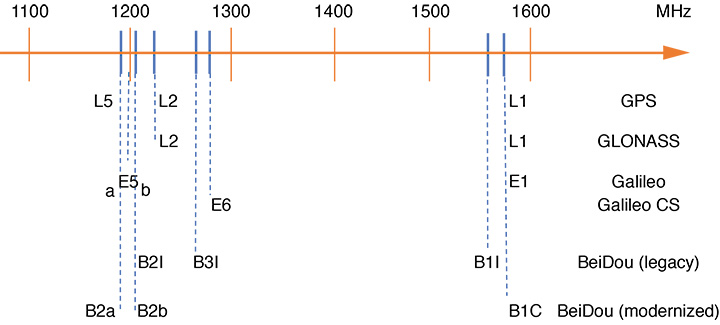
    FIGURE 1. GNSS open signals (as of May 2018). (Image: authors)
    FIGURE 1. GNSS open signals (as of May 2018). (Image: authors)

    With three or more frequencies, a series of widelane ambiguities can be resolved in a cascading scheme. These unambiguous widelane signals can be used to form an ionosphere-free phase measurement with lower noise than code measurements, but typically still at the decimeter level. The availability of the Galileo E6 signal provides a significant step forward for PPP-AR, permitting instantaneous convergence. As a result of frequency separation, unambiguous widelane signals have low noise characteristics, which further benefits the resolution of the whole set of ambiguities. The strategy used in our study is a generalization of the widelaning technique, based on uncombined observations, which we describe as Optimal Estimation using Uncombined Four-frequency Signals (OEUFS).

    We explain how instantaneous centimeter-level PPP is achieved by first analyzing the precision of the ambiguity and range parameters in the single-satellite case. The network estimation of the uncombined Galileo phase biases is then described, followed by epoch-by-epoch and 5-minute PPP solutions based on OEUFS.

    SINGLE-SATELLITE PROCESSING

    To get a first grasp of the benefits of using four frequencies, we first look into single-satellite data. The aim of this analysis is twofold: first, to evaluate the ability of fixing linear combinations of ambiguities and, second, to determine the resulting precision of the unbiased range estimate once these ambiguities are fixed.

    Uncombined observations on four Galileo frequencies (E1, E5a, E5b and E6) are used to model an ionosphere-free range, a slant ionospheric delay, and four carrier-phase ambiguities. It should be noted that measurements on a fifth frequency (E5) are available but, due to the proximity of E5 with respect to E5a and E5b, its impact was found to be almost negligible. We will, therefore, restrict ourselves to the four-frequency case. Only two code observations are included in the model — in this case E1 and E5a — since adding other frequencies would require the estimation of differential code biases. Thus, for single-epoch processing, additional code measurements would not usefully contribute to the solution. Observable standard deviations are set to 3 millimeters and 30 centimeters for carrier phase and code, respectively. An analysis using a zero-length baseline revealed that weak correlations do exist between signals, and multipath effects could further increase this correlation. Although taking into consideration correlations among observations would lead to a more realistic covariance matrix, these correlations were neglected in producing the results shown in this article. This is justified by the fact that correlation coefficients are usually not available, especially for real-time processing.

    The above-mentioned model was inverted in a least-squares adjustment to perform covariance analysis. While the Least‐squares AMBiguity Decorrelation Adjustment (LAMBDA) method can be used for the identification of optimal linear combinations of ambiguities, the classic widelane ambiguities were found to perform equally well and were used in our work to simplify the exposition. When no ambiguities are fixed, the quality of the solution is driven by the noise on the code observations. TABLE 1 shows that, in this case, the receiver-satellite range parameter can be estimated with a precision of 0.776 meters. This value can be translated into a 3D-position precision by using the position dilution of precision (PDOP) factor. As a rule of thumb, if the PDOP for all satellites in view is equal to 1, the resulting 3D precision should be around 78 centimeters.
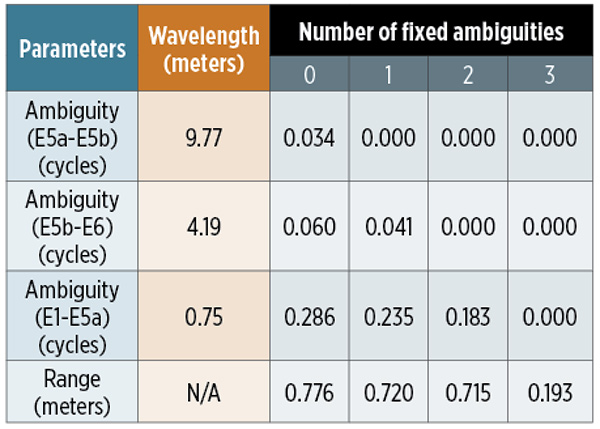
    TABLE 1. Precision of parameters in the Galileo four-frequency (E1, E5a, E5b, E6) single-satellite case.

    Even though the range is not very precise, forming the E5a-E5b widelane ambiguity from the estimated uncombined ambiguities gives a precision of 0.034 cycles, which can be reliably fixed due to the very long wavelength of the signal (9.77 meters). Adding this constraint to the system allows us to estimate the E5b-E6 widelane ambiguity with a standard deviation of 0.041 cycles (although it could also have been fixed initially). Interestingly, fixing both extra-widelane ambiguities does not significantly improve the precision of the range information derived from a single satellite. Nevertheless, due to correlations among ambiguity parameters, a precision of 0.183 cycles is now obtained for the E1-E5a widelane, an improvement of approximately 35 percent over the initial estimate.

    While the E1-E5a ambiguity is not sufficiently precise for reliable instantaneous fixing based on single-satellite data from one epoch, using the geometric information from several satellites will enable single-epoch ambiguity resolution for three widelane ambiguities per satellite, as we show in the following sections. Assuming for the moment that ambiguity resolution was indeed successful on all three widelanes, Table 1 indicates that the range parameter can now be estimated with a standard deviation of 19 centimeters, a substantial improvement over the initial 78-centimeter precision. Recalling the PDOP factor introduced above, instantaneous 3D position precision at the 20-centimeter mark should then be possible with good geometry.

    Including all available measurements in the model necessarily leads to the best performance. Still, TABLE 2 presents the conditional precision of parameters in three-frequency configurations. The precision for the widelane ambiguity is conditioned on first fixing the extra-widelane ambiguity, while that for the range assumes fixed extra-widelane and widelane ambiguities. The table highlights that frequency spacing plays a key role in the system performance. After fixing two widelane ambiguities, the Galileo E1-E5a-E5b configuration provides a range with a standard deviation of approximately 42 centimeters. The E1-E5a-E6 configuration is the best option, with a precision of the range parameter equal to the four-frequency case. In other words, the contribution of the E5b signal is almost negligible once the E5a-E6 ambiguity, having a wavelength of 2.93 meters, is resolved. For comparison purposes, the values for GPS are included and show that Galileo has the potential for significantly more precise instantaneous positioning.
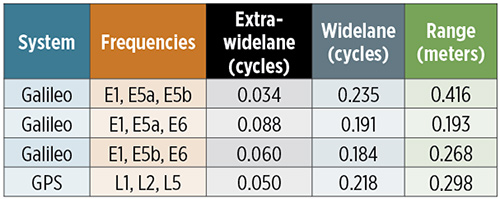
    TABLE 2. Conditional precision of parameters for three-frequency single-satellite configurations.

    NETWORK SOLUTION

    To demonstrate the concept of four-frequency ambiguity resolution for PPP, a phase-bias network solution for the Galileo constellation must be generated. Our solution is based on the precise satellite orbit and clock corrections produced by the Centre National d’Études Spatiales (CNES) as a part of the International GNSS Service (IGS) Multi-GNSS Experiment (MGEX). These products contain satellite clock corrections at a 30-second interval, as well as widelane biases allowing for GPS ambiguity resolution in the L1 and L2 frequency bands. For this reason, the following analysis considers both GPS and Galileo constellations.

    Consistent processing of multi-frequency and multi-modulation signals requires code-bias corrections. The differential code-bias products from the German Aerospace Center (DLR), including the Galileo E6 signals, are used. Ambiguity resolution for Galileo can only be enabled with corresponding phase biases for all frequencies. To this date, the main contributors to the IGS for E6-compatible receivers are Natural Resources Canada (NRCan), CNES and Geoscience Australia. Since a global network of ground receivers tracking all four Galileo frequencies is not yet available, our solution is computed from a regional, but wide-area, network in Australia. The network consists of six reference stations with multi-system, multi-frequency receivers as depicted with red triangles in FIGURE 2. (Station CEDU is not included in the network solution because it is used later as a rover for PPP testing.) Measurements collected at a 30-second interval are retrieved from the Crustal Dynamics Data Information System (CDDIS) data archive. For the purpose of our demonstration, data from April 1, 2018, from 13:45:00 to 14:35:00 GPS Time is selected. During this period, five Galileo satellites were continuously tracked by the Australian stations, allowing the computation of a Galileo-only solution.

    The phase-bias solution is a generalization in the multi-frequency case of the well-known widelane/narrowlane GPS scheme. The first step consists of resolving all integer ambiguities in the network. As we deal with four frequencies, it is required to fix four ambiguities, or their combinations, per satellite-station pass. The first three combinations used for this study are the widelanes defined from E5a-E1, E5b-E1 and E6-E1. Their ambiguities are solved, as for the dual-frequency GPS case, thanks to the Melbourne-Wübbena combination. Then, one remaining integer ambiguity (here, E1) is solved by forming the ionosphere-free phase combination between E1 and E5a (with the corresponding widelane ambiguity already resolved as an integer value). The second step aims at recovering the uncombined phase biases from the estimated linear combinations of biases. By a simple system inversion, it is possible to reconstruct the phase biases on each frequency.
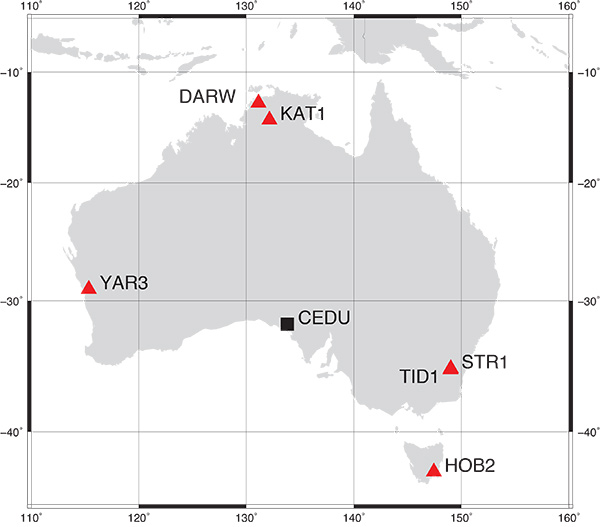
    FIGURE 2. Stations used to generate the Galileo phase-bias solution are represented by red triangles, while the PPP user is represented by a black square. (Image: authors)
    FIGURE 2. Stations used to generate the Galileo phase-bias solution are represented by red triangles, while the PPP user is represented by a black square. (Image: authors)

    FIGURE 3 shows the estimated biases for each frequency over the study period. The values were shifted by an integer number of the carrier wavelength for plotting purposes. The uncombined biases obtained are relatively stable, although they vary by a few centimeters over this one-hour period. These fluctuations are correlated among frequencies due to the transformation from linear combinations to uncombined biases. It should be understood that the resulting biases are not true phase biases, but rather biases to be applied to the carrier-phase observations.
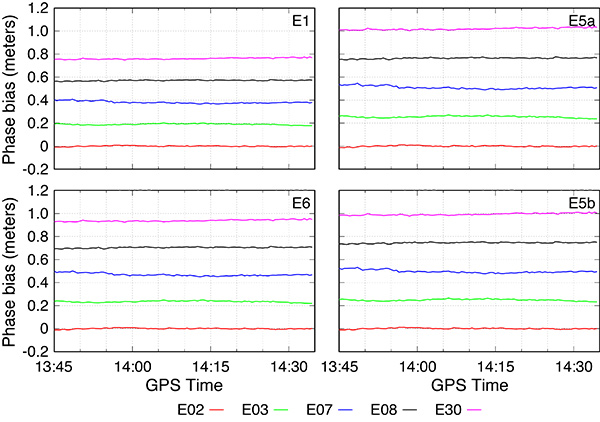
    FIGURE 3. Estimated Galileo phase biases for the four frequency bands over the study period. (Image: authors)
    FIGURE 3. Estimated Galileo phase biases for the four frequency bands over the study period. (Image: authors)

    PRECISE POINT POSITIONING

    We assessed the impact of using four frequencies transmitted by Galileo (E1, E5a, E5b and E6) on positioning performance by using station CEDU in Australia (see Figure 2). It is equipped with a multi-frequency receiver collecting multi-GNSS observations at 30-second intervals. Position estimates are derived from the PPP methodology using the satellite orbit and clock corrections, along with the carrier-phase and code biases, described in the previous section.

    We computed three different solutions:

    1. a GPS-only solution;
    2. a Galileo-only solution; and
    3. a GPS and Galileo combined solution.

    For all solutions, all error sources affecting observations are modeled, including relativistic and wind-up effects, solid Earth tides and ocean loading. The a priori tropospheric zenith delay (TZD) is computed using the Vienna Mapping Function 1 (VMF1) grids, while a priori ionospheric delays are obtained from a global ionospheric map (GIM) generated at the Center for Orbit Determination in Europe (CODE). The eccentricity between the satellite antenna phase centers and the satellite center of mass is obtained from the latest version of the IGS ANTEX file, which includes frequency-dependent phase-center offsets and variations for Galileo. Since there are no Galileo-specific ground-antenna calibrations available, GPS values are used as approximations.

    In all cases, we processed uncombined observations corresponding to the OEUFS strategy. For GPS, the L1C and L2W carrier-phase observations are used, along with the C1W and C2W code observations. For Galileo, the L1C, L5Q, L6C and L7Q carrier phases are used, with identical modulations for code measurements. Note that this signal identification uses the RINEX 3 conventions where, for Galileo, the L5 and L7 signals correspond to those in the E5a and E5b bands, respectively. Carrier-phase observations are given a standard deviation of 2 millimeters at zenith, while code observations are deweighted by a factor of 100. An elevation-angle-dependent weighting strategy also assigns lesser weight to satellites closer to the local horizon. Therefore, the value of 3 millimeters used in the single-satellite analysis above corresponds to a satellite tracked at an elevation angle of approximately 40 degrees.

    The PPP filter includes states for the three position components, one receiver clock parameter per satellite system, inter-frequency code biases, one phase-bias parameter per frequency, a residual TZD, a residual slant ionospheric delay per satellite and carrier-phase ambiguities. To confirm the theoretical analysis from a previous section, the empirical single-epoch ambiguity-fixing success rate is first evaluated using a bootstrapping algorithm. The full vector of estimated float ambiguities is first decorrelated using the LAMBDA method, and all ambiguities having a success rate larger than 99 percent are fixed to integers. FIGURE 4 shows the number of fixed ambiguities for each solution.
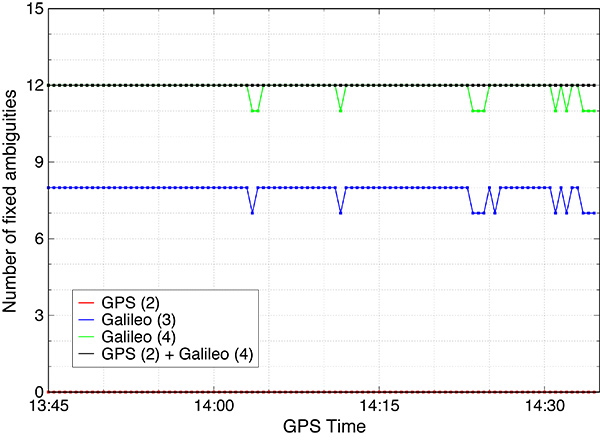
    FIGURE 4. Number of fixed ambiguities using a bootstrapping approach for independent, single-epoch, solutions. Number of frequencies in parentheses. (Image: authors)
    FIGURE 4. Number of fixed ambiguities using a bootstrapping approach for independent, single-epoch, solutions. Number of frequencies in parentheses. (Image: authors)

    Not surprisingly, the dual-frequency GPS solution is incapable of reliably fixing ambiguities within a single epoch. During this time period, five Galileo satellites are tracked. If we first consider all four frequencies from Galileo, and use the ambiguities on one satellite to provide the datum, then a total of 16 ambiguities are being estimated in the PPP filter, 12 of which are considered widelanes. Figure 4 confirms that using correlations introduced by the geometry allows instantaneous fixing of all widelane ambiguities for Galileo for most epochs. Adding GPS to the Galileo solution makes Galileo widelane fixing more reliable, but does not allow fixing of additional ambiguities. The three-frequency (E1, E5a and E6) Galileo configuration also enables instantaneous fixing of all eight widelane ambiguities, since the inclusion of E5b brings minimal additional information.

    In all subsequent solutions, ambiguity estimation is performed using a more sophisticated method referred to as the best integer equivariant (BIE) approach. Because it is expected that not all ambiguities can be fixed simultaneously, a partial ambiguity resolution scheme is required. The BIE method fulfills this criterion by computing a weighted average of integer vectors. The outcome is a constrained ambiguity vector whose entries take either integer or float values. The key point of this approach is that the BIE float estimates can be improved by the averaging process with respect to the least-squares float estimates. Furthermore, by exploiting the correlations contained in the ambiguity covariance matrix, this method can effectively fix linear combinations of ambiguities. Therefore, we are not explicitly forming widelane ambiguities, but rather optimal linear combinations of ambiguities are fixed through the BIE averaging process. This strategy is implemented using the LAMBDA method to decorrelate ambiguities. Even though the BIE estimates are independent of the decorrelation, this step improves the computational efficiency of the approach.

    As we explained in the previous sections, positioning with fixed widelane ambiguities can potentially allow for instantaneous precise positioning. FIGURE 5 demonstrates the epoch-by-epoch position estimates for the three solutions. As the strategy implies, the filter is entirely reset between epochs, and each point in the time series is independently determined. As expected, instantaneous ambiguity resolution with GPS alone is not feasible. Although the external information provided by the GIM is beneficial in reducing the errors, the root-mean-square (RMS) error is at the decimeter level for all components (see TABLE 3).
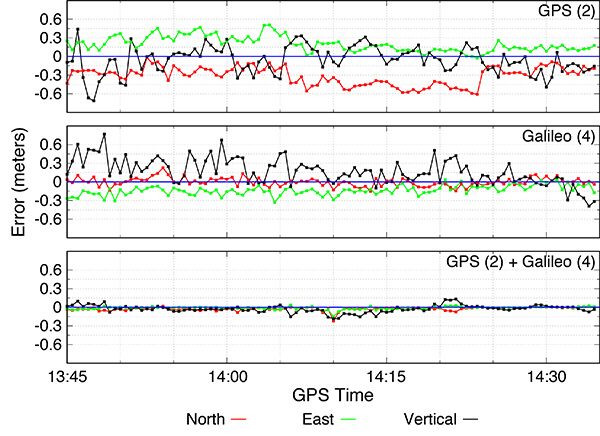
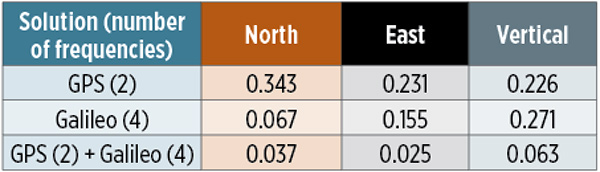
    FIGURE 5. Instantaneous (epoch by epoch) PPP-AR solutions for GPS only, Galileo only and GPS and Galileo combined. Number of frequencies in parentheses. (Image: authors)
    FIGURE 5. Instantaneous (epoch by epoch) PPP-AR solutions for GPS only, Galileo only and GPS and Galileo combined. Number of frequencies in parentheses. (Image: authors)
    TABLE 3. RMS errors for each instantaneous PPP-AR solution (meters).

    The Galileo-only solution offers a substantial improvement in the horizontal components. These results are explained by the ambiguity-resolved widelane signals providing precise range estimates. It should be noted that only five Galileo satellites are visible during this period with a PDOP slightly exceeding a value of 3. When the full constellation of satellites will be in orbit, even better results could be obtained from a Galileo-only solution. The three-frequency (E1, E5a, E6) Galileo solution offers almost identical position estimates and is not shown here for conciseness. Combining GPS and Galileo yields the best solution with centimeter-level instantaneous positioning (refer to Table 3). For several epochs, a fully converged position is even obtained within a single epoch.

    While the RMS errors of the combined GPS + Galileo solution is at the centimeter level, individual epochs can still exhibit decimeter-level errors. To demonstrate the convergence capabilities of the OEUFS strategy, we computed 5-minute PPP sessions. Even though the station is stationary, we added a large amount of process noise to the position states to simulate kinematic processing. FIGURE 6 shows the results of all 10 sessions: horizontal convergence to a few centimeters could be achieved within two epochs in all but one session.
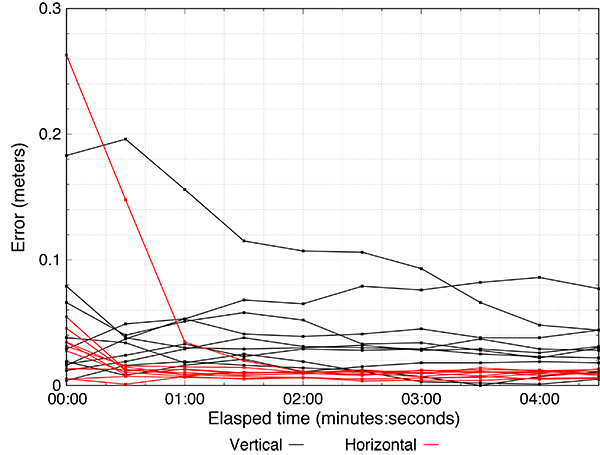
    FIGURE 6. Independent 5-minute kinematic PPP solutions using GPS and Galileo. Each trace represents a different session. (Image: authors)
    FIGURE 6. Independent 5-minute kinematic PPP solutions using GPS and Galileo. Each trace represents a different session. (Image: authors)

    CONCLUSION

    We have shown that GNSS modernization is a key component for reducing the convergence time of PPP solutions. Combining multiple constellations strengthens the geometry, and using multiple frequencies allows for improved ambiguity resolution performance. In particular, tracking of the E6 Galileo commercial service signal turns out to be particularly beneficial in terms of instantaneous positioning capabilities. We demonstrated that ambiguities can be instantaneously resolved on Galileo satellites, leading to a range estimate approximately four times better than that provided using code measurements. With good satellite geometry, these frequencies can enable instantaneous 3D positioning with an accuracy of around 20 centimeters. Combining Galileo and GPS allows for single-epoch centimeter-level PPP solutions and full convergence within a few epochs.

    We expect that the robustness and accuracy of the OEUFS strategy will improve in the future, with an increasing number of multi-frequency satellites and ground stations. Specifically, the additional frequencies provided by BeiDou and the Quasi-Zenith Satellite System will enhance the geometry of the solution and will further expedite convergence. Within a few years, instantaneous PPP might very well become a practical alternative to RTK for a wide range of applications.

    ACKNOWLEDGMENTS

    The authors acknowledge Geoscience Australia for making publicly available modernized GNSS data, as well as Paul Collins from NRCan for the review of our manuscript and technical advice. This article is published as NRCan Contribution 20180102.

    MANUFACTURER

    All of the stations used for the tests described in this article have PolaRx5 reference receivers manufactured by Septentrio (www.septentrio.com).


    DENIS LAURICHESSE is a member of the Navigation Systems Department at CNES in Toulouse, France. He has been in charge of the DIOGENE GPS orbital navigation filter, and is now involved in navigation algorithms for GNSS. He is in charge of the CNES IGS real-time analysis center. Laurichesse was the co-recipient of the 2009 Institute of Navigation Burka Award for his work on phase ambiguity resolution.

    SIMON BANVILLE is a senior geodetic engineer with the Canadian Geodetic Survey of NRCan, Ottawa, Canada, working on PPP. He obtained his Ph.D. degree in 2014 from the Department of Geodesy and Geomatics Engineering at the University of New Brunswick, under the supervision of Richard B. Langley. He is the recipient of the Institute of Navigation 2014 Parkinson Award.

    FURTHER READING

    •  Precise Point Positioning

    Where Are We Now, and Where Are We Going?: Examining Precise Point Positioning Now and in the Future” by S. Bisnath, J. Aggrey, G. Seepersad and M. Gill in GPS World, Vol. 29, No. 3, March 2018, pp. 41–48.

    “Precise Point Positioning” by J. Kouba, F. Lahaye and P. Tétreault, Chapter 25 in Springer Handbook of Global Navigation Satellite Systems, edited by P.J.G. Teunissen and O. Montenbruck, published by Springer International Publishing AG, Cham, Switzerland, 2017.

    •  Multi-GNSS Experiment

    “The Multi-GNSS Experiment (MGEX) of the International GNSS Service (IGS) – Achievements, Prospects and Challenges” by O. Montenbruck, P. Steigenberger, L. Prange, Z. Deng, Q. Zhao, F. Perosanz, I. Romero, C. Noll, A. Stürze, G. Weber, R. Schmid, K. MacLeod and S. Schaer in Advances in Space Research, Vol. 59, No. 7, April 2017, pp. 1671–1697, doi: 10.1016/j.asr.2017.01.011.

    Getting a Grip on Multi-GNSS: The International GNSS Service MGEX Campaign” by O. Montenbruck, C. Rizos, R. Weber, G. Weber, R. Neilan and U. Hugentobler in GPS World, Vol. 24, No. 7, July 2013, pp. 44–49.

    •  PPP Carrier-Phase Ambiguity Resolution and Convergence

    Carrier-phase Ambiguity Resolution: Handling the Biases for Improved Triple-frequency PPP Convergence” by D. Laurichesse in GPS World, Vol. 26, No. 4, April 2015, pp. 49-54.

    “Zero-difference GPS Ambiguity Resolution at CNES–CLS IGS Analysis Center by S. Loyer, F. Perosanz, F. Mercier, H. Capdeville, and J.C. Marty in Journal of Geodesy, Vol. 86, No. 11, Nov. 2012, pp. 991–1003, doi: 10.1007/s00190-012-0559-2.

    “Undifferenced GPS Ambiguity Resolution Using the Decoupled Clock Model and Ambiguity Datum Fixing” by P. Collins, S. Bisnath, F. Lahaye and P. Héroux in Navigation, Vol. 57, No. 2, Summer 2010, pp. 123–135, doi: 10.1002/j.2161-4296.2010.tb01772.x.

    •  Leastsquares AMBiguity Decorrelation Adjustment (LAMBDA)

    “Carrier Phase Integer Ambiguity Resolution” by P.J.G. Teunissen, Chapter 23 in Springer Handbook of Global Navigation Satellite Systems, edited by P.J.G. Teunissen and O. Montenbruck, published by Springer International Publishing AG, Cham, Switzerland, 2017.

    “Theory of Integer Equivariant Estimation with Application to GNSS” by P.J.G. Teunissen in Journal of Geodesy, Vol. 77, No. 7-8, Oct. 2003, pp. 402–410, doi: 10.1007/s00190-003-0344-3.

    A New Way to Fix Carrier-phase Ambiguities” by P.J.G. Teunissen, P.J. de Jonge, and C.C.J.M. Tiberius in GPS World, Vol. 6, No. 4, April 1995, pp. 58–61.
  • Innovation: Examining precise point positioning now and in the future

    Innovation: Examining precise point positioning now and in the future

    Where Are We Now, and Where Are We Going?

    In this month’s column, we travel along the road of PPP development, examine its current status and look at where it might go in the near future

    By Sunil Bisnath, John Aggrey, Garrett Seepersad and Maninder Gill

    Innovation Insights with Richard Langley
    Innovation Insights with Richard Langley

    PPP. It’s one of the many acronyms (or initialisms, if you prefer) associated with the uses of global navigation satellite systems. It stands for precise point positioning. But what is that? Isn’t all GNSS positioning precise? Well, it’s a matter of degree.

    Take GPS, for example. The most common kind of GPS signal use, that implemented in vehicle “satnav” units; mobile phones; and hiking, golfing and fitness receivers, is to employ the L1 C/A-code pseudorange (code) measurements along with the broadcast satellite orbit and clock information to produce a point position.

    Officially, this is termed use of the GPS Standard Positioning Service (SPS). It is capable of meter-level positioning accuracy under the best conditions. There is a second official service based on L1 and L2 P-code measurements and broadcast data called the Precise Positioning Service (PPS).

    In principle, because the P-code provides somewhat higher precision code measurements and the use of dual-frequency data removes virtually all of the ionospheric effect, PPS is capable of slightly more precise (and accurate) positioning. But because the P-code is encrypted, PPS is only available to so-called authorized users.

    While meter-level positioning accuracy is sufficient for many, if not most applications, there are many uses of GNSS such as machine control, surveying and various scientific tasks, where accuracies better than 10 centimeters or even 1 centimeter are needed. Positioning accuracies at this level can’t be provided by pseudoranges alone and the use of carrier-phase measurements is required. Phase measurements are much more precise than code measurements although they are ambiguous and this ambiguity must be estimated and possibly resolved to the correct integer value.

    Traditionally, phase measurements (typically dual-frequency) made by a potentially moving user receiver have been combined with those from a reference receiver at a well-known position to produce very precise (and accurate) positions. If done in real time (through use of a radio link of some kind), this technique is referred to as real-time kinematic or RTK.

    A disadvantage of RTK positioning is that it requires reference station infrastructure including a radio link (such as mobile phone communications) for real-time results. Is there another way? Yes, and that’s PPP. PPP uses the more precise phase measurements (along with code measurements initially) on at least two carrier frequencies (typically) from the user’s receiver along with precise satellite orbit and clock data derived, by a supplier, from a global network. Precision, in this case, means a horizontal position accuracy of 10 centimeters or better.

    In this month’s column, we travel along the road of PPP development, examine its current status, and look at where it might go in the near future.


    In a 2009 GPS World “Innovation” article co-authored by Sunil Bisnath, the performance and technical limitations at the time of the precise point positioning (PPP) GPS measurement processing technique were described and a set of questions asked about the potential of PPP, especially with regard to the real-time kinematic (RTK) measurement processing technique.

    Since the 2009 article, we’ve seen a significant amount of research and development (R&D) activity in this area. Many scientific papers discuss PPP and making use of PPP — a search on Google Scholar for “GNSS PPP” delivers nearly 7,000 results, and for “GPS PPP” more than 15,000 results! Will PPP eventually overtake RTK as the de facto standard for precise (that is, few centimeter-level) positioning? Or, in light of PPP R&D developments, should we be asking different questions, such as will multiple precise GNSS positioning techniques compete or complement each other or perhaps result in a hybrid approach?

    In almost a decade, have we seen much in the way of positioning performance improvement, where “performance” can refer to positioning precision, accuracy, availability and integrity? Or, to some users, has the Achilles’ heel of PPP — the initial position solution convergence period — only been reduced from, for example, 20 minutes to 19 minutes? From such a perspective, all of this PPP research might not appear to have produced much tangible benefit. Advances have been made from this research and we will explore them here. Also, aside from many researchers working diligently on their own PPP software, there are now a number of well-established PPP-based commercial services — a number that has grown and been affected by the wave of GNSS industry consolidation over the decade. Consequently, there is much more to this story.

    This month’s article summarizes the current status of PPP performance and R&D, and discusses the potential future of the technique. In the first part of the article, we will present brief explanations of conventional dual-frequency PPP, recent research and implementations, and application of the evolved technique to low-cost hardware. We will conclude the article with a rather dangerous attempt at near-term extrapolation of potential upcoming developments and conceivable implications.

    Conventional PPP

    The concept of PPP is based on standard, single-receiver, single-frequency point positioning using pseudorange (code) measurements, but with the meter-level satellite broadcast orbit and clock information replaced with centimeter-level precise orbit and clock information, along with additional error modeling and (typically) dual-frequency code and phase measurement filtering. Back in 1995, researchers at Natural Resources Canada were able to reduce GPS horizontal positioning error from tens of meters to the few-meter level with code measurements and precise orbits and clocks in the presence of Selective Availability (SA). Subsequently, the Jet Propulsion Laboratory introduced PPP as a method to greatly reduce GPS measurement processing time for large static networks. When SA was turned off in May 2000 and GPS satellite clock estimates could then be more readily interpolated, the PPP technique became scientifically and commercially popular for certain precise applications.

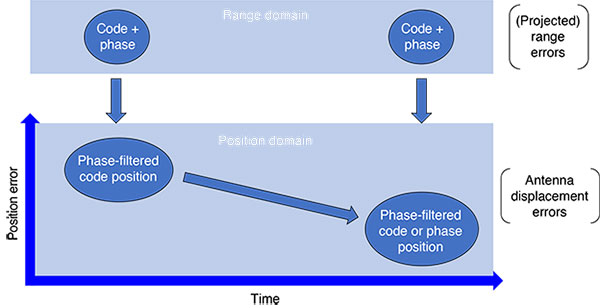
    Unlike static relative positioning and RTK, conventional PPP does not make use of double-differencing, which is the mathematical differencing of simultaneous code and phase measurements from reference and remote receivers to greatly reduce or eliminate many error sources. Rather, PPP applies precise satellite orbit and clock corrections estimated from a sparse global network of satellite tracking stations in a state-space version of a Hatch filter (in which the noisy, but unambiguous, code measurements are filtered with the precise, but ambiguous, phase measurements). This filtering is illustrated in FIGURE 1, where measurements are continually added in time in the range domain, and errors are modeled and filtered in the position domain, resulting in reduced position error in time.

    FIGURE 1. Illustration of conventional PPP measurement and error modeling in state-space Hatch filter, resulting in reduced position error in time.

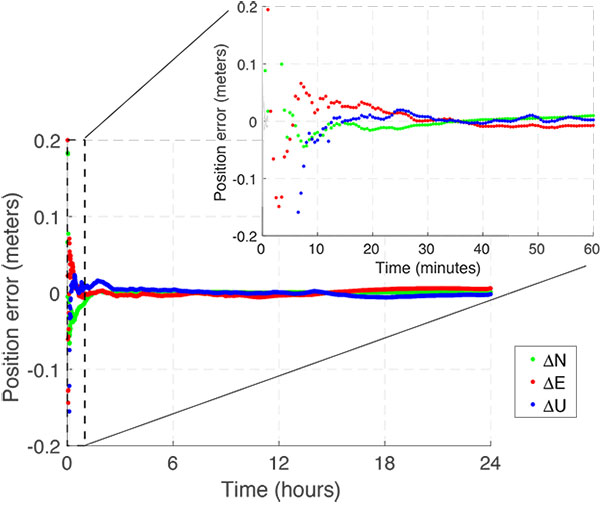
    The result is the characteristic PPP initial convergence period seen in FIGURE 2, where the position solution is initialized as a sub-meter, dual-frequency code point positioning solution, quickly converging to the decimeter-level in something like 5 to 20 minutes, and a few centimeters after ~20 minutes when geodetic-grade equipment is used (at station ALGO, Algonquin Park, Canada, on Jan. 2, 2017). For static geodetic data, daily solutions are typically at the few millimeter-level of accuracy in each Cartesian component.

    FIGURE 2. Conventional geodetic GPS PPP positioning performance characteristics of initial convergence period and steady state for station ALGO, Algonquin Park, Canada, on Jan. 2, 2017.

    The primary benefit of conventional PPP is that with the use of state-space corrections from a sparse global network, there is the appearance of precise positioning from only a single geodetic receiver.

    Therefore, baseline or network RTK limitations are removed in geographically challenging areas, such as offshore, far from population centers, in the air, in low Earth orbit, and so on, and without the need for the requisite terrestrial hardware and software infrastructure. PPP is now the de facto standard for precise positioning in remote areas or regions of low economic density, which limit or prevent the use of relative GNSS, RTK or network RTK, but allow for continuous satellite tracking. These benefits translate into the main commercial applications of offshore positioning, precision agriculture, geodetic surveys and airborne mapping, which also are not operationally bothered by initial convergence periods of tens of minutes.

    For urban and suburban applications, RTK and especially network RTK allow for near-instantaneous, few-centimeter-level positioning with the use of reference stations and regional satellite (orbit and clock) and atmospheric corrections. The use of double-differencing and these local or regional corrections allows sufficient measurement error mitigation to resolve double-differenced phase ambiguities. All of this additional information is not available to conventional PPP, limiting its precise positioning performance, but which is considered in PPP enhancements.

    Progress on PPP Convergence Limitations

    Over the past decade or so, PPP R&D activity can be categorized as follows:

    • Integration of measurements from multiple GNSS constellations, transitioning from GPS PPP to GNSS PPP;
    • Resolution of carrier-phase ambiguities in PPP user algorithms — in an effort to increase positional accuracy and solution stability, but foremost in an effort to reduce the initial convergence period; and
    • Use of a priori information to reduce the initial convergence and re-convergence periods and improve solution stability, making use of available GNSS error modeling approaches.

    Unlike relative positioning, which makes use of measurements from the user receiver as well as the reference receiver, PPP only relies on measurements from the user site. This situation results in weaker initial geometric strength, and so the addition of more unique measurements is welcome. To make use of measurements from all four GNSS constellations (GPS, GLONASS, Galileo and BeiDou), user-processing engines must account for differences in spatial and temporal reference systems between constellations and numerous equipment delays between frequencies and modulations. The former can be done so that any number of measurements from any number of constellations can be processed to produce one unique PPP position solution. The latter requires a great deal of calibration, especially for heterogeneous tracking networks and user equipment (antenna, receiver and receiver firmware), most notably for the current frequency division multiple access GLONASS constellation.

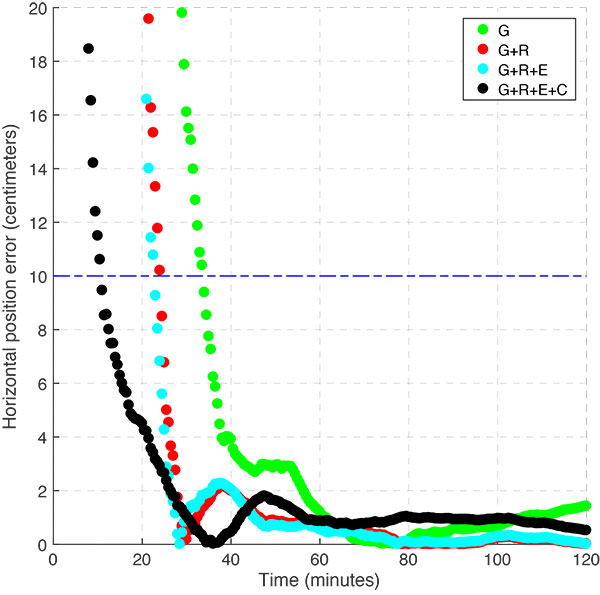
    FIGURE 3 shows typical multi-GNSS float (non-ambiguity-fixed) horizontal positioning performance at multi-GNSS station GMSD in Nakatane, Japan, on March 24, 2017. As with all modes of GNSS data processing, more significant improvement with additional constellations can be seen in sky-obstructed situations.

    FIGURE 3. Typical conventional multi-GNSS PPP float horizontal positioning accuracy for station GMSD, Nakatane, Japan, March 24, 2017 (G: GPS, R: GLONASS, E: Galileo and C: BeiDou).

    Related to multi-constellation processing is triple-frequency processing afforded by the latest generation of GPS satellites and the Galileo and BeiDou constellations. More frequencies mean more measurements, although with the same satellite-to-receiver measurement geometry as dual-frequency measurements. Again, additional signals require additional equipment delay modeling, in this case especially for the processing of GPS L1, L2 and L5 observables.

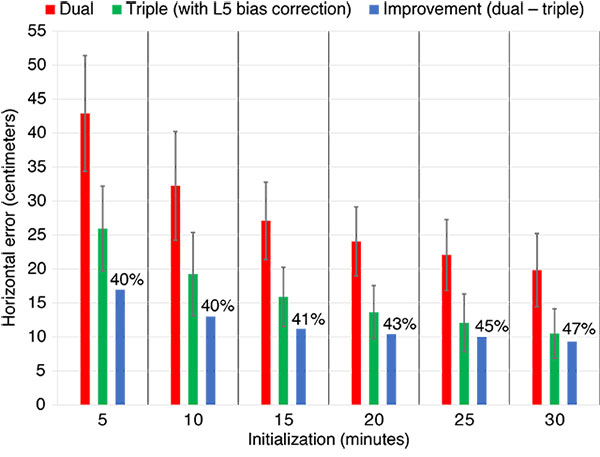
    For processing of four-constellation data available from 20 global stations in early 2016, FIGURE 4 shows the average reduction of float (non-ambiguity-fixed) horizontal error from dual- to triple-frequency processing of approximately 40% after the first five minutes of measurement processing. In terms of positioning, this result, for this time period with a limited number of triple-frequency measurements, means a reduction in average horizontal positioning error from 43 to 26 centimeters within the first five minutes of data collection.

    FIGURE 4. Average dual- and triple-frequency static, float PPP horizontal solution accuracy for 20 global stations. Data collected from tracked GPS, GLONASS, Galileo and BeiDou satellites in early 2016.

    PPP with ambiguity resolution, or PPP-AR, was seen as a potential solution to the PPP initial solution convergence “problem” analogous to AR in RTK. Various researchers put forward methods, in the form of expanded measurement models, to isolate pseudorange and carrier-phase equipment delays to estimate carrier-phase ambiguities. These methods remove receiver equipment delays through implicit or explicit between-satellite single-differencing and estimate satellite equipment delays in the network product solution either as fractional cycle phase biases or altered clock products.

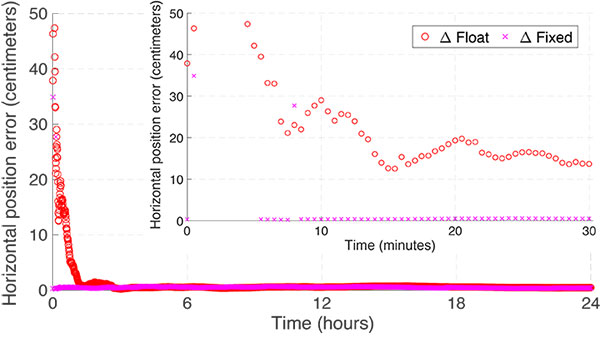
    FIGURE 5 illustrates the difference between a typical GPS float and fixed solution (for station CEDU, Ceduna, Australia, on June 28, 2017). Initial solution convergence time is reduced, and stable few-centimeter-level solutions are reached sooner. For lower quality data, ambiguity fixing does not provide such quick initial solution convergence. Fixing is dependent on the quality of the float solution; and, for PPP, the latter requires time to reach acceptable levels of accuracy. Therefore, depending on the application, PPP-AR may or may not be helpful.

    FIGURE 5. Typical float (red) and fixed (pink) GPS PPP horizontal solution error at geodetic station CEDU, Ceduna, Australia, on June 28, 2017.

    To consistently reduce the initial solution convergence period, PPP processing requires additional information, as is the case for network RTK, in which interpolated satellite orbit, ionospheric and tropospheric corrections are needed since double-differenced RTK baselines over 10 to 15 kilometers in length contain residual atmospheric errors too large to effectively and safely resolve phase integer ambiguities. For PPP, uncombining the ionospheric-free code and phase measurements from the conventional model is required, to directly estimate slant ionosphere propagation terms in the filter state.

    In this form, the model can allow for very quick re-initialization of short data gaps by using the pre-gap slant ionospheric (and zenith tropospheric) estimates as down-weighted a priori estimates post-gap — making these estimates bridging parameters in the estimation filter. Expanding this approach, external atmospheric models can be used to aid with initial solution convergence.

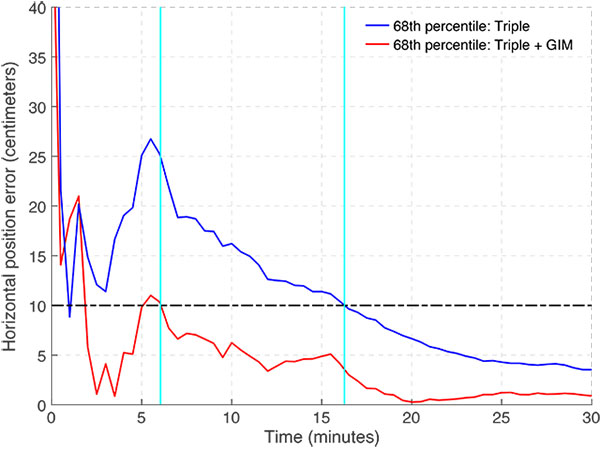
    FIGURE 6 illustrates, for a large dataset, that applying a spatially and temporally coarse global ionospheric map (GIM) to triple-frequency, four-constellation float processing can reduce one-sigma convergence time to 10 centimeters horizontal positioning error from 16 to 6 minutes. If local ionospheric (and tropospheric) corrections are available and AR is applied, PPP (sometimes now referred to as PPP-RTK) can produce RTK-like results with a few minutes of initial convergence to few-centimeter-level horizontal solutions.

    FIGURE 6. Averaged horizontal error from 70 global sites in mid-2016 using four-constellation, triple-frequency processing.

    PPP Processing with Low-Cost Hardware

    As the impetus for low-cost, precise positioning and navigation for autonomous and semi-autonomous platforms (such as land vehicles and drones) continues to grow, there is interest in processing such low-cost data with PPP algorithms. For example, it has been shown that with access to single-frequency code and phase measurements from a smartphone, short-baseline RTK positioning is possible. It has also been shown that similar smartphone data can be processed with the PPP approach. From the origins of PPP, it may be argued that single-frequency processing and many-decimeter-level positioning performance is not “precise.” But we will avoid such semantic arguments here (but see “Insights”), and focus on the use of high-performance measurement processing algorithms to new low-cost hardware. We are currently witnessing great changes in the GNSS chip market: single-frequency chips for tens-of-dollars or less; and boards with multi-frequency chips for hundreds-of-dollars. And these chips will continue to undergo downward price pressure with increases in capability, and be further enabled for raw measurement use in a wider range of applicable technology solutions. There are now a number of low-cost, dual-frequency, multi-constellation products on the market, with additional such products as well as smartphone chips coming soon.

    To process data from such products with a PPP engine, modifications are required to optimally account for single-frequency measurements in the estimation filter, optimize the measurement quality control functions for the much noisier code and phase measurements compared to data from geodetic receivers, and optimize the stochastic modeling for the much noisier code and phase measurements. The single-frequency measurement model can be modified to either make use of the Group and Phase Ionospheric Calibration linear combination (commonly referred to as GRAPHIC) or ingest data from an ionospheric model. Due to the use of low-cost antennas, as well as the low-cost chip signal processing hardware, code and phase measurements suffer from significant multipath and noise at lower signal strengths; therefore, outlier detection functions must be modified. Also, the relative weighting of code and phase measurements must be customized for more realistic low-cost data processing.

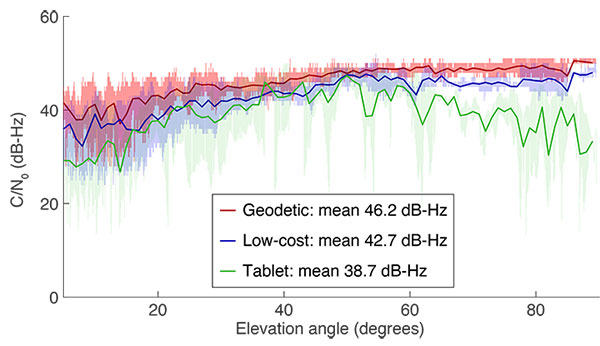
    FIGURE 7 compares the carrier-to-noise-density ratio (C/N0) values from ~1.5 hours of static GPS L1 signals collected from a geodetic receiver with a geodetic antenna, a low-cost receiver chip with a patch antenna, and a tablet chip and internal antenna, as a function of elevation angle. Received signal C/N0 values can be used as a proxy for signal precision. The three datasets were collected at the same time in mid-September 2017 in Toronto, Canada, with the receivers and antennas within a few meters of each other. The shading represents the raw estimates output from each receiver, while the solid lines are moving-average filtered results.

    FIGURE 7. Carrier-to-noise-density ratios of ~1.5 hour of static GPS L1 signals from a geodetic receiver with a geodetic antenna, a low-cost receiver chip with a patch antenna, and a tablet chip and internal antenna, as a function of elevation angle.

    Keeping in mind the log nature of C/N0, the high measurement quality of the geodetic antenna and receiver are clear. The low-cost chip and patch antenna signal strength structure is similar, but, on average, 3.5 dB-Hz lower. And the tablet received signal strength is lower still, on average a further 4.0 dB-Hz lower, with greater degradation at higher signal elevation angles and much greater signal strength variation.

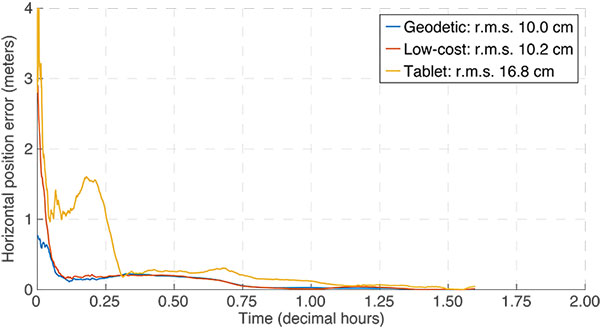
    The PPP horizontal position uncertainty for these datasets is shown in FIGURE 8. Note that reference coordinates have been estimated from the datasets themselves, so potential biases, in especially the low-cost and tablet results, can make these results optimistic. Given that only single-frequency GPS code and phase measurements are being processed, initial convergence periods are short and horizontal position error reaches steady state in the decimeter range. The geodetic and the low-cost results are comparable at the 2-decimeter level, whereas the tablet results are worse, at the approximately 4-decimeter level. Initial convergence of the geodetic solution is superior to the others, driven by the higher quality of its code measurements. The grade of antenna plays a large role in the quality of these measurements, for which there are physical limitations in design and fabrication. While geodetic antennas can be used, this is not always feasible, given the mass limitations of certain platforms or the cost limitations for certain applications.

    FIGURE 8. Horizontal positioning error (compared to final epoch solutions) for geodetic, low-cost and tablet data processed with PPP software customized for single-frequency and less precise measurements.

    Comments Regarding the Near Future

    The PPP GNSS measurement processing approach was originally designed to greatly reduce computation burden in large geodetic networks of receivers by removing the need for network baseline processing. The technique found favor for applications in remote areas or regions with little terrestrial infrastructure, including the absence of GNSS reference stations. Given PPP’s characteristic use of a single receiver for precise positioning, various additional augmentations have been made to remove or reduce solution initialization and re-initialization interval to near RTK-like levels. But, to what end?

    This question can be approached from multiple perspectives. From the theoretical standpoint, there is the impetus to maximize performance — millimeter-level static positioning over many hours, and few-centimeter-level kinematic positioning in a few minutes — by augmenting PPP in any way necessary. There is the academic exercise of maximizing performance without the need for local or regional reference stations – apparent single-receiver positioning, or truly wide-area augmentation. In terms of engineering problems, we can work to do more with less, that is, decimeter-level positioning with ultra-low-cost hardware, or the same with less, that is, few-centimeter-level positioning with low-cost hardware. And from the practical or commercial aspect, the great interest is for the implementation of evolved PPP methods for applications that can efficiently and effectively make use of the technology.

    In terms of service providers, be it regional or global, commercial or public, there is momentum to provide enhanced correction products that are blurring the lines across the service spectrum from constellation-owner tracking to regional, terrestrial augmentation. A public GNSS constellation-owner, through its constellation tracking network, can provide PPP-like corrections and services. A global commercial provider with or without regional augmentation can provide similar services. The key is providing multi-GNSS state-space corrections for satellite orbits, satellite clocks, satellite equipment delays (fractional phase biases), zenith ionospheric delay and zenith tropospheric delay at the temporal and spatial resolution necessary for the desired positioning performance at reasonable cost, that is, subscription fees that particular markets can bear.

    Given these correction products, PPP users have a greater ability to access a wide array of positioning performance levels for various new applications, be it few-decimeter-level positioning on mobile devices to few-centimeter-level positioning for autonomous or semi-autonomous land, sea and air vehicles. PPP can be used for integrity monitoring and perhaps safety-of-life applications where low-cost is a necessity and relatively precise positioning for availability and integrity purposes is required. For safety critical and high-precision applications, such as vehicle automation, PPP can be used alongside, or in combination with, RTK for robustness and independence with low-cost hardware. Such a parallel and collaborative approach would require a hybrid user processing engine and robust state-space corrections from a variety of local, regional and global sources, as we are seeing from some current geodetic hardware-based commercial services.

    Near-future trends should also include more low-cost, multi-sensor integration with PPP augmentation. Optimized navigation algorithms and efficient user processing engines will be a priority as the capabilities of low-cost equipment continue to increase and low-cost integrated sensor solutions are required for mass-market applications. Analogous to meter-level point position GNSS, lower hardware costs should drive markets to volume sales, PPP-like correction services, and GNSS-based multi-sensor integration into more navigation technology solutions for various industry and consumer applications.

    Clearly, the future of PPP continues to be bright.


    SUNIL BISNATH is an associate professor in the Department of Earth and Space Science and Engineering at York University, Toronto, Canada. For over twenty years, he has been actively researching GNSS processing algorithms for a wide variety of positioning and navigation applications.

    JOHN AGGREY is a Ph.D. candidate in the Department of Earth and Space Science and Engineering at York University. He completed his B.Sc. in geomatics at Kwame Nkrumah University of Science and Technology, Ghana, and his M.Sc. at York University. His research currently focuses on the design, development and testing of GNSS PPP software, including functional, stochastic and error mitigation models.

    GARRETT SEEPERSAD is a navigation software design engineer for high-precision GNSS at u-blox AG and concurrently is completing his Ph.D. in the Department of Earth and Space Science and Engineering at York University. His Ph.D. research focuses on GNSS PPP and ambiguity resolution. He completed his B.Sc. in geomatics at the University of the West Indies in Trinidad and Tobago. He holds an M.Sc. degree in the same field from York University.

    MANINDER GILL is a geomatics designer at NovAtel Inc. and concurrently is completing his M.Sc. in the Department of Earth and Space Science and Engineering at York University. His M.Sc. research focuses on GNSS PPP and improving positioning accuracy for low-cost GNSS receivers. He holds a B.Eng. degree in geomatics engineering from York University.

    FURTHER READING

    • Comprehensive Discussion of Technical Aspects of Precise Point Positioning

    “Precise Point Positioning” by J. Kouba, F. Lahaye and P. Tétreault, Chapter 25 in Springer Handbook of Global Navigation Satellite Systems, edited by P.J.G. Teunissen and O. Montenbruck, published by Springer International Publishing AG, Cham, Switzerland, 2017.

    • Earlier Precise Point Positioning Review Article

    Precise Point Positioning: A Powerful Technique with a Promising Future” by S.B. Bisnath and Y. Gao in GPS World, Vol. 20, No. 4, April 2009, pp. 43–50.

    • Legacy Papers on Precise Point Positioning

    “Precise Point Positioning Using IGS Orbit and Clock Products” by J. Kouba and P. Héroux in GPS Solutions, Vol. 5, No. 2, October 2001, pp. 12–28, doi: 10.1007/PL00012883.

    GPS Precise Point Positioning with a Difference” by P. Héroux and J. Kouba, a paper presented at Geomatics ’95, Ottawa, Canada, 13–15 June 1995.

    “Precise Point Positioning for the Efficient and Robust Analysis of GPS Data from Large Networks” by J.F. Zumberge, M.B. Heflin, D.C. Jefferson, M.M. Watkins and E.H. Webb in Journal of Geophysical Research, Vol. 102, No. B3, pp. 5005–5017, 1997, doi: 10.1029/96JB03860.

    • Improvements in Convergence

    Carrier-Phase Ambiguity Resolution: Handling the Biases for Improved Triple-frequency PPP Convergence” by D. Laurichesse in GPS World, Vol. 26, No. 4, April 2015, pp. 49-54.

    “Reduction of PPP Convergence Period Through Pseudorange Multipath and Noise Mitigation” by G. Seepersad and S. Bisnath in GPS Solutions, Vol. 19, No. 3, March 2015, pp. 369–379, doi: 10.1007/s10291-014-0395-3.

    “Global and Regional Ionospheric Corrections for Faster PPP Convergence” by S. Banville, P. Collins, W. Zhang and R.B. Langley in Navigation, Vol. 61, No. 2, Summer 2014, pp. 115–124, doi: 10.1002/navi.57.

    “A New Method to Accelerate PPP Convergence Time by Using a Global Zenith Troposphere Delay Estimate Model” by Y. Yao, C. Yu and Y. Hu in The Journal of Navigation, Vol. 67, No. 5, September 2014, pp. 899–910, doi: 10.1017/S0373463314000265.

    “External Ionospheric Constraints for Improved PPP-AR Initialisation and a Generalised Local Augmentation Concept” by P. Collins, F. Lahaye and S. Bisnath in Proceedings of ION GNSS 2012, the 25th International Technical Meeting of the Satellite Division of The Institute of Navigation, Nashville, Tennessee, Sept. 17–21, 2012, pp. 3055–3065.

    • Improvements in Ambiguity Resolution

    Clarifying the Ambiguities: Examining the Interoperability of Precise Point Positioning Products” by G. Seepersad and S. Bisnath in GPS World, Vol. 27, No. 3, March 2016, pp. 50–56.

    “Integer Ambiguity Resolution on Undifferenced GPS Phase Measurements and Its Application to PPP and Satellite Precise Orbit Determination” by D. Laurichesse and F. Mercier, J.-P. Berthias, P. Broca and L. Cerri in Navigation, Vol. 56, No. 2, Summer 2009, pp. 135–149.

    “Resolution of GPS Carrier-phase Ambiguities in Precise Point Positioning (PPP) with Daily Observations” by M. Ge, G. Gendt, M. Rothacher, C. Shi and J. Liu in Journal of Geodesy, Vol. 82, No. 7, July 2008, pp. 389–399, doi: 10.1007/s00190-007. Erratum: doi: 10.1007/s00190-007-0208-3.

    “Isolating and Estimating Undifferenced GPS Integer Ambiguities” by P. Collins in Proceedings of ION NTM 2008, the 2008 National Technical Meeting of The Institute of Navigation, San Diego, California, Jan. 28–30, 2008, pp. 720–732.

    • Precise Positioning Using Smartphones

    Positioning with Android: GNSS Observables” by S. Riley, H. Landau, V. Gomez, N. Mishukova, W. Lentz and A. Clare in GPS World, Vol. 29, No. 1, January 2018, pp. 18 and 27–34.

    Precision GNSS for Everyone: Precise Positioning Using Raw GPS Measurements from Android Smartphones” by S. Banville and F. van Diggelen in GPS World, Vol. 27, No. 11, November 2016, pp. 43–48.

    Accuracy in the Palm of Your Hand: Centimeter Positioning with a Smartphone-Quality GNSS Antenna” by K.M. Pesyna, R.W. Heath and T.E. Humphreys in GPS World, Vol. 26, No. 2, February 2015, pp. 16–18 and 27–31.

  • Leica highlights Zeno GG04 smart antenna, DS2000 radar at Esri UC

    Leica Geosystems showed off its Zeno GG04 smart antenna and DS2000 Utility Detection Radar at the 2017 Esri User Conference, which took place July 10-14 in San Diego, California. The Zeno GG04 improve mobile devices’ GNSS accuracy with Real-Time Kinematic (RTK) and precise point positioning (PPP), while the Leica DS2000 Utility Detection Radar detects and positions shallow and deep targets simultaneously.

  • Septentrio releases 4.2 firmware for greater performance, security and functionality

    Septentrio releases 4.2 firmware for greater performance, security and functionality

    Septentrio has released version 4.2 firmware for the AsteRx4, AsteRx-U and the newly launched AsteRx-m2. The 4.2 firmware brings higher output rates, low and constant latency, support for TerraStar-C and a built-in NTRIP caster.

    AsteRx-m2 UAS receiver.

    The 4.2 firmware targets machine control applications delivering higher output rates with consistent and low latency. Maximum output rates have increased on all platforms: up to 100 Hz for the AsteRx4 and AsteRx-m2 and 50 Hz for the AsteRx-U, with latencies better than 10 ms and 20 ms respectively.

    TerraStar-C is now supported, bringing precise point positioning (PPP) horizontal position precision to 4 cm. In addition, Septentrio algorithms deliver fast PPP re-convergence making PPP even more attractive for positioning in difficult environments.

    For the AsteRx4 and the AsteRx-U, the 4.2 firmware enhances ease-of-use by including a built-in NTRIP caster. Correction data from the receiver is available for up to 10 NTRIP clients (or rovers) over the internet. The caster supports up to three mount points and can also rebroadcast correction data from a remote NTRIP server.

    “For machine control and automation, Septentrio receivers have unique low-latency behaviour which is constant and independent of the update rate.” stated Francesca Clemente, Product Manager at Septentrio. She continued: “The 4.2 firmware demonstrates Septentrio’s commitment to advancing performance and functionality of its products.”

  • CNES offers new Android apps for GNSS

    PPPWizzlight
    PPP Wizzlight.

    French space agency CNES has made available two applications on the Google Play store for Android apps. Both are compatible with Android N (Nougat).

    RTCM Converter: This app aims to convert the smartphone GNSS raw measurements to Radio Technical Commission for Maritime Services (RTCM message type 1077) and send them to a caster, for use by third-party software.

    PPP WizzLite: This app is a port of the CNES PPP client (code and Doppler only, light version) on Android. Accuracies of 1-2 meters can be reached in kinematic mode, and sub-meter in static mode (using external SBAS data). To do so, users need to pull external RTCM streams for orbits/clocks corrections and broadcasts, such as ones available from the International GNSS Service Real-Time Service (IGS RTS).

    Both apps have been validated on a Nexus 5X device with no phase support.


  • NavCom’s StarFire Network achieves centimeter-level accuracy without a base station

    NavCom’s StarFire Network is a global satellite-based augmentation system (GSBAS) that provides real-time accuracy, typically better than 5 centimeters. To accomplish this, StarFire utilizes a network of more than 40 GNSS reference stations around the world to compute GNSS satellite orbit and clock corrections. The precise point positioning (PPP) service requires no base station, saving users time and hardware costs.

    Get more information on the StarFire Network.

    SPONSORED CONTENT

  • CNES and Geoflex sign agreement on satellite positioning

    French Space Agency CNES has signed a cooperation agreement with the company Geoflex, granting it the right to spin off software developed by CNES that employs satellite precise point positioning (PPP) technology.

    Under the agreement, CNES is granting Geoflex a license to use its patented technologies in this field with a view to offering a global commercial operational service. This partnership ties in with the agency’s strategy of spinning off its research and development results.

    The agreement was signed June 28 at the Toulouse Space Show by Lionel Suchet, CNES’s director of innovation, applications and science, and Romain Legros, chairman of Geoflex.

    The Geoflex team was able to draw on more than 10 years’ experience in GNSS precise positioning when they founded their start-up to pursue this project. Through this cooperation agreement with CNES, Geoflex is set to benefit from significant opportunities worldwide in real-time precise positioning, navigation and timing, serving a broad customer base employing applications such as topographic mapping, construction and civil engineering, agriculture, shipping, rail, driverless vehicles and unmanned aerial systems.

    “Today’s space technologies will drive revolutionary changes in usage in the future,” Suchet said after signing the agreement. “Through their commitment to developing a global GNSS precise positioning service, CNES and Geoflex are showing that France has a key role to play in innovating and in growing our future economy. The people at this start-up are looking to shake up the status quo, so it was natural that CNES should support them.”

  • Tallysman expands geodetic antenna line

    Tallysman, a manufacturer of high-performance GNSS antennas, has introduced two additions to its VeraPhase line of precision antennas.

    TW6000-tallysmanThe VP6300 is a triple-band antenna for reception of GPS L1/L2/L5, GLONASS G1/G2/G3, BeiDou B1/B2 and Galileo E1/E5a+b (1165MHz to 1254MHz + 1560MHz to 1610MHz).

    The VP6200 is a dual-band antenna for reception of GPS L1/L2, GLONASS G1/G2, BeiDou B1/B2, Galileo E1 and the L-Band correction services (1195MHz to 1254MHz + 1525MHz to 1610MHz).

    Both antennas have been calibrated by the U.S. National Geodetic Survey (NGS) and are designed for high-precision applications such as real-time kinematic (RTK), precise point positioning (PPP) and other applications where precision matters.

    For OEM manufacturers, the antennas feature an available, uncommitted printed circuit board (PCB) for integration of custom electronics such as precision GNSS receivers.

    According to Tallysman, these antennas fill out the VP6x00 product family with precision at a cost-effective price point. Both of these new products feature the same patented VeraPhase technology as in the VP6000 all-band reference antenna.

    VeraPhase technology is proven to have the lowest axial ratios from horizon to horizon across all frequencies, very tight Phase Centre Variations (PCV), superior gain and extremely high efficiency.

    The new antennas feature a highly linear LNA with robust pre-filtering to minimize desensing from high-level out-of-band signals such 700MHz LTE and other cellular band signals.


  • Veripos extends Apex service, offers Quantum software

    Veripos, a global supplier of high-precision GNSS positioning services to the offshore oil and gas industries, has extended its ranges of proprietary software with the introduction of Quantum, a new, all-purpose suite of visualization modules providing a state-of-the-art user interface to support next-generation services and features.

    Designed to operate with all current Veripos positioning options including its latest Apex5 multi-constellation PPP service (see below), the new software has been developed with significant input from a wide range of users by way of simplifying any system configuration while easing methods of interpretation. Other advances include integral diagnostic functions for simple identification of operational problems together with indications of likely solutions.

    Visualization modules can also be operated independently without affecting concurrent positioning calculations which might otherwise be feeding critical survey or vessel systems.

    At the same time, the Quantum framework comprises a series of different modules to meet a variety of specific operational tasks such as those necessary for hydrographic and seismic surveying as well as dynamic positioning. Its versatility also extends to providing a basic foundation for accommodating new modules or features.

    Apex5 PPP service launched

    Veripos has extended its Apex service with introduction of Apex5, which is capable of receiving observations from five available satellite constellations comprising GPS, GLONASS, Beidou, Galileo and QZSS.

    Using precise point positioning (PPP) methods for correction or modeling of all GNSS error sources, the new multi-constellation service with its access to increased civilian signals ensures greater power levels via interoperable networks in addition to improved levels of observation and redundancy.  Other advantages include a higher satellite count and position availability, particularly in masked and scintillated environments.

    Calculations are based on Veripos’s own orbit and clock determination system (OCDS) which derives real-time corrections for all available satellite constellations using proprietary algorithms.  The OCDS uses data from the company’s own global network of reference stations with multiple and redundant systems supported by dedicated network control centres in Aberdeen and Singapore.

    Apex5 is broadcast alongside existing Apex, Apex2 and Ultra services via seven geostationary satellites to ensure continuous availability and service redundancy. Typical position accuracies are better than 5cm horizontal at the two sigma (95 percent) confidence level.

  • Innovation: Guidance for road and track

    Innovation: Guidance for road and track

    Real-time single-frequency precise point positioning for cars and trains

    By Peter de Bakker and Christian Tiberius

    INNOVATION INSIGHTS with Richard Langley
    INNOVATION INSIGHTS
    with Richard Langley

    “IT’S GETTING BETTER ALL THE TIME.” This refrain from the Beatle’s song could well describe precise point positioning or PPP. PPP is a positioning technique that relies on GNSS carrier-phase measurements (in addition to code or pseudorange measurements) from a user’s receiver along with satellite orbit and clock data much more precise (and accurate) than that included in broadcast satellite navigation messages to achieve accuracies down to the centimeter level. It also requires a more sophisticated model of the measurements compared to that used in most consumer GNSS equipment and even some professional devices, including accounting for residual tropospheric propagation delay, carrier-phase windup, and even solid Earth tides.

    PPP has been around for more than a decade and ongoing research has gradually improved its capabilities. Until recently, it has been used primarily with dual-frequency GPS observables. However, the technique is not restricted to GPS. It works equally well with observables from other constellations including GLONASS, Galileo and BeiDou. As long as precise orbit and clock products are available (typically from the International GNSS Service or its participating analysis centers), then PPP positioning solutions are possible. And, single-frequency PPP is also possible. The primary advantage of dual-frequency PPP is that the ionospheric propagation delay is almost completely removed by linearly combining the measurements on the two frequencies, taking advantage of the dispersive nature of signal propagation through the ionosphere. But, if good predictions of the ionospheric delay at, say, the L1 GPS frequency are available, then it is possible to do single-frequency PPP. While not as accurate as dual-frequency PPP, the technique is considerably more accurate than typical pseudorange point positioning (the so-called Standard Positioning Service).

    PPP is also traditionally a post-processing technique. That is, data is collected but it is not processed until some later convenient time when the necessary precise products are available. Such an approach is useful for many applications but clearly not for navigation, which requires real-time positioning. But in the past few years, a number of commercial and non-commercial entities have started streaming real-time satellite orbit and clock corrections over the Internet and various radio links, making real-time PPP a reality.      

    In this month’s Innovation column, we bring together, perhaps for the first time, single-frequency and real-time PPP. Our authors describe a series of experiments they have conducted on roadways and a railway achieving sub-meter horizontal positioning at a 95 percent confidence interval. Such accuracies may already be sufficient for freeway lane and railway track guidance. But we might expect even better accuracies in the future. After all, PPP is getting better all the time.


    The single-frequency precise point positioning (SF-PPP) method, developed at Delft University of Technology, was previously demonstrated to provide lane-level position accuracy on a freeway in post-processing mode. Important applications of SF-PPP are lane-level traffic state estimation and lane-level specific driver advice for next-generation car navigation. For a functional system, as well as for advanced experiments in this field, the computed positions have to be available in real time. Therefore, a new real-time implementation of the SF-PPP method was developed as part of the Dutch Dynamic Lane Guidance project. In this article, we outline aspects of the real-time implementation, and we present experimental results from this new implementation collected on a busy freeway in the Netherlands and in a parking lot, as well as results from a railway experiment.

    In these experiments, a test vehicle was equipped with a low-end, automotive-type single-frequency receiver with a patch antenna to collect raw GPS observations. A 3G mobile communications link was used to obtain data-correction streams over the Internet using the Ntrip protocol. The SF-PPP processing was performed on a laptop computer onboard the vehicle, in real time. Various forms of ground-truth positions were used to assess the real-time SF-PPP positioning accuracy. For some of our tests, the vehicle was also equipped with high-end GPS antennas and receivers to provide ground truth. The position solutions obtained with the SF-PPP algorithm have been compared to (post-processed) network-RTK solutions using the Netherlands Positioning Service (NETPOS). Additional validation was performed by means of a 5-centimeter-accuracy road-infrastructure map from Rijkswaterstaat, the Dutch Ministry of Infrastructure and the Environment, and by a centimeter-level a priori ground survey.

    The new real-time SF-PPP software was tested successfully with performance comparable to our previous post-processing software, and meeting the required accuracy for freeway lane identification. Statistics on the performance are provided, as well as their dependence on a number of external parameters including the number of available satellites.

    Precise corrections from both the German Aerospace Center (Deutsches Zentrum für Luft- und Raumfahrt or DLR) and the International GNSS Service (IGS) were used. Delays in the correction streams vary between providers and can increase further in the event of a time-out of the mobile link. The influence of these delays is considered, and an optimal approach for dealing with outages is discussed.

    PPP Model and Corrections

    The GNSS positioning model is non-linear. The observations are non-linear functions of the unknown parameters plus noise.

    To solve for the unknown parameters (including the receiver position coordinates), through least squares estimation, the model must be linearized around an approximate solution.

    In our SF-PPP model, the primary observations are, from each satellite, the pseudorange measurement and the carrier-phase measurement. The unknown parameters are the receiver position vector and the receiver clock offset, both of which are involved in the linearization, and also the ambiguity, associated with the carrier-phase measurement, for which the model is already linear.

    In the context of PPP, it is important to note that in addition to the linearization around the initial approximate values, the computed observations contain a number of a priori model values for parameters which are not estimated, including:

    • The precise satellite position and clock offset (including the relativistic effect): The GPS satellite positions and clock offsets are computed from the broadcast products (navigation message) and corrected with real-time data streams via Ntrip. The correction streams of DLR and IGS were used at different times as detailed in Table 1. In post-processing older files, the satellite orbits and clocks are taken from sp3 files, but to keep the processing as close as possible to the real-time functionality, these are first converted to corrections to the broadcast products.
    • The (neutral) troposphere delay: The troposphere delay is modeled with the a priori Saastamoinen model using the Ifadis mapping function and parameters from the 1976 U.S. Standard Atmosphere.
    • The ionosphere delay and satellite differential code bias: The ionosphere delay is computed a priori using the one-day predicted Global Ionosphere Maps (GIMs) from the Center for Orbit Determination in Europe (CODE), together with the corresponding differential code biases.
    • The carrier-phase observations are corrected for the phase wind-up at the receiver and satellite. The user orientation is estimated from the vehicle velocity vector.
    TABLE 1. Four SF-PPP field tests.
    TABLE 1. Four SF-PPP field tests.

    Besides the primary observations, the ambiguity estimate from the previous epoch can be added to the current epoch as an additional observation per satellite, because it is assumed to be constant in the absence of a cycle slip.

    Observations from different epochs are assumed to be uncorrelated, and consequently the ambiguity estimates from previous epochs are uncorrelated to the current observations. Observations to different satellites are also assumed to be uncorrelated.

    The carrier-phase ambiguities are the only parameters propagated from a previous epoch to the current epoch. The receiver position coordinates (and receiver clock offset) are estimated each epoch anew — no vehicle dynamics model is involved.   

    The computed positions are finally corrected for solid Earth tides with an efficient numerical model. Computed positions result in the International Terrestrial Reference Frame (ITRF) 2008 at the epoch of the observations.

    In parallel with the positioning filter, statistical hypothesis testing is used to detect errors in the observations or propagated ambiguities (such as those caused by excessive multipath or a cycle slip), based on the detection, identification and adaptation (DIA) procedure. First, an overall model test is run at each epoch to test the validity of the model and observations. If the test is rejected, data snooping is applied to determine which observation is most likely to have caused the problem. If one of the pseudorange measurements is identified, it is removed from the model. If either a carrier-phase measurement or ambiguity is identified, the ambiguity for that satellite is reset; that is, the propagated ambiguity is removed.

    Experiments

    Four field tests that we have carried out are considered here.

    • In October 2012, more than 100 laps were driven over a 5-kilometer stretch of the A13 freeway between Delft and Rotterdam. The data collected were reprocessed to validate the new real-time software implementation (but obviously carried out in post-processing mode).
    • The first real-time tests were performed in December 2014 and later in May 2015 on the same stretch of the A13 freeway.
    • In May 2015, a third dataset was collected on a recently constructed and nicely outlined parking lot in Delft.
    • In July 2015, a train carriage was equipped with a GPS receiver and data were collected on a train trip from the center of The Netherlands to the far southern part — a distance of more than 200 kilometers.

    Details of the four field tests are collected in Table 1.

    Ground Truth

    In our earlier experiments, the ground truth for the vehicle positions was computed with measurements from high-end equipment onboard the same vehicle. Both the antenna of the SF-PPP receiver and the high-end antennas were rigidly connected to a wooden beam on the roof rack of the van (positions of the two high-end antennas at both ends of the beam were obtained through network RTK GPS). As our results from this experiment show, the performance, and especially the precision, is very good, but a moderate bias of 17 centimeters in the cross-track direction was observed (see FIGURE 1 and TABLE 2). The suspect cause of this bias was the antenna location, close to the side of the vehicle and not attached to the metal roof itself.

    FIGURE 1. 2D histogram of SF-PPP position errors (with respect to the network RTK GPS solution) in horizontal directions for the 2012 test on the A13 freeway, expressed in local east and north directions (left), and in cross-track and along-track directions (right). The color indicates the number of samples in each bin.
    FIGURE 1. 2D histogram of SF-PPP position errors (with respect to the network RTK GPS solution) in horizontal directions for the 2012 test on the A13 freeway, expressed in local east and north directions (left), and in cross-track and along-track directions (right). The color indicates the number of samples in each bin.
    TABLE 2. Statistics of the position errors in each direction, for the 100 laps on the A13 freeway.
    TABLE 2. Statistics of the position errors in each direction, for the 100 laps on the A13 freeway.

    Therefore, during more recent experiments, the test vehicle was only equipped with a patch antenna for the low-end, automotive-type GPS receiver, and attached directly to the roof of the car, in the middle of the centerline of the vehicle. In this case, the metal roof acts as a ground plane for the antenna, improving the gain and not acting as a source of multipath. However, this setup also has complications for the accuracy assessment. Thus, instead of computing accurate ground truth from the measurements from high-end equipment directly near the test receiver, a number of other ways were used to determine the ground truth.

    During the first real-time test on the A13 freeway, a 5-centimeter accurate road infrastructure map from Rijkswaterstaat was used as previously mentioned. This comparison was done both visually and numerically.

    For our next experiment, we selected a recently constructed parking lot with a simple, neat rectangular layout. By surveying the corners of the rectangle and using the repetitive pattern, a schematic drawing of the parking lot was made, and used to evaluate the positioning performance in a visual manner. The car was first driven over the lined-up parking spaces in a lengthwise manner, circling round at each end of the parking lot, and changing lanes once each lap at the same point. Then the car was driven along the edges of the rows of parking spaces to and fro over the parking lot.

    SF-PPP positions were obtained live in the vehicle while driving. The raw (single-frequency) observations of this experiment were also post-processed with the RTKLib software package using the nearby permanent DLF1 station at the TU Delft GNSS observatory on a very short baseline (less than 1 kilometer). The ambiguity-fixed results could then be used to also numerically assess the SF-PPP positioning performance.

    For the test on the train, again the network RTK GPS solution provided the ground truth positions. Two antennas were mounted along the centerline of the carriage at a fixed offset from each other: a patch antenna for the single-frequency  receiver and a geodetic antenna for the ground truth. With this known offset, and the direction of motion, the ground truth position for the single-frequency receiver was obtained.

    The ground-truth positions, either in the European Terrestrial Reference System (ETRS) 89 (from NETPOS or our own survey) or in the local national reference frame Rijksdriehoeksmeting (National Triangulation System) / Normaal Amsterdams Peil (Amsterdam Ordnance Datum) or RD/NAP, have been transformed into ITRF2008, to allow for comparison with the SF-PPP positions.

    Computational Performance, Data Rates

    The real-time software was used under the 64-bit Windows 8.1 operating system on a moderately fast laptop with i5-4200U CPU running at 1.60 GHz. The software consists of uncompiled Matlab R2014b scripts and functions using timer objects to repeatedly read in new observations, corrections and ephemerides, and to update the position computation. The software can run with data arriving at about 20 Hz in the current state on this platform, but was used with 5-Hz data because of limitations of the receiver to provide raw data and to prevent any overrun. It should be noted that only a few obvious potential computational bottlenecks were targeted; the software was not optimized for efficiency.

    The RT SF-PPP implementation relies on a 3G mobile Internet connection for a number of data products. The ionosphere map, which is a predicted product (24 hours ahead), comes as a 200-kilobyte file (and 5 kilobytes for the associated differential code biases), which covers the globe and is valid for 24 hours. The file contains 13 maps at 2-hour intervals, between which interpolation in time is required.

    Spatial interpolation is also required for the ionosphere pierce point of each satellite signal, between the grid points in the map (at intervals of 5 degrees in longitude and 2.5 degrees in latitude). The satellite orbit/position corrections (every 60 seconds) and satellite clock corrections (every 10 seconds) are retrieved over the Internet using the Ntrip protocol by means of the Bundesamt für Kartographie und Geodäsie (BKG) Ntrip Client (BNC), which passes these on to Matlab.

    The data-rate used by this correction stream is about 1 kilobit per second. The corrections are applied to the broadcast ephemerides (in quasi-Keplerian-element form), which are therefore also required. These satellite ephemerides can be extracted by the GPS receiver itself (from the GPS navigation message), but in our implementation are also collected via Ntrip for convenience only, with a bandwidth consumption of 6 kilobits per second. Note that, much like the software implementation itself, the data stream has not been optimized for any particular bandwidth limitation. For instance, orbit and clock corrections are needed only for those satellites in view, and hence transmitting the data for all satellites of the constellation is not needed.

    Results

    In this section, we present the results of our tests, followed in the next section with a discussion of important common factors affecting accuracy and continuity of RT SF-PPP.

    Road-Test A13 Freeway (100 Laps). Under different conditions, we collected a large amount of data with a van, driving repeatedly the same 5-kilometer stretch of road on the A13 freeway from Rotterdam to Delft. The test amounted to almost a full day of driving.

    2D histograms of the results are shown in Figure 1 with corresponding statistics in TABLE 2. Note a small bias in the cross-track direction. The total number of position solutions was 2.0  × 105.

    Road-Test A13 Freeway (Real Time). The results of the real-time freeway road test are shown in FIGURE 2. The different lanes used by the vehicle are clearly visible in the figure. The number of GPS satellites is indicated by the color bar. Shown is the Delft-Zuid / TU Delft exit of the A13 freeway, roughly a 300 × 300 meter area, taken from the Digitaal Topografisch Bestand (DTB) of Rijkswaterstaat. Note that only the cross-track performance can be assessed in this manner, but fortunately this is exactly the performance aspect that is most interesting for the target application of lane identification. Note also that if the vehicle was not driving exactly in the middle of the lane, which to some extent is unavoidable, this effect cannot be separated from the positioning errors.

    FIGURE 2. SF-PPP solution displayed on a 5-centimeter accurate road infrastructure map, on Dec. 18, 2014.
    FIGURE 2. SF-PPP solution displayed on a 5-centimeter accurate road infrastructure map, on Dec. 18, 2014.

    The 95-percent error southbound and northbound is 0.65 meters and 0.58 meters respectively, in the cross-track direction.

    Road-Test Parking Lot. FIGURE 3 shows an aerial photograph (left) and schematic drawing (right) of the 3M company parking lot in Delft showing measured positions and driven tracks. The lines in red and yellow represent the measured tracks while driving the same loop over the parking lot again and again (more than 60 times in total), and the purple lines show the track while driving around and following the parking space boundaries with the left front wheel of the test vehicle (4 laps). These lines show both the SF-PPP position error and the driver error. The white parking spaces are each 2 meters wide.

    FIGURE 3. Aerial photograph, from Google Earth, (left) and schematic drawing (right) of the parking lot in Delft showing measured positions and driven tracks.
    FIGURE 3. Aerial photograph, from Google Earth, (left) and schematic drawing (right) of the parking lot in Delft showing measured positions and driven tracks.

    The position errors in local north, east and up directions for part of the first dynamic session, of about 4.5 laps, of the 3M parking lot experiment (lane change 1) are shown in the upper panel of FIGURE 4. We see a clear periodic signal as well as a bias in each direction. The driving direction gives an approximation of the heading (shown in the bottom panel), which confirms that the periodic signal coincides with the driven laps.

    FIGURE 4. Position errors (top) in local north, east and up directions and heading (bottom) for part of the first dynamic session, about 4.5 laps, of the 3M parking lot experiment (lane change 1).
    FIGURE 4. Position errors (top) in local north, east and up directions and heading (bottom) for part of the first dynamic session, about 4.5 laps, of the 3M parking lot experiment (lane change 1).

    The figure shows that the errors in the position solution are on the order of 0.2 meters, and consist of a bias in each of the three directions and a periodic signal with a period equal to the lap-time (confirmed by the driving direction of the vehicle). Since the bias does not depend on the orientation of the vehicle, and given the slow variation over time, the most likely cause is a residual ionosphere error or errors in the satellite products. The repeating pattern, on the other hand, is most probably related to multipath or near-field effects related to the vehicle antenna.

    Rail-Test Amersfoort to Simpelveld. The train carriage with the GPS antennas installed was pulled by a 1955-built diesel-electric locomotive. A trip of more than 200 kilometers was made, over the main Intercity Network of Nederlandse Spoorwegen (NS) / ProRail (Dutch Railways). Only the last 20 kilometers were on a local line to a historic railway station.

    The overhead power line (about 1 meter above the GPS antennas) and portals seem to have no impact on the SF-PPP positioning performance. An example of the positioning accuracy is shown in FIGURE 5. The figure shows position error scatter for an almost 20-kilometer stretch of nearly straight east-west track through rural and forest areas (Weert to Roermond). The time span of the data is 10 minutes, and the data rate was 5 Hz. SF-PPP positions were compared with NETPOS network RTK GPS solutions. Generally, eight satellites were received and used in the SF-PPP solution. The corresponding error statistics are presented in TABLE 3.

    FIGURE 5. Position error scatter for an almost 20-kilometer stretch of nearly straight east-west track through rural and forest areas (Weert to Roermond); 10 minutes of data at 5 Hz.
    FIGURE 5. Position error scatter for an almost 20-kilometer stretch of nearly straight east-west track through rural and forest areas (Weert to Roermond); 10 minutes of data at 5 Hz.
    TABLE 3. Statistics of the position errors, over 2994 epochs, in along- and cross-track directions, for the position scatter shown in Figure 5.
    TABLE 3. Statistics of the position errors, over 2994 epochs, in along- and cross-track directions, for the position scatter shown in Figure 5.

    A heavy steel-construction bridge along the route at the River Lek near Culemborg, 15 kilometers south of Utrecht, was found to degrade positioning performance considerably. The heavy steel construction of the bridge hampers reception of GPS satellite signals. The positioning performance on the bridge is shown in FIGURE 6. The computed SF-PPP trajectory overlaid on a Google Earth aerial photograph is shown on the left.

    FIGURE 6. Positioning performance on the Lek Bridge. Left: measured trajectory overlaid on a Google Earth aerial photograph. The number of satellites available is indicated by the color bar. Right top:  SF-PPP positions in local east-north directions. Right bottom: Absolute cross-track offset of position solution with respect to a straight line, as a function of time.
    FIGURE 6. Positioning performance on the Lek Bridge. Left: measured trajectory overlaid on a Google Earth aerial photograph. The number of satellites available is indicated by the color bar. Right top: SF-PPP positions in local east-north directions. Right bottom: Absolute cross-track offset of position solution with respect to a straight line, as a function of time.

    From the positions, one can clearly see the train driving straight on the right-hand track (going south) on the ramp onto the bridge, and on the ramp down from the bridge. However, on the bridge itself, position solutions show considerably larger variations of up to 8 meters. The image shows a 250-meter stretch of the track. Also, the number of satellites available, and used in the position solution, drops considerably (indicated by the color bar) while the train is on the bridge. On the right of the figure at the top, the SF-PPP positions in local east-north coordinates are shown along with a straight line between the first and last epochs, representing the assumed straight track. The plot at bottom right shows the absolute cross-track offset of the position solutions with respect to the straight line, as a function of time, over 250 5-Hz epochs.

    Analysis

    Two factors significantly affect the performance of our tests: the number of satellites available and the continuity and latency of the corrections.

    Number of Satellites. As can be expected, the SF-PPP position accuracy depends to a large extent on the number of satellites used to compute the solution. For the third test, the road-test in the 3M parking lot, the three-dimensional position error (SF-PPP versus RTK GPS) is shown as a boxplot in FIGURE 7 in which various accuracy measures are plotted as a function of the number of satellites for the second and longest dynamic part of the test (lane change 2), consisting of about 12,000 epochs of data. During this session, the available number of satellites varied between 10 and 12. This number was reduced artificially by increasing the elevation mask angle to 15 and to 30 degrees. The red lines show the medians, the boxes show the 25th and 75th percentiles, the dashed lines cover all data points not considered outliers, and outliers are plotted with red plus signs. The graph shows a clear improvement going from six to seven or more satellites.

    FIGURE 7. Boxplot of 3D position error vs. the number of satellites for the second and longest dynamic part of the 3M parking lot test (lane change 2).
    FIGURE 7. Boxplot of 3D position error vs. the number of satellites for the second and longest dynamic part of the 3M parking lot test (lane change 2).

    PPP Correction-Stream Outages. To determine the optimal approach to an interruption in the correction data stream, we studied the variation of the corrections over time. Suppose we lose reception of the correction stream at epoch 0, and we keep using the last-received corrections (simply hold onto them). Then the change in values can be interpreted as the additional error introduced in the positioning algorithm by the outage on the mobile link. The effect is not catastrophic. Only after about 200 seconds do the additional satellite clock errors grow to the decimeter level. The position errors remain even smaller.

    However, one might wonder whether this can be improved further by performing a linear extrapolation of the corrections, for example, using a number of previous epochs. We looked at what would happen in this case if 5 minutes of previous data are used. For the clock errors, there is no real benefit — the errors only grow larger. But the position errors do remain smaller during the first 5 minutes of extrapolation. After that time, the errors are larger than those without the linear extrapolation (just holding onto the last corrections). The effect of increasing the order of the polynomial extrapolation was also considered. The polynomials of different order outperform each other at different extrapolation times, and also the number of previous epochs used for the polynomial estimation impacts this. Further optimization to reduce the satellite position errors might well be possible, but may be of marginal value, since, the extrapolated clock error is dominant and polynomial extrapolation does not improve this. Simply using the most recent corrections is thus a straightforward and acceptable approach.

    Conclusions

    In this article, we outlined a real-time implementation of single-frequency GPS precise point positioning. With a fairly low-cost GPS receiver and reception of a modest correction data stream, it is possible to achieve sub-meter horizontal positioning accuracy, in real-time, live in the vehicle (95-percent error of better than 1 meter). Actual results were shown from four field tests: two tests using a vehicle on a freeway, a vehicle test in a parking lot, and one test on a train.

    The number of satellites used in the position solution has a big effect on the positioning performance; seven or more satellites yields a good position accuracy. And up to 5 minutes outage of the satellite position and clock corrections does not seem to pose a serious threat to SF-PPP positioning performance.

    Acknowledgments

    The Dynamic Lane Guidance project under which the first road test was carried out was funded by the Ministry of Infrastructure and Environment, the Province of Noord-Brabant and the Eindhoven Regional Government in the context of Brabant in-car III. This project was carried out in close cooperation with colleagues in the Transport and Planning Department at TU Delft.

    We acknowledge the provision of the Real-Time Clock Estimation (RETICLE) satellite clock products by André Hauschild at DLR for several of our field tests. We are also grateful for the use of the IGS Real-Time Service. Also, we acknowledge the provision of the NETPOS network RTK GPS service as ground truth by Lennard Huisman of Kadaster, the Dutch Land Registry and Mapping Agency. Colleague Hans van der Marel analyzed the NETPOS RTK-GPS solution of the train test. Colleagues of the TU Delft Railway Engineering Department offered the opportunity to carry out the test on the train trip from Amersfoort to Simpelveld.

    Manufacturers

    The vehicle receivers used for the tests were u-blox AG TIM LP and 7P modules in evaluation kits fed by a Tri-M Technologies Inc. Big Brother SM-66 or Taoglas Dominator AA.161 antenna. A Trimble Navigation R7 receiver with a Zephyr Geodetic antenna was used to establish ground truth for some tests. 


    PETER DE BAKKER is a researcher in the Faculty of Civil Engineering and Geosciences at Delft University of Technology (TU Delft). He recently finished his Ph.D. dissertation on user algorithms for GNSS precise point positioning, and is working on localization for automotive applications, including autonomous vehicles.

    CHRISTIAN TIBERIUS is an associate professor in the Faculty of Civil Engineering and Geosciences at TU Delft. He has been involved in GNSS positioning and navigation research since 1991, currently with an emphasis on data quality control, satellite-based augmentation and precise point positioning.

    Further Reading

    • Earlier Work on Single-Frequency Precise Point Positioning

    “Lane Identification with Real Time Single Frequency Precise Point Positioning: A Kinematic Trial” by R.J.P. Van Bree, P.J. Buist, C.C.J.M. Tiberius, B. van Arem and V.L. Knoop in Proceedings of ION GNSS 2011, the 24th International Technical Meeting of the Satellite Division of The Institute of Navigation Portland, Ore., Sept. 19–23, 2011, pp. 314–323.

    “Real Time Satellite Clocks in Single Frequency Precise Point Positioning” by R.J.P. Van Bree, C.C.J.M. Tiberius and A. Hauschild in Proceedings of ION GNSS 2009, the 22nd International Technical Meeting of the Satellite Division of The Institute of Navigation, Savannah, Ga., Sept. 22–25, 2009, pp. 2400–2414.

    “Single-frequency Precise Point Positioning with Optimal Filtering” by A.Q. Le and C. C. J. M. Tiberius in GPS Solutions, Vol. 11, No. 1, 2007, pp. 61–69, doi: 10.1007/s10291-006-0033-9.

    • Single- vs. Dual-Frequency Precise Point Positioning

    GNSS Solutions: Single- versus Dual-Frequency Precise Point Positioning” by H. van der Marel and P.F. de Bakker with M. Petovello in Inside GNSS, Vol. 7, No. 4, July/Aug. 2012, pp. 30–35.

    • Precise Point Positioning: Overviews and Issues

    Improved Convergence for GNSS Precise Point Positioning by S. Banville, Ph.D. dissertation, Department of Geodesy and Geomatics Engineering, Technical Report No. 294, University of New Brunswick, Fredericton, New Brunswick, Canada. Recipient of The Institute of Navigation 2014 Bradford W. Parkinson Award.

    Precise Point Positioning: A Powerful Technique with a Promising Future” by S.B. Bisnath and Y. Gao in GPS World, Vol. 20, No. 4, April 2009, pp. 43–50.

    • Real-Time Data Streaming

    Ntrip – Networked Transport of RTCM via Internet Protocol” by the GNSS Data Center of the Bundesamt für Kartographie und Geodäsie (BKG), the German Federal Agency for Cartography and Geodesy.

    Coming Soon: The International GNSS Real-Time Service” by M. Caissy, L. Argrotis, G. Weber, M. Hernandez-Pajares and U. Hugentobler in GPS World, Vol. 23, No. 6, June 2012, pp. 52–58.

    • Miscellaneous

    Digitaal Topografisch Bestand” (in Dutch) by Rijkswaterstaat, the Dutch Ministry of Infrastructure and the Environment.

    Development of the Low-cost RTK-GPS Receiver with an Open Source Program Package RTKLIB” by T. Takasu and A. Yasuda in Proceedings of the International Symposium on GPS/GNSS, Jeju, Korea, November 4–6, 2009.

    Variations of Box Plots” by R. McGill, J.W. Tukey and W.A. Larsen in The American Statistician, Vol. 32, No. 1, Feb. 1978, pp. 12–16, doi: 10.2307/2683468.

  • PPP for hydrography

    PPP for hydrography

    A new high-accuracy technique using one dual-frequency GNSS receiver, precise point positioning (PPP) offers the possibility of cost-effectively obtaining coordinates. This study investigates the accuracy of kinematic PPP for hydrographic applications on rivers, and shows results comparable to double-difference solutions.

    By Ashraf Abdallah and Volker Schwieger

    PPP_opening_W
    Duisburg Harbor, Germany: site of the PPP survey.

    Precise Point Positioning (PPP) is a challenging surveying technique for high-accuracy 
results. It offers the advantage of using one dual-frequency GNSS instrument. Estimation of a PPP solution is based on the ionosphere-free linear combination for code data and carrier-phase data.

    Bernese Software. Bernese software V. 5.2 is a GNSS post-processing software, using GNSS measurement data for static and kinematic surveying. It processes the data in double-difference (differential GNSS) and zero-difference (PPP solution) techniques. The software was developed at the Astronomical Institute of the University of Bern.

    Bernese software contains a group of different tools or programs to complete the processing for double-difference or zero-difference mode. The estimation of the two techniques has the same processing schedule in most of the pre-processing stages. The change appears later within the parameter estimations section.

    As shown in Figure 1, the processing starts with downloading the related orbits from the CODE (Center for Orbit Determination in Europe) FTP server. The orbit tools include the updating of the Earth orientation parameters to be in Bernese format, converting the satellite data to a specific format and generating the standard orbit format for Bernese software. A preprocessing program contains the smoothing of the RINEX data from outliers and cycle slips.

    Figure 1. Bernese software processing schedule.
    Figure 1. Bernese software processing schedule.

    This smoothing step is following by converting the RINEX into Bernese binary format. The receiver clock is synchronized with respect to the GPS time and stored to observation files using clock synchronization tools. Using the code solution, a kinematic file is written to be inserted in the next parameter estimation procedure. For double-difference solution, a baseline is created, and this baseline is corrected from cycle slips for phase data. Parameter estimation is carried out by least-square estimation for the phase and code GNSS observations.

    Kinematic PPP Solution. Bernese software provides the possibility to obtain the PPP solutions in automatic script (Bernese Protocol Engine [BPE]). The satellite orbit and clock ephemeris data from CODE center were used with intervals of 5 seconds to obtain highly accurate results. Satellite and receiver phase center offsets are considered. Tropospheric correction is applied using the Global Mapping Function (GMF) model for the hydrostatic and wet delay estimation. Regarding ionospheric correction, the estimation of the PPP solution is based on the linear ionospheric-free combination, with high-order ionospheric parameters to improve the estimation.

    The ocean tidal loading correction is considered in the PPP estimation. Atmosphere tidal loading is also corrected.
    Figure 2 gives the analysis flowchart. Some outputs of the PPP solution could be visualized, such as the satellite phase and code residuals. The high residuals might come from the lower elevation angles of the satellites. Moreover, the residuals appear because of the effect of the remaining observation errors, such as atmospheric delay, multipath, or even the satellite orbit and clock residuals.

    Figure 2. Flowchart of analysis strategy.
    Figure 2. Flowchart of analysis strategy.

    Regarding kinematic PPP solution, the error values in the east, north and ellipsoidal height are calculated with respect to the double-difference solution from Bernese software. The root-mean-square (RMS) error, which refers to the double-difference solution, and the standard deviation (SD), which is related to the mean value of the PPP solution error, are calculated, and the frequency histogram is plotted.

    An antenna and a receiver were mounted on the surveying vessel to collect the GNSS data with an interval of 1 second during two days.
    An antenna and a receiver were mounted on the surveying vessel to collect the GNSS data with an interval of 1 second during two days.

    Experimental Work. Two kinematic trajectories were observed on the Rhine River in Duisburg, Germany, as a part of the project “HydrOs — Integrated Hydrographical Positioning System.” The project was launched in cooperation with Department M5 (Geodesy) of the German Federal Institute of Hydrology (BfG) and the Institute of Engineering Geodesy at the University of Stuttgart (IIGS) .

    An antenna and a receiver were mounted on the surveying vessel (inset photo, opener) to collect the GNSS data with an interval of 1 second during two days. The virtual SAPOS (SAtellitenPOSitionierungsdienst der deutschen Landesvermessung) reference station was considered as a reference station, provided from the SAPOS-NRW team. SAPOS is a continuously operating reference station (CORS) GNSS service collecting data throughout Germany.

    Results and Discussions

    The layout of the first trajectory, which was observed for more than three hours, is presented in Figure 3. The measurements started from the inner harbour in Duisburg. The left figure shows the overview layout, and the right figure illustrates a zoom-in of the trajectory below two bridges. The white line refers to the kinematic PPP trajectory; the cross-hatched white line shows interpolated points between two solved points from the PPP solution. Because of loss of GNSS signals from the bridges, the yellow line indicates the actual vessel trajectory below bridges.

    Figure 4L-W

    Figure 3. Layout of the first trajectory [DOY: 2014/126], zoom-in on bottom. (Photo: Google Earth)
    Figure 3. Layout of the first trajectory [DOY: 2014/126], zoom-in on bottom. (Photos: Google Earth)
    As mentioned before, the double-difference solution of the Bernese software is considered as the reference solution for the PPP solution. The PPP residuals for phase and code observations (not using double-difference solution) are presented in Figure 4. Here the residual values in phase and code have a gap because of the loss of GNSS signals, which starts from epoch 438 to 486 [GPS week second = 199845: 200115]. Additionally, there are some cycle slips from epoch 883 to 892 [GPS week second = 202105: 202150].

    Figure 4. Satellite residuals for the first trajectory [DOY: 2014/126].
    Figure 4. Satellite residuals for the first trajectory [DOY: 2014/126].
    To assess the accuracy of the PPP solution for this hydrographic trajectory, Figure 5 illustrates the analysis results for this trajectory between the double-difference and PPP solutions. The X-axis refers to the number of observations (one epoch/5 seconds), and the Y-axis indicates the error value in meters. Figure 5.1 shows the error plot (m) in east, north and height. As shown previously, the error values have a gap in the solution because of the loss of lock below the bridges. Moreover, there are some cycle slips later on, which decrease the estimated kinematic PPP accuracy.

    Figures 5.2 and 5.3 provide the error plot for the east and north and east and height directions. The blue points refer to the errors, and the red cross refers to the mean value. Table 1 summarizes the PPP results.

    Table 1. Statistical results of the first trajectory [DOY: 126/2014].
    Table 1. Statistical results of the first trajectory [DOY: 126/2014].
    Five percent of the PPP errors are eliminated to get outlier-free results. The SD (95%) of the kinematic PPP solution is obviously improved to reach 5.0 cm, 1.20 and 5.0 cm in east, north and height directions, respectively.

    To distinguish between the standard deviation and the standard deviation based on 95 percent of the data, Figure 5 shows additionally the histogram of SD in Figures 5.4, 5.5 and 5.6 for east, north and height respectively. Figures 5.7, 5.8 and 5.9 provide the error with 95 percent of the results. Absolutely, the error range is improved by eliminating 5 percent of the data including outliers.

    Figure 5. Analysis results for the first trajectory. Standard deviations shown in plots on the left, with outliers excluded, right.
    Figure 5. Analysis results for the first trajectory. Standard deviations shown in plots on the left, with outliers excluded, right.

    Second Data Set. The second trajectory on the Rhine River was observed [DOY: 127] for more than 5 hours (see Figure 6). Sixteen satellites were observed during the measurement time.

    Figure 6. Layout of the second trajectory [DOY: 127/2014]. (Photo: Google Earth)
    Figure 6. Layout of the second trajectory [DOY: 127/2014]. (Photo: Google Earth)
    In Figure 7, the phase and code residuals are plotted. Some outliers are reported in this graph, which refers to cycle slips during the observations.

    Figure 7. Satellite residuals for the second trajectory [DOY: 127/2014].
    Figure 7. Satellite residuals for the second trajectory [DOY: 127/2014].
    Figure 8 illustrates the PPP results for this kinematic trajectory. Figure 8.1 shows the PPP error values in the east, north and height directions with respect to the double-difference solution from Bernese software.

    Figure 8. Kinematic PPP solution for the second trajectory. Standard deviations shown in plots on the left, with outliers excluded, right.
    Figure 8. Kinematic PPP solution for the second trajectory. Standard deviations shown in plots on the left, with outliers excluded, right.

    The first 40 minutes of that trajectory were realized in a quasi-static observation technique (nonmoving vessel) from GPS week second 281660: 284060. The result obtained from this solution is more accurate due to the high number of satellites, and the trajectory did not include the bridges area. Figure 8.2 and 8.3 show errors in east and north, and east and height.

    As shown in Table 2, the maximum and minimum values for the error range, which are presented in detail in Figure 8.4, 8.5 and 8.6, are reported in the east, north and height directions. These figures show the frequency histogram for the PPP errors. The RMS error from the solution is 2.10 cm and 2.90 cm in east and north respectively, with an RMS error of 5.60 cm in height. The standard deviation is definitely improved after eliminating 5 percent of the PPP errors as outliers. The standard deviation for 95 percent of the results shows 1.5 cm in east and north and 3 cm in height. The error histograms for 95 percent of the data are provided in Figures 8.7, 8.8 and 8.9.

    Table 2. Statistical results of the second trajectory [DOY: 127/2014].
    Table 2. Statistical results of the second trajectory [DOY: 127/2014].
    The second trajectory clearly provides a higher accuracy than the first. Its data has a higher number of satellites and lower outliers than the first. Figure 8 shows the histogram of the second trajectory is similar to the Gaussian distribution curve.

    Acknowledgments

    The authors would like to thank Annette Scheider for receiving the GNSS measurements through the HydrOs project, our BfG partners Harry Wirth and Marc Breitenfeld, and Bernhard Galitzki form SAPOS-NRW for providing us with the reference stations.

    This article is based on a peer-reviewed paper presented at the FIG Working Week, May 2015, in Sofia, Bulgaria.

    Manufacturers

    A Leica 1203+ antenna and GX1230+ GNSS receiver collected the data shown here.


    Ashraf Abdallah is an assistant lecturer in engineering, Aswan University, Egypt, and a Ph. D. student at the Institute of Engineering Geodesy (IIGS), Stuttgart University, Germany. He received a master’s degree from Aswan University in applications of single-frequency GNSS. 


    Volker Schwieger is a full professor at the University of Stuttgart and director of the IIGS. He received a Ph.D. from the University of Hannover, focusing on GPS for monitoring applications.

  • A Scintillating Project

    A Scintillating Project

    FIGURE 2. TEC map over São Paulo state as forecast by the CALIBRA model on Sept. 26, 2012, at 2:00 UT. The range of the TEC in the image is from 0 to 90 TEC units (blue to red). The red line is the geomagnetic equator.
    FIGURE 2. TEC map over São Paulo state as forecast by the CALIBRA model on Sept. 26, 2012,
    at 2:00 UT. The range of the TEC in the image is from 0 to 90 TEC units (blue to red). The red
    line is the geomagnetic equator.

    Countering Ionospheric Disturbances Affecting GNSS in Brazil

    By Marcio Aquino

    After 27 months of intense research, the CALIBRA project ended successfully in February 2015, with the project team devising solutions to tackle the effects of perturbations typical of the Brazilian ionosphere on high-accuracy GNSS positioning. CALIBRA was funded by the European Union and the European GNSS Agency.

    Kicked off in 2012, CALIBRA first confirmed the vulnerability of GNSS high-accuracy techniques to ionospheric disturbances through a thorough user performance review, where degradation in GNSS Precise Point Positioning (PPP) and real-time kinematic (RTK) positioning was seen to correlate with the occurrence of ionospheric scintillation and high Total Electron Content (TEC) variability. This is especially so in Brazil, because of its geographical location extending across the magnetic equator in one of the most troublesome ionospheric regions of the Earth, qualifying the country as a test-bed for worst-case scenarios.

    The team established a suitable metric to characterize these disturbances, which was used in developing the new models and algorithms to counter their effects. The short-term empirical CALIBRA Forecasting Model (CFM) for TEC and scintillation was developed and tested.

    To counter scintillation, a number of approaches were proposed and their benefits demonstrated. Building on the project’s success, CALIBRA partner INGV (Istituto Nazionale di Geofisica e Vulcanologia) filed a patent for the CFM and a new spin-off company — SpacEarth Technology — was set up. SpacEarth aims to secure the software’s commercialization for potential applications and services, while also improving and adapting it to evolving market needs.

    Another outcome of commercial interest is that project partner Septentrio developed several rover-level mitigation approaches, notably a new model for ionospheric delay estimation.

    Monitoring Network. To support the research and operational activities of the project, a dedicated network of ionospheric scintillation monitor receivers (ISMRs) was deployed, forming the CIGALA-CALIBRA network of 12 monitoring stations equipped with PolaRxS receivers. A web interface for data analysis — the ISMR Query Tool  — was developed by project partner UNESP (São Paulo State University) and is available for public use, collecting and treating more than 10 million observations of GPS, GLONASS, Galileo, BeiDou and other augmentation systems on a daily basis. Data visualization and data mining techniques support users in data analysis and knowledge extraction.

    Finally, two important field trials aiming to validate the new algorithms were carried out in Brazil, involving actual precision agriculture and offshore operations. For the precision agriculture trial, the Brazilian company Agro Pastoril Campanelli provided expert operational environment and support.

     The tractor used in the precision agriculture trial at Agro Pastoril Campanelli’s premises.
    The tractor used in the precision agriculture trial at Agro Pastoril Campanelli’s premises.

    For the offshore trial, the project counted on the collaboration of the DOF Brasil Group representing Norskan Offshore, a provider of high-end offshore services to the Brazilian oil and gas industry. Detailed results of both trials are in the project’s final report, which can be accessed through the GSA.

    The Geograph vessel is operated by DOF Brasil.
    The Geograph vessel is operated by DOF Brasil.
    Setting up the receiver antenna for the offshore trial on board the Geograph vessel.
    Setting up the receiver antenna for the offshore trial on board the Geograph vessel.

    To provide a glimpse of the performance of the CALIBRA algorithms during the offshore trial, in FIGURE 1 we selected a period when strong scintillation conditions were encountered. In the top plot, two height component time series for kinematic PPP processing are shown, respectively, for the case where no mitigation is applied (black time series) and the case where the CALIBRA algorithm is applied (red time series).

    FIGURE 1. Performance of CALIBRA algorithms in the offshore trial.
    FIGURE 1. Performance of CALIBRA algorithms in the offshore trial.

    The bottom plot shows the level of amplitude scintillation (S4 index) affecting the GPS satellites over a 10-degree elevation angle.

    The improvement obtained with the CALIBRA solution can be seen in particular during the PPP convergence period (18:00 to 18:30 UT) and during the period of strong scintillation (22:30 to 23:30 UT). As there was no accurate ground truth available, the RMS values with respect to the mean height, taken from the quiet period (between 19:00 and 22:00 UTC), along with the percentage of improvement when applying the CALIBRA mitigation approach are summarized in TABLE 1.

    TABLE 1. RMS values with respect to mean height, 19:00–22:00 UTC.
    TABLE 1. RMS values with respect to mean height, 19:00–22:00 UTC.

    Despite all the successful work carried out by CALIBRA, the team notes that research must be continued to accomplish further improvement in models and algorithms to finally develop processes for real-time operation. The challenge would be to counter these ionospheric threats in the scope of an operational service aimed to provide robust high-accuracy positioning to support user applications.

    Furthermore, there were strong indications that the addition of Galileo will assist in mitigating the problems addressed in the project when more signals are available in space.


    Marcio Aquino is a Principal Research Fellow at the Nottingham Geospatial Institute of Nottingham University and leader of CALIBRA.