Tag: Qualcomm

  • On the Edge: Find Yourself in Vegas

    On the Edge: Find Yourself in Vegas

    The Bellagio Hotel & Casino in Las Vegas, Nevada. Photo credit: Photographersnature.
    The Bellagio Hotel & Casino in Las Vegas, Nevada. Photo credit: Photographersnature.

    Qualcomm and Cisco Collaborate to Improve Indoor Navigation

    Las Vegas — home of gambling, shows, and massive hotel/entertainment/resort complexes. It’s not always easy to find what you’re looking for amid miles and miles of indoor floorspace.

    PropertyMap-W
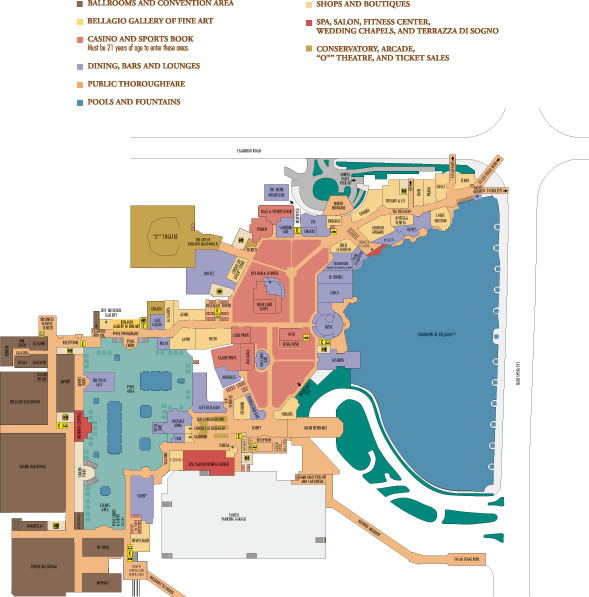
    Previous Bellagio visitors had to rely on a static map to find their way around the massive Bellagio resort.

    In May, Qualcomm Atheros and Cisco showcased its collaboration to enhance indoor location services at a customer deployment at the Bellagio Resort and Casino in Las Vegas. The event took place in cooperation with MGM Resorts International during the Interop information technology conference. Participants had the opportunity to try out Qualcomm and Cisco’s approach to indoor location services, which uses the Qualcomm IZat indoor location platform with Cisco’s Connected Mobile Experience. According to the companies, the combination improves location accuracy and allows users to discover services with context awareness in sprawling retail, travel, and hospitality venues, such as Las Vegas resorts.

    The companies began their collaboration in November 2012. The Bellagio mobile app, available for iOS and Android, is now offered as a free download for guests using their smartphones, tablets, and other mobile devices.

    At the Interop event, participants were given Samsung devices with Qualcomm IZat software, which tracked their position within the Bellagio on a map as they moved through the hotel — a definite advantage over less-advanced apps which only provide a static map.

    Based on the person’s location, the mobile app provides recommendations of nearby services such as restaurants, shows, spa services, and bars and lounges on the property. Guests can become a loyalty member and be alerted to discounts at local restaurants, shops, and wine bars. “This creates a truly unique mobile experience for guests and visitors, putting all the amenities of indoor-location-enabled spaces at their fingertips,” according to Cisco.

    Event participants pick up Samsung phones equipped with the Bellagio app.
    Event participants pick up Samsung phones equipped with the Bellagio app.

    Qualcomm Atheros, which is Qualcomm Technologies’ networking and connectivity subsidiary, recently enhanced its IZat location platform to enable more precise positioning (within 3–5 meters) inside buildings to make indoor positioning more useful to consumers.

    The Cisco Connected Mobile Experience offers a Wi-Fi Passpoint (HotSpot 2.0) solution to integrate indoor location and real-time analytic technologies to deliver personalized mobile services and content. The solution is built upon the Cisco Mobility Services Engine, which uses the Bellagio’s existing wireless access-point infrastructure to determine indoor location for mobile devices. Cisco worked with MGM Resorts’ service provider Mobilitie and its partner Meridian to link the mobile app, context-aware services, and wireless connectivity experience together.

    The solution is designed to help app developers deploy mobile applications and services that engage the customer more effectively, the companies said.

  • Qualcomm to Sell Fleet Management Unit for $800M

    Qualcomm to Sell Fleet Management Unit for $800M

    Logo: OmnitracsQualcomm Incorporated has signed a definitive agreement to sell its fleet management and tracking business Omnitracs to Vista Equity Partners for $800 million in cash.

    The acquisition will include all of Omnitracs operations in the U.S., Canada and Latin America, including Sylectus and FleetRisk Advisors, which were acquired by Omnitracs in 2011. The transaction is expected to be completed during the first quarter of Qualcomm’s fiscal 2014.

    Omintracs, formerly known as Qualcomm Enterprise Services, provides integrated fleet management applications, services and platforms to transportation and logistics companies. The company provides solutions for safety and compliance, driver retention, GPS fleet tracking, and fleet maintenance software.

    “In the late 1980s, Qualcomm pioneered the use of commercial vehicle telematics with the introduction of the first mobile information system for transportation and logistics,” said Qualcomm executive vice president Derek Aberle. “As one of Qualcomm’s earliest businesses, Omintracs has maintained a leadership position within the industry for 25 years. Today, the opportunity for fleet management and telematics is evolving rapidly, and we believe Omnitracs is well positioned to continue its leadership position as a stand-alone entity.”

    “We are long-term investors in enterprise software, data and technology-enabled businesses that are committed to being leaders in their fields,” said Robert Smith, chief executive officer and founder of Vista Equity Partners. “We are impressed with the compelling value proposition Omnitracs’ products and services offer their customers. We look forward to working with them and helping them to reach their full potential.”

    The closing of the transaction is conditioned upon, among other things, clearance under the Hart-Scott-Rodino Antitrust Improvements Act of 1976 and other customary closing conditions.

  • Qualcomm Announces 4G LTE Advanced Connectivity Platform for Mobile Computing

    Qualcomm Technologies, Inc., has announced the industry’s first 4G LTE Advanced embedded data connectivity platform for mobile computing devices, including thin form factor laptops, tablets and convertibles. The technology, based on Qualcomm Technologies’ Gobi chipsets — the MDM9225 and MDM9625 — is the first embedded, mobile computing solution to support LTE carrier aggregation and LTE Category 4 with peak data rates of up to 150Mbps. The announcement came at the Mobile World Congress being held in Barcelona, Spain, this week.

    The Gobi MDM9x25 embedded platform includes an embedded GPS receiver with GLONASS support for enhanced asset tracking, turn-by-turn navigation and other location-based services.

    The introduction marks the arrival of Qualcomm Technologies’ third-generation 4G LTE embedded chip, extends Qualcomm Technologies’ modem technology leadership in mobile computing, and promises to deliver the fastest 3G and 4G LTE connections worldwide, while offering the broadest multi-region coverage via a single SKU solution, the company said. PC OEM customers can  select from embedded module vendors that support a range of Gobi chipsets, from 3G solutions with speeds up to 42Mbps to cutting-edge 4G LTE Advanced. Coupled with pay-as-you-go, no contract data plans, these products enable thinner, lighter and better connected mobile computing devices running leading operating systems such as iOS, Android, Windows 8 and Windows RT, and support a variety of modules for thin form factors, including PCI Express Mini Card, PCI Express M.2, and Land Grid Array.  Additionally, the Qualcomm RF360 Front End solution, providing expanded active band support integral to Qualcomm Technologies’ single SKU LTE World Mode solution will also be included.

    “Our broad portfolio of Gobi chipsets — including 3G 42Mbps, 4G LTE and 4G LTE Advanced — features industry-leading LTE multiband support for seamless connections to the fastest networks worldwide,” said Cristiano Amon, executive vice president of Qualcomm Technologies and co-president of Qualcomm Mobile Computing. “This latest addition can be easily implemented across enterprise, SMB and consumer industries allowing end users to download and stream rich HD content, access enterprise applications, share large files quickly and connect virtually wherever they are in the world.”

    Qualcomm Gobi MDM9x25 chipsets began sampling to module vendors last November and will enable commercial device launches in the second half of this calendar year.

  • Verve Mobile Ad Company Secures Funding from Nokia, Qualcomm

    Location-powered mobile advertising company Verve Mobile announced today it has closed its Series C financing led by Nokia Growth Partners, a global growth stage venture firm focused on mobile technology, services and media with participation from new investor Qualcomm Incorporated, acting through its venture investment group, Qualcomm Ventures (QCOM), and Series B lead investor BlueRun Ventures.

    The capital will be used to further develop and expand Verve’s proprietary mobile location-based advertising and publishing products and to grow its marketing and sales capabilities.

    “Verve’s focus is combining big data, location-based services (LBS) and ad technologies to make mobile advertising work better for advertisers and publishers,” said Tom MacIsaac, Verve Mobile CEO.  “Nokia and Qualcomm are global leaders in mobile technology innovation and have important insights, assets, initiatives and relationships that can help Verve maintain its lead in location powered mobile advertising.”

    John Gardner of Nokia Growth Partners has joined Verve’s Board in connection with the financing, and Quinn Li of Qualcomm Ventures has become a Board Observer.

    Verve Mobile’s customers are national-brand advertisers who want to engage consumers on their mobile devices with location-aware, data-driven and highly targeted marketing, the company said. Verve has offices in New York, Washington D.C. and San Diego, California.

  • Report Looks at Indoor Location Positioning and Mobile Markets

    In December 2011, Grizzly Analytics released its first comprehensive report on indoor location positioning technology, predicting that indoor location services were ready to revolutionize the mobile market. The five months that followed have shown how true this was, with new initiatives announced on a regular basis and numerous demonstrations at industry conferences, Grizzly Analytics says.

    In a fully revised and updated 163-page report, Grizzly Analytics gives an up-to-date analysis and comprehensive overview of indoor location positioning R&D. Included is information on the research activity of all the major mobile companies — Google, Microsoft, Samsung, Apple, Nokia, RIM, Cisco, Qualcomm, Broadcom, STMicroElectronics, Sony Ericsson and others — and also more than 30 start-up companies that are actively bringing indoor location services to market.

    “These technologies are poised to revolutionize smartphone usage by enabling GPS-style mapping, navigation, local search, check-ins, location-sharing and other location-based services to work indoors in malls, megastores, offices, airports, casinos and other big indoor places,” according to a statement by Grizzly Analytics. “Indoor location will also transform commerce, enabling searching for items on store shelves, sending deals and promotions to nearby customers, advertisements for nearby stores in malls, and more. Location services are also entering the enterprise, with indoor asset tracking, employee search, and more.

    “In this updated technology trend report, Indoor Location Positioning: Research Pipelines, Start-ups and Predictions, Grizzly Analytics answers the questions you have about this new technology. What approaches are being researched by different companies? Which companies have mature research? What are the gaps in each company’s research that they are likely to fill by acquiring start-up companies? Which start-up companies are likely to be acquired or to emerge successful in the market? What areas of technology are not yet addressed by start-ups, and remain open to new entrepreneurs and investors?”

    A related report, Indoor Location Solutions and Services: Challenges, Opportunities and Market Outlook, is also available from Research and Markets.

  • Telit Introduces Qualcomm-Based HSPA Modules for Global M2M Markets

    Telit Wireless Solutions today introduced the UE910 V2 HSDPA (High Speed Downlink Packet Access) and HE910 V2 HSPA+ (High Speed Packet Access) modules based on Qualcomm Technologies, Inc. chipsets, each to be banded for European and North American markets.

    The MDM6200-based HE910 V2 supports both GPS and GLONASS location technologies, is fully digital audio capable, and provides full-duplex PCM input and output. With these features — combined with the up to 14.4Mpbs downlink and 5.76Mbps uplink data rates — the HE910 V2 is designed for applications such as video surveillance and security, and emerging applications areas such as healthcare, Smart Home, and Smart Grid.

    Both products feature dual-band 3G and GSM/GPRS/EDGE support. The entry-level 3G UE910 V2 is based on Qualcomm Technologies’ QSC6270 chipset and delivers a top 3.6Mbps downlink data rate.

    The new products are fully compatible with Telit’s xE910 family and can be easily dropped into existing or planned designs for xE910 modules requiring no additional rework. Positioned at entry-level and mid-range respectively, the new Qualcomm Technologies-based UE910 V2 and HE910 V2 modules enable the Telit xE910 family to enhance cross-technology compatibility with its other popular global air-interface technologies. The application of the Qualcomm Technologies chipsets improves interchangeability between CDMA (1xRTT, EV-DO) and UMTS (HSDPA, HSPA+) variants making the adaptation of customer applications to regional technical requirements quick and easy, minimizing time to market and total cost of ownership.

    The QSC6270-based UE910 V2 is to be positioned as a 2G to 3G migration path product, and includes high-value features such as analog audio, making it ideal for applications from home and commercial security and surveillance systems, to asset monitoring, logistics, and mass-transit monitors. Telit is planning a UE910 V2 variant based on QSC6270-Turbo with additional support for Java J2ME 3.2 and eCall.

    Both the UE910 V2 and HE910 V2 will be available in local band-group variants as required for all major carriers and partner networks in North America and Europe. The Qualcomm Technologies-based products will be available in North America with 850/1900MHz and in Europe with 900/2100MHz dual-band combinations. Both regional variants will be available in data-only as well as data & voice variants.

    “The Qualcomm Technologies-based entry-level 3G UE910 V2 and mid-range HE910 V2 are Telit’s new 3G products launched in response to increasing demand for dual-band HSDPA, and HSPA+ modules,” said Dominikus Hierl, chief marketing officer at Telit Wireless Solutions. “They come to address the need from application areas and regions requiring easy interchangeability between CDMA or UMTS lines of air interface technology, particularly in United States, Europe and key opportunities.”

    “Qualcomm Technologies’ fully-integrated QSC6270, QSC6270-Turbo and MDM6200 chipsets support the bandwidth and feature requirements of a broad range of M2M applications, and we are pleased to enable  HSDPA, and HSPA+ products in the xE910 family,” said Nakul Duggal, vice president of product management for IOE, Qualcomm Technologies. “By using Qualcomm Technologies’ Gobi 3G solutions in its xE910 product family, Telit will be able to offer its customers the technology flexibility to address M2M products and drive 2G to 3G migration in Europe and North America.”

  • Qualcomm, AT&T Support Internet of Everything Development Platform

    Qualcomm Incorporated, through its wholly-owned subsidiary Qualcomm Technologies, Inc., has announced an Internet of Everything (IoE) development platform based on Qualcomm Technologies’ QSC6270-Turbo chipset that supports Oracle’s Java ME Embedded 3.2. The IoE development platform features support for standalone GPS.

    The platform, which uses Qualcomm Technologies’ Gobi modem solution for 3G, enables developers to accelerate development efficiency and decrease time-to-market for a wide range of applications and devices to connect to the AT&T mobile internet. AT&T and Qualcomm Technologies expect this IoE development platform to be available to developers in the second quarter of 2013.

    The IoE development platform provides a starting point for creating a range of cellular-connected products and applications for IoE verticals such as tracking, industrial controls and health care. With this platform being capable of supporting Oracle’s Java ME Embedded 3.2 software release, developers with little mobile development experience can quickly go from concept to writing and executing Java applications directly on the QSC6270-Turbo chipset.

    In North America, this IoE development platform will be supported by AT&T, allowing developers to test their solutions and demonstrate functionality on a live network in the design and development phases, which can reduce complexity, cost and time for developers as they drive to get their solutions to market. With access to the various hardware interfaces and capabilities of the 3G modem via the application environment hosted on the QSC6270-Turbo chipset, developers can also customize and optimize end-product PCBs without the need for additional discreet processors or micro-controllers, thus cost-effectively integrating cellular capabilities into a wider range of devices and solutions.

    The platform includes several onboard sensors and indicators, including an accelerometer, light sensor and temperature sensor. The Java ME 3.2 software release, which can run on this platform, includes several new JSRs for IoE applications, as well as Device Access and AT Command Pass Through APIs that give developers access to a large number of chipset IOs and interfaces, such as GPIO, I2C and SPI. The platform supports cellular coverage for tri-band UMTS/HSDPA – 2100/1900/850 MHz – and quad-band GSM – 850/900/1800/1900 MHz – support, as well as 2.4GHz Wi-Fi a/b/g/n via a Qualcomm Atheros, Inc. AR6103 module.

    “This IoE development platform opens a world of opportunity for equipment makers who want to connect their devices to the mobile internet,” said Chris Penrose, senior vice president, emerging devices, AT&T. “Wireless connectivity makes products better, and this IoE development platform makes it easier for both existing and new AT&T developers to embed wireless into their products.”

    “Qualcomm Technologies sees the Internet of Everything as having significant potential. In addition to large IoE verticals like automotive and energy that have established industry players, application developers are key to creating future IoE verticals and applications that haven’t even been thought of yet,” said Kanwalinder Singh, senior vice president of business development, Qualcomm Technologies, Inc. “This IoE development platform with Java support is a tool to extend the power of our integrated chipsets to application developers. We are excited that AT&T shares our vision of a cellular-connected IoE, and by the opportunities that will be created by the AT&T developer community.”

  • Qualcomm Announces Commercial Availability of MCP50 for Fleet Management


    Qualcomm announced the commercial availability of the Mobile Computing Platform 50 (MCP50). For fleets of all sizes, the fleet management solution helps transportation companies meet safety and regulatory compliance requirements to manage their business operations, Qualcomm said. Qualcomm also launched flexible new monthly pricing plans.

    “We are committed to helping fleets succeed and grow as they adapt to new industry demands and regulations,” said Norm Ellis of Qualcomm Enterprise Services. “With more than 150 private and for-hire fleets of all sizes already committed to adopting the MCP50, we are pleased that our industry-leading fleet management applications are now more accessible than ever to help fleets address a broad range of operational challenges, including safety, compliance, productivity and fuel efficiency.”

    MCP50 delivers applications to meet the core operational needs, including safety and compliance requirements, such as FMCSA’s HOS regulations and CSA program. Applications include: Qualcomm Hours of Service, CSA Safety Performance Service, Critical Event Reporting, CoPilot Truck In-Cab Navigation provided by ALK Technologies, Performance Monitoring with Fuel Manager, Analytics Manager and Vehicle Inspection Report. Other Qualcomm applications planned for future releases of the MCP50 include Circle of Service Workflow, Trip Manager and Vehicle Maintenance.

    MCP50 is available for $799 SRP through local dealers and resellers that are part of the Pana-Pacific distribution network or directly from Qualcomm Enterprise Services. Qualcomm Enterprise Services also offers six different monthly service pricing plans, starting at $19.95 per month.

  • January Is Off to a Mad Start

    Join me on January 29 at 1:00 ET for a free webinar on location-enabled networking applications. I will talk with my guests from Pelago’s Whrrl and Booyah!’s MyTown about the state of the market, monetization, and the future.

    January is off to a mad start. iPhones users are no longer hostage to AT&T. CES was cooking with navigation announcements from car makers and more connected personal navigation devices. Garmin took a radical step. Location-based social networks applications are getting hotter with a new entry from Qualcomm. AT&T has a new location service for enterprises. And Groupon is sitting on a mattress stuffed with money.

    Qualcomm is now in the location-based social network business with its introduction of Neer, an application for Android and iPhones. Neer is privacy sensitive and designed to keep information within personal groups. Unlike foursquare, it is not searchable. Locations are also given names that don’t disclose specifics. For instance, it may be “meet at school,” “arrived at work,” or “meet at game.” According to Qualcomm, Neer is accurate within a few blocks.

    The market. Melissa Parrish of Forrester Research wrote a report on location-based social networks (LBSN) in July that started a heated industry discussion. Parrish estimated the market to be 4% of U.S. online adults, but many argued (some loudly) it was much larger. I asked Parrish for her current thoughts: “The LBSN market is steadily growing,” says Parrish. “Facebook Places hasn’t overpowered the market as many supposed.” This is in part because no one location-based social network app has delivered a clear and overpowering utility, allowing niche players a place at the table. Facebook also hasn’t dominated because it has been collaborative and opened up its social graph to partners like Loopt, Gowalla, and Yelp.

    Privacy continues to be a big discussion around these applications. Users are concerned both about sharing their location and having data collected about their activities. As location becomes more accurate and applications become more personalized, the creepiness factor can take hold. Parrish says the question is, “What can be done; what should be done; and what will be legislated?

    AT&T enterprise customers in for location. Last week AT&T announced Location Information Services, a cloud-based offering to provide enterprises with network-based location information for corporate assets, employee devices, and consumer handsets. “We’re seeing an increased demand from our business customers to utilize the AT&T global network to be more location aware of their assets,” said Chris Hill, AT&T. The service is being developed with LOC-AID and TechnoCom. The service is scheduled to launch later this year.

    Money is flowing. Groupon and SCVNGR are in the money. Groupon is getting a windfall. According to the New York Times, Groupon’s $950 million financing round is the largest venture financing for a start up. Groupon sells bargains in 500 international markets. Users pay up front for discounts such as 50% off shi shi cupcakes in Santa Monica or cellulite reduction treatments in Queens. Last year Groupon partnered with JiWire to enable hyper-local offerings based on a person’s real-time location, allowing contextual ads.

    SCVNGR, pronounced Scavenger, got a more modest round of $15 million. Players of this social location-based game are given challenges to compete in a particular location. Challenges might direct you to upload a photo of yourself at Sam Adam’s grave or answer a riddle about a piece of art at the Metropolitan Museum of Art. Google Ventures is one of its investors.

    Game that revenue. Advertising spends on mobile gaming apps is predicted by Juniper Research to increase ten-fold over the next five years, from $87 million worldwide in 2010 to $894 million in 2015. The immensely popular Rovio Mobile’s Angry Birds is being offered for free and sustained by ad revenue. Yet Juniper forecasts paid downloads and in-game purchases will be 10 times higher than ad spends in 2015.

    Garmin goes Apple (finally!). Apparently, after waiting to see if iPhones catch on, Garmin announced its first iPhone navigation app. The Garmin StreetPilot is a server-based solution, downloading maps as needed, rather than storing them on the phone. It sells for $39 on iTunes. In another first, Garmin is entering the personal and property tracking market with the GTU 10.

    Transform your smartphone. Pioneer unveiled SmartCradle for iPhones at CES. The cradle is used in a vehicle in conjunction with a smartphone to create a full navigation application. According to Pioneer, it is compatible with all GPS enabled apps, including MotionX-GPS Drive, which incorporates a built-in gyro sensor and accelerometer combined with an external antenna for improved GPS reception and location accuracy. The SmartCradle will also charge the connected iPhone.

    Newbie. Four months ago Geomium launched in the UK and U.S. as a new location-based social network. Michael Ferguson of Geomium says, “We are using real time location and providing our users with a dynamic experience in which they can connect to people, places, deals, and events.” Geomium finds the 20 closest deals within a few miles and provides a stream of “shouts” about what is happening nearby.

  • The Business: SiRF, CSR to Merge; Kanwar Chadha’s Perspective

    » MASS MARKET OEM

    SiRF, CSR to Merge; Kanwar Chadha’s Perspective

    SiRF Technology Holdings, Inc., of San Jose, California, and CSR plc, formerly Cambridge Silicon Radio, headquartered in Cambridge, United Kingdom, will merge in a stock-for-stock transaction to create a new company, which will automatically assume a competitive, leading position in global connectivity and location markets. The companies expect the transaction to close in the second quarter of 2009.

    “Financially, strategically, and commercially, this is a compelling transaction,” said Joep van Beurden, CEO of CSR — and analysts would almost universally agree. SiRF has been under the financial microscope since troubles surfaced in Q1 2008, and speculation about an acquisition had been rife.

    Further, SiRF has been locked in a patent battle with Broadcom, the latter involved through its July 2007 acquisition of Global Locate.

    CSR has made its mark in the Bluetooth connectivity sector, combining multiple connectivity technologies, while SiRF has long pioneered GPS location with multifunction system-on-chip (SoC) location platforms for consumer handhelds and cell phones. In January 2007, CSR purchased GNSS software receiver innovator NordNav.

    Chadha Says. “From a strategy viewpoint,” SiRF founder and vice president of marketing Kanwar Chadha told GPS World, “multi-function radios is something we have been talking about for two years. Market opportunities became much larger in the last six months, with Nokia driving loction into every mobile phone.

    “When you see a market opportunity in front of you, it’s better to combine best-of-class than to build a solution from scratch.

    “We have a strong customer base in automotive and PNDs, while we are expanding into wireless. CSR is compelementary: strong now in wireless, and so on.

    “In easy times, you can build your own solution. In tough times, trying to build an additional platform of technology, if we start from scratch, that may take four to five years to prove out; that’s very difficult. Both of us tried to do that, by the way. They need GPS, we need Bluetooth.

    “Now, our multimode AGPS with their EGPS, and the economies of scale enjoyed by a now close to a billion-dollar company, we feel very good about that. Bluetooth in hands-free mobile phones, that has a 50 percent penetration in handsets. It is much deeper than GPS today, although GPS is catching up.

    “Their [CSR’s] world is very mobile-phone centric. We are more location-platform centric, more diverse in our view. It will be very interesting. GPS-Bluetooth-FM: for our customers, the handset vendors, this is their most requested combination. There are two ways to integrate these function: integrate GPS with a modem, as Qualcomm does, or integrate it into  what CSR calls a connectivity center, of short-range wireless technologies.”

    Lines Drawn. A significant market battle continues between the big four in the mass market OEM GPS chip sector: Broadcom, Qualcomm, CSR, and TI, formerly Texas Instruments — with Sony and Panasonic quietly going about their own business, making GPS chips for brand devices, but in a position to supply others, if they are not doing so already. The new ST-NXP Wireless joint venture with Ericsson (see story page 18) will also play in that arena.

    Chadha does not expect to see competition from manufacturers in Taiwan and China, at least not immediately. “These are complex radio technologies, not simple digital technologies.”

    Brand. “The SiRF brand won’t go away, it’s very strong,” he concluded. “We’ll continue to build on it. the location platform will be our recognizable art of the new company , and of course we’ll continue applying our expertise there.”

    On a pro forma basis, the two companies combined would have had 2008 sales of approximately $927 million. The combination will create the single largest pure-play provider of integrated connectivity and location platforms and will be one of the top 10 fabless semiconductor companies in the world, according to a joint statement. Customers include four of the top five handset makers, the top five PND makers, the top two auto-telematics suppliers, and other leading electronics providers. CSR and SiRF will have design and customer-support centers around the world.

    On closing of the transaction, SiRF stockholders are expected to own 27% and CSR shareholders are expected to own 73% of the combined company. CSR’s board will add SiRF interim CEO Dado Banatao and Chadha. The combined company, with CSR’s Van Beurden as CEO, will be based in Cambridge, and San Jose will serve as U.S. headquarters.

    » TELECOMMUNICATIONS

    Ericsson and STMicro Complete Mobile Merger

    STMicroelectronics and Ericsson have closed their agreement merging Ericsson Mobile Platforms and ST-NXP Wireless into a 50/50 joint venture. The deal was completed on the terms originally announced on August 20, 2008.

    The new company is designed for long-term stability and to become an industry leader in product research, as well as design, development, and the creation of mobile platforms and wireless semiconductors. The joint venture begins as a major supplier to four of the industry’s top five handset manufacturers, who together represent about 80 percent of global handset shipments, as well as to other industry leaders.

    Ericsson contributed $1.1 billion net to the joint venture, out of which $0.7 billion was paid  to STMicro. Before the closing of the transaction, STMicro exercised its option to buy out NXP’s 20 percent ownership stake of ST-NXP Wireless.

    Alain Dutheil, CEO of ST-NXP Wireless and chief operating officer of STMicroelectronics, will lead the joint venture as president and chief executive officer.Employing about 8,000 people — roughly 3,000 from Ericsson and 5,000 from STMicro — the new wireless technologies company is headquartered in Geneva, Switzerland.

    » MILITARY & GOVERNMENT

    Honeywell T-Hawk Micro Vehicle Heads for U.K.

    Honeywell received an order for six T-Hawk micro air vehicle (MAV) systems from the U.S. Navy, the contracting agency for the U.K. Ministry of Defence (MOD) for the T-Hawk MAV system procurement, in a contract valued at USD $5.7 million.

    The new U.K. order comes in addition to the Navy’s existing T-Hawk contract with Honeywell, announced in November 2008, for 90 systems. The T-Hawk MAV will be used by joint force EOD (Explosive Ordinance Device) units in Iraq and Afghanistan, among other locations.

    The circular vehicle, weighing 17 pounds and 14 inches in diameter, can fly down to inspect hazardous areas for threats without exposing warfighters to enemy fire. The T-Hawk MAV can take off and land vertically and fly more than 40 minutes, at more than 40 knots of airspeed, operating at altitudes of more than 10,000 feet.

    An eye-in-the-sky for battlefield surveillance, the Honeywell MAV carries video cameras to relay real-time data and a GPS device. It identifies improvised explosive devices (IEDs) and can inspect suspected bomb sites in areas inaccessible by ground robots.

    » MASS MARKET OEM

    Epson, Infineon Develop Tiny Single-Chip Receiver

    Seiko Epson Corporation of Tokyo, Japan, and Infineon Technologies AG of Neubiberg, Germany, have developed a GPS single-chip design, the XPOSYS, which is optimized for mobile devices for the consumer market — especially cellular phones with navigation features.

    Compared to existing solutions in the market, the XPOSYS, which is manufactured in a 65-nanometer process technology, provides increased performance and new levels of user experience, the companies said.

    Sensitivity has been increased from -160 dBm to -165 dBm, allowing for pinpoint positional accuracy when indoors or in urban canyons. Power consumption has been reduced by 50 percent, increasing the battery life of products in which it is included. The footprint has been reduced to 2.8 x 2.9 millimeters, which the companies claim is 25 percent less than the smallest GPS chip available elsewhere.

    u-blox Launches Cards for Mobile Computers

    A GPS PCI Express Mini card from u-blox (Thalwil, Switzerland) enables next-generation laptop, netbook, mobile internet device and Ultra Mobile PC OEMs to provide GPS and location-based services (LBS) such as personal navigation, services and people finders, and geo-tagging.

    “With the explosive potential of next-generation GPS applications and services for mobile PCs, it is the right time to introduce a robust PCI Express mini card supporting location-based services,” said Thomas Nigg, Vice President Product Marketing at u-blox.Sales of mobile PCs with integrated GPS are projected to grow from 3 million units in 2007 to 45 million units in 2011, according to u-blox.

    Qualcomm Launches Chipset for Low-Cost Smartphones

    Qualcomm, Inc., has launched the Mobile Station Modem MSM7227 chipset designed to enable high-performance, sub-$150 smartphones. The MSM7227 chipset features integrated Bluetooth 2.1 and GPS, a 600-MHz applications processor with a floating point unit, 320-MHz application DSP, 400-MHz modem processor, hardware-accelerated 3D graphics, 8-megapixel camera, and 30-fps WVGA video encode and decode and display support.

    The MSM7227 chipset is designed to provide advanced processing and multimedia while using HSDPA/HSUPA for broadband data speeds over 3G networks. It also can support all leading mobile operating systems including Android, Symbian S60, Windows Mobile and BREW Mobile Platform, according to the company.

    The MSM7227 chipset has a 12 x 12 millimeter footprint and lower power consumption than previous MSM7xxx-series chips. It is sampling now, and commercial smartphones based on the chip are expected to launch later this year.

    Broadcom Combos GPS, Bluetooth, and FM Radio System-on-Chip

    Broadcom Corporation of Irvine, California, has released BCM2075, a new, integrated GPS, Bluetooth, and FM radio in a single-chip design, targeting location-based services (LBS) applications. The processor reduces the host and application processing required by competing combo solutions, enabling greater adoption in mass market handsets, according to the company.

    The BCM2075 integrates four radios (Bluetooth, GPS, FM receive, and FM transmit), enabling the radios to operate simultaneously and with minimal interference.

    The company expects the chip to drive key handset applications that network operators and consumers are looking to adopt, furthering the cause of LBS and advanced multimedia available on mid-range mobile phones. The GPS core uses a host-based integration architecture that splits the processing duties between the BCM2075 and the host CPU system and provides low GPS power, delivering a reported 50 percent better power performance compared to other chips, the company said. Broadcom’s GPS technology, stemming largely from its July 2007 purchase of Global Locate, enables a fast time-to-first-fix and provides integrated support for other positioning technologies, such as Wi-Fi positioning.


  • SiRF and CSR to Merge

    SiRF Technology Holdings, Inc., based in San Jose, California, and CSR plc, formerly Cambridge Silicon Radio, headquartered in Cambridge, UK, will merge in a stock-for-stock transaction to create a new company, which will automatically assume a competitive/leading position in global connectivity and location markets. The companies expect the transaction to close in the second quarter of 2009.

    “Financially, strategically and commercially, this is a compelling transaction,” stated Joep van Beurden, CEO of CSR — and analysts would almost universally agree. SiRF has been under the financial microscope since troubles surfaced in Q1 2008, and speculation about an acquisition had been rife.

    Further, SiRF has been locked in a patent battle with Broadcom, the latter involved through its July 2007 acquisition of Global Locate.

    CSR has made its mark in the Bluetooth connectivity sector, combining multiple connectivity technologies, while SiRF has long pioneered GPS location with multifunction system-on-chip (SoC) location platforms for consumer handhelds and cell phones. In January 2007, CSR purchased GNSS software receiver innovator NordNav.

    For the moment, Qualcomm CDMA sits on the sidelines, but a significant and long-going market battle continues between (now) the big three in the mass market OEM GPS chip sector: Broadcom, Qualcomm, CSR — with Sony and Panasonic also quietly going about their business, primarily making GPS chips for their own brand devices, but certainly in a position to supply others, if they are not doing so already.

    Based on CSR’s and SiRF’s results for fiscal year 2008, on a pro forma basis, the combined companies would have had sales of approximately $927 million. The combination will create the single largest pure play provider of integrated connectivity and location platforms and will be one of the top 10 fabless semiconductor companies in the world, according to a joint statement by the two. Customers of the combined company include four of the top five handset manufacturers, the top five personal navigation device makers, the top two auto-telematics suppliers, and other leading auto and consumer electronics providers. CSR and SiRF will have design and customer support centers around the world.

    Under the terms of the agreement, SiRF stockholders will receive 0.741 of a CSR share for each share of SiRF common stock they own. Based on the closing stock price for CSR on February 9, this consideration would be equivalent to $2.06 of CSR stock for each SiRF share, representing total consideration of $136 million. This represents a premium to SiRF stockholders of approximately 91% over SiRF’s closing stock price on February 9. On closing of the transaction, SiRF stockholders are expected to own approximately 27% and CSR shareholders are expected to own approximately 73% of the combined company. The transaction is expected to be tax-free for SiRF stockholders.

    SiRF, listed on the NASDAQ exchange, generated revenues of $232 million in 2008, and had gross assets of $195 million as of December 27, 2008.

    CSR is listed on the London Stock Exchange. CSR’s customers include industry leaders such as Audi, Ford, LG, Motorola, NEC, Nokia, Panasonic, RIM, Samsung, Sharp, Sony, TomTo,m and Toshiba. CSR has its headquarters and offices in Cambridge, UK, and offices in Japan, Korea, Taiwan, China, India, France, Denmark, Sweden, and both Dallas and Detroit in the USA.

    According to the companies, the transaction proffers the following benefits to both the companies themselves and their stockholders:

    Combined Product Roadmap for Next-Generation Chips. The combined company will have significant R&D resources to deliver a broader portfolio of location and connectivity solutions to customers. R&D efforts will continue to support each company’s existing product lines and will also be focused on the delivery of additional multifunction radio chips, which combine CSR’s Bluetooth and other connectivity capabilities with SiRF’s GPS and GNSS technologies.

    Growing Market Opportunities and Revenue Synergies. The combined company will benefit from significantly increased scale to meet the demand for both connectivity and location services in a broad range of products spanning mobile phones, automobiles, personal computers, mobile Internet devices, digital cameras, mobile gaming, and other consumer electronics products. The companies expect to achieve significant additional revenue synergies beginning in 2010 and beyond through a combination of cross-selling opportunities, deeper penetration of existing customers, new product offerings combining complementary technologies, and access to new markets.

    Financial Synergies. The companies expect that annual cost synergies of at least $35 million in savings from gross margin improvements and reduced R&D, sales and marketing, and overhead costs can be achieved through steps that can be implemented within 60 days post completion of this transaction.

    Financial Strength and Flexibility. The combined company is expected to have a strong balance sheet and cash position. At the end of fiscal year 2008, on a pro forma basis, the combined company had $378 million in cash and no bank debt.

    Following the close of the transaction, CSR’s board of directors will be expanded to add two members of the SiRF board, interim CEO Dado Banatao and co-founder and VP of marketing Kanwar Chadha. Van Beurden will lead the combined company as CEO with the remaining leadership to be comprised of executives from both SiRF and CSR. The combined company will be headquartered in Cambridge (United Kingdom), and SiRF’s San Jose, California, headquarters will become the headquarters for CSR’s U.S. operations.

    The transaction is subject to regulatory approvals and the approval of SiRF and CSR shareholders.

    More information can be found at www.csr.com.