Tag: QZSS

  • The System: QZSS Puts L1C on the Air

    QZSS Puts L1C on the Air

    JAVAD Receivers Track the First Truly Interoperable Signal

    JAVAD GNSS engineers in Moscow have released plots of the C/A, L2C, L5, SAIF, and the new L1C signals broadcast by Japan’s QZSS Michibiki, the first satellite to transmit L1C.

    The company stated that all of its current GNSS receivers can track QZSS signals with a software update that is available as an option to purchase.

    A new civil signal, L1C is designed to be interoperable among GNSSs. Currently, agreements are in place between the U.S. GPS, Europe’s Galileo, and Japan’s QZSS systems regarding broadcast and use of L1C. The U.S. system is not destined to add the L1C signal until the GPS III block of satellites, still more than three years out.

    The SAIF (Submeter-class Augmentation with Integrity Function) signal is a GPS augmentation with information on positioning correction and system health. The QZSS L1-C/A, L2C, L5, and L1C signals are GPS augmentation signals that can be operated reciprocally with positioning signals provided by GPS. The figures supplied by JAVAD GNSS show SNR (top) and code-minus-phase (bottom) plots for L1C.


    Plot of QZSS L1C signal, SNR.

    Plot of QZSS L1C signal, code minus phase (above).


    EC’s Galileo Manager Discusses Progress, Interoperability

    Paul Verhoef, the European Commission’s program manager for European Union (EU) satellite navigation programs, discussed current issues at length with GPS World, in a conversation on November 10. He addressed aspects of interoperability with GPS and prospects for further development in that area, the need for an ongoing political commitment by the EU to Galileo, the challenges of financing, the prospects for an 18-satellite constellation (which he dismisses as unrealistic), military considerations for both Galileo and GPS, and the recent uncertainty around Galileo’s Public Regulated Service.

    The full conversation is available here. Here are a few extracted quotes:

    Interoperability. “We have seen in the process with the U.S. that first of all there has been a quite clear political commitment on both sides, at the highest levels, that interoperability was wanted. Secondly, in the implementation we’ve had a very good working relation with our U.S. colleagues in order to establish that. The advantage that I see is that we have been able at a very early stage to deliver on such an interoperability agreement, that this is clear to industry, it provides for predictability. It allows industry to monitor clearly how the two systems are evolving, and when this interoperability is actually going to be available in the marketplace, and it allows them to time their investments, their R&D, their production, and all the rest.” [ . . . . ]

    Challenges. “It is time that Galileo delivers something concrete. We’ve had many years of discussion behind us on whether the system will come, and if it will come, and how it will come, and what it will look like, and all the rest. For my part, I’m very happy to see that in 2011, we plan to launch.

    The first four satellites are on the way; they are almost ready. About half the ground infrastructure is currently under implementation, we have every couple of months the opening of another ground station around the world. With this, the system becomes a reality, and I think once the satellite launches will go across television screens in the whole world, people will see that the system is becoming a reality. And I think that is desperately needed in order to give it a sense that things are moving forward. I’m really looking forward to that. That is a piece of good progress we have achieved over the last couple of years.

    Constellation. “There is a bit of a discussion for some reason in Europe, for some reason some people seem to think that we could do away with 18 satellites. Well, from me you will hear a solid ‘No.’

    “The availability figures for an 18-satellite constellation are around 90 percent on average, which means that for an aggregate total of some six weeks a year you would not receive sufficient views, not have sufficient satellites in sight to actually determine a position. There are going to be sectors like aviation where this is completely unacceptable, and they would never invest in anything if that is what we’re going to do. So my sense is that we will always have a lot of upward pressure in terms of constellation size. Of course it needs to be offset against costs and other considerations, but I think the pressure is always going to be there. It is very premature for people to be trying to take a shortcut, to think, well, maybe we could do with less. Because in the end you would have a constellation with a technical performance which the marketplace is not interested in, and then you would have a real problem.”

    Click here for the full discussion, spanning many topics.

    GPS Control Upgrade

    The U.S. Air Force 2nd Space Operations Squadron is scheduled to release the next software upgrade for the GPS ground system in early December, as part of an ongoing effort to improve and maintain the GPS Operational Control Segment before the next-generation GPS Control Segment is deployed in 2015. The upgrade is expected to be completed in early January 2011. The upgrade does not change the navigation message and should be transparent to GPS users. Tests have shown that the navigation message produced by the new software is identical to that produced by the current ground software. While no anomalies are expected, civilians experiencing any anomalies should contact the Coast Guard Navigation Center at (703) 313-5900.

    GLONASS Launch Fails

    The Russian Federal Space Agency announced that the December 5 launch of three GLONASS-M satellites ended in failure when the Proton-M rocket’s Block DM upper stage and its three payloads crashed into the Pacific Ocean about 1,500 kilometers (932 miles) northwest of Honolulu. Although an investigation will look into the exact cause of the failure, early unconfirmed reports indicate a software error. According to the Russian News Agency RIA Novosti, incorrect calculations were loaded into the rocket’s onboard computers.

    Compass Settles, Moves

    The Beidou/Compass G4 satellite launched on October 31 achieved geostationary orbit by November 6. The satellite is positioned at about 160 degrees east longitude. G4 is the furthest east of the operational Beidou geostationary satellites. Meanwhile, the orbital location of the Beidou 1A satellite has been changed.

    On or about October 27, as indicated by NORAD tracking data, the satellite underwent a significant delta-V, raising its orbit by about 200 kilometers. Its orbit had been slightly drifting for a few weeks before the maneuver, and there was speculation that the satellite had been placed in a disposal or graveyard orbit. However, on November 24 a second delta-V was observed that returned the satellite to the geostationary belt.

    The two maneuvers placed the satellite at a new location at about 60 degrees east longitude — the furthest west of any of the Beidou satellites. The satellite may eventually end up at 58.75 degrees east, one of the Beidou orbital slots registered with the International Telecommunication Union.

    The geostationary satellite, the first for the demonstration regional Beidou system or Beidou-1, was launched on October 30, 2000, and positioned at 140 degrees east longitude. Following several years of use, there were unofficial reports that the satellite was no longer functional. However, station-keeping was maintained, implying some usefulness of the satellite. It remains unclear how functional the satellite is and whether it is still useful for the Beidou-1 demonstration system.

  • The System: Michibiki Takes Up Station and Other GNSS Constellation Updates

    The System: Michibiki Takes Up Station and Other GNSS Constellation Updates

    As this issue goes to press in late August, the first Japan Aerospace Exploration Agency Quasi-Zenith Satellite System (QZSS) space
    vehicle, nicknamed Michibiki, holds steady for a September 11 launch.

    QZSS will use multiple satellites in inclined orbits, placed so that one satellite always appears near zenith above Japan, well known for its high-rise cities. The design provides high-accuracy satellite positioning service covering almost all of the country, including urban canyons and mountainous terrain.

    QZSS Phase One will validate technological enhancement of GPS availability, performance, and application. Phase Two will demonstrate full system capability using three QZSS satellites, including Michibiki.

    The satellites will generate and transmit their own signals, compatible with modernized GPS signals. QZSS also transmits GPS corrections and availability data.

    Michibiki Profile. Dual-box shape with wing-type solar-array paddles; overall dimensions, 2.9 x 3.1 x 6.2 meters, paddles extending 25.3 meters; weight approximately 4,000 kilograms; altitude approximately 32,000–40,000 kilometers; inclination approximately 40 degrees;
    period, 23 hours 56 minutes.

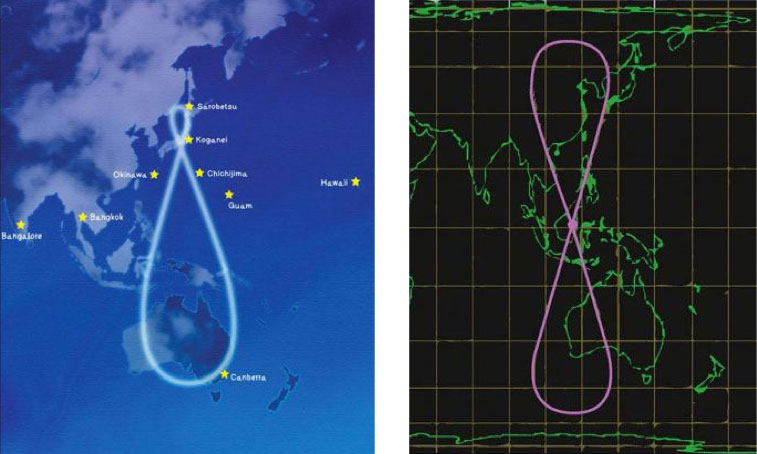
    Compass. In early August, the first Beidou/Compass inclined geosynchronous orbit (IGSO) satellite achieved near-geosynchronous orbit. The mean east longitude of the sub-satellite ground point is currently 117 degrees, 19 minutes (see figure 1). This is one of the first, if not the first, satellite to use such a highly inclined circular geosynchronous orbit.

    QZSS-orbits
    Figure 1. Left, the orbit path of three QZSS satellites will eventually keep at least one of them directly over Japan at all times. Right, the inclined geosynchronous orbit of the fifth Compass satellite, launched in July, has a similar ground track and mission goal.

    Multi-GNSS Campaign. An international collaboration is poised to take advantage of a coming proliferation of satellites, led by Compass and QZSS but also including GPS, GLONASS, and Galileo, over the Asia/Pacific region. The website www.multignss.asia/campaign.html states, “The Asia and Oceania region is a unique place where the number of usable modernized navigation satellites will increase much faster than other areas in the world. We will see great improvement of PNT capability and hence there is a great opportunity to try, test, and validate new receiver hardware, algorithms, and applications in order to address user requirements.”

    The web page also carries an animation of the availability of more than 100 GNSS space vehicles that will operate over the region in the next decade. An initial campaign workshop in Bangkok, Thailand, in January drew 195 participants from 18 countries. A second workshop is scheduled for November 21–22 in Melbourne, Australia.

    GLONASS September. Three GLONASS-M satellites to be launched on September 2 completed pre-launch testing and mating to the upper stage of the booster rocket at Baikonur Cosmodrome. Numbered 36, 37, and 38, the satellites will constitute the Block 42 triad.

    GPS III Design: Done. The Lockheed Martin team developing GPS III has successfully completed the program’s Critical Design Review (CDR) phase, two months ahead of baseline schedule. CDR completion validates the detailed GPS III design to ensure it meets warfighter and civil requirements. It culminates many rigorous assembly, subsystem, element, space vehicle and system-level CDR events, validates the overall design maturity of the GPS III space vehicle, and allows Lockheed Martin to enter production phase. Col. Bernard J. Gruber, U.S. Air Force GPS Wing Commander, certified the completion. Lockheed Martin, ITT, and General Dynamics are working under a $3 billion development and production contract for up to 12 GPS IIIA satellites. The team is on track to launch the first GPS IIIA satellite in 2014.

    GPS Interface Specs. New IS-GPS-200E, IS-GPS-705A, and IS-GPS-800A documents have been posted to www.gps.gov/technical.
    SVN62 Rubidium Clock. The U.S. Naval Research Laboratory issued a preliminary report on the rubidium atomic clock currently in use on the SVN62 Block IIF satellite. While documenting excellent short-term performance, the report notes anomalous fluctuations in the clock signal with distinct 12-hour and 6-hour periodicities. The exact cause has not been identified although it is speculated that the fluctuations are of thermal origin like SVN-62’s L5 phase variance detected earlier. But note that the clock signal analysis relies only on L1 and L2 measurements.

    GPS IIF Got Active. The 50th Space Wing’s 2nd Space Operations Squadron formally took over command and control of the first Block IIF satellite on August 26 from the GPS Wing, and the satellite was set healthy on August 27, making 31 healthy GPS satellites on orbit.

    Advisory Board Update
    GPS World Editorial Advisory Board member Art Gower has been elected a Lockheed Martin Fellow, an honor recognizing pre-eminent technical individual contributors in the company, delivering mission success and vision by undertaking the most difficult technical challenges facing the company and its customers. Art started his career with IBM Federal Systems Division (now part of Lockheed Martin Integrated Systems and Global Solutions) in 1983, developing displays and performing navigation upload and command and control system engineering for the GPS control segment, and becoming chief engineer for the GPS control segment in 1990. He has spent the majority of his career working on GPS, GNSS, and SBAS systems.

  • Out in Front: Beyond Cute

    Michibiki has more Twitter followers than you and me put together. All of you, and all of me with my 17 followers. Michibiki hit 16,284 when I signed on just now, and she (he?) has not yet even emerged upon the global stage. Perhaps by the time you read this, if the September 11 launch date holds true, s/he will be an orbiting, broadcasting entity.

    Michibiki-Alan
    Michibiki

    Why follow a satellite? One might well ask why follow anything or anyone these days. For utterings momentous or vacuous, leavened in lucky moments by a bit of gossip, or an even rarer bit of news. It’s a good bet that Michibiki’s scriptwriters will display more intelligence than the mass of online mouths. Right now it’s hard to tell; they communicate in Japanese, which comes through my browser as so many question marks.

    For intelligence is what the Michibiki anthropomorphizing — from the creation of a friendly, pettable caricature to the establishment of a Twitter voice — is all about. Savvy marketing by purposeful people to an audience that they have studied and know well. This goes beyond the cute that large segments of Japan have a fondness for. It has the goal of buliding a solid, sustained client core for location-based services, powered by QZSS signals.

    Other places where LBS have failed to take hold — and this means everywhere — despite their vast potential utility, would do well to watch and learn.

    As cell-phone text-message readers and e-mail users (could there be a broader market segment, other than people who eat and breathe?) become accustomed to receiving messages from Michibiki, they will subtly but increasingly think of this 4,000-kilogram, 40,000-kilometer high hunk of orbiting metal and circuitry as a personality, and even, a friend. They will be open to suggestions, impressionable and cute-prone teens and twenty-somethings, especially so. This is the next generation of satnav users. Or I should say, this is the Now Generation of satnav users.

    Young men and women with places to go and friends to see will remember Michibiki, and call upon her/him often. “My guide will tell me how to get there. With added services, my guide will also track my friends right now, and tell me where they are. My guide can do many more wonderful things for me: here is a list of them.”

    By no means  do I suggest that the U.S. GPS Industry Council or the Galileo Supervisory Authority or Roscosmos rush out and commission a cartoon character based on their respective space vehicles. Different markets require different approaches, and careful study.

    The Now Generation of satnav users is coming through, to supplant current users, and uses. They’ll soon rattle your windows and shake down your walls. If your time to you is worth saving, I do suggest that you pick up on social media. That is the message my own marketing staff keeps drumming into this obdurate old head.