Tag: radar

  • IMSAR sells UAV detect-and-avoid radar tech to Fortem

    IMSAR LLC, manufacturer of miniaturized synthetic aperture radar (SAR), is selling its detect and avoid radar technology to Fortem Technologies. The technology powered IMSAR’s previously announced family of collision-avoidance radar designed for the commercial unmanned aerial systems (UAS) market.

    The Federal Aviation Administration (FAA) requires an aircraft operating in civil airspace to be able to “see and avoid” other aircraft. Collision-avoidance systems seek to meet this requirement by allowing UASs to detect other airborne objects, predict potential midair collisions, and automatically maneuver the UAS to avoid catastrophes.

    A radar-based sense-and-avoid solution for small UAS was previously not viable because of high cost, weight and complex technology and algorithms required. Fortem’s product will enable small UAS to avoid mid-air collisions with manned or unmanned aircraft as well as targets that lack a transponder, such as cranes, paving the way for the integration of UAS into civil airspace worldwide.

    “Radar is ideally suited because it operates effectively in darkness, cloud cover, fog, smoke and precipitation,” said Britton Quist, IMSAR’s CTO.

    According to Ryan Smith, CEO, IMSAR, key development milestones have been met allowing the spin out of sense and avoid to Fortem Technologies. Adam Robertson, vice president of IMSAR, will be leaving to join Fortem Technologies after nine years at IMSAR.

    Fortem Technologies has announced product availability in July 2016.

    Fortem and IMSAR products are on display May 2-5 at the Xponential show in New Orleans, Booth 134.

  • IMSAR sells UAV detect-and-avoid radar tech to Fortem

    IMSAR LLC, manufacturer of miniaturized synthetic aperture radar (SAR), is selling its detect and avoid radar technology to Fortem Technologies. The technology powered IMSAR’s previously announced family of collision-avoidance radar designed for the commercial unmanned aerial systems (UAS) market.

    The Federal Aviation Administration (FAA) requires an aircraft operating in civil airspace to be able to “see and avoid” other aircraft. Collision-avoidance systems seek to meet this requirement by allowing UASs to detect other airborne objects, predict potential midair collisions, and automatically maneuver the UAS to avoid catastrophes.

    A radar-based sense-and-avoid solution for small UAS was previously not viable because of high cost, weight and complex technology and algorithms required. Fortem’s product will enable small UAS to avoid mid-air collisions with manned or unmanned aircraft as well as targets that lack a transponder, such as cranes, paving the way for the integration of UAS into civil airspace worldwide.

    “Radar is ideally suited because it operates effectively in darkness, cloud cover, fog, smoke and precipitation,” said Britton Quist, IMSAR’s CTO.

    According to Ryan Smith, CEO, IMSAR, key development milestones have been met allowing the spin out of sense and avoid to Fortem Technologies. Adam Robertson, vice president of IMSAR, will be leaving to join Fortem Technologies after nine years at IMSAR.

    Fortem Technologies has announced product availability in July 2016.

    Fortem and IMSAR products are on display May 2-5 at the AUVSI Xponential show in New Orleans, Booth 134.

  • Echodyne offers detect and avoid radar for small UAS

    Echodyne offers detect and avoid radar for small UAS

    echodyne-saa-auvsiEchodyne today announced the development of MESA-DAA, an Airborne Detect and Avoid (DAA) radar for small to medium-sized unmanned aircraft systems (UAS).

    Echodyne made the announcement at AUVSI’s Xponential 2016 trade show and conference.

    The small, lightweight and low power DAA radar will operate at K-band and be capable of rapidly scanning a broad field of view in azimuth and elevation at ranges out to 3 kilometers. MESA-DAA is based on Echodyne’s patented Metamaterials Electronically Scanning Array (MESA), which offers breakthrough cost, size, weight, and power (C-SWAP) improvements over traditional electronically scanning array technology.

    The MESA-DAA radar is scheduled for release at the end of 2016 and will be an evolution of the MESA-K-DEV radar, which Echodyne released today.

    “Detect and avoid is the single biggest technical hurdle to opening up the National Airspace System to UAS,” said Jim Williams, former head of the Federal Aviation Administration’s (FAA) UAS Integration Office and current Principal at Dentons US, LLP and Echodyne advisor.

    uav-Echodyne-W“NASA, the FAA, industry and academia have spent years studying the DAA problem and have determined radar is by far the best sensor, if not the only sensor, capable of providing the all-weather, long-range, and broad field of view scanning that is necessary for safe, highly reliable DAA. MESA-DAA technology may well represent the key to safely opening up airspace for beyond visual line of sight operations.”

    Detect and Avoid Requirement

    One of the FAA’s central aircraft operating rules is that pilots maintain vigilance so as to see and avoid other aircraft. To fulfill this requirement, UAS need to remain within visual line of sight of their pilot.

    Although the regulations for UAS are still in development, there is widespread acceptance that for UAS to fly beyond line of sight of their operator, they will need DAA sensors and systems that safely replace the pilot’s see and avoid capability. This DAA capability will need to detect both cooperative objects (those transmitting their position with a transponder) and non-cooperative objects (aircraft without transponders, birds, etc.).

    Radar is the only sensor capable of reliably performing DAA in all weather conditions and at the ranges, broad fields of view and scanning speeds necessary for safe operation of UAS in the NAS. Radar is the only sensor that directly measures the position of an object (such as range, azimuth, elevation) as well as its relative speed of approach (via Doppler).

    “We believe MESA-DAA will be a critical technology for safely opening up the National Airspace System to small UAS for beyond visual line of sight operations,” said Eben Frankenberg, founder and CEO of Echodyne. “Radar is the sensor of choice for DAA, but existing radar technology is too slow, too bulky and too expensive to provide DAA radar capabilities on small UAS. The C-SWAP characteristics of MESA and our DAA radar are completely unparalleled and uniquely well suited for small UAS.”

    In the April 7 “FAA Aerospace Forecast,” the FAA reports that it has already granted more than 4,000 Section 333 Exemptions for commercial UAS operations, clear evidence of the high demand for UAS applications. The FAA forecasts that sales of commercial small UAS could exceed 600,000 for 2016 and grow to 2.7 million by 2020, noting that “the overall demand for commercial UAS will soar once regulations more easily enable beyond visual line of sight operations and operations of multiple unmanned aircraft by a single pilot.”

    MESA-DAA Specifications. MESA-DAA is based largely on Echodyne’s existing MESA-K-DEV radar. Package size and weight are expected to be less than MESA-K-DEV, especially if the unit is placed inside the UAS. Range is expected to be 3 kilometers, and scanning speed is expected to be 1 Hz for the entire field of view and as fast as 10 Hz for updating locations on previously detected objects. The field of view for a single unit is expected to be ±60 degrees in azimuth (120 degrees total) and ±45 degrees in elevation. Multiple units can be combined if greater field of view is desired.

    MESA-K-DEV. Echodyne also announced availability of MESA-K-DEV, an ultra-low C-SWAP, fast electronically scanning radar based on its patented MESA. The radar operates at K-band. The fully self-contained and packaged unit measures 22 by 7.5 by 2.5 centimeters and weighs 820 grams.

    Unlike conventional mechanical apertures that steer a radar beam using motorized gimbals, Echodyne’s MESA requires no moving parts to steer its beam. And unlike phased array radars or active electronically scanning array radars that require complicated and expensive transmit/receive modules — including phase shifters, amplifiers, circulators and low noise amplifiers behind every single antenna element — MESA uses a simpler meta-materials architecture. The net effect of this simplified architecture is lower cost, size, weight and power.

  • Hexagon to acquire geospatial radar technology firm

    Hexagon AB plans to acquire the GeoRadar division of the Italian-based company Ingegneria dei Sistemi S.p.A, a privately owned company with core expertise in radar-based solutions for multiple industries.

    Located near Pisa, Italy, with approximately 60 employees, the IDS GeoRadar division provides the mining and geospatial industries with innovative radar solutions for structural health monitoring and underground utility mapping.

    GeoRadar’s structural health monitoring solutions enable engineers to remotely monitor — in real time — movements and vibrations of the earth such as mine walls, landslides, and glaciers and a wide variety of infrastructures such as bridges, buildings and dams. Its underground utility detection solutions provide engineers with dimensional information such as size and location of buried pipes and/or the health condition of roads and rail tracks through the detection of underground cracks and cavities.

    “GeoRadar’s solutions nicely complement our reality capture solutions, enriching Hexagon’s portfolio across a wide variety of segments like surveying, construction and mining,” said Hexagon President and CEO Ola Rollén. “Additionally, combining GeoRadar’s technologies with our mobile reality capture portfolio broadens our solution offering for large-scale asset management across segments like utilities, road and rail.”

    The transaction remains subject to customary closing conditions. Closing is expected during the second quarter of 2016. IDS GeoRadar turnover for 2015 amounted to approximately 18 MEUR.

  • Spectracom Offers Master Clock/GPS/Inertial Module for Intelligence

    Spectracom Offers Master Clock/GPS/Inertial Module for Intelligence

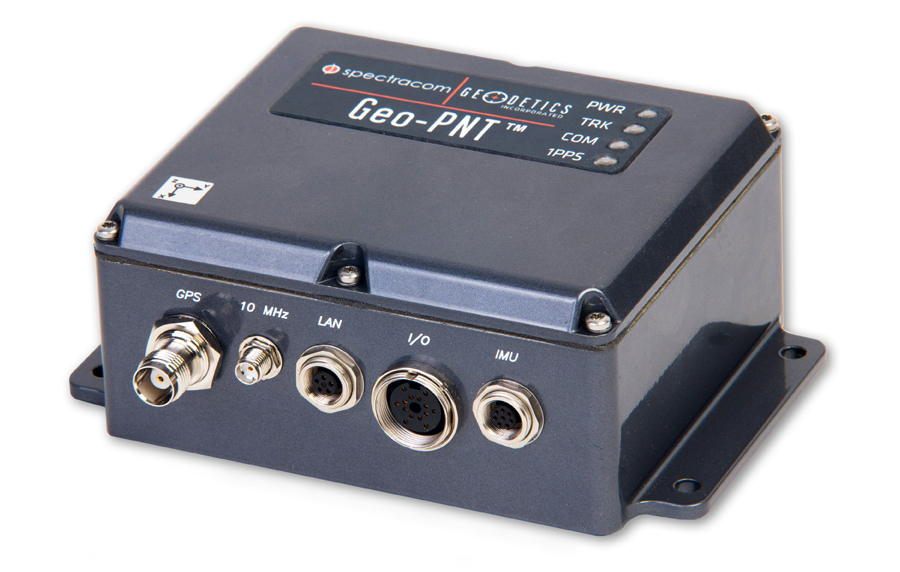
    Spectracom's Geo-PNT Photo: Spectracom
    Spectracom’s Geo-PNT integrates precision references for position, attitude, and timing. Photo: Spectracom

    A new combination master clock and GPS-aided inertial navigation system is now available from Spectracom to reduce redundant subsystems in mobile applications. The Geo-PNT integrates precision references for position, attitude, and timing all in one box. Applications include radar, optoelectronic sensing, electronic warfare, satcom on the move, and mobile test platforms.

    Geo-PNT benefits any mobile intelligence, surveillance, and reconnaissance (ISR) platform because signal/electronic intelligence applications require precision positioning, navigation, and timing references. Electro-optic sensors and other imaging technologies, antenna steering, and encrypted communications always need a combination of precision motion compensation, geolocation, time stamping, and frequency reference.

    The high degree of integration within the Geo-PNT supports the goals of low size, weight and power (SWaP) and cost optimization while achieving a high level of performance for ISR platforms and mobile communications systems. A single subsystem for all PNT functions in a volume of about 40 cubic inches is about three times less than the traditional approach of deploying dedicated devices.

    The Geo-PNT is a highly configurable platform to provide the capabilities needed for the mission:

    • Single-box solution combining precision local oscillator, inertial motion unit (IMU), and GPS receiver.
    • Configurable output interfaces for timing and navigation.
    • Standalone or RTK/differential GPS, commercial (non-ITAR) or SAASM GPS receiver.
    • Choose from a variety of IMUs to meet performance specifications.
    • NTP server, precision 1PPS, 10 MHz with low phase noise.
    • Rugged and tested to MIL-STD-810G.
    • Low SWaP (< 0.7 liters, <0.8 Kg, <10 watts).

    “Our time and frequency technology, combined with geodetics positioning and navigation capability in the same module, provides an opportunity for platform designers to lower SWaP requirements while staying within the limits of today’s demanding system specifications,” said Rohit Braggs, Spectracom’s sales and marketing VP.

    Geo-PNT is the latest example of Spectracom’s flexible configure-to-COTS approach. The use of commercial technology reduces lead time and offers the lowest cost of ownership for both standard and semi-custom configurations. Hardware and software can be adapted to meet the needs of the application.

  • GPS IIF-6 Launch Tracked by GPS, Not Radar

    Friday’s launch of a Delta 4 rocket carrying the latest GPS satellite was tracked via GPS itself instead of by radar, reports Spaceflight Now in an article.

    United Launch Alliance’s Atlas and Delta rockets are transitioning to GPS metric tracking for range safety functions, which protect the public and property should a launch vehicle veer off course. The move is a money-saving upgrade to the military’s aging range infrastructure.

    A special avionics system on the launcher transmitted the location. For decades, most rockets launching from Cape Canaveral, Florida, and Vandenberg Air Force Base, California, have been tracked by C-band radar.