Tag: satellite

  • New GNSS weather datasets available from TechDemoSat-1

    New GNSS weather datasets available from TechDemoSat-1

    GNSS-R Data collections. The measured reflection tracks are shown in yellow over the Globe. A sequence of Delay Doppler Maps from one track is shown below — the spread of each is related to the sea surface roughness and surface wind speed.
    GNSS-R Data collections. The measured reflection tracks are shown in yellow over the Globe. A sequence of Delay Doppler Maps from one track is shown below — the spread of each is related to the sea surface roughness and surface wind speed.

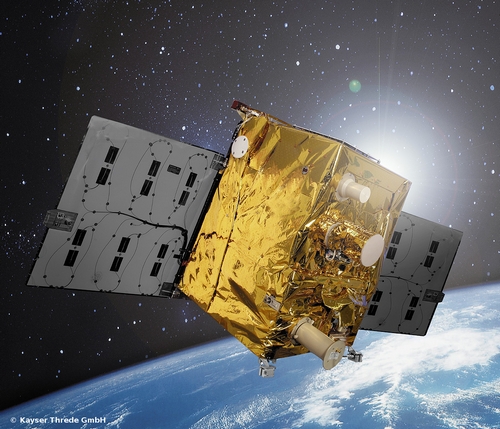
    New weather datasets, which could prove highly valuable for weather forecasting and for longer term climate monitoring, have just been made available from the Space GNSS Receiver-Remote Sensing Instrument (SGR-ReSI) instrument on board TechDemoSat-1, a small technology demonstration satellite launched by Surrey Satellite Technology Ltd (SSTL) in 2014.

    With support from the European Space Agency, SSTL and the National Oceanography Centre (NOC) are continuing to work on the data received from TechDemoSat-1 and have been steadily improving the calibration of the measurements and researching new techniques and applications.

    New data, including delay Doppler maps and wind speed analysis over oceans, has been released on the MERRYBS website (Measurement of Earth Reflected Radio-navigation Signals By Satellite).

    Looking to the future, the NASA CYGNSS mission due to launch later this year will fly eight satellites carrying SSTL’s SGR-ReSI instrument to measure the winds within cyclones, hurricanes and typhoons.

    The SGR-ReSI instrument was developed by SSTL and is able to calculate TechDemoSat-1’s position and speed in much the same way as does a car-based SatNav, by measuring ranges and triangulating its position from high-altitude GNSS satellites orbiting 20,000 km above the satellite itself. The SGR-ReSI also carries a high-gain nadir (downward-pointing) antenna to utilize GNSS reflectometry, a technique where the GNSS signals scattered off the Earth’s surface are collected and measured.

    A calm ocean will give a clean reflection, while a rough, wind-driven ocean will spread the signal out. SSTL’s partner, the National Oceanography Centre in Southampton, has developed an algorithm that calculates from the signals the ocean roughness and in turn estimates the wind speed at the surface of the ocean.

    To validate the algorithm, NOC has compared the wind speed measurements from the SGR-ReSI against radar measurements from EUMETSAT’s MetOp satellite. These wind speed measurements are valuable for weather forecasting, and could also prove to be of significant benefit to the scientific community for climate monitoring.

    The GNSS reflections off ice are much stronger than reflections off the ocean, and it has been possible to demonstrate from the results a new method for measuring the changing location of ice edges over time, and the potential for a new method of measuring ice height and thickness.

    GPS reflections are not only collected by the SGR-ReSI over the ocean, but over land, where measurements to date show strong variations that could contain valuable geophysical information about the land surface. For instance, healthy vegetation will absorb more of the signal while damp soil can cause stronger reflections. Soil moisture is considered an essential parameter for climate monitoring, and is not currently measured with sufficient coverage over the globe.

    TechDemoSat-1 was in part funded by Innovate UK and is jointly operated by SSTL in Guildford and by the Satellite Applications Catapult in Harwell.

    SSTL received funding to support the development of the SGR-ReSI and ground processing from the UK CEOI, SEEDA, Innovate UK and the European Space Agency.

    The below videos show processing and application of the SGR-ReSI data.

    Video 1: This video shows in about 20 times real-time speed the motion of the TechDemoSat-1 satellite over an orbit, indicated by a white cross on the world map. The specular reflections targeted by the SGR-ReSI are shown by yellow spots, and the measurement tracks are shown in yellow.

    The four Delay Doppler Map channels from measurement tracks are shown in yellow. The four Delay Doppler Map channels from the SGR-ReSI are shown at the top right.

    The spreading horseshoe shape is caused by reflections being received away from the specular point, and a rougher ocean causes more spreading. When reflections are received from over land and over ice, there is much less spreading.

    The red band on the map indicates the collection of “raw” unprocessed data, which takes a few minutes to transfer before the processed Delay Doppler Maps resume.

    Video 2: This video shows reflections over the Northwest Passage, with and without ice.
  • Indian space agency asks industry to build spare satellites

    The Indian Space Research Organisation (ISRO) is finalizing plans to have two spare satellites for its navigation fleet built by private industry in the next two years, reports The Hindu. The seven-satellite NAVIC (Navigation Indian Constellation) — formerly known as IRNSS — is now complete.

    The Indian government will “handhold” industry for the first satellite, scheduled to be built by March 2017. The second satellite will be built entirely by industry, said M. Annadurai, director of ISRO Satellite Centre. Both 1,400-kilogram spare satellites will be kept ready on the ground.

    The space agency issued “expressions of interest” in June, reports The Hindu, and ISRO is discussing details of risk, price and profit-sharing with prospective partners.

  • Timing in Mission-Critical Systems

    Broadcast Date: March 31, 2016
    On-Demand Available Until: March 31, 2017
    Sponsor: Microsemi
    Summary: You’ll hear from our expert speaker panel about real-life timing challenges in mission-critical applications, such as satellite and military communications, test ranges and radar; time transfer accuracy and stability via GPS or PTP; and what technologies to look for in your next-generation instrument class clock to cost-effectively deliver accurate and stable time and frequency signal types, signal output flexibility and robust security.
    Speakers: Paul Skoog, Microsemi Corporation; Scott Williams, G.L. Williams Associates; and James L. Wright, Range Generation Next

  • Galileo 11 and 12 mission to launch Dec. 17

    Galileo satellites 11 and 12 will be launched atop of the legendary Soyuz rocket on Dec. 17 from Europe’s Spaceport in French Guiana. Ten years after the launch of GIOVE A, on Dec. 28, 2005, Galileo is now a reality.

  • Final GLONASS-M Satellite Passes Tests

    Final GLONASS-M Satellite Passes Tests

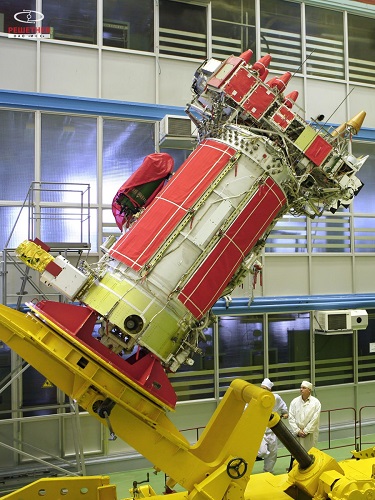
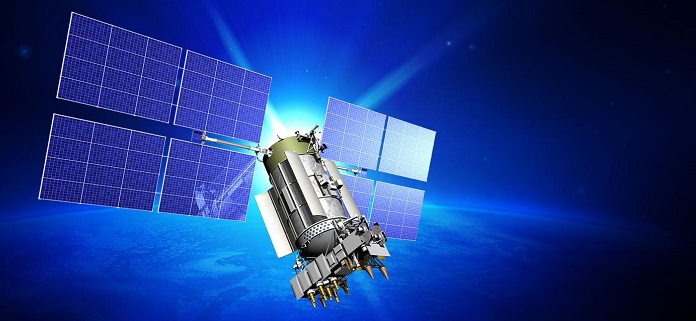
    Artist's rendering of the GLONASS-M satellite.
    Artist’s rendering of the GLONASS-M satellite.

    News courtesy of CANSPACE Listserv.


    The last of the GLONASS-M satellites (serial number 61) has been built and has passed all acceptance tests, reports the July 20 issue of Sibirskii Sputnik (Siberian Satellite), the internal newspaper of ISS Reshetnev. It will join eight other GLONASS-M satellites in storage on the ground awaiting launch between now and 2017.

    Following the launch of the last GLONASS-M satellite, 11 GLONASS-K1 satellites will be launched through 2020. The GLONASS-K2 model is currently under development and will be launched beginning in 2017, according to a presentation made by ISS Reshetnev at the Workshop on the Applications of Global Navigation Satellite Systems held in Krasnoyarsk in May 2015.

    Photo: GLONASS-M

  • USGS Provides Higher Level Landsat Data

    USGS-logoThe U.S. Geological Survey (USGS) has begun production of higher level (more highly processed) Landsat data products to help advance land surface change studies. One such product is Landsat surface-reflectance data. Landsat satellite data have been produced, archived, and distributed by the U.S. Geological Survey since 1972.

    Surface reflectance data products approximate what a sensor held just above the Earth’s surface would measure, if conditions were ideal without any intervening artifacts (interference or changing conditions) that may come from the Earth’s atmosphere, different levels of illumination, and the changing geometry of the view by the sensor from hundreds of miles above the Earth. The precise removal of atmospheric artifacts increases the consistency and comparability between images of the Earth’s surface taken at different times of the year and different times of the day.

    Surface reflectance and other high-level data products can be requested through the USGS Earth Resources Observation and Science (EROS) Center by accessing the EROS Science Processing Architecture (ESPA) interface. Surface reflectance data are also available using the USGS EarthExplorer; select “Landsat CDR” under the tab for datasets. More information on Landsat surface reflectance data is available at the USGS Landsat website and in an updated USGS Fact Sheet.

    Data users in many different fields depend on basic Earth observation information from the USGS to conduct broad investigations of historical land surface change that cross large regions of the globe and span many years. Accordingly, this community of users requires consistently calibrated radiometric data that are processed to the highest standards.

  • Galileo Boosters Prepped for March 27 Launch

    Two more full operational capability (FOC) Galileo satellites are scheduled for launch March 27. This video shows the four first-stage boosters of the Soyuz launcher being assembled in Europe’s Spaceport in French Guiana. Assembly takes place on a horizontal basis, in the Russian manner. The video shows four thrusters assembled around the main body. After takeoff, the engines burn for 120 seconds and then are dropped. The thrust is transferred to the main body by a ball joint located above the propeller of the cone-shaped structure.

  • DigitalGlobe Launches WorldView-3 High-Resolution Commercial Satellite

    DigitalGlobe, a  provider of commercial high-resolution Earth observation and advanced geospatial solutions, successfully launched WorldView-3, the company’s sixth and most advanced super-spectral, high-resolution commercial satellite.

    The satellite launched August 13 on a Lockheed Martin Atlas V rocket from Vandenberg Air Force Base in California.

    “The successful launch of WorldView-3 extends DigitalGlobe’s commanding technological lead and will enable us to help our customers see through smoke, peer beneath the ocean’s surface, and determine the mineral and moisture content of the Earth below — all with unprecedented clarity,” said Jeffrey R. Tarr, chief executive officer of DigitalGlobe.

    WorldView-3 will collect super-spectral imagery at 0.31 meter resolution — delivering five times the clarity of the company’s nearest competitor. In addition, WorldView-3 will offer the most spectral diversity available commercially, the company said, and will offer multiple shortwave infrared (SWIR) bands that allow for accurate imaging through haze, fog, dust, smoke and other air-born particulates. The satellite will also offer CAVIS — a cloud, aerosol, water vapor, ice and snow atmospheric correction instrument — which monitors the atmosphere and corrects data for an unprecedented level of consistency.

    “The unmatched abilities that WorldView-3 brings to our constellation will enable us to provide our customers with information and insight never before possible and advance our efforts to create a living digital inventory of the Earth,” Tarr said.

    The satellite and atmospheric monitoring instrument called CAVIS were built by Ball Aerospace. Exelis built the integrated, super-spectral payload consisting of a telescope, sensor and shortwave infrared system, making WorldView-3 the first commercial satellite to carry such capabilities. A United Launch Alliance Atlas V launch vehicle provided by Lockheed Martin Commercial Launch Services (LMCLS) delivered the satellite into orbit.

  • Septentrio PolaRx2 Receiver Orbits Earth on Board TET-1 Satellite

    Septentrio PolaRx2 Receiver Orbits Earth on Board TET-1 Satellite

    The TET-1 Satellite has Septentrio on board. (Image: DLR)
    The TET-1 satellite has Septentrio on board. (Image: DLR)

    Septentrio announced today that a PolaRx2 receiver has reached more than 330 hours of successful operation on board “Technologie-Erprobungs-Träger 1” (TET-1), the first satellite of the German On-Orbit-Verification program. The Septentrio receiver is the backbone of the Navigation and Occultation Experiment (NOX) developed by German Aerospace Center (DLR). The purpose of the experiment is to prove the suitability of commercial-off-the-shelf (COTS) technology for use in space missions.

    The receiver provides GPS observations on the L1 and L2 frequencies, which are used for precise orbit determination and atmospheric sounding. The dual-frequency observations allow reconstructing the orbit of TET-1 with decimeter or better 3D accuracy. A dedicated antenna pointed into the anti-flight direction of the satellite is used to collect measurements during GPS radio occultations, where the signals are tracked through the Earth’s atmosphere.

    After the first activation on July 26, 2012, the receiver has operated flawlessly in the harsh environment 500 km above the Earth’s surface and has been unaffected so far by space radiation. The receiver demonstrates quick acquisition of GPS signals and tracks a sufficient number of satellites even under challenging visibility conditions. The short time-to-first-fix together with the high availability of position and timing information from the navigation solution make the PolaRx2 a very suitable receiver for space-borne applications.

    “We are proud to see a new illustration that our standard commercial receivers perform flawlessly even in the harshest circumstances,” said Peter Grognard, Septentrio’s founder and CEO. “Our customers benefit every day from the same high quality and robustness for their demanding industrial applications on earth ”

  • UNB Technology Space Launch Delayed

    UNB Technology Space Launch Delayed

    Update: Elon Musk, SpaceX’s CEO and chief designer, has posted an update on the status of the upcoming Falcon 9 launch on his Twitter account. “Will do another static fire of rocket to make sure all is good & AF [[Air Force]] needs to test ICBMs, so probable launch Sept 29/30,” Musk tweeted.

    “The static fire is scheduled for later this week, perhaps Wednesday, sources said. It will retest the Falcon 9 rocket after several problems cropped up during a hotfire of the launcher’s engines Thursday at Vandenberg Air Force Base, Calif.

    “The U.S. Air Force Western Range, which controls a network of tracking and communications assets based at Vandenberg, is busy for the next few weeks due to Minuteman ballistic missile testing.”


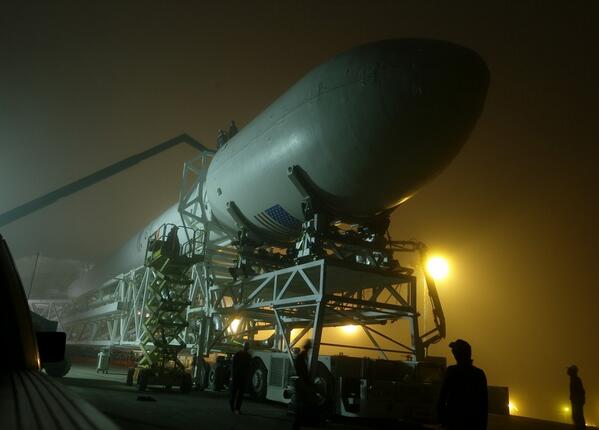
    The Falcon 9 rocket, with CASSIOPE inside its fairing, on the way to the launch pad at Vandenberg Air Force Base. (Photo credit: SpaceX).
    The Falcon 9 rocket, with CASSIOPE inside its fairing, on the way to the launch pad at Vandenberg Air Force Base. (Photo credit: SpaceX).

    A GPS instrument designed by University of New Brunswick scientists is scheduled to be launched into space aboard the SpaceX Falcon 9 rocket on September 15. The rocket will depart Vandenberg Air Force base in California as part of the CASSIOPE (Cascade Smallsat and Ionospheric Polar Explorer) mission.

    Dr. Richard Langley, GPS World Innovation editor and professor in geodesy and geomatics engineering at the University of New Brunswick, is a principal investigator behind the scientific portion of the CASSIOPE mission. Langley and his colleagues will monitor data from the GPS instrument, which is part of the Enhanced Polar Outflow Probe (e-POP) payload aboard the spacecraft.

    E-POP will continue the sequence of Canada’s orbiting space environment sensors, which began with Canada’s first satellite, Alouette 1, launched in 1962 to study the ionosphere. e-POP is, perhaps, the most extensive suite of sensors for studying the ionosphere/magnetosphere/thermosphere yet to be launched, and will provide Canadian and other scientists with the opportunity to better understand the impact and variability the sun has on the space environment — what we call “space weather.”

    The website SpaceFlight Now will be covering the launch.

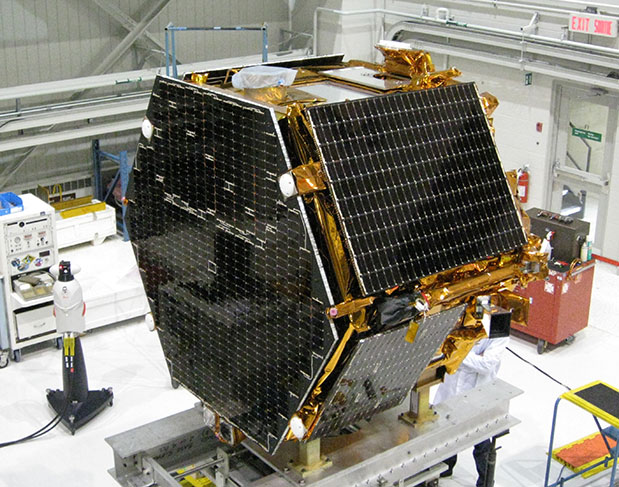
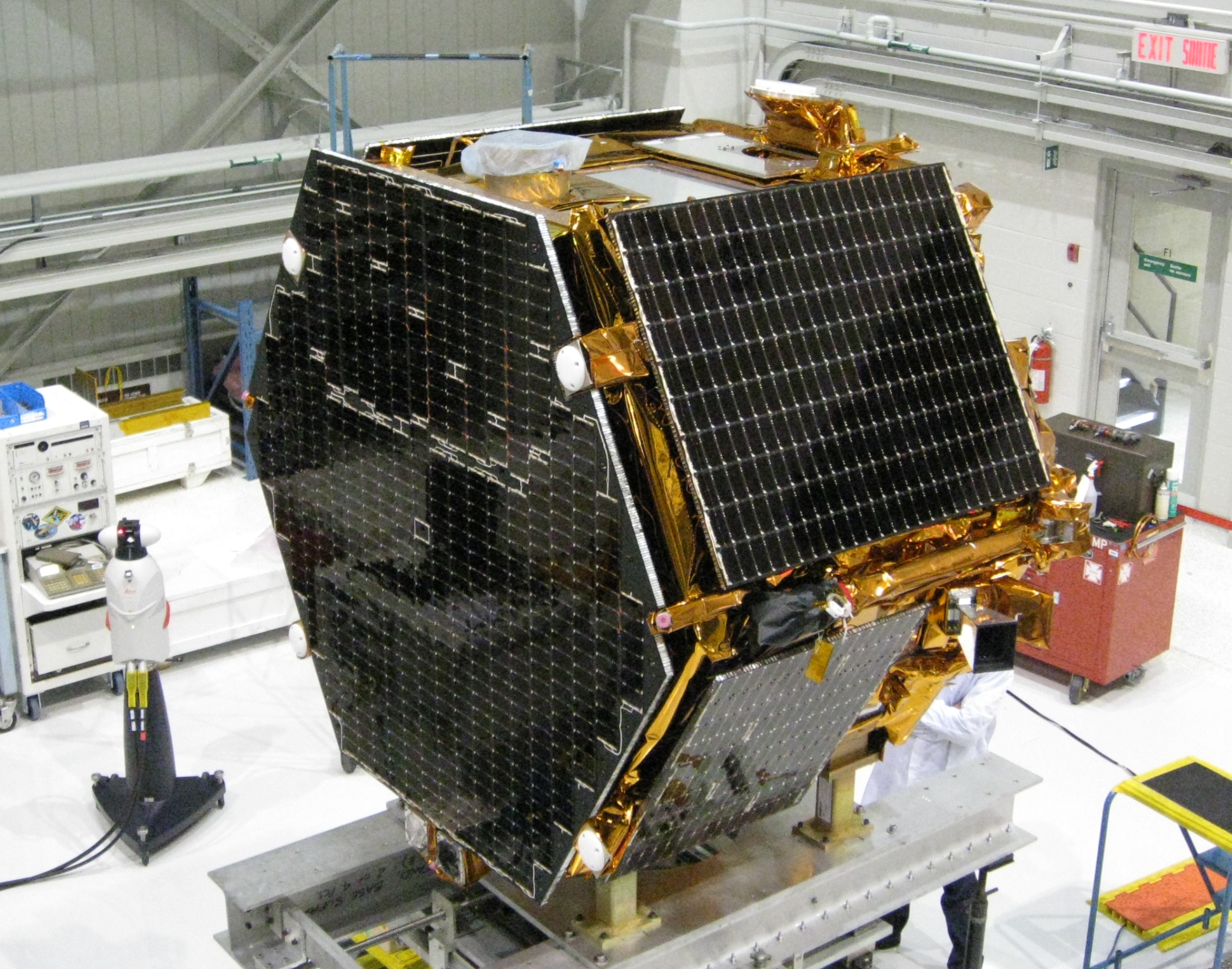
    The research satellite CASSIOPE on a test platform at the Canadian Space Agency’s David Florida Laboratory. CASSIOPE hosts the GPS Attitude, Positioning, and Profiling instrument designed by GGE researchers. It is currently scheduled for launch in 2010. The four white antennas on the left-facing side of the spacecraft will be used to determine the position, velocity, and attitude of the spacecraft while the antenna on the upper side will be used to profile the ionosphere’s electron density. Photograph courtesy of MacDonald, Dettwiler and Associates Ltd.
    The research satellite CASSIOPE on a test platform at the Canadian Space Agency’s David Florida Laboratory. CASSIOPE hosts the GPS Attitude, Positioning, and Profiling instrument designed by GGE researchers. The four white antennas on the left-facing side of the spacecraft will be used to determine the position, velocity, and attitude of the spacecraft while the antenna on the upper side will be used to profile the ionosphere’s electron density. (Photograph courtesy of MacDonald, Dettwiler and Associates Ltd.)
  • BeiDou-2/Compass G3 Satellite Moved

    News courtesy of CANSPACE listerv.

    The BeiDou-2/Compass geostationary satellite, G3, was moved between about November 7 and 22 from an orbital longitude of  84 degrees east to 110.5 degrees east.

    The 110.5 degree east longitude slot had been previously used by BeiDou 1C, one of the demonstration or BeiDou-1 satellites, which was initially shifted to about 85 degrees east between about June 2 and July 7, 2012. BeiDou 1C has drifted slightly since and is currently at 84 degrees east.

    According to orbital data supplied by the U.S. Joint Space Operations Center, once BeiDou 1C was shifted to about 85 degrees east longitude, station keeping seems to have been no longer applied. This may imply that the satellite is no longer in use but this has not yet been confirmed.


  • GeoEye to Receive Payment of $111 Million from the National Geospatial Intelligence Agency

    GeoEye, Inc. announced that it has successfully passed a major milestone for the development of the GeoEye-2 satellite under the EnhancedView program. GeoEye’s completion of this milestone triggers the $111 million cost-share payment from the National Geospatial-Intelligence Agency (NGA).

    GeoEye reports that this critical milestone demonstrates the company’s capabilities to meet all of the U.S. government’s EnhancedView program requirements, on time and under this firm-fixed-price contract.

    Matt O’Connell, GeoEye’s CEO and president, said, “This is a terrific achievement by our team and a great confirmation of our strong partnership with the NGA, especially during these uncertain economic times. We look forward to providing the NGA with the highest resolution color imagery from GeoEye-2, which will be an important long-term security asset to the DoD and the intelligence agencies of the United States.”
    “GeoEye-2, designed and built by Lockheed Martin Space Systems, includes market-leading technology features, such as robust tasking capabilities, faster imagery collection rates and a new state-of-the-art, ITT Exelis Geospatial Systems camera,” said Carl Alleyne, GeoEye’s vice president of Engineering.