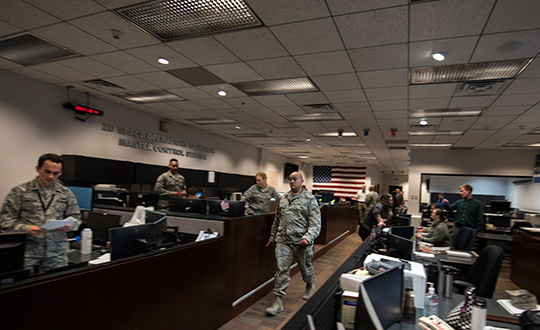
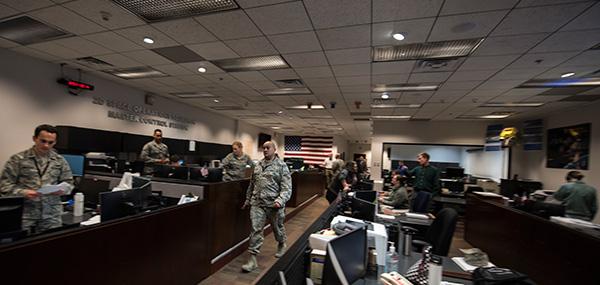
The United States Space Force’s Space and Missile Systems Center on July 27 completed the military code (M-code) Early Use (MCEU) hardware and software upgrade to the GPS Operational Control System (OCS).
Completion of the upgrade is a major step toward Operational Acceptance of the long-awaited GPS M-code.
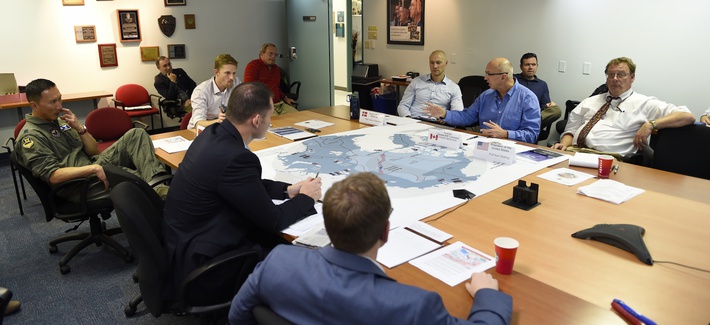
Photo: U.S. Air Force photo/Dennis Rogers
The encrypted M-code signal enhances anti-jamming and anti-spoofing capabilities for the warfighter. M-code signals are currently available on all 22 GPS Block IIR-M, IIF and III space vehicles currently on orbit.
The installs were completed at the Master Control Station at Schriever Air Force Base, Colorado, and Alternate Master Control Stations at Vandenberg Air Force Base, California.
The MCEU upgrade allows the OCS Architecture Evolution Plan to task, upload and monitor M-code within the GPS constellation, as well as support testing and fielding of modernized user equipment.
Operational Acceptance Set for November. MCEU will be in a trial period before Operational Acceptance in November. Once Operational Acceptance is granted, upcoming Military Ground User Equipment (MGUE) will be able to leverage the M-code signal-in-space to provide more secure position, navigation and timing (PNT) to warfighters.
“Working closely with Lockheed Martin and our other mission partners — with the common national goal of providing enhanced PNT signal security and safety always in sharp focus — means we’re able to deliver the right mission capability faster to our warfighters,” said Lt. Col. Steven A. Nielson, program manager of the MCEU project.
MCEU serves as a gap-filler for M-code operations before the entire GPS constellation’s operational transition to the Next Generation Operational Control System Block 1, which is now in development.
A key to enabling M-code is a new software-defined receiver being installed at all six Space Force Monitoring Sites. The M-code Monitor Station Technology Improvement and Capability receiver uses commercial, off-the-shelf hardware to cost-effectively receive and process M-code signals, enabling OCS operators to monitor the signals.
On July 23, the 2nd Space Operations Squadron (2 SOPS) gained Satellite Control Authority of GPS satellite vehicle number 76 — also known as GPS III SV03 — which was launched on June 30. This handover was special: for the first time, a crew of eight women space operators took control of the satellite.
Schriever’s 2 SOPS, the providers of GPS signals to billions of users worldwide, made history July 23 when a crew of eight women space operators gained satellite control authority of satellite vehicle number 76 (SVN 76), previously known as GPS III SV03.
The crew included 1st Lt. Kelley McCaa, 2 SOPS satellite vehicle operator; 1st Lt. Alexis Thuli, 2 SOPS operations assistant flight commander; Staff Sgt. Kelly Malone, 2nd SOPS satellite systems operator and crew chief; 1st Lt. Mary McLaughlin, 2 SOPS payload system operator; 1st Lt. Mikayla Roberts, 2 SOPS mission analyst; Senior Airman Joelle Schritt, 19th SOPS mission planner; Airman 1st Class Gillian Clover, 2 SOPS satellite systems operator; and Airman 1st Class Larissa Contreras, 2 SOPS SSO.
“It’s like the grandparents hand the keys to the parent, then the parent hands the keys to us,” said McCaa. “When a new satellite is launched, we don’t have full authority of it. [Lockheed Martin] takes it over [after launch], then we bring it into our systems and then we actually gain full control of [the satellite] as a squadron.”
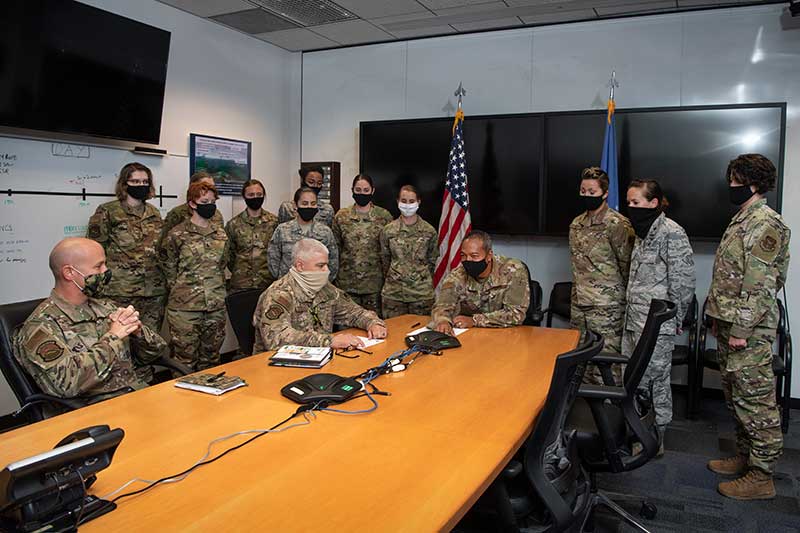
The 2nd Space Operations Squadron gained satellite control acceptance of satellite vehicle number 76, July 23, 2020, at Schriever Air Force Base, Colorado. The new satellite will provide more than 5 billion users across the globe with stronger precision, navigation and timing signals. It will also bring improved capabilities to warfighters. (U.S. Air Force photo by Dennis Rogers and Kathryn Calvert)
The new satellite will provide more than 5 billion users across the world with stronger precision, navigation and timing signals, Schriever Air Force Base said.
“With these new satellites, they have a lot of capabilities we didn’t previously have,” said McCaa. “There are certain things the new generation of satellites are capable of doing that are brand new to us, and will immediately enhance our GPS signal, helping the warfighters down-range.”
The crew included eight uniformed 2 SOPS and 19 SOPS (the Air Force Reserve component) Airmen who gained SCA of the satellite.
“We have a lot of females in the squadron, and given the crew scheduling, we had the opportunity to establish an all-female crew,” said Thuli. “We decided to have this female team on crew during the SCA, creating a more historic event for the squadron.”
Maj. Lucia White, 2 SOPS assistant director of operation, said the 45th Space Wing female meteorologists at Cape Canaveral Air Force Station, Florida, who determined weather was suitable for rocket launch June 13, inspired her to bring the idea to life in 2 SOPS.
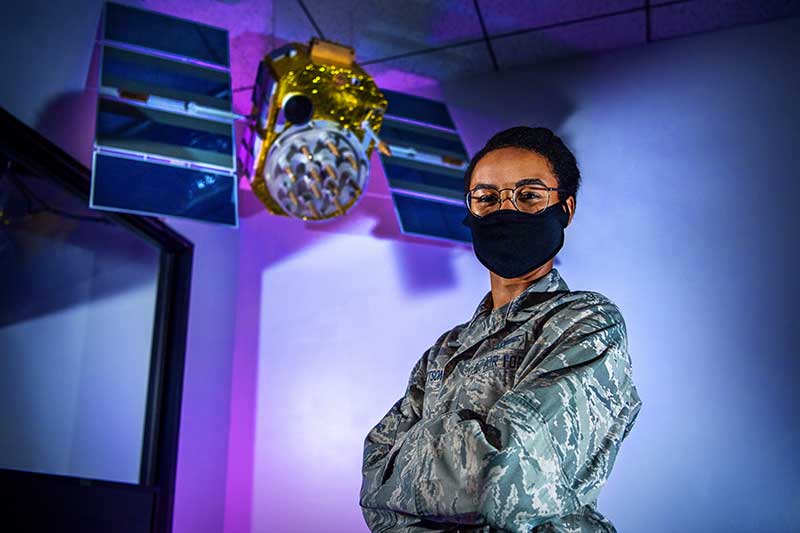
First Lt. Mikayla Roberts, 2nd Space Operations Squadron mission analyst, poses with a model satellite July 23, 2020, at Schriever Air Force Base, Colorado. Roberts was one of eight women who worked on the historic all-female crew. (U.S. Air Force photo by Dennis Rogers and Kathryn Damon)
“We want to inspire future generations of young women and let them know they can have a place in the Space Force,” White said. “[The Space Force] is the place to be, especially for those who may have barriers to overcome.”
In addition to the operational crew, Brig. Gen. Traci Kuekermurphy, Mobilization Augmentee to the Space Force Director of Operations and Lt. Col. Maggie Sullivan, Space and Missile Systems Center, granted SCA approval for their respective entities making the entire transfer an all-female event.
Not only did 2 SOPS and the 45th SW have female crews, the Department of the Air Force also made history when it selected Chief Master Sgt. JoAnne Bass to serve as the 19th Chief Master Sergeant of the Air Force. Bass is the first woman to serve in this role.
According to the National Science Foundation, women make up only 28% of employment in science and engineering career fields. Furthermore, an even smaller percentage of women serve in the Air Force, at about 21%.
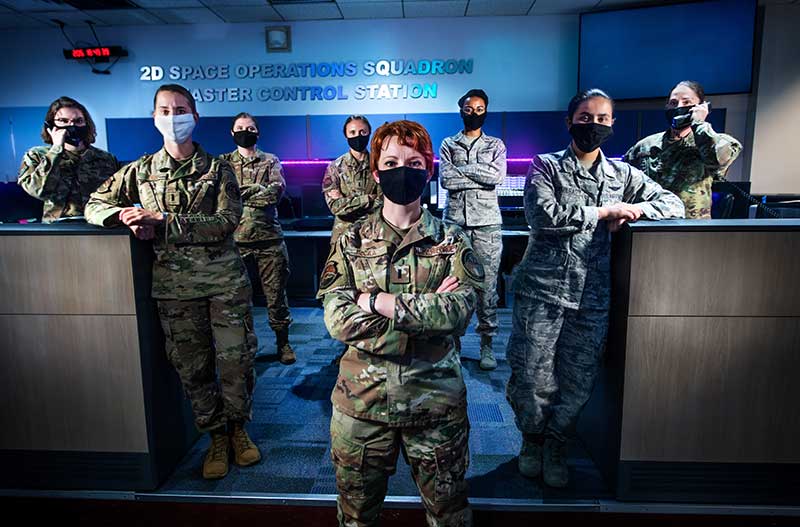
Feature image: The women of the 2nd Space Operations Squadron made history as the first ever all-female space operations crew July 23, 2020, at Schriever Air Force Base, Colorado. The crew gained satellite control acceptance of SVN-76, officially adding another satellite to the GPS III fleet. (U.S. Air Force photo by Dennis Rogers and Kathryn Calvert)
News by Airman 1st Class Jonathan Whitely
50th Space Wing Public Affairs Schriever Air Force Base
The 2nd Space Operations Squadron at Schriever Air Force Base, Colorado, initiated the disposal of the last operational GPS IIA satellite, satellite vehicle number 34, April 13-20.
The GPS satellite program currently uses 31 satellite vehicles to transmit precise position, navigation and timing signals to more than 6 billion users around the world. To support the Air Force’s GPS III modernization efforts, 2nd SOPS operators phase out older models to make room for the new GPS III satellites.
The disposal of SVN-34 marks the end of a 26.5-year era in which the satellite outlived its 7.5-year design life by 19 years.
“As we continue to manage the influx of GPS III (the newest iteration of GPS satellites) and maintaining other vehicles in a residual status, we have to be cognizant of effective risk management,” said Capt. Angela Tomasek, 2nd SOPS GPS mission engineering and analysis flight commander. “As SVN-34 continued to age, we had to manage its aging components and likelihood of having a critical malfunction. We are at a stage where we are confident in the robustness of the overall GPS constellation to remove the last remaining IIA vehicle.”
Disposal process. Units conduct satellite disposals when a satellite reaches the end of its operational life and no longer requires daily caretaking and maintenance.
“We push the satellite vehicle to a higher, less congested, ‘disposal orbit’ to eliminate the probability of collision with other active satellites,” Tomasek said. “[Then,] the vehicle is put into a safe configuration by depleting the leftover fuel and battery life and shutting off the satellite vehicle transmitters so no one else can access the satellite in the future.”
Once SVN-34 is in its final orbit, 2 SOPS will on April 20 hand over full tracking responsibility to the 18th Space Control Squadron at Vandenberg Air Force Base, California, where it will be treated and cataloged like every other space object.
“This disposal marks the end of an era in GPS history,” said Lt. Col. Stephen Toth, 2nd SOPS commander. “There are senior leaders and long-time contractors [who] launched and operated the IIA satellites at the beginning of their careers [who] are nowhere to see it end. It is an opportunity to reflect on the legacy and heritage of 2 SOPS and GPS to see how far we have come.”
Feature image: Artist’s depiction of a GPS IIA satellite in orbit. (Image: USAF)
Despite the worldwide COVID-19 response, the 50th Space Wing at Schriever Air Force Base continues to execute its critical operations, while ensuring the proper steps are taken to maintain airmen’s health and well-being.
As of March 20, there are no confirmed cases of COVID-19 at the base. The 50th Space Wing commander, Col. James E. Smith, has enacted multiple safety measures — social distancing, minimum manning and temperature checks at restricted area portals — to protect Airmen and the base’s critical operations.
No pandemic in space
Airman 1st Class Brice Brewington, 4th Space Operations Squadron, is an extremely high-frequency satellite systems operator.
“It’s critical we continue the mission during trying times,” Brewington said. “Although there is a pandemic here on Earth, there’s no pandemic in space and our adversaries aren’t going to stop trying to gain superiority from us any time soon. We need to stay mission-ready rain, sleet, snow, hail and even during a pandemic to complete our mission at the most elite level possible.”
To minimize transmission, 4th SOPS Airmen use cleaning wipes and sanitation spray to clean their workstations. Additionally, accountability is taken daily to make certain the squadron’s airmen are feeling healthy and well.
“I know the service I help provide is critical for [service members] down range,” Brewington said. “I take my job very seriously. Lives depend on it, and we can’t let a pandemic slow down our operations.”
2 SOPS at their stations
The 2nd Space Operations Squadron is one of the United States Space Force’s premier units. 2 SOPS operates the GPS mission, providing a global utility to Earth’s population for free.
“No matter what, we need to ensure this mission continues so the American people and the world know they can depend on us to be the gold standard in precision, navigation and timing,” said Lt. Col Stephen Toth, 2nd SOPS commander.
Some of the services that use GPS to operate are ambulances, hospitals, police departments and fire departments.
“It would make a global pandemic that much worse if we were to go down,” Toth said. “It could prevent a lot of the day-to-day things we rely on from happening, it could be catastrophic.”
According to a study conducted by U.S. Department of Transportation on the economic impact of GPS, a 30 day outage could range from a 2.7 to 5.5 billion dollar economic loss. Additionally, GPS supports 14 of 16 essential industries in the U.S.
“We’ll remain reliable no matter what the condition the world is in,” Toth said. “Whether it be a pandemic, hurricane, tornado or any other type of crisis, we have plans and training for whatever threat we may face so the mission doesn’t stop.”
Unlike other jobs across the Department of Defense, those directly conducting operations can’t telework. They need to be in a sensitive compartmented information facility or restricted area in a secured area to perform the mission. Airmen can access specific terminals and networks only accessible on the operations floor.
“The American people can count on space and they can count on our military to continue to provide the level of capability that’s expected no matter what’s going on in the world,” Toth said. “In times of crisis, people shouldn’t have to question whether we’ll be here or not, because we will and the mission won’t stop.”
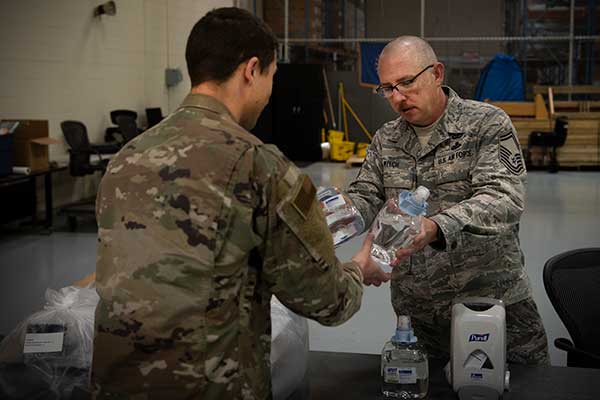
Senior Master Sgt. Michael Welch, 50th Contracting Squadron superintendent, distributes sanitizer to an Airman at the 50th Logistics Readiness Flight warehouse at Schriever Air Force Base, Colorado, April 2, 2020. The 50th CONS secured sanitizing supplies to units across the base to prevent Airmen from contracting COVID-19. (Photo: U.S. Air Force / Airman 1st Class Jonathan Whitely)
Rapid response and decontamination
The 50th Space Wing stood up the Rapid Response Decontamination Detail in response to COVID-19 and hosted a training session March 26 in the wing headquarters building. The training highlighted the importance of having a crew on standby to keep the mission essential operations centers clean and functioning.
“It’s a 24/7 team trained and equipped for rapid response to support operations inside the restricted area,” said Capt. James Selix, 3rd Space Experimentation Squadron weapons officer and R2D2 officer in charge.
For operations crews to request R2D2 services, a squadron commander must call the team and they have 15-30 minutes to respond and initiate the cleaning operation.
“We’re expecting airmen do the preventative portion of their cleaning,” Selix said. “We’re not there to do it for them. We are activated when there are folks showing symptoms of COVID-19 or have positive tests.”
The crew has a priority system should they need to deconflict requests.
“We want to be rapid to support operations,” Selix said. “[Airmen] are continuing their missions 24/7 and if their crews are doing deep cleanings, that’s pulling them away from doing supports, contacting satellites or protecting the restricted area.”
The detail will be operating in eight-hour shifts to ensure their 24/7 availability. They will be on standby to provide terminal cleanings and supplies to squadrons as needed.
“This is a new enemy,” Selix said. “This is a new fight for all of us. We’re developing teams that make sense in the fight against COVID-19, it takes all of us building the road as we walk it.”
The crew has hydrogen-peroxide, disinfectant wipes, protective gear and cleaning sprays and solutions to ensure the operation floors are sanitized and operational.
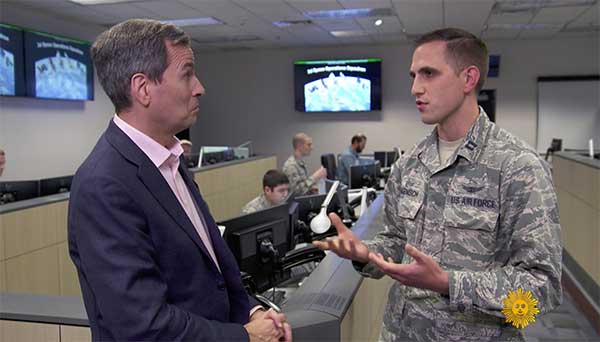
On CBS’ Sunday Morning show Dec. 1, correspondent David Pogue was invited into the Air Force’s GPS Master Control Station at Schriever Air Force Base in Colorado Springs, Colorado, to show viewers what GPS is all about.
Pogue discussed the GPS program with Brigadier General DeAnna Burt, who oversees the program as the director of operations at Air Force Space Command at Peterson Air Force Base in Colorado Springs.
He also discussed GPS vulnerabilities with Dana Goward, president of the Resilient PNT Foundation and contributor to GPS World magazine.
Pogue also visited Lockheed Martin’s satellite assembly facility, where the new generation of GPS III satellites is being built.
Raytheon Company’s GPS Next-Generation Operational Control System program, known as GPS OCX, completed final qualification testing of the system’s modernized monitor station receivers, which are now ready to be installed around the world starting in August.
GPS OCX is the enhanced ground control segment of a U.S. Air Force-led effort to modernize America’s GPS system.
“The modernized receivers give GPS OCX the ability to receive and decrypt all GPS III military and civil signals, a critical capability the current system doesn’t have,” said Dave Wajsgras, president of Raytheon Intelligence, Information and Services. “Monitor station receiver installation keeps us on track for full system delivery by our June 2021 contractual deadline.”
The modernized receivers will measure and monitor legacy military and civilian signals sent by the current GPS satellite constellation plus the new signals sent by the next-generation GPS III.
The receivers will also feed correction models at the master control station, giving U.S. Air Force satellite controllers the information necessary to make key adjustments to maximize accuracy.
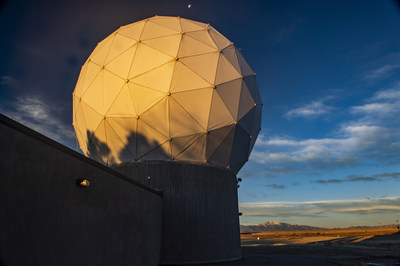
Feature photo: GPS ground antenna at Schriever Air Force Base, home of the 50th Space Wing. (Photo: Raytheon)
The 50th Space Wing Public Affairs office of Schriever Air Force Base has established and posted guidelines, known as Interface Specification GPS-200 (IS-GPS-200), for receiver manufacturers to ensure continued capability during the April 6 GPS Week Number Rollover on Coordinated Universal Time derived from GPS devices.
According to the 50th Space Wing, users should be aware of the upcoming GPS Week Number Rollover as it may impact receivers that are not manufactured in compliance with IS-GPS-200 specifications.
The GPS Week Number count began around midnight on Jan. 5, 1980. Since then, the count has been incremented by one each week and years later broadcast as part of the GPS message. One of the GPS week number fields in the legacy navigation message counts from zero to 1,023 weeks. At the completion of every 1,024 GPS weeks, the field rolls from 1,023 to zero and starts counting again.
The first occurrence took place the evening of Aug. 21, 1999, and the message field rolled to zero at midnight GPS time.
The next similar GPS Week Number Rollover is set to take place April 6.
“We appreciate the four billion people around the world who use GPS signals on a daily basis, which is why we are transparent in providing detailed guidance on use for compatibility,” said Lt. Col. Stephen Toth, 2nd Space Operations Squadron commander.
Civil GPS users are encouraged to submit reports of GPS problems to the Coast Guard Navigation Center; civil aviation users are encouraged to report GPS anomalies to the Federal Aviation Administration; and military users should contact the GPS Operations Center.
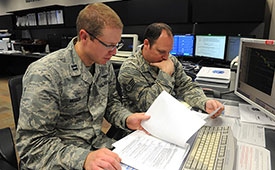
Capt. Adam Moody, 2 SOPS GPS Operations Support flight commander, and Staff Sgt. Carl Ellinger, 2 SOPS GPS mission chief, review a checklist of procedures for a transfer operation at Schriever Air Force Base. (Photo: U.S. Air Force photo/Dennis Rogers)
The 2nd Space Operations Squadron (2 SOPS), based at Schriever Air Force Base, will implement the GPS Issue of Data, Clock software modification this summer in accordance with established guidance, according to Rick Hamilton, CGSIC Executive Secretariat, U.S. Coast Guard Navigation Center.
The modification is in compliance with GPS Interface Specifications IS-GPS-200, which is published for manufacturers to ensure continued device compatibility.
As the largest Department of Defense spacecraft constellation, operators must modify processes, software and operations to meet the ever-growing demand for GPS signals. The squadron conducts software modifications regularly to support the constellation.
The modifications are primarily transparent to users, specifically those with IS-GPS-200 compliant devices. Users who experience issues with their devices or receivers should contact the manufacturer to troubleshoot the problem.
The U.S. Coast Guard Navigation Center provides information and services to civil GPS users. They can be contacted at 703-313-5900 or online.
By Senior Airman William Tracy, 50th Space Wing Public Affairs
The 2nd Space Operations Squadron took formal command of Architecture Evolution Plan 7.5, the largest GPS architectural change in operational history, after its successful installation at Schriever Air Force Base, Colorado, Nov. 16.
“AEP 7.5 is a milestone in GPS history and improves our cybersecurity capabilities and postures us to better operate in a contested, degraded and operationally limited environment,” said 1st Lieutenant Jonathan Campbell, 2nd SOPS assistant operations flight commander.
The 2nd SOPS installation replaced 600,000 lines of code in AEP and implemented more than $29 million worth of hardware and software changes.
Additionally, AEP 7.5 sets the platform for the installation of AEP 8.0, which will deliver the capability to command and control GPS III satellite vehicles — the first GPS III satellite scheduled to be launched from Cape Canaveral Air Force Station, Florida, next month.
Campbell said AEP 7.5 is a significant step up from the previous AEP 7.3, with overall improvements allowing Airmen to command and control satellites with better efficiency.
The program’s successful installation was the result of extensive training from a Mission Operations Transfer at the squadron’s Alternate Master Control Station at Vandenberg Air Force Base, California. Both rotations of the Space Mission Force crew structure were activated to ensure full operational capabilities at both sites, performing security control assessments on the system and taking other measures.
“Training consisted of acclimating to AEP 7.5, learning how to navigate it and utilize it to the best capability,” said Senior Airman Ryan Lape, 2nd SOPS satellite systems operator. “Because our constellation was so big, upon taking command at Schriever we had to iron out the changes on a large scale.”
Campbell said the hard work was worth it — the successful installation and command of AEP 7.5 through the squadron’s efforts will prepare for changes in the near future.
“This will provide combat ready space warfighters delivering position, navigation and timing to optimize the full range of Air Force, joint force and civilian operations, across all domains,” he said. “The updated hardware provided in the AEP 7.5 installation lays the foundation for a software update next year enabling the command and control of GPS Block III vehicles.”
Campbell added not only will the installation advance the 2nd SOPS’s mission, but the 50th Space Wing’s as well, helping evolve space and cyberspace warfighting superiority through integrative and innovative operations.
“The capabilities provided in this update, and those coming in the next year, provide a significant improvement to our warfighters,” he said.
With this milestone, Campbell said the continuation of the U.S. military’s dominance in position navigation and timing systems is secured.
“This update furthers the U.S. military’s and Schriever AFB’s position as the center of satellite command and control and space operations,” he said.
Lape said the milestone will make an impact outside of the military as well.
“We are the premier PNT system in the world with the largest satellite constellation,” he said.
“With measures like these, it will definitely make our adversaries think twice.”
The 2nd Space Operations Squadron operations floor is a flurry of activity during 2nd SOPS’s formal command of Architecture Evolution Plan 7.5. (Photo: USAF/Senior Airman William Tracy)
System prevented broadcast of corrupt navigation, timing data.
The GPS Operational Control System’s launch and checkout system will control launch and early orbit operations and the on-orbit checkout of all GPS III satellites. (Image: Raytheon)
Raytheon Company’s GPS Next-Generation Operational Control System, known as GPS OCX, has completed several cybersecurity vulnerability assessments that tested the system’s ability to defend against both internal and external cyber threats, the company said.
GPS OCX, based at Schriever Air Force Base in Colorado Springs, Colorado, prevented the broadcast of corrupt navigation and timing data in all tests, bolstering the program’s readiness for the GPS III launch in December, the company added.
“We’ve built a layered defense and implemented all information assurance requirements for the program into this system,” said Dave Wajsgras, president of Raytheon Intelligence, Information and Services. “We’re cognizant that the cyber threat will always change, so we’ve built GPS OCX to evolve and to make sure it’s always operating at this level of protection.”
GPS OCX is the enhanced ground control segment of a U.S. Air Force-led effort to modernize America’s GPS system. The program has implemented 100 percent of the Department of Defense’s 8500.2 Defense in Depth information assurance standards without waivers, giving it the highest level of cybersecurity protections of any DoD space system.
The first tests took place April 2-13, and were led by a contracted “blue team” that aimed to breach the system from within its information assurance boundary.
The second round of tests took place May 16-20, and were led by an Air Force “red team” of cyber-penetration testers who tried to breach the system’s IA boundary from outside. The system worked as designed, validating it is secure.
The assessments took place on the launch and checkout system, GPS OCX Block 0, which was delivered to the U.S. Air Force in 2017 as a fully cyber-secure satellite ground system.
A 2016 wargame involving the Air Force and Navy at the Naval Postgraduate School. (Photo: U.S. Navy)
The 12th in a series of Air Force Space Command Wargames concluded Oct. 19 at the Maxwell Air Force Base in Alabama. Set in the year 2028, Schriever Wargame 2018 (SW 18) explored critical space and cyberspace issues in depth.
The objectives of the wargame centered on:
examining how international partner capabilities can deter an adversary from extending or escalating a conflict into space;
gaining insight into resiliency, deterrence, and warfighting through international partner synchronization of space and cyberspace operations;
exploring various combined command and control (C2) frameworks to employ and defend air, space and cyberspace capabilities in support of global and geographic / regional operations;
identifying the strategic and operational contributions of space and cyberspace in a multi-domain conflict; and
exploring partnerships framed by a whole of governments approach (International, Civil, Commercial) to combined space and cyberspace operations.
The SW 18 scenario depicted a notional peer space and cyberspace competitor seeking to achieve strategic goals by exploiting those domains. It included a global scenario with the focus of effort towards the U.S. Indo-Pacific Command (USINDOPACOM) Area of Responsibility.
The scenario also included full spectrum threats across diverse operating environments that challenged civilian and military leaders, planners and space system operators, as well as the capabilities they employ.
Approximately 350 military and civilian experts from more than 27 agencies around the country as well as from Australia, Canada, France, Germany, Japan, New Zealand, and the United Kingdom participated in the Wargame.
Agencies that participated included: Air Force Space Command, Army Space and Missile Defense Command, Naval Fleet Cyber Command, the National Reconnaissance Office, Executive Agent for Space Staff, Air Combat Command, Office of the Secretary of Defense, USINDOPACOM, U.S. Strategic Command, U.S. Special Operations Command, U.S. Northern Command, the Intelligence Community, National Aeronautics and Space Administration, Office of Homeland Security, Department of Transportation, Department of State and Department of Commerce.
The Air Force Space Command will conduct the 12th Schriever Wargame Oct. 11 at the Maxwell Air Force Base in Alabama.
The Schriever Wargame scenario, set in the year 2028, will explore critical space issues and investigate the integration activities of multiple agencies associated with space systems and services. Schriever Wargame 2018 (SW 18) will include international partners from Australia, Canada, France, Germany, Japan, New Zealand and the United Kingdom.
The objectives of the wargame are centered on:
examining how international partner capabilities can deter an adversary from extending or escalating a conflict into space;
gaining insight into resiliency, deterrence, and warfighting through international partner synchronization of space and cyberspace operations;
exploring various combined command and control (C2) frameworks to employ and defend air, space and cyberspace capabilities in support of global and geographic/regional operations;
identifying the strategic and operational contributions of space and cyberspace in a multi-domain conflict; and
exploring partnerships framed by a whole of governments approach (international, civil, commercial) to combined space and cyberspace operations.
The SW 18 scenario depicts a notional peer space and cyberspace competitor seeking to achieve strategic goals by exploiting those domains. It will include a global scenario with the focus of effort towards the U.S. Indo-Pacific Command (USINDOPACOM) Area of Responsibility.
A 2016 wargame involving the Air Force and Navy at the Naval Postgraduate School. (Photo: U.S. Navy)
The scenario will also include a full spectrum of threats across diverse operating environments to challenge civilian and military leaders, planners and space system operators, as well as the capabilities they employ.
The Schriever Wargame Team will conduct the wargame on behalf of Air Force Space Command, headquartered in Colorado Springs, Colorado. Approximately 350 military and civilian experts from more than 27 commands and agencies around the country, as well as seven international partners, will participate in the wargame.
U.S. commands and agencies participating in Schriever Wargame 2018 include: