Tag: SpaceX Falcon 9

  • New Galileo satellites declared operational

    New Galileo satellites declared operational

    Galileo satellites 29 and 30 have reached their target positions at an altitude of 23,222 km and are now fully operational three months after being launched from Cape Canaveral, Florida, by SpaceX. These new additions to the Galileo constellation are now active and provide navigation signals to users.

    Both satellites have been positioned on the same orbital plane, one of three that comprise the Galileo constellation. With this latest addition, two of the three Galileo orbital planes are fully populated, bringing the constellation close to completion. The next Galileo launch is planned in the coming weeks from the Kennedy Space Center in Florida onboard a SpaceX Falcon 9.

    The Galileo Service Operator, supported by a team of approximately 30 satellite experts from the European Space Agency (ESA) and satellite manufacturer OHB, conducted early operations at the Galileo Control Centre in Oberpfaffenhofen, Germany, under supervision from the European Union Agency for the Space Programme (EUSPA). Following the initial operations, the satellites entered a drift phase, during which ground teams guided them to their final positions, which was reached on June 24.

    On August 21, 2024, ESA, OHB and payload manufacturer SSTL evaluated the in-orbit test results, confirming that the satellites had not experienced any degradation during launch. ESA, in collaboration with EUSPA, then validated the satellites’ performance at the system level.
  • SSC, SpaceX ready to launch next US Space Force mission

    SSC, SpaceX ready to launch next US Space Force mission

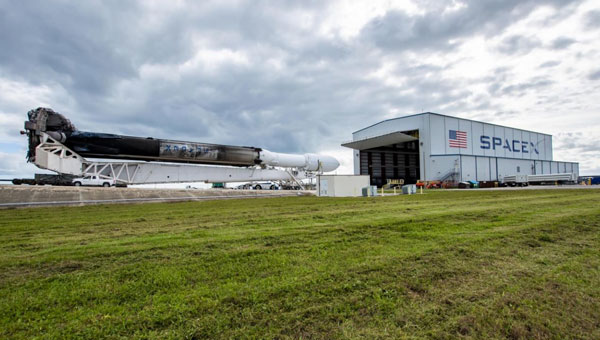
    SpaceX’s Falcon Heavy rocket begins its roll out to the historic Launch Complex (LC)-39A at NASA’s Kennedy Space Center in Florida. (Image: SpaceX)
    SpaceX’s Falcon Heavy rocket begins its roll out to the historic Launch Complex (LC)-39A at NASA’s
    Kennedy Space Center in Florida. (Image: SpaceX)

    Space Systems Command (SSC) and SpaceX are preparing to launch the U.S. Space Force (USSF)-52 mission into orbit. The Falcon Heavy mission is set to launch on Dec. 10, 2023, from the historic Launch Complex (LC)-39A at NASA’s John F. Kennedy Space Center in Florida.

    USSF-52 is the seventh mission of the X-37B Orbital Test Vehicle, an experimental program with technologies designed to provide the U.S. Space Force with a reliable, reusable, unmanned space test platform.

    This launch adds to a notable year. The last NSSL Falcon Heavy launched in early January; that mission, USSF-67, was followed by a Falcon 9 launching a GPS satellite 61 hours later, both from the Eastern Range and using the same Space Systems Command crew. The Assured Access to Space team worked alongside SpaceX to complete both launches.

    In preparation for a challenging and busy launch schedule, the U.S. Space Force is placing greater importance on being agile and resilient. The ability to conduct launch operations at a faster pace will be particularly crucial for successfully deploying multiple constellations, the Space Force said.

  • SpaceX successfully launches Ireland’s first satellite

    SpaceX successfully launches Ireland’s first satellite

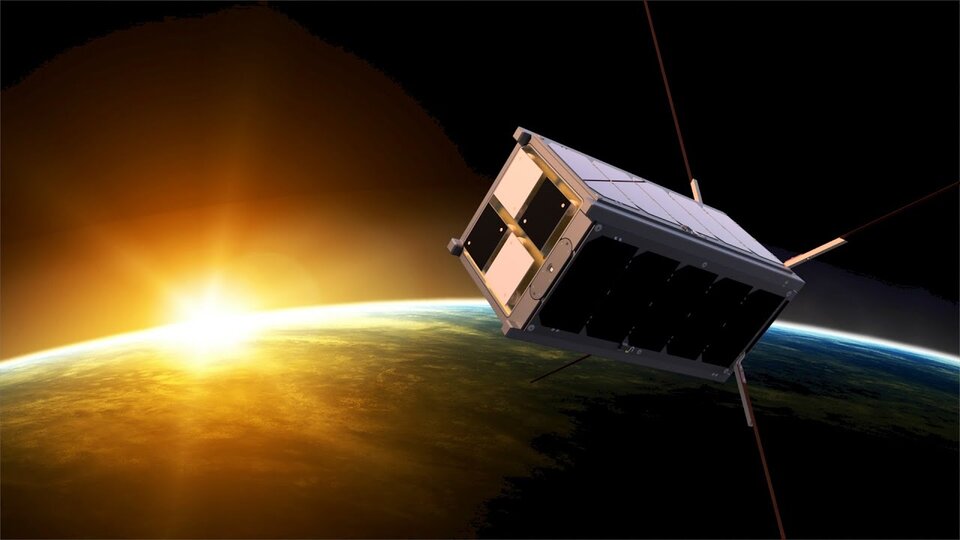
    EIRSAT-1, Ireland’s first satellite. (Image: ESA)
    EIRSAT-1, Ireland’s first satellite. (Image: ESA)

    The Educational Irish Research Satellite, EIRSAT-1, has successfully launched from Vandenberg Space Force Base, California, on Dec. 1, 2023. Hitching a ride on a SpaceX Falcon 9 launcher, the small satellite has made history as Ireland’s first satellite.  

     Over the course of six years, EIRSAT-1 was designed, built and tested by students from University College Dublin (UCD) in Dublin, Ireland, participating in the European Space Agency (ESA) Academy’s Fly Your Satellite Program. The program is a hands-on initiative that helps university student teams develop their own satellites according to professional standards. The launch opportunity itself was provided by the ESA. 

     Throughout the development of the satellite, ESA experts provided training and guidance to dozens of UCD students, the ESA said. The students’ learning journey included test campaigns at ESA Education’s CubeSat Support Facility in Belgium, as well as dedicated spacecraft communications sessions at both ESA Academy’s Training and Learning Centre and the European Space Operations Centre in Darmstadt, Germany. These sessions were designed to teach the procedures for operating Ireland’s first spacecraft.  

    From low-Earth-orbit (LEO), EIRSAT-1 will carry out three main experiments, which were built from scratch by the students: 

    • GMOD, a detector to study gamma ray bursts, which are the most luminous explosions in the universe and occur when a massive star dies or two stars collide. 
    • EMOD, an experiment to see how a thermal treatment protects the surface of a satellite when in space. 
    • WBC, an experiment to test a new method of using Earth’s magnetic field to change a satellite’s orientation in space. 

    Following EIRSAT-1’s deployment to orbit, the student team is now working to establish contact with the satellite and start operations from their dedicated ground control facility, also entirely operated by students and located at UCD in Dublin. 

  • Final GPS III satellite available for launch

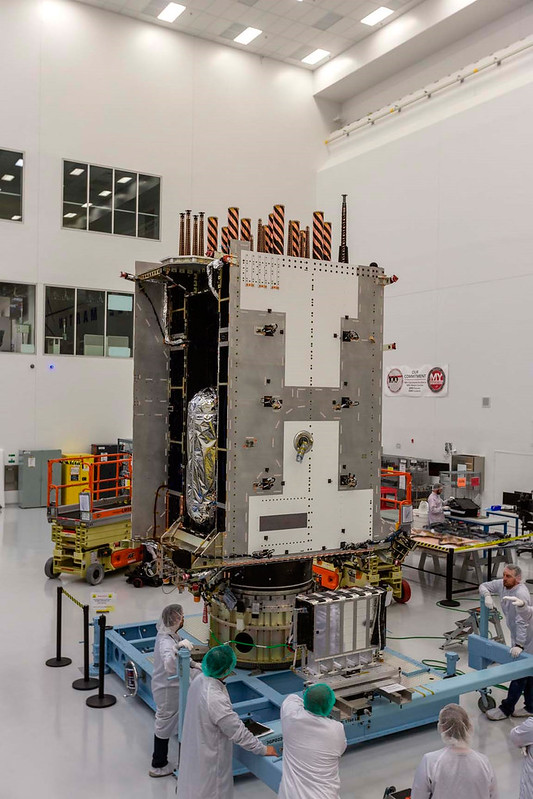
    Space Systems Command (SSC) has declared GPS III Space Vehicle 10 (SV10) available for launch, marking completion of constellation modernization efforts and production for the GPS III program.

    “The completion of the tenth, and final, GPS III space vehicle is a significant milestone for GPS modernization,” said Scott Thomas, GPS III program manager for the GPS Space Vehicles Acquisition Delta within SSC’s Military Communications and PNT directorate. “This would not have been possible without the collaboration, communication, and accountability of our industry and government partners. The GPS III program contributions underpin U.S. national security needs for our warfighters and for more than four billion GPS users worldwide.”

    GPS III satellites deliver enhanced performance and accuracy through a variety of improvements, including increased signal protection with improved accuracy. GPS III also delivers a new L1C signal designed for interoperability with similar GNSS, and expands the civilian L5 signal, dubbed safety-of-life, which is not yet operational.

    GPS III SV06 was launched on a SpaceX Falcon 9 Block 5 vehicle on Jan. 18, and Operational Acceptance was declared on Jan. 31. GPS III SV07, SV08, SV09 and SV10 are awaiting launch at Lockheed Martin’s GPS III processing facility in Waterton, Colorado.

  • GPS III SV06 receives Operational Acceptance

    GPS III SV06 receives Operational Acceptance

    Image: SSC
    Image: SSC

    GPS III Space Vehicle 06 (SV06) reached Operational Acceptance on Jan. 31 according to the Space Systems Command (SSC) of the United States Space Force. SV06 was launched on a SpaceX Falcon 9 Block 5 vehicle on Jan. 18.

    SSC also transferred Satellite Control Authority (SCA) of SV06 to the 2nd Space Operations Squadron at Schriever Space Force Base, Colorado. GPS III SV06 joins the GPS PNT constellation of 31 operational satellites.

    This is the first time SCA and Operational Acceptance has occurred on the same day enabling faster delivery for users. SSC’s Military and Communication positioning, navigation and timing (PNT) enterprise collaborated with the U.S. government acquisition team, industry and space operators on the achievement.

    “The Operational Acceptance of GPS III SV06 further contributes to SSC’s ongoing modernization efforts, as it brings our overall suite of capabilities ever closer to our target dates for deployment to the warfighter,” said Col. Heather J. Anderson, transition director within SSC’s PNT directorate. “GPS III SV06 will be set healthy to all global users in February 2023.”

    The first-stage booster used in the SV06 launch previously sent the NASA Crew-5 mission to the International Space Station on Oct. 5, 2022.

  • Fugro SpaceStar positioning service heads into space

    Fugro SpaceStar positioning service heads into space

    Fugro’s SpaceStar GNSS precise point positioning (PPP) service provides high-accuracy positioning in space

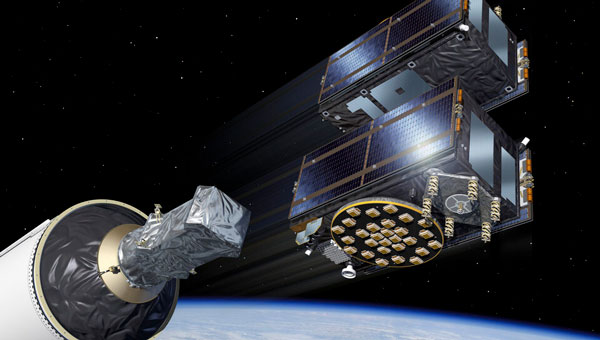
    Artist's rendering of Loft Orbital’s YAM-2 small satellite in orbit. The small sat will demo Fugro's PPP service. (Image: Loft Orbital)
    Artist’s rendering of Loft Orbital’s YAM-2 small satellite in orbit. The small sat will demo Fugro’s PPP service. (Image: Loft Orbital)

    Loft Orbital on June 30 launched its YAM-2 satellite, the first satellite equipped with Fugro’s SpaceStar next-generation positioning technology from Cape Canaveral in Florida onboard a SpaceX Falcon 9 rocket. Now in orbit, the satellite will provide an on-orbit demonstration of the new service.

    From its 525-km Sun-synchronous orbit, SpaceStar is using PPP to deliver high-accuracy sub-decimeter onboard positioning in real time during YAM-2’s low Earth orbit (LEO) operations. Fugro’s proprietary positioning software is integrated into YAM-2 and receives precise GNSS real-time orbit and clock corrections from geostationary satellites. Highly accurate positioning in LEO is becoming increasingly important for Earth observation applications, safe constellations management, and space debris collision avoidance.

    “We’re especially excited to demonstrate this new functionality,” said Loft Orbital CTO, Pieter van Duijn. “Fugro’s SpaceStar service is something that can really help not only Loft Orbital’s missions, but also be of interest to the wider application of space situational awareness and safety.”

    “We are extremely proud to be providing our real-time PPP service to the YAM-2 small satellite,” said Daan Scheer, Fugro’s satellite positioning commercial manager. “We’ve been able to bring this innovative product to market thanks to our close cooperation with Loft Orbital, and we’re looking forward to completing a successful in-orbit demonstration mission. The accuracy of our SpaceStar position service is not only contributing to our purpose of a safe and liveable world but, by facilitating safer navigation in space, even beyond.”

  • GPS III SV05 arrives in Florida for June launch

    GPS III SV05 arrives in Florida for June launch

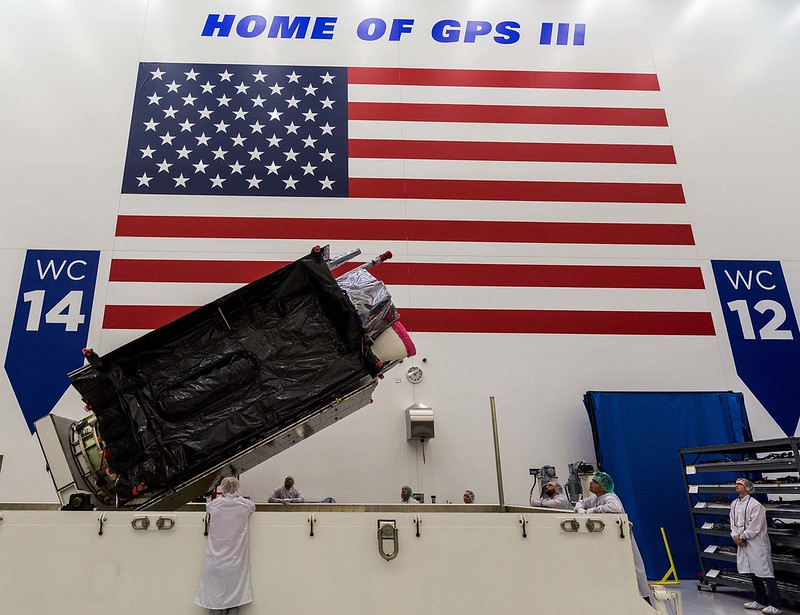
    GPS III SV05, now in Florida, is shown fully integrated at Lockheed Martin's production facility in Colorado. (Photo: Lockheed Martin)
    GPS III SV05, now in Florida, is shown fully integrated at Lockheed Martin’s production facility in Colorado. (Photo: Lockheed Martin)

    The U.S. Space Force’s Space and Missile Systems Center successfully delivered the fifth GPS III satellite to Cape Canaveral Space Force Station, Florida, on April 6.

    GPS III Space Vehicle (SV) 05 was transported from the Lockheed Martin facility in Waterton, Colorado, to the Space Coast Regional Airport in Titusville, Florida, by a C-17 Globemaster III crew from Joint Base Lewis-McChord, Washington. Lockheed Martin is the contractor for construction of the GPS III satellites.

    Now that the satellite has arrived at the Astrotech Space Operations facility, the latest addition to the GPS constellation modernization effort will begin final testing and checkout before the launch. While at Astrotech, it will undergo final post-ship functional testing, be fueled with onboard propellant, and then be encapsulated for launch.

    Once these tasks are accomplished, SV05 will be horizontally integrated with the first-ever SpaceX Falcon 9 launch vehicle to be reflown for a National Security Space Launch (NSSL) mission.

    “SV05 is the third GPS III satellite shipped to the Cape in the last 14 months and marks a key step to our larger goal of GPS constellation modernization,” said Col. Edward Byrne, SMC’s Space Production Corps Medium Earth Orbit Space Systems Division chief. “As the fourth GPS III launch campaign with SpaceX, this NSSL mission is historic both for the first reflight of a Falcon 9 rocket and for being the 24th military-code (M-code) satellite introduced to our constellation, the last needed to bring M-code to full operational capability.”

    Slated to launch in June, GPS III SV05 will join the operational constellation of 31 GPS satellites, delivering enhanced performance and accuracy through a variety of improvements.

    Improvements include increased signal protection, L1C signal interoperability, and the newest civilian signal, L5. As a crucial technological foundation for internet, financial, transportation and agricultural operations, GPS delivers the gold standard in positioning, navigation and timing services supporting U.S. and allied operations worldwide.

    The U.S. Space Force’s Space and Missile Systems Center, located at the Los Angeles Air Force Base in El Segundo, California, is the center of excellence for acquiring and developing military space systems. SMC’s portfolio includes space launch, global positioning systems, military satellite communications, a meteorological satellite control network, range systems, space-based infrared systems, and space situational awareness capabilities.

  • New launch window set for GPS III SV04

    New launch window set for GPS III SV04

    After an aborted launch with two seconds to go, the fourth GPS III satellite is now planned to launch on Nov. 5.

    The first launch attempt on Oct. 2 from Cape Canaveral was halted due to an “unexpected pressure rise in the turbomachinery gas generator,” said SpaceX CEO Elon Musk on Twitter, referring to a part in the rocket’s Merlin engines.

    SpaceX test-fired the Falcon 9 rocket for the GPS mission on Saturday at 7 p.m. on pad 40 at Cape Canaveral Air Force Station to verify that corrective actions have resolved the issue, according to SpaceX and reported by SpaceFlightNow. The fourth GPS III satellite was not aboard during the test.

    GPS III SV04 first rolled out to Cape Canaveral’s Space Launch Complex 40 on Sept. 27. The satellite was originally scheduled for launch Sept. 30, then Oct. 1, but that launch was delayed because of a “traffic jam” at the launchpad caused by launch delays of other rockets.

    The satellite was almost launched at 9:43 p.m. EDT on Oct. 2 until the launch was stopped at T– 2 seconds.

    The Lockheed Martin-built GPS III SV04 will be launched aboard a SpaceX Falcon 9 rocket — the third National Security Space Launch (NSSL) mission on a Falcon 9 rocket, the second U.S. Space Force (USSF) first-stage booster recovery, and the sixth USSF launch.

    A live feed will begin 20 minutes before the launch and conclude approximately 45 minutes afterward. A simulcast of the broadcast can be viewed at www.spacex.com.

    GPS III SV04 will be launched to augment the current GPS constellation comprised of 31 operational spacecraft. GPS satellites operate in Medium Earth Orbit (MEO) at an altitude of approximately 20,200 km (12,550 miles) in six orbital planes. Each satellite circles the earth twice per day.

    GPS III brings new capabilities to users such as the new L1C civilian signal, which opens the window for future interoperability with international satellite navigation systems.

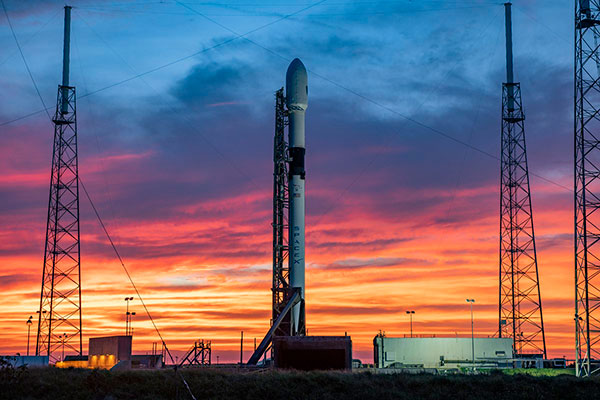
    GPS III SV04 rests atop a Falcon 9 rocket, waiting to be sent into orbit. (Photo: SpaceX)
    GPS III SV04 rests atop a Falcon 9 rocket, waiting to be sent into orbit. (Photo: SpaceX)
  • Aborted launch of GPS III SV04 results in hardware analysis

    Aborted launch of GPS III SV04 results in hardware analysis

    The aborted launch of the fourth GPS III satellite has sparked an investigation into the SpaceX Falcon 9’s Merlin engine. With only two seconds before launch, SpaceX stopped the scheduled launch of the fourth GPS III satellite on Oct. 2.

    Tim Dunn of NASA’s Launch Services Program said at an Oct. 16 briefing that the engines had undergone significant testing since the GPS III launch scrub, including taking the Merlin engines from that rocket back to SpaceX’s McGregor, Texas, test site for further study, reports SpaceNews.com. That investigation has involved NASA and Space Force personnel working with SpaceX.

    While the GPS III launch has not been rescheduled, Dunn said that the NASA and SpaceX personnel have learned much, with implications involving the rocket hardware.

    GPS III SV04 rests atop a Falcon 9 rocket, waiting to be sent into orbit. (Photo: SpaceX)
    GPS III SV04 rests atop a Falcon 9 rocket, waiting to be sent into orbit. (Photo: SpaceX)
  • US Space Force grants GPS III SV03 operational acceptance 

    US Space Force grants GPS III SV03 operational acceptance 

    The United States Space Force (USSF) and the Space and the Missile Systems Center achieved another major GPS milestone on July 27 when the GPS III Space Vehicle (SV) 03 received USSF’s Operational Acceptance approval.

    This marks the third GPS III satellite to receive operational acceptance in less than a year.

    GPS III SV-03 satellite packed prior to shipment to Cape Canaveral. (Photo: Lockheed Martin)
    GPS III SV-03 satellite packed prior to shipment to Cape Canaveral. (Photo: Lockheed Martin)

    The GPS III satellites are the newest generation built by Lockheed Martin that provide precise positioning, navigation and timing information with three times better accuracy, and up to eight times improved anti-jamming capability than previous generations of GPS satellites.

    SV03 was launched on June 30 and was the second National Security Space Launch (NSSL) mission launched on a SpaceX Falcon 9 rocket. This was the first NSSL mission where a Launch Service Provider recovered a booster, with SpaceX successfully recovering the first stage and fairings as part of the launch.

    The GPS III SV03 mission was dedicated to Colonel Thomas G. Falzarano, 21st Space Wing commander, who passed away in May.

    “We are adding GPS warfighter capability and resiliency with each new GPS III satellite. The on-boarding of GPS III SV03 enables our first use of cross link commanding capability for assured nuclear detection,” said Lt. Col. Michael Schriever, 2nd Space Operations Squadron commander. “With the GPS III SV03 addition to the constellation, our modernized signals capable satellites increases to 22 vehicles. This results in nearly a fully capable Military-Code constellation, which our space warfighters will operate to deliver expanded capabilities to the joint force.”

    The USSF’s Space and Missile Systems Center, located at Los Angeles Air Force Base, California, is the center of excellence for developing, acquiring and delivering military space systems. Its portfolio includes

    GPS, military satellite communications, defense meteorological satellites, space launch and range systems, satellite control networks, space based infrared systems, and space situational awareness capabilities.

  • GPS III Space Vehicle 04 safely arrives in Florida

    GPS III Space Vehicle 04 safely arrives in Florida

    The U.S. Space Force Space and Missile Systems Center on July 14 delivered the fourth GPS III satellite to Cape Canaveral Air Force Station, Florida. The satellite is scheduled for launch on Sept. 30.

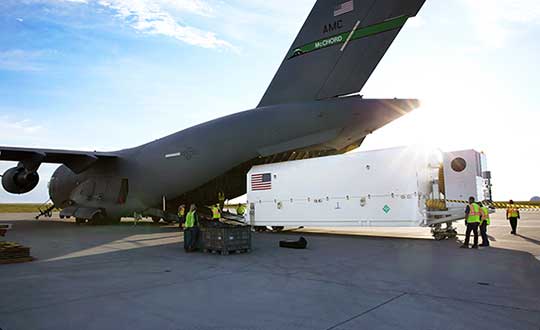
    GPS III Space Vehicle (SV) 04 was safely transported from the Lockheed Martin facility in Waterton, Colorado to Space Coast Regional Airport in Titusville, Florida. The satellite was carried aboard a C-17 Globemaster III originating from Joint Base Lewis-McChord, Washington.

    The fourth GPS III satellite arrived at Cape Canaveral July 14 for launch on Sept. 30. (Photo: USAF)
    The fourth GPS III satellite arrived at Cape Canaveral July 14 for launch on Sept. 30. (Photo: USAF)

    The delivery of GPS III SV04 starts the clock for final testing and checkout prior to launch. The satellite will be processed at the Astrotech Space Operations facility in Florida to ensure the full functionality of the satellite, prepare the satellite for propellant loading, and encapsulate the satellite in its protective fairing. At the completion of these activities, the satellite will be horizontally integrated with the SpaceX Falcon 9 launch vehicle.

    “The shipment of the fourth GPS III satellite was successfully conducted just two weeks after the launch of our GPS III-SV03 satellite. This operation is a remarkable achievement and testament to the hard work of the entire GPS team members from all across the country,” said Col. Edward Byrne, SMC’s Medium Earth Orbit Space Systems Division chief. “The delivery of SV04 marks the start of our third GPS III launch campaign on a SpaceX Falcon 9 rocket and brings us another step closer in advancing the GPS constellation with more capable satellites.”

    GPS III SV04 is slated to launch in September. Once on-orbit, it will join the operational constellation of 31 GPS satellites, delivering enhanced resiliency, better accuracy, and advanced anti-jam capabilities.