Tag: Spirent

  • Launchpad: Navigation modules, fleet tracking, UAVs

    Launchpad: Navigation modules, fleet tracking, UAVs

    A roundup of recent products in the GNSS and inertial positioning industry from the November 2021 issue of GPS World magazine.


    OEM

    Simulator

    Designed for desktop convenience
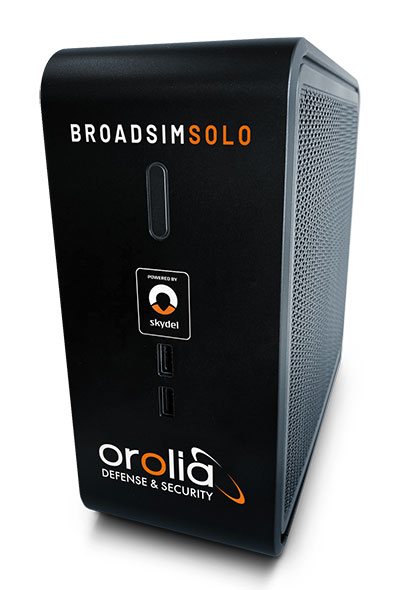
    Photo: Orolia
    Photo: Orolia

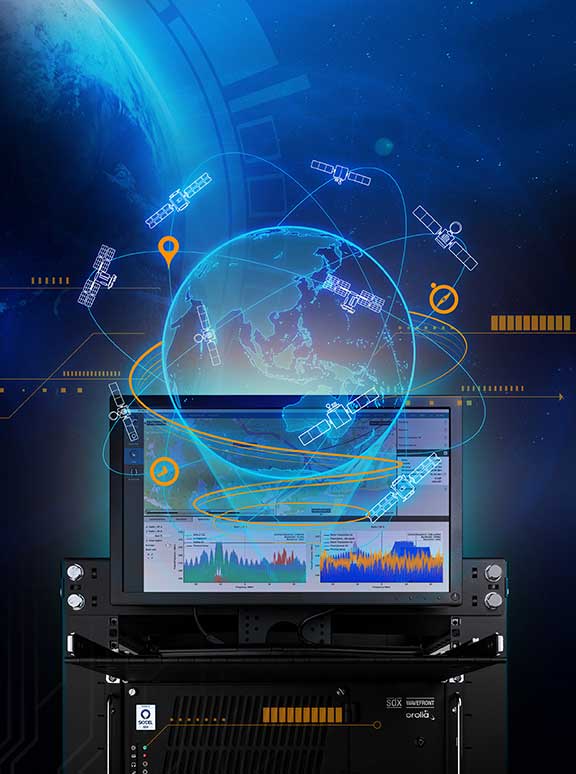
    The BroadSim Solo has a compact form factor designed to fit comfortably at a typical desk or workstation. It shares the same Skydel simulation engine that runs on a standard BroadSim, BroadSim Anechoic and BroadSim Wavefront. It supports advanced scenario creation features and the benefits provided by a software-defined architecture such as high dynamics, a 1000-Hz iteration update rate and ultra-low latency of 5 ms. Nearly all civilian GNSS signals can be generated through the Solo’s single RF output (one frequency band at a time), along with jamming or spoofing signals, and GPS AES M-code.

    Orolia, orolia.com

    9-in-1 Antennas

    Series offers GNSS, 5G NR, and wifi-6E combination
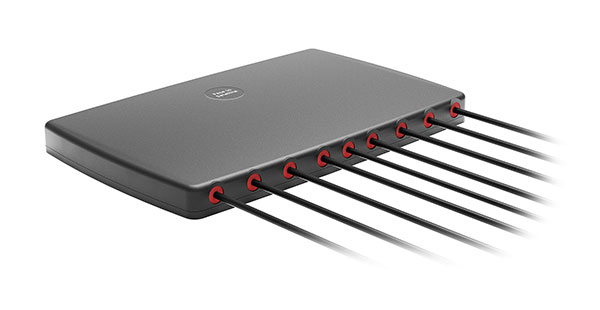
    Photo: 2J Antennas
    Photo: 2J Antennas

    The Stellar series of antennas is designed for a large suite of devices with a focus on GNSS, sub-6 GHz, 5G NR, 4G LTE, 3G, 2G and WiFi-6E technologies. The series is suitable for law enforcement, medical transportation, fire rescue and other mission-critical applications. The series includes single or up to 9-in-1 configuration choices within the range of 617 MHz to 7125 MHz frequency bands. The patent-pending technology reduces the antenna footprint by 55% while implementing a new double trifilar design and longitudinal resonances for MIMO/ARRAY configurations that traditionally have more complex size restrictions (such as B71 band/600 MHz). Each antenna configuration uses symmetrical or asymmetrical resonators for negative sections of the antenna, resulting in maximum performance at low and mid frequencies.

    2J Antennas, 2j-antennas.com

    GNSS Antenna 

    Full-band helical design for precise positioning
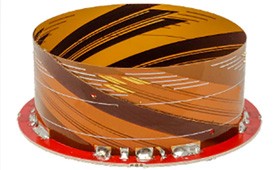
    Photo: Tallysman Wireless
    Photo: Tallysman Wireless

    The full-band GNSS HC990E embedded helical antenna is designed for precise positioning, covering the GPS/QZSS-L1/L2/L5, QZSS-L6, GLONASS-G1/G2/G3, Galileo-E1/E5a/E5b/E6, BeiDou-B1/B2/B2a/B3, and NavIC-L5 frequency bands, including the satellite-based augmentation system (SBAS) available in the region of operation [WAAS (North America), EGNOS (Europe), MSAS (Japan), or GAGAN (India)], as well as L-band correction services. The HC990E embedded helical antenna is designed and built for high-accuracy positioning. It is packaged in a very light and compact form factor, making it suitable for a wide variety of applications, especially lightweight UAV navigation. The HC990E is 60-mm wide and 25-mm tall, weighing 12 grams. It features a precision-tuned helical element that provides an excellent axial ratio and operates without the requirement of a ground plane. The HC990E also features a low-current, low-noise amplifier (LNA) and pre-filter to prevent harmonic interference from high-amplitude signals, such as 700 MHz band LTE and other nearby in-band cellular signals.

    Tallysman Wireless, tallysman.com

    Chip-Scale Atomic Clock 

    Provides wider operating temperatures, faster warm-up, improved stability
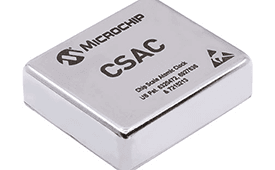
    Photo: Microchip Technology
    Photo: Microchip Technology

    The SA65 chip-scale atomic clock (CSAC) provides precise timing accuracy and stability in extreme environments. Designed for military and industrial systems, it features ultra-high precision and low power consumption. The SA65 CSAC delivers higher performance than the previous SA.45s CSAC, including double the frequency stability over a wider temperature range and faster warm-up from cold temperatures. It has an operating temperature range of –40° C to 80° C and a storage temperature range of –55° C to 105° C. The warm-up time of two minutes at –40° C is 33% faster than that of the SA.45s. These performance improvements benefit designers of highly portable solutions for military applications such as assured positioning, navigation and timing (A-PNT) and C5ISR (command, control, communications, computers, cyber, intelligence, surveillance and reconnaissance).

    Microchip Technology, microchip.com

    Processor

    Provides L1 receiver for mobile, wearables
    Image: Samsung
    Image: Samsung

    Samsung Electronics is offering a new processor for wearables, the Exynos W920. The new processor integrates an LTE modem and is built with an advanced 5-nanometer (nm) extreme ultraviolet process node, offering powerful yet efficient performance demanded by next-generation wearable devices. The Exynos W920 is embedded with a GNSS L1 receiver (GPS, GLONASS, BeiDou, Galileo) for tracking speed, distance and elevation during outdoor activities. It also has a 4G LTE Cat. 4 modem. It has two Arm Cortex-A55 cores for high-performing, power-efficient processing and an Arm Mali-G68 GPU with CPU performance improved by 20% and 10 times better graphics performance than its predecessor. The Exynos W920 supports a new unified wearable platform that Samsung built jointly with Google, and will be first applied to the upcoming Galaxy Watch model.

    Samsung, samsung.com


    SURVEYING & MAPPING

    GNSS Receivers

    Longer battery life, more signals
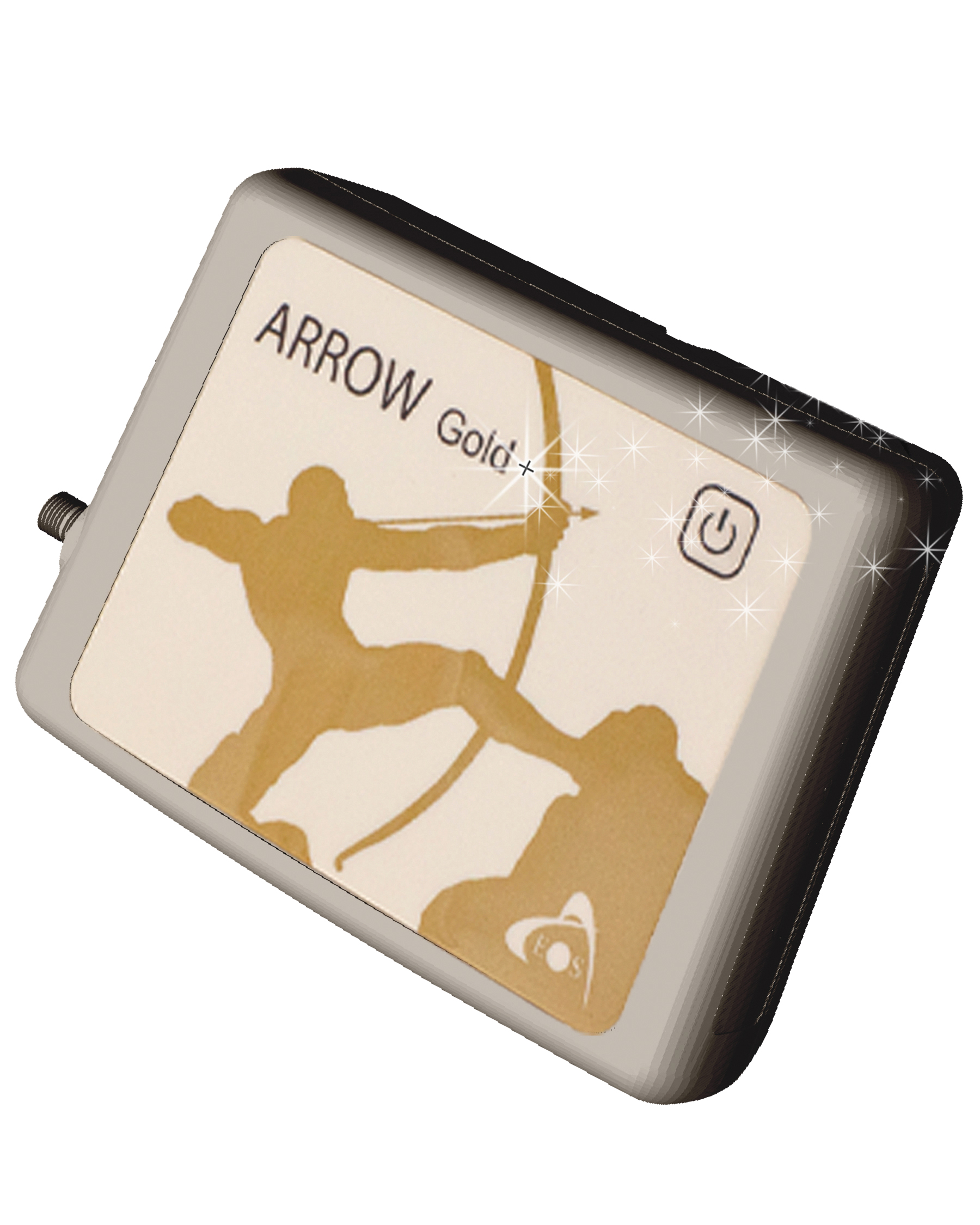
    Photo: Eos Positioning
    Photo: Eos Positioning

    The Arrow Gold+ and Arrow 100+ expand upon the features of the Arrow Gold and Arrow 100. The Arrow Gold+ has a battery life 3.5 hours longer, for a total of 11 hours of field autonomy. It supports concurrent use of BeiDou B3 and GPS L5 signals when using RTK corrections, and the upcoming Galileo E6 High-Accuracy Service (HAS). The Arrow 100+ has a battery life 6 hours longer than the Arrow 100, for a total of 18 hours of field autonomy. It also supports Atlas H50 (Basic) service subscriptions, which provide 30-50 cm positioning accuracy worldwide when no SBAS or RTK network is available. Both the Arrow Gold+ and Arrow 100+ use Eos Bridge to connect with external sensors — multiple mobile devices can connect to a single Arrow GNSS receiver via Bluetooth.

    Eos Positioning, eos-gnss.com

    3D Mesh Conversion

    Enables new visualization of geospatial data
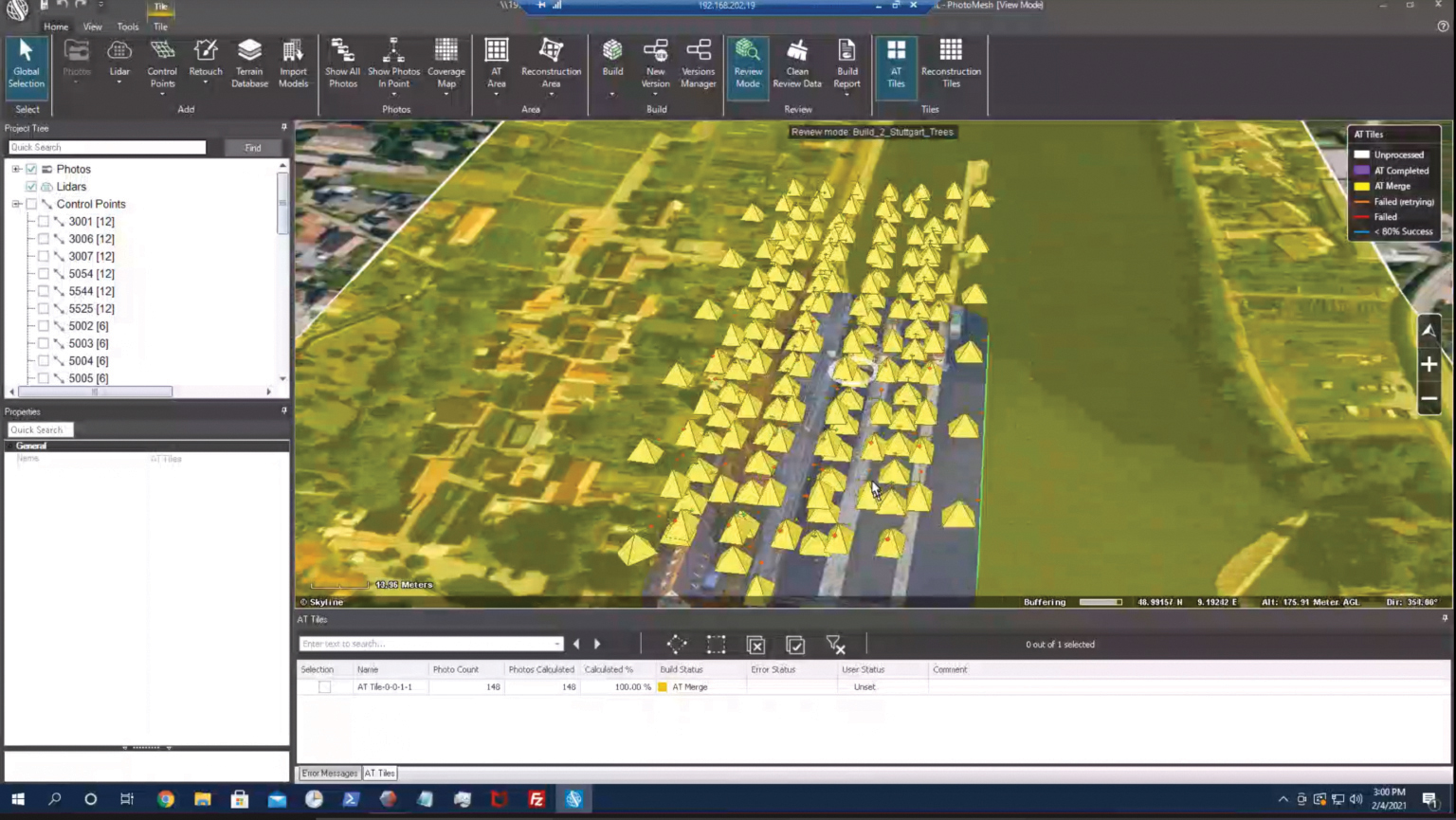
    Photo: Skyline
    Photo: Skyline

    EagleView’s high-resolution ortho and oblique imagery now can be converted into 3D mesh layers with Skyline’s PhotoMesh and viewed, edited and analyzed on Skyline’s TerraExplorer platform. EagleView customers will be able to use Skyline’s TerraExplorer web-based GIS viewer and editor to see, analyze and share their imagery in an immersive environment. Accurately measuring distance, area and volume is now easier than ever, which is critical for planning and zoning to verify regulations or estimate the costs of flattening a site. With floodplain analysis, disaster management can identify flood risks before they happen, and with viewshed calculations E911 can pre-plan for high-profile events. Other key analytic features for customers include the ability to analyze shade, view contour and slope maps, and view in underground mode. The additional 3D Mesh capability is available as an add-on to any new Reveal Essentials+ Property or Neighborhood image capture.

    Skyline, skylinesoft.com; EagleView, eagleview.com

    Ground Survey App

    Enables ground surveys on KlauPPK drone setup
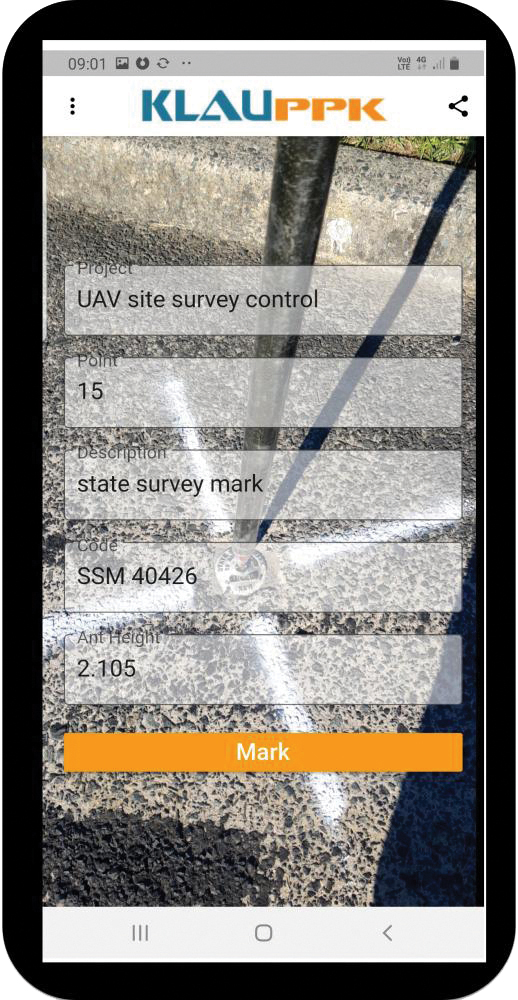
    Photo: Klau Geomatics
    Photo: Klau Geomatics

    The KlauPPK Phone App, designed for use on drones with KlauPPK hardware and software, enables users to collect ground survey points with a name, description, feature code and antenna height like a traditional survey controller. The app sends the information to the operator’s computer for processing with the raw GNSS data logged in the KlauPPK unit on the pole. After post processing, the accurate survey data can be brought into CAD software to create points and line strings. The app takes a photo of the point being captured, and metadata is collected in the project. Users can place ground control points or check points, pick up as-built data like roads and utilities, and perform basic surveying. The system is compatible with the hybrid PPP/PPK MakeItAccurate post-processing service.

    Klau Geomatics, klauppk.com

    Geospatial Software

    For command-and-control applications
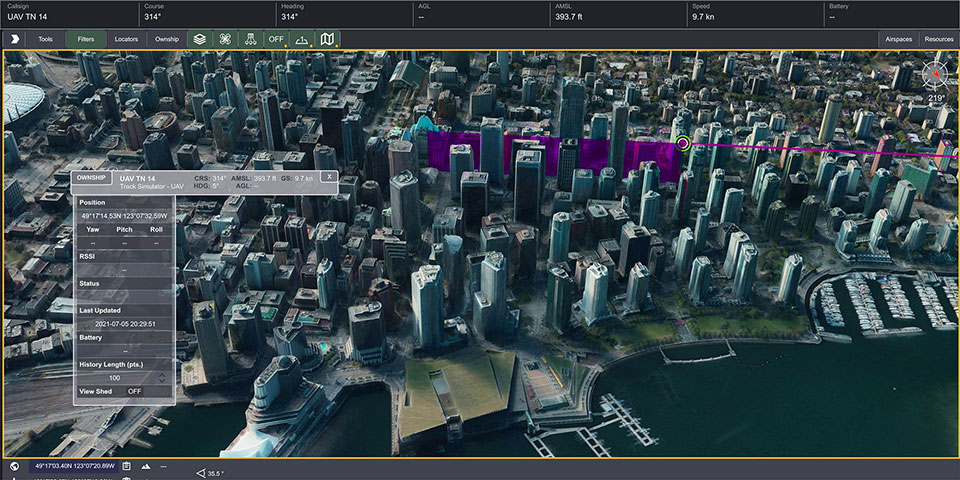
    Image: Kongsberg
    Image: Kongsberg

    TerraLens 9.3 is a real-time software development toolkit for geospatial visualization. This release improves performance for 3D visualization for large viewports and multi-domain visualization features for command-and-control applications. It is significantly faster to enhance situational awareness. With increased multithreading in its map handling, TerraLens can load and display vector, raster and elevation formats smoothly without pre-processing, suitable for applications with disk size constraints or customers with a short turn-around time. A pre-processing option is still included. Improved data culling ensures only visible items will be rendered — especially noticeable when displaying large numbers of dynamic tracks and objects. New tools and features including support for OGC 3D Tiles for cityscapes, and a new API to control resolution of terrain mesh. Elevation warnings can now be displayed.

    Kongsberg Geospatial, kongsberggeospatial.com

    Panoramic Camera

    Now usable on UAVs
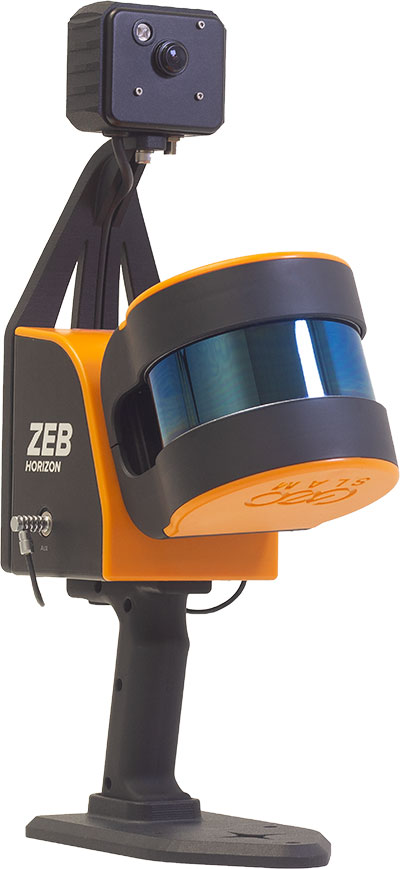
    Photo: GeoSLAM
    Photo: GeoSLAM

    The ZEB Vision 16MP panoramic camera is now available for pre-order. Suitable for any ZEB Horizon, the new camera provides better colorization, image walkthroughs and point-cloud measurements using optional Draw software. Further updates mean GeoSLAM customers now can take a ZEB Horizon from handheld to UAV usage to get a more complete picture of projects. ZEB Horizon is compatible with the DJI Matrice 300 UAV.

    GeoSLAM, geoslam.com


    TRANSPORTATION

    Auto Modules

    Accurate navigation in heat
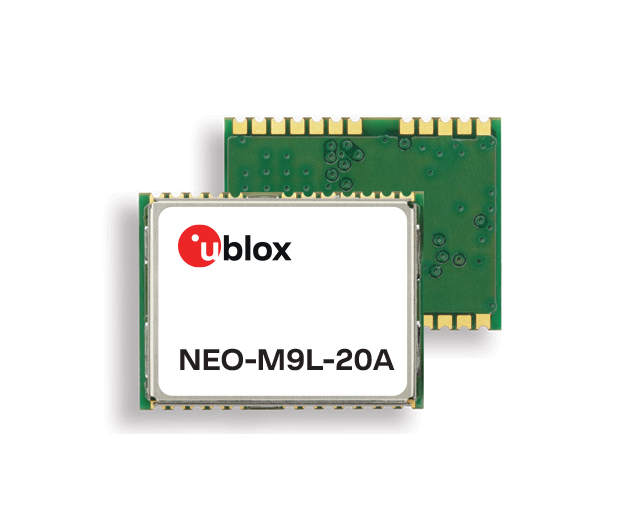
    Photo: U-blox
    Photo: U-blox

    A new series of automotive-grade positioning modules are operational up to 105° C (221° F). The NEO-M9L modules and the M9140-KA-DR chip are built on the u-blox M9 GNSS platform and use dead-reckoning techniques to provide accurate position data when satellite signals are compromised or unavailable. The NEO-M9L-20A and NEO-M9L-01A modules, as well as the M9140-KA-DR chip, are specially designed for first-mount automotive solutions. The NEO-M9L-01A variant offers an extended operational temperature range up to 105° C, making it suitable for integration on the roof, behind the windscreen, or inside hot electronics control units. Applications include integrated navigation systems such as in-vehicle infotainment (IVI) and head units, integrated telematics control units and V2X.

    U-blox, ublox.com

    Dead-Reckoning Module

    Provides positioning accuracy in tunnels, parking garages
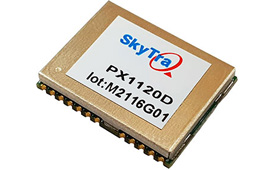
    Photo: SkyTraq
    Photo: SkyTraq

    The PX1120D GNSS/inertial measurement unit (IMU) is suitable for both automotive pre-installation and aftermarket. The robust dead-reckoning module integrates a six-axis IMU and a concurrent quad-GNSS chipset. It receives signals from GPS, GLONASS, Galileo and BeiDou, as well as QZSS. The sensor-fusion module maximizes positioning accuracy in challenging environments, providing continuous navigation in tunnels and underground parking lots. For automotive pre-installation applications where vehicle wheel-tick signals are available, the PX1120D provides wheel-tick sensor fusion with automotive dead-reckoning. In aftermarket applications where wheel-tick signals are unavailable, the PX1120D provides an untethered dead-reckoning sensor-fusion solution. A single PX1120D module provides both automotive and untethered dead-reckoning functionality, simplifying logistics. It is suitable for infotainment systems, telematics control units, vehicle tracking, and advanced driver-assistance systems.

    SkyTraq Technology, skytraq.com.tw

    Sharkfin Antenna

    For intelligent transportation and public safety
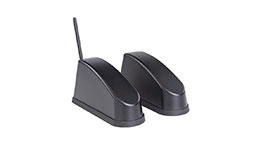
    Photo: PCTEL
    Photo: PCTEL

    The Trooper Max 5G FR1 antenna platform is a 5G configurable and low-profile antenna platform for intelligent transportation and public safety applications. Configurable and optimized for multiband applications, the platform includes an option to add land mobile radio connectivity through an external whip port. With a slender shark-fin form factor, the Trooper Max is recommended for installation on public safety fleets. It is compatible with cellular routers supporting 600-MHz to 6-GHz frequencies. It also covers Wi-Fi 6 frequency ranges.

    PCTEL, pctel.com

    Fleet Tracking

    New features increase functionality for winter operations

    Photo: EvgeniaParajanian/iStock/Getty Images Plus/Getty Images
    Photo: EvgeniaParajanian/iStock/Getty Images Plus/Getty Images

    Version 7.9 of the CompassTrac fleet and asset management solution provides winter fleets with more detailed spreader controller information and greater insight through enhanced dashboard and reporting functions. Features include integration of numerous spreader controllers for granular, pre-wet and liquid materials; a snow-fighting dashboard consolidating key performance indicators; and a snow materials report that delivers historical reporting of granular, pre-wet and direct liquid material application rates and totals, including air and road temperature (where available). The fleet-management solution integrates GNSS, GIS and wireless networks, enabling end users to view the real-time locations and status of vehicles, people, and other high-value assets for full situational awareness.

    CompassCom, compasscom.com

    Marine Planning App 

    New departure scheduling charts route, wind, tides
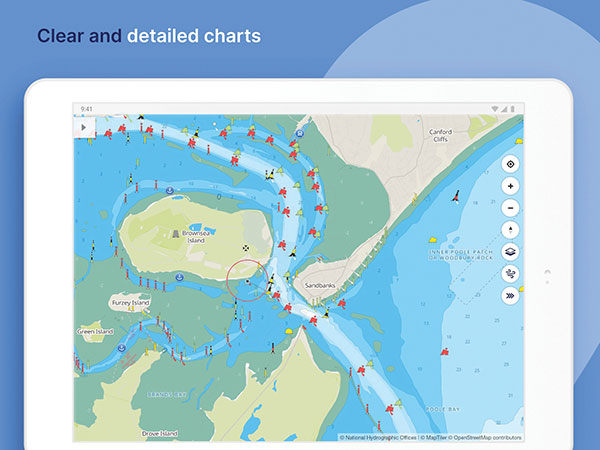
    Photo: Savvy Navvy
    Photo: Savvy Navvy

    Smartphone app Savvy Navvy now allows boaters to plan better by visually showing the best time to depart given wind and tidal implications, leading to more informed and cost-saving decisions for journeys. By comparing passage times, as well as weather and tide information, boaters can immediately make crucial decisions based on safety, comfort, time and cost. Savvy Navvy is available on Android, iOS, PC and Mac and can be used on an unlimited number of devices simultaneously. It charts, weather, tide, marina details and passage planning with full tidal vectors. Active GPS tracking shows vessel position and enables boaters to instantly check course over ground (COG) and speed over ground (SOG). The app uses UKHO, NOAA and other official hydrographic charts from around the globe, as well as tide data from 8,000 tidal stations.

    Savvy Navvy, savvy-navvy.com


    UAV

    Heavy Lift Platform

    Multi-purpose, dual-rotor unmanned aircraft
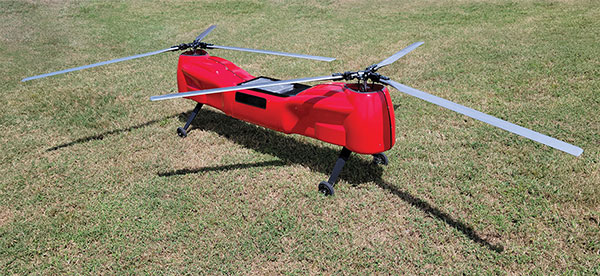
    Photo: UAS Global
    Photo: UAS Global

    The Anzen EG-1250 provides a heavy lift, multi-drop, long endurance and flexible platform, expanding the services and operational support offerings from UAS Global Services. With an endurance of six hours, the EG-1250 can carry 75 pounds, cruise at 65 knots, in any weather day or night. The EG stands for an electric and gas dual-engine configuration, with the secondary engine able to power the aircraft or act as a power boost for the primary Skypower rotary SP-180 SRE engine. The Anzen EG-1250 is auto-rotation capable and offers an optional safety parachute system. The flexible platform can support industries such as maritime, agriculture, oil and gas, utility, cargo delivery and intelligence, surveillance and reconnaissance (ISR).

    UAS Global Services, uas-gs.com

    VTOL drone

    Fixed-wing design for long endurance
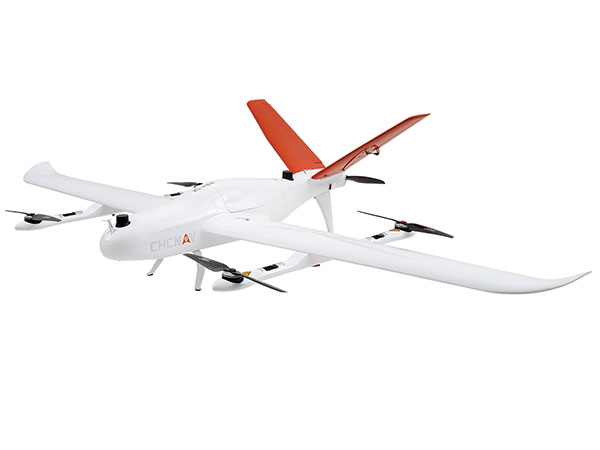
    Photo: CHC Navigation
    Photo: CHC Navigation

    The P330 Pro is a high-performance vertical takeoff and landing (VTOL) fixed-wing UAS for aerial surveying and mapping. It provides high accuracy, long endurance and multiple payloads. It features a 100-Hz differential module, which allows aerial mapping operations at the centimeter level, and a flight endurance with payload reaching more than 150 minutes. The P330 Pro can be used to conduct small- and large-scale aerial surveys with extreme data quality, and is an alternative to manned aircraft for surveying and mapping, mining, construction and infrastructure, environmental monitoring and agriculture.

    CHC Navigation, chcnav.com

    Mining Software

    Capability expansion enables M300 for data capture
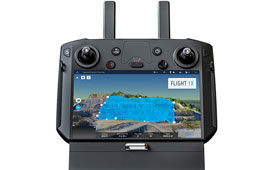
    Photo: Skycatch
    Photo: Skycatch

    Flight1x software now provides data-capture capabilities for the DJI Matrice 300. The Skycatch High Precision Package provides mining operations with cloud or edge-based data processing that enables viewing terrain in 4D, automated RTK/PPK industrial drone management, and fast edge processing with data visibility in minutes. Built on technology adopted by large mining companies, Flight1x includes purpose-built flight automation software for the M300, leveraging DJI’s L1 and P1 sensors. Flight1x is part of the Skycatch High Precision Package, which provides mining operations with cloud or edge-based data processing that enables viewing terrain in 4D, automated RTK/PPK industrial drone management, and fast edge processing with data visibility in minutes.

    Skycatch, skycatch.com

    5G Drone Platform

    Offers 5G and artificial intelligence capabilities
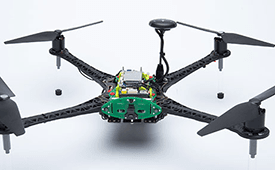
    Photo: Qualcomm
    Photo: Qualcomm

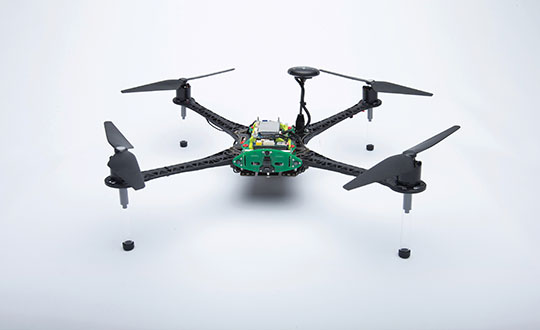
    The Flight RB5 5G platform is designed to accelerate development of commercial, enterprise and industrial drones. Powered by the Qualcomm QRB5165 processor, it condenses multiple complex technologies into a tightly integrated drone system. With 5G and Wi-Fi 6 connectivity, the platform enhances critical flying abilities beyond visual line-of-sight to support safer, more reliable flight. High-performance computing provides power efficiency for artificial intelligence and machine learning, enabling fully autonomous drones. A secure processing unit supports cybersecurity protections. New camera capabilities deliver premium image capabilities and performance. The Flight RB5 5G drone reference design is available through ModalAI. Use cases include mapping, inspection, film and entertainment, defense, security and emergency response, and delivery.

    Qualcomm Technologies, qualcomm.com

    Cloud-Based Service

    Predicts aerial traffic in urban areas
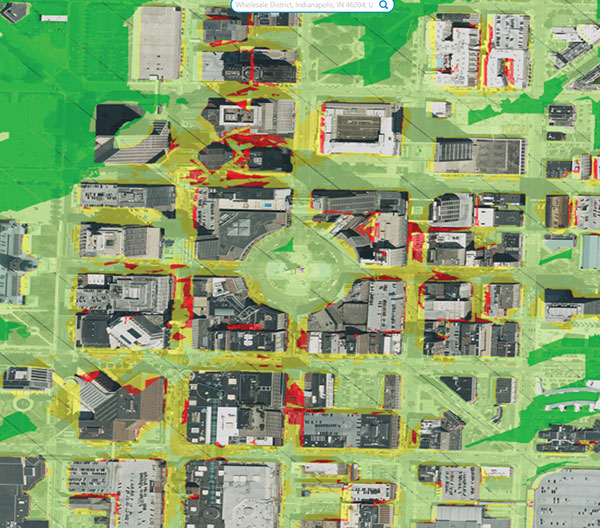
    Photo: Spirent
    Photo: Spirent

    Spirent GNSS Foresight lets operators know where and when unmanned vehicles, air taxis and drones can operate safely and dependably beyond visual line of sight, especially in urban areas where buildings frequently obstruct GNSS signals. The cloud-based solution can produce forecasts using data from any of the world’s satellite constellations, and is of particular interest to the aviation, UAS and automotive industries. Spirent GNSS Foresight’s ability to accurately predict where and when autonomous systems will perform enables users to scale operations or services by expanding operational areas, reducing the number of system disengagements, and providing a greater level of safety and reliability assurance when reducing — or ultimately removing — human involvement in the driving or piloting task.

    Spirent Communications, spirent.com
     

  • Spirent SimIQ brings insight early in process

    Spirent SimIQ brings insight early in process

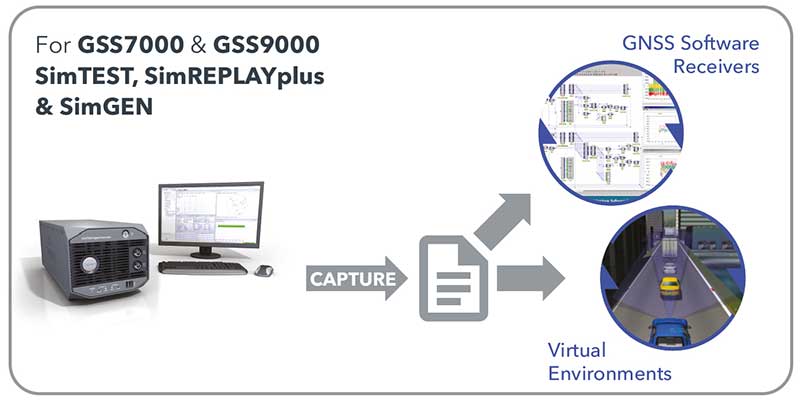
    For 30 years, Spirent Communications has built GPS/GNSS simulators, operating at the radio frequency (RF) level and building a broad customer base. Now, with the launch of SimIQ — which starts shipping at the end of October — the company is providing simulation at the I/Q level. (When talking about frequency mixers, the “I” stands for “in phase” and the “Q” stands for “in quadrature.”)

    SimIQ is in response to requests from receiver experts, who want to be able to test their receiver algorithms earlier in the development cycle before designing the Application Specific Integrated Circuits (ASIC) or the Field Programmable Gate Arrays (FPGA).

    SimIQ Capture: Record I/Q data from Spirent GNSS simulators into files. (Image: Spirent)
    SimIQ Capture: Record I/Q data from Spirent GNSS simulators into files. (Image: Spirent)

    “They used to come up with their own individual mechanisms to generate I/Q data and test it,” said Ajay Vemuru, product line manager, NPI, Spirent. “For example, you can use programs that you develop on MATLAB to come up with I/Q data files, but that requires an effort in debugging them and keeping them up to date with the different constellations.” That effort grows as the number of GNSS constellations grows. SimIQ will use the same software as Spirent’s current simulator. However, instead of generating the RF signal, it will generate the I/Q data.

    Any GNSS receiver, Vemuru explained, contains a radio that receives the RF signal and down-converts it to create a baseband digital I/Q signal. “That is the I/Q data that we are generating,” he said. “Instead of customers waiting for the RF or the ASIC to be completely designed, they can now take the I/Q straight out of our simulators, inject that into their algorithms, and run their correlators. You can run all your processing on this I/Q data without having to worry about the antenna characteristics and the front-end noise. You can pick and choose which pieces of the receiver you want to test.”

    Because the software has not changed, the scenarios — such as the movement of the platform — are the same as before. Plus, customers can reuse them, running them at the I/Q level instead of the RF level.

    SimIQ Replay: Generate RF with Spirent GNSS simulators from I/Q files. (Image: Spirent)
    SimIQ Replay: Generate RF with Spirent GNSS simulators from I/Q files. (Image: Spirent)

    While Vemuru expects many of Spirent’s customers to be interested in SimIQ, he also anticipates new and evolving markets might take advantage of it. “There will be new teams in existing markets that we haven’t reached because they are engaging an earlier phase of the design process,” said Adam Price, director of PNT simulation at Spirent. “We want to target earlier phases in chipset development.”

    In the world of autonomous vehicles, Price explained, engineers are doing significantly more simulation in software to verify more “corner cases” — jargon for problems or situations that occur outside of normal operating parameters, such as when multiple environmental variables or conditions are simultaneously at extreme levels. “As you start to get into safety-critical systems, for example, software simulation is becoming increasingly required,” Price said. “This could allow us to engage that segment. People want to carry out verification earlier in the design cycle.”

    By running a simulation in hardware and presenting the devices being tested with a real RF signal, Price points out, engineers are limited to operating in real time. By contrast, in software they can run simulations faster or slower than in real time and even run several simulations in parallel. This is important for developing autonomous vehicles because engineers need to test many scenarios over millions of miles of simulated travel.

    Spirent’s SimIQ, however, is addressing a somewhat different market, Vemuru said. “In fact, they would prefer to run slower than in real time because their ASIC or FPGAs are not yet in production. So, they would be essentially running them on CPUs, which take a lot more processing time.”

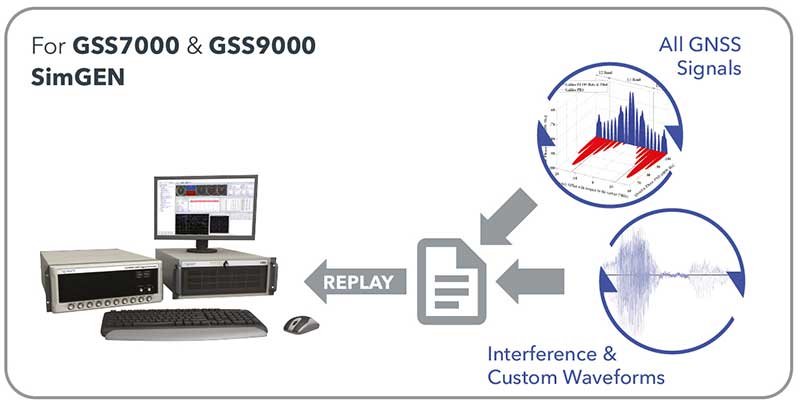
    So far, we have been talking only about capturing I/Q data. However, SimIQ can also replay it. This, Vemuru said, “is essentially for customers who want to add interference patterns that, for some reason, they don’t want Spirent or anybody else to see. It can be any signal, so long as it is within the frequency of the GNSS spectrum. They can inject I/Q files into the platform itself. We take the external I/Q stream, generate the GNSS signals, add them up, and generate this at the RF level.”

    One use case deals with classified signals. “They can always generate baseband I/Q data of that classified signal, as a file, and inject it into our simulator, so that we can generate the RF signal for that particular classified I/Q signal alongside the GNSS that already comes out natively from our boxes,” Vemuru explained.

  • SimINERTIAL designed for GPS/INS testing

    SimINERTIAL designed for GPS/INS testing

    Photo: Spirent
    Photo: Spirent

    Testing the full operational performance of GPS/inertial systems usually requires expensive and time-consuming field testing on an appropriate moving vehicle platform. Spirent’s SimINERTIAL system emulates inertial sensor outputs while simultaneously simulating GPS RF signals. This enables controlled, repeatable testing of integrated GPS and inertial units, reducing the need for field trials.

    SimINERTIAL is housed in a PC platform equipped with the appropriate data interface card. The simulated motion data is streamed from Spirent’s state-of-the art SimGEN application via Ethernet to SimINERTIAL, which translates this simulated motion data into representative real-time data streams at the data rate and with the data format appropriate to the unit being tested.

    SimINERTIAL is equipped with fully user-configurable sensor error modeling and supports a range of popular inertial formats. SimINERTIAL architecture is also available in configurations to support transfer alignment and multiple sensor architectures. SimINERTIAL solutions can also be equipped to deliver a barometric altitude output via a MIL-STD-1553B card installed in the SimINERTIAL controller PC.

  • Navigating testing options: Simulator innovators map out solutions and trends

    Navigating testing options: Simulator innovators map out solutions and trends

    This tongue-in-cheek photo, courtesy of Racelogic, underlines how simulators help GNSS engineers “road test” multiple positioning products in multiple scenarios. (Photo: Racelogic)
    This tongue-in-cheek photo, courtesy of Racelogic, underlines how simulators help GNSS engineers “road test” multiple positioning products in multiple scenarios. (Photo: Racelogic)

    The number of GNSS signals, the frequency and sophistication of intentional and unintentional threats to those signals, and the need for integration between GNSS and other positioning, navigation and timing (PNT) sources — especially for indoor and autonomous navigation — are continuing to increase, as is the number of new applications for GNSS. In response, manufacturers of GNSS simulators are creating new and improved models able to simulate all these new signals and scenarios.

    Additionally, as GNSS chipsets continue to be further commoditized, simulator manufacturers must address the needs of new entrants into the GNSS receiver market that have lower accuracy requirements and require less technical expertise and, therefore, require units that are smaller and cheaper and have simpler interfaces.

    No single manufacturer can address the full spectrum of challenges that these trends present. So, while their products overlap in capabilities and SWaP-C (size, weight, power and cost), each one has chosen its market niche and preferred mix of features.

    Even on the deceptively simple question of definition (“What is a GNSS simulator?”), the seven manufacturers featured here give different answers, covering the following capabilities:

    • Simulating GNSS signals as well as inertial navigation data.
    • Enabling users to test hardware, software and new solutions in the lab before deployment.
    • Enabling users to test systems under pristine or extreme conditions, including error conditions.
    • Enabling users to test systems during rare, transitional and prohibited events.
    • Helping to retrofit existing equipment to new and emerging standards.

    Innovations being introduced or developed include:

    • an anechoic simulator to test continuous radiation pattern antennas (CRPAs).
    • simulation of a full M-code modernized signal.
    • software-defined simulators.
    • increased automation of repetitive tasks.
    • the capability to record and replay real-world signals.
    • the capability to record and synchronize data on the conditions faced by a test vehicle.

    While the universe of GNSS satellites and receivers continues to grow and evolve, the universe of GNSS simulators is keeping pace — or even a step ahead.


    Click on the company to be directed to that section.

    CAST Navigation with John F. Clark Jackson Labs Technologies with Said Jackson
    Orolia with Stéphane Hamel Racelogic with Julian Thomas
    Rohde & Schwarz with Markus Irsigler Spirent Federal Systems with Roger Hart & Jeff Martin
    Syntony with Cyrille Gernot

    CAST Navigation

    John F. Clark, Vice President, Engineering. (Photo: CAST Navigation)
    John F. Clark, Vice President, Engineering. (Photo: CAST Navigation)

    In the lab, simulators allow users to “drive” a piece of equipment through 3D space, performing flight testing or checking equipment integration. Simulators also validate operational flight programs (OFPs) for pilots before they are fielded, to ensure that the software is working correctly.

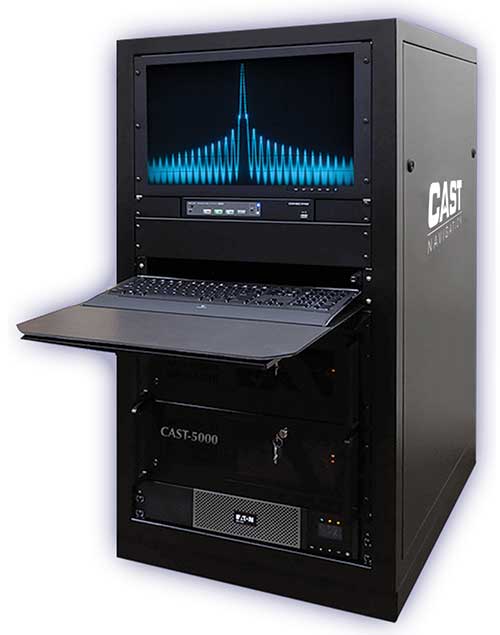
    Innovation. CAST’s latest simulator is the CAST 5000 wavefront generator. It allows users to drive GNSS and interference signals that represent a continuous radiation pattern antenna (CRPA), which consists of multiple, smaller antennas all combined into one unit. In real life, each one of those antenna elements is in a different location; therefore, when they receive signals from a jammer or any of the GNSS satellites, each one will see that signal in a slightly different phase from the other elements. “Our simulator allows us to present signals to these antennas that model the same type of phase differentiation that you see in real life,” Clark said.

    Photo: CAST Navigation
    Photo: CAST Navigation

    Coming Next. CAST Navigation is constantly improving its software based on user feedback. “We are in the process of enhancing our user interface to make it much more powerful but also much simpler to use,” Clark said. Hardware is also being improved, with implementation of the latest available GNSS always on the list.

    Looking Ahead to 2022. Jamming and spoofing are becoming more prevalent, not just for the military but also for consumers. Consumers are starting to encounter more instances of jamming, denying their phone the ability to track a GPS satellite or transmitting incorrect GPS data so the solution that their device gives them is not correct. “Our focus is on products and capabilities that help our customers simulate those types of environments and mitigate those kinds of reactions,” Clark said.


    Jackson Labs Technologies Inc.

    Said Jackson, President and CTO. (Photo: Jackson Labs)
    Said Jackson, President and CTO. (Photo: Jackson Labs)

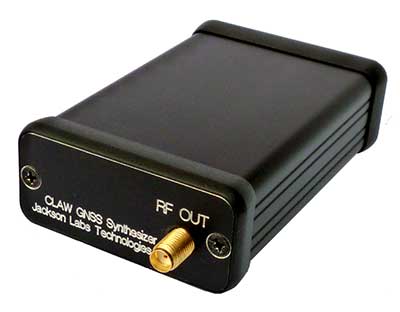
    Jackson Labs’ simulators take a position, navigation or timing signal, re-encode it into an RF signal through a GPS simulation procedure, and output a real-time RF signal that encodes the position, navigation and timing (PNT) information, within milliseconds, into an RF signal that can be fed into existing equipment. “We came up with a general-purpose simulator that is basically a no-frills, low-cost, highly accurate, highly stable, highly reliable, extremely small GPS-only simulator,” explained Jackson. “We only provide GPS L1 simulation, to keep the cost of the product down, because GPS L1 C/A code is the only code required to generate an accurate and assured PNT fix, and because we are looking at simulating to embedded systems, where you only need an L1 C/A code simulator.”

    Photo: Jackson Labs
    Photo: Jackson Labs

    Coming Next. Jackson Labs’ simulators don’t require an external computer for data processing or control. That makes it possible for companies like Toyota to plug the unit into a car on the assembly line, and generate RF output that is fed into their GPS-based navigation systems to pass final quality-assurance checks on the production line. Jackson Labs expects to further reduce SWaP-C (size, weight, power and cost) requirements and potentially add other signals. “We are also looking to potentially combine our simulators with other product lines that we have, such as our comprehensive atomic clock product line,” Jackson said.

    Looking Ahead to 2022. Jackson predicts that the sector will split into two paths: an industrial sector with units for manufacturing and deployment, and companies that introduce emerging GNSS systems at much lower price points, smaller SWaP, and with more modular deployment. Inertial navigation systems (INS) are critical for autonomous driving and assured capabilities during spoofing and jamming events, Jackson said. “It is not possible today to very easily simulate INS units.There is a market for innovation in terms of integrating what the military calls ‘assured PNT,’ which includes things like dual navigation.”


    Orolia

    Stéphane Hamel, Director, Testing and Simulation. (Photo: Orolia)
    Stéphane Hamel, Director, Testing and Simulation. (Photo: Orolia)

    According to Orolia’s Hamel, a simulator’s purpose is two-fold: first, it must reproduce threats and second, it must prove the solution is working.

    Innovation. When Skydel Solutions joined Orolia in March, it brought a professional software-defined simulator that makes possible fast prototyping and development cycles. It integrates advanced interference simulation and can simulate hundreds of threats simultaneously. “When you want to do a repetitive step, automation is the key,” Hamel said. “Our simulator can teach you how to automate, just by clicking on a button and generating source code.” In 2018, Skydel introduced an anechoic simulator to test Controlled reception pattern antennas (CRPAs). Also new is a waveform simulator, so CRPA units can be tested in a conducted (rather than radiated) way.

    Image: Orolia
    Image: Orolia

    Coming Next. In the next three years, Orolia is looking at adding Galileo PRS, GPS M-code, or the next-generation signal. “Being software-defined means that we are very flexible and we can allow our partners to develop their own plug-ins,” Hamel said. “They can build custom signals, restricted or modernized signals. Our simulator will take care of the dynamics of the signal and our partners can focus on the characteristics of the signal, or the things that are secret, classified, or if they simply want to protect their IP.”

    Looking Ahead to 2022. Resilience to serious spoofing and jamming threats is high on Orolia’s list, as well as ensuring secure or valid positioning, navigation and timing (PNT) in GPS-denied environments. Alternative signals, sensors and increased complexity require a simulator to address all of these. Companies that develop complex proprietary hardware platforms will be challenged to keep up with the increasing complexity. and a software-defined approach will be an advantage.


    Racelogic

    Julian Thomas, Managing Director. (Photo: Racelogic)
    Julian Thomas, Managing Director. (Photo: Racelogic)

    Racelogic’s first LabSat was a recorder with player — the signals were recorded outside, and then replayed in the lab. Racelogic’s simulators now also provide simulation of the signals using software to generate the signals as though they are being sent by the satellites.

    Innovation. In 2018, Racelogic introduced the LabSat wideband, which uses the company’s SatGen software. It records at 56 MHz and up to 6 bits of resolution and streams the data to an internal SSD hard drive. It can also replay real-world simulations or ones generated with SatGen. For the automotive world, it records and replays signals such as CAN, RS232, RS485, IMU and other data channels, synchronizing them at the same time. VBOX allows users to record and replay video with the perfectly synchronized recording made on the LabSat. “You see exactly the kinds of conditions of the test vehicle or person who has been subjected to the test,” Thomas said.

    Photo: Spirent
    Photo: Spirent

    Coming Next. Racelogic is providing wider bandwidth, greater bit depth, and multiple channels in a small battery-powered device that records even more signals, including lidar, EtherCAT (an automotive Ethernet format) and CAN-FD (a faster version of the CAN format). It will be able to synchronize with multiple video cameras instead of just one in high resolution. “It is basically the same as what we are selling, but on steroids, and at a very similar price point,” Thomas said.

    Looking Ahead to 2022. With multi-GNSS going mainstream, both chip manufacturers and simulator manufacturers will be challenged by the cost of test equipment. Chip makers need to be able to test the new signals on their production lines, while simulator makers will need to provide devices at a price point and ease of use for customers with less stringent or slightly less technical requirements. “They need a simpler interface and a smaller, cheaper unit,” Thomas said.


    Rohde & Schwarz

    Markus Irsigler, Product Manager, Signal Generators. (Photo: Rohde & Schwarz)
    Markus Irsigler, Product Manager, Signal Generators. (Photo: Rohde & Schwarz)

    An increasing number of GNSS applications depend on multi-frequency GNSS.

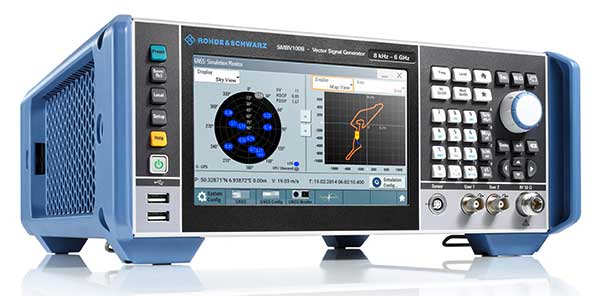
    Innovation. In response, Rohde & Schwarz added multi-frequency test capabilities to its entry-level and mid-range test solutions. “We have launched a new GNSS simulator based on the new mid-range vector signal generator R&S SMBV100B,” Irsigler said. A simple and flexible option concept allows users to turn the instrument into a full-featured and powerful GNSS signal source. It addresses a wide range of test applications, from single- and multi-frequency production testing to multi-frequency receiver characterization. The instrument can be equipped with an internal noise generator that allows users to simulate GNSS plus noise or CW interference without using additional external hardware.

    Photo: Rohde & Schwarz
    Photo: Rohde & Schwarz

    Coming Next. GNSS test solutions from R&S are based on general-purpose vector signal generators. With this approach, GNSS and other signals can be generated at the same time in the same instrument allowing coexistence and interference testing without additional external signal sources. As this results in test solutions that are compact and very flexible to use, R&S will continue to use this approach for upcoming product upgrades and enhancements as well as for its next generation of GNSS test solutions. The company’s upcoming activities will mainly focus on the high-end segment, where the R&S SMW200A with up to 4 RF outputs and up to 144 channels addresses multi-antenna and multi-vehicle GNSS test applications.

    Looking Ahead to 2022. With the safety demands of autonomous driving or aircraft landing procedures, multi-frequency testing will become standard. Because such applications must be sufficiently robust against spoofing and jamming threats, there will be an increasing need to test navigation systems against such influences. “Simulating GNSS alone is not enough,” Irsigler said. “Test solutions for autonomous driving will require several other techniques and signals to be applied or simulated, such as RTK/PPP or outputs from other vehicle sensors to perform sensor fusion.”


    Spirent Federal Systems

    Roger Hart, Director of Engineering. (Photo: Spirent)
    Roger Hart, Director of Engineering. (Photo: Spirent)

    Spirent’s simulators test with “real-world” signals as well as allowing tests under pristine conditions or under extreme conditions that may never occur in the real world, including error conditions.

    Innovation. In December 2018, Spirent released the SimMNSA, which provides a full M-code modernized signal solution. Until now, the GPS Directorate limited M-code simulation to either pseudo-M-code, which provides the same spread-spectrum but uses a commercial encryption standard, or a system of playing back a canned set of M-code limited to certain satellites and dates and times. With the policy change, Spirent can now implement M-code based on the modernized Navstar security algorithm (MNSA), and now offers both an M-code solution with the SimMNSA and a full Y-code with the SimSAAS.

    Jeff Martin, Director of Sales. (Photo: Spirent)
    Jeff Martin, Director of Sales. (Photo: Spirent)

    Coming Next. Spirent plans to provide customers an increased channel count to help test multi-constellation, multi-frequency receivers against multipath, jamming and spoofing. “We are in a period of intense development in terms of AVs, UAVs, and so forth, which don’t use GNSS exclusively,” Hart said, explaining that Spirent is working on testing of GNSS/sensor-fusion platforms.

    Looking Ahead to 2022. “As new interface specifications are released, we are proactive in developing new signals,” Hart said. Spirent also is supporting efforts to achieve assured PNT solutions. It is investigating interference-mitigation techniques such as algorithms, directional antennas, and other anti-jam technologies. Signal authentication is another need. “As the systems are becoming more integrated and networked, we are conscious of cyber-security threats and are looking in that area,” Hart said.

    Photo: Spirent
    Photo: Spirent

    Syntony GNSS

    Cyrille Gernot, GNSS Receiver Development and Product Manager. (Photo: Syntony GNSS)
    Cyrille Gernot, GNSS Receiver Development and Product Manager. (Photo: Syntony GNSS)

    GNSS receiver manufacturers use simulators to ensure that their products are robust in challenging situations that can’t be clearly assessed using real-world data. “That’s where the GNSS simulator comes into play,” Gernot said, “by offering controlled and repeatable scenarios.”

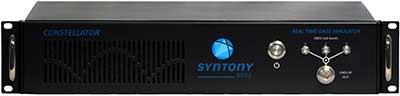
    Innovation. Syntony’s new pseudo-random-noise code (PRN code) server allows the GNSS simulator user to dynamically send the pseudo-random sequence modulating a carrier. It is especially useful for testing encrypted signals such as the GPS military signal or the IRNSS RS signal. “Access to encryption keys is extremely difficult for a simulator manufacturer to obtain,” Gernot said. “However, the simulator does not actually need to have knowledge of those encryption keys; only the resulting pseudo-random sequence to modulate is required.” The Syntony PRN server allows users to dynamically input their own pseudo-random sequences to be modulated on the target carrier into the simulator.

    Coming Next. Syntony’s next simulator will simulate spoofing and synchronous multi-antenna signals for CRPA and antenna network testing.

    Photo: Syntony GNSS
    Photo: Syntony GNSS

    Looking Ahead to 2022. As the threat of spoofing and jamming increases, the receiver industry will have to develop countermeasures and mitigation strategies. One of the best methods remains the use of antenna arrays, Gernot said. “Antenna arrays allow for spatial discrimination that is especially efficient to counter spoofing, jamming or unintentional interferences.To meet the industry’s future demands, Syntony is already working on accurate simulation of antenna arrays while accounting for inherent errors such as inter-antenna phase and amplitude offsets and overcoming obstacles, including phase coherency at the output of the simulator RF channels.”

  • Spirent unveils enhanced flagship simulator at ION GNSS+ 2019

    Spirent unveils enhanced flagship simulator at ION GNSS+ 2019

    Updated GSS9000 Series takes a bow, joining range of test solutions on show

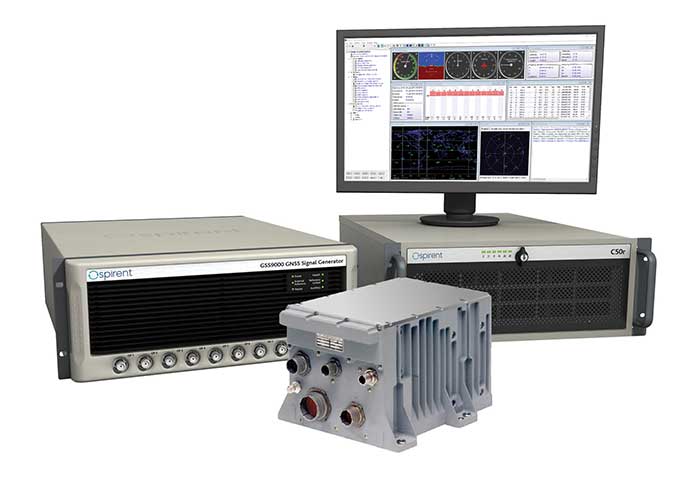
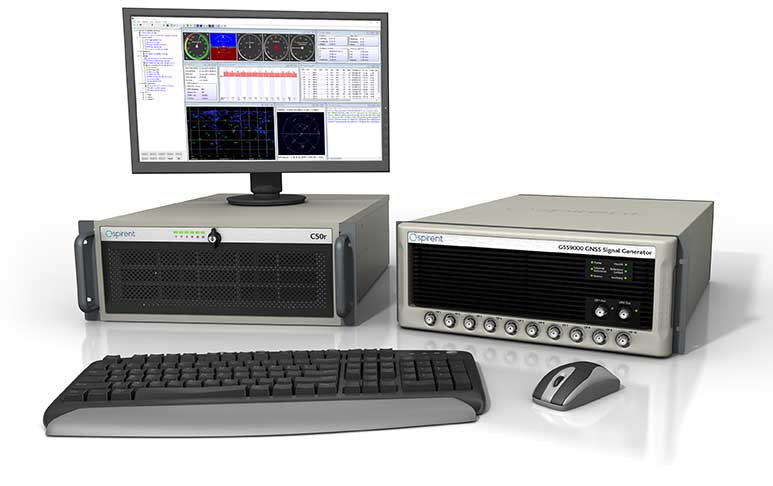
    the Enhanced GSS9000 Series GNSS constellation simulator. (Photo: Tyler Gunter)
    The Enhanced GSS9000 Series GNSS constellation simulator. (Photo: Tyler Gunter)

    Spirent Communications will unveil its enhanced GSS9000 Series GNSS constellation simulator at ION GNSS+ 2019 in Miami, which will take place Sept. 16–20. It joins Spirent’s already impressive range of test solutions on display at the world’s largest showcase of GNSS technology, products and services.

    “The industry is at a very important point,” said Spirent Marketing Director Steve Hickling. “With the volume of GNSS signals growing, more multi-constellation receivers being developed every day, and the need for greater precision increasing all the time, it’s vital that testing solutions are able to stay ahead of this reality. This is why we’re excited to demonstrate the enhanced GSS9000 Series at ION.”

    The GSS9000 Series constellation simulator has been improved with enriched features and enhanced capabilities combined with an increased channel capacity. Most importantly, this greater flexibility, coherence, fidelity, performance, accuracy and reliability is maintained under all test conditions.

    At ION, Spirent (booth E) will also be showing its GSS6450 — the highly portable 16-bit RF record and playback system — and the GSS7000 series multi-frequency, multi-GNSS RF simulation solution. Visitors can also learn more about Spirent’s realistic multipath and obscuration simulation tool, the new Sim3D.

    Spirent’s expertise will also be demonstrated during three ION GNSS+ speaking panels:

    1. “Simulating Realistic Ionospheric Scintillation of GPS Signals for Robust PNT Testing,” presented by Spirent’s Talini Pinto Jayawardena
    2. “Development of Array Receivers with Anti-Jamming and Anti-Spoofing Capabilities with Help of Multi-Antenna GNSS Signal Simulators,” presented by German Aerospace Center’s Andriy Konovaltsev
    3. “Robust and Resilient PNT in Autonomous systems — the Need for the Development and Testing of Both Offensive and Defensive Technology,” reserve paper to be presented by Spirent CAV software engineer Felix Krefft

    For more information about Spirent at ION GNSS+ 2019, visit this page.

  • Bernard Gruber, former GPS Program director, joins Spirent Federal Systems Board

    Bernard Gruber, former GPS Program director, joins Spirent Federal Systems Board

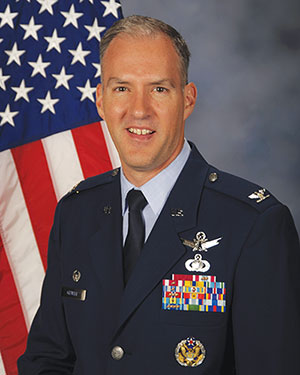
    Spirent Federal Systems, a provider of GPS/GNSS test equipment, announced that Col. (retired) Bernard Gruber, former program director of what is now the U.S. Air Force GPS Directorate, has joined the company’s board of directors as government security committee chairman. Also joining as the chairman of the board is Robert Lollini.

    Spirent Federal President/CEO Ellen Hall stated, “We are happy to have retired Col. Gruber and Bob Lollini joining our dynamic company. We are leading the industry in innovation and quality products for the U.S. government and these two new leaders will help us continue that momentum.”

    Col. Bernie Gruber in 2012. Photo: U.S. Air Force
    Col. Bernie Gruber in 2012. (Photo: U.S. Air Force)

    Bernard Gruber brings to the position the experience gained from a long and distinguished career in the government and military sector. Mr. Gruber has held several positions in important commands focused on navigation in space, including serving as the chief of Space and Global Integrated Intelligence at the Pentagon from 2009-2010, and director of the Global Positioning System (GPS) at the Los Angeles Air Force Base from 2010-2013. He is currently the director of Precision Guidance and Advanced Programs, Armament Systems at Northrop Grumman.

    Robert Lollini is currently the chief executive officer and president of BioFire Defense LLC, a subsidiary and proxy company of bioMerieux. Lollini contributes to the board his broad understanding of strategic financial and executive management.

    Spirent Federal Systems was formed in July 2001 by Spirent Communications as a wholly owned subsidiary and U.S. proxy company. Spirent Federal markets and sells Spirent Communications’ GNSS products in North America. The company also provides value-added features and ongoing customer support. Spirent Federal Systems is headquartered in Pleasant Grove, Utah, with support and sales offices throughout the U.S.

  • Spirent Federal Systems discusses upcoming release of SimMNSA at ION GNSS+ 2018

    Spirent Federal Systems’ Tyson Gurney discusses the company’s upcoming release of SimMNSA at ION GNSS+ 2018 in Miami. According to the company, SimMNSA implements the Modernized Navstar Security Architecture, taking the next step in GPS signal modernization.
     
     
    (Background image: iStock.com/imaginima)

  • GSA, Joint Research Centre test automotive eCall with Spirent

    Spirent Communications plc is working with the European Commission’s Joint Research Centre (JRC) to help implement the eCall system, which is required in new cars sold in Europe starting in April.

    Experts from the JRC have been working with Spirent GNSS test equipment during the European GNSS Agency (GSA) eCall test campaign. The campaign aims to pre-test eCall in-vehicle modules and evaluate their compatibility with the positioning services provided by Galileo and the European Geostationary Navigation Overlay Service (EGNOS) in accordance with the test procedures established by the regulation.

    As the eCall initiative goes live this month, the GSA launched a test initiative to support eCall device manufacturers in their preparation for type approval. In safety-critical situations, eCall must be as accurate as possible, so defining and conducting proper test procedures is imperative.

    Spirent is cooperating with the JRC to develop its own eCall test solution. “Working with JRC enabled us to develop better tests to verify that eCall devices are working properly,” said Steve Hickling, product director for Spirent’s positioning business.

    When a collision occurs, an eCall-equipped car automatically calls the nearest emergency centre. Even if no passenger is able to speak – such as because of injuries — a “minimum set of data” is sent, which includes the exact location of the crash site. eCall is expected to significantly reduce emergency service response times, leading to lives saved and injuries reduced.

    The JRC used a Spirent GSS9000 simulator to assess eCall devices’s capability to support the reception and processing of the Galileo and EGNOS signals. Using feedback from the JRC, Spirent has developed an eCall Test Suite for its automation solution, PT TestBench.

    Tested with various eCall devices, the eCall Test Suite is available for eCall device manufacturers and include, among others, positioning accuracy, time to first fix, GNSS receiver sensitivity and reacquisition performance.

    For more information on Spirent’s GNSS testing solutions, visit the website or download the company’s white paper Detecting and Protecting Against GPS Cyberthreats.

  • Project to advance multi-GNSS development uses Spirent test systems

    Project to advance multi-GNSS development uses Spirent test systems

    Spirent Communications’ testing systems are being used by the European Union TREASURE project (Training, REsearch and Applications network to Support the Ultimate Real-time high-accuracy EGNSS).

    The aim of the four-year project is to provide instantaneous and high-accuracy positioning anywhere in the world, exploiting different satellite systems operating together to provide users with positional accuracy of a few centimeters.

    Spirent’s GSS7000 test system.

    By 2020 Galileo, the European GNSS system (EGNSS), will be fully operational and provide positioning data of unprecedented accuracy. Galileo’s integration with other satellite systems through the TREASURE project is key to increasing Europe’s competitiveness in the field, which has been mainly based on the GPS system in the past 20 years.

    Higher accuracy services will not only assist safety-critical industries such as air and maritime navigation services, but also help industries such as the global agri-tech market, autonomous vehicles and capital-intensive sectors.

    Kimon Voutsis, Robust PNT Solutions Architect, works on a professional services project for a client.

    For example, more accurate real-time positioning data can assist farmers in maximizing food production, reducing costs and minimizing the environmental impact. Equally, a deep-sea drilling platform that experiences any temporary degradation in positioning accuracy could lead to significant financial losses.

    “Spirent is proud to support multi-national initiatives that advance our industry and provide better end user performance,” said Martin Foulger, general manager of Spirent’s positioning business unit. “More systems are using GNSS data, and users always want better accuracy, so TREASURE will help to provide this.”

    TREASURE is an EU-funded project under the H2020-Marie Skłodowska-Curie Innovative Training Network. It is coordinated by the University of Nottingham, and Spirent is the partner providing GNSS simulation systems.

    For more information on Spirent’s GNSS testing solutions, visit the website. To learn more about how to test receivers of GPS, Galileo and other GNSS, download Spirent’s eBook.

    To learn more about TREASURE, contact Marcio Aquino, Nottingham Geospatial Institute.

  • Spirent helps to improve search-and-rescue operations at sea

    Spirent helps to improve search-and-rescue operations at sea

    Test solutions by Spirent Communications plc have been used to improve maritime safety.

    Working with the Radio Technical Committee for Maritime Services (RTCM), Spirent has created test scenarios that simulate realistic satellite reception conditions at sea so that GPS distress beacon performance can be improved, allowing users to be rescued faster by search and rescue organizations.

    One of the first customers to use these scenarios to test its locator beacons is ACR Electronics Inc., a manufacturer of emergency lifesaving equipment. Its latest ACR and ARTEX products have been tested using a Spirent signal simulator, and have been certified as meeting the RTCM standards for cold-start time-to-first-fix, which specifies the time taken by a device when it is turned on to capture GPS signals and determine its location.

    ACR-Spirent-W
    Photo: Spirent

    The U.S. Federal Communications Commission (FCC) has now mandated that in future, any new products in the related categories must be tested using a GNSS simulator and the scenarios in the RTCM standards, which were developed by Spirent.

    “We are able to test the performance of our dual-frequency GPS/Galileo receivers using a Spirent simulator that can accurately simulate signals from different constellations to enhance the performance of our Emergency Position Indicating Radio beacons (EPIRBs, PLBs and ELTs),” said Bill Cox, Director of Engineering at ACR. “Our customers will soon be able to take advantage of a new confirmation system that will let them know that their call for help was heard.”

    “We are very pleased to have worked with RTCM and ACR to improve maritime safety”, said Martin Foulger, General Manager of Spirent’s Positioning Business Unit. “This project shows the importance of testing in realistic conditions to give better end-user experience, which in this case could be a matter of life or death. This will make lifesaving equipment more reliable both for maritime users and search and rescue agencies.”

    ACR-Spirent-resqlinkplus-W
    Photo: Spirent

    The RCTM discovered that Cospas-Sarsat 406MHz beacons with integral GPS receivers suffered from poor cold start performance, causing delays in providing accurate location information to Search and Rescue (SAR) authorities. It later discovered that this was because beacons tended to be tested on land in benign conditions, rather than in real-world oceanic conditions.

    It has addressed the issue by specifying a set of performance standards for Emergency Position Indicating Beacons (EPIRBs), Personal Locator Beacons (PLBs), Hand-held VHF Radios with integral GPS Receivers, Manoverboard (MOB) devices and Satellite Emergency Notification Devices (SENDs).

    Spirent was asked to develop a set of custom test scenarios that enable manufacturers to simulate realistic satellite reception conditions at sea in laboratory environments. Use of these scenarios enables manufacturers to better assess the performance of their products in the real world.

    Details of the FCC mandate can be found in the Federal Register, Vol. 81, No. 241, Dec. 15, 2016, Page 90739, FCC 47 CFR Parts 1, 25, 80 and 95.

  • GNSS plays prominent role at Mobile World Congress

    Global navigation satellite system (GNSS) technology found its way into products ranging from autonomous vehicles to wearables at this year’s Mobile World Congress in Barcelona, Spain.

    One company says it is tailoring a GNSS receiver chip to meet the demands of mobile devices that require high levels of speed and position accuracy. Thalwil, Switzerland-based u-blox said its new low-power UBX-M8230-CT GNSS receiver chip can not only be used for smartwatch development, but for tracking people, animals and assets.

    “The highlight of the chip is that it has much better balance, while maintaining the accuracy of a traditional, full-power receiver,” said Florian Bousquet, u-blox market development manager. “It can work in the most difficult urban canyon environments. It works well in sports watches, smartwatches, activity trackers and other wearables — and just about anything portable that has a battery.”

    Bousquet said the chip, in what the company calls a Super-E mode, uses GPS with either GLONASS or BeiDou. This mode allows batching location data on the chip, which reduces power consumption, he said.

    Bousquet said the chip is available now, in an evaluation kit, for around $120. He said the chip will be manufactured in volume this summer.

    It took u-blox a year-and-a-half to develop the GNSS chip, Bousquet said. “It took time for our development team to optimize the system and field test the infrastructure to make sure the product performed in different scenarios and environments.”

    Another company, Racelogic, exhibited its LabSat 3 Wideband GNSS simulator, which is used by u-blox and others to help test and develop products. Some applications include drones, autonomous vehicles, survey equipment, personal monitoring devices, aerospace and end-of-the-line product testing, the company said.

    The newer L2C, L5 and L1C signals give companies the opportunity to develop products that are compatible with new receivers as they come to market, said Mark Sampson, LabSat product/sales manager.

    The company also showed off its SatGen v3 simulator software that allows users to create a data file to be replayed on the LabSat GNSS simulator. The software allows companies to define a complicated route, and then import it into the software.

    Company tests eCall and ERA-GLONASS modules

    Both the European Union (EU) and Russian Federation are requiring governments to have intelligent telematics-based safety systems. In case of a serious accident, these systems automatically call for local medical services.

    Technology to meet the requirements of eCall and ERA-GLONASS include an antenna, GNSS receiver, crash sensors and other components.

    To reproduce end-to-end and standard-compliant testing of the eCall and ERA-GLONASS modules, Rohde & Schwarz offers two products. One is the CMW-KA094 eCall application software. The other is the CMW-KA095 extension for ERA-GLONASS to simulate a public safety answering point (PSAP) to emulate a cellular network in a lab.

    “It’s pretty important testing because of the safety of life. We have set up implementation of it in our labs,” said Christian Hof, Rohde & Schwarz senior product manager for mobile radio testers.

    CMW_ERA-Glonass_eCall_T
    CMW500 simulator by Rohde & Schwarz. Photo: Rohde & Schwarz

    During testing, governments and companies can use the CMW500 platform, which identifies Internet of Things (IoT) and mobile communications devices’ IP connection security issues, Hof said.

    The company believes, since many IoT platforms are proprietary as standardization is still in progress, security gaps are frequently reported.

    Spirent rolls out new simulator

    Spirent Communications displayed its Elevate IoT Device Test Solution, a new cellular test designed to support IoT applications. These applications include end-to-end cloud server connectivity, security-vulnerability assessment and battery-life measurement.

    The new unit is available through the company’s Spirent Elevate platform, which addresses areas affected when designing 3G, LTE and new narrowband wireless technologies for IoT devices.

    Overall, Spirent is finding many use cases and applications in the IoT and mobile industry.

    “We are finding that smaller companies developing software and services want to test GNSS, but don’t have the capabilities to do so. These could include small projects such as people and pet trackers,” said Simon Loe, Spirent’s head of marketing solutions and services. “We are trying to democratize the technology. Another trend we are seeing is growing importance on GNSS in network timing.”

    Not everything is about drab simulation. Far from it. Spirent last year teamed with Aston Martin Racing to evaluate automotive technologies on the 2016 V8 Vantage GTE race cars.

    This includes the accuracy and performance of GPS receivers and interference monitoring, said Julian Kemp, Spirent product manager, custom solutions.

    Antenna market for IoT, autonomous vehicles robust

    Taoglas is offering GNSS antennas that support IoT products, unmanned aerial vehicles (UAVs) and future autonomous vehicles, said Ronan Quinlan, company co-founder.

    The company is offering lightweight antennas for mass-market unmanned UAVs, which had a growing presence at Mobile World Congress this year.

    The future markets for Taoglas will be in connected and autonomous vehicles, Quinlan said. “We found out years ago that we missed out on the rise of 2G, but we did not miss the rise of 4G. The advent of 5G and GNSS will lead to the development of the autonomous vehicle,” he said.

    Antenna costs associated with the rise of autonomous vehicles will have to be reduced, Quinlan said. “Some antennas that were $100 solutions have to go down to $20 solutions once they get into a car,” he said.

    In other Mobile World Congress news:

    • Fraunhofer IIS displayed its Enhanced Voice Services (EVS), the Third Generation Partnership Project (3GPP) communication protocol designed specifically for voice over LTE (VoLTE) services.
    • Telit said it is expanding its relationship with Tele2 on Pan-European long-term evolution (LTE) IoT connectivity services. Telit and Tele2 now offer custom data plans with predictable pricing, no hidden fees or roaming charges for high bandwidth IoT applications, the company said. Services include video monitoring, digital signage or real-time asset tracking.
  • Spirent highlights GNSS threats at cybersecurity conference

    Spirent Communications plc will demonstrate its expanded focus on security at the cybersecurity RSA Conference 2017, held in the Moscone Center in San Francisco Feb. 13–17. In a classroom session, Spirent positioning security technologist Guy Buesnel will discuss deliberate threats to GNSS.

    Focusing on deliberate attacks against GNSS at the application layer and through RF channels, Buesnel will introduce session attendees to the vulnerabilities of satellite navigation and timing systems and how they have been exploited. Based on his experience in protecting GNSS receivers from emerging threats for nearly two decades, Buesnel’s session will address the evolution of deliberate GNSS threats and present the latest evidence of deliberate jammer use from a network of detector devices.

    “There are compelling parallels between the manner in which IP threats have developed on the internet and the evolution of both jamming and spoofing attacks against GNSS,” said Buesnel. “Once people understand that the evolution of GNSS threats not only has clear parallels with the way in which IP threats have evolved, but also that GNSS share many of the features of a connected network, they will see that many of the lessons learned by the information security community apply equally well to the GNSS community.”

    Part of the Mobile & IoT Security track, the Guy Buesnel classroom session (Session Code MBS-F01) will take place 9–9:45 a.m. on Friday, Feb. 17, on the second floor of the Moscone West hall, room 2002.

    Spirent will also preview new Cyberflood performance and security validation software at RSA.

    “With our expanded focus on security, Spirent is addressing the growing need in government, industry, health care and financial services for effective products and services to assess, validate and monitor the performance and security of their networks and applications,” said John Weinschenk, general manager of applications and security at Spirent. “We look forward to demonstrating at the RSA Conference how our industry-leading product and service offerings can meet today’s need for performance and security effectiveness under a wide range of real-world threat and attack scenarios.”

    Spirent representatives in the company’s booth (S2015 in the Moscone South hall) will be available during the show to speak with attendees about the Cyberflood software and many of its upcoming ease-of-use features and real-world threat and attack emulation capabilities. The new features will include a flexible advanced testing component for customized testing needs and extended fuzzing techniques that enable users to find more issues faster and understand them better than any competing product in the industry.

    Attendees will also be able to learn more about the scanning, penetration testing, monitoring and source-code-analysis security services available from Spirent Security Labs for networks, wireless infrastructures, websites, mobile applications and embedded devices.