Tag: Syntony-GNSS

  • Simulator suppliers discuss latest technology and trends

    Simulator suppliers discuss latest technology and trends

    The number of GNSS constellations, satellites and signals is constantly growing. The threats to GNSS — from unintentional radio frequency interference (RFI), jamming, spoofing, multipath… and Federal Communications Commission rulings — are increasing, as are the public’s expectations of GNSS accuracy.

    All these factors contribute to the need for ever more powerful and advanced simulators that can realistically simulate a wide range of optimal and suboptimal environments. That is why simulators are a rapidly growing sector of the GNSS industry.

    At present, the main defense against jamming are continuous radiation pattern antennas (CRPA). Therefore, it is essential that simulators be able to accurately reproduce signals from CRPAs. They are even more useful when they can generate M-code (MNSA) signals, which not all simulators do.

    Additionally, the development of autonomous vehicles requires engineers to simulate driving millions of miles, under a variety of environmental and traffic circumstances. To accomplish this in a reasonable amount of time requires them to run simulations faster than in real time, or run many simulations in parallel.
    Finally, there is an increasing need to simulate alternative positioning, navigation and timing (PNT) signals being developed as supplements to and substitutes for GNSS signals in circumstances that make the latter unavailable or unreliable.

    These are some of the challenges facing manufacturers of GNSS simulators. What follows are their brief descriptions of the approaches they are taking and the innovations they are introducing.

    CAST Navigation Orolia Racelogic
    Rohde & Schwarz Spirent Federal Systems Syntony GNSS

    CAST Navigation

    Headshot: John Clark
    John Clark
    VP of Engineering

    What is your most recent innovation?
    Our latest simulator innovations contain wave-front generation signal technology, which allows you to generate GNSS and interference signals that represent the received signals for each antenna element in a phased array antenna manifold, usually referred to as a controlled radiation pattern antenna (CRPA). Our modular design approach enables users to simulate IMU data commensurate with the wave-front signals for a complete coherent GNSS/IMU simulation that is ideal for stimulating receivers that contain CRPA and IMU capabilities. Our simulators also contain proprietary synchronization technology that allows users to synchronize multiple systems to produce a “wave-front” of GNSS and IMU signals for multiple vehicles, or even an entire fleet.
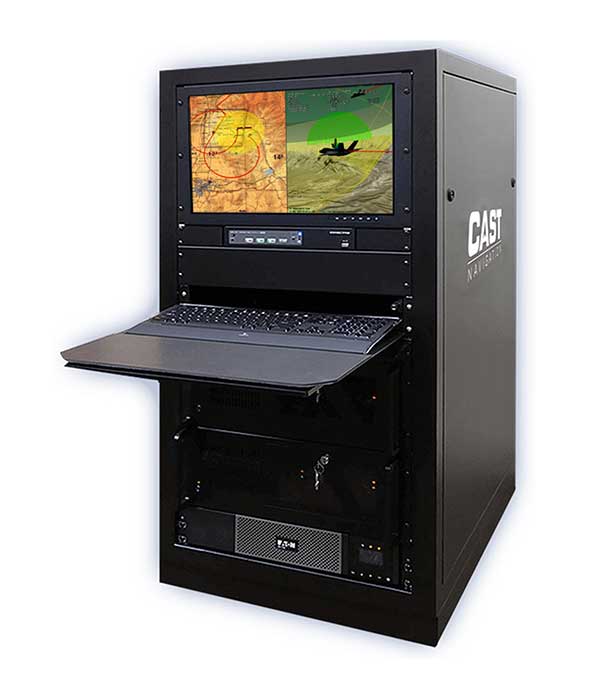
    Photo: CAST Navigation
    Photo: CAST Navigation

    What is your approach to jamming and spoofing?
    CAST Navigations’ family of GNSS simulators are capable of realistically simulating a wide range of suboptimal conditions—such as jamming/spoofing, multipath, RF interference and satellite constellation perturbations—for virtually any commercial or military environment. Our interference signals or “jammers” can be located at any terrestrial location and can be static or dynamic in nature. A distinguishing feature of CAST Navigations’ simulation systems is that our interference signals are phase-controlled and coherent, allowing for proper phase transmission of each signal type for each receiving antenna element. You can also add an INS capability to any of our systems. These types of systems are perfect for testing GNSS and GNSS/INS types of navigation equipment.

    What’s coming by 2023?
    One of the key trends is the ability to generate M-code (MNSA) signals. Jamming and spoofing are becoming more prevalent, not just to the military but also to consumers. Every day, the military, as well as people like you and me, are starting to encounter more instances of interference that can deny GNSS equipment and even phones the ability to track some GNSS satellites or that transmit incorrect GNSS data, causing receivers to display incorrect position solutions. So, our focus is on products and capabilities that enable our customers to simulate those types of environments and help them to mitigate those kinds of events.


    Orolia

    Headshot: Lisa Perdue
    Lisa Perdue
    Product Manager

    What is your most recent innovation?
    At Orolia we continue to evolve our innovative software-defined simulator approach. Our most recent innovation is our advanced spoofing option. We have taken our ability to define multiple jamming transmitters, each with their own trajectory and antenna pattern, and added the ability for the transmitters to send spoofing signals as well. By utilizing our capability to run multiple simulations on a single system, we give the user the ability to control every parameter of the generated spoofing constellation(s). The system automatically calculates the signal time of flight and the propagation loss, making this advanced capability powerful and easy to use.

    What is your approach to jamming and spoofing?
    Simulation of threat environments is a critical component of GNSS receiver testing. As awareness of the impact that jamming and spoofing can have on a GNSS-based system rises, so does the need to test. That is why we have implemented advanced jamming and spoofing options into our Skydel simulator’s core engine. Replication of degraded environments with threats ranging from one to hundreds is possible using the same hardware and software used for generating GNSS signals. No third-party hardware or software is required for complete testing against jamming and spoofing because we feel that this capability should be part of the core system, not an afterthought.
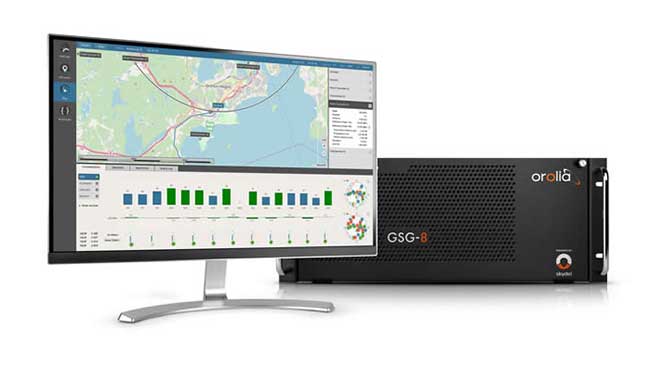
    Photo: Orolia
    Photo: Orolia

    What’s coming by 2023?
    In the coming years, we expect to see more requirements for simulation of alternative positioning, navigation, and timing (PNT) signals. As governments and organizations continue to investigate alternate technologies, it will become necessary to simulate low Earth orbit (LEO) PNT, ground-based transmitters, and other signals being considered.

    Another growing trend is the adoption of controlled reception pattern antennas (CRPAs) for their anti-jam capabilities. These anti-jam antenna systems can only be tested by specialized simulation systems, so we can imagine these simulation systems being commercialized for a broader market around 2023.


    Racelogic

    Headshot: Julian Thomas
    Julian Thomas
    Managing Director

    What is your most recent innovation?
    Recognizing the need of our customers to test their products with a simple solution that uses the latest GNSS signals, we have updated our SatGen software to create accurate simulations using all satellite data currently being transmitted across the various constellations. We have also optimized the performance of SatGen so that a standard desktop PC can be used to simulate these signals in real time. Also, the simulation can now be driven using an external NMEA stream, allowing full remote control of the trajectory.

    What is your approach to jamming and spoofing?
    The LabSat 3 Wideband records and replays all available GNSS signals in high fidelity, allowing jamming and spoofing signals to be reproduced accurately on the test bench.
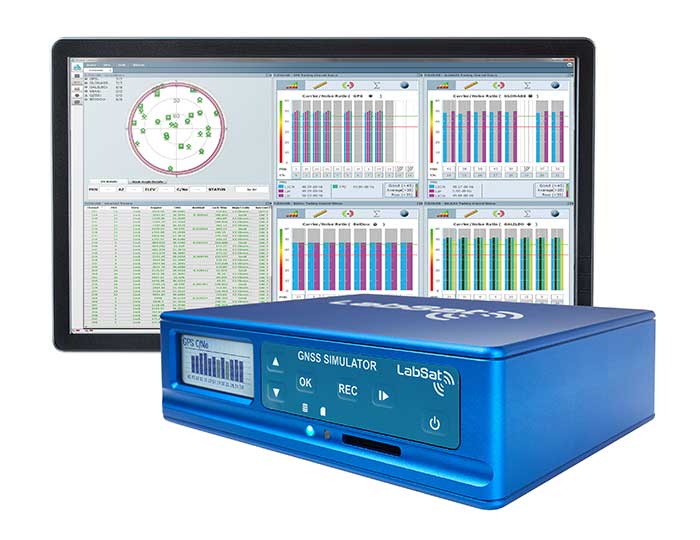
    Photo: Racelogic
    Photo: Racelogic

    What’s coming by 2023?
    With so many employees now working from home due to COVID-19, the pressing concern for many companies developing GNSS technology is how to provide employees with suitable equipment that is required for them to carry out their jobs efficiently away from the office. Usually these employees would utilize the shared resources of a well-equipped office, with experts on hand to help, but working from home has made access to these devices challenging. Due to LabSat 3’s small size, low cost and ease of use, we have seen a significant increase in sales to companies furnishing their employees with a suitable method of testing their GNSS devices while working from home.

    With the advent of a new breed of high-performance, low-cost GNSS receiver, many new applications are being developed in new and exciting sectors, utilizing a level of accuracy previously considered too expensive to be a commercial proposition. The number of GNSS engines will therefore increase rapidly in the marketplace, with a corresponding increase in demand for cost-effective signal simulation for test and development.


    Rohde & Schwarz

    Headshot: Markus Irsigler
    Markus Irsigler
    Product Manager Signal Generators, Power Meters

    What is your most recent innovation?
    We further improved multi-frequency, multi-constellation simulation capabilities in our high-end segment. The GNSS high-end simulator R&S SMW200A provides signals for all GNSS frequency bands on a single RF output. A second internal RF path can be used for advanced interferer simulation, testing the receiver’s resilience to spoofing or to address dual-antenna scenarios. This keeps setups simple and compact. When more than two RF paths are required, two or more R&S SMW200A can be operated together in a master/slave configuration. Such setups are required for multi-antenna receiver test applications where the signals’ relative carrier phases are analyzed, like CRPA or attitude determination tests. Our new RF ports alignment software automates alignment of the GNSS signals and guarantees correct amplitude, time and phase relations at the RF inputs of the device under test. We also increased the maximum channel count to more than 600 channels to improve testing of multi-constellation, multi-frequency receivers against multipath, jamming and spoofing.

    What is your approach to jamming and spoofing?
    Besides our recent innovations, Rohde & Schwarz plans to provide new interference simulation capabilities within the GNSS simulator. This new feature will allow the user to replay recorded jammer signals as well as user-defined waveforms. The R&S Pulse Sequencer software helps with the definition of most complex interferer scenarios.
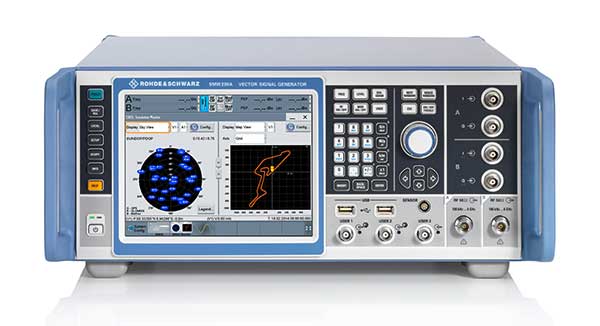
    Photo: Rohde & Schwarz
    Photo: Rohde & Schwarz

    What’s coming by 2023?
    Developments in the field of advanced driver-assistance systems (ADAS) aiming for fully autonomous vehicles raise new challenges for reliable PNT solutions. Simulation of interference and jamming scenarios will hence become important in the automotive market. Antenna arrays have proven suitable to counteract RF interference (RFI) by incorporating spatial-processing techniques and might therefore find greater entry into the automotive market. Test solutions must address requirements for simulating all kinds of intentional and unintentional RFI for multi-constellation, multi-frequency and multi-antenna receivers. Apart from simulating GNSS and interference sources, test solutions for autonomous driving will require several other techniques and signals to be applied or simulated, such as RTK/PPP or outputs from other vehicle sensors to perform sensor fusion.


    Spirent Federal Systems

    Headshot: Jeff Martin
    Jeff Martin
    Vice President, Sales

    What is your most recent innovation?
    Launched in 2018, SimMNSA became the first MNSA simulator to achieve GPS Directorate security approval. The software enables users to simulate true MNSA M-code with real-time code and message generation, removing the constraints imposed by simulator data sets (SDS). SimMNSA v2.0 does even more. It is able to broadcast nominal M-code conditions and recreate SDS-defined events. It incorporates an advanced editor to edit military navigation (MNAV) content, allows users to craft and define scenarios, and much more.

    What is your approach to jamming and spoofing?
    Spirent offers numerous capabilities for emulating GNSS signals in the presence of interference and spoofing attacks. Our solutions provide accurate, repeatable and quantifiable signals, enabling customers to conduct accurate tests with trusted results. We can test against internally generated interference enabling multiple “fields” of jammers with various interference types; hundreds of interference signals using external IQ blended with simulator-generated GNSS, and Blue Force Electronic Attack jamming waveforms for testing MGUE devices operating in GPS-denied environments. Spoofing capabilities include signal, navigation data and cyber-level attacks via manipulation of up to 12 copies of each primary GNSS constellation, each fully editable; intuitive spoof attack generation via Spirent’s SimSAFE software option — which also allows live sky synchronization/spoofing, and more.
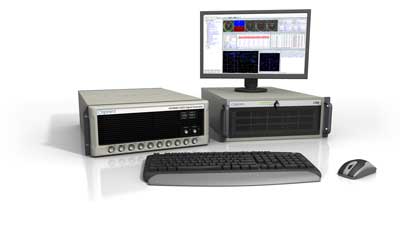
    Photo: Spirent
    Photo: Spirent

    What’s coming by 2023?
    Threats to reliable and accurate GNSS navigation and timing are developing rapidly. Fortunately, innovative solutions for resilient PNT are in development and will continue to challenge the industry for years to come. The ability to simulate these threats and the mitigation techniques to overcome them is changing the landscape for the simulator industry. It’s more important than ever to have up-to-date test tools. Robust signals along with frequency and constellation diversity will continue to drive the market in addition to GNSS backup systems, or AltNav. The FCC has certainly presented the GNSS industry with an immense challenge.


    Syntony GNSS

    Headshot: Sylvain Daubas
    Sylvain Daubas
    Simulator Activity Manager

    What is your most recent innovation?
    Yesterday, GPS systems had to “work.” Today, they must work fine. This is the difference, and all equipment vendors have realized this. It is no longer acceptable to have 200 meters or more of error in an urban environment. Because of the extreme complexity of the electromagnetic situation in the GNSS spectrum, making a reliable and precise location system requires more and more powerful and advanced simulators. This is why the GNSS simulator market is booming.

    Among the many new features implemented in Syntony’s GNSS simulator this year, two stand out.

    First, 1000-Hz hardware-in-the-loop now allows an accurate simulation for high-dynamic receivers (up to more than 100 Gs!), with zero artifact and zero-effective latency. This is the ultimate in trajectory management.
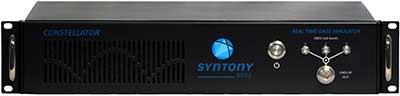
    Second, signal computing capacity has made a significant leap forward due to hardware and software optimizations. Constellator can now simultaneously generate up to 660 L1 C/A-equivalent signals. And this level of performance can be unlocked remotely, without a hardware update.
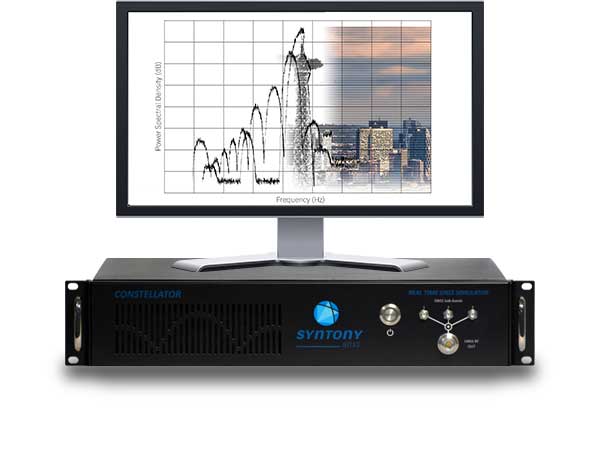
    Photo: Syntony GNSS
    Photo: Syntony GNSS

    What is your approach to jamming and spoofing?
    Simulating a GNSS environment with a set of jamming or spoofing signal sources today is the standard. But what about a simulation of an extremely complex urban scene with 50 or 100 jamming/spoofing sources? The only reasonable solution to implement this would be a massive parallel software-defined radio (SDR)-based simulator solution. This is what Syntony can and will do, thanks to its full software GNSS simulator architecture, which can be distributed on a server farm.

    What’s coming by 2023?
    A revolution is arriving: the possibility of generating a full GNSS simulation including many hundreds of satellites and signals, in real time and in pure software. This is now possible, and Syntony has demonstrated it with the Constellator. This will change the simulation world. First of all, Moore’s law will bring significant improvements to this domain year after year. More importantly, new systems and services will be possible: massive parallel scenario simulation including jamming and spoofing, floating simulator licenses, software as a service, etc. In this trend, playback machines will be needed, and obviously a strong internet connection will be necessary to download hundreds of gigabytes of I/Q files overnight.


    Feature image: Samuel King Jr./United States Air Force
  • Syntony GNSS, Ramjack partner for global mining operations solutions

    Syntony GNSS, Ramjack partner for global mining operations solutions

    Logos: Syntony GNSS and Ramjack Technology Solutions

    Syntony GNSS, a designer and manufacturer of software-baed navigation and GPS coverage extension, has partnered with Ramjack Technology Solutions, a specialized system integrator for advanced technologies in the global mining market, with the goal of driving connectivity in global mining operations.

    Syntony innovations extend GPS coverage into previously inaccessible spaces, giving mining operations relentlessly reliable connectivity. This partnership will allow Ramjack Technology Solutions to further introduce enhanced connectivity into even the most rugged of global mining operations, the companies said.

    “Ramjack is very excited about our partnership with Syntony and the opportunity to bring this groundbreaking technology to the mining industry,” said Mike Jackson, president and CEO at Ramjack Technology Solutions. “The need for accurate underground tracking — and the convenience of being able to use the industry-standard GPS chipsets — is a huge advantage and one that we’ve been waiting for in mining for a very long time. We’re encouraged by Syntony’s commitment to the mining industry and look forward to showing our customers how they can continue to enhance safety and production performance.”

    Syntony also looks forward to the partnership.

    “We’re pleased to be joining forces with Ramjack to bring our technology to the mining industry,” said Joel Korsakissok, CEO at Syntony GNSS. “We value their intrinsic understanding of integrated technologies and how to ensure advanced technology provides mines with the ultimate competitive advantage, with safety and optimisation always at the forefront. Our sophisticated solutions are perfect for their portfolio.”

  • Syntony GNSS, Chronos Technology partner on GNSS underground coverage

    Syntony GNSS, Chronos Technology partner on GNSS underground coverage

    GNSS Underground Coverage for Tunnels, Stations, Car Parks, Bus Stations and Airports in the U.K.

    Syntony GNSS and Chronos Technology have formed a partnership to deliver underground GNSS positioning, navigation and timing (PNT) solutions for critical infrastructure applications in the United Kingdom.

    Syntony GNSS is a leader and expert in the design and manufacture of GNSS systems, and Chronos Technology is a resilient GNSS system integrator.

    GNSS coverage has become fundamental to many services from emergency services to asset tracking for example. Yet when entering an underground area such as a metro/subway, tunnel, car park, airport, or bus station for example, the GNSS signal is lost.

    Syntony’s SubWAVE solution expands the GNSS coverage to underground areas, enabling the localization of any equipment with a standard GNSS chipset. Examples include standard smartphones and the TETRA  Emergency Services Network handset used for security and services. Security and services applications include locating emergency calls, keeping track of staff, locating faults in tunnels, managing assets, locating trains and providing guidance.

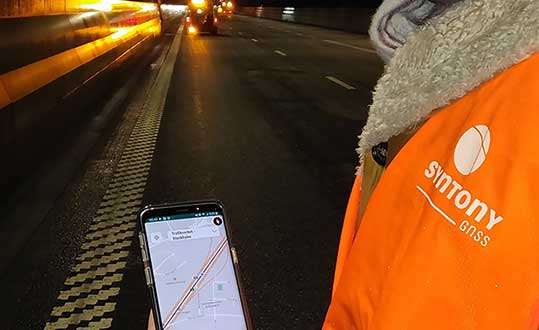
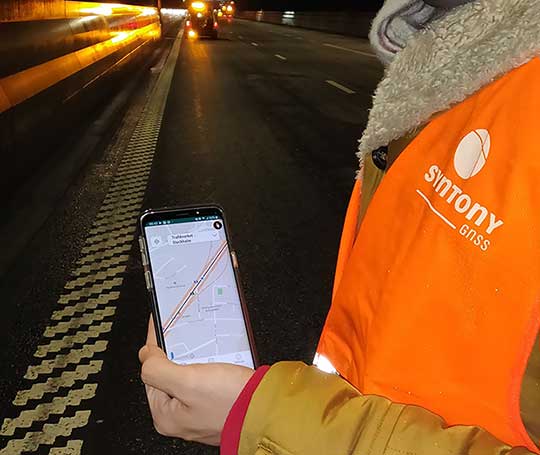
    A Syntony team member in a Swedish road tunnel during SubWAVE testing shows the positioning in an underground environment on a smartphone. (Photo: Syntony GNSS)
    A Syntony team member in a Swedish road tunnel during SubWAVE testing shows the positioning in an underground environment on a smartphone. (Photo: Syntony GNSS)

    By emitting a perfect emulation of the “real” GNSS signal, SubWAVE offers underground operators, their staff, emergency services and the general public the benefit of full GNSS coverage in all underground areas for both operational and safety reasons.

    One fundamental aspect is the user only needs a standard GNSS receiver (a smartphone or TETRA radio) — no new handsets, receivers or apps are required. The system operates by broadcasting synthetic location specific GNSS signals through existing or new leaky feeder cables in the tunnels.

    Accuracy levels vary with leaky feeder and system complexity options; however, 2-meter accuracy is possible with a standard smartphone. The system is widely installed in the Stockholm metro and is in active trials throughout Europe and America.

    “We are pleased to form a partnership with GNSS specialists Chronos,” said Joel Korsakissok, president of Syntony GNSS. “Their knowledge and experience, together with their dedicated installation, commissioning and support teams complement our sophisticated solutions.”

    “Since its first general availability, one of the well-known shortcomings of the GPS system was lack of indoor or underground coverage,” said Charles Curry, managing director with Chronos. “Many have tried to solve this with various technologies over the years. Syntony’s innovative technology offers underground GNSS coverage for PNT applications. We are very excited by the possibilities and pleased to be partnering with them to offer their solution for critical infrastructure applications in the UK.”

    In addition, Chronos will also supply Syntony’s sophisticated GNSS simulators used in the aerospace and defence industries for product testing.

  • Navigating testing options: Simulator innovators map out solutions and trends

    Navigating testing options: Simulator innovators map out solutions and trends

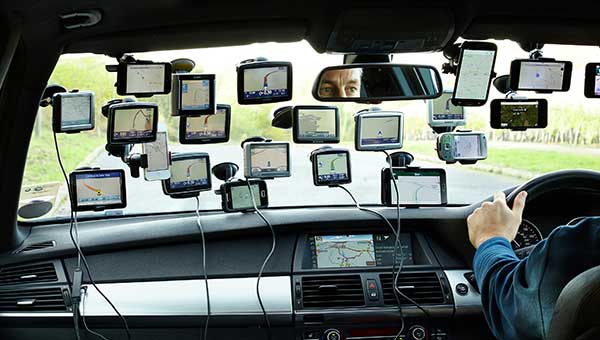
    This tongue-in-cheek photo, courtesy of Racelogic, underlines how simulators help GNSS engineers “road test” multiple positioning products in multiple scenarios. (Photo: Racelogic)
    This tongue-in-cheek photo, courtesy of Racelogic, underlines how simulators help GNSS engineers “road test” multiple positioning products in multiple scenarios. (Photo: Racelogic)

    The number of GNSS signals, the frequency and sophistication of intentional and unintentional threats to those signals, and the need for integration between GNSS and other positioning, navigation and timing (PNT) sources — especially for indoor and autonomous navigation — are continuing to increase, as is the number of new applications for GNSS. In response, manufacturers of GNSS simulators are creating new and improved models able to simulate all these new signals and scenarios.

    Additionally, as GNSS chipsets continue to be further commoditized, simulator manufacturers must address the needs of new entrants into the GNSS receiver market that have lower accuracy requirements and require less technical expertise and, therefore, require units that are smaller and cheaper and have simpler interfaces.

    No single manufacturer can address the full spectrum of challenges that these trends present. So, while their products overlap in capabilities and SWaP-C (size, weight, power and cost), each one has chosen its market niche and preferred mix of features.

    Even on the deceptively simple question of definition (“What is a GNSS simulator?”), the seven manufacturers featured here give different answers, covering the following capabilities:

    • Simulating GNSS signals as well as inertial navigation data.
    • Enabling users to test hardware, software and new solutions in the lab before deployment.
    • Enabling users to test systems under pristine or extreme conditions, including error conditions.
    • Enabling users to test systems during rare, transitional and prohibited events.
    • Helping to retrofit existing equipment to new and emerging standards.

    Innovations being introduced or developed include:

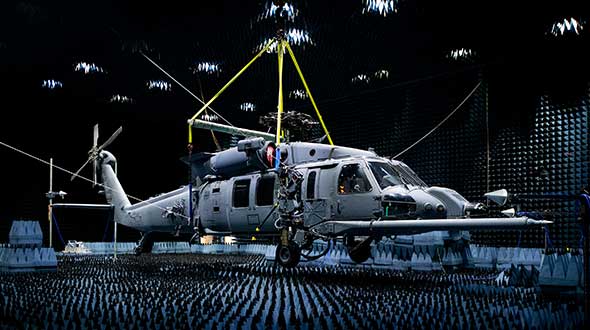
    • an anechoic simulator to test continuous radiation pattern antennas (CRPAs).
    • simulation of a full M-code modernized signal.
    • software-defined simulators.
    • increased automation of repetitive tasks.
    • the capability to record and replay real-world signals.
    • the capability to record and synchronize data on the conditions faced by a test vehicle.

    While the universe of GNSS satellites and receivers continues to grow and evolve, the universe of GNSS simulators is keeping pace — or even a step ahead.


    Click on the company to be directed to that section.

    CAST Navigation with John F. Clark Jackson Labs Technologies with Said Jackson
    Orolia with Stéphane Hamel Racelogic with Julian Thomas
    Rohde & Schwarz with Markus Irsigler Spirent Federal Systems with Roger Hart & Jeff Martin
    Syntony with Cyrille Gernot

    CAST Navigation

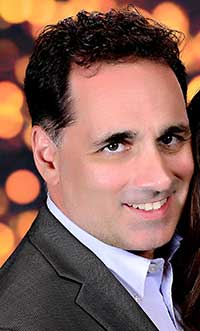
    John F. Clark, Vice President, Engineering. (Photo: CAST Navigation)
    John F. Clark, Vice President, Engineering. (Photo: CAST Navigation)

    In the lab, simulators allow users to “drive” a piece of equipment through 3D space, performing flight testing or checking equipment integration. Simulators also validate operational flight programs (OFPs) for pilots before they are fielded, to ensure that the software is working correctly.

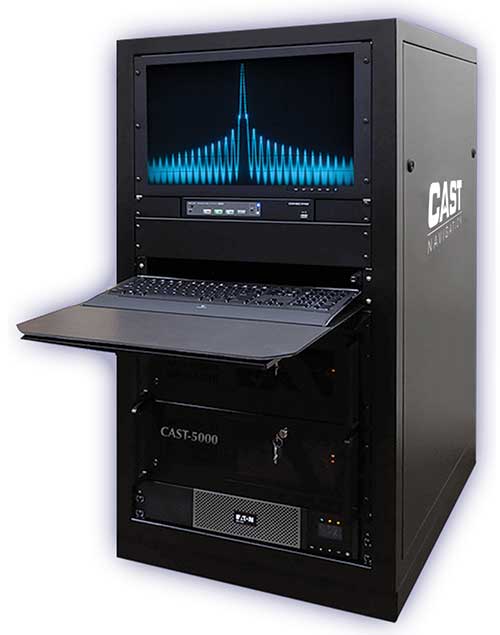
    Innovation. CAST’s latest simulator is the CAST 5000 wavefront generator. It allows users to drive GNSS and interference signals that represent a continuous radiation pattern antenna (CRPA), which consists of multiple, smaller antennas all combined into one unit. In real life, each one of those antenna elements is in a different location; therefore, when they receive signals from a jammer or any of the GNSS satellites, each one will see that signal in a slightly different phase from the other elements. “Our simulator allows us to present signals to these antennas that model the same type of phase differentiation that you see in real life,” Clark said.

    Photo: CAST Navigation
    Photo: CAST Navigation

    Coming Next. CAST Navigation is constantly improving its software based on user feedback. “We are in the process of enhancing our user interface to make it much more powerful but also much simpler to use,” Clark said. Hardware is also being improved, with implementation of the latest available GNSS always on the list.

    Looking Ahead to 2022. Jamming and spoofing are becoming more prevalent, not just for the military but also for consumers. Consumers are starting to encounter more instances of jamming, denying their phone the ability to track a GPS satellite or transmitting incorrect GPS data so the solution that their device gives them is not correct. “Our focus is on products and capabilities that help our customers simulate those types of environments and mitigate those kinds of reactions,” Clark said.


    Jackson Labs Technologies Inc.

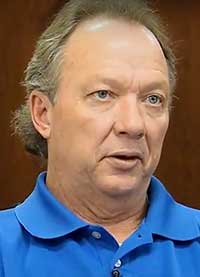
    Said Jackson, President and CTO. (Photo: Jackson Labs)
    Said Jackson, President and CTO. (Photo: Jackson Labs)

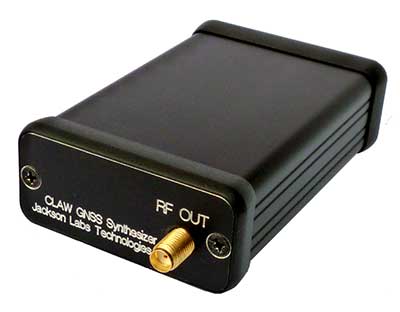
    Jackson Labs’ simulators take a position, navigation or timing signal, re-encode it into an RF signal through a GPS simulation procedure, and output a real-time RF signal that encodes the position, navigation and timing (PNT) information, within milliseconds, into an RF signal that can be fed into existing equipment. “We came up with a general-purpose simulator that is basically a no-frills, low-cost, highly accurate, highly stable, highly reliable, extremely small GPS-only simulator,” explained Jackson. “We only provide GPS L1 simulation, to keep the cost of the product down, because GPS L1 C/A code is the only code required to generate an accurate and assured PNT fix, and because we are looking at simulating to embedded systems, where you only need an L1 C/A code simulator.”

    Photo: Jackson Labs
    Photo: Jackson Labs

    Coming Next. Jackson Labs’ simulators don’t require an external computer for data processing or control. That makes it possible for companies like Toyota to plug the unit into a car on the assembly line, and generate RF output that is fed into their GPS-based navigation systems to pass final quality-assurance checks on the production line. Jackson Labs expects to further reduce SWaP-C (size, weight, power and cost) requirements and potentially add other signals. “We are also looking to potentially combine our simulators with other product lines that we have, such as our comprehensive atomic clock product line,” Jackson said.

    Looking Ahead to 2022. Jackson predicts that the sector will split into two paths: an industrial sector with units for manufacturing and deployment, and companies that introduce emerging GNSS systems at much lower price points, smaller SWaP, and with more modular deployment. Inertial navigation systems (INS) are critical for autonomous driving and assured capabilities during spoofing and jamming events, Jackson said. “It is not possible today to very easily simulate INS units.There is a market for innovation in terms of integrating what the military calls ‘assured PNT,’ which includes things like dual navigation.”


    Orolia

    Stéphane Hamel, Director, Testing and Simulation. (Photo: Orolia)
    Stéphane Hamel, Director, Testing and Simulation. (Photo: Orolia)

    According to Orolia’s Hamel, a simulator’s purpose is two-fold: first, it must reproduce threats and second, it must prove the solution is working.

    Innovation. When Skydel Solutions joined Orolia in March, it brought a professional software-defined simulator that makes possible fast prototyping and development cycles. It integrates advanced interference simulation and can simulate hundreds of threats simultaneously. “When you want to do a repetitive step, automation is the key,” Hamel said. “Our simulator can teach you how to automate, just by clicking on a button and generating source code.” In 2018, Skydel introduced an anechoic simulator to test Controlled reception pattern antennas (CRPAs). Also new is a waveform simulator, so CRPA units can be tested in a conducted (rather than radiated) way.

    Image: Orolia
    Image: Orolia

    Coming Next. In the next three years, Orolia is looking at adding Galileo PRS, GPS M-code, or the next-generation signal. “Being software-defined means that we are very flexible and we can allow our partners to develop their own plug-ins,” Hamel said. “They can build custom signals, restricted or modernized signals. Our simulator will take care of the dynamics of the signal and our partners can focus on the characteristics of the signal, or the things that are secret, classified, or if they simply want to protect their IP.”

    Looking Ahead to 2022. Resilience to serious spoofing and jamming threats is high on Orolia’s list, as well as ensuring secure or valid positioning, navigation and timing (PNT) in GPS-denied environments. Alternative signals, sensors and increased complexity require a simulator to address all of these. Companies that develop complex proprietary hardware platforms will be challenged to keep up with the increasing complexity. and a software-defined approach will be an advantage.


    Racelogic

    Julian Thomas, Managing Director. (Photo: Racelogic)
    Julian Thomas, Managing Director. (Photo: Racelogic)

    Racelogic’s first LabSat was a recorder with player — the signals were recorded outside, and then replayed in the lab. Racelogic’s simulators now also provide simulation of the signals using software to generate the signals as though they are being sent by the satellites.

    Innovation. In 2018, Racelogic introduced the LabSat wideband, which uses the company’s SatGen software. It records at 56 MHz and up to 6 bits of resolution and streams the data to an internal SSD hard drive. It can also replay real-world simulations or ones generated with SatGen. For the automotive world, it records and replays signals such as CAN, RS232, RS485, IMU and other data channels, synchronizing them at the same time. VBOX allows users to record and replay video with the perfectly synchronized recording made on the LabSat. “You see exactly the kinds of conditions of the test vehicle or person who has been subjected to the test,” Thomas said.

    Photo: Spirent
    Photo: Spirent

    Coming Next. Racelogic is providing wider bandwidth, greater bit depth, and multiple channels in a small battery-powered device that records even more signals, including lidar, EtherCAT (an automotive Ethernet format) and CAN-FD (a faster version of the CAN format). It will be able to synchronize with multiple video cameras instead of just one in high resolution. “It is basically the same as what we are selling, but on steroids, and at a very similar price point,” Thomas said.

    Looking Ahead to 2022. With multi-GNSS going mainstream, both chip manufacturers and simulator manufacturers will be challenged by the cost of test equipment. Chip makers need to be able to test the new signals on their production lines, while simulator makers will need to provide devices at a price point and ease of use for customers with less stringent or slightly less technical requirements. “They need a simpler interface and a smaller, cheaper unit,” Thomas said.


    Rohde & Schwarz

    Markus Irsigler, Product Manager, Signal Generators. (Photo: Rohde & Schwarz)
    Markus Irsigler, Product Manager, Signal Generators. (Photo: Rohde & Schwarz)

    An increasing number of GNSS applications depend on multi-frequency GNSS.

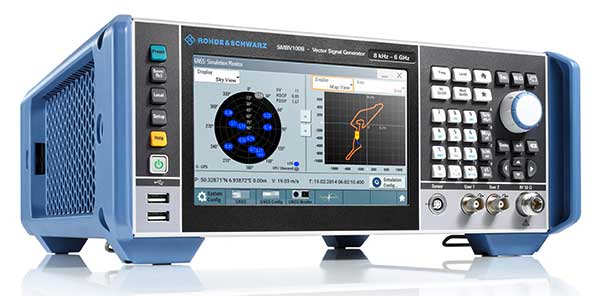
    Innovation. In response, Rohde & Schwarz added multi-frequency test capabilities to its entry-level and mid-range test solutions. “We have launched a new GNSS simulator based on the new mid-range vector signal generator R&S SMBV100B,” Irsigler said. A simple and flexible option concept allows users to turn the instrument into a full-featured and powerful GNSS signal source. It addresses a wide range of test applications, from single- and multi-frequency production testing to multi-frequency receiver characterization. The instrument can be equipped with an internal noise generator that allows users to simulate GNSS plus noise or CW interference without using additional external hardware.

    Photo: Rohde & Schwarz
    Photo: Rohde & Schwarz

    Coming Next. GNSS test solutions from R&S are based on general-purpose vector signal generators. With this approach, GNSS and other signals can be generated at the same time in the same instrument allowing coexistence and interference testing without additional external signal sources. As this results in test solutions that are compact and very flexible to use, R&S will continue to use this approach for upcoming product upgrades and enhancements as well as for its next generation of GNSS test solutions. The company’s upcoming activities will mainly focus on the high-end segment, where the R&S SMW200A with up to 4 RF outputs and up to 144 channels addresses multi-antenna and multi-vehicle GNSS test applications.

    Looking Ahead to 2022. With the safety demands of autonomous driving or aircraft landing procedures, multi-frequency testing will become standard. Because such applications must be sufficiently robust against spoofing and jamming threats, there will be an increasing need to test navigation systems against such influences. “Simulating GNSS alone is not enough,” Irsigler said. “Test solutions for autonomous driving will require several other techniques and signals to be applied or simulated, such as RTK/PPP or outputs from other vehicle sensors to perform sensor fusion.”


    Spirent Federal Systems

    Roger Hart, Director of Engineering. (Photo: Spirent)
    Roger Hart, Director of Engineering. (Photo: Spirent)

    Spirent’s simulators test with “real-world” signals as well as allowing tests under pristine conditions or under extreme conditions that may never occur in the real world, including error conditions.

    Innovation. In December 2018, Spirent released the SimMNSA, which provides a full M-code modernized signal solution. Until now, the GPS Directorate limited M-code simulation to either pseudo-M-code, which provides the same spread-spectrum but uses a commercial encryption standard, or a system of playing back a canned set of M-code limited to certain satellites and dates and times. With the policy change, Spirent can now implement M-code based on the modernized Navstar security algorithm (MNSA), and now offers both an M-code solution with the SimMNSA and a full Y-code with the SimSAAS.

    Jeff Martin, Director of Sales. (Photo: Spirent)
    Jeff Martin, Director of Sales. (Photo: Spirent)

    Coming Next. Spirent plans to provide customers an increased channel count to help test multi-constellation, multi-frequency receivers against multipath, jamming and spoofing. “We are in a period of intense development in terms of AVs, UAVs, and so forth, which don’t use GNSS exclusively,” Hart said, explaining that Spirent is working on testing of GNSS/sensor-fusion platforms.

    Looking Ahead to 2022. “As new interface specifications are released, we are proactive in developing new signals,” Hart said. Spirent also is supporting efforts to achieve assured PNT solutions. It is investigating interference-mitigation techniques such as algorithms, directional antennas, and other anti-jam technologies. Signal authentication is another need. “As the systems are becoming more integrated and networked, we are conscious of cyber-security threats and are looking in that area,” Hart said.

    Photo: Spirent
    Photo: Spirent

    Syntony GNSS

    Cyrille Gernot, GNSS Receiver Development and Product Manager. (Photo: Syntony GNSS)
    Cyrille Gernot, GNSS Receiver Development and Product Manager. (Photo: Syntony GNSS)

    GNSS receiver manufacturers use simulators to ensure that their products are robust in challenging situations that can’t be clearly assessed using real-world data. “That’s where the GNSS simulator comes into play,” Gernot said, “by offering controlled and repeatable scenarios.”

    Innovation. Syntony’s new pseudo-random-noise code (PRN code) server allows the GNSS simulator user to dynamically send the pseudo-random sequence modulating a carrier. It is especially useful for testing encrypted signals such as the GPS military signal or the IRNSS RS signal. “Access to encryption keys is extremely difficult for a simulator manufacturer to obtain,” Gernot said. “However, the simulator does not actually need to have knowledge of those encryption keys; only the resulting pseudo-random sequence to modulate is required.” The Syntony PRN server allows users to dynamically input their own pseudo-random sequences to be modulated on the target carrier into the simulator.

    Coming Next. Syntony’s next simulator will simulate spoofing and synchronous multi-antenna signals for CRPA and antenna network testing.

    Photo: Syntony GNSS
    Photo: Syntony GNSS

    Looking Ahead to 2022. As the threat of spoofing and jamming increases, the receiver industry will have to develop countermeasures and mitigation strategies. One of the best methods remains the use of antenna arrays, Gernot said. “Antenna arrays allow for spatial discrimination that is especially efficient to counter spoofing, jamming or unintentional interferences.To meet the industry’s future demands, Syntony is already working on accurate simulation of antenna arrays while accounting for inherent errors such as inter-antenna phase and amplitude offsets and overcoming obstacles, including phase coherency at the output of the simulator RF channels.”

  • 2017 Simulator Buyers Guide

    Cast Navigation iP-Solutions Racelogic Skydel Spectracom
    Spirent Federal Systems Syntony-GNSS Talen-x

    Cast-5000 GPS wavefront generator

    CRPA and Attitude Determination Receiver Testing

    5000layeredwhite-castnavThe CAST-5000 produces a single coherent wavefront of GPS RF signals to provide repeatable testing in the laboratory environment or anechoic chamber. The basic system generates four independent, coherent simulations that reference a single point and is upgradeable to support seven elements for CRPA testing. With an intercard carrier- phase error of less than 1 centimeter, the CAST-5000 is extremely accurate.

    The system generates a wavefront of GPS when its GPS RF generator cards are operated in a ganged configuration. Each generator card provides a set of GPS satellites coherent with the overall configuration. Several RF generator cards may be utilized together, ensuring phase coherence among the bank of signal generator cards.

    The CAST-5000 Controlled Reception Pattern Antenna (CRPA) tester allows a full end-to-end test of the antenna system. The CRPA antenna, antenna electronics and the GPS receiver can be tested as a unit with or without radiating signals.

    Features

    • Generates single coherent wavefront of GPS.
    • 6-DOF motion generation capability.
    • Complete SV constellation editing.
    • Post-mission processing via ICD-GPS-150/153.
    • Differential/relative navigation.
    • Antenna pattern modeling.
    • Waypoint navigation.
    • RAIM events.
    • Multipath modeling.
    • Spoofer simulation.
    • Satellite clock errors.
    • External trajectory input.
    • External ephemeris and almanac.
    • Several iono and tropo models.
    • Modifiable navigation message.
    • Modeled selective availability.
    • Time-tagged satellite events.
    • Selectable host vehicle parameters.

    www.castnav.com
    phone: 978 858-0130
    email: [email protected]

    iP-Solutions, Zero-C Seven Inc.

    Simceiver, Replicator, ReGen

    iP-Solutions brings its 10-year development for designated users — including the Japan Aerospace Exploration Agency (JAXA) COSMODE ionospheric scintillation monitor — to general users worldwide.

    MFR1iP-Solutions users have a complete GNSS lab at their disposal. They can simulate, record and process signals in real-time with the company’s receiver, and playback almost any GNSS signal.

    Moreover, users have complete control over the simulated signals in real-time and with high fidelity.

    iP-Solutions provides mid-level and high-end simulation solutions with the same level of accuracy and fidelity.

    Mid-Level Solution
    iP-Solutions’ mid-level Simceiver simulator allows multi-frequency simulation of various GNSS signals with all essential models. The additional ANSI C API allows users to modify existing models or introduce their own.

    iP-Solutions’ mid-level solution range even includes a comprehensive interference and spoofing laboratory.

    The Simceiver is controlled usign the comprehensive ReGen software, providing the user with great freedom to create any desired signal.

    High-End Solution
    ninja-hresiP-Solutions’ high-end Ninja simulator allows for multi-antenna controlled radiation pattern antenna (CRPA) and local-area augmentation system (LAAS) simulation.

    Academia
    iP-Solutions’ educational packages for academia combine hardware at a special academic price with academic versions of all the software and two textbooks authored by iP-Solutions’ lead engineer Ivan Petrovski and JAXA lead scientist Toshiaki Tsujii (published by Cambridge University Press).

    www.ip-solutions.jp
    phone: +81-3-3560-7747
    e-mail: [email protected] (Japan)
    [email protected] (Nth. America)
    [email protected] (International)

    Racelogic

    LabSat 3 Wideband
    LabSat is a cost-effective and intuitive GNSS simulator.

    Labsat_Lid-OffNew to the LabSat range of GNSS record and replay devices is LabSat 3 Wideband, which continues with the established reliability, cost-effectiveness, and simplicity of operation that are the benchmarks of the LabSat system.

    A recording bandwidth of 56 MHz allows for the capture of a very wide range of live-sky satellite signals:

    • GPS: L1 / L2 / L5
    • GLONASS: L1 / L2 / L3
    • BeiDou: B1 / B2 / B3
    • QZSS: L1 / L2 / L5
    • Galileo: E1 / E1a / E5a / E5b / E6
    • IRNSS: L5
    • SBAS: WAAS / EGNOS / GAGAN / MSAS / SDCM

    Depending on the desired bandwidth, recording resolution can be set to 2, 4, or 6 bit. Check out the GNSS frequency guide on the LabSat website — labsat.co.uk — to see exactly which signals can be recorded and at which resolution.

    Even with this greatly increased capacity over the original LabSat 3, the new simulator remains extremely easy to use: one-touch recording, no connection to PC required, battery powered for up to two hours, and with a removable 1-TB solid-state hard drive that can be replaced in no time, the LabSat 3 Wideband is convenient to use. It measures a compact 167 x 128 x 46 millimeters and weighs 1.2 kilograms.

    SatGen Wideband
    For product future-proofing, the soon-to-be-launched SatGen Wideband will allow for testing with signals not yet fully available, such as GPS L2C and L5 — further increasing the power and versatility of the new LabSat 3 Wideband.
    www.labsat.co.uk
    phone: +44 (0)1280 823803

    Skydel

    SDX: Software-Defined GNSS Simulator

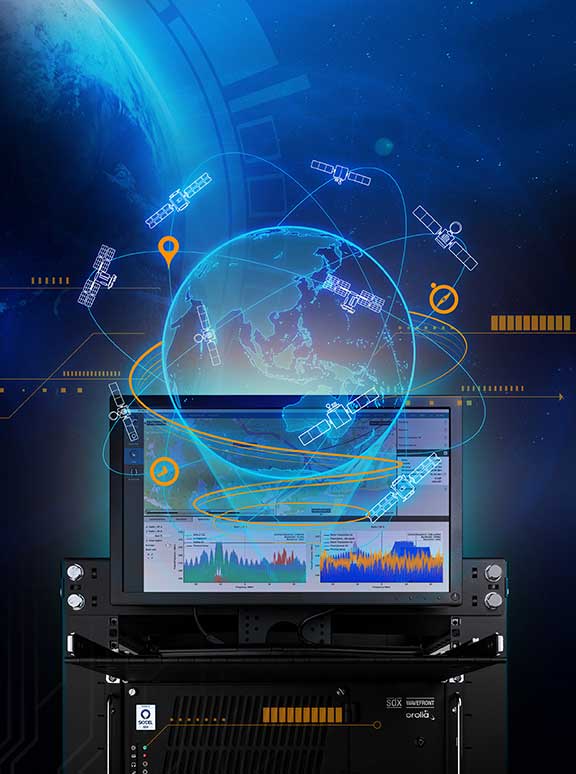
    skydel-sdxSDX uses GPU-accelerated computing and software-defined radios (SDR) to create an advanced and fully-featured GNSS simulator. SDX is available as complete turnkey systems or software only.

    The software-defined approach offers many benefits:

    • COTS hardware offers economy of scale and eliminates dependency over dedicated hardware platforms.
    • Generic hardware allow users to repurpose their equipment for different projects.
    • Configurable output to test receiver at various entry point with RF, IF or IQ data.
    • Uncompromised performance with high dynamics and accuracy.
    • Record user interactions and export them to scripts to automate complex use cases intuitively. The export feature reduces the learning curve for advanced concepts.
    • Advanced signal customization (signal signature, private encryption, etc.)

    SDX Key Features

    • Multi-constellation (GPS, GLONASS, Galileo, BeiDou), multi-frequency (upper and lower L-band).
    • Selectable RF, IF frequency and IQ file data.
    • GPS encrypted codes.
    • Fully integrated jammers (static or moving) with over 120-dB jamming-to-signal ratio.
    • Multipath.
    • Additive pseudorange (PSR) ramps.
    • Message modification and corruption.
    • 1000-Hz update rate and high dynamics.
    • Space (LEO-GEO), air and ground vehicle with 6DoF trajectories.
    • Hardware-in-the-loop (HIL) integration.
    • Street maps integration.
    • Raw data logging.
    • Real-time receiver deviation analysis.
    • Powerful and simple API.
    • On-the-fly reconfiguration.
    • Windows and Linux compatible.

    SDX is ideal for design and validation of GNSS receivers, complex integration, academic research, NAVWAR and test engineering.

    Skydel engineering and research teams offer direct support to clients to ensure prompt deployment and integration, or review advanced customization requirements.

    www.skydelsolutions.com
    [email protected]

    Spectracom

    For mission-critical PNT applications

    Spectracom_GSG_highres_smallThe Spectracom GSG series of GPS/GNSS simulators are an essential tool to evaluate risk to jamming, spoofing or any other threat. Spectracom GSG-5/6 series simulators are easy-to-use, feature-rich and affordable, offering high value for hardening GPS-based systems compared to the limitations of testing from live-sky signals. The Spectracom platform approach allows users to buy what they need today and upgrade later. The adaptability of the GNSS RF generation platform can extend to applications for intelligent repeating and meaconing.

    Test Solutions

    • Position accuracy and dynamic range/sensitivity.
    • Simulate movements/trajectories anywhere on or above Earth.
    • Sensitivity to GPS impairments: loss of satellites, multipath, atmospheric conditions, interference, jamming and spoofing.
    • Conducted or over-the-air RF.
    • GPS time-transfer accuracy.
    • Effect of leap-second transition.
    • Multi-constellation testing.
    • Modernization signals/frequencies.
    • Keyless military SAASM, dual-frequency and survey-grade receiver testing.
    • Application packages for, RTK, CRPA (controlled radiation pattern antennas).
    • Hardware-in-the-loop (HIL) integration.
    • Test solutions for eCall and ERA-GLONASS Infrastructure Possibilities.
    • Zone-based indoor location (intelligent repeating).
    • seudolite applications.

    GSG-6 Series 64-channel, multi-frequency, advanced GNSS simulator is powerful enough for any cutting-edge test program. GPS, GLONASS, Galileo, Beidou, QZSS and IRNSS signals are available across multiple frequencies. The GSG-6 is designed for military, research and professional applications.

    GSG-5 Series 16-channel multi-constellation L1-band GNSS Simulator is designed for commercial development/integration programs. If the user is developing commercial products with GNSS capability, the GSG-5 will shorten test programs with confidence.

    GSG-51 single channel signal generator is designed for one purpose — fast, simple Go/No-Go manufacturing test and validation, ensuring the manufacturing line is operating at full capacity with confidence in quality.

    spectracom.com
    email: [email protected]
    phone: +1-585-321-5800

    Spirent Federal Systems

    GSS9000, CRPA Test System, GSS6450 RPS, GSS200D
    Spirent Federal provides simulators that cover all applications, including research and development, integration/verification and production testing.

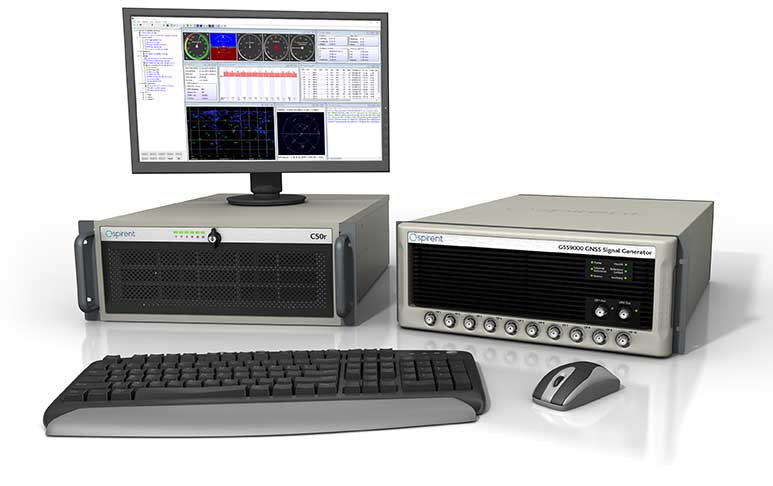
    GSS9000GSS9000. The Spirent GSS9000 Multi-Frequency, Multi-GNSS RF Constellation Simulator can simulate signals from all GNSS and regional navigation. The GSS9000 offers a four-fold increase in RF signal iteration rate (SIR) over Spirent’s GSS8000 simulator. The GSS9000 SIR is 1000 Hz (1ms), enabling higher dynamic simulations with more accuracy and fidelity. It includes support for restricted and classified signals from the GPS and Galileo systems as well as advanced capabilities for ultra-high dynamics. It can evaluate resilience of navigation systems to interference and spoofing attacks, and has the flexibility to reconfigure constellations, channels and frequencies between test runs or test cases.

    CRPA Test System. Spirent’s Controlled Reception Pattern Antenna (CRPA) Test System generates both GNSS and interference signals. Users can control multiple antenna elements. Null-steering and space/time adaptive CRPA testing are both supported by this comprehensive approach.

    GSS6450. The GSS6450 RF Record Playback System (RPS) takes RF recording and playback systems to a whole new level of performance and flexibility, while being housed in a small (8.5 x 7.8 x 3 inch) portable case. The GSS6450 can record any GNSS signals currently available with bit depths up to 16 bits (I&Q) and bandwidths of up to 50 MHz. The flexible product structure allows the system complexity to grow with the user’s testing needs.

    GSS200D. A truly end-to-end solution that builds up a complete picture of interference activity at site of interest. It continuously monitors the GNSS frequency bands for interference, then captures and analyzes them. The GSS200D is a detection system that operates simultaneously on multi-frequency.

    Spirent Federal Systems
    1402 W. State Rd.
    Pleasant Grove, UT 84062
    www.spirentfederal.com
    [email protected]
    phone: 801-785-1448
    fax: 801-785-1294

    Key contacts: Jeff Martin, VP of Business Development and Sales
    Kalani Needham, Sales West
    Tyson Gurney, Sales East

    Syntony-GNSS

    Montage-gui-constellatorConstellator is Syntony’s cost-effective full soft multi-constellation GNSS simulator. Designed to test receivers against current and future signals, Constellator matches top-end processing performance and RF quality and offers utmost flexibility in simulation control.
    Constellator

    • performs fair-weather tests, but also is designed to subject receivers to suboptimal conditions, extreme situations and combinations of errors difficult to access in real-world tests — all of it finely controlled and indefinitely repeatable.
    • is compatible with other best-in-class test solutions providing GNSS component end-to-end system tests, including hardware in the loop.
    • core is software, ensuring that all future constellations, satellites and codes can be handled. Most functional upgrades will then be software-only.
    • is used in aerospace and defense (among others) for: multi-antenna receiver testing for spacecraft launcher, satellite onboard receiver testing (telecom and observation) and defense UAV receiver testing.


    Main Features

    • 128 channels (extensible) delivering high-quality satellite signals on six distinct frequencies (L and S band)
    • Hardware-in-the-loop testing at 10- to 100-Hz refresh rates
    • Extensive simulation options:
      • • Full-time and location control
      • Receiver trajectories with extreme dynamics
      • Background noise, interference and jamming/spoofing (two units)
      • Atmospheric propagation errors
      • Satellite errors
      • Multipath and obscuration
      • On-the-fly scenario modifications
      • Receiver attitude control
      • Very accurate spaceborne trajectories

    Main Simulation and Modeling Capabilities

    Receiver trajectories: Includes four spatial reference frames and trajectory editors for ground, marine, aerial and spatial motion and import facility.

    Hardware-in-the-loop:
    Receives receiver’s position updates from test-rig in real time and generates corresponding GNSS signals and messages.

    Atmospheric errors: Propagation issues can be simulated at individual signal level with different models provided for ionosphere and troposphere.

    Satellite error modeling options include orbital errors, onboard clock errors, satellite electronics (front-end) defects, satellite dysfunctions and signal fade, disappearance and “evil waveform” incidents.

    www.syntony-gnss.com
    [email protected]
    phone :+33(0) 581 319 919

    Talen-x

    BroadSim: The NAVWAR Simulator
    BSim_stacked-forward-facing_reflectionBroadSim was developed to simplify advanced jamming and spoofing scenarios with Navigation Warfare (NAVWAR) testing in mind. Powered by Skydel SDX, a 1000-Hz GNSS simulator engine, BroadSim is able to simulate multiple vehicles, constellations, and code types (military and civil). BroadSim is ideal for supporting real-world field tests, NAVWAR testing and jamming.

    Field Testing. Field testing GPS receivers to determine their performance and vulnerabilities in degraded or competing environments is becoming standard practice. BroadSim has proven to excel in field testing events due to its integrated GPS receiver allowing for built-in live-sky synchronization, four independent RF outputs, and a wide dynamic range with up to 0 dBm transmit power. A typical configuration for a live-sky field test would have BroadSim time synchronized to live sky, transmitting C/A, P, Y and M on L1 while simultaneously transmitting P, Y and M on L2 all at 0 dBm.

    NAVWAR. BroadSim is great for NAVWAR testing because of how easy it is to use and configure multiple vehicles. Talen-X has carefully designed the simulator such that users can easily create true signals using two RF outputs and spoofed signals using the other two RF outputs. BroadSim’s graphical user interface (GUI) is intuitive and designed to meet the demand of NAVWAR testing.

    Advanced Jamming. An innovative feature that has been added to BroadSim is the ability to generate jamming signals without any additional hardware. Using a simple interface, users can specify the jammer location, power level, waveform type and antenna pattern. BroadSim uses its 1000-Hz engine to compute the I/Q data incident on the user antenna for both the GNSS and jammer signals. This new paradigm of jamming simulation makes it easy to simulate complex jamming environments.

    www.talen-x.com
    phone: +1-319-382-5369
    email: [email protected]