Taoglas, a provider of IoT and M2M antenna products, has launched a range of high-performance GNSS antennas specifically designed to power the next generation of applications that require highly accurate location capabilities.
These applications include navigation, unmanned aerial vehicles (UAVs), surveying, agriculture, connected cars and autonomous vehicles.
The new antenna range is Taoglas’ most comprehensive series of high-precision GNSS antennas and incorporates new form factors and use of multiple RF bands.
Taoglas’ new range includes systems and antennas that use Galileo, GLONASS and BeiDou, as well as GPS L2 or L5 bands.
“Today’s connected devices and applications demand new ways of approaching the age-old problem of location accuracy,” said Dermot O’Shea, co-CEO for Taoglas. “In certain applications, there is simply no room for positioning errors — location accuracy is an absolute requirement.”
The GRS.10 smart antenna. (Image: Taoglas)
The new antenna range includes:
The GRS.10, a smart antenna that includes a high-performance Taoglas GNSS (GPS, GLONASS, Galileo, BeiDou) ceramic patch antenna module integrated with a u-blox NEO-M8U GNSS receiver.
The Torpedo series GNSS quadrifilar helical antennas, extremely high-performance wideband satellite antennas for position-information-critical applications. It provides high circularly polarized antenna gain across a wide beamwidth. These are available in a passive (QHA) or active (AQHA) versions.
The BOLT A.90.A.10451111, a new GNSS timing antenna that includes lightning-induced surge protection. It is designed for the base station market. The advantage over other timing antennas is the addition of GLONASS and BeiDou frequencies.
The complete range of precision GNSS antennas also includes:
The MAT.12A. (Image: Taoglas)
The ASFGP.36A.07.0100C, a ceramic GPS L1/L2 low-profile, low-axial-ratio, embedded stacked active patch antenna.
The MAT.12A, a GPS/GLONASS/BeiDou dueling-loop chip antenna evaluation board, which delivers the advantages of a circularly polarized patch antenna with two miniaturized low-profile chip antennas on a smaller PCB footprint at one-fifth the weight.
This week, Taoglas also launched small form-factor ultra-wideband (UWB) antennas designed to work with DecaWave’s chipset and module solutions for applications including asset tracking, follow-me drones, healthcare monitoring, smart home services and other applications that demand high-performance indoor localization capabilities.
Taoglas’ complete range of GNSS and UWB antennas will be on display in Booth N.614 at Mobile World Congress Americas, Sept. 12-14, in San Francisco.
Taoglas has launched a range of small-form-factor ultra-wideband (UWB) antennas specifically designed to enable centimeter-level positioning and angle-of-arrival applications.
The FXUWB10, UWC.01 and UWCCP.01 ultra-wideband antennas by Taoglas.
Applications include asset tracking, follow-me drones, healthcare monitoring, smart home services and other applications that demand high-performance indoor localization capabilities, the company said.
The antennas offer high efficiencies across a wide spectrum of frequency bands, from 3 GHz to 10 GHz.
Indoor wireless positioning has long been hampered by technologies that were not designed for this purpose, such as Bluetooth, Wi-Fi and assisted GPS.
Ultra-Wideband. UWB is a low-power digital wireless technology that offers significant increases in location precision and range while transmitting large amounts of digital data short distances over a wide spectrum of frequency bands. UWB’s low-power requirements offer increased battery life of sensors and tags, leading to reduction in overall operational costs.
Taoglas’ range of UWB antennas, designed in Taoglas’ Munich, Germany, engineering center, features both state-of-the-art flexible embedded UWB antennas and UWB embedded SMT chip antennas. According to the company, the flexible FXUWB range of antennas were developed utilizing a “peel and stick” assembly process, attaching securely to non-metal surfaces via 3M adhesive with a flexible micro-coaxial cable mounting.
The UWB chip antennas are designed to be surface mounted directly onto a printed circuit board (PCB). Both series of antennas help designers future-proof devices, keeping costs low while covering all common UWB commercial bands.
“Today’s emerging applications require very precise indoor localization of assets, objects and people,” said Ronan Quinlan, co-CEO for Taoglas. “UWB can work as a type of ‘indoor GPS’ to help solve the precision dilemma for indoor applications, bringing much greater levels of precision than current technologies. We optimize complex antenna performance parameters such as the Group Delay, Polarization and Fidelity Factor. Taoglas’ first-to-market line of UWB antennas are designed to help our customers capitalize on this need for real-time precision localization.”
Autonomous Antenna. One antenna that Taoglas co-developed exclusively with DecaWave is the UWCCP.01 circularly polarized chip antenna, a mass-market antenna specifically designed to enable a new generation of autonomous applications.
The DecaWave DW1000 chip.
The UWB antennas were designed for use with the DecaWave DW1000 chip and are also compatible with any other UWB sensor modules on the market, the company added. Since its launch in December 2013, more than 3.5 million units of the DW1000 have shipped across multiple industries.
From real-time location of people and assets in factories, hospitals and mines, to automotive keyless entry systems, to drones, connected home and sports, the accurate location and secure communications capability of the DW1000 has already taken numerous applications to new heights.
“Antennas play a key role in our customers’ applications. Performance is a given for customers but the capability to adapt to the constraints of the applications — size, shape, electronics environment — is equally important as end products get smaller and smaller,” said Ciaran Connell, CEO and co-founder, DecaWave. “DecaWave is really pleased to partner with Taoglas, as their expertise is not only in delivering high-performance, off-the-shelf antennas, but also to provide customization services that will be highly beneficial to our customers.”
The Apex tracker has Taoglas inside. (Photo: STATSports)
When the world’s best athletes take the field, many are equipped with a GPS-based performance monitor that tracks a wealth of data. By monitoring in real time the players’ actions, professional sports teams can collect and analyze data that gives them an edge over the competition.
STATSports is a provider of GPS player tracking and analysis solutions for some of the biggest sports franchises in the world. Teams in the English Premier League, La Liga, National Football League, National Basketball Association and other leagues rely on STATSports to help them improve performance and strategy, and reduce injuries.
Tracking Key Metrics. STATSports’ Apex System includes the Apex Pod and Apex Software. The Apex Pod is an ergonomically designed unit that curves to fit players’ backs. The pod is inserted into a specially designed vest or base layer.
It tracks a variety of metrics, including a player’s total distance, speed, accelerations, decelerations, heart rate, fatigue level and other variables that teams can use in real time or alongside post-game reviews. The data is processed through Apex Software, which creates reports and visual tracking mechanisms to compare players, track players over time and provide metrics personalized for each team.
A tablet app gives coaches portable functionality. (Photo: STATSports)
Apex Live Streaming uses multiple channels and synchronized mesh networking to deliver data streams from players to Apex Software for analysis. Apex delivers GPS speed and positional data; heart-rate variability; and digital compass, gyroscopic and accelerometer data. It transmits half a million numbers every minute during training and games for a squad of more than 30 players.
Accurate Antenna
In devices so small and sensitive, antennas can be the most common point of failure in the communications chain, said Dermot O’Shea, co-CEO of Taoglas. STATSports evaluated several antenna options before selecting Taoglas.
Taoglas’ 25×25-mm AGGBP.25B is a two-stage 28-dB active GPS patch antenna module that provides positional accuracy in a small form factor.
With a few dozen players and coaches on the field in training and at games, highly accurate positioning is critical. Players move quickly and are often clustered around a ball, making it difficult to accurately track player movement. STATSports required location accuracy within 1 meter, precision that
Taoglas delivered.
The LA Galaxy team uses STATSports. (Photo: LA Galaxy)
Because the STATSports technology captures data in real time, teams can make real-time tactical and strategic decisions and adjustments instead of waiting for post-game analysis.
However, with that many antennas and transmissions in close proximity, interference can be an issue. Taoglas’ solution includes a front-end surface acoustic wave (SAW) filter in front of the two-stage low noise amplifier (LNA) to reduce out-of-band noise, such as signals from nearby cellular transceivers.
The real-time nature of STATSports’ solution means the company also requires a condensed time to first fix — when the devices are turned on, STATSports needs them to register a signal quickly and begin to receive data. The Taoglas antenna is ready within 30 seconds of powering on.
STATSports’ proximity to Taoglas’ Wexford, Ireland, headquarters and development labs means the teams can collaborate on new functionality as STATSports develops increasingly advanced performance-tracking solutions.
Taoglas has launched Axiom, a reference design for a low-profile, compact multiple-antenna solution for the next generation of connected cars. Taoglas is a provider of GNSS, automotive and Internet of Things products.
The reference design will help automobile manufacturers overcome one of the biggest challenges of the connected car: where and how to place the multitude of antennas needed for maximum performance.
As many as 18 antennas are needed to power the next-generation connected car, including
multiple cellular antennas for network connectivity;
Wi-Fi for hotspot connectivity;
GNSS for navigation, emergency call systems and other location-based technologies;
satellite radio;
AM/FM antennas;
radar antennas for object detection;
Bluetooth antennas for smartphones and other devices, and
dedicated short-range communications (DSRC) antennas for vehicle-to-vehicle/infrastructure applications.
Locating these antennas in a vehicle in close proximity to each other and additional electronics systems while minimizing interference and maximizing performance is extremely challenging from a design and RF performance perspective.
Manufacturers also need to take into consideration both ease of installation and assembly, and antenna size to determine how they would best work with the vehicle’s aesthetics. Taoglas has worked with the automotive industry for more than a decade, providing antenna solutions to many of the major tier 1 automobile OEMs across the globe.
The Axiom reference design incorporates Taoglas’ wealth of knowledge and expertise gained over the years into a roadmap to help automobile manufacturers more quickly advance antenna configurations that work for their particular make and model.
“Getting that many antennas to work efficiently in a small space at a competitive cost is the number one challenge for the RF teams of automobile manufacturers,” said Dermot O’Shea, co-CEO of Taoglas. “While every car manufacturer will require a slightly different solution, having a multi-antenna reference design to work from allows them to see what they can do in terms of placement and size, and how that impacts performance — all without waiting months for a custom solution to test. They can take the prototype and test it in the field to prove out concepts. Using Taoglas’ Axiom reference design allows them move more quickly to market with solutions that work. We can also work with Tier 1 OEMs to integrate the elements of the Axiom antenna reference design quickly and efficiently directly onto the board of their telematic control units, achieving highest radiated power and sensitivity, while minimizing project time, cost and size, all in one single package.”
Taoglas’ Axiom reference design has integrated nine antennas, including:
LTE Antennas: Four LTE antennas, each operating from 698 MHz to 6 GHz to fully cover LTE worldwide application bands.
Wi-Fi Antennas: Two Wi-Fi elements, supporting both 2.4 GHz and 5.8 GHz bands for Wireless Local Area Network.
GNSS Antenna: An active GNSS element to support GPS, GLONASS and BeiDou navigation systems. L1/L2 options available.
SDARS Antenna: One SDARS element to support satellite radio applications.
DSRC Antenna: One DSRC element, which supports V2V/V2X dedicated short range communication.
Taoglas’ advantage is its ability to integrate all of the antennas required for the connected car in a confined space and maintain maximum performance. The Axiom reference design uses a compact PCB all with SMT-mounted components, and also incorporates a unique board-to-board connector option, allowing the antennas and electronics systems to coexist in a single space inside the vehicle, with no RF cables or additional connectors required.
The Axiom reference design also helps auto manufacturers simplify manufacturing and assembly, with surface-mount solutions that feature the temperature and vibration resistance with the quality standards that manufacturers require. Installation is clipping the PCB into the telematics board.
Taoglas, a provider of Internet of Things (IoT) and GNSS antenna products, has released two new GPS certification testing services for Google and its device partners. The services are required for devices to meet Google’s new Street View auto-ready standard.
Auto-ready certification distinguishes 360-degree cameras that deliver accurately positioned 360 video, even at high speeds. Taoglas worked with Google to develop the performance requirements, as well as the test methodology used to establish a basic minimum level of GPS receiver performance.
The services are available at any of Taoglas’ design centers and labs in the United States, Ireland, Germany and Taiwan.
Compact wireless devices such as digital cameras with built-in GPS receiver systems contain complex electronic systems that can emit unwanted RF signals that can impact radio receiver performance. The effect of this RF noise can be combated with critical design decisions like the antenna, low noise amplifier, filters, and transmission line choice and implementation.
Taoglas’ new services will help device manufacturers objectively measure real-world performance to understand any GPS performance issues with their products. With this information, product manufacturers will know if their performance is optimized and will meet or exceed user expectation for the application at hand, as well as how it compares with their competitors.
“Google Street View provides people with a 360-degree view of the world, and to enable these services, we require highly accurate location data,” said Charles Armstrong, product manager at Google. “By working with Taoglas to establish a standardized compliance process, we’re helping device manufacturers understand our requirements for GPS performance and quickly deliver products that match and exceed those high performance standards.”
Taoglas is offering two levels of certification testing:
Street View Auto-Ready Conformance Testing (GSA.31) provides a quick verification of minimum performance (in a pass/fail manner) required to achieve Street View certification. Taoglas uses its GPS constellation simulator and anechoic chamber to verify that radiated tracking and acquisition sensitivity meet a minimum performance standard at 15-degree intervals in one hemisphere.
From these test results, manufacturers will be able to clearly see if the device’s GPS is performing adequately for basic location capabilities. The condensed period needed to run this test provides device manufacturers the best value to answer the question, “Is the GPS working optimally?”
A street view image of Guatemala. (Credit: Google)
Street View Auto-Ready Performance Testing (GSA.32) provides an absolute level of testing to assess the GPS receiver performance according to the optional Google Street View Assessment test procedures.
Taoglas uses its GPS constellation simulator and anechoic chamber to measure radiated tracking and acquisition sensitivity at 15-degree intervals in one hemisphere. These optional tests provide more insight into how well a device performs, providing absolute receive sensitivity performance data.
Testing results for both services include suggestions on next steps to resolve identified issues.
“This partnership with Google to deliver GPS testing solutions for Google Street View compliance is an excellent example of how we’re working successfully with the world’s biggest companies to delivering high-quality, reliable antenna solutions,” said Dermot O’Shea, co-CEO of Taoglas. “By certifying their products through Taoglas, device manufacturers will also be able to take advantage of Taoglas’ deep RF expertise, achieving success quickly and reducing time to market.”
“Street view” of the Ambrym Volcano, Vanuatu. (Credit: Google)
Global navigation satellite system (GNSS) technology found its way into products ranging from autonomous vehicles to wearables at this year’s Mobile World Congress in Barcelona, Spain.
One company says it is tailoring a GNSS receiver chip to meet the demands of mobile devices that require high levels of speed and position accuracy. Thalwil, Switzerland-based u-blox said its new low-power UBX-M8230-CT GNSS receiver chip can not only be used for smartwatch development, but for tracking people, animals and assets.
“The highlight of the chip is that it has much better balance, while maintaining the accuracy of a traditional, full-power receiver,” said Florian Bousquet, u-blox market development manager. “It can work in the most difficult urban canyon environments. It works well in sports watches, smartwatches, activity trackers and other wearables — and just about anything portable that has a battery.”
Bousquet said the chip, in what the company calls a Super-E mode, uses GPS with either GLONASS or BeiDou. This mode allows batching location data on the chip, which reduces power consumption, he said.
Bousquet said the chip is available now, in an evaluation kit, for around $120. He said the chip will be manufactured in volume this summer.
It took u-blox a year-and-a-half to develop the GNSS chip, Bousquet said. “It took time for our development team to optimize the system and field test the infrastructure to make sure the product performed in different scenarios and environments.”
Another company, Racelogic, exhibited its LabSat 3 Wideband GNSS simulator, which is used by u-blox and others to help test and develop products. Some applications include drones, autonomous vehicles, survey equipment, personal monitoring devices, aerospace and end-of-the-line product testing, the company said.
The newer L2C, L5 and L1C signals give companies the opportunity to develop products that are compatible with new receivers as they come to market, said Mark Sampson, LabSat product/sales manager.
The company also showed off its SatGen v3 simulator software that allows users to create a data file to be replayed on the LabSat GNSS simulator. The software allows companies to define a complicated route, and then import it into the software.
Company tests eCall and ERA-GLONASS modules
Both the European Union (EU) and Russian Federation are requiring governments to have intelligent telematics-based safety systems. In case of a serious accident, these systems automatically call for local medical services.
Technology to meet the requirements of eCall and ERA-GLONASS include an antenna, GNSS receiver, crash sensors and other components.
To reproduce end-to-end and standard-compliant testing of the eCall and ERA-GLONASS modules, Rohde & Schwarz offers two products. One is the CMW-KA094 eCall application software. The other is the CMW-KA095 extension for ERA-GLONASS to simulate a public safety answering point (PSAP) to emulate a cellular network in a lab.
“It’s pretty important testing because of the safety of life. We have set up implementation of it in our labs,” said Christian Hof, Rohde & Schwarz senior product manager for mobile radio testers.
CMW500 simulator by Rohde & Schwarz. Photo: Rohde & Schwarz
During testing, governments and companies can use the CMW500 platform, which identifies Internet of Things (IoT) and mobile communications devices’ IP connection security issues, Hof said.
The company believes, since many IoT platforms are proprietary as standardization is still in progress, security gaps are frequently reported.
Spirent rolls out new simulator
Spirent Communications displayed its Elevate IoT Device Test Solution, a new cellular test designed to support IoT applications. These applications include end-to-end cloud server connectivity, security-vulnerability assessment and battery-life measurement.
The new unit is available through the company’s Spirent Elevate platform, which addresses areas affected when designing 3G, LTE and new narrowband wireless technologies for IoT devices.
Overall, Spirent is finding many use cases and applications in the IoT and mobile industry.
“We are finding that smaller companies developing software and services want to test GNSS, but don’t have the capabilities to do so. These could include small projects such as people and pet trackers,” said Simon Loe, Spirent’s head of marketing solutions and services. “We are trying to democratize the technology. Another trend we are seeing is growing importance on GNSS in network timing.”
Not everything is about drab simulation. Far from it. Spirent last year teamed with Aston Martin Racing to evaluate automotive technologies on the 2016 V8 Vantage GTE race cars.
This includes the accuracy and performance of GPS receivers and interference monitoring, said Julian Kemp, Spirent product manager, custom solutions.
Antenna market for IoT, autonomous vehicles robust
Taoglas is offering GNSS antennas that support IoT products, unmanned aerial vehicles (UAVs) and future autonomous vehicles, said Ronan Quinlan, company co-founder.
The company is offering lightweight antennas for mass-market unmanned UAVs, which had a growing presence at Mobile World Congress this year.
The future markets for Taoglas will be in connected and autonomous vehicles, Quinlan said. “We found out years ago that we missed out on the rise of 2G, but we did not miss the rise of 4G. The advent of 5G and GNSS will lead to the development of the autonomous vehicle,” he said.
Antenna costs associated with the rise of autonomous vehicles will have to be reduced, Quinlan said. “Some antennas that were $100 solutions have to go down to $20 solutions once they get into a car,” he said.
In other Mobile World Congress news:
Fraunhofer IIS displayed its Enhanced Voice Services (EVS), the Third Generation Partnership Project (3GPP) communication protocol designed specifically for voice over LTE (VoLTE) services.
Telit said it is expanding its relationship with Tele2 on Pan-European long-term evolution (LTE) IoT connectivity services. Telit and Tele2 now offer custom data plans with predictable pricing, no hidden fees or roaming charges for high bandwidth IoT applications, the company said. Services include video monitoring, digital signage or real-time asset tracking.
Taoglas, a provider of IoT (Internet of Things) and M2M (Machine to Machine) antenna solutions, has launched a new series of high-performance LTE + GNSS or Wi-Fi antennas. The announcement was made at CTIA Super Mobility, held Sept. 7-9 in Las Vegas.
The Taoglas Guardian X 11-in-1 antenna.
The Guardian series includes 4, 5, 6 and even 11-in-1 antenna options for 4G LTE cellular applications that also require GNSS or Wi-Fi or satellite options.
“Drilling holes in assets and doing long coaxial cable runs is a thing of the past for many IoT applications, particularly in the transportation industry,” said Dermot O’Shea, joint CEO at Taoglas. “Most vehicles and assets are no longer made from metal, but of a carbon fiber or composite material. This means the antenna does not need to be outside the asset but can be mounted internally.”
One example is in the trucking industry, where antennas are mounted under the roof and above the headliner, eliminating the need for holes to be drilled. “This saves huge amounts of time and cost for the installation as well as increasing device performance due to the cable runs being shorter,” O’Shea said. “It also decreases the likelihood of antenna damage due to impact or vandalism.”
The Guardian series antennas are delivered in a gloss-finished, compact square-shaped enclosure (146 x 134 x 20 mm). In the series are these options:
MA931 – 6 in 1 (2 x Cellular, 3 x Wi-Fi, 1 x GNSS)
MA930 – 6 in 1 (2 x Cellular, 2 x Wi-Fi, 1 x GNSS, 1 x Satellite)
MA950 – 5 in 1 (2 x Cellular, 2 x Wi-Fi, 1 x GNSS)
MA961 – 4 in 1 (2 x Cellular, 2 x Wi-Fi)
Also, an extension to the line is the Guardian X series, with the first product being MA4000, an 11-in-1 antenna (six cellular, four Wi-Fi, one GNSS).
The Guardian X dimensions are 540 x 183.1 x 35.4 millimeters. Despite its small size, the MA4000 antenna eliminates the requirement for multiple holes to be drilled in a valuable asset. The enclosure material is flame retardant, as is the CFD-200-FR low-loss cable. This means the antenna is compliant for airline, bus and rail passenger applications and complies with UNECE regulation R 118.
Antenna maker Taoglas USA has opened a facility in San Diego for its North American customers.
In the midst of explosive wireless device growth in the Internet of Things (IoT) market, the company has quadrupled the original size of its local facility — now more than 16,000 square feet.
The new Taoglas IoTx Center offers a fully equipped design and test location that supports companies seeking a competitive, time-to-market advantage for machine to machine (M2M) and IoT applications.
According to Taoglas, the location offers support for customers at all stages of their product design cycle — from concept to certification readiness.
“This kind of open-door policy is rare in the antenna and wireless device testing business,” explained Dermot O’Shea, president of Taoglas USA. “We have expanded our engineering team, added more test equipment, and now have two chambers here to increase design and test capacity. As well as being able to prototype antennas and PCBs, we can test the antenna and devices in operation on site to ensure they work reliably in the real world.
“We have also now added an antenna and cable assembly operation so we can quickly produce antenna and custom RF cable orders here in San Diego,” O’Shea said. “Quite often customers require products in a few days rather than weeks and we have now facilitated that demand with this new move.”
Taoglas has dedicated the facility to support it’s North American customer base. San Diego was chosen due to the strong, experienced talent pool in the areas of antenna and hardware design.
In addition to the site’s two CTIA calibrated anechoic chambers, the campus includes a custom antenna and RF cable assembly facility, expanded development and office space as well as a well-equipped, sound-proofed customer lounge area with workspaces and other features to accommodate customers while testing and product development are in process. Taoglas will increase its San Diego staff by 50 percent this year and expects to double that in the next three years.
“Our enlarged San Diego facility reflects our growth rate last year of almost 100%,” explained O’Shea. “We’re bullish about the potential in the Internet of Things (IoT) market, which is key for us. The vendors in this space who we support not only need the off-the-shelf or custom antennas we offer, they need design services and assistance. All our services have clear explanations and fast deliverables, all available on our website. You just select your service code, or call our sales, and we will book you in for work on your device immediately. No waiting around or complicated contractual discussions.
“First time certification is also critical so wireless OEMs can avoid the hardware failures that are so common in the IoT sector. Having two anechoic testing chambers means we can work on multiple devices in real time, helping customers get successful products into the market first time and on time.”
According to International Data Corp., the IoT market will grow to $1.7 trillion by 2020, with a compound annual growth rate of 16.9 percent. “We’re currently shipping millions of antennas per month into the IoT market,” O’Shea said. “Our larger campus here will be well utilized.” Taoglas also has offices in Minneapolis, Ireland, Taiwan and Germany.
According to Rory Moore, a prominent San Diego technology company founder and investor, in addition to being CEO of Southern California startup incubator EvoNexus, “The enlarged Taoglas campus is another sign of success in the local innovation economy. San Diego already has a strong base in IoT growth and this large new Taoglas IoTx facility cements San Diego as an IoT hub in a very hot sector. I also like the fact that Taoglas has been collaborating with SDSU (San Diego State University), building useful bridges between the business and educational communities.”
Taoglas USA, Inc., provider of antenna solutions to the M2M and connected device market, has launched the FXP.611 Cloud, a GPS/GLONASS flexible loop antenna that the company says outperforms most active patch antennas with an efficiency of 80 percent and a peak gain of 3 dBi across the GPS and GLONASS bands (1575 to 1610Mhz).
This antenna can resist external detuning effects due to dual resonance and has a small form factor of 38 x 37 x 0.1 millimeters. At less than half the cost of heavy active patch antennas, this peel and stick, flexible loop antenna is suitable for any GPS/GLONASS M2M device, Taoglas said.
“We’ve been blown away by the performance of this linear polarized A-GPS GLONASS antenna,” said Dermot O’Shea, director at Taoglas. “Before we developed the FXP.611 Cloud, we had only seen this kind of performance from active patch antennas. We ran a drive test in downtown San Diego and were surprised by the real-time performance and first time to fix from cold-start of this passive loop, particularly in urban canyons where you expect active patches to out perform.”
Original equipment manufacturers will find the FXP.611 suitable for assisted GPS/GLONASS applications for industrial handheld devices, tablets and smartphones. According to Taoglas, the patent-pending FXP.611 Cloud antenna
eliminates the need for a filter or low noise amplifier (LNA), and can connect directly to a module or to a connector on a board.
offers a “peel and stick” mounting with 3M tape that can be attached to plastic device housings freeing up board space.
costs half the price of active patch antennas.
incorporates a detuning design with dual resonance.
radiates power uniformly with an omnidirectional design, making it suitable for use in devices that have fixed positions.
The FXP.611 Cloud antenna is available for purchase immediately from Taoglas by contacting [email protected] and online later in the first quarter of 2013 with Taoglas distributors.
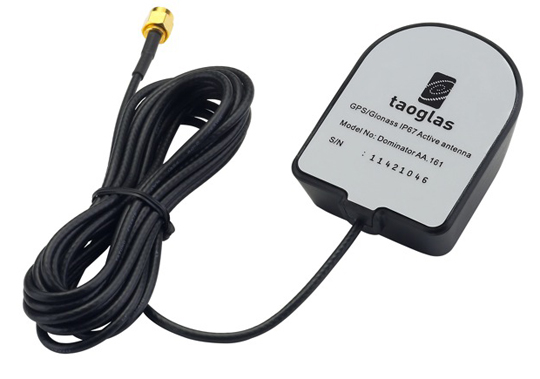
Taoglas is launching the AA.16X Dominator series of antennas, which have a wider bandwidth to cover the GLONASS operating frequencies up to 1610 MHz, a good axial ratio, and a double resonance design for optimum reception at the center frequencies.
Taoglas’ GPS antennas are being used in the field by many different M2M solution providers including tracking, telematics, and GPS manufacturers, the company said.
The AA.161 Dominator is a magnetic mount GPS-GLONASS IP67, external antenna incorporating a 35-millimeter ceramic patch. It is a wide-band active patch antenna product with a large integral ground that delivers a gain up to 35 dB. With the Dominator antenna series, Taoglas has a comprehensive range of GPS-GLONASS active embedded antennas (AGGP series) and passive embedded (CGGP) antennas for automotive first-tier TS16949 and after-market applications.
“In the coming months, for the first time the true availability of GPS and GLONASS satellites along with the latest generation of GNSS receivers are going to dramatically change the performance of M2M location devices,” said Ronan Quinlan, Director Taoglas. “With close to double the amount of satellites to draw from compared to a stand-alone GPS constellation, we are now going to see quicker time to first fixes with accuracy improving from meters to sub one meter. The ability to view and lock on four or more satellites in traditionally difficult reception areas such as urban canyons, city centers or locations with restricted views of the horizon, will give M2M manufacturers the ability to triangulate and pinpoint locations with greater accuracy and with quicker time to first fix.
Taoglas’ new Dominator antennas have been rigorously tested and pre-approved by the GNNS receiver companies worldwide and have been shown to display higher and more consistent gain in comparison to competing antennas, the company claimed. Two key components have been engineered from scratch for the Dominator series, a wide-band front-end SAW filter (critical to prevent out of band noise entering on both GPS and GLONASS degrading the signal) and a high-gain 35-mm patch.
CONTACT INFO
Company: Taoglas
Country: United States (USA)
URL: http://www.taoglas.com
Taoglas is launching the AA.16X Dominator series of antennas, which have a wider bandwidth to cover the GLONASS operating frequencies up to 1610 MHz, a good axial ratio, and a double resonance design for optimum reception at the centre frequencies. The company will showcase its line of antennas at CTIA in New Orleans May 8-10.
Taoglas’ GPS antennas are being used in the field by many different M2M solution providers including tracking, telematics, and GPS manufacturers, the company said.
The AA.161 Dominator is a magnetic mount GPS-GLONASS IP67, external antenna incorporating a 35-millimeter ceramic patch. It is a wide-band active patch antenna product with a large integral ground that delivers a gain up to 35 dB. With the Dominator antenna series, Taoglas has a comprehensive range of GPS-GLONASS active embedded antennas (AGGP series) and passive embedded (CGGP) antennas for automotive first-tier TS16949 and after-market applications.
“In the coming months, for the first time the true availability of GPS and GLONASS satellites along with the latest generation of GNSS receivers are going to dramatically change the performance of M2M location devices,” said Ronan Quinlan, Director Taoglas. “With close to double the amount of satellites to draw from compared to a stand-alone GPS constellation, we are now going to see quicker time to first fixes with accuracy improving from meters to sub one meter. The ability to view and lock on four or more satellites in traditionally difficult reception areas such as urban canyons, city centers or locations with restricted views of the horizon, will give M2M manufacturers the ability to triangulate and pinpoint locations with greater accuracy and with quicker time to first fix.”
Taoglas’ new Dominator antennas have been rigorously tested and pre-approved by the GNNS receiver companies worldwide and have been shown to display higher and more consistent gain in comparison to competing antennas, the company claimed. Two key components have been engineered from scratch for the Dominator series, a wide-band front-end SAW filter (critical to prevent out of band noise entering on both GPS and GLONASS degrading the signal) and a high-gain 35-mm patch.