Tag: technology

  • Bentley Systems releases open-source library, iModel.js

    Open-source JavaScript library for creating immersive connections to infrastructure digital twins.

    Bentley Systems has released its iModel.js library, an open-source initiative designed to improve the accessibility, for both visualization and analytical visibility, of infrastructure digital twins.

    iModel.js can be used by developers and IT professionals to quickly and easily create immersive applications that connect their infrastructure digital twins with the rest of their digital world, the company said.

    iModel.js is the cornerstone of Bentley’s new iTwin Services that combine iModelHub, reality modeling and web-enabling software technologies within a Connected Data Environment for infrastructure engineering.

    iModelHub manages an iModel as a distributed database with an intrinsic ledger of changes — enabling alignment, accountability and accessibility of its digital components — to form the backbone of an infrastructure digital twin.

    The iModel.js library is a comprehensive collection of JavaScript packages that build on the most open, popular and flexible standards for modern cloud and web development. It is written in TypeScript and leverages open technologies including SQLite, Node.js, NPM, WebGL, Electron, Docker, Kubernetes, and HTML5 and CSS. The same codebase can produce cloud services and web, mobile and desktop applications. The source code is hosted on GitHub and is distributed under the MIT license.

    With iModel.js, it is simple to create a web-based experience that shows interactive “nD” views (1D, 2D, 3D, 4D, etc.) of iModels that are assembled and synchronized from BIM files and other digital engineering models, as well as from data created directly with iModel.js.

    Those same views can also include digital (reality) context, real-time sensor data, and other data from enterprise sources and analytics. Since the iModel is synchronized by iModelHub, it always reflects the most recent updates from all project participants, who are thus able to visualize and analyze changes between points in time or between versions. Importantly, only users and applications authorized by the iModel owner, through iModelHub, are granted access through iModel.js.

    “iModel.js gives Hatch the ability to implement a stakeholder engagement technology that extends the iModelHub visionary technology,” said Johan Palm, program manager of digital project delivery at Hatch. “We can expose complex project information to a level that is accessible, consumable and extendable via the cloud and in context to the 3D model. Most importantly we can do so in a manner that embraces change as the project progresses. iModel.js aligns with Hatch’s internal development strategies as it is built on modern, highly portable web technology. Bentley is a key software technology partner on Hatch projects globally where our main objective is to provide a positive impact to our client’s assets and operations.”

    “The digital twin powered by iModelHub is efficiently improving project management, substantially reducing the waste of resources caused by site problems and will achieve digital handover after completion of the project for visual operations and maintenance,” said Cai Chengguo, chair and general manager at Shenzhen Expressway Consulting Group.

    “We firmly believe that iModel.js, and of course the foundation upon which it is built, is the most open, productive, intuitive and powerful development environment for capital projects and infrastructure assets, ever,” said Keith Bentley, Bentley Systems’ founder and CTO. “We’re excited to work with user organizations, strategic partners and third-party developers to build an open ecosystem around iModels to tap the vast potential of infrastructure digital twins. With iModel.js, the well-refined techniques of mainstream cloud and web development can leverage the physical and virtual reality in digital twins with near-zero impedance. By open-sourcing the libraries we use to create our iTwin cloud services, we expect to foster a substantial and vibrant ecosystem of innovation.”

  • NCTech to unveil iSTAR Pulsar developments at Intergeo

    Photo: NCTech
    Photo: NCTech

    NCTech, a developer of reality imaging systems, will showcase its iSTAR Pulsar mobile 360-degree data capture system at Intergeo in Frankfurt, Germany.

    Companies at Intergeo, including GeoSLAM and Orbit Geospatial Technologies, will also unveil innovative developments that incorporate iSTAR Pulsar.

    iSTAR Pulsar is NCTech’s professional edge-to-cloud big data system, optimized for capture on the move. iSTAR Pulsar is designed to capture 360-degree data while mounted on a vehicle, drone or on foot.

    At Intergeo, NCTech will be showing a demonstration of a future feature in its cloud-based processing software VR.WORLD that uses artificial intelligence and image recognition to analyse the images captured by iSTAR Pulsar. This means that objects like cars, trucks, traffic lights, road signs, pedestrians and cyclists can be automatically identified in images, the company said.

    Photo: NCTech
    Photo: NCTech

    Handheld 3D mobile mapping company GeoSLAM also will introduce new developments at Intergeo, including an innovation that integrates with iSTAR Pulsar.

    “We immediately saw the potential for collaboration when NCTech introduced the iSTAR Pulsar,” said Mark Reid, head of strategic business development, GeoSLAM. “And now we’re excited to show the attendees at Intergeo what we’ve been working on.”

    Orbit GT has updated its mobile mapping software to enable iSTAR Pulsar data to be integrated into its smart 3D mapping solutions.

    “We’re very pleased to announce that Orbit GT solutions now support data from NCTech’s iSTAR Pulsar,” said Peter Bonne, CEO, Orbit GT. “We’ll be showcasing the great 360-degree imagery captured by iSTAR Pulsar at our booth.”

    “We launched iSTAR Pulsar earlier this year, so it’s great to see that key industry players like GeoSLAM and Orbit GT are already leveraging its capabilities in their own developments,” said Andrew Baddeley, technical sales director, NCTech. “Combined with the exciting new AI developments from our labs, we look forward to showing everyone at Intergeo how we are helping to virtualize the world.”

  • U.S. Army recognizes GeoDecisions for modernizing convoy mapping module

    Automated Movement and Identification Solutions (AMIS), a division of the U.S. Department of the Army, has bestowed a Certificate of Appreciation to GeoDecisions, Gannett Fleming’s geospatial technology division.

    The certificate recognizes GeoDecisions for its outstanding technical expertise and dedication in the modernization of the Transportation Coordinators’ – Automated Information for Movements System II (TC-AIMS II) Convoy Planning Highway Regulation (CPHR-M) module.

    TC-AIMS II CPHR-M is an advanced software solution used to plan the Army’s convoy movement around the globe. GeoDecisions integrated the Transportation Geospatial Information System (TGIS) map and routing tool through the TGIS application programming interface to embed the map within the TC-AIMS system.

    The TGIS integration with TC-AIMS provides enhanced, real-time mapping functions, faster processing speeds, and a more user-friendly experience.

    The recognition also honors the GeoDecisions team for its technical knowledge, attention to detail, and ability to recognize, understand and address issues quickly to allow CPHR-M to stay on schedule.

    The team’s efforts resulted in more than a dozen changes to the baseline to provide better performance and additional capabilities that were not identified at the start of the project.

    “It’s almost unheard of to receive an award like this from a government program, so we feel especially humbled by this honor,” said Brendan Wesdock, MCP, GISP, president of GeoDecisions. “We’ve built an exceptional team of geospatial professionals who continuously push the boundaries of geospatial technology to deliver the most effective and valuable solutions to our clients.”

    AMIS is the primary source of providing automated movement and identification solutions across the DOD and around the globe. AMIS is the essential supplier for Transportation Coordinators’ – Automated Information for Movements System II (TC-AIMS II) with approximately 5,000 active users.

    The GeoDecisions team (from left): Jay Ross, senior software test specialist; Jeff Carter, TGIS lead system administrator with sub-consultant Aegis Strategies, LLC; Steve Kraabel, senior client manager; Debra Houser, director of Application Development; Bret Huber, lead and software developer; (not pictured) Andrew Miller, developer. (Photo: GeoDecisions)
    The GeoDecisions team (from left): Jay Ross, senior software test specialist; Jeff Carter, TGIS lead system administrator with sub-consultant Aegis Strategies, LLC; Steve Kraabel, senior client manager; Debra Houser, director of Application Development; Bret Huber, lead and software developer; (not pictured) Andrew Miller, developer. (Photo: GeoDecisions)


  • Esri to monitor illegal activities in Argentine waterways

    Argentina’s coast guard Prefectura Naval and Aeroterra S.A. have partnered to implement Esri’s ArcGIS platform for a real-time tracking system.

    The new system, called Guardacostas Pro, uses a combination of satellite imaging and signal processing to monitor vessels for illegal activities such as drug smuggling and fish poaching in the coastal waters of Argentina’s exclusive economic zone (EEZ).

    As Argentina’s coast guard, Prefectura Naval deploys patrol vessels, helicopters and airplane spotters to protect its economic interests and to guard against the decline of its fishery.

    This year, the Guardacostas Pro system allowed Prefectura Naval to track a Spanish vessel that entered the EEZ and attempted to return to international waters. The coast guard was able to catch the ship, which had poached roughly $380,000 worth of fish; escort it back to port; impound it; and fine the crew.

    The captain had little ground to refute the charges because the coast guard had the data to prove the illegal activity.

    “As of five years ago, we had very little information about the use of our seas,” said Ernesto Miguel Klocker, Prefectura Naval director of informatics and communications. “Now we have a good picture, which gives us electronic control of the sea, allowing us to send our air and naval units directly to the places where ships operate.”

    Until recently, its primary enforcement tool was constant patrolling and investigation of all ships. Now Guardacostas Pro monitors signals that every vessel transmits to avoid collision and to provide data on vessel type, speed, and location. It combines this with satellite imaging and Esri’s spatial analytics capabilities to give coast guard personnel real-time alerts when a vessel is entering their waters.

    “Prefectura Naval is setting a truly cutting-edge example of a forward-thinking organization,” said Dean Angelides, Esri head of international alliances and partners. “The best way to effectively enforce laws over such a large scale as the EEZ is to know exactly where things are happening and when, and Argentina is now leading the way in data-driven public safety.”

    After being successfully proven at sea, the Guardacostas Pro system has been moved ashore and is now a multiagency tool to aid Argentina’s Ministry of Security’s homeland security mission. The Ministry of Security will use the system to track and locate its operative units through mobile phones, radio equipment, vehicles with location sensors, and search and rescue aircraft.

  • Hurricane Florence impact revealed in Nearmap aerial imagery

    Newly captured aerial maps show before and after images to support cleanup efforts by public safety organizations, utility companies and insurance agencies.

    Aerial mapping company Nearmap has flown and captured aerial imagery in the areas in North and South Carolina impacted by Hurricane Florence.

    The imagery is already supporting the extensive cleanup and reconstruction efforts for public safety, utility companies, insurance agencies and numerous contractors in many industries.

    High-resolution captures from the Wilmington and Myrtle Beach areas are now online and available for immediate use with more areas scheduled to come online over the next several days.

    The post-hurricane coverage includes about 4,530 square kilometers around the coastline from Newport, N.C., to Myrtle Beach, S.C., covering a population of about 752,000 people.

    High-resolution imagery shows the impact of Hurricane Florence at Southport, North Carolina, comparing September 2017 to September 2018. (Image: Nearmap)
    High-resolution imagery shows the impact of Hurricane Florence at Southport, North Carolina, comparing September 2017 to September 2018. (Image: Nearmap)

    Before the hurricane, Nearmap had already covered more than 30,000 square kilometers in North and South Carolina with ortho imagery and more than 12,000 square kilometers with oblique imagery. With previous aerial maps taken at least once a year totaling over 140,000 square kilometers online, some of them dating back to 2014, users are able to compare current imagery with historical photos.

    “A key element to the recovery efforts is having access not only to high-resolution imagery from after the storm, but also to historical aerial captures from before the storm hit,” said Rob Newman, CEO and managing director of Nearmap. “Historical captures provide consistency and contrast, enabling crews to look at the current truth on the ground and compare it to previous time periods to help assess the damage along the coastlines.”

    All pre- and post-hurricane imagery can be accessed through a standard web browser using Nearmap’s MapBrowser, through Nearmap partners or via APIs to integrate with common GIS, CAD and other applications.

    All the Nearmap pre- and post-hurricane imagery is published at sub-3-inch ground sampling distance, which allows users to see great detail on the ground. At this resolution, they can clearly identify important ground conditions such as roof blow-off, property damage and flooding. The same is true for streets and all other ground features, providing details for users to complete analysis both pre and post storms.

    “Our thoughts are with the residents of North and South Carolina recently impacted by the hurricane,” Newman said. “We are pleased that Nearmap customers are using our imagery to help restore these neighborhoods, and help residents fix and rebuild after rooftop, flooding and other damage.”

    Nearmap customers use aerial imagery to assist in the following aspects of post-disaster cleanup:

    • Public Safety: Access to immediate, crystal-clear aerial imagery of areas affected by storm damage for emergency response routing and safety.
    • Utilities: View all areas where above-ground utilities have been affected and also see where infrastructure is down or damaged and causing hazards.
    • Reconstruction Efforts: Compare historical image captures with post-event imagery to see structure elements and provide proper measurements to rebuild.
    • Insurance: View impacted properties to see first-hand damage and potential structural damage.
  • Caliper supplies US traffic count data for Mapitude

    Image: Caliper
    Image: Caliper

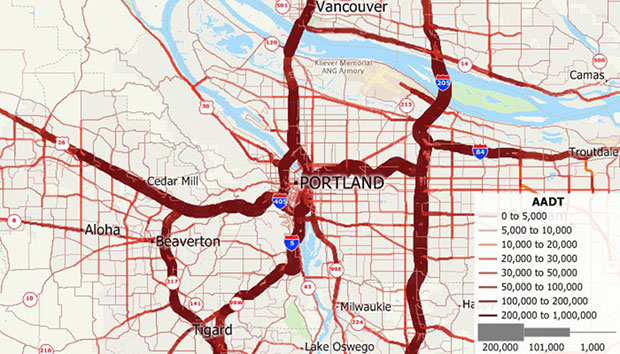
    Caliper has released a free average annual daily traffic (AADT) map layer for Maptitude 2018 users.

    The latest version includes fields with total AADT traffic count, semi-trailer truck count, single-unit truck and bus count, number of through lanes and road classification.

    AADT is the total volume of vehicle traffic on a highway or road for a year divided by 365 days. It is a useful and simple measurement of how busy a road is, and is useful for:

    • selecting a new site or facility location, evaluating a site, or designing a territory
    • determining funding for highway maintenance and improvement
    • forecasting road maintenance needs and expenditure
    • identifying the best location for your business based on traffic patterns
    • analyzing how traffic may impact store construction
    • analyzing the environmental hazards of sound and pollution related to road transport

    The downloaded layer can be added to any Maptitude 2018 map.

  • Extensis and LizardTech unite as one company

    logos

    Extensis and LizardTech are uniting as one global company to help organizations increase their return on investment and the value of their digital assets, fonts and large imagery.

    In 2017, Extensis and LizardTech collaborated on the development of new portfolio asset geo-referencing capabilities for applications in the geospatial, infrastructure, architecture/engineering/construction and building information modeling segments.

    With Extensis’ market leadership in digital asset and font management combined with LizardTech’s expertise in image management and image compression technology, the united company is situated to provide a suite of solutions and support for digital asset challenges.

    “Organizations today are investing in imagery of all kinds, including photography, aerial, and spatial, to name a few,” said Osamu Ikeda, CEO of Extensis. “Fully leveraging these digital files means having an easy and efficient way to organize, store, access and distribute them.”

    Ikeda continued, “Uniting Extensis and LizardTech strengthens our ability to support our customers’ success and give them effective and time-tested solutions for maximizing the value of digital assets of all kinds.”

    The combined company will operate under the Extensis brand, headquartered in Portland, Oregon, with an office presence in Seattle.

    Starting now, LizardTech products (GeoExpress, Express Server, GeoViewer) will become part of the Extensis suite of solutions, which spans digital asset management, font asset management, brand asset management, image management and image compression.

  • Mobile mapping market size worth over $40B by 2024

    The mobile mapping market size is expected to be worth more than $40 billion by 2024, according to a new research report by Global Market Insights.

    The mobile mapping market is propelled by the increasing adoption of mobile devices such as smartphones and tablets across the globe. Smartphone users are extensively using mapping applications on their devices for navigation and driving assistance, the report said.

    Furthermore, they are also leveraging on the GIS and GPS applications to access geo-referenced data for searching nearby restaurants, cinema halls and other landmarks. This is encouraging the technology companies to commence mapping across the globe to acquire accurate GIS data and provide an enhanced customer experience.

    High initial investment is a major factor limiting the growth of the mobile mapping market. Currently, the market comprises a few major players with a long-standing expertise in location-based technologies. High initial investments in developing mobile mapping systems and assembling major components have restricted the entry of new players in the market.

    According to the report, the software market is anticipated to grow at a CAGR of 15 percent over the projected timespan. The growing demand for geo-referenced data acquisition and data analysis software among the organizations is driving the mobile mapping market growth. The software assists organizations in simplifying the data extraction process by combining the vital details. It retrieves geographic and spatial data captured by the positioning devices to develop maps and other graphic displays. This data is also used by enterprises to build effective decision support systems, which will drive the market demand.

    The report includes key industry insights in 250 pages with 341 market data tables and 38 figures and charts from the report, “Mobile Mapping Market Size, By Component (Hardware [Imaging Device, Laser Ranging Device & Scanning Device, Positioning Device], Software [Mapping Data Extraction, Data Processing], Service [Consulting, Integration & Maintenance, Managed Service]), By Application (Road & Railway Survey, GIS Data Collection, Vehicle Control & Guidance, Asset Management), By End-User (Agriculture, BFSI, Government & Public Sector, Real Estate, Retail, Mining, Telecommunication, Transport & Logistics), Industry Analysis Report, Regional Outlook (U.S., Canada, the United Kingdom, Germany, France, Italy, Spain, Australia & NZ, China, India, Japan, South Korea, Brazil, Mexico, Argentina, GCC, Israel, South Africa), Growth Potential, Competitive Market Share & Forecast, 2018 – 2024.”

    The mobile mapping technology is used for conducting road and rail surveys, collecting GIS data, and developing vehicle control and guidance systems and asset management systems. The road and rail survey market is expected to register a growth rate of over 17 percent during the forecast period. It is used to analyze the road and rail infrastructure and plan the engineering operations with minimum disruptions. The surveying authorities across the globe are using mobile mapping technology to create maps for the transportation department for road assessment purposes.

    The agriculture sector is estimated to grow at a CAGR of 22 percent during the forecast timeline. The integration of the GPS and GNSS devices into the farming process to acquire geospatial data is the primary factor driving the mobile mapping market share. Furthermore, the ability of the mobile mapping technology to monitor the crop yield and land variability also augments the demand for the technology among the farmers.

    The European region accounted for over 25 percent global mobile mapping market in 2017. The increasing investments by the government agencies have accelerated the adoption of mobile mapping technology in the region. For instance, in 2017, the U.K. government established the Geospatial Data Commission to frame a strategy for using the public sector location data to support the country’s growth.

    The Asia Pacific region will grow at a rapid pace over the forecast timespan. The rapid urbanization of the region and the growing number of infrastructural projects have fostered the growth of the mobile mapping market in the region. Moreover, the widespread adoption of smartphones has also driven the market size.

    Prominent players operating in the mobile mapping market are Phoenix LiDAR, Sharp Corporation, Teledyne Optech, TomTom International, Topcon Positioning Systems, MapJack, Mapquest, Navteq, NCTech, Microsoft, Mitsubishi, NovAtel, Phaseone industrial, Hexagon, EveryScape, Foursquare Labs and XIMEA.

    The major companies in the market are collaborating with other expert companies in the market to develop new product offerings and conduct strategic acquisitions to gain a competitive advantage over its competitors.

    For instance, in 2017, Garmin acquired Navionics, a provider of electronic navigational charts to the marine industry. This acquisition is aimed at combining the data from Navionics charts and Garmin’s blue charts to develop improved navigational services to its customers. Similarly, in 2017, Hexagon entered into an OEM partnership with Smart Guided Systems to develop new precision technologies for commercial applications.

    The global mobile mapping market research report includes an in-depth coverage of the industry with estimates and forecast revenue in USD respectively from 2013 to 2024, for the following segments.

    Mobile Mapping Market, By Component

    Hardware
    Imaging device
    Laser ranging and scanner device
    Positioning device
    Software
    Mapping data extraction
    Data processing
    Service
    Consulting
    Integration & maintenance
    Managed

    Mobile Mapping Market, By Application

    Road & railway survey
    GIS data collection
    Vehicle control & guidance
    Asset management

    Mobile Mapping Market, By End-User

    Agriculture
    BFSI
    Government & public sector
    Real estate & infrastructure
    Retail
    Mining
    Telecommunication

    Regions and Countries

    North America
    U.S.
    Canada
    Europe
    UK
    Germany
    France
    Spain
    Italy
    Asia Pacific
    ANZ
    China
    India
    Japan
    South Korea
    Latin America
    Brazil
    Mexico
    Argentina
    MEA
    GCC
    South Africa
    Israel

  • Free highway exits, interchanges data provided for Maptitude 2018

    Image: Caliper
    Image: Caliper

    GIS software company Caliper has released new highway exit data for the United States and Canada.

    Users of Maptitude 2018 with the Canada or United States country packages can download a free point layer containing all signed and numbered highway exits within their respective country.

    The highway exits layer allows users to find the nearest highway interchange to a particular location or determine proximity to a desired interchange. Applications include site location assessment, commercial real estate, franchise development and accessibility studies.

    The data can also be used in conjunction with the free U.S. traffic count data to determine traffic volumes around a chosen exit.

    The Highway Exits and Interchanges layer can be added to any Maptitude 2018 map.

    Image: Caliper
    Image: Caliper
  • Imagery works for growing city

    Image: Nearmap
    Image: Nearmap

    Location content provider Nearmap has partnered with the City of Durham, North Carolina, Public Works Department to upgrade its imagery on numerous projects.

    Using real-time imagery from Nearmap in the field, the department streamlines data collection and saves time and money.

    The department manages all infrastructure data for the city, including mapping the impervious area (structures that resist water infiltration) for the city’s $16 million a year Stormwater Utility Fee fund. “That is half a billion square feet of impervious area that we manage through digitization and review daily,” said Edward Cherry, city GIS administrator.

    After using several satellite imagery systems with low resolution and infrequent captures, Cherry and his 14-member GIS staff determined the city needed far superior quality in their mapping imagery to accommodate the city’s explosive growth.

    Captured every six months at a 2.8-inch ground sample distance, Nearmap now supplies Durham with up-to-date images accessible through web-based cloud servers.

    With Nearmap, the Durham Public Works Department has achieved better monitoring of pavement conditions; time savings and documentation of road repairs; more detailed maps of city riparian zones; and accurate and detailed customer billing.

    “With Nearmap, we’ve been able to update development processes and policies to support the revitalization of the downtown district as well as rapid city growth,” Cherry said.

  • Airbus, Orbital Insight partner on OneAtlas analytics platform

    Europe-based Airbus Defence and Space has entered into a partnership with Orbital Insight, a U.S.-based geospatial analytics company, to build a suite of geospatial analytics services and tools.

    The agreement will provide Orbital Insight with access to Pleiades and SPOT satellite imagery at scale, and provide Airbus with analytics services, making Orbital Insight the first analytics partner for the Airbus Digital Platform OneAtlas.

    The OneAtlas Platform is a collaborative environment enabling users to easily access constantly updated satellite imagery, perform large-scale image processing, extract industry-specific insights, and benefit from Airbus assets to develop tailored solutions for a wide range of markets in both commercial and government sectors, the company said.

    “Under this agreement, we will offer premium analytics capabilities to a large range of users, powered by Orbital Insight’s services and tools,” said François Lombard, director of the Intelligence Business at Airbus Defence and Space. “The OneAtlas Platform is definitively the cornerstone to leverage both Airbus and partner assets to support our customers’ business development and growth.”

    “We’re proud to be Airbus’ first geospatial analytics partner on the OneAtlas Platform,” said James Crawford, Orbital Insight’s CEO and founder. “Along with our new satellite imagery agreement, this partnership drives customer value for those looking to better understand what’s happening on and to Earth.”

  • Rebrand GIS to better showcase its power

    GIS specialists are much more than mapmakers. Make sure your organization and customers understand how spatial analytics can help them succeed.

    By Adam Carnow

    Most non-GIS users hear the term “G-I-S” and think “M-A-P.” That is, they think of GIS, and GIS practitioners, as mapmakers. Most GIS practitioners have unknowingly perpetuated this image. Ask any GIS practitioner what they do for a living and most will say, “I make maps;” however, the reality is that what they do for a living is help people make better decisions through the power of location. This is what I call location intelligence.

    There is a tremendous growth opportunity for GIS in government across the enterprise. GIS was created to perform spatial analysis. GIS can often be underutilized because non-GIS users sometimes don’t understand the reach of spatial analysis and how it can help them. GIS practitioners need to market and evangelize the power of spatial analysis to help change that image.

    Photo: rmnoa357/Shutterstock.com
    Photo: rmnoa357/Shutterstock.com

    You can break down location intelligence into six categories. As you move down this list, the value of the location intelligence increases:

    • Understanding Where. A map (could be paper or PDF, but should be an interactive web map) showing where the fire stations are located across a city.
    • Measuring Size, Shape and Distribution. A map showing the size, shape and distribution of wetlands across an area would help with wetland protection and preservation.
    • Determining How Places Are Related. Showing how certain soil types correspond to flood zones.
    • Finding the Best Locations and Paths
      • To find the best location for a new fire station, run a drive-time polygon process to show the coverage area for each fire station. The areas that are uncovered are where a new fire station is needed.
      • To find the best path for field inspectors: We have 50 inspections to do today and three inspectors. Divide the inspection locations among each inspector and create the most efficient route to get their work done.
    • Detecting and Quantifying Patterns. Crime analysts look at crime data to try to predict where the next one may occur and to help identify known perpetrators. (See also An inside look at fighting crime with GIS.)
    • Making Predictions. Modeling a watershed can allow for flood predictions based on anticipated rainfall.

    Another way to help break the mapmaker image is to rebrand. Most staff in any organization use spreadsheets daily for a multitude of things that bring value to the organization – some say it’s the number one business intelligence (BI) tool.

    There are GIS software tools that are as easy to use as a spreadsheet; in fact, you can use GIS inside of spreadsheets.

    Wetlands map, Oregon's Klamath Lake. (Map: USGS)
    Wetlands map, Oregon’s Klamath Lake. (Map: USGS)

    Even though spreadsheets are such a useful tool, you don’t see a Spreadsheet Department. Spreadsheet is just the name of the tool, so you don’t have, or name, a department for it. A department should be named based on the function, or value, it serves.

    GIS should be thought of as BI with location data and spatial analysis, or location intelligence. A great way to get people to understand the real value and power of GIS is to rebrand your GIS department to something like Enterprise Location Intelligence.

    One such example of this is Walgreens. As the drugstore chain’s GIS department became more strategic and tied to the analytics of the organization, the company rebranded it as Enterprise Location Intelligence.

    If your organization has a BI group, they should consider reorganizing to put GIS with that BI group. I’m seeing real-world examples of this rebrand:

    • GIS job title changes to things like:
      • Data Analytics Manager
      • Content Delivery Manager
      • Business and Location Intelligence Manager
    • Reorganization putting GIS with BI: A major city has a Smart City initiative, and in response the city has reorganized its IT group — they now have a Data Analytics Group that consists of a BI team and their GIS team.

    This rebrand, and expansion of the understanding of the true purpose and value of GIS, will not just help the organization realize more return on investment (ROI) for their GIS investment, it will help the GIS practitioners elevate their value to the organization and hence their careers.

    What can you do? If you’re a GIS practitioner:

    • Explore rebranding your title and your GIS group as a start to changing your image from mapmaker to solution provider.
    • Evangelize the power of location intelligence. This is actually pretty easy to do. When someone asks for a map, ask them why they need it, probe to find out more about their project; you will probably uncover a need for spatial analysis.
    • Start to enable others in your organization to become GIS users via easy-to-use web maps and apps. As they use GIS, they will realize its full potential and seek to utilize it more often.

    If you’re not a GIS practitioner, seek out your GIS team to learn more about their capabilities and how they can help you. And, become a GIS user, there are plenty of GIS tools available that are easy to learn and use.


    This article originally appeared on Govloop.com and is reprinted with permission.

    Adam Carnow is an Esri community evangelist and part of the GovLoop Featured Contributor program.