Tag: U.S. Space Force

  • Fourth GPS III satellite successfully launched

    Fourth GPS III satellite successfully launched

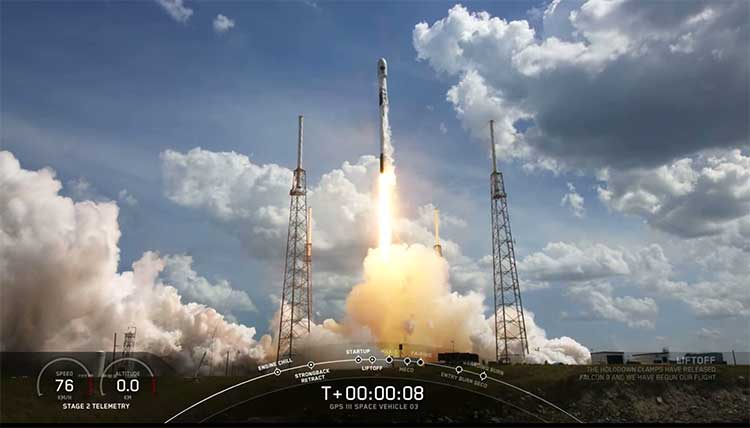
    UPDATE:  The U.S. Space Force, Space and Missile Systems Center (SMC) and its mission partners successfully launched the fourth GPS III satellite at 6:24 p.m. EST Nov. 5 from Space Launch Complex 40 at Cape Canaveral Air Force Station, Florida.

    The Lockheed Martin-built satellite was carried to orbit aboard a Space Exploration Technologies Corporation (SpaceX) Falcon 9 launch vehicle.

    “The launch of GPS III SV04 is a testament to SMC’s ability to rapidly and safely deliver new capabilities on orbit,” said Cordell DeLaPena, Air Force program executive officer for SMC’s Space Production Corps. “At SMC, we are proud to deliver our fourth GPS III satellite and will continue to operate at an accelerated pace to enhance the capabilities of the billions of users worldwide.”

    “I’m proud of my team’s 83rd successful National Security Space Launch and look forward to our future missions with SpaceX,” said Col. Robert Bongiovi, SMC’s Launch Enterprise director. “Ultimately, our ability to embrace innovation with our launch providers advances warfighter’s capabilities while lowering costs to the U.S. Government and its taxpayers.”

    GPS III SV04 separated from its upper stage approximately 90 minutes after launch. Engineers and operators at Lockheed Martin’s Waterton Facility will now begin on-orbit checkout and tests, which are estimated to complete in approximately one month. Operational use is expected to begin in a few months.

    “The GPS III program continues to make strides in modernizing the GPS constellation for the U. S. Space Force while maintaining the gold standard for position, navigation and timing,” said Col. Edward Byrne, Medium Earth Orbit Space Systems Division chief.

    GPS III SV04 will join the current GPS constellation comprised of 31-operational spacecraft. GPS III, the newest generation of GPS satellites, brings new capabilities to users, including three times greater accuracy and up to eight times improved anti-jamming capabilities.
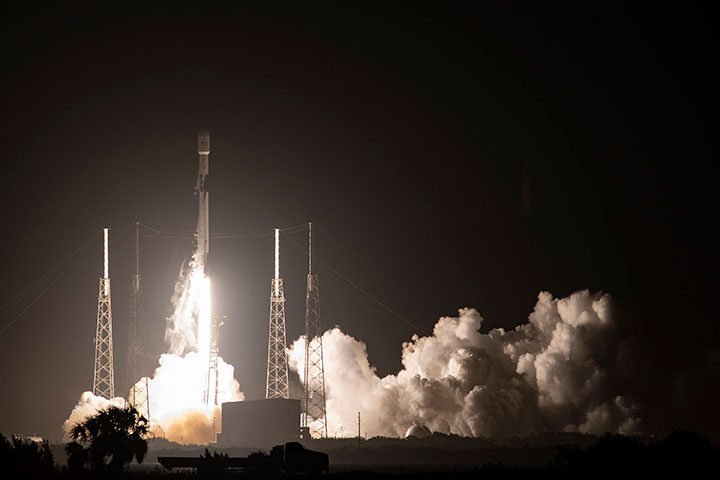
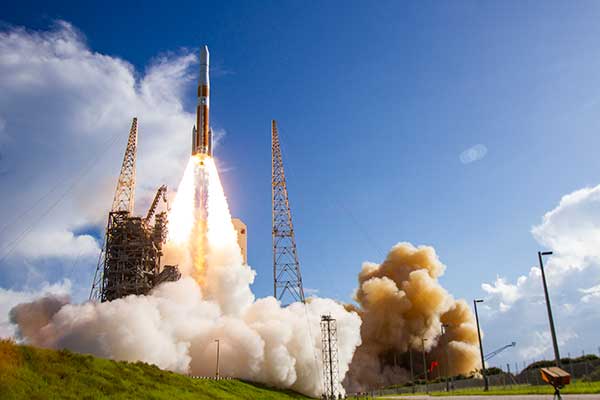
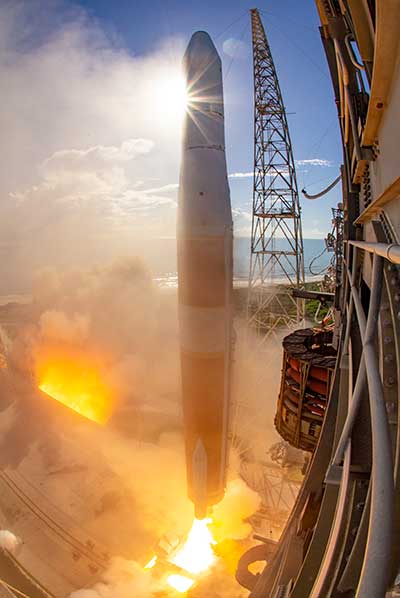
    A Falcon 9 carrying GPS III SV04 lifts off from Cape Canaveral Air Force Station, Florida, Nov 5. (Photo: SpaceX via USAF)
    A Falcon 9 carrying GPS III SV04 lifts off from Cape Canaveral Air Force Station, Florida, Nov 5. (Photo: SpaceX via USAF)

    GPS constellation status

    According to the U.S. Space Force Second Space Operations Squadron (2 SOPS), the satellite is designated  SVN-77/PRN-14 in the GPS almanac. GPS III SV04 (SVN-77/PRN-14) will replace SVN-44/PRN-28 in the B plane at slot 03. 2 SOPS will issue a Launch NANU after on-orbit checkout when control of SVN-77 is transferred from Lockheed Martin to 2 SOPS for insertion into the GPS control segment.

    GPS III SV-2 (SVN 75), launched Aug. 22, 2019, replaced SVN 45/PRN-21 at D3 and was set healthy on April 1, 2020. As a result, SVN 45 is being re-phased from D3 to D2F replacing SVN 46/PRN 11 and will arrive sometime in November of this year. SVN 46 will be taken out of the operational constellation before the January 2021 launch of GPS III SV05 (SVN-78) and sent to Launch, Anomaly, Resolution, and Disposal Operations (LADO), making PRN-11 available.

    GPS III SV-03 (SVN 76, PRN-23) launched June 30, 2020, and was set operational and healthy on October 1.

    SVN-46, launched October 7, 1999, has been an “iron bird” workhorse in the D-plane and has successfully served the world’s GPS users for more than 20 years, 12 years past its designed service life. It outlasted (and in many cases, outperformed) many of its peers on-orbit, testament to quality engineering and the diligent efforts of the men and women of the U.S. Air Force.
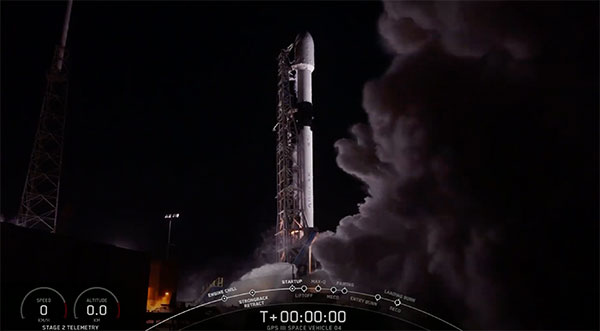
    Screenshot: SpaceX
    Screenshot: SpaceX

    The fourth GPS III satellite (GPS III SV04) is scheduled to launch today at 06:24 p.m. EST (~15 minute launch window) from Cape Canaveral Air Force Station, Florida, on a SpaceX Falcon 9 rocket. The new launch window follows an aborted launch with two seconds to go on Oct. 2.

    The launch can be viewed on this live feed.

    Built by Lockheed Martin, GPS III satellites are designed to help the U.S. Space Force modernize the current GPS constellation with new technology and advanced capabilities. GPS III provides three times greater accuracy and up to eight times improved anti-jamming power over satellites in the current constellation. GPS III also adds a new L1C civil signal compatible with Europe’s Galileo global navigation satellite system, which will provide greater civil user connectivity in the future.

    After adding GPS III SV04, the four GPS III satellites on orbit will represent about 12 percent of the 31 satellites in the GPS constellation.

    GPS III SV04 is the 23rd M-code-enabled satellite in the constellation, only one short now of the 24 needed for global coverage. M-code is a more-secure, harder-to-jam or spoof signal invaluable to U.S. and allied military forces.

    GPS III SV03, which lifted off from the Cape on June 30, was set operational on Oct. 1. The next satellite — GPS III SV05 — was declared  “Available for Launch” in May 2020. The satellite is now waiting to be called up for a launch date in 2021. Five more GPS III satellites are in production, three of which are fully assembled and in testing.

    Lockheed Martin is also under contract to build up to 22 additional GPS III Follow On (GPS IIIF) satellites, which add additional technology and advanced capabilities to this warfighting system, including a new Regional Military Protection Capability, which will increase anti-jam support in theater to ensure U.S. and allied forces cannot be denied access to GPS in hostile environments; an accuracy-enhancing laser retroreflector array; a fully digital navigation payload; and a new search and rescue payload.

    In July, the Space Force declared that the GPS IIIF program had fulfilled Milestone C, which means the start of the production phase. Lockheed Martin has introduced augmented reality tools into the GPS IIIF production process to drive even-greater efficiency into the production process.

    Continued investment in GPS is important. Besides the military applications, the U.S. economic benefit of GPS is estimated to be over $300 billion per year and $1.4 trillion since inception.
  • GPS III launch aborted with 2 seconds to spare

    GPS III launch aborted with 2 seconds to spare

    UPDATE (Oct. 5): Elon Musk, SpaceX founder and CEO, said a Falcon 9 launch was halted Friday night due to an “unexpected pressure rise in the turbomachinery gas generator,” referring to a part in the rocket’s Merlin engines, reports SpaceflightNow.

    SpaceX has not yet set a new launch date. Another planned launch, for a Starlink satellite, was also aborted.


    UPDATE (Oct. 3): Only two seconds before launch, SpaceX aborted the scheduled launch of the fourth GPS III satellite on Oct. 2. SpaceX has not yet announced a new launch window, or stated the reason for the cancellation.

    One Twitter user responded with video of the launch up to the moment it was cancelled.


    (Oct. 1) The U.S. Space Force’s newest GPS III satellite, Space Vehicle 04 (GPS III SV04), rolled out to Cape Canaveral’s Space Launch Complex 40 on Sept. 27. Originally scheduled for launch Sept. 30, then Oct. 1, the satellite is now slated to launch 9:43 p.m. EDT on Oct. 2 (01:43 a.m. UTC on Oct. 3).

    The launch was delayed because of a “traffic jam” at the launchpad. According to Spaceflight Now, SpaceX initially rescheduled the GPS launch for Wednesday night after a Delta 4 launch was delayed to Tuesday. After the Delta 4-Heavy’s scrub Tuesday, SpaceX announced the GPS launch would be pushed back to Friday, when there is a 15-minute launch window available opening at 9:43 p.m. EDT (0143 GMT Saturday, Oct. 3).

    The Lockheed Martin-built GPS III SV04 is scheduled to launch aboard a SpaceX Falcon 9 rocket — the third National Security Space Launch (NSSL) mission on a Falcon 9 rocket, the second U.S. Space Force (USSF) first-stage booster recovery, and the sixth USSF launch on Sept. 30. The 15-minute launch window opens at 9:51 p.m. EDT. A live feed will begin 20 minutes before the launch and conclude approximately 45 minutes afterward. A simulcast of the broadcast can be viewed at www.spacex.com.

    “The GPS III program office in partnership with our contract teammates continue to push the envelope on the capabilities they deliver to users, both civil and military around the globe. Our latest GPS III satellites’ nearly 70 percent digital payload provides the U. S. Space Force with greater operational flexibility and cutting edge capabilities while continuing to support legacy users,” said Cordell DeLaPena, Air Force program executive officer for SMC’s Space Production Corps.

    GPS III SV04 will be launched to augment the current GPS constellation comprised of 31 operational spacecraft. GPS satellites operate in Medium Earth Orbit (MEO) at an altitude of approximately 20,200 km (12,550 miles) in six orbital planes. Each satellite circles the earth twice per day. GPS is the premier space-based provider of positioning, navigation, and timing services for more than four billion users worldwide. This latest generation of GPS satellite boasts a 15-year design life — 25 percent longer than the previous generation of GPS satellites on orbit.

    GPS III brings new capabilities to users such as the new L1C civilian signal, which opens the window for future interoperability with international satellite navigation systems.

    “Our GPS III team is excited to be here once again. Less than 3 months ago, we successfully launched GPS III SV03. Since then, the team has successfully delivered the satellite to its final orbit, performed on-orbit testing and delivered the satellite to operations, while executing a mature satellite production line. I can’t be more proud of everyone involved in this mission,” said Col. Edward Byrne, Medium Earth Orbit Space Systems Division chief. “The launch of GPS III SV04 will continue to modernize our GPS constellation by increasing our capabilities with advanced features for both our civil and military users across the world.”

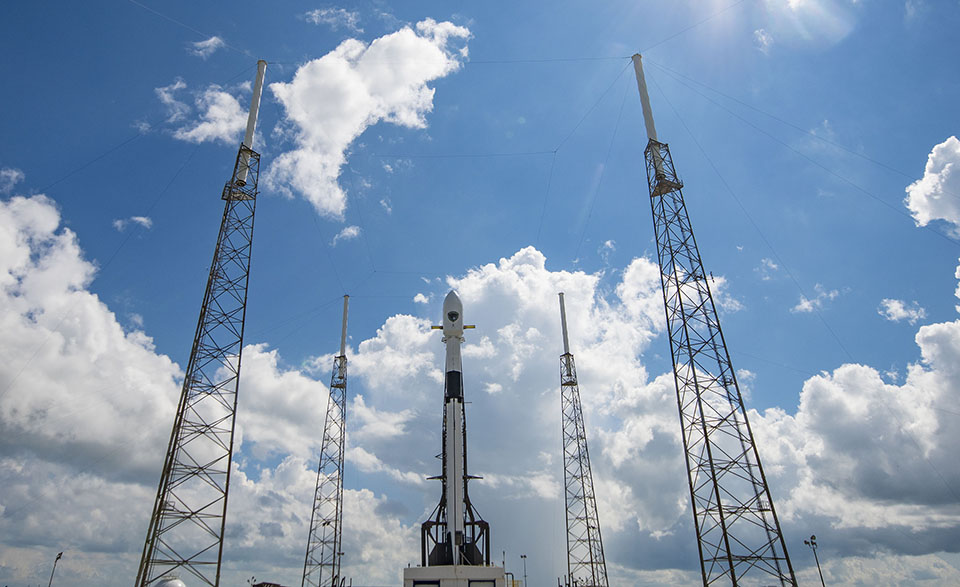
    A Falcon 9 with GPS III SV 04 encapsulated inside the payload fairing the stands vertical on the pad at Cape Canaveral’s Space Launch Complex 40 in preparation for launch. (Photo: USAF/SpaceX)
    A Falcon 9 with GPS III SV 04 encapsulated inside the payload fairing the stands vertical on the pad at Cape Canaveral’s Space Launch Complex 40 in preparation for launch. (Photo: USAF/SpaceX)
  • US Space Force grants GPS III SV03 operational acceptance 

    US Space Force grants GPS III SV03 operational acceptance 

    The United States Space Force (USSF) and the Space and the Missile Systems Center achieved another major GPS milestone on July 27 when the GPS III Space Vehicle (SV) 03 received USSF’s Operational Acceptance approval.

    This marks the third GPS III satellite to receive operational acceptance in less than a year.

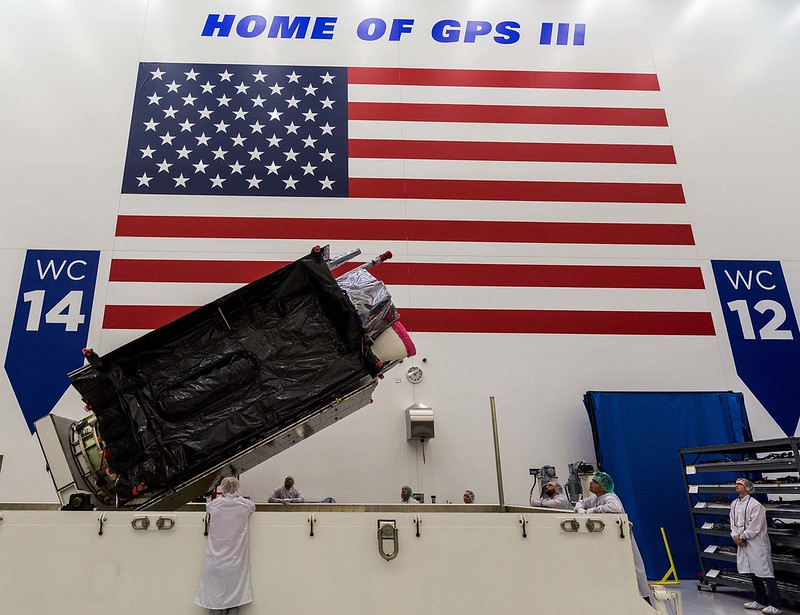
    GPS III SV-03 satellite packed prior to shipment to Cape Canaveral. (Photo: Lockheed Martin)
    GPS III SV-03 satellite packed prior to shipment to Cape Canaveral. (Photo: Lockheed Martin)

    The GPS III satellites are the newest generation built by Lockheed Martin that provide precise positioning, navigation and timing information with three times better accuracy, and up to eight times improved anti-jamming capability than previous generations of GPS satellites.

    SV03 was launched on June 30 and was the second National Security Space Launch (NSSL) mission launched on a SpaceX Falcon 9 rocket. This was the first NSSL mission where a Launch Service Provider recovered a booster, with SpaceX successfully recovering the first stage and fairings as part of the launch.

    The GPS III SV03 mission was dedicated to Colonel Thomas G. Falzarano, 21st Space Wing commander, who passed away in May.

    “We are adding GPS warfighter capability and resiliency with each new GPS III satellite. The on-boarding of GPS III SV03 enables our first use of cross link commanding capability for assured nuclear detection,” said Lt. Col. Michael Schriever, 2nd Space Operations Squadron commander. “With the GPS III SV03 addition to the constellation, our modernized signals capable satellites increases to 22 vehicles. This results in nearly a fully capable Military-Code constellation, which our space warfighters will operate to deliver expanded capabilities to the joint force.”

    The USSF’s Space and Missile Systems Center, located at Los Angeles Air Force Base, California, is the center of excellence for developing, acquiring and delivering military space systems. Its portfolio includes

    GPS, military satellite communications, defense meteorological satellites, space launch and range systems, satellite control networks, space based infrared systems, and space situational awareness capabilities.

  • GPS military code installs complete at master control sites

    GPS military code installs complete at master control sites

    The United States Space Force’s Space and Missile Systems Center on July 27 completed the military code (M-code) Early Use (MCEU) hardware and software upgrade to the GPS Operational Control System (OCS).

    Completion of the upgrade is a major step toward Operational Acceptance of the long-awaited GPS M-code.

    Photo: U.S. Air Force photo/Dennis Rogers
    Photo: U.S. Air Force photo/Dennis Rogers

    The encrypted M-code signal enhances anti-jamming and anti-spoofing capabilities for the warfighter. M-code signals are currently available on all 22 GPS Block IIR-M, IIF and III space vehicles currently on orbit.

    The installs were completed at the Master Control Station at Schriever Air Force Base, Colorado, and Alternate Master Control Stations at Vandenberg Air Force Base, California.

    The MCEU upgrade allows the OCS Architecture Evolution Plan to task, upload and monitor M-code within the GPS constellation, as well as support testing and fielding of modernized user equipment.

    Operational Acceptance Set for November. MCEU will be in a trial period before Operational Acceptance in November. Once Operational Acceptance is granted, upcoming Military Ground User Equipment (MGUE) will be able to leverage the M-code signal-in-space to provide more secure position, navigation and timing (PNT) to warfighters.

    “Working closely with Lockheed Martin and our other mission partners — with the common national goal of providing enhanced PNT signal security and safety always in sharp focus — means we’re able to deliver the right mission capability faster to our warfighters,” said Lt. Col. Steven A. Nielson, program manager of the MCEU project.

    MCEU serves as a gap-filler for M-code operations before the entire GPS constellation’s operational transition to the Next Generation Operational Control System Block 1, which is now in development.

    A key to enabling M-code is a new software-defined receiver being installed at all six Space Force Monitoring Sites. The M-code Monitor Station Technology Improvement and Capability receiver uses commercial, off-the-shelf hardware to cost-effectively receive and process M-code signals, enabling OCS operators to monitor the signals.

  • Third GPS III powers itself into orbit

    Third GPS III powers itself into orbit

    Third Lockheed Martin-Built GPS III satellite climbs to orbit on its own power

    GPS III SV03 increases number of secure military code (M-code) enabled satellites in GPS constellation to 22 total. 

    After a successful launch on June 30, the third Lockheed Martin-built GPS III satellite headed to orbit under its own propulsion. The satellite separated from its rocket and used onboard power to climb to its operational orbit, approximately 12,550 miles above the Earth.

    GPS III Space Vehicle 03 is responding to commands from U.S. Space Force and Lockheed Martin engineers in the Launch & Checkout Center at the company’s Denver facility. There, they declared rocket booster separation and satellite control about 90 minutes after the satellite’s June 30 launch aboard a SpaceX Falcon 9 rocket from Cape Canaveral Air Force Station, Florida.

    “In the coming days, GPS III SV03’s onboard liquid apogee engines will continue to propel the satellite towards its operational orbit,” said Tonya Ladwig, Lockheed Martin’s acting vice president for Navigation Systems. “Once it arrives, we’ll send the satellite commands to deploy its solar arrays and antennas, and prepare the satellite for handover to Space Operations Command.”

    After on-orbit testing, GPS III SV03 is expected to join the GPS constellation — including GPS III SV01 and SV02, which were declared operational in January and April — in providing positioning, navigation and timing signals for more than four billion military, civil and commercial users.

    Lockheed Martin designed GPS III to help the Space Force modernize the GPS constellation with new technology and capabilities. The new GPS IIIs provide three times better accuracy and up to eight times improved anti-jamming capabilities over any previous GPS satellite. They also offer a new L1C civil signal, which is compatible with other international global navigation satellite systems, like Europe’s Galileo, to improve civilian user connectivity.

    GPS III also continues the Space Force’s plan to field M-code, a more-secure, harder-to-jam and spoof GPS signal for our military forces. GPS III SV03 brings the number of M-code enabled satellites to 22 in the 31-satellite GPS constellation.

    “As a nation, we use GPS signals every day — they time-stamp all our financial transactions, they make aviation safe, they make precision farming possible, and so much more,” added Ladwig. “GPS has become a critical part of our national infrastructure. In fact, the U.S. economic benefit of GPS is estimated to be over $300 billion per year and $1.4 trillion since its inception. Continued investment in modernizing GPS — updating technology, improving its capabilities — is well worth it.”

    Screenshot: SpaceX live feed of launch
    Screenshot: SpaceX live feed of launch
  • GPS celebrates 25 years of operation

    GPS celebrates 25 years of operation

    “Celebrating this anniversary gives us a moment to recognize how far we’ve come, but also to get pumped about what lies ahead for our program and our role in executing that.”


    By  First Lieutenant Tyler Whiting
    Peterson Air Force Base, Colorado

    The Global Positioning System marked its 25th year of operation on April 27.

    On this date in 1995, the system reached full operational capability, meaning the system met all performance requirements.  U.S. Air Force Space Command formally announced the milestone three months later.

    “This is a major milestone,” Gen. Thomas S. Moorman Jr., former Air Force Vice Chief of Staff, said in 1995. “GPS has become integral to our warfighters and is rapidly becoming a true utility in the civilian community.”

    Initially developed for the military to meet a critical need for determining precise location on the battlefield, GPS has also become an integral part of technology affecting the lives of billions of people worldwide.

    “The United States Space Force’s continuing objective for the constellation is to ensure GPS remains the Gold Standard for global space-based positioning, navigation and timing,” said Gen. Jay Raymond, USSF Chief of Space Operations, and U.S. Space Command Commander.

    Image: USAF
    Image: USAF

    Today, the U.S. Space Force operates the GPS satellite constellation as a global utility – always available to everyone, everywhere on Earth.

    “GPS is a free for use service provided by the Space Force that enhances everyday lives around the world,” said Brig. Gen. DeAnna Burt, USSF Director of Operations and Communications. “GPS provides the highest accuracy positioning and timing data.  In addition to the essential capabilities it provides for the military, GPS underpins critical financial, transportation and agricultural infrastructure.  It’s always available, whether for an ATM transaction or securing a rideshare.”

    Military capabilities

    Its military capabilities first enhanced combat operations in 1990 and 1991 during Operations Desert Shield and Desert Storm. Allied troops relied heavily on the new GPS signal to navigate the featureless deserts in Kuwait and Iraq.

    In the early 2000s, during Operations Enduring Freedom and Iraqi Freedom, GPS contribution to warfighting increased significantly.  For example, the GPS constellation enabled accurate munitions, allowing the delivery of GPS-aided Joint Direct Attack Munitions with pinpoint precision and minimal collateral damage.

    Today, in addition to these and other GPS-enabled warfighting capabilities, Airmen conduct resupply missions with battlefield precision airdrops to combat forces with GPS-guided, parachute-delivered equipment pallets known as “Smart Pallets.”

    Continually updated

    The GPS operational constellation currently has 31 satellites, and the system is continually updated and modernized, making it a resilient system to maintain the signals required for accurate positioning, navigation and timing around the world.

    The first satellite of the new GPS III version, called Vespucci, was launched into space Dec. 23, 2018.

    The 2nd Space Operations Squadron at Schriever Air Force Base, Colo., operates GPS. The squadron recently accepted control of the second GPS III satellite, called Magellan, on March 27.

    GPS III is meeting users’ emerging needs and responding to tomorrow’s threats with improved safety, signal integrity and accuracy. GPS III satellites are more accurate, have improved anti-jamming capabilities, and have doubled the design life; when compared to previous iterations of GPS. They are also designed to incorporate new technology and changing mission needs,

    “The 25th Anniversary is a huge, momentous occasion for us. We take great pride in providing this global utility to the approximately six billion users worldwide,” said Lt. Col. Stephen Toth, 2nd SOPS commander. “Celebrating this anniversary gives us a moment to recognize how far we’ve come, but also to get pumped about what lies ahead for our program and our role in executing that.”

  • Coronavirus delays GPS III SV03 launch until June

    The United States Space Force’s Space and Missile Systems Center (SMC) has decided to reschedule the launch of GPS III SV03 (GPS III-3) from Cape Canaveral Air Force Station to minimize the potential of COVID-19 exposure to the launch crew and early-orbit operators.

    Originally scheduled for late April, the launch is now projected for no earlier than June 30, pending a reevaluation in May.

    “We do not make this decision lightly, however, given our GPS constellation remains strong, we have the opportunity to make a deliberate decision to maintain our mission assurance posture, without introducing additional health risk to personnel or mission risk to the launch,” said Lt. Gen. John F. Thompson, SMC commander and program executive officer for space.

    The Lockheed Martin-built GPS III satellite will be the second GPS satellite launched on a SpaceX Falcon 9 rocket. It will be the first National Security Space Launch mission where SpaceX will attempt to recover the booster, reports Space News.

    GPS III-3 brings the third modernized GPS III satellite to the operational GPS mission, and the team remains ready to execute. GPS III will bring three times better accuracy and up to eight times improved anti-jamming capability than its predecessor.

    The current constellation is healthy with 31 satellites on orbit, allowing the team to take this strategic pause without gaps in coverage or capability.

    “The GPS system supports vital U.S. and allied operations worldwide, unabated. As the COVID-19 pandemic is a threat to national security, likewise, rescheduling the launch is in the interest of national security,” said Gen. Thompson. “We have to get it right the first time, and protecting our people is just as important as cost, schedule, and performance.”

    SMC still plans to complete the next three GPS launches this year. The team is taking the necessary steps to protect the health of personnel to allow a swift return to the mission.

    “Some of the steps include procedural and facility modifications at the GPS III Launch and Checkout Capability (LCC) operations center and reducing the onsite crew size to provide adequate physical distancing, per CDC guidelines,” said Col. Edward Byrne, chief of Medium Earth Orbit Space Systems Division. “Once these efforts are completed, and the crews have rehearsed and are deemed proficient and ready to execute under these modified conditions, we fully intend to return to our launch cadence for deploying GPS III satellites.”

    A leader of GPS III acquisition, SMC’s Production Corps is the United States Space Force’s acquisition office for producing and delivering GPS satellites, ground systems and military user equipment. The Production Corps’ agile program management techniques, smart business approach and close teaming with Lockheed Martin Space are enabling the production and delivery of GPS III’s new civil and warfighting capabilities by 2023. GPS delivers the “gold standard” of space-based positioning, navigation, and timing services vital to U.S. and allied operations worldwide, and underpins critical financial, transportation, and agricultural infrastructure that more than four billion users have come to depend on daily.

    SMC’s Launch Enterprise, located at Los Angeles Air Force Base, California, is responsible for the acquisition and operation of launch vehicles, which includes mission assurance and launch safety. The Launch Enterprise is also responsible for leading the effort to certify new entrants to provide launch services for National Security payloads.

    GPS III SV03 will be launched into operational orbit by a SpaceX Falcon 9 rocket. GPS III SV03 will be the second National Security Space Launch (NSSL) mission to be launched on a SpaceX Falcon 9 rocket and the first NSSL mission where a Launch Service Provider is recovering a booster.

    The Space and Missile Systems Center is the U.S. Space Force’s center of excellence for acquiring and developing military space systems. SMC’s portfolio includes space launch, global positioning, military space vehicle communications, defense meteorological space vehicles, range systems, space vehicle control networks, space-based infrared systems, and space situational awareness capabilities.

    SMC continues to deliver vital capabilities to the warfighter and the world, despite the challenges of COVID-19. Recent examples include the successful launch of AEHF-6 on March 26, Operational Acceptance of GPS III SV02 by Space Operations Command on March 27, and the inclusion of SV02 into the operational GPS constellation on April 1.

    SpaceX’s Falcon 9 rocket orbited the first GPS III satellite on Dec. 23, 2018. (Photo: SpaceX)
    SpaceX’s Falcon 9 rocket orbited the first GPS III satellite on Dec. 23, 2018. (Photo: SpaceX)
  • U.S. Space Force accepts control of GPS III SV02 amidst global pandemic

    U.S. Space Force accepts control of GPS III SV02 amidst global pandemic

    The second GPS III satellite, nicknamed Magellan, has been designated healthy and usable.

    According to a Notice of Advisory to Navstar Users (NANU) issued by the U.S. Coast Guard, the satellite has been designated usable as of April 1, 1945 ZULU.

    The 2nd Space Operations Squadron (2 SOPS) accepted control of the Magellan on March 27 at the Schriever Air Force Base in Colorado.

    Designated Satellite Vehicle Number 75 (SVN75) in the GPS constellation, Magellan is the second GPS III satellite to be accepted into the program, and the first to be accepted during a global pandemic.

    The second GPS III satellite is encapsulated before launch. (Photo: Lockheed Martin)
    The second GPS III satellite is encapsulated before launch. (Photo: Lockheed Martin)

    “We’re continuing to make major strides even while working through this pandemic, and we continue to expand our capability to further the program along,” said Lt. Col Stephen Toth, 2 SOPS commander. “This is a huge, momentous occasion for us, that we’re reaching this milestone, that our programs are being delivered, that they’re being executed and the systems are performing as expected. Ultimately, we’re all very excited that we’ve accomplished this major milestone in the program’s history, and we’re very excited for the next things to come.”

    The new generation of GPS III vehicles have a 15-year design life and signals that are three times more accurate than the current generation.

    “[This means users will have] better accuracy anywhere in the world, with a user’s device being able to determine their location more reliably,” said Capt. Ryan Thompson, 2nd SOPS assistant director of operations.

    Additionally, the new satellites have eight times improved anti-jam capability, allowing the military warfighter to operate better in contested, degraded and operationally limited environments.

    The vehicles are designed to be forward and backward compatible, which allows them to adapt to the future while remaining fully adaptable to the previous generation of vehicles.

    Eight more GPS III satellites are scheduled to launch from now until 2025.

    Despite any challenges that may arise, 2nd SOPS remains focused on the mission and continues to make history in space.

    “As we’ve moved forward into the Space Force, we’ve taken a bigger mindset approach toward being warfighters,” Toth said. “What COVID has actually brought out of us is the full understanding of what it is to operate with a warfighter mindset. We may not be at war with an enemy per say, but we are definitely at war with the virus. My job is to ensure we continue to provide position, navigation and timing to the world. And we take that very seriously, so despite the virus, we’ll ensure that our mission continues.”

  • Contingency Ops, GPS III SV02 receive Operational Acceptance from USSF

    Contingency Ops, GPS III SV02 receive Operational Acceptance from USSF

    A ULA Delta IV rocket carrying GPS III SV02 lifts off from Space Launch Complex-37 on Aug. 22. (Photo: ULA)
    A ULA Delta IV rocket carrying GPS III SV02 lifts off from Space Launch Complex-37 on Aug. 22. (Photo: ULA)

    The Space and Missile Systems Center achieved a major GPS milestone on March 27 with the Contingency Operations (COps) program and GPS III Space Vehicle (SV) 02, both of which received U.S. Space Force’s Operational Acceptance approval.

    COps is an upgrade to the current GPS Operational Control System to operationally command and control GPS III satellites. These satellites are the newest generation built by Lockheed Martin, providing precise positioning, navigation and timing information with three times better accuracy, and up to eight times improved anti-jamming capability than previous generations of GPS satellites.

    The first GPS III satellite, SV01, was launched on Dec. 23, 2018, and achieved Operational Acceptance on Jan. 2, 2020. USSF made SV01 available for use by military and civilian users for critical missions worldwide on Jan. 13.

    Operating in a trial period since October 2019, COps supports developmental testing of the GPS III ground and space capabilities. The trial period culminated in a fully mission capable rating from the Air Force Operational Test and Evaluation Center’s Operational Utility Evaluation conducted on the new GPS III satellite and COps upgrade. This event successfully completed on Feb. 20.

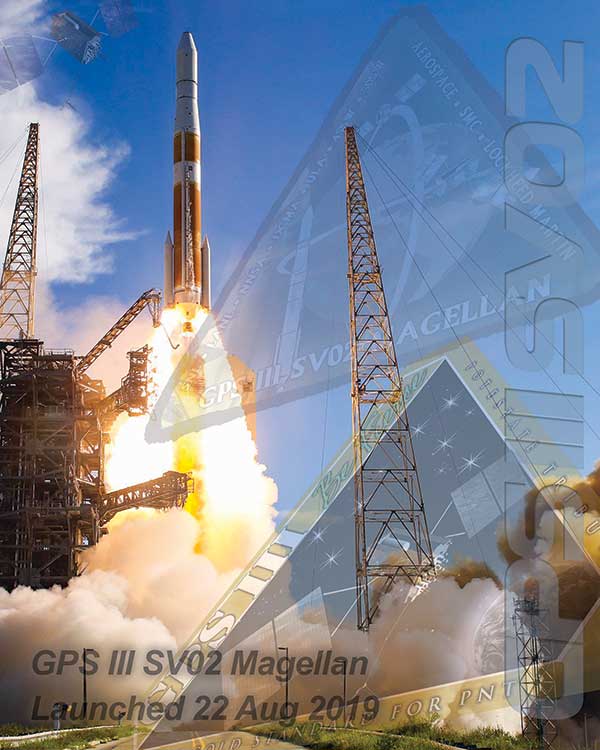
    Subsequently, GPS Operational Control System and COps received the second GPS III satellite — SV02, nicknamed “Magellan” — which the Space and Missile Systems Center launched on Aug. 22, 2019.

    “The COps and GPS III SV02 Operational Acceptance marks another major milestone for the GPS enterprise and presents a clear picture that the Department of Defense is moving to the future,” said Lt. Col. Stephen Toth, 2nd Space Operations Squadron commander. “Of all the programs that will be delivered this year, there are few that carry with it as significant an impact to the warfighter and civilian users as this program will. This is truly a remarkable leap forward for the GPS enterprise and the capability it provides, and I couldn’t be more proud of the team that came together to make it happen.”

    Photo: ULA
    Photo: ULA
    A ULA Delta IV rocket carrying GPS III SV02 lifts off from Space Launch Complex-37 on Aug. 22. (Photo: ULA)
    A ULA Delta IV rocket carrying GPS III SV02 lifts off from Space Launch Complex-37 on Aug. 22. (Photo: ULA)
  • Final steps underway to operationalize new GPS M-code signal

    Final steps underway to operationalize new GPS M-code signal

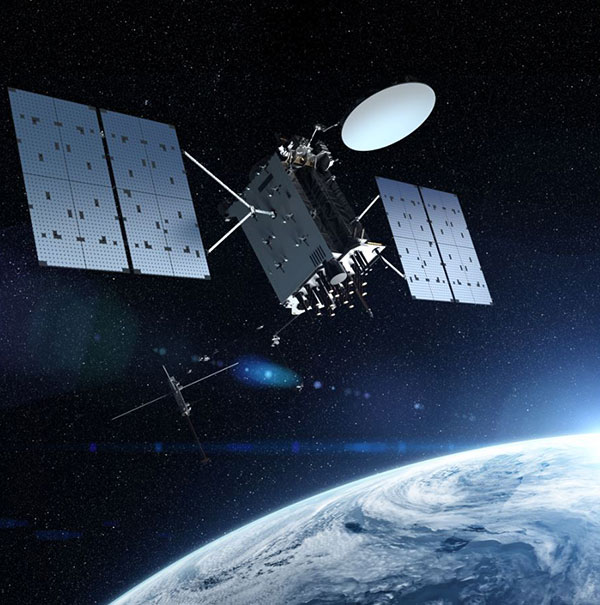
    GPS IIIF’s M-Code can be broadcast from a high-gain directional antenna in a concentrated, high-powered spot beam, in addition to a wide-angle, full-Earth antenna. (Artist rendering: Lockheed Martin)
    GPS IIIF’s M-code can be broadcast from a high-gain directional antenna in a concentrated, high-powered spot beam, in addition to a wide-angle, full-Earth antenna. (Artist rendering: Lockheed Martin)

    U.S. Space Force, Lockheed Martin upgrade Operational Control System (OCS) and refresh GPS constellation with new satellites.

    The final steps to fully enable the ultra-secure, jam-resistant military code (M-code) signal on GPS are now underway.

    As part of the U.S. military’s effort to modernize GPS, the U.S. Space Force has been steadily upgrading its existing GPS Ground Operational Control System (OCS). The Space Force recently announced Operational Acceptance of the GPS Contingency Operations (COps) upgrade, developed by Lockheed Martin.

    COps enabled control of the operational GPS constellation, now containing 21 M-code-capable GPS satellites, including Lockheed Martin’s first two GPS III satellites, until the next generation OCX ground control system is delivered.

    M-code availability on track for 2020

    The Space Force’s M-Code Early Use (MCEU) upgrade, delivered earlier this year, will enable the OCS to task, upload and monitor M-code within the GPS constellation, as well as support testing and fielding of modernized user equipment, prior to the completion of the next-generation ground control systems.

    This spring, work will begin to install the components needed to command and monitor the M-Code encrypted GPS signal, which enhances anti-jamming and protection from spoofing, as well as increases secure access for our forces, into the GPS OCS. M-code signals are available on all the on-orbit GPS IIR-M, IIF and III space vehicles.

    A key to enabling M-code is a new software-defined receiver Lockheed Martin developed and is installing at all six Space Force monitoring sites. The M-code Monitor Station Technology Capability (M-MSTIC) uses a commercial, off-the-shelf general purpose graphics processing unit (GPU) to cost effectively receive and monitor M-code signals. Operators can monitor the signal as needed. M-MSTIC complements MSTIC’s, which Lockheed Martin developed and fielded to replace aging hardware receivers that were becoming difficult and expensive to maintain.

    “Our warfighters depend on GPS signals every day for many critical missions, so anything we can do to make these signals more resistant to jamming and spoofing is extremely important — and available today,” said Johnathon Caldwell, Lockheed Martin vice president of Navigation Systems. “The more powerful GPS III/IIIF satellites coupled with Lockheed Martin’s upgrades to the GPS ground system are making that possible.”

    Second GPS III satellite joins GPS Constellation

    On March 27, the Space Force declared Operational Acceptance of Lockheed Martin’s second GPS III satellite, which was transferred to 2 SOPS control earlier that week. An M-code enabled satellite, GPS III SV02 has three times greater accuracy and up to eight times improved anti-jamming capabilities.

    GPS III also provides a new L1C civil signal, compatible with other international GNSS, such as Europe’s Galileo.

    Lockheed Martin is contracted to build up to 32 GPS III/GPS III Follow On (GPS IIIF) satellites to help modernize the GPS constellation with new technology and advanced capabilities. The delivery tempo for these modernized GPS satellites will allow for several launches per year. The third M-code enabled GPS III satellite, named “Columbus,” is expected to launch in April, 2020.

    Red Dragon Cybersecurity Suite

    Cyber defenses across the upgraded GPS system were recently evaluated by a government assessment team and passed the Operational Utility Evaluation. Lockheed Martin delivered the Red Dragon Cybersecurity Suite (RDCSS) Phase III upgrade during the fourth quarter of 2019, dramatically improving Defensive Cyber Operations (DCO) visibility into GPS network traffic.

    Other add-ons include user behavior analytics to analyze patterns of traffic and network taps to improve data collections.

    “GPS is an attractive target for our adversaries, so it was critical we bring our best cybersecurity defenses to the table,” said Stacy Kubicek, vice president of Mission Solutions Defense and Security. “Since we began sustaining the Ground OCS in 2013, we have systematically upgraded and replaced software and hardware — it’s now a very secure system.”

    Lockheed Martin has sustained the GPS Ground OCS since 2013. In November of 2018, the team completed the AEP 7.5 architectural change – replacing the hardware and software to improve resiliency and cybersecurity. In December of 2018, the Air Force awarded Lockheed martin the GPS Control Segment Sustainment II (GCS II) contract to further modernize and sustain the AEP OCS through 2025.

    The GPS III team is led by the Production Corps, Medium Earth Orbit Division, at the Space Force’s Space and Missile Systems Center, at Los Angeles Air Force Base. The GPS OCS sustainment is managed by the Enterprise Corps, GPS Sustainment Division at Peterson Air Force Base. 2 SOPS, at Schriever Air Force Base, manages and operates the GPS constellation for both civil and military users.

  • GPS III SV02 satellite control authority transferred to 2 SOPS

    GPS III SV02 satellite control authority transferred to 2 SOPS

    Image: USAF
    Image: USAF

    On March 23, the U.S. Space Force’s Space and Missile Systems Center successfully transferred the second GPS III space vehicle (GPS III SV02) to Space Operations Command.

    GPS III SV02, dubbed “Magellan” in honor of Ferdinand Magellan, the Portuguese explorer who led the first expedition to circumnavigate the Earth, is now officially under the control of the Second Space Operations Squadron located at Schriever Air Force Base, Colorado.

    GPS III SV02 was launched on August 22, 2019, aboard a United Launch Alliance Delta IV Medium+ launch vehicle from Cape Canaveral Air Force Station, Florida.

    GPS III satellites deliver positioning, navigation and timing information with three times better accuracy, and up to eight times improved anti-jamming capability than its predecessor. This is crucial for the warfighter, who will benefit from the increased power, accuracy and protections provided by the newer GPS III systems.

    “This marks our second transfer of Satellite Control Authority for the GPS III program as we continue to modernize the GPS constellation with more capable and resilient systems,” said Col. Edward Byrne, chief of Production Corps’ Medium Earth Orbit Space Systems Division. “It’s only through the hard work, professionalism, and dedication of our entire government and industry partner team that we can successfully transition GPS III SV02 to operations.”

    The GPS III spacecraft has a 15-year design life, 25 percent longer than the last generation of GPS satellites currently on-orbit. Additionally, it delivers new capabilities, such as a fourth civilian signal (L1C), designed to enable interoperability between GPS and international satellite navigation systems, such as Galileo. GPS III satellites will also bring the full capability of the military code (M-code) signal, increasing anti-jam resiliency in support of the warfighter.

    These continued improvements and advancements to the GPS system make it the premier space-based provider of positioning, navigation, and timing services for more than four billion users around the globe.

    U.S. Space Force’s Space and Missile Systems Center, located at Los Angeles Air Force Base in El Segundo, California, is the U.S. Air Force’s Center of Excellence for acquiring and developing military space systems. Its portfolio includes the Global Positioning System, military satellite communications, defense meteorological satellites, space launch, range systems, satellite control networks, space-based infrared systems and space situational awareness capabilities.

  • Third GPS III arrives at Cape Canaveral for April launch

    Third GPS III arrives at Cape Canaveral for April launch

    The nation’s third next-generation GPS III satellite — and the first delivered by Lockheed Martin to the new U.S. Space Force — has arrived in Florida for an expected April launch.

    On Feb. 5, the third Lockheed Martin-built GPS III space vehicle (GPS III SV03) was shipped to Cape Canaveral from the company’s GPS III Processing Facility near Denver aboard a massive Air Force C-17 aircraft traveling from Buckley Air Force Base, Colorado.

    GPS III SV03 — nicknamed “Columbus” — is the latest of up to 32 next-generation GPS III/GPS III Follow-On (GPS IIIF) satellites Lockheed Martin has designed and is building to help the Space Force modernize GPS with new technology and capabilities.

    On Jan. 13, 2020, GPS III SV01 (“Vespucci”) was set healthy and active by the 2nd Space Operations Squadron (2 SOPS) at Schriever Air Force Base, in Colorado. 2 SOPS is now using the GPS III Contingency Operations (COps)-upgraded OCS ground control system to operate both the new GPS III and previously launched GPS satellites.

    GPS III SV02 (“Magellan”), launched on Aug. 22, 2019, has completed its on-orbit testing and is currently awaiting its turn for integration into the constellation.

    On Jan. 21, 2020, the Space Force called up GPS III SV04 for a launch later this summer. GPS III SV05-09 are now in various stages of assembly and test at Lockheed Martin’s commercial-like large satellite production line for GPS III satellites near Denver.

    The company is expected to soon complete its critical design review with the Space Force to begin production on the first two GPS IIIF satellites under contract.

    GPS III Advantages

    GPS III is the most powerful and resilient GPS satellite ever put on orbit. Developed with an entirely new design for U.S. and allied forces, GPS III has three times greater accuracy and up to eight times improved anti-jamming capabilities over any previous GPS satellites in the constellation.

    GPS III is also the first GPS satellite to broadcast the new L1C civil signal, which is shared by other international global navigation satellite systems, like Galileo, to improve future connectivity worldwide for commercial and civilian users.

    “Every day, more than four billion civil, commercial and military users rely on the positioning, navigation and timing (PNT) services provided by 31 GPS satellites launched since 1997,” said Tonya Ladwig, Lockheed Martin’s program manager for GPS III. “We are excited to help the Space Force refresh the constellation to ensure U.S. and allied forces always have the best technology and that the U.S. Global Positioning System remains the gold standard for PNT.”

    GPS III was designed to evolve with new technology and changing mission needs. The satellite’s evolutionary modular design will allow new GPS IIIF capabilities to start being added at the 11th satellite. These will include a fully digital navigation payload, a Regional Military Protection capability, an accuracy-enhancing Laser Retroreflector Array, and a Search & Rescue payload.

    ”It’s an exciting time across the GPS mission as we bring together the best of our space, ground, and operations systems to help the United States Space Force modernize this critical national capability,” commented Johnathon Caldwell, Lockheed Martin’s vice president for Navigation Systems.

    Lockheed Martin’s GPS III team is led by the Production Corps, Medium Earth Orbit Division, at the Space Force’s Space and Missile Systems Center, Los Angeles Air Force Base.

    2 SOPS, at Schriever Air Force Base, manages and operates the GPS constellation for both civil and military users.

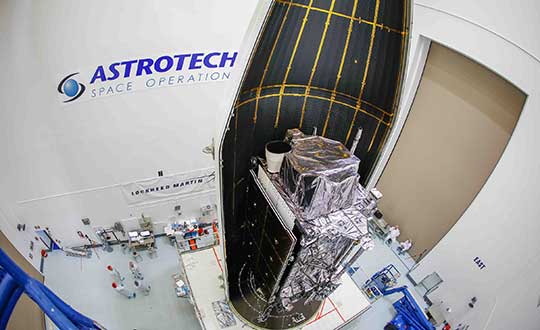
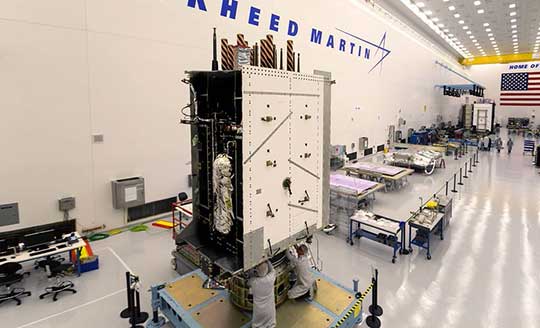
    Lockheed Martin shipped the U.S. Space Force’s third GPS III satellite to Cape Canaveral, Florida, ahead of its expected April launch. (Photo: Lockheed Martin)
    Lockheed Martin shipped the U.S. Space Force’s third GPS III satellite to Cape Canaveral, Florida, ahead of its expected April launch. (Photo: Lockheed Martin)