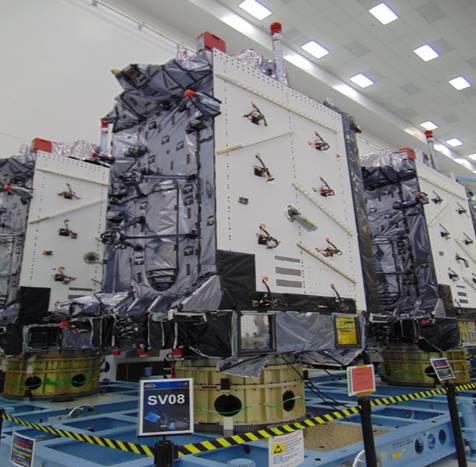
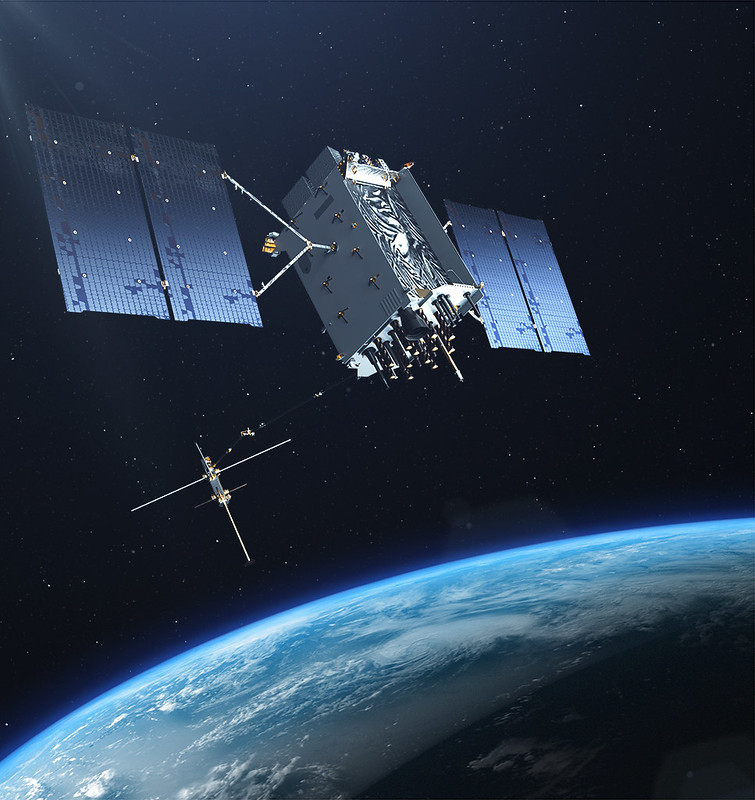
The U.S. Space Force’s Space Systems Command recently declared GPS III SV06, SV07 and SV08 satellites “Available for Launch.” Here, the space vehicles await official call up for launch in Lockheed Martin’s GPS III Processing Facility in Waterton, Colorado. (Photo: Lockheed Martin)
The U.S. Space Force’s Space Systems Command recently declared the eighth GPS III satellite as “Available for Launch.” This significant accomplishment officially marks the third space vehicle within the GPS III program to be declared available for launch in the past three months.
GPS III SV06, SV07, and SV08 are now awaiting official call up for launch in Lockheed Martin’s GPS III Processing Facility in Waterton, Colorado.
“SV06, SV07, and SV08 AFL milestones in just three months prove that GPS III production continues to benefit from efficiencies with each satellite delivery,” said Col. Edward Byrne, chief of SSC’s Space Production Corps’ Medium Earth Orbit Space Systems Division.
The first of the three recently completed satellites, SV06, is scheduled to launch in 2022 and will join the operational constellation of 31 GPS satellites.
GPS III satellites deliver enhanced performance and accuracy through a variety of improvements, including increased signal protection and improved accuracy. GPS III also expands the civilian L5 signal, dubbed the “safety-of-life” signal, currently broadcast by the 12 GPS IIF satellites, but not yet operational, and delivers a new L1C signal designed to grant interoperability to similar international space-based positioning, navigation, and timing systems around the world.
Space Systems Command, located at Los Angeles Air Force Base in El Segundo, California, is the U.S. Space Force’s Center of Excellence for acquiring and developing military space systems. SSC’s portfolio includes space launch, global navigation satellite systems, military satellite communications, a defense meteorological satellite control network, range systems, space-based infrared systems, and space domain awareness capabilities.
The U.S. Space Force’s Space Systems Command recently declared GPS III SV06, SV07 and SV08 satellites “Available for Launch.” Here, the space vehicles await official call up for launch in Lockheed Martin’s GPS III Processing Facility in Waterton, Colorado. (Photo: Lockheed Martin)
The U.S. Space Force’s Space Systems Command has declared the eighth GPS III satellite “Available for Launch.” This milestone marks the third space vehicle within the GPS III program to be declared available for launch in the past three months.
The next three GPS III satellites — SV06, SV07 and SV08 — are now awaiting official call up for launch in Lockheed Martin’s GPS III Processing Facility in Waterton, Colorado.
“SV06, SV07, and SV08 AFL milestones in just three months prove that GPS III production continues to benefit from efficiencies with each satellite delivery,” said Col. Edward Byrne, chief of SSC’s Space Production Corps’ Medium Earth Orbit Space Systems Division.
The first of the three recently completed satellites, SV06, is scheduled to launch in 2022 and will join the operational constellation of 31 GPS satellites.
GPS III satellites deliver enhanced performance and accuracy through a variety of improvements, including increased signal protection and improved accuracy.
GPS III also expands the civilian L5 signal, dubbed the “safety-of-life” signal, currently broadcast by the 12 GPS IIF satellites, but not yet operational, and delivers a new L1C signal designed to grant interoperability to similar international space-based position, navigation and timing (PNT) systems around the world.
As a crucial technological foundation for internet, financial, transportation and agricultural operations, GPS delivers the gold standard in positioning, navigation, and timing services supporting U.S. and allied operations worldwide.
Space Systems Command, located at Los Angeles Air Force Base in El Segundo, California, is the U.S. Space Force’s Center of Excellence for acquiring and developing military space systems. SSC’s portfolio includes space launch, global positioning systems, military satellite communications, a defense meteorological satellite control network, range systems, space-based infrared systems, and space domain awareness capabilities.
Lt. Gen. John F. Thompson, commander of the Space and Missile Systems Center (SMC), will retire Aug. 1. A ceremony celebrating his career and achievements took place July 27 at Los Angeles Air Force Base, California, where SMC is based.
Thompson, who is the longest serving three-star commander for SMC, retires after a 36-year career with the U.S. Air Force, having served in various roles leading defense acquisition programs, strategic systems and lifecycle management.
Brig. Gen. D. Jason Cothern, current vice commander of SMC, will serve as the SMC commander while the center awaits a confirmation of a three-star general officer.
SMC includes the positioning, navigation and timing (PNT) mission, in which professionals acquire, deliver and sustain reliable GPS capabilities to America’s warfighters, allies and civil users.
“Lt. Gen. Thompson’s exemplary career has made the nation safer, stronger and better secured against an increasingly contested space environment, and earned the well-deserved opportunity to enjoy this next chapter in his life,” stated a press release from SMC.
As the commander of SMC, he led more than 6,300 military, government service and contract employees nationwide, and oversaw an annual budget of $9 billion, which accounts for 85 percent of the nation’s space budget.
In the past 18 months, Lt. Gen. Thompson tirelessly led the groundwork for the stand-up of the U.S. Space Force’s newest Field Command, Space Systems Command, which will lead the Force in the development, delivery and acquisition of innovative space warfighting capabilities.
Having completed his four-year tour as the SMC commander, his retirement will not affect the timeline of the SSC stand-up — a complex process requiring activities and approvals at the highest levels before implementation.
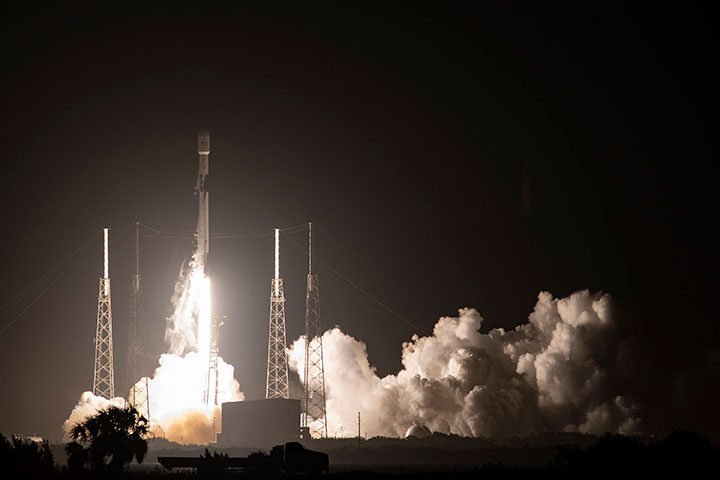
SpaceX launched into orbit for the U.S. Space Force the fifth GPS III satellite (SV05) on June 17.
Photo: U.S. Space Force
GPS III SV05 eventually will replace one of the legacy GPS IIR satellites. Once GPS III SV05 is operational, about 16% of the 31-satellite constellation will be modernized with GPS III’s new capabilities.
M-Code Requirement Met
GPS III SV05 is the 24th M-code satellite on orbit, completing the constellation’s baseline requirement to provide U.S. military forces a more-secure, harder-to-jam and spoof GPS signal.
GPS III SV05 is the fifth Lockheed Martin-built, next-generation GPS III space vehicle. The SpaceX Falcon 9 rocket is the first U.S. Space Force mission to reuse a previously-flown booster, the company said.
The U.S. Space Force contracted Lockheed Martin to design and build GPS III/GPS IIIF satellites to help modernize today’s GPS satellite constellation with new technology and advanced capabilities. Lockheed Martin said the GPS III provides three-times greater accuracy, eight times improved anti-jamming capability for U.S. military forces; a new L1C civil signal to the constellation that is compatible with other GNSS; and a new modular design that allows new technology and capabilities to be added in the future to better address changing mission needs and emerging threats.
Future GPS III Satellites
GPS III Space Vehicles 06, 07 and 08 already are complete and waiting to be called up for their launch dates, which are to be determined.
In addition, GPS III SV09 was core-mated, meaning it reached a major production milestone in which two major satellite components — the mission module and the propulsion core — are paired to form one space vehicle. The GPS III SV10 currently is in the component build up stage.
Lockheed Martin has been contracted to design and build up to 22 additional GPS III Follow On – or GPS IIIF – satellites (SV11-32), with even more capabilities. Contract options for the first four GPS IIIFs, SV11-14, have been exercised so far.
The U.S. Space Force contracted Lockheed Martin to design and build GPS III/GPS IIIF to help modernize today’s GPS satellite constellation. Photo: Lockheed Martin
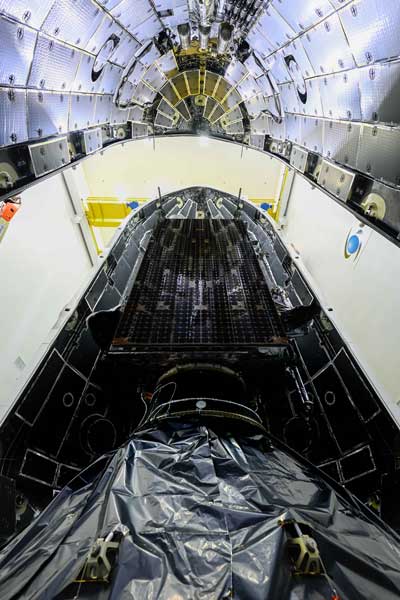
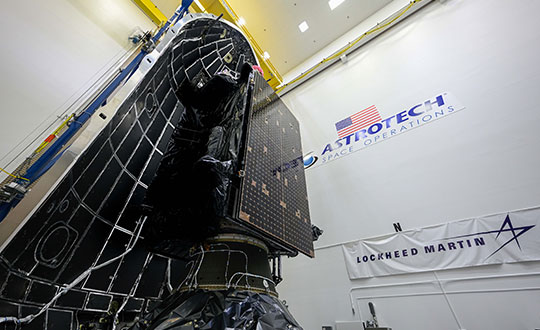
The fifth GPS III satellite was encapsulated within a SpaceX payload fairing on June 9 in preparation for its June 17 launch.
The U.S. Space Force’s Space and Missile Systems Center’s Lockheed Martin-built GPS III Space Vehicle 05 satellite was encapsulated within a SpaceX payload fairing at Astrotech Space Operations Florida facility on June 9 in preparation for launch, scheduled for June 17 from Cape Canaveral Space Force Station.
The 15-minute launch window opens 12:09 p.m. EDT. If SpaceX provides a live feed to view the launch, it will be available here.
Encapsulation of the satellite within the payload fairing protects the satellite from the impact of dynamic pressure and aerodynamic heating during its harrowing journey through the earth’s atmosphere, and supports the ability to communicate with the satellite until separation from the launch vehicle on orbit.
“The GPS III program continues to make strides in modernizing the GPS constellation for the United States Space Force, maintaining the ‘gold standard’ for position, navigation and timing,” said Col. Edward Byrne, Medium Earth Orbit Space Systems division chief, “SV05 is not only the first-ever USSF satellite launched on a previously flown booster, but also is the 24th military-code (M-xode) satellite introduced to our constellation, the last needed to bring M-code to full operational capability.”
GPS III SV05 will join the current 31-satellite operational constellation to continue to provide the gold standard in positioning, navigation and timing services for more than four billion users worldwide.
The Space and Missile Systems Center, located at Los Angeles Air Force Base in El Segundo, California, is the U.S. Space Force’s center of acquisition excellence for acquiring and developing military space systems. Its portfolio includes the development of advanced space and launch capability and systems, global navigation satellite systems, military satellite communications, defense meteorological satellites, space launch and range systems, satellite control networks, space-based infrared systems, and space situational awareness capabilities.
GPS III SV05 is encapsulated within a SpaceX payload fairing at Astrotech Space Operations Florida in preparation for its June 17 launch. (Photo: Lockheed Martin)
BAE Systems has received a $247 million contract from the U.S. Space Force’s Space and Missile Systems Center to design and manufacture an advanced military GPS receiver and next-generation semiconductor.
The technology will provide positioning, navigation, and timing (PNT) capabilities to warfighters so they can execute missions in challenging electromagnetic environments.
The Military GPS User Equipment (MGUE) Increment 2 Miniature Serial Interface program will provide improved capabilities for size-constrained and power-constrained military GPS applications, including precision-guided munitions and battery-powered handheld devices.
The program will focus on the certification of an advanced application-specific integrated circuit (ASIC) and the development of an ultra-small, low-power GPS module.
Both products will work with the next-generation military M-code signal technology, which provides reliable GPS data with anti-jamming and anti-spoofing capabilities to protect against electronic warfare threats.
“This program enables us to further develop our core M-code technology to deliver high-performance, next-generation GPS capabilities,” said Greg Wild, director of Navigation and Sensor Systems at BAE Systems. “Our M-code receiver and next-gen ASIC will enable secure and reliable military GPS capabilities in a broader range of platforms.”
BAE Systems’ Precision Strike business has 45 years of military GPS experience and more than 1.5 million GPS devices on over 280 platforms around the world. The company is currently producing M-code GPS receivers in multiple form factors, including a low power, small form factor M-code solution.
Additional prototypes are in development for ground, weapons and airborne mission applications, and the company’s M-code GPS products are available to U.S. allies via foreign military sales.
Work on the program will be conducted at the company’s facility in Cedar Rapids, Iowa.
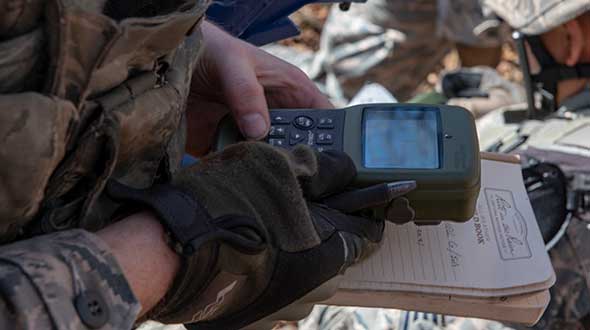
Feature image: An Airman with the 374th Security Forces Squadron uses a Defense Advanced GPS Receiver (DAGR) to track the team’s current during a 2018 field training exercise at Camp Fuji, Japan. (Photo: Senior Airman Matthew Gilmore/U.S. Air Force)
Lockheed Martin, the prime contractor for GPS III/IIIF, selected L3Harris in 2018 to design and build the first two fully-digital MDUs, the heart of the satellite’s navigation payload. (Artist rendering: Lockheed Martin)
L3Harris Technologies has received contracts totaling $137 million for four navigation payload Mission Data Units (MDU) for future GPS III Follow-On (GPS IIIF) satellites.
Lockheed Martin, the prime contractor for GPS III/IIIF, selected L3Harris in 2018 to design and build the first two fully-digital MDUs, the heart of the satellite’s navigation payload. The MDU generates more powerful GPS signals and assures clock operations for GPS users, L3Harris said.
“The digital MDU is flexible enough to adapt to advances in GPS technology and future changes in mission needs,” said Ed Zoiss, president, Space and Airborne Systems, L3Harris. “The new MDU will also support a smooth transition for the U.S. Space Force’s GPS OCX ground control segment.”
The U.S. Space Force expects the first GPS IIIF satellite, which builds on GPS III adding new capabilities and technology, to be available for launch in 2026. According to L3Harris, the GPS IIIF MDU will provide improved capabilities over L3Harris’ 70-percent-digital MDU on the first ten GPS III satellites. The first four GPS III satellites have successfully launched and are now operational in the GPS constellation.
L3Harris Technologies is a global aerospace and defense technology innovator, delivering end-to-end solutions that meet customers’ mission-critical needs. The company provides advanced defense and commercial technologies across air, land, sea, space and cyber domains.
Germany is the first United States ally to order the new military code (M-code)-capable Military GPS User Equipment (MGUE).
The Space and Missile Systems Center’s Space Production Corps achieved the major milestone on Sept. 30, when GPS Foreign Military Sales (FMS) office received its first M-code MGUE order.Germany is expected to receive delivery of its first M-code receivers this year.
SMC is facilitating international access and availability of M-code user equipment as directed by the Secretary of the Air Force and the Office of the Secretary of Defense to 58 authorized nations. Additional foreign military sales of MGUE are being worked.
Currently, SMC is engaged with several nations in bilateral M-code prototyping, demonstration and lead platform planning efforts. Under a multilateral agreement, MGUE ground-based receivers are on schedule to be loaned to approved partners for early integration and test in national weapons systems.
M-code is an upgrade to the currently available GPS signals that provides enhanced secure positioning, navigation and timing (PNT) performance, anti-jam and anti-spoofing to provide a more resilient PNT solution. It will improve interoperability with our defense partners’ equipment and operations while increasing navigation warfare effectiveness for allied operations.
The Space and Missile Systems Center’s Production Corps achieved a major GPS milestone on Nov. 18 with the approval for Operational Acceptance of GPS Military-Code (M-Code) Early Use (MCEU). MCEU serves as a gap filler for M-code operations before the entire GPS constellation’s operational transition to the Next Generation Operational Control System Block 1.
The encrypted M-code signal enhances anti-jamming and anti-spoofing capabilities for the warfighter. M-code signals are available on all 23 GPS Block IIR-M, IIF and III space vehicles currently on orbit. The successful testing events were completed at the Master Control Station at Schriever Air Force Base, Colorado and Alternate Master Control Stations at Vandenberg Air Force Base, California.
Operational Acceptance followed successful integrated developmental and operational testing of the GPS Operational Control Segment (OCS) upgrade. Operating in a trial period since June 2020, the MCEU upgrade allows the OCS Architecture Evolution Plan to task, upload and monitor M-code within the GPS constellation, as well as support testing and fielding of modernized user equipment. With M-code now declared operational, upcoming Military GPS User Equipment (MGUE) will be able to request early use of the M-code signal-in-space to provide more secure position, navigation and timing (PNT) to warfighters.
“MCEU ushers in a new era of GPS support that will provide operators across the warfighting domain with assured PNT access while further preventing unauthorized use by our adversaries. This is a critical step in remaining the gold standard of PNT systems and promoting a peaceful, secure, stable, and accessible space domain,” said Lt. Jordan Malara, 2nd Space Operations Squadron GPS Warfighter Collaboration Cell assistant flight commander.
M-code designed for security
Military code (M-Code) is a more-secure, harder-to-jam and spoof GPS signal specifically for military forces. Awarded in September 2017, M-Code Early Use (MCEU) is a software upgrade to the OCS AEP, which allows the current ground control system to task, upload and monitor M-Code within the GPS constellation. It will also help Accelerating M-Code’s deployment supports testing and fielding of modernized user equipment in support of the warfighter.
MCEU includes a new software-defined receiver installed globally at all six Space Force Monitoring Sites. The M-code Monitor Station Technology Improvement and Capability (M-MSTIC) uses commercial, off-the-shelf hardware to cost effectively receive and process M-code signals, enabling OCS operators to successfully monitor the M-code signals.
“M-code’s more-secure, harder-to-jam and spoof signals are critical to helping our warfighters complete their missions, especially in contested environments,” said Maria Demaree, vice president and general manager for Lockheed Martin’s Mission Solutions line of business. “This upgrade to the current GPS ground control system, and the launch of more modernized GPS III satellites, is making M-code’s full-fielding a reality.”
With the Dec. 1 Operational Acceptance of GPS III Space Vehicle 04 (GPS III SV04), 23 GPS IIR-M, GPS IIF and GPS III satellites broadcast M-code in the current GPS Constellation.
Ground Control Timeline — OCS AEP
Lockheed Martin has sustained the Space Force’s current GPS ground control system since 2013. The system is known as the GPS Operational Control Segment (OCS) Architecture Evolution Plan (AEP) or “OCS AEP.”
In February 2016, the Air Force contracted Lockheed Martin to develop the GPS III Contingency Operations (COps) software upgrade to the OCS AEP. COps was delivered in May 2019, successfully connected with on-orbit GPS III SV01 in October 2019, and was Operationally Accepted in February 2020. COps enabled the Air Force’s ground control system to command and control both the legacy satellites, as well the more powerful GPS III satellites beginning to launch.
In November 2018, the company completed the AEP 7.5 upgrade — the largest architectural change in the systems history — replacing significant code, hardware and software to improve the system’s cybersecurity capabilities and positioning the Air Force to better operate in contested, degraded and operationally limited environments.
In December 2018, the Air Force awarded Lockheed Martin the GPS Control Segment Sustainment II (GCS II) contract to continue to further modernize and sustain the OCS AEP through 2025.
In the fourth quarter of 2019, Lockheed Martin delivered the Red Dragon Cybersecurity Suite (RDCSS) Phase III upgrade to the OCS AEP, dramatically improving Defensive Cyber Operations (DCO) visibility into GPS network traffic. Other add-ons include user behavior analytics to analyze patterns of traffic and network taps to improve data collections.
Earlier this year — and key to enabling M-Code — Lockheed Martin installed new software-defined M-Code Monitor Station Technology Capability (M-MSTIC) receivers at six Space Force monitoring sites around the world. In Dec. 2019, SMC granted security approval for M-MSTIC.
From his side window, a crew chief relays vital position information back to the CH-47 Chinook pilot as paratroopers hook their pallet of equipment to the underside of the helicopter during sling load and air operations training. (Photo: U.S. Army/Maj. Robert Fellingham)
The U.S. Coast Guard Navigation Center has issued a notice that GPS satellite SVN-77 (PRN-14) was set healthy for initial use on Dec. 2 at 0131Z. This follows the U.S. Space Force announcement that the satellite, the fourth GPS III (SV04), received Operational Acceptance approval on Dec. 1.
SVN-77 is the 23rd satellite to broadcast L2C, the second civil GPS signal at 1227.6 MHz. L2C is not yet designated as “operational” by the U.S. Space Force.
However, the L2C signal is set to healthy, and users can utilize this signal at their own risk.
The U.S. Air Force’s Lockheed Martin-built next generation GPS III satellite on orbit. Rendering portrays GPS III Space Vehicles (SVs) 01-10. (Artist’s Rendering: Lockheed Martin)
SVN-77 is the 16th satellite to begin broadcasting the third civil GPS signal, L5, specifically designed for aviation use in an internationally protected band of spectrum designated for aeronautical navigation at 1176.45 MHz. L5 continues to broadcast an unhealthy designation.
SVN-77 is the fourth satellite broadcasting the new L1C signal at 1575.42 MHz.
The next GPS III satellite, SVN-78, initially scheduled to launch in January, will launch no earlier than July 1, 2021.
The fourth GPS III satellite, space vehicle (SV) 04, received United States Space Force’s Operational Acceptance approval on Dec. 1.
Operational acceptance marks another significant milestone for the GPS III program, Space and Missile Systems Center and USSF, according to the Space Force. This is the fourth GPS III satellite delivered into the operational constellation in the past 12 months and the second in the past three months.
Also, this is the first GPS III vehicle delivered to the warfighter through an expedited satellite control authority transfer process, which cuts 10 days off the previous operational acceptance timeline.
One more to go for M-code capability
“With the onset of SV04, the GPS constellation continues moving forward in next generation modernization,” said Capt. Collin Dart, the 2 SOPS DOA flight commander. “The 2nd Space Operations Squadron is one step closer to providing military code (M-code) capability for the entire 24 satellite baseline.”
“The highly encrypted M-code to protect GPS signals from jamming and spoofing is currently enabled on 22 GPS satellites of various generations; 24 are needed to bring the M-code to the next level of operational capability,” Dart explained. “SV04 brings the constellation to 23 M-code capable vehicles. SV05 will launch no earlier than July 2021. This will add the 24th M-code capable vehicle.”
“M-code signals are more-secure, harder-to-jam and spoof, and are critical to helping our warfighters complete their missions, especially in contested environments,” said Tonya Ladwig, Lockheed Martin’s vice president for Navigation Systems. “GPS III is a warfighting system and we are proud to be helping bring this critical capability to the men and women protecting our nation.”
GPS III SV04 is encapsulated in its protective launch fairings. (Photo: 45th Space Wing Public Affairs)
Faster handover from contractor
SV04 also sets a new standard for handover from contractor Lockheed Martin’s launch team to operational acceptance, setting the satellite healthy to the global user community approximately 30 days post launch, according to Dart. “Moving forward with future GPS III launches, the timeline between launch and the satellite being set healthy will be at a minimum,” he said.
SV04 was launched on a SpaceX Falcon 9 Block 5 vehicle on Nov. 5. The Air Force has been flying 31 operational satellites for years to ensure the United States’ commitment to have 24 operational GPS satellites available 95% of the time.
GPS III SV04 joins this operational constellation of 31 GPS satellites orbiting in medium-Earth orbit. The system delivers improved accuracy, advanced anti-jam capabilities and increased resiliency for the GPS III constellation.
Lockheed Martin’s production proceeds
The Space Force declared GPS III SV05 “Available for Launch” in May. The satellite is waiting to be called up”for launch.
GPS III SV06, 07 and 08 are now fully assembled and going through environmental testing at Lockheed Martin’s GPS III Processing Facility in Denver.
GPS III SV09 and 10 are in component build up.
Lockheed Martin is also under contract for up to 22 additional GPS III Follow On (GPS IIIF) satellites, which introduce further technology and capabilities. In May, Lockheed Martin completed its Critical Design Review for the GPS IIIF and in July, the Space Force declared that GPS IIIF fulfilled “Milestone C,” which means the production phase of the program has officially begun.
“The operational acceptance of GPS III SV04 is another significant milestone for GPS Modernization, delivering critical new capabilities to our Military and Civil Users. We now have a total of 23 M-code spacecraft for our Warfighters. For our billions of civil users, it brings the count up to 23 L2C spacecraft and 16 L5 spacecraft,” said Col. Ryan Colburn, director of the SMC Portfolio Architect Office’s Spectrum Warfare Division. “For professional users with existing dual-frequency operations, L2C enables faster signal acquisition, enhanced reliability, and greater operating range. L5 is broadcast in a radio band reserved exclusively for aviation safety services. It features higher power, greater bandwidth, and an advanced signal design. Future aircraft will use L5 in combination with L1 C/A to improve accuracy (via ionospheric correction) and robustness (via signal redundancy). The operational acceptance of this spacecraft is another display of the fantastic teamwork across SMC’s Corps, Space Delta 8, National Geospatial-Intelligence Agency, Department of Transportation, Federal Aviation Administration, our industry partners and many others who work together to make these missions possible.”
GPS satellites provide position, navigation, and timing to more than four billion military and civilian users worldwide.
A Falcon 9 carrying GPS III SV04 lifts off from Cape Canaveral Air Force Station, Florida, Nov 5. (Photo: SpaceX via USAF)
The United States Space Force’s Space and Missile Systems Center awarded the Military Global Positioning System User Equipment (MGUE) Increment (Inc) 2 Miniature Serial Interface (MSI) with Next-Generation Application Specific Integrated Circuit (ASIC) to BAE Navigation & Sensor System, L3 Technologies (now L3Harris) and Raytheon Technologies.
According to the U.S. Space Force, the three MSI contracts are valued at $552 million and will be executed as Middle Tier Acquisition rapid prototyping efforts. The first delivery is scheduled for early fiscal year 2026.
Enhanced processing and security features associated with M-code drove the decision to develop a smaller and more powerful receiver card for handheld and dismounted applications, the U.S. Space Force said. The MSI with Next-Generation ASIC will enable Military-Code GPS receiver production, mitigating the obsolescence issue of current ASICs and providing significant security and performance improvements for GPS-enabled weapons systems. MGUE Inc 2 will be compatible with all existing and future spacecraft and ground systems, it added.
MGUE Inc 2 enables military GPS user equipment to receive allied GNSS positioning, navigation and timing (PNT) signals to increase both the resilience and capability of military PNT equipment, and deter attacks on GPS, the U.S. Space Force said. These signals will supplement GPS-based PNT in accordance with Department of Defense policies regarding usage of allied GNSS signals, ensuring identification and mitigation of cyber risks, and compatibility with existing PNT equipment.