Tag: uAvionix

  • UAvionix offers free receivers for Hurricane Dorian recovery efforts

    UAvionix is offering free pingRX unmanned aircraft system (UAS) ADS-B receivers to first responders and UAS service organizations participating in rescue and recovery efforts associated with Hurricane Dorian.

    Hurricane Dorian is expected to travel along the Eastern coast of the U.S. northward at a slow pace, creating extensive damage from winds and flooding.

    UAvionix is a designer and manufacturer of communications, navigation and surveillance (CNS) equipment for unmanned and manned aircraft.

    The pingRX. (Photo: uAvionix)
    The pingRX. (Photo: uAvionix)

    PingRX is a dual-frequency ADS-B receiver designed for use onboard a UAS. Retailing for $249 and weighing 5 grams, pingRX can provide the operator with a digital view of ADS-B-equipped aircraft in the airspace up to hundreds of miles away.

    When integrated with a compatible autopilot — such as ARDUPILOT, Pixhawk, PX4 or the Cube — local ADS-B traffic is displayed on the ground control station (GCS) display.

    Image: National Weather Service
    Image: National Weather Service

    The FAA’s mandate for ADS-B OUT equipage on manned aircraft has a deadline of Jan. 1, 2020, so equipage levels are currently high. Users are cautioned, however, that equipage is not at 100%, so reliance on ADS-B as a sole means of detect and avoid (DAA) is not advised.

    In 2017, in response to Hurricane Harvey’s landfall in Houston, Texas, UAS were used extensively for the first time in recovery and rescue efforts. The use of UAS has continued to grow in response to hurricane efforts ever since.

    Photo:
    Photos: NOAA

    “Over the past few years, the use of drones in hurricane and natural disaster recovery efforts has increased significantly due to the value of the real-time data collected in combination with ease of deployment,” said Christian Ramsey, uAvionix president. “First responders and recovery crews will undoubtedly work tirelessly for weeks in response to Dorian. We hope to make these efforts just a bit safer and encourage good airspace safety practices with the use of the pingRX systems.”

    The FAA has published guidance for UAS operators, urging strict adherence to Notices to Airmen (NOTAMS) and Temporary Flight Restrictions (TFR). The airspace in these areas can be crowded and unpredictable.

    First responders and UAS service organizations are encouraged to contact uAvionix at [email protected] for details on the offer.

    Grand Bahama Island before Hurricane Dorian. (Photo: ICEYE)
    Grand Bahama Island before Hurricane Dorian. (Photo: Google)
  • uAvionix developing transponder for space-based ADS-B surveillance

    uAvionix is developing and testing skyBeacon X, a wingtip mounted 1090MHz Mode S ADS-B OUT transponder designed to meet the update rate performance required when used in conjunction with the Aireon satellite-based global ADS-B air traffic surveillance system.

    According to the company, skyBeacon X is similar to the original skyBeacon in that it is an ED position light replacement with an integrated 1090MHz transponder, GPS position source, barometric altimeter, and LED position and anti-collision lights.

    In January 2019, NAV CANADA revealed that it will be implementing an ADS-B Performance Requirements mandate in three phases. Phase 1 includes Class A airspace and Class E airspace above FL600 by Jan 1, 2021. Phase 2 includes Class B airspace which in Canada extends from FL125 to FL180, and requires equipage by Jan 1, 2022. Phase 3, to be implemented no sooner than 2023, will require General Aviation (GA) aircraft to equip with transponders which employ antenna diversity — an antenna installed on both the bottom and the top of the aircraft — in order to achieve acceptable performance to provide Air Traffic Services.

    uAvionix plans for skyBeacon X to serve as a low-cost, diversity-compatible system for Canadian users to meet these requirements.

    “Many of our ANSP customers would like to provide air traffic control services at lower altitudes and to all types of aircraft in controlled airspace, including GA,” said Cyriel Kronenburg, Aireon’s Vice President of aviation services. “We are excited to participate in testing and validation with uAvionix to ensure skyBeacon X meets performance requirements to be used with the Aireon system. We believe these transponders offer an affordable, reliable solution for ADS-B OUT equipage that would help many of our international ANSP customers and regulators increase equipage rates for GA aircraft. This will also allow GA to leverage both the safety and operational benefits of a space-based surveillance system.”

    skyBeacon X is expected to be certified and available in 2021. According to the company, skyBeacon X will be uAvionix’s first global GA product operating on 1090MHz. While it will not be available in time for U.S. users to meet the deadline for the FAA’s mandate, it will be available and TSO certified for the Canadian projected mandate date of 2023, uAvionix added.

    The company also recently expanded into two new facilities: one in Leesburg, Virginia, and one in Columbia Falls, Montana.

  • uAvionix introduces truFYX GPS, transponder at Xponential 2019

    uAvionix Chief Operating Officer Ryan Braun discusses the company’s truFYX GPS and transponder at Xponential 2019, which took place April 29-May 2 in Chicago.

  • Live from AUVSI’s Xponential 2019

    Live from AUVSI’s Xponential 2019

    Logo: Xponential 2019The GPS World and Geospatial Solutions staff are reporting live from the Association for Unmanned Vehicle Systems International’s (AUVSI’s) Xponential 2019 April 29-May 2 in Chicago.

    The event convenes the global community of commercial and defense leaders in intelligent robotics, drones and unmanned systems. Check out news, photos and videos from the show.

    NEWS

    VIDEOS

    Click the icon in the top left hand corner to choose the video you’d like to watch.

  • UAvionix partners with CubePilot on ADS-B IN for carrier board

    UAvionix partners with CubePilot on ADS-B IN for carrier board

    Photo: uAvionix
    Photo: uAvionix

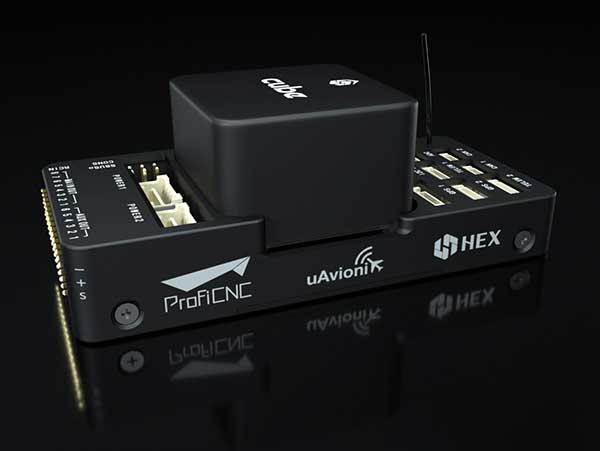
    uAvionix has announced a partnership with autopilot maker CubePilot to integrate ADS-B IN receive capability into its carrier board.

    uAvionix is the designer and manufacturer of communications, navigation and surveillance (CNS) equipment for unmanned and manned aircraft.

    CubePilot is the designer and manufacturer of the “The Cube” autopilot (formerly known as Pixhawk) for unmanned aircraft systems (UAS).

    The new carrier board, available in July, integrates uAvionix’s custom ADS-B silicon for 1090-MHz ADS-B reception for worldwide detect and avoid (DAA) functionality.

    With this integration, UAS operators will be able to see nearby ADS-B OUT enabled aircraft on ARDUPILOT’s Mission Planner, providing the remote pilot in command (RPIC) with timely notification to take the necessary actions to remain well clear.

    CubePilot, which uses the open-source ARDUPILOT platform, previously provided plug-and-play functionality for several uAvionix ADS-B IN and OUT products, including PingRX, Ping2020i and Ping1090i. Support for these products is retained in the new design, allowing for 978MHz ADS-B reception or integration of ADS-B OUT functionality.

    “With this partnership, uAvionix furthers our goal of ensuring safety and common situational awareness between airspace users,” states Christian Ramsey, uAvionix president. “We believe that ADS-B IN functionality should be a requirement for every DAA system for UAS operations over people or beyond visual line of sight, and meeting that requirement should not be cost prohibitive.”

    “The safe integration of UAS into the National airspace of any country needs to take a safety-first approach from all players,” said Philip Rowse, Hex/ProfiCNC (CubePilot) CTO. “By partnering with uAvionix and including the ADSB-in at practically no cost to the customer, we remove the cost barrier, adding safety to our customers’ UAS solutions.. We envisage this added situational awareness, and optional auto avoidance behavior will be an important step towards safely shared skies.”

    Visit uAvionix at AUVSI Xponential in Chicago April 30-May 2 at Booth 4421 and CubePilot at Booth 1816.

  • UAvionix offers testing of CNPC command link radios for UAS

    UAvionix offers testing of CNPC command link radios for UAS

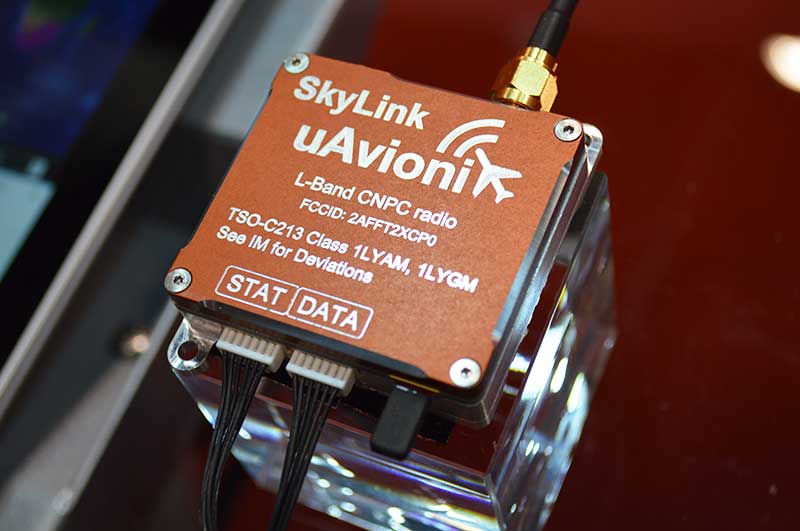
    uAvionix, designer and manufacturer of communications, navigation, and surveillance (CNS) equipment for unmanned and manned aircraft, is testing its prototype of a command and non-payload control (CNPC) radio for unmanned aircraft systems (UAS) and urban air mobility vehicles.

    Photo: Allison Barwacz
    Photo: Allison Barwacz

    SkyLink is an L-band frequency-modulated CNPC radio ultimately intended for point-to-point or networked Beyond Visual Line of Sight (BVLOS) UAS operations. uAvionix has focused on minimizing size, weight, and power consumption (SWaP) while maximizing range and spectrum efficiency.

    The current 50-gram 10-Watt prototype is testing successfully at ranges exceeding 40 miles at low altitude. uAvionix is testing under an experimental transmit license and approval from the Federal Communications Commission and Federal Aviation Administration, respectively.

    Prior to founding uAvionix, CEO Paul Beard invented and brought to market the Spektrum digital spread spectrum radio control (RC) technology which moved the control link from 27 and 72 MHz bands to a high-bandwidth 2.4-GHz ISM band.

    “Building high performance datalinks for airborne applications is insanely challenging,” said Beard. “Combining our ability to produce TSO certified equipment with the experience of developing and deploying millions of commercial products globally with Spektrum, we expect to bring affordable, scalable, and safe solutions to enable the UAS and UAM markets.”

    Visit uAvionix at AUVSI Xponential 2019 at booth 4421.

  • uAvionix demonstrates dime-sized ADS-B for high-traffic drone operations

    uAvionix demonstrates dime-sized ADS-B for high-traffic drone operations

    uAvionix Corporation, an unmanned aircraft system (UAS) avionics provider, has developed and is testing a tiny ADS-B transceiver for UAVs.

    Weighing less than 1 gram, a dime-sized ADS-B prototype module for drones with transmission power between 0.01-0.25 Watts could provide visibility to any aircraft equipped with ADS-B “IN” avionics from 1 to 10 miles away, and is small enough to integrate directly into professional and consumer-level drones.

    uAvionix is working with the Federal Aviation Administration (FAA) and other partners under a Cooperative Research and Development Agreement (CRADA) to test the unit, along with other uAvionix products.

    uAvionix Ping ADS-B transceiver.
    uAvionix Ping ADS-B transceiver. Photo: uAvionix 

    A recent study published in January 2017 by The MITRE Corporation’s Center for Advanced Aviation System Development (CAASD) imagined a future of high-traffic densities of drones operating with ADS-B onboard, and then sought to understand the implications of that.

    The study suggests that there is a nominal transmission power output between 0.01 and 0.1 Watts that when coupled with limited drone traffic densities can result in a compatible operation with the system as a whole.

    “We developed this product to show the world the art of the possible,” said Paul Beard, CEO of uAvionix. “We can’t yet sell this device because the standards that were developed for ADS-B did not take into account the value of air-to-air ADS-B communications between small drones or between small drones and manned aircraft. It’s literally not legal to transmit at these low power outputs. We aim to lead the discussion and development of those standards, and will work with any regulatory body to do so.”

  • uAvionix debuts pingRX receiver for small drone collision avoidance

    pingRX-receiver-auvsiElectronics manufacturer uAvionix has introduced the smallest and lightest ADS-B receiver, according to the company. The new pingRX weighs 1.5 grams and requires one hundredth the power of conventional ADS-B (Automatic Dependent Surveillance – Broadcast) receivers. It implements “sense and avoid” capabilities for small drones operating in the National Airspace (NAS).

    The receiver, for use in small drone collision avoidance systems ADS-B, helps aircraft operators sense and avoid possible collisions. ADS-B is mandated by the U.S. Federal Aviation Administration for all aircraft in the NAS in 2020. Used now primarily on manned aircraft, miniaturizing the equipment was essential to make it useable for small drones, uAvionix says. pingRX measures 32 by 15 by 3 millimeters, which is a fraction of the size of earlier units.

    Early adopter Randy Mackay, lead developer of ArduCopter, said to the company that it “feels slightly magical to have real aircraft appearing on our ground station map.”

    pingRX receives ADS-B information broadcast by other aircraft on two frequencies approved by the FAA (978 megahertz and 1090 megahertz). This allows the unit to detect commercial aircraft threats within a 100 statute mile radius in real time.

    For drone aircraft system installation, pingRX is designed for direct MAVLink integration with Pixhawk autopilots and APM Mission Planner software.

    uAvionix will display its new patent-pending pingRX ADS-B receiver at the Association for Unmanned Vehicle Systems International’s Xponential trade show May 3-5 in New Orleans.