Tag: UrsaNav

  • GNSS has bad days, too

    GNSS has bad days, too

    (courtesy Ursanav)
    (courtesy UrsaNav)

    “Even the best technology has a bad day,” Charles Schue told the New York Stock Exchange (NYSE), which relies very heavily on the best technology to keep the world’s financial edifice afloat. Vulnerabilities in the stock market were pointed up during a demonstration on April 19, showcasing how one positioning, navigation and timing (PNT) system can cover the chinks in another. Respectively, eLoran and GPS in this case.

    Schue is CEO of UrsaNav, a company that has been developing complementary PNT solutions, specifically the high-power, low-frequency (LF), ground-wave technology that is eLoran, which UrsaNav calls “the most reliable, scalable, and future-proof available.” Schue spoke at the NYSE along with representatives from the Department of Homeland Security (DHS), the U.S. Coast Guard, Juniper Networks and Harris Corporation.

    “2014 was a very bad year for GNSS,” Schue continued, citing the GLONASS full-system outage for 11 hours and Galileo’s wrong-orbit launch of two satellites. “This year, GPS, the gold standard, had an ‘oops’ and slipped from gold to silver, when one satellite kind of wigged out, a 13.7 microsecond error that contaminated 15 other satellites.” He ran a simulation that showed how, at one point, six GPS satellites were communicating bad timing to the Eastern seaboard, where the NYSE is located.

    2016 has also seen renewed GPS jamming from North Korea.

    The stock exchange, along with other global financial markets, relies on microsecond timing to properly execute all transactions. The U.S. air traffic management system likewise relies on high-precision aspects of GPS that are vulnerable to interference, jamming, and even occasional system failure. Many other industries, telecommunications principally among them, are also building infrastructures and applications that rely on GPS for precise timing, thus making them vulnerable as well.

    One Back-Up Transmitter in Place

    An eLoran transmitter in Wildwood, New Jersey, relies on three primary reference standards, three atomic clocks, just as each GPS satellite carries three or four atomic clocks. “The signals coming from space, the signals coming from ground, they’re very similar.” ELoran also has monitoring and control sites on the ground, just like the satellite system; it has differential reference stations, and of course eLoran receivers, playing the same role as GPS receivers.

    Schue asserted that the cost of launching one GPS satellite into space would fund an eLoran system for the continental United States for 20 years. Also, that a lot of industries in addition to the financial community are building infrastructures and applications that rely on GPS for precise timing, and so are equally vulnerable.

    The eLoran demonstration showed how the Wildwood station sent a timing signal 130 miles to the NYSE, deep within several urban canyons and enveloped in several layers of concrete, steel and glass. A GPS receiver in the room did not pick up anything. The eLoran receiver showed precise time, to the standard of NYSE requirements.

    Equipment utilized included a Spectracom SecureSync providing time to the network, once it received it from eLoran.

    On a screen display showing plus or minus 500 nanoseconds relative to Coordinated Universal Time, “that red line is us receiving eLoran timing at that antenna, 130 miles away, through the urban canyons, inside this building, right now at minus 14 nanoseconds.” The eLoran equipment transmitted and received two signals, with a data channel on one of the signals. “We could put the data channel on both signals, and we could put multiple data channels on both on there as well.”

    Photo: UrsaNav Photo: UrsaNav

    Schue said another demo inside a downtown Boston hotel, 305 miles from the New Jersey transmitter, obtained 83-nanosecond accuracy. A 2015 test to an outdoor receiver in Bangor, Maine, 500 miles from the transmitter, logged 68-nanosecond accuracy.

    Plus or minus 100 nanoseconds is the typical GPS performance. “We can do far better, and GPS often does far better than that.”

    Initial operating capability for a wide-area eLoran service providing precise time for the continental United States would require four transmitter sites across the middle of the country. The corporate and government partners hope to use some repurposed Loran-C assets and turn them into eLoran stations. Wildwood is transmitting at 360 kilowatts; if transmitting at 1 million watts, or 1 megawatt, the signal could penetrate even further inside buildings. The cost difference between the two powers of transmitter is not significant.

    Bringing six more continental eLoran transmitter sites online, for a total of ten, would add a back-up positioning capability in addition to timing. “This is very important, because with positioning, you get mobile time — a co-primary solution for position, navigation, and timing.”

    Using a differential receiver would yield even better local-area accuracy for about 35 miles around a selected site, for high-priority locations. Such a higher-precision system for the nation’s top 50 metropolitan areas, top 50 airports, and top 50 harbors could be accomplished with 71 differential sites.

    Concurrence from Government and Other Industry Partners

    Spokespersons from the DHS, Coast Guard, Juniper Networks and Harris Corporation preceded Schue at the NYSE presentation, all giving similar perspectives on U.S. vulnerability in many aspects, due to reliance on GPS as a sole, unsupported source of precision PNT.  “Of the 16 critical infrastructure / key resource sectors in the United States, 15 use GPS for timing. GPS timing is deemed essential for 11 of these sectors,” stressed DHS.

  • PNT Roundup: Taviga collaboration, leap second reconsidered and drone rules

    eLoran

    New joint venture to ensure, assure secure PNT

    The founders of Chronos and UrsaNav have formed a new collaboration, named Taviga, that will focus on preserving and establishing low-frequency (LF) positioning, navigation and timing (PNT) networks in the United Kingdom, Europe and the U.S., using repurposed Loran-C or purpose-built eLoran technology.

    Taviga aims to ensure timing and navigation for critical infrastructure, protecting it from cyber and other threats, and addressing the concern that over-dependence on single systems for PNT increases vulnerability.

    According to a joint press release, “Taviga combines the founders’ decades of experience specializing in low-frequency (LF) PNT technology and industrial timing applications at national and international levels. Its objective is to provide a commercially operated assured LF PNT service.”

    Partner with Government. Charles Curry of Chronos Technology Ltd. in the UK and Charles Schue of UrsaNav Inc. in the U.S. joined forces to launch Taviga Ltd. and Taviga LLC. Taviga anticipates working in partnership with government agencies and other entities that have a vested interest in reducing the vulnerability and improving the resilience of critical national infrastructure with a dependency on the GPS and other GNSS sources of PNT.

    “We have been researching the precise timing capability of eLoran transmissions for over 10 years,” Curry said. “During that time, the system has never failed, and most impressively it has continued to deliver sub-microsecond time accuracy traceable to UTC in very challenging locations, including deep inside buildings.

    “Our research program was supported by the UK’s Innovation Agency — Innovate UK through two flagship projects, GAARDIAN and SENTINEL,” Curry continued. “These two projects highlighted the vulnerabilities that threaten GPS signals (and in the future, Galileo) such as jamming, interference and spoofing. They also demonstrated how eLoran is a technically dissimilar source of PNT and not vulnerable to the same types of interference. eLoran is a truly complementary source of PNT, ideal for use in critical infrastructure applications such as telecoms, broadcasting, financial services and power utilities.

    “Every government, academic and industrial study has resulted in the selection of the LF technology known as Enhanced Loran, or eLoran, as the best wide-area complement to GNSS,” UrsaNav’s Schue added. “There is no doubt that the combination of GNSS and eLoran provides the PNT resilience that most users require.

    “Integrated GNSS-eLoran solutions can provide the proof-of-time and proof-of-position necessary to safeguard national infrastructure and for business continuity of operations,” Schue said. “Adding eLoran to the PNT mix enables or enhances capabilities of regional and purpose-built solutions. Overreliance on a single solution is neither prudent nor safe.”

    Tests led by Chronos and using UrsaNav’s eLoran receiver engine have consistently demonstrated positioning accuracies of better than 10 m and timing accuracies of less than 100 nanoseconds in the area of differential eLoran reference sites.

    Taviga’s goal is the long-term operation of an eLoran system for at least 10 years, a period that provides the necessary service assurance continuity to enable industrial users to invest with confidence in an eLoran-based timing and navigation service that complements their GNSS solutions. As users become accustomed to the capabilities and resilience of a combined GNSS-eLoran solution, Taviga expects to expand the service footprint worldwide.

    Timing

    Leap second lives on

    The International Telecommunication Union (ITU) World Radiocommunication Conference (WRC-15) decided that further studies are required on the impact and application of a future reference time-scale, including the modification of Coordinated Universal Time (UTC) and suppressing the so-called “leap second.”

    Leap seconds are added periodically to adjust to irregularities in the Earth’s rotation in relation to UTC, the current reference for measuring time, in order to remain close to mean solar time (UT1). A leap second was added most recently on June 30 at 23:59:60 UTC. The proposal to suppress the leap second would have made continuous reference timescale available for all modern electronic navigation and computerized systems to operate while eliminating the need for specialized ad hoc time systems.

    A report will be considered by the World Radiocommunication Conference in 2023. Until then, UTC shall continue to be applied as described in Recommendation ITU‑R TF.460‑6.

    Disconnect from the Sun? As a representative of the Lick Observatory of the University of California stated, “a problem is that simply omitting leap seconds would redefine the meaning of the word “day” so that it is not related to the sun in the sky, nor connected with the rotation of the Earth.”

    “Modern society is increasingly dependent on accurate timekeeping,” said ITU Secretary-General Houlin Zhao.“ITU is responsible for disseminating time signals by both wired communications and by different radiocommunication services, both space and terrestrial, which are critical for all areas of human activity.”

    Further studies will be coordinated by ITU along with several other international organizations.

    Inertial/GNSS

    Drone rules, registry

    The Federal Aviation Administration announced in December an official rule and registration process for hobbyists who own small unmanned aircraft weighing more than 0.55 pounds and less than 55 pounds, including payloads such as on-board cameras.

    The online registration system does not yet support registration of small UAS used for any purpose other than hobby or recreation — for example, using an unmanned aircraft in connection with a business. The FAA is developing enhancements that will allow such online registrations by spring of 2016.

    The registration procedure is a statutory requirement that applies to all hobby aircraft. Under this rule, any owner of a small UAS who has previously operated an unmanned aircraft exclusively as a model aircraft prior to Dec. 21, 2015, must register no later than Feb. 19, 2016. Owners of any other UAS purchased for use as a model aircraft after Dec. 21, 2015, must register before the first flight outdoors.

    Owners may register through a web-based system or paper-based process. There is a $5 registration fee, but the FAA is offering a full rebate for those who register before Jan. 20, 2016.

    Under the rule, each aircraft must be marked with a unique number, although not necessarily the serial number. The goal is to help authorities track down an owner if a drone collides with another aircraft, flies too high or encroaches on an airport.

    Owners using the model aircraft for hobby or recreation will only have to register once and may use the same identification number for all of their model UAS. The registration is valid for three years.

    “We expect hundreds of thousands of model unmanned aircraft will be purchased this holiday season,” FAA Administrator Michael Huerta said. “Registration gives us the opportunity to educate these new airspace users before they fly so they know the airspace rules and understand they are accountable to the public for flying responsibly.”

  • Chronos and UrsaNav partner on Loran PNT networks

    Chronos and UrsaNav partner on Loran PNT networks

    Taviga-logoThe founders of Chronos and UrsaNav have formed a new collaboration, named Taviga, that will focus on preserving and establishing low-frequency (LF) positioning, navigation and timing (PNT) networks the United Kingdom, Europe and the United States, using repurposed Loran-C or purpose-built eLoran technology.

    Taviga — named for timing and navigation — aims to ensure timing and navigation for critical infrastructure from cyber and other threats, and address the concern that over-dependence on single systems for PNT increases vulnerability.

    According to a joint press release, “Taviga combines the founders’ decades of experience specializing in low-frequency (LF) PNT technology and industrial timing applications at national and international levels. Its objective is to provide a commercially operated assured LF PNT service.”

    Charles Curry, founder of Chronos Technology Ltd. in the UK, and Charles Schue, founder of UrsaNav Inc. in the United States, joined forces to launch Taviga Ltd. and Taviga LLC. Taviga anticipates working in partnership with government agencies and other entities that have a vested interest in reducing the vulnerability and improving the resilience of critical national infrastructure with a dependency on the GPS and other GNSS sources of PNT.

    “We have been researching the precise timing capability of eLoran transmissions for over 10 years,” Curry said. “During that time, the system has never failed and most impressively it has continued to deliver sub-microsecond time accuracy traceable to UTC in some very challenging locations including deep inside buildings.

    “Our research program was supported by the UK’s Innovation Agency – Innovate UK through two flagship projects, GAARDIAN and SENTINEL,” Curry continued. These two projects highlighted the vulnerabilities that threaten GPS signals (and in the future, Galileo) such as jamming, interference and spoofing. They also demonstrated how eLoran is a technically dissimilar source of PNT and not vulnerable to the same types of interference. eLoran is a truly complementary source of PNT ideal for use in critical infrastructure applications that demand precise time and timing such as telecoms, broadcasting, financial services and power utilities.

    “Every government, academic and industrial study has resulted in the selection of the LF technology known as Enhanced Loran, or eLoran, as the best wide-area complement to GNSS,” Schue said. “There is no doubt that the combination of GNSS and eLoran provides the PNT resilience that most users require.

    “Whether the application is timing/frequency, aviation, maritime, land-mobile, or location based, integrated GNSS-eLoran solutions can provide the proof-of-time and proof-of-position necessary to safeguard national infrastructure and for business continuity of operations,” Schue said. “Additionally, adding eLoran into the PNT mix enables or enhances the capabilities of regional and purpose-built solutions. PNT resilience results from an eco-system made up of layered solutions. Over reliance on a single solution is neither prudent nor safe. It’s time for Taviga.”

    Tests have been conducted as part of Innovate UK supported research projects GAARDIAN and SENTINEL, which were led by Chronos Technology Ltd and included UrsaNav’s eLoran receiver engine. eLoran transmissions from the UK, Denmark, Germany, France and Norway have consistently demonstrated positioning accuracies of better than ten meters and timing accuracies of less than 100 nanoseconds in the area of differential eLoran reference sites. Taviga will now seek to engage those governments and others in discussions as to how to transition their Loran stations to commercial operation.

    Taviga’s goal is the long-term operation of an eLoran system for at least 10 years. This length of time provides the necessary service assurance continuity to enable industrial users to invest with confidence in an eLoran-based timing and navigation service that complements their GNSS solutions. As users become accustomed to the additional capabilities and resilience provided with a combined GNSS-eLoran solution, Taviga expects to expand the service footprint into other countries worldwide.

  • Wildwood eLoran Transmitter Test Operations Continue

    According to UrsaNav Inc., the Wildwood, NJ eLoran transmitter will be continuously broadcasting from 0900 (EST) on 21 October 2016 through 1200 (EST) on 22 November 2016. Wildwood will be broadcasting as 8970 Master and Secondary most of the time but occasionally may operate at other rates.

    In May, Exelis, UrsaNav, the Department of Homeland Security’s Science and Technology Directorate (DHS S&T) and the U.S. Coast Guard entered into a cooperative research and development agreement (CRADA) for testing and demonstration at former Loran-C sites, including Wildwood, N.J.

    The team will evaluate eLoran as a potential complementary system to GPS. The capabilities and potential utilization methods of eLoran will be explored in depth to identify all strengths, capacities, and potential vulnerabilities of the technology.

    The sites are the legacy ground-based radio navigation infrastructure of the decommissioned Loran-C service that could be retained and upgraded to provide eLoran low frequency service.

    Under the CRADA, Exelis will use the former Loran-C assets to put eLoran signals in space for research, test and demonstration of the ability of eLoran to meet precise positioning, navigation and timing (PNT) requirements of government and privately-owned critical infrastructure.

    The first station Exelis is broadcasting from is in Wildwood, N.J. The broadcasts will provide a usable signal at a range up to 1,000 miles.


  • Exelis, UrsaNav to Demo eLoran with Homeland Security, Coast Guard

    Exelis, UrsaNav, the Department of Homeland Security’s Science and Technology Directorate (DHS S&T), and the U.S. Coast Guard have entered into a cooperative research and development agreement (CRADA) for testing and demonstration at former Loran-C sites.

    The team will evaluate eLoran as a potential complementary system to GPS. The capabilities and potential utilization methods of eLoran will be explored in depth to identify all strengths, capacities, and potential vulnerabilities of the technology.

    The sites are the legacy ground-based radio navigation infrastructure of the decommissioned Loran-C service that could be retained and upgraded to provide eLoran low frequency service.

    Under the CRADA, Exelis will use the former Loran-C assets to put eLoran signals in space for research, test and demonstration of the ability of eLoran to meet precise positioning, navigation and timing (PNT) requirements of government and privately-owned critical infrastructure. The first station Exelis will broadcast from is located in Wildwood, N.J. The broadcast will provide a usable signal at a range up to 1,000 miles.

    “eLoran is an ideal technology to complement GPS for critical, resilient and assured PNT,” said Ed Sayadian, vice president of Civil & Aerospace Systems for Exelis. “eLoran is a difficult to disrupt technology that offers PNT and wide area broadcast data capabilities indoors, in underground locations and other GPS-denied environments.”

    “A preponderance of government, academic, and industry reports have concluded that eLoran is the best independent, multi-modal solution to provide assured PNT as a complement to GPS,” said Chuck Schue, president and CEO of UrsaNav.

    Exelis and UrsaNav have entered into this CRADA because they believe that low frequency signals, such as eLORAN, operate independently of GPS signals and can provide alternative timing, either standalone, or as a component of a PNT service. Exelis also believes that as a result of its wealth of experience in its PNT portfolio, that there are many civil and defense applications that require precise time and/or position in GPS-denied environments. Examples include radio frequency interference, both intentional and unintentional; signal attenuation from heavy forest canopy, terrain or buildings; and indoor and underground locations.

  • UrsaNav Accepts Delivery of First Production Nautel NL40 eLoran Transmitter

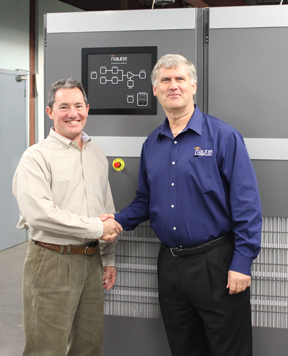
    UrsaNav’s President, Charles Schue, shown accepting the transmitter from Nautel’s President, Peter Conlon.
    UrsaNav’s President, Charles Schue, shown accepting the transmitter from Nautel’s President, Peter Conlon.

    After extensive Final Acceptance Testing at Nautel’s Hackett’s Cove, NS facility, UrsaNav has accepted delivery of the first production NL40 Loran-C and Enhanced Loran (eLoran) transmitter. This seventh-generation Loran transmitter technology is the culmination of more than six years of collaborative development between the two companies.

    The transmitter successfully met or exceeded all of the requirements of the U.S. Coast Guard “Specification of the Transmitted Loran-C Signal.” Testing was conducted into a simulated antenna matching the characteristics of a U.S. Coast Guard “standard” 625-foot top-loaded monopole. The NL-Series transmitters are capable of transmitting Loran-C, eLoran, Chayka, and eChayka in any combination at power levels exceeding one megawatt. They are qualified for today, and prepared for tomorrow, UrsaNav said.

    “Resilient PNT begins with complementary technologies, layered one upon the other in such a way that the user is ensured improved continuity of operations over a sole-source solution,” said UrsaNav President Charles Schue. “eLoran is the terrestrial co-primary complement to GNSS, and our technology makes eLoran the most economical, efficient, and wide-area alternative when GNSS is not available.”

  • UrsaNav Follows Up with Second Wide-Area Timing Tests

    This week, UrsaNav once again transmitted from the former USCG Loran Support Unit (LSU) facility in Wildwood, New Jersey. To ensure that those interested understand that the USCG has no intent to acquire, operate, or provide a wireless time technology or services, UrsaNav has renamed the LSU — it’s new facility name is the Diamond Beach Facility, or “dBF.”

    In a statement released today, UrsaNav said:

    “Our main purpose for on-air testing at this time is to demonstrate wide-area precise time distribution using terrestrial, ground-wave RF solutions. However, a robust timing solution uses on-signal data channel(s) for nanosecond-level corrections, so we are also testing a variety of modulation techniques that provide significant throughput gains over the current 100-180 BPS methods.

    “Our current equipment suites consist of the Nautel NL Series prototype transmitters, Symmetricom Timing and Frequency Equipment (TFE), and UrsaNav UN-150 eLoran Timing Receivers.

    “We are not simply transmitting eLoran. We are also evaluating some improvements to eLoran that do not change the underlying signal structure. Finally, we are testing various alternative LF solutions that include new waveforms and modulation techniques.

    “We have established preliminary monitor sites at five locations: Boston, Massachusetts; Chambersburg, Pennsylvania; Leesburg and Chesapeake, Virginia; and Charleston, South Carolina. We are scouting for additional monitor sites at distances of up to 1,500 miles from our current transmitting location.

    “During this week’s testing, we tightened the synchronization of our transmissions to within 10 ns of UTC. We tested continuously for periods in excess of 24 hours. Without the use of any propagation corrections or differential monitoring, we successfully demonstrated UTC traceability to within +/- 30 ns at 160 miles and to within +/- 70 ns at 500 miles. Several acquisition trials showed that our receivers can very quickly acquire the LF signal and steer to within 50 ns of UTC. At all distances, our receivers met the ITU and ETSI Maximum Time Interval Error (MTIE) masks for Primary Reference Clocks.

    “Additional on-air tests are planned for next week, so stay tuned for the third part of our continuing series on wide-area timing.”

  • eLoran and UrsaNav: Timing Is Everything

    The first part of the recent UrsaNav press release says it best:

    This week for the first time since August 2010 advanced low frequency (LF) signals, including a new eLORAN, are on the air in North America! As a result of a Cooperative Research and Development Agreement (CRADA) between the United States Coast Guard (USCG) and UrsaNav, Inc. live testing of a wide-area precise timing solution has begun. These initial tests include a comprehensive pallet of signals, including eLoran, that are being evaluated for their ability to provide a robust, wide-area, wireless precise timing alternative that can operate cooperatively with GPS, or during periods of GPS unavailability.

    Why eLORAN

    Global government, industry, and academic experts recognize that advanced LF signals, of which eLORAN is just one example, can provide alternative timing — either as a stand-a-lone service, or as a component of an existing PNT service. The high power, virtually jam proof and spoof proof LF signals operate independently of GPS and GNSS, and provide a Universal Coordinated Time (UTC) time reference in the order of tens of nanoseconds. The recognition of the criticality of time to many aspects of our national critical infrastructure has led to establishment of the CRADA to evaluate the benefits of an LF wide-area timing system.

    UrsaNav on-air eLORAN tests continue at various sites throughout the United States (CONUS and Alaska). Broadcast demonstrations will test several different frequencies, waveforms, and modulation techniques using evolutionary state-of-the-art technology.

    Reception demonstrations of the eLORAN broadcasts are planned at both on- and offshore locations, and will include advanced LF data delivery techniques. Trial results will be presented at national and international conferences. Anyone interested in any part of the testing or interested in making their own measurements are invited to contact UrsaNav.


    UrsaNav eLORAN system. Arthur Helwig (UrsaNav) and
    Aaron Grant (Nautel) prepare the LF transmitter for the next
    set of on-air tests.

    Partnered with Symmetricom and Nautel, UrsaNav says it has the world’s most advanced LF alternate PNT and data solutions to include the world’s best high-performance eLORAN timing receivers. UrsaNav has partnered with two of the best in the business for timing and transmitters, and this alliance of expertise provides the foundation technology for the best wide-area terrestrial-based alternative to GNSS such as GPS, GLONASS, and Galileo.

    That being said, I would add that you should not only consider the UrsaNav LF system as an alternative, but during normal GPS operations as a complimentary and/or augmentation to GPS, and then as a back-up and integrity system when the situation warrants.

    As one of my professional colleagues, who is a retired USCG officer and once ran the USCG Navigation Center, stated, “This is a big deal! It is in fact the first and biggest piece of good news about a true PNT (position, navigation, and timing) backup for GPS since Loran-C was killed in the FY2010 budget.

    “Not only is this an independent timing backup, but the LF signals can also be used as pseudoranges mixed in with GPS, or if enough transmitters are available, as a fully independent PNT network. In other words, a true backup PNT capability for safety-of-life navigation, for dispatching first responders, and for supporting critical national infrastructures.”

    This is a pretty enthusiastic response, even from a LORAN aficionado, and it is indicative of the responses I received whenever I reached out for comments from knowledgeable PNT SMEs (subject matter experts) around the globe.

    The response nationally and internationally has been extremely positive as well — especially in light of the recent LightSquared debacle and the now better-understood vulnerabilities of the very low-power GPS signals.

    I hoped I would never have to type or have you read that word again, as a noun or a verb, but the whole LightSquared scenario did serve to point out a dire need and shortcoming in the U.S. PNT infrastructure. Fortunately, the proposed UrsaNav eLORAN system appears to be on track to fill that need perfectly.

    For the first 32 years that GPS signals were broadcast, LORAN-C served as a critical backup for timing and a less accurate but viable alternative for navigation. In fact, Loran-C, along with GPS and cesium clocks synchronized to UTC, were the only accepted Stratum 1 frequency sources at the time (Stratum 1 frequency sources provide a minimum frequency stability of 1 x 10-11 per day.). Then in 2010 the current U.S. administration was looking for government programs to cut and for some unknown reason they latched onto LORAN-C, which was in a critical state of transition at the time.

    LORAN-C has been around since World War II. I among many other aviators used it extensively in Vietnam, and frankly for many countries and users today it is still a totally adequate service. With USCG expertise and support for 52 years, LORAN-C provided unparalleled timing and navigation services around the United States and Canada until the pretender known as GPS came along and dethroned the aging monarch.

    Now, that may sound like a natural sequence of events, except that LORAN-C was in metamorphosis, 80% of the way through the process actually, of morphing into a new digital (1990s era technology) LORAN know as eLORAN or enhanced LORAN with better, more reliable transmitters, smaller receivers, and a virtually jam-proof signal structure. Many likened the legacy eLORAN to a strong ground-based GPS with coded signals for security. All that was in place and 80% complete when the whole process was killed by an administration with a strong Luddite orientation and subsequently the bean counters pulled the plug in 2010, despite recommendations to complete eLoran from both the Department of Transportation’s Positioning and Navigation (PosNav) Committee and the Department of Homeland Security Geospatial Committee and the strong personal support of the DOT Undersecretary for Policy and the DHS Deputy Undersecretary for Preparedness and National Protection and Programs. My sources tell me the Office of Management and Budget (OMB) was determined to do away with Loran-C and facilitated its ultimate demise. An unfortunate theme we have seen played out much too often: Non-technical people forcing ill-advised technical decisions. In a country whose greatness has always been its technical acumen, willingness to take risks, and self-assurance, OMB stands as a chilling element of focus today…but, that’s a subject for a future article.

    Since that time the U.S. Coast Guard spent more money dismantling the legacy LORAN-C infrastructure and antennas than it would have taken to complete the 20% upgrade for a full transition to eLORAN. Taking down the Port Clarence, Alaska, tower, the video of which was a YouTube favorite for many weeks, cost an estimated $8 million. The destruction of the towers in Attu (right), Shoal Cove and St. Paul were probably on average $5 million each. With the tower removal in Baudette, Minnesota, the cost of removing Loran towers to date cost close to $25 million. One could argue that the administration created some jobs in these “shovel-ready” tower tear downs, but I have no doubt that a better use of the funding would have been to deliver a robust positioning, navigation, and timing backup for the nation. But alas that is ancient history in the technology world, a whole 18 months to be exact.

    Then along comes the Lone Rang… I mean Chuck Schue, the CEO and president of UrsaNav, which is a small company originally founded by Charles “Chuck” Schue, because frankly he has always been interested in navigation. Chuck is a former ION (Institute of Navigation) Washington, D.C., Section Chair and is a current member of the ION Council. Chuck is also a retired USCG officer and his last job in the USCG was as Commanding Officer of the Loran Support Unit, providing direct support to a large portion of the functions supported by the USCG Navigation Center (NAVCEN). So it is no accident that Chuck and UrsaNav saw the gaping hole for GPS support that was created when LORAN-C and the legacy eLORAN programs were unceremoniously put on the chopping block. Now UrsaNav with their new 2012 version of eLORAN and the help of the USCG, through a CRADA, have stepped in to fill a very real need.

    In my opinion (pun intended) their timing could not have been better. LightSquared is hopefully behind us along with the threat of losing GPS capabilities and all GPS P&T (positioning and timing) enables without a viable backup. This is definitely not a scenario any sane person wants to see happen again and fortunately UrsaNav LF timing and eLORAN can provide a critical back-up, augmentation and integrity check while simultaneously providing the USG with a security blanket, as Linus would say.

    The USCG-UrsaNav CRADA

    Before considering reactions from other USG agencies and then international reactions to the UrsaNav program, maybe it would be best, in case any of you are wondering, to describe the function of the subject CRADA since it has been mentioned several times.

    In February 2012 the U.S. Coast Guard Research & Development Center (R&DCEN) announced it had entered into a Cooperative Research and Development Agreement (CRADA) with UrsaNav to research, evaluate, and document at least one alternative to the Global Positioning System (GPS) as a means of providing precise time. The alternative under consideration is a wireless technical approach for providing precise time using U.S. government facilities and frequency authorizations.

    While this is a very general statement and does not give much away, it is meant to be that way since it is, after all, an R&D effort and general statements give you the most leeway when considering options and trade space.

    CRADAs are authorized by the Federal Technology Transfer Act to promote the transfer of technology to the private sector for commercial use as well as specified research and/or development efforts that are consistent with the mission of the federal parties to the CRADA. The federal party or parties (USCG) agree with one or more non-federal parties (UrsaNav) to share research resources, but the federal party does not contribute funding.

    This means that the USCG and UrsaNav are sharing R&D efforts, data, and even non-monetary resources, but the USG is not providing any funding to UrsaNav for the project. So UrsaNav is footing the bill; at the same time, it has access to USG data and resources, to include buildings and transmitting towers, for example, and UrsaNav knows it has at least generated interest among government and commercial users for LF timing signals.

    DOT/FAA Reactions

    When I first saw the UrsaNav announcement, I immediately thought of the DOT and FAA, since they have been trying to think of ways to provide a common, non-GNSS, distributed timing backup for all their facilities and customers as part of their efforts to develop an alternate PNT (APNT) capability. One of the APNT alternatives is considering distributing time to air traffic control facilities and aircraft through their ground-based DME (distance measuring equipment) facilities. For the non-aviators among you, DME signals allow aircraft to determine their distance from a DME location. Properly equipped aircraft (primarily commercial and high-end general aviation) can use ranging from multiple DMEs to actually determine their position and follow area navigation (RNAV) procedures for more effective routing and flexibility. In order to utilize the DMEs as a ground-based, high-power (1000 W) equivalent of a satellite constellation will require each DME facility to be synchronized in time to around 30 nanoseconds or better. Now, with the possibility of an eLORAN time standard with a huge booming, virtually jam-proof and spoof-proof signal, across the CONUS and Alaska, this FAA alternative solution could be greatly facilitated. While the FAA also has the option to use GPS time, or time from its own WAAS ground-based clock ensemble, or WAAS retransmitted time combined with GPS time for remote locations and to back it all up and provide an integrity check, the availability of an eLoran alternative is certainly worthy of FAA APNT consideration. The FAA’s distribution problems would be solved, and since both GPS and eLORAN have the capability for encoded signals, the integrity (information assurance) and security problems are solved as well. Comparison of the vulnerable GNSS signal with the robust eLoran timing signal could alert an operator to possible spoofing or even a less sinister loss of integrity event. So this is a win/win for the FAA and several other critical national agencies and infrastructures that must remain nameless for security purposes.

    International Partners

    What makes the UrsaNav solution so promising and frankly exciting is that they are not conducting these experiments and demonstrations in isolation. For the past few months UrsaNav has been working with the Lighthouse Authorities of the United Kingdom and Northern Ireland as well as Chronos Technology, a world leader in GNSS jamming and interference detection, in Great Britain. To determine how the UrsaNav eLORAN program is progressing internationally, who are you going to call? Personally, if it concerns GPS, time, and the UK, there are two people who immediately come to mind: Dr. David Last and Martin Bransby.

    Professor David Last is a consultant engineer and internationally renowned expert witness specializing in radio navigation and communications systems. David is a Professor Emeritus (that means he is at least as old as I am) at the University of Bangor, Wales, and Past-President of the Royal Institute of Navigation (RIN), the equivalent of the U.S. ION, but RIN has only been around since 1947. David acts as a consultant on radionavigation and communications to companies and to governmental and international organizations worldwide and is active as an expert witness, especially in forensic matters concerning GPS.

    Both David and Martin are highly qualified SMEs and BLUF, or bottom line up front; their praise for the UrsaNav initiative could not be higher.

    According to Professor Last, “…a ‘sky-free’ timing service like the one UrsaNav will hopefully soon be radiating in the United States is already available across the British Isles and adjacent parts of Europe. The eLORAN system uses the GLAs’ prototype eLoran system plus GPS/eLoran timing receivers from UrsaNav and Chronos Technology.

    “The prototype eLoran service has been running 24/7 since January 2008, serving the eastern half of Britain and the North Sea. It now delivers 10-meter (~30 feet) navigation accuracy in the approaches to Harwich and Felixstowe, the UK’s major container ports, where a prototype full differential service has been in place since mid-2010.

    “In addition, the UK transmissions support a prototype robust, nationwide data channel that will benefit in future from the techniques currently being developed by UrsaNav to expand the data capacity of eLoran-compatible LF transmissions.

    “This is all part of the resurgence of terrestrial LF services in response to the vulnerability of GPS and all other GNSS (read LightSquared). The GLAs are leading this movement to adopt eLoran as the terrestrial complement at sea and supporting the use of the new eLoran transmissions for sky-free complementary navigation, timing, data, and tracking of land vehicles. And the neat thing about LF timing and data is that a single station serves a large area. So the UK station delivers data across the UK and timing even more widely. This appeals to all sorts of folks who aren’t interested in navigation. But once enough timing and data stations are on the air, you get back navigation!”

    Now, Martin Bransby is the R&RNAV (Research and Radionavigation) manager for the General Lighthouse Authorities (GLAs) of the UK & Ireland. Which simply means he is a senior engineering manager and program manager with extensive experience in R&D of highly technical assets, such as maritime aids to navigation, radar, C4ISTAR, and tactical data links, and he is the official GLA POC working the eLORAN program in the UK and Ireland, which he indicates is progressing extremely well. So well, in fact, the GLAs awarded a 15-year contract to provide a state-of-the-art eLORAN service to improve the safety of mariners in the UK and Western Europe. The service contract includes R&D work and the operation of an eLORAN service through 2022.

    Support: The Good News

    Back on this side of the pond, my sources at the USNO (U.S. Naval Observatory) our resource for Coordinated Universal Time or UTC are supportive of the UrsaNav eLORAN effort. A senior source, who prefers to remain anonymous, stated that the USNO will support any USG terrestrial time distribution system that may emerge from the UrsaNav eLORAN effort by providing the underlying timing reference “UTC (USNO).” However, to achieve true GPS independence, my source would like to see either fiber-optic or two-way satellite time transfer (TWSTT) utilized to sync the eLORAN ground transmitters. And in the end higher power, GPS independence, and good indoor reception are probably the greatest advantages. My source is looking forward to the results of this initial demonstration by UrsaNav and the USCG.

    According to Chuck Schue, UrsaNav, anticipated this USNO preference and is working with Symmetricom on a TWSTT while also developing a TWLFTT, or two-way low-frequency time transfer capability, which allows for time transfer from a UTC source such as USNO or NIST that is completely sky-free.

    The Bad News

    We’ve all heard the Biblical phrase that originated in Matthew concerning “the right hand not knowing what the left hand is doing.” In this instance, where eLORAN is concerned, the USCG may have adopted that as a program motto.

    Note: The real motto of course is Semper Paratus, and the brave men and women of the USCG live up to it everyday.

    Originally in the Unites States, CONUS, and Alaska, there were 24 LORAN-C transmitters with towers between 600 and 1350 feet tall; add the towers supporting the Joint U.S.-Canadian LORAN-C system plus the LORAN-C Support Unit tower, and there were a total of 30 huge LORAN-C towers with all the accompanying support structures for the transmitters, support crews, etc. Today, there are only 25 towers remaining — as the USCG engineers are in the process of dismantling the LORAN-C infrastructure — five towers in the last 18 months.

    As often happens in a large distributed organization, though Headquarters (CG-5) supports the eLORAN CRADA with UrsaNav and fully realizes that future eLORAN deployment depends on reuse of existing infrastructure, the civil engineering support organization gets its money and develops its project lists separately. Consequently the antenna towers at Attu (located at the end of the Aleutian chain) and Port Clarence (situated well north of Nome) have come down, as have the towers in St. Paul (in the Pribilof Islands, northern Bering Sea) and Shoal Cove (located in SE Alaska, near Ketchikan). Only two towers remain in Alaska; one in Kodiak (adjacent to the USAF-Alaska launch facility) and one at Tok Junction (on the ALCAN Highway, southeast of Fairbanks). Within CONUS, the USCG engineers are in the process of dismantling the facilities in Baudette — which is just about as isolated as some of the sites in Alaska.

    Operational Issues

    The operational problem is that while the much more powerful and economical energy-scavenging transmitters from UrsaNav’s partner Nautel, and new wave forms being produced by UrsaNav, probably only need to utilize 8-10 towers — the system is that much better and more powerful — no one knows where they need to be located until more tests are conducted. So how do the USCG engineers know which ones to dismantle? Obviously they don’t and there’s the rub, plus if the system is really successful and the data portion is a success, there could be a need for even more towers. Solution — the R&D guys (RH) need to coordinate with the engineering crews (LH) and put a hiatus on dismantling LORAN-C towers and the associated infrastructure, unless they pose a safety hazard, until the outcome of the CRADA and subsequent acquisition decisions have been made.

    Seriously, the USCG and UrsaNav are heroes for initiating the CRADA, and my hat is off to them for realizing the critical need for eLORAN, but seriously, somebody pick up a phone and call the engineers, call the Commandant, call somebody that can put the tower demolitions on hold.

    The bottom line is UrsaNav and the USCG are to be congratulated for their foresight and planning. Let’s hope the eLORAN demonstrations continue to be successful and that a contract is forthcoming quickly before we, and the powers that be, forget the LightSquared lessons learned…like we would ever let that happen.

    All in all, this is a win/win proposition for the USCG, the USG, and for GPS users everywhere. Stay tuned for more on this topic.

    While you are reading this I will be attending the Munich Satellite Summit in Germany, so guess what my topic will be next month?

    Until next time, happy navigating.

  • UrsaNav Testing Wide-Area Timing Alternative

    As a result of a Cooperative Research and Development Agreement (CRADA) between the U.S. Coast Guard and UrsaNav, Inc., on-air tests are being conducted from the former Loran Support Unit site in New Jersey.

    One of the CRADA’s goals is to research, evaluate, and document a wireless technical approach as an alternative to GPS for providing precise time. The ability to obtain precise time to at least one microsecond is necessary for the proper operation and functioning of many critical industries and systems. Examples include telecommunications networks, banking and finance, energy and power delivery, emergency services, transportation systems, and military and homeland security systems.

    Additional on-air tests are planned at various sites throughout the United States. Broadcasts will test several different frequencies, waveforms, and modulation techniques using evolutionary, state-of-the-art technology. Reception of these broadcasts are planned at both on-shore and off-shore locations, and will include advanced LF data delivery techniques. The results of these trials will be presented at national and international conferences. Any party interested in any part of the trial, or interested in doing their own measurements, are invited to contact us.

    UrsaNav provides advanced solutions for Low Frequency Alternative Positioning, Navigation, Timing, and Data, including high-performance eLoran Timing Receivers. The company has partnered with precise-time synchronization company Symmetricom and Nautel, supplier of high-power RF transmitters. According to UrsaNav, this “alliance of expertise” provides the foundation technology for a wide-area, terrestrial-based alternative to satellite systems such as GPS, GLONASS, and Galileo.