Details of this Thursday’s Connected Car webinar emerged as speakers gathered today to share their presentation materials. (You can join this free webinar here.) A key concept is that no single technology can provide the required position accuracy in all environments. A combination of core GNSS technologies is needed: SSR-RTK with correction data (satellite and LTE), multi-GNSS for large number of measurements, Multi-band reception for minimal convergence time and 3D automotive dead reckoning.
Speakers from Renesas Electronics, Toyota InfoTechnology, u-blox and Denso will present technical material of interest to engineers and system integrators as well as product managers, strategic planners and executives.
The topics covered in the webinar include:
• Recent developments in – and the potential safety impact of – V2X technology, by Chaminda Basnyake, Renesas Electronics
Driver and Pedestrian intent are both expressed Over-the-Air (OTA). Key: Basic Safety Messages (BSM) / Personal Safety Messages (PSM) / Signal Phase and Timing (SPAT). OTA also broadcasts an intersection map and GPS corrections.
• The status of V2X standards (traditional DSRC and emerging 3GPP), and the status of US spectrum and NHTSA regulations, by John Kenney, Toyota InfoTechnology Center
Spectrum choices and the possibility of unlicensed device spectrum sharing.
• Considerations for GNSS and cellular/short-range connectivity for autonomous vehicles, and examples of implementations for connected vehicles, by Nikolaos Papadopoulos, u-blox America
There is no single technology capable of providing required position accuracy in all environments. A combination of core GNSS technologies is needed: • SSR-RTK with correction data (satellite, LTE) brins accuracy of Multi-GNSS for large number of measurements. • Multi-band reception for minimal convergence time. • 3D automotive dead reckoning to smooth multipath effect, bridge obstructions and maintain positioning in tunnels and parking.
• Connected and Automated Vehicles for Traffic Safety: How radar, lidar, cameras, dedicated short range communications (DSRC) and V2X will combine to create advanced Advanced Driver Assistance Systems (ADAS),by Roger Berg, Denso International
Video demonstrates in-car system giving audio warning of a hard-braking directly vehicle ahead, hidden from the driver’s view.
Esri is hosting a free one-hour webinar “Effective Vector-Borne Disease Surveillance and Control” on Thursday, May 26, at 11 a.m. PDT. The webinar will help city and county staff implement a complete workflow that is driven by understanding the location of information.
Geographic information systems (GIS) technology plays a vital role in monitoring and eradicating mosquitos, and ramping up to fast and efficient response when outbreaks occur. The webinar will introduce how the Esri ArcGIS platform can help create smart communities when collecting and analyzing data, improving operations and response times, and communicating critical information with the public.
When vector-borne disease outbreaks occur, fast, effective response protects people from infection and its consequences,” said Este Geraghty, Chief Medical Office and Health Solutions Director, Esri. “Integrated pest management programs respond through the vital functions of prevention, surveillance, and control activities. Temporal and spatial information are critical to those efforts to curb the spread of disease. Organizations that harness the power of a location platform can achieve faster, more efficient response.”
Speakers are Este Geraghty, chief medical officer and health solutions director, Esri; and Jared Shoultz, health and human services technical specialist, Esri.
For more information on how Esri solutions help with vector-borne disease surveillance and control, visit go.esri.com/vector-ready.
A GPS World webinar on April 14 explores how five organizations made the switch to using their own tablets and smartphones for field data collection (also known as bring your own device, or BYOD).
Lance Fugate of Enmapp based in Calgary inspects pipelines using TerraGo Edge on iPads.
Webinar participants will learn about and benefit from the real-world challenges faced during the five deployments of BYOD GPS field data-collection solutions. These customers and projects span very different industries, working conditions and requirements for GPS field data collection. Each offers a unique perspective based on their requirements and ultimately their approach to using smartphones and tablets for GPS-powered asset inspections, surveys, field service and remote workforce management.
The City of Sebring Water Utility faced challenges with field crew use of CAD diagrams, as well as obtaining RTK accuracy on iPads. Read more about the Sebring project in this article from our March issue.
The State of Louisiana needed to complete more than 4,000 miles of annual levee inspections while syncing field data from tablets to the cloud. Read more about the project.
Kleinfelder engineers needed to shift to real-time GPS on tablets so they could eliminate four hours per day of post-field processing, and bring projects in faster and under budget.
Empire Electric needed a method for customers to approve GPS-tagged work orders in real-time from the job site to avoid delays and lower costs.
Enmapp needed to cut pipeline inspection hardware and labor costs in the face of the oil industry’s low-price and margin-challenged cost environment.
Working with large scanning projects with billions of data points can be a tedious and time-consuming process, often resulting in breaking the project into manageable pieces and duplicating data sets across your organization. However, a new solution by Leica enables users to instantly load point clouds regardless of size and create CAD deliverables with increased productivity.
In this 60-minute webinar, Wallace shows how Leica JetStream, when paired with CloudWorx, can cut project time by up to 40 percent while allowing multiple users to stream the full data set simultaneously for added efficiency.
Covered topics include:
How to greatly improve data processing speed
How to reduce storage requirements with enhanced data management
How to accelerate the loading, display, and rendering of point cloud images for an application.
The free Leica TruView panoramic point-cloud viewer enables users to view, zoom in or pan over point clouds naturally and intuitively. In this 60-minute webinar, Wallace and David Langley provide a exclusive behind-the-scenes look at this point-cloud sharing tool.
Covered topics include:
How to communicate more effectively through point clouds by sharing them from any browser on any device, with no plug-ins required.
How to use new project management tools to make a team’s performance — and clients’ interaction with the data — more efficient.
How to take deliverables to the next level by incorporating strategies from some of today’s most successful innovative thinkers.
The September article Receiver Design for the Future is based on a GPS World webinar, which sprang from a presentation at the Stanford PNT Symposium. Listener questions and Greg Turetzky’s answers during the webinar are provided below. Greg Turetzky is a principal engineer at Intel responsible for strategic business development in Intel’s Wireless Communication Group focusing on location. He has more than 25 years of experience in the GNSS industry at JHU-APL, Stanford Telecom, Trimble, SiRF and CSR.
Is dual frequency expected to be seen in smartphones this year?
If what you’re saying there is L1, L2, L5, the answer is absolutely not. But if what you’re saying is GPS, Galileo, BeiDou, which are all in different bands, then I think we are already seeing tri-bands between the GLONASS band, the GPS band and the BeiDou band. I expect to see that continue from a multi-constellation standpoint, rather than multi-frequency on individual constellations.
How do you see antenna design changing and developing relative to receiver design?
If you go back to that slide, the answer is the opposite — antenna design has been getting worse and worse in order to shave cost and size and is being made up for in silicon design. A really good example is, most GPS receivers that we build for mobile phones aren’t optimized to work at -140 dBm, our standard normal outdoor power, because we never see that. The antennas that we typically work with are 8, 10, 12 dB down, so no matter what, we never see anything above -140.
So I think the answer is the opposite — no one is trying in my market to make better antenna design, they’re trying to make them even smaller and even cheaper. Especially if you think about getting into wearables and button-sized things, you need a GPS antenna, a Bluetooth antenna and a Wi-Fi antenna in a button. That’s the problem, and still leaving room for performance. So basically we’re being asked to make up for that in the receiver design.
One of your slides showed GPS with 100% penetration, and SBAS was one of the next highest bars on that chart, outdated as it was, even though it’s only less than a year old. What are the benefits of SBAS in a commercial receiver?
The issue with that fact is we like geostationary satellites, because they’re easy to find and they’re useful from a visibility standpoint. But the data demodulation of those is even more challenging than GPS because of the additional coding schemes that go on top of it. It’s very difficult for us to demodulate off the SBAS satellite, so we primarily use them for ranging and for autonomous operation when we’re not aided.
In aided operation, we use them less, because we get the data that we need off the Internet, right off a feed, or it comes in off of a satellite, which is much more useful. So SBAS stuff is there because it doesn’t add a lot of cost of difficulty to the receiver design, but it’s not a crucial part of the operation anymore — I’d say with the exception of QZSS, which has a large impact in its regional operating area.
Let’s continue the trend in questions towards multi-constellations. What’s the strategy to switch on another GNSS constellation in case of a GPS problem for a future receiver?
It’s a really good question, but it comes from a premise that we would switch something on that was normally off. The general strategy that’s being followed is to use everything that’s available all the time, so that we can use the methodologies of essentially autonomous RAIM on a receiver where we now have 8, 10, 12 signals coming into the receiver. It’s pretty obvious right away when something has gone wrong, and so it’s not so much time when we can flag when to switch on. It’s more a time when we can switch off. If we see a systemic problem in multiple satellites, then we may use that in our definition, but it’s not from a switching-on standpoint.
So, basically what we’re doing is we’re keeping everything on all the time and relying on autonomous RAIM capabilities from the fact that we’re tracking 14 or 16 satellites at a time with all this extra compute horsepower, because now I’m running embedded CPUs at hundreds of megahertz, where back at SiRF when we could get 15 megahertz, we were happy. So we have a lot more compute horsepower on the mobile side to do autonomous RAIM.
GPS World held a webinar on new unmanned aircraft initiatives on May 21 led by a panel of experts. On hand were Don Mark of the law firm Fafinski, Mark and Johnson; James Spicer and Adrien Perkins, both students in aeronautics and astronautics at Stanford University; and Peter Cosyn site manager and director of research and development at Gatewing, a Trimble company. I also participated.
Alan Cameron, editor-in-chief and publisher of GPS World, hosted the event and introduced the participants. Around 300 people signed up to listen to the webinar and ask questions.
Don Mark provided a legal overview of the FAA’s regulations for UAS, FAA and U.S. Senate initiatives, James Spicer and Adrien Perkins reviewed the Jäger UAV jammer detection project, and Peter Cosyn provided an overview of the Gatewing/Trimble UX5 UAS solution. I provided insight into recent UAS industry.
Finally, the panel discussed a few of several written questions submitted by the webinar attendees. We promised to publish both these questions and our attempt at providing answers. Please bear in mind that this is new area of technology, applications and regulations governing operations — so we welcome clarifications and inputs as we may miss the mark occasionally!
Q&A for GPS World Webinar:
“New Frontiers in Unmanned Flight: Hey You, UAV!”
Is the FAA going to keep requiring a pilot’s license to operate a UAV?
The draft sUAS rulemaking proposed by the FAA does not require a pilot’s license. Instead, there’s a requirement to pass an aeronautical knowledge test, obtain an FAA UAS operator certificate and to pass an FAA knowledge test every 24 months. However, the Section 333 exemptions granted by FAA so far have all required that the operator have a private pilot’s license.
What are the effects (operational, legal) of GNSS receiver failures in UAV missions and what are some technical measures to avoid them?
Most UAS used within a critical or commercial operation not only carry GNSS, but also have some form of navigation back-up system — MEMS inertial being the most common — so navigation is still possible, albeit for a short time with any degree of accuracy. And in the event of a communications link failure, the norm is to have the UAV follow a pre-programmed “return-to-base” route, so the vehicle returns safely to a known location.
What is the development of UAVs in the healthcare industry?
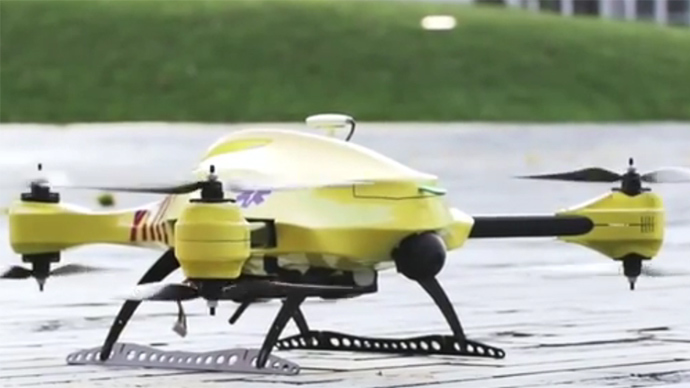
There are a number of ongoing and proposed applications of drones that are health related. A prototype system in Delft, Netherlands, carries a defibrillator to be used to revive heart-attack victims. The concept is that a network of geographically distributed drones would be called from a cellphone, and the closest UAV would be dispatched and would be able to arrive much quicker than a conventional ambulance.
This drone is part of a prototype healthcare delivery system in Delft, designed to carry a defibrillator to heart attack victims and caregivers.
Other healthcare applications could include the rapid delivery of vaccines, medications and supplies delivered right to the source of an outbreak. This could more rapidly reduce the incidence of life-threatening communicable diseases. Communication equipment, mobile technology and portable shelters could be delivered in a rapid fashion to areas where critical infrastructure damage would prevent ground or typical air transport. Drones have also been used extensively in disaster relief efforts.
Also, in July, unmanned aerial vehicles will deliver medical supplies to a free health clinic in Wise, Virginia. The most urgent prescriptions will be provided by pharmacies located out of town. To get the medicine to the community as soon as possible, the pharmacies will deliver them to their local airport, where they will be collected by NASA’s fixed-winged aircraft and be flown to Lonesome Pine Airport. When the prescriptions arrive there, they will be loaded onto Flirtey drones and delivered to the Wise County Fairground. Flirtey drones are expected to deliver around 24 packages of prescription medication.
Please describe LiDAR systems available for UAVs.
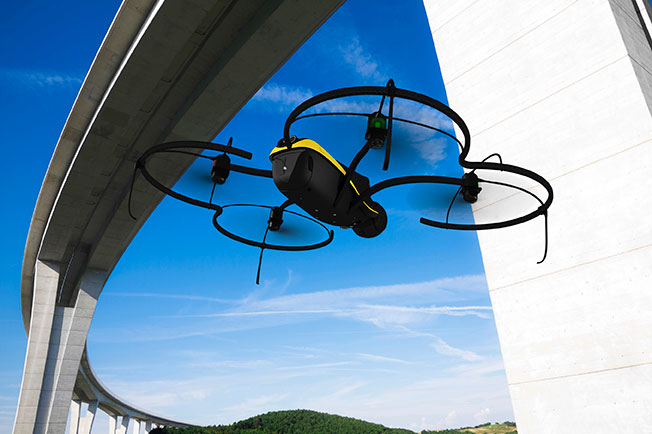
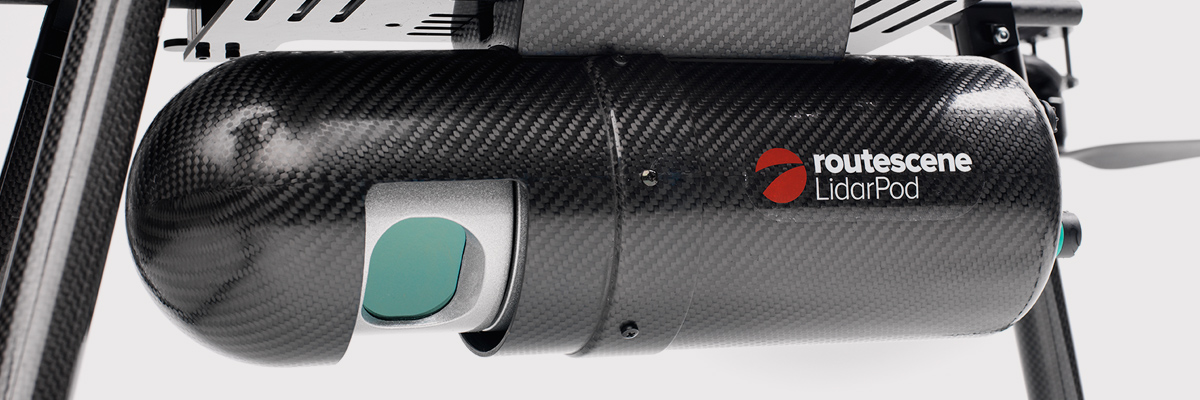
There are many lightweight LIDAR systems on the market for UAV applications — some even come integrated within their own operational drone system. Coupling drone-mounted LiDAR systems with vision cameras, advanced computer processing and GPS, it has now become possible to create a remotely piloted flying LiDAR scanner.
Routescene’s LiDAR pod attached to the belly of a UAV.
Update us on legal matters within the European Union?
The EU has been very active in preparing for the commercial use of UAS, so drone use in the EU appears to be significantly higher than in North America because of the proactive effort of regulators to introduce drones into regular commercial applications. This Forbes article summarizes the approach being taken and the progress towards introducing regulations within the EU by the end of 2015.
You speak of “UAV navigation in environments where traditional GPS receivers may fail.” Are you considering indoors navigation or “just” urban environment?
It’s true that drones are being operated indoors — for instance, within restaurants. In these environments, all the typical indoor navigation techniques will be viable — RF/magnetic fingerprinting, Bluetooth beacons, Wi-Fi source databases, cellphone signals including small cells, and even optical sensors, all often combined with indoor maps.
Urban environments with a restricted view of the sky also continue to challenge GNSS only navigation, which has led to extensive use of integrated inertial/GNSS navigation sensors.
Modularity of UAVs? Different sensors for different types of applications using the same UAV?
A number of professional drone manufacturers offer UAS that could carry different payloads. However, most manufacturers seem to focus on particular applications (flying camera, LIDAR and/or video survey) and don’t carry an extensive range of optional third-party payload equipment.
What regulations are there for self-made UAS?
It’s hard to imagine that the regulations would be different for a commercially manufactured drone or a home-built UAS. Only time will tell as regulations are developed that include this category of UAS.
What background and abilities should a team possess if it wants to develop a UAV?
An engineering team that takes on developing a UAV needs to be aware of the basics of flight, navigation and control/communications — these are the principle elements of UAV operations.
Do you exploit software-defined radio techniques?
Software-defined radios may find their way into UAVs whenever weight/volume are an issue, but they potentially require higher computing capability, and maybe somewhat higher power to run co-processors. Weight and power consumption are at a premium on small UAVs, so any initiative that saves in these areas will no doubt be welcomed.
What are the emerging application areas for UAVs?
It would seem that the application areas for UAVs are virtually unlimited. High interest areas include agriculture, pipelines, buildings and transmission line inspection, aerial survey, filmmaking and newsgathering, wildlife and environmental monitoring, fishing and military reconnaissance/weapons delivery. But there are many, many applications, some of which might not fit into this summary of applications.
When will the UAV market move beyond focusing on the drone itself and get to the important topic of what sensor technology and back-office systems provide the best value to the user? The UAV is a commodity.
Good comment — the utility of the UAV comes from the payload it carries and the analysis of the data it collects and how it can be operated.
I’m curious if the UAV mission will be used in conjunction with autonomous agricultural tractors and construction machinery. I’m assuming an off-site tractor operator would benefit from the aerial data for their scope of work.
Absolutely — another possible UAV application.
Do you know when high-altitude long-endurance solar-powered UAVs will start being used?
The key application being pursued by Google using high-altitude, long-endurance, solar-powered drones is to provide Internet coverage in areas that currently have no ground infrastructure. A number of countries around the world would benefit from connection to the Internet using this approach. Unfortunately, the prototype aircraft built by Titan Aerospace recently crashed. But Google has vowed to continue with its efforts. Another development, called Project Loon, involves the use of high-altitude balloons and is already well underway.
I am currently enrolled in the UAV Pilots Certificate Training Program offered through the Unmanned Vehicle University. Is this certificate, which costs $3500, going to actually benefit me in my future commercial operations? Does the FAA recognize it as anything valid? So unless the certificate provides me some practical advantage, I’m not sure if it was legitimate or a scam. Any thoughts on this or experience with this “University”?
A recent Senate bill seeks to establish the six FAA test centers as the authorities for training UAS pilots. However, it would appear that currently no universal training course has yet been developed or approved for UAS pilot training — so it may be premature at this stage to engage with third parties for training until guidelines are published by the FAA.
What is the positional uncertainty associated with the locational measure of GPS systems on these UAVs? What will it be in five years?
Depending on the application, accuracies between 1 meter and a few centimeters are being achieved. For higher accuracy requirements such as precision surveying, post-processing of data collected during a survey can provide accuracies within a few millimeters.
In five years’ time there will be more satellites in more constellations, and it’s possible that accuracies could improve further. However, the most benefit will come from having more reliable signals, more often, thereby reducing re-test and operational costs.
What industry do you see being the fastest adopter of UAV technology in the USA?
The U.S. military is already leading in the number of applications, number of operational UAS and number of different types of vehicles. Commercial applications have increased substantially now that the FAA has authorized a large number of civilian operations in the last year or so. There are a number of film and TV applications for movie-making and newsgathering, and this appears to be a growing area for commercial UAS. Aerial survey is also growing in popularity, and there is a huge range of monitoring applications for building inspection, pipeline and transmission line inspection, and also for crop growth monitoring — which may turn out eventually to have the highest number of applications in the U.S.
How do you think the industry should protect UAVs from GPS spoofing and other forms of remote or internal component (example ICS or SCADA) attacks?
Solutions to mitigate GNSS spoofing and signal jamming are currently high on the list of most receiver manufacturers’ development agendas, with several options already having reached the market. Anti-jam antennas, improved signal rejection in RF front ends, and algorithms that claim to be able to deduce and overcome spoofing attacks — these are the leading solutions that have been fielded. But we have only just scraped the surface of deceptive techniques being used and the frequency with which they are being encountered, so we should continue to see the solutions evolving to counteract more sophisticated interference and spoofing capabilities over time.
Will the upcoming regulations only impact commercial users, or will they also directly affect non-commercial and/or recreational operators?
In the U.S., regulations governing the operation of recreational or hobby aircraft appear to be less stringent than, say, a drone operating commercially. As long as common sense rules are observed, hobby aircraft operators have been able to operate without the FAA looking over their shoulders — provided they stay below 400 feet in an open space away from sensitive areas such as schools or hospitals and don’t make an inordinate amount of noise, no one has yet proposed more restrictions for hobbyist model aircraft operators. The focus for the FAA is currently on bringing drones safely into the national airspace system for commercial operations, so regulations so far have been mostly formulated to enable this to happen.
Proposed legislation in the USA refers to one pilot per vehicle; no mention is made of swarming or control of multiple vehicles per pilot. Is it worth developing apps that use swarms of UAVs at the moment?
Certainly, it’s been difficult for the FAA to introduce regulations for UAS that are acceptable for most anticipated commercial operators, while still respecting and protecting current manned aircraft operations. So far, we’ve had case-by-case approval for specific operations, while regulations for small UAS (sUAS) have only just been circulated for comments — and a huge number of comments have been received. So regulations for “regular-sized” and operated drones and for larger vehicles have not yet seen the light of day. So, the more complex applications involving the operation of a swarm of UAS may not yet have been even considered by the FAA. It has taken years to get this far, and we still don’t have any published regulations for any class of UAS in commercial applications, so it’s doubtful that there is any work underway on regulations for swarming drones. So develop apps if you wish, but don’t expect much regulatory support for some time yet.
What assurance do we have that a UAV operator won’t deliver a weapon instead of an Amazon purchase?
The exemptions that have been published allow certain well-defined, specific commercial operations of UAS. The unmanned vehicle has to be registered to an individual and get a unique tail number. The operators have to be identified and must regularly demonstrate proficiency and adequate knowledge to become a recognized operator. So authorities get to inspect the UAV, know the owner and know the operator, and even get to review and approve the location of each UAS operation — not that that would prevent someone subsequently modifying the vehicle to carry ordinance, or knowingly attacking a target. It would, however, be pretty easy to track down the offender, but that doesn’t really prevent “weaponization” or delivery. But we are only at the small-vehicle-level currently, so its doubtful if major damage would be possible with small weapons, but an individual attack might still be lethal. Careful screening of individuals seems to be the route the regulators have taken to minimize this risk. This is still a difficult issue that is going to take some policing and close control.
Instead of an actual pilot’s license required for legal flight of a UAV, do you think an all-encompassing UAV pilot’s license will be required? I ask because I am a trained Trimble UX5 pilot, but I do not have my pilot’s license. I also build UAVs, and I am curious how I would get a UAV pilot’s license for a UAV I built? Unless they had an all-encompassing training course for pilot/flight safety.
The FAA proposed rulemaking for sUAS operations did not require operators to have a pilot’s license. Instead, UAS operators are required to undertake a specific recurrent training course for UAS operators, administered by FAA qualified trainers. Regulations relating to “home-built” UAS have yet to emerge, and may be some time away from publication.
It is said that mainland China has over 70% of the world UAV market? How did we fall so far behind?
Lack of regulations in the U.S. may have held back U.S. industry — see related comments by Amazon in testimony to the U.S. Congress.
But also the absence of restrictions in other countries may have helped overseas manufacturers get established and to gain initial market share. While the majority of done R&D was initially within the U.S., it’s clear that DJI and its Phantom line of drones have become very popular, very quickly. Strangely enough, the largest concentration of buyers and operators currently appears to be in the U.S.
Insurance against UAVs crashing and causing damage to humans: what progress has been made in this area?
Several insurance companies are now writing risk-coverage policies for UAS, including Global Aerospace, USAIG, Allianz and AIG.
We are operating a GNSS reference network in Greece, SmartNet-Greece (Leica Geosystems). Is there a tested NTRIP system on UAVs, to be connected and monitored to Ntrip caster? How could this augment real-time GNSS accuracy of UAVs?
Seems like you are trying to get RTCM corrections from a ground network to a flying UAV – correct? So do we need an Internet connection to get your ground network RTCM corrections onto the UAV? I’m not an expert on available mobile Internet hook-ups, but most smartphones have one, so it can’t be that hard to add this onto a UAV. Alternatively, wouldn’t it be easier to have the GNSS receiver on the UAV listen to a PPP broadcast from one of the several services providing these corrections? We could get down as far as 10 cm accuracy with one of these commercially available correction services.
Talk about the possibilities of precise positioning in UAVs, instead of mapping.
Precise real-time positioning on a UAV is a question of which GNSS receiver is onboard and which PPP or local RTK network transmissions are available in the area of UAV operations. Positioning accuracy is possible of a few centimeters down to a few millimeters post-processed.
Realistically, how close are we to being able to fly UAVs for commercial applications such as topographic surveys and earthworks applications such as mining sites?
As we heard during the webcast, obtaining an FAA section 333 exemption is quite possible for these applications, and some have already been granted. The FAA has been streamlining the process recently to reduce the time it takes to obtain these authorizations.
What is a practical ceiling for UAV flight?
The FAA has limited UAS operations to below 400 feet in the Section 333 exemptions that have been granted, while 500 feet is used as the maximum ceiling in the proposed draft sUAS regulations.
What is status of technology for “see and avoid” requirements for UAVs?
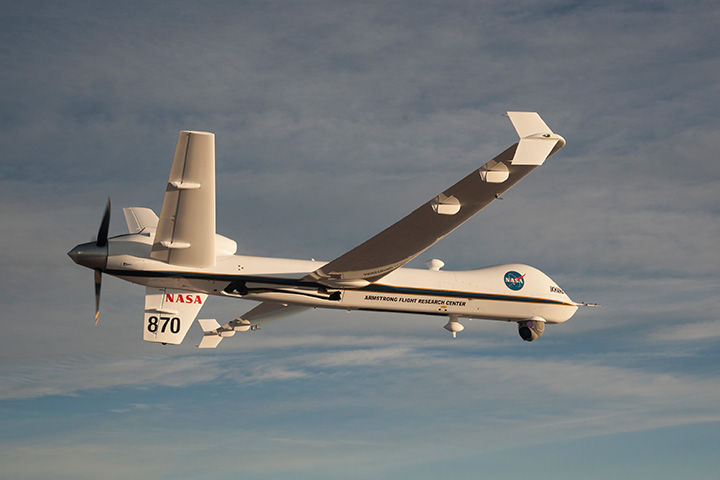
NASA, the Federal Aviation Administration (FAA), General Atomics Aeronautical Systems (GA-ASI) and Honeywell International Inc. have successfully demonstrated a UAS proof-of-concept sense-and-avoid (SAA) system. GA-ASI worked with NASA’s Armstrong Flight Research Center to integrate the new system aboard NASA’s Ikhana research aircraft, a civilian version of the company’s Predator B. The flight-test campaign in November and December 2014 evaluated the SAA system in a wide variety of collision-avoidance and self-separation encounters between two remotely piloted aircraft and various manned aircraft and included a sensor-fusion algorithm being developed by Honeywell.
NASA’s Ikhana Predator B drone.
An RTCA subcommittee is also working in parallel to develop the requirements for an SAA system, and these flight-test evaluations will contribute to those technical standards.
Other companies that are also thought to be active in SAA development include Rockwell/Collins, Sierra Nevada and Insitu/ Queensland University of Technology Australia.
So, a large number of questions on a pretty wide range of subjects — hopefully some of the answers we’ve provided will be of assistance — but please provide us with your comments if you have information to share.
Disclaimer: The statements, questions, views and opinions presented in this article are those of the author and webcast audience, and may not necessarily reflect the opinions of GPS World magazine, its owners or staff. Readers are also warned that the answers are provided on a best-effort basis and could be less than 100% correct.
Three new speakers have been announced for Thursday’s GPS World Market Insights Webinar. The webinar, “Street Smart: City Modeling and Other New Geospatial Techniques in Urban Mapping and Navigation,” will be held July 16, 1 p.m. EDT/ 10 a.m. PDT/ 5 p.m. GMT. Registration is free.
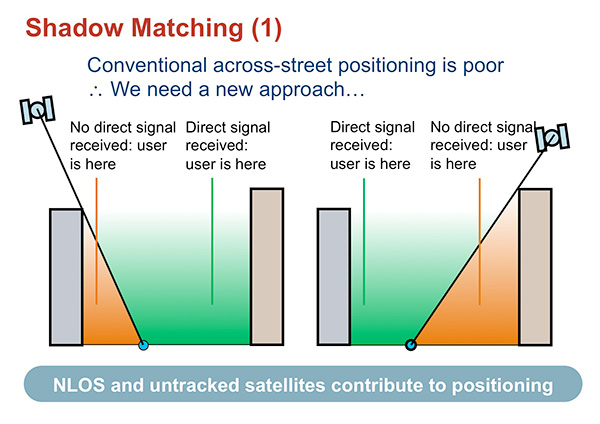
The webinar provides a high-level overview of the latest enhancements to computerized geometric city models, which can help overcome data gaps and inaccuracies created by signal obstruction, to improve GNSS positioning in dense urban areas. The webinar will focus on use of 3D mapping to aid GNSS in three different ways: shadow matching, height aiding and non-line-of-sight (NLOS) detection for conventional positioning.
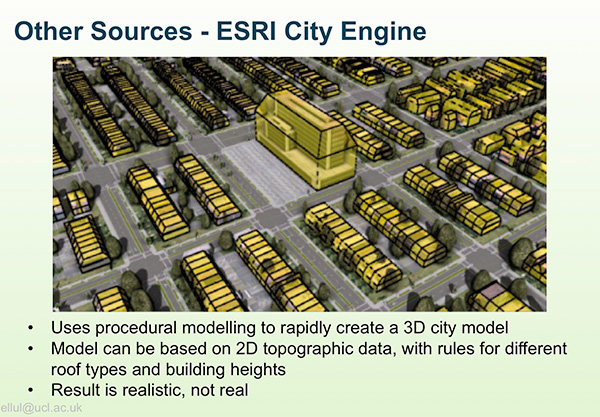
Claire Ellul, University College London, will discuss creating 3D datasets from photogrammetry, LiDAR, building information models (BIMs), Esri City Engine, Sketch Up, Google Earth and Open Street Map.
A page from Claire Ellul’s upcoming webinar presentation.
Also speaking are Rahul Gupta, Spirent Communications, and Gregory Moura, OKTAL Synthetic Environment, who leads the development of SE-NAV, a RayTracing simulator computing the propagation of GNSS signals in urban environments. The new version of this software can be embedded in a hardware in the loop process with Spirent’s SimGen to assess the performances of HW receiver in constrained environments.
Paul Groves will discuss “Better GNSS Positioning in Cities using Enhanced 3D Mapping,” addressing the problems of poor GNSS geometry in urban canyons, showing how 3D mapping improves GNSS positioning in several ways: height aiding, non-line-of-sight prediction, model-aided ranging and shadow matching.
A page from Paul Grove’s upcoming webinar presentation.
Visit our webinar page for full biographies of the speakers, and more information about our webinars.
Advanced driver-assistance systems (ADAS) are now integrated in all luxury cars and moving into mainstream models. Governments are getting involved to prevent accidents and minimize the related economic impacts with them. Manufacturers are not far behind; every one of them wishes to be seen as a technology master. Most car and truck companies are working actively on qualifying fully driverless technology today. The military also has a high interest in this area, and has developed autonomous convoy capability for large trucks and supply vehicles.
Although no driverless car is expected to operate freely on public roads for the next 10 years, some open test drives have already taken place, including one 100-mile highway cruise by a driverless Mercedes. This technology is restrained by legal issues and the lack of reliable nationwide mapping data — but the platforms are nearly ready to go.
Join us as we explore the current state of affairs and the likely near-term future developments.
Speakers:
John Fischer, Chief Technology Officer, Spectracom
Fischer has more than 30 years experience creating navigation and communications systems, received his Masters in electrical engineering from SUNY at Buffalo and has worked in radar, command and control, and wireless systems prior to joining Spectracom. To learn more, visit www.spectracom.com.
Lisa Perdue, Applications Engineer, Spectracom
Perdue is an applications engineer at Spectracom and a specialist in GNSS simulation. She has more than 15 years of navigation and RF systems experience, including 10 years of Naval Service.
Topics:
Accurate positioning of ADAS vehicles on the test track using similar methods as used in military UAVs – John Fischer
GNSS and Hybrid Navigation Testing Issues for ADAS and Driverless Cars – Lisa Perdue
Realtime Testing Issues for V2V and V2X for ADAS and Driverless Cars – John Fischer
Screenshot of a mobile mapping service integrating USGS topographic data; hiking and biking trails south of Golden, Colo. Imagery with road and contour data overlaid via AlpineQuest.
Are you a developer, firm, or organization using mobile or web applications to enable your users? The United States Geological Survey (USGS) has publicly available geospatial services and data to help your application development and enhancement.
The USGS’ National Geospatial Technical Operations Center (NGTOC) will be hosting a 30-minute webinar on “Using The National Map services to enable your web and mobile mapping efforts” on June 16 at 9 a.m. MT.
Screenshot of a mobile mapping service integrating USGS topographic data; hiking and biking trails south of Golden, Colo. Trail data in KML/GPX overlaid via AlpineQuest.
This webinar will feature a brief overview of services, data and products that are publicly available, a quick overview on how AlpineQuest, a leading private firm, is leveraging this public data to benefit their users, and a Question & Answer session with a USGS developer to help you get the most out of the national geospatial services.
“This is an opportunity from NGTOC to bring developers and users together for some demonstrations and starting some dialogue,” said Brian Fox, the NGTOC Systems Development Branch Chief. “The webinar format allows us to improve awareness of USGS geospatial services and develop a better understanding of what users and developers need to make our data and services more available and usable.”
To access the webinar, you’ll need to activate Cisco WebEx and call into the conference number (toll free) 855-547-8255 and use the security code: 98212385. The webinar will display through WebEx.
Use this system diagnosis to ensure that you have the appropriate players installed for this WebEx enabled webinar.
The session will be recorded and closed caption option is available.
Click here to find out more about this and other NGOC webinar conferences.
A city hall built in Minecraft. (Photo: Wikimedia Commons)
Safe Software is offering a webinar that discusses how the popular building game Minecraft offers a gaming approach to real-world geospatial scenarios. The presenters will discuss examples such as rapid design prototyping to increasing citizen and youth engagement, and helping urban planners create the perfect city block.
The presenters say they also will show attendees how they can integrate GIS, CAD, and BIM data sources with Minecraft in an automated way.
A few weeks ago at the Esri 2014 International User conference in San Diego, California, we conducted our first live event webinar from a Plexiglas booth sitting among many of the 14,000+ attendees buzzing around inside the San Diego Convention Center.
The webinar focused on high-precision GNSS on mobile devices (iOS/Android/Windows), unmanned aerial systems (UAS), and real-time GIS transactions. These are hot topics in the geospatial world, and that was confirmed when I received about 100 pre-webinar questions and more than 100 post-webinar questions.
In my article this month, I’ll do my best to provide answers to the questions asked. If I don’t get to your question, or if you have another, please email me at [email protected].
First of all, if you didn’t attend the webinar and would like to view the recording, you can register here and you’ll be provided a link to view it. It’s a great, interactive discussion. I grabbed Sharad Garg, iOS consultant, from the Esri show floor to talk about the intricacies and complexities of using GNSS receivers on iPads and iPhones.
Without further delay, following are some of the more popular pre- and post-webinar questions I received.
Mobile Devices
First, I’ll start with the questions about mobile devices and high-precision GNSS.
1. Will Android be the dominant mobile tablet platform in the Enterprise?
It’s hard to say. I recently met with a group of enterprise IT professionals and we were discussing this issue. Basically, the group was equally divided into thirds. One third were using Android. one third were using iOS, and one third were using Windows.
Android advantages: Lots of mobile devices available that run Android. Android disadvantages: Open source = non-standard implementations, so app software may not run on every device; security concerns.
iOS advantages: Consistent user interface, consistent software development environment, popularity of iPad and iPhone. iOS disadvantages: Closed ecosystem (very limited number of tablets); doesn’t interface to devices (such as GNSS) that haven’t been through the Apple certification process; security concerns.
Windows advantages: Security; lots of legacy apps and utilities written for Windows. Windows disadvantages: Limited number of tablets being deployed based on Windows.
For enterprise organizations, data security is a huge concern. Since Android is open source and gaining the most market share (at least in the consumer market), it’s got a target on its back for hackers. That’s the biggest concern I hear from corporate IT professionals. How will Android device developers address that, or will they? The consumer market for Android devices is exploding regardless of security. Do they even care about the enterprise market? Apparently Apple does as it recently signed an agreement with IBM to address the enterprise market, with IBM committing to deploying more than 100 enterprise solutions for iOS.
Site of the webinar broadcast from the Esri UC.
2. Which mobile platform is the most universal/easy to integrate with GNSS receivers?
Out of the box, Windows and Windows Mobile devices are still the easiest to interface to external GNSS receivers for the average consumer. Using Bluetooth, serial or USB, NMEA (or proprietary binary) data flows easily via the device com port or virtual com port. If you’re using a Bluetooth interface, there is some inconsistency among mobile devices due to the different versions of Bluetooth management software used on mobile devices, but it’s workable, and worst case you can buy an inexpensive third-party Bluetooth software manager like BlueSoleil.
With the use of an app such as Bluetooth GPS that allows you to select an external GNSS receiver, connecting your Android device to an external Bluetooth GNSS receiver is relatively painless.
Apple products are the toughest to integrate with external GNSS receivers via Bluetooth. Each GNSS receiver has to be specifically designed with an Apple Bluetooth authentication chip and be subjected to the Apple certification process, which can be lengthy and costly. This is the reason why you see very few Bluetooth GNSS receivers available for Apple products. The good news is that once the GNSS receiver is approved, the Bluetooth connection happens automatically when the GNSS receiver is in range of the Apple device. No com port config, no baud rate to worry about, etc.
3. What is available on Android that will make my smartphone a practical and useable tool that can assist in collecting professional data?
First of all, you need to find a high-precision Bluetooth receiver to connect to your Android device. Then, establish the Bluetooth partnership between the Android and GNSS receiver (scan for Bluetooth devices, enter passcode, etc). Once you have that, download the Bluetooth GPS utility I mentioned above and it will allow you to select which GNSS device to use (external vs. internal). Once you’ve selected the external GNSS receiver and connected to it via Bluetooth, every location app on your Android device will use the high-precision GNSS receiver for location.
This applies to an Android tablet or Samsung Galaxy phone. Take a look at this article to see how I ran RTK on a Samsung Galaxy using a Bluetooth RTK receiver.
Today’s challenge is finding “professional” GIS data collection apps that run in the Android environment. There are a few, but the selection is limited. Esri has its Collector for ArcGIS app that runs on Android, but it requires an ArcGIS server backend or ArcGIS Online account. Other data collection apps like Fulcrum and Amigocloud run on Android as cloud-based services.
4. Is there an actual GPS receiver within smartphones, or are they triangulating off of cell towers?
There’s a GNSS receiver in virtually every smartphone manufactured. The GNSS chips are so cheap (a few dollars) compared to the functionality gained that it wouldn’t make sense not to design a GNSS receiver in a smartphone. Now, just because there’s a GNSS chip in each smartphone doesn’t mean it’s the only technology used for location. For example, Apple iOS uses multiple data sources to determine the location at any given time. It will use a combination of cellular triangulation, Wi-Fi IP address, and internal GNSS receiver and external GNSS.
5. Which applications do you see requiring RTK accuracy within the mass-market applications?
A couple of years ago at the GPS World Leadership Dinner at the ION GNSS conference in Nashville, Dr. Todd Humphreys of the University of Texas at Austin predicted that you’ll have RTK (real-time centimeter accuracy) capability on your smartphone by the year 2020. I agree with his prediction, and I think we’ll see inexpensive Bluetooth RTK “pucks” well before 2020, as I’ve written before.
Often, I get the question raised above. Who needs RTK on a mobile phone?
I can’t tell you any more than that in the early 1970s when GPS was first being conceived, not one could tell you what GPS would be used for today. I love the following quote from Steve Jobs: “People don’t know what they want until you show it to them.”
6. Since many devices are complete systems with GNSS inside, do you see the direction of the industry moving towards remote “add-ons” like Bluetooth receivers?
Bluetooth receivers are certainly trending, and it’s primarily driven by the explosion of powerful yet inexpensive tablets and smartphones in the past five years, starting with the iPad/iPhone, and now with Android devices and smartphones in general. People want to use their consumer devices in a professional capacity and some need high-precision GNSS receivers, so that’s driving the demand for “add-ons” like Bluetooth GNSS receivers, laser rangefinders, and more.
Unmanned Aerial Systems
Ok, let’s transition to some questions on UAS (such as UAV, drones).
1. Do you see the FAA allowing simple operations for very low altitude UAV-sensors?
It’s difficult to speculate what the FAA will implement, but I have to think, based on its past behavior, that the initial rules will be super-conservative with minimum requirements being that a licensed pilot will be required to operate the UAS in addition to strict equipment requirements.
What’s going to be interesting to observe is what the FAA will do about the hundreds (maybe thousands) of UAS operators who will attempt (or are attempting) to “fly under the radar” and skirt the FAA rules. We’ve seen the FAA attempt (sometimes successfully and sometimes not) to crack down on some UAS operators whom it believes are violating the rules, but there have only been a handful of those cases.
2. When do you think the FAA will release rules for commercial UAV users?
I wouldn’t be surprised if the FAA issued some guidelines in September 2015, but I seriously doubt they will publish the full set of rules by then.
By the way, I attended an interesting UAS presentation at the AEC Summit prior to the Esri UC. You can see my write-up of it here.
That’s it for now. I’ve got many more questions from the audience that I’ll address in upcoming newsletters. Stay tuned and feel free to email me directly at [email protected].
On Thursday, March 20, CEO Javad Ashjaee of JAVAD GNSS will conduct a free webinar on the current state-of-the art in high-precision GNSS technology: Where is high-precision GNSS today? Where is it headed?
Further topics include new products and solutions from JAVAD GNSS, U.S. sales and customer-support news, and the offer of a two-week free trial for professional land surveyors of the JAVAD GNSS’s newest equipment, the TRIUMPH-LS and TRIUMPH-2. There will also be a question and comment session with one of the industry’s most accessible CEOs. Register here.
The 75-minute free webinar starts at 1 p.m. Eastern U.S. Time, 10 a.m. Pacific.