Tag: Xponential 2019

  • SBG Systems debuts line of inertial navigation systems at Xponential 2019

    SBG Systems debuts line of inertial navigation systems at Xponential 2019

    SBG Systems debuted its Quanta UAV series, a new line of inertial navigation systems (INS), at Xponential 2019, which took place April 29-May 2 in Chicago.

    According to the company, the Quanta UAV is a small, lightweight and low-power INS. Designed specifically for UAV survey applications, the Quanta UAV series provides precise orientation and centimeter-level positioning data delivered both in real-time and post-processing.

    “The Quanta UAV series is a new product line specifically designed for UAV applications and, more particularly, to precision applications like lidar mapping and photogrammetry,” Alexis Guinamard, chief technology officer at SBG Systems, told GPS World.

    The Quanta UAV series is also offered on two levels of accuracy: one of its most important benefits, Guinamard added.

    “The main advantage of the Quanta UAV series is high flexibility because we have two difference performance levels: the standard grade, which is suitable for most applications, and for higher altitude surveys we have Quanta Extra, which delivers improved accuracy,” Guinamard said.


    According to SBG Systems, Quanta UAV embeds a web interface for an easy configuration with a 3D view showing all parameters. Its calibration tool automatically aligns the lever arm between the two antennas and the sensor, then re-estimates it in flight for more precision. The Quanta UAV also eliminates the need for ground control points.

    In addition, the product comes bundled with one year of access to Qinertia, SBG Systems’ post-processing software, which will “enable accurate data in post processing,” Guinamard said.

    The single- or dual-antenna also adds another layer of flexibility to the Quanta UAV series. According to SBG Systems, the dual-antenna mode allows a more precision heading, which is an ideal set up for low dynamic flights.

    “I think the flexibility is the key advantage because we have these two performance levels and also the possibility to operate in real-time or in post-processing, and the possibility to operate in single- or dual-antenna,” Guinamard said. “It’s an all-in-one product.”

  • AUVSI, Airports Council announce UAS mitigation task force

    AUVSI, Airports Council announce UAS mitigation task force

    The Association for Unmanned Vehicle Systems International (AUVSI) and Airports Council International-North America (ACI-NA) are forming a Blue Ribbon Task Force on Unmanned Aircraft System (UAS) Mitigation at Airports.

    The task force brings together a cross-section of stakeholders representing the airport, UAS and manned aviation communities to refine procedural practices and provide a policy framework to address the timely and critical issue of incursions by unauthorized UAS at airports and how best to mitigate this threat.

    The task force begins work on May 2 during a keynote session at AUVSI Xponential 2019 with a panel discussion featuring Huerta and a representative from the airport industry.

    “UAS interfering with manned aviation is a serious issue, and it requires serious solutions. That is why we are bringing together the best and brightest minds to recommend a plan to keep our skies safe for the flying public,” said Brian Wynne, president and CEO of AUVSI during a news conference at Xponential 2019.

    “While UAS hold tremendous societal and economic benefits, occasional bad actors threaten to undermine the great progress we have made and even put responsible, legal UAS operations in a negative light,” Wynne said.

    Serious concerns regarding unauthorized and unsafe drone operations near airports have been highlighted by the major disruption such activity caused at London Gatwick Airport in December 2018 and Newark Liberty International Airport in January 2019.

    Task Force members will examine and develop recommendations around two main areas:

    1. They will generate expert-led dialogue to refine procedural practices for airports, law enforcement and other stakeholders to ensure efficient and seamless responses to future UAS incidents.
    2. They will develop a longer term policy framework based on the experience from the initial efforts to deter incursions and emerging technologies.

    The goal is for the task force’s work to lead to and inform future conversations about UAS mitigation at other facilities, such as national landmarks, stadiums, prisons and military bases.

    “One of ACI-NA’s highest priorities is ensuring unauthorized and unsafe drone operations do not adversely affect the safety or security of U.S. and Canadian airports,” said Kevin Burke, president and CEO of ACI-NA, at the news conference. “With more and more drones flying in the airspace, we have found ourselves in a new situation with no clear playbook. By bringing together this exceptional group of experts, we are hopeful we can make significant progress in developing best practices that will help airports respond better.”

    The Blue Ribbon Task Force will be comprised of former government officials, security professionals and aviation executives, including:

    • Michael Huerta, Former Administrator, Federal Aviation Administration (Co-Chair)
    • Deborah Flint, CEO, Los Angeles World Airports (Co-Chair)
    • Scott Brockman, President and Chief Executive Officer, Memphis-Shelby County Airport Authority
    • Rich Davis, Former Managing Director of Global Security, United Airlines
    • Trish Gilbert, Executive Vice President, National Air Traffic Controllers Association
    • Cathy Lanier, Senior Vice President of Security, National Football League
    • Huntley A. Lawrence, Director of Aviation, Port Authority of New York and New Jersey
    • Chad Makovsky, EVP of Operations, Dallas Fort Worth International Airport
    • Marily Mora, President/CEO of the Reno Tahoe Airport Authority (RTAA)
    • John Pistole, Former Administrator, Transportation Security Administration, and Former Deputy Director, Federal Bureau of Investigation
    • Jamie Rhee, Commissioner, Chicago Department of Aviation (CDA)

    Expert advice and comments sought. As part of its work, the task force will meet with experts in UAS technology, national security and defense, law enforcement, government, and those working in the National Air Space, including UAS operators, commercial and general aviation pilots, air traffic controllers, and airline and airport leadership.

    The task force will solicit comments on its website from the public and will explore holding a limited series of in-person and virtual public meetings on UAS mitigation. It anticipates releasing findings over the summer.

    “The industry is working with our government partners on remote identification and tracking standards, but we understand that more needs to be done and at faster pace than the regulatory process allows,” Wynne said. “That’s why the industry is stepping up to explore near-term solutions before remote ID regulations are finalized and published.”


    Featured photo: Federal Aviation Administration
  • Tallysman releases new UAV helical GNSS antennas

    Tallysman releases new UAV helical GNSS antennas

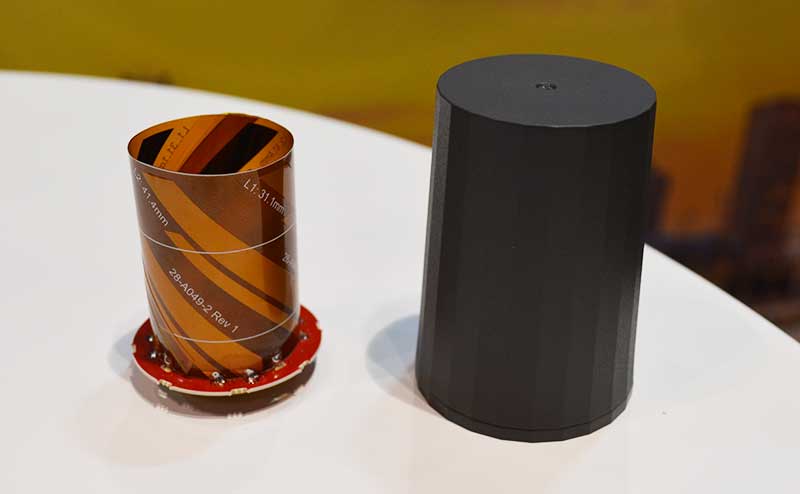
    The new helical antenna in both housed (right) and unhoused form. (Photo: Allison Barwacz)
    The new helical antenna in both housed (right) and unhoused form. (Photo: Allison Barwacz)

    Tallysman, a manufacturer of high-performance GNSS and iridium antennas, launched the first three products of a new range of helical antennas. Additional models will be announced in the third quarter of 2019 and onward.

    Tallysman exhibited at booth 3739 at AUVSI Xponential 2019, which took place April 29 to May 2 in Chicago.

    The first three models of the Tallysman helical family are:

    • HC871 (25g) – A housed, dual band, active GNSS antenna, supporting GPS L1/L2,
      GLONASS G1/G2, Galileo E1, and BeiDou B1.
    • HC872 (36g) – A housed, dual band, active GNSS antenna, supporting GPS L1/L2,
      GLONASS G1/G2, Galileo E1, BeiDou B1, and L-Band services.
    • HC600 (18g) – A housed, passive Iridium antenna.


    The active GNSS helical antennas feature a low-current, low-noise amplifier (LNA), and include integrated low-loss pre-filters, to protect against harmonic interference from high amplitude interfering signals, such as 700-MHz band LTE and other near in-band cellular signals.

    Available in both housed and embedded OEM versions, the lightweight Tallysman helical antennas have excellent axial ratios, making them ideal for a variety of high-precision unmanned aerial vehicle (UAV) applications, the company said.

    The housed Tallysman helical antenna models feature a robust, military-grade plastic case, while the embedded Tallysman helical antenna models can be custom-tuned for any application and configured with a variety of cables and connectors.

    “We think — if anything — the price-performance ratio is the biggest benefit,” Allen Crawford, director of key accounts at Tallysman, told GPS World. “The pre-filter is also unique to us; the robustness of the enclosure is unique to us; and also the shortness, which is important to a lot of aerodynamic vehicles.”

    Patents have been applied for with respect to several aspects of these new products.

    “There is a clear requirement for lightweight, high performance antennas for the rapidly growing UAV market,” said Tallysman President and CTO Gyles Panther. “These new patented helical products are an extension to our existing range of superlight L1/L2 patch antennas, and will provide customers with a wider choice of antenna formats to suit their specific application requirements. These are the first of a number of new products we plan to introduce for this application to support our already wide customer base for UAV antennas.”

  • System downs multiple drones in U.S. Air Force exercise

    System downs multiple drones in U.S. Air Force exercise

    Speed-of-light technologies will protect ground troops.

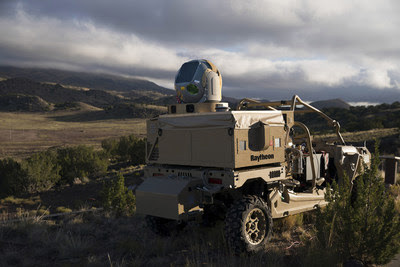
    Raytheon's high-energy laser (HEL). (iPhoto: Raytheon)
    Raytheon’s high-energy laser (HEL). (iPhoto: Raytheon)

    Raytheon Company‘s advanced high-power microwave and mobile high-energy laser systems engaged and defeated multiple unmanned aerial system targets during a U.S. Air Force demonstration. The mature HPM and HEL technologies offer an affordable solution to the growing UAS threat, the company said.

    Raytheon made the announcement at AUVSI Xponential, taking place this week in Chicago.

    Raytheon’s mobile high energy laser looks out into a wide-open sky. The company’s advanced high-power microwave and high-energy laser engaged and defeated dozens of unmanned aerial system targets in a recent U.S. Air Force demonstration.

    The HEL system, paired with Raytheon’s Multi-Spectral Targeting System, uses invisible beams of light to defeat hostile UASs. Mounted on a Polaris MRZR all-terrain vehicle, the system detects, identifies, tracks and engages drones.

    “Countering the drone threat requires diverse solutions,” said Stefan Baur, Raytheon Electronic Warfare Systems vice president. “HEL and HPM give frontline operators options for protecting critical infrastructure, convoys and personnel.”

    Raytheon’s HPM uses microwave energy to disrupt drone guidance systems. High-power microwave operators can focus the beam to target and instantly defeat drone swarms. With a consistent power supply, an HPM system can provide virtually unlimited protection.

    “After decades of research and investment, we believe these advanced directed energy applications will soon be ready for the battlefield to help protect people, assets and infrastructure,” said Thomas Bussing, Raytheon Advanced Missile Systems vice president.

    Raytheon’s HEL and HPM were the only directed energy systems that participated in this Air Force experimentation demonstration. The event expanded on previous directed energy demonstrations such as a U.S. Army directed energy exercise held in 2017.

  • Raytheon system downs multiple drones in U.S. Air Force exercise

    Raytheon Company’s advanced high-power microwave and mobile high-energy laser systems engaged and defeated multiple unmanned aerial system targets during a U.S. Air Force demonstration. The mature HPM and HEL technologies offer an affordable solution to the growing UAS threat, the company said.

    Raytheon made the announcement at AUVSI Xponential, which took place April 29-May 2 in Chicago.

    Raytheon’s mobile high energy laser looks out into a wide-open sky. The company’s advanced high-power microwave and high-energy laser engaged and defeated dozens of unmanned aerial system targets in a recent U.S. Air Force demonstration.

    The HEL system, paired with Raytheon’s Multi-Spectral Targeting System, uses invisible beams of light to defeat hostile UASs. Mounted on a Polaris MRZR all-terrain vehicle, the system detects, identifies, tracks and engages drones.

    “Countering the drone threat requires diverse solutions,” said Stefan Baur, Raytheon Electronic Warfare Systems vice president. “HEL and HPM give frontline operators options for protecting critical infrastructure, convoys and personnel.”

    Raytheon’s HPM uses microwave energy to disrupt drone guidance systems. High-power microwave operators can focus the beam to target and instantly defeat drone swarms. With a consistent power supply, an HPM system can provide virtually unlimited protection.

    “After decades of research and investment, we believe these advanced directed energy applications will soon be ready for the battlefield to help protect people, assets and infrastructure,” said Thomas Bussing, Raytheon Advanced Missile Systems vice president.

    Raytheon’s HEL and HPM were the only directed energy systems that participated in this Air Force experimentation demonstration. The event expanded on previous directed energy demonstrations such as a U.S. Army directed energy exercise held in 2017.

  • Teledyne presents image processing solutions at Xponential 2019

    Teledyne Scientific & Imaging’s Mark Anderson gives GPS World an overview of the company’s image processing solution, which uses an artificial intelligence algorithm to recognize various objects, at AUVSI’s Xponential 2019.

  • Harxon, Skycatch partner for high-precision package

    Harxon’s Winnie Yang and Skycatch’s Jackie Guilbault discuss the companies’ partnership, which has resulted in a high-precision package offering, at Xponential 2019.

  • MicroPilot integrates Trimble receivers into its product line

    At Xponential 2019, MicroPilot President Howard Loewen discusses how the company has integrated the Trimble MB-Two receiver and Trimble BD940 receiver into its product line.

  • SBG Systems debuts Quanta UAV series at Xponential 2019

    SBG Systems Chief Technology Officer Alexis Guinamard gives GPS World an overview of the company’s Quanta UAV series, which launched at Xponential 2019 in Chicago.

  • Tallysman launches helical antennas at Xponential 2019

    Tallysman’s Allen Crawford offers an overview of the company’s recently launched helical antennas, which include the HC871, HC872 and HC600, at Xponential 2019, which took place April 29-May 2 in Chicago.

  • Auterion showcases product portfolio at Xponential 2019

    Auterion, an open-source software company, showcased its product portfolio, which includes Enterprise PX4, at Xponential 2019. According to the company, Enterprise PX4 is a software that powers the drone, keeps it away from obstacles and collects the data you need.

  • Xsens debuts MTi 600-series of inertial sensors at Xponential 2019

    Xsens launched its MTi 600-series of inertial sensors at Xponential 2019, which took place April 29-May 2 in Chicago. At the show, the MTi 600-series won a Technology Innovation Award from the Association for Unmanned Vehicle Systems International.