Arianespace will launch eight additional Galileo satellites, confirmed the European Union Agency for the Space Programme (EUSPA).
Arianespace will launch the first two satellites in 2022, leading to the Full Operational Capability of Galileo open service. Then, three successive launches on Ariane 62 in 2023, 2024 and 2025 will finalize the launch of the first generation of Galileo satellites and will increase the constellation resilience.
These will be the 13th to 16th Galileo missions by Arianespace, which has orbited all satellites in the constellation.
With this order, EUSPA takes over the role of placing launch services contracts for Galileo from the European Space Agency (ESA), which has acted so far in the name and on behalf of the European Commission and will continue to be the technical authority for these launches.
The order follows ESA’s order for the launch of four satellites in October 2021, and will complete the deployment of first-generation Galileo satellites.
The launches will take place from the Guiana Space Center, Europe’s Spaceport in Kourou, French Guiana. After a Galileo launch in the first half of this year, carrying satellites from a previous order, a second Soyuz launch this year will orbit the first two satellites from this latest order. The next three missions will orbit two satellites each on Ariane 62.
“I would like to thank ESA and EUSPA, along with the European Commission, for continuing to entrust us with their satellites,” said Stéphane Israël, CEO of Arianespace. “We’re very proud to once again be helping the EU deploy its own global navigation satellite system. This additional order to the service of Galileo once again confirms Arianespace’s assigned mission of ensuring reliable access to space for Europe.”
Each of the eight satellites under this order, built by OHB System AG in Bremen, Germany, will weigh less than 730 kg. They will join the 28 Galileo satellites already deployed to date, as well as the two to be orbited in early 2022 from the Guiana Space Center by Arianespace.
Approval is given for Arianespace’s Ariane 5 flight on July 31
Arianespace’s fifth mission of 2020 has been given the green light for liftoff following a July 29 launch readiness review conducted at the Spaceport in French Guiana.
The launch will deliver the Intelsat Galaxy 30 (G-30) satellite into orbit. G-30 will become part of the Wide Area Augmentation System (WAAS), the air navigation aid developed by the U.S. Federal Aviation Administration to augment GPS and GNSS.
Besides G-30, the Ariane 5 launch vehicle will also carry the Mission Extension Vehicle-2 (MEV-2) and BSAT-4b. All satellites are flight-ready, along with the Spaceport’s infrastructure and the network of downrange tracking stations.
With approval granted, Ariane 5 also is cleared for rollout on July 30 from its Final Assembly Building to the ELA-3 launch zone. Liftoff will occur on July 31 during a 46-minute launch window opening at 6:30 p.m. local time in French Guiana. To watch the launch live, visit the Arianespace website.
Ariane 5 will deliver a total payload lift performance of approximately 10,468 kg. on the mission to geostationary transfer orbit (GTO), which is designated Flight VA253. This total factors in the three passengers, plus the workhorse vehicle’s multi-payload deployment system and integration hardware.
G-30 and MEV-2 — both produced by Northrop Grumman to serve the operational needs of Intelsat — are stacked together in the upper position of Ariane 5’s payload configuration. G-30 will be deployed first during the 47-minute flight sequence, followed by MEV-2.
To be released last as the mission’s lower passenger, BSAT-4b is being launched by Arianespace as part of a turnkey contract between the Japanese operator B-SAT and the satellite manufacturer, Maxar.
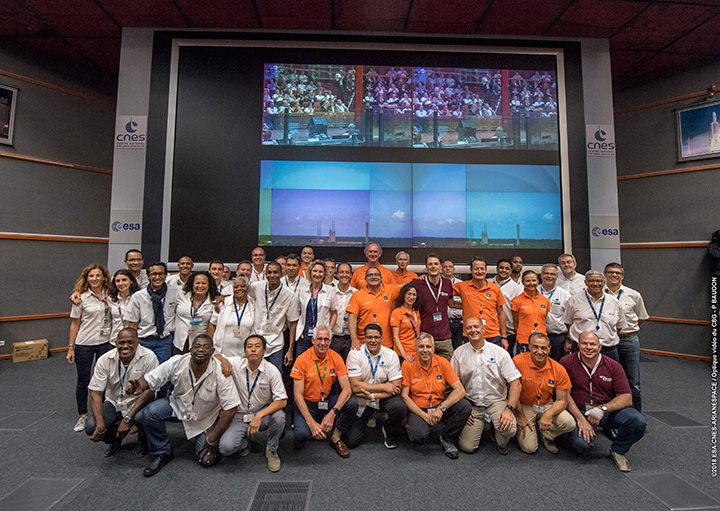
Countdown team at Kourou, Guiana control center for July’s four-satellite launch. (Photo: ESA/CNES/Arianespace, P. Baudon)
By Javier Benedicto Head, Galileo Programme department, European Space Agency
Since the declaration of initial services in December 2016, the European Space Agency (ESA) and the European GNSS Agency (GSA) have expanded Galileo’s system capabilities and service robustness with significant improvements of the ground segment and the last batch of four satellites launched by Ariane 5 in July. Once these satellites reach their final position and complete their in-orbit commissioning before the end of 2018, all 24 nominal slots of the Galileo constellation will be occupied.
Up to 22 satellites are planned to be commissioned in early 2019 and, eventually, the two FOC satellites injected in elliptical orbit should join the operational constellation after on-board software upgrade to provide for automatic health status flagging to users. This should lead to a total of 24 operational Galileo satellites supporting global PNT for users worldwide.
New Infrastructure Contracts
To further expand the system capabilities by 2020 and beyond, and reach Full Operational Capability (FOC), ESA has awarded new large industrial contracts in the context of the Exploitation Phase.
A contract to build and test another twelve Galileo satellites (so-called Batch-3) was awarded in 2017 to a consortium led by prime contractor OHB GmbH in Germany, with Surrey Satellite Technology Ltd in the UK as payload prime. These new satellites are based on the already qualified design of the previous Galileo FOC satellites. Production is advancing well, with first launch planned by late 2020.
With the Galileo constellation now expanded to 26 navigation satellites and plans to deploy additional Batch 3 satellites, the ground control infrastructure is undergoing a corresponding upgrades. In July, ESA awarded a new contract for the Galileo Ground Control Segment to GMV Aerospace and Defence, Spain. This contract includes upgrading the system architecture to manage a constellation of up to 41 Galileo satellites, updating obsolescent elements in the current system, improving operability linked to the provision of services and additional telemetry, tracking, and command capabilities to improve system robustness.
In October, Thales Alenia Space in France received a contract to upgrade the Galileo Ground Mission Segment and the Galileo Security Monitoring Centres (GSMC). This work includes upgrading Galileo’s system architecture to provide more accurate navigation products for broadcast by Galileo satellites, updating obsolescent elements in the current system and improving operability linked to the provision of services and enhanced robustness.
It will also include the construction of additional navigation message uplink and sensor stations. This contract will also augment the capabilities for implementation of the Public Regulated Service (PRS), the single most accurate and secure class of Galileo signals. Encrypted PRS signals will be made available only to authorized governmental users through approved national authorities. GSMCs in France and Spain will ensure the security monitoring functions for Galileo operational assets and manage PRS access and operations.
Growing Service Portfolio
The European Commission, GSA and ESA have jointly defined a broad range of service improvements and system capability enhancements to be deployed in 2019–2020, leading to FOC.
The newly qualified system infrastructure will support the broadcast of authentication information as part of the Open Service Navigation Message in E1; experimentation will start by end of 2019, leading to the possibility to offer trusted PNT to Galileo users.
Galileo will also be the first GNSS constellation to provide a Search and Rescue return link capability: as of 2019 the system will allow broadcast of acknowledgement of receipt message to users in distress with a very low latency, contributing to saving lives.
ESA has also started preparing the necessary modifications to the Navigation Signal Generation on-board the satellites to offer further capabilities to users after 2020. The signal-in-space will be enhanced with additional data transmitted in the I/NAV message, offering faster acquisition and more robust Galileo positioning on E1 and an encrypted navigation signal on E6 supporting authentication at signal level.
The new Galileo High Accuracy Service, soon entering the experimental phase, will consist in the delivery of un-encrypted high accuracy correction data in E6, enabling users to achieve sub-meter level positioning.
The usage of Galileo Open Service for aviation applications using horizontal advanced receiver-autonomous integrity monitoring techniques is being carefully assessed through measurements and review of the system design, including feared-events characterisation.
Longer Term Evolution
Galileo Second Generation has been the subject of technology pre-developments in the areas of platform and payload critical equipment, system techniques and processing algorithms, as well as system and segment Phase B studies over the past few years. We are now approaching the start of the implementation phase.
The European Commission, in close consultation with EU member states, has defined a decision roadmap aiming at very important future budget and programme implementation decisions in the course of 2019. In this context, ESA has launched a competitive procurement procedure for the first batch of so-called “Transition Satellites” with a broad range of enhanced and some new capabilities being considered. This includes improvements in the signal domain for faster acquisition and lower receiver power consumption, on-board clock technology, inter-satellite links, electrical propulsion, flexible payloads and power allocation by means of on-board digital technology and in-orbit re-configurability.
Transition satellites and related ground segment development contracts will begin by the end of 2019, aiming at in-orbit validation of second-generation capabilities from 2025 onwards.
EGNOS Evolution for Aviation
The adoption of Europe’s SBAS EGNOS by aviation is growing faster and faster. EGNOS will continue to evolve in the coming years. In particular, for 2019 and 2020, the evolutions under implementation focus on the obsolescence management of the hardware of some critical components, improvement of the system performances thanks to addition of new stations and system algorithms.
All these evolutions are planned to be qualified in 2021-2022, to continue to offer an excellent level of performance to Aviation Users until the operational take-over by the second generation of EGNOS V3,planned in 2025.
The European Performance-Based Navigation Implementing Regulation plans a growth from the current 35% to 66% in 2020 and 100% in 2024 of all European airports instrumental runways end-equipped with SBAS localizer performance with vertical guidance procedure.
On the aircraft manufacturer side, Airbus confirmed that it will continue equipping its aircraft; following the A350 family already equipped, both A320 and A330 families will be equipped for entry into service in summer 2020.
NAVISP
ESA’s Navigation Innovation and Support Programme (NAVISP), launched in 2017, will continue to boost member states’ industrial competitiveness and innovation in the upstream and downstream navigation sector, investigate the integration of satellite navigation with non-space technologies and complementary positioning and communication techniques, and study novel receiver-based techniques to counteract vulnerabilities and improve the robustness and reliability of GNSS.
Conclusion
The EU-built GNSS infrastructure systems EGNOS and Galileo are operational and serving users in Europe and worldwide. EC, GSA, ESA and European industries are committed to improvement plans over the next 2–3 years, with emphasis on endurance, resilience and robustness of the systems’ infrastructure, and delivering enhanced services.
For the longer term, the real challenge is to modernize the systems with new spaceborne and ground technologies, increase operational robustness and automation, and provide for additional system capabilities, while retaining a large degree of flexibility and in-orbit re-configurability to meet the long-term challenges and evolution of satellite-based navigation and timing.
Four more Galileo satellites were launched July 25 by an Ariane 5. Their arrival in orbit brings the Galileo constellation to 26 satellites, extending the global coverage of the constellation.
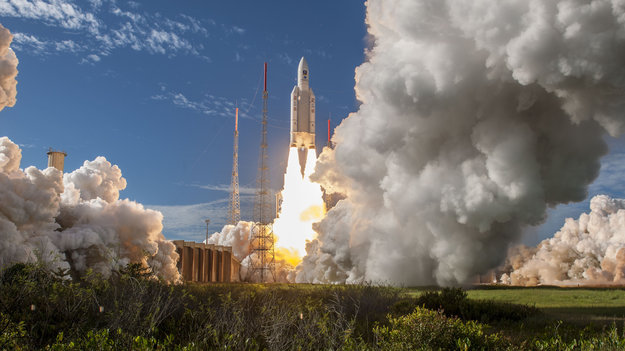
Ariane 5 flight VA244, operated by Arianespace under contract to ESA, lifted off from Europe’s Spaceport in Kourou, French Guiana, at 11:25 GMT (13:25 CEST, 08:25 local time), carrying Galileo satellites 23–26. The first pair of 715 kg satellites was released almost 3 hours 36 minutes after liftoff, while the second pair separated 20 minutes later.
They were released into their target 22 922 km-altitude orbit by the dispenser atop the Ariane 5 upper stage.
In the coming days, this quartet will be steered into their final working orbits by the French space agency CNES, under contract to the Galileo operator SpaceOpal for the European Global Navigation Satellite System Agency (GSA).
There, they will begin around six months of tests by SpaceOpal to verify their operational readiness so they can join the working Galileo constellation.
“Galileo is ESA’s largest ever satellite constellation, built up to its present size in rapid time, with 22 Full Operational Capability satellites added within just the last four years,” remarked Jan Wörner, ESA’s director general.
“We must thank our industrial partners OHB (DE) and SSTL (GB) for the satellites, as well as Thales Alenia Space (FR/IT) and Airbus Defence and Space (GB/FR) for the ground segment and all their subcontractors throughout Europe for their continued support to the programme. Together with ESA, the entire industrial team has worked hard for the point at which we now are and this cooperation have proven to be very successful, as we can show in the excellent performance of Galileo.”
Paul Verhoef, ESA’s director of navigation, added, “Galileo has been providing Initial Services on a worldwide basis since 15 December 2016, and today has more than 100 million users, and rapidly increasing. Today’s satellites will increase the global coverage of Galileo with a performance that is widely recognized as excellent.
“This is the end of the current phase of Galileo deployment, but our pace is not slacking. A further 12 Galileo ‘Batch 3’ satellites are in preparation as in-orbit spares and as replacements for the oldest Galileo satellites, first launched in 2011, in order to keep the system working seamlessly into the future.
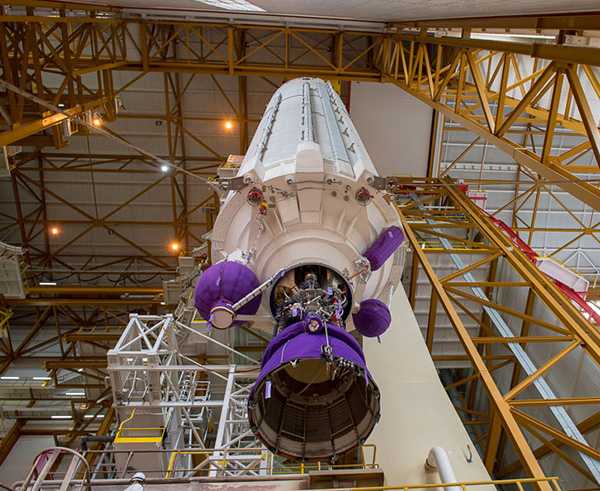
Ariane 5’s cryogenic main stage is moved into position over the mobile launch table inside the Spaceport’s Launcher Integration Building. (Photo: Arianespace)
Four more Galileo satellites will be launched on a customized Ariane 5 on July 25.
The next Arianespace rocket to orbit Galileo satellites has begun taking shape at the spaceport in French Guiana, reported Arianespace. Build-up of the heavy-lift vehicle is now underway inside the spaceport’s Launcher Integration Building.
Following the established assembly flow, the rocket build-up began with this week’s positioning of the launch vehicle’s central core cryogenic stage over one of two mobile launch tables used for Ariane 5.
Ariane 5’s two solid propellant boosters are rolled out. (Photos: Arianespace)
It was followed by integration of the two large solid propellant boosters — installed directly on the launch table and mated to the core stage — clearing the way for placement of the upper stage, topped off with the vehicle equipment bay.
Once the Ariane 5’s basic build-up is completed under the direction of production prime contractor ArianeGroup, it will be moved to the spaceport’s Final Assembly Building for installation of its four Galileo FOC (Full Operational Capability) satellite passengers, which are undergoing their own pre-flight preparations at the spaceport.
The Ariane 5 will deploy its satellite passengers at a targeted orbital altitude of 23,222 kilometers in circular medium Earth orbit. The launch is designated Flight VA244 by Arianespace.
Galileo satellites arrive
In early June, Galileo satellites 25 and 26 landed at Europe’s Spaceport in Kourou, French Guiana, joining their two predecessors, satellites 23 and 24, according to the European Space Agency (ESA).
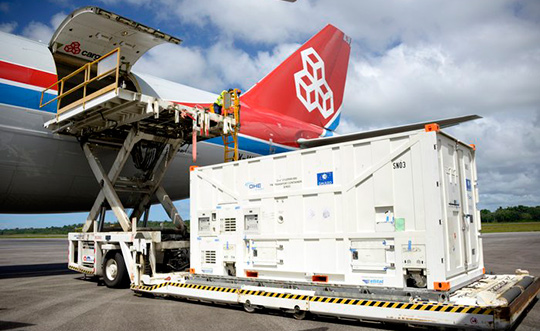
One of the two Galileo satellites 25 and 26 is unloaded from a Boeing 747 cargo jet at Cayenne – Félix Eboué Airport in French Guiana on June 1. The satellites travel inside protective air-conditioned containers. (Photo: ESA)
The pair left Luxembourg Airport on a Boeing 747 cargo jet on the morning of June 1, arriving at Cayenne – Félix Eboué Airport in French Guiana that evening.
After they were off-loaded, they were driven by truck to the cleanroom environment of the S1A payload preparation facility at Europe’s Spaceport, still in their protective air-conditioned containers. In the cleanroom, they joined Galileo satellites 23 and 24, which arrived last month.
The cryogenic main stage of the Ariane 5, known as the EPC — from its French title Etage Principal Cryogénique — arrived by sea at French Guiana’s Port Pariacabo on May 30.
A further 12 Galileo “Batch 3” satellites were ordered in 2017, supplementing the 26 built so far to provide further in-orbit spares and replacements for the oldest Galileo satellites, first launched in 2011.
A steady stream of orbital spares, ready to replace satellites reaching the end of their operational lives, is essential to ensure Galileo continues operating seamlessly, according to ESA.
Looking further ahead, with the aim of keeping Galileo services as a permanent part of the European and global landscape, new satellites will be required by the middle of the next decade, offering improved performance and added features.
The Ariane 5 for Arianespace’s Dec. 12 year-ending flight for 2017 has completed its initial build-up at the Spaceport in French Guiana — where preparations also are moving ahead with four satellite passengers that will further expand Europe’s Galileo global navigation system once in their final orbit.
During activity in the Spaceport’s Launcher Integration Building, the heavy-lift vehicle for Arianespace Flight VA240 underwent the assembly process that began by mating its two solid propellant strap-on boosters with the main cryogenic stage.
The next step was integration of Ariane 5’s vehicle equipment bay, which serves as the launch vehicle’s “brain,” providing autonomous control during the various mission phases.
It was followed by installation of the EPS storable propellant stage, powered by a reignitable engine that operates with MMH and N2O4 propellants. This differentiates the Ariane 5 ES configuration from Arianespace’s Ariane 5 ECA version, which has a cryogenic upper stage and typically is used on Arianespace missions with telecommunications satellites to geostationary transfer orbits.
Inside the Spaceport’s Launcher Integration Building, Ariane 5’s vehicle equipment bay is lowered atop the core cryogenic stage on Flight VA240’s Ariane 5 ES launcher version (left and center). This cleared the way for installation of the launch vehicle’s EPS storable propellant upper stage (right). (Photo: Arianespace)
After completion of verifications and systems checkout by production prime contractor ArianeGroup, the Ariane 5 ES launch vehicle will be moved to the Spaceport’s Final Assembly Building for payload integration and readiness for rollout to the launch zone.
The mission’s ongoing payload preparations — including checkout and fit-check procedure for each of the four Galileo satellites — took place inside the Spaceport’s S1A processing facility. This involved a one-by-one verification of the spacecraft’s interface with the payload dispenser that will release them into circular orbit during the mission.
After the fit-check procedure in the S1A facility, the four satellites were readied for transfer to the S5 payload preparation center for fueling.
For Ariane 5’s Dec. 12 mission, the heavy-lift vehicle will carry its quartet of Galileo satellites (weighing 700 kg. each) and their dispenser system for a medium-Earth orbit deployment.
A Galileo satellite undergoes its fit-check validation at the Spaceport. Flight VA240. (Photo: Arianespace)
Galileo is the European initiative to develop a global satellite navigation system. Under civilian control, it will offer a guaranteed, high-precision positioning service. As a European Union-funded program, the Galileo constellation will comprise 24 operational satellites, along with spares.
Overall responsibility for Galileo’s management and implementation is held by the European Commission, with the European Space Agency assigned design and development of the new generation of systems and infrastructure.
Ariane 5’s mission with the four Galileo spacecraft will close out a busy year of launch activity for Arianespace, which has performed 10 missions from French Guiana so far in 2017 — all of which were successful. The flights to date involved five launches of the heavy-lift Ariane 5, two with the medium Soyuz and three with the lightweight Vega.
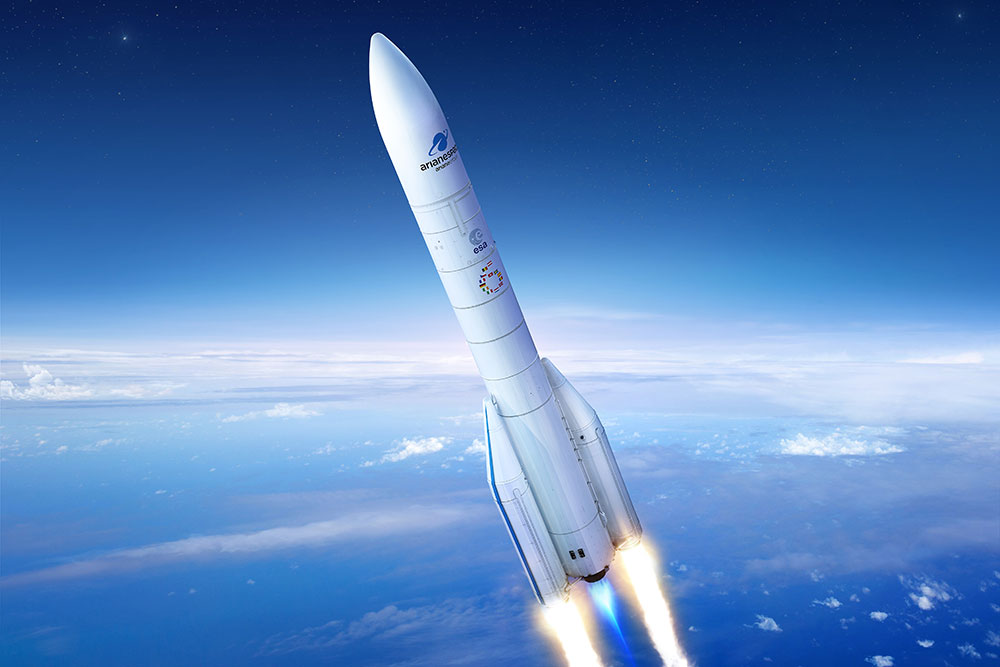
Arianespace will launch four new satellites for the Galileo constellation, using two Ariane 62 versions of the next-generation Ariane 6 rocket from the Guiana Space Center in French Guiana.
The Ariane 62 rocket. (Image: Arianespace)
The contract will be conducted by the European Space Agency (ESA) on behalf of the European Commission (DG Growth) and the European Union.
This is the first ESA first contract to use the company’s new rocket.
Stéphane Israël, Arianespace chief executive officer, and Paul Verhoef, director of Navigation at the European Space Agency (ESA), signed the launch contract for four new satellites to join the European satellite navigation system Galileo. The contract will be conducted by ESA on behalf of the European Commission (DG Growth).
These launches are planned between the end of 2020 and mid-2021, using two Ariane 62 launchers — the configuration of Europe’s new-generation launch vehicle that is best suited for the targeted orbit. The contract also provides for the possibility of using the Soyuz launch vehicle from the Guiana Space Center, if needed.
Both missions will carry a pair of Galileo spacecraft to continue the constellation deployment for Europe’s satellite-based navigation system. The satellites, each weighing approximately 750 kg, will be placed in medium earth orbit (MEO) at an altitude of 23,222 kilometers and be part of the Galileo satellite navigation constellation.
An ESA video about Ariane 6 is below:
Galileo is the first joint infrastructure financed by the European Union, which also will be the owner. The Galileo system incorporates innovative technologies developed in Europe for the greater benefit of citizens worldwide.
A total of 18 Galileo satellites already are in orbit. Fourteen of these satellites were launched two at a time by Soyuz launchers, with the last four orbited on a single Ariane 5 ES mission in November 2016. Two more Ariane 5 ES missions are planned on December 12, 2017 and in the summer of 2018.
Following the signing of this latest contract, Stéphane Israël, CEO of Arianespace, issued this statement:
“Arianespace is especially proud to have won this first launch contract for the Ariane 6 from its loyal customers and partners, the European Commission (DG Growth) and ESA. We are very pleased to have earned this expression of trust from the European Commission; by choosing to continue the deployment of the Galileo constellation with two Ariane 62 launches, they become the first confirmed customer for our next-generation heavy launcher, which is slated to make its initial flight in the summer of 2020. Through this decision, which adds two additional launches to follow the already-scheduled Ariane 5 ES flights, the European Commission and ESA are clearly indicating a key commitment to Arianespace’s next generation of launchers, which reaffirms more than ever its mission to ensure Europe’s autonomous access to space.”
The Sentinel-2B satellite was launched for the European Commission on Monday, March 6, at 10:49 p.m. local time from the Guiana Space Center (CSG), Europe’s Spaceport in Kourou, French Guiana.
Following the successful launches of Sentinel-1A, Sentinel-2A and Sentinel-1B, the mission with Sentinel-2B marks the fourth satellite in the European Commission’s Copernicus Earth observation program to be orbited by Arianespace from the Guiana Space Center, within the scope of a contract with the European Space Agency (ESA).
The Sentinel-2B Earth observation satellite mainly focuses on monitoring land masses and coastal zones around the world. It will be positioned in an orbit opposite that of Sentinel-2A to ensure optimum coverage and data delivery. The pair of Sentinel-2 satellites will cover the Earth’s entire surface in five days. This high frequency means they will capture brand-new views of the Earth, driving considerable progress in monitoring and predicting changes in vegetation and aquatic pollution.
Sentinel-2B combines a multispectral, wide-swath, very-high-resolution optical imaging instrument with a dedicated platform developed by Airbus, a long-standing partner to Arianespace. It is the 61st Earth observation satellite to be launched by Arianespace.
ESA’s Sentinel program includes six families of satellites:
Sentinel-1 will ensure data continuity with the ERS and Envisat radar satellites.
Sentinel-2 and Sentinel-3 are designed to help provide a better understanding of how climate change impacts our daily lives.
Sentinel-4 and Sentinel-5 are dedicated to meteorology and climatology, with a special focus on studying the composition of the Earth’s atmosphere.
Sentinel-6 will measure ocean topography, mainly for operational oceanography and climatology.
This was the third launch of the year for Arianespace and the first in 2017 with the Vega light launcher. It also marked the ninth successful launch in a row for Vega, which made its debut at the Guiana Space Center in 2012.
This week’s Arianespace flight with four European Galileo navigation system spacecraft has been approved for a morning liftoff on Nov. 17 following the launch readiness review held Monday at the Spaceport in French Guiana.
Paul Verhoef, ESA Director Satellite Navigation, at the Kourou launch site to witness Thursday’s liftoff.
Designated Flight VA233 in Arianespace’s numbering system, the launch will deploy its quartet of Galileo spacecraft during a nearly four-hour flight, with liftoff set at exactly 10:06:48 a.m. local time in French Guiana on Thursday.
All four Galileo satellites are mated to the dispenser in readiness for the upcoming launch.
Monday’s launch readiness review validated the “go” status of the Ariane 5 ES launcher version, its Galileo passengers, as well as the Spaceport’s launch site infrastructure and the network of tracking stations.
As a follow-up to Arianespace’s previous missions that used the medium-lift Soyuz to orbit Galileo satellites in pairs, the heavy-lift Ariane 5 enables four of the global positioning spacecraft to be accommodated on a single launch vehicle.
The four satellites are numbered Galileo 15 through 18.
Arianespace previously deployed 14 Galileo in-orbit validation and full operational capability spacecraft from the Spaceport in French Guiana on seven Soyuz missions, along with performing two other Soyuz flights from the Baikonur Cosmodrome in Kazakhstan with the GIOVE-A and GIOVE-B experimental satellites for the Galileo system.
Galileo will offer a guaranteed, high-precision positioning service for Europe under civilian control. Its constellation will comprise 24 operational satellites, along with spares.
The European Commission funds — and has overall responsibility — for Galileo’s management and implementation, with the European Space Agency assigned design and development of the new generation of systems and infrastructure.
OHB System in Bremen, Germany built the satellites to be orbited by Arianespace’s Flight VA233, and their navigation payloads were supplied by UK-based Surrey Satellite Technology Limited (SSTL), which is 99 percent owned by Airbus Defence and Space.
Launch kit
The four spacecraft carried by Ariane 5 are called Antonianna, Lisa, Kimberley and Tijmen – with their naming for winners of a European children’s drawing contest.
A video of the launch will be streamed here. Streaming starts at 12:36 GMT (13:36 CET)
Arianespace has entered the final phase of preparations for its next Ariane 5 launch — the company’s first heavy-lift mission to orbit satellites for Europe’s Galileo navigation constellation.
During activity in the Spaceport’s Final Assembly Building, Arianespace “topped off” the Ariane 5 launcher with installation of the payload fairing over the four Galileo spacecraft and their payload dispenser.
With Ariane 5 complete, it is being readied for rollout to the Spaceport’s ELA-3 launch complex in advance of its Nov. 17 flight, set for liftoff at 10:06:48 a.m. local time in French Guiana.
This mission — designated Flight VA233 in Arianespace’s numbering system — will deploy the quartet of Galileo spacecraft over the course of a nearly four-hour flight.
For the Galileo program, Arianespace is using the Ariane 5 ES version with an enhanced storable propellant upper stage that allows for reignition and long coast phases during the mission.
The protective fairing is lowered onto the four Galileo satellites and their dispenser resting atop an Ariane 5 launcher. The fairing was placed on Nov. 3. (Photo: ESA)
These upgrades maximize the launcher’s performance for deploying the Galileo spacecraft — which will have a combined mass of 2,865 kg at liftoff — two at a time into a circular medium-Earth orbit.
As a European initiative to develop a new global satellite navigation system under civilian control, Galileo will offer a guaranteed, high-precision positioning service that will end Europe’s dependence on the American GPS system.
The Galileo constellation will comprise 24 operational satellites, along with spares. Arianespace already has deployed 14 Galileo in-orbit validation and full operational capability spacecraft from French Guiana on seven medium-lift Soyuz missions, along with performing two other Soyuz flights from the Baikonur Cosmodrome in Russia with the GIOVE-A and GIOVE-B experimental satellites.
Galileo is funded by the European Union. It features innovative technologies developed in Europe for the benefit of all citizens. The European Commission holds overall responsibility for Galileo’s management and implementation, with the European Space Agency assigned design and development of the new generation of systems and infrastructure.
The Galileo satellites on Arianespace’s Flight VA233 are sized at 2.7 x 1.2 x 1.1 meters and were built by OHB System in Bremen, Germany, while their navigation payloads were supplied by UK-based Surrey Satellite Technology Limited (SSTL), which is 99 percent owned by Airbus Defence and Space.
All four Galileo satellites are mated to the dispenser in readiness for the upcoming launch.
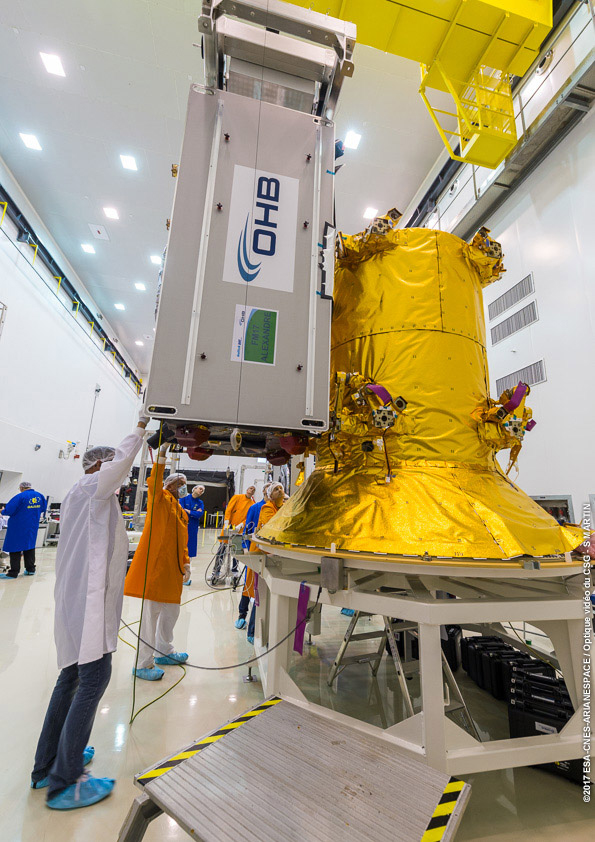
The launch campaign for the Nov. 17 Galileo launch from the French Guiana spaceport has entered its latest phase of preparations, with the mission’s four satellite passengers being installed on their multi-payload dispenser system.
The activity — performed in the Spaceport’s S3B clean room — clears the way for the satellites’ integration as a single unit atop the heavy-lift Ariane 5, which was transferred earlier this week from the Launcher Integration Building to the Final Assembly Building, where payload integration is set to occur, according to launch contractor Arianespace.
Designated Flight VA233, the upcoming mission is scheduled for a Nov.17 liftoff from the Spaceport in French Guiana at precisely 10:06:48 a.m. local time, with the four Galileo satellites subsequently being deployed into circular orbit during a mission lasting just under four hours.
Flight VA233 will mark Arianespace’s first use of Ariane 5 to loft spacecraft for Europe’s Galileo global navigation system, following seven previous missions with the medium-lift Soyuz — which carried a pair of satellites on each liftoff. Flight VA233 is scheduled as the company’s ninth launch overall performed so far in 2016, as well as the sixth this year using the heavy-lift workhorse. Arianespace’s full launcher family is rounded out by the light-lift Vega.
Two of the four Galileo satellites after their installation on the multi-passenger dispenser system, with a third positioned for its integration. (Photo: Arianespace)
Galileo is an important infrastructure program for Europe, creating a civil global satellite navigation system that provides highly accurate positioning with great precision and reliability.
It is funded and owned by the European Union, with overall responsibility for management and implementation held by the European Commission. Design and development of the new generation of systems and infrastructure has been assigned to the European Space Agency.
OHB System in Bremen, Germany, built the Galileo satellites, which are sized at 2.7 x 1.2 x 1.1 meters, while their navigation payloads were supplied by UK-based Surrey Satellite Technology.
Fueling operations have begun with the four Galileo spacecraft to be launched Nov. 17 from French Guiana. This will be launch contractor Arianespace’s first launch using its Ariane 5 rocket to deploy Europe’s constellation of navigation satellites.
Fueling operations of Galileo spacecraft. (Photo: Arianespace)
The fueling activity is now underway in the Spaceport’s S3B payload preparation facility. One of the first to be processed is named “Antonianna,” after an Italian child who won a European Commission Galileo drawing competition — with one winner selected from each member state of the European Union.
Weighing between 715 kg. and 717 kg. each, the quartet of Galileo satellites will have a combined liftoff mass of 2,865 kg., and they will be deployed by Ariane 5 into circular orbit during a mission lasting just under four hours.
The Ariane 5 launch, designated Flight VA233 in Arianespace’s numbering system, is set for a morning departure from the Spaceport on Nov. 17 at an exact liftoff time of 10:06:48 a.m. in French Guiana (13:06:48 p.m. Universal Time — UTC).
Flight VA233 will mark Arianespace’s first use of its heavy-lift Ariane 5 to loft Galileo satellites, following seven previous missions with the company’s medium-lift Soyuz. The Soyuz vehicles carried a pair of Galileo spacecraft on each flight, delivering a total of 14 navigation satellites into orbit since 2011.
Galileo is an important infrastructure program for Europe, creating a civil global satellite navigation system that provides highly accurate positioning with great precision and reliability.
Fueling operations of Galileo spacecraft. (Photo: Arianespace)
This program is funded and owned by the European Union, with overall responsibility for management and implementation held by the European Commission. The European Space Agency has been assigned design and development of the new generation of systems and infrastructure for Galileo.
OHB System in Bremen, Germany built the rectangular-shaped satellites, which are sized at 2.7 x 1.2 x 1.1 meters, with their navigation payloads provided by Surrey Satellite Technology in the United Kingdom.