Tag: BlueSky

  • Bluesky, SkyFi collaborate to broaden aerial imagery access

    Bluesky, SkyFi collaborate to broaden aerial imagery access


    Image: Bluesky
    Image: Bluesky

    Bluesky International and SkyFi have collaborated to provide access to Earth observation assets and multi-perspective imagery to users globally. Bluesky is providing its high-resolution aerial imagery, taken by aircraft-mounted cameras, to SkyFi to make available for businesses, forestry, water and land managers across the United Kingdom.

    SkyFi aims to make Earth observation data more accessible to users through its growing network of satellites and aerial platforms. The company has created a data marketplace where users can purchase existing images or task a satellite to purchase a new image.

    Bluesky provides a wide range of geospatial data products and services to users across the United Kingdom. GIS and CAD-ready imagery from Bluesky captures ground terrain, cityscape rooftops, fauna and more. The company’s catalogue of aerial imagery is available in England, Scotland, Wales and the Republic of Ireland.

  • Seen & Heard: Hitchhiking marine life heads to Antarctica

    Seen & Heard: Hitchhiking marine life heads to Antarctica

    “Seen & Heard” is a monthly feature of GPS World magazine, traveling the world to capture interesting and unusual news stories involving the GNSS/PNT industry.


    Photo: Anton Rodionov/iStock/Getty Images Plus
    Photo: Anton Rodionov/iStock/Getty Images Plus

    UNWANTED HITCHHIKERS

    Antarctica’s pristine marine ecosystem, isolated for 15–30 million years, could be threatened by species such as mussels, barnacles, crabs and algae arriving on ships from 1,500 ports worldwide. A research team from the British Antarctic Survey and the University of Cambridge used automatic identification system (AIS) data, which relies on GNSS navigation data, and shipping databases to determine traffic to the Antarctic. The study is published in the Proceedings of the National Academy of Sciences, January 2022.


    Photo: FrankRamspott/iStock/Getty Images Plus
    Photo: FrankRamspott/iStock/Getty Images Plus

    QUAKE PREDICTION

    Within the next 30 years, a highly destructive Nankai Trough megathrust earthquake is predicted to hit southwest Japan. Understanding long-term slow slip events under the Bungo Channel is essential for pinpointing when such an earthquake will happen. Kobe University’s Yoshioka Shoichi and Seshimo Yukinari analyzed the 2018–2019 Bungo Channel slow-slip event using longitudinal GNSS data provided by the Geospatial Information Authority of Japan. The data revealed that even though the 2018–2019 event was shorter than others, it was bigger in terms of slippage and slip velocity, as well as magnitude. Results appear in Scientific Reports, Jan. 10, 2022.


    Photo: Bluesky
    Photo: Bluesky

    SUPPORTING SOLAR 

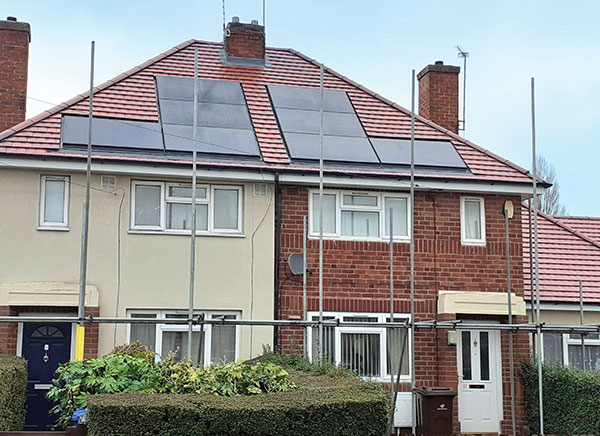
    British aerial mapping company Bluesky is helping Derby Homes roll out integrated solar photovoltaic systems across its housing stock. A project to identify suitable roof coverings assessed more than 8,000 addresses for size, pitch, aspect, existing structures and infringing vegetation. Using its ultra-high-resolution imagery, Bluesky determined the solar suitability of each property, the number of panels needed, and their potential output. Derby Homes recently installed its first integrated solar array on an initial batch of trial properties identified by Bluesky.


    Photo: JohnCarnemolla/iStock/Getty Images Plus
    Photo: JohnCarnemolla/iStock/Getty Images Plus

    TAKING MOM TIME 

    CQUniversity’s precision livestock management research team is using GNSS to detect calving events in extensive grazing herds. The discovery could provide beef producers in Australia with a way to remotely monitor their cattle and improve calf survival rates, one of their biggest challenges. The research project used GNSS collars with motion-detecting accelerometers on 30 cows in a 28-hectare paddock over an eight-week period at Belmont Research Station. The collars captured the animals’ location information every 10 minutes. Because the distance between mother and herd increases during calving, the data helped predict calving events, which were then visually confirmed by the research team. 

  • Bluesky National Tree Map shows changing face of Sevenoaks

    Photo: Bluesky
    Photo: Bluesky

    A new map detailing the location, height and canopy for trees more than 3 meters in height is helping Sevenoaks District Council manage its iconic ancient trees and natural woodland.

    Derived from Bluesky’s National Tree Map, which provides geospatial intelligence for more than 300 million trees across the United Kingdom, the data has already been used to create a district-wide map of tree cover, to create 3D visualizations to inform development decisions, and to support planning enforcement investigations.

    Sevenoaks District Council originally purchased National Tree Map data from Bluesky in November 2019, and the data is widely used across the council with specific applications in planning.

    Updated this year, the original and new tree-map layers are stored in the council’s GIS alongside multiple years of aerial photography, Ordnance Survey maps, data such as Ancient Woodland and Biodiversity Opportunities, and council data including Tree Preservation Orders and Planning Applications. The tree data is accessible to all staff via the council’s intranet mapping system GISMO (GIS Online).

    The name Sevenoaks (the name given to the town and more recently to the district) dates to circa 800 A.D. and is thought to be derived from “Seouenaca,” the name given to a small chapel near seven oak trees. Records of these trees through the ages are sparse; it is not until the 19th century when a group of seven trees appears on an Ordnance Survey map.

    The eponymous oak trees have been replaced many times over the years, including the planting of seven oaks to commemorate the coronation of Edward VII in 1902 and tree planting by personnel from the Canadian Air Force in 1947 in gratitude for being billeted in the town.

    Bluesky’s National Tree Map is created using innovative algorithms and image processing techniques in combination with the most up-to-date and detailed aerial photography, terrain and surface height data, and color infrared imagery.

    In addition to the three vector map layers — Crown Polygons, Idealised Crowns and Height Points — the Bluesky National Tree Map also includes an attribute table with unique identification for each crown feature, height attributes and area calculations.

  • SyncServer S600 now defends against GPS jamming, spoofing

    SyncServer S600 now defends against GPS jamming, spoofing

    Photo: Microchip
    Photo: Microchip

    Microchip Technology has integrate its BlueSky technology signal-anomaly detection software into its SyncServer S600 Series network time server and instruments.

    The SyncServer S600 Series now provides GPS jamming and spoofing detection and protection, in combination with local radio frequency (RF) data logging and analysis. The SyncServer S600 Series Stratum 1 instrument, along with the BlueSky technology’s intelligent jamming and spoofing detectors, continuously monitor local GPS constellation health and examine GPS and local RF signal integrity to assure validity.

    If an anomaly is detected, the solution sends an alarm and, if necessary, the SyncServer instrument can be shifted to alternative time sources or an internal oscillator. This protects ongoing timing outputs while ensuring only minimal, predictable timing degradation to vital network and business operations in applications ranging from banking and stock trading to electric utilities and aerospace and defense.

    The SyncServer BlueSky technology, which provides continuous detection and protection against GPS jamming and spoofing. includes a comprehensive suite of logging, charting and measuring tools to characterize local GPS satellite signals as well as local RF events over time.

    This can help enable correlating, troubleshooting, identifying and correcting local anomalies, some of which may be related to consumer electronics, or nearby RF signal broadcasts. The solution is optionally available through the SyncServer v4.1 software release that provides a selection of features found in Microchip’s BlueSky GNSS Firewall solution for third-party GPS receivers and critical infrastructure.

  • Bluesky launches online streaming service for panoramic aerial images

    Bluesky launches online streaming service for panoramic aerial images

    The Bluesky MetroVista range includes high-resolution imagery combined with high-accuracy, wide-scale 3D models. (Image: Bluesky)
    The Bluesky MetroVista range includes high-resolution imagery combined with high-accuracy, wide-scale 3D models. (Image: Bluesky)

    Aerial mapping company Bluesky is releasing its entire catalog of geographically referenced oblique aerial images of cities in the United Kingdom (UK) via a new subscription-based streaming service.

    Working with Geoxphere, a specialist in cloud-based GIS, Bluesky will offer MetroVista imagery via an easy-to-use web viewer that also includes measurement tools for detailed analysis of building features, façade details and street furniture locations.

    “Oblique imagery offers an unparalleled view of the built environment revealing real world features simply not present in any other type of aerial image or map,” commented Rachel Tidmarsh, managing director of Leicestershire-based Bluesky International. “The MetroVista imagery can be used to inform decision making with time stamped intelligence, and even evidence, as well as improving engagement with colleagues through better communication of ideas. All of this without even leaving your desk!

    “However this wealth of information, as you would expect, can present some issues when it comes to storing and consuming data. The MetroVista Oblique Viewer overcomes these issues meaning the value of the data can be realised without the burden of storing, processing or updating.”

    With a data-as-a-service (DaaS) solution powered by Geoxphere’s XMAP geospatial cloud technology, the MetroVista Oblique Viewer is a fully managed subscription service meaning there is no need to download or store large volumes of data locally. The MetroVista Oblique Viewer does not require any specialist software, plugins or downloads and, as the data is also managed, newly captured images are automatically added to an account as they become available.

    The MetroVista Oblique Viewer has split screen options and rotating views allowing the user to toggle through images to get a 360 degree view of a building. The Bluesky Geoxphere Viewer also includes height and area measurement tools for recording a building height or distance from a feature and its façade area.

    Captured using the world’s first large format imagery and lidar hybrid airborne sensor, Bluesky MetroVista imagery collection includes simultaneously captured oblique and vertical aerial photography. The MetroVista datasets also include geographically accurate, photo-textured, mesh models ready for use in 3D GIS, CAD and other modelling software as well as visualisation, gaming and Virtual Reality workflows.

    Bluesky has already captured MetroVista data for cities such as London, Birmingham, Manchester, Bristol, Nottingham, Oxford, Cambridge, Brighton, Norwich, Leicester, Derby and Newcastle as well as Bournemouth, Brighton, Cardiff, Doncaster, Eastbourne and Southend.

  • Bluesky 3D building models aid designs for London residences

    Bluesky 3D building models aid designs for London residences

    Image: Bluesky
    Image: Bluesky

    London building-design agency DCSK is using 3D building models from Bluesky to inform the design of high-profile urban residential developments.

    Derived from the most up-to-date and accurate aerial photography, the Bluesky 3D models allow DCSK to place a design within its real-world context, consider sensitive view and vantage points, and communicate ideas to clients, planning authorities and the public.

    DCSK has used a number of models from Bluesky, including a detailed representation of central Birmingham for the design of a 24-storey student accommodation on Lancaster Street.

    “We have always had to consider how a design sits within the existing cityscape and how it will interact with the buildings and infrastructure that surround it,” said James Khamsi, Director of DCSK. “Before geographically accurate computer representations, such as the Bluesky 3D models, were available and affordable, we relied on a combination of site photographs and traditional 2D maps. This was a crude workflow that raised potential concerns about the currency and accuracy of information that was informing both the design and resulting planning permissions.”

    DCSK is using 3D models from Bluesky for projects such as Curzon Circle Student Accommodation and others.Photogrammetrically derived from stereoscopic aerial photography, the Bluesky models are fully rendered and are provided as either wireframe or block models in a format suitable for use in both CAD and GIS software.

    All Bluesky 3D models are supplied with a digital terrain model (DTM) depicting the topography of the underlying surface.

    DCSK imports the Bluesky data into its 3D modelling software Rhino, where it is used to create a background layer for the design. The development site is isolated, and this data removed from the background layer, allowing for the detailed design to be dropped in. The proposed development can then be viewed and analyzed in its real-world context with detailed assessments of access ways and viewpoints, for example.

    “The Bluesky models allow us to inhabit the site and experience the design as if we were there,” said Khamsi. “We can explore potential sensitivities, and, as the models are agile, we can massage the design exploring different options without leaving the office. The Bluesky models are also intuitive and therefore easy to interpret allowing us to communicate complex design ideas.”

  • Bluesky awarded lidar contract to map Wales from the air

    This image of Wales is color-coded to show the relative height of the land. (Image: Bluesky)
    This image of Wales is color-coded to show the relative height of the land. (Image: Bluesky)

    Aerial mapping company Bluesky International has been awarded a contract by Natural Resources Wales, on behalf of Welsh Government, to capture a high-resolution laser mapped aerial survey of the whole of Wales.

    Working alongside Natural Resources Wales and the Welsh government, Bluesky will capture the data at a resolution of 2 points per metre before processing and delivering lidar data for more than 20,000 square kilometers of rural and urban landscapes.

    The Bluesky lidar data will be employed in a range of policy areas including flood modeling, forestry management, coastline monitoring, urban planning and archaeological conservation.

    In addition to use internally by Welsh Government and Natural Resources Wales, the lidar data will also be made publicly available in due course, via Welsh Government’s Lle Geo-Portal website and Bluesky’s Mapshop.

    “Historically, lidar data has been acquired over Wales at various points in time from the 1990s onwards,” said Paul Isaac, project manager at Natural Resources Wales. “However, since these datasets have been collected for different reasons a patchwork of data exists that is inconsistent in terms of capture technology, coverage and resolution. Also, many of the high-altitude, mountainous areas have not been captured at all resulting in key habitats and ecosystems remaining unmapped.”

    “This pattern of largely uncoordinated acquisitions would likely have continued with different programmes and projects funded from various sources,” he added. “Therefore, rather than different public sector bodies securing data individually — leading to inefficiencies and discrepancies — Welsh Government proposed to capture one consistent dataset to cover the whole country. A further key driver for the projects is the wider economic benefit as organizations and individuals will no longer have to fund separate data capture.”

    Bluesky was awarded the National Lidar for Wales contract following a formal tender process with responses evaluated on technical ability as well as price. All tenders were required to provide a detailed methodology of how they would complete the project to the published specification.

    “Bluesky was able to provide evidence that they could provide the required services at a competitive price,” Isaac said. “Bluesky also showed they had extensive experience in this field having successfully delivered a number of related projects.”

    “We are delighted to be working with Natural Resources Wales on this nationally significant project,” said Rachel Tidmarsh, managing director of Bluesky International. “As a team, we have great experience delivering large scale projects of this nature to the required specification and timescales.”

  • Bluesky launches MetroVista 3D city models online

    San Francisco. (Image: Bluesky)
    San Francisco. (Image: Bluesky)

    Highly accurate, UK city-wide 3D models are now available to view and download from Bluesky’s online Mapshop.

    The geographically accurate, photo-realistic MetroVista mesh models are available in a variety of formats ready for use in 3D GIS, CAD and other modelling software as well as visualisation, gaming and Virtual Reality workflows.

    Captured using Leica’s large-format imagery and lidar hybrid airborne sensor and generated in Skyline’s PhotoMesh software, the Bluesky MetroVista datasets of major UK cities are available online offering a compelling alternative to traditional photogrammetrically produced models.

    Now in America. In December, Bluesky launched its 3D data capture programme in the United States. The MetroVista product suite allows high-resolution imagery, both vertical and oblique, to be captured simultaneously with high-accuracy, wide-scale 3D data using an advanced Leica camera, the  CityMapper. Specifically designed for 3D city modeling and urban mapping, the system includes a traditional vertical camera as well as survey-grade oblique cameras.

    The CityMapper also includes high-performance lidar technology to accurately collect elevation data — even in shadows that are common in urban environments and can make photo-based collection difficult.

    “Since launching in the UK the MetroVista product range has received enormous offline interest from sectors such as infrastructure and building development, risk assessment, telecommunications and environmental mapping,” said Rachel Tidmarsh, managing director of Bluesky. “By making the data easy to access and consume via our online Mapshop, we hope to increase the take up from traditional users of 3D models and encourage applications such as smart city management, autonomous vehicle testing, virtual reality experiences and gaming.”

    Two seasons in the UK

    Bluesky has been capturing MetroVista data in the UK for two flying seasons. Visitors to Bluesky’s Mapshop will initially be able to select an area and download MetroVista mesh models of London, Birmingham and Cambridge with other UK and U.S. cities coming online in the future.

    Data can be supplied in a variety of proprietary and open source formats including OBJ, FBX, I3s and 3DML for use in Skyline’s TerraExplorer product suite.

    The Bluesky Mapshop also offers complete nationwide coverage of aerial photography from multiple epochs, 3D models, lidar data, thermal mapping and Bluesky’s National Tree Map. Blueskymapshop.com is easy to use and purchasing of data is simple, straightforward and secure. Account options are also available and data can be purchased with a range of easy to understand licence options, including the option of a Sub Contractor Licence.

  • Bluesky debuts MetroVista city mapping service for Europe at Intergeo 2019

    Bluesky debuts MetroVista city mapping service for Europe at Intergeo 2019

    The Bluesky MetroVista range includes high-resolution imagery combined with high-accuracy, wide-scale 3D models. (Image: Bluesky)
    The Bluesky MetroVista range includes high-resolution imagery combined with high-accuracy, wide-scale 3D models. (Image: Bluesky)

    Bluesky International has launched its international MetroVista city mapping service for Europe at Intergeo 2019, which took place Sept. 17-19 in Stuttgart, Germany.

    The mapping service incorporates the Leica CityMapper hybrid airborne sensor, which can simultaneously capture vertical and oblique aerial photography, as well as lidar.

    According to the company, the Bluesky MetroVista range includes high-resolution imagery combined with high-accuracy, wide-scale 3D models. Bluesky’s CityMapper also has already been used to capture MetroVista data for cities across the United Kingdom, including London, Manchester, Newcastle and Bristol.

    Bluesky’s CityMapper, used to produce the MetroVista data, includes a traditional vertical camera, as well as survey-grade oblique cameras. The sensor, designed for 3D city modeling and urban mapping, incorporates lidar technology to accurately collect elevation and infrared data.


    “Here at Intergeo, we’re showing our MetroVista data sets, which are the city meshes,” Ralph Coleman, sales director at Bluesky, told GPS World. The city meshes are extremely dense, they’re very feature-rich, and they’re vey accurate. They provide a vast range of detail for a massive range of applications.”

    Bluesky is a United Kingdom-based aerial survey and geographic data company that produces and maintains digital aerial photography and height data. The company has offices in the United Kingdom, United States and the Republic of Ireland, as well as a production center in India.

  • Bluesky with CityMapper captures cities in 3D

    St. Paul’s Cathedral in London was captured in RGB. (Image: Bluesky)
    St. Paul’s Cathedral in London captured in RGB. (Image: Bluesky)

    Aerial survey company Bluesky International Ltd. is using the Leica CityMapper to capture imagery of major cities throughout the United Kingdom.

    CityMapper is a hybrid airborne sensor combining vertical and oblique imagery with 3D laser scanning designed for 3D city modeling and urban mapping.

    Using the CityMapper, Bluesky was able to capture parts of London, Manchester and Birmingham as well as Brighton, Bristol, Cambridge, Norwich, Nottingham and Oxford. Bluesky intends to increase its coverage by capturing additional towns and cities across the U.K. and Ireland in 2019.

    St. Paul’s Cathedral in London captured in lidar point-cloud data. (Image: Bluesky)
    St. Paul’s Cathedral in London captured in lidar point-cloud data. (Image: Bluesky)

    According to Bluesky, this is the first time the technology has been used commercially in the UK to this level. The captured city data is available from Bluesky and Leica Geosystems, part of Hexagon, in its constituent components of vertical orthorectified aerial imagery, oblique photographs and lidar point cloud data. Plans are in place to also include the imagery in the HxGN Content Program.

    The combination of multiple survey-grade cameras and lidar enables the simultaneous capture of data for the automatic creation of highly accurate and detailed citywide 3D models, with one sensor, according to Bluesky.

    Previous 3D models have either been prohibitively expensive for use across larger areas or of insufficient detail or accuracy. The CityMapper sensor enabled efficient, cost-effective capture of highly detailed and accurate data, and could make possible widespread use of 3D models possible.

    The CityMapper sensor is designed for 3D city modeling and urban mapping. (Photo: Leica Geosystems)
    The CityMapper sensor is designed for 3D city modeling and urban mapping. (Photo: Leica Geosystems)

    CityMapper includes a traditional vertical camera as well as survey-grade oblique cameras. The sensor also includes high-performance lidar technology to accurately collect elevation data even into the shadows, which are common in urban environments and make photo-based data collection difficult.

    The CityMapper sensor also collects color infrared data, which can be used to aid greenspace mapping and vegetation studies.

    Applications of the new Bluesky 3D models are expected to include urban planning, line-of-sight analysis, new development visualizations and environmental modeling, as well as potentially 3D fly throughs and virtual reality experiences. Early adopters of the data include architects, planning consultants and other map publishers.

  • BlueSky GNSS firewall from Microsemi provides secure, continuous timing integrity

    The signals transmitted from GPS and other GNSS constellations can be a threat vector that, if disrupted, could harm key critical infrastructure sectors including telecommunications, energy, transportation, emergency services and data centers.

    The susceptibilities of the GPS signal to attack, whether intentional or not, are viewed similarly as a cybersecurity threat.

    In recent months, there has been a dramatic increase in the number of reported GPS incidents, causing critical infrastructure providers to evaluate the security, reliability and resiliency of their GPS-based PNT dependency.

    The new BlueSky GNSS Firewall from Microsemi Corporation, a wholly owned subsidiary of Microchip Technology Inc., enables critical infrastructure providers to harden the security of their operations from GPS threats and deliver a more reliable and secure service, the company said.

    The security-hardened system provides protection against GPS threats such as jamming, spoofing and complete outage. It also supports a range of precision timing technologies, including atomic clocks, to enable continuous operation when GPS may be completely denied for extended periods.

    In addition, Microsemi is expanding the GNSS portfolio with the introduction of a BlueSky option to its TimePictra software management suite, providing centralized control and visibility of GPS reception across regional, national and global geographic areas.

    “At last year’s ION GNSS+ show we launched the BlueSky GPS Firewall Evaluation Kit to help customers understand GNSS vulnerabilities and how a firewall approach could provide protection,” said Randy Brudzinski, vice president and manager of Microsemi’s Frequency and Timing business unit. “We received valuable feedback from customers as a result of those evaluations and have incorporated new features in our second-generation BlueSky GNSS Firewall. In addition to expanded monitoring and reporting capabilities, this robust, future-proof platform is now equipped with atomic clock technology to provide security-hardened resiliency, including the ability to operate in a GNSS-denied environment for more than 30 days.”

    Microsemi has applied the same principles of a firewall used for network security to defend against GPS threats coming from the sky. Within the new BlueSky GNSS Firewall, the incoming GPS signal is analyzed in real time to detect a wide range of threats before connected GPS receivers and related systems are affected.

    The BlueSky GNSS Firewall incorporates an optional internal rubidium miniature atomic clock (MAC) enabling continuous output of the GPS signal to the downstream GPS receiver in case of complete loss of live-sky GPS reception.

    Alternatively, Microsemi’s cesium clocks, such as the 5071A or TimeCesium 4400/4500, can be connected to the device, enabling UTC traceable time for more than 30 days.

    BlueSky GPS Firewall platform features optional BlueSky software incorporated into its TimePictra management system.

    To ensure the BlueSky GNSS Firewall is equipped to defend against an ever-evolving threat, Microsemi updates and continuously tracks GPS signal manipulation, spoofing threats, jamming attacks, multipath signal interference, atmospheric activity and many other issues which can create GPS signal anomalies, disruptions and outages.

    These updates are available through a BlueSky subscription service. To learn more about Microsemi’s GPS threat protection and security solutions, including videos demonstrating how the product provides secure and resilient protection, visit the website.

  • Bluesky granted funding for mobile phone mapping project

    Bluesky granted funding for mobile phone mapping project

    Geographic data specialist Bluesky has secured funding from the United Kingdom’s innovation agency, Innovate UK, to investigate the potential of mobile phones for capturing accurate 3D spatial information.

    Designed to reduce the costs of monitoring and managing essential infrastructure, such as overhead electricity cables, and mitigate the effects of potentially damaging vegetation, the Bluesky-led study will assess the feasibility of extracting 3D measurements from standard smartphone video footage.

    Using specialist software and specially developed photogrammetric algorithms, it is possible to compute depth values for individual pixels within overlapping images taken from video to create dense 3D point clouds of an object or scene, Bluesky said.

    Working in partnership with ADAS, an environmental consultancy, Bluesky will provide experience gained through previous data capture and management projects with electricity distribution network operator (DNO) companies in the UK and overseas.

    The initial application of this innovative use of mainstream technology would be the accurate measurement of vegetation encroachment in the field for maintenance purposes. The company will also explore other applications of the solution in sectors such as forensics, insurance and emergency response.

    World Market

    DNO companies spend millions monitoring and maintaining clearance between trees and power lines, with the market potential in Europe alone estimated at £10 million per annum.

    By using readily available mobile phone technology, Bluesky hopes to reduce this cost of overhead networks, both power and telecommunications, across the world, and provide managers with an easy-to-use and easy-to-update efficient audit trail.