Author: Eric Gakstatter

  • Nightmare on GIS Street: Accuracy, Datums, and Geospatial Data

    This subject scares me. I’m not a trained geodesist. I’m not a mathematician. Yet, I’d be derelict in my duty if I didn’t write about this subject. I know enough to be dangerous, and enough to know this subject is going to be a nightmare for people managing geospatial databases.

    Headache today, nightmare tomorrow

    The only reason it’s not a nightmare today is because most of you don’t know it’s even a problem. Or, you know it’s a problem, but let it slide because dealing with it is not easy. It’s going to get worse in the future, much worse. It’s going to get worse because sensors (GPS, GNSS, imagery, etc.) are getting much more accurate. The cost of acquiring high-precision (centimeter-level) data, whether it’s via GNSS, scanning or ?? is falling hard and fast. As I’ve written before, high-precision GNSS receivers are getting much cheaper. Geodata 2.0 is coming, and it is making existing geospatial databases look like my kids’ coloring books.

    It reminds me of an experience I had nearly 20 years ago.

    I was traveling through the southeastern U.S. demonstrating a new GPS mapping handheld that I helped develop. Mind you, this was in the early days of GPS mapping. WAAS/SBAS didn’t exist, sub-meter receivers didn’t exist, CORS didn’t exist, and real-time corrections were only a dream so almost everyone post-processed using a local base station, if they could find one — and achieving 1-3 meter accuracy was pretty dang good.

    I was showing this new GPS mapping receiver to a forestry company that owned a lot of land in the southeast. We traversed a ~40 acre parcel of land, brought it back to the office and post-processed the data against a nearby GPS base station. After post-processing, the data looked very clean and I was eager to see it inserted into the company’s GIS, hoping it would slide into the right spot in the GIS and they would purchase a bunch of GPS units. No dice. When it was inserted into their GIS, the perfectly shaped polygon fit imperfectly into the GIS. It didn’t match up with the orthophotos and it didn’t match up with their existing vector data (point/line/polygon). It was offset enough to make you raise your eyebrows and think to yourself — hmmm, that’s a problem.

    Of course, I did my due diligence by checking the integrity of the GPS base station data I used and verified its surveyed antenna location. Everything checked out. I was confident that my data was accurate. I started questioning the GIS manager about the horizontal datum used in their GIS database. It quickly became clear to me that the enterprise GIS database was referenced to something different than the modern horizontal datum of that era. It was also clear that there were varying types of accurate and less accurate data in the GIS. A mish-mash of geographic data with some of it based on the legacy NAD27 horizontal datum that was transformed to NAD83/86 using NADCON or something similar.

    After discussing this a bit with the GIS manager, he admitted that my GPS data was likely more accurate than his GIS database, but he was clear that “I’m not going to readjust my entire GIS database for your GPS unit.” My counter-argument that “you’re going to have to do it eventually anyway” was met with “I honestly don’t see this happening anytime soon.”

    I may have won the battle, but lost the war.

    Later that same year, I had a similar experience in California. A major environmental consulting company wanted to delve into using GPS for mapping. I sent them one of my GPS units to try. After a few days of the company collecting GPS data and post-processing, I got the call.

    “Your GPS unit isn’t accurate enough for our work.”

    Whaaaat? From the outset, I was clear to them that the GPS unit would deliver accuracy within 1-3 meters, and they stated this was acceptable accuracy to them. I looked at the data. It was clean and point averages were tight. It looked very good. I verified the GPS base station they were using. No problems there.

    “What are you comparing the GPS data to?” I asked.

    USGS 7.5’, 1:24,000 scale topo maps,” he replied.

    Ruh roh.

    Me: Wellllll, you know that USGS 7.5’ topos are referenced to NAD27 and have gross errors up to hundreds of feet in some places, especially rural areas, don’t you?

    Him: We’ve used 7.5’ topo maps for many years and feel good about the accuracy they provide. Your GPS data is on the wrong side of the creek.

    Me: Hmmm, how about you go occupy a survey mark with known coordinate and compare the GPS data to the survey mark coordinates? That will tell you how accurate the GPS is performing.

    Him: We need it to work where we work, and it’s giving us data on the wrong side of the creek. Thanks for your time. Click.

    Sigh, lost the battle, and lost the war.

    After nearly 25 years in the GPS/GNSS and GIS industries, data mismatch (“my data doesn’t line up”) is still the #1 question I get from people.

    The problem is two-fold.

    1. People, even educated geospatial professionals, have a general lack of understanding of the different horizontal datums being used (not to mention vertical datums).
    2. Software vendors (even the major ones), have generally done a poor job of keeping up with modern datum transformations. While most software makes it easy to transform data from one horizontal datum to another, they mostly do it wrong.

    The errors can vary from a few centimeters to a few meters to tens of meters. In the world of GPS data collection, the most common datum transformation error is when software considers WGS-84 equivalent to NAD 83 and applies no transformation when, in reality, the difference between the latest version of NAD83 differs from the latest version of WGS-84 by more than a meter in most parts of the USA.

    In this day of ever-increasing availability of public GIS data, it’s soooo easy to download an orthphoto (ortho-rectified aerial photograph), or GIS vector data from a public website and import it into your GIS. When importing, you’ll likely be asked to select the horizontal datum and the measurement units of the new data. More than likely, information about the new GIS data (metadata) isn’t readily obvious or available so you make your best guess from the list of choices presented. Is the data referenced to NAD83/86? Is it referenced to NAD83/HARN? Is it referenced to WGS-84? If so, which version of WGS-84? Your selection might significantly affect the accuracy of imported features of your GIS. What if you make the wrong selection with an aerial photo, then months or years later you have someone digitize (heads-up with a mouse) road centerlines, fire hydrants, manhole covers, etc., based on that aerial photo? Any transformation error you introduced when importing the original aerial photo will carry through to the digitized features.

    The good news is that GIS software makes it very easy to import raster (images) and vector (points/polylines/polygons) data. That’s also the bad news. With a few clicks of a mouse, your GIS database can be infected with data you think is accurate to a certain level, but it’s really not, maybe due to the way you imported the data. I’m not saying that every piece of data imported into a GIS needs to be a certain (or the same) accuracy level. The problem is if you don’t keep track of the metadata for items that you import into your database, you will quickly lose a grip on the accuracy integrity of your GIS. As GIS data becomes more accurate, as I discussed above, the accuracy disparity among different layers in your GIS will increase. In other words, the problem will become bigger than it is today.

    I’ll give you a scenario I’m involved with now that highlights this challenge. I used a pseudo-name for the company and have embellished a bit to emphasize some points, but the basic facts are correct.

    ABC Company has tens of thousands of small infrastructure assets in the field across the U.S. It already has the desired location accuracy on some (within 30 cm, or 1 foot) on some of them. For the remaining assets, the company wants to improve the accuracy of the features. To do this, the company plans to use GPS/GNSS receivers to collect position and attribute information on the assets. A second requirement is to deploy GPS/GNSS receivers capable of sub-meter accuracy to navigate back to assets when necessary.

    They are now in initial phase of testing various GPS/GNSS receivers.

    Their first try was using a handheld GNSS receiver capable of “sub-foot” accuracy and post-processing against GPS CORS. It didn’t take long for them to figure out the workflow was a headache. I agree, the whole GPS post-processing workflow is so last decade (and mind you, I helped design one of the first Windows-based GPS post-processing software programs back in the 1990s).

    For the second iteration, the workflow was much smoother. They used a GNSS receiver that utilized real-time WAAS corrections for sub-meter accuracy. The workflow was smooth due to real-time GNSS data being brought directly into ArcGIS Mobile in the field. The problem was accuracy. All of the coordinates collected during the testing were offset to the northwest by about 3 feet. Precision was great, but accuracy was unacceptable. Was it a problem with the GNSS receiver? No. When GPS/GNSS data is shifted consistently in one direction when compared to other data, it is almost always due to a difference in horizontal datums. In this case, it didn’t take long to determine that the difference was data referenced to ITRF (WAAS) vs. NAD83 (basemap). However, we had to do a little more investigation to understand which version of NAD83 was being used in order to find the best horizontal datum transformation choice in ArcGIS Mobile. It wasn’t obvious, not by a long shot. In fact, it was downright cryptic. There wasn’t a datum transformation labeled “WAAS” or anything close to it. As an example, one of the transformation names was cryptically named NAD_1983_To_WGS_1984_5. What does that mean? Which version of NAD83? Which version of WGS-1984? What does _5 mean?

    With some investigation and experimenting with different transformation choices, we finally got it dialed in to a reasonable level. Remember, we were only looking for sub-meter accuracy so ~10 cm of datum transformation error here or there wasn’t significant. Even if we didn’t make the perfect transformation choice, we were close enough. However the investigation and experimenting drill was painfully time-consuming (locate a high-integrity survey mark nearby and occupy it), more than it should have been.

    The next step, setting up the workflow for the “sub-foot” mapping GPS/GNSS receivers, wasn’t as easy. First of all, instead of using WAAS as a correction source (not accurate enough), they used an RTK network. The network base stations were tied to the latest version of NAD83, which is NAD83/2011. They really wanted to dial in the correct horizontal datum transformation. The challenges were a bit different than testing the datum transformation for the sub-meter equipment. They wanted to dial in the datum transformation as close as possible. Again, the datum transformation selection choices in ArcGIS Mobile were cryptic. But, this wasn’t the only challenge. Since they were using RTK GPS/GNSS receiver capable of 1-2 cm accuracy, errors within the different GIS layers emerged. Some layers were referenced to NAD83/2011, which was perfect, while other layers were referenced to much older versions of NAD83. To the software’s credit, an alarm popped up noting the difference in datums of the older layers, but didn’t give them any guidance as to how they should proceed. In that case, Cancel is the normal response and is what they selected.

    After experimenting and testing the different datum transformations in ArcGIS Mobile, they found the one that seemed to produce the best results (confirmed by testing against a high-integrity survey mark). All in all, a very time-consuming process spread out over a few weeks.

    A challenge that still remains is “hot-swapping” between using the RTK Network (NAD83/2011) or WAAS (ITRF08) as a source of GPS/GNSS corrections. ArcGIS Mobile doesn’t seem to deal with switching GPS/GNSS incoming datum changes very well on the fly (in the field).

    If, after reading the above, you’re confused or feel the need to read it again to understand it, welcome to the club. Plenty of brainpower was spent sorting out this problem and verifying the solution. When your GIS has plenty of slop in it, no worries. When you start dissecting it at the centimeter level, you’ll really be forced to take a microscope to each data layer and all of the sudden metadata becomes very important.

    This article is just an introduction to the challenge of dealing with disparate horizontal datums in your GIS. As the programmer for datum transformation at a major GIS software manufacturer said, “We are moving into a new era” in dealing with datum transformations. Although I mention Esri software in this article, other leading software vendors aren’t doing any better. I discussed the issue of supporting the 14-parameter transformation between NAD83/2011 and ITRF08 with another major software vendor late last year. Their CEO’s response? “Yeah, we just had an internal meeting on that and need to support it.” Whaaaat? I wonder how his thousands of users utilizing WAAS as a source of GPS corrections have been  handling this in the past 10 years. Not surprisingly, they aren’t the only major geospatial software that is falling down in this area. More than likely the software you use isn’t handling this correctly.

    Lastly, in speaking with Michael Dennis at the U.S. National Geodetic Survey, he said that while the 14-parameter transformation algorithm is important, the step that people are leaving out is reconciling epoch dates of the data. Why is a date stamp of the data important? That’s the focus of my next article on this subject.

    Follow me on Twitter by clicking here.

    Thanks, and see you next time.

  • Why the Price of Precision Receivers Will Drop

    Why the Price of Precision Receivers Will Drop

    Eric Gakstatter
    Eric Gakstatter

    For quite some time, I’ve been writing in GPS World magazine and speaking at conferences about the declining prices of high-precision GNSS receivers and how the cost of high-precision data (especially vertical) is going to decline substantially. For my colleagues in Asia, Africa, Europe, and South America, you’ve already seen this. Dual-frequency, multi-constellation GNSS receiver prices in those areas are significantly lower than in the United States and Canada.

    Previously, I’ve presented to you that I think dual-frequency (L1/L5), dual-constellation (GPS/Galileo) GNSS receivers will be  inexpensive in the future. My reasoning, simply, is that L5 is an open signal (legacy L2 is not) and supported by both GPS and Galileo. Furthermore, both GPS and Galileo use a CDMA radio technology, so designing a GPS/Galileo receiver is a heck of a lot easier than a GPS/GLONASS receiver. Therefore, unlike today’s GNSS receiver competitive landscape of only a dozen or so manufacturers of high-precision GNSS receivers, there will be dozensssss (emphasis on s) and maybe hundreds of high-precision GNSS receiver manufacturers, based on oodles of L1/L5 GNSS chipsets that are sure to come.

    Will all GNSS chipset designers decide to expend the extra energy it takes to optimize their chipset for RTK FIX or Float solution? No, but certainly there will be “boutique” GNSS chip designers that will specialize in high-precision designs. It likely won’t be the companies selling a $3 GNSS chip to Apple or Samsung  today. Those companies rely on selling tens (or hundreds) of millions of GNSS chips per year. I’m talking about companies that can survive on selling hundreds of thousands of high-precision GNSS chipsets for $50-100 each.

    However, Galileo is still at least two years from a minimal usable constellation and the GPS operator, the U.S. Air Force, is in no hurry to launch GPS satellites with new capabilities (for example, L5) — so low-cost, high-precision GNSS chipsets are still a couple of years away. If this is the case, then why are high-precision GNSS receiver prices declining in some areas today?

    As I mentioned before, our colleagues in Asia, Africa, Europe, and South America are already seeing lower-cost high-precision GNSS receivers. There are brands offered in those geographic regions that aren’t known (or are very little known) in the U.S. and Canada. Brands like Stonex, FOIF, BHCNav, CHCNav, and others market themselves outside of the U.S. and Canadian markets, but not much in the United States or Canada. The increased competition in those foreign markets has driven high-precision GNSS prices down.

    Intergeo2012_eric1
    The CHC booth at Intergeo 2012.

    The reason high-precision GNSS prices are still high in the U.S. and Canadian markets are because it’s still primarily a Trimble, Leica, Topcon game. Yes, there are other brands like Ashtech/Spectra-Precision, SXBlue, Javad, Sokkia, Hemisphere, Altus, and Navcom, that may offer entry-level entry points, but the Big Three still dominate the U.S. and Canadian markets, partly because of their broader product lines and mostly because they have the best network of dealers. Differing from the others in this mix is Navcom, a subsidiary of John Deere & Co. Navcom’s GNSS technology is distributed by Deere & Co, and is focused almost exclusively on the agriculture market.

    In the United States and Canada, high-precision GNSS receiver users are still willing to pay a premium for leading brand-name products and their dealer networks. You might think that there’s a lot of price pressure from the other brands. There is some, but some of the other brands are owned by the big boys. Trimble owns Spectra-Precision and Ashtech. Topcon owns Sokkia.

    Intergeo2012_eric3
    Spectra Precision (here at Intergeo 2012) is owned by Trimble.

    For there to be serious price movement in the United States and Canada as there has been in other areas of the world requires more competition. I think we’re going to start to see more of that.

    I know you don’t want to hear this, but the competition for high-precision GNSS receivers is coming from China — and it’s serious competition. Chinese GNSS receiver manufacturers are already well-established in Africa, Europe, and Asia (of course). Their high-precision GNSS gear is coming soon to a place near you.

    CHCX91What exactly is a Chinese-made GNSS receiver? Mostly, they are receivers made using the guts (GNSS receiver boards) from mainstream GNSS receiver designers like Trimble, Topcon, NovAtel, and Hemisphere. The Chinese companies buy these receiver boards and design their own cases, battery packs, and other supporting systems around the GNSS receiver board. The finished products, like the CHCNav X91, look much like what you see from Trimble/Topcon/Leica today, and it sports a Trimble or Novatel GNSS receiver inside, for fraction of the price you’ll pay for the equivalent Trimble GNSS receiver.

    Of course, you wouldn’t benefit from Trimble (or whomever) dealer network support, and you would be risking that the manufacturer has designed a reliable system around the GNSS receiver board. What happens if the receiver needs service? Where’s the nearest support center? Who do you call? These are all very valid questions that any prudent businessperson would ask themself before making a significant equipment purchase.

    Some of the Chinese manufacturers rely on low price to attract your attention and then offer minimal customer support. Others, like CHCNav, are addressing this by setting up regional centers around the globe for support and repair. Can they produce high-quality GNSS products that will meet the expectations of U.S. and Canadian buyers? The reputation of Chinese manufactured products in the surveying market is not very good. Will they have the staying power to hang on for a few years, long enough to gain the confidence of U.S. and Canadian users?

    In their favor is their home market. China is the largest consumer of high-precision GNSS receivers in the world. In fact, it’s been said that more high-precision receivers are sold in China than in the rest of the world combined. Even if that’s not an accurate statement, it’s not incorrect by very much. That tells you something about the size of the Chinese market for high-precision receivers. With a market that size, I think it’s safe to say that Chinese receiver manufacturers are gaining a lot of experience in designing and manufacturing GNSS receivers, and one can assume that the next-generation receiver design is better than the previous one.

    While they haven’t quite ventured into offering their own GNSS receiver designs (still buying GNSS receiver “guts” from established manufacturers), last week one Chinese manufacturer took a step closer to doing so. On January 31, Hemisphere GPS announced that Beijing UniStrong Science & Technology Co Ltd. is acquiring Hemisphere’s core GPS design/manufacturing business. Hemisphere has chosen to divest itself of all non-agriculture related businesses and rename the company AgJunction, the same name as a software company it acquired recently. Of course, GNSS technology is highly related to agriculture, and there’s no doubt that AgJunction will continue to use GNSS technology, but clearly the AgJunction management team doesn’t think it’s an important enough technology to have to own it.

    UniStrong is no stranger to the GPS/GNSS business and is no small fry. It’s been in business since the mid-1990s and boasts more than 1,000 employees, offering a wide variety of high-precision GPS/GNSS receiver solutions from handheld GIS receivers to full-blown RTK GNSS receivers. With this acquisition (US $15 million), it becomes the first Chinese-owned GNSS receiver design/manufacturing group in North America.

    Thanks, and see you next time.
    Follow me on Twitter.

    Intergeo2012_eric2
    Navcom, a subsidiary of John Deere, focuses on the ag market.
  • Esri Announces 24 Organizations to Receive $2 Million in GIS Imagery Grants

    Esri and PCI Geomatics announced they have selected 24 organizations to develop and apply innovative methods for using GIS to analyze imagery for land-use management. Through the Esri Natural Resources Imagery Grant Program, Esri, the world leader in GIS, and PCI Geomatics, the world leader in geoimaging, provide each grant recipient with software and data valued at $100,000.

    “Esri is committed to the development of tools and processes that advance the use of imagery for geospatial analysis,” said Lawrie Jordan, Esri’s imagery solutions director. “The applications that participants design will offer proof-of-concept models useful to imagery analysts worldwide.”

    According to the announcement, participants are required to improve efficiency, productivity, or accuracy for detecting and analyzing land-cover change using MDA synthetic aperture radar (SAR) imagery from RADARSAT-2 and 5 m multispectral imagery from RapidEye. They will use Esri and PCI software to process and analyze imagery. Grant participants, project titles, and organizations are listed on the Esri Natural Resources Imagery Grant Program web page.

    “Imagery provides a cost-efficient means to monitor and measure what is happening on the ground and can be integrated with GIS to make better decisions,” said Terry Moloney, president and CEO of PCI Geomatics. “Our partnership with Esri on this program will significantly change the GIS approach participants will apply to land-use management, planning, and policy making.

  • From LightSquared to Narrowbanding: What’s Coming in 2013

    After a four-month sabbatical and the GPS World servers back in order, I’m back writing on a regular basis. I’ve been super busy on different GPS/GNSS-related products, conferences and various GPS/GNSS applications.

    Let’s take a look at some of the technologies and events that were significant in 2012 and some that will be significant in 2013 for high-precision GNSS users.

    LightSquared

    House Representative Anna Eshoo, ranking member on the House Subcommittee on Communications and Technology, who in September 2011 wrote to the NTIA’s Larry Strickland asking Strickland to find a way for LightSquared and GPS to coexist, said it best a year later (November 2012):

    “What happened to LightSquared is disappointing, but unfortunately that ship has sailed.”

    Now all that’s left are negotiations regarding GNSS receiver standards and/or a frequency guard band around GPS L1, both of which are moving at a snail’s pace. Regardless, you can bet that GNSS receiver designers are taking this experience to heart and tightening up their filtering as much as possible. The more difficult problem to solve is the augmentation services offered in the MSS band (such as Trimble’s OmniSTAR, Deere’s Starfire and just-introduced Terrastar), all of which broadcast their correction signals in the MSS band at low-power satcom power levels (as opposed to high-power terrestrial power levels).

    You can pretty much dismiss the LightSquared-proposed spectrum sharing proposal from last fall. It’s just another desperate move from a desperate company. If you have a few minutes, you can listen to the NSPS (formerly ASCM) Radio Hour show I participated in on October 8, 2012, where we discuss this issue.

    FCC UHF/VHF Narrowbanding Rule

    Hidden behind the LightSquared issue over the past two years has been the FCC narrow-banding ruling that took effect on January 1, 2013. Initially adopted in 1995, the narrowbanding ruling has been around for a number of years. In fact, equipment suppliers have been required to offer narrowbanded (12.5kHz vs. 25kHz spacing) radios since 1997. In 2004, the FCC set the January 1, 2013 deadline for users to comply.

    The FCC’s webpage on the narrowbanding ruling shed some light on the rationale behind it, but narrowbanding doesn’t specifically target RTK users so there’s not any RTK-specific information contained in the FCC documents. The bottom line is that the FCC is trying to allow more users in the same spectrum, similar to trying to fit more cars on a highway by splitting lanes in two. The problem with this, from a user standpoint, is that some vehicles won’t fit in the new, narrower lanes and therefore aren’t legal to use any longer. That’s the case with most UHF/VHF RTK base stations.

    To be clear, the narrowbanding ruling doesn’t affect UHF/VHF radios on your rover (receiving radio) GPS/GNSS receiver. I’m talking about the base station UHF/VHF radio. The ruling states that your UHF/VHF base station radio must be able to broadcast at 12.5kHz vs. 25kHz, essentially utilizing half the spectrum. Your UHF/VHF base radio can still broadcast at 25kHz if it broadcasts at 19,200 baud. Since January 1, 2013, it is illegal to broadcast at 4,800 or 9,600 using 25kHz spacing. The reality is that it becomes complicated when trying to broadcast at 19,200 baud at 25kHz spacing. Radio range is reduced and communication protocols (compatibility) become an issue. The reality is that you’ll likely need to replace your UHF/VHF base radio in order to stay compliant with the FCC rules.

    Just a few weeks ago (January 7, 2013), I was a guest on the NSPS Radio Hour to discuss the FCC narrowbanding rule. I invited Charlie Branch from Pacific Crest Corporation, a major supplier of VHF/UHF radios for RTK users, and Mark Silver from IGAGE Corp, a Pacific Crest dealer, to discuss their thoughts on the FCC narrowbanding rule and their experience with equipment compatibility. It is a great discussion on the subject and well worth listening to if you’re interested in learning more about the narrowbanding rule and how it affects RTK users.

    Lastly, you might also be interested in this presentation from Charlie Branch on the FCC narrowbanding rule.

    S-20203-P-Navigating-the-FCC's-Narrowbanding-Requirement-1-W

    Low-Cost RTK Receivers

    At the GPS World dinner during the Institute of Navigation GNSS conference last September, Dr. Todd Humphreys predicted that RTK GNSS would be available in mobile phones by the year 2020. As I’ve written before, the challenge with this is not really the quality of the GPS receiver used in mobile phones (some of the key engineers at Broadcomm, who supply the GNSS chip to Apple, used to design RTK receivers at Ashtech), but rather the poor quality antennas that mobile phone designers choose to use. Instead of RTK inside the mobile phone, I think small RTK “pucks,” a few inches in diameter, are more practical and realistic and will become common and easily interfaced to mobile phones (or other mobile devices) via Bluetooth. I think you will start seeing these within the next three years.

    Galileo

    With four Galileo IOV (in-orbit validation) test satellites in orbit that will be converted to operational satellites, Europe’s Galileo is on its way to becoming a viable satellite navigation system for high-precision apps. Launch of production satellites is scheduled to begin later this year and scheduled to occur every three months, launching in pairs. With an aggressive launch schedule, 18 satellites are predicted to be in orbit by the end of 2015, a little more than two years from now.

    I’m very bullish on Galileo because, like GPS, it supports the new L5 signal, which will lead to less expensive dual-frequency, dual-constellation receivers. It’s clear that the European Union is committed to Galileo, and it would be difficult for them to shut down the project after advancing as far as they have.

    GPS Modernization

    Modernizing GPS, on the other hand, is moving very slowly. Galileo already has more L5-capable satellites in orbit than GPS. My 2010 prediction that 18 Galileo satellites and 12 GPS satellites would provide the high-precision user community with a full 30-satellite constellation broadcasting L1/L5 signals by 2015 may not materialize. However, the weak link might end up being delays with the GPS program rather than a lack of commitment from the European Union with its Galileo program.

    Last August at a CGSIC (Civil GPS Service Interface Committee) meeting, I heard rumblings of three GPS launches this year (2013). Sadly, I don’t think this is going to materialize. I think we’re on pace for a single launch this year, again. Budget, launch pad scheduling and a healthy GPS constellation continue to be the culprits.

    There’s also a bit of second-guessing happening with respect to GPS signals. Earlier this month, Don Jewell wrote a piece entitled “2C or not 2C: An Important Signal Question.” While the delay in launching next-generation GPS satellites may have saved the U.S. government some money, I think it has put the L2C signal in peril. There were high hopes for L2C, as the second civil GPS signal, when it was conceived in the 1990s. But it’s been seven long years since the signal was deployed on the first GPS II-RM satellite in 2005, and there are only a total of 10 GPS satellites broadcasting L2C today. That’s not enough, and it’s hard for receiver manufacturers and the civilian user community to take L2C seriously when it appears the U.S. government is not taking it seriously.

    Some sort of positive traction with L2C must happen soon, or it will risk being ignored as it is overtaken by the new L5 signal that is supported by up-and-coming GNSS like Galileo and Compass/BeiDou.

    UAVs (Unmanned Aerial Vehicles)

    The United States is the last major geographic region (that I’m aware of) where UAVs are illegal to use by commercial entities. Service companies in other countries are going crazy with UAVs in offering mapping services (for instance, in mining and agriculture). The Federal Aviation Administration (FAA) is working on establishing rules by 2015 that will allow commercial entities to utilize UAVs in the U.S. This will turn the market for digital mapping imagery upside down. It will become very easy and inexpensive for people to obtain quick-n-dirty imagery for mapping purposes with a very quick turnaround.

    Thanks, and see you next month.

    Follow me on Twitter at https://twitter.com/GPSGIS_Eric

  • Leica Geosystems Begins E-Commerce Sales

    Leica Geosystems Inc. announced the launch of the e-commerce site for Leica Geosystems Solutions Centers. The grand opening of the Leica Geosystems Solutions Center is marked by an unprecedented online-only promotion.

    Logo: Leica Geosystems

    Providing 24/7 personalized access to the products essential to the surveying, engineering, and construction industries, the site is a resource for more than purchases. It also enables customers to compare thousands of products based on features, shipping options and availability, and to create wish lists.
    The Leica Geosystems Solutions Centers e-commerce site offers a range of supplies, accessories and rentals, from paint and flagging, safety supplies, total stations and GPS systems for surveying, construction lasers and building layout systems. Relevant products and pricing are presented based on each customer’s unique profile, and subscription and quick-order capabilities make it easy to reorder frequently needed products.
    “We are committed to continually delivering value to our customers, and it is exciting to respond to customer needs by bringing this e-commerce site to the market,” said Mike Strom, General Manager, Solutions Centers for Leica Geosystems. “Our customers are busy, and they often need to place orders outside of standard business hours. Our new e-commerce website provides customers a more convenient way to buy from us, and we will be offering online-only promotions on a regular basis – similar to the tremendous grand opening deals – so it’s easier than ever for customers to begin reaping the benefits of Leica Geosystems solutions.”
    The Leica Geosystems Solutions Center is factory-owned and operated, which guarantees that customers will receive the quality products and service expected from Leica Geosystems. Additionally, because support is critical at every step of the way, even during the purchase process, the site features multiple avenues to online support: customers get real answers, from real factory-trained experts.

  • Leica Geosystems Begins E-Commerce Sales

    Leica Geosystems Inc. announced the launch of the e-commerce site for Leica Geosystems Solutions Centers. The grand opening of the Leica Geosystems Solutions Center is marked by an unprecedented online-only promotion.

    Logo: Leica Geosystems

    Providing 24/7 personalized access to the products essential to the surveying, engineering, and construction industries, the site is a resource for more than purchases. It also enables customers to compare thousands of products based on features, shipping options and availability, and to create wish lists.
    The Leica Geosystems Solutions Centers e-commerce site offers a range of supplies, accessories and rentals, from paint and flagging, safety supplies, total stations and GPS systems for surveying, construction lasers and building layout systems. Relevant products and pricing are presented based on each customer’s unique profile, and subscription and quick-order capabilities make it easy to reorder frequently needed products.
    “We are committed to continually delivering value to our customers, and it is exciting to respond to customer needs by bringing this e-commerce site to the market,” said Mike Strom, General Manager, Solutions Centers for Leica Geosystems. “Our customers are busy, and they often need to place orders outside of standard business hours. Our new e-commerce website provides customers a more convenient way to buy from us, and we will be offering online-only promotions on a regular basis – similar to the tremendous grand opening deals – so it’s easier than ever for customers to begin reaping the benefits of Leica Geosystems solutions.”
    The Leica Geosystems Solutions Center is factory-owned and operated, which guarantees that customers will receive the quality products and service expected from Leica Geosystems. Additionally, because support is critical at every step of the way, even during the purchase process, the site features multiple avenues to online support: customers get real answers, from real factory-trained experts.

  • CoreLogic: Top 25 Zip Codes in NYC at Risk of Property Damage from Hurricane Sandy


    Note to Readers: The CoreLogic storm-surge analysis provided below was developed based on the projected path of Hurricane Sandy as of 12:30 p.m. ET Monday, October 29.

    CoreLogic has released data showing the top 25 zip codes in New York City-Northern New Jersey-Long Island that are at risk of exposure to residential property damage from hurricane-driven storm-surge flooding when Hurricane Sandy hits the Atlantic coast later today. Massapequa, located on the South Shore of Long Island, holds the top spot with more than $4.6 billion in total structure value at risk.

    In a report issued Saturday, CoreLogic also provided an estimate of the total number of residential properties at risk among the coastal Mid-Atlantic states, assuming Sandy hits the coast as a Category 1 hurricane. Within that seven-state region, nearly 284,000 total residential properties valued at almost $88 billion stand at risk:

    According to CoreLogic, the number of residential properties in eight major metro areas and their respective potential exposure to damage are as follows:

    CoreLogic reports that hurricane-driven storm-surge flooding can cause significant property damage when high winds and low pressure causes water to amass inside the storm, releasing a powerful rush over land when the hurricane moves on shore. The CoreLogic analysis measures damage from storm surge and does not include potential damage from wind and rain associated with hurricanes.

    To view a map showing hurricane-driven storm-surge risk through Google Earth, visit here. To download the map as a KML file, visit here. Static maps depicting storm surge in the Northeast are available upon request.

    For more information on CoreLogic storm-surge methodology, data and analysis, download a copy of the more in-depth 2012 CoreLogic Storm Surge report at http://cl.internal.cvic.com/corelogic/url.php?cin=2d2e1y1w2c2c.

  • Geneq Introduces Palm-Sized GPS/GLONASS Receiver that Uses OmniSTAR’s 10-cm Service

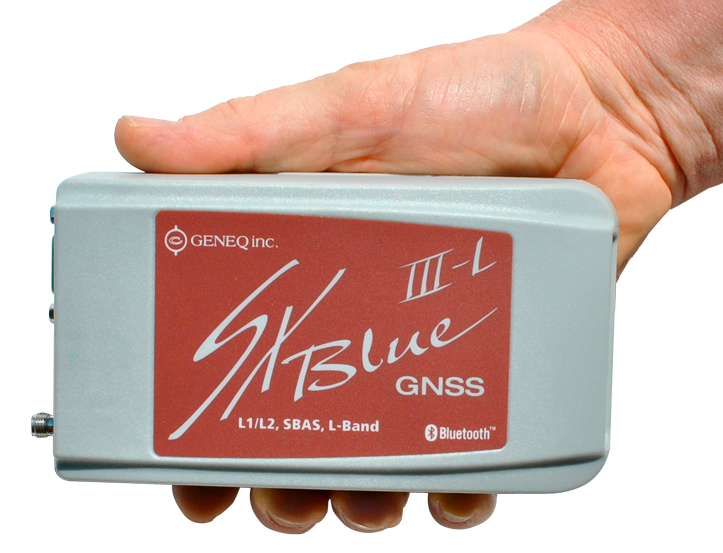
    Geneq Inc. has introduced the SXBlue III-L GNSS, a palm-sized L1/L2/GLONASS GNSS receiver that is designed to use OmniSTAR’s G2 or HP service to attain realtime 10-cm accuracy in all regions of the world, including North/South America, Australia, Asia, Africa, Europe, and the Middle East. The SXBlue III-L GNSS connects wirelessly to smartphones, handhelds, tablet or notebook computer that are bluetooth-compliant. Optionally, the SXBlue III-L GNSS receiver is fully RTK capable (1cm real-time accuracy) when using an RTK network or other RTK reference station.

    Photo: Geneq
    Photo: Geneq


    According to the announcement,  the SXBlue III-L GNSS is designed to use OmniSTAR’s G2 service, which supports GPS and GLONASS satellites, to provide 10cm accuracy in real-time in most parts of the world. The ability to track both GPS (31 satellites) and GLONASS (24 satellites) significantly increases the number of satellites in view, making the SXBlue III-L GNSS more productive in areas where trees, terrain or buildings block satellite visibility. It also outputs raw observation data that can be used for post-processing using free, online processing software services such as OPUS.

    “We’ve set a new standard for world-wide, real-time high-precision mapping using OmniSTAR’s G2 service,” said product engineer Jean-Yves Lauture. “The affordable price and flexibility of the SXBlue III-L GNSS makes worldwide, dual frequency, dual constellation 10cm real-time accuracy available to a wide number of users.”

    In addition to the OmniSTAR service, the SXBlue III-L GNSS also supports RTK GNSS. “If you want 1cm real-time accuracy, the RTK option lets the user connect to an RTK Network or a single RTK base station using standard RTCM and common industry formats,” said Lauture. “And, in that case, the RTK network or RTK reference station doesn’t need to support GLONASS for the SXBlue III-L GNSS to fully utilize the benefits of GLONASS.”

    The company reports the SXBlue III-L GNSS measures 14.cm (5.57”) x 8.0cm (3.15”) x 5.6cm (2.22”) and weighs slightly over a pound (1.14lbs, 517g) including battery. The SXBlue III-L GNSS is the smallest and lightest GNSS L1/L2 OmniSTAR receiver being produced in the world today.

    The SXBlue III-L GNSS is compact and rugged for optimal field use, requiring no backpack or external batteries. It was designed to meet the IP-67 rating, and can survive accidental immersion in water. The SXBlue III-L GNSS comes with a small, hermetically-sealed antenna that receives GPS, GLONASS, SBAS and OmniSTAR signals.

    The SXBlue III-L GNSS is targeted at high-precision users in industries such as surveying, GIS, utilities, construction, agriculture, engineering and other natural resource industries in addition to local, state and federal government users.

  • GSAT-10 Satellite Placed in Geosynchronous Orbit

    The Indian Space Research Organization has announced that the orbit-raising maneuvers of GSAT-10 satellite have been successfully completed from ISRO’s Master Control Facility, Hassan. GSAT-10 was launched September 30. The third and final orbit-raising maneuvers was performed October 3 to place the GSAT-10 in an orbit with 35,734 km apogee (farthest point to earth), 35,585 km perigee (nearest point to earth), and an inclination of 0.172 degree with respect to the equator. Currently, the orbital period of GSAT-10 is 23 hours 50 minutes.

    According to the announcement from the Indian Space Research Organization, the two solar panels and the two dual gridded reflector antennas were also deployed later in the day. Currently, the satellite is in final orbital configuration at 70.18 degree East longitude. In the coming days, the satellite will be moved towards its designated location of 83 degree East and in-orbit testing of its communication and navigations payloads will be performed.

    As is often the case, NORAD/JSpOC has temporarily “lost” the satellite following one of its orbital maneuvers. The last published two-line orbital element set for the satellite is dated September 30.

  • Thoughts on GPS/GNSS from the CGSIC Meeting Held Earlier this Week

    I attended the CGSIC (Civil GPS Service Interface Committee) State and Local Government subcommittee meeting in Seattle earlier this week. Following are some interesting observations you might be interested in.

    The Civil GPS Service Interface Committee (CGSIC) was established to facilitate communication among civilian GPS users, identify civilian user community needs, and report to the Office of the Assistant Secretary for Transportation. You are welcome to attend any of the CGSIC meetings. The U.S. state and local government subcommittee meeting moves around to different parts of the U.S. The next meeting is the annual CGSIC meeting that’s typically held the two days prior to the Institute of Navigation (ION) GNSS conference. This year it’s being held in Nashville, Tennessee.

    You can view the agenda for this week’s meeting by clicking here.

    Some take-away bullet point observations from this week:

    1. GNSS receiver technology is moving much faster than GPS policymakers can keep up with. If the policymakers can keep the various GNSS from interfering with each other, can protect the spectrum used by GNSS, and do their best to mitigate jamming/interference (intentional and unintentional), they’ve done their job.

    Rather than try to cage the GNSS animal, let it run wild and it will explore so many apps. Some will fail and many will succeed, but either way it’s a given that GNSS technology will contribute significantly to the world’s economy. With the introduction of the L5 civilian signal by the U.S. and Europeans, a new era of high-precision GNSS technology will emerge, along with countless new apps.

    2. The NTIA (National Telcommunications and Information Administration), while seemingly our friend when they recommended to the FCC last February that LightSquared not be allowed to move forward, did so because they had no choice. Make no mistake; the NTIA is trying to figure out a way to execute President Obama’s National Broadband Plan (which includes finding 500 MHz of wireless spectrum for high-speed Internet), which may mean trying to draw a tight box around the GNSS spectrum, via receiver standards. On the other hand, the FAA (Federal Aviation Administration) and RITA (Research and Innovative Technology Administration) are taking a different approach by developing a Spectrum Protection Plan. Which one will move faster? Likely the NTIA due to political pressure. While the LightSquared debate is seemingly on indefinite hold for now, the spectrum discussion is far from over. We might see draft proposal (for public comment) from the NTIA and FAA/RITA as soon as the end of this year, but could easily slip into 2013. Stay tuned.

    3. With all the talk about illegal GPS jammers and “jammagedon,” as Gavin Schrock (PLS) jokingly coins it, it was reported at the CGSIC meeting that there’s been no increase in reported incidences of GPS jamming and has stayed at the “couple of events” per year level. People are still talking about the 2007 San Diego event and the Newark airport event as the major ones. Unless the DoD is keeping something from us, jamming (intentional or unintentional) hasn’t panned out like one might have thought. The FCC is certainly cracking down on the distribution of GPS jammers (and cell-phone jammers). It is illegal to manufacture, import, distribute, and use GPS jammers in the United States.

    Not that jamming doesn’t occur and we shouldn’t be aware of it, but when your receiver isn’t working the way you think it should, jamming and solar activity shouldn’t be the first thoughts that cross your mind.

    4. Of the 12 Block IIF GPS satellites being built, two are in orbit with the first being launched in 2010 and the second one last year. A third is scheduled to launch later this year. That equates to one launch per year. Clearly, this pace cannot continue or it would be the year 2022 before all twelve were in orbit. What’s the problem? Part of the problem is that the legacy Block IIA model satellites have performed so well. In fact, one has been operational for 22 years. That’s an incredible feat for a satellite that was designed with an expected life of 7.5 years. Unfortunately for the IIF program (and the high-precision user community), it means that congress can defer a few hundred million dollars per year by delaying the IIF launches. In these budget-conscious economic times, it’s not difficult to understand the reasoning that if there are 31 operational GPS satellites in orbit, why spend $150-200M to launch each GPS satellite when we don’t need it yet? But, that won’t last for long. The many legacy GPS satellites are one component failure away from being unusable. That said, the word at the CGSIC meeting is that three IIF satellites will be launched in 2013.

    How important is the IIF satellite to the high-precision user community? It brings the new L5 civil GPS signal, which has huge implications on high-precision receiver performance and cost. Read here for more thoughts on L5.

    If you looked at the meeting agenda, you can see that I was on the agenda to make a 20-minute presentation. During my presentation, one of the messages I wanted to be clear on is that GPS is not in competition with GLONASS, Compass/BeiDou, Galileo, or any other GNSS. The GPS user community needs the other GNSS to succeed and the GPS program needs the other GNSS to succeed just as much as the other GNSS rely on GPS. Other GNSS, along with GPS, clearly provide a better solution for the user community than any one of them used by itself.

    I think it’s pretty clear, at this point in time, that the days of GPS-only receivers are numbered. Of course, they’ll still be around for a few years, but the trend is clear that even mobile phones are beginning to use GPS/GLONASS receivers.

    If you’re interested, click below and you can view a PDF of my presentation.

    Thanks, and see you next time.

    Follow me on Twitter for the latest GPS/GNSS news.

  • My Presentation at the 2012 Esri International User Conference

    This is my powerpoint presentation (in pdf format) that I gave at the 2012 Esri International User Conference in San Diego on July 26, 2012.

    Somehow, I was able to deliver this in about 20 minutes (although I did skip over a few slides). However, I really needed about 60+ minutes to go through it.


    Next week, I’m presenting at the Civil GPS Service Interface Committee (CGSIC) Meeting in Seattle, WA.

    This week I intended to post my 2012 Esri UC post-conference summary, but I couldn’t finish it in time. Look for that next week. Being in the geospatial space is pretty exciting these days with so much technology development happening.


    Thanks, and see you next week.
    Follow me on Twitter at http://twitter.com/GPSGIS_Eric
  • On the Edge: Mapping the Delta

    By Tracy Cozzens

     Surveyors install and configure a base and rover for a 13,000-hectare survey of the Plains Kogoni in Mali.
    Surveyors install and configure a base and rover for a 13,000-hectare survey of the Plains Kogoni in Mali.

    In the heart of landlocked Mali, between the Atlantic Ocean 800 miles to the south and the Sahara desert to the north, lays the extraordinary Inner Niger River Delta, also known as the Macina, a 1.8 million hectare oasis of lakes and floodplains with a vast potential for hydro agriculture.

    CIRA, a major West African consulting engineering firm, working on behalf of the Office du Niger, a quasi-governmental Mali company charged with managing more than100,000 hectares of irrigated delta land, has completed surveying an additional 25,000 hectares for hydro-agriculture development.

    map

    Created in 1991, CIRA is an engineering and applied research consulting firm working in transportation, hydraulics, civil engineering and the environment. Based in Bamako, Mali, the firm works in more than 15 African countries, primarily in West Africa, Central Africa and East Africa.

    In the course of two months during the dry season, two CIRA survey teams, each equipped with three Spectra Precision ProMark 500s, a base station, and two rovers connected via UHF, completed the entire 25,000 hectare survey collecting four points in x, y, and z per hectare to produce a digital model. The model enabled the production of rough pre-study with all plans and a detailed pre-project CAD drawings for drainage, irrigation canals, and related infrastructures.

    A very short eight-month contractual time set to complete the different studies meant that the land survey study would have to be completed as quickly as possible. The first thought was to use aerial photography combined with LIDAR, but setting this up would have taken too long, according to a CIRA spokesperson. Instead, CIRCA chose to employ differential GNSS, using base and rovers working in real-time kinematic. CIRA’s experience suggested the firm would achieve reliable results much quicker using only optical total stations. CIRA elected to use Ashtech ProMark 500 GNSS receivers for the project. From experience, they knew the models were easy to set up and use, lightweight, offered long battery life in the field, and field to office data transfer would be easy. Their expectations were met, and the job was completed within two months and on time.

    The ProMark 500 RTK survey system provides short time to fix, long-range RTK and solution reliability. Its BLADE technology provides multi-constellation signal processing with the use of SBAS and GLONASS ranging signals to strenghten the GPS solution.

    Trimble acquired Ashtech in 2011, making it part of Spectra Precision.

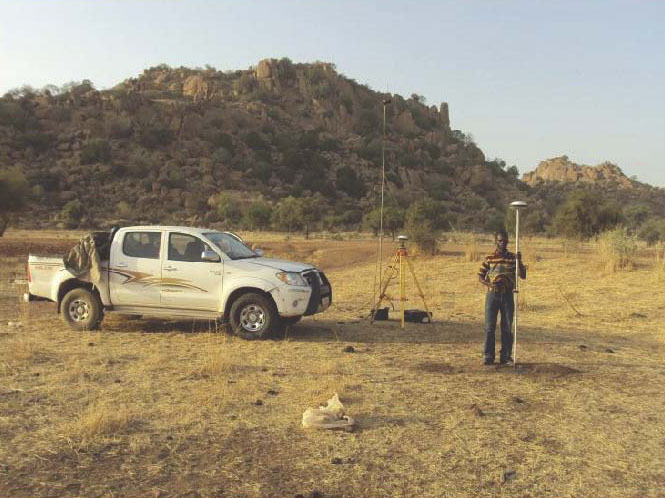
     Setting up bitter points for calibration of satellite images on the corridor Sarh - Abeche in Chad (800km).
    Setting up bitter points for calibration of satellite images on the corridor Sarh – Abeche in Chad (800km).
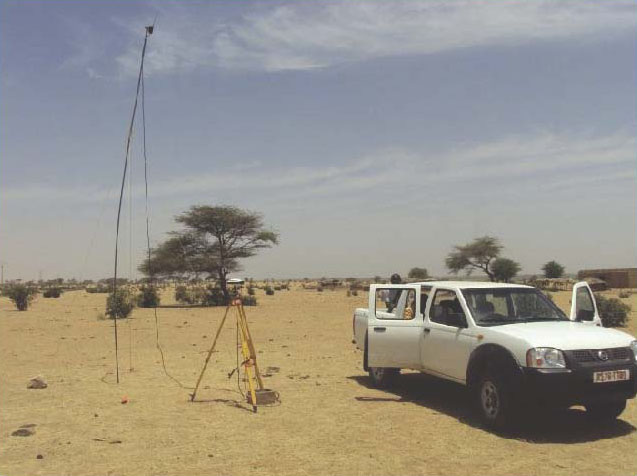
     Reference station during the survey topo Richard Toll road - N Dioum (120 miles) in Senegal.
    Reference station during the survey topo Richard Toll road – N Dioum (120 miles) in Senegal.
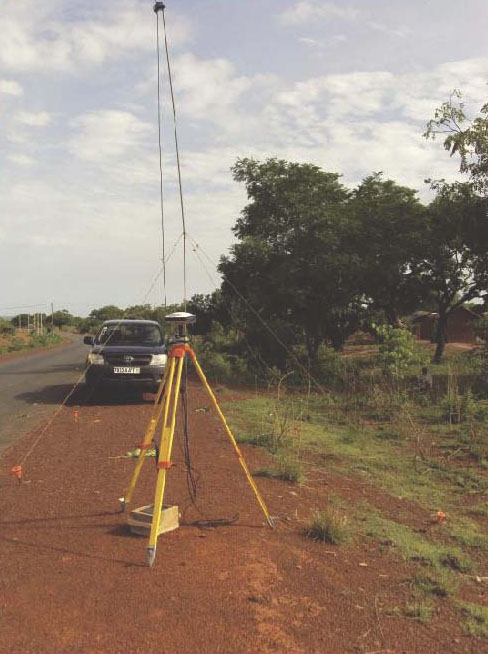
     A reference station during the survey topo Zégoua Sikasso road (95 km) in Mali.
    A reference station during the survey topo Zégoua Sikasso road (95 km) in Mali.