Author: Eric Gakstatter

  • Esri’s Survey Summit Showcases UAVs, 3D, the Cloud

    While the Esri Survey Summit still struggled to find a way to attract attendees, the International User Conference exploded by blowing away last year’s attendance by attracting a record 16,000+ GIS’ers this year in San Diego.

    The Survey Summit reeled in only ~250 people this year along with a roomful of exhibitors. That’s not to say the content wasn’t good. On the contrary, the content was very good, as it usually is. However, state/regional conferences seem to be gearing up so it’s difficult to see how a national conference like the Survey Summit can offer enough superior content to entice people to spend a few days and a lot of dollars traveling to San Diego during prime field season.

    Further complicating the issue is the fact that ACSM/NSPS is likely not going to participate in next year’s Survey Summit. But, the Survey Summit will survive because Esri will continue to sponsor it, and there’s a select few of us (yes, I’ll likely attend next year) who see the value of networking with the others who are like-minded.

    Highlights of the Survey Summit

    The opening ceremony featured Esri’s Donny Sosa playing the “Star-Spangled Banner” on an electric guitar.

    But Donny wasn’t playing just any electric guitar. It was an Atom 3D “printed” guitar made by 3D Systems. Folks, 3D printing is going to be mind-blowing technology of the future. It will be like everyone having a machine-shop in their home/office. Design a part or a system on your home computer and manufacture it using your 3D printer (or a local 3D printing service).

    Aside from the 3D printing entertainment, three subjects stuck in my head from the Survey Summit:

    1. UAVs (Unmanned Aerial Vehicles) for mapping

    I think the presenter from Hawkeye UAV said it best. Paraphrasing, he said that UAV commercial operations aren’t a major issue in any country besides the U.S. In the U.S., of course, commercial operations of UAVs are still prohibited. Only universities and government entities that are granted a CoA (Certification of Authorization) from the Federal Aviation Administration (FAA) are allowed to operate UAVs. The requirement for a CoA isn’t to be taken lightly, either. Last week, the Oregon Department of Fish & Wildlife was shut down from deploying a mapping UAV because its FAA paperwork wasn’t in order. They were planning to use an inexpensive RiteWind Zephyr II modified by Embry-Riddle University.

    If you recall, a bill was passed earlier this year with a provision to integrate UAVs into the U.S. National Airspace System (NAS) by 2015. This is going to be a challenge for the FAA, and you can expect some pretty tight regulations being applied to UAV operations. Imagine paparazzi circling UAVs over Hollywood snapping photos of celebrity sunbathers. Some people speculate that UAV operators will be required to be licensed pilots, even if they aren’t actually flying the UAV (UAVs have pre-programmed paths they follow). The rationale is that UAV operators may need to communicate with Air Traffic Controllers to ensure there is a safe distance from other aircraft.

    Although there are UAVs being designed and built specifically for mapping such as Gatewing (recently acquired by Trimble), there are an increasing number of low-cost and do-it-yourself UAVs such as Event 38 and others. In fact, I was speaking with one university researcher who operates UAVs. He said that for navigating one of his UAVs, he actually places a GPS-enabled mobile phone inside the UAV. The mobile phone, with a u-blox GPS chipset, is used to navigate the UAV as well as receive GPS corrections from mobile phone network. The only missing link from him obtaining reeeeally good accuracy was an external antenna (no such luck on a mobile phone), but he said the accuracy was still usable, and very affordable.

    GPS World has published several articles lately on UAVs that you may be interested in reading.

    March 9, 2012 – Unmanned Aerial Vehicles: The FAA is Taking Them Seriously, Should You?

    March 21, 2012 – Unmanned Aircraft Navigation

    April 9, 2012 – Unmanned Aerial Vehicles (UAVs)

    May 8, 2012 – Massive GPS Jamming Attack by North Korea

    July 25, 2012 – Is It Time for Unmanned Aerial Systems to Get Certified GNSS?

    August 1, 2012 – Drone Hack

    Although I hear people say they don’t take UAVs seriously, I think it’s a serious technology with a lot of potential. Hawkeye UAV, which I mentioned earlier, says it is as busy as ever performing a lot of stockpile (volume) measurements in mines. That’s just one of many apps for this low-cost, fast, and easy-to-deploy technology.

    2. 3D Rendering Technology

    I’ve written before about 3D rendering technology; remember this cool Ted video? It’s worth watching.

    Last year, Esri acquired a company called Procedural, which is the developer of a product named City Engine. It’s a really neat tool for “building” a city, from scratch if you wish, to help people visualize (in 3D) what a proposed development would look like. I’ve done similar things in the past with Autodesk’s 3D Studio Max, but City Engine seems to be a more quick-and-dirty, GIS-centric tool. Take a look at the following video on how to build a city from scratch into a complete 3D visualization:

    3D visualization tools have been progressing slowly over the years, but I think it’s getting to the point that without a lot of expertise, one can generate high-quality 3D visualizations. The trend is clear. If you recall, Trimble acquired Sketchup from Google earlier this year to incorporate a 3D visualization toolset inside its software. Geospatial specialists are getting closer and closer to being able to produce video-game-quality 3D renderings for visualizing everything from land development to regional watersheds and environmental impact areas. It’s a fantastic tool for presenting rich, complex geospatial data to the general public.

    3. The Cloud

    Ok, cloud-based apps aren’t anything new. In fact, I’m writing this article using a cloud app. Microsoft has had a cloud version of Office apps for years.

    It seems Esri has retooled its entire corporate strategy around cloud-based apps and data. It’s not just www.arcgis.com, Esri’s new cloud app for GIS, or ArcGIS for Android/iOS/Windows Mobile for mobile devices. According to Esri president Jack Dangermond, Esri has spent “tens of millions” on acquiring/licensing content (data) for cloud users. It’s not just vector data either (roads, etc.). In the U.S. arcgis.com subscribers will have access to nationwide 30-cm resolution imagery. In Europe, subscribers will have access to 60-cm resolution imagery, while subscribers in the rest of the world will have access to 1-meter imagery.

    The upside of cloud apps is that users can offload the IT overhead part of GIS, which can be frightenly expensive and complex. It also makes GIS apps easier to deploy because there is no client software to install or maintain on users’ computers.

    However, cloud GIS is not the solution to every GIS challenge. Even Esri president Jack Dangermond openly stated last week that “You don’t have to buy this, but you should,” referring to arcgis.com. But make no mistake about it, he’s clearly pointed the Esri ship to the cloud. My gut tells me that with arcgis.com, Esri will be successful in introducing GIS apps to a much broader audience, seemingly in line with Dangermond’s vision that eventually GIS will evolve from a scientific tool to a tool used by general society.

    Courtesy: ESRI

    On the subject of bringing GIS tools to to general public, Esri announced Esri Maps for Office, which Esri describes as an analytics tool to “visualize data by creating and sharing interactive maps directly within Microsoft Office.” In other words, make maps based on your Excel (or other Office) data. Take a look at the video below to gain an understanding of what Esri is talking about.

    If you’d like to see some brief comments that I tweeted from the Survey Summit on some other interesting items, click here for a quick summary. In next week’s newsletter, look for my summary on the Esri User Conference.

    Thanks, and see you next week.

    Follow me on Twitter at http://twitter.com/GPSGIS_Eric
  • Hello From San Diego…Survey Summit and Esri User Conference

    Last weekend, I attend the Survey Summit in San Diego, which is sponsored by Esri with participation by ACSM/NSPS. As usual, there’s was some great content, but it’s not all good news. On the other hand, attendance at the Esri International User Conference, which started on Monday, was at 16,000 and counting. That’s up considerably from last year.

    Survey Summit

    The agenda for the first day of the Summit was different this year, and better. It was mostly a set of Lightning talks, followed by some technical presentations, and rounded off with a keynote. The lightning talks were very good. I like that style, get to the point and show what you have

  • Survey Summit and Esri International User Conference Coming Up

    This weekend is the Survey Summit conference, which is a joint effort between Esri and the American Congress on Surveying and Mapping (ACSM). I expect it will attract around 500 people. It’s immediately followed by the Esri International User Conference, which runs all of next week and will likely attract ~13,000 attendees. Both conferences are in San Diego.

    The Survey Summit agenda format is a bit different this year. First of all, it’s at the Hyatt Hotel next to the San Diego Convention Center. Second, it’s starting two days later, on Saturday, as opposed to starting earlier in the week on Thursday. The first day of the Summit is now a series of lightning talks and presentations followed by a keynote presentation to wrap up the day into the the expo and reception.

    8:30 a.m. – 9:00 a.m.WelcomeOpening Remarks – BrentJones, Esri
    9:00 a.m. – 9:10 a.m.Lightning TalkThe National Survey Society: Road Ahead  Curt Sumner, National Society of Professional Surveyors, NSPS
    9:10 a.m. – 9:20 a.m.Lightning TalkSupporting the Next Generation, Rich Vannozzi, NSPS Student Competition
    9:20 a.m. – 9:30 a.m.Lightning TalkCelebrating 200 Years with the GLO, Don Buhler, Bureau of Land Management, BLM
    9:30 a.m. – 9:40 a.m.Lightning TalkA New Approach for New Datums,  Ronnie Taylor, National Geodetic Survey, NGS
    9:40 a.m. – 9:50 a.m.Lightning TalkLand Surveys in Support of Fish and Wildlife, David Clark, U.S. Fish & Wildlife Service, FWS
    9:50 a.m. – 10:00 a.m.Lightning TalkGPS Day, Donny Sosa, Esri
    10:00 a.m. – 10:30 a.m.Break
    10:30 a.m. – 10:50 a.m.Industry PresentationSurveyor 2.0, CheeHai Teo. International Federation of Surveyors , FIG
    10:50 a.m. – 11:15 a.m.Technology PresentationUAVs for Mapping and Survey, Rowland Harrison, Hawkeye UAV
    11:15 a.m. – 11:30 a.m.Technology PresentationPreserving the California Missions with 3D, Tom Greaves. CyArk
    11:30 a.m. – 12:00 p.m.Technology PresentationMapping Our Future, Lawrie Jordan, Esri
    12:00 p.m. – 1:30 p.m.LUNCH
    1:30 p.m. – 2:15 p.m.Technology PresentationSurveying the New Frontier, Mike Beavers, Frontier Surveying
    2:15 p.m. – 2:30 p.m.Break
    2:30 p.m. – 3:15 p.m.Keynote PresentationNOAA’s Geospatial Information Officer, Tony Lavoi , NOAA
    3:30 p.m. – 6:30 p.m.Survey Summit EXPO and Reception
    On Sunday, the technical presentations are in a traditional format (45-minute presentations) on subjects from surveying in the cloud to UAV mapping to handling lidar data. Of course, there’s also the annual discussion of surveying vs. GIS.

    There’s no real discussion about GPS/GNSS (albeit a talk about GEOID12) at the Survey Summit, which is surprising given that GPS/GNSS such a prolific tool for surveyors and high-precision GIS users. But, you have to realize that at the end of the day, this is a vendor conference and not an industry conference. I see a real shift going back to state and regional conferences, as opposed to a national surveying conference. It just seems that attendees will get more localized and relevant information in that type of venue, and I also see the trend of state/local conferences bringing in nationally recognized speakers talking about national issues that complement the local speakers and presentations.

    Esri International User Conference

    Yes, it’s a vendor conference, so you get a lot of Esri Kool-Aid. But, that said, there’s no better place in the U.S. to network with your colleagues about geospatial technologies and issues like this venue. If nothing else, it’s due to the sheer volume of geospatial people that converge on San Diego…~13,000.

    Nearly all, if not all of the geospatial technology trends I write about (mobile GIS, BIM, UAVs, GPS/GNSS, RFID, satellite imagery/lidar, etc.) are being discussed at this conference in some form or another. You may have to dig into the agenda a bit to find them, but they are there, and there are plenty of experts attending the conference who are presenting, manning exhibit booths, and otherwise walking around that can answer nearly any question you have. The challenge is finding the people you want to talk to among the 13,000 other people.

    I’ll be there all week attending sessions and talking with exhibitors about their work, products, services, and vision. If you want to keep up with me during the week, make sure you follow me on twitter. Twitter is replacing blogging to a certain degree. I’ll be posting photos, links, and interesting comments via Twitter throughout the day, every day at the conferences. You’ll get the latest news in almost real-time.

    On Wednesday, I’ll have a professional film crew following me around the User Conference as I talk with different exhibitors and attendees. We’ll produce some pretty neat videos of the conference that will be posted to a special Video Gallery section at 98.27.162.175/gpsworld.com. I’ll be asking exhibitors to talk about their newest GIS, surveying, and mapping products and services, their customers’ requirements and success stories, and any special features they may be unveiling at the show. The videos will be edited to 3- to 5-minute clips for posting to the Geospatial Solutions website. Relevant interviews may also be featured on GPS World’s website.

    On Thursday at 10:15 a.m. in Room 31B, I’ll be giving a presentation on the latest developments in GPS and GNSS technology. It’s part of the “Using a Mobile GIS to Manage Assets in the Field” session in the Mobile GIS topic track. I’ll be touching on the newest developments in SBAS, GPS, GLONASS, Galileo, and maybe a little bit about LightSquared. As always, there’s a lot happening in the world of GPS/GNSS and some major changes that you should know about, so stop by and join me.

    Esri Acquires ArcPad Developer Maptel

    In late-breaking news today, Esri announced it has acquired Austrailian-based ArcPad developer Maptel. This adds an interesting twist to Esri’s mobile GIS development efforts. While it’s been clear that Esri has been pushing ArcGIS for Mobile as the mobile GIS path for the future, the acquisition may be signaling a change in that strategy. ArcPad is the most widely deployed mobile GIS software in the world with well over 500,000 copies deployed. Look for more on this subject from me next week while I’m in San Diego.

    Thanks, and see you next week.

    Follow me on Twitter at http://twitter.com/GPSGIS_Eric

  • Reader Response on Open Source and Mobile Devices

    I’ve received some great reader response from readers regarding my articles on open source GIS and mobile devices. I’ve included them in this week’s column along with my comments.

    Open Source GIS

    As you can read below, the comments are directed at my statement regarding technical support for open source GIS software. I wrote that, essentially, “you’re on your own” to find solutions to technical problems and implied that open source GIS software support is not as good as commercial GIS software due to the lack of accountability. These readers clearly disagree and are passionate about the responsiveness of the user community and commercial support for open source GIS software.

    By way of background, following are links to two articles I’ve written in the past two months on open source GIS that the readers are referring to:

    May 17, 2012 – Open Source GIS

    May 24, 2012 – Open Source GIS: Part II


    Hi, Eric.

    Thanks for your paper. Please avoid spreading old FUD such as:

    There’s no accountability, no priority tech support, no one to call when you can’t figure out why things aren’t working, etc. You’re on your own, sort of.

    Which is plainly false. e.g., for QGIS, there are a number of companies that provide first class support, of far higher quality (having access to source code) than you can get for proprietary software, at favourable rates.

    By spreading such wrong opinions you actually damage, even if unwillingly, our work, and the open source ecosystem.

    All the best.

    Paolo – Italy


    Hi there, Eric.

    I would just like to mention my own personal experience and view on your statement about being on my own when using Open Source GIS software.

    I am using both commercial and open source in my organization, I pay quite a bit for the commercial support in the form of an annual maintenance fee. I don’t pay anything for support for the open source products I use, not because there aren’t any offerings, but it is more difficult do convince my company´s hierarchy to buy the same kind of annual support contract for open source products.

    Now, even under these circumstances, I get more results from the “unofficial” open source support from mailing lists then from the commercial support contract.

    Let me give you some examples on commercial support:

    1. I discovered, to my surprise, the latest version of the commercial product didn’t support wms services on computers with international settings (comma instead of dot as decimal separator). I waited a year and a half for that)
    2. I have found that the commercial product is 100% slower (half the speed) with a supported database product than the open source equivalent. The support told me that it was the database’s fault (which was aggravating). I had to log the sql statements and prove them wrong. I’m still waiting for a solution. There is no guarantee this will be solved. I was informed an enhancement request was filled but it is not publicly viewable.

    On the other hand, I had some problems with the open source product, without any support contract. I’m seeing a quick release cycle that solves a good portion of known bugs and problems, almost always solving my problem in the process. But the best thing that happened to me is when my particular bug is fixed under 24h and I can immediately download the fixed version. I even had a situation where I needed a new feature and someone developed an initial version in a week. A day later, one of the main developers included a similar feature in the core of the program.

    So, really, stating you are on your own when using open source products is really just not true and really a disservice to your audience when you state that so firmly.

    From my own experience, I am convinced there is a problem with changing our usual procedures. Instead of buying a product that includes one year of some kind of support (many times ineffective), and  then paying a fee annually, we must switch to using a free product, whose cost is that when we change it for the better we contribute that back to the rest of the users. And we can and should buy commercial support when our usage pattern reaches the level when it makes sense to acquire this type of contract.

    Thank you for your article. Other than this particular point, I enjoyed reading it.

    Best regards,

    Duarte – Portugal


    Dear Mr. Gakstatter,

    It’s great to see open source GIS featured in gpsworld.com (98.27.162.175/gpsworld.com) but I cannot agree with the following statement:

    “there’s limited amount of technical support available to implement and maintain the apps”

    There are both very professional companies (redacted) and enthusiastic communities behind any of the graduated OSgeo projects.

    As you mentioned correctly, one main issue is “market awareness” concerning open source GIS. Another issue is the very limited marketing budgets which makes it difficult to push the message and articles claiming lacking support are unfortunately not encouraging the average user to look into open source.

    I really appreciate that you picked up the topic of open source, I’d just  hope that correct pointers the the many support possibilities would be included.

    Best wishes,

    Anita – Austria


    I just read your article on Open Source GIS, dated May 17, 2012. I agree that it will be interesting to see where FOSS GIS goes in the future, I have to question your view on support.  I have been a user of proprietary GIS and image processing software for 10 years (from ArcView 2 through present day ArcGIS 10.1, ERDAS IMAGINE, ENVI, MapInfo etc…) and I have to say that I have received MUCH better “technical support” the past two years with FOSS products than I ever had with the other proprietary products.  Many of the FOSS packages have excellent document and reference websites (could be because these are built by the developer s and users alike, and added to continuously.)  There are also a large number of blogs and other websites documenting steps in these packages.  Additionally, the email lists are incredible.  I can usually find what I need WITHOUT having to call someone!  In the past, I was a heavy user of ESRI Knowledge Forums, which I thought was great when I started. ESRI staffers did not post as much as you would like. Numerous questions would go months or years without an answer or post by ESRI. The numbers of qualified people posting to the ESRI forums and email lists were far outnumbered by the users and were less responsive when needed. Maybe there is also a factor that is you recived software and support for free, then you’re more willing to help others. As well, being a tech support person myself for many years, I can attest that many ESRI/ArcGIS users do not understand much about GIS and cannot answer may questions posted. There are of course, local user groups, but many are specific to their needs. IT was tough in the ESRi world to get support than in the FOSS world.

    One last comment is the adoption of gvSig. Quantum GIS has really taken off and is the primary FOSS GIS desktop people use. MapWindow also is becoming very popular and used heavily by US federal govt related groups. Both of which feel closer to traditional GIS. gvSig is also a little different in its feel and use.

    John – Delaware USA


    I’d like to thank these folks for taking the time to write about their experiences. I’m going to continue to investigate, understand, and start using open source GIS to gain a feel for it. Initially, my interest in open source GIS was focused on mobile apps, such as gvSig Mobile, but I also see there’s an effort to develop Quantum GIS Mobile for Android, which could be very interesting given the tremendous adoption of Android in mobile devices. Also, the website agenda doesn’t reflect it yet, but I’ve added a keynote speaker on open source GIS to the 2012 Field Technology Conference general plenary. It’s important for the GIS user community to understand what’s available.


    Operating System Wars: Android, iOS or Windows Mobile?

    I also received an email from a reader regarding my series on mobile devices and operating systems. I’ve written a few articles on this subject recently. In fact, an article titled “Expert Advice: Mobile Computing on the Rise” will be in the GPS World print magazine in the July issue, which is what the following reader email is referring to. For more background, refer to the following articles:

    April 27, 2012 – Mobile Device Operating System Wars: Android vs. iOS vs. Windows Mobile

    May 10, 2012 – Thoughts on Mobile Devices, UAVs, and Cheap Data-Collection Software

    July 4, 2012 – Mobile GIS Webinar Follow-up and the New Google Nexus 7 Tablet


    Eric,
    Just read your July 1 article “Expert Advice: Mobile Computing on the Rise.” Seems every time you write on mobile I feel compelled to send you an email follow up. This time’s no exception.
    I too remember the Grid computer days when a tablet’s heft was in tons, handwriting recognition involved mystical templates that helped you shape your letters just so with the stylus, screen visibility outdoors was essentially non-existent and battery life diminished at the same rapid rate as water evaporating in the southwestern desert sun on a 115 degree day. I absolute agree that WinMobile’s future is questionable and even if that OS does manage to avoid emulating dinosaurs it will likely remain relegated to professional uses only with high price points both for hardware to run that OS and for the software that makes owning a device powered by it marginally worthwhile. Ruggedized hardware is the best thing going for WinMobile in my mind and I believe that’s all that can save it from becoming fossilized. But that advantage is beginning to resemble the Garmin/TomTom legacy losing traction nowadays.
    Where we differ, however, is that I’m already willing to go WAY out on the limb and give the trophy for victory in the mobile war to Android devices. Here’s why.
    My first smartphone was an Apple iPhone 3GS and when it came time to move up to a new phone, I wrestled quite a long time between Samsung Android-based offerings and the very new at that time Apple 4s. If you guess that I went for the Android for my second smartphone and that’s why I’m emailing you, you’d be wrong. Although I absolutely hate several limitations of iOS-based phones (no removable battery, throttling back to near non-existence of Bluetooth by Apple, and zero removable storage specifically), I went iOS yet again primarily because of Siri (which I’ve not been that thrilled with) and the fact I already had many iOS apps that I’d paid for and understood how to use.
    But when it came time to buy my first non-Windows (… and I’m not talking WinMobile) tablet, I reversed course totally. I purchased a Toshiba Thrive which I really love. I don’t even bother to pack my Win7 laptop for most business trips nowadays. I have a small twelve inch laptop case with a Bluetooth mouse and keyboard and I just grab the Thrive and the case and I’m good to go. When I first got the Android OS tablet, many of the apps that were readily available in iOS were not there. By that I’m not talking about DropBox or the Weather Channel app … I’m taking specialized category level not there. I was blown away, for example, that I couldn’t find a camera app that geotagged photos taken with the Thrive. Over time, however, that gap has narrowed so it’s far less a factor and I really like the fact that I can take my 128 GB SDXC chip on which I have all my geospatial professional, university teaching and personal files and pop it out of my work Win7 laptop and into the Thrive and head out across the county. QuickOffice lets me read MS Office docs and make changes on the go. Right now, I’d not trade my year and a half old Thrive for a new retina display iPAD even if Apple paid me what the new IPAD costs if I had to give up my Thrive.
    Knowing that just my enthusiasm about someday being able to take a terabyte of geospatial data on an Android tablet with me to the field will probably not convince you to join my declaration of victory, I’ll finally get to the point of this email.
    The fact is that MANY vendors are introducing this summer ruggedized Google-based tablets. Contrast that to the fact that iPADs will always have to be encased in some kind of protective shell. That’s the piece of the story that I think you missed. To me this is a very big deal. A Panasonic Toughbook Android offering compared to the delicate iPAD for use in my geography is a no brainer. I also don’t expect to see too many daylight optimized iPAD screens coming out anytime soon from Apple.  Also MIA in your piece was easy of development.  Friends and I are building a new geospatial apps company and so we’ve been done a bit of development on both Android and iOS. So far we’ve used Flash Builder and created FLEX-based apps just by checking the two appropriate boxes for iOS and Android Mobile. Then it came time to test the apps. I can tell you that the venture capital sized fee required, the CDC DNA sample, TSA full body scan and NSA screening one must endure plus the length of Apple’s approval process to be able to just push a simple test app out to a few devices from iTunes compared to the far more pleasurable experience fielding a test Google app leave me never wanting to write again for iOS. And then there are the UDIDs for every darn iOS device you plan on testing your code on. Developing on iOS is a royal pain compared to Android. Pain of development is the second thing not in your write up.
    Yes I find the lack of being able to create a folder unifying programs of a general type (telecom apps, office apps, etc.) on one of the Thrive’s home screens to be a bit of a pain but I really like being able to switch out my Thrive’s battery when I need a new one or I need one that’s freshly charged to head out into the field.
    So … I predict loudly (because unlike you I have nothing to lose in doing so), Google will win the field mobile race beating Apple as you said but I’m thinking more like three years and I believe ruggedized hardware designed specifically for field use that cost more than a Thrive but far less than a Getac Win7 convertible or a Trimble GeoXT will be a key factor in that victory.  And if ArcPAD for Android or a Trimble GeoXT with Android comes out…best get out of the way ‘cause a Tsunami’s coming.
    Keep up the great articles and I hope you find my thinking interesting,
    Larry – West Virginia USA


    I largely agree with Larry. I think the mobile operating system war will likely be won by Android (market research predictions support this), and Windows Embedded Handheld might end up being the choice for “professional” users. Why? It’s all about the apps. Of course, there are tons of professional apps written for Windows Mobile (Windows Embedded Handheld will run them) and we’re starting to see geospatial apps being written for Android. Yes, there are geospatial apps written for iOS too, but if you look at the potential upside, I keep hearing that Apple just isn’t a developer-friendly environment, and as Larry mentions, Apple will always be focused on the consumer market, so don’t expect a ruggedized version of the iPad anytime soon. However, on the flip side, one Apple developer relayed to me that it’s very helpful that Apple retains strict control over app development for iOS devices:

    “When Apple upgrades IOS, it is pushed out to all devices (pad/pod/phone) and the updates are very well documented in terms of what changed. He said users just agree and they all get it, very rarely does someone say no to the upgrade. So, you have basically one version to program for/test at a time. Long story short, you only have to program the different screens and the rest is standardized. The info is there to tell you what the device is, so it is easy to have one app look diff or add something for a pad w/larger screen than on the phone.

    For android, the OS is open, so every manufacturer and/or provider and every different phone from them can have a different/unique OS. It starts out the same but some add features others don’t and most modify the code to suit their needs. Then, upgrades only happen if the manufacturer and/or provider decide they want to upgrade them and which ones (old phones might not get upgraded for example).  So, lots of Androids out there are not on the same/most current OS. Users can’t just do upgrade themselves, a generic version might not work right on their phone and most people don’t look for upgrades anyway.”

    Over the next six months, it’s going to be really interesting to watch what kid of geospatial apps are introduced for iOS and Android. That will be the main driver behind the adoption of mobile devices based on iOS and Android. It will also be interesting to watch how many new devices are introduced that are running Windows Embedded Handheld/Windows Mobile.


    Again, thanks to the readers for taking time to write and stimulate further discussion on this fascinating subject.


    Thanks, and see you next week.

    Follow me on Twitter at http://twitter.com/GPSGIS_Eric

  • Mobile GIS Webinar Follow-up and the New Google Nexus 7 Tablet

    Thanks to those able to attend the June 21 webinar titled “Mobile GIS: What’s the New Normal? Windows, Android, iOS, Open Source?” If you weren’t able to attend and would like to listen to it, you can by registering here. It’s a fascinating discussion about the direction that mobile GIS devices are taking in the future. To top it off, two days after the webinar, Google announced its own tablet computer, the Nexus 7.

    I conducted three live audience polls during the webinar. One audience member noted that by asking the poll questions after presenting slides on the subject that I may have skewed the results. I guess it’s possible, but I think most audience members already had some idea of which direction they were going even before attending the webinar. However, I do agree that by presenting information the audience may not have been aware of (such as Microsoft’s commitment to support Windows Mobile until at least 2019), that this may have caused audience members to reconsider or change their answers based on new knowledge, but isn’t that what the webinar is supposed to do? Provide timely and current information for more informed decision-making?

    Followng are the poll results from the webinar.

    Poll #1: For Mobile GIS work, which type of device do you prefer?

    Poll1

    Gakstatter comment: The audience results don’t surprise me. Some might expect that smartphones would be higher, but as one audience member noted, “The screen is too small and who wants to risk using their phone?” Also, there are a very limited number of mobile GIS apps available for smartphones running Android or iOS. But, I think the fundamental issue is risk. Yes, for lightweight mobile GIS, a smartphone may be very useful, but if you’re tasked with an all-day intensive mapping project, would you really use a smartphone for this? It’s a valid question.

    Poll #2: Which Mobile device operating system do you foresee using in the future for Mobile GIS?

    Poll2

    Gakstatter comment: This is interesting, but not completely surprising. The dominance of Android makes sense because the vast number of Android-based devices being introduced, from smartphones to tablets. I expected the iOS number to be higher, but I think what’s hurting iOS is the lack of apps for mobile GIS and the inability of iPads/iPhones to interface (Bluetooth) with external sensors (such as GPS, lasers, cameras, etc.). Another interesting point is the high number of “Don’t Know yet” responses (27.4%). With the lack of powerful mobile GIS apps for Android and iOS and the user community’s uncertainty about Microsoft’s intentions with Windows Mobile, there’s a lot of “wait and see” going on. My gut tells me that Windows Handheld will garner the largest share of the “Don’t know yet” audience. It’s going to take quite some time before mobile GIS Android apps are developed, introduced, debugged, etc. Plus, there are so many versions and variations of Android that I think developers will have to target certain devices to support. It’s not a “one-size-fits-all” thing. An app developed for Android doesn’t mean it’s going to run properly on all Android devices.

    Poll #3: In the future, do you think your organization will be using cloud-based mobile GIS apps or standalone mobile GIS apps?

    Poll3

    Gakstatter comment: I have to say, this is the most confusing webinar question I’ve ever asked. During the webinar, I noted this and asked the audience to respond Yes for cloud-based apps and No for standalone apps. If you understood it that way and responded accordingly, the results seem reasonable. Either way, there’s no doubt about the huge interest in working with cloud-based apps. It’s going to be interesting to watch where the cloud-based apps go. It’s not like a small consulting company or local government agency can deploy cloud-based mobile GIS apps easily. They would need a whole level of back-end support (hardware and software) to do this. In that case, maybe there’s companies that will offer SaaS (Software as a Service) for these folks to use? That starts to make sense. But, where are they? Is ArcGIS for Android/iOS and Google for Android as good as it’s going to get? One segment where I have seen some traction is local governments offering mobile GIS SaaS from companies like Accela and CitySourced.

    If I haven’t said it enough, what’s hindering Android and iOS in mobile GIS is the lack of apps. Esri will never have ArcPad (arguably the world’s most popular mobile GIS software) rewritten to Android or iOS, that’s pretty clear. Esri’s successor for ArcPad is ArcGIS for Windows Mobile, in which they just released version 3.0. It’s a hybrid standalone/cloud app so you can use it when your not connected to the Internet, but it still doesn’t have some of the useful features that ArcPad (and others) have like supporting related tables and direct support for raster imagery, CAD, and shapefiles that don’t have to be “pre-processed” in ArcGIS. There’s really nothing similar for Android or iOS.

    Due to the lack of apps for Android and iOS apps, I’m not so quick to write off Windows Mobile devices as many people have. As poorly as Microsoft has communicated its intentions, they have committed to supporting Windows Embedded Handheld (essentially, the same as Windows Mobile) until at least 2019. That’s plenty of time to let Android mature and settle (or even some other operating system to emerge), which it needs to do in order to not drive software developers insane. Android ships in many flavors today, from version 2.3 to the new Google Nexus 7 tablet running version 4.1. Since Android is an open operating system, you can have so many variations and nuances that it will be nearly impossible for app software to run flawlessly across so many different hardware devices and operating system versions.

    On the flip side, Apple (iOS) has a highly-controlled app registration process, so other than varying screen sizes, apps will largely run across the iOS hardware platforms. The highly controlled environment seems to work well in ensuring smooth running apps. I’m told that Apple does this to ensure the “best user experience.” However, in some areas, notably Bluetooth connectivity, the proprietary nature of Apple rears its head in a not-so-flexible way. For example, for those of you waiting for the day you can use Bluetooth to connect your high-precision GPS, camera, or laser rangefinder to the iPad or iPhone, don’t hold your breath. If it wasn’t specifically made to Bluetooth to iOS, it’s not going to work. For example, following is a Bluetooth GPS receiver (XGPS150) that works with iPads/iPhones as well as other non-Apple Bluetooth hosts. Note the “Mode” toggle switch where the user must select between Apple and non-Apple products.

    Dual XGPS150 (Source: Dual)
    Dual XGPS150 (Source: Dual)

    The Dual XGPS150 is your typical consumer-grade GPS receiver. It has value for pilots, auto nav, and other apps where the users need to place the GPS antenna in a different location than the iPad/iPhone. However, none of the professional-grade Bluetooth GPS receiver manufacturers have designed “Apple Bluetooth” into their systems, so there’s no way to connect your iPad/iPhone to a high-precision GPS/GNSS receiver via Bluetooth, unless you jailbreak the Apple Bluetooth stack.

    With iOS devices “out” for the forseeable future, that leaves the battle between Android and Windows Mobile devices for the most flexible and powerful GIS data collection devices.

    Google’s New Nexus 7 Tablet Computer

    Just two days after Mobile GIS webinar, Google introduced its Nexus 7 tablet computer.

    Google Nexus 7
    Google Nexus 7

    Even though Google says it’s not meant to target the Apple iPad, it may be better suited for geospatial apps than the iPad. One of the apps it was built for is gaming, so it’s got a pretty strong processor, a 1.3GHz quad-core CPU backed by 1 GB of RAM. Given that, dealing with raster imagery efficiently may not be an issue, although storage might. The Nexus 7 comes in 8-GB and 16-GB versions, with no memory expansion slot. That’s a lot of storage, but we like our SD cards.

    Of course, the “7” in the Nexus 7 name matches the display size, 7 inches, with 1280 x 800 pixel resolution, which is higher-res than the first two iPads. The Nexus 7 weighs in at 12 ounces, which is ligher than a Kindle Fire and half the weight of an iPad (although the iPad has a larger 9.7″ display). It reportedly works fine in direct sunlight, which is a must for geospatial users.

    It’s 4300-mAh Li-Ion battery will run it 9+ hours and I’d probably buy the $20 protective case for it since it’s not built for outdoor use any more than a notebook computer is. Ruggedness is always the rub with using consumer electronics devices outdoors, and the Nexus 7 is no different.

    By the way, the Nexus 7 is actually an ASUS Transformer Prime tablet that Google has rebranded. This is a good thing because the hardware bugs have likely been flushed out. Gizmodo rated the ASUS unit its favorite Android-based tablet.

    The Nexus 7 is one step closer to bringing consumer tablet computer technology to professional geospatial users. Although it has a built-in GPS receiver and 1.2-megapixel cameras, we need better geospatial tools. If various Bluetooth geospatial devices like high-precision GPS receivers, cameras, laser rangefinders, etc. can be interfaced to the Nexus 7, it’s a better match for geospatial apps than the iPad.

    Running Android’s latest 4.1 operating system, it’s going to suffer from a lack of geospatial apps, for now. But maybe this is the sort of hardware that developers need to see to get them excited.

    Did I mention the price?

    $200 bucks. If you want to splurge, $250 for the 16-GB model.

    This is getting interesting, very interesting.

    Thanks, and see you next time.

    Follow me on Twitter here.

  • Expert Advice: Mobile Computing on the Rise

    This discussion of current trends in location-enabled mobile devices takes as its foundation the different operating systems (OSs) for those devices. Why? For GPS/GNSS hardware units to be useful, there have to be software applications — apps — also riding on those units. Apps are totally dependent on the operating system. An analogy is that the operating system is the foundation of a house and the app is the house itself. The type of foundation you have drives what type of house you can build.

    For example, no one is going to write an app today for Palm OS because that OS is essentially dead. While that’s an obvious one, a not-so-obvious one is Microsoft Windows Mobile. Most apps written for professional users are written in Windows Mobile, but Microsoft hasn’t done a good job of communicating its intentions regarding Windows Mobile, so users and developers think Microsoft may abandon it.

    On the other hand, Android is gaining so much momentum. Will developers rewrite their apps from Windows Mobile for Android? Or for Apple’s iOS? Can they afford to? Can they afford not to? If they don’t, that would mean that fewer professional apps will be available for Android and iOS users. Will that mean Windows Mobile will be the OS for professional GPS/GNSS users, and conversely, will Android/iOS be the OS for consumer-level GPS/GNSS users? Taking it to a practical conclusion, according to the type of mobile computing device that you purchase, what kind of location application will you be able to use?

    Photo: Apple
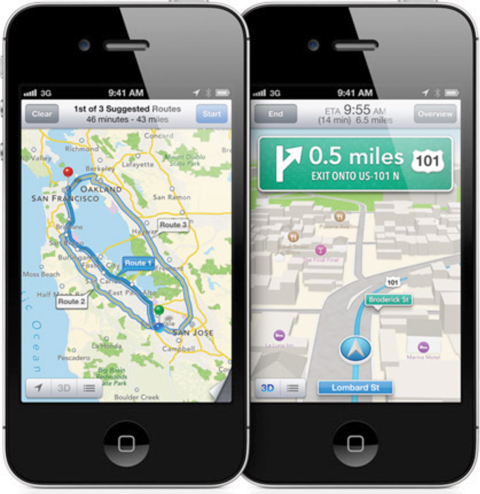
    Smartphones. Apple iOS’s new Maps app will likely be the largest scale crowd-sourced app ever introduced.


    PNDs Out-Smarted

    For the past decade, GPS personal navigation device (PND) sales have burned white-hot. In 2007, Garmin experienced double- and triple-digit growth, selling more than 10 million units. TomTom grew from zero to hero and sold more than 9.5 million units in that same year. During that brief golden era, every consumer electronics company who was anyone took a stab at introducing a PND to get a piece of the action. As unlikely as it seems, Garmin and TomTom stayed on top, fighting off consumer electronic giants like Sony, Panasonic, Hewlett-Packard, and Philips, all orders of magnitude larger. PNDs ruled the GPS world during that era.

    Credit: GPS World
    Download a PDF of our Mobile Computing Product Showcase.

    At the height of that period of explosive GPS PND growth, Apple introduced a new generation of smartphone, the iPhone, in January 2007. At that time, there were approximately 17 million smartphones on the market. Nokia with its Symbian operating system led the pack at 63 percent of worldwide market share, Blackberry was the rising smartphone of choice, while Microsoft Windows Mobile operating system captured 18 percent. Google’s Android operating system had not yet debuted.

    It’s amazing how a mass-market technology, so personal to us all, can change so quickly. Today, Google’s Android operating system dominates the smartphone market (roughly144.4 million smartphones were sold in Q1 alone of 2012, according to Gartner Research) with a 56.1 percent share. Apple’s iOS follows at 22.9 percent; Symbian (Nokia) has fallen from leader to bit player at 8.6 percent, and keeps company in the low rungs with RIM/BlackBerry (6.9 percent), Samsung’s Bada (2.7 percent), and Microsoft Windows (1.9 percent).

    The trend is clear. Android and iOS are cleaning up at the expense of all the others. Is it any coincidence that these two are the ones making the most of their maps and nav? More on this in a moment.

    By the way: every one of the 144.4 million smartphones that shipped in the first three months of 2012, no matter what operating system it ran on, carried a GPS receiver inside, typically a chipset from Broadcom, CSR/SiRF, u-blox, Qualcomm, or Texas Instruments. That spells trouble for Garmin and TomTom. Google and Apple are doing to Garmin and TomTom what Microsoft did to NetScape with Internet Explorer.

    Even with GPS PND prices at an all-time low, Google’s Navigator, with high-quality, PND-like turn-by-turn street navigation, is included on Android smartphones free of charge. Apple is following suit. Just last month, Apple introduced the Maps app for turn-by-turn street navigating as well as real-time traffic information. With more than 100 million iPhones behaving like traffic sensors, Apple’s Maps app will likely be the largest scale crowd-sourced app ever introduced.

    What does this mean to Garmin and TomTom? The numbers don’t lie. In February 2012, TomTom reported a 40 percent decrease in GPS PND sales for Q4 2011 compared to Q4 2010.


    Tablet Computers

    For another wild ride, take a look at the tablet-computer market. The tablet has been around for many years. I remember playing with them in the 1990s when they were horribly expensive ($3,000–$5,000). The price, a limited outdoor-viewable display, and power usage all combined to squash unit sales. Only a few manufacturers such as Fujitsu had the determination to stay. That all changed in 2010 when Apple introduced the iPad.

    Prior to the iPad rollout, tablet computer sales were limited primarily to business users. Healthcare provided a particular arena for Fujitsu and others to focus on, and there were a few other markets that were not very price-sensitive, and so receptive to the tablet. The iPad blew away that $3–5K price point (iPad 2, $629) and brought the tablet experience to the average consumer. The result? Roughly 67 million units sold since its introduction, far surpassing all tablet computer unit sales in history in just two years. Apple hit a sweet spot, for sure.

    The iPad catalyzed the tablet industry for two reasons:

    • It opened the eyes of the consumer to the applications of a tablet computer.
    • It drove the price-point expectation of all tablets down.

    Of course, the iPad has its limitations. It runs Apple’s proprietary operating system, iOS, so you are limited to the number of apps written for that platform. It also lacks horsepower to run more challenging programs that an Intel or AMD-based computer can breeze through. From a GPS/GNSS perspective, certain models of the iPad sport a GNSS chipset (from Broadcom) similar to mobile phones; however, because of the way the GPS functionality is designed into the system, accuracy is limited to a few meters at best. Power GPS/GNSS users would love it if Apple would implement serial port profile (SPP) in its Bluetooth software. Then, GPS/GNSS users could attach any Bluetooth-compliant GPS/GNSS receiver they like, even RTK-capable receivers for centimeter-level accuracy. But Apple doesn’t seem interested.

    As in the mobile-phone market, Google is making a strong tablet play with its Android operating system. Google’s device-agnostic operating system is attracting tablet hardware makers in droves with iPad-like tablet computers, notably Samsung Galaxy (with GPS) and Amazon Kindle Fire (no GPS). Also, there’s an interesting link between mobile phones and tablets. Gartner reports that 40 percent of user apps run on both mobile phones and a corresponding tablet computer. This is significant because the operating system may well drive the tablet purchase. For example, a person with an iPhone is more likely to buy an iPad than a Samsung Galaxy, which runs Google Android.

    However, Android has not achieved the dominance in the tablet computer space that it has in smartphones. iOS (iPad) held 67 percent market share in 2011, falling to 61 percent in 2012,but still retaining the pole position. Android is a strong second with 29 percent in 2011, rising to 32 percent in 2012, according to Gartner. No other operating system even comes close.

    Gartner forecasts show that Android will eventually approach iOS in market share, and my guess is that it will overtake iOS within five years. Apple’s proprietary system will catch up to it. While GPS/GNSS chipsets aren’t as widely integrated in tablets as they are in mobile phones, that will change as GPS/GNSS use becomes even more ubiquitous. Further, there are plenty of ways to add GPS to a non-GPS model via Bluetooth, PCMCIA, and USB.

    Android supports Bluetooth SPP, or a derivation of it, so you can connect any Bluetooth SPP-compliant GPS receiver that you like and not be limited to the receiver chipset the tablet engineer decided to design into the system.

    ]Although PDAs have an embedded receiver, they are lower-precision systems, in the 1- to 5-meter range, largely due to poor antennas. For higher precision requirements, these are used as field data collectors connected to an external antenna and/or a high-precision GPS/GNSS receiver.Handheld PDAs

    Handheld personal digital assistants (PDAs) were all the rage 10 years ago when Compaq Computer Corp. introduced the iPAQ H3100 running Microsoft’s PPC2000 (Pocket PC) operating system, the precursor to Microsoft’s Windows Mobile operating system. The iPAQ made a strong run through 2009, with the last models running Windows Mobile 6 before smartphones became powerful enough to negate the purpose of the PDA.

    While we probably will never see another introduction of a new iPAQ-branded PDA, it was a useful device and an inexpensive handheld for interfacing to GPS/GNSS receivers. Albeit a niche market, there’s still a demand for such handhelds for field data collection.

    According to the nature of capitalism, where there’s a demand, suppliers will show up. Since the iPAQ has faded, and smartphones aren’t yet well-suited as field data-collection devices, a new breed of semi-rugged and rugged PDAs has emerged in the past year from small, niche-oriented companies. Examples include the SXPad from Geneq, Juno 3 series from Trimble, and the Mesa/Rampage 6 from Juniper Systems/SDG Systems.

    These devices, with GPS/GNSS receivers embedded, are not built for the average consumer. Their prices are higher — but coming down — and they are more rugged; some are water-resistant, some waterproof.

    In a nutshell, PDAs went professional, targeting organizations that need maximum data-collection productivity from field personnel. Although they have an embedded receiver, they are lower-precision systems, in the 1- to 5-meter range, largely due to poor antennas. For higher precision requirements, these are used as field data collectors connected via Bluetooth to a high-precision GPS/GNSS receiver.

    Although the professional PDA market is not immune to the operating-system wars we’ve seen in mobile phones and tablet computers, it’s a bit stickier. Professional data-collection apps have been written almost exclusively around the Microsoft Windows Mobile operating system. These niche software programs are written for relatively small audiences (compared to the mass-market apps on smartphones), and it can be economically tough to justify porting the apps to iOS or Android. Therefore, the professional PDA market has been slower in adopting iOS and Android.

    Microsoft hasn’t helped the cause. It stopped certifying new products with the Windows Mobile operating system, creating confusion in the user community. Is Microsoft exiting the mobile device business? Not according to the company. It appears that it has split the mobile device business into two operating systems. Smartphones will run Windows Phone, and other mobile devices will run Windows Embedded Handheld, which is compatible with Windows Mobile.

    The problem, the confusion, and the frustration come from the fact that the Windows Phone operating system is not compatible with Windows Mobile (or Windows Embedded Handheld). Microsoft split the market between smartphones and other Microsoft-driven mobile devices. Given Gartner’s research that 40 percent of users’ smartphone apps also run on a tablet device, this means that Microsoft is going to either change that dynamic or suffer the consequences.

    No matter which direction mobile devices take, be it phone, handheld, or tablets running Android, iOS, Windows, or something we haven’t yet seen, embedded GPS/GNSS functionality will remain the centerpiece of location technology in all mobile devices. Even more exciting are the new GNSS signals and constellations in the next five years that will bring unprecedented accuracy to all mobile devices, driving the development of a tremendous number of new apps to exploit the improving accuracy.


    Eric Gakstatter is contributing editor for survey at GPS World magazine and the editor of Geospatial Solutions. He has spent the past 20 years in the GPS survey/mapping industry, using many brands of GPS equipment and software. He is a non-partisan advocate for the GPS user community, and a frequent speaker at user and technical conferences.

  • Spatial Plexus

    Two weeks ago I attended a somewhat different GIS conference at Georgia Tech called Spatial Plexus touted to be a new conference devoted to solving “Wicked Problems.” This was not to be confused with “Wicked,” the only musical I ever attended where the audience went home humming the scenery. As stated in the program brochure, “Wicked problems are those difficult to solve because of incomplete, contradictory, and changing requirements. By inspecting wicked problems with “geospatial goggles,” complexities and interdependencies can be exposed, better defined, dissected, better managed through the geospatial approach and reassembled for overall improvements.”

    One of the reasons that I attended this conference is that most of the attendee names were not familiar to me so I had a chance to meet some new people in the GIS community. The conference was all plenary sessions, so we didn’t have to play the game of running from one break-out session to another and missing some because of conflicts. It was held at the Georgia Tech Hotel & Conference center in Atlanta, a new, nicely designed conference center.

    Danielle Ayan, GISP of GTRI (Georgia Tech Research Institute), organized the conference and it was perfectly planned, executed, and well-documented. The dominant themes of this new conference included higher education sustaining academic programs in ever-shrinking budget times and getting spatial thinking accepted in more disciplines across the campus disciplines. Geospatial technology in infrastructure and economic development were also major topics.

    Key speakers included: David DiBiase of Esri, GTCM, and Penn State fame; Dr. Peter Lea of the NSF ATE program serving geospatial technologies; Peter Folger, specialist in energy and natural resources, Policy Resources Science and Industry Division, Library of Congress; and Dr. Helen N. Parker, regional administrator for the Atlanta Region of the Employment and Training Administration at the Department of Labor. You can view some of the key presentations online by clicking here.

    A major portion of the conference was devoted to GeoTECH, a collaborative organization of colleges, universities, and industry working to enhance GIS education. The organization is funded by the National Science Foundation supporting the efforts of the Department of Labor to build a Geospatial Technology Competency Model (GTCM). Simply put, the GeoTech Center goals are to provide resources and guidance that will expand the geospatial workforce with qualified technicians that meet the GTCM guidelines. Most of the GeoTECH programs are aimed at two-year college programs but there was also discussion about K-12 programs.

    Attendees were asked to review sample curricula developed by GeoTECH participants to make sure that they reflected current technology and thinking. Without going into the details, I can tell you that the sample curricula were very thorough and well thought out. Only minor tweaking was recommended by the reviewers.

    If any of you are doing volunteer work at your local K-12 schools, you may want to investigate two resources that came up in several discussions: “ESRI Press” and an organization called “GIS etc.”

    GIS etc was created by Roger and Anita Palmer to provide GIS professional development, curriculum, and software to support K-12 and post-secondary educators and students. Roger and Anita started out as high school teachers so they had hands-on experience teaching science and technology. Along with Lyn Malone, they co-authored “Mapping Our World” and “Analyzing Our World” as well as the first GPS activity book “Going Places with GPS” that many conference attendees cited as superb entry-level GIS resources. They also authored a beginner’s GIS program called “20 Minute GIS for Young Explorers” for teachers who want to add geospatial elements to their classroom but have only one computer in the classroom, have minimal GIS skills, and are not permitted to use Google Earth, but want a virtual globe experience for students.

    The new version of “Mapping Our World” contains a GIS media kit including a CD and DVD that contain files with student worksheets, GIS data for completing the lessons, and additional files and resources for teachers. The DVD contains a one-year trial version of ArcView 9.3 software for computers using Microsoft Windows operating systems. This is proving to be ideal for entry-level GIS programs.

    There were also several “ignite” sessions, at which presenters were limited to 7 minutes each. These were the equivalent of Pecha Kucha sessions or elevator pitches that quickly get to the point and focus the mind sharply. One of those sessions that I wish was longer was from Max Baber, director of Academic Programs for USGIF. For those of you not familiar with USGIF, it is a non-profit geospatial organization comprising geospatial industry partners that puts on GEOINT and other geospatial activities that NGA can’t do itself.

    Max provided advanced word of a pending USGIF credentialing process that was officially announced at USGIF Tech Days last week. The credentialing is in response to NGA desires to have minimally qualified personnel working on NGA contracts similar to URISA’s GISP qualifications. The credentialing process will eventually be required for all geospatial analysts working for NGA and should be in place within three years. I saw some angst in the audience from potential contractors, but hopefully this will minimize past problems resulting from delays and communication errors caused by contractors using personnel with little or no prior geospatial experience.

    As with most conferences, there were new sidebar lessons to be learned. One example was an Apple Bluetooth keyboard. How many times have you been at a conference or on a plane where you wish you could do a little unobtrusive typing without breaking out a laptop and power cord or struggling with the tiny on-screen iPhone keyboard? One of the attendees was typing his notes using a nicely designed solid keyboard with his iPhone. I’ve seen several cheesy foldable plastic keyboards, but this Apple keyboard was small, high quality, and had a nice tactile feel. I had to get one and wrote most of this article while flying to D.C. using it and my iPhone. Minimalists would approve.

    I learned another item of interest from one of the presenters, Randy Hale, GISP of North River Geographic Information Systems, Inc. Imagine being able to view a video of the best teachers in the country covering concepts and topics that many of us struggled with in school. The Khan Academy is a not-for-profit organization with the goal of changing education for the better by providing free world-class online lessons to anyone anywhere. With more than 3,000 separate video lessons in science, math, economics, and others, this is a free resource you should share with anyone in school or needing a refresher.

  • Open Source GIS: Part II

    I received a bit of email from my article last week on open source GIS. There are two letters from readers I’d like to share with you because I think they clearly represent two different perspectives of the open source GIS discussion.

    I’d love to hear from more folks about their open source GIS apps. Please send me a quick email.

    The first letter points out an important fact about open source GIS that I didn’t touch on last week. His point is that with open source GIS, anyone can modify the software source code to add or change features of the software.


    Dear Eric,

    I’ve been following your writings for a few years now, and I’m delighted to see you bring up open source geospatial software in your column!

    Last year, I finished an online MGIS degree from Penn State, using open source GIS and web mapping tools with local township staff for my “capstone project.” Here in Michigan, townships are the local units of government that are below counties in the hierarchy of governments. There are over 1200 of them in the state.

    Open source tools, I think, represent an “enabling” technology and movement, especially for impoverished township governments like those I worked with in northern Michigan. There, some of the staff may actually be trained in using commercial GIS tools (from previous employment or from schools), but their small, rural townships may not be able to afford licenses for them. In other townships, staff have enthusiasm for, but not training in, GIS tools, and are willing to spend the time to learn and use them if their townships can provide them with such tools. (Here again, up here in rural northwest lower Michigan, townships typically can’t.) The townships up here typically have populations in the low thousands.

    For this segment of potential users, open source desktop GIS tools such as QGIS and uDig turned out to be just what was needed. For a couple of townships, I just had to show them how to download and install these tools, and then they were off on their own! After they created paper maps and such for their use (planning commission work, recreational planning, and so on), I made online interactive versions for their websites using open source tools. Such open source web mapping tools included Open Layers, Geoserver, and even Google Maps API, even though Google Maps API is not, strictly speaking, open source. In other townships, I initially had to sit down and coach them in the use of QGIS and uDig, but they soon caught on and started producing their own mapping products. Granted, the maps were fairly simple maps, but perfectly adequate to communicate to their constituents whatever needed to be communicated. Without open source GIS products, none of this would have been possible, especially in today’s economic climate.

    If you take a close look at QGIS, for example, you’ll see that the current release version (1.7.4) and the development version (1.9.x) contain highly sophisticated tools that rival those from commercial packages. In fact, for the vast majority of potential users (such as those I worked with), what are in the current versions are more than enough for their needs. Through the efforts of the worldwide communities of enthusiastic, part-time developers who program in their own time, these open source geospatial products of great sophistication are made available to those who need them most!

    Again, thank you for hi-lighting open source geospatial products in your column!

    Howard Yamaguchi

    P.S.  Eric, in your column you dwelled on the “free as in free beer” aspect of open source, where anybody can download the software and use it, gratis. The other aspect of open source that you could have mentioned is the part where, in addition to  downloading the product, we can also download the source code and tinker with it. We are then free to use the tinkered code for our own use, even to profit from it by deploying and using such modified versions for our clients. Open source licenses typically require us to eventually upload the modified source code to the developer community so that they can, if they so choose, incorporate it into the release versions of the product. That’s the “free as in free speech” part, the part that really distinguishes open source software from the world of commercial software. (But you probably knew all this!)  Cheers!


    Following is a letter from a gentleman who says the cost-savings potential with open source GIS isn’t worth it for the organization he works in.


    Eric—

    Thanks for your always insightful columns. You asked for feedback from users who are using open source GIS apps, but might I offer the following counterpoint? The electric utility company I work for doesn’t use open source GIS and has no plans to use it, regardless of how reliable or low-priced it becomes. “Why?” you ask. “Is it because we’re herd-bound and lacking vision?  Are we so tied to our big-box traditions that we can’t see the coming GIS software wave?”

    No, the reason is simply that the cost of neither software nor hardware is significant in comparison to the value of GIS data integration. When our system operators remotely close a switch, the distribution SCADA system’s electrical-connectivity data (which it receives from our GIS) darn well better correctly identify the facilities it just energized. So a GIS that’s highly integrated into our distribution-SCADA, accounting, work-management, outage-management and meter-data-management systems is a bargain at any price; but a stand-alone GIS app (even one with really great data-collection capabilities) is effectively worthless to us, regardless of how cheap it is.

    This system integration is not something our management cares to do in-house (though I’m always making the argument that we can and should do more in-house), nor is it something we can entrust to volunteer hackers (regardless of how altruistic they are). There will always be a market for high-dollar GIS platforms that frictionlessly exchange real-time data with mission-critical systems.

    It seems (to me anyway) that the only role open source apps might play is in areas that don’t involve interfaces with other mission-critical systems — e.g., in presenting our GIS data alongside other datasets, or perhaps in data collection/validation.

    Thanks again, for your always interesting insights,

    Bob


    Thanks to Howard and Bob for their perspectives.

    How about open source geo data such as openstreetmap.org?

    If you recall, one of the trends identified by the experts that the United Nations polled was that “There is unlikely to be a market for datasets like those currently sold to power navigation and location-based services solutions in five years, as they will have been superseded by crowdsourced datasets from OpenStreetMaps or other comparable initiatives.”

    Do you think that Bob’s rationale also applies to open source data? I’m sure that’s what Navteq/Nokia and Teletlas/TomTom would argue.

    Personally, I think that the U.N. prediction of five years is pretty aggressive. Navteq and TeleAtlas have put a tremendous amount of time and effort into collecting and validating their datasets. They get paid to be accountable for the quality of their product. The challenge for OpenStreetMap to take over the GPS Personal Navigation and other LBS markets is that the quality bar has already been set. If OpenStreetMap data quality doesn’t match or come close, the user experience will be disappointing and OpenStreetMap’s reputation will take a hit.

    Don’t take this wrong, though. Open source GIS data sources like OpenStreetMap, OpenSeaMap, etc. have a bright future. As I’ve written before, and as the U.N. correctly identifies, the proliferation of high-precision GNSS receivers, along with other sensors, will make high-precision data collection inexpensive and commonplace. Super-detailed, feature-rich, open source data is in our future.

    Thanks, and see you next week.

    Follow me on Twitter at http://twitter.com/GPSGIS_Eric
  • Open Source GIS

    Some years ago, I predicted that the price of GIS data-collection hardware would eventually decline to the point that software would be the most expensive part of a GIS data-collection system. Well, I’m beginning to rethink that statement. Here’s why.

    There’s a solid push towards the open source concept in GIS. Since 2006, there’s been an annual conference called FOSS4G (Free and Open Source Software for Geospatial) hosted by OSGeo, the Open Source Geospatial Foundation. According to the OSGeo website,

    The Open Source Geospatial Foundation, or OSGeo, is a not-for-profit organization whose mission is to support the collaborative development of open source geospatial software, and promote its widespread use. The foundation provides financial, organizational and legal support to the broader open source geospatial community. It also serves as an independent legal entity to which community members can contribute code, funding and other resources, secure in the knowledge that their contributions will be maintained for public benefit. OSGeo also serves as an outreach and advocacy organization for the open source geospatial community, and provides a common forum and shared infrastructure for improving cross-project collaboration.

    The foundation’s projects are all freely available and useable under an OSI-certified open source license.

    The OSGeo Mission Statement:

    To support the collaborative development of open source geospatial software, and promote its widespread use.

    OSGeo Goals:

    The following more detailed goals support the overall mission:

    • To provide resources for foundation projects — e.g., infrastructure, funding, legal.
    • To promote freely available geodata — free software is useless without data.
    • To promote the use of open source software in the geospatial industry (not just foundation software) — e.g., PR, training, outreach.
    • To encourage the implementation of open standards and standards-based interoperability in foundation projects.
    • To ensure a high degree of quality in foundation projects in order to build and preserve the foundation “brand”.
    • To make foundation and related software more accessible to end users — e.g., binary “stack” builds, cross package documentation.
    • To provide support for the use of OSGeo software in education via curriculum development, outreach, and support.
    • To encourage communication and cooperation between OSGeo communities on different language (eg. Java/C/Python) and operating system (eg. Win32, Unix, MacOS) platforms.
    • To support use and contribution to foundation projects from the worldwide community through internationalization of software and community outreach.
    • To operate an annual OSGeo Conference, possibly in cooperation with related efforts (e.g., EOGEO).
    • To award the Sol Katz award for service to the OSGeo community.

    Clearly, from the mission statement and goals, this effort is all about the geospatial user community, and you should stay tuned into this effort.

    Some of the current OSGeo projects include desktop GIS applications like gvSIGQuantum GIS, and GRASS GIS.

    gvSIG Desktop App.
    gvSIG Desktop App.

    There is also a gvSIG Mobile app I mentioned in last week’s Geospatial Solutions Weekly column. It was developed using Java and runs on the Windows Mobile platform. With both gvSIG desktop and mobile, you can have an entire GIS data collection and desktop software suite free of charge. Of course, free comes with a price. There’s no accountability, no priority tech support, no one to call when you can’t figure out why things aren’t working, etc. You’re on your own, sort of. There’s an online community of users who interact and support each other. Also, like open source operating system LINUX, there are companies that will provide commercial support for open source GIS apps.

    gvSIG originated in Spain, and although it is available in more than 20 languages, it hasn’t gained much momentum in the U.S. yet. I think it’s an important enough subject that I’ve added it as a session topic to the Field Technology Conference this September. We will have at least one technical presentation on the subject and I will address open source GIS in my keynote presentation. If we’re lucky, we’ll also have a hands-on open source GIS area so conference attendees can see open source GIS apps being used in action.

    If you recall two weeks ago in my Geospatial Solutions Weekly article, I presented the United Nations Five to Ten Year Vision on Geospatial Information Management. Some of the key geospatial trends the U.N. identified related to open source are:

    • Free and open source software will continue to grow as viable alternatives both in terms of software, and potentially in analysis and processing.
    • Free and open access to data will become the norm and geospatial information will increasingly be seen as an essential public good.
    • Within five years the level of detail on transport systems within OpenStreetMap will exceed virtually all other data sources and will be respected and used by major organisations and governments across the globe.
    • National Mapping Agencies are likely to find it difficult to justify the costs of traditional data maintenance mechanisms as their products are used in increasingly niche areas.
    • Crowdsourced content will decrease cost, improve accuracy and increase availability of rich geospatial information.
    • There will be increased combining of imagery with crowdsourced data to create datasets that could not have been created affordably on their own.
    • Crowdsourced data will push National Mapping Agencies towards niche markets.
    • Progress will be made on bridging the gap between authoritative data and crowdsourced data, moving towards true collaboration.
    • Crowdsourced sensoring will emerge.
    • There is unlikely to be a market for datasets like those currently sold to power navigation and location-based services solutions in 5 years, as they will have been superseded by crowdsourced datasets from OpenStreetMaps or other comparable initiatives.

    It’s going to be very interesting to watch how quickly open source GIS apps and data (e.g., OpenStreetMap) are adopted. Part of the challenge is market awareness of open source GIS apps and data. Being open source (free), there aren’t big (or any) marketing budgets to promote the open source GIS concepts and products. Another challenge is if one chooses to implement open source GIS apps, there’s limited amount of technical support available to implement and maintain the apps unless there’s a reasonable level of commercial technical support available. However, as the adoption of open source GIS increases, it’s reasonable to assume the quality and quantity of user community technical support will grow.

    If any of my readers use open source GIS apps and would like to share, I’d love to hear about your experiences. Click here to send me a quick email.

    Thanks, and see you next week.

    Follow me on Twitter at http://twitter.com/GPSGIS_Eric
  • Thoughts on Mobile Devices, UAVs, and Cheap Data-Collection Software

    On the coattails of last week’s Geospatial Solutions newsletter outlining the United Nations’ five- to ten-year vision on geospatial information management, and my column on the mobile device operating system war, here are some more thoughts on those subjects.

    As the cost of GIS data collection devices (handheld, tablet) has plummeted in the past two years and smartphones have proliferated, the quest for inexpensive GIS data-collection software has intensified. It makes sense. When people were used to paying thousands of dollars for a GIS data-collection device, another US$800-$1,000 for GIS data collection software seemed reasonable. It might have added 15-25% to the total price of the system. With today’s inexpensive devices, sometimes data collection software ends up costing more than the device itself, thus pushing the demand for cheaper software. On top of that, as I discussed a couple of weeks ago, we are in the middle of a mobile device operating system war. Whereas it used to be a no-brainer that Windows Mobile (or some derivative of it) was going to be the dominant operating system and supported by software developers, that’s not the case any longer. Windows Embedded is going to be around, but it’s clearly not the dominant mobile device operating system it once was.

    Interestingly enough, GIS data collection software for iOS and Andoird have followed the iOS and Android price trends. The mobile devices running iOS and Android are inexpensive, sometimes free. You don’t see any iOS or Android GIS data collection software packages costing thousands of dollars. On the other hand, many Windows Mobile-based geospatial softwares cost upwards of US$2,000. Of course, you can make the argument that the Windows Mobile-based softwares are mature and feature rich. That’s true, as most of the iOS and Android-based softwares have a fraction of the capability, but I’d venture to say that most users don’t need many of the features they are paying for. I also agree with one of the trends outlined in the UN document in that I think open source might be where things are headed.

    • Free and open source software will continue to grow as viable alternatives both in terms of software, and potentially in analysis and processing.

    Ironically, open source GIS data collection software has been around for years. However, you probably don’t know about it because no organization is actively marketing it (if there’s no revenue, there’s no marketing budget). Software like gvSIG Mobile is a reasonably powerful GIS data collection product. A little quirky? Perhaps. But, if your budget is depleted and your requirements exceed the capabilities of the typical free or inexpensive software in the iTunes or Google Market, you might tolerate the quirkiness.

    gvSIG Mobile Open Source GIS Data Collection Software.
    gvSIG Mobile Open Source GIS Data Collection Software.

    The UN also predicts that geospatial data will trend toward open source.

    • Within five years the level of detail on transport systems within OpenStreetMap will exceed virtually all other data sources and will be respected and used by major organizations and governments across the globe.
    • Community-based mapping will continue to grow.
    • There is unlikely to be a market for datasets like those currently sold to power navigation and location-based services solutions in five years, as they will have been superseded by crowdsourced datasets from OpenStreetMaps or other comparable initiatives.|
    While I agree that the trend towards open source data is gaining traction, five years is a really aggressive timeline for phasing out the likes of TeleAtlas (owned by TomTom) and Navteq (owned by Nokia). These are the two major map database suppliers for virtually all GPS navigation devices used in vehicles around the world. I think there will be, for the forseeable future, a quanitifiable and valued difference between open source data and commercial geospatial data. Commercial users will pay for perceived quality and accountability, especially if the price differential is minimal. Consumer GPS users (vehicle navigation) might be a different story. A $30 difference in retail price can sway a consumer from one brand to another.
    More on UAVs for Mapping
    One of the first trends in the UN listed are:
    • There will be an increased demand for applications to be used with high-resolution imagery.
    • The use of Unmanned Aerial Vehicles (UAVs) as a tool for rapid geospatial data collection will increase.

    Trimble’s acquisition of Gatewing just last month supports this trend as well as the Obama administration’s accelerating the use of civilian UAVs back in February of this year via the National Defense Authorization Act of 2012.

    Cost-effective mapping UAVs are starting to emerge. In just this past week, Event 38 announced a small mapping UAV for under US$1,000.

    Low-cost E382 Mapping UAV from Event 38.
    Low-cost E382 Mapping UAV from Event 38.
    Augmented Reality

    As does the UN vision, I think augmented reality has a bright future for both commercial users and consumers.

    • Augmented reality applications will be pervasive, with the ability to view a whole range of data overlays on top of the real world.

    For professional geospatial users, the situational awareness possibilities are tremendous. Imagine the backhoe operator being able to “see” the underground infrastructure in order to avoid it. Imagine the park superintendent being able to “see” all of the underground irrigation and drainage lines by simply positioning a tablet computer towards the area of interest.


    Thanks, and see you next week.

    Follow me on Twitter at http://twitter.com/GPSGIS_Eric

  • United Nations Five to Ten Year Vision on Geospatial Information Management

    This is an interesting look at the five and ten year vision of geospatial information management from the United Nations, a collection and summary of industry expert opinions. According to its website, “the UN initiative on Global Geospatial Information Management (GGIM) aims at playing a leading role in setting the agenda for the development of global geospatial information and to promote its use to address key global challenges. It provides a forum to liaise and coordinate among Member States, and between Member States and international organizations.”


    UN Committee of Experts on Global Geospatial Information Management
    Future trends in geospatial information management: the five to ten year vision
    Background
    At the inaugural meeting of the Committee of Experts on Global Geospatial Information Management (GGIM), held in Korea in October 2011, it was decided that there was a need to document the thoughts of leaders in the geospatial world as to the future development of this world over the next 5 years and then looking further out, to thoughts as to its development over the next 10 years. In particular, the Committee was interested in how these developments will contribute to the local, national and global strategic agendas of economic growth, social cohesion and wellbeing, environmental sustainability, disaster management, public safety and good governance. A number of experts and visionaries across a wide range of aspects of the geospatial community – from data collection experts, academics and major users of geospatial information, through to leading figures from the private sector and the Volunteer Geographic Information (VGI) movement – have been invited to contribute their views on the emerging trends in the geospatial world. Responses have now been received from individuals across the broad spectrum of the geospatial community.
    This paper briefly summarises the main themes and trends identified in these responses. It is designed to inform further discussion to take place alongside the Geospatial World Forum in Amsterdam in April 2012. Output from that session will then be used to develop further iterations of the document to be presented to the Committee for review at its second formal meeting in New York in August (13-15th August 2012). Final editing will take place based on the content of the discussions at this meeting and a final paper will be presented at the Second High-Level Forum on GGIM in Qatar in 2013.
    Executive Summary
    The use of geospatial information is increasing rapidly. There is a growing recognition amongst both Governments and the private sector that an understanding of location and place is a vital component of effective decision making. Citizens with no recognised expertise in geospatial information and who are unlikely to even be familiar with the term are also increasingly using and interacting with geospatial information, indeed in many cases they are contributing to its collection.
    As with all technology-driven sectors, the future is difficult to predict. However, this paper takes the views of a recognised group of experts from a wide range of fields related to the geospatial world and attempts to offer some vision of how this is likely to develop over the next 5-10 years.
    This paper will look at a number of aspects of the geospatial world in order to attempt to provide a tangible vision of where this community, providers, practitioners, and users, are heading. Based on contributions received, these trends have been broken down into broad themes covering major aspects of the geospatial world, as follows: data creation, maintenance and management; uses of geospatial data; trends in technology; legal and policy developments; skills requirements and training mechanisms; the future role of National Mapping Agencies; and the role of the private sector and volunteer geographic information.
    Future direction of data creation, maintenance and management
    Contributors noted the exponential growth in capture methods – the volume of data that will flow in, the increased potential of “traditional” positioning and capture methods such as the use of Satellites, but also the introduction of new (to geospatial information) methods such as Unmanned Aerial Vehicles (UAVs) and Social Media. The responses considered the challenges of bringing these datasets together into manageable environments, particularly as the capture, processing and distribution of this data becomes more “real-time”.
    Uses of geospatial data
    The experts’ view is that geographic information will become ubiquitous in almost every aspect of government and of citizens’ lives. In its most positive aspects, crisis response will be greatly enhanced through the wide availability of more accurate, timely and accessible data – satellite flight paths can be changed, UAVs launched, and crowdsourced data ingested in real-time. This data will not only assist immediate response but facilitate better planning and long-term recovery. The data will also facilitate better governance by providing citizens with richer information and will support economic growth through enhanced resource planning, and therefore improved decision-making. However, this does come with risks as the pervasive availability of information, especially where citizens act as passive and even unwitting data providers, does increase the potential for misuse by both state and private organisations. Hence there is a need for vigilance and appropriate ethical standards, and accountability in this area.
    Trends in technology (including future of delivery mechanisms for geospatial data)
    Responses received from contributors have emphasised that technological evolution will continue to accelerate, with a key trend being the way that previously niche geospatial information technologies will become mainstream, whilst at the same time mainstream technologies such as the Cloud and Software as a Service are absorbed into geospatial information. Data will be increasingly interconnected through the web via capabilities such as Linked Data and this will challenge current standards methods. Contributors highlighted that technology will enable rapid distribution and absorption of information, and also accelerate responses to that data to the extent that location devices will be pervasive – everything and everyone will be locatable. Alongside this, respondents noted the emerging trend towards the provision of 3D and even 4D geospatial information. Responses emphasised these major technological developments and considered how this potential can be exploited to
    meet global goals.

    Legal and policy developments

    There were a myriad of legal and policy issues highlighted by contributors that are likely to impact the geospatial world over the coming five to ten years. The trends identified include issues related to the increasing demand for free and open access to geospatial data; the privacy challenges related to the growing number of devices that act as geospatial sensors; the potential gap between legal and policy developments in the geospatial world, and developments in the legal and policy frameworks of interrelated issues such as privacy, national security, liability and intellectual property; the potential legal status of national spatial data infrastructures; and other governance roles expected to be required in relation to geospatial information.
    Skills requirements and training mechanisms
    Understanding what the skills requirements and necessary training will be in the next five to ten years will be an important component of ensuring the value of geospatial information is maximised. Responses discussed the likely changes that will take place as interaction, analysis and use of geospatial information continues its shift from the domain of a relatively small group of experts to the wider populace. Respondents also gave consideration to the likely impact of the transformations and intersections between geospatial information in what may be viewed as its traditional form and geospatial information as data, particularly in light of the expected proliferation of this data over the coming five to ten years.
    The future role of the National Mapping Agencies
    Contributions have highlighted that, as in the last five to ten years and the decades prior, the role of National Mapping Agencies will inevitably continue to evolve over the next five to ten years. Responses suggested that Governments are likely to continue to play a major role in securing and guaranteeing the quality of the fundamental geospatial information base, and in overseeing the principles and arrangements required to ensure authoritative frameworks are maintained. Contributors also highlighted the challenges and opportunities that will develop as a result of the increasing availability of crowdsourced data and the involvement of the private sector in the geospatial world, particularly in ‘competitive’ geographies. Consideration was given to how these trends will impact the role of National Mapping Agencies, and how these different data providers can complement each other.

    The role of the private sector and voluntary sector

    In addition to considering how the private and public sectors can work together to benefit the citizen, respondents explored a wide range of trends in the private sector and within the volunteer geographic community and discussed how these will evolve, Ten years ago few would have predicted that Google would be a large provider of location information to the citizen, or that most citizens would be buying location services and devices. Respondents noted that we have also seen the private sector begin to challenge the National Mapping Agencies in data collection and maintenance, especially for cross-border solutions, where the national remit of traditional providers is a barrier to users. Contributions also discussed the other extreme, where citizen and voluntary groups have seized the opportunity of new technology to develop initiatives such as Open Street Map and Map Action to complement and even challenge traditional data providers.
    Annex A: Future trends
    Key emerging trends identified as a result of the input received include:
    • The growing number of sensors in everyday devices, which collect and provide geospatial information, will increase and alter the dynamic of data collection. This will also increase the role of geospatial data creation and collection by citizens, both active and passive.
    • New data will be created on top of accurate geospatial data using real-time user information available through social media and other web uses.
    • There will be an increased demand for applications to be used with high-resolution imagery.
    • The use of Unmanned Aerial Vehicles (UAVs) as a tool for rapid geospatial data collection will increase.
    • 3D and even 4D geospatial information, incorporating time as the fourth dimension, will increase.
    • Developments in technology mean that collaboration on data collection and management will increase, with different aspects carried out in different parts of the globe.
    • The emergence of new independent Global Navigation Satellite Systems (GNSS) will require a concomitant system for unification.
    • Demand for geospatial data will increase, particularly in developing countries, as they look to develop different sectors of their economies.
    • Education and broader capacity building will play a vital role in this field, ensuring that both the skills required to make best use of spatial information are available and that key decision-makers are aware of the value of this information.
    • Citizens’ familiarity with information that has a spatial aspect to it, particularly through the use of Location Based Services, will continue to increase.
    • People will change and adapt as they become more familiar with technology and handling of data streams, and will become increasingly adept at recognising trends (spatial, temporal and causal) within the vast quantities of data that will likely be available.
    • Analysis and reasoning based on data may start to form part of Spatial Data Infrastructures, as the concepts of infrastructure as a service, IaaS, platform as a service, PaaS, and software as a service, SaaS, evolve further on to model as a service, MaaS.
    • The provision of data as Linked Data, similar to the www where documents are linked together, will increase and will be widely implemented within the next 5 years, replacing current exchange standards (e.g. GML).
    • There will be a dramatic push to give access to both imagery and applications to end‐users anytime, anywhere.
    • The cloud will become increasingly important as a delivery mechanism for geospatial data. It will also have a significant impact on current business models.
    • Technology will move faster than legal and governance structures.
    • Low-cost low tech sensors will proliferate.
    • Gaming may inspire new developments as opposed to traditional geospatial information.
    • The link between geospatial information and social media, plus other actor networks, will become more and more important.
    • Real-time information will enable more dynamic modelling and response to disasters.
    • Metadata and other ways of dealing with the increasing amounts of data that will be available will be increasingly important.
    • Free and open source software will continue to grow as viable alternatives both in terms of software, and potentially in analysis and processing.
    • Earth observations systems will be increasingly improved and make the satellite imagery of any place at any time available.
    • Geospatial computation will increasingly be non-human consumable in nature, with an increase in the number of fully-automated decision systems.
    • Businesses and Governments will increasingly invest in tools and resources to manage Big Data. The technologies required for this will enable greater use of raw data feeds from sensors and other sources of data.
    • Global demand for Location-Based Services will continue to rise and should lead to geospatial information achieving ubiquity.
    • The widespread use and creation of geospatial data will lead to the establishment of a geospatial infrastructure. Society will increasingly rely on this infrastructure, much as it has become dependent on other, more traditional forms of infrastructure, such as electrical grids or highway networks.
    • Within five years GNSS modernisation will have a significant effect on all classes of positioning – from high end, geodetic quality applications such as orbit determination of low earth orbiting satellites and warning systems for earthquakes and tsunamis, down to consumer grade devices in phones and PDAs. Positioning will be more accurate, with lower latency and greater integrity. Integration with other sensor sets (typically low cost MEMS devices and compasses) will also have developed significantly. Positioning devices will work reliably in far more places than they currently do, and because of this, applications enabled by the technology will spiral upwards in terms of volume and sophistication.
    • In ten years time it is likely that all smart phones (or whatever replaces them) will be able to film 360 degree 3D video at incredibly high resolution by today’s standards, and wirelessly stream it in real time. Such devices would likely be carried or worn by workers in situations where it would be useful for their colleagues (back at the office or in the field) to be able to see what they are seeing – for example police officers, firefighters, utility workers, etc. They would also be mounted in many vehicles, at street intersections, etc. This network of devices will provide data that can be merged in real time to give an immersive video view of the world.
    • Augmented reality applications will be pervasive, with the ability to view a whole range of data overlays on top of the real world.
    • We will see significantly more diversity in the geospatial market than we have had over the past couple of decades. We are likely to see much more influence from video games, in terms of dynamic graphics and 3D visualization. This will be another driver for a new generation of software to replace today’s incumbents.
    • There will be a need for geospatial use governance in order to discern the real world from the virtual/modelled world in a 3D geospatial environment.
    • Free and open access to data will become the norm and geospatial information will increasingly be seen as an essential public good.
    • Funding models to ensure full data coverage even in non-profitable areas will continue to be a challenge.
    • Privacy will continue to be a major battleground.
    • Rapid growth will lead to confusion and lack of clarity over data ownership, distribution rights, liabilities and other aspects.
    • Protection of data from processes like data ‘scraping’ will be an issue.
    • Legislation will increasingly recognise digital signatures as digital cadastre/deeds will become the norm.
    • In five years, legal and policy communities in most parts of the world will be getting to grips with the power of geospatial technology and some of the unique aspects of geospatial data. However, in many areas of the world a consistent and transparent legal and policy framework will not have developed with regards to such matters as privacy, national security, liability and intellectual property. This will cause a number of issues.
    • In ten years, there will be a clear dividing line between winning and losing nations, dependent upon whether the appropriate legal and policy frameworks have been developed that enable a location-enabled society to flourish.
    • Some governments will use geospatial technology as a means to monitor or restrict the movements and personal interactions of their citizens. Individuals in these countries may be unwilling to use LBS or applications that require location for fear of this information being shared with authorities.
    • Supervision and regulation of geospatial information according to law will prevail, with governments paying increasing attention to the authoritativeness and accuracy of geospatial information.
    • National geospatial data infrastructures will be planned, developed and maintained as statutory infrastructures.
    • The deployment of sensors and the broader use of geospatial data within society will force public policy and law to move into a direction to protect the interests and rights of the people.
    • Location awareness should form a core component of the Internet of Things.
    • Capacity development and educational programmes will need to be tailored to individual country needs.
    • Spatial literacy will not be about learning GIS in schools but will be more centred on increasing spatial awareness and an understanding of the value of understanding place as context.
    • Staff at National Mapping Agencies will have to be rationalized and retrained to acquire multidisciplinary skills.
    • As well as playing a major role in securing and guaranteeing the quality of base geospatial information, governments/National Mapping Agencies will take on an additional role as geospatial information manager, and playing a guiding role in guaranteeing the quality and reliability of software used in creating user specific geospatial realities.
    • Government’s roles may increasingly be one of compensating for market failure as opposed to providing the complete geospatial framework.
    • The role of National Mapping Agencies as an authoritative supplier of high quality data and of arbitrator of other geospatial data sources will continue to be crucial.
    • National Mapping Agencies set up with large numbers of staff within individual specialist units will change.
    • Monopolies held by National Mapping Agencies in some areas of specialised spatial data will be eroded completely.
    • More activities carried out by National Mapping Agencies will be outsourced and crowdsourced.
    • Crowdsourced data will push National Mapping Agencies towards niche markets.
    • Government should provide leadership and establish/oversee frameworks.
    • National Mapping Agencies will be required to find new business models to provide simplified licenses and meet the demands for more free data from mapping agencies.
    • The integration of crowdsourced data with government data will increase over the next 5 to 10 years.
    • Crowdsourced content will decrease cost, improve accuracy and increase availability of rich geospatial information.
    • There will be increased combining of imagery with crowdsourced data to create datasets that could not have been created affordably on their own.
    • There will be no more than ten global providers of geospatial information services in the world.
    • Progress will be made on bridging the gap between authoritative data and crowdsourced data, moving towards true collaboration.
    • There will be an accelerated take-up of Volunteer Geographic Information over the next five years.
    • In all geographies without market failure, the private sector will wish to compete with traditional players.
    • Crowdsourced sensoring will emerge.
    • Within five years the level of detail on transport systems within OpenStreetMap will exceed virtually all other data sources and will be respected and used by major organisations and governments across the globe.
    • Community-based mapping will continue to grow.
    • There is unlikely to be a market for datasets like those currently sold to power navigation and location-based services solutions in 5 years, as they will have been superseded by crowdsourced datasets from OpenStreetMaps or other comparable initiatives.
    • National Mapping Agencies are likely to find it difficult to justify the costs of traditional data maintenance mechanisms as their products are used in increasingly niche areas.

    Thanks, and see you next week.

    Follow me on Twitter at http://twitter.com/GPSGIS_Eric
  • Mobile Device Operating System Wars: Android vs. iOS vs. Windows Mobile

    Following up on my” Mobile Devices Galore” column a couple of weeks ago, one predominant question I hear reverberating across all industries with geospatial apps on mobile devices is “what is the mobile device operating system of the future?”

    After years of relatively benign evolution, the mobile device market (smart phone, tablet, handheld) is changing really quickly, and it’s really making geospatial users think hard about which device and operating system to deploy.

    I think it’s safe to say that if there were enough apps available for the Android platform, Android would clearly be the geospatial operating system of choice. There are a myriad of smart phones and cheap tablet computers running Android that consumers are eating up and geospatial users are salivating over. Unlike Apple with their iOS, Google will license Android to almost anyone so hardware manufacturers like Samsung are flocking to Android. One would think this might be déjà vu for Apple a la Microsoft Windows.

    However, the fact is that there’s not much in the way of geospatial apps for Android, yet.

    Almost all geospatial apps in existence today are built for Windows Mobile, but most people I’ve spoken to aren’t convinced that Microsoft is committed to Windows Mobile. The follow on to Windows Mobile 6.5 called Windows Embedded Handheld. You might think that Windows Phone 7 is the follow-on to Windows Mobile 6.5, but the problem is that apps have to be re-written for Windows Phone 7 while the software development environment for Windows Embedded Handheld is the same/similar as/to Windows Mobile 6.5. Following is a video explaining Microsoft’s mobile device strategy for Windows:

    Almost all geospatial apps in existence today are built for Windows Mobile, but most people I’ve spoken to aren’t convinced that Microsoft is committed to Windows Mobile. The follow on to Windows Mobile 6.5 called Windows Embedded Handheld. You might think that Windows Phone 7 is the follow-on to Windows Mobile 6.5, but the problem is that apps have to be re-written for Windows Phone 7 while the software development environment for Windows Embedded Handheld is the same/similar as/to Windows Mobile 6.5. Following is a video explaining Microsoft’s mobile device strategy for Windows:

    Dual Boot?

    We have a problem. We need mobile devices to support Windows Mobile, for now, due to the wide number of apps available for that operating system. However, we aren’t sure of Microsoft’s committment to Windows Mobile in the future and it seems Android has a tremendous amount of momentum, How many IT people have you seen with dual boot Windows/Linux? It makes me think about a dual boot mobile device…Windows Mobile and Android. But, that could get ugly pretty quickly since average consumer is not going to be interested in this. Without the benefit of consumer acceptance of what we use for a mobile device, we are back to where we started, stuck with a few niche suppliers that produce high-priced mobile devices specifically for the geospatial industries.

    I can dream about dual boot, but I doubt it will happen.

    Which Mobile Device Operating systems will survive and flourish?

    Earlier this month, technology research firm Gartner, Inc. issued a report detailing the results of their research on tablet computer operating systems. While it’s not completely indicative of smart phone and handheld operating systems, I think it’s a very good indicator of where things are headed.

    Following is a table summarizing the results of their research by operating system.

    Worldwide Sales of Media Tablets to End Users by OS (Thousands of Units):
    OS 2011 2012 2013 2016
    iOS 39,998 72,988 99,553 169,652
    Android 17,292 37,878 61,684 137,657
    Microsoft 0 4,863 14,547 43,648
    QNX (RIM) 807 2,643 6,036 17,836
    Other OS 1,919 510 637 464
    Total 60,017 118,883 182,457 369,258

    If you’d like to read a detailed article about their results and report, click here.

    Is Apple’s iOS really going to continue to dominate?

    I wish I would have bought Apple stock a few years ago. Apple is a serious cash machine, earning more profit than even ExxonMobile, thus becoming the most profitable company in the world.

    However, with their closed system, it smacks of the Mac vs. Windows battle of 20+ years ago of which Apple clearly lost. Can a closed operating system like iOS maintain its dominance? I doubt it, I really doubt it. Apple has been on a great run, but even from the table above, one can clearly see that Android is projected to grow faster.

    While I’m reasonably sure iOS isn’t going to be a long-term dominator, I’m not so sure about Android vs. Windows Embedded. As we saw with Microsoft’s Internet Explorer going from zero to hero in a short period of time, Microsoft has the ability to focus a tremendous amount of resources to tackle a market if they choose. They could do it with Windows Embedded, if they choose.

    Thanks, and see you next week.

    Follow me on Twitter at http://twitter.com/GPSGIS_Eric