Author: Maddie Saines

  • ESA funding expanded to help boost leading role in satellite navigation

    ESA funding expanded to help boost leading role in satellite navigation

    Photo:
    Image: ESA

    The Ministerial Council of the member states of the European Space Agency (ESA) has pledged 351 million euros to ESA’s board of directors for navigation to aid in multiple satellite navigation endeavors.

    This funding helps support ESA’s FutureNAV program, the Navigation Innovation and Support Program (NAVISP), and the Moonlight Initiative, developed for lunar telecommunications and navigation coverage and innovation.

    The FutureNAV program is aimed at addressing the rapidly growing need for more ubiquitous, resilient and reliable positioning, navigation and timing (PNT). Its first mission consists of an initial in-orbit demonstration, small constellation of low-Earth-orbit (LEO) navigation satellites. The LEO-PNT satellites will test a multi-layer approach to deliver more accurate and robust PNT services, supplementing Galileo.

    The second FutureNAV mission, GENESIS, will map the moving contours of Earth, while enhancing the accuracy of Galileo.

    The expanded funding will also be invested in NAVISP. The program has already began working on over 200 projects relating to satellite navigation, PNT research, and backing Member States in research priorities.

    Lastly, funding is being delegated to the Moonlight Initiative, a project designed by ESA to extend satellite navigation and telecommunications coverage to the Moon. The advancement and launch of Moonlight infrastructure on the Moon will undertake several missions bolstering future Moon exploration.


  • TinyMobileRobots enters the field painting game with TinyLineMarker

    Photo:
    Image: TinyMobileRobots

    TinyMobileRobots’ has introduced TinyLineMarker to the field painting market. TinyLineMarker is designed to accurately paint field lines in stadiums using GPS technology.

    In addition to GPS signals, the robot receives corrections signals from an RTK network in order to accurately trace the markers onto the field. Even if the GPS signal is disrupted, the numerous RTK network reference stations make it possible for the robot to correct its position and continue painting.

    As TinyLineMarker is compatible with handheld tablets, the robot will begin painting in accordance with the markers when it is started from a tablet. Once the robot completes a line marking job, the line pattern can be saved to the cloud and saved for future use. Line patterns can also be updated or changed from a tablet as needed.

  • Spirent offers SimORBIT to help developers determine LEO for lab tests

    Spirent offers SimORBIT to help developers determine LEO for lab tests

    Spirent Communications logoSpirent Communications has revealed its latest low-Earth-orbit (LEO) satellite solution software named SimORBIT, developed in partnership with space-borne receiver developer SpacePNT. The software is designed to aid developers in determining LEO orbits accurately for GNSS/PNT lab testing.

    SimORBIT calculates LEO orbits as well as their environments and intricate characteristics to provide an accurate result to developers for testing. The software replicates LEO orbits so that simulations can provide the realistic environment of a LEO satellite, including gravitational and atmospheric impacts the satellite could encounter in space.

    SimORBIT was created in partnership with spaceborne receiver developer SpacePNT. “Until now, PNT testing on LEO applications has been limited due to the lack of an integrated solution that could offer realistic LEO orbital data together with GNSS simulation capabilities,” explained Adam Price, Spirent’s vice president of PNT Simulation. “By working in close collaboration with SpacePNT, we have been able to develop the SimORBIT tool to bring a new level of accuracy and realism to LEO application testing by combining the simulation of precise LEO orbits and highly accurate GNSS signals.”

    With Spirent’s release of SimORBIT, developers can create non-ICD signals via I/Q injection, or by the Spirent “Flex” feature, generating space-centered PNT signals to be developed in the lab as realistically as possible.

  • Position Partners unveils SmartSurveyor 3–in–1 mapping tool

    Position Partners unveils SmartSurveyor 3–in–1 mapping tool

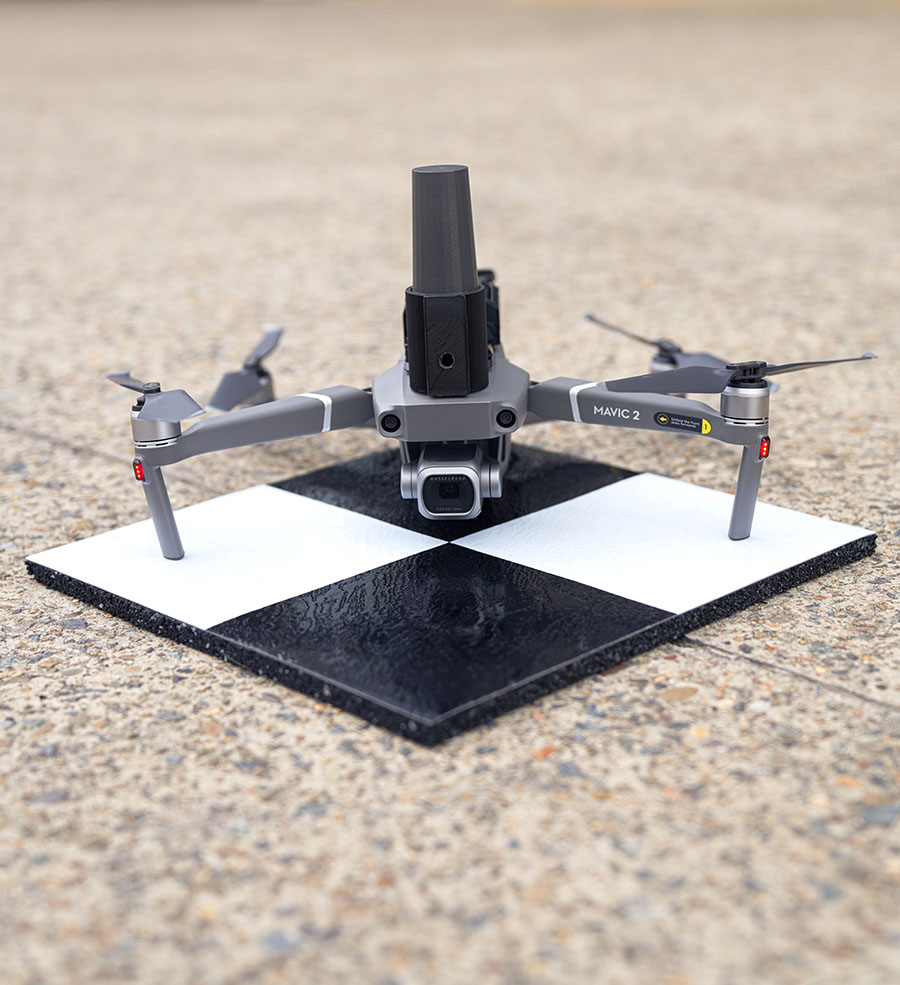
    Position Partners has unveiled SmartSurveyor, which facilitates accurate, survey-grade aerial mapping and photogrammetry without the need for a connection between a camera shutter and a GNSS receiver.

    The fully compact, handheld, aerial mapping survey rover is compatible with DJI Mavix 2 and 3 series and Phantom 4 Pro drones.

    Photo:
    Image: Position Partners

    The design is dissimilar to other drone mapping systems in that it works from a drone or smartphone and with two or more ground control points (GCPs) while using an ultra-matching technique.

    Once data is captured by SmartSurveyor, all the photos and the GNSS file are uploaded to a PC and analyzed through the Agisoft UltraMatch workflow to confirm their accuracy before they are exported. Data can be managed in the cloud or on a local PC using software designed by MapSender.

    Additionally, this mapping tool works in tandem with the AllDayRTK subscription GNSS network service so collected data can be uploaded to Tokara to remotely manage a project.

    Photo:
    Image: Position Partners