Author: GPS World Staff

  • Raytheon UK Receives Order for GPS Anti-Jam Prototype

    Raytheon UK has taken its first order for a pre-production MiniGAS, the latest in GPS Anti-Jam technology, designed and manufactured by the company in the U.K. This contract, awarded by an undisclosed customer, requires Raytheon UK to produce demonstrator units for customer evaluation.

    MiniGAS is the latest in Raytheon’s GPS anti-jam family of products, and it aims to be the lightest and smallest GPS anti-jamming system produced by Raytheon UK. It will have flexible form factors, suited to land, unmanned aerial vehicles and missile platforms. Raytheon is also producing demonstration units of its Landshield high performance digital anti-jam product for customer evaluation.

    As well as developing new products, Raytheon has also received an order for a further 100 of its Advanced Digital Antenna Production (ADAP) systems with the U.S. government. To date, more than 500 ADAP systems and more than 6,600 GAS-1 systems have been delivered to the U.S. government and other international customers over the course of 15 years.

    “Raytheon UK is a world leader in the production and supply of GPS anti-jamming systems to the majority of the world’s military forces,” said Richard Daniel, defence director for Raytheon UK. “These contracts and milestones demonstrate that we continue to make advancements in new systems, ensuring that Raytheon’s systems continue to meet the latest platform requirements.”

    Raytheon continues to deliver GPS anti-jam systems to Northrop Grumman Italia to be used in the Eurofighter Typhoon aircraft, and the company has also delivered a significant number of systems for the Airbus Military A400M aircraft. The company also completed the delivery of its first order for its latest GPS Anti-Jam Land product to the UK Ministry of Defence within six months of contract award.

  • Racelogic to Launch LabSat3 at ION GNSS+

    Racelogic to Launch LabSat3 at ION GNSS+

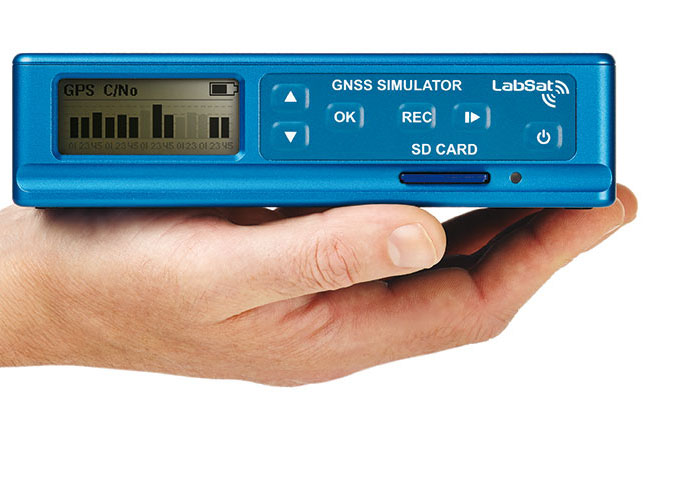
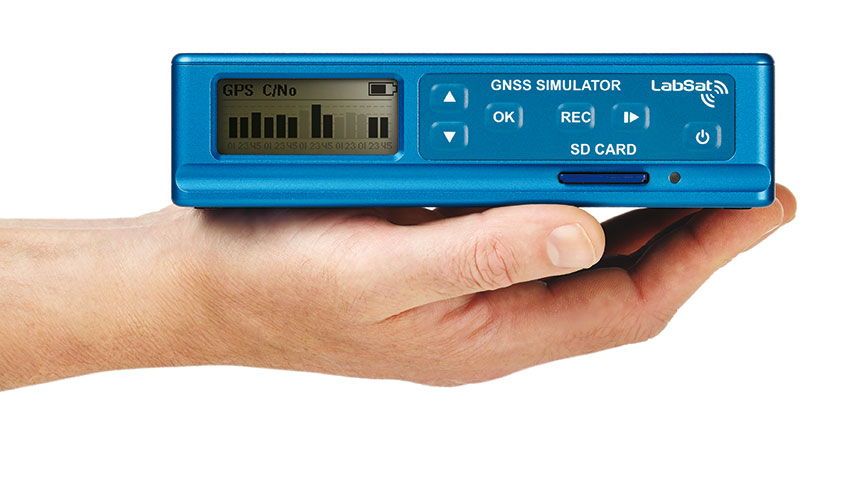
    Racelogic LabSat 3
    Racelogic LabSat 3

    LabSat, the GPS record, replay, and simulation brand produced by Racelogic in the UK, is about to be augmented with the introduction of LabSat3.

    The key feature of the new product is its simplicity. It is, essentially, a single-box device that incorporates a GPS record-and-replay system without the need for a laptop or PC. Racelogic has designed the LabSat3 with convenience at its core: it is small and light, allowing users to record GPS signals in any situation, the company said. It will also come with a pre-recorded library of worldwide scenarios to allow engineers to perform immediate bench testing.

    The new LabSat is able to record signals from GPS, GLONASS, Galileo, BeiDou, QZSS, and SBAS, with the top of the range models able to output two channels simultaneously. Both the recording and replay procedures are simple one-touch operations, with data being logged to an SD card.

    LabSat3 is compatible with scenarios generated with SatGen software for those that wish to create full simulations. Ethernet connectivity extends its potential to end-of-line testing where multiple units can be remotely controlled, with potentially large savings in production line testing times.

    LabSat3 is set to be launched at the ION GNSS+ exhibition in Nashville next week. Prices will start at $4,400. For further details, visit the LabSat website.

  • Veripos Introduces GNSS Mobile for Offshore Positioning

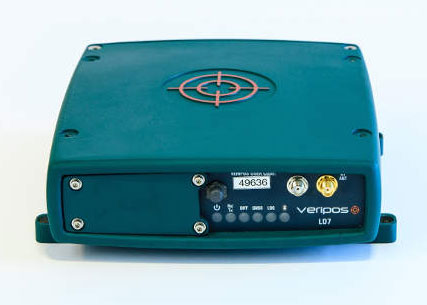
    LD7
    Veripos LD7

    Veripos, supplier of high-precision GNSS positioning services to the offshore industry, has extended its range of integrated mobile receiver units with introduction of a multi-frequency system featuring GNSS heading, L-band positioning and wireless communication capabilities, the LD7.

    Typical use is for the provision of high accuracy heading output combined with high accuracy positioning data for vessel systems.

    Compatible with both GPS and GLONASS networks, the fully ruggedized 272-channel system includes an additional processor for on-board configuration and customized applications separate from its GNSS engine. Integral wireless options include Bluetooth for simple configuration in addition to an optional full-band UHF radio modem for transmission and reception of RTCM or RTK corrections.

    With 2GB internal memory and provision for remote Ethernet access, the LD7 also features an extended range of interface facilities for data output, timing and event marks in addition to a second antenna port for GNSS heading.

  • CGSIC Agenda Released

    The 53rd meeting of the Civil GPS Service Interface Committee will be held Monday and Tuesday, September 16-17, before the Institute of Navigation GNSS+ 2013 Conference. Both events take place at the Nashville Convention Center, in Nashville, Tennessee.

    The meeting agenda is now available on the event website.

    Monday morning’s CGSIC concurrent sessions include the Timing Subcommittee and the Surveying, Mapping, and Geosciences Subcommittee. Monday afternoon’s sessions include the International Information Subcommittee and the U.S. States and Local Government Subcommittee.

    A plenary session will be held Tuesday.

  • Ford Studies Space Robots for Connected Vehicle Communications

    Ford is studying communications between space robots and Earth to enhance future applications of the connected-car communications protocol. The research furthers the company’s commitment to the development of connected vehicle communications to help reduce traffic congestion and aid in the advancement of emergency vehicle communication methods, Ford said.

    Ford has launched a three-year research partnership with the telematics department of St. Petersburg Polytechnic University in Russia in its association with that country’s space industry. The goal is to analyze space-based robotic communications systems for vehicle mesh networks to aid in mobility solutions.

    The development of connected vehicle communications has the potential to reduce traffic accidents and ease congestion by enabling vehicles to communicate with each other, and to communicate with buildings, traffic lights, the cloud and other systems to deliver a message or detect and respond to imminent collision warnings.


    Webinar: The Connected Vehicle

    All major international car-makers are installing telematics units, sending a signal that wireless information and connectivity is here to stay in the vehicle, and location will be a big part of the growth. To learn more about the rapid changes in the connected vehicle field, tune in to our September 19 webinar, hosted by Wireless LBS editor Janice Partyka. Registration is free.


    “Ford has been committed to the research and development of connected vehicle communications for more than a decade,” said Paul Mascarenas, chief technical officer and vice president, Ford research and innovation. “Our participation in this research can aid in the development of next-generation Ford driver-assist technologies. These technologies will globally benefit Ford customers, other road users and the environment.”

    Emergency Situations. One promising development from Ford’s research project with St. Petersburg Polytechnic University is the advancement in emergency vehicle communication methods. Ford is analyzing how emergency messages should be sent to ensure delivery if network failures were to occur, identifying the systems and methods that provide redundancy in case of primary delivery failure.

    For example, if an accident were to cause vehicle-to-cloud communications (V2C) to be broken, a vehicle may still have access to a vehicle-to-vehicle (V2V) communications network. An emergency signal message could potentially be sent through V2V to a vehicle nearby, and then between vehicles and infrastructures until it reached EMS.

    “The research of fallback options and robust message networks is important,” said Oleg Gusikhin, technical leader in systems analytics for Ford. “If one network is down, alternatives need to be identified and strengthened to reliably propagate messages between networks.”

    Space Telematics. Telematics — the long-distance transmission of digital information — developed for use on space stations provide excellent potential for improving the reliability of future vehicle-to-cloud, vehicle-to-infrastructure, vehicle-to-vehicle and other forms of communication (V2X). The communications blend multiple networking technologies including dedicated short-range communication (DSRC), cellular LTE wireless broadband and mesh networking to ensure robust and reliable connectivity for optimum signal strength for critical messages.

    Using the knowledge accrued from analyzing the space robots, Ford engineers could then develop an algorithm that is integrated into the V2X system resulting in a message that would route through the appropriate network depending on the level of its importance. An emergency message, for example, may be communicated through the faster mesh network, whereas an entertainment-related message would route through a vehicle-to-infrastructure application, an embedded device or a brought-in device network.

    “We are analyzing the data to research which networks are the most robust and reliable for certain types of messages, as well as fallback options if networks were to fail in a particular scenario,” said Oleg Gusikhin, technical leader in systems analytics for Ford. “In a crash, for example, a vehicle could have the option to communicate an emergency though a DSRC, LTE or a mesh network based on the type of signal, speed and robustness required to reach emergency responders as quickly as possible.”

    The specific space robots leveraged for Ford’s telematics analysis include the JUSTIN Humanoid, EUROBOT Ground Prototype and NASA Robonaut R2.

    Here is a video showing how Ford is studying space robot communications.

    Findings from this work could potentially enhance Ford’s wireless communication technologies and Blueprint for Mobility. Ford’s Blueprint for Mobility details the company’s vision on how to tackle the issues of mobility in an increasingly crowded and urbanized planet between now and 2025.
  • Garmin Updates Astro GPS Dog Tracking System with the DC 50 Collar


    Garmin International Inc. now offers the DC 50 – a new and improved GPS dog tracking collar that’s even more robust and reliable than previous models.

    “From more reliable satellite reception to a more rugged design, the new DC 50 gives sporting dog owners what they’ve been asking for,” said Dan Bartel, Garmin’s vice president of worldwide sales. “The new DC 50 has the features that will bring the benefits of GPS tracking to first-time users, and will convince existing Astro customers to upgrade.”

    The DC 50’s main housing sits below the dog’s neck while a low-profile, high-sensitivity GPS antenna is now positioned atop the dog’s neck, providing a clearer view of satellites.  In addition to tracking GPS satellites, the DC 50 can also utilize the GLONASS system. When using GLONASS satellites, acquisition time is (on average) approximately 20 percent faster than using GPS.  And when using both GPS and GLONASS together, the receiver has the ability to lock on to 24 more satellites than when using GPS alone. In practical terms, that means sporting dog owners will spend less time waiting for the collar to acquire satellites before the hunt, and the collar will better maintain its location even in heavy cover and deep canyons during the hunt.

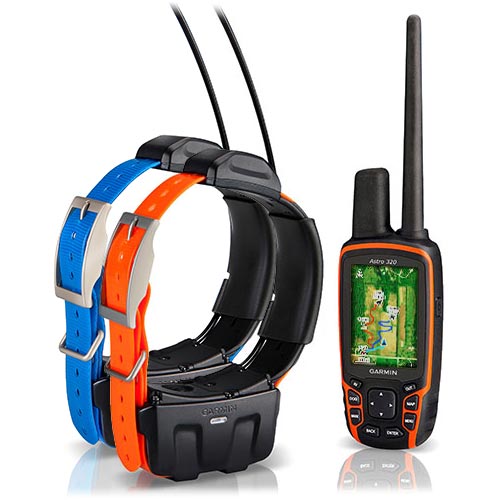
    The Garmin Astro 320 GPS tracking device with two DC-50 collars.
    The Garmin Astro 320 GPS tracking device
    with two DC-50 collars.

    The newly redesigned 22.5-inch long VHF antenna is made of braided steel that’s built to take any punishment that hard-charging dogs can deliver.  Hunters can track their dogs up to nine miles in flat, unobstructed ground as often as every five seconds.  A shorter 18.5-inch antenna is also included.

    The battery life of the DC 50 has improved over previous generations, too.  At a five second update rate, the DC 50 will get approximately 26 hours of battery life when fully charged.  By slowing the update rate down to once every two minutes, the DC 50 collar can get up to 54 hours of use.   As a safety feature, the DC 50 also has a selectable Dog Rescue mode, which automatically switches the DC 50 to a two minute update rate when the battery is less than 25 percent charged – making it easier to recover a lost dog.

    For houndsmen, the DC 50 also features built-in Bark Detection, which alerts a hunter when their dog is barking frequently, even out of earshot.  Users can customize the Bark Detection feature to adjust the frequency of barking and the manner in which the user is notified (visual, tone, vibration, or a combination of each).

    The DC 50 features a standard one inch coated polyurethane collar strap that can be swapped out for a different color to easily distinguish between multiple dogs.  The collar transmitter is waterproof to 10 meters (33 feet).  Shipped alone, the DC 50 features a blue collar, and when purchased in conjunction with an Astro 320, the collar strap is orange.

    When paired with the Astro 320, the system can track up to ten dogs per receiver at once, and will indicate the dog’s distance, direction, and status (sitting, running, pointing, or treeing).  The Astro 320 features a full color, sunlight readable display with a pre-installed basemap.  In addition to the pre-installed basemap, the Astro can be loaded with optional 100k Topo or 24k Topo maps or photorealistic BirdsEye Satellite Imagery.  Many third-party specially-designed hunting maps are also available.

    The DC 50 is compatible with Astro 320 handhelds that are currently in service, but users must download a free software update to their handheld before pairing the new collar, by visiting www.garmin.com/webupdater.  The DC 50 is not compatible with the Astro 220 handheld or the Alpha Track and Train system.

    Purchased alone, the DC 50 has a minimum retail price of $229.99, and the DC 50 bundled with the Astro 320 system has an MRP of $599.99.

  • Averna, National Instruments Team on Recording and Playback of RF Signals

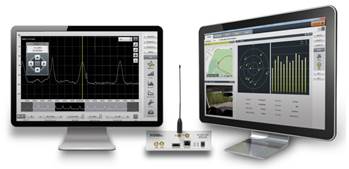
    AvernaRF
    Photo: Averna

    Averna, developer of test solutions and services for communications and electronics device-makers worldwide, now offers RF Studio for National Instruments Software Defined Radio Platform (USRP), converting the USRP into a portable and cost-effective RF system for the recording and playback of real-world GNSS signals.

    National Instruments USRP is an affordable, PC-hosted platform used with NI LabVIEW system design software to build powerful wireless communications systems for research and education, Averna said. RF Studio is Averna’s proprietary software platform designed to streamline work with real-world RF signals. It provides user-friendly modules for capturing, processing, analyzing, archiving, and playing back RF spectrum while also maintaining the signal-recording context.

    Working together, Averna and National Instruments teams developed RF Studio for the USRP, an innovative and portable solution to record and play back live RF environments to accelerate RF project work. RF Studio’s LabVIEW compatible plug-in support delivers great value to LabVIEW users as it gives them quick access to a rich toolset for their in-house applications, and supports additional capture sources and customized views.

    “RF Studio for the USRP is the only cost-effective and portable product on the market that offers the flexibility to cover a wide variety of use cases, thus making it a very competitive solution for general-purpose RF record and playback,” commented Brendan Wolfe, Director of Market Development for Averna. “We’ve been working very closely with the NI teams to bring this innovative solution to market, and we expect great success from this solution partnership.”

    RF Studio for the USRP offers these features:
    ·  Record and play back real-world RF signals, up to 40 MHz wide
    ·  Capture actual RF spectrum like FM, DAB, GPS, GLONASS, and cellular
    ·  Visualize and record weak signals with the Noise Figure view
    ·  Advance signal analysis with the Spectrum, Histogram, and Power views
    ·  Use simple RF-chain configuration tools to quickly detect and set up the recording environment
    ·  DriveView option: Log video, audio and NMEA data at the same time as recording RF

    “The combination of RF Studio and the USRP provides a flexible, affordable solution for RF record and playback. Now in addition to prototyping wireless communications systems in LabVIEW, users can test them by reproducing realistic RF environments in the lab,” said Erik Luther, Wireless Communications Group Manager for National Instruments.

    RF Studio for the USRP is available now to customers worldwide through National Instruments’ LabVIEW Tools Network.

  • NovAtel Offers Commercial Tactical-Grade MEMS IMU

    NovAtel Offers Commercial Tactical-Grade MEMS IMU

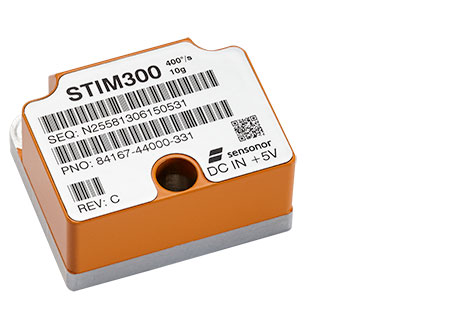
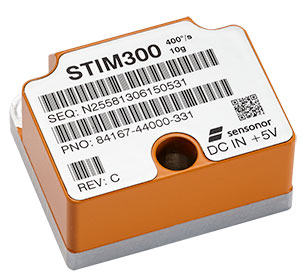
    NovAtel OEM-IMU-STIM300.
    NovAtel OEM-IMU-STIM300.

    NovAtel has added Sensonor’s commercially exportable OEM-IMU-STIM300 to its SPAN GNSS + INS line of positioning products. The OEM-IMU-STIM300 is a Micro Electromechanical System (MEMS) Inertial Measurement Unit (IMU) that integrates with NovAtel’s OEM6 receiver technology to provide a powerful 3D continuous position, velocity and attitude solution, the company said.

    The distinguishing characteristic of the OEM-IMU-STIM300 is its small form factor with tactical-grade performance capabilities. “As an OEM supplier, our customers come to us with a wide range of application demands. The addition of the OEM-IMU-STIM300 to our SPAN portfolio enables us to provide a cost-effective solution for weight and space constrained environments without having to compromise performance in any way,” said Jason Hamilton, NovAtel director of marketing.

    NovAtel’s proprietary MEMS Interface Card (MIC) integrates the OEM-IMU-STIM300 with NovAtel’s OEM6 receiver products for full SPAN navigation capabilities. The product will be available as an integrated single-enclosure SPAN solution (SPAN-IGM-S1), enclosed standalone IMU (IMU-IGM-S1) for use with external SPAN-enabled receivers, and as an OEM component (OEM-IMU-STIM300).

    OEM-IMU-STIM300 is available for delivery in September, followed by SPAN-IGM-S1 and IMU-IGM-S1 in November 2013.


  • Raytheon GPS Launch and Checkout Capability Cleared for Test

    Raytheon GPS Launch and Checkout Capability Cleared for Test

    Photo; Raytheon Company

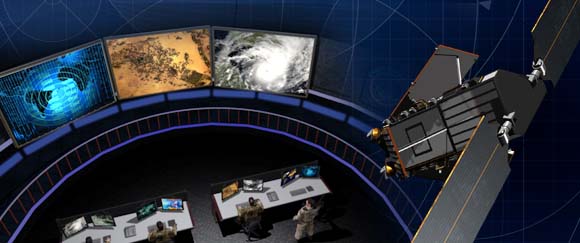
    Raytheon Company has received Interim Authorization to Test (IATT) security certification for the Global Positioning System Next Generation Operational Control System (GPS OCX) Launch and Checkout System (LCS) four months ahead of schedule.

    Raytheon received a one-year certification with no liens, meaning the government does not require any changes. The LCS IATT certification enables Raytheon to move to the next stage of testing the Launch and Checkout System in preparation for launch of the first GPS III satellite.

    “Successful IATT certification ahead of our original schedule demonstrates not only that Raytheon meets the U.S. Air Force’s high standards for information assurance as we develop this critical national system, but also the efficient efforts of our government partners,” said Matthew Gilligan, Raytheon’s GPS OCX program manager and a vice president in Raytheon’s Intelligence, Information and Services business. “Typically IATT certification is given for six-month increments; the LCS one-year accreditation speaks to the quality of the information assurance design and threat protection.”

    The Interim Authorization to Test not only includes the LCS, but also Lockheed Martin’s GPS III satellite support systems, including the Exercise and Rehearsal Training Tool and Upload Generation Tool.

    The next-generation GPS ground-control system, known as OCX.
    The next-generation GPS ground-control system, known as OCX.

    Raytheon’s OCX and the Lockheed Martin-built GPS III satellites are critical elements of the U.S. Air Force’s effort to modernize the GPS enterprise while improving capabilities to meet the evolving demands of military, commercial and civilian users worldwide. OCX is being developed in two “blocks” using a commercial best-practice iterative software development process. There are seven iterations in Block 1 and one in Block 2. LCS is the fifth Iteration of Block 1, and it successfully completed Critical Design Review in June 2013.

    The first GPS III satellite is in production at Lockheed Martin and expected to be delivered to the U.S. Air Force “flight-ready” in mid-2014. GPS III satellites are expected to deliver three times better accuracy, provide up to eight times more powerful anti-jamming capabilities, and include enhancements that extend spacecraft life 25 percent further than the prior GPS block. The GPS III also will carry a new civil signal designed to be interoperable with other international global navigation satellite systems, enhancing civilian user connectivity.

  • Nokia Unveils Its Connected Car Platform

    HERE, a Nokia business, has announced a complete Connected Driving offer, which will help car makers and in-vehicle technology suppliers connect the car and the driver to the cloud. The offering includes HERE Auto, HERE Auto Cloud, and HERE Auto Companion. In addition, HERE has radically improved its Traffic product, HERE Traffic, by building a new system to process data even faster and more accurately than before, Nokia said. The HERE Connected Driving offering will be demonstrated at the International Motor Show in Frankfurt, Germany, starting on September 10.


    Webinar: The Connected Vehicle

    All major international car-makers are installing telematics units, sending a signal that wireless information and connectivity is here to stay in the vehicle, and location will be a big part of the growth. To learn more about the rapid changes in the connected vehicle field, tune in to our September 19 webinar, hosted by Wireless LBS editor Janice Partyka. Registration is free.


    Technology is rapidly transforming driving, with connectivity bringing the outside world to the car and the sensor revolution creating new possibilities for the automobile industry, Nokia sai,d. People today demand that cars become integrated into their ecosystem of connected devices with the same level of innovation they see in their personal devices.

    HERE Connected Driving offers a full range of automotive products and services that builds on our high-quality and fresh map to go beyond navigation. The customizable offering is a fully flexible framework that allows automakers to differentiate the driving experience. It will help them solve the problems that drivers face every day such as synching routes and other personal information across their car and devices and finding the right parking spot or closest gas station.

    HERE Auto is the first embedded in-car navigation experience that delivers the right map at the right moment with and without a data connection. Drivers can get turn by turn voice guided navigation in 95 countries and 2D, 3D and satellite map views including street level imagery. In the future, car makers will be able to easily extend the HERE Auto experience using a software development kit (SDK) to create entertainment and other applications, such as in the areas of music and social networking. HERE Auto is already integrated in Continental’s next-generation Open Infotainment Platform. HERE is also working with partners such as Magneti Marelli and others to bring HERE Auto to the market in the coming months.

    HERE Auto Cloud provides drivers with always-on access to several dynamic services such as real-time traffic updates, helping drivers avoid congested areas, road closures or blockages that occur en route. Drivers can also get recommendations on places to eat, parking spots, information on where to charge an electric vehicle or where to find the most inexpensive fuel.

    HERE Auto Companion, a customizable mobile and web application, keeps drivers connected outside of the car allowing them to synchronize their favorite places and routes across their devices so that they won’t need to re-enter their route when they get in the driver’s seat. Car makers can tap assets from the existing HERE suite such as walking navigation, public transit routes and even indoor venue maps to build custom mobile applications. Drivers could use the app to remotely find their car with their device using LiveSight augmented reality technology and check the car’s vital stats such as fuel levels and tire pressure.

    HERE Traffic has been radically improved by “Halo,” our new engine that processes data quickly and accurately. Every month we’re collecting ever greater numbers of high-quality data, such as probe points and sensor information to deliver real-time information such as weather, traffic congestion, road construction and other factors that affect a drive. With our new Traffic product drivers get improved travel time estimates, so they can better plan their routes and quickly re-route on the go.

    “By 2016, the majority of consumers in mature markets will consider in-vehicle web-based data access a key criterion in their automotive purchase,” said Thilo Koslowski, VP of Automotive at Gartner. “Successful connected vehicle solutions will add value to the connected driver’s digital lifestyle and enable integrated cross-device experiences relevant for people everyday.”

    For more information about HERE Auto, visit Nokia’s blog.

  • GPSTrackIt Announces New Analytics Dashboard

    GPSTrackit’s Fleet Manager Software now features an Analytics Dashboard that enables fleet managers to monitor and review fleet performance by reviewing historical data in a series of charts and graphs. Fleet Manager is a robust application providing fleet owners and managers with a comprehensive suite of integrated tools, GPSTrackIt said.  The system delivers real-time GPS vehicle tracking, vehicle maintenance scheduling, and a wide range of alerts. The Analytics Dashboard brings to the system a new array of powerful and flexible capabilities.

    “It puts the information fleet managers and owners need at their fingertips,” said Eddie Bermudez, GPSTrackIt’s product manager.  “We already provide all the historical data via the reports system. This new feature brings that data to life with dynamic graphics.”

    The dashboard displays up to six charts, which can be configured as bar charts or pie charts. Each chart can focus on particular issues important to fleet owners, managers and dispatchers: Idle Time, Drive Time, Stop Time, Speeding and Mileage.

    “The charts can be configured to show data for all units or a single group,” explained Bermudez. “Or a chart can compare groups by displaying their data side-by-side using different colors.”

    In addition, three composite charts are available; Engine Time, which monitors idle time and driving time; Driving Overview, which monitors idle time and driving time and stop time; Idle Stop, which monitors idle time and stop time. The time metric determines which historical data is used. Options available are week, month, quarter, and year.

    “Charts can be rearranged on the dashboard by dragging and dropping,” added Bermudez.  “And there are several additional options that can be configured. Chart labels of up to 25 characters can be added. The start of day can be set to any of the 24 hours. For bar charts, the average value can be shown superimposed on the graph.”

    Bermudez continues, “The Analytics Dashboard can also display the highest or lowest values for a given graph. This can be configured to show values from one to 20. Selecting Highest and a numerical value of five on an Idle Time chart, for example, displays the five vehicles with the highest values for idle time.”

    “This is important for fleet managers to know because of added fuel consumption, as well as vehicle wear,” according to Bermudez.  ”Selecting Lowest and a numerical value of ten on a Speeding chart shows the ten vehicles with the lowest incidence of speeding.”

  • Trimble Launches Connected Farm Dashboard

    Trimble has launched the Connected Farm dashboard, which provides one centralized location for farmers to view key information impacting their operations. With this information, farmers will be able to make better daily decisions based on the latest data. The Connected Farm dashboard is customizable and accessible via Internet-enabled devices such as desktop and notebook personal computers, smartphones and tablets, and Trimble’s new TMX-2050 display.

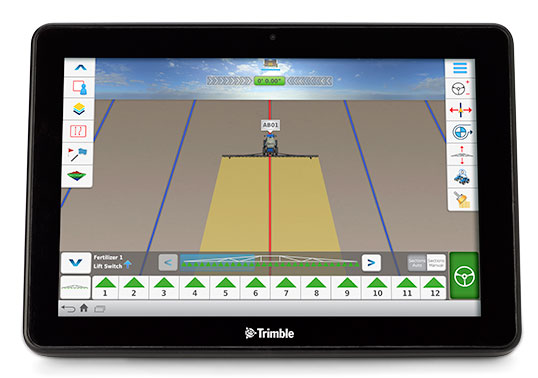
    Trimble TMX-2050 display.
    Trimble TMX-2050 display.

    The TMX-2050 display is a next-generation display built on the Android operating system. It offers an intuitive interface that enables farmers to easily implement precision agriculture solutions as their business grows. Its flexible software platform improves the ability for a customer to seamlessly add applications to their operations while the modular architecture allows for future expandability.

    The TMX-2050 display is an addition to Trimble’s existing line of guidance displays, which include the EZ-Guide 250 lightbar guidance system, CFX-750 display, and FmX integrated display.

    The Connected Farm dashboard will allow farmers to:

    • Check daily rainfall totals for each virtual rain gauge—without the use of physical rain gauges. (Made possible by Trimble’s acquisition of RainWave’s assets). This will allow a farmer to reprogram his irrigation system based on the previous evening’s rainfall, optimizing the use of water.
    • View the weather forecast weekly, daily, or hourly for a given location including temperature, humidity, chance of precipitation and wind speed. For example, wind speed will allow a farmer to plan when to spray a given field.
    • Set up a Doppler radar map to show upcoming weather patterns for their area. This will allow a farmer to assess in real time whether or not to continue with a current activity.
    • Check the latest commodity prices. Farmers will be able to select the commodities that matter to them and list them based on personal priority.
    • View farming operations data. For example, if the farmer is viewing yesterday’s planting activities, the dashboard may show population, singulation, skips and doubles.
    • Monitor a fleet by tracking the location and status of vehicles and receive geo-fence and curfew alerts. Farmers also can link through to Trimble’s new Connected Farm fleet app to add landmarks or for turn-by-turn directions to locate vehicles from their current position, and view historical positions.
    • View a boundaries map created with Trimble’s Connected Farm scout app.

    Following the completion of the recently announced IQ Irrigation asset acquisition, irrigation pivot data is expected to be available on the Connected Farm dashboard in New Zealand in the fourth quarter of 2013 and the U.S. in the first half of 2014.

    “With the Connected Farm dashboard, farmers can quickly see a snapshot view of their latest field operation as well as key information that may impact today’s activities such as rainfall, commodities, and the day’s weather forecast,” said Joe Denniston, vice president for Trimble’s Agriculture Division. “With this information available in one convenient central location through Connected Farm, farmers can access the information they need to make the best daily decisions about their farm. Since the dashboard can be accessed from Internet-enabled devices, farmers can make these decisions from potentially any location at any time.”

    The Connected Farm dashboard is a free web portal and is currently available. To view rainfall totals, monitor pivot irrigators (when available), or for fleet management, customers will need to purchase these services.

    On August 27, Trimble acquired the assets of privately-held RainWave, LLC and Hydro-Engineering Solutions, LLC of Auburn, Alabama. The acquisitions will help to extend the monitoring and reporting capabilities of Trimble’s Connected Farm solution and strengthen its water management expertise. Financial terms were not disclosed.

    RainWave provides precipitation monitoring services for agribusiness, construction and engineering, government and consumer industries. RainWave will be part of the Connected Farm solution, which simplifies and integrates operations management by providing information exchange across the entire farm. This RainWave service will provide farmers across the U.S. with vital rainfall data they can use to better manage their crop production.

    Using RainWave, farmers can set up a virtual rain gauge by entering GPS coordinates for identified locations to receive a rainfall report for those locations. Since on-site rain gauges are not needed, farmers no longer need to monitor dispersed gauges or manually track precipitation. The farmer will now be able to obtain this rainfall information through their Connected Farm dashboard. RainWave’s convenient, accurate rainfall information allows farmers to make better management decisions by optimizing irrigation plans and application timing, and comparing yield against rainfall to plan for next season’s crop. This results in savings of time and water usage.

    Hydro-Engineering Solutions is a civil engineering company that specializes in hydrology and hydraulics. The company provides high-quality engineering services to federal, state and local governments as well as commercial entities, and has extensive experience with streams and rivers. Hydro-Engineering’s expertise in hydrology and hydraulics modeling is expected to strengthen Trimble’s water management solution in watershed analysis for both drainage and irrigation.