Author: GPS World Staff

  • Mobile Location-Based Advertising Will Be Worth 6.5B Euros in 2017

    According to a new research report from the analyst firm Berg Insight, the total value of the global real-time mobile location-based advertising and marketing (LBA) market will grow from €526 million in 2012 at a compound annual growth rate (CAGR) of 65 percent to €6.5 billion in 2017. This will then correspond to 32.8 percent of all mobile advertising and marketing. This means that location-based advertising and marketing will represent around 5 percent of digital advertising, or more than 1 percent of the total global ad spend for all media. SMS, mobile search and coupons are today important high-volume LBA formats.

    The ability to precisely target prospective customers using real-time location is currently one of the most promising additions to the advertising toolbox, Berg Insight said. “Key drivers for LBA include the growing adoption of both outdoor and indoor location technologies, as well as the increasing consumer acceptance of location-based services in general,” said Rickard Andersson, Telecom Analyst, Berg Insight. Location targeting in combination with other contextual and behavioral segmentation greatly enhances the relevance of mobile advertising. “Major brands are so far the main spenders, but LBA has also opened the mobile channel for small local merchants. Local businesses can extend their marketing initiatives with mobile components such as location-sensitive coupons using online self-services, while big box retailers leverage enterprise LBA solutions for conquesting and to combat showrooming,” Andersson said.

    The LBA value chain is still forming and there are a large number of players involved in the ecosystem, Berg Insight said. Since the value chain is fragmented and the industry has not yet reached maturity, many different roles are involved. Companies range from LBA specialists such as Verve, Placecast and xAd, to LBS players including Telmap, Telenav and Waze, and operators such as AT&T, SFR and the new UK joint venture Weve.

    There is, furthermore, an abundance of location-aware applications and media that serve geo-targeted ads, with examples such as Foursquare, Shopkick and SCVNGR. Other stakeholders include coupons and deals providers including Vouchercloud, Yowza!! and COUPIES, search solutions such as Yell and Yelp, and proximity marketing providers like Proxama, NeoMedia and Scanbuy. A number of traditional mobile advertising players are also active in the LBA space, for example Millennial Media, Madvertise and Nexage, as well as major digital and telecom players such as Google, Apple and Facebook.
  • First GPS Cell Phone on Display at Smithsonian

    WASHINGTON, D.C. — The first GPS-enabled cell phone, developed by Navsys Corporation, is now on display at the Smithsonian National Air and Space Museum’s Time and Navigtion exhibition, which opened today. This device marks an important step in GPS history that paved the way for positioning to become the integral component of communications technology that exists today, Navsys said.

    Navsys assisted in the development of the Colorado Department of Transportation’s Emergency Vehicle Location System Mayday platform in 1995. To address the need for faster notification and responsiveness during emergencies, Navsys was contracted to integrate GPS positioning into a cell phone so that location information could be sent to a communications center for mobile 911 calls.

    One of the enabling technologies Navsys developed for this system was LocaterNET. When activated by a user’s in-vehicle unit (IVU), LocaterNET collects a snapshot of raw GPS information. That information is then sent to a remote processing system to determine the user’s location. This technique allowed for low power consumption and processing requirements for the IVU, which is vital for small form factor personal navigation and communication devices.

    “We are honored to be a part of this exhibition and for the awareness it creates for how GPS technology has advanced many other technologies we use today,” said Alison Brown, president and CEO of Navsys.

    The Smithsonian exhibition covers a multitude of navigation and timing innovations and opens on April 12. A detailed description of the LocaterNET Mayday platform can be found here.

  • GIOVE-A Uses GPS Side Lobe Signals for Far-Out Space Navigation

    GIOVE-A Uses GPS Side Lobe Signals for Far-Out Space Navigation

    The European Space Agency’s (ESA’s) retired GIOVE-A navigation mission has become the first civilian satellite to perform GPS position fixes from high orbit. Its results demonstrate that current satnav signals could guide missions much further away in space, up to geostationary orbit or even as far as the Moon.

    GIOVE-A has been able to fix its position, velocity and time from GPS signals, despite orbiting more than 1000 km above the downward-pointing U.S. satellites.

    “Satellite navigation has become almost as indispensable for most low-orbiting satellites as it is for car drivers and other terrestrial users,” said ESA’s Steeve Kowaltschek. “Satellites equipped with satnav receivers can continuously monitor their orbit in space, enabling largely autonomous operations with limited ground intervention. GIOVE-A’s three months of data show that future geostationary satellites could operate in the same way, bringing real competitive advantage to the multi-billion-euro telecommunications satellite market.”

    Launched in 2005 to claim radio frequencies and test hardware for Europe’s Galileo satnav constellation, the Galileo In-Orbit Validation Element-A, or GIOVE-A, mission far outlasted its original two-year design life. It was formally decommissioned by ESA in the middle of last year, once the first Galileo satellites completed their orbital commissioning. Having been moved into a graveyard orbit about 100 km above Galileo’s orbital altitude of 23 222 km, control was passed to its prime contractor Surrey Satellite Technology Ltd. of Guildford, UK.

    ESA had originally worked with SSTL to customize one of the company’s existing satnav receivers for testing on GIOVE-A, an activity supported through ESA’s Advanced Research in Telecommunications Systems (ARTES) program. In the event, the satnav receiver was activated for only 90 minutes during the very beginning of the satellite’s seven-year operational life, with GIOVE-A’s main tasks given priority. Once the formal mission was over, ESA and SSTL took the opportunity to switch the receiver on again.

    “We have been really encouraged by the initial results from our receiver,” said Martin Unwin at SSTL. “Our patience has finally been rewarded, and we would like to make the best of this unique opportunity.”

    SSTL is able to upload new software to the receiver in orbit, and has been able to apply sophisticated software algorithms to help detect faint satnav signals. Further work is planned to refine operation through the use of an accurate onboard clock and orbit-estimating algorithms.

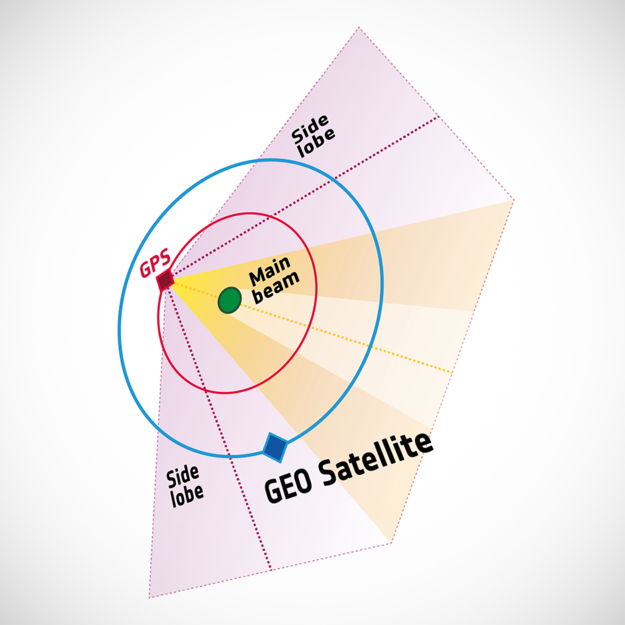
    GPS satellites – like those of Galileo, Russia’s Glonass or their Japanese, Chinese and Indian counterparts – aim their antennas directly at Earth. Any satellite orbiting above the GPS constellation can only hope to detect signals from over Earth’s far side, but the majority are blocked by the planet. For a position fix, a satnav receiver requires a minimum of four satellites to be visible, but this is most of the time not possible if based solely on front-facing signals. Instead, GIOVE-A has been able to make use of signals emitted sideways from GPS antennas, within what is known as ‘side lobes’. Just like a flashlight, radio antennas shine energy to the side as well as directly forward.
    GIOVE-A has been able to make use of signals emitted sideways from GPS antennas, within what is known as side lobes.

    GPS Side Lobes. GPS satellites — like those of Galileo, Russia’s Glonass or their Japanese, Chinese and Indian counterparts — aim their antennas directly at Earth. Any satellite orbiting above the GPS constellation can only hope to detect signals from over Earth’s far side, but the majority are blocked by the planet. For a position fix, a satnav receiver requires a minimum of four satellites to be visible, but this is most of the time not possible if based solely on front-facing signals.

    Instead, GIOVE-A makes use of signals emitted sideways from GPS antennas, within what is known as side lobes. Just like a flashlight, radio antennas shine energy to the side as well as directly forward.

    “These side lobes are not typically well measured because this is energy that doesn’t reach users on Earth,” explained Kowaltschek. “Antenna designers seek to minimize them, but the laws of physics mean they will always be present in some form. Measuring these GPS side lobes has shown them to be stronger than anticipated, and the combination of side lobes and signals spilling over from the other side of Earth mean that a position fix can be maintained throughout GIOVE-A’s orbit.”

    The satellite has also acquired detailed profiles of the signal side-lobe characteristics of the various GPS design blocks.

    Geostationary satellites reside in set orbital slots, some 80-km across, up in the 36,000-km-altitude belt. Chemical thruster firings are needed every fortnight or so to correct for drift, checked against radio ranging from the ground.

    Harnessing satnav would be a way of automating station-keeping functions. It also meshes with the current move to all-electric comsat designs, such as ESA’s Electra. Electric propulsion would do the job of conventional chemical thrusters, delivering more compact satellites capable of flying on cheaper launch vehicles while offering longer mission lifetimes. But electric propulsion provides lower thrust and therefore requires almost permanent ground ranging. Continuous position fixes via satnav could perform this task onboard, maintaining the orbit position with better accuracy.

    SmallGEO. (Image: ESA)
    SmallGEO. (Image: ESA)

    In addition, constant orbit determination and close-to-perfect time knowledge also improves pointing accuracy on comsats that use startrackers as their main attitude sensor.

    All-electric comsats using satnav could gradually steer themselves up to geostationary orbit following launch, further slashing the required launcher size, onboard fuel and ground support.

    “We envisage a future satnav receiver that can track not only GPS, but also Galileo and Glonass signals at high altitudes, meaning a near-continuous availability of accurate position and time for geostationary and other satellites,” says Martin.

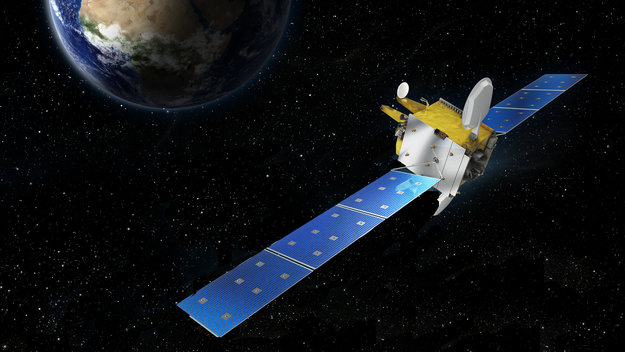
    As a next step, a receiver will be flown on ESA’s SmallGEO telecom mission, due for launch in 2014. Building on the positive results of the GIOVE-A experiments, SmallGEO will be the first civilian mission to use satnav in geostationary orbit.

  • Topcon Announces MR-1 Precise Heading Solution

    Topcon Positioning Systems has released the MR-1 Heading System, an OEM GNSS solution for high-performance positioning and heading.

    Using the MR-1 receiver and Topcon’s MG-A8 antenna, the system provides “centimeter-accurate RTK positioning and better than 1/10 of a degree heading accuracy in challenging environments,” said Doug Langen, TPS GNSS product manager. “The rugged MR-1 receiver is water and dustproof and operates at a robust operational temperature range of -40°C to 75°C.”

    When combined with Topcon’s Quartz Lock Loop technology, the MR-1 offers continuous operation during “extreme vibration and shock, typical of intense dynamic environments,” he said.

    The MG-A8 antenna of the MR-1 Heading System is designed for moving platforms and provides multipath rejection. It also offers increased resistance to near-band interference from satellite communications systems commonly found in marine applications.

    Additional information is available at www.topconoemsolutions.com.

  • Extreme Miniaturization: Seven Devices, One Chip to Navigate without GPS

    The U.S. Military relies on GPS to aid air, land and sea navigation. Like the GPS units in many automobiles today, a simple receiver and some processing power is all that is needed for accurate navigation. But, what if the GPS satellites suddenly became unavailable due to malfunction, enemy action or simple interference, such as driving into a tunnel? Unavailability of GPS would be inconvenient for drivers on the road, but could be disastrous for military missions. DARPA is working to protect against such a scenario, and an emerging solution is much smaller than the navigation instruments in today’s defense systems.

    DARPA researchers at the University of Michigan report that they have made significant progress with a timing and inertial measurement unit (TIMU) that contains everything needed to aid navigation when GPS is temporarily unavailable. The single-chip TIMU prototype contains a six-axis IMU (three gyroscopes and three accelerometers) and integrates a highly-accurate master clock into a single miniature system, smaller than the size of a penny. This chip integrates devices (clocks, gyroscopes and accelerometers), materials and designs from DARPA’s Micro-Technology for Positioning, Navigation and Timing (Micro-PNT) program.

    Three pieces of information are needed to navigate between known points A and B with precision: orientation, acceleration and time. This new chip integrates tiny devices that can measure all three simultaneously. The design is accomplished through new fabrication processes in high-quality materials for multi-layered, packaged inertial sensors and a timing unit, in a tiny 10-millimeter-square package. Each of the six microfabricated layers of the TIMU is only 50 microns thick, approximately the thickness of a human hair.  Each layer has a different function, akin to floors in a building.

    “Both the structural layer of the sensors and the integrated package are made of silica,” said Andrei Shkel, DARPA program manager. “The hardness and the high-performance material properties of silica make it the material of choice for integrating all of these devices into a miniature package. The resulting TIMU is small enough and should be robust enough for applications (when GPS is unavailable or limited for a short period of time) such as personnel tracking, handheld navigation, small diameter munitions and small airborne platforms.”

    The goal of the Micro-Technology for Positioning, Navigation and Timing (Micro-PNT) program is to develop technology for self-contained, chip-scale inertial navigation and precision guidance.  Other recent breakthroughs from Micro-PNT include new microfabrication methods and materials for inertial sensors.

  • Lockheed Martin Team Completes Delta Preliminary Design for Next GPS III Satellite Capabilities

    Lockheed Martin has successfully completed a Delta Preliminary Design Review (dPDR) for the next Global Positioning System (GPS) III satellite vehicles planned under the U.S. Air Force’s GPS III program.

    The GPS III program will replace aging GPS satellites, while improving capability to meet the evolving demands of military, commercial and civilian users. GPS III satellites will deliver three times better accuracy and up to eight times improved anti-jamming signal power while enhancing the spacecraft’s design life and adding a new civil signal designed to be interoperable with international GNSS.

    The Air Force plans to purchase up to 32 GPS III satellites. Lockheed Martin is under contract for production of the first four GPS III satellites, and has received advanced procurement funding for long-lead components for the fifth, sixth, seventh and eighth satellites.  The successful dPDR addresses design modifications, agreed on by the Air Force and the Lockheed Martin-lead industry team, which will provide new capabilities for GPS III Space Vehicle 9 (SV09) and beyond, including the addition of a search and rescue satellite payload and a Laser Retroreflector Array (LRA). An innovative new waveform generator permits the addition of new navigation signals after launch to upgrade the constellation without the need to launch new satellites.

    “We have worked very closely with the Air Force and GPS community to make GPS III the most affordable and lowest risk solution for bringing new capabilities to the GPS constellation,” said John Frye, Lockheed Martin’s GPS III capability and affordability insertion manager. “The design modifications from this dPDR address ways to further reduce Air Force launch costs by $50 million per satellite through dual launch of two GPS III space vehicles on a single booster. This successful dPDR milestone sets the stage to proceed with SV09 design maturation.”

    From the beginning of the program, the Lockheed Martin team has remained focused on affordability for GPS III, the company said, while working to ensure the enhanced satellite system can evolve to continue to meet the world’s global navigation and timing needs for the next 30 years. To help reduce risks and cut costs, the GPS III team developed a GPS Non-Flight Satellite Testbed (GNST), which serves as the program’s ground pathfinder and vehicle demonstrator for the first complete satellite. The entire GPS III development and production sequence uses the GNST to provide space vehicle design level validation; early verification of ground support and test equipment; and early confirmation and rehearsal of transportation operations.

    Lockheed Martin team has met recent milestones and appears to be on track to deliver the first GPS III satellite, for launch availability in 2014.

    In February, the Lockheed Martin team successfully turned on power to the system module of the program’s first spacecraft, designated GPS III Space Vehicle 1 (SV01), demonstrating mechanical integration, validating the satellite’s interfaces, and leading the way for electrical and integrated hardware-software testing.  The satellite will complete its Assembly, Integration and Test (AI&T) in Lockheed Martin’s new GPS Processing Facility (GPF) designed for efficient and affordable satellite production.

    The GPS III team is led by the Global Positioning Systems Directorate at the U.S. Air Force Space and Missile Systems Center. Lockheed Martin is the GPS III prime contractor with teammates ITT Exelis, General Dynamics, Infinity Systems Engineering, Honeywell, ATK and other subcontractors. Air Force Space Command’s 2nd Space Operations Squadron (2SOPS), based at Schriever Air Force Base, Colorado, manages and operates the GPS constellation for both civil and military users.

  • ESA Telecom and Navigation Vehicle Ready for Test Driving

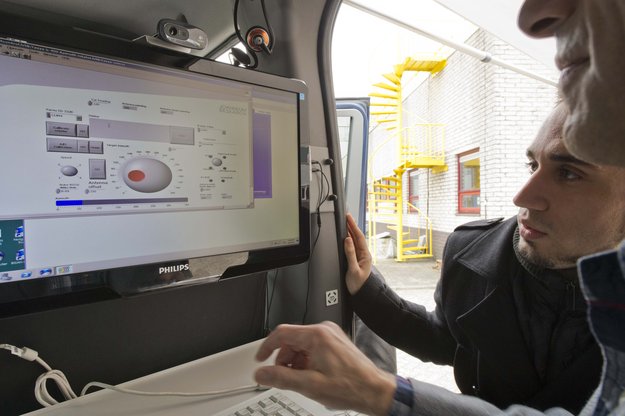
    The radio spectrum is about to get even busier, as Europe’s Galileo satnav system starts services, at the same time the European Space Agency (ESA) tests novel satellite-based telecommunication services. Supporting these developments from the ground, ESA’s new custom-built Telecommunications and Navigation Testbed Vehicle will measure the resulting signals from all over Europe.

    Adapted from a Mercedes Benz Sprinter van, this unique measurement vehicle has been delivered to ESTEC by Austria’s Joanneum Research institute. “This is a dual-purpose vehicle, suitable for both telecommunications and navigation system testing,” explained Simon Johns of ESA’s Radionavigation Systems and Techniques Section.

    “For navigation, we have the Galileo constellation coming on stream, as well as the stepping up of ESA’s GNSS Evolution programme — designing what comes next after Galileo’s first generation.”

    The four wheel-drive vehicle can host a three-person team, and is crammed with dedicated navigation and telecommunication monitoring equipment.

    Testbed vehicle screen.
    Testbed vehicle screen.

    “One of the main goals driving the design was to have an ‘easy to adapt’ test platform suitable to set up test campaigns for different mobile satellite systems and standards that would require different types of antennas and specific receiver/transmit equipment,” explained Olivier Smeyers of ESA’s Communication-TT&C Systems and Techniques Section.

    “On the telecommunications side, there is a continuous effort to enhance current and create new mobile satellite-based broadcast and interactive services via the evolution of current systems or developing new standards,” Smeyers said. “Testing in the field is an essential element for validating and eventually establishing evolved or new standards. The vehicle has built-in multimedia equipment, including storage and control computers, multimedia gateway, passenger LCD screens, cameras and microphones, to serve this purpose.”

    The vehicle features include two removable roof plates to mount specialized antennas (one currently hosts the antenna of a Broadband Global Area Network satellite terminal for Internet connectivity and multimedia and data streaming), an 8-meter-high telescopic mast capable of carrying 25 kilograms, a rubidium atomic clock synchronized to GPS time with nanosecond accuracy, a high-end spectrum analyzer and oscilloscope for signal measurements, and mobile temperature sensors to monitor the rack equipment.

    A fish-eye video camera incorporating onscreen GPS timing and positioning performs continuous recording of its surroundings — to throw light on high buildings, trees, or other factors that might affect results.

    Internal and external generators yield up to 5 kilowatts to keep everything running — sufficient power to supply two typical European households.

    “The challenge was to fit in all the equipment and provide the necessary power and air conditioning, while still weighing less than 3.5 tonnes,” said Thomas Prechtl of Joanneum Research. “Exceeding this weight would have meant drivers would have needed a special license, and potentially limited its operations in some European nations.”

  • Smithsonian Time and Navigation Exhibit Opens Friday

    Smithsonian Time and Navigation Exhibit Opens Friday

    A major exhibition opening April 12, “Time and Navigation: the untold story of getting from here to there,” explores how revolutions in timekeeping over three centuries have influenced how people find their way. This project is a unique collaboration between two of the Smithsonian’s largest and most popular museums: the National Air and Space Museum and the National Museum of American History.

    “Time and Navigation is an ambitious exhibit because it traces the development of very complicated technologies and makes us think about a subject we now take for granted,” said Gen. J.R. “Jack” Dailey, director of the museum. “Today, the technology needed to accurately navigate is integrated into mobile computers and phones: hundreds of years of technological heritage tell your handheld device where you are in a seamless manner. This opens up new possibilities and challenging questions for the next generation of scientists and explorers who visit this exhibit to start thinking about.”

    Don Jewell discussed the exhibit in depth in his March Defense PNT column.

    The gallery is organized into five sections and spans three centuries of efforts to travel on Earth and through the solar system. In each section the visitor will learn about pioneer navigators facing myriad issues, but one challenge always stands out: the need to know accurate time.

    Sections

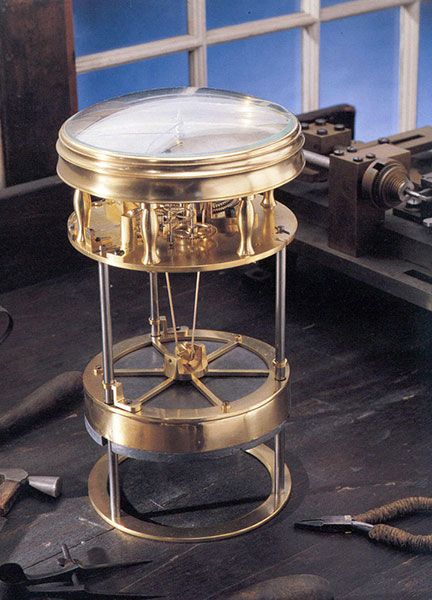
    This timekeeper was the first American-made marine timekeeper taken to sea. William Cranch Bond, a 23-year-old Boston clockmaker, crafted it during the War of 1812.
    This timekeeper was the first American-made marine timekeeper taken to sea. William Cranch Bond, a 23-year-old Boston clockmaker, crafted it during the War of 1812.

    Navigating at Sea is an immersive environment that suggests a walk through a 19th-century sailing vessel. Visitors will learn how centuries ago navigators at sea relied on chronometers and measurements of celestial objects to determine location. This section includes a mariner’s astrolabe, dating from 1602; a Ramsden sextant and dividing engine; several chronometers; a model of Galileo’s pendulum clock; and the earliest sea-going marine chronometer made in the United States, produced by Bostonian William Cranch Bond during the War of 1812. It also features an interactive display that allows visitors to use a sextant to navigate with the stars.

    Navigating in the Air relates how air navigators struggled with greater speeds, worse weather and more cramped conditions than their sea-going predecessors. It tells the story of the innovations that overcame these challenges, as represented the gallery’s largest artifact, the Lockheed Vega “Winnie Mae,” flown by Wiley Post and Harold Gatty, shattering the around-the-world record in 1931. Visitors will learn that Charles Lindbergh required navigational tutoring after he flew to Paris and how he paved the way for a new system of navigation in the process. A personal account by a WWII navigator highlights wartime innovations. This section ends with an explanation of how clocks with tiny quartz crystals opened an entirely new era of navigation in the form of LORAN (LOng RAnge Navigation).

    Wiley Post’s Winnie Mae circled the globe two times, shattering previous records. The first time was in 1931 with Weems associate Harold Gatty as lead navigator. The second was a solo flight in 1933 assisted by “Mechanical Mike,” one of the world’s first practical autopilots.
    Wiley Post’s Winnie Mae circled the globe two times, shattering previous records. The first time was in 1931 with Weems associate Harold Gatty as lead navigator. The second was a solo flight in 1933 assisted by “Mechanical Mike,” one of the world’s first practical autopilots.

    Navigating in Space traces how teams of talented engineers invented the new science of space navigation using star sightings, precise timing and radio communications. This section includes an Apollo sextant, a space shuttle star tracker, timing equipment used at a ground tracking station and a flight spare (duplicate spacecraft) of Mariner 10, the first spacecraft to reach Mercury.

    Inventing Satellite Navigation describes how traveling in space inspired plans to navigate from space. Innovators found that time from precise clocks on satellites, transmitted by radio signals, could be used to determine location. The U.S. military combined several breakthroughs to create the Global Positioning System. Some of the artifacts in this section are the NIST-7 atomic clock that served as the U.S. time standard in the 1990s, the navigation system from the nuclear submarine U.S.S. Alabama, a satellite from the Transit system used for global navigation before GPS and a test satellite global navigation built at the Naval Research Laboratory.

    An official DARPA photograph of Stanley at the 2005 DARPA Grand Challenge. Stanley, created by the Stanford University Racing Team, won the race.
    An official DARPA photograph of Stanley at the 2005 DARPA Grand Challenge. Stanley, created by the Stanford University Racing Team, won the race.

    Navigation for Everyone tells the stories of real people — a fireman, a farmer and a student — who use modern navigation technology in their everyday lives. It also addresses what might come next: the story is not over yet and many new technologies are being developed. This section includes a disassembled mobile phone with a diagram showing all its parts and depicts how hundreds of years of navigation technology are now in the palm of a user’s hand. It also features “Stanley,” the robot car that won the 2005 Grand Challenge, a robot race sponsored by the Defense Advanced Research Projects Agency.

    The exhibition is made possible through the support of Northrop Grumman Corporation; Exelis Inc.; Honeywell; National Geospatial-Intelligence Agency; U.S. Department of Transportation; Magellan GPS; National Coordination Office for Space-Based Positioning, Navigation and Timing; Rockwell Collins; and the Institute of Navigation.

    The National Air and Space Museum building on the National Mall in Washington, D.C., is located at Sixth Street and Independence Avenue S.W. The museum’s Steven F. Udvar-Hazy Center is located in Chantilly, Va., near Washington Dulles International Airport. The National Museum of American History collects, preserves and displays American heritage in the areas of social, political, cultural, scientific and military history.

  • GreenRoad’s Tracking Data Sheds Light on Driver Performance

    GreenRoad has announced the integration and availability of GreenRoad Advanced Tracking, powered by GPS Insight fleet tracking service. GreenRoad Advanced Tracking provides fleet operators with a new level of insight into fleet performance, resulting in improved fuel economy, better asset utilization, and enhanced productivity, GreenRoad said.

    With the availability of GreenRoad Advanced Tracking, GreenRoad adds powerful fleet management capabilities to its best-in-class driver performance and safety solution, which combines real-time, in-vehicle safety feedback with a management portal that provides insight and guidance.

    “GreenRoad Advanced Tracking builds on the GreenRoad Connected Fleet vision by giving managers deeper, broader insight into how they’re using their fleet assets, in addition to how their drivers are performing,” said Karen White, senior vice president of customer solutions for GreenRoad.

    Additional highlights of GreenRoad Advanced Tracking include:

    • Interactive displays of entire fleet, any vehicle group or single vehicle. Color-coding for easy status identification, 2D and 3D mapping, vehicle history trails, automatic alerts when management attention needed.
    • Increased fleet activity insight with landmark and geofence support. Automatic alerts when a vehicle enters or leaves a landmark or group of landmarks.
    • Enhanced reporting to optimize fleet resources. Multiple, detailed activity reports including Drive Time Summary, Fleet Utilization and Odd-Hours Violations. Vehicle MPG reports available with fuel card transaction data integration.
    • A customizable dashboard runs specific reports and provides managerial insights with a minimum of mouse clicks.


  • TomTom App Center Offers Integrated Fleet Apps

    TomTom has launched a new resource to showcase the range of business applications available for integration with its fleet management technology.

    The TomTom Business Solutions App Center is a dedicated web resource, detailing a range of partner applications ready for integration with TomTom’s WEBFLEET platform. These include office solutions, such as CRM, ERP, scheduling and planning software.

    This move is at the heart of TomTom Business Solutions’ strategy to create added value for connected vehicle and fleet management solutions and expand its network of development partners.

    “The new App Center will enable companies to identify those solutions that can be swiftly deployed and integrated with their TomTom system,” said Thomas Schmidt, TomTom Business Solutions’ managing director.

    “By bringing fleet management data together with information from a host of other software systems, companies can benefit from greater efficiencies across all areas of their business — from workflow management to customer service. With our seamless integration options customers do not have to change the way they work, they simply improve it ”

    The App Center will also host in-vehicle and mobile applications. Recently, TomTom opened the Bluetooth channel on its in-vehicle LINK tracking device, enabling connectivity with a host of hardware devices for use in and around the vehicle.

    The App Center launch is designed to spark the development of more integrated business applications, further enhancing the potential of TomTom’s fleet management platform. Developer partners can work with TomTom’s API WEBLFEET.connect and LINK.connect to create new solutions.

    Detailed developer resources can be found here.

  • ITT Exelis Offers Signal Sentry to Detect Jamming Sources

    ITT Exelis Offers Signal Sentry to Detect Jamming Sources

    ITT Exelis is offering the Signal Sentry 1000, a proprietary product  that detects, geolocates, and characterizes sources of intentional and unintentional interference to the U.S. GPS signals, and provides actionable intelligence to the user.

    The system leverages GNSS signal domain knowledge, and is based upon patented technology developed through the company’s history of designing and fielding electronic intelligence systems, ITT Exelis said.

    Leveraging Exelis GNSS signal domain knowledge, the system is implemented using commercially available GPS receiver and computer server/data technology. Actionable intelligence is available in the form of pin mapping of interference sources in addition to longitude/latitude/altitude data, all available through a web-enabled graphical user interface.

    Signal Sentry 1000 can assist efforts to ensure GPS spectrum integrity and aid in law enforcement operations that require GPS availability. Benefits for users include:

    • Instantaneous identification and geolocation of jamming sources, improving situational awareness.
    • Detect multiple jamming occurrences, geolocate multiple jammers simultaneously in harsh electromagnetic environments.
    • Defend against disruption of GPS guidance, traffic and asset control systems.
    • Protect against interference of GPS tracking of high-value assets.
    • Quickly identify jamming sources in open forums and emergencies, detecting disruption of critical  communications.
  • CrowdOptic, LBMA Research Focus-Aware Mobility for Events

    CrowdOptic, a maker of crowd-powered mobile applications for live events, and the Location Based Marketing Association (LBMA) have joined forces to develop and promote new focus-aware mobile technology for fans at live events.

    Part of LBMA’s mandate is to foster research, innovation and pilot projects that push the boundaries of place-based marketing. Through this initiative, LBMA has partnered with several top-tier global brands carefully selected from among LBMA’s large network of marketing affiliates to introduce the new technology to consumers. The technology will be introduced in a series of test launches at major entertainment events throughout the summer, before making it widely to marketers in the fall, the association said.

    Focus awareness combines traditional GPS-location awareness with data on where mobile users are aiming their smartphones. Focus-based technology enables new kinds of apps in which users aim their phones to engage with one another as they watch events simultaneously — for example to connect, chat or vote on the shared subject of focus. Focus-awareness also allows marketers to chart the shifting momentum in crowds.

    The partnership comes as demand grows among LBMA’s network for mechanisms to enhance context-awareness in mobile. Marketers want to know how many phones are engaged with their apps as events are happening (heat), who those users are, where they are looking, and how the crowd’s engagement is dynamically changing moment to moment — all capabilities of CrowdOptic’s technology.

    “Our vision of the future is new apps that dynamically adapt based on knowing what activities people in a crowd are watching and engaging in, as well as joining people with shared interests together, right there in the moment,” said Asif Khan, founder and president of LBMA.

    “Focus is an emerging mobile category that will play a significant role in the next generation of location services,” said Brent Iadarola, Global Research Director of Mobile & Wireless Communications at Frost & Sullivan. “In contrast to augmented reality, which combines location and mobile Internet search to provide information on landmarks in static environments, focus-based services enable the tracking and tagging of objects (or individuals) in moving or dynamic environments. By enabling mobile users to point their phones at moving objects or people to access real-time information about their subject of interest, this area of technology in which CrowdOptic is a pioneer clearly presents some very unique and lucrative avenues for hyper-targeted marketing promotions, advertising, and mobile coupons.”

    CrowdOptic is in use around the world in apps that enable users to “aim their phone” to act or interact — whether to discuss, report or discover other people based on their shared focus.  The company powers a range of applications which vary from finding friends in a crowd, to aiming a phone to vote, to aiming to alternate views of a live broadcast, to aiming to connect with athletes and celebrities at live events.  The technology works both through an app and anytime without an app, by historically mining the standard metadata tags embedded in shared photo images. The mechanisms used to acquire context beyond location include continuous streams of GPS, compass and triangulation algorithms illuminating common points of focus between mobile users.

    The LBMA will begin to introduce these projects which leverage the CrowdOptic platform for top global brands beginning in the summer of 2013.

    About LBMA – http://thelbma.com/

    The Location Based Marketing Association is an international group dedicated to fostering research, education and collaborative innovation at the intersection of people, places, and media. Our goal is simple: To educate, share best practices, establish guidelines for growth and to promote the services of member companies to brands and other content-related providers. The over 600 members of the LBMA include retailers, restaurant chains, agencies, advertisers, media buyers, software and services providers, and wireless companies.

    About CrowdOptic – www.crowdoptic.com