Author: GPS World Staff

  • TeleCommunication Systems Selects Locaid as Location-as-a-Service Partner

    Locaid, a location-as-a-service company, and TeleCommunication Systems, Inc., (TCS) mobile communication technology company, have announced that TCS’ portfolio of mobile location-based products and services (LBS) will now incorporate Locaid’s location-as-a-service capabilities. This partnership provides wireless operators with access to rapidly deployable location technology for additional financial yield from their location infrastructure, the companies said.

    The TCS-Locaid partnership provides a turn-key LBS solution that includes location network capabilities via TCS’ Xypoint Mobile Positioning Center (MPC) or Xypoint Gateway Mobile Location Center (GMLC) platforms and cross-carrier, multi-source, location aggregation enablement. Through this partnership, Locaid’s aggregation solution integrates with TCS’ network location platforms and enables wireless operators to rapidly enhance their monetization of a location technology investment. Further, TCS facilities enable hybrids of in-network, hosted or managed services location platforms and cloud-based location aggregation enablement, the companies said.

    Locaid President and CEO Rip Gerber said, “TCS is known for providing carriers with new revenue opportunities and delivering them in a rapidly deployable, hosted and turn-key way. This agreement is testimony to the importance of Location-as-a-Service among the biggest players in mobile, and it is an historic first step between our two companies.”

    “With the appropriate privacy protections, the location of an individual has proven to be a valuable asset that can enhance the value of a carrier or enterprise’s service,” said Lynne Seitz, vice president of location products, TCS. “One of our key goals is to help our carrier customers to monetize this asset by making it available on demand to third parties across a wide-variety of verticals. After an extensive study of the mobile location market and providers, we selected Locaid for their commitment to privacy and impressive portfolio of content providers, enterprises, application developers and merchants who will compensate operators for access to location.”

  • Soyuz Takes Shape in French Guiana for Dual Galileo Launch

    Assembly process for the Soyuz launcher began with integration of the four first-stage strap-on boosters to the Block A core second stage (photos at left and center).  At right, the Block I third stage is seen after its mating to the launcher’s core.

    The launcher for Arianespace’s next Soyuz mission from the Spaceport in French Guiana is completing its initial checkout for a flight in the second half of 2012, which will carry another two spacecraft for Europe’s Galileo satellite navigation constellation, according to Arianespace.

    During activity at the Spaceport’s Soyuz Launcher Integration Building — known by its Russian “MIK” designation — the vehicle’s four first-stage strap-on boosters have been mated with the Block A core second stage, followed by integration of the Block I third stage.

    With its initial build-up concluded, the Soyuz is undergoing regular maintenance checks that are standard for the Russian-built vehicles that have been in storage prior to their mission. Such verifications include testing of the launcher’s pneumatic and electrical systems, Arianespace said.

    This Soyuz will carry Europe’s next two Galileo In-Orbit Validation (IOV) satellites, joining the first pair of spacecraft lofted on Arianespace’s historic maiden flight of the Russian-built launcher from French Guiana in October 2011. Once the four IOV satellites are in orbit, they will provide the minimum information needed for space-based navigation: latitude, longitude and altitude data, along with ranging accuracy, enabling assessment of the Galileo system’s performance, while also allowing suppliers to realistically check their receivers and services against actual signals.

    Arianespace has been chosen to deploy the entire Galileo constellation of 30 satellites. This began with the launch of the first two experimental satellites, GIOVE-A and GIOVE-B, orbited by Arianespace’s Starsem affiliate on Soyuz launchers from Baikonur Cosmodrome in 2005 and 2007. Subsequently, Arianespace lofted the initial pair of In-Orbit Validation spacecraft on Soyuz’ October 2011 inaugural mission from the Spaceport.

    The remaining 24 Galileo constellation satellites will be orbited through 2015, using six additional Soyuz vehicles carrying two spacecraft each, along with three Ariane 5s configured with four per launch.

    Initial phases of the Galileo program were carried out by the European Space Agency (ESA) in activity co-funded with the European Commission. Galileo’s Full Operational Capability phase is being managed and funded by the European Commission, with ESA and the Commission having signed a delegation agreement by which the space agency acts as design and procurement agent.

    The upcoming Galileo mission is designated VS03 in the numbering system for Arianespace’s launcher family — which is composed of the medium-lift Soyuz, heavy-lift Ariane 5 and light-lift Vega – all operated at the Spaceport. The “V” represents the French word for “flight” (Vol), while “S” signifies the use of a Soyuz launch vehicle. Its “3” denotes the third Arianespace mission of Soyuz from French Guiana.

  • Hemisphere GPS Provides New Snow Grooming Guidance and Snow Depth System

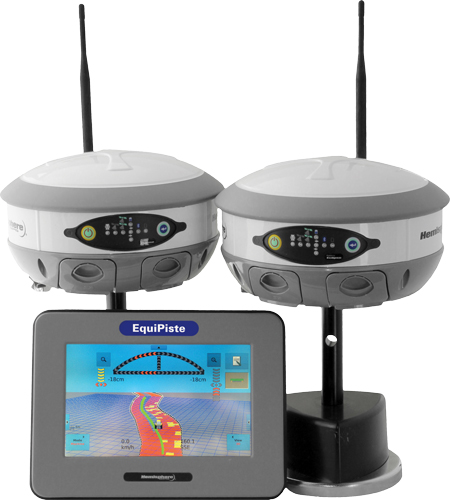
    Photo: Hemisphere GPSHemisphere GPS has announced the EquiPiste integrated snow grooming management system. EquiPiste provides visual guidance, snow depth status, and event logging for snow grooming operators, mountain managers and snow road operations. Ski resorts benefit from improved grooming quality and productivity, optimal snow making decisions and distribution, as well as more predictable and preventative snow cat maintenance, according to Hemisphere GPS.

    Snow grooming operations are tasked with creating quality snow conditions for ski trails or pistes, as they are referred to in the industry. Designed with an integrated touchscreen terminal and Crescent GPS, Hemisphere GPS’ EquiPiste graphically displays to the operator the areas groomed, boundaries, assets, points of interest, and hazards. Through the guidance cues, operators increase their efficiency and quality of work by avoiding overlaps and skips in grooming, Hemisphere GPS said. Areas that need attention such as thin snow pack and winch anchors can be flagged with meta-data so operators can easily navigate back at any time, even in low visibility. Pathways can be mapped and re-used for training novice operators or for repeatedly navigating snow roads. Operation managers benefit from reviewing the job files from each machine to determine variable costs, performance and maintenance tracking, the company said. As well, data can be mapped within Google Earth and used for generating daily grooming or road maintenance reports for customers.

    Many ski resorts also spend a substantial amount of their budget on snow making activities. When combined with Hemisphere GPS’ survey grade Eclipse GNSS technology, EquiPiste displays and records real-time snow depth measurements and maps, the company said. The snow depth data improves the efficiency and quality of managing the snow levels. The depth data helps indicate where and when to make snow, it alerts the operator to thin snow pack, where to redistribute snow as well as how to identically recreate (day to day and year to year) downhill race courses. Analysis of the snow depth data enables more optimized snow management.

    “Through collaboration with the ski resort and snow vehicle machine industry we have customized existing Hemisphere GPS technology to serve an adjacent vertical market,” said Andre Roberge, senior manager of New Ventures at Hemisphere GPS. “EquiPiste is truly a comprehensive snow management system that allows ski and snow road operations to capture and visualize the status and behaviour of snow for optimized grooming and manufacturing. Our customers have experienced tremendous benefits in productivity, quality, and safety as well as significantly reduced operational expenditures and lowered environmental impact. As a result, EquiPiste customers are able to provide a better standard of service and experience to their customers.”

  • Safe Software and Blue Marble Geographics Partner for Innovative Data Transformation

    Safe Software and Blue Marble Geographics announced that they have teamed up to bring the best of both of their products together in one authoring environment to increase the possibilities of what can be achieved in the use and distribution of spatial data. With the release of the GeoCalc Extension for FME, in addition to FME’s industry-leading format support and flexible transformation capabilities, users can have access to Blue Marble’s highly accurate coordinate transformations directly through FME Workbench.


    According to the announcement, the GeoCalc Extension for FME allows those relying on GeoCalc’s coordinate transformations to bring them into FME’s intuitive graphical user interface where they have access to FME’s unparalleled format support and data transformation capabilities.

    “GeoCalc and FME are highly complementary products,” says Patrick Cunningham, President of Blue Marble Geographics. “By integrating the two, our users can take advantage of FME’s excellent data transformation authoring environment, while directly accessing the highly accurate coordinate transformations they rely on in GeoCalc.”

    For FME users, access to the Blue Marble coordinate engine means more choice in coordinate transformations, and increased vertical height conversion accuracy and flexibility.

    “We are very excited about how this integration will increase the possibilities of what users can achieve with FME,” says Dale Lutz, Vice President of Development at Safe Software. “For example, we are seeing an explosion in the use of 3D data, particularly LiDAR, and GeoCalc’s superior geoid selection means more accurate reprojection results.”

    With the GeoCalc Extension, FME users with a valid Blue Marble Desktop GeoCalc license can select the GeoCalc datasource for use in coordinate transformations directly from FME Workbench. Through the Blue Marble Desktop administrative tools, they can also guide end users to preferred coordinate systems and transformations by specifying which GeoCalc systems and geodetic objects are available for import into FME.

    According to the announcement, the integration also provides access to fine datum shift control, including the option of processing shifts with late binding transformations or direct datum transformations, avoiding the potential loss introduced by using an interim WGS84 datum shift.

    The GeoCalc Extension for FME is currently in beta and will soon be available from Blue Marble Geographics.

  • Event 38 Announces UAV For Mapping

    Event 38 announced its first major product, model E382, a ready-to-fly mapping UAV. Based on the Ardupilot Mega 2.0 autopilot, the E382 is designed to take aerial photos quickly and easily.


    According to the announcement, equipped with a small point and shoot camera, the E382 can make five centimeter resolution maps from individual pictures stitched together. Digital elevation models and georeferenced orthorectified maps can be made using online services like DroneMapper.com.

    Event 38 reports that the E382 is capable of flying for just under an hour and can cover over 200 acres at a time on one charge. For larger areas, replacing the battery is quick and can be done in the field. Weighing in at under five pounds and made of soft, durable foam, the airframe is resistant to damage and can’t significantly damage anything on the ground. The 66″ wings come apart for easy transport to and from the job site.

    The basic kit consists of a ready to fly airframe with autopilot, motor and servos installed. Options are available to add on for those without any R/C gear like a controller, batteries and a suitable point and shoot camera. If you’re starting without any gear, a full system costs about $1,050. Training and on-site setup are available as well.

  • DigitalGlobe, Inc. Rejects GeoEye’s Proposed Acquisition

    GeoEye announced that DigitalGlobe, Inc.’s Board of Directors has rejected GeoEye’s acquisition proposal. On May 4, 2012, GeoEye announced a proposal to acquire DigitalGlobe for $17.00 per share in total consideration, payable $8.50 per share in cash and $8.50 in GeoEye stock, or 0.3537 shares of GeoEye stock for each share of DigitalGlobe stock, representing a premium of 26% to DigitalGlobe’s closing price as of May 3, 2012.

    “We are disappointed that DigitalGlobe’s Board of Directors has rejected our highly attractive proposed acquisition,” said Matt O’Connell, CEO of GeoEye. O’Connell continued, “We believe, and DigitalGlobe appears to agree, that combining these two companies makes clear strategic sense. A combined company would generate substantial synergies while better satisfying the needs of all customers, domestic and international. The combined company would be able to deliver significantly greater certainty in the continuity and quality of its future satellite constellation. We view this proposal as being proactive to continue to deliver the high level of service to our government and commercial clients in the most cost effective manner.”

    GeoEye reported it will consider its options in light of DigitalGlobe’s rejection. We have engaged Goldman, Sachs & Company, Convergence Advisors LLC and Latham & Watkins LLP to advise us in this transaction.

  • Massive GPS Jamming Attack by North Korea

    Large coordinated cyber attacks from North Korea near its border with South Korea produced electronic jamming signals that affected GPS navigation for passenger aircraft, ships, and in-car navigation for roughly a week in late April and early May. To date, no accidents, casualties, or fatalities have been attributed to jammed navigation signals aboard 337 commercial flights in and out of South Korean international airports, on 122 ships, including  a passenger liner carrying 287 people and a petroleum tanker. One South Korean driver tweeted “It also affects the car navigation GPS units.  I am getting a lot of errors while driving in Seoul.”

    South Korea experienced similar electronic attacks in March 2011, and in August and December of 2010, all of which were blamed on the North. The South Korean Defense Ministry said it is developing anti-jam programs to counter the attacks, which are being launched by what it termed a regiment-sized electronic warfare unit near the North Korean capital Pyongyang, and battalion-sized units closer to the inter-Korean border.

    “Despite disruption in GPS, there is no serious threat to the safety of flights because planes are using other navigation devices,” claimed a Transport Ministry spokesperson. Officials say planes can use other navigation devices like  very-high-frequency omni-directional range (VOR) and inertial navigation systems.

    “We have traced the jamming signals to the direction of Kaesong,” said a Korean Communications Commission deputy director. Kaesong lies roughly 10 kilometers from the border between the two countries, and roughly 50 kilometers from downtown Seoul, Incheon International Airport, and the Yellow Sea.

    It is unknown how long the jamming may continue, or when it might resume if halted. In March 2011, GPS jamming signals from the North lasted for 10 days during an annual U.S.-South Korea joint military drill. The motivation for North Korea to develop and employ anti-GPS technology would appear to come from its fear of attack by GPS-guided cruise missiles that might target key sites within the country. Clearly, any such military capability would require regular testing.

    China is well known as a source of mass-produced small GPS jammers widely available over the Internet, but equipment on this scale would not be capable of jamming at the distances stated above. “At least one, or possibly more Russian companies are selling fairly powerful GPS jamming equipment,” said one knowledgeable source.

    The source also alluded to Iran’s reported use of GPS spoofing to mislead and capture a U.S. surveillance unmanned aerial vehicle (UAV). Such an effort would similarly require large and sophisticated equipment, for which the most likely source is Russia.

    “Receivers which cannot tolerate LightSquared will get in trouble in North Korea!” commented one well-known GPS manufacturer. “Today’s receivers don’t have protection. We just completed our ad [for the June issue of GPS World] which somewhat covers this.”

    Other sources pointed to much wider potential threats than those in the Korean peninsula or areas of strategic conflict such as Afghanistan-Iran. Local jamming attacks can be anticipated almost anywhere, anytime: harassment by insurgent groups against established governments or armed forces, or GPS-denial actions by pirates in high-density commercial shipping lanes.

    Since aviation is increasingly and in some cases exclusively dependent on GPS and regional GNSS augmentations or equivalents, jamming represents a growing concern for the aviation industry, including commercial airlines. In March of this year, the U.S. Federal Aviation Administration published an updated report on “Concept of Operations for NextGen alternative positioning, navigation and timing (APNT).”  It advocates GPS backup by transponder-based distance-measuring equipment (DME), supported by onboard inertial reference systems, and assisted in places by low-powered GPS-like pseudolites and wide-area multilateration. The report concludes that any GPS/GNSS backup must be multi-modal, unjammable, provide GPS-like timing, have signals extending from the ground up to all altitudes, be unaffected by line-of-sight restrictions and, preferably, have reasonably long range to keep down the number of transmitting stations required.

    Commenters have pointed out that eLoran meets those requirements, except for a vertical component, limiting it non-precision approaches. The system currently does not operate in the United States, although it is undergoing limited testing. The United Kingdom has a more active program. See upcoming GPS World webinar, Alternative PNT – Backing Up Critical Infrastructure with eLoran, on May 17.
  • Letter to the Editor: Suggestion to Protect Bandwidth

    In your March editorial, “The Fire Next Time,” you ask for suggestions to protect against another LightSquared encroachment. The solution is remarkably simple. Just let the same bandwidth be used for space downlink as it was originally intended. That would be both innocuous to GPS receivers and, more importantly, stake the ground against future challenges like LightSquared.

    — Alan Browne
    Lorraine, Quebec

  • CMT Releases iCMTGIS II App for the Apple iPAD

    CMT Release iCMTGIS II App for the Apple iPAD, one of a series of apps the company is presenting to the iPAD and iPhone users in 2012. iCMTGIS II provides a host of powerful and user-friendly functions to facilitate GPS/GIS data collection and mapping for a variety of applications, such as forestry, land management, utility pole data collection, wildlife management and archaeology.


    iCMTGIS II functions include:
    • Display the coordinates of a geographic location
    • Create Feature Lists for data collection
    • Create sampling grids
    • Display Google Map as the background map
    • Import and Export Shapefiles
    • Collect multi-layer GPS/GIS data
    • Update the coordinates for Point Features
    • Create new points using angles and distances
    • Digitize points, lines and areas
    • Assign symbols and attributes to Features and Topics
    • View/Edit the collected data
    • View the area of an enclosed region
    • Measure distances on the displayed map
    • Send and receive job files via email
    • Store job data on the Cloud
    • Get and send job data via ftp
    iCMTGIS II Version 1.0.0 is available now from the App Store at: http://itunes.apple.com/us/app/icmtgis-ii/id516124344?ls=1&mt=8
  • Esri Releases Free Business Analyst Online Mobile App for Android Smartphones

    Esri announced the release of a free Business Analyst Android app for retail and commercial real estate professionals, allowing them to access demographic data anywhere with the Esri Business Analyst Online (BAO) application. The application is designed for anyone who needs access to population and consumer marketing data on the go.

    According to the announcement, the BAO application enables users to access up-to-date facts on demographics, lifestyle, and consumer spending for any region in the United States. With it, users can compare any address with another or with the county, state, or United States and analyze an area within one mile of a prospective location. Unlike traditional market research, users can quickly compare and contrast regional information with the regional average and show that data to clients in the field. Reports created in the mobile BAO application can also be e-mailed to share with a broader audience. More extensive data, capabilities, and reports are available through the application with a subscription to the BAO web application.

    The BAO application is free and can be downloaded directly from Android Marketplace.

    To learn more, visit esri.com/BAOapp.

  • Arby’s Assesses Market Footprint with Esri Business Analyst

    Esri announced that Atlanta-based Arby’s Restaurant Group, Inc. has licensed Esri Business Analyst software and business data to help with corporate decision making. The second largest quick-service sandwich chain in the United States, Arby’s is using the location-based system to more accurately assess its restaurants and trade areas including growing, remodeling, and relocating restaurants.


    “Esri’s Business Analyst has saved our GIS analyst countless hours and has had a positive impact on the Business Development department,” said Dave Conklin, senior vice president, Business Development, at Arby’s Restaurant Group, Inc..

    According to the announcement, Arby’s can now update the locations of its restaurants and business development activity on designated market area (DMA) maps, which describe the activity taking place in individual markets. These maps are readily accessible to users, including development teams working in the field, through the Arby’s intranet. Since the implementation, the teams are able to more easily and quickly monitor the business climate around each restaurant. This provides an opportunity for the organization to model different market scenarios to better serve its current customers and attract new ones.

    “We are pleased to provide a single-platform approach for managing and analyzing business data to Arby’s staff,” said Simon Thompson, director of global commercial industry, Esri. “With an enterprise system, Arby’s can scale to meet the changing business landscape with tools that make it competitive in the marketplace.”

  • Tablet Users Will Help Shape Future Mobile App Market

    Between 2010 and 2011 the global installed base of app consumers increased by 104%, according to a report released by  mobile research specialists Research2guidance. While the installed base of smartphones increased by nearly 274 million, tablets were the fastest growing segment. The number of new tablet app consumers increased by 58 million. As a result, tablet owners now constitute 8.6% of the installed app consumer base.

    Based on Q2 projections for tablet shipments in 2012, the installed base of tablet users is set to increase more than 150% by 2013.  As tablet users become a larger and larger app downloading segment, their app behavior and preferences will have an increasing influence on the app market – illustrated already in the growth in the number of apps and stores devoted to them.

    Installed base of tablet users to increase more than 150% by 2013

    During 2011, apps in the Apple App Store for iPad grew 180% to more than 140,000 apps by the end of Q4 2011. While this cannot be easily quantified for Android as tablet apps are not separated out, the growth of niche stores and niche store categories focusing on Android tablets reflects their growing presence. For example, Archos Appslib focuses completely on Android tablet apps, while other stores like Android Tapp has a dedicated category.

    Several studies have shown that tablet users exhibit different behaviour towards app downloading/usage and mobile browsing than smartphone users.  Based on the breadth of use cases for gaming, ecommerce, digital publishing and the enterprise – tablet user growth is likely to have a marked effect on consumption in these areas.

    Tablet apps for the enterprise market

    In the enterprise, for example, tablets have already been largely implemented at upper levels of management and are quickly working their way throughout organizations – according to Apple’s CEO Tim Cook in 2012, 92% of Fortune 500 companies are testing or deploying iPads. As more and more use cases are developed and penetration increases, so too will the number of apps being developed for enterprise tablet users. While Apple has already carved out a niche section for iPad and iPhone Business users called “@Work”, other players like Lenovo and Cisco are trying to do the same for Android Business users.