Author: GPS World Staff

  • SuperGeo Technologies Introduces SuperPad 3.1

    SuperGeo Technologies introduces SuperPad 3.1, which mainly enhances the user interface, adjusts toolbar icons, adds SBAS extension, and improves the display of GPS status. For customization, SuperPad 3.1 provides sample codes for developing extensions and offers Microsoft Visual Studio templates to assist users in developing the functions they need. To have a smoother GIS workflow, SuperPad 3.1 improves the connection with SuperGIS Server 3 to make data synchronization more effective.

    User Interface Enhancement

    • To enhance the efficiency of data editing and collecting, SuperPad 3.1 improves the user interface and toolbar allocation. Therefore, users are able to achieve the task target with better efficiency.
    • To have the toolbar button display more clearly, SuperPad 3.1 adjusts the icon style and size so that users can choose the most suitable icon size for different mobile devices.

    Newly-Added SBAS Extension

    • The whole new SBAS extension supports to turn on SBAS function of mobile device to improve the accuracy of GPS data collection.
    Providing Custom Samples and Templates
    • A number of sample codes of extensions are provided; users can directly use the objects of SuperGIS Mobile Engine to design the GIS functions they need.
    • Microsoft Visual Studio templates for customizing GIS functions are provided so that users can customize SuperPad with ease.

    Improved Capability of Synchronizing SuperGIS Server Data


    • The capability of synchronizing the map data published by SuperGIS Server is improved. Thus, users can synchronize the data with SuperGIS Server while surveying outdoor.
  • GPS Monitoring of Sex Offenders Can Cut Recidivism

    The United States Department of Justice’s National Institute of Justice (NIJ) recently released a study that evaluated the use of global positioning systems (GPS) technology to monitor high-risk sex offenders on parole in California.

    Offenders in the GPS group demonstrated significantly better outcomes than offenders who were monitored in traditional ways. The evaluation showed that risk for a sex-related violation was nearly three times greater for offenders who received traditional parole supervision, than offenders who received GPS supervision. The risk of committing an offense that resulted in an arrest was twice as high for offenders who received traditional parole supervision than for offenders in the GPS group. When compared to traditional supervision, the study found that GPS monitoring costs approximately $8.51 more per day. The outcomes of GPS monitoring, however, are significantly better.

    TITLE: Monitoring High-Risk Sex Offenders with GPS Technology: An Evaluation of the California Supervision Program


  • GPS Robots Swarm California Rivers

    GPS Robots Swarm California Rivers

    gps-robot
    UC Berkeley researchers have developed a method to learn about the quality, volume, speed, and direction of the flow of salt walter and freshwater through the Sacramento Delta. (Photo courtesy of : University of California, Berkeley.)

    Swarms of robots equipped with GPS and sensors were released May 9 into California rivers to measure water flow, salinty levels, and pollution, reports OurAmazingPlanet.com. The Floating Sensor Network is intended to change the way water quality and flows are monitored in the Sacramento-San Joaquin river system.

    At the University of California, Berkeley, a group of 100 robots was released into the Sacramento River near Walnut Grove. About two thirds of California’s fresh water is in the river system, supplying about two-thirds of the state’s population with drinking water and irrigation. The initiative is led by associate professor Alexandre Bayen at the Center for Informatin Technology Research in the Interest of Society (CITRIS).

    The robots each have a sensor to test salinity and a GPS unit from a smartphone. Some have propellers so they can maneuver around obstacles and reach specific destinations. The robots are also sending Tweets, to @fsnandroid61.

    Watch Electrical Engineering Graduate Student, Andrew Tinka, describe the project:

  • Trimble Introduces New DR+GPS Module for Vehicle and Asset Tracking Applications

    Trimble has introduced the Aardvark DR+GPS module that combines dead reckoning (DR) with GPS technology on a single, compact board. The Trimble Aardvark DR+GPS module provides positioning information when GPS signals are limited or not available, such as in urban canyons and tunnels. The Aardvark DR+GPS module is being marketed as a solution for system integrators or OEMs who are adding dead reckoning capabilities to vehicle navigation, fleet management and asset tracking systems.

    Dead reckoning estimates position based on heading and distance traveled since the last known position. The more accurate the speed, time and heading inputs, the more accurate the dead reckoning. GPS contributes to accuracy by continuously calibrating the gyro and speed sensors to produce optimal dead reckoning.

    The 19 x 19 millimeter surface-mount module has an on-board gyro and collects speed and forward/reverse data from the vehicle’s sensors. Its DR+GPS algorithm automatically calibrates the gyro and external sensors’ inputs and blends this information with GPS measurements to produce accurate position and velocity outputs in hostile GPS environments such as urban canyons.

    The Aardvark DR+GPS module is available in two configurations: model number 88788-30 for flat installations; and model number 88788-50 with a feature supporting variable mounting installations. The 88788-50 self-determines the module’s orientation allowing the ultimate in installation flexibility.

  • Indoor Positioning May Need Several Solutions, Says IMS Research

    A range of solutions are vying to replicate what GPS does outdoors in an indoor environment, from Wi-Fi to Bluetooth to “terrestrial” GPS, plus many others. Which one is likely to be successful? IMS Research (recently acquired by IHS Inc.) said the answer will not simply be just “one.” Locating a smartphone in an outdoors environment is straightforward, with more than 90 percent of smartphones providing GPS functionality. However, GPS becomes less useful in built-up areas and can be useless indoors, reports IMS Research.

    Indoor location enables a number of exciting applications that may previously have been considered impossible, for both the consumer and the venue owner, said IMS Research. Not only can it provide analytics, tracking footfall and understanding consumer behavior, but also improve the shopping experience, helping the consumer to find a particular store or product. Whilst these examples are useful, the real benefit and revenue generation is likely to arrive in the shape of advertising.

    Bluetooth in Nokia’s HAIP variety can provide accuracies claimed to be less than one meter, making it suitable for “aisle level” positioning. NextNav is beginning to roll out a technology described as “terrestrial GPS” in the United States, using transmitters based on the ground, and the existing GPS chipsets found in many smartphones. Other solutions include the IMES system in Japan and cellular-based solutions from companies such as Path Intelligence.

    While the roll out of commercial solutions has only recently begun, Wi-Fi has, to date, been the primary technology used. “Its high penetration in smartphones, combined with an existing infrastructure of access points, in venues such as shopping malls and airports etc., means minimal additional investment is required to support some level of positioning solution,” noted Alex West, Connectivity and Location research director at IMS Research. “For this reason, a range of different companies from Google, to Qualcomm and CSR, to Qubulus, all have solutions incorporating Wi-Fi.” Current location accuracies through Wi-Fi make it suitable for “store-level” positioning but less so for product or aisle-level, although IMS Research forecasts that consumers’ exposure to store-level accuracy will drive demand for aisle/product-level accuracy.

    In reality, it is unlikely that one solution will meet all requirements, and among recent announcements is CSR’s SiRFusion platform, which uses not only Wi-Fi, but also cellular and MEMS sensors such as accelerometers and gyroscopes, to provide a hybrid solution. MEMS sensors, which are becoming increasingly common in smartphones, are expected to play a bigger part in positioning, not only improving accuracy levels but also aiding in cutting down power consumption.

    Other leading IC suppliers, including Broadcom and Qualcomm, have announced solutions incorporating these technologies, and Bluetooth in some cases, with the necessary software. As such, a more accurate indoor positioning service is expected to be included on smartphones over the next 12 months, and is expected to provide the platform for the many apps and services that are being developed utilizing indoor location, according to IMS Research.

  • LightSquared Bankrupt, But Spectrum Void Still Beckons

    By Alan Cameron.

    LightSquared, the company that mounted a powerful threat to GPS signals, declared bankruptcy on May 14, after losing a lengthy struggle in the court of the Federal Communications Commission (FCC) with the GPS industry, the U.S. military (behind the scenes), the Federal Aviation Administration, and many other GPS users. However, the vacuum into which Lightsquared sought to step — a dearth of spectrum for exploding mobile data use, up 123 percent last year — remains a gaping hole that will likely attract other entrants.

    The Lightsquared bankruptcy move followed collapse of negotiations with lenders to the company, and will likely give CEO Philip Falcone several further months of control. It is not known whether his efforts will seek to salvage the business plan to provide wholesale broadband capacity to wireless carriers, who need more capacity to feed a ravenous market. In her May Wireless Pulse column, GPS World contributing editor Janice Partyka writes, “Carriers [at the CTIA industry show] sounded alarms about running out of spectrum to support ballooning mobile data consumption.”

    As a result of the February FCC decision to revoke LightSquared’s conditional waiver to broadcast a powerful terrestrial signal immediately adjacent to a band reserved for satellite services, the company’s main asset, its spectrum license, lost most of its potential value, unless significantly repackaged and redirected, or traded for another spectrum band..

    In late 2010, when the LightSquared threat first surfaced, Falcone maintained that LightSquared’s interference issues were not his to solve, because GPS users were encroaching on his spectrum. “People who are in adjacent bands have to understand that there is now a new driver in town driving on that highway,” he said. “And they can’t be weaving in and out of that highway.”

    Falcone now has to deal with creditors who include Carl Icahn, the near-legendary corporate raider. Icahn and other investors have bought about $300 million of LightSquared debt. “Icahn is a take-control, alpha-male investor,” said Brad Balter, head of Balter Capital Management, as quoted in a May 3 Business Week story. “Falcone is both desperate and naive if he thinks of Icahn as anything other than an adversary who would wrest control of the spectrum if LightSquared went into bankruptcy.” What Icahn might venture if he gained control of LightSquared spectrum represents another unknown on the GPS horizon.

    Spectrum Shortage. Meanwhile, writes GPS World editor Partyka, “Verizon Wireless and T-Mobile executives complained that the future of data use is at risk if more spectrum isn’t put to use. FCC Chairman Julius Genachowski defended the agency’s decision to block the AT&T T-Mobile deal with a rejoinder about spectrum shortage. ‘Some have argued that transactions — let’s be frank, one transaction — is somehow causing a shortage,’ said Genachowski. ‘But the overall amount of spectrum hasn’t changed.’  While this is true, spectrum is a concern. CTIA reports that U.S mobile data traffic surged 123 percent in 2011.”

    In a statement regarding the company’s bankruptcy filing, Marc Montagner, interim co-chief operating officer and chief financial officer, stated “All LightSquared distribution partners and customers, including public safety, emergency response, government, and military users of LightSquared’s satellite-based communications services can continue to rely on LightSquared to provide them with mission critical communications services. The filing was necessary to preserve the value of our business and to ensure continued operations. The voluntary Chapter 11 filing is intended to give LightSquared sufficient breathing room to continue working through the regulatory process that will allow us to build our 4G wireless network.”

  • BeiDou/Compass Satellites Launched April 29 Now Being Tracked

    BeiDou/Compass Satellites Launched April 29 Now Being Tracked

    News courtesy of CANSPACE listserv.


    The two BeiDou-2/Compass satellites launched on April 29 became active on May 6. Several tracking stations in the Asia/Pacific area began tracking the satellites at about 08:00 UTC.

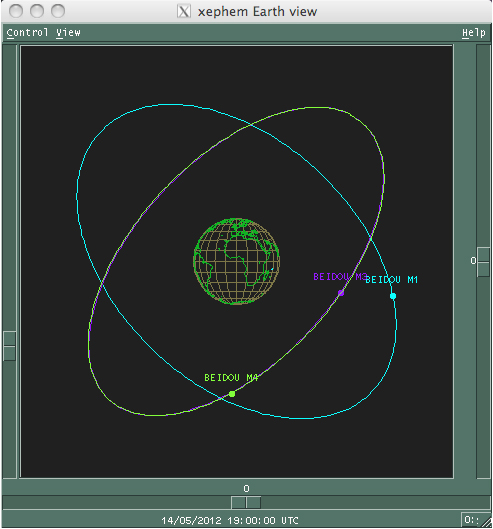
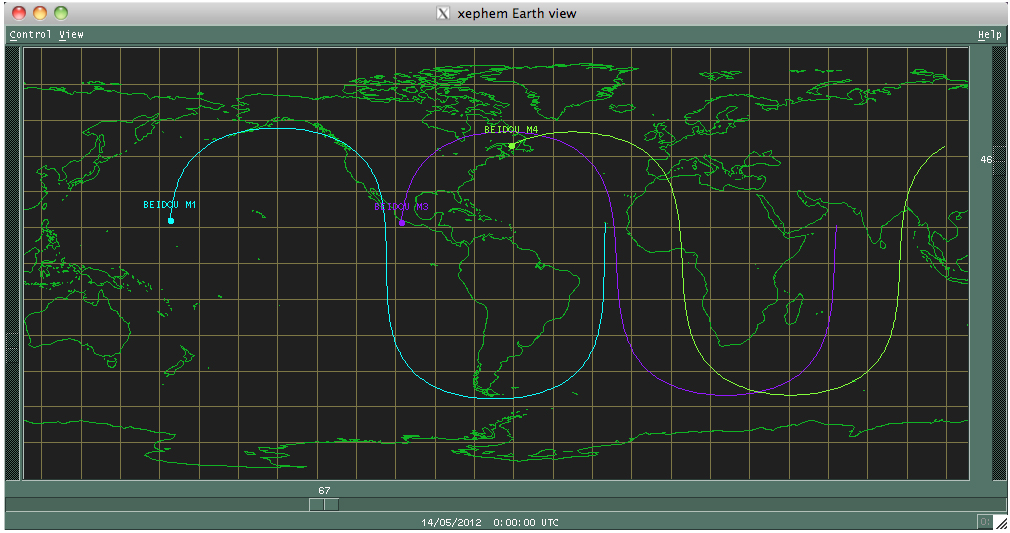
    The medium Earth orbit (MEO) satellites, identified by their international designators 2012-018A and 2012-018B and by Chinese officials as M3 and M4, are using pseudorandom noise codes 11 and 12. M3 and M4 are in the same orbit plane,  a different one than that of M1, the first BeiDou-2/Compass MEO satellite launched.

    A view of the three MEO satellites in their orbit planes is pictured here:

    cmpass-1

    The one-orbit ground tracks of the satellites are pictured here (click to enlarge):

    Compass-2


    Tracking of the satellites by NORAD/JSpOC appears to have been interrupted when the satellites fired their apogee kick motors to circularize the orbits. The last days the satellites were tracked in their transfer orbits were 30 April and 1 May. They were recovered by NORAD/JSpOC on 9/10 May. Likely the orbit circularizations occurred around April 30 / May 1.

    Recent two-line element sets for the three MEO satellites are given below:

    BEIDOU M1
    1 31115U 07011A   12134.10254588 -.00000105  00000-0  10000-3 0  5834
    2 31115 056.7122 028.7463 0003954 199.1314 301.1397 01.86191632 34665

    BEIDOU M3
    1 38250U 12018A   12132.52529875 +.00000052 +00000-0 +10000-3 0 00275
    2 38250 055.1626 116.9959 0024183 186.6025 335.0953 01.86239286000385

    BEIDOU M4
    1 38251U 12018B   12133.86489950  .00000061  00000-0  10000-3 0   262
    2 38251 055.0887 116.4855 0024672 179.1060 208.4713 01.86163690   419

  • Racelogic Wins Two Queen’s Awards for Enterprise

    Simulator company Racelogic, based in the United Kingdom, has been honored with two 2012 Queen’s Awards for Enterprise. The awards were given April 21 to 209 companies to mark Queen Elizabeth’s birthday. Racelogic was one of four companies to be honored with the awards for both Innovation and International Trade.

    Racelogic won the Innovation award for advances in GPS/GLONASS test simulation, with customers such as Broadcom, ST-Ericsson, and Telefonica using LabSat to test their devices.

    Almost 90% of Racelogic’s sales are now to countries other than the UK, with customers in 92 countries around the world. Racelogic received the International Trade Award to recognize this achievement.

    “We are extremely proud to be named as a winner of these two awards, with many highly reputable companies in the UK competing for these honors,” Racelogic’s CEO, Graham Mackie, said. “As a company we continue to grow and now employ more than 50 people in the UK alone. We have distributors located all over the world who help us to market and sell our systems to a wide variety of markets and customers.”

    All winners will be invited to collect their awards at a reception hosted by the Queen in Buckingham Palace later this year.

  • Spectracom Releases Dual-Frequency Multi-GNSS Constellation Simulator

    GSG-62 simulator

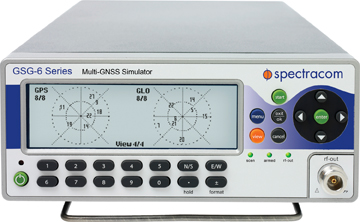
    Spectracom announced its new L1+L2 dual-frequency 32-channel multi-GNSS simulator, the GSG-62. The GSG-62 offers multiple frequency band operation, multiple GNSS constellation simulation, and expansion capability for more frequency bands and channels, the company said.

    The new simulator provides expanded capabilities for those who are testing more than GPS L1, according to the company. “We understand the challenges our customers have in fast-paced development, migration and delivery of products with ever changing embedded GNSS receivers,” said John Fischer, Spectracom CTO. “As such, we are excited to introduce this next-generation multi-signal instrument that allows for real-time scenarios, is intuitive to understand, quick to deploy and, given its design to support upgrades to L2C, L5, and future GNSS frequencies and systems, protects our customer’s investment in test gear.”

    Fischer continued, “In addition to a wide variety of technical challenges, we also understand our customers must balance the ability to quickly develop solutions and improve cost performance in their operations. We believe the price, unique features, and form factor of the GSG-62 will allow them to do both.”

    The GSG-62 is designed for manufacturing and development testing with its ability to simulate all the visible satellites for the receiver under test. With 16 channels for L1 frequency and 16 channels for L2 frequency, channels can be assigned to GPS or GLONASS, P-code or C/A code. Channels may also be used for SBAS simulation of EGNOS, WAAS, GAGAN, or MSAS satellites, or for multipath and interference signals.

    The GSG-62 incorporates all the features of Spectracom’s previous models, including compatibility with GSG StudioView PC software for creation and editing of simulation scenarios via Google Maps.

    Spectracom is a business of the Orolia Group and provider of practical test solutions for GPS and GNSS devices and systems.

  • Indianapolis Awards Multi-Million Dollar Mapping Contract to Woolpert

    Woolpert announced its Indianapolis office has been awarded two contracts totaling approximately $2 million by the City of Indianapolis Department of Public Works (DPW) to survey pavements and develop a street sign inventory using mobile mapping technology.

    According to the announcement, the project requires collection of data across 3,200 miles of city streets, one of the single largest mobile light detection and ranging (LiDAR) collection efforts to date. LiDAR technology uses pulses from a laser to produce highly accurate measurements and map physical features.

    “We’re proud to be at the front of using this industry-leading technology for a cost-effective approach to collecting data and developing a 3D model of the city. This truly maximizes taxpayers’ dollars by reducing the cost of a data collection effort while also providing us with the data necessary to perform government functions more efficiently, such as street rehabilitation,” said Jeremy Jobe, Woolpert project manager in Indianapolis. “Further, the dataset can be used for safety improvements through viewshed or line-of-sight analysis to proactively identify potential traffic hazards caused by the surrounding environment.”

    Nearly half of the cost associated with the project is being covered through a federal grant, according to Woolpert. The city leveraged this grant to significantly reduce using local dollars for the project. Remaining funds were generated from the RebuildIndy program and other local funding sources.

    Woolpert will use its Optech LYNX M1 Mobile LiDAR system to collect the data and then use that data to develop a street sign database for compliance with Federal Highway Administration’s (FHWA) Manual on Uniform Traffic Control Devices (MUTCD) requirements for sign inventories. This manual provides the U.S. standard for signs, signals and pavement markings.

    “The benefit of using a high-accuracy mobile LiDAR system with survey-grade capabilities on such projects is the rich dataset that it captures from which assets can be extracted, in this case signage,” said Jobe. “The city will not only be able to use the data for its sign database, it will also be able to extract or call on the Woolpert team to extract additional features in the future without remobilizing the team and assuming associated costs or placing additional field crews in harm’s way, which provides the true value in this collection effort.”

    Woolpert will team with VS Engineering and DB Engineering on the sign inventory and Dynatest on the pavement analysis. Upon completion of the project, data will be integrated with the city’s existing computerized maintenance management system.

  • Independent Evaluation Demonstrates Benefits of SCALGO Flash Flood Mapping

    SCALGO announced that at the recent Florida Floodplain Managers Association Annual Conference, the engineering and environmental sciences consulting firm Jones Edmunds & Associates presented an evaluation of the SCALGO Flash Flood Mapping product.


    According to the announcement, using a detailed terrain model, SCALGO Flash Flood Mapping can be used to rapidly assess flood risk during extreme rain events on a local, regional or even national scale. Jones Edmunds compared SCALGO Flash Flood Mapping with the results of a recently completed Jones Edmunds flood study in Marion County, Florida, based on an advanced dynamic model (ICPR) used by the Florida authorities and listed by Federal Emergency Management Agency (FEMA) as a nationally accepted hydraulic model. They found that despite a cost of under 5% and a significantly reduced production time, the Flash Flood Mapping results were close to the results of the advanced modelling and the same time significantly more detailed. Another main conclusion was that SCALGO Flash Flood Mapping is a very cost efficient way of screening large areas for high flood-risk areas where very detailed dynamic modelling is justified.

    SCALGO reports that its Flash Flood Mapping software can show how much rain has to fall during an extreme rain event before any given cell of a detailed (LiDAR based) raster terrain model is below water. Consequently, the mapping can be easily used to compute what part of each depression is below water after a given amount of rain, and thus effectively shows how water collects in depressions for all possible amounts of rain. The SCALGO Flash Flood Mapping product is being offered as a computation service. Based on the service and its national LIDAR-based terrain model, the major Danish engineering, environmental science and economics consulting company COWI has already successfully launched a new flash flood map product in Denmark, which is being used by several local governments as well as one of the five regional governments in Denmark (covering approximately 13.000 km²).

  • TerraGo Releases Publisher for ArcGIS v.6

    TerraGo announced the release of Publisher for ArcGIS v.6,  the latest version of TerraGo geospatial collaboration software allows the Esri community to produce TerraGo GeoPDF maps and imagery for users to collaborate without the need for sophisticated GIS tools or training.


    According to the announcement, TerraGo Publisher for ArcGIS provides unprecedented collaboration capabilities by enabling Esri users to extend, exchange and exploit their enterprise geospatial assets by producing highly portable, intelligent and interactive TerraGo GeoPDF maps and imagery. Mobile and field workers can use GeoPDF maps and imagery to easily access, update and share mission-critical geospatial intelligence whether in connected or offline environments.

    Version 6 Publisher for ArcGIS provides advanced GeoPDF map and imagery production and collaboration capabilities that empower users to:

    • Produce GeoPDF applications that are automatically enabled to allow anyone, anywhere using the no-cost v.6 TerraGo Toolbar with Adobe Reader to update and share maps and imagery with georeferenced audio, video, notes, geoforms, and Web services;
    • Support automated GeoPDF map production using Esri data-driven pages;
    • Export feature layers and attributes into TerraGo GeoPDF maps to allow markup and editing in TerraGo Toolbar and Adobe Reader.

    Detailed product information about TerraGo Publisher, Composer and Toolbar v.6 software is available at: http://www.terragotech.com/products/overview