Author: GPS World Staff

  • First Galileo Satellite Arrives in French Guiana for October Launch

    The first Galileo navigation satellite has arrived in Europe’s Spaceport in French Guiana, ready to begin preparations for launch on October 20, reports the European Space Agency (ESA). Packed within a protective, air-conditioned container, the satellite known as Flight Model 2 (FM2) landed at Cayenne Rochambeau Airport aboard an Antonov aircraft at 06:45 local time on Wednesday after departing from Thales Alenia Space Italy’s Rome facility where it was built.

    A Thales and ESA team stood ready to receive FM2, having flown into French Guiana the previous week, along with all the testing and support equipment. The team loaded the satellite container on a lorry for transport to the Guiana Space Center, where it arrived at 10:00 local time and was moved into the preparation facility. It stayed there overnight for the temperature to settle before it was taken out of its container the following morning.

    The FM2 satellite is due to be launched aboard a Soyuz ST-B vehicle on October 20, together with a second Galileo satellite called the Proto-Flight Model (PFM), now being readied for its own flight to French Guiana.

    This will be the first launch of Russia’s Soyuz rocket from French Guiana, and the first Soyuz launch from a spaceport outside of Baikonur in Kazakhstan or Plesetsk in Russia. The launch will take place from a new facility 13 km northwest of the Ariane 5 launch site. French Guiana is much closer to the equator, so each launch will benefit from Earth’s spin, increasing the maximum payload into geostationary transfer orbit from 1.7 tonnes to 3 tonnes.

    The first four Galileo satellites, built by a consortium led by EADS Astrium Germany, will form the operational nucleus of the full Galileo satnav constellation.

    For more information, see the ESA website.

    Source: GPS world staff
    Galileo IOV satellite in its protective wrap.
    Source: GPS world staff
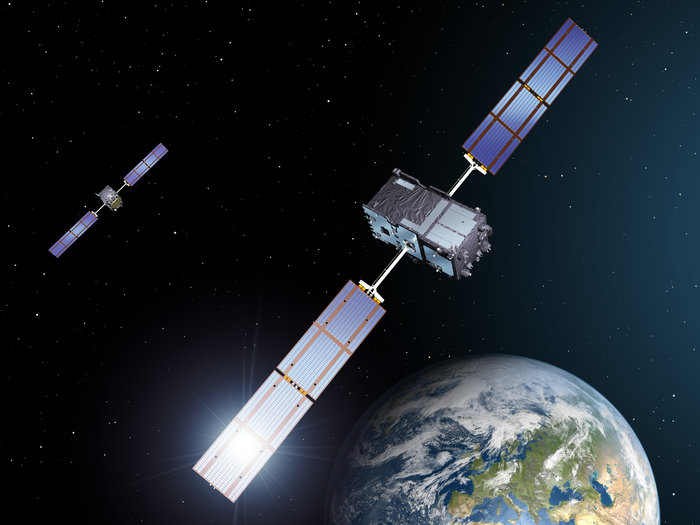
    Artist’s concept of Galileo IOVs in orbit.


  • Expert Advice: EPIC Happening — Europe’s PNT Industry Council

    John_Wilde-W
    John Wilde

    By John Wilde

    We have the United States GPS Industry Council, the Japan GPS Council, and the Korean GNSS Technology Council.

    Anything missing?

    The challenges facing the performance, navigation, and timing (PNT) community, which relies on GNSS amongst other things, are getting more numerous and complex, and Europe is the only major territory without a unified industry nexus where such challenges can be engaged. However, this is about to change.

    From my background and current activity as CEO of DW International, an independent navigation consultancy with a strong interest in GNSS specifically, I have begun forming the European PNT Industry Council (EPIC) with other industry leaders to act as a focal point for the PNT community’s concerns and to help coordinate the effort for standardization and harmonization. Additionally, with issues such as the LightSquared debacle looming, it is key that European stakeholders have a voice on the global stage.

    A recent survey that the nascent EPIC conducted jointly with Marketing Analytics highlighted the need for an organization such as EPIC. We asked key PNT figures around the globe about the issues concerning them and how these concerns should be addressed by EPIC. For such a diverse group of respondents (including representatives from state transport agencies, academic institutions, OEMs, independent consultancies, land survey companies, maritime, and aviation) there was clear agreement on the need for a European focal point for PNT to better facilitate interoperability and harmonization of standards among the current PNT activities being undertaken around the world. Sixty-six percent of respondents wanted an international forum for information exchange (that is, ideas, best practices, and lessons learned) where such issues as interoperability and harmonization could be addressed.

    Sixty-three percent rated system-level PNT policy issues as a very important subject area for EPIC, while 56 percent rated standards for PNT in areas such as aviation, rail, and E112 as being very important. There is no shortage of issues to tackle, and EPIC will prove to be a key player in forming the coalitions required.

    As one respondent put it, when asked about his priorities regarding PNT policy:

    • Galileo launch schedule;
    • Compass CPII and CPIII signal details and operational plans;
    • Information about GLONASS L3 and GLONASS CDMA plans, particularly ICD and frequency of planned L1 CDMA signal;
    • SBAS plans, such as EGNOS and GAGAN;
    • European regulatory plans that relate to navigation and positioning; E112, road user charging, tracking and logistics;
    • Standards for navigation and positioning applications, plus applications that rely on a position.

    Whatever the appeal of a forum for the exchange of technical knowledge amongst professionals, it was also clear that respondents wanted EPIC to take action as well. One wrote:

    “EPIC needs to be outcome/results oriented and not turn into a talkfest. Therefore issues such as LightSquared need to be addressed head on so that bureaucrats start listening to the science behind decisions and policies rather than commercially driven for short-term political expediency.”

    Indeed, EPIC joined the chorus of organizations writing directly to the FCC calling for a rethink of the LightSquared issue.

    I personally believe that with the industry councils active in the United States and Asia, EPIC is the third leg of the stool. PNT is such a dynamic world, with so many moving parts, that even large international organizations risk being left behind unless their interests are represented and the information they need is available in a consistent and practical fashion.

    But more than that, PNT is a utility that needs to be protected, maintained, enhanced, and utilized. EPIC will ensure that those who want to, can.

    The need is there. The stakeholders are there. It’s happening.

  • Microtechnology Comes of Age

    By Andrei M. Shkel, Defense Advanced Research Projects Agency (DARPA)

    The aggregated DARPA Microtechnology for Positioning, Navigation, and Timing (micro-PNT) program is pursuing a new wave of innovation focused on bringing to life revolutionary ideas and fabrication technologies on micro/nano/pico/femto/atto scales, packaging, ultra-low-power electronics, innovative algorithms, never-before-explored architectures, and exploitation of new integration paradigms.

    After about two decades of harmonic investment in developments, potential users of so-called small technology for positioning, navigation, and timing (PNT) applications increasingly ask, “Are we there yet?” Clearly, some significant advances have been made, and we see a footprint of the technology in an ever-growing consumer electronics market full of interactive products enabled by inertial and timing microtechnologies. These products include accelerometers for gaming applications, gyros for auto safety, resonators for clocks, and more.

    The question remains, however: Is the technology really on the level of what we consider to be precision navigation and timing, that is, is it capable of achieving an accuracy level of at least 10 meters in position and 1 nanosecond in time throughout the entire duration of missions that may range from minutes to hours to days? In reality, small technology remains several orders of magnitude short with respect to long-term stability, dynamic range, and accuracy compared to conventional technology, which is already known to perform adequately for many military applications.

    Why does making inertial instruments and clocks small necessarily lead to degradation in performance?

    We don’t yet have a complete answer to this question, and we are still working hard to disprove the contention that high-performance inertial micro-instrument is a contradiction in terms. We can make things small, but we cannot yet make them sufficiently precise and uniform; the accuracy of lithography-based manufacturing is on the order of 10–2–10–3 (the ratio of the average defect to the smallest feature size), while the accuracy of conventional manufacturing utilizing precision machining is two to three orders of magnitude higher, on the order of 10–5. We know we can deposit materials layer-by-layer with high precision, but we cannot make micro-devices truly 3D, as is readily achievable using conventional machining. We consistently have an excellent case for low-cost and bulk fabrication, but we cannot seriously challenge so-called boutique processes when it comes to achieving precision, structural complexity, and long-term stability.

    We need new knowledge regarding the dimensional stability of materials. We also need a better understanding of material scaling, surface effects, energy-loss mechanisms, and the consequences of fabrication imperfections on the performance of micro-instruments.

    PNT applications demand both unusual new fabrication technologies and new materials with special properties. To achieve the required phenomenal accuracy for precision navigation and timing, we need a new wave of innovation in design and refinement of many existing transducers. Future breakthroughs in microtechnology for PNT will likely rely on yet-to-be-exploited physics, new materials, highly specialized fabrication technologies and batch assembly techniques, selective wafer-level trimming and polishing, a combination of passive and active calibration techniques strategically implemented right on-chip, and introduction of innovative test technologies.

    Need for Advanced Capabilities

    PNT technology usage has doubled every five years since 1960, mostly due to GPS and the miniaturization of electromechanical components. Future PNT usage is expected to double every two years as a result of telecommunication, automobile navigation, robotics, and other commercial markets inserting micro-electromechanical systems (MEMS) technologies. The modern PNT paradigm is based on the assumption that space-based GPS is accessible most of the time to provide position, velocity, and timing information, enabling every user to operate on the same reference system and timing standard.

    Today’s military systems increasingly rely on GPS, creating a potential vulnerability for U.S. and allied war-fighters should GPS be degraded or denied. When GPS is inaccessible, critical information with respect to position, orientation, and timing can only be gathered through self-contained onboard instruments: a local clock and two triads of inertial sensors (three accelerometers for position and three gyroscopes for orientation). The ideal solution would be a self-sufficient instrument not relying on any external information. Precision microscale clocks and inertial sensors are required to address the paradigm of self-contained PNT.

    Clocks. Position and time have a relationship important to a broad spectrum of military applications, including communication systems that feature efficient spectrum utilization, resistance to jamming, high-speed signal acquisition, and an increase in the period of autonomous operation. Other important applications include surveillance, navigation, missile guidance, secure communications, identification friend-or-foe, and electronic warfare.

    The emerging applications require new compact time-distribution systems technologies capable of achieving signal phase (time) common synchronization of better than 10–9 seconds relative to the Coordinated Universal Time (UTC) standard; intersystem synchronization of less than 10–8 seconds relative to battle group; and less than 10–9 seconds for interoperability, surveillance, and high-speed communications. Solid-state and atomic oscillators are the key components enabling time and frequency distribution for communication, navigation, and command and control systems.

    To support emerging applications, we are interested in clocks with

    • signal phase (time) communication synchronization less (better) than 28 nanoseconds (ns) within 5 minutes (real time), UTC;
    • intersystem synchronization less (better) than 28 ns relative to other system nodes within 5 minutes (real time); and
    • local navigation/communication systems capable of time transfer less (better) than 28 ns, UTC.

    The operational frequency mismatch (δf=f), where f is a nominal frequency and δf is a frequency deviation from the nominal, is a measure of oscillator quality and subsequently the quality of the frequency distribution system. Different applications can tolerate different levels of frequency mismatches. For example, for low-accuracy aircraft/land mobile platforms, the requirement for frequency mismatch is 10–12, while for intermediate land reference sites the requirement is an order of magnitude smaller, 10–13. For large time-division multiple-access (TDMA) systems, the tolerable frequency mismatch is on the order of 10–11.

    Small size, weight, and power (SWaP) are critical metrics for portable time and frequency distribution systems. The target performance characteristic for low-power clocks and oscillators is long-term stability (aging), which need to be less than 10–11/month, with less than 1 W power consumption. It is desirable that the oscillators have small SWaP and preserve the level of long-term stability while surviving an inertial environment with accelerations on the level 10,000 g, where g is the gravity constant.

    For comparison, the one-way satellite transmission from a GPS satellite in common view at two sites allows one to do accurate time transfer to within 10 ns, with a potential to achieve accurate time transfer of the order of 1 ns. Achieving an accuracy of time transfer on the level of 1 ns is loosely defined as precision timing.

    Inertial Navigation Systems. The navigation-grade performance provided by inertial sensors is defined as an INS that accumulates an uncertainty in location not greater than one nautical mile (nmi), or 1.852 km, after one hour of navigation. The error in position is historically defined by the circular error probable (CEP) of 50 percent. The ability to achieve a CEP of 1 nmi in one hour (or 1 nmi/hour) does not translate to a unique performance requirement for a gyroscope and/or an accelerometer. Rather, it presents a trade-off in the overall inertial measurement unit (IMU) error budget. The trades can be generated within a family of gyroscope errors, such as gyro angle random walk (ARW) versus bias drift, or similarly within a family of accelerometer errors. For example, an IMU with gyroscope bias drift of 0.01º/hour combined with an accelerometer bias drift of 25 μg would guarantee a CEP of less than 1 nmi/hour, if no other errors are present. To generate the trade-off space for component performance, one efficient approach is to first generate the parameter space at the linear error covariance level, taking into account the bias drift of components, and subsequently perform  more extensive modeling in a bounded trade-off space by a nonlinear Monte Carlo simulation.

    The ability to navigate and keep precise timing has been an important factor in defining the military and economic power of nations for at least a millennium. For almost a century, the development of high-performance inertial instruments has been an extensive area of research. It is anticipated that the following level of performance will soon be achieved, significantly reducing navigation errors and enhancing military capabilities, within the next 5 to 10 years:

    • < 0.1 nmi/hour CEP for aircraft, vehicle, or spacecraft for attitude, guidance, and control;
    • < 1.0 nmi in 30 hours for ships;
    • < 0.4 nmi/hour CEP for missiles.

    It is critical that future-generation INS systems be capable of operating through shock levels greater than 1,000 g.

    Similar to clocks, the reduction of SWaP and cost (SWaP+C), while not compromising in performance, are the critical metrics for future development of IMUs. The current performance of state-of-the-art MEMS-based IMUs is on the level of tactical grade, with CEP approaching 100 nmi/hour. There is a great potential for achieving performance improvements that will subsequently enable platforms for personal navigation, precision navigation of small unmanned aerial vehicles (UAVs), unmanned underwater vehicles (UUVs), and GPS-free navigators for missiles. It is expected that the performance levels of chip-scale inertial instruments and clocks, shown in Table 1, could be achieved within the next 5 to 10 years, thus significantly enhancing military capabilities. The conservative estimations are projected by the Department of Defense’s Science and Technology List for Positioning Navigation and Timing. The aggressive estimates presume successful completion of the micro-PNT program described here.

    The military has access to a currently specified accuracy of 21 meters (95 percent probability) from the GPS Precise Positioning Service (PPS). Accuracy can be improved after calibration for some of the GPS errors, for example, by utilizing optimal estimation techniques correlating GPS and INS signals. A CEP of less than 10 meters has been routinely achieved, with a potential to achieve accurate positioning on the order of 1 meter CEP.

    Navigation, guidance, and automatic control are not the only military applications that could benefit from improvements in inertial sensors. Azimuth or north-pointing determination systems include celestial devices, magnetic compasses, and inertial sensors. Utilization of gyroscopes to precisely determine orientation has a number of benefits attributed to their immunity to magnetic fields, speed of acquisition, and potentially small SWaP+C. For this purpose, a variety of inertial equipment is being explored, including IMUs, attitude-heading reference systems (AHRS), and gyro-compasses. Providing an azimuth or north-pointing accuracy of less (better) than 0.5 arc minute multiplied by secant latitude has the potential to significantly enhance military capabilities for many targeting applications, especially for anticipated mobile platforms.

    Current Research

    This section provides an overview of the ongoing efforts funded by DARPA (Defense Advanced Research Projects Agency) under the micro-PNT program.

    Clocks. The potential payoff of the precision-clock technology developed by the program will enable ultra-miniaturized and ultra-low power absolute time and frequency references for applications such as nano/pico satellite systems, UUVs, UAVs, wristwatch-size high-security UHF communicators, and jam-resistant GPS receivers.

    There are currently two efforts within the micro-PNT program involving the development of clocks: Chip-Scale Atomic Clock (CSAC) and Integrated Micro Primary Atomic Clock Technology (IMPACT).

    The goal of the CSAC effort is to create ultra-miniaturized, low-power, atomic time and frequency reference units that will achieve, relative to present approaches: more than 200× reduction in size (from 230 cm3 to <1 cm3); more than 300× reduction in power consumption (from 10 W to less than 30 mW); and matching performance (1 × 10–11 accuracy and 1 ns/day stability). This work, funded by DARPA since 2002, has been supporting 11 teams. The program is currently in its final phase and supports two performers, Symmetricom and Teledyne Scientific. Symmetricom has already demonstrated pilot units that are 1 cm3 in volume, consume on the order of 100 mW of power, and perform on the level of better than 30 × 10–11 short-term 1 sec instability (Allan Deviation) and 5 × 10–11/day (1.4 × 10⁻¹⁰/month) long-term frequency drift.

    The IMPACT program seeks to improve the stability and accuracy of microscale atomic clocks by as much as two orders of magnitude. Atomic-clock performance is affected by buffer gases (nitrogen or argon), which are necessarily present in either rubidium- or cesium-based atomic clocks. Buffer gas atoms interact with alkali atoms and effectively shift the resonant frequency of atoms. Emerging atomic-clock technologies based on laser-cooled atoms and trapped ions could overcome the limitations of CSAC.

    The goal of IMPACT is to create miniaturized, low-power, integrated micro primary atomic clock technology that will achieve significant reduction in size relative to conventional clocks, but slightly larger than CSAC (volume less than 5 cm3 in final package, excluding battery); significant reduction in power relative to conventional clocks, but slightly greater than CSAC (50 mW); and two orders of magnitude increase in performance relative to CSAC (frequency accuracy 1 × 10–13, Allan deviation at one-hour integration time, and stability characterized by 5 ns/day time loss). The work, funded by DARPA since 2008, currently involves four teams: Honeywell, Symmetricom, Sandia National Laboratories, and OE Waves.

    The overall approach is based on sampling of atomic transitions at extremely low temperatures, requiring vacuum on the level of 10–9 Torr and the ability to trap atoms in a small volume. The technology has been previously demonstrated on a large scale, but transferring the technology to small scale is far from trivial, requiring major innovations. The effort has already demonstrated magneto-optical trapping in a 16 cm3 atomic cell, and chip-scale clocks implemented using cold atoms performing on the level, quality factor × signal/noise ratio ∼ 2.6 × 10¹⁰, time loss after 1 ms equal to 10–4 ns; after 1 second, 6 × 10⁻³ ns; after 1 hour, less than 10 ns; and after 24 hours, on the order of 100 ns. Frequency retrace was demonstrated at the end of the phase on the level of 10–11.

    Inertial Sensors and Systems. There are currently three efforts within the micro-PNT program involving the development of inertial sensors and systems: Navigation-Grade Integrated Micro Gyroscopes (NGIMG), Micro Inertial Navigation Technology (MINT), and Information Tethered Micro Automated Rotary Stages (IT-MARS).

    The NGIMG effort seeks to develop tiny, low-power, rotation-rate sensors capable of achieving performance commensurate with requirements for GPS-denied navigation of small platforms, including individual soldiers, unmanned (micro) air vehicles, unmanned underwater vehicles, and even tiny (for example, insect-sized) robots. By harnessing the advantages of microscale miniaturization, the NGIMG effort is expected to yield tiny (if not chip-scale) gyroscopes with navigation-grade performance characteristics: overall size less than 1 cm3 (no power source), power consumption less than 5 mW, ARW less than 0.001°/√hour, bias drift less than 0.01°/hour, scale factor stability on the order of 50 parts per million (ppm), full-scale range greater than 500°/sec, and bandwidth on the order of 300 Hz.

    The NGIMG effort has been funded by DARPA since 2005, and work is currently being conducted by three teams: Northrop Grumman, Boeing, and Archangel Systems. The work has demonstrated several experimental prototypes (some, but not all, independently verified by the government) performing on the level of ARW 0.01°/√hour,  and bias drift 0.05°/hour.

    The MINT effort seeks to develop microscale low-power navigation sensors that allow long-term (hours to days) precision navigation in GPS-denied environments. The goal is to create high-precision, navigation-aiding sensors that directly measure intermediate inertial variables, such as velocity and distance, to mitigate the error growth encountered by integrating signals from accelerometers and gyroscopes alone. In addition to aiding sensors such as velocity sensors, the combination of microscale inertial sensors will be integrated to a form-factor of one or two integrated circuits. Such an integrated sensor suite will be incorporated into the sole of a shoe for accurate and precise velocity sensing using zero-velocity events during walking.

    The final goal of MINT is to achieve an overall package and form-factor for a velocity sensor (excluding IMU) of less than 1 cm3, power consumption for the velocity sensor of less than 5 mW, 1-meter position accuracy after 36 hours of walking, and 10 µmeter/second velocity sensing bias per step. The effort has been funded by DARPA since 2008 and involves work by four teams: Carnegie Mellon University, Analog Devices, Northrop Grumman, and Case Western Reserve University/University of Utah. To date, the work has demonstrated positioning error on the order of 4 meters after 30 minutes of walking.

    The goal of the IT-MARS program is to implement and demonstrate a MEMS-fabricated rotary stage providing a rotational degree of freedom to planar MEMS structures and sensors, thus enabling free rotation of micro-structures and micro-sensors relative to the package, with coupled power and signal transfer from the rotating platform to the package. The IT-MARS effort may enable highly accurate calibration of inertial sensors and serve as a micro-platform for carouseling of inertial sensors that further enable on-chip calibration and gyro compassing. The ultimate program goal is to achieve an overall volume of no more than 1 cm3, power consumption for actuation on the order of 10 mW, angle position absolute accuracy to within 1 milli-degree, maximum wobble of 10 micro-radians, a rotation rate of 360°/second, and reliability (run time of rotor) greater than 104 hours.

    This effort, which has been funded by DARPA since 2009, supports three teams: UCLA, UC-Berkeley, and the Boyce Thompson Institute. The work has already demonstrated free rotated platforms, and future efforts will focus on manufacturability and precision control of the stage-rotation and reduction of wobbling.

    New Initiatives

    In January 2010, DARPA launched a coordinated effort focused on the development of microtechnology specifically addressing the challenges associated with miniaturization of high-precision clocks and inertial instruments. The new program, Microtechnology for Positioning, Navigation, and Timing (micro-PNT), aggregated the existing efforts (CSAC, IMPACT, NGIMG, MINT, and IT-MARS) and initiated four complementary new developments:

    • Microscale Rate Integrating Gyroscopes (MRIG),
    • Chip-Scale Timing and Inertial Measurement Unit (TIMU),
    • Primary and Secondary Calibration on Active  Layer (PASCAL),
    • Platform for Acquisition, Logging, and Analysis of Devices for Inertial Navigation & Timing (PALADIN&T).

    The overall goal of the new aggregated micro-PNT program is to focus all of these complementary efforts toward achieving one specific overarching goal: self-contained chip-scale inertial navigation (see opening illustration). The reduction of SWaP+C of IMUs and timing units (TUs) is the technological objective. The developments consider a number of operational scenarios, ranging from dismounted-soldier navigation to navigation, guidance, and control (NGC) of UAVs/UUVs and guided missiles. The new micro-PNT initiatives will increase the dynamic range of inertial sensors, addressed by the new MRIG effort; reduce the long-term drift in clocks and inertial sensors, addressed by the PASCAL work; develop ultra-small chips providing position, orientation, and time information, addressed by the TIMU effort; and provide a universal and flexible platform for the testing and evaluation of components developed within the comprehensive micro-PNT program, addressed by the PALADIN&T effort.

    The primary goal of MRIG is to create a vibratory gyroscope that can be instrumented to measure the angle of rotation directly, thereby extending the dynamic range and eliminating the need for integrating the angular rate information; MRIG will thus eliminate the accumulation of errors due to numerical/electronic integration.

    The final goals are to:

    • extend the dynamic range to 15,000°/second;
    • achieve drift repeatability on the level of 0.1°/hour (angle dependent) and 0.01°/hour (bias-dependent) under variable –55°C to 85°C thermal conditions;
    • achieve ARW of 0.001°/√hour, an operation range of 1,000 g with acceleration sensitivity of 10–5 degrees/hour/g, vi
      bration sensitivity angle random walk of 0.01°/√hour per g/√Hz, and drift rate of 0.01°/hour per g2/√Hz.

    These performance characteristics are thought to be achievable through development of precision 3-D fabrication technologies utilizing high-Q materials; development of wafer-level balancing and trimming techniques that reduce the effects of aniso-inertia (mass misbalance), aniso- compliance (stiffness misbalance), and aniso-damping (damping misbalance); and development of active control and an active calibration architecture.

    These performers have been selected for the initial phase of the MRIG effort: Draper Labs, Honeywell, Northrop Grumman, Systron Donner, UC-Irvine, UC-Davis, UCLA, Cornell, University of Michigan, and Yale University.

    The TIMU effort will address challenges associated with the development of a miniature (10 mm3), low-power (200 mW), high-performance (CEP on the order of 1 nmi/hour), and self-sufficient navigation system on-a-chip. The smallest state-of-the-art IMUs perform on the level of tactical-grade instruments (CEP on the order of 100 nmi/hour) and are about the size of an apple (more than 104 mm3). This effort intends to develop a technological foundation for a navigation-grade TIMU (CEP less than 1 nmi/hour and time accuracy of 1 nanosecond/minute) with a significant reduction in SWaP, potentially miniaturizing the TIMU to the size of an apple seed (10 mm3).

    PASCAL will develop self-calibration technologies intended to eliminate long-term bias drift of inertial sensor and clocks. The grand challenge of this effort is to raise long-term bias stability to the level of 1 ppm.

    This level of stability represents a two-orders-of-magnitude improvement compared to state-of-the-art inertial microsensors, currently at 200 ppm. The work will investigate an approach for fabricating sensors on an active layer that may serve as a calibration layer for micro-PNT systems.

    The PALADIN&T effort will develop a universal platform for test and evaluation of early prototypes developed in the micro-PNT program. The effort will also simplify the uniform evaluation of pilot prototypes within the program and provide an early field demonstration, advancing the technology readiness level.

    Conclusions

    Current state-of-the-art microscale clocks and inertial instruments can provide the required level of precision only for missions having a duration of no more than about one minute. The micro-PNT program at DARPA is developing small SWaP+C inertial sensors for a variety of operational scenarios for missions ranging from minutes to hours. Current projects (CSAC, IMPACT, NGIMG, MINT, IT-MARS) mainly focus on navigation, characterized as missions of prolonged durations in relatively benign environments (a few hours of operation on a platform moving at relatively low speed, less than 100 km/hour).

    The new initiatives (MRIG, TIMU, PASCAL, and PALADIN&T) target the challenges of missile guidance for precision engagement scenarios, short duration missions in highly dynamic environments (10 seconds to 3 minutes of operation at speeds of 1,000 km/hour and higher). Ongoing efforts and new initiatives explore new physical phenomena, high-quality factor materials, specialized fabrication technologies, and innovative approaches to system integration.

    Disclaimer. The views, opinions, and findings in this article are those of the author and should not be interpreted as representing official views or policies, either expressed or implied, of the Defense Advanced Research Projects Agency or the Department of Defense. The document GPS0911 [DISTAR case 17952] is approved for public release, distribution unlimited.


    Andrei M. Shkel received a Ph.D. in mechanical engineering from the University of Wisconsin-Madison and is a program manager in the Microsystems Technology Office at the Defense Advanced Research Project Agency (DARPA), and on-leave professor of mechanical and aerospace engineering at University of California, Irvine, where he is also the director of the UCI Microsystems Laboratory. He holds 15 U.S. and international patents (12 pending) on micromachined angle-measuring gyroscopes, wide-bandwidth rate gyroscopes, light manipulators and tunable optical filters, and hybrid micromachining processes.

  • Availability and Safety

    Many maritime users today believe that GPS will always be available. This is simply not the case.

    By Alan Grant, Paul Williams, George Shaw, Michelle De Voy, and Nick Ward, The General Lighthouse Authorities of the United Kingdom and Ireland

    GNSS availability can be affected in many ways, through events or conditions that affect constellation health, the signal-in-space, or the reception of that signal. The primary means of positioning, navigation, and timing (PNT) employed in maritime applications, whether stand-alone or augmented, has well known vulnerabilities.

    This article considers three specific threats and reports on how they may affect maritime safety: GNSS interference and jamming; constellation availability; and space weather events.

    Interference and Jamming

    There has been a marked increase in both the use and the availability of GPS jamming equipment in recent years. The implications are that jamming units may find their way onto ferries and around ports or harbors where they will interfere with the many systems utilizing GPS, thus affecting maritime safety.

    GPS jamming units are widely available on the Internet, with current models already capable of jamming L1, L2, and L5 signals. While we report here on the jamming of GPS, all GNSS constellations would be affected in a similar manner.

    To understand the effects of jamming and GPS service denial on maritime safety, the General Lighthouse Authorities of the United Kingdom and Ireland (GLAs) conducted two jamming trials, in collaboration with the UK Government’s Ministry of Defence (MOD), who provided and operated the GPS jamming units. For the safety of all GPS users, and in line with MOD regulations for the peacetime use of GPS jamming units, notice was given to all national bodies. In addition, the GLAs issued notices to mariners explaining that aids to navigation (AtoNs) using GPS in the vicinity of the trials location would be unreliable during the jamming periods.

    Flamborough Head. The first jamming trial was conducted off the East coast of the United Kingdom near Flamborough Head. The aim of this trial was to understand the effect GPS jamming may have on ship-borne and shore-based equipment, GLA AtoNs, and also on the crew.

    The Northern Lighthouse Board vessel Pole Star steamed between two known waypoints, through an area affected by the jamming signal. Data was recorded from two typical marine-grade GPS receivers installed on the vessel, along with an eLoran receiver that provided the true position throughout the trial.

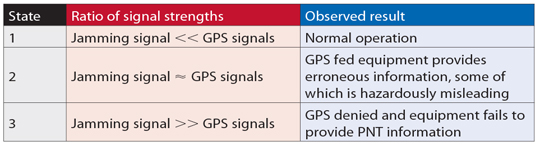
    The results identified three distinct states (Table 1) corresponding to the manner in which GPS-fed equipment responded to jamming conditions. When the jamming signal was sufficiently strong to prevent reception of GPS signals, a large number of alarms sounded on the bridge almost simultaneously, providing a potentially disconcerting and confusing environment for the mariner. However, the effect that represented the highest risk was the provision of erroneous data from some GPS receivers.

    Table1 Source: Alan Grant, Paul Williams, George Shaw, Michelle De Voy, and Nick Ward, The General Lighthouse Authorities of the United Kingdom and Ireland
    Table 1. Effects observed for the three states identified from Flamborough Head trials.

    Figure 1 compares an erroneous position reported by a typical marine-grade GPS receiver with the vessel’s true location. In this figure, the light blue line shows the path taken between the two waypoints.

    The colors of the plotted position points indicate vessel speed. The three states described in Table 1 can be seen.

    State 1 is observed at either end of the passage where the solid blue line occurs; this is where the jamming signal strength is much lower than the GPS signal strength, and the GPS-fed systems are operating normally.

    As the vessel approached the main lobe of the jamming signal, indicated by the red lines, it reached an area where the jamming signal was comparable with the received GPS signals, leading to State 2. During this state, erroneous data can be observed with the receiver reporting the vessel on land traveling at high speed.

    As the vessel entered the main lobe of the jamming signal, State 3 was observed: the GPS signals were swamped by the jamming signal, and the receivers failed to provide an output. Then, as the vessel continued the passage out of the jamming area, one can observe the change in states as the ratios of jamming to GPS satellite signals decrease, and GPS is reacquired.

    In the worst case, the GPS receiver reported a position some 22 kilometers  away from the true location. The GPS receiver nevertheless declared the position valid. This position was made worse by the fact it was reported inland at a speed of more than 100 knots, while the trial vessel steamed steadily at 10 knots. Depending on how the resulting GPS positioning data is used, it could feasibly result in vessels changing course, through the use of an autopilot, and it could also affect the vessel’s reported position to the outside world. This would then not only affect the vessel’s situational awareness but also the situational awareness of vessels in the vicinity.

    The errors observed in Figure 1 were also seen on the vessel equipment fed by the onboard GPS receivers. Erroneous positions were observed on the vessel’s electronic chart display and information system (ECDIS), on the automatic identification system (AIS) positions (where loss of position prevents the unit from calculating a range or bearing to nearby vessels, greatly affecting the crew’s situational awareness), and on the vessel’s radar (Figure 2).

    The results observed during these trials gave an important example of what can happen to onboard equipment as well as the impact it can have on the mariner during periods of GPS jamming and service denial. It is clear that GPS denial caused by jamming can not only prevent PNT information from being calculated, it can also result in erroneous data being presented to the mariner.

    Newcastle. A second series of demonstrations was conducted off Newcastle-upon-Tyne, on the North East coast of England, to communicate the importance of resilient PNT to a selected audience. The audience included a number of key decision-makers from European and UK governments, maritime industry, mariners, and other aids-to-navigation service providers. The demonstrations took place onboard the Trinity House vessel Galatea.

    For this trial, the GPS jamming unit was installed onboard the Galatea and configured to jam GPS within a small
    area around the vessel. As before, two typical marine-grade GPS receivers were installed along with an eLoran receiver; for this trial, a modified electronic chart display was also installed and altered to enable two position inputs to be displayed at the same time, to compare the reported GPS and eLoran positions in real-time.

    Throughout the demonstrations differential Loran (dLoran) corrections were provided using a transportable reference station installed on the shore at South Shields, to mitigate the impact of temporal variations on the eLoran position. Differential-Loran corrections were generated by the reference station and sent to the GLAs’ eLoran transmitter in Cumbria for inclusion in the eLoran Loran Data Channel (LDC) broadcast. The eLoran receiver on the vessel received the broadcast and was able to extract and apply the corrections in order to obtain an eLoran position within 9 meters (95 percent).

    One demonstration scenario showed the sudden effect of a strong jamming signal, designed to simulate a jamming unit being brought onto a ferry or other vessel. This took the vessel’s equipment directly to State 3: complete loss of GPS information with a large number of alarms sounding on the bridge. The loss of GPS data prevented the Galatea’s AIS and VHF units, among other systems, from operating correctly.

    Before the second scenario was conducted, the jamming unit was stopped, and all of the GPS receivers integrated into the bridge equipment were allowed to reacquire satellites and fully recover. The second scenario was designed to reflect a vessel steaming towards a jamming source. The field strength of the jamming signal was slowly increased until State 2 was observed, with erroneous and often hazardously misleading information reported.

    As with the Flamborough trials, erroneous GPS positions reporting unfeasibly high speeds were observed as shown in  the OPENING Figure. However, significantly more subtle errors were seen: errors where the vessel’s reported position differed only very slightly from the true location and wandered around slowly. These subtle changes produce believable positions but hazardously misleading information (HMI). While the overall result of GPS jamming on Galatea was consistent with that observed on Pole Star, there were a few marked exceptions.

    The effect of GPS jamming can be seen (Figure 3) on the erroneous positions reported by the trial vessel NLB Pole Star (center right) and also on the vessel Dutch Progress (top left).

    The ECDIS onboard the Pole Star reported erroneous positions and ultimately failed with the complete denial of GPS. However the ECDIS on the Galatea continued to track the vessel’s position due to an additional position feed from the vessel’s gyro, making it more resilient to jamming, but only in the short term until the gyro requires re-calibration. This is carried out with its built-in GPS receiver! In addition, the AIS transceiver on the Pole Star reported the vessel’s position erroneously due to jamming, and this was observed at shore-based traffic monitoring stations.

    During the demonstrations on the Galatea, the AIS transceiver did not provide any erroneous position information, as can be seen in Figure 4. These differences show that the impact of GPS jamming will be different for each vessel and depends on the model, installation, and configuration of the onboard systems.

    Effect of Jamming on Safe Navigation

    To navigate safely, the mariner needs reliable, clear and trusted information about where the ship is and what is going on around it, so that any threat can be located and identified. While consideration is often given to threats such as areas of shallow water, obstacles, or other vessels; consideration is not generally given to the loss of positional information, timing, or situational awareness.

    Loss of GPS-derived PNT information at sea results in the loss of the vessel’s ECDIS, AIS, GPS, and DGPS receivers, preventing the mariner from being able to position the ship and others around it through what are nowadays regarded as the normal means. In addition, the systems one would normally expect to be independent from GPS, and as such available for use in GPS-denied conditions, are also affected; namely the vessel’s radar and gyro-compass.

    The radar takes a GPS input to provide a “North-up” setting and the gyro-compass uses GPS to stabilize drift error. Under GPS-denial conditions these units also enter an alarm state and should not therefore be used in that condition.

    Clearly GPS jamming can significantly affect the safety of mariners. From these trials it can be seen that the extent of the impact varies from vessel to vessel depending on the equipment installed and the configuration selected.

    Satellite Constellation. From the users’ perspective, GNSS availability is the percentage of time they can receive usable data from sufficient satellites in order to calculate their position. The reduction in the number of available satellites in the constellation will have a direct impact on the system’s availability.

    A report from the U.S. Government Accountability Office (GAO) in 2009 predicted “significant challenges in sustaining and upgrading widely used [GPS] capabilities” due to delays in launching modernized GPS satellites. The GAO reported the probability of maintaining a constellation of at least 24 usable GPS satellites could reduce to 80 percent or less by 2011, and not return to 95 percent probability consistently until 2015. This could lead to reduced satellite numbers causing coverage “windows” where less than four satellites could be observed and as such reduced GPS availability.

    A later report by the GAO indicates that the probability of maintaining a constellation of at least 24 operational GPS satellites is now expected to be 95 percent for the foreseeable future. This figure is based on the current launch schedule, and although the U.S. Air Force Space Command (AFSPC) has provided reassurances, the satellite launch program has in recent years experienced delays, and therefore the risk of reduced satellite availability still remains.

    Following the 2009 report, the GLAs commissioned a study to investigate the impact a reduced GPS constellation would have on users in their waters. This study was conducted by the GNSS Research and Applications Centre of Excellence (GRACE) and was split into two parts. The first part was to analyze the impact theoretically and found that with a 21-satellite constellation, GPS coverage “windows” (for example, fewer than four satellites) could last for several minutes and cover a large proportion of the UK and Ireland (Figure 5). This can cause reduced GPS availability and therefore increased likelihood of position errors affecting maritime safety.

    The second part of the study investigated the effects further through a dynamic simulation, investigating the effects should a vessel be position
    ed off the coast of Belfast during one of the coverage windows. For this a marine-grade GPS receiver and a simulator were used to observe the effects. The study found that the number of available satellites fell below four for several minutes and the reported position data from the receiver appeared to freeze for up to 10 minutes.

    If a mariner was traveling at a speed of 35 knots when the position input froze, his reported position would be in error by 10 kilometers from an outage lasting 10 minutes. These outages are significant, and mariners need to be informed of such risks to GPS (and GNSS in the future) before they occur, so they are prepared for any disruptions.

    Space Weather. Space-weather events are a particular concern to GNSS availability due to their random nature. It is known that GNSS signals are delayed proportionally to the number of free ions as they propagate through the Earth’s atmosphere enroute to the receiver. The amount of ions in the ionosphere, the total electron count (TEC), is dependant on time of day, latitude, and solar activity, among other factors. During high solar activity, the number of ions in the atmosphere is much higher than at any other time. The greater the signal delay, the larger the errors are in the satellite’s pseudo range and hence the position error can be significant.

    Variation in electron density along the GNSS signal path causes signal refraction that produces phase scintillation, introducing group delay that may cause large errors in the pseudorange measurement. Diffraction of the signal wave front induces amplitude scintillation — variations in signal amplitude — with strong fades possible, leading to a GNSS receiver losing signal tracking, and at worst the GNSS navigation solution may be lost.

    Solar activity is cyclical, peaking at a maximum approximately every 11 years, during which periods GNSS performance can be severely degraded, especially at equatorial, auroral and polar latitudes. The next solar maximum is predicted to occur during 2013.

    During quiescent periods of solar activity, ionospheric effects on GNSS can be managed such that the residual errors caused by the ionosphere do not generally pose a problem to maritime navigation performance.

    The GLAs’ DGPS corrections significantly reduce common mode errors, including the effects of the ionosphere. However, at the peak of the solar cycle with high levels of sunspot activity, solar storms and flares, the application of ionospheric models and differential corrections may be less effective, and this could increase position errors and introduce an integrity risk to maritime navigation.

    Maritime navigation systems and services that rely on GNSS are at greatest risk of disruption from the ionosphere during the period from 2011 to 2015. Even during a quiet solar maximum, the occurrence of individual sun spots could produce significant effects for discrete events. The effects vary with latitude, season, and time of day (the hours soon after sunset being most affected).

    Space weather events have the potential to affect GNSS availability, either by affecting the performance of the satellites themselves or by preventing signal reception.

    Mitigation. In general, a number of steps can be taken to help reduce the impact of these threats:

    • Increase awareness of GNSS vulnerabilities.
    • Detect incidents and warn the mariner when they occur.
    • Prevent incidents from occurring, where possible, through legislation and enforcement.
    • Reduce as much as possible the effects of incidents when they occur, through the hardening of GNSS technology.
    • Have alternative means of PNT, independent of GNSS.

    Understanding that these threats exist and knowing what disruption they may cause is the first step to mitigating their effects, but this does not stop them happening. Being able to identify that an event is occurring and that the data being received from the receiver may not be true is an important part of mitigating the effects.

    For jamming issues specifically, the use of GPS jamming units is illegal in the UK and Ireland; however, preventing them from being used is very difficult to achieve. Jamming units are small and easily hidden; however, port-side security and vessel security procedures should prevent jamming units from being used in these locations.

    It is a different case, however, to prevent a jamming unit from being used at a coastal location or headland due to the remote nature of these areas.

    Mitigating the effect of jamming can be achieved in a number of ways: by limiting the effect within the receiver by using anti-jamming techniques, or by hardening GNSS receivers. Ultimately the best mitigating activity is to not rely on GNSS PNT once the integrity of the data has been compromised.

    For space weather events or cases of reduced satellite numbers, there is very little action the mariner can take to remedy the problem or stop it happening. The mitigating action here is one of awareness — information forewarning the mariner that such a condition is imminent, for example.

    Monitoring and detection networks can assist in providing such notifications and real-time information on GNSS problems. The need for such a network across the UK and Ireland is the subject of a different GLA publication, but the GLAs support the discussion on a body to monitor GNSS performance and to take the lead in the dissemination of key information.

    For periods where GNSS availability has been affected by mutual interference, jamming, space weather events or constellation issues, the best mitigating action is to use PNT information from a second source, one with dissimilar failure modes.

    Mariners need to be prepared for GNSS failures and have access to PNT information through dissimilar systems. In addition, procedures covering what to do in the case of GNSS unavailability should also be provided and rehearsed. It is with this view that the GLAs firmly promote the use of all available means of navigation.

    Conclusions

    All three threats to GNSS availability reviewed here could affect maritime safety. The two trials observed presentation to the mariner of erroneous data, some of which could be considered hazardously misleading, along with the degradation of crews’ situational awareness. The main effects observed were:

    • The presentation of random errors leading to hazardously misleading information that could, depending on installation, cause a vessel to move off course.
    • The presentation of erroneous and potentially misleading data to other vessels and shore-based infrastructure.
    • The sheer number of alarms on the bridge of the vessel could be disconcerting and distracting for the mariner.
    • The loss of GPS-fed systems, which can create an unfamiliar bridge situation and remove safety-critical systems from operation.
    • A large number of bridge systems are integrated with GPS and enter an alarm state during periods of GPS outage.

    The loss of GPS or a lack of integrity in the reported information leads to an unfamiliar situation on the bridge.

    The crews of the Pole Star and the Galatea were expecting to lose GPS, were well-trained, and had primed other systems so they could navigate safely. In real life, there would be no advance notice, and the impact on the crew would be more severe.

    The impact of low satellite numbers, as predicted in the 2008 GAO report, could produce poor constellation availability and a loss of PNT information for a considerable period of time. This could result in the same outcome as observed in the GPS jamming trials when entering State  3, where many systems on the bridge failed and entered an alarm condition.

    Space weather events are difficult to predict both in terms of when they may occur and their severity. Events could affe
    ct satellite positions, their operation, and the reception of their signals by the user, and are clearly a threat.

    The GLAs strongly support the need for a resilient PNT solution, one that could continue to provide reliable information during such threats for the safety and benefit of all mariners.

    Acknowledgment

    This article is based on a paper given at the Institute of Navigation’s 2011 International Technical Meeting.


    Alan Grant is a principal engineer for the Research and Radionavigation Directorate of the GLAs of the UK and Ireland, technical lead and project manager for all GNSS projects there. He has a Ph.D. from the University of Wales.

    Paul Williams is a principal development engineer with the Directorate and currently technical lead of the GLAs’ eLoran Work Programme. He has a Ph.D. in electronic engineering from the University of Wales.

    George Shaw is an engineer at the Directorate and holds a master’s degree in mathematics from the University of Cambridge.

    Michelle De Voy is a development engineer for the Directorate, with an MSc in oceanography from the University of Southampton and an MSc in satellite positioning from the University of Nottingham.

    Nick Ward is research director of the General Lighthouse Authorities of the UK and Ireland, with responsibility for strategy and planning of research and development.

  • Expert Advice: Exploring the Technologies Behind Location-Gate

    Feuerstein-200
    Marty Feuerstein

    By Marty Feuerstein

    For the past several months, controversy has raged over the revelation that Apple and Google tracked mobile subscriber location movements and stored that information in an unencrypted file on the handset, where it was potentially vulnerable to hacking and other inappropriate usage. The resulting Location-gate scandal highlights the sometimes tenuous control of mobile subscriber information versus the business objectives of dominant platform and applications providers. These business objectives may include immediate revenue opportunities from the subscriber being tracked or broader self-interest initiatives, such as collecting marketing data that may be valuable to third parties like advertisers, or building subscriber-reported Wi-Fi access point databases.

    Furthermore, while much has been written about the privacy impacts of the collection and use of consumer location information, few articles have clearly outlined the technologies behind Apple and Google’s tracking activities. It is important to fully explore and understand these technology methods, and how they differ from other location technologies in use, in order to properly evaluate the threat posed by Location-gate and to develop responses that maintain privacy while enabling the benefits of location-based services.

    Location, Tracking, and Storage

    iPhone and iPad subscribers had previously been aware that Apple tracked their location via GPS, because the company notified subscribers when an app required the use of GPS to identify location, and asked them to opt-in. However, soon after Location-gate erupted, Apple’s vice president of software technology, Bud Tribble, testified to Congress in May 2011 that Apple also had been tracking device locations over time using triangulation between nearby Wi-Fi access points and wireless base stations. Triangulation is the moderately accurate method in which the mobile device measures the nearby cell site or access point identifications and possibly signal strengths, typically pinpointing device location to within a few hundred meters.

    Following this revelation, Apple’s initial response was that “users are confused” and that it was simply “maintaining a database of Wi-Fi access points and cell towers around your current location…to help your iPhone rapidly and accurately calculate its location when requested.” Soon after Apple location tracking activity was revealed, it became known that Google was doing essentially the same thing, although to a slightly lesser degree (Android phones stored only the 50 most recent coordinate fixes and up to 200 Wi-Fi access-spot locations), and using a similar triangulation method without the subscriber’s explicit knowledge. Google Android devices also have GPS capability.

    Why, if both OS providers embedded or leveraged GPS in their phones, would they resort to a less accurate location method, triangulation?

    Neither company has provided an answer. We know that the triangulation method uses less battery power than GPS, conserving battery life for other uses while filling in performance holes for GPS in urban and indoor environments. Also, unlike with GPS, mobile subscribers are either not able to disable triangulation or must disable it separately. More relevant is the fact that triangulation allowed the OS providers to identify location automatically and track it over time in the background without the subscriber’s knowledge, for purposes such as building and maintaining a subscriber-reported database of Wi-Fi access points.

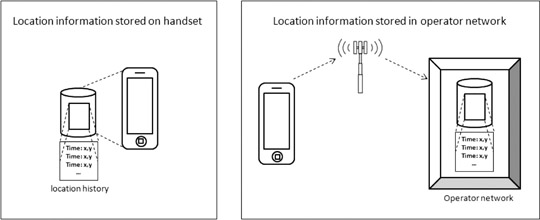
    From a privacy perspective, there is a dramatic difference between tracking someone’s location over time (the bread crumb trail that Apple and Google used), versus locating one’s position for a specific purpose and handling the location information only within the confines of a secure wireless network. Useful applications that are universally accepted, such as E911 for safety-of-life situations, employ the latter method.

    Other players in the mobile ecosystem, such as wireless network operators, have collected subscriber location information as well, but not by storing it in the device as historical files in the same way that Apple and Google did. Some information exists on the network side in association with billing records for calls (call detail records or CDRs), but this is not bread-crumb tracking of cell-IDs. E911 calls have records stored for use by public safety agencies, but most users never make an E911 call. Other messages containing coarse location may exist on a transitory basis (for example, location area updates), but these are not typically aggregated or stored for later processing.

    feurstein_figure-W
    Depictions of location information stored on handset and in operator network.

    Alternative Geo-Location Methods

    There exist location methods that provide far greater privacy and security than the location tracking and handset storage that Apple and Google have utilized. Standard methods exist for performing location using the wireless service provider’s network elements. These are called control-plane methods, which follow standards developed by 3rd Generation Partnership Project (3GPP) and 3GPP2. Other standard methods exist using IP transport from the client phone to a location server. These are called user-plane methods, such as the Secure User Plane Location (SUPL) standard from the Open Mobile Alliance (OMA). Both control- and user-plane location standards incorporate mechanisms for data security and user privacy. These standard control- and user-plane methods differ from the proprietary methods used by many client applications and OSs, which are inherently user-plane in nature but with non-standard implementations.

    Methods using a client application with handset-based location on the mobile device, also called user-plane methods, bypass the carrier’s wireless network elements and instead rely on an IP connection to transmit information from the client application to a server on the Internet. These user-plane location methods, such as client applications for handset-based A-GPS, as discussed, are already widely in use for location-based services. Handset applications are inherently vulnerable to hacking and privacy intrusions, as the recent spate of mobile viruses on Android has highlighted.

    A-GPS is highly accurate at identifying location in direct line-of-sight conditions with the satellites (open sky conditions), as found in suburban and rural areas, but performs less well in challenging dense urban and indoor environments. GPS in the phone can be easily disabled by the end user, and the receiver chip in the handset can cause significant battery consumption when used in demanding applications, such as navigation and monitoring geo-fences. A-GPS, as used by wireless network operators for navigation and other location-based services, does not usually store unencrypted files of historical location information in the handset, as Apple and Google did.

    Alternative, network-based, or control-plane, methods make use of the wireless services provider’s network elements to keep location information wholly behind the security of the operator’s firewall, employing highly standard protocols for security and privacy. Control plane location methods are used for today’s safety-of-life applications, like E911, where security and privacy are prime considerations.

    One example of a network-based location technology that can work in control-plane is RF pattern-matching (RFPM), which is the only high accuracy, software-based, scalable location solution that requires no additional hardware changes/additions to the mobile device or at the base stations. It compares mobile measurements (signal strengths, signal-to-interference ratios, time delays, and so on) against a geo-referenced database of the mobile operator’s radio environment. RFPM boasts a 100 percent security record for subscriber mobile location information it produces, for critical applications such as E911 emergency call and law enforcement location applications.

    Location information for growing consumer uses deserves the same privacy and security protections that other standards-compliant control-plane solutions provide for today’s mission-critical and safety-of-life location applications. RFPM works extremely well in non line-of-sight conditions such as dense urban and indoor environments, where GPS-based solutions face challenges. RFPM also offers low battery consumption and geo-fencing capabilities, which makes it ideal for providing location for the growing opportunity in location-based advertising and other location-based services (widely believed to be the true driver behind Apple and Google’s location tracking activities).

    As Location-gate clearly illustrates, there is no shortage of methods to identify and track one’s location via mobile device. Now that the issue has been raised, it is imperative that the entire mobile ecosystem — network operators, OS providers, regulators, and subscribers — clearly understand what methods are used, when one’s location is being identified and tracked, and what is being done with that data. Breadcrumb trails are useful if you’re trying to find your way out of the forest, but not if Big Brother is tracking you.


    Marty Feuerstein is chief technology officer of Polaris Wireless, where he leads research into new products, algorithms, system performance, and regulatory activities. He has a Ph.D. in electrical engineering from Virginia Tech.

  • Locata, A New Constellation: ICD and Live Demos at ION-GNSS 2011

    “GPS can no longer evolve fast enough. Satellite-based systems cannot maintain the speed of development now required for the hyper-fast evolutionary pace of modern applications and devices. For positioning for the future, it has become exceedingly clear that GPS now needs a terrestrial component.” — from a Locata Corporation prospectus

    A large number of companies and engineers have thrown billions of dollars at trying to improve GPS in urban and indoor applications,” states Locata Corporation co-founder Nunzio Gambale. “From a technological perspective, Locata has created something completely new: the capability to autonomously create a GPS-style system on the ground.”

    Members of the GNSS community can see for themselves at Locata’s coming-out party at ION-GNSS 2011, including release of a Locata signal interface control document (ICD). GPS World took an advance look at the technology in a June trial of the demo that all ION attendees can see. This article presents these reports, after an outline of the technology.

    The key to Locata’s positioning system is the signal generated by the Locata transceiver, or LocataLite, to synchronize its time to other LocataLites in a network. Locata creates a network that, according to the company, “is in almost perfect synchronization” without using atomic clocks. Each transmitter dynamically synchronizes with other Locata transmitters using a patented method called Time-Loc. Gambale says that a Locata network currently locks to about 2 nanoseconds.

    Each LocataLite base station has an uninterrupted range of approximately 10 kilometers, with indoor signal penetration similar to that of a mobile phone tower.

    The company emphasizes that its transceivers are not pseudolites, but devices that create TimeLoc synchronization, and thereby enable an autonomous synchronized network that, locally, looks like GPS. The local constellation is under local control, and can therefore be designed for deployment at any power, any frequency, or any density required by an application.

    The networks can scale easily. The term “local” can mean a room or warehouse (100s of m2), a campus or open-cut mine (10s of km2), an airport terminal area with approach and landing routes (100s of km2), or a wide area, range, or city (1,000s of km2)

    Gambale sees markets for Locata’s technology in defense, mining, emergency services, construction, and security. Locata is designed to integrate with existing GPS technology, as simply another constellation. This means an approprieate GPS-Locata receiver can use the satellite signal when outside the range of a Locata network. To a combined GPS-Locata chip, the LocataLite will appear as another satellite.

    The company sold its first Locata network in July 2005. Locata has signed partnership agreements of various kinds with Leica Geosystems and Newmont Corporation (mining), the U.S. Air Force, the Advanced Navigation Technology Center of the Air Force Institute of Technology, and several other firms under non-disclosure terms. There was an initial test deployment at Holloman Air Force Base in May 2008, as a truth reference system spanning a test area of about 52 by 15 kilometers.

    For high-multipath environments such as indoors and warehousing, the company’s latest development is a new antenna called a TimeTenna, which it will demonstrate at ION-GNSS.

    Future research and development will focus on the miniaturization of the Locata receiver. Work has begun on a combined GPS-GLONASS-Locata chip that can be integrated initially into professional and industrial devices, and eventually into consumer devices such as mobile phones.

    Locata plans to work with integrators only, not with end users, making the technology available to qualified partners developing receivers and applications. The ICD is the first step in Locata’s technology rollout.

    #2
    LocataLites awaiting boards. Each LocataLite transmits four PRN signals.

    A Long Time Coming

    Eric Gakstatter, Survey editor

    You may have heard the Locata name pop up over the past several years. It would be in the news, then back underground into stealth mode. About five years ago, I heard some interesting rumors about its technology but I decided not to take them seriously until I saw some real products.

    Two years ago, I sat down with Nunzio Gambale, Locata CEO, at the ION-GNSS conference. At last year’s ION, I talked with him again. At that point, I understood the potential impact of Locata’s technology — if it worked as advertised. I again told myself that before I spent more time on it, I wanted to see a product introduced to the market based on Locata technology. In January of this year, it happened.

    Leica Geosystems introduced its terrestrial GPS Augmentation Network for the mining industry, based on Locata technology. To me, that was a pivotal point. Leica is a reputable company and wouldn’t introduce a product without a thorough vetting.

    I contacted Nunzio and we had further discussions. I wanted to see the technology in action — hard to do since Locata is based in Australia, I’m in Portland, Oregon, and an early installation occurred in South Africa. Fortunately, the company’s need to do a real run-through of its demo on site, prior to ION, meant that I got what I wanted to see, right on my doorstep: a Locata preview at the Oregon Convention Center in June.

    The Technology

    Essentially, Locata has developed a system that is very much GPS-like in that one has a network of reference stations (LocataLites) that interface to an unlimited number of rovers. One major difference is that there is no space segment. It doesn’t need or use satellites. Essentially, each reference station behaves like a satellite on the ground, with the rover moving around inside the polygon formed by the reference stations. The rover position is accurate to the centimeter level.

    The value of the Locata receivers is that they don’t need a clear view of the sky to operate like a GPS receiver does. Yes, that means centimeter-level positioning indoors, where RTK GPS doesn’t work due to satellite visibility constraints, as well as outdoors.

    Sound cool? It is. I saw it working indoors at the Oregon Convention Center. Locata staff set up a large room with Locata reference stations around the perimeter. They had two different rovers: one mounted on a small push cart and the other on a golf cart. We were able to move the rovers around the room freely and view the updated coordinates at 1 Hz intervals (although it’s capable of much faster update rates).

    The Challenges

    The new TimeTenna (see facing page) is large. Today that form factor is required to handle the high-multipath indoor environment. Locata is working on a scaled-down version, although it’s not unreasonable to envision the current model being mounted on a forklift or other vehicle if it was mechanically hardened. The antenna for Locata’s outdoor systems (for mining and other less hostile environments) is much lower profile and similar to a standard GPS antenna.

    The Locata system requires that you manage a network of Locata reference stations. Similar to an RTK network, the Locata system is based on a network of reference stations around the project area. The baseline distances can be quite long (tens of miles), but nevertheless, one must install and manage the network much as one would a GPS RTK network, albeit with much less IT department involvement than a GPS RTK network.

    Lastly, Nunzio Gambale wholeheartedly agrees that Locata’s technology is still developing. He likens it
    to where GPS was in 1990. I tend to agree. The antenna technology needs to reduce in size and the system architecture needs to be vetted for reliability in production environments. But keep in mind that Leica and the U.S. Air Force’s 746 Test Squadron have already bought into Locata’s technology in a big way.

    Although I don’t pretend to have the technical understanding that some of the others in the room possessed during the June demo, I did hear one of the sharper engineers exclaim “genius” at one point, referring to the design.

    It’s certainly worth a close look as Locata’s technology continues to develop and be deployed. I think the day isn’t far away when we will see a system from Locata that will allow a user to transition seamlessly from centimeter-level positioning outdoors using RTK GPS to centimeter-level positioning indoors without breaking a step.

    Now I’m a Believer

    Tony Murfin, Professional OEM editor

    I was invited to Portland in late June to preview an operational system which promises to help GPS in tough signal situations and work well indoors. While Europe, China, India, Japan, and of course Russia are all working to get more operational satellites in space, Locata in Australia has quietly been perfecting its terrestrial navigation system. I say perfecting because skeptics and naysayers have criticized Locata and what was seen as a pseudolite system with a rather lengthy development cycle. But nothing speaks as loudly as an operational system adopted and fielded by Leica Geosystems or a contract with the U.S. Air Force to get people’s attention back in the right place, even though Locata would claim it is only just getting started.

    As I walked into the Portland Convention Center I was certainly apprehensive as to how any GPS-like system could function well within the massive concrete and steel building. When I found the smiling Locata group tucked away in one of the side ballrooms, it didn’t take long before I became a believer. Those wall dividers that allow the Convention Center to reconfigure rooms are apparently referred to as Acousti-Seal 931 Steel Operable Wall panels — yep, perfect multipath reflectors. So to see totally repeatable few centimeter positions in this cavern was not what I was anticipating.

    The ballroom’s carpeted floor had been carefully laser-surveyed with a matrix of 5-meter squares, with a high-precision dot marking each grid intersection. LocataLite stations were set up at each corner and one in the middle at the far end, each with three antennas. A master station at the left corner of the entry wall originated the TimeLoc signal, and on each station one antenna pointed to an adjacent station, over which TimeLoc synchronization was cascaded around the network. This is a key feature of the ground network, allowing it to become fully synchronized and also to be extended or reconfigured at will.

    Of course, when you run your own ground network it helps to be able to run at power levels significantly higher than GPS, so it’s easy for each station to communicate with another, provided they roughly have line-of-sight of each other — kind of like having to actually see a GPS satellite to get it into your GPS position solution. If you have some buildings or bushes or trees to contend with, having higher power available makes things easier, especially if you want an RTK carrier solution.

    The secret to working indoors appears to be the TimeTenna phased-array antenna that Locata demonstrated in the steel-clad ballroom. With this top-hat-like antenna mounted on a wheeled cart along with a receiver and laptop, and positioned over one of those surveyed locations on the carpet, we could easily see that positions within less than 5 centimeters were consistent and solid. As a truth system, the company also had a motorized laser scanner pumping out centimeter-level positions on a parallel measurement system, and it was clear that there was excellent centimeter-level correlation.

    But don’t take my word for it. Come to Portland for the ION-GNSS conference, September 20–23, and see the Locata demo for yourself — you’ll be impressed too!

    Then there is the sole-source U.S. Air Force contract that has Locata updating an existing network to provide independent reference positions over 2,500 square miles of the White Sands Missile Range in New Mexico. The Air Force apparently needs to know how its navigation systems work when it turns on localized GPS jamming. The Locata system is designed to give the Air Force better than the specified <18-centimeter position accuracy in GPS-denied environments.

    In August, Locata cleared the final USAF critical design review milestone for the wide-area White Sands Missile Range deployment. This is clearly a good sign that Air Force wants to continue with the next-generation Locata system. With GPS denied on this range, test vehicles will likely be constrained to inertial-only navigation, but with a LocataLite receiver onboard pumping out high-accuracy position measurements, the Air Force will no doubt have plenty of location data to track dynamic performance under GPS jamming conditions.

    Another application that Locata has been investigating involves airborne trials in Australia, where initial results indicate position accuracy of less than 3 meters at up to 50 kilometers. The trials have involved a ground network with six base stations spread over a roughly square area of 1,500 square kilometers.

    A University of New South Wales test aircraft equipped with precision GPS, inertial reference system, and laser scanner for truth reference use flew to within 3 to 49 kilometers of the reference stations at around 7,000 feet, producing the reported <3-meter code solution. Trials data is still being analyzed to produce a higher accuracy carrier solution, and Locata expects to issue these results at ION.

    Airborne Reference Equipment

    Leica has apparently been working with Locata for some time. The proof-of-concept installation at a 300-foot deep diamond mine in South Africa and a production set-up at a gold mine in Western Australia are going strong.

    The gold-mine installation has now been extended to two pit sites using 15 LocataLite transmitters in total. LocataLite receivers are mounted on vehicles, atop drills and shovels, and all run off the multi-pit Locata network. The mobile units not only carry LocataLite receivers, but also precision Leica GNSS receivers running off side-by-side antennas. As time progresses, the ultimate solution will use integrated multi-constellation/LocataLite receivers: the Locata signals integrated into a combined satellite+terrestrial receiver position solution, using a single integrated antenna.

    It’s easy to envisage such an integrated receiver and antenna where the Locata ground-network signals are used as just another local constellation. The investment to get to such a receiver would of course have to be justified by a whole proliferation of Locata networks. This would seem to be on the way, given the significant progress that Locata has now unveiled.

    Will It Fly — Literally?

    William Shears, aviation engineer

    If you are an aviation satellite navigation enthusiast, you probably noticed this hasn’t been an auspicious year for aviation GNSS or for GNSS applied to any other user segment that needs highly reliable GNSS service. Between personal privacy jammers, instances of accidental interference, and the big chill sent through the community by the LightSquared debacle, many are asking if GNSS is now or ever will be reliable enough to be a sole means of position and time for safety-of-life applications.

    A few years ago, the very idea that ordinary people would want to own GPS jamming devices and that they would be easily obtainable on the Internet would have been considered absurd. Similarly, the idea that the U.S. government would not vigorously protect GPS from interference was just not credible. But here we are in mid-2011 and the vulnerability of GNSS to interference has come home to roost, in several very big ways. This new awareness of the weaknesses of GNSS has led the U.S. Federal Aviation Administration (FAA) and civil aviation authorities of other countries to start rethinking their long-term strategies with respect to satellite navigation.

    Even well before LightSquared crept into the consciousness of the GPS community and then burst forth as the apocalyptic specter that threatens to virtually end the utility of GPS in North America, the FAA had begun a study to consider the need for an alternate positioning, navigation, and timing (APNT) system to support critical aviation needs. The idea being that as the U.S. air traffic management system transitions to become increasingly dependent on management of traffic via four-dimensional trajectories, reversion to a non-trajectory based mode (for example, controllers vectoring aircraft as they do today) would become unfeasible. Hence, airplanes will need a very reliable source of 4D positioning and outages for any extended period of time due to interference, or anything else will be unacceptable. The FAA set about studying what level of performance would be required for a system intended to back up GNSS in the future. Other countries began to follow suit, and whereas the concept of an APNT was obscure a year and a half ago, it has become a significant point of discussion at the International Civil Aviation Administration (ICAO) as well as within various countries, including the United States, Australia, and several in Europe.

    At first blush, the Locata system would seem to be a ready-made solution poised to fulfill aviation’s need for a GNSS backup system. In fact, acting as an independent backup (and/or an augmentation to) GNSS is one of the main motivations in Locata’s development. The technology seems to have promise in meeting the aviation community’s needs for an APNT. Locata is relatively mature technology that has demonstrated accuracies well in excess of what is required of an APNT meant to back up GNSS for enroute, terminal, and non-precision approach operations. Perhaps even precision approach and landing could be supported. Also, the system is very flexible, which suggests that service coverage could be tailored as needed around important airports. The system has significant redundancies built in, including multiple frequencies, multiple antennas for path diversity, and the ability for the network to reconfigure which LocataLite uses which other LocataLite for time synchronization.

    Given this flexibility and redundancy, it should be possible to configure a system that provides highly reliable service where it is needed. Another major advantage of the Locata technology for aviation is the higher signal power level that comes from using terrestrial signals rather than signals from space. In theory, a Locata system would be more robust to interference than space-based GNSS signals.

    Some people are indeed thinking about Locata for aviation use. Locata has conducted flight trials in Australia using a prototype demonstration network of six LocataLites covering an area of more than 1,500 square kilometers around Cooma airport in Australia. Locata has reported code positioning solutions of better than 3 meters at ranges up to 50 kilometers, and will present higher accuracy carrier-phase solutions at ION. The U.S. Air Force is also preparing to use Locata in an aviation environment as an independent truth reference.

    At the ICAO Navigation Systems Panel (NSP) meeting in May 2011, the Australian panel member presented a paper outlining the general need for an APNT. The paper included a description of Locata as an example of what an APNT solution might look like. However, it is interesting that the paper fell short of proposing that the panel pursue Locata as the solution or to suggest that any standardization of a solution for APNT begin immediately. In spite of all the potential advantages discussed above, the Locata system faces a major obstacle before it can practically be used in aviation applications: standardization.

    The first aspect of standardization that is likely to be a huge impediment for Locata (or any other APNT proposal, for that matter) is spectrum. The Locata systems implemented to date have been designed to operate in the 2.4 GHz unlicensed industrial applications band. For Locata to support safety-of-life applications, national aviation authorities will require that an APNT system use spectrum that is properly allocated for use in a safety-critical aeronautical navigation system, that is, spectrum allocated for Aeronautical Route Navigation Services (ARNS). Spectrum allocated as ARNS is afforded special protection from interference. Coordination of services in or near ARNS spectrum is often difficult, time-consuming, and expensive. For example, coordination between civil aviation use of the 108–118 MHz band (used for instrument landing systems, or ILS, and VHF omnidirectional range, or VOR) and FM broadcasting in the 88.1–107.9 MHz band produces real costs and restrictions to be borne by the FM broadcasters. Consequently, any proposal to convert non-ARNS allocated spectrum to ARNS is likely to be met with significant opposition.

    Spectrum is a finite resource, and virtually all spectrum is already in use by someone. So, the reality is that a future APNT will likely have to be implemented in some existing ARNS spectrum, since a new global allocation of spectrum for ARNS is an unlikely proposition.

    The current allocations for ARNS include:

    • 108–118 MHz (ILS/VOR),
    • 960–1215 MHz (DME/Mode-S/ADS-B/SSR/JTIDS/MIDS),
    • 1556–1626 MHz, and
    •  5.1–5.25 GHz.

    All indications are that a Locata system could be could be operated at these frequencies. However, services that already exist in those bands will continue for the foreseeable future. So, to be viable, a Locata system would have to coexist in one of these bands with other existing systems, that is, not interfere with the operation of those other systems. Such coexistence has yet to be demonstrated either by analysis or test.

    After suitable spectrum has been identified, the next major hurdle for Locata is standardization of the signal-in-space to the degree that supports interoperability of equipment produced by different manufacturers in different countries. The Locata ICD released at ION-GNSS 2011 is a good step in the right direction. But for an aviation application, a great deal more would need to be specified, including details about the waveform (spectral mask, out-of-band emissions, and so on), the protocols for producing the signals, and the standard protocols for the application of data to derive a position solution. A clear allocation of responsibility between the ground processing and airborne processing will need to be defined so that system integrity can be analyzed and assured.

    At the international level, such standardization activities can take a decade or more. The length of time required depends on the maturity of the system that is proposed for standardization. The existence of a similar standard, with perhaps a significant user base and operational experience also helps (for example, an IEEE standard or RTCM standards). So, again, the ICD is a good start.

    Beyond the technical aspects of standardization, there are political and institutional aspects that can often be more formidable barriers. Issues with spectrum have already been mentioned. Beyond that, there are issues with intellectual property. Creating aviation standards based on proprietary technology is unpopular although not unprecedented. Proposals for standardization are more likely to be successful the fewer strings, such as licensing agreements or fees, that are attached. This is a challenge since companies that have worked hard to develop cool new technology are often reticent to give away their intellectual property in the name of standardization.

    Given all the barriers, how does new technology ever get implemented in civil aviation? Typically, applications begin in one of two ways:

    • in support of war.
    • in support non-safety related industrial applications.

    The military has historically pioneered many technologies (radar, DME/TACAN, GPS) that would probably not have been developed otherwise. Even after the initial military experience, there is typically a period of time when the new technology is used in a non-safety-critical capacity to support some commercial objective. In the case of Locata, some potential applications would be flight-test position-reference systems, high-precision photogrammetry, high-precision positioning for crop dusting, and any other applications that require a highly robust, high-accuracy position solution in a well-defined region where interoperability and certification are not issues. Those are relatively small niche applications, which may provide some valuable operational experience.

    However, serious movement towards adopting Locata as a standard for APNT is unlikely to happen without the support of at least a couple of large countries. Even a large user base with equipage does not guarantee that countries will adopt the technology or that air navigation service providers will authorize the use of the technology for safety-critical applications. For example, many carriers are equipping with broadband Internet equipment to provide service to the passenger cabin. Yet, there is no serious discussion of using that datalink capability for safety-related communications. Similarly, a very large number of aircraft are equipped with Aircraft Condition and Reporting System (ACARS) datalink, yet use of that system is largely limited to non-essential Airline Operational Communication (AOC) applications.

    So will Locata fly? I believe that is entirely up to Locata and other companies that work with Locata to address the initial military and niche airborne positing markets. Operational experience gained by such early adopters will be critical in laying the groundwork for the support that will be needed from large states like the United States, Australia, China, and those in Europe, if Locata is to be a player in the longer-term international standardization of APNT.

    In the near term, Locata is already serving the aviation community by demonstrating the art of the possible relative to what a ground-based navigation system based on modern technology could be.

  • Expert Advice: Cloud-Based Location Changes Enterprise Playing Field

    Mario Proietti
    Mario Proietti

    By Mario Proietti

    New technology and wireless carrier openness now make real-time access to telephone location information available to the enterprise with no application required on the mobile device.

    Yes, that’s right: no application required! Cloud-based location, offered via direct connections to wireless operators, changes the playing field for enterprises to introduce instant operational efficiencies. Marrying location insight, privacy controls, and multi-modal communications through network application programming interfaces (APIs) provides enterprises with flexibility, cost savings, and time-to-market advantages. Whether delivering geo-targeted promotions, dispatching services, verifying worker activities, or performing other location-relevant actions, businesses now have cross-carrier access to location information for more than 85 percent of U.S. wireless subscribers — instantly!

    This enables businesses to go app-less with no costly, time-consuming deployment and maintenance of handset applications. Additionally, no specialized hardware is required. Location through carrier networks also assures secure and tamper-proof delivery of the location information since no potentially hackable client software is involved in the generation or delivery of that information. It comes straight from the carrier network over secure connections.

    Cloud-based deployment, such as that available through TechnoCom’s Location Platform, opens up location intelligence to all device types, including both smartphones and feature phones. This removes a huge barrier that exists with the existing smartphone-only applications and enables businesses to immediately tailor their workflows and business processes to utilize the knowledge of real-time location from a secure and dependable source. Development cycles and costs are a fraction of those required for smartphone applications, such as Droid or iPhone apps, and the adoption hurdle of user download initiation is eliminated.

    Simplification of access and deployment paves the way for adoption and finally opens the floodgate for location-based services to be implemented on a large scale across all wireless networks. This is analogous to the inflection point that cross-carrier text messaging access and interoperability had on cellular text messaging adoption rates in the ’90s.

    By leveraging technology similar to that in the carrier networks and proven for use in 911 emergencies, businesses instantaneously benefit when new data is exposed by wireless operators, such as device capabilities, presence, rate plan status, roaming status, and so on. Enterprises may immediately harness this insight with upgrades to their server applications and no new technology deployments required in the field. That offers businesses a huge return on investment as they integrate once and consume enhancements dynamically. Location from the cloud opens up a new, instant intelligence frontier that was not possible for businesses to leverage just last year.

    This unprecedented access to location information comes with a responsibility to comply with industry-accepted privacy controls. To make this easy on enterprises that are not expert in such policies, TechnoCom Location Platform provides carrier-approved privacy management functionality, and we work hand-in-hand with our customers to ensure their implementations are in line with best practices established by CTIA.

    Tapping into location from other mediums such as VoIP, Wi-Max, NFC, Wi-Fi will increase the ubiquity of cloud-based location access even further. As devices get smarter and more powerful, better communications, device intelligence, and positional awareness will catapult businesses to yet another level of efficiencies in interacting with their mobile users, workers, and assets.


    Mario Proietti is co-founder and chief executive officer of TechnoCom Corporation, and a member of the Editorial Advisory Board of GPS World magazine. He has a master’s degree in electrical engineering from the University of Southern California. TechnoCom delivers cross-carrier location services to enterprises through its location platform’s web services APIs. The company also integrates location technologies into wireless networks, products, and software, and works with wireless carriers to enable E911 and location-based services.

  • Watching and Waiting. And Questioning. GPS in the Balance

    The difference between navigation and communication signals — a key point not well or not at all understood in Washington — and an FCC rule that could cause LightSquared to foot substantial GPS refitting bills even if it prevails to interfere, were two of several subjects that came to light in last week’s “LightSquared Watch” webinar. As the Federal Communications Commission goes through its deliberations, two inside-the-Beltway experts joined me to speculate on what may happen, what we might do about it at that time, and the long, strange trip that brought us to this point. These matters, and your questions answered, in this month’s column.


    To download the slides and one-hour audio recording of the “LightSquared Watch” webinar, click here.

    Webinar speaker Scott Pace, director of the Space Policy Institute at George Washington University, included in his presentation a substantial chunk from an FCC filing by Glenn Borkenhagen of Cody, Wyoming. Here it is, verbatim.

    Nav Signals Are Different from Com Signals

    “The interference problems exhibited by precision GPS receivers can be fixed with filters.”  [according to LightSquared]

    This sounds plausible, even to some engineers knowledgeable in radio-signal processing, until it is realized that the typical filtering concepts don’t really apply here because the critical data for accurate GPS position is the ranging information that is derived from the arrival times of the state transition in the code message modulated onto the GPS carrier frequency and the arrival times of the carrier waves.

    Synchronized atomic clocks on each of the satellites tell us when the signals leave the satellites, and when the GPS receiver is tracing four or more satellites the receiver can measure with atomic-clock accuracy when the clean signals arrive at the receiver’s antenna. To oversimplify a bit, the important factor about a clean code-message signal is that it has a good sharp and square edge when the digital signal modulated onto the carrier frequency changes from a digital 0 to a digital 1 or vice-versa.  We know the signal traveled at the speed of light from the satellite to the receiver’s antenna and when we know how long it took to make the trip we know how far the receiver’s antenna is from each satellite and can determine the position of the receiver’s antenna.

    Accurate edge/transition-time detection is necessary to determine when the signals arrive at the receiver’s antenna. When heavy filtering is applied to remove strong near-band interference, the signal edge transitions get rounded, blurred, and even time-displaced so determining an accurate arrival time becomes much more difficult if not impossible. It is easy in comparison to filter simple 0s and 1s to transmit a video file, for example – much more difficult to filter code and carrier without destroying the essential ranging information.  GPS is essentially determining position using a “measuring stick” that is moving at 3 x 10 **8 meter/second. 

    [end of Glenn Borkenhagen’s comments, as excerpted in the webinar]

    Thus, the fix proposed by LightSquared will not fix anything. It is broken to begin with.

    Pace also alluded briefly to Section 25.255 of the FCC’s own rules. It states:

    § 25.255 Procedures for resolving harmful interference related to operation of ancillary terrestrial components operating in the 1.5./1.6 GHz, 1.6/2.4 GHz and 2 GHz bands.
    If harmful interference is caused to other services by ancillary MSS ATC operations, either from ATC base stations or mobile terminals, the MSS ATC operator must resolve any such interference. If the MSS ATC operator claims to have resolved the interference and other operators claim that interference has not been resolved, then the parties to the dispute may petition the Commission for a resolution of their claims.
    [68 FR 33653, June 5, 2003]

    Note the date of enactment: 2003. This was at the time of, or immediately following, negotiations involving the FCC, a previous owner of the MSS band now held by LightSquared, and the U.S. GPS Industry Council. The regulation seems to imply that LightSquared could be held accountable for the costs associated with coping with the interference created by its signal, as incurred by the multitudinous arms of the GPS industry and user community, not to mention various arms of government such as the Federal Aviation Administration.  We’re talking many billions here.  Many billions.

    Our other webinar speaker, Jules McNeff, vice president of strategy and programs for Overlook Systems Technologies, noted that this is a very political process that since the beginning has appeared heavily slanted to favor LightSquared entry. The political access of company executives and the owner to the White House has been well documented. Misinformation is rampant throughout the waiver petitioner’s arguments pre- and post-, and the pressure for action before analysis has been strong, surprisingly so. History has been reinterpreted — and McNeff should know, he was a key participant in those historical discussions of the late 90s and early 2000s — with facts twisted to fit the desired reality. The FCC’s  actions are inconsistent with what public should expect from an unbiased federal rulemaking agency: public statements by agency leaders and staffers undermine the GPS industry and its users, agency positions ignore the fundamental differences between GPS and comm., and its statements resonate with assertions from LightSquared about the GPS community.

    Both speakers concurred that the safest and most fact-based course of action for the FCC to take — and the only approach fully consistent with the terms of both the National Space Policy and the Broadband Memorandum as well as the FCC’s own regulations — is for the agency to conclude that the terms of the LightSquared conditional waiver have not been met and withdraw LightSquared license to deploy a terrestrial network in the 1525-1559 MHz band.

    And now, your questions:

    Q: What GNSS frequencies will and will not be affected by Lightsquared?

    Webinar speakers’ Answer: The entire Radionavigation Satellite Service (RNSS) band from 1559 to 1610 MHz will be affected by LSQ transmissions below the band (ground stations) and above (handsets).

    Q: Will you discuss Doppler shift and how the GPS recieved frequencies may fall in the bandwidth being used by LightSquared?

    A: GPS uses relativistic doppler shift corrections and the adjusted carrier frequency is in the navigation message. Doppler effects don’t shift the received frequencies out of the RNSS band.

    Q: Are there other MSS service in the band that will be affected by the power levels of LS?

    A: Inmarsat is the primary MSS service affected that I’m aware of. Omnistar and Starfire use MSS to provide DGPS serives

    Q: Can we address the potential effects on GPS timed simulcast radio systems?

    A: Any GPS-enabled systems, capabilities, or applications would be affected within the areas covered by LSQ ground transmitters

    Q: Will this problem undermine the position of the FCC?

    A: If, on investigation by competent oversight authorities, the FCC’s actions prior to and following the issuance of the LSQ waiver (including rulemaking in previous years) are found to violate accepted practices or be motivated by political bias counter to the public interest or adversely affecting public safety, then yes, it will undermine the position (perception?) of the FCC as an independent federal rul
    emaking organization.

    Q: Does anyone have a read of how the FCC will actually rule and when? If the FCC approves LightSquared deployment, is the "Save Our GPS" coalition prepared to go to court in order to stop LightSquared deployment?

    A: No to both parts. Any further actions taken by the FCC are subject to unpredictable political considerations at present. The coalition itself likely does not have the legal standing necessary to bring a lawsuit.  Individual members and specific adversely affected parties would have to act

    Q: This appears to me to be a factual and fair interpretation of the situation. Thank you. I assume that that since the slides provide credit to their authors and origin, I can share them with others without reproach.

    A: Yes. To download the slides and full audio of the webinar, click here.

    Q: How long do you think the FCC will take to review the docket before issuing a decision? Does anyone know when the FCC will render its final decision?

    A: Any further actions taken by the FCC are subject to unpredictable political considerations at present.

    Q: Given that the laws and regulations cited are settled law, is the GNSS industry prepared to go to The Court of Appeals for the District of Columbia to stop the harmful and illegal waiver process?

    A: This matter is still being considered in the political arena for the moment, and so going to court is premature at this point.  If the FCC upholds the waiver it issued at the beginning of this year, then my personal opinion is that adversely affected parties would have to bring suit individually (at least at first) based on the specific damages they can attribute to the FCC’s decision.

  • Guiding the Troops: Operation Waypoint Puts GPS Devices into Soldiers’ Hands

    Operation Waypoint, a Minnesota-based, non-profit program administered by American Legion Post 621, has broadened its program from a state and regional focus to national in scope with its new website, gpsfortroops.org.

    Run by volunteers, the program is committed to increasing the safety of military men and women deploying to the Middle East with the guidance of highly accurate, handheld GPS units and mapping cards for Iraq and Afghanistan. Since its inception, Operation Waypoint has relied heavily on its partnership with GPS device manufacturer Lowrance to provide GPS products and charts to soldiers preparing to serve, as well as generous donations from service and social organizations and numerous individuals to fund the effort.

    Operation Waypoint was started in 2005 by retired educator Ed Meyer after a former student, preparing for deployment to Iraq, contacted him to ask what type of GPS unit would be best for his mission. As the military only provides one GPS device per unit, which is usually mounted in a vehicle, Meyer contacted a friend at Lowrance, requested three GPS handheld devices, and trained the company commander and two former students how to use them.

    Close Call in Baghdad. Shortly after the soldiers arrived in Iraq, while traveling at night, their 24-vehicle convoy took a wrong into a dangerous Baghdad neighborhood following the lead truck’s Army-issued GPS unit. Realizing the mistake, the convoy commander called Sgt. Gaylen Heacock, one of the soldiers equipped with a Lowrance GPS supplied by Meyer. Heacock’s device determined the correct route and was able to guide the convoy to safety. Upon hearing of how the Lowrance units aided in safety, Meyer worked through the American Legion Auxiliary and Post 621 to broaden the idea into a full not-for-profit program.

    “Our goal is to spearhead an even larger movement where communities nationwide can directly support our troops in a very meaningful way,” said Meyer. “I believe that every soldier that feels a GPS would aid them in their mission in the Middle East should have one with them.”

    With the enhancement of GPS accuracy and advanced features, today’s GPS units are even better suited to the challenges often seen by the military than when the program began. Operation Waypoint provides soldiers with Lowrance Endura Safari handheld GPS units that contain a precision GPS+WAAS antenna with 42-channel receiver and 3-axis magnetic compass to ensure troops have pinpoint accuracy for proper guidance or calling in air support when needed. The combination of the touchscreen, simple menus, and the ability to control one-handed or with gloves keeps usability fast and seamless, Meyer said. However, the most important benefit is the ability to store up to 2,000 waypoints for areas of safe passage, suspected insurgent buildings, and other items that are marked and identified with any of 193 different icons and then shared between GPS units over time or added to satellite maps.

    “The [GPS] unit helped ensure the safety of crews while running convoys through the worst part of Iraq,” said Sgt. Heacock. “It’s helpful in pinpointing casualty evacuation points and points of hostile action.”

    To date, Operation Waypoint is responsible for delivering more than 200 handheld devices into the hands of deploying soldiers. The St. Augusta American Legion accepts donations for Operation Waypoint and purchases its Endura Safari handheld GPS units directly from Lowrance. Lowrance also provides permission for the organization to copy and encrypt its Middle East mapping onto locally sourced microSD cards. While more work, this avoids packaging and operational overhead costs that would normally be seen by a manufacturer. Once the GPS and mapping cards are prepared, each participating soldier is personally trained on the GPS device and mapping before he or she takes it overseas.

    “Each Lowrance GPS and chart card costs $115 after corporate discounts are factored in,” said Meyer. “Unfortunately, there are still times when we can’t purchase enough units. I have even given my personal GPS away, because I can’t imagine turning down a brave soldier. The challenge, as with most non-profits, is maintaining enough donations to support the program effectively.”

    Operation Waypoint seeks to grow nationally by working with other American Legion Posts and organizations with a goal to provide a GPS device to every deployed unit. The Operation Waypoint website was redesigned to build awareness, make it easier for visitors to donate, and encourage other organizations to become partners in the project to provide GPS devices for soldiers in their own communities.

  • Out in Front: A Pawn in Their Game

    Maybe we got played. But we put up a good fight. We really had no option to do anything but fight. So we did, and we’re still fighting the LightSquared attack on the GPS signal. It’s not over yet, not by a long shot.

    Suspicions now creep in that the attack may have been a feint, that the company never really intended to do what it threatened: broadcast a very powerful signal from ground towers, on a frequency immediately adjacent to the GPS signal. LightSquared had its eye on another prize instead.

    Here’s what I have heard, independently from two people who follow the telecommunications industry for a living. Party number one:

    “These guys have b..ls.

    Off the record, their business plan is a 100 percent swap.

    So the more GPS gets irritated by their b..ls..t and says get out of the L-band, the more LS like it.

    Tell your friends to recommend that LS use their other [lower] spectrum.

    Now that’s what they don’t want.

    The trade is 40 MHz of new terrestrial spectrum.”

    Party number two, a Wall Street contact, said the same, implying a direct interaction with top-level LightSquared personnel as its source.

    Somewhere in the very early going, back in December of last year, I read a similar speculation, but gave it little credence because it seemed too good to be true. I’m still wary.

    But such deceit seems consistent with the sly and manipulative behavior that LightSquared has evidenced to date, on top of the near-total lack of any engineering or scientific case for its power play on spectrum. Time and again, company spokespersons made their case on legalistic and rule-making grounds, abetted by no less a person than the FCC chair. Any technical language or justification they used was transparently, almost laughably, unfounded.

    That’s the way government works, unfortunately. The laws of man are held above the laws of physics — even when it comes to rewriting the previous laws of man, which, it turns out, had some logic. The MSS spectrum, about which all this furor has raged, turns out to stand for Mobile Satellite Service spectrum. If the LightSquared signal were held to its license, it would broadcast from satellites, with a small provision for ancillary ground broadcast.

    Even with the Technical Working Group’s strong repudiation of both the LightSquared proposal and the FCC’s conditional waiver, and the stern-jawed joint letter from the Departments of Defense and Transportation, we are far from safe. I have seen too many government boards — local, state, and federal — fly in the face of evidence, to believe that facts rule.

    It ain’t over till the statuesque lady sings.

  • The System: Technical Report on LS/GPS Interference

    Once again, developments in the news outpaced print technology’s ability to keep up in the LightSquared saga. Shortly after the July issue went to press on June 27, the TWG final report appeared on June 30. Thus you readers, who received the magazine circa July 15, held old news in your hands. Likely this will occur again.

    Chronologically in this section, from late June to mid-late July:


    Final Report of Technical Group

    The final report to the Federal Communications Commission (FCC) by the technical working group (TWG) tasked to analyze effects of powerful terrestrial L-band transmitters on the GPS signal and services finally appeared on June 30, nearly two weeks after its assigned date. LightSquared had requested an extension and used the time to write many pages of self-justification and legal argument of the company’s case. But the facts are clear: the LightSquared signal would devastate services for users of all GPS receivers tested.

    “Based on the analysis performed, LightSquared should not be permitted to use the L-Band spectrum for a densely-deployed, non-integrated terrestrial-only network. Such a network would cause unacceptable interference to GPS operations, wiping out an installed base of over 500 million units used in a wide array of public safety, aviation, industrial, and consumer applications. While mitigation techniques utilizing filters were discussed in theory, they could not be tested as part of the WG effort because filters do not exist, even in prototypes. No information considered by the WG demonstrated that any mitigation techniques — other than relocation of the proposed terrestrial network to an alternative band — would be successful.” (From the U.S. GPS Industry Council’s overview)

    The final report is not easy to find on the FCC’s labyrinthine website. Download it here.

    LightSquared COO, President Gone

    Harbinger Capital Partners, the hedge-fund firm that owns LightSquared, announced on July 6 that its chief operating officer had resigned by “mutual agreement.” Peter Jenson’s exact role in the application for a FCC conditional waiver is unknown at this time; however, it is certain to have been key.

    On June 30, the date of the TWG report, Harbinger Group Inc., a publicly traded company majority-owned by Harbinger Capital, appointed Omar Asali as acting president, replacing Harbinger founder Phil Falcone, who continues as chairman and chief executive.

    DoD, DoT Say Hands Off L-Band

    The U.S. Departments of Defense and Transportation declared their strong opposition to the LightSquared plan in a June 14 letter to the National Telecommunications and Information Administration (NTIA).

    In their official statement, “The Departments continue to support the National Broadband Plan, but cannot do so at the expense of a global, ubiquitous utility such as the Global Positioning System. The Departments encourage further assessment of any alternative spectrum and/or signal configuration plans.” See www.pnt.gov.

    The Department of Homeland Security was conspicuously absent from the signatory line, as it has been in most public goings-on. Under pointed congressional questioning about its reluctance to enter the ring, a DHS spokesperson averred that the agency had been “carrying a lot of water.”

    Javad Says End P-Code Encryption

    To solve the LightSquared versus GPS controversy, Javad Ashjaee, president and CEO of JAVAD GNSS, has appealed directly to President Obama to discontinue the encryption of P-code, the restricted military GPS signal. “This policy is not helping national security. It is hurting both precision users and the broadband project. We need more broadband, for global, fast, and inexpensive real-time kinematic (RTK) GPS.”

    IIF II Up, Up, and Away

    The U.S. Air Force successfully launched GPS IIF-2 Space Vehicle Number (SVN) 63 aboard a United Launch Alliance Delta IV Medium rocket on July 16 from Cape Canaveral Air Force Station, Florida. This is the second in the series of 12 GPS IIF satellites that Boeing has on contract with the Air Force. Boeing reported the first satellite signals from space received within four hours. On July 20, stations of the International GNSS Service tracking network reported a signal from SVN63’s L-band transmitter. Testing will ensure health of L1, L2, and L5 signals beforethe satellite is turned operational; this is expected in August.

    The satellite joins the GPS constellation of 30 operational satellites. SVN-63 will assume plane D, slot 2A, replacing SVN-24 after nearly 20 years of service.

    The IIF satellites will provide greater navigation accuracy to users through improvements in atomic clock technology and a more robust signal for commercial aviation and safety-of-life applications, through the third civil signal (L5). GPS IIFs will have a longer design life of 12 years, and will continue to deploy the modernized capabilities that began with the modernized GPS IIR satellites, including a more robust military signal.

    A Boeing statement concluded: “With safety checks completed, checkout will begin under the direction of the Air Force GPS Directorate. Checkout includes payload and system checks to verify operability with the GPS constellation of satellites, ground receivers, and the Operational Control Segment system. Boeing will officially turn over SVN-63 to the Air Force 50th Space Wing and the 2nd Space Operations Squadron this fall after the spacecraft completes on-orbit checkout.”

    GPS III Design Review Completed

    Lockheed Martin successfully completed on schedule a system design review (SDR) for the GPS IIIB satellite increment under the U.S. Air Force’s next-generation GPS III program. The company is under contract to produce the first two of a planned eight GPS IIIA satellites, with first launch projected for 2014. The contract, which features a “back to basics” acquis
    ition approach, includes a Capability Insertion Program (CIP) designed to mature technologies and perform rigorous systems engineering for future GPS III increments.

    The GPS IIIB SDR established requirements for the capability insertion planned for the follow-on GPS IIIB satellites and “validated the satellite design will meet the ever-increasing demand of more than one billion GPS users worldwide.”

    GPS IIIA will deliver signals three times more accurate than current GPS spacecraft and provide three times more power for military users, while also enhancing the spacecraft’s design life and adding a new civil signal designed to be interoperable with international global navigation satellite systems.

    GPS IIIB will provide higher power modernized signals, a fully digital navigation payload capable of generating new navigation signals after launch and a Distress Alerting Satellite System payload that relays distress signals from emergency beacons back to search and rescue operations.

    Galileo Finds LS Interference

    The head of the European agency overseeing Galileo filed an official FCC comment, expressing strong concern about the Lightsquared terrestrial signal. Analysis in Europe shows that LightSquared transmissions “have considerable potential to cause harmful interference to Galileo receivers.”

    Video. Meanwhile, the European Space Agency has a video of Galileo in-orbit validation satellite assembly and testing. The first two satellites are destined to launch together at the end of October aboard a Russian Soyuz rocket, from the European spaceport in French Guiana. They will join two experimental satellites already on orbit. See video.

  • New Dawn for Driver Nav: GPS World Takes a Spin in the Audi A8L

    Today, some of the most exciting innovations in consumer electronics aren’t the ones in your living room or your office — they’re the ones inside your car. — Audi CEO Rupert Stadler

    While most automobile magazines do a great job of reviewing the performance of automobiles and trucks, they do not adequately address the vehicles’ GPS or positioning, navigation, and timing (PNT) capabilities, sensors, or electronics suites. Nor do they endeavor to fully grasp how these sensor suites, many enabled by GPS and other PNT devices, add to their safety, peace of mind, and overall situational awareness. My pick of the best automobile currently on the market for driver situational awareness is the 2011 Audi A8.

    Lest you think the choice was easy, it was not. For two years I drove more than 26 different candidate automobiles and I found myself repeatedly comparing them to the A8L. The Audi 8L is designated by its maker to premiere and test all electronic features — hardware and software, including situational awareness devices — that may eventually go into production on other Audi models.

    I noticed when I began testing automobiles that, on the high end, they were fairly uniform in performance. The majority of them went from 0 to 60 miles per hour (0 to 100 kilometers per hour) in less than five seconds. They all stopped or went from 60 to 0 in approximately 100 feet (30.48 meters), depending on the tires, weather, and road surface. They were all reasonably quiet and to some degree comfortable. The average fuel mileage varied from 15 to 27 miles per U.S. gallon, with the Audi A8L taking honors in this class. However, the models varied tremendously in their electronic sophistication, integration, and situational awareness: some vehicles kept the driver situationally aware, and some failed miserably at this critical task.

    I look not only at the electronics and how they are integrated, but also how easily and completely they inform the driver in all sorts of traffic and weather conditions. Do the windshield wipers activate automatically when it rains or you enter a fog bank? Does the navigation system automatically reroute you or at least offer that option when weather, accidents, or delays are encountered? Does the PNT system alert you in time to take evasive action in a potential dangerous situation? Does it present the mapping interface and alerts so that you are aware of your options both aurally and visually? Do you have to manually intervene or merely follow clear and precise directions?

    Every major automobile maker and dealer I spoke with said that the majority of serious buyers today look for performance and style as always — but those have become secondary to the options provided, mainly the electronic awareness, safety, and entertainment suites. Of course, makers and dealers also appreciate the fact that these options, while adding safety, convenience and awareness, also add — often significantly — to the bottom line, or the vehicle’s drive-away price. So, yes, situational awareness does come at a price and sometimes a steep one. However, if it gives you peace of mind, lower stress, and saves lives, it is hard to complain. One can certainly make the argument that all these devices should be available on all automobiles. As time goes by they will be, and at a lower price. For now, we pay a premium for them. But what price can you place on a human life? Rest assured, many of these features are potentially life-saving.

    Stealth GPS

    I want to alert you to a phenomenon some GPS subject matter experts and I discovered while researching for the Department of Defense. It surprised us, but in retrospect we have always suspected the phenomena existed; we have chosen to call it Stealth GPS.

    Stealth GPS exists in many military platforms today, and the practice now extends to the automotive industry as well. Basically, 90 percent of the more than 1 billion GPS users in the world use GPS for time or timing purposes and not for just position or navigational purposes. Obviously, in automobiles with very high-tech systems onboard, timing and synchronization are critical. Since GPS chips today are relatively inexpensive, they occasionally show up in unexpected places. No less than five major auto makers told us that every model they produce has a single and more likely multiple GPS chip(s) embedded somewhere in the electronic suites. These automobiles may or may not have a standalone GPS display, and it may not be obvious to the owner or even the mechanics that work on the vehicle, but GPS information, including timing data, is essential to proper vehicle operation.

    For example, on the Audi A8L the Quattro sensors measure tire adhesion or slip up to 100 times per second and report that information through the traction-control system’s electronics. This requires precision timing and a tightly integrated timing or synchronization system.

    Consider that GPS time is distributed freely around the world, and relatively cheap quartz crystal clocks can act to hold over precise GPS timing for a considerable period when the vehicle’s GPS antenna, also usually a stealth device, cannot see the sky. GPS chips in addition to position and navigation information may provide time of day to include day, month, year, hour, seconds, and divisions of seconds down to 1 x 10-14, along with altitude, attitude, heading, and velocity information, all independent of any other sensors on the car. As you will see, when GPS data are tightly integrated with other sensor data and display systems, the resulting displays and capabilities can be almost staggering in their versatility and ability to make the driver situationally aware.

    How many GPS chips, stealth or otherwise, does the Audi 8L carry? Frankly, I am not sure, and it’s just possible that neither is Audi; after all, some of them are likely very stealthy. But regardless of how many there are, they inform and enable a dizzying array of displays, capabilities, and overall situational awareness second to none.

    When I drove the A8L, every time I wanted a piece of information that the situation demanded, it always seemed to be readily available, and usually in more than one location. There is a pop-up full-color 8-inch display screen in the center console and a full color 7-inch display screen directly in front of the driver, between the speedometer and tachometer. The 7-inch screen is so well integrated that until information starts to appear, you never know it exists. I did not have to search or push buttons or pull levers — the information was simply there when I needed it.

    The Audi’s displays were the most intuitive I have experienced to date. So much so that after experiencing the Audi’s non-intrusive total situational awareness capabilities, they were subsequently conspicuously absent on any other vehicles I drove.

    The Audi A8L is available with all of what Car and Driver calls Audi’s latest “electronannies,” including a multimedia interface (MMI) and voice-controlled GPS display, which disappears when not in use or when the automobile is turned off. There is also active and adaptive cruise control with low-speed stop-and-go capability that will actually initiate and fully stop the vehicle if you are about to collide with an object, person, or another vehicle — and you fail to stop the car yourself.

    The A8L has

    • a blind-spot monitoring system;
    • a camera-enabled lane-assist mode that turns on above 40 miles per hour and warns you with a steering wheel vibration when you are wandering in your lane or about to intrude on another;
    • a night-vision system that displays yellow silhouettes for anything warm-blooded ahead, including pedestrians and those lovable but pesky Bambis lurking by the side of the road; when such creatures are directly in the car’s path, the alerts turn bright red.
    • a visual reverse navigator in the center pop-up that clearly displays the exact parking path the car will take depending on how you turn the wheel. The proximity sensors beep with increasing frequency as you near objects and turn to a solid tone when you are within four inches of the object. I parked the Audi A8L several times solely by monitoring the center display.

    While these wonders are merely enabled by GPS, the display screens in the vehicle are nothing short of amazing in their capability and versatility. The touch-screen color display can enable almost any feature of the automobile through a mere touch while many features are MMI- and/or voice-activated. You quickly learn, if your hands are occupied keeping you on the road, that you merely need to speak, and the Audi quickly obeys.

    Road Trip

    Before driving from Colorado Springs to Denver and back, I spent two very informative hours with the dealer staff going through the A8L’s features and capabilities. They do this with every prospective buyer — a good thing because the number of features can be daunting. But once you are actually driving, everything seems intuitive and, most important, non-distracting. I never once had to hunt for switches or buttons, because if you can’t remember, just use the audio system and tell the Audi what you want or need.

    On the open road, I headed north to Denver. I set my destination merely by asking aloud for the Denver airport; the system immediately gave me a choice of the three airports in and around Denver, and I selected one. I could have looked up all airports within 100 miles, or put in the address if I knew it, or just browsed local transportation options, or even input the coordinates if I had them.

    The center display always gave me the speed limit of the road I was traveling; it allows you to set a warning if you exceed that speed by your choice of number. The car is so quiet, there are no audible clues as to your actual velocity. If there had been any speed cameras on I-25, the Audi would have warned me about them as well.

    The car always displayed the next three turns in blocks that clearly gave the mileage to the turn, the direction and degrees of the turn, and the name of the exit and road to turn onto. A mile before each exit, the navigation system displayed all its amenities and points of interest (POIs): gas stations, motels, hotels, restaurants, hospitals, and cash machines. It can display much more or less, depending on how you program, it, but the logos for the amenities show up just like they do on some road signs with the same information (although the road signs never seem to be there when you need them, or they go by too fast to read). Plus, both the center and driver’s panel displays show in bright vivid blue your route and the turns to make, the lane you should be in, and very accurate distances and times to the next turn, your final destination, and any intermediate points.

    Wonder of wonders, when I turned off the prescribed route (on purpose), I never heard the dreaded “Recalculating…” The system adjusted and gave me new data to my destination based on my waywardness, and a pleasant suggestion to “proceed along the highlighted route.”

    Back on I-25, all of a sudden yellow triangles appeared on both navigation displays, with a visual and audible warning of slow traffic ahead; a few seconds later came an indication that an accident had occurred. The nav system immediately zoomed out to show alternate routes with major thoroughfares that would take me around the slowdown. I took the first turn off the Interstate without making any manual adjustments to the system. It routed me effortlessly around the accident and back to I-25. I never pushed a button or had to ask a question. If I’d wanted to continue on secondary roads, it would have accommodated that automatically.

    On the outskirts of Denver, I programmed the system to find the nearest Starbucks, which was less than a half-mile off the Interstate. There I reprogrammed my return route to go through seven POIs. Having accomplished this feat without once looking at a manual, I was off again.

    I made the trip back on secondary roads mainly so I could cruise with both sun roofs open and listen to the 19 speakers  of the wonderful Bose stereo system (Bang and Olufsen option). I stayed about 5 miles below the speed limit and was passed innumerable times, but I didn’t care because I was having so much fun. This automobile is so comfortable, you find yourself looking for ways to extend your journey: 22-way adjustable leather seats; five-way, five-intensity massage system, automatic seat heating/cooling.

    I made it to all seven POIs, including a couple I had heard of but never visited before, because of the frustration of getting lost trying to find them. Before I was ready, I found myself back at the dealership. The excellent staff encouraged me to keep the car longer, but frankly I was afraid if I did, it would wind up in my garage, and that is just not in the budget right now. That reminds me, I need to ask for a raise.

    Bluetooth connectivity is available; the Apple iPhone can be fully controlled and/or downloaded onto the A8’s terabyte hard drive and accessed from any of the three color touchpad screens in the car.

    You can control the GPS navigation interface to include new destinations, from the full color 10-inch touch screens in the rear passenger compartment, giving new meaning to the phrase “back seat driver.” There is a single DVD-CD drive slot in the center dash console as well as a six-disk changer unit in the optionally refrigerated glove box. That is, if the large cooler that extends into the rear cabin from the trunk space is not enough for you. Understandably, the rear cooler is a bit hard to reach from the front seat while you are barreling along the Autobahn at 130 miles per hour, or down I-25 at 75.

    Information Everywhere

    Bottom line for the Audi A8L: the information you need is displayed almost everywhere you look, and can be called up with the touch of a button, the scroll of a finger, or the sound of your voice. All internal and external data is provided in an atmosphere that is second to none climatologically and ergonomically. It is the only automobile I have driven lately with four full-color touchscreens that, while keeping you situationally aware no matter where you are seated, can simultaneously control all the systems in the automobile. The two 10-inch rear-seat screens can be used to read e-mail, browse the Internet, or watch the latest movies or television programming. Add to this an incredibly performance-minded vehicle, the highest gas mileage rating in its rank, amenities that want to make you slow down and enjoy the journey, and you have my pick for the best GPS-enabled, situationally aware vehicle in its class.

    Thanks to Vince Cimino, general manager at the Phil Long Audi dealership in Colorado Springs, and his staff for unfettered access to the Audi A8L and all their expertise.

    Until next time, happy navigating.


    huhnke_MG-W
    Burkhard Hunhke, executive director of Volkswagen Group’s Experimental Research Laboratory: “We are now able to keep up with and even surpass the technology in mobile devices.”

    Interview with Audi Research Director Burkhard Huhnke

    While testing Audis for this article, I had the opportunity to interview Dr. Burkhard Huhnke, executive director of the VW/Audi Experimental Research Laboratory (ERL) in Palo Alto, California. Palo Alto is also home to Stanford University, and thus to Stanley and Shelley, autonomous vehicles that have driven into the record books. ERL supports all brands within the Volkswagen Group: Audi, Bentley, Bugatti, Lamborghini, Seat, Skoda, and Volkswagen.

    The integration of external and onboard capabilities with GPS and a screamingly fast new Nvidia Tegra 2 chip make the Audi navigation system the first in-car navigation system with 3-D display capabilities.

    Don Jewell (DJ): How is this integrated GPS different from a mobile device adhered to the windshield?

    Burkhard Huhnke (BH): Let’s say the driver is overwhelmed in a very difficult situation, like approaching a traffic jam in bad weather at high speed. The Audi will sense this — we call it pre-sense — alert the driver, begin a series of automatic safety measures, such as tightening the seatbelts and closing windows, and then automatically start to brake the automobile. For us, the systems in the Audi are for more than just displaying information or blinking warning lights. The systems actually take over some of the functions and support the driver, especially in emergency situations. GPS provides a way for us to localize the car in its environment with data such as time of day, weather and traffic conditions, and any other information that both onboard and external sensors, such as the Internet and Google, connected provide.

    DJ: What happens when GPS data is not available?

    BH: We must provide additional sensors and train our systems to learn to bridge the time with GPS outages or interruptions without the driver being aware that GPS is no longer being received, make it seamless. The intelligence, the metadata from other sensors is onboard in the embedded systems, and they are programmed to provide the necessary data when GPS is not available.

    DJ: How does this translate to a better experience for the customer?

    BH: We put a lot of effort into the optimization of the human-machine interface (HMI). We have psychologists working on the HMI along with our designers and programmers. Some car manufacturers provide systems that force you to think like an engineer to operate them. We realized this approach won’t work. To create an intuitive navigation system requires much, much more. It requires input from our customer, what is intuitive to them. For this as I said we use simulators, customer inputs, along with psychologists, clinical studies, and a great deal of effort that goes into understanding what makes a truly intuitive interface and a system that people will like and enjoy using.

    You do not need a handbook to operate our systems. I actually hate handbooks and I believe that if you cannot figure out how to do something, such as program a destination into a GPS in just a few seconds, without a handbook, then the customer will not like it; so we purposely made the system intuitive and very user friendly. The learning curve is very short and our customers find themselves using the system in no time at all.

    We found out one of the key things our customers want is beautiful, high-definition, and fast graphics. So we started working with one of the leading companies (Nvidia) for graphical interfaces. In the end, we created an environment in the Audi A8 that is more like your home living room than a normal automobile.

    In  the A8 we combined the Internet and the onboard Audi network with things like Google Maps so you can continuously download Google Maps as they are needed: beautiful high-definition color graphics and maps with connectivity. The POI search is absolutely as up-to-date as it can be, often including data updated the same day or possibly just a few minutes before from the Internet. In the A8 for a POI you get the same information as if you had searched on your computer at home.

    DJ: How much do you care about accuracy for your GPS/PNT systems in the Audi? Is one meter enough?

    BH: We are extremely interested in a very accurate GPS position down to the centimeter level. Not all manufacturers are. Since you live in Colorado you may have heard about the Audi TT that successfully drove autonomously up Pikes Peak. To do this, we used differential GPS signals to take hairpin turns at race-like speeds.

    But we realized that it is a risk to only depend on external signals such as GPS. GPS information is critical, but we find ourselves depending more and more on our onboard sensors. This gives us a huge advantage, such as with our onboard camera system. It gives us the ability to develop better adaptive cruise-control functions. All these extra sensor inputs combined with GPS gives you the best precision, but when you don’t have GPS, you have to rely on other sensors to take over.

    We launched a navigation system with a processor from Nvidia at the same time it was announced as a capability in a mobile device. In the past, we were always behind the time with technology because we were conservative with what we put in the cars, but with this move we are now able to keep up with and even surpass the technology in mobile devices. We created a very smart motherboard so we can exchange and process data quickly.

    DJ: What do you see as your mission?

    BH: Producing the safest car in the world, and I think we are there. The United States  still has 37,000+ traffic fatalities every year, so we took it as our responsibility to create the safest systems onboard any automobile. Our new navigation system predicts curves and safe speeds for the conditions and sometimes automatically reduces the speed of the automobile. We talk a lot about driverless cars, but actually I think we all enjoy driving, like you do, Don, with your Q7 in the snow in Colorado. But there are also times when we are extremely bored and not paying attention to our driving and just wish we could press an autopilot button and start answering e-mails or something. This could be in a traffic jam or any circumstance where it is no longer fun to drive. So that is something we would like to accomplish.

    Recently we created a new program with Stanford University to work on solutions for mobility challenges. We want to be able to obtain more external information, use onboard information, and create the car of the future with the smart people at Stanford and those of us at ERL. We want a navigation system that is smart and can predict traffic, which helps and supports the driver, and therefore makes driving extremely safe. That is now our mission.


    Don Jewell is contributing editor for defense and government at GPS World. His monthly e-mail newsletter column is free at env-gpsworld-integration.kinsta.cloud/subscribe.