Author: GPS World Staff

  • Fugro bathymetric maps support global initiative Seabed 2030

    Fugro is supporting NF-GEBCO Seabed 2030, a global initiative to produce a definitive, high-resolution bathymetric map of the entire world’s ocean floor by the year 2030.

    The initiative is being facilitated by the General Bathymetric Chart of the Oceans (GEBCO) project in partnership with The Nippon Foundation as a means to inform global policy, improve sustainable use and advance scientific research.

    Less than 20 percent of the world’s oceans are mapped using modern survey techniques. Accurate seabed measurements (bathymetry) are important for numerous government, scientific and industry applications, according to Fugro.

    “As the world’s largest offshore survey company, Fugro is in a position to help close this data gap, and we are committed to doing our part through the Seabed 2030 project,” said David Millar, Fugro’s government accounts director in the Americas.

    One of the primary ways Fugro is supporting Seabed 2030 is through crowdsourced bathymetry data contributions.

    In 2017 the company devised a methodology for collecting valuable high-resolution bathymetry datasets while its vessels are transiting between survey projects. The approach is made possible through Fugro’s Office Assisted Remote Services (OARS), its proprietary technology that enables safe and efficient data acquisition without the need for dedicated survey staff on board.

    In this way, valuable data can be collected from transiting vessels with minimal effect on Fugro’s standard operating procedures.

    In 2017, Fugro deployed its in-transit data collection methodology on two survey vessels, delivering approximately 65,000 square kilometers of crowdsourced bathymetry data to GEBCO.

    The company has recently expanded that collection capacity to include four survey vessels and intends eventually to incorporate the approach across its entire global survey fleet to make an increasingly significant impact on the Seabed 2030 program.

    “Fugro has displayed exemplary corporate leadership by sharing transit data from two of its survey vessels,” acknowledged Seabed 2030 Project Director Satinder Bindra. “In the coming months we look forward to receiving more transit data from all its survey vessels, which we believe will serve as a shining example to others in the industry and play an important role in helping us map the entire ocean floor for the benefit of humanity by 2030.”

    Along with its own data contributions, Fugro is working with its clients to investigate how their datasets (existing and planned) may be incorporated into the Seabed 2030 program. In some instances, data sharing is straightforward, but in many others, datasets contain sensitive information.

    Reducing the data resolution to a suitable degree and delaying the release of datasets until an acceptable amount of time has passed can mitigate these sensitivities and ensure the integrity of client-owned data.

    The company is also helping to establish a workflow for integrating third-party datasets into the overall Seabed 2030 project database. The workflow will address such things as data formats and metadata standards, with the goal of simplifying and accelerating the rate of crowdsourced contributions and data sharing arrangements.

    “We are proud to continue our support of the Seabed 2030 programme and to lead industry participation in this way,” Millar said. “As an appreciable portion of our work is ocean related, Seabed 2030 provides a perfect opportunity for us to contribute to global society and practice good ocean stewardship.”

  • Red Bull Air Race selects VectorNav VN-300 for onboard telemetry

    Red Bull Air Race has selected the VectorNav VN-300 dual-antenna GNSS-aided inertial navigation system (INS) as its primary source of aircraft telemetry data for Master Class raceplanes participating in the Red Bull Air Race World Championship.

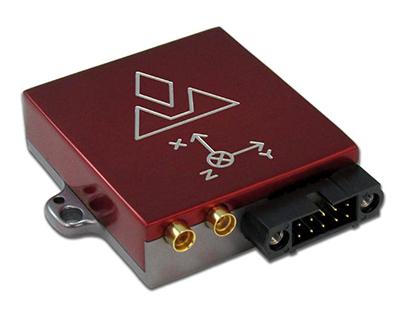
    Weighing less than 30 grams, the VectorNav VN-300 is a tiny dual-antenna GNSS-aided INS. It is used in applications ranging from autonomous vehicles to antenna pointing for satellite communication and aerial surveillance applications.

    The inaugural event of the 2018 season in Abu Dhabi saw the VN-300, manufactured by VectorNav Technologies, used for the first time in all 14 aircraft to provide real-time telemetry data used for judging, in-race simulation and virtual reality applications.

    Created in 2003, the world championship has held more than 80 races around the globe. The motorsport competition combines speed, precision and skill.

    U.S. pilot Michael Goulian performs during the finals at the first round of the Red Bull Air Race World Championship in Abu Dhabi on Feb. 3.(Photo: Andreas Langreiter, Red Bull Content Pool)

    Using the fastest, most agile, lightweight racing planes, pilots hit speeds of 370 km/h while enduring forces of up to 10 G as they navigate a low-level slalom track marked by 25-meter-high, air-filled pylons. Pilots incur time penalties for hitting pylons, incorrectly passing through air gates or only exceeding 10 G for more than 0.6 seconds, among others.

    Being an individual sport, spectators need a reference to see the difference between the pilots’ lines and speed through the racetrack. Red Bull Air Race Live TV uses an augmented reality (AR) solution known as the Ghost Plane to display the trajectory of the pilots’ runs for real-time comparison in the head-to-head rounds and the Final 4 that decides the winner of the race by time.

    The Ghost Plane is driven by the position, velocity and attitude data gathered during flight from the onboard INS.

    Critical to the success of the Ghost Plane is the accuracy of the telemetry data, which, given the high dynamics experienced during flight, is extremely difficult to obtain.

    For example, as a plane races through a chicane and into a vertical turn maneuver, GPS signals are lost and the INS needs to rely solely on the inertial sensors to accurately estimate the position and velocity until GPS is fixed again in level flight.

    The VectorNav VN-300. (Photo: VectorNav)
    The VectorNav VN-300. (Photo: VectorNav)

    “We evaluated several different inertial navigation systems and struggled to find one that was able to perform in our dynamics,” said Alvaro Navas, sport technical manager for the Red Bull Air Race. “VectorNav’s VN-300 was the only product able to deliver the attitude, position and velocity data accuracy we require, and it did this out of the box, no customization was required. The sensor is really amazing.”

    “We are really excited to be working with Red Bull Air Race,” said Gordon Hain, VectorNav product manager. “Not only are we able to provide accurate data for the race judges and spectators, but we are also able to provide valuable information to pilots and tacticians. With the VectorNav data in hand, they are able to compare actual flight trajectories with their simulations to find areas for improvement. We are looking forward to continued work with Red Bull Air Race in the 2018 season and beyond.”

  • Expert Opinions: How to select the right GNSS antenna

    Q: What are the key criteria in selecting a GNSS antenna for a particular application?

    Jerry Freestone, Chief Engineer, Antennas and Anti-Jam, NovAtel

    A: Performance, size and cost. Size and cost are easy for the integrator to assess; determining the necessary antenna performance to achieve the desired system-level performance is difficult to evaluate. Obtaining the complete GNSS solution from a single source is ideal; vendors that sell both antennas and receivers will generally understand the minimum system-level performance their solutions can provide for a given application and deliver the optimized solution to meet all three criteria.


    Brandon Oakes, Director, North American Sales and Marketing, OriginGPS

    A: Antenna selection for GNSS applications must consider performance, size and cost. Successful GNSS deployments start with the antenna selection in mind rather than waiting until the end and letting other design constraints drive the antenna selection. Patch antennas are always our preferred solution due to polarization, robustness and our patented integration method that minimizes bandwidth shift. Chip antennas are attractive due to their size, but consideration must be paid to ground-plane size and detuning.

  • Esri acquires ClearTerra location data extraction technology

    Esri acquires ClearTerra location data extraction technology

    Spatial analytics company Esri has acquired technology from ClearTerra, a company that offers geospatial and activity-based intelligence tools.

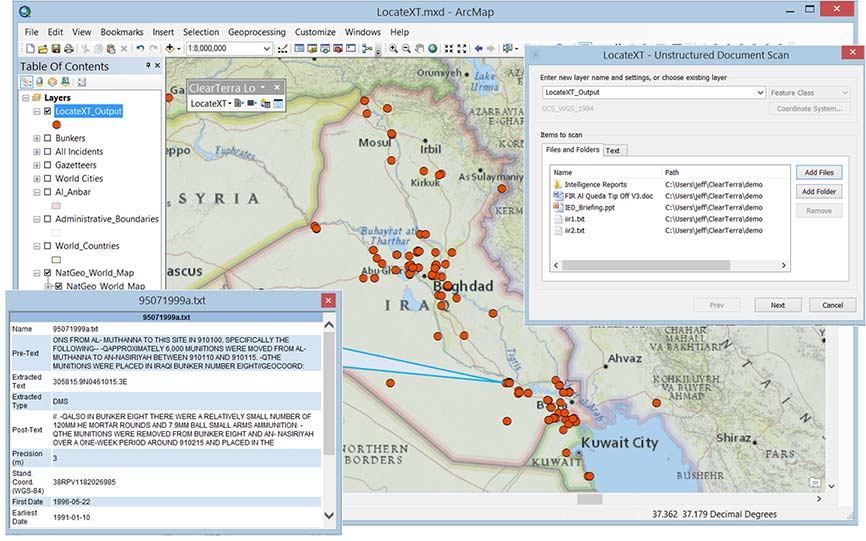
    The acquisition will provide ArcGIS platform users the ability to easily discover and extract geographic coordinates from unstructured textual data like emails, briefings and reports, instantly generating intelligent map-based information.

    This capability will make mapping this elusive information easier across many industries. Defense, intelligence and public safety organizations tend to have massive volumes of unstructured data, as do other fields, such as petroleum, utilities and maritime, where locating information on the Earth is not as easy as searching for a street address.

    Esri’s acquisition of ClearTerra technology brings workflow-enhancing software technologies into the ArcGIS platform.

    “We have been close partners with Esri for a number of years,” said Jeff Wilson, former vice president of sales for ClearTerra, now an executive for defense and intelligence with Esri. “Esri has the platform and resources to provide a solid path going forward for our technology, allowing us to expand this capability to the global market.”

    ClearTerra LocateXT technology allows analysts to rapidly scan through documents without having to spend hours reading, copying, pasting and running spreadsheet formulas, placing the results instantly into geospatial features.

    Additionally, ClearTerra FindFZ technology provides enhanced search capabilities for the ArcGIS platform, incorporating the powerful techniques found in internet search engines, including a tolerance for misspelled words, as well as wildcard and Boolean logic searches.

    The LocateXT extension for ArcMap is used to extract locations from unstructured data (messages, reports, briefings) into a geodatabase feature class. (Image: ClearTerra)
    The LocateXT extension for ArcMap is used to extract locations from unstructured data (messages, reports, briefings) into a geodatabase feature class. (Image: ClearTerra)

    “We are excited to bring ClearTerra technology into the Esri family,” said Jeff Peters, Esri director of national government. “The unstructured data tools are powerful not only for those who have made use of this technology for a number of years, such as in the military, but it also has useful applications for so many more Esri users.”

    ClearTerra has been an active member of the Esri partner program, providing their software to ArcGIS users via desktop, server, and the cloud. Support and maintenance for the software will continue via Esri with no interruption of service, and is readily available for licensing.

    ClearTerra specializes in geospatial and activity based intelligence software products, custom solutions, technical services, consulting and training. ClearTerra is a business unit of ClearShark.

  • Cyberhawk completes UAV inspections on 63 platforms for Dubai Petroleum

    Cyberhawk completes UAV inspections on 63 platforms for Dubai Petroleum

    As part of a framework agreement with Dubai Petroleum, Cyberhawk was appointed to inspect more than 350 risers on 63 offshore platforms. The inspection took one month to complete, followed by the production of more than 90 detailed engineering inspection reports.

    Photo: Cyberhawk

    The rationale behind Dubai Petroleum’s use of UAVs was to quickly complete detailed inspections of all their risers. Risers are traditionally a difficult area of an offshore platform to inspect; in the under deck and the splash zone, options for access, such as abseiling or scaffolding, are limited, extremely time consuming and very expensive.

    Using UAVs as a scanning tool, the high-quality reports produced by the Cyberhawk team allowed the client to plan contact-based inspections or repairs. With a full inspection completed on all risers, defects can be tracked over time to understand their long-term degradation.

    Daily reports were produced to notify Dubai Petroleum of potentially serious defects, with detailed inspection reports then produced by Cyberhawk’s experienced oil and gas inspection team.

    On the same project, an additional three elevated flare stacks and 24 bridges were inspected, maximizing the value of the mobilization.

    Image: Cyberhawk

    “Having worked with Cyberhawk in the past, we understand and appreciate the potential on offer from UAV inspections,” said Dubai Petroleum’s asset integrity manager. “This confidence led us to use UAVs in a new area within our business; this risers survey project. The campaign was a great success and we are pleased with the outcome. The speed and efficiency with which this project was completed has proven that the scope and application of UAV inspection can be expanded for our requirements, and we look forward to continuing our relationship with Cyberhawk in the future.”

  • PNT Roundup: Exploring X-ray navigation in space

    PNT Roundup: Exploring X-ray navigation in space

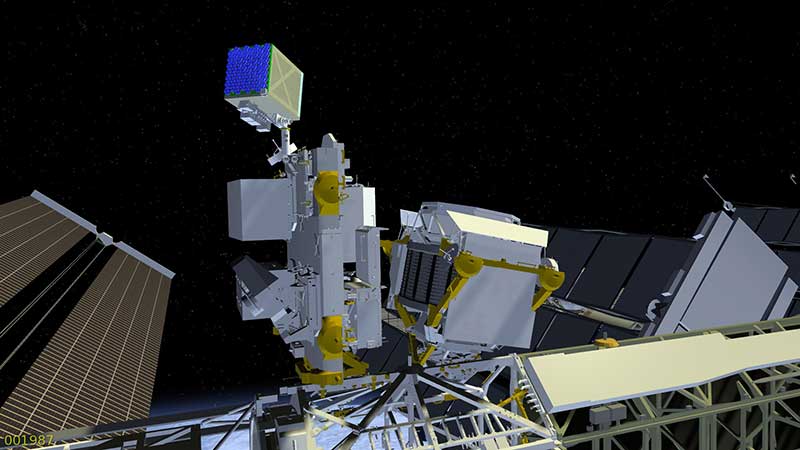
    Neutron-star Interior Composition Explorer, or NICER, is an external attached payload on the International Space Station. (Image: NASA Goddard Space Flight Center)

    A team of engineers at the U.S. National Aeronautics and Space Administration (NASA) has demonstrated fully autonomous X-ray navigation in space — a capability that could enable robotic spacecraft to navigate beyond the edges of the solar system.

    The experiment, Station Explorer for X-ray Timing and Navigation Technology (SEXTANT), showed that millisecond pulsars could be used to accurately determine the location of an object moving at thousands of miles per hour in space, functioning in a way similar to GPS.

    The system provides a new option for spacecraft to autonomously determine their locations outside Earth-based global navigation networks because pulsars are accessible in virtually every conceivable flight regime, from low-Earth to deepest space.

    The SEXTANT demonstration used the 52 X-ray telescopes and silicon-drift detectors that make up NASA’s Neutron-star Interior Composition Explorer (NICER), an external attached payload on the International Space Station.

    The size of a washing machine, NICER studies neutron stars, which emit radiation across the electromagnetic spectrum. Incredibly dense — one teaspoonful of neutron star matter would weigh a billion tons on Earth — these objects would collapse into black holes if compressed any further.

    Pulsars. The SEXTANT experiment focuses on a particular type of neutron star: pulsars, highly magnetized, rotating neutron stars. Their electromagnetic radiation can be observed only when the beam of emission points toward Earth, thus their pulsed appearance. The short, regular rotational period produces a precise interval between pulses that ranges from milliseconds to seconds for an individual pulsar. These predictable pulsations can provide high-precision timing information similar to the atomic-clock signals supplied through GPS.

    Demonstration. A demonstration in November 2017 selected four millisecond pulsar targets — J0218+4232, B1821-24, J0030+0451 and J0437-4715 — and directed NICER to orient itself so it could detect X-rays within their sweeping beams of light. These millisecond pulsars are so stable that their pulse arrival times can be predicted to accuracies of microseconds for years into the future.

    During the two-day experiment, the payload generated 78 measurements to get timing data, which the SEXTANT experiment fed into its onboard algorithms to autonomously stitch together a navigational solution that revealed the location of NICER in its orbit around Earth. The team compared that solution against location data gathered by NICER’s onboard GPS receiver.

    “For the onboard measurements to be meaningful, we needed to develop a model that predicted the arrival times using ground-based observations provided by our collaborators at radio telescopes around the world,” said Paul Ray, a SEXTANT co-investigator with the U.S. Naval Research Laboratory. “The difference between the measurement and the model prediction is what gives us our navigation information.”

    The goal was to demonstrate that the system could locate NICER within a 10-mile radius as the space station sped around Earth at slightly more than 17,500 mph. Within eight hours of starting the experiment on Nov. 9, the system converged on a location within the targeted range of 10 miles and remained well below that threshold for the rest of the experiment. In fact, a good portion of the data showed positions that were accurate to within three miles.

    GPS-level accuracy on the order of a meter or less is not necessary when navigating the far reaches of the solar system, where distances between objects measure in the millions of miles. “In deep space, we hope to reach accuracies in the hundreds of feet,” said Mitchell.

    The team will now focus on updating and fine-tuning both flight and ground software in preparation for a second experiment later in 2018. The ultimate goal, which may take years to realize, is to develop detectors and other hardware to make pulsar-based navigation readily available on future spacecraft.

    To advance the technology for operational use, teams will focus on reducing the size, weight and power requirements and improving the sensitivity of the instruments. The SEXTANT team now also is discussing the possible application of X-ray navigation to support human spaceflight.

    If an interplanetary mission to the moons of Jupiter or Saturn were equipped with such a navigational device, for example, it would be able to calculate its location autonomously, for long periods of time without communicating with Earth.

    “This successful demonstration firmly establishes the viability of X-ray pulsar navigation as a new autonomous navigation capability,” said project manager Jason Mitchell. “We have shown that a mature version of this technology could enhance deep-space exploration anywhere within the solar system and beyond.”

  • Satelles shows improved PNT accuracy from LEO constellation

    Satelles had demonstrated in 2016 sub-microsecond timing using its Satellite Time & Location (STL) service with a stand-alone TCXO-based receiver. The service uses a signal from the Iridium low-Earth orbit (LEO) constellation.

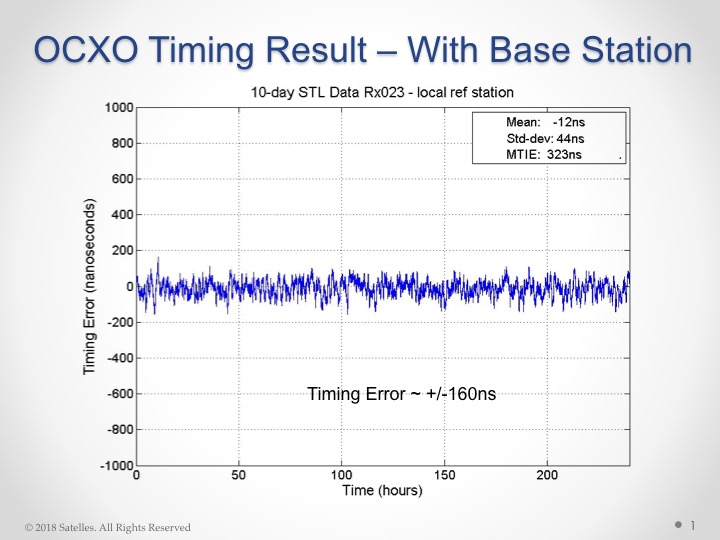
    Now the company has released from new tests using configurations with a differential source and with a more accurate OCXO clock, producing timing accuracy of 160 nanoseconds.

    Gregory Gutt, president and chief technical officer of Satelles, made the presentation at the recent Institute of Navigation International Technical Meeting.

    The 66-satellite Iridium LEO constellation transmits overlapping spot beams, which provide location-specific data that changes every few seconds. The featured image on this article (above) shows spot beam pattern for 2 of 66 satellites.

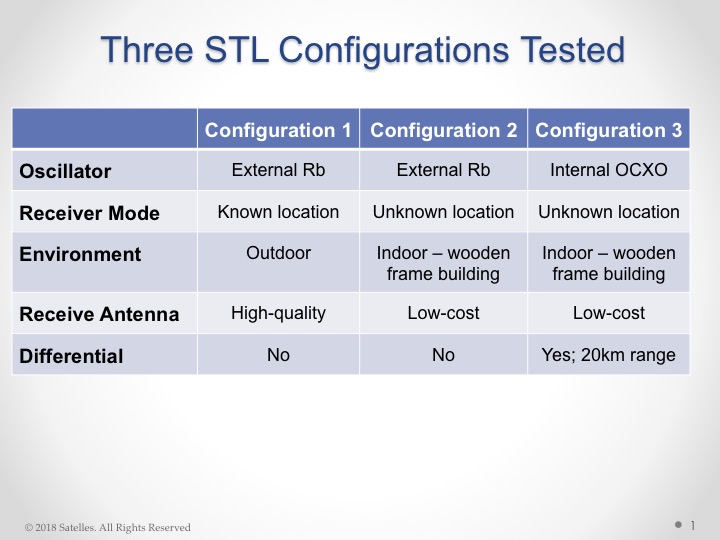
    Overview of Satelles test configurations. (Chart: Satelles)
    Overview of Satelles test configurations. (Chart: Satelles)

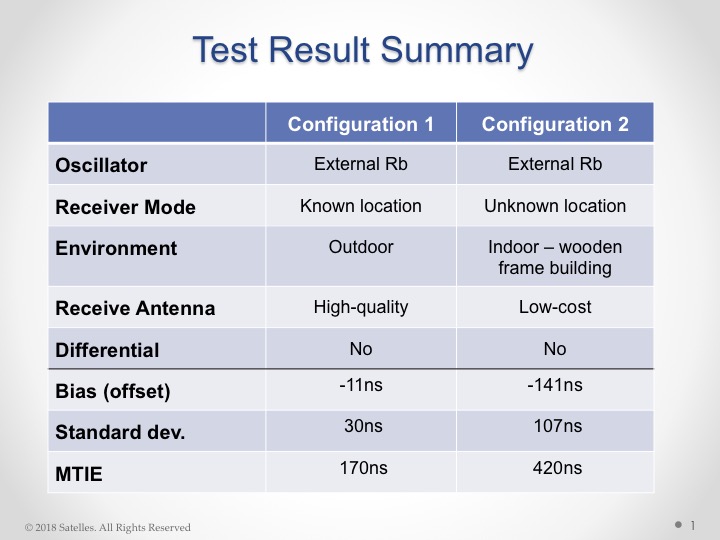
    The testing employed three different configurations of equipment, services, and environment, as shown in the adjacent figure. Equipment employed in the tests included a Stanford Research Systems (SRS) rubidium vapor frequency reference, based on the PRS10 module, and a Satelles Evaluation Kit (EVK2) STL receiver, comprising a Maxim RF chip, Xylinx Spartan-3 FPGA , TI dual core DSP chip, and internal OCXO or external clock.

    Parameters and equipment for the three test configurations:

    Configuration #1 – Optimal. Outdoor antenna, Rubidium clock powered on for months prior to data collection, receiver configured in static mode with a known location, and high-quality antenna

    Configuration #2 – Sub-optimal. Indoor antenna, Rubidium clock powered on 6 hours prior to data collection, receiver configured in static mode with an unknown location, and low quality antenna

    Results from the first two tests are shown here:

    Test results, configurations 1 and 2. (Chart: Satelles)
    Test results, configurations 1 and 2. (Chart: Satelles)

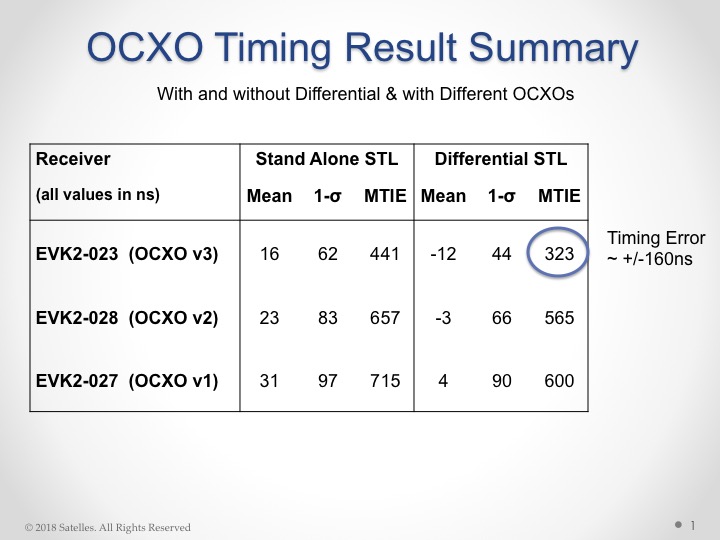
    Configuration #3. Three independent receivers collecting data, receiver on-board OCXO, indoor antenna, receiver configured in static mode with an unknown location, low-quality antenna. Tests performed:

    • 10 days with no local reference station running
    • 10 days with local reference station, 20km away from test receivers, providing timing corrections to STL ground segment.

    Results from these tests shown here:

    Results from OCXO tests. (Table: Satelles)
    Results from OCXO tests. (Table: Satelles)

    With this individual test result:

    OCXO timing result with base station. (Chart: Satelles)
    OCXO timing result with base station. (Chart: Satelles)

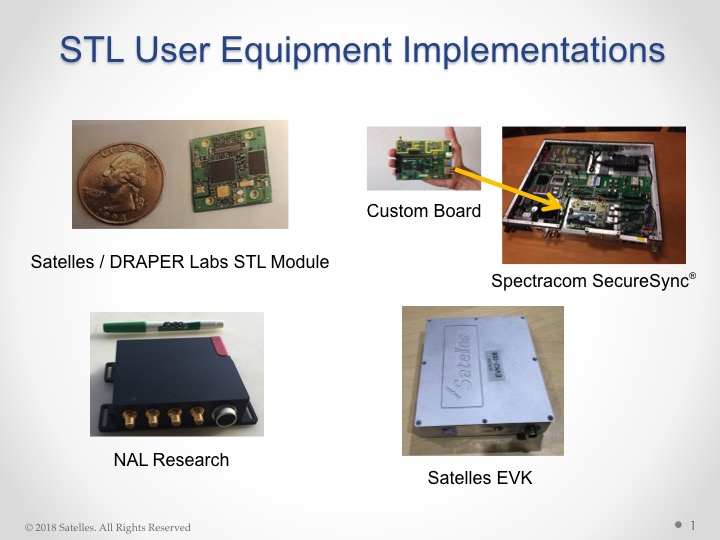
    Some of the commercially available products and evaluation kits that incorporate the STL service are shown here:

    STL user equipment implementations. (Image: Satelles)
    STL user equipment implementations. (Image: Satelles)
  • A first look at the FleetUp Trace device for truckers

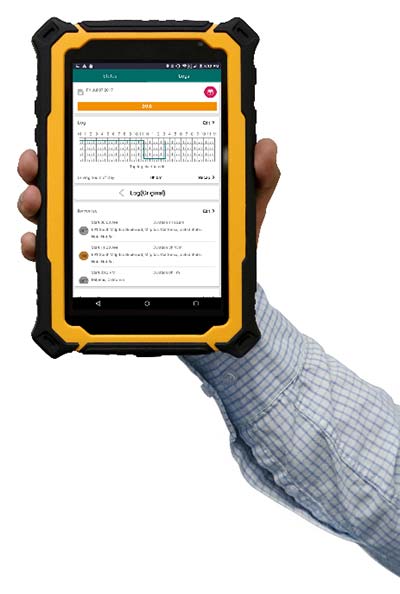
    FleetUp Trace is a ruggedized tablet designed for fleet drivers required to display Records of Duty Status (RODS) upon request instead of printing out hard copies with the new Electronic Logging Device (ELD) mandateTim provides thoughts on the product hardware, ease-of-use and various app features.

    Photo: FleetUp-Trace
    Photo: FleetUp-Trace

    By Tim Spence

    Sometimes, there is great anticipation when buying a new electronic gadget. The look, the feel and the flashy presentation is what many products on the market rely on to make their product the best. With ELDs though, drivers and fleets managers are thinking about these products a bit differently. Thoughts like:

    • Will this satisfy our need for compliance?
    • How much training will this take?
    • How many drivers am I going to lose?
    • Is this even going to work?

    When powering up the FleetUp Trace tablet for the first time and opening the Hours of Service (HOS) app, it was evident that a lot of thought went into fulfilling these needs. Here is a first look at FleetUp Trace, a ruggedized tablet designed for fleet drivers required to display Records of Duty Status (RODS), as part of the FMCSA ELD mandate.

    Unboxing

    When removing the FleetUp Trace case from the box, you will notice that it is quite unique and will not easily be lost among other items because of that. The case was durable and tough but soft as well. When unzipped it revealed the Android tablet, a couple of short manuals and various accessories for charging and memory.

    The Tablet

    Safety orange is the key color with this tablet and since it is a popular color in our industry, it definitely catches the eye. In addition, the protective case fits the tablet so well, it looks to be a part of the product (if you have ever purchased a tablet and tried to find a durable hard case that fits well, you know).
    Booting the tablet, a brilliant orange screen for FleetUp appears and then four preloaded apps on the home screen: FleetUp’s HOS app, FleetUp’s CamVue app, Camscanner (a very reliable document scanner) and a preset version of Teamviewer QuickSupport, which provides an ID and easy instructions to show the FleetUp screen to another device.

    HOS app tutorial

    Starting the app and logging in, the Voice Over HOS greets you by name, gives you the current date, tells your current duty status, how many hours you have left in the 70-hour cycle, and how many on-duty hours you have before you are required to take a break. It then tells you to select a vehicle. After selecting a vehicle and confirming, you are told to tap the HOS button.

    The app automatically uses a tutorial showing each feature. One button at a time, the app guides you to the next feature prompted by your action of pressing the “GOT IT” button. This tutorial is available on each section of the device and can be turned off on the main menu that slides over from the left. That is a great feature not only because you wouldn’t want to go through the tutorial EVERY SINGLE TIME but just in case you forget how to use a certain section, like driver vehicle inspection report (DVIR), you can manually slide open the main menu and turn it back on to REINFORCE YOUR LEARNING. After going through the tutorial for each section, you will find a lot of reasons (mainly regulatory) why this is valuable.

    Using the HOS app

    After going through the tutorial once, even if you have years of experience on paper logs, you will find that many of the basics of logging are easy to find or figure out. It is very comfortable operating without the Voice Over HOS or Tutorial features. On the “Status” tab, you can see your current status and log graph, as well as change your status and check your available hours. On the “LOGS” tab, you can fill out a pre-trip or post-trip inspection and edit your time (except for driving time, of course). This section also allows you to enter shipping document information, edit any equipment information and certify your logs by signing with your finger (no special pen needed).

    Features that make the difference

    Tutorial mode. While this feature may sound simplistic, it has the capability to answer a driver’s question with the flip of a switch. Just the fact that you can turn it on whenever you need to be reminded is so valuable. It is beneficial to know that this feature does work best in the portrait or vertical mode.

    Voice over HOS. This feature reminds you of the actions that many drivers forget. If you have ever used ELDs in the past as a driver or fleet manager, you understand. Along with the text prompts, it reminds the driver to do things such as certifying the log at the end of the day, sign the DVIR, release the vehicle, etc. All the voice and text prompts work hard to keep the driver in compliance. Even when you want to LOG OUT, the app asks you if you still need to complete unfinished actions.

    Easy-to-read availability. Many electronic logging devices make it very challenging to understand what hours are left for a driver. With FleetUp, there is no confusion at all because it is stated in text and graph.

    Big buttons to change status. No more calibrating screens or needing a stylus just to change your status. Just touch a big button with your finger, enter the note under the GPS-enabled address entry, and tap “Yes.” It is that easy.

    On top of everything else, FleetUp Trace and the HOS app are extremely user-friendly. This should be the key to it all because if the device and app are not user-friendly and easy to operate, there is no reason for it to exist.

    FleetUp has accomplished a great feat by making the transition to E-Logs painless and smooth while complying with a multitude of regulations. Whether you’re looking for a simple way to track internal records of duty status (RODS) or to ensure HOS compliance and DVIR with a simple, hands-free gadget, FleetUp is one provider that clearly committed a lot of thought into what drivers are going to go through on the road, and offers plenty of features for an all-encompassing solution to the ELD mandate.

    Tim Spence, creator of Apps4truckers, is an app consultant, writer and safety manager in Birmingham, Alabama.

  • Research Online: Monitoring of wide-area oscillations in presence of GPS spoofing attacks

    By Yongqiang Wang and Aranya Chakrabortty, Clemson University /
    IEEE Power and Energy Society General Meeting, September 2017

    Phasor Measurement Units (PMU) are playing an increasingly important role in wide-area monitoring and control of power systems. PMUs allow synchronous real-time measurements of voltage, phase angle and frequency from multiple remote locations in the grid, enabled by their ability to align to GPS clocks. Given that this ability is vulnerable to GPS spoofing attacks, which have been confirmed easy to launch, this paper proposes a distributed real-time wide-area oscillation estimation approach that is robust to GPS spoofing on PMUs and their associated Phasor Data Concentrators (PDCs). The approach employs the idea of checking update consistency across distributed nodes and can tolerate up to one third of compromised nodes. Numerical simulations confirmed the effectiveness of the proposed approach.

    The lead author, an assistant professor of electrical and computer engineering at Clemson, leads a team that received $1 million from the National Science Foundation to fortify computers and devices against cyberattacks associated with timekeeping. “We want to provide secure timing solutions by securing the two most commonly used time distribution approaches,GPS receivers and NTP.”

  • Spoofing detection available on Javad GNSS OEM boards

    Two methods of spoofer detection, the identification and sourcing of false GNSS signals, have been released by Javad GNSS, using features available for all of its OEM GNSS boards.

    • Spoofer detection and alarm. This feature then identifies and isolates the spoofer signal, ignores it, and provides a position solution using only valid satellite signals.
    • Determination of the direction from which the spoofing signals emanate. This can aid in tracking down the actual spoofing source.

    Spoofer Detection

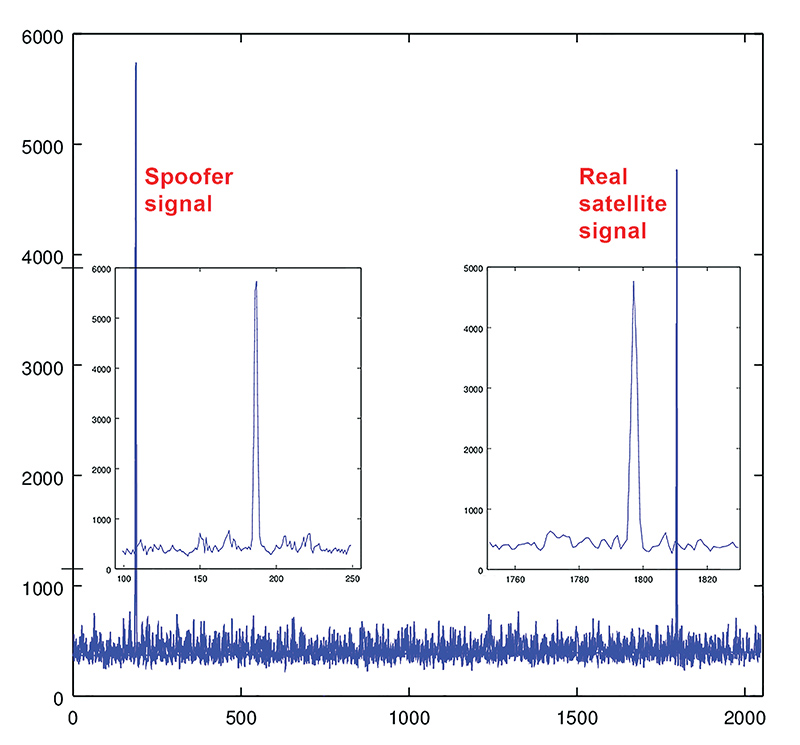
    With 864 channels and roughly 130,000 quick-acquisition correlators, the Javad GNSS Triumph chip can assign more than one channel to each GNSS satellite, in order to find all the signals that are transmitted with that satellite’s PRN code. If the chip detects more than one reasonable and consistent correlation peak for any PRN code, it concludes that spoofing is present and can the proceed to identify the spoofed signals.

    In this case, it uses the position solution provided by all other clean signals (L1, L2, L5, and so on, from all GNSS constellations — GPS, GLONASS, Galileo, Beidou, and mroe) to identify the spoofer signal and use the real satellite measurement. If all GNSS signals are spoofed or jammed, then the system issues an alarm, directing the user to ignore GNSS and use other sensors in an integrated system.

    Satellite and Spoofer Peaks

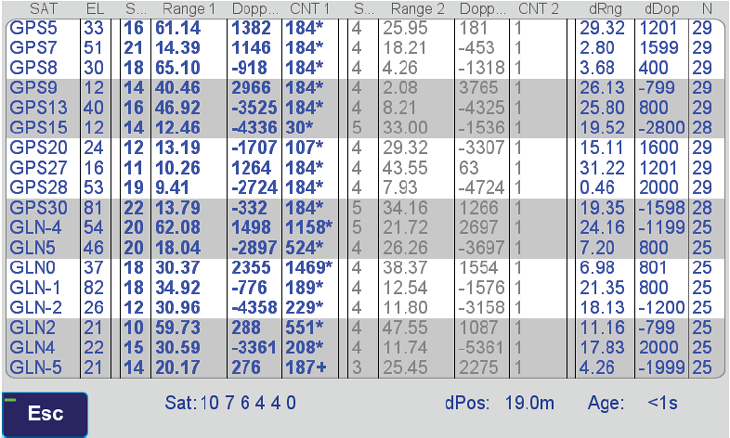
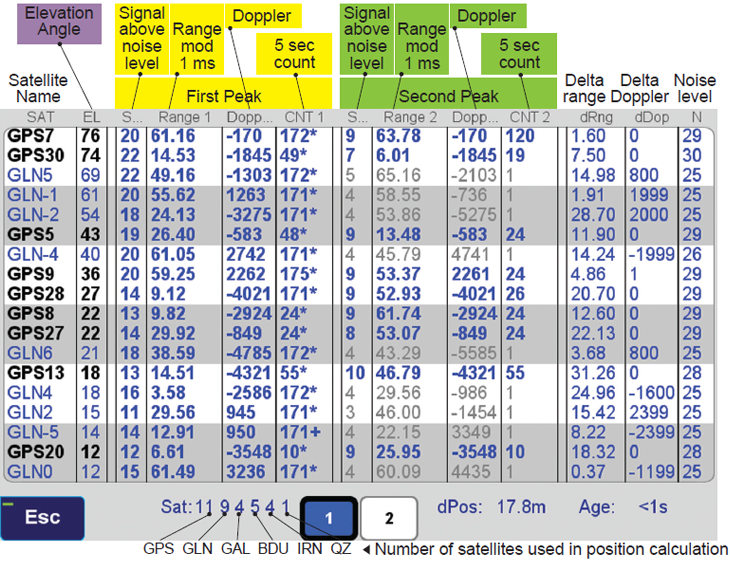
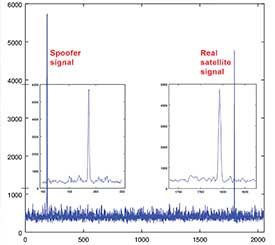
    The figure below shows an example of a spoofer signal and a real satellite signal received at a GNSS receiver. These  screenshots  are from a real spoofer in a large city. The bold numbers are for the detected peaks. The gray numbers represent highest noise, not a consistent peak. A “*” symbol next to the CNT numbers indicate that signal is used in position calculation. Each CNT count represent about 5 seconds of continuous peak tracking.

    The first screenshot shows no spoofing is present. The second shows that all GPS satellites are being spoofed.

    No spoofer. Only one reasonable peak for each satellite. (Table: Javad GNSS)
    No spoofer. Only one reasonable peak for each satellite. (Table: Javad GNSS)
    Table: Javad GNSS
    Table: Javad GNSS

    In the above screenshot all GPS satellites have two peaks and all are spoofed. We were able to distinguish the spoofer signal and use the real satellite signals in correct position calculation as indicated by the ”*” next to the CNT numbers.

    GNSS Overall View

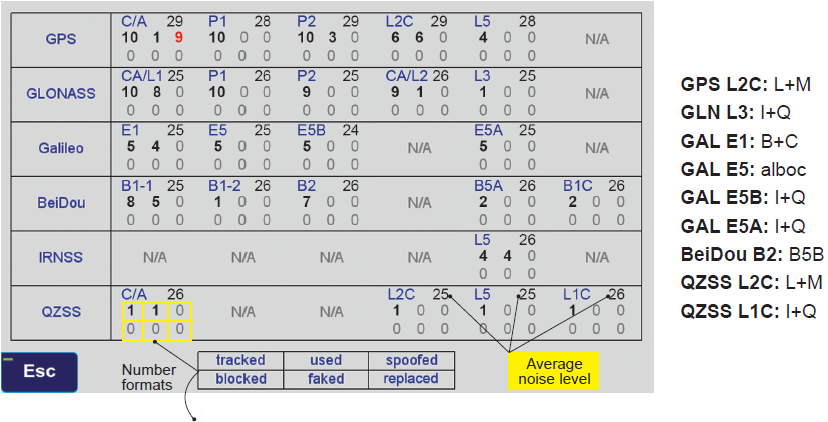
    The following screenshot  shows the status of all GNSS signals. The format and the signal definitions are explained below.

    Table: Javad GNSS
    Table: Javad GNSS

    Tracked: Tracked by the tracking channels and has one valid peak only.
    Used: Used in position calculation.
    Spoofed: Has two peaks. Good peak is isolated, if existed.
    Blocked: Blocked by buildings or by jamming. If jammed, shows higher noise level.
    Faked: Satellite should not be visible, or such PRN does not exist.
    Replaced: Real signal is jammed and a spoofed signal put on top of it. Because of jammer, it shows higher noise level.

    For determination of the direction from which the spoofing signals emanate, see Where is that spoofed signal coming from?

  • Using GPS, NASA tests atomic clock for deep space navigation

    Using GPS, NASA tests atomic clock for deep space navigation

    While in orbit, the Deep Space Atomic Clock (DSAC) mission will use the navigation signals from GPS coupled with precise knowledge of GPS satellite orbits and clocks to confirm DSAC’s performance.

    News from the Jet Propulsion Laboratory, NASA

    In deep space, accurate timekeeping is vital to navigation, but many spacecraft lack precise timepieces on board. For 20 years, NASA’s Jet Propulsion Laboratory in Pasadena, California, has been perfecting a clock. It’s not a wristwatch; not something you could buy at a store. It’s the Deep Space Atomic Clock (DSAC), an instrument perfect for deep space exploration.

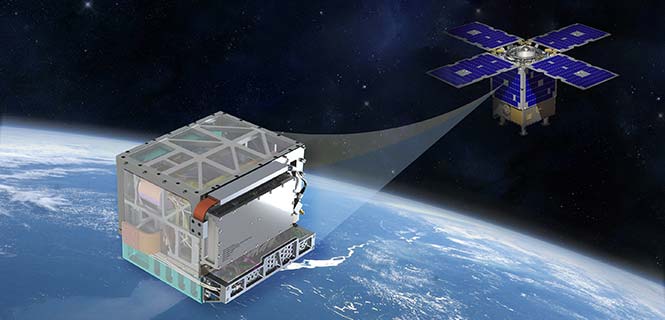
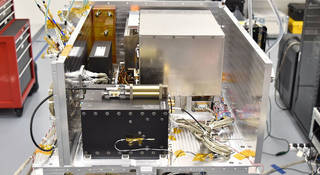
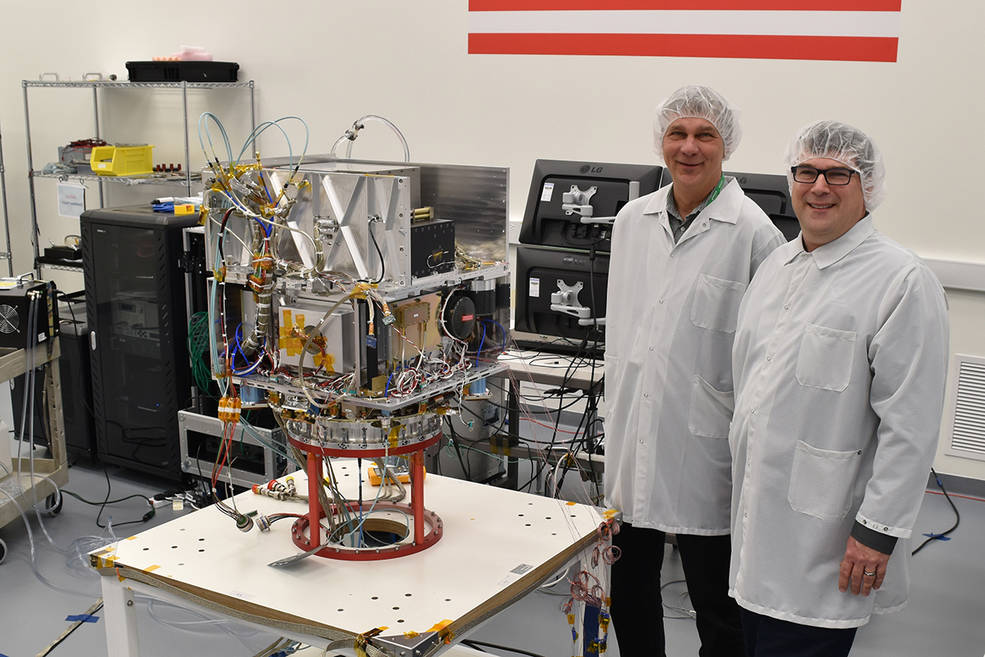
    The atomic clock, GPS receiver and ultra-stable oscillator that make up the Deep Space Atomic Clock Payload, following integration into the middle bay of Surrey Satellite US’s Orbital Test Bed Spacecraft.
    (Photo: Surrey Satellite Technology)

    Currently, most missions rely on ground-based antennas paired with atomic clocks for navigation. Ground antennas send narrowly focused signals to spacecraft, which, in turn, return the signal. NASA uses the difference in time between sending a signal and receiving a response to calculate the spacecraft’s location, velocity and path.

    This method, though reliable, could be made much more efficient. For example, a ground station must wait for the spacecraft to return a signal, so a station can only track one spacecraft at a time. This requires spacecraft to wait for navigation commands from Earth rather than making those decisions on board and in real-time.

    “Navigating in deep space requires measuring vast distances using our knowledge of how radio signals propagate in space,” said Todd Ely of JPL, DSAC’s principal investigator. “Navigating routinely requires distance measurements accurate to a meter or better. Since radio signals travel at the speed of light, that means we need to measure their time-of-flight to a precision of a few nanoseconds. Atomic clocks have done this routinely on the ground for decades. Doing this in space is what DSAC is all about.”

    The Deep Space Atomic Clock in the middle bay of the General Atomics Orbital Test Bed spacecraft. (Image: NASA)

    The DSAC project aims to provide accurate onboard timekeeping for future NASA missions. Spacecraft using this new technology would no longer have to rely on two-way tracking. A spacecraft could use a signal sent from Earth to calculate position without returning the signal and waiting for commands from the ground, a process that can take hours. Timely location data and onboard control allow for more efficient operations, more precise maneuvering and adjustments to unexpected situations.

    This paradigm shift enables spacecraft to focus on mission objectives rather than adjusting their position to point antennas earthward to close a link for two-way tracking.

    Additionally, this innovation would allow ground stations to track multiple satellites at once near crowded areas like Mars. In certain scenarios, the accuracy of that tracking data would exceed traditional methods by a factor of five.

    DSAC is an advanced prototype of a small, low-mass atomic clock based on mercury-ion trap technology. The atomic clocks at ground stations in NASA’s Deep Space Network are about the size of a small refrigerator. DSAC is about the size of a four-slice toaster, and could be further miniaturized for future missions.

    The DSAC test flight will take this technology from the laboratory to the space environment. While in orbit, the DSAC mission will use the navigation signals from U.S. GPS coupled with precise knowledge of GPS satellite orbits and clocks to confirm DSAC’s performance. The demonstration should confirm that DSAC can maintain time accuracy to better than two nanoseconds (.000000002 seconds) over a day, with a goal of achieving 0.3 nanosecond accuracy.

    Tom Cwik, the head of JPL’s Space Technology Program (left) and Allen Farrington, JPL DSAC project manager, view the integrated atomic clock payload on Surrey Satellite US’s Orbital Test Bed Spacecraft.
    (Photo: Surrey Satellite Technology)

    Once DSAC has proved its mettle, future missions can use its technology enhancements. The clock promises increased tracking data quantity and improved tracking data quality. Coupling DSAC with onboard radio navigation could ensure that future exploration missions have the navigation data needed to traverse the solar system.

    Technologies aboard DSAC could also improve GPS clock stability and, in turn, the service GPS provides to users worldwide. Ground-based test results have shown DSAC to be upwards of 50 times more stable than the atomic clocks currently flown on GPS. DSAC promises to be the most stable navigation space clock ever flown.

    “We have lofty goals for improving deep space navigation and science using DSAC,” said Ely. “It could have a real and immediate impact for everyone here on Earth if it’s used to ensure the availability and continued performance of the GPS system.”

    DSAC is a partnership between NASA’s Space Technology Mission Directorate and the Space Communications and Navigation program office, a program under the Human Exploration and Operations Mission Directorate. DSAC will launch in 2018 as a hosted payload on General Atomic’s Orbital Test Bed spacecraft aboard the U.S. Air Force Space Technology Program (STP-2) mission.

  • Expert Opinions: Challenges faced by multi-constellation GNSS receiver designers

    Expert Opinions: Challenges faced by multi-constellation GNSS receiver designers

    Javad Ashjaee
    President and CEO,
    Javad GNSS

    Q: What is the biggest challenge facing designers of multi-constellation GNSS receivers today?

    Javad Ashjaee, founder of Javad GNSS: The biggest challenge now is spoofing.

    Some years ago the issue was jamming —the hot issue of LightSquared — that would hurt GNSS. To solve that problem we created the J-Shield and showed that J-Shield technology could protect against LightSquared and similar signals. We manufactured dozens of units that were successfully tested by several independent laboratories.

    Now GNSS faces the spoofing issue. Reports of Black Sea spoofing and other examples show the urgency of paying attention to this problem. When a spoofer is successful, both position and time are spoofed.

    A Nov. 3 CNN video report on this subject gives an example of how little people know about spoofing and about the work that has been done on this subject. The report claims that GNSS technology companies have not done much or spent money on this subject. Obviously the reporter doesn’t know what we have done, as I will report here.

    I’ll review the spoofing methods and how we counter them.

    Source: Javad GNSS
    Source: Javad GNSS

    Spoofers use three methods: One simple way is to broadcast GNSS-like signals that provide the wrong ranging information which, when used, creates wrong position and time solutions. Most probably this is the method that Prof. Todd Humphreys used to spoof the GNSS receiver on the $80 million yacht [“GNSS Lies, GNSS Truth,” November 2014 GPS World.] This method fools the GNSS receiver into ignoring the correlation peak of the real satellite signal and using the correlation peak of the spoofer signal. To deal with this type of spoofer we take advantage of the 864 tracking channels and over 130,000 fast acquisition channels of our TRIUMPH chip. We assign more than one channel to each satellite signal and we track all their peaks: The real peak and the spoofer’s peaks. Then in Step 1, below, we exclude all signals with more than one correlation peak.

    Method Two is broadcasting spoofed signals for satellites that are below the horizon in the spoofed area or for satellites that do not exist. In this case only one correlation peak exists. Our equipment and OEM boards can download valid and certified almanac data from our website to know the status of satellites and their visibility ahead of their mission. Almanac data can be used for several weeks.

    Method Three is to cover the signal of a visible satellite with noise and on top of the noise add the spoofer signal with more power. We recognize such spoofers by their unreasonable signal power and the background noise.
    In the first counter-spoofing step we ignore these signals:

    1. Those with more than one peak;
    2. Those that according to our almanac should not be visible;
    3. Those with unreasonably high or inconsistent signal-to-noise ratio (SNR);
    4. Systems whose satellites all have similar SNR.
    5. Satellites that do not generate complete multi-frequency signals (spoofers usually generate only C/A code).

    After removing all questionable signals, we use the remaining signals to compute our approximate position. We need at least 4 signals from the many available signals of GPS L1, L2P, L2C, L5, GLONASS L1, L2, L3, and the many signals of BeiDou, QZSS and IRNSS.

    In the second step we validate all questionable signals against the approximate position that we have calculated and keep only those that pass our validation. We then re-compute the more precise position using all good signals. We consistently throw away the spoofer correlation peak and use the real satellite signal.

    If all signals of all satellites are spoofed, then we warn the user to ignore the GNSS signals and use some other sensors (like compass and gyro) to get out of the spoofed area. A spoofer that can spoof all signals of all satellites will be very expensive to build and deploy.

    In a very difficult situation, the user can enter their approximate position to quickly understand if spoofers exist, and then identify them.

    All the counter-spoofing methods that I have discussed here are the subject of patents for which we have applied.

    Since currently most of spoofers spoof the L1 C/A code, we can simply initially ignore the C/A signals to compute the initial approximate position and use it to identify the spoofed signals.

    It is vital that in areas that spoofing danger exists, users employ OEM boards that provide more satellite systems and more signals, rather than using a simple GPS C/A code, for example.

    Finally I would like to challenge Prof. Todd Humphreys [professor and director, Radionavigation Laboratory, University of Texas-Austin] to spoof any of our receivers that have this anti-spoofing option. We offer this as an option on all of our OEM boards.