Author: GPS World Staff

  • Telit releases category 11 LTE full mini PCIe card

    Telit has launched the LM940, a global Full PCI Express Mini Card (mPCIe) module for the router and gateway industry supporting LTE Advanced Category 11 (Cat 11) with speeds of up to 600 Mbps.

    The internet of things (IoT) module is available with various mobile network operator approvals in the fourth quarter of 2017, the company said.

    The module includes quad-constellation integrated GNSS and is in an mPCIe form factor to support Cat 11 with the Snapdragon X12 LTE modem. The industrial-grade LM940 delivers significant flexibility and a competitive edge to original equipment manufacturers (OEM) looking to quickly deploy next generation products.

    Today, customers of router and gateway OEMs demand additional bandwidth and near instant network response times as applications like high definition video streaming with digital signage, commercial and enterprise failover needs and pop-up stores are becoming increasingly sophisticated.

    “This industrial-grade module from Telit supporting LTE Cat 11 with global coverage will be very attractive for equipment manufacturers looking to deploy the latest solutions now, especially in the router and gateway market supporting high-bandwidth dependent applications like digital signage,” said Sam Lucero, senior principal analyst for IHS Markit, a global information provider. “As detailed in our June 2016 report on the industrial cellular IoT gateways market, IHS Markit anticipates gateway shipments will rise from nearly two million shipped in 2016 to more than six million shipped in 2021. The value of these industrial cellular IoT gateways shipped in 2021 will slightly exceed USD $1.6 billion.“

    “Telit extends its leadership again by delivering customers the latest releases in LTE Advanced technology that they can take to market today,” said Manish Watwani, vice president of global product marketing for Telit. “The LM940 is the only global product for the router and gateway segment that allows OEMs to immediately leverage the 3x carrier aggregation and the higher order modulation of the 256 QAM capabilities currently available amongst most mobile operator networks. Combined with an exceptional power efficiency platform, this is by far the ideal solution to enable commercial and enterprise applications in the router industry, such as branch office connectivity, LTE failover, digital signage, kiosks, pop-up stores, vehicle routers, construction sites and more.”

    “The Snapdragon X12 LTE modem with LTE Advanced technologies providing peak download speeds of 600 Mbps, defines a new level of service for emerging applications,” says Gautam Sheoran, director of product management for Qualcomm Technologies, Inc. “We are pleased with our ongoing collaboration with Telit to bring technologies that enable emerging applications like 4K video, virtual reality and cognitive computing to the global market.“

    Additional technical features include:

    • LTE Category 11 LTE Cat. 11 DL / Cat. 5 UL Rel.10
    • 3x Carrier Aggregation leverages extended capabilities of the network for increased coverage and bandwidth
    • Up to 600 Mbps DL w/3x Carrier Aggregation and 256 QAM
    • Up to 75 Mbps UL w/ 64QAM
    • HSPA+ Rel. 8
    • Quad-constellation integrated GNSS
    • Popular mPCIe form factor (50.95 x 30 x 2.8 mm)
    • Temperature range: -40 to 85° C
    • Linux and Windows driver support
  • GLONASS-M satellite shipped to Cosmodrome for launch

    GLONASS-M satellite shipped to Cosmodrome for launch

    The Russian navigation satellite GLONASS-M 52 has traveled from ISS-Reshetnev Company’s facilities in Zheleznogorsk to the Plesetsk launch site, reported ISS-Reshnetev on Aug. 25.

    GLONASS-M 52 is one of the GLONASS system’s ground spares. It was built by ISS-Reshetnev Company more than two years ago and was stored at the company’s facilities waiting for launch.

    Before flying to the cosmodrome, GLONASS-M 52 was thoroughly tested and prepared for transportation. ISS-Reshetnev technicians used multi-layer insulation and special cases to protect the satellite’s sensitive equipment from damage during transport.

    GLONASS-M 52 was loaded in a special container and flown to the Plesetsk cosmodrome on an IL-76 aircraft accompanied by ISS-Reshetnev specialists. The satellite is due to launch in September.

    There are currently six GLONASS-M satellites in the ground reserve of the GLONASS navigation satellite system. All of them were constructed by ISS-Reshetnev Company in strict compliance with contract terms and are now stored at its facilities.

    Each of these satellites is on standby for launch and can be shipped to the cosmodrome whenever needed to augment the GLONASS orbital constellation.

    GLONASS-M 52 will replace a retired long-lived satellite that carried out its mission in orbit 1.5 times longer than initially designed.

    GLONASS-M 52 is expected to launch in September. (Photo: ISS-Reshetnev)
  • Nearmap expert joins Aug. 31 mapping and UAV webinar

    Tony Agresta of Nearmap has joined the panel of speakers on the Aug. 31 webinar, “Integrated Technologies for Industrial Positioning.”

    Tony Agresta, Nearmap

    The webinar is free (register here) and focuses on applications in the electric utility/telecom sector, such as site inspections, drones and geographic information systems (GIS) mapping in general. Participants will learn how to maximize reach and capabilities using various sensors and technologies integrated with GPS aboard unmanned autonomous vehicle (UAV) platforms.

    Agresta leads the U.S. marketing effort including customer use cases for Nearmap across industries.

    Nearmap provides instant access to high resolution aerial imagery including ortho, oblique and now 3D — at scale. Today, this imagery is used for site locate analysis, planning and tracking change over time. The webinar presentation will review the different forms of imagery, how they are captured, managed and delivered in the cloud and used inside ESRI and AutoDesk.

    Nearmap provides cloud-based subscription access to up-to-date 2-D orthomosaic aerial imagery. Using its patented HyperCamera2 technology, Nearmap is applying the same access model to the oblique aerial imagery market.

    Screen capture from a Nearmap 3D fly-through of Austin, Texas, rendered from Nearmap oblique Imagery.

    Because this new camera system provides a high degree of overlap from different angles, Nearmap can reconstruct the real world in stunning detail, producing not only high-resolution orthomosaic and oblique imagery, but also surface and terrain models, natural-color point clouds and textured 3-D meshes.

    Other Speakers on the Panel

    Jeff Fagerman, Lidar USA

    Jeff Fagerman. Fagerman, a professional surveyor and certified photogrammetrist, is founder and owner of Lidar USA. He holds a master’s degree in photogrammetry from Purdue University. During his tenure with Intergraph from 1985 to 1999, he worked as a photogrammetric software developer on that company’s innovative photogrammetric workstations. In 1999, he started Fagerman Technologies, now known as Lidar USA. In 2010, the main corporate focus became mobile lidar aboard UAVs.

    Lidar USA provides solutions for GIS, surveying, civil engineering, agriculture, forensics, BIM, heritage mapping — all things 3D and beyond. In addition to UAV-based mapping and surveying, the company has developed ground—based lidar, building an economical mobile mapping system called ScanLook, incorporating scanning, imaging, and navigation. The company has provided client services in survey/mapping, agriculture, law enforcement, military, archaeology, and education.

    Chris Lund, Honeywell

    Chris Lund, Honeywell Corporation. Lund will focus on inertial sensors as the centerpiece of any robust industrial positioning solution. Given they can’t be interfered with, inertial sensors are the glue that binds the information from all the other sensors together to reveal the desired insights and maximize operator uptime/efficiency.

    Lund is a senior director of product marketing for Honeywell’s Navigation and Sensor business. He has experience running product lines for inertial measurement units as well as for surface and marine navigators. Previously, he had engineering roles as a researcher, project lead and technical manager. Lund has an M.S. in the management of technology. He has been working on navigation-related technologies since the late 90s, holds multiple patents, and has co-authored several conference papers and presentations.

    Derrick Reish, LTI

    Derrick Reish, Laser Technology Inc. (LTI). (LTI) started working with the U.S. government more than 30 years ago by designing lasers that measured distances between two planes in-flight for a de-icing exercise. The company then won a contract with NASA to build a custom laser that could measure both distances and speeds for space docking missions. Its first professional measurement device was a hand-held reflector-less total station launched the GPS laser offset sector.

    LTI addresses real world needs and applications, including forestry, mining, utilities and surveying, among others. The company focuses on facilitating data collection and GPS/GNSS mapping for professionals, with innovative solutions aboard Android and UAV platforms.

    Register here for the free Aug. 31 webinar.

  • System of Systems: Second QZSS Signal on Air

    System of Systems: Second QZSS Signal on Air

    QZS-2 L-band spectra, July 18, 2017, Weilheim, Germany. (Courtesy DLR)

    Second QZSS Signal on Air

    The successful launch of the Michibiki No. 2 satellite of the Quasi-Zenith Satellite System (QZSS) on June 1 has been followed by broadcast initiation. Researchers at the German Aerospace Center, Deutsches Zentrum für Luft- und Raumfahrt (DLR), have been observing the satellite from their ground station in Weilheim. They will provide a written analysis in the September issue.

    The Japan Aerospace Exploration Agency launched first Michibiki satellite of the anticipated four-satellite constellation in September 2010.

    Air Force to Recompete GPS III Follow-on

    The U.S. Air Force will launch multibillion-dollar competition between current GPS III contractor Lockheed Martin Corp. and former GPS Block I and Block II contractor Boeing Co. for as many as 22 new GPS III satellites. At press time, an industry day in was scheduled for July 20 in El Segundo, California, to solicit company input, according to a new draft Request For Proposals.

    In 2015 the Air Force undertook the first phase of a now two-year process to determine whether to put the next block of satellites up for competition. An initial review “has determined that viable, low-risk, high-confidence sources exist to conduct a full and open competition” for a second phase starting in fiscal 2018, according to the draft.

    Lockheed Martin is assembling the first 10 satellites of the Block III program. Formal delivery of the first satellite was scheduled earlier this year, delayed by of a series of now-resolved problems with the navigation payload, cracked capacitors and a subcontractor gaffe last year that resulted in the wrong part being tested.

    The satellite, which passed all of its qualification testing and verification, has been placed in storage pending the results of an unrelated review of the propulsion systems used to boost military satellites into orbit. The plan remains to launch the first GPS III satellite by spring of 2018.

    “Lockheed Martin is working closely with the Air Force on resolving any concerns about the mission readiness of SV01’s Propulsion Subsystem,” Eschenfelder said in February. “We are confident that this review will not delay the Air Force’s planned spring 2018 Initial Launch Capability (ILC).”

    NAVIC Clock Failures Resemble Galileo’s

    The seven orbiting satellites of the Navigation Indian Constellation (NAVIC, formerly India’s Regional Navigation Satellite System, or IRNSS) have been hit by problems with some of their rubidium atomic clocks, similar to difficulties encountered earlier by Europe’s Galileo program.

    NAVIC G-1 launch April 2017.

    The Indian Space Research Organization (ISRO) had announced in July 2016 that all three atomic clocks on IRNSS-1A, launched in 2013, had malfunctioned, rendering that satellite ineffective.

    Now, reports indicate that four more atomic clocks on the other six satellites launched more recently are not performing as required.

    ISRO plans to launch a replacement satellite called IRNSS-1H in July-August to compensate for the loss of IRNSS-1A, although it is yet to announce the failure of more atomic clocks, which has not incapacitated the clock systems on the other six satellites.

    The European Space Agency reported in January that anomalies had occurred in three of 36 Rubidium Atomic Frequency Standard (RAFS) clocks in the 18-satellite Galileo system, although none of the satellites were affected. ESA had said, “These failures all seem to have a consistent signature, linked to probable short circuits, and possibly a particular test procedure performed on the ground.”

    ISRO has nine satellites indented for IRNSS. While seven satellites make up the Indian regional navigation constellation, the other two were indented as backup in the event of failure. Each satellite has three atomic clocks, one the primary timekeeper and the other two acting as backup.

    “Measures are being taken to correct the problems caused by the clocks in the launch of future satellites. The atomic clocks to be used in the other satellites have been modified to prevent malfunction,” a senior official in the programme said.

    ISRO chairman Kumar has indicated the number of satellites could go up from the originally envisaged seven to 11 but it is not clear if this is a consequence of the failing clocks. “We are set to launch more navigational satellites. They are in the process of approvals and clearances,” he said recently, and added efforts were on to revive the IRNSS-1A clocks.”

    In Europe, the European Space Agency and an industrial partner-supplier have agreed that “some refurbishment is required on the remaining RAFS clocks” to be used in new Galileo satellites.

    Look to GSA Service Centre for Galileo Advisories

    In July, a wide transfer of responsibilities for the Galileo constellation took place, from the European Space Agency (ESA) to the European Global Navigation Satellite System Agency (GSA) of the European Union. Key among these was a handover of communications responsibilities to manufacturers, users and markets.

    All parties can now find updates in the form of Notice Advisory to Galileo Users (NAGUs) at the GSA’s Galileo Service Centre, www.gsc-europa.eu/system-status/user-notifications.

    NAGUs are issued as new satellites are launched and when satellites become ready for service provision, or to give advance warning of signal unavailability owing to planned maintenance or testing activities, or to notify users of unplanned outages and then to inform them when satellites become active again.

    “Keeping our users in the picture on planned activities that might lead to satellite unavailabilityhas helped them to plan their own test activities and to prepare future products,” said Rafael Lucas Rodriguez, ESA’s Galileo services engineering manager.

    A total of 189 NAGUs were issued under ESA oversight in the last four years, as the constellation grew to its current 18 satellites. The user base increased from 86 to 774 registered users on the European GNSS Service Centre website as companies worked to prepare Galileo-ready products. In December 2016, Galileo’s Initial Services began operating.

    One regular consumer of Galileo NAGUs, Broadcom, uses them to organize engineering activities and tests as well as input them into its orbit prediction engine for its Long Term Orbits products.

  • Wyzelink IoT workflow app now on Geotab Marketplace

    Wyzelink Systems’ IoT workflow-automation application, WyzeTask, is now available in the Geotab Marketplace. WyzeTask is the newest application in the marketplace and is a complement to the MyGeotab platform, which serves more than 14,000 Geotab customers.

    WyzeTask maximizes employee productivity by automating task tracking and job completion processes, freeing workers from paperwork and manual data entry. Automation also maximizes record accuracy by avoiding the errors that come with manual entry.

    The WyzeTask solution includes the WyzeBeacon, a wearable device that uses Bluetooth Low Energy (BLE) to transmit data to a nearby BLE scanner, which can be a Geotab IOX-BT hub or a smartphone/tablet running the WyzeTask application. Employees simply click a button on their WyzeBeacon to have it log and share information such as their task status, time and GPS location.

    Designed for field workers in public works, construction and manufacturing, WyzeTask leverages Geotab’s IOX-BT hub to reliably transmit data even when they’re away from their smartphone or IOX-BT-enabled vehicle.

    WyzeTask includes an easy-to-navigate Geotab webAdd-in with an interactive map that allows administrators to view task progress and other key information. A mobile app also lets supervisors assign and change worker’s tasks from the job site or remotely.

    “Wyzelink creates intelligent solutions for workforces outside of a typical office building with wireless IoT technology, smart sensors and wireless applications,” said Brian Barry, Wyzelink Systems CEO. “By closely tracking workforce tasks, businesses can cut through the tedious paperwork process and focus on core responsibilities while improving efficiency, productivity and workplace safety.”

    “The addition of Wyzelink provides increased IoT capability as we continue to create an impressively connected ecosystem for Geotab’s Marketplace customers,” said Joey Marlow, Geotab executive vice president of U.S. operations. “Through Geotab’s IOX Bluetooth hub, telematics tracking and data collected from WyzeTask, management now has the ability to collect and analyze workforce data to deliver business intelligence.”

    The Geotab Marketplace provides an extensive ecosystem of valuable business focused applications and Add-Ons, helping customers add value to their Geotab fleet management solution. Launched in 2015 as a complement to the MyGeotab platform, the marketplace is used by more than 14,000 Geotab customers.

  • Joint NASA-Brazil CubeSat mission will unlock equatorial phenomena that affect GPS

    NASA and a team of Brazilian space researchers have announced a joint CubeSat mission to study phenomena in Earth’s upper atmosphere — a region of charged particles called the ionosphere — capable of disrupting communications and navigation systems on the ground and potentially impacting satellites and human explorers in space.

    Two phenomena in the ionosphere — equatorial plasma bubbles and scintillation — have impacted GPS signals, radio communication systems and satellite technologies for decades, said Jim Spann, chief scientist for the Science and Technology Directorate at NASA’s Marshall Space Flight Center in Huntsville, Alabama.

    Equatorial plasma bubbles are regions of comparatively low density which may elongate into towering plumes during high-intensity periods.

    Scintillation is a unique type of atmospheric fluctuation that can interrupt radio frequencies, much like the “twinkling” effect seen in starlight when optical frequencies are disrupted.

    The Scintillation Prediction Observations Research Task (SPORT) mission, funded by NASA’s Science Mission Directorate in Washington, will observe these peculiar structures in order to understand what causes them, determine how to predict their behavior and assess ways to mitigate their effects.

    The joint U.S.-Brazilian team, led by Spann as principal investigator, will design and launch SPORT as a CubeSat, a compact satellite about the size of two loaves of bread. It will be launched in 2019 to an Earth orbit 217-248 miles high (350-400 km). Its operational phase is expected to last at least a year.

    “Degraded communications and GPS signals are known to be closely linked to these phenomena,” Spann said. It’s his goal to shed new light on these phenomena and inspire new operational solutions to contend with the disturbed conditions.

    Protecting Brazil’s aviation, agriculture

    The Brazilian SPORT team seeks targeted solutions as well. Otavio Durão, project manager for the team at Instituto Nacional de Pesquisas Espaciais (INPE) in São Jose dos Campos, a São Paulo municipality, said ionospheric responses to a space phenomenon called the South Atlantic Anomaly or the South American Magnetic Anomaly — where space radiation dips close to Earth — negatively impacts Brazil’s busy airports.

    “Our country is interested in refining GPS signal processing, making takeoffs and landings safer and more precise,” he said. “Because so many international flights come to and through Brazil, this should be a matter of concern for all countries.”

    Brazil’s strong agricultural industry also is concerned about the anomaly’s effects on GPS, said Durão’s colleague Luís Loures, the SPORT spacecraft manager at the Instituto Tecnológico da Aeronáutica in São Jose dos Campos.

    “Our agribusiness is always trying to increase crop productivity,” he said. “One way to accomplish this is by using automated tools. But being able to precisely position those automated tractors and field sprayers, without disruption from solar phenomena, is crucial.”

    “As society becomes more dependent every day on space-based technology — cell phones, self-driving cars, secure military communications — it’s critically important we first understand the environment in which our technology resides, then learn how to operate through and preserve it from potentially disruptive or damaging interference,” Spann said.

    Understanding the phenomena

    Building on decades of previous ground-based studies of plasma bubbles over equatorial regions, especially intensive research in Brazil and Peru, SPORT will help researchers determine what’s happening in the ionosphere to stir up the bubbles, why they form along the equator and what causes them to appear at night.

    Plasma bubbles and scintillation are global equatorial and mid-latitude phenomena, made worse by the South American Magnetic Anomaly, where Earth’s magnetic equator dips close to Earth.

    “Many of the discoveries to date have been confined to a limited number of longitudinal sectors,” Spann said. “SPORT will make a systematic study of the ionosphere at all longitudes around the planet, documenting the conditions that trigger formation of the bubbles, with particular focus on the South American sector.”

    As multiple instruments on the ground also record data, Spann said, SPORT will probe the ionosphere from above. During subsequent passes, it will study specific sectors to identify conditions favorable for developing plasma bubbles and ionospheric scintillations.

    These simultaneous satellite and ground-based studies will help researchers identify how the observations are related, providing a better understanding of the results at all longitudes.

    The team is confident the findings will enable researchers to use physics-based models to determine the physics of plasma bubble triggers, and thus identify the resulting scintillation of radio signals that propagate throughout the turbulent region.

    More about SPORT

    SPORT science mission data will be distributed from and archived at the EMBRACE space-weather forecasting center in Brazil’s National Institute for Space Research (INPE) and mirrored at the Space Physics Data Facility at NASA’s Goddard Space Flight Center in Greenbelt, Maryland.

    The SPORT mission management team is led by Marshall alongside its international partners, the Brazilian Space Agency in Brasília, and the National Institute for Space Research and Technical Aeronautics Institute, both in São Jose dos Campos, São Paulo.

    Spann’s team, which oversees the mission science, flight instruments and the CubeSat launch, includes researchers at Marshall; Goddard; Utah State University in Logan, Utah; The Aerospace Corporation in El Segundo, California; the University of Texas at Dallas; and the University of Alabama in Huntsville.

    NASA’s Brazilian partners are overseeing the development of the spacecraft; integration and testing; mission operations; data management and dissemination; and the ground observation network. The science analysis will be conducted by the entire team.

    SPORT is part of NASA’s Heliophysics Technology and Instrument Development for Science program. NASA’s heliophysics mission includes research into the effects of the sun on Earth, its atmosphere and the planets of our solar system.

  • PCTEL launches multi-band LTE/Wi-Fi/GNSS antenna with sub-inch profile

    PCTEL launches multi-band LTE/Wi-Fi/GNSS antenna with sub-inch profile

    PCTEL Inc. is offering a new multi-band LTE/Wi-Fi/GNSS antenna with a sub-inch profile. The antenna combines PCTEL’s high rejection multi-GNSS technology for precision timing and location tracking with high performance multi-band data connectivity.

    The antenna is also rugged and easy to install, making it suitable for covert public safety operations, precision agriculture and the industrial Internet of Things (IoT).

    “Complex, high performance antennas are critical for modern public safety communications, as well as for commercial applications such as mobile asset management,” said Rishi Bharadwaj, senior vice president and general manager of PCTEL’s Connected Solutions group. “However, vehicles and autonomous systems have limited space for antenna installation. PCTEL’s sub-inch antenna addresses these space limitations while delivering high performance multi-band coverage. PCTEL also offers external and embedded antenna system design services for customers with more severe antenna size constraints or other specialized requirements.”

    Within its ruggedized ultra-low profile housing, PCTEL’s new antenna supports multi-band LTE MIMO and dual-band 2.4/5 GHz Wi-Fi for data connectivity, as well as GPS, GLONASS, BeiDou and Galileo GNSS satellite technologies.

    All GNSS elements feature PCTEL’s proprietary high rejection technology to ensure reliable satellite connectivity in the presence of LTE signals or other interference. The antenna has been fully tested for use in extreme environments and on heavy agricultural equipment.

    PCTEL will display its new multi-band LTE/Wi-Fi/GNSS antenna along with other antenna solutions for public safety communications at APCO 2017 in Denver Aug. 14-15, in booth #1943. The antenna can be ordered using part number GNSMB-COV beginning Aug. 15.

  • NASA describes expected impact of total eclipse on GPS

    NASA describes expected impact of total eclipse on GPS

    NASA has issued a statement to let the GPS community know what to expect when the total solar eclipse takes place across America on Aug. 21.

    On Aug. 21, the eclipse will cross all of North America. Anyone within the path of totality will see the moon completely cover the sun, and the sun’s tenuous atmosphere — the corona — can be seen.

    Observers outside this path will still see a partial solar eclipse where the moon covers part of the sun’s disk.

    A map of the United States showing the path of totality for the August 21, 2017 total solar eclipse. (Image: NASA)

    For NASA, the eclipse provides a unique opportunity to study the sun, Earth, moon and their interaction because of the eclipse’s long path over land and coast to coast. Eleven NASA and NOAA satellites, as well as the International Space Station, more than 50 high-altitude balloons and hundreds of ground-based assets, will take advantage of this rare event over 90 minutes, sharing the science and the beauty of a total solar eclipse with all.

    Via live streams and a NASA TV broadcast, NASA will bring the Aug. 21 eclipse live to viewers everywhere in the world.

    Below is the statement from NASA regarding GPS.


    NASA Note on the Aug. 21 Solar Eclipse and Its Effect on GPS Users

    FOR THE GPS COMMUNITY

    From ionospheric point of view, the expected effect of solar eclipse is a significant reduction in solar EUV ionization (solar EUV radiation is blocked) and thus in the amount of ionospheric total electron content (TEC) with respect to nominal conditions along the eclipse path.

    Some observations also show wave-like TEC perturbations in small magnitude (~1 TECU) during eclipse as shown in the attached reference. The wave-like perturbations appear to be the effect of atmospheric gravity waves or traveling ionospheric disturbances (TIDs) that might be triggered during eclipse.

    The TEC decrease would reduce ionospheric-induced delay of GPS signals. The small-magnitude TIDs won’t cause any major effects on GPS signals. These should not cause loss of GPS signals.

    I have not seen any reports about ionospheric scintillation observations during eclipse (I might have missed them). It would be interesting to analyze GPS data along the path of upcoming August eclipse to see if any scintillation events could be triggered.

    We have some GPS data processing tools at JPL and can contribute to this analysis.

    FOR THE GENERAL PUBLIC

    A solar eclipse occurs when the Moon passes between the Sun and the Earth, thereby totally or partly obscuring the image of the sun for a viewer on Earth. There is a region of Earth’s upper atmosphere, called the ionosphere which affects radio waves, including GPS.

    The ionosphere consists of “ions,” a shell of electrons and electrically charged atoms and molecules. Because ions are created through sunlight interacting with the atoms and molecules in the very thin upper atmosphere, the density (thickness and consistency) of the ionosphere varies from day to night.

    The ionosphere bends radio signals, similar to the way water will bend light signals. That is why you can hear AM radio broadcasts from far away at night. Also, ham radio operators rely on the ionosphere to bounce their signals from their station to the far reaches of the globe.

    Since GPS is a radio signal, its measurements are slightly impacted by ionosphere changes, resulting in small increases in position error. For all except very precise GPS users, these changes are negligible.

    Note that a total eclipse of the Sun is similar to our day-night cycle, only much faster. So, while the ionosphere will be more dynamic during an eclipse, it will not cause a loss of the GPS signal.

    In summary, while any effects from the eclipse are of scientific interest, GPS service should not be adversely affected by the Aug. 21 solar eclipse.

    Ionospheric effects should not be confused with those from solar flares (a brief eruption of intense high-energy radiation from the sun’s surface) that can cause significant electromagnetic disturbances on the earth, impacting radio frequency communications/transmissions (including GPS signals) and power line transmissions. Solar flares are not produced because of an eclipse.

    NASA has funded 11 studies in a range of heliophysics disciplines; work at MIT Haystack Observatory and Virginia Tech will make extensive use of GPS receivers to study the effects of the total eclipse on the Earth’s ionosphere.

    (NASA acknowledges the expertise of Larry Young and Xiaoqing Pi of NASA’s Jet Propulsion Laboratory for content, and AJ Oria of Overlook Systems Technologies for the coordination and editing of these statements.)

  • Sokkia GNSS receivers now integrated with TerraGo Magic

    Sokkia GNSS receivers now integrated with TerraGo Magic

    GCX3

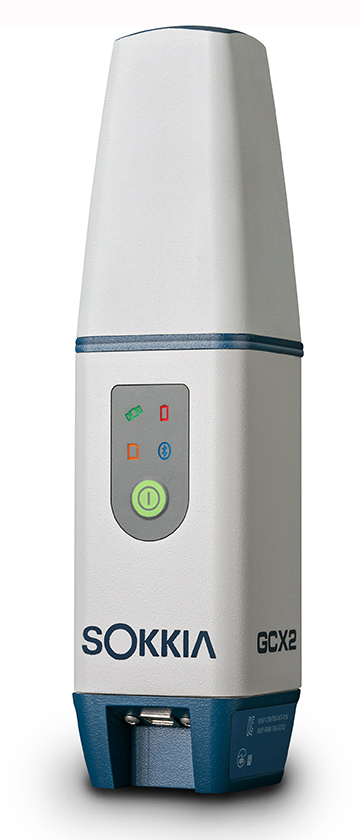
    TerraGo Magic now offers advanced integration and support for the Sokkia line of GNSS receivers, including the new GCX3.

    TerraGo Magic is a zero-code platform-as-a-service that enables customers to build their own custom mobile apps without writing any code by choosing from a menu of available, field-tested features.

    Featuring advanced constellation tracking and longer range base to rover communication, the GCX3 offers lightweight, compact and ergonomic benefits — along with centimeter-accurate positioning — now with expanded satellite tracking capabilities.

    “The GCX3 features the new second generation POST2 integrated antenna – adding BeiDou, Galileo, SBAS, QZSS, and GAGAN satellite tracking in addition to GPS and GLONASS to provide users with the best positioning availability,” said Jason Tuck, branch manager at Topcon Solutions. “With TerraGo Magic, users can build their fully customized apps, tailored for their specific industry requirements and capture high-precision data in real-time from the receiver.”

    “TerraGo Magic custom apps combined with the Sokkia GCX3 receiver is a superior solution for our partners and customers in utility, energy and other industries that require high-accuracy data collection,” said John Timar, vice president of worldwide sales at TerraGo. “Our integration makes it possible to capture the full fidelity and GPS data record with a user experience and modern mobile features unmatched by legacy GPS data collectors.”

  • Launchpad: Automated modules, drones, lasers

    Launchpad: Automated modules, drones, lasers

    OEM

    Automobile module

    Supports integration of telematics, managed services

    The LE940A9 automotive-grade smart module supports LTE Advanced Category 9 (Cat 9) networks. It comes in three multi-band, multi-mode variants, including Voice-over-LTE (VoLTE), and is optimized for automobile manufacturers to deploy next-generation connected car technology in world markets. It features worldwide GNSS support including GPS, GLONASS, Galileo, Beidou and QZSS. The LE940A9 delivers 450-Mbps download and 50-Mbps upload speeds with extremely low latency and advanced security, enabling the next wave of automobile industry’s applications and services that also serve as a springboard for autonomous driving.

    Telit, www.telit.com

    Refreshed board

    Low-power, high-precision, positioning and heading

    The refreshed Vector Eclipse H328 is designed for robotics, autonomous vehicles, antenna pointing, marine survey, machine control and any application where high-accuracy positioning and heading is required. The multi-frequency, multi-GNSS H328 is an all-signals receiver board that includes Hemisphere’s new and innovative hardware platform, reducing its overall cost, size, weight and power consumption. It also integrates the Atlas GNSS Global Correction Service. The H328 offers fast accuracy heading of better than 0.17 degrees at 0.5-meter antenna separation and aiding gyroscope and tilt sensors for temporary GNSS outages. The 60 x 100 millimeter module with 24-pin and 16-pin headers is a drop-in upgrade for existing designs using this industry standard form factor.

    Hemisphere GNSS, www.hemispheregnss.com

    Personal mobility

    Wheelchair with embedded 3G module can be upgraded with GNSS

    A cellular module is embedded in a personal mobility wheelchair built by WHILL, a Japanese company specializing in innovative products for the mobility industry. The WHILL Model C features cloud connectivity based on a 3G cellular module from u‑blox. The embedded module features worldwide UMTS/HSPA and GPRS/EDGE coverage with a small footprint, also enabling easy and cost‑effective bolting on of a u‑blox GNSS receiver such as the MAX‑7C. The personal electric vehicle combines a sleek design with the latest innovative functionalities, enabling users to live an active lifestyle. As WHILL is looking into autonomous driving for people with disabilities, u‑blox plans to contribute with wireless positioning and connectivity technology.

    WHILL KK, www.whill.jp; u-blox, www.u-blox.com

    GNSS for small cells

    Technology for 5G networks, IoT

    The OSA 5405 SyncReach is an integrated Precision Time Protocol (PTP) grandmaster and GNSS receiver with a patent-pending dual antenna and receiver to enable the mass roll out of small cells. The new technology has been engineered to provide accurate and affordable phase synchronization for the rapidly growing small-cell market and meet the stringent timing requirements of 4.5G and 5G connectivity. With the OSA 5405, operators can migrate from legacy GNSS RF antennas and cables to standard, cost-effective copper and fiber Ethernet cabling, reducing capital expenditure and operating expenses. Available in both indoor and outdoor variants, the OSA 5405 can be deployed in challenging environments, including urban canyons where GPS signals fail or positioned on indoor windows to avoid multipath signal interference from objects in the building.

    Oscilloquartz, www.oscilloquartz.com

    LPWA with GNSS

    Global, dual-mode low-power wide-area (LPWA) cellular module

    The AirPrime WP77 smart wireless modules simplify LPWA deployments for customers developing products that need to connect to multiple networks where different LPWA technologies are supported.

    With integrated GNSS for tracking and location-based services, low-power modes and a comprehensive set of interfaces for connecting sensors and companion chips (including Wi-Fi and Bluetooth), customers can develop multi-service platforms for the transportation market, and use the WP77 for applications requiring low throughput and optimized power performance. The WP77 supports both LTE-M (Cat-M1) and NB-IoT (Cat-NB1) with optional 2G fallback, allowing customers to deploy the same device with multiple network operators worldwide. For those deploying in regions where 4G LTE coverage is not as widely available, 2G fallback ensures their devices stay connected to the network.

    Sierra Wireless, www.sierrawireless.com

    GNSS-aided ins

    Absolute orientation for devices

    The INS-T-306 module is a GNSS-aided inertial navigation system that combines GPS L1/L2, GLONASS, BeiDou and a high-performance strap-down system. It is capable of determining position, velocity and absolute orientation (heading, pitch and roll) for any device on which it is mounted. The INS-T-306 aims at facilitating motionless and dynamic applications that need high accuracy, such as vessels, ships, helicopters, unmanned aerial vehicles (UAVs) and unmanned ground vehicles (UGVs). The INS-T-306 uses an advanced GNSS receiver, barometer, magnetometers, micro-electro-mechanical (MEMS) accelerometers and gyroscopes to provide accurate position, velocity, heading, pitch and roll of the device under measure. The unit supports differential GPS (DGPS) and real-time kinematic (RTK). It is able to integrate into the lidar brands Velodyne, Riegl and Faro.

    Tersus GNSS, www.tersus-gnss.com

    UAV

    UAV detection

    Effective detection and neutralization of drones

    The SafeSky multi-sensor UAV detection and tracking system detects and neutralizes drones in any weather, providing true dome-like protection. A combination of proprietary radar, acoustic, vision and RF sensors enables minimized alarm-rates detection of small drones at a distance of at least 1,000 meters. Its miniaturized, low-power radars are based on proprietary space technology developed with the European Space Agency. All sensors data is fused and the result presented in an integrated software environment. No-drone zones are easily defined. Alarms are issued via SMS, email and in graphical and sound form. The SafeSky application is web-based and can be run on desktop computers and tablets for untethered operation. To neutralize drones, the system uses directive jammers or drone hacking (depending on regulations), forcing the drone to return to its operator or land safely in a controlled manner.

    Advanced Protection Systems, www.detectdrones.com

    Fixed-wing drone

    Large area survey tool

    The DATAhawk PPK is an ultra-high accuracy fixed-wing drone package designed for professional surveyors that need maximum geospatial precision. It provides absolute (not relative) survey-grade results within minutes. The drone produces repeatable results. It is equipped with a dual-frequency L1/L2 receiver tracking GPS and GLONASS; 132 hardware channels allow simultaneous tracking of all visible GPS/GLONASS satellites. This system allows the aircraft to fly much further than with an RTK system, once flight camera positions are corrected by combining GNSS recordings of the aircraft with the corresponding information of the reference base station on the ground. The UAV is free of the requirement of a separate, high bandwidth, GPS link to a base station.

    Quest UAV, www.questuav.com

    Light imager

    Dual thermal and visible sensor drone camera

    The FLIR Duo is the same size and shape as popular action cameras, but features advanced capabilities. Equipped with FLIR’s smallest and lightest Lepton thermal camera core, operators are no longer constrained by daylight. The Duo provides the power to see objects over 100 yards away in complete darkness, smoke and light fog. Equipped with a 160 x 120 thermal camera and High-Definition (HD) 1080 color camera, FLIR Duo allows operators to swap between the two cameras mid-flight or view both in a picture-in-picture mode via the FLIR UAS app. FLIR’s proprietary multi-spectral dynamic (MSX) image processing algorithm embosses the thermal image with key details from the visible camera, resulting in a sharp dual-spectrum image. A fully radiometric variant called Duo R delivers accurate, calibrated temperature measurements in every pixel.

    FLIR, www.flir.com

    Drone deterrence

    Technology without electronic jamming is safe for urban areas

    ApolloShield is a radio system that detects and drives unauthorized drones away at the push of a button. Its RF jammers are field-proven, immediately deployable devices that emit strong signals that break the communications of unwanted drones, driving them away from secure sites. Drone identities are extracted from the radio signal and can be used as a lead to catch the operator. ApolloShield is customizable so that every site will have optimal protection, yet is plug-and-play and can be deployed in a few hours at any location and operated without any special training. The system consists of several elements, including an omni-directional antenna, a signal processing unit (pictured), and the Cloud Control Center that can be accessed from any cloud-connected device (pictured). ApolloShield is designed for various threat scenarios, including surveillance, accident response, terrorism, and incarceration violations using drones.

    ApolloShield, www.apolloshield.com

    Collision-tolerant UAV

    Reduces accidents and injuries

    The Elios drone solves the challenge of flying drones indoors in complex and confined spaces or in contact with humans, reducing the risk of collisions and injuries. By enabling remote visual inspection in any indoor environments, Elios eliminates the need for workers to enter hazardous places or face dangerous situations. The protective carbon-fiber frame is collision-tolerant up to 15 km/h. Elios reduces downtime and performs an entire inspection in hours, eliminating the need for scaffolding, rope access, or cranes for visual inspections of difficult-to-reach areas. Its integrated payload includes simultaneous full HD and thermal imagery recording, and adjustable tilt angle.

    Flyability, www.flyability.com

    Navigation kit

    RTK GNSS for pixhawk drones

    The Here+ RTK GNSS kit is an open source drone navigation kit. It is built around u‑blox’ NEO‑M8P high-precision real-time kinematic (RTK) GNSS module. Supported by Ardupilot out of the box, the kit consists of a round rover designed to be mounted on the drone and is connected to the flight controller using a supplied 8‑pin CLIK-mate connector (for the autopilot Pixhawk2) or an optional 4 pin + 6 pin DF13 connector (for the Pixhawk1). The base station with its smaller GNSS receiver and an external antenna complete the equipment. The open-source drone technology is intended to reach a larger community and assist drone companies with affordable accessories for applications such as agriculture, powerline inspection, precision farming, logistics and 3D mapping.

    HEX, www.hex.aero

    Agriculture sensor

    Customizable filters allow for unique crop health detection

    The Quad Sensor features four fully customizable imagers for collecting precision agriculture data. In its standard configuration, the sensors offer standard normalized difference vegetation index (NDVI), green NDVI, normalized difference red edge (NDRE) and high-resolution color data capture in a single flight. Simultaneous collection of NDVI and NDRE data provides users with informative, accurate insights about crop health while streamlining operations. Custom filtering options provide virtually limitless configuration options. Because the Quad Sensor allows targeting of specific vegetative indices, it is being used by universities, researchers, large growers and agriculture advisors.

    Sentera, www.sentera.com

    Auto-follow camera drone

    Autonomous drone takes flight

    The Airdog ADII builds on the high-performance elements of the original Airdog drone. It combines advanced intelligent tracking technology with a durable design and autonomous, all-terrain flight performance. Built for hands-free operation, the ADII eliminates the need for manned operation, giving the user complete active freedom with perfect content capture. Customizable flight trajectories allow for more dynamic angles and obstacle avoidance, and scenic-capture modes provide unique filming perspectives. Its pro-grade camera stabilization and auto-record system guarantee smooth, framed, professional-grade footage even in challenging environments, such as high speeds, wind, water and abrupt elevation and terrain changes. The durable, lightweight, waterproof AirLeash tracking device allows for hands-free action with simple controls. The backlit LCD interface is loaded with easy flight, start-up tutorials and preset, sport and customizable modes plus a series of automated creative modes for capturing scenery.

    Airdog, www.airdog.com

    Onboard Defense

    Micro Electronic Defense System (OMEDS) for drones, robots

    The Pyramid installs easily to fully secure a drone or robot, add system robustness, and provide data for better planning and execution of missions. The Pyramid provides three layers of functionality: advanced security for the system and data with real-time full system encryption and GPS spoofing protection; operational reliability and robustness with RF link redundancy; and mission-enhancing benefits of RF mapping provided by collection and analysis of big data. RF mapping visually maps the datalink’s RSSI and GPS reception for better mission planning and execution. This enables better, safer, continuous autonomous operation in all environments. It includes virus and malware protection, and full system encryption for remote-control, telemetry and video links. Pyramid weighs about 1 ounce (30 grams), measures 2 inches (5 cm) and has no effect on a system’s performance. Regulus is offering a test and evaluation program to customers.

    ​​Regulus Cyber, www.regulusx.com

    UAS mapping software

    Cloud support added

    Version 17.1 of the UAS Mapping desktop product now includes an upload-to-the-cloud feature. The upgrade includes the capability to upload any UAS Mapping content to a SaaS-based sharing and collaboration platform. Users can instantly bring their drone/UAS/UAV data online. The upload process is fluently integrated in the workflows of the product, with the required checks and validations. Upload time depends on the internet connection. Once uploaded, the data is immediately available for sharing on 3dmapping.cloud. The new Catalog tool adds insight and overview of all data-collection jobs.

    Orbit GT, www.orbitgt.com

    Survey & Mapping

    Survey-grade laser

    For field data collection and mapping

    The TruPoint 300 is a fully integrated laser with vertical and horizontal angle encoders capable of producing 3-D, survey-grade measurements. It produces +/–1 millimeter range accuracy. The phase-technology product has a laser diode that emits light pulses with a distinct wavelength and pulse repetition frequency that obtains millimeter accuracy. The fully integrated MapStar Angle Technology makes the Trupoint 300 suitable for GIS, incident mapping, crush analysis, surveying, electric utilities, architecture and construction. It will measure the distance between two remote points and has onboard solutions for volume, height, 2D and 3D area. Professionals can navigate through measured data, routines and menus with a full-color touchscreen.

    Laser Technology Inc., www.lasertech.com

    Surveying application

    Enables custom app design for Android and iOS

    TerraGo Magic is a custom app designed for both iOS and Android platforms that simplifies the process of designing a custom application for specific clients and needs.Surveying firms can install this tool in their mobile device to enable the specific collection and sharing of important data that can vary as needed. The data can overlay Google and Apple Maps and allow attachments of images and video. The app avoids the time-consuming coding process, and can significantly improve workflow for many firms.

    TerraGo, www.terragotech.com

    Rugged receiver

    For harsh construction environments

    The Vector VR1000 GNSS receiver enables better positioning for machine control applications. Designed specifically for harsh construction environments, the Vector VR1000 — when combined with SiteMatrix software — can empower heavy equipment manufacturers to provide their own machine control and guidance solutions to their customers. It also has a new web user interface. The multi-frequency, multi-GNSS receiver offers real-time kinematic (RTK) positioning and high-precision heading. It has an Athena RTK engine, Atlas L-band corrections and excellent connectivity. With a baseline separation up to 10 meters, users can achieve heading accuracies of up to 0.01 degrees. The 744-channel VR1000 tracks GPS, GLONASS, BeiDou, Galileo, QZSS and IRNSS. Its connectivity features support Ethernet, CAN, internal 400-MHz/900-MHz radio, serial, Bluetooth and Wi-Fi. Integrated L-band adds support for Atlas GNSS global corrections for meter- to sub-decimeter-level accuracy.

    Hemisphere GNSS, www.hemispheregnss.com

    Imaging scanner

    Miniaturized for quick collection of as-built reality-capture data

    The BLK360 miniaturized 3D imaging laser scanner simplifies collection of as-built reality-capture data for work in architecture, design, construction and engineering, among other vertical markets. It is an easy-to-use and powerful device that enables professionals to capture 360-degree high-dynamic range (HDR) spherical imagery within minutes. Users place the lightweight BLK360 on a level surface or tripod and, with the push of a button, it captures 360-degree HDR spherical imagery and takes a 360,000 points per second laser scan. The BLK360 features +/–4 mm accuracy at 10 meters and an overall 0.6–60-meter range. Within three minutes, the spherical image and laser scan is completed and ready to view in the Autodesk ReCap Pro for mobile app, which runs on an iPad Pro. From there, users can take measurements, add markup and annotations or share onsite data with their colleagues back in the office.

    Leica Geosystems, lasers.leica-geosystems.com

  • Kansas utility finds new workflow solutions

    Water, Water, Where?

    WaterOne found itself stuck in the past. The independent public utility knew that its workflow for collecting geospatial data was broken.

    WaterOne serves a 272-square-mile area on the Kansas side of the Kansas City, Missouri, metropolitan area, which has a population of 420,000, 145,000 metered accounts and 2,685 miles of water pipes. The survey/geospatial staff consisted of three analysts, two editors, one programmer and one GPS collector. By 2016, less than 40 percent of the water features had been captured with GPS.

    The staff was using legacy GNSS handhelds — operators had to return to the office every night and physically download their data.

    Besides being time-consuming, the operators would become frustrated by the antiquated system. Sometimes the handhelds wouldn’t sync to the computer, or files for download would be hard to find. Also, the GNSS handhelds had a tiny screen, making it difficult for operators to see background data in the field. The handhelds’ limited computing power meant the entire water system couldn’t be loaded onto it.

    WaterOne turned to a new workflow using Panasonic ToughPad tablet computers and Eos Positioning Systems’ Arrow 200 RTK GNSS receivers mounted on a range pole (see photo).

    The Arrow 200 receiver connects to the Panasonic ToughPad via wireless Bluetooth link. The ToughPad has a Verizon SIM card for internet connectivity, used for two purposes:

    • Connecting to the Missouri Department of Transportation RTK network to receive RTK corrections for centimeter accuracy;
    • Connecting to the WaterOne ArcGIS server in real time from the field.

    Whenever the field tech collects data, the data syncs up with ArcGIS server. This eliminates the task of having to physically download the data at the end of the day.

    The new workflow also provides near real-time updates to WaterOne’s geospatial information system. This means that if five techs are in the field collecting data, they can each see the map updated in near real time.

    The ToughPad tablets have a large, sunlight-readable 10-inch display. The large displays combined with the new data-collection software allows the field techs to view the entire GIS water system on the tablets. The field tech can now “see” all of the water system assets — pipes, valves, fittings, hydrants — around them. This significantly improves productivity over the legacy GNSS handhelds.

    Street maps and aerial photos were loaded on the ToughPad to give the field techs a choice of background data to view.

    The result? Compared to the 1,767 GPS points collected in 2016, the WaterOne team has collected 5,770 just in the first four months of 2017.

  • UNICEF UAS vaccine delivery trial takes place this month

    UNICEF and the Vanuatu government have selected Martek Marine to demonstrate UAV use for vaccine delivery. Martek will fund the trial, which will take place on Efate Island Aug. 21–25.

    Vanuatu is an archipelago of 83 islands —  65 of which are inhabited — that stretch 1,600 kilometers. Many islands are only accessed by boat, and mobile vaccination teams are frequently required to walk to communities carrying needed equipment to undertake vaccinations of children and communities in remote areas. The climate, lack of infrastructure and topography make this an arduous task.

    The trial aims to assess technologies and proven safe operators that can help reduce the vaccine supply chain disruption and enhance service delivery, without requiring massive investment in infrastructure and transport. It will also provide the opportunity to explore and understand the wider application and potential of UAVs in the Pacific region long term.