Author: Tracy Cozzens

  • GPS Directorate requests additional public comment

    Following the 2018 Public Interface Control Working Group (ICWG) in September, the GPS Directorate invites additional public comments on the following Proposed Interface Revision Notices (PIRNs) due to the nature of changes since the June 2018 review.

    The documents are available in the Public ICWG section of GPS.gov.

    • PIRN-IS-200J-001, v2: NAVSTAR GPS Space Segment / Navigation User Interface
    • PIRN-IS-705E-001, v2: NAVSTAR GPS Space Segment / User Segment L5 Interface
    • PIRN-IS-800E-001, v2: NAVSTAR GPS Space Segment / User Segment L1C Interface
    • PIRN-ICD-240B-001, v2: NAVSTAR GPS Control Segment to User Support Community Interface
    • PIRN-ICD-870C-001, v2: NAVSTAR GPS Control Segment to User Support Community Interface

    Comments are due Dec. 18. Submit all comments following the directions found on GPS.gov.

    The minutes for the 2018 Public Interface Control Working Group (ICWG) held in September are also available on GPS.gov.

  • First GPS III satellite encapsulated for Dec. 18 SpaceX launch

    First GPS III satellite encapsulated for Dec. 18 SpaceX launch

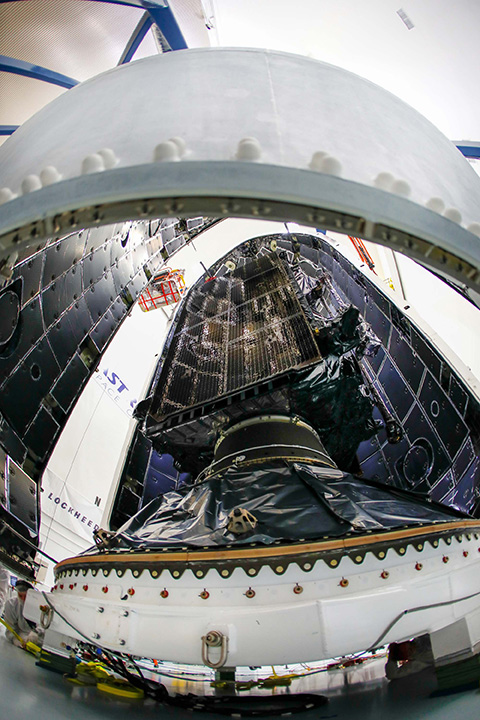
    GPS III SV01 is now encapsulated and awaiting launch scheduled for Dec. 18. (Photo: Lockheed Martin)
    GPS III SV01 is now encapsulated and will be placed on the SpaceX rocket for Dec. 18 launch. (Photo: Lockheed Martin)

    The U.S. Air Force’s first Lockheed Martin-built GPS III satellite is now encapsulated for its planned Dec. 18 launch from Cape Canaveral Air Force Station, Florida, on a SpaceX Falcon 9 rocket.

    GPS III Space Vehicle 01 (GPS III SV01) underwent pre-launch processing, fueling and encapsulation at Astrotech Space Operations in Titusville, Florida. During encapsulation, GPS III SV01 was sealed in its launch fairing — an aerodynamic, nose-cone shell that protects the satellite during launch.

    In the coming days, the fairing-enclosed satellite will be mounted to the rocket as launch preparations continue.

    GPS III SV01 is the first of an entirely new design of GPS satellite that will help the Air Force modernize today’s GPS constellation with new technology and advanced capabilities.

    GPS III has three times better accuracy and up to eight times improved anti-jamming capabilities. Spacecraft life will extend to 15 years, 25 percent longer than any of the GPS satellites on-orbit today. GPS III’s new L1C civil signal also will make it the first GPS satellite broadcasting a compatible signal with other international global navigation satellite systems, like Galileo, improving connectivity for civilian users.

    “The world is dependent on GPS. More than four billion military, commercial and civilian users connect with signals generated by GPS satellites every day,” said Johnathon Caldwell, Lockheed Martin’s vice president for Navigation Systems. “The launch of GPS III SV01 will be the first step in modernizing the Air Force’s GPS constellation with the most powerful and resilient GPS satellites ever designed and built.”

    Lockheed Martin developed GPS III and manufactured GPS III SV01 at its advanced $128-million GPS III Processing Facility near Denver. In September 2017, the Air Force declared the satellite “Available for Launch” (AFL) and had the company place it into storage.

    In 2017, the Air Force “called up” the satellite for launch and Lockheed Martin delivered it to Florida on Aug. 20. The Air Force nicknamed the satellite “Vespucci” after Italian explorer Amerigo Vespucci.

    GPS III SV01 is the first of 10 GPS III satellites originally ordered by the Air Force. GPS III SV03-08 are now in various stages of assembly and test. In August, the Air Force declared the second GPS III “AFL” and, in November, called GPS III SV02 up for 2019 launch.

    In September, the Air Force selected Lockheed Martin for the GPS III Follow On (GPS IIIF) program, an estimated $7.2 billion opportunity to build up to 22 additional GPS IIIF satellites with additional capabilities.

    GPS IIIF builds off Lockheed Martin’s existing modular GPS III, which was designed to evolve with new technology and changing mission needs. On Sept. 26, the Air Force awarded Lockheed Martin a $1.4 billion contract for support to start up the program and to contract the 11th and 12th GPS III satellite.

  • Russia company makes drones for Arctic work

    Russia company makes drones for Arctic work

    Photo: Zala Aero
    Photo: Zala Aero

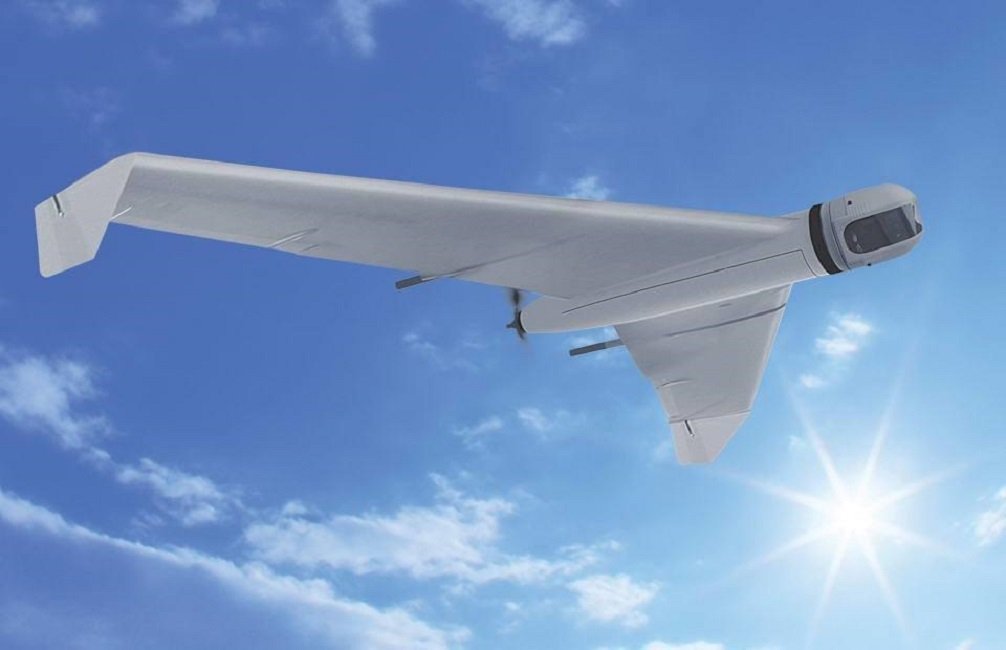
    The ZALA Arctic drones are capable of successfully solving both civilian and military tasks, according to maker Kalashnikov.

    Russian small arms manufacturer Kalashnikov presented the ZALA Arctic unmanned aerial vehicle (UAV) adapted for work in Arctic latitudes at the eighth international forum, “The Arctic: the Present and the Future,” reports Russian state news agency TASS.

    The drone has its own GIRSAM alternative navigation system developed specially for the navigation of both UAVs and the ground-and water-based users amid the suppression or the absence of GPS or GLONASS signals.

    The ZALA 421-08M and ZALA 421-16E systems are suited for their operation at freezing temperatures, which makes it possible to carry out numerous surveillance operations and regularly monitor the ice. The ZALA Arctic’s capabilities facilitate oil and gas extraction planning in areas where accurate weather and ice situation forecasts are required, according to the Kalashnikov website.

    ZALA drones are equipped with the AIS system capable of detecting and identifying vessels at a distance of up to 100 kilometers, which exceeds the operational range of ground-based equipment. The user of the ZALA Arctic system receives information about each vessel: its name, size, course and speed.

    The operators can autonomously live in the Arctic in a specially developed all-weather living module based on a marine 200-feet container. It is also designed for maintenance of unmanned aerial vehicles at the place of their operation.

    “ZALA Arctic drones are capable of successfully solving civilian and military tasks for carrying out research in the Arctic zone, providing for the safety of sea shipping and the round-the-clock protection of the perimeters, organizing the full-fledged system of tracking the Arctic coast and territorial waters,” Kalashnikov Group CEO Vladimir Dmitriyev was quoted as saying.

    The forum, “The Arctic: the Present and the Future,” organized by the Association of Polar Explorers, took place Dec. 5-7 in St. Petersburg.

  • U.S. Air Force chooses Collins Aerospace GPS anti-jam receiver

    U.S. Air Force chooses Collins Aerospace GPS anti-jam receiver

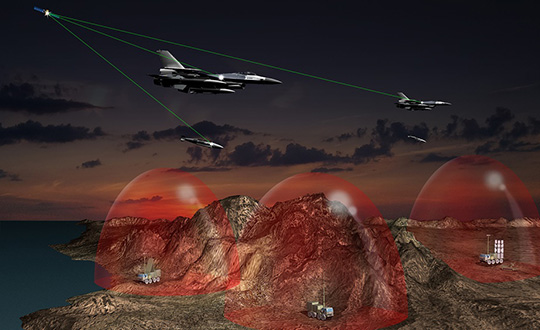
    The U.S. Air Force has selected an anti-jam GPS receiver from Collins Aerospace (through the division formerly known as Rockwell Collins) for Air National Guard and Air Force Reserve F-16 fighter aircraft.

    The U.S. Air Force Life Cycle Management Center (USAF AFLCMC) chose Collins Aerospace to supply its latest-generation Digital GPS Anti-Jam Receiver (DIGAR), designed to prevent jamming of GPS signals.

    The DIGAR receivers will provide highly reliable navigation for U.S. Air National Guard and U.S. Air Force Reserve F-16 aircraft operating in contested, electromagnetic environments.

    This will be the first combat fighter aircraft to be installed with the latest version of the receiver.

    “As enemies continue to find new ways to affect the ability to navigate, the latest DIGAR will provide the highest level of protection available so our warfighters can execute missions with precision and accuracy,” said Troy Brunk, vice president and general manager, Communication, Navigation & Electronic Warfare Solutions for Collins Aerospace.

    Image: Rockwell Collins
    Image: Collins Aerospace

    Integration of the DIGAR requires no changes to existing operational flight programs or A-kit aircraft wiring, lowering the risk and cost involved to upgrade.

    Built on an open systems architecture, the DIGAR is designed for use across a variety of aircraft platforms that include rotary wing, fixed-wing fighter, bomber, transport aircraft and small to large unmanned aerial systems.

    DIGAR is a form, fit replacement for existing antenna electronic systems with demonstrated performance that exceeds legacy capability, the company said.

    DIGAR Features

    • Superior digital beamforming or nulling anti-jam
    • Up to 16 simultaneous beams for superior jamming immunity to 125+ dB J/S performance (beamsteering mode, actual performance is classified.)
    • Two- to seven-element CRPA compatible
    • Simultaneous L1/L2 protection
    • Supports Y-code and M-code Anti-jam
    • Supports STAP/SFAP beamforming
    • Two form factors: DIGAR-200 (218 cubic inches) or DIGAR-300 (75 cubic inches)
    • Supports retrofit AE-1/GAS-1/ADAP platforms


  • Port of Amsterdam trials GPS-based UAV monitoring system

    The M.A.D.S. radomes track drones at the port, so they can be identified as beneficial or a threat. (Photo: Martek)
    The M.A.D.S. radomes track drones at the port, so they can be identified as beneficial or a threat. (Photo: Martek)

    The Port of Amsterdam has begun a four-week trial of a drone detection system. Martek Anti-Drone Systems is providing its M.A.D.S. (Marine Anti-Drone System) to build understanding of how, where and why drones are flying over the Port of Amsterdam.

    The M.A.D.S system will support the port by monitoring legal and illegal flying across its land. The system detects and identifies drones within a 5-kilometer range, providing GPS positioning of both drone and pilot together with the drone’s speed and heading.

    Configurable and escalating stage alarms in real time allow the drones’ intentions to be assessed in time to decide on appropriate defense actions.

    M.A.D.S. radomes are installed around the Port of Amsterdam. (Photo: Martek)
    M.A.D.S. radomes are installed around the Port of Amsterdam. (Photo: Martek)

    The data collected from the trial will have far-reaching influence on the future use of UAVs (unmanned aerial vehicles) across the 650-hectare port area, according to Martek.

    The port has identified the potential of drones for numerous use applications across its operations and its customers’ operations. Many port customers are preparing to use drones for infrastructure inspection and measurement of environmental parameters. The trial will monitor their use.

    Project manager of  innovation Joost Zuidema is overseeing the trial for the Port Authority. “This trial is an important part of our innovation strategy,” Zuidema said. “The M.A.D.S system gives us a first opportunity to get a feeling for the technology that will help us understand drone usage and make a first assessment on unwanted drone flights in a part of our port.”

    Like any tool, drones are being used for good as well as malevolent purposes. There is a potential threat to transport such as container ships and major infrastructure, such as ports, around the world. Threats include:

    • privacy invasion
    • terrorism threats of explosives or gas attack
    • flyby hacking to take control of autonomous or semi-autonomous systems
    • stealing valuable data off unprotected networks or breaking into insecure networks
    Infographic: Martek:
    Infographic: Martek:

    “As the Port Authority, we do want ensure drone flights in our port are carried out safely and responsibly, within the laws and regulations,” Zuidema said.

    “The growing trend for the use of UAVs being used on ports, commercial shipping and super yachts is, as yet, not fully recognised by authorities,” said Erik Van Wilsum, Martek. “We are delighted to be working with Port of Amsterdam, who are on the cutting edge of developing technology to understand the opportunities for drone use and the potential threats and benefits they can provide for key national infrastructure.”

    A report by International Data Corporation stated that it expected worldwide investment in drones to be US$12.3 billion in 2019, with drone purchase growing nearly twice as fast as the investment in robotics over the same period.

  • GPS reveals Antarctic bedrock rising

    The entirety of West Antarctica contains enough ice that, if it were to melt, would cause oceans to rise 10 feet. While the West Antarctic ice sheet is at risk of collapse, GPS data suggests this crisis could be averted because the bedrock supporting it is rising.

    Using GPS, an international team of researchers found that the viscosity of the mantle under the West Antarctic Ice Sheet is much lower than expected, with the crust rebounding faster than expected, possibly stabilizing against catastrophic collapse. According to the study, in 100 years, the uplift rates at the GPS sites will be 2.5 to 3.5 times more rapid than currently observed.

    Backer Islands GPS station: The small mushroom-shaped GPS antenna is supported by the nearby equipment with solar panels. (Photo: David Saddler via Colorado State University)
    Backer Islands GPS station: The small mushroom-shaped GPS antenna is supported by the nearby equipment with solar panels. (Photo: David Saddler via Colorado State University)

    Participating researchers led by scientists at the Ohio State University installed a series of GPS stations on rock outcrops around the region to measure the Earth’s rise in response to thinning ice. Measurements showed that the bedrock uplift rates near the coast of West Antarctica were as high as 1.6 inches per year, one of the fastest rates ever recorded in glacial areas.

    “This very rapid uplift may slow the runaway wasting and eventual collapse of the ice sheet,” said Rick Aster, a co-author of the study from Colorado State University. Nevertheless, Aster told the UK’s Independent, “To keep global sea levels from rising more than a few feet during this century and beyond, we must still limit greenhouse gas concentrations in the atmosphere, which can only occur through international cooperation and innovation.”

    The team also included DTU Space. Study results were published in the journal Science.

  • Lidar data fused for understanding of tropical forests

    A University of Queensland, Australia, environmental project fused data from terrestrial and UAV lidar collections to estimate forest biomass.

    Forest ecosystems contain more biomass than any other ecosystem. Estimating biomass — a critical endeavor to detect the health of ecosystems — can be difficult. Traditional methods can be destructive, such as harvesting trees to measure the weight of the different components.

    “We know that forest ecosystems contain more carbon biomass than any other above-ground ecosystem on the planet,” said Kim Calders, Ghent University, on the TERN website. TERN is Australia’s land ecosystem observatory, under the University of Queensland.

    It’s estimated that Australian forests store about 10 billion tonnes of carbon, but calculating an exact figure without cutting down trees is difficult. “Traditional methods of estimating aboveground biomass are based on volumes calculated from cut trees and expensive field measurements of tree diameter and height,” Calders said.

    Enter 3D-FOREST

    The three-year 3D-FOREST project is funded by the Belgian Federal Science Policy Office led by Calders and Hans Verbeeck from Ghent University, partnering with Harm Bartholomeus and Martin Herold from Wageningen University.

    Tracking progress towards meeting major global environmental agreements and targets, such as the United Nations’ Sustainable Development Goals and The Paris Agreement, require detailed accounts of carbon stocks and how they’re changing over time.

    To meet this need, the 3D-FOREST project is developing new on-ground remote sensing techniques to measure biomass and forest structure and validate global-scale satellite measurements.

    “The concept of the project is to capture data to create ‘virtual forests’ with high level detail,” Calders said. “The combination of ‘bottom-up’ terrestrial laser scanning (TLS) and ‘top-down’ UAV lidar data improves biomass estimates and knowledge on how we can upscale plot-based measurements to the landscape level.”

    Harvesting virtual forests

    Representatives of the 3D-FOREST team undertook terrestrial laser scanning and UAV lidar data collection at three TERN sites: the TERN Litchfield Savanna SuperSite in the Northern Territory; the TERN Robson Creek SuperSite and the affiliate TERN Daintree Rainforest SuperSite in Queensland.

    Back in the lab, virtual 3D forests created from the lidar data are then ‘virtually harvested’. Quantitative structure models (QSM) digitally weigh individual trees by calculating their volume and converting this to carbon mass.

    “These 3D structural metrics and biomass estimates allow us to scale-up the spatial patterns of tree structure and evenness from the 1-hectare plot scale to entire forests,” Calders said. “This information is crucial for more efficient forest management, but also for better understanding of the spatial variation of forest structure in ecosystem models.”

    Scaling up to global carbon budgets

    As Europe’s, America’s and India’s space agencies get ready to launch satellites to measure and map the planet’s forests in high-resolution 3D, the value of on-ground and UAV lidar data collected by Calders’ team at TERN sites is even more apparent.

    The data from 3D-FOREST will be used to calibrate, validate and improve the accuracy of global bio-geophysical satellite data delivered by space missions including the European Space Agency’s BIOMASS, NASA’s GEDI, and the joint Indian Space Research Organisation and NASA NISAR.

    “The ability for these space missions to scale-up estimates of forest biomass to the global carbon budget and monitor ecosystem disturbances is dependent on the high-quality ground reference measurements collected at ecosystem research infrastructure sites, including TERN’s,” Calders said. “The emerging methods and technologies for data collection, and the speed of their development, are truly exciting.”

    The field campaign was made possible thanks to collaborations with the CSIRO, James Cook University and the Australian Government Department of Environment and Energy.

    For more information on the TERN Ecosystem Processes platform, its network of 12 open-access SuperSites and eddy covariance flux towers, and the data they collect, click here or explore the open data via TERN’s Data Discovery Portal.
  • Quectel’s new C-V2X module supports autonomous driving

    Quectel’s new C-V2X module supports autonomous driving

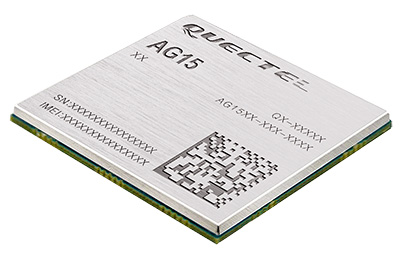
    Quectel Wireless Solutions has launched the automotive-grade C-V2X module AG15, which features the Qualcomm 9150 C-V2X chipset solution from Qualcomm Technologies, a subsidiary of Qualcomm Incorporated.

    Image: Quectel
    Image: Quectel

    The module is now sampling to the automotive industry for the development of commercial C-V2X products.

    The AG15 C-V2X module is manufactured in accordance to IATF 16949:2016 quality management system standard for the automotive sector, and it fully complies with the automotive product quality processes, including APQP and PPAP.

    Pairing with the Quectel automotive-grade LTE module AG35, Quectel’s AG15 is designed to meet the telematics and vehicle-to-everything (V2X) connectivity requirements of the next-generation automotive applications, such as autonomous driving and road safety.

    Also known as LTE-V2X, C-V2X is the V2X communication technology based on the globally recognized Third Generation Partnership Project (3GPP) Release 14 specifications. The PC5-based direct communication mode of C-V2X supports vehicle-to-vehicle (V2V), vehicle-to-infrastructure (V2I) and vehicle-to-pedestrian (V2P) communications on the 5.9-GHz intelligent transport system (ITS) spectrum.

    In addition, C-V2X paves a strong evolution path toward 5G new radio (5G NR) and plays an essential part of the future of safe autonomous driving with its capabilities including non-line-of-sight (NLOS) sensing to support high-speed mobility and high vehicular density deployments, the company said.

    For positioning function, the AG15 features a built-in multi-constellation high-precision GNSS (GPS/GLONASS/BeiDou/Galileo/QZSS) receiver, with additional support from satellite-based augmentation systems (SBAS) and Qualcomm 3D dead-reckoning technology, which greatly improves the positioning accuracy and speed while simplifying customer designs.

    Based on C-V2X technology, the Quectel AG15 module adopts the 3GPP Release 14 C-V2X PC5 protocol. It is designed to allow low-latency, highly reliable and highly dense data exchange between vehicles and their surroundings, enabling effective information sharing among road users in avoidance of collisions, thus improving automotive safety, automated driving and traffic efficiency.

    Without the need for a subscriber identity module (SIM), cellular subscription or network assistance, the C-V2X direct communication mode helps reduce complexity and cost for customers.

    Additionally, the Qualcomm 9150 C-V2X chipset solution has a built in A7 application processor (1.5 GHz), which could be potentially utilized to run ITS stack and associated C-V2X applications.

    “We are very pleased to introduce our first batch of automotive grade C-V2X modules based on the Qualcomm 9150 chipset solution. Automated driving has unique requirements for V2X connectivity, such as lower latency, higher reliability and wider bandwidth, all of which could be addressed by C-V2X technology,” said Patrick Qian, CEO of Quectel. “Built upon Quectel’s expertise in connected vehicles and Qualcomm Technologies’ high-performance C-V2X chipset solution, the AG15 module is expected to help automakers and Tier 1 suppliers to effectively accelerate their efforts towards automated driving.”

    “Quectel is a global leader in cellular modules with rich experience in commercial automotive products,” said Nakul Duggal, vice president of product management, Qualcomm Technologies. “We are pleased to work closely with Quectel again to support its modules with our 9150 C-V2X chipset solution to help create safer and more efficient V2X solutions and to help empower road safety and autonomous driving. We look forward to working with Quectel in delivering the solutions required to address the needs of the next generation automobiles.”

  • New ESA facility puts satnav at the service of science

    New ESA facility puts satnav at the service of science

    News from the European Space Agency (ESA)

    Global satellite navigation systems are continuously bathing Earth in satnav signals. As well as helping in our daily lives, these signals are also tools for cutting-edge science. A new ESA facility, based at ESA’s astronomy centre near Madrid, is championing their use for everything from Earth monitoring to fundamental physics.

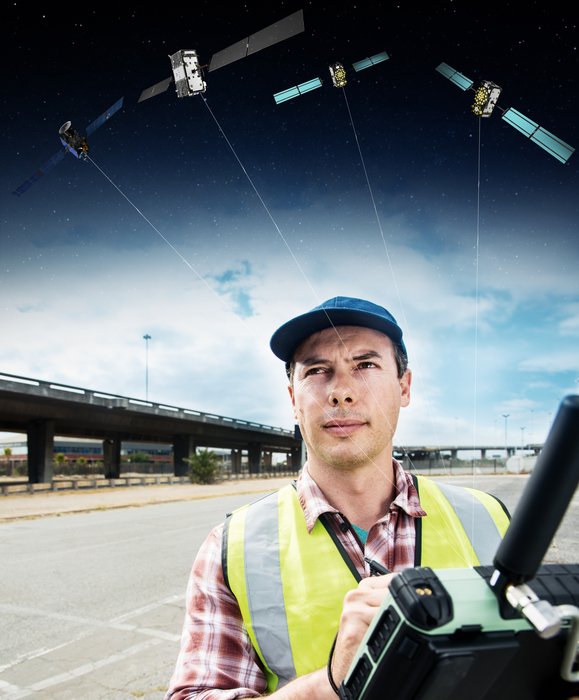
    A Surveyor uses a GNSS device to map urban assets with Galileo and EGNOS. (Image: ESA)
    A Surveyor uses a GNSS device to map urban assets with Galileo and EGNOS. (Image: ESA)

    The new ESA Global Navigation Satellite Systems (GNSS) Science Support Centre is based at ESA’s European Space Astronomy Centre, ESAC, near Madrid. Run by ESA’s Galileo Science Office, the GSSC integrates IT and satnav infrastructure to deliver advanced data processing services to the scientific community.

    Precisely timed to a few billionths of a second and highly stable, satnav signals can be used as a point of reference for many scientific sectors, including Earth and atmospheric sciences, astronomy, highly precise timing metrology as well as the study of relativity and other fundamental physics topics.

    Current satnav infrastructure plans worldwide should see more than 120 satnav satellites in orbit in coming years. This number includes Europe’s own Galileo constellation — offering unique features such as its highly stable passive hydrogen maser atomic clocks, multiple transmission frequencies, robust modulation, wide bandwidth and onboard laser retro-reflectors, which permit exact pinpointing of the satellites’ position in space down to a few tens of centimetres.

    “The potential of satnav for science has been recognised for a long time,” explains Javier Ventura-Traveset, Head of ESA’s Galileo Science Office. “The Galileo Science Office was set up in 2016 as a joint initiative between ESA’s Science and Navigation Directorates, coordinating scientific opportunities through interaction with the scientific community and the independent GNSS Science Advisory Committee.

    “The opening of the new centre is the next step. It is ESA’s concrete answer to the need expressed by the scientific community for a one-stop-shop to offer researchers long-term GNSS data, products information, results of scientific experiments, plus services to enhance GNSS scientific research and collaboration.

    “The future evolution of the centre will be driven by the interaction and feedback received from the scientific community, maximizing synergies with other GNSS data service providers from other institutions and research organization.”

    Among the activities to be supported by the new GSSC are big data processing of large amounts of satnav data, crowdsourcing as a means of weather monitoring and a scientific assessment of satnav performance in Antarctica.

    It also supports the continuing measurements of general relativity using Galileo satellites 5 and 6 and serves as a global data centre for the International GNSS Service. The long-established Navipedia website, giving technical information on satnav, is also hosted by the GSCC.

    One enthusiastic early adopter is ESA’s Navigation Support Office, based at ESA’s ESOC mission control centre in Darmstadt, Germany, lending support to mission teams making use of satnav to steer satellites.

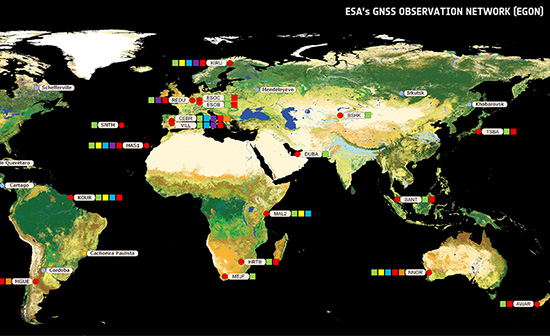
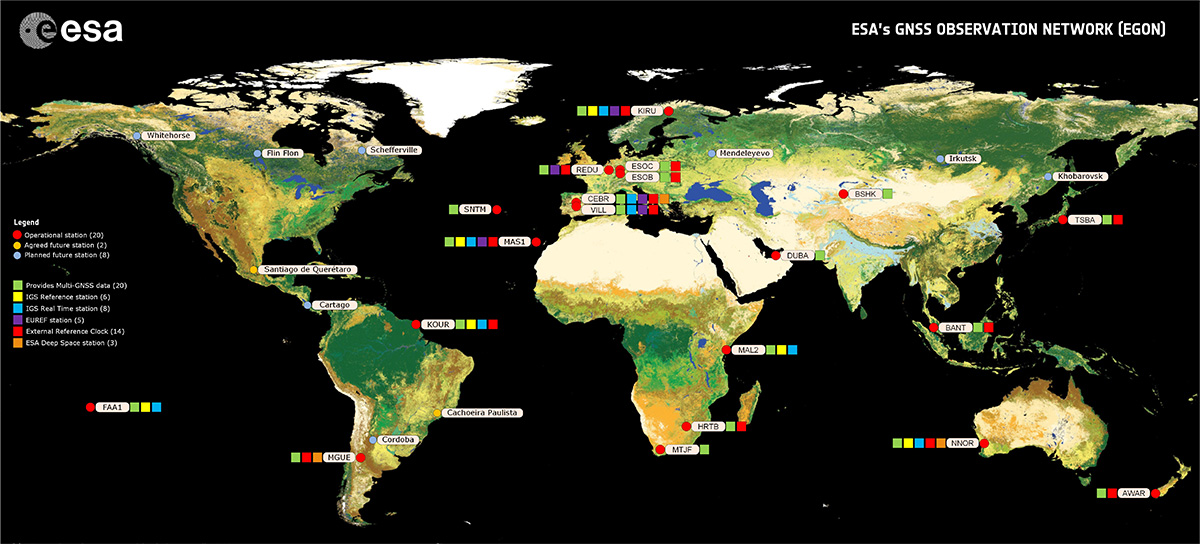
    ESA's GNSS Observation Network (EGON). (Image: ESA)
    ESA’s GNSS Observation Network (EGON). (Image: ESA)

    “The GSSC is a welcome addition to ESA’s activities in the science of satellite navigation,” says Werner Enderle, heading ESOC’s Navigation Support Office. “The GSSC already hosts GNSS products generated by the team at ESOC, including observations from our worldwide EGON GNSS Observation Network and precise satellite orbits generated by their state-of-the-art software. Our two teams look forward to this collaboration continuing for the benefit of ESA and the scientific community.”

    The GSSC will roll out access to data, products and services over the coming months.

  • Ag Leader launches GNSS smart antenna for precision agriculture

    Ag Leader launches GNSS smart antenna for precision agriculture

    Ag Leader has unveiled new guidance and steering solutions for precision agriculture, including a dual-antenna automated steering system and the latest in GNSS technology.

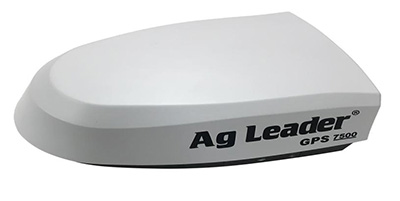
    The GPS 7500 GNSS smart antenna. (Photo: Ag Leader)
    The GPS 7500 GNSS smart antenna. (Photo: Ag Leader)

    The GPS 7500 is a field-ready, multi-frequency GNSS smart antenna providing the latest technology including access to multiple GNSS signals for up to sub-inch accuracy and increased performance in variable terrain.

    When combined with NovAtel’s TerraStar-C PRO differential correction service, GPS 7500 receives multi-constellation support for better satellite availability.

    A full range of performance accuracies are available from GLIDE to RTK, offering a variety of solutions for customers. Combined with SteerCommand, the GPS 7500 offers sub-inch real-time kinematic (RTK) accuracy using the Relay 400, Relay 900 or InCommand NTRIP Client.

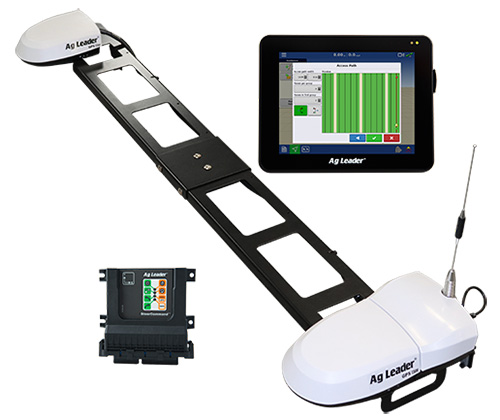
    The receivers with InCommand software. (Photo: Ag Leader)
    The receivers with InCommand software. (Photo: Ag Leader)

    Wi-Fi capability within GPS 7500 allows for base-station configuration from a smartphone or tablet.When uptime is valued over absolute accuracy, integrated StableLoc technology utilizes available correction signals to provide a seamless transition between correction sources — without position jumps — and maximize signal uptime.

    “SteerCommand with DualTrac brings a dual-antenna offering to the market that provides RTK accuracy and meets the needs of many farmers requiring high-accuracy automated steering at low speeds,” said Bill Cran, Ag Leader product specialist. “New GNSS technology in the GPS 7500 was leveraged to make this possible and also adds new satellite and correction offerings including TerraStar-C PRO.”

    The GPS 7500 supports the new TerraStar-C PRO service, available in 3-month and 12-month subscriptions. TerraStar-C PRO offers multi-constellation/multi-frequency positioning with greater accuracy, availability and reliability than before. Its convergence is 60-percent faster and accuracy 40-percent better than TerraStar-C to overcome challenging signal conditions such as multipath, shading, interference and scintillation.

    SteerCommand with DualTrac. Combining the GPS 7500 receivers with SteerCommand and InCommand displays offers automated steering control with sub-inch accuracy at ultra-low speed (as low as 0.05 mph). SteerCommand with DualTrac is designed for operations requiring precise steering such as planting or harvesting bedded crops, installing drip tape or planting and harvesting specialty crops. It provides a stable heading, even when the vehicle is not moving, as well as rapid line acquisition in forward or reverse.

  • Trimble announces new geospatial products at Dimensions conference

    Trimble announces new geospatial products at Dimensions conference

    Trimble introduced several new geospatial products at its annual Trimble Dimensions user conference, which took place Nov. 5-7 in Las Vegas.

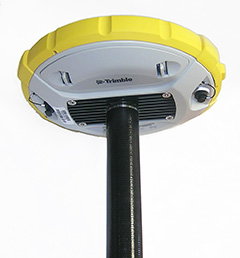
    The Trimble R4sLE GNSS receiver. (Photo: Trimble)
    The TrimbleR4sLE GNSS receiver. (Photo: Trimble)

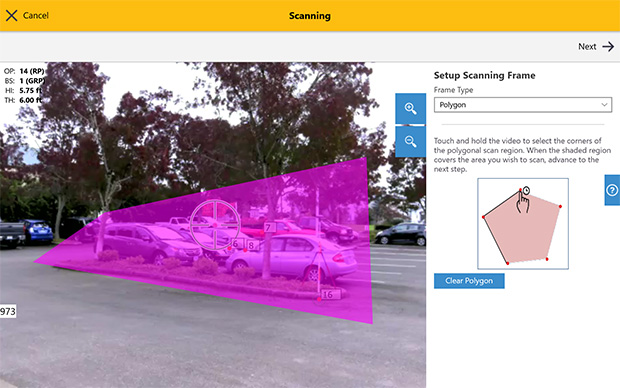
    Forensics GNSS Solution. The Trimble Forensics GNSS solution combines the Trimble T10 tablet or TDC100 handheld with the Trimble Forensics Capture software and the Trimble R4sLE GNSS receiver.

    The solution enhances forensics fieldwork by improving efficiency and broadening the range of data collection technologies available using the same, proven software. Trimble Forensics Capture software supports GNSS-based workflows and works with the Trimble R4sLE receiver, or any Trimble R-series receivers. Options for data collection now include GNSS, 3D scanners, total stations and unmanned aerial systems.

    Trimble Forensics Capture software. (Image: Trimble)
    Trimble Forensics Capture software. (Image: Trimble)

    Key features:

    • Forensics Capture field software, designed with the help of law enforcement, uses industry terminology and Wizard-based workflows, making it easy to learn and easy to use.
    • Built-in ground scaling and local coordinate system for every scene so there is no need for site calibrations.
    • Integrated surveying workflows for GNSS, Trimble SX10 or total stations.
    • Storage for all collected data within the same Capture file, including GNSS, total stations or the SX10.
    • An IP-67 rated Trimble R4sLE receiver, which is protected from dust and capable of withstanding water immersion up to a 1 meter for 30 minutes.

    The new solution is expected to available in December 2018.

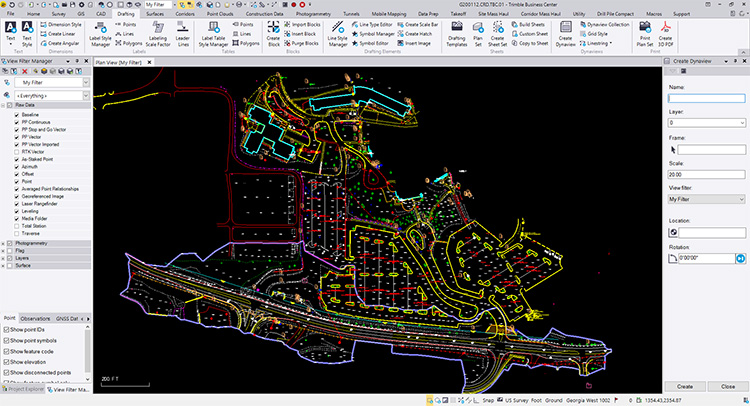
    Trimble Business Center v5.0. (Image: Trimble)
    Trimble Business Center v5.0. (Image: Trimble)

    New version of Business Center. Version 5.0 of Trimble Business Center merges two products, Trimble Business Center and Business Center – HCE, to provide both surveying and civil construction customers with a complete office software solution. Combining both products into one platform provides a larger set of tools and data interoperability between survey and construction workflows.

    New capabilities:

    • Support for mobile mapping and terrestrial scanning data from systems such as the Trimble MX9 mobile mapping system and the Trimble TX series terrestrial scanners.
    • Ability to combine high-quality flight data from Delair unmanned aerial systems (UAS) with other sensor data for the rapid creation of vivid orthomosaics and highly accurate surface models. Survey and construction professionals can now integrate these multi-sensor data types within the single software environment.
    • Intelligent new tools for the creation of computer-aided design (CAD) and geographic information system (GIS) deliverables, corridor inspection reports and tunnel as-built analysis from complex 3D point clouds.
    • The addition of automated feature extraction, powered by Trimble eCognition software, to dramatically reduce the time to extract features, such as trees, poles and signs, from point cloud data.
    • New multi-slice capabilities, combined with cutting plane workflows, which allow users to quickly extract cross sections from point clouds at intervals along a linear geometry, further streamlining corridor redesign and maintenance reporting.
    •  Trimble Macro Language (TML), which allows survey and construction professionals to customize data computations and add new CAD and GIS workflows to fit specific local requirements.

    New Versions of eCognition Software. Trimble’s eCognition is a software platform for advanced geospatial image analysis for environmental, agriculture, forestry and infrastructure applications.The software extracts accurate geo-information from remote sensing data; eCognition’s intelligent information extraction capabilities accelerate mapping, change detection and object recognition by delivering standardized and reproducible image analysis results.

    Updates:

    • eCognition Suite 9.4 — An improved data management and visualization user interface,  algorithms for common feature extraction operations and enhanced 3D data visualization to streamline the development workflow for automatic extraction of valuable information from images and point cloud data. The new capabilities increase the productivity of remote sensing specialists, GIS experts, cartographers, photogrammetrists and geospatial professionals.
    • eCognition Oil Palm Application 1.3 — A specific solution that provides oil palm plantation managers with valuable information from UAS data that enables them to efficiently manage the plantation. Version 1.3 introduces extended functionality to identify gaps within the plantation to maximize productivity and to enable more sustainable management.
  • GPS Innovation Alliance celebrates NASA’s 60th anniversary

    GPS Innovation Alliance celebrates NASA’s 60th anniversary

    Association recognizes key role the agency has played in furthering GPS.

    GPSIA logoThe GPS Innovation Alliance (GPSIA), an organization dedicated to furthering GPS innovation, creativity and entrepreneurship, commends NASA — the U.S. National Aeronautics and Space Administration — on its momentous 60th anniversary. GPSIA celebrates the occasion by recognizing the vital role NASA has played in furthering and facilitating the growth of GPS around the world.

    NASA has long been an integral supporter of GPS technologies, from its origins in the first space shuttle program, to the launch of the International Space Station (ISS), to the recent announcement of plans to develop an artificial intelligence-based GPS for space.

    Throughout its history, NASA has played a critical role in the success of expanding GPS systems. NASA manages the Navigator GPS receiver, developed by its Goddard Space Flight Center, which has pushed GPS satellites out of lower earth orbit and beyond to enable high altitude applications and track weaker and more rural GPS signals with increased accuracy.

    The Global Differential GPS System (GDGPS), a network of more than 350 GPS monitoring stations from 200 contributing organizations in 80 countries developed and operated by NASA’s Jet Propulsion Laboratory, provides an unparalleled combination of real time positioning accuracy and availability and acts as the largest network providing global, multiply-redundant, real time coverage of all GPS satellites at all times.

    “GPS contributes immeasurable value to our economy and is used in almost every industry sector,” said NASA Administrator Jim Bridenstine. “It is crucial for our way of life on Earth — the way we communicate, navigate, conduct banking transactions, and so much more rely on our GPS systems. As NASA looks to its future endeavors in exploration and discovery, GPS will remain a cornerstone of technology to accomplish its missions. NASA looks forward to its continued work with the GPS Alliance.”

    NASA 60th anniversary logoWith the establishment of the National Executive Committee for Space-Based Positioning, Navigation, and Timing in 2004 and other governing bodies since, NASA has also acted as a thought leader on policy trends in the field, advising on and advocating for protections of GPS , one of the world’s most important and ubiquitous public resources.

    “The alliance, on behalf of its members and the GNSS industry, congratulates NASA on six decades of cutting-edge innovation and wishes the agency continued success for many decades to come,” said J. David Grossman, executive director of the GPS Innovation Alliance. “As one of the most recognizable technologies in the world, GPS supports navigation, public safety, financial transactions and utilities and varied industries worldwide. We applaud NASA for its unwavering commitment to scientific innovation and to GPS around the globe, now and in the future.”

    The GPS Innovation Alliance recognizes the ever increasing importance of GPS and other GNSS technologies to the global economy and infrastructure and is firmly committed to furthering GPS innovation, creativity and entrepreneurship. The GPS Innovation Alliance seeks to protect, promote and enhance the use of GPS.