Author: Tracy Cozzens

  • IGNSS focuses on autonomy in February Sydney conference

    The upcoming annual conference sponsored by the IGNSS Society will take a close look at autonomy and provide GNSS constellation updates.

    IGNSS is the southeast Asian region’s premier conference on GNSS and related position, navigation and timing (PNT) technologies.

    This year’s conference theme is “Trusted Positioning: From Here to Autonomy.” The event, sponsored by Lockheed Martin, takes place Feb. 7-9 on the campus of the University of New South Wales in Sydney, Australia.

    At the conference, leaders in GNSS and PNT will gather to examine the latest technology, present cutting-edge research and discuss in open forums the implications for policy, market development and positioning infrastructure deployment.

    IGNSS 2018 will showcase a number of contemporary topics, including

    • the role of PNT in automated land, aerial and marine vehicles;
    • the growing range of commercial precise positioning services;
    • hard infrastructure issues such as space based augmentation systems; and
    • soft infrastructure issues such as datum modernization and mitigation of system vulnerabilities.

    These topics will be discussed in the context of the latest system developments fueling the multi-GNSS era.

    Running over two days immediately prior to IGNSS2018 is a meeting of the RTCM SC-104; all attendees are invited to attend.

    Also running one day before IGNSS2018 is the Japan-Australia Quasi-Zenith Satellite System Industry Utilisation Workshop. IGNSS delegates are also welcome to attend this free workshop.

    The IGNSS conference takes place on the UNSW campus in Sydney. (Photo: University of New South Wales)
    The IGNSS conference takes place on the UNSW campus in Sydney. (Photo: University of New South Wales)

    IGNSS2018 Highlight Sessions

    • Global GNSS service provider updates
    • SBAS Testbed overview and project updates
    • Panel: positioning autonomous systems

    Keynote Speakers

    • Air Vice-Marshall Kym Osley, Department of Defence
    • Kent Rosser, Discipline Leader Aerial Autonomous Systems, DST Group
    • Dorota Grejner-Brzezinska, The Ohio State University
    • Joe Burns, Sensurion
    • Rod Bryant, u-blox
    • Kendall Ferguson, RTCM Board of Directors & SC-104 Chair
    • Representative from the Expert Reference Group conducting the Review of Australia’s Space Industry Capability
    • Representative from the iMove CRC

    The IGNSS Association runs the SE Asian region’s premier conference on Global Navigation Satellite Systems and related Position, Navigation & Timing technologies. This year’s IGNSS is hosted in conjuction with the Australian Centre for Space Engineering Research at UNSW Sydney.

  • Rohde & Schwarz offers certified eCall test solution

    Rohde & Schwarz offers certified eCall test solution

    From April 1 onward, car manufacturers are required to equip new vehicles for sale in the European Union with an eCall module. In the event of a serious accident, this emergency call system automatically sends data to the uniform European emergency phone number 112 to facilitate faster response by emergency services.

    The independent test house CETECOM has now certified the eCall test solution from Rohde & Schwarz, which can be used to simulate a public-safety answering point, in accordance with the EN standard. This puts manufacturers and suppliers in a very good position for acceptance tests of their installed emergency call systems, and the Russian emergency call counterpart ERA-Glonass can also be tested with an extension.

    The Rohde & Schwarz eCall test solution is the first of its kind to be certified by an independent test body, according to the company. CETECOM has examined the implementation of the eCall test public safety answering point (PSAP) in the Rohde & Schwarz solution for the pan-European emergency call system and certified it as compliant with the CEN EN 16454:2015 standard. This is a prerequisite for tests compliant with Commission Delegated Regulation (EU) 2017/79.

    CETECOM has been officially designated as a technical service for eCall by the German Federal Motor Transport Authority. After March 31, manufacturers must equip new vehicles for sale in the EU with an eCall module. The R&S CMW-KA094 test solution is the first independently certified test PSAP system based on a wireless communications test platform.

    Rohde & Schwarz thus offers a compact solution for reproducible end-to-end functional tests and standard-compliant conformance tests of eCall and ERA-Glonass modules. The prescribed conformance tests can be performed with the test solution.

    Manufacturers and suppliers use these tests to check whether the installed modem properly initiates an emergency call in the event of a motor vehicle accident, correctly acquires the relevant data and sends it via the mobile network, and is able to establish a voice connection to the PSAP.

    Test houses and vehicle manufacturers use this solution for type approvals and for other tests requiring the emulation of mobile networks, such as location-independent testing of a car telephone.

    The certification of an eCall test solution by an independent body demonstrates that Rohde & Schwarz is a reliable partner for the automobile industry — the majority of global OEMs use the R&S CMW500 wideband radio communication tester and rely on the field-proven Rohde & Schwarz test solution.

    The company is also developing test features for the next-generation eCall over LTE system and making the corresponding solution fit for the future and for testing new vehicle telematics units.

    Along with eCall, Rohde & Schwarz supports the automobile industry with test solutions for V2X communications (from a vehicle to other users).

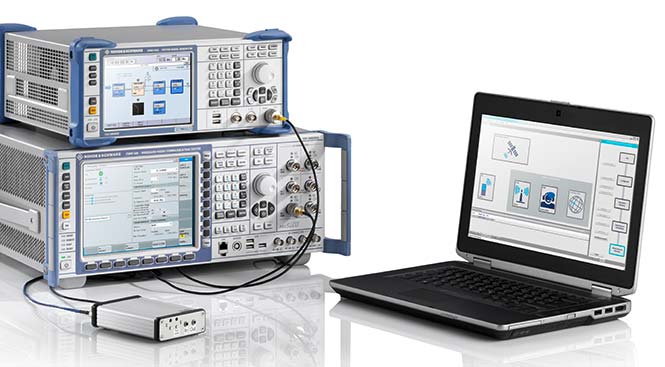
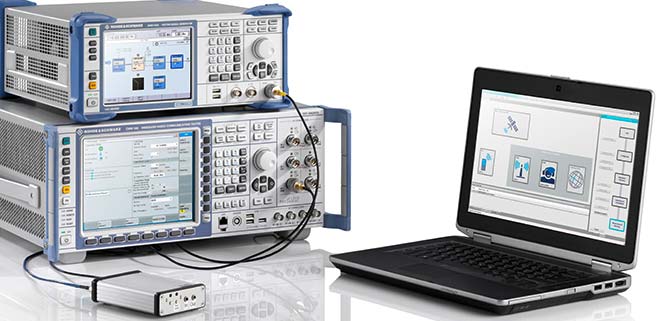
    The eCall test solution based on the R&S CMW500 platform in combination with the R&S SMBV100A GNSS simulator is the first to be certified by CETECOM. (Photo: Rohde & Schwarz)

    Technical basis. The R&S CMW-KA094 application software specifically developed for eCall is based on the R&S CMW500 platform in combination with the R&S SMBV100A GNSS simulator.

    The software simulates a PSAP and controls the R&S CMW500, which emulates a mobile network in the lab. It also controls the GNSS simulator, which provides the position data of the accident location.

    The R&S SMBV100A additionally supports the GNSS receiver performance tests in accordance with Commission Delegated Regulation (EU) 2017/79 Annex VI.

    The eCall test solution can be fully automated with the R&S CMWrun sequencer software for further conformance tests, enabling users to directly utilize ready-made test sequences for eCall and ERA-Glonass modules compliant with ETSI TS 103 412, CEN EN 16454 or GOST 33467. This additionally facilitates demonstration of the functional capability of the overall system in accordance with Commission Delegated Regulation (EU) 2017/79. For more information on how to test eCall and ERA-Glonass system modules, visit www.rohde-schwarz.com/ad/press/ecall-cetecom.

  • Topcon, Bentley Systems kick off Constructioneering Academy

    Topcon Positioning Group and Bentley Systems announced the kick-off date of their collaborative Constructioneering Academy initiative. The first session is scheduled for Feb. 13 in Livermore, California.

    Topcon and Bentley have joined efforts to provide opportunities designed to allow construction industry professionals to learn best practices in constructioneering, a process of managing and integrating survey, engineering and construction data, to streamline construction workflows and improve project delivery.

    “The courses are designed in a dialogue format to allow Topcon and Bentley personnel to interact directly with attendees to cater the experience for their specific questions and demands,” said Ron Oberlander, senior director of Topcon Professional Services. “The future of construction automation continues to move forward with constructioneering digital workflows, which make the work of surveyors, engineers, and construction professionals automated, continuous, and continuously more valuable, throughout project lifecycles and beyond completion.”

    “Topcon and Bentley’s federated constructioneering technologies enable firms to gain unprecedented digital visibility and insights into their project outcomes, as compared to traditional construction workflows. Attendees of our Constructioneering Academy will learn how their organizations can improve project delivery by leveraging constructioneering technology, methods, and best practices to execute their projects more efficiently, monitor construction performance and progress, and reduce project costs,” said Vinayak Trivedi, Bentley Institute vice president.

    The Constructioneering Academy will continue with additional sessions throughout learning centers located worldwide designed to reach industry professionals with hands-on training in real-world scenarios and workflows.

    To register, visit constructioneering.com.

  • A look at LocationTech open source geospatial solutions

    LocationTech open source project provides core technology for geospatial big-data analytic solutions.

    LocationTech has released five open source projects that provide core technology used to build geospatial big data analytics solutions.

    A working group of the not-for-profit Eclipse Foundation, the LocationTech community builds software for geospatial technology. The Eclipse Foundation enables collaboration on open source software. Besides geospatial technology, the foundation’s 300-plus open source projects include tools for software developers, system engineers and scientific research.

    LocationTech provides technology for the $500 billion in worldwide geospatial industry. Its projects can be used to efficiently process satellite images, analyze maps for the agriculture industry, visualize smart-city sensor data, and in many other geospatial use cases.

    The LocationTech community has grown to include nine open source projects, 18 member organizations and more than 100 developers.Collaborating geospatial organizations include Boundless, Red Hat, Radiant Solutions, IBM and Oracle.

    “Geospatial big data analytics technology is becoming more and more important across all industries, such as agriculture, transportation, and government,” said Mike Milinkovich, executive director of the Eclipse Foundation. “LocationTech is delivering on the promise of providing key technology for companies that enable large-scale analytics of geospatial data. Having an open source community, like LocationTech, that accelerates adoption and innovation of geospatial technology will have a significant impact on the entire industry.”

    The new project releases include the following:

    GeoWave is a software library that connects the scalability of distributed computing frameworks and key-value stores with modern geospatial software to store, retrieve, and analyze massive geospatial datasets. GeoWave takes multidimensional data, such as spatial or spatial-temporal, and indexes it into a key-value store such as Apache Accumulo or Apache HBase. These distributed storage technologies, in addition to complementary distributing processing frameworks such as Apache Hadoop and Apache Spark, have proven capabilities to unlock the potential of massive datasets across a variety of domains.

    GeoGig 1.2 is a tool for geospatial data versioning. It enables users to leverage versioning of their geospatial data and to enable replication and synchronization workflows, in addition to supporting end-to-end data management workflows. The new GeoGig 1.2 release improves the collaborative version workflow by improving cloning and push/pull performance and provides an updated Web API to align with the latest version of GeoServer.

    GeoGig-sample-W

    GeoTrellis 1.2 is a geographic data processing Scala library designed to work with large geospatial raster datasets. The tool provides developers with a set of utilities to help create useful, high performing web services that load and manipulate raster data (data normally used to represent satellite or aerial images). The new release includes a number of optimizations and new features including distributed computation support for viewshed and Euclidean distance through Apache Spark.

    GeoTrellis-example-W

    GeoMesa 1.3.5 is a distributed, spatio-temporal database built on a number of distributed cloud data storage systems, including Apache Accumulo, Apache HBase, Apache Cassandra, and Apache Kafka. The suite of tools brings spatial-temporal data, real-time IoT, and sensor workloads to the cloud. GeoMesa’s novel indexing schema enables efficient queries resulting in rapid access to large data stores for any client application.

    GeoMesa-taxi-casestudy

    Java Topology Suite (JTS) 1.15 is a Java library for vector geometry providing spatial data types, spatial relationships and spatial operations. JTS is an established open source project that recently moved to the LocationTech community. New technical features for JTS 1.15 include K-Nearest Neighbor search for STR-Tree, improved handling of Quadtree queries, support for GeometryCollection, and a new JTSTestRunner command-line application. This initial LocationTech release the project is changing from LGPL to a dual license of Eclipse Distribution License (EDL) / Eclipse Public License (EPL) . This license change opens up JTS to a wider range of organizations and applications.

    “LocationTech is becoming the critical nexus for organizations looking to develop and deploy geospatial Big Data solutions,” says Eddie Pickle, Managing Director of Open Source Programs at Radiant Solutions.

    “The latest release of GeoGig to LocationTech represents a huge leap forward. Not only does it support versioning workflows for traditional geospatial data, but it is now optimized for spatio-temporal analysis of big data and streaming datasets from IoT sensors,” says Anthony Calamito, Chief Geospatial Officer and Vice President of Products

    The LocationTech Working Group is also organizing the annual FOSS4G NA conference May 14-16, 2018, in St. Louis, Missouri, followed by a Community Day on May 17. Members of the LocationTech community will be speaking and showcasing their open source projects at this conference.

    The vision of the LocationTech community is to be the leading provider of core technology for geospatial big data analytics. The five projects being released reflect the growing investment towards achieving this vision.

  • Aeronyde to develop infrastructure for autonomous flying cars

    Aeronyde has received $4.7 million in seed financing to develop its end-to-end infrastructure for self-flying vehicles.

    Aeronyde is an aerial systems company aimed at enabling safe autonomous urban flight. The company is working to integrate artificial intelligence and augmented reality into a full-service system for the safe and secure operation of commercial drones.

    The investment was led by Korean electronics manufacturing giant JASTech Co. Ltd, best known for flexible OLED/QLED display. Aeronyde is applying the strategic investment to the development of hardware and systems software for autonomous fleet management.

    “In the 21st century, drones will shape global transportation and distribution and redefine the urban landscape, however we’re not there yet,” said Edgar Muñoz, CEO of Aeronyde. “Adoption of unmanned aerial vehicles (UAV) platforms depends wholeheartedly on the public’s acceptance of the technology. As an industry, we must ensure public safety is addressed prior to the commercial unmanned aerial system (UAS) industry boom. This is what Aeronyde is working on.”

    Through data collection and partnerships with national, state and private stakeholders, Aeronyde aims to deliver a turnkey UAV service for emergency responders, disaster relief and commercial transportation and logistics in urban areas.

    “The market is growing rapidly as more countries are looking at developing UAS regulations,” said Jason Chung, Chairman of JASTech. “We are excited to invest in Aeronyde, a leader in this revolution, as they innovate UAS technology. Aeronyde is helping to build the future of Autonomous Aerial Systems with software and hardware that ensure the responsible management of drones in urban environments.”

    Other Partnerships

    The Aeronyde team is also working with U.S. regulators and international associations to define standards and protocols for the safe implementation of commercial drone technology. Key partnerships include:

    • IBM Watson: Aeronyde is conducting rigorous testing, working with IBM Watson to run millions of flight simulations, and collecting data on the security of the system.
    • Leading technology, systems and regulatory partners: Unifly, the Police Foundation, iSENSYS and the Global UTM Association (GUTMA), a consortium of public and private entities working on unmanned traffic management (UTM) technology.

    The Aeronyde system provides flexible infrastructure for aerial logistics, transportation and data collection including:

    • real-time data analysis to contextually apply sequencing, tasking, local environment, and weather.
    • machine learning to build situational awareness.
    • live flight and testing in Aeronyde research and development centers.

    The end-to-end Aeronyde hardware and software system includes:

    • autonomous flying vehicles and processors
    • airspace and flight path management
    • unmanned traffic management (UTM)
    • user interface and training programs
  • Bentley publishes 'Plain Language BIM' book

    Plain_Language_BIM_coverPlain Language BIM is now available as both a print publication and as an eBook for Kindle and iOS devices from Bentley Institute Press.

    Bentley Institute Press is the publisher of a broad array of textbooks and professional reference works dedicated to building information management (BIM) advancements in the architectural, engineering, construction, operations, geospatial and educational communities.

    Plain Language BIM is by Iain Miskimmin, a BIM Advancement Academy expert.

    “Current industry thinking in the digital world moves at a fast-changing pace,” Miskimmin said,. “But the lessons we have learned in the BIM Advancement Academy and that we share with you in this book, are an excellent starting point for any individual or organization wishing to grasp both the high-level reasoning and the details of BIM.”

    Because BIM improves the ability to manage, produce and consume asset information throughout the lifecycle (design, construction, operations, and maintenance) of infrastructure assets, an increasing number of governments around the world are mandating BIM Level 2 standards and deliverables for publicly funded projects.

    Successfully implementing a BIM strategy can result in considerable cost savings, improved performance and better project outcomes. Plain Language BIM is beneficial for beginners and for those with experience with BIM strategies to ensure all professionals are thoroughly prepared to be part of industry efforts focused on advancing BIM.

    Plain Language BIM condenses years of experience and lessons learned from Bentley Institute’s BIM Advancement Academy. It guides the reader through the many complexities of BIM methodology by providing a plain language understanding of the concepts and building blocks required to deliver an effective strategy.

    It demonstrates why gathering data about the asset is vital to the BIM process, and why trustworthy and reliable information, delivered in an understandable and consumable manner, is essential for effective decision making— upgrading, augmenting, replacing, decommissioning, or leaving assets as they are.

    Plain Language BIM also explores three elements in creating good BIM practices: people, process and technology. It explains how the combination of these elements plays a crucial role in the lifecycle of an asset and in delivering better outcomes.

    The book also examines the Eight Pillars of BIM Wisdom that ensure best practices and world-class BIM vision.

    Like all the titles in the Bentley Institute Press portfolio, Plain Language BIM aims to deliver continuous learning to help both students and practitioners in infrastructure professions increase their expertise and improve their workflow efficiencies.

    Plain Language BIM is available as a printed book, and also as an eBook from Amazon and from iTunes.

    Miskimmin has spent the better part of two decades working in support of the infrastructure and construction industries, helping to deliver the first BIM projects in the UK. Since 2012, he has run the Crossrail/Bentley Information Academy and the BIM Advancement Academy in London. This position has allowed him to interact with more than 4,000 industry people from all over the globe to capture their thoughts and experiences about BIM technology, including some about the biggest infrastructure projects in the world. He was worked closely with the UK BIM Task Group and leads the Infrastructure Asset Data Dictionary for the UK (IADD4UK) initiative.

  • Velodyne LiDAR, Paracosm team up to capture environments in 3D

    Paracosm's PX-80 handheld 3D scanner has Velodyne lidar inside. (Photo: Paracosm)
    Paracosm’s PX-80 handheld 3D scanner has Velodyne lidar inside. (Photo: Paracosm)

    Paracosm’s PX-80 mobile 3D scanner leverages lightweight, powerful VLP-16 Puck for fast and accurate surveying of indoor and outdoor areas.

    Velodyne LiDAR Inc., which makes 3D vision systems for autonomous vehicles, and Paracosm, a division of Occipital, have integrated Velodyne’s VLP-16 Puck lidar sensors into Paracosm’s PX-80 handheld 3D scanner.

    The PX-80 3D scanner is commonly used for geospatial, construction and industrial applications to survey a wide array of spaces from large office buildings to thick forests.

    Paracosm’s PX-80 uses Velodyne’s VLP-16 Puck and its own proprietary SLAM technology — itself a fusion of lidar, color imagery and inertial measurement unit (IMU) data — to produce detailed three-dimensional documentation of complex environments and geometries in minutes.

    The resulting point clouds come in full color with corresponding spherical imagery that can provide virtual tours along with accurate 3D measurements. With the lightweight VLP-16 lidar sensor from Velodyne, Paracosm is able to offer a handheld scanner with unprecedented accuracy, range and detail.

    “When we first began our 3D mapping journey, we wanted to be able to capture huge environments as fast as possible, but were limited by the range and accuracy of available sensors,” said Amir Rubin, president of Paracosm. “After searching far and wide for a better solution, we found that the VLP-16 was the best combination of size, accuracy, and functionality to fit our needs.”

    “Paracosm has proven its ability to expand the application of lidar into handheld use cases, allowing the PX-80 to become one of the most accurate and versatile mobile 3D scanners on the market,” said Mike Jellen, president and chief commercial officer, Velodyne LiDAR. “We are thrilled to partner with Paracosm for their development of the PX-80 and look forward to working with them as they expand their footprint.”

    As the VLP-16 is the smallest commercially available sensor in Velodyne’s lidar portfolio, it is the easiest to embed in other products. “The performance of the VLP-16 is unrivaled in the marketplace. We remain deeply impressed with the range, acquisition rate, noise levels and accuracy it provides in such a compact form factor,” said Gannon Wilder, who leads business development in the Paracosm division.

    Both Velodyne LiDAR and Paracosm will be at the Consumer Electronics show (CES) providing product demonstrations. Velodyne LiDAR will be at Booth #3525 in the North Hall of the Las Vegas Convention Center, while Paracosm will be at Booth #21029 in South Hall 1.

  • OGC seeks sponsors for Phase 2 of Future Cities Pilot Project

    The Open Geospatial Consortium (OGC) is seeking interested sponsors to define the challenges for Phase 2 of its Future Cities Pilot Project.

    As the operation and planning of cities increasingly relies on 3D geo-information in their processes, and apply Building Information Models (BIM) paradigms to their information management approach, efficient information flow in both directions between geospatial systems (GIS) and the architecture/engineering/construction (AEC) systems becomes increasingly important. This requires data to be interoperable, which requires common — and ideally open — standards.

    Completed in 2017, the Future City Pilot, Phase 1 (FCP1) demonstrated that interoperability between CityGML and BIM Industry Foundation Classes (IFC) works well in practice, and showed clear benefits in three use cases: urban planning; social care; and flood modelling. However, to achieve success, a significant amount of manual intervention needed to be employed.

    Phase 2 of the Future City Pilot (FCP2) aims to improve the automation of the flow of data, as well as address a number of related interoperability challenges, including:

    • Comparing data conversion with data linking approaches;
    • Looking at tools that consume both CityGML and BIM structured data;
    • Data structures that support the seamless integration of GIS data and BIM data;
    • Linking real-time sensor information with 3D City Models encoded as CityGML;
    • Security models to protect the sensor readings, including Single-Sign On (SSO) methodologies to protect parts of the 3D City Model;
    • Understanding where and how we must capture location and time information: the ability to correlate location in different coordinate reference systems (CRS) such as local, regional, global, and understand if, and how, the integrity of the location data has changed through that process (Survey4BIM use case); and
    • Data linking to facilitate asset management over dispersed geographies.

    Below is a video summary of FCP1.

    The Engineering Reports documenting the main outcomes of FCP1 are available.

    • Sponsorship of the Future City Pilot will provide the following benefits to sponsoring organisations:
    • Assess and affect market direction based on sponsor needs;
    • Visibility as global leader in information technology critical to deploying smarter cities;
    • Amplification of funding by multiple sponsors’ to solve common/similar problems;
    • Leveraging effort up to 3.5 times based on participant in-kind;
    • Accelerated process – workable interface specifications in 4-6 months;
    • Follow-on procurements using standards-based architecture proven in the pilot;
    • These Innovation Program pilots help feed into the consensus standards process of OGC’s Standard Program; and
    • Leading the way to safer and more efficient cities.

    There are three main deliverables resulting from an OGC pilot:

    • Testing of running software from several organizations to ensure interoperability of the independently developed implementations based on open standards;
    • Demonstration of policy-oriented scenarios with the deployed code. These scenarios show the previously unavailable capability from a non-technical point of view;
    • Documentation of the results of the architecture, testing, and demonstration. The reports may then become the basis of procurement activities of the operational system.

    The scope of this pilot as currently planned will include the demonstration of a common architecture and data model in multiple cities. The number of cities used for the demonstration will depend upon the sponsor requirements.

    If you want an innovative solution to your organisation’s Geospatial & BIM data interoperability problem, OGC urges you to contact Bart De Lathouwer, director of OGC’s Innovation Program.

  • Air-directed UAV completes first flight trials

    BAE Systems and the University of Manchester has successfully completed the first phase of flight trials with MAGMA — a small-scale unmanned aerial vehicle (UAV) that uses a blown-air system to maneuver. The UAV design paves the way for future stealthier aircraft designs, according to BAE Systems.

    The new concept for aircraft control removes the conventional need for complex, mechanical moving parts to move flaps that control the aircraft during flight. The new design could provide greater control as well as reduce weight and maintenance costs, allowing for lighter, stealthier, faster and more efficient military and civil aircraft.

    The two technologies to be trialed using the jet-powered MAGMA, are:

    • Wing Circulation Control, which takes air from the aircraft engine and blows it supersonically through the trailing edge of the wing to provide control for the aircraft.
    • Fluidic Thrust Vectoring, which uses blown air to deflect the exhaust, allowing for the direction of the aircraft to be changed.

    The flight trials are part of an ongoing project between the two organizations and wider long-term collaboration between industry, academia and government to explore and develop innovative flight-control technology.

    Further flight trials are planned for the coming months to demonstrate the flight control technologies with the ultimate aim of flying the aircraft without any moving control surfaces or fins. If successful, the tests will demonstrate the first use of such circulation control in flight on a gas turbine aircraft and from a single engine, BAE Systems said.

    “The technologies we are developing with the University of Manchester will make it possible to design cheaper, higher performance, next-generation aircraft,” said Clyde Warsop, engineering fellow, BAE Systems. “Our investment in research and development drives continued technological improvements in our advanced military aircraft, helping to ensure UK aerospace remains at the forefront of the industry and that we retain the right skills to design and build the aircraft of the future.”

    “These trials are an important step forward in our efforts to explore adaptable airframes. What we are seeking to do through this programme is truly ground-breaking,” said Bill Crowther, a senior academic and leader of the MAGMA project at The University of Manchester.

    Additional technologies to improve the performance of the UAV are being explored in collaboration with the University of Arizona and the NATO Science and Technology Organisation.

  • No positive train control on train that derailed over Interstate 5

    No positive train control on train that derailed over Interstate 5

    Photo: NTSB
    Photo: National Transportation Safety Board

    Multiple injuries and fatalities have been reported after an Amtrak train derailed Dec. 18 on the inaugural run of a new high-speed service linking Seattle and Portland.

    Train 501 was going south when it derailed while crossing a bridge over Interstate 5 (I-5) near DuPont, Washington, around 7:40 a.m. Pacific Time, causing at least one car to fall onto the freeway below. At least six are dead, none of them motorists on the freeway.

    Amtrak Cascades Train 501 was making a southbound run from Seattle to Portland. The Interstate northbound route is closed.

    The Amtrak/Cascade trains are pulled by new Charger locomotive. While equipped with positive train control systems that automatically stop trains when trouble is detected, the PTC system isn’t due to be activated until 2018.

    The last serious train accident in the United States took place May 12, 2015, when the Amtrak 188 connecting Washington to New York with 243 people on board derailed at the entrance of a curve while the train was launched at 100 miles per hour, more than twice the speed allowed. The accident killed eight people and injured more than 200.

    PTC makes it possible to monitor the location of the train and the speed at which it travels, by using GPS and sensors placed both in the trains and along the tracks.

    A computer system centralises the data and prevents any excess speed, any red light or collision with another convoy by acting on the locomotive instead of the driver, to curb if it goes too fast, or stop it completely if an obstacle has been detected on the tracks for example.

    The accident comes just a week after the mayor of Lakewood, a nearby town, warned that high speeds on this segment of track could causes accidents.

    According to John F. Banzhaf, the accident could have been avoided with an inexpensive GPS-based speed control system. Banzhaf is an MIT-trained professor who is also an inventor with two U.S. patents.

    Banzhaf argues that trains should be using a simple GPS-based system to prevent excessive speeds, and not waiting for the delayed and expensive PTC.

    “Rather than waiting for so-called positive train control [PTC] systems which may not be operational soon, there is a much simpler and much less expensive GPS-only speed control system for trains which could be put into operation much more quickly, and at only a fraction of the cost of PTC,” Banzhaf said.

    “It is also so simple that its basic principle is already in use in millions of automobiles and trucks now on the roads.

    The new routing of the trains, which began Monday, uses Sound Transit tracks that go through Lakewood and along I-5 in the area. In all, the new routing was meant to shave about 10 minutes on the travel time and make for more on-time trips, as the Amtrak trains would no longer have to share single-track tunnels with BNSF trains near Point Defiance and along southern Puget Sound.

    “One reason that PTC is so expensive, time-consuming to establish, and difficult to install is that it is designed to do far more than the simplest but most vital task of keeping trains from exceeding the speed limit — e.g., also dealing with switches left in the wrong position, hijackings, natural disasters, etc.

    “It is therefore a very complex system which requires not just GPS units in each locomotive, but also many thousands of signaling devices along sections of about 140,000 miles of track which transmit cab codes to antennas on railroad cars.

    “Unfortunately, for PTC to work properly, there must be close cooperation and coordination between the many different entities which own the different tracks to which the devices are attached, and the owners of over 500 different railroad companies which may run on these many different tracks.

    “All of the devices must also be able to communicate seamlessly with each other, and much of the delay in installing the system has been caused by the need to unify dozens of different systems, obtain permission to use the radio frequencies necessary for the devices to flawlessly exchange information, and related coordination problems…

    “Since automobile GPS units can show not only the car’s speed, but also the speed limit on that section of the road, they could also be mounted on each locomotive and prevent the posted speed from being exceeded — completely independent of the tracks on which they are traveling, and without the need for any other sensing devices, cooperation with other companies, communication between devices, etc.”

    Read Banzhaf’s full blog at ValueWalk.com.

  • Harxon releases frequency-hopping OEM modem

    Harxon has launched the HX-DU2017D, a frequency-hopping OEM modem designed to provide strong anti-jamming and signal receiving capability for complex data-intensive applications.

    HX-DU2017D is a miniature, dual-frequency, software-selectable 840 MHz and 900 MHz data link modem. It provides a power switching of 0.5 W, 1 W and 2 W, 20 ms/30 ms/40 ms/50 ms/ frequency hopping interval, and supports point-to-point, point-to-multipoint network.

    Its full duplex mode ensures secure data transferring and stable long-range communication, the company said.

    HX-DU2017D also provides short latency of data transmission and communication recovery in millisecond level.

    According to Harxon, HX-DU2017D allows fast and secure, simultaneous data communication for mission-critical applications, especially in the fields of precision agriculture and UAVs, including unmanned plant surveys, UAV plant protection and automatic mowers.

    It could easily be placed on a UAV with its extremely small footprint for tight OEM integration and design flexibility. Meanwhile, its frequency hopping transmission ensures the data security and flight stability.

  • Search engine offers range of opportunities using satellite imagery

    Where are baseball stadiums in the world?

    Where are all the windmills on Earth? Or oil derricks? How about baseball stadiums?

    You could scan through the millions of satellite images snapped by hundreds of satellites now circling the planet. Or you could try Descartes Labs’ demo search engine.

    Satellites are snapping images of the Earth every day. Alongside Planet Inc. and DigitalGlobe satellites, imaging constellations are planned from companies such as Urthecast and Astro Digital (the latter launched its first pair of satellites in July). But how do we make use of all of that data in an organized, searchable way?

    New Mexico startup Descartes Labs has created a cloud-based supercomputing platform to apply machine intelligence to massive data sets, using satellite imagery to model complex systems on the planet.

    While Descartes started by focusing on forestry and agriculture, its new Geovisual Search tool allows users to find similar-looking objects of any kind all over the globe. Just click anywhere on the map and a red tile appears, enabling users to search for similar objects. Descartes was inspired by a team at Carnegie Mellon University, who applied the principles of visual search to seven cities around the world in a demo called Terrapattern. Descartes has built three demo maps on three different scales: The continental United States, China and the entire world.

    Check out GeoVisual Search at https://search.descarteslabs.com, and Terrapattern at www.terrapattern.com.