Author: Tony Murfin

  • UAV updates: Attack drones deployed in the Iran conflict and autonomous boats at RoboBoat 2026

    UAV updates: Attack drones deployed in the Iran conflict and autonomous boats at RoboBoat 2026

    The war between Israel, the United States and Iran has dominated headlines since it began with surprise attacks launched by Israel and the U.S. on the last day of February. Significant damage has since been inflicted on Iran as the allies seek to end the country’s nuclear capabilities and bring about regime change — removing those responsible for worldwide terrorism through its proxy groups, including Hezbollah, the Houthi movement in Yemen, various Iraqi Shiite militias, Hamas and Islamic Jihad, all of which have targeted Western countries and Israel.

    Iran maintains a formidable military with more than 600,000 active-duty personnel, an estimated 2,000 to 3,000 ballistic and shorter-range missiles, and a significant offensive drone capability. The Shahed series and Mohajer-6 drones have emerged as low-cost kamikaze weapons central to Iran’s arsenal. The Shahed-136 in particular has been supplied in large quantities to Russia for use in its ongoing war against Ukraine and is now also manufactured by Russia, or a version of it is. The Shahed drone has several variants, including the jet-powered, long-range Shahed-238.
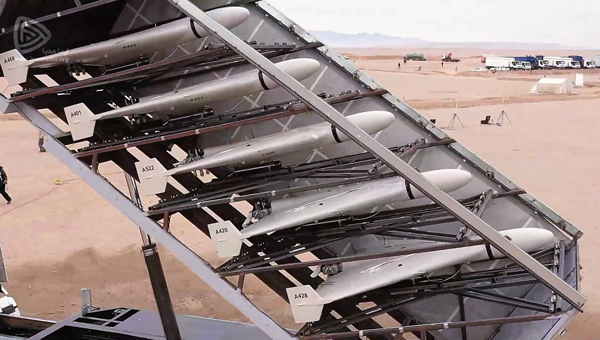
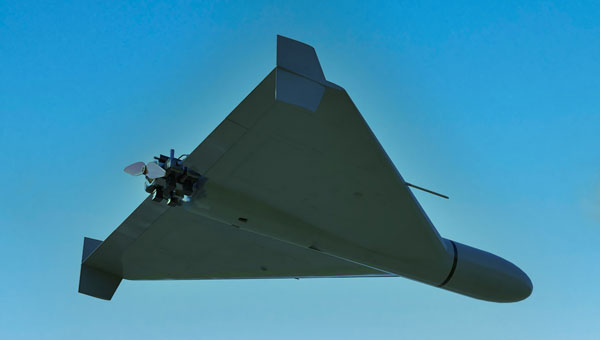
    Iranian Shahed-136 attack drones, read for launch. (Photo: IMA Media)
    Iranian Shahed-136 attack drones, read for launch. (Photo: IMA Media)

    With a range of 800 miles to 1550 miles, the Shahed-136 carries an 88-pound warhead which can punch very large holes in buildings, disable oil tankers or warships, destroy equipment on the ground, and kill and injure lots of personnel. It’s possible that those six US servicemen killed and others injured during the early hours of the conflict in Port Shuaiba, Kuwait, were victims of a Shahed kamikaze drone attack.

    This is not all bad news: the U.S. has analyzed captured downed Shahed-136 drones and has quickly replicated its own version, the Low-cost Unmanned Combat Attack System (LUCAS), admittedly with a shorter range but just as deadly. It’s reported that the Iranians can build and mass-produce thousands of drones for between $20 and $50,000 each. Nevertheless, the U.S. has now been producing large volumes of LUCAS, and has them to fight in Iran.   
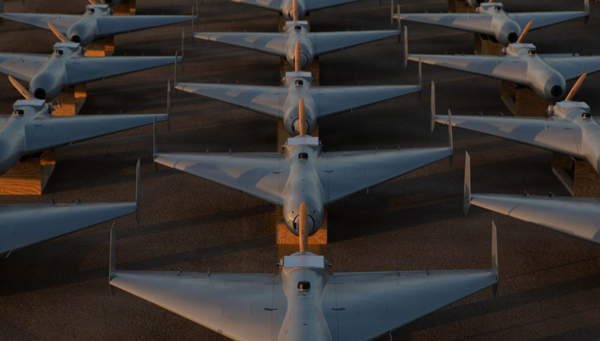
    LUCAS is already in US volume production. (Photo: US Central Command)
    LUCAS is already in US volume production. (Photo: US Central Command)

    Spektraworks, based in Phoenix, was awarded a $30 million contract, and within 18 months, a redesigned, hardened and autonomously coordinated attack drone — manufactured in the U.S. at a cost of approximately $43,000 per unit — became available in significant quantities and was fielded to U.S. Central Command’s newly formed drone task force, Task Force Scorpion Strike.

    The unit was responsible for the Shahed-like drones seen flying over Baghdad in early television coverage as the U.S. offensive got underway.

    It marks a notable achievement — delivering similarly designed attack drones, and the destruction they carry, back to Iran, a country that has exported terror to numerous nations for more than 50 years.


    Meanwhile, the 2026 RoboBoat Competition took place at Nathan Benderson Park near Sarasota, Florida, drawing 37 high school and university teams. The event challenges students to demonstrate progress in developing autonomously operating marine systems installed on model boats. Benderson Park features a large rowing lake that has hosted Olympic rowing and canoe trials, making it a fitting venue for RoboBoat competitors and spectators.

    Teams arrived with a wide variety of model boat designs and technical approaches, navigating through a series of in-water obstacle courses while gaining hands-on experience relevant to future careers. Volunteer support was plentiful, and each team brought cheering crews and technical assistance. Typical tasks included restoring simulated harbor operations, assessing underwater infrastructure and supporting exploration scenarios.

    After watching more than 2 hours of posted videos, it is clear that the competition is run by a volunteer student organization. The final-round objectives were not clearly defined, and without commentary, it was difficult to determine whether any team successfully completed the obstacle course — though several boats did navigate between narrow red and green buoys after avoiding a series of posts in the water.
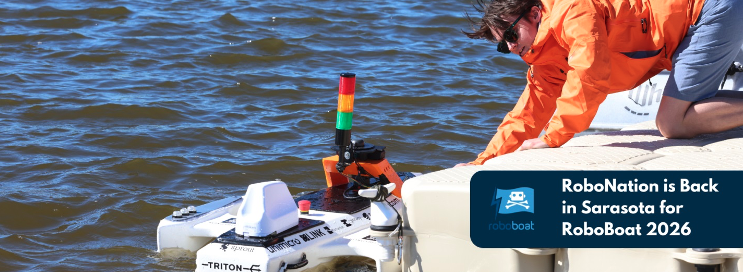
    RoboBoat 2026
    RoboBoat 2026

    Nevertheless, it was great to see the whole gathering, many from overseas, and the level of enthusiasm. One guy told the story of how the team’s heavy equipment had survived a long-distance shipment from overseas and arrived almost intact. But during the competition, the quite heavy demo boat sank; it was just a minor setback for him — we’ll learn something and keep going!  — was his mantra. As everyone in the industry knows, having your tested, verified, and 100% reliable set-up actually function at a trade show is a major hurdle we’ve all had to overcome. So, it’s good to see these young men and women learn firsthand what it takes to get a prototype to work when it becomes absolutely essential – and of course, to actually make progress and extend their reach towards autonomous robotics.


    The U.S. military has been throwing Shahed-like kamikaze weaponized drones back at the country that had not only invented them, but also spread the technology to and through other antagonists, yet now feeling their impact on their own capital city — a significant success for the initial U.S. attack on Iran. And growing and supporting the latest wave of students and their autonomous aspirations at RoboBoat 2026 in Florida. One aspect of UAVs is warlike and deadly, while another is encouraging young engineering candidates towards their dreams of maritime robotic autonomy.
  • UK’s Watchkeeper drone program nears the end:  What went wrong and what’s to come

    UK’s Watchkeeper drone program nears the end: What went wrong and what’s to come

    We usually look for what’s new, with innovative drones emerging and gaining traction in commercial and military applications, but this month, news of the termination of a leading UAV program has sparked interest.

    The British Army’s Watchkeeper drone program has long been the subject of criticism over development delays, cost overruns and poor performance. Recent reports that the Watchkeeper fleet could be retired as early as 2025 — though that timeline may now slip to 2027 — have renewed scrutiny of the troubled effort. Perhaps a review of the story behind this drone adventure may be in order.

    The UK has been involved with drone operations going back into the 1960s, giving this military force deep experience and expertise in the field. Political support has enabled significant investment over time. When the Watchkeeper program was rolling in 2004-05, the US was moving toward the MQ-9 Reaper project, and military forces around the world were building their own mil-spec UAVs, mostly for surveillance to support military ground operations.

    At that time, few commercial drones existed beyond radio-controlled model aircraft flown by hobbyists. The idea was growing in China at that time for DJI and quad-copters, so these multi-use UAVs eventually emerged, and have led to a multitude of outfits elsewhere also making commercially available drones.

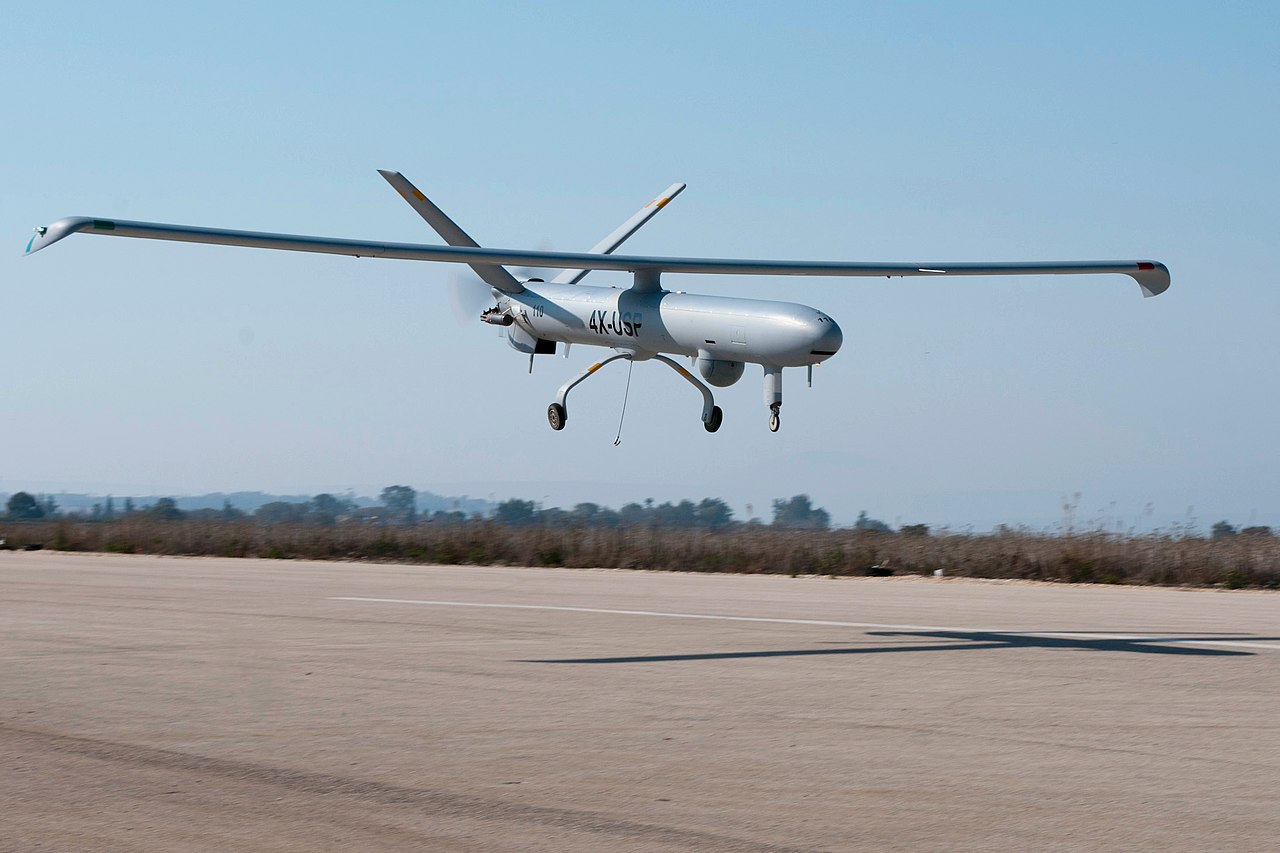
    When the Watchkeeper program took shape in 2004, developing a custom platform was essentially the only way for the UK to obtain a medium-altitude ISTAR intelligence, surveillance, target acquisition and reconnaissance (ISTAR) drone tailored to its requirements. The Ministry of Defence identified Israel-based Elbit Systems, which produced the Hermes 450 military drone, as a close match. The program was built around an extensively modified version of that aircraft, with the goal of bringing production to the UK

    Hermes 450 (Photo: Nehemia Gershuni-Aylho)
    Hermes 450 (Photo: Nehemia Gershuni-Aylho)
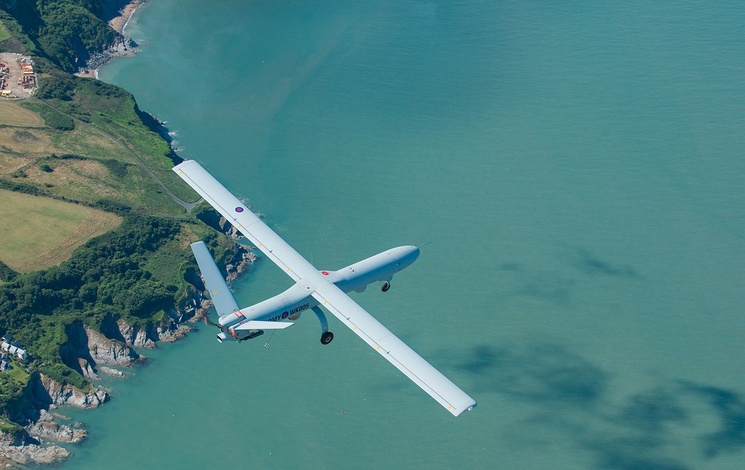
    Watchkeeper-X export version (Photo: U-tacS)
    Watchkeeper-X export version (Photo: U-tacS)

    In 2005, the U.K. Ministry of Defence awarded a £775 million contract to U-TacS, a joint venture between Thales UK and Elbit Systems, for the design, manufacture and support of 54 Watchkeeper WK-450 drones. The modifications involved making the UAV all-weather capable, including Thales integrated radar/GPS system for automated landing and take-off (Magic-ATOLS), Thales MASTER SAR/GMTI radar, dual electro-optical/IR cameras, laser designator, and tweaks to the Line-of-Sight radio system, with a satellite link option. Nevertheless, the range of the radio limits operation to within less than 100 miles of the mobile base-station, but it did provide a high-bandwidth, secure, direct, unobstructed wireless link for control and real-time video and targeting data back from the vehicle.

    Cost overruns and delays pushed the first flight to 2008 in Israel. Production of the WK-450 was then established at Thales UK, formerly Racal Electronics. The technology transfer between the two companies, separated by more than 2,000 miles, operating across different corporate cultures and exchanging proprietary material, proved more difficult and time-consuming than anticipated.

    The program delivered its first aircraft in 2014. Four drone systems flew in Afghanistan during the British troop withdrawal, logging a total of just 140 flight hours. Performance fell short of expectations, particularly the system’s all-weather capability, which proved inadequate in Afghan conditions. The U.S. military encountered similar challenges with sand contamination of helicopters and fixed-wing aircraft during early operations in Iraq and Afghanistan.

    As time rolled by, Watchkeeper found some use in Cyprus and in the UK, mostly for training, but problems continued. Between 2014 and 2022 eight vehicles crashed, and most have presumably been written off. Others have apparently experienced unplanned ‘contact with ground’ in more recent times. Faith in the now pretty old drone system has waned with the British forces — even recent political pressure to hand over the remaining fleet to Ukraine has been rebuffed by the Army — maybe too many problems with which to coach Ukraine troops. Watchkeeper is apparently now dismantled for the UK, along with the whole £1 billion investment. But not without gaining a lot of knowledge and operational experience, however an expensive lesson none the less.

    The UK has operated MQ-9A Reapers in Afghanistan, Iraq and Syria for more than 18 years, but after the Royal Air Force’s success with this US drone, these too have been retired in favor of the new MQ-9B Protector. The Protector has been customized and brought up to civilian certification standards by the manufacturer General Atomics. There have been similar sad programs with many ground, marine, and air projects around the world, but this has been such a visible and unhappy tale, it’s sad to see it end, but it’s probably a good thing so that other newer, more promising projects can get funding and become successful.

    Almost in the same breath, another UK company has already been supplying unmanned cargo aircraft to Ukrainian forces for more than three years. Windracer ULTRA is a twin-prop aircraft that can lift 330 lb for up to 620 miles, with 10 hours of endurance at a ceiling of up to 13,000ft. A newer version can reportedly travel twice as far with more payload.

    In Ukraine, the drone has been supplying front-line troop emplacements on a regular basis. The UK has been using ULTRA for surveillance and parachute drop re-supply, middle-mile parcel and cargo delivery to remote destinations, and for aerial surveys in Antarctica and elsewhere.

    So, a commercial start-up got there on its own, no direct government funding other than contracted support, and apparently no JV with another company!  So does 100% government funded development work better than setting up on your own, borrowing a bunch of cash, and doing it yourself? Mil-spec stuff is special with a limited market, so it’s unlikely that governments will ever be able to pick up finished products that fulfil all needs, but as the U.S. is proving with its bulk buy of off-the-shelf small one-way UAVs, these can meet many requirements.

  • RQ-170 stealth drones tied to Venezuela operation as FCC bans foreign UAV imports

    RQ-170 stealth drones tied to Venezuela operation as FCC bans foreign UAV imports

    As the news subsides on the U.S. operation in Venezuela to capture Nicolás Maduro and his wife, attention is now turning to the legal aspects of the prosecution. Nevertheless, this military undertaking was apparently extremely complex and involved very discreet initial persistent surveillance of not only Maduro’s location but also of a large number of military installations and facilities.

    Venezuela has acquired an extensive arsenal of sophisticated Russian air defense capabilities beginning in 2011 and which were apparently recently upgraded in 2024. Heavy damage during the U.S. operation at La Carlota Air Base in Caracas, Fort Tiuna Military Complex, La Guaira Port and El Higuerote Airport appears to have overcome not only surface-to-air anti-aircraft missile systems but also Su-30 Sukhoi Flanker fighter aircraft armed with air-to-air missiles.

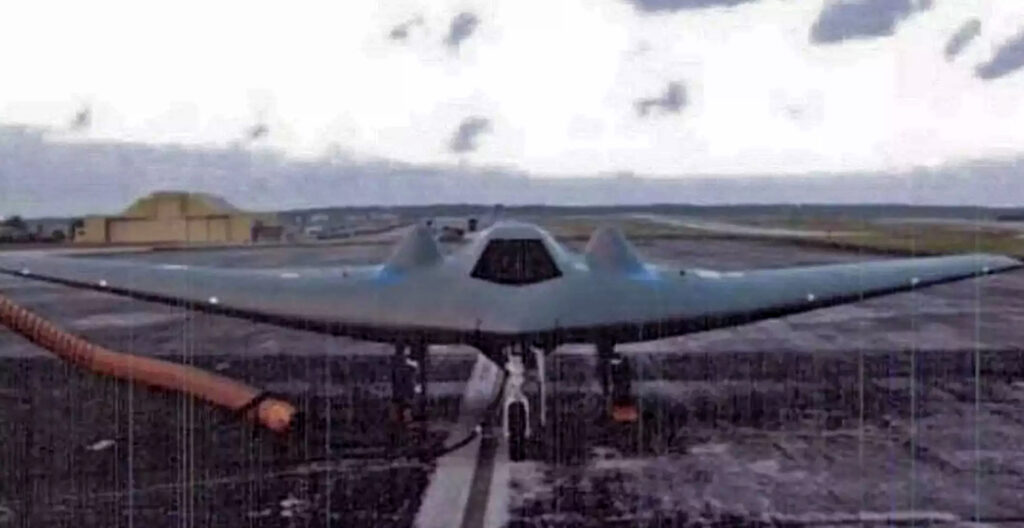
    And how was this accomplished? Well, likely with the help of legendary Lockheed RQ-170 Sentinel Stealth Drones. Nothing in the classified operation has been positively confirmed, but it is known that one or two of these surveillance drones were videoed returning to Naval Station Roosevelt Roads in Puerto Rico in the early morning of Jan. 3 following the U.S. attack. And piecing together earlier photos of U.S. Latin American command with an RQ-170 operations operative, pundits now believe confirm RQ-170 involvement.

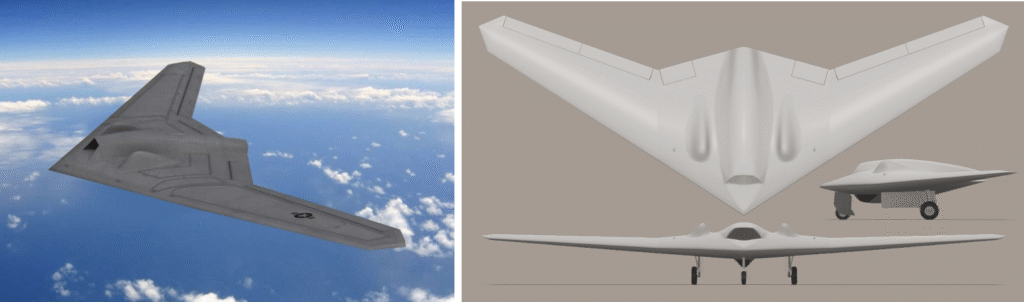
    Lockheed RQ-170 stealth drone, nicknamed Wraith (Photo: USAF)
    Lockheed RQ-170 stealth drone, nicknamed Wraith (Photo: USAF)

    The 30th and 44th Reconnaissance Squadrons at Wing at Creech Air Force Base in Nevada are the only units the Air Force has confirmed to be operating RQ-170s Wraith low-observable stealth drones.

    It’s therefore quite possible that when President Trump said, “I was able to watch it in real time, and I watched every aspect of it,” that the video link may have been supplied by one or more of the RQ-170 Wraith drones circling over the action on the ground.


    Another aspect of the Venezuelan operation comes from people on the ground in Caracas who reported a number of instances of “flying bombs” which fell on targets during the U.S. operation. Video clips and numerous personal accounts apparently supported the reports that prop-powered attack drones were being crashed into ground targets, followed by big explosions.

    And previously on Dec. 16, the U.S. had a “first” for the U.S. Navy to have launched a one-way attack drone from the deck of the USS Santa Barbara in the Arabian Gulf. These earlier reports indicated that these attack drones could be launched by catapult, using rocket assist and from mobile ground vehicles.

    Therefore, it is not much of a leap to say it’s very likely that other marine and ground launch facilities in and around Venezuela dispatched many one-way, likely semi-autonomous attack-drones to take out targets prior to Delta Force being helicoptered in to capture Madura.


    Meanwhile back in the U.S., well away from military action, the Federal Communications Commission has effectively banned the sale of any new UAS or parts for UAS being imported into the U.S. The ruling was developed after the White House initiated a review aimed at protecting American security which decided “that UAS and UAS critical component parts that are produced in foreign countries pose unacceptable risks to the national security of the United States and to the safety and security of U.S. persons.”

    To somewhat clarify the situation, the FCC just added exemptions for Pentagon-approved “Blue List” drone models and parts thereof from EagleNXT, Parrot, Teledyne FLIR, Neros Technologies, Wingtra, Auterion, ModalAI, Zepher Flight Labs and AeroVironment — imports from these suppliers will be allowed through the end of 2026.

    So with new models of foreign drones being prevented from entering the U.S., the U.S. drone industry has been granted, at least for the moment, an opportunity to develop leading UAS models which will eventually outpace existing foreign drones operating in the U.S. It’s predicted that the FIFA soccer World Cup this summer will need a lot of drone coverage for security purposes — possibly a new U.S. drone home market.


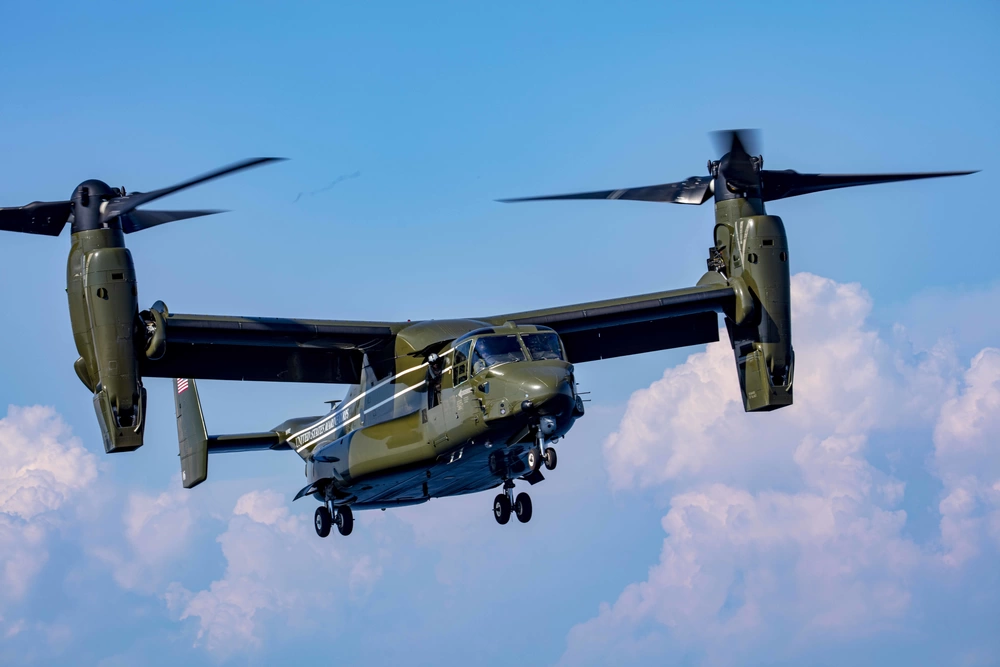
    The Bell-Boeing V-22 Osprey is a complex military tilt-rotor aircraft which overcame many hurdles in its development and initial operations phase, even having some incidents during its mature field operations.

    Bell-Boeing V-22 Tilt-rotor aircraft (Photo:  Boeing)
    Bell-Boeing V-22 Tilt-rotor aircraft (Photo: Boeing)

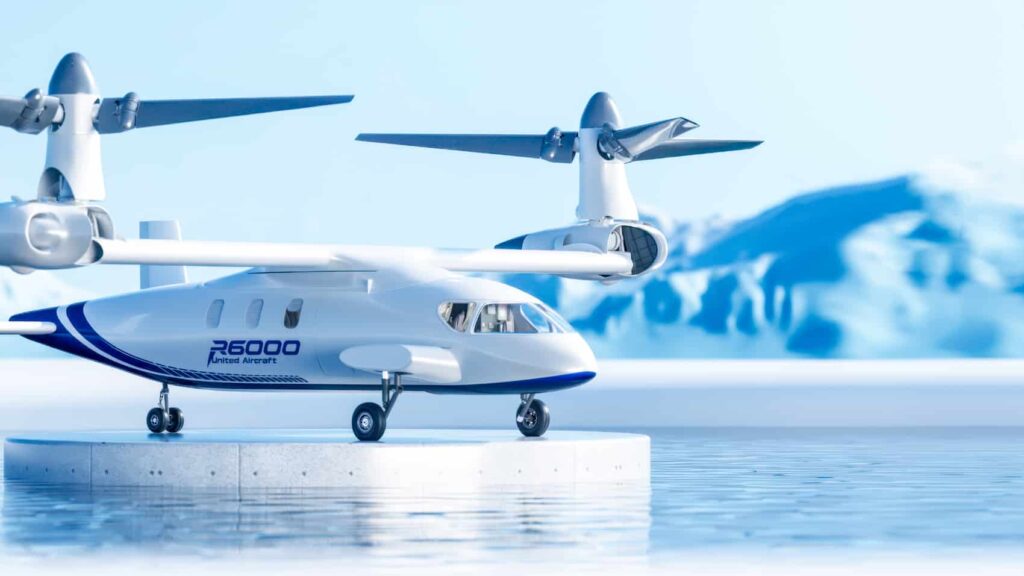
    Nevertheless, the Chinese appear to have adopted a similar design approach for the Lanying R-6000 manned/unmanned tilt-rotor 6-12 passenger eVTOL and a 2-ton-cargo transport version. The promotional video for the Chinese United Aircraft R-6000 seems to interchange shots of the V-22 in hover mode with recent R-6000 prototype system in hover flight. However, Bell-Boeing web statements disclaim any linkage with the Chinese company or its R-6000 development.

    If the name “United Aircraft” seems familiar, it’s because there was such a company in the U.S. in the 1930s, changing its name to United Technologies (Pratt & Whitney) in 1975, now RTX Corp.

    United Aircraft in China has apparently been around since 2012 and has produced a number of vertical lift aircraft, including the TD220 twin-coaxial helicopter (without tail boom). As with most large industrial companies in China, this one also seems heavily engaged with the Chinese military and is now making inroads into the civilian marketplace with a number of UAVs for various applications, leading up to the projected 550 mph Lanying R-6000, which has been depicted in low-level flight mode.

    Promotional image of eVTOL Lanying R-6000. (Photo: United Aircraft)
    Promotional image of eVTOL Lanying R-6000. (Photo: United Aircraft)

    So, a mixed bag of unmanned aircraft reports this month, ranging from drones likely used in the recent U.S. action in Venezuela, FCC rulemaking to restrict imports of foreign UAVs into the U.S., and all the way to a new potential Chinese tilt-rotor eVTOL entrant.

  • NASA preps Mars helicopter as war shapes defense tech future

    NASA preps Mars helicopter as war shapes defense tech future

    It’s always good news when we hear about NASA’s “out-of-this-world” next steps toward building a replacement for Ingenuity, the small Mars helicopter-drone. With 72 flights over 1,004 days, Ingenuity outlived NASA’s expectation of just 30 operational days on Mars. It ended up serving as a trailblazer for the SUV-sized Perseverance rover as it worked its way around Jezero Crater. Built with a large number of smartphone components, it’s actually amazing that this thing survived for so long, given the radiation environment on the surface of Mars, along with the harsh temperature extremes of daytime 32°F to nighttime minus 130°F. How a Samsung S5 phone battery survived, operating so far outside its design temperature range, is hard to fathom.

    NASA’s 20-year plan for future Mars exploration now looks to take advantage of the huge expansion of the envelope for exploration that the small 30-day Mars helicopter brought to the Perseverance mission: “Enhanced mobility systems will enable exploration of challenging terrains and increased operational range. Aerial mobility technologies will facilitate access to previously unreachable areas on Mars.”

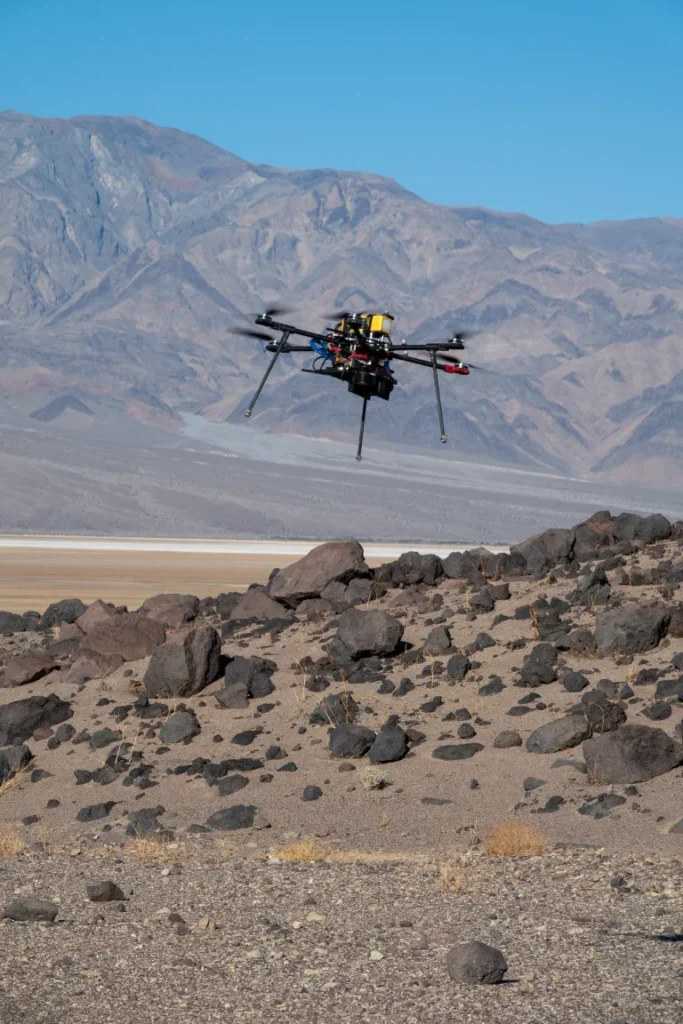
    NASA drone flies over ‘Mars Hill’ in Death Valley during recent navigation tests (Photo: NASA/JPL)
    NASA drone flies over Mars Hill in Death Valley during recent navigation tests. (Photo: NASA/JPL)

    So now NASA is working on the next Mars rover mission and on improvements for its accompanying airborne support. A team recently took three commercial drones into Death Valley to work on overcoming navigation problems that Ingenuity encountered on Mars flying over “bland” terrain with few visual features for its optical navigation system. Sand dunes without features on Mars messed with Ingenuity’s navigation solution, including on its 72nd flight.

    Death Valley and Mesquite Flats Sand Dunes were two places the NASA team visited to test improved navigation algorithms installed on existing commercial drones, and they found some improvements by adding camera filters. The new software helped find landing spots in cluttered terrain.

    But now new initiatives are seeking ways to get crewed flights to Mars in the next couple of years, well ahead of NASA’s timetable, which doesn’t move to anything crewed until around 2030. NASA still seems to prefer to pursue landers to gather much more data on Mars before risking crewed flights. Robotic dogs are also being investigated that can traverse rugged uphill areas that landers cannot access, as well as a winged glider the size of a small school bus.


    Meanwhile, the never-ending Russia-Ukraine war rages on, dominated by drone attacks from both sides. Russia is increasingly using Iranian Shahed or the equivalent Russian-produced Geran-2 one-way drones, while Ukraine intercepts them with low-end modified commercial drones. This stalemate has $20,000 Geran-2 drones being brought down by high-speed interceptor drones built for $2,000 to $6,000 — in other words, the cost of attrition might determine the victor.

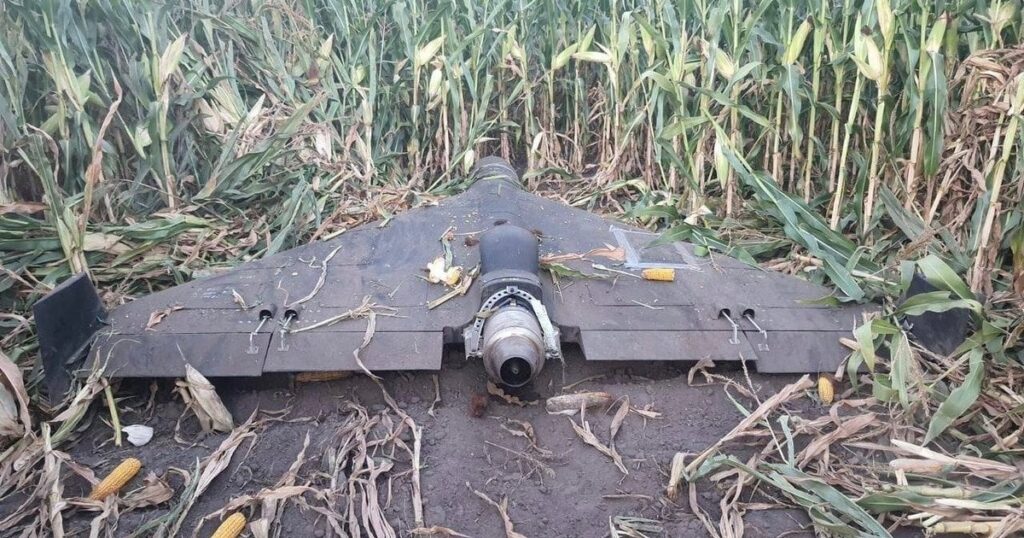
    Russian Geran-3 jet-powered drone downed by Ukraine. (Photo: DIU)
    Russian Geran-3 jet-powered drone downed by Ukraine. (Photo: DIU)

    However, Russia has now introduced a jet-powered Geran-3 model that flies at up to 230 mph, which Ukraine has apparently been able to bring down.

    As we well know, Ukraine not only regularly receives Western military equipment but also civilian drones in large numbers. But an industrial capability has also been created in Ukraine to design, develop and build high volumes of drones. So it’s not surprising that Ukraine has revealed its own interceptor drone known as Sting.

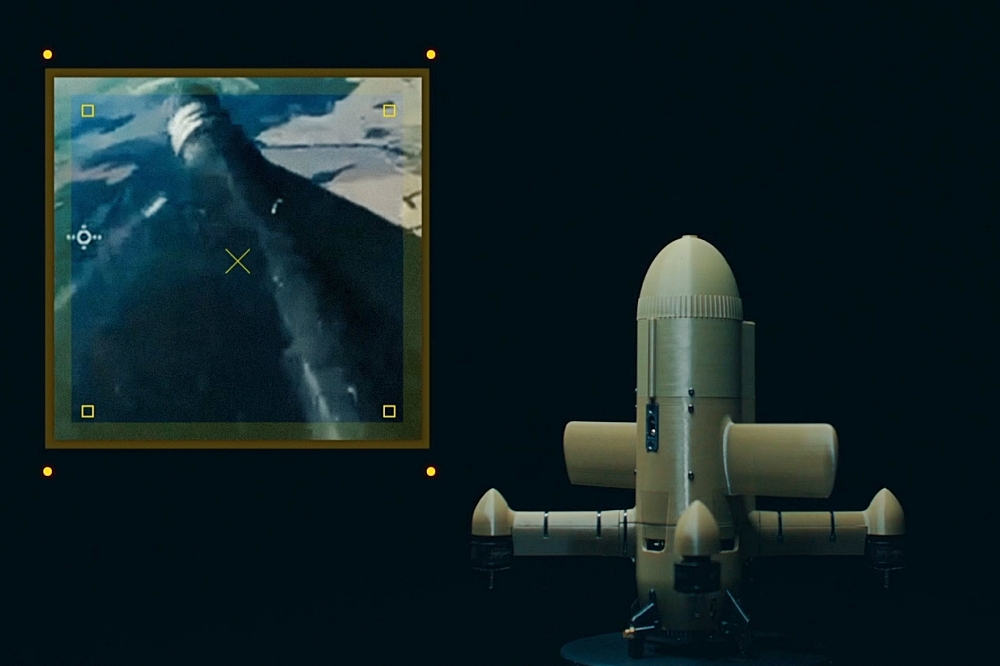
    STING interceptor drone and imagery striking a Shahed drone. (Photo: Wild Hornets Group)
    STING interceptor drone and imagery striking a Shahed drone. (Photo: Wild Hornets Group)

    Nevertheless, Sting has four rotor props and should be no match for a Geran-3 flying at top speed, even though Sting is claimed to be capable of 215 mph. The Russian jet-powered drone also apparently comes with anti-jam capabilities and a satellite navigation system, but Russia has yet to field these new drones in large numbers. Of course, Ukraine says it has already developed jet-powered interceptor drones — so the step up to the next level of technology should happen for both sides, but of course, costs increase for both sides, which neither can really afford.


    Defense has always affected the speed of development for any technology — government funding and oversight are major incentives for new companies to emerge and for new technologies to be developed. Anduril Industries has recently emerged as a new entrant to the U.S. industrial defense complex, specializing in autonomous systems. Anduril’s products include unmanned aircraft systems and counter-UAS, and they have made big strides in both areas.

    Anduril is a relatively new company, initially founded in 2017, so its products are fresh off the drawing board and its product improvement experience is at best eight years. The big U.S. defense contractors have fielded and corrected decades of problems in their high-tech systems, so new generations come with hard-learned design and build understanding. The advantage for Anduril is that they are not bound by the restrictions of a long-established industrial heritage, but this can also mean they may still have a way to go in learned experience.

    Nevertheless, in high technology, much is new technology and new software and new approaches to build. So it takes effort to not only make this stuff work but also to make it work reliably.

    Altius — 33lb warhead attack drone. (Photo: Anduril)
    Altius — 33lb warhead attack drone. (Photo: Anduril)

    Anduril builds lots of test articles and rapidly evolves the design through rigorous internal and real-world testing. So it’s not uncommon to see test failures — this is how improvements are developed.

    Recent U.S. defense tests that saw crashes at Eglin Air Force Base in Florida drew a lot of bad press, given that the Altius drone had already been battle-tested in Ukraine. However, if the approach of lower cost, high volume and attritable drones is the one we have chosen, it may take a little more time to get maturity into the beast.


    Navigation testing for NASA’s next Mars drone, jet-powered attack drones, and evolving interceptor defenses and drones from a new player on the U.S. defense scene — a pretty wide range of unmanned aircraft applications.

  • UAV updates: DARPA advances UAVs, Area-51 RQ-170 investigation expands and more

    UAV updates: DARPA advances UAVs, Area-51 RQ-170 investigation expands and more

    Most people appear to be silently waiting for artificial intelligence (AI) to come up with a meaningful application beyond replicating jobs — one that actually helps people accomplish new tasks.

    Daily news reports show one of the so-called “Magnificent Seven” technology companies pouring another billion dollars or more into AI data centers or basic development. Well now, the Defense Advanced Research Projects Agency (DARPA) has found a smaller AI company to develop a novel application for UAVs.

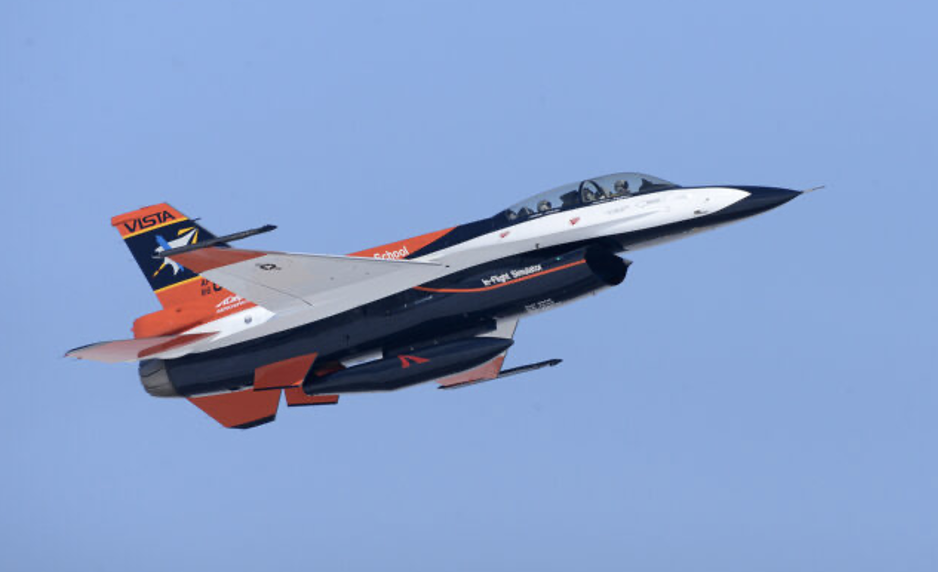
    VISTA X-62A autonomous aircraft (Photo: Alex Lloyd/USAir Force)
    VISTA X-62A autonomous aircraft (Photo: Alex Lloyd/U.S. Air Force)

    PhysicsAI has contributed AI “agents” to a highly modified F-16 for machine perception, intelligent behavior, control and adaptive learning to create an autonomous UAV, according to available information. The VISTA X-62A participated in a manned-unmanned dogfighting demonstration in September 2023, though the outcome has not been disclosed. Other platform enhancements include intelligent sensors through computer vision, EO/IR/RADAR sensor fusion and virtual reality simulations.

    DARPA has engaged PhysicsAI to enhance UAVs so they can extend range and mission length by “soaring” — the technique birds use to find thermals in the atmosphere to climb to higher altitudes. AI agents will be designed, trained and tested to evaluate dynamic wind conditions, optimize flight profiles and perform soaring maneuvers.

    DARPA intends to develop AI agents that will extend endurance by employing this bird-like soaring capability to reduce UAV onboard power usage and extend range and mission duration.


    There is nothing new to report on the apparent drone crash Sept. 25, 2025, near the secretive base in Nevada, known as Area 51. The aircraft was attached to the 432nd Wing/432nd Air Expeditionary Wing at Creech Air Force Base in Nevada, about 57 miles southwest of the crash site. The 432nd operates MQ-9 Reaper drones, but the 33rd and 44th Reconnaissance Squadrons are also known to operate out of Creech and may operate RQ-170 Sentinel stealth drones.

    RQ-170 Sentinel Stealth Drone thought to operate out of Cheech AFB Nevada (Photo: Lockheed Martin)
    RQ-170 Sentinel stealth drone thought to operate out of Cheech AFB Nevada (Photo: Lockheed Martin)

    Famous (or infamous) for a 2023 reconnaissance operations in Iran, where one aircraft was apparently captured by the Iranians, the RQ-170 has been around since 2021.

    The mystery surrounding the crash near Area-51 has grown somewhat since an inert training bomb and an aircraft panel were discovered at the crash site, but these items were not part of the damaged/destroyed crashed aircraft. In addition, the Air Force Office of Special Investigations (OSI) and the FBI have now been brought in to investigate. Enthusiasts who managed to get to the crash site recently found it cleaned completely, with no sign of spilt fuel or debris.


    Troops in the field need information most — where the enemy is, their capabilities and what they’re doing.

    One option: Launch a drone with video, infrared and radar, then use whichever works best depending on lighting, weather and whether the enemy jams signals. Better yet, call in a high-altitude surveillance drone like a GA-ASI Reaper that the enemy can’t see or hear. But that takes time, and one might not be available.

    A new concept builds on an old precept — climb a tree and look at the opposition. But trees can be hard to find, difficult to climb and not high enough.

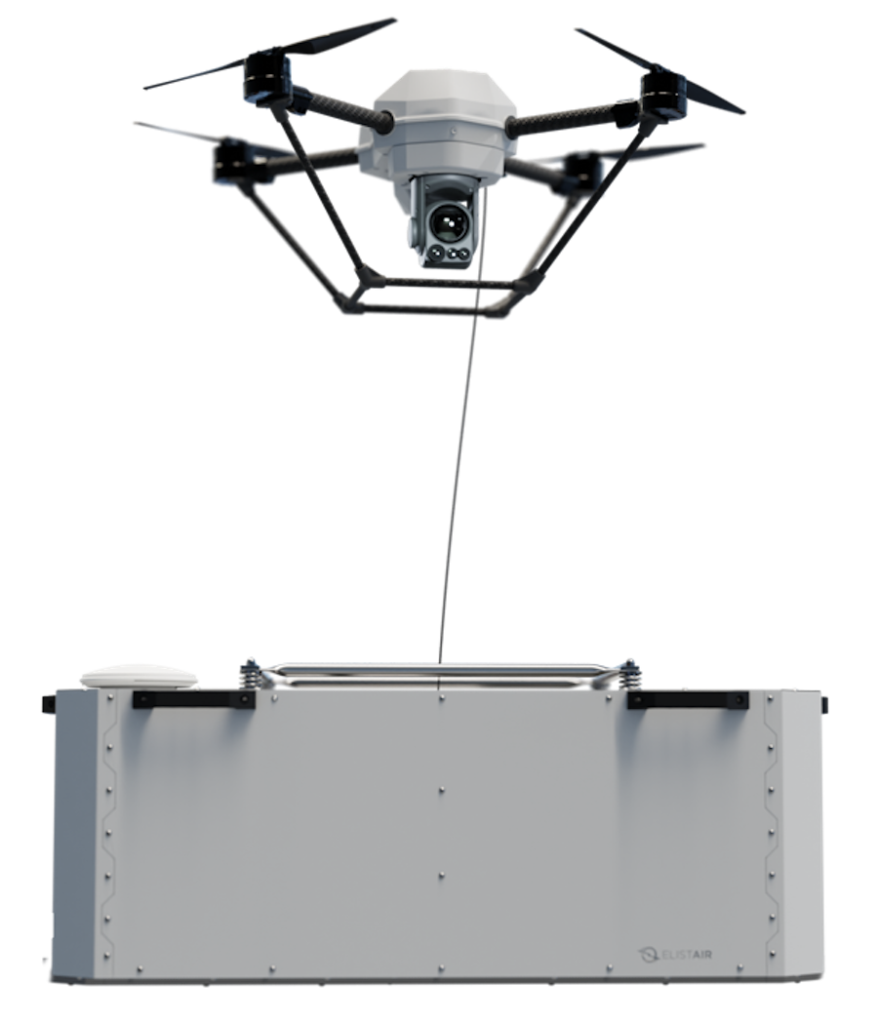
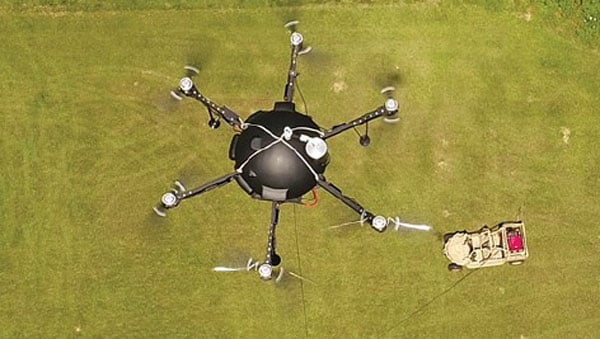
    The answer to jamming and observational altitude: a tethered drone that a squad can carry. If the squad has a truck or Humvee, it can launch a tethered drone with no time limits because power comes up the tether with driving instructions while visual data goes back down. If necessary, move the ground vehicle closer and the drone moves with it.

    Tethered drones serve any operation needing overview — rescue teams in disasters needing to see farther or a temporary communications hub, security operations searching for someone or something, monitoring or observing for infiltrators, initial surveys of difficult-to-access locations or military operations. Many other applications exist.

    Most commercial and first-responder operations favor commercial or heavy-lift multirotor drones. Companies using multirotor drones include Hoverfly, Zenith, Fotokite, USaS, Advexure, Elistair, Kratos and Volarious.

    Elistair Khronos Tethered DroneBox. (Photo: Elistair)
    Elistair Khronos Tethered DroneBox. (Photo: Elistair)
    Kratos Aethon	 Tethered Drone. (Photo: Kratos)
    Kratos Aethon Tethered Drone. (Photo: Kratos)

    If tethering drones to get really high, maybe use an aerostat that TCOM claims can operate from ground level to the stratosphere — pretty long tether needed! But applications also include anti-drone systems used to track and disrupt drone intruders.

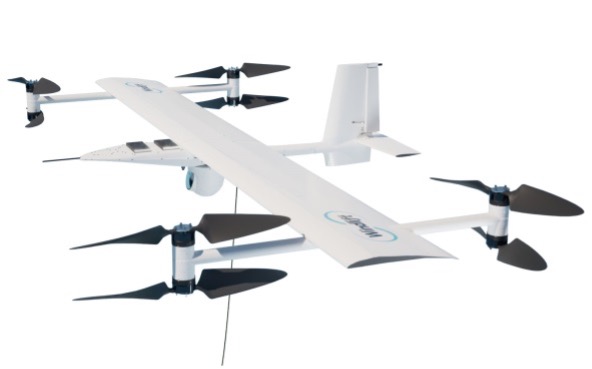
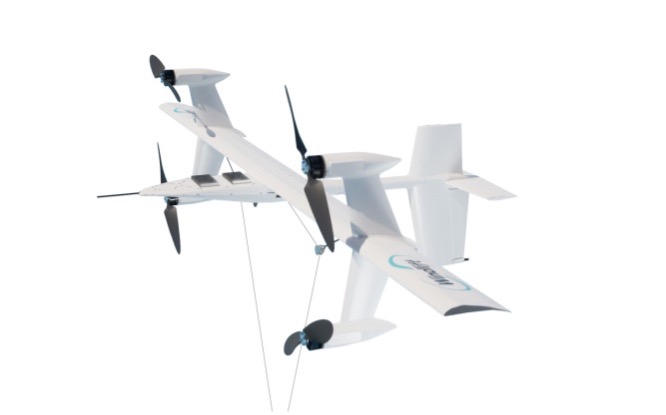
    Then a more recent entrant is Windlift who uses a fixed wing multi-prop drone on the end of a very long tether to gain altitude and to operate in the sort of wind conditions that might be found at times in many locations world-wide, on land or at sea — very windy to gale force winds, actually up to 55mph. Now this is pretty tough for any tether system, but Windlift has a variable cross section tether which mitigates wind-resistance. And their special application is to fly in a figure of eight pattern at high altitude — to generate electricity.

    Windlift surveillance drone(Photo: Windlift)
    Windlift surveillance drone (Photo: Windlift)
    Windlift power generator (Photo: Windlift)
    Windlift power generator (Photo: Windlift)

    This month brings a mixed bag of drone news, ranging from AI-driven “soaring” drones to an Area 51 drone crash mystery and an overview of tethered drones and their applications, including power generation. Who could have forecast these drone applications? Well, maybe the crashing part.

  • Unmanned systems updates: Government shutdown risks, UAS advances and eVTOL industry challenges

    Unmanned systems updates: Government shutdown risks, UAS advances and eVTOL industry challenges

    To echo the Association for Uncrewed Vehicle Systems International’s (AUVSI) pleas to Congress, a prolonged government shutdown could impact recent efforts to establish stronger counter-UAS protection for sensitive establishments across the U.S. and forestall key Federal Aviation Administration (FAA) hiring plans to support safe drone integration into the U.S. National Airspace System.

    Nothing is good about having roughly 750,000 people out of work and stalling their buying contributions to the American economy, not to mention that air traffic controllers, Border Patrol agents and other essential services are still working without pay. Hopefully common sense will prevail and the government will reopen soon.


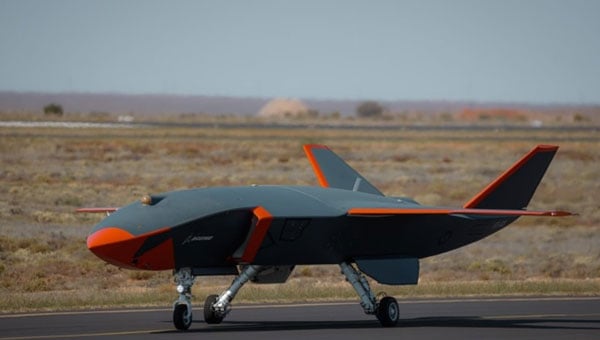
    Originally known as the Boeing Airpower Teaming System or “Loyal Wingman,” the Boeing Australia MQ-28A Collaborative Combat Aircraft has been rechristened. Developed jointly by Boeing and the Royal Australian Air Force, the MQ-28A was not entered in the U.S. CCA competition and has remained fully employed in Australia with its team. Now referred to as the “Ghost Bat” — a name inspired by a north Australian flying bat by the same name, which uses “multi-spectral sensors” to hunt and learn in packs together — the name is a fitting analogy for the anticipated role of the MQ-28A.

    Ghost Bat taxies at RAAF base Woomera in Australia. (Credit: Beoing)
    Ghost Bat taxies at RAAF base Woomera in Australia. (Credit: Beoing)

    Flying since February 2021, the Ghost Bat has made significant steps toward operational readiness. Using AI-powered intelligence to perform autonomously, Ghost Bat has a replaceable nose section, each fitted with different sensor suites appropriate for different missions.

    With eight vehicles now available for a comprehensive operational verification test, in June and four months ahead of schedule, Ghost Bat completed a series of flights at both Woomera and Tindal bases in northern Australia. Capabilities demonstrated included autonomous missions, multi-ship operations and teaming with an E-7A Wedgetail early warning aircraft — including data fusion between multiple MQ-28A Ghost Bat aircraft and the crewed Wedgetail. The aircraft has flown for 150 hours and has accomplished more than 20,000 hours of virtual and ground testing. Able to find, fix, track and target, MQ-28A has proven its capability to carry out essential pieces of the air combat role — remaining elements include engage and assess, which will involve carrying air-to-air missiles later in 2025.

    This apparently brings the Boeing MQ-28A close to operational capability and ready for volume manufacturing. The eight aircraft have been built at an automated manufacturing facility in Melbourne, where two improved versions are currently being built that incorporate improvements developed through the testing phase, and a combined GPS/INS system will replace the commercial GPS on the aircraft. Ground has meanwhile been broken on a 100,000-square-foot high-volume manufacturing plant in the Wellcamp Aerospace and Defence Precinct in Queensland — expected to be complete within three years.


    While electric vertical take-off and landing (eVTOL) air-taxis under development progress towards certification by FAA and other agencies, introductory trials are also underway and agreements for future collaboration are being made all over around the world. While major players such as airlines and manufacturers have invested heavily to provide the capital for eVTOL development and manufacturing, one such agreement appears to be in trouble.

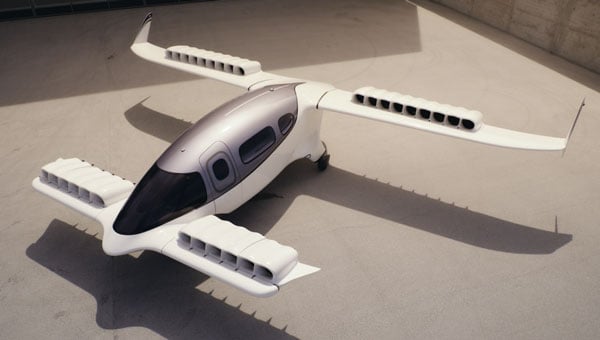
    Lilium jet eVTOL (Credit: Lilium)
    Lilium jet eVTOL (Credit: Lilium)

    Lilium, a jet eVTOL developer, and GlobeAir, an existing operator of an Austrian fixed-wing business aviation operation, signed a memorandum of understanding in September 2022. GlobeAir posted an article on its website that said it saw the agreement with Lilium as a step toward the “next generation of regional air mobility” and that it intended to buy 12 jet-powered Lilium eVTOL aircraft “to operate in Northern Italy and the French Riviera.” GlobeAir was also reported to have supported the inclusion of several potential key local suppliers to participate in the build of Lilium aircraft.

    Lilium went bankrupt in October 2024, and its assets and intellectual property have been up for bids. Emerging briefly from bankruptcy protection, Lilium again ended up broke and on the auction block in February 2025. Vaeridion has already purchased Lilium’s battery facility, and Ambitious Air Mobility is close to a deal to acquire the rest.

    The CEO of GlobeAir has now told the magazine Aviation Week in an interview that he expects the whole eVTOL adventure to fail, given the cost of not only vehicle development and construction but also the landing and charging infrastructure needed. Other hurdles include the level of test and verification and excessive levels of documentation — overall being “highly regulated, with low margins.” It’s an unfortunate, perhaps premature assessment from an existing fixed-wing operator who contracts out last-mile passenger transitions to third-party helicopter operators.


    So, there is another mixed bag of going ons in the world of unmanned and derivative eVTOL aircraft – hopefully following the restoration of funding for the government, paused programs will be restored to extend counter UAS defenses across the U.S., Ghost Bat will complete its combat engage and assess phases and there will be much better news on the eVTOL front.

  • Military drones advance as law enforcement seeks expanded counter-UAS mitigation authority

    Military drones advance as law enforcement seeks expanded counter-UAS mitigation authority

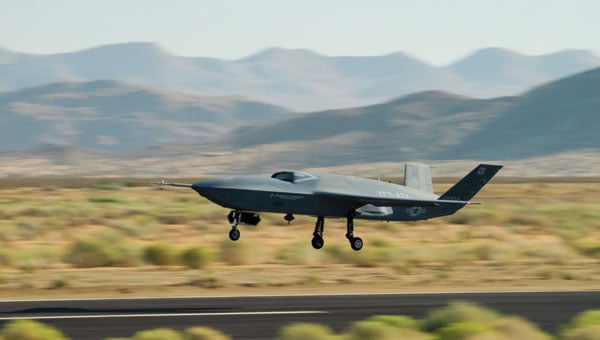
    General Atomics Aeronautical Systems Inc. (GA-ASI) is in the news again, as it got its prototype version of the U.S. Air Force (USAF) Collaborative Combat Aircraft (CCA) into the air for the first time, with an anticipated lengthy flight test campaign to follow. This latest CCA iteration, refered to as the YFQ-42A CCA, was derived from an earlier jet-powered XQ-67A Off-Board Sensing Station, a platform that enabled the company to not only develop and build but also fly this latest aircraft in just one year.

    GA-ASI CAA makes first flight Aug.t 27, 2025. (Credit: GA-ASI)
    GA-ASI CAA makes first flight Aug. 27, 2025. (Credit: GA-ASI)

    The UAV features significant autonomous capabilities developed over nearly five years of training using the MQ-20 Avenger unmanned jet aircraft. The strategy of beginning with a company-developed baseline aircraft (Avenger), securing USAF support for an initial derivative and then for the YFQ-42A CCA, appears to be accelerating development of the Loyal Wingman concept toward USAF operational manned-unmanned airborne teaming.

    Previously, in July, GA-ASI began preparations to enable friendly European countries to rapidly participate in the future CCA-capabilites by teaming with its German affiliate General Atomics Aerotec Systems GmbH (GA-ATS). The agreement appears to enable high-volume local manufacture of a European CCA, and press releases have implied that potential content is expected to be provided by other high-tech local suppliers.


    Following earlier reports that Reliable Robotics (RR) has been busy automating all phases of aircraft operations, including a Cessna Caravan cargo aircraft, USAF has awarded RR a $17.4 million contract to install a Reliable Autonomy System (RAS) in another Cessna. The resulting automated Cessna 208A Caravan is to be used in an estimated two-year program toward obtaining FAA certification that should enable flight within the U.S. National Airspace System (NAS). The system has been demonstrated — with a remote pilot in the loop — to be able to take an aircraft from startup on the ramp, through taxi, takeoff, en route flight, landing and taxi return to the ramp for unloading.

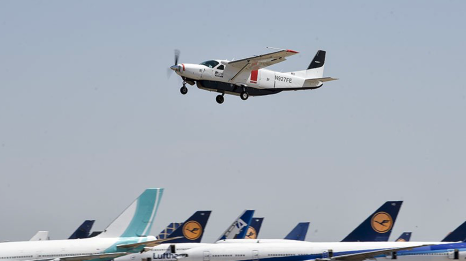
    RR autonomous Cessna 208B takes off from Mojave Air and Space Port, California, on Aug. 8, 2024. (Credit: RR))
    RR autonomous Cessna 208B takes off from Mojave Air and Space Port, California, on Aug. 8, 2024. (Credit: RR)

    Cessna Caravans have been heavily used for cargo transport across the U.S. (and around the world) with a range of 1000 miles, carrying up to 1000 lb of cargo. The RR certification program is intended to allow these types of automated unmanned commercial and military operations on a regular basis throughout FAA controlled US airspace, alongside manned aircraft. Flying military unmanned aircraft in the NAS currently requires extremely highly-coordinated, continuous activity. The hope is that eventually it could become an easier more regular form of autonomous cargo/people air transport.


    The cost of the continuing war in Ukraine may be affecting the Russian economy — a major drone manufacturer apparently is facing bankruptcy despite Russia currently using thousands of drones in attacks on Ukraine. The situation is difficult to understand, but this is an expensive war.

    However it appears that, AO Kronshtadt, one of the major drone suppliers in Russia is also beset by civil lawsuits from several organizations to which it owes lots of rubles. Its Orion and an updated version Inokhodets drone are apparently somewhat similar to the US MQ-9 Reaper UAV.

    AO Kronstadt employees assemble the Russian Orion UAV. (Credit: open source)
    AO Kronstadt employees assemble the Russian Orion UAV. (Credit: open source)

    Russia has apparently converted the Orion/Inkhodets medium-altitude surveillance drone into a strike version, but with limited success. Nevertheless, Kronshtadt apparently has made some progress, selling an export version in Asia.

    Meanwhile, Russia still is apparently producing up to 6,000 Shahed one-way drones per month by another manufacturer in the Alabuga Special Economic Zone at a unit cost of around $70,000. This is significantly lower than drones that were originally purchased from Iran at $370,000 each.

    Shahed suicide drone. (Credit: Olena Bartienieva / iStock / Getty Images Plus / Getty Images
    Shahed suicide drone. (Credit: Olena Bartienieva / iStock / Getty Images Plus / Getty Images)

    The U.S. Federal Government through its transport agencies apparently has the exclusive right to control drones, including bringing malicious UAVs down from the sky. Most people understand that the Federal Aviation Administration (FAA) regulates who flies what and where, but who is in charge of reducing and removing drone threats? It may have been difficult to understand during recent unauthorized overflights of military installations on the East Coast why someone didn’t shoot down the offending drones.

    Now, a group of police agencies has approached members of Congress to ask for the right to “detect, track, identify and mitigate” the unlawful, negligent or malicious use of drones that threaten public safety. Citing a number of incidents — including drone incursions at airports and other incidents where unmanned aircraft have interfered with firefighting and disaster response, instances where law enforcement activities have been overflown and disrupted, and the practice of using drones to drop drugs, guns and mobile phones into prisons — the law enforcement group sees a need for permission to engage. With several major events scheduled across the U.S., it likely is time to support law enforcement with the appropriate powers needed to protect the public.

    It is true that several bills are already pending before Congress to enable state, local, tribal and territorial law enforcement agencies to find, identify and possibly mitigate inappropriate drone activity, but the group is urging action now. And they clearly demonstrate the need to be able to stop drone activity when necessary — the federal government cannot cover the whole country all the time, so it makes more sense to adequately train law enforcement and to distribute authorized local mitigation activity whenever it is found to be necessary.


    So a mixed bag this month — progress for the U.S. Collaborative Combat Aircraft initiative, more steps toward automation for air cargo transport, problems for one Russian drone supplier while others increase volume and the United States seeks options for better defense against them, and U.S. law enforcement seeks the capability to help mitigate drone incursions where they are not wanted — plenty of different angles to consider around unmanned aerial vehicles.

  • New eVTOL and UAV platforms mark key advances in urban air mobility

    New eVTOL and UAV platforms mark key advances in urban air mobility

    As we are always looking for news on electric vertical take-off and landing vehicle (eVTOL) progress, the United Kingdom has recently stepped up with Gloucestershire-based Vertical Aerospace in the Cotswolds area, a beautiful part of Southwestern England.

    The company flew its new VX4 prototype from Cotsword airport to RAF Fairford (a military airport) for the Royal International Air Tattoo (RAIT), one of the world’s largest military airshows. This demonstration marked the first flight between two public airports in the country. The VX4 was also the only eVOTL on display at RAIT.

    RAF Fairford, which also serves as a base for the U.S. Air Force in Europe, has hosted aircraft including the U.S. B-52, B-1, B-2 bombers and U-2 reconnaissance aircraft. This year, RAIT featured several hundred aircraft from 30 countries, with around 200,000 attendees.

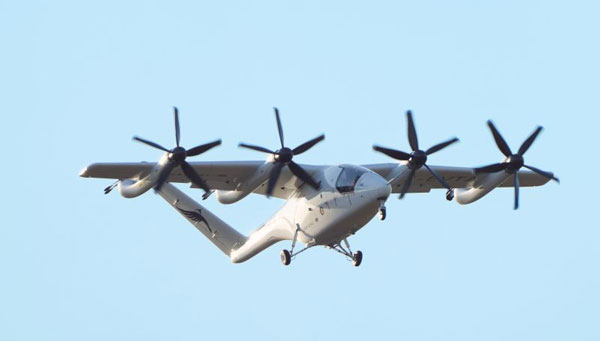
    The VX4 is equipped with eight tilt-and-lift propellers that provide redundancy for takeoff, landing and horizontal flight. The aircraft is designed to carry four passengers and one pilot.

    The avionics include proven Honeywell flight controls, and the lightweight airframe is constructed from carbon composite materials. Vertical Aeropspace said the eVTOL is designed to meet the same UK and European certification requirements as existing conventional passenger aircraft.

    The VX4 is designed with extremely low noise characteristics in both hover and horizontal flight at up to 150 mph. The company plans to use a hybrid-electric power unit in its production models.

    VX4 in flight.(Credit: Vertical Aerospace)
    VX4 in flight.(Credit: Vertical Aerospace)

    With a range of 100 miles and a max speed of 150mph, VX4 is being touted for short hops to overcome crowded city roads, or in London, avoiding changes on the underground while toting cumbersome luggage, and flying between downtown and one of London’s busiest airports.

    The VX4 can be reconfigured to carry cargo and is powered by specially designed batteries built for high output and rapid recharging, enabling quick turnaround for trans-city passenger transport.

    While aiming to replace helicopters for short hops over the city, Vertical Aerospace claims the VX4 offers far quieter, less maintenance-intensive and lower operating costs. There has been no mention of autonomous operations at this stage, but with all the necessary capabilities in hand, it’s possible that pilotless, automated flight could be possible at some future stage.


    Reliable Robotics (Reliable) has been around since being founded in 2017 – they have the objective of automating flight for General Aviation (GA), passenger airlines and cargo aircraft. Reliable reports that roughly 400 people are killed each year in GA through loss of flight and controlled flight into terrain accidents. Reliable believes that about 70% of issues could be prevented by their automation systems. For airlines, 1397 people died in 75 fatal accidents between 2017 and 2021.

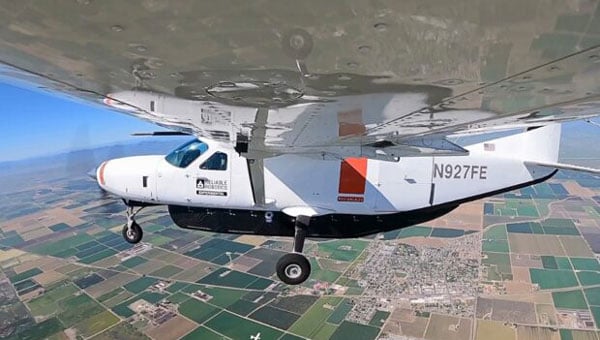
    Working with the US Air Force (UASAF), FAA and NASA, Reliable first equipped and flew an unmanned Cessna 172 and later did the same with a Cessna 208B Caravan, similar to those operated by Federal Express (FedEx). In the process, they developed their own detect and avoid (DAA) system and qualified their own actuators to FAA standards. With the intention of developing a certifiable autopilot which would manage taxi, take-off, en-route flight, and landing, Reliable implemented a multiple flight management system which is supervised by a remote pilot.

    Unmanned Cessna 208B Caravan (Credit: Reliable)
    Unmanned Cessna 208B Caravan (Credit: Reliable)

    With the extensive use of simulations, around 140 landings were first accomplished and the third landing of the actual equipped aircraft was fully automated. It may have seemed a little unnerving at first to see the aircraft taxi out to the runway with no pilot in the cockpit!

    Nevertheless, it was clear that the system worked extremely well, with a remote voice interface, ground control, data link control, and monitoring of the aircraft system. With over 5000 airports available around the US, only 130 actually experience commercial operations, so the scope of enabling automated cargo transport activity more extensively across the nation appears to have room for expansion.

    Reliable has just begun more simulation work with NASA — automated aircraft human-in-the-loop detect and avoid (DAA); loss of the command and control (C2) link and the necessary reversionary recovery systems, and management of the automated aircraft alongside manned aircraft as they both enter and leave airports. Work is intended to figure out the level and type of automated systems required for safe integration of large volumes of cargo-carrying unmanned aircraft systems (UAS) into the National Airspace System (NAS).


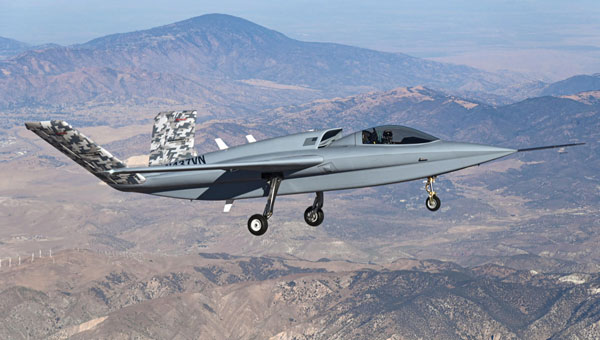
    Northrop Grumman had Scaled Composites (SC) build a prototype (Model 437) manned UAV, which, according to the company, is now destined to become a testbed for autonomous systems development.

    Now called Beacon, the testbed originally flew in August 2024, possibly as a contender for the Loyal Wingman Collaborative Combat Aircraft opportunity, with a Pratt & Whitney 3400 lb thrust jet engine and an internal weapons bay capable of carrying 2000 lb of weapons. SC originally built the M437 as a platform to demonstrate Northrop’s digitally engineered wings.

    Model 437 in flight. (Photo: Scaled Composites)
    Model 437 in flight. (Photo: Scaled Composites)

    Now, Northrop is providing the airframe to enable collaborative partners to further develop autonomy capability to be used in future Northrop programs.

    Nice to see some VTOL air taxi development in the UK, an outfit focusing on the insides of UAV autonomy and even an aircraft platform for developers to use — all together interesting times for autonomous UAV growth.

  • Helicopter and space UAVs pave the way for autonomous systems

    Helicopter and space UAVs pave the way for autonomous systems

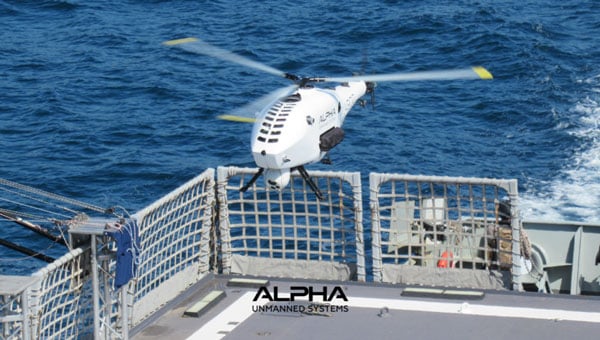
    Alpha Unmanned Systems (Alpha) in Madrid, Spain, has been developing and building helicopter UAVs for 10 years and has successfully employed them with defense departments in 10 countries. Its UAVs are ruggedized and qualified for the harsh conditions encountered at sea. The fully autonomous A800 and more recent A900 model UAVs have been used in military applications such as border patrol, situation awareness, intelligence gathering, coast guard support and aerial helicopter target simulation. Commercial applications include fishing fleets and oil rig support.

    Alpha A900 approaches for deck landing. (Credit: Alpha)
    Alpha A900 approaches for deck landing. (Credit: Alpha)

    The helicopter UAVs are equipped with a GNSS/MEMS autopilot system that maintains navigation if GNSS is jammed. MEMS sensors, however, can experience significant drift over time. The Alpha model offers two additional backup solutions. With an advanced air data system and pitot sensors, the aircraft can estimate airspeed and wind velocity to help maintain its flight path. If attitude estimation degrades further, remote pilot judgment may be required to recover control. For ground operations, a visual navigation system with a downward-looking camera can record terrain during overflights, building a database that enables navigation in GNSS-denied environments.

    One of the newer capabilities Alpha has added includes an Automatic Identification System (AIS) receiver. AIS is a primary radar transponder system used by ships around the world to provide each other with tracking information on other ships that are within about a 30-mile range. With an AIS receiver onboard the UAS surveillance helicopter, ships that are out of visual range, maybe out close to the horizon, now become trackable.

    Alpha is a small company that has been in operation since 2014, and it is one of the first to design helicopter UAVs for rough weather and at-sea environments. It’s good to see a focused, supportive outfit gradually succeed, not only with European defense organizations, but also in the U.S. and around the world.


    Meanwhile, in a universe that’s not far, far away — in fact, in our solar system — plans are moving forward at NASA to visit Titan with a UAV. Titan is a moon of Saturn that is most favored to have the capability to start, and maybe support, life. Numerous organic compounds have been detected during earlier satellite visits. But this is no ordinary UAV, quite unlike Ingenuity, the solar-powered hopper that NASA flew 72 times on Mars.

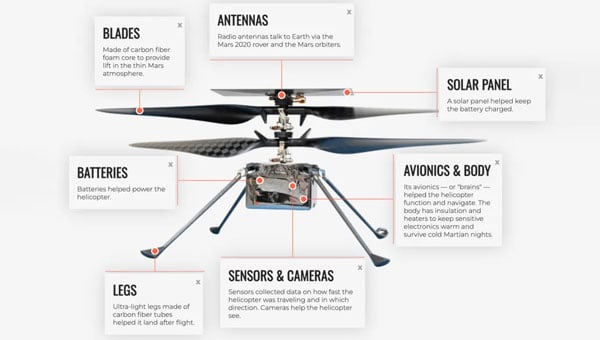
    Ingenuity, a UAV that flew 72 times on Mars. (Credit: NASA)
    Ingenuity, a UAV that flew 72 times on Mars. (Credit: NASA)

    NASA’s Ingenuity helicopter, which traveled to Mars attached to the Perseverance rover, was designed to demonstrate powered flight in the Red Planet’s thin atmosphere. Ingenuity featured oversized rotor blades to generate enough lift and was built to be as lightweight as possible. Its only equipment was a camera and speed sensors, with no scientific instruments aboard.

    The helicopter performed flights over Jezero Crater, ultimately spending about 130 minutes aloft and covering 11 miles during 72 flights. Ingenuity’s mission came to an end after it sustained damage to a rotor during a hard landing, grounding the aircraft and concluding its operations on Mars.

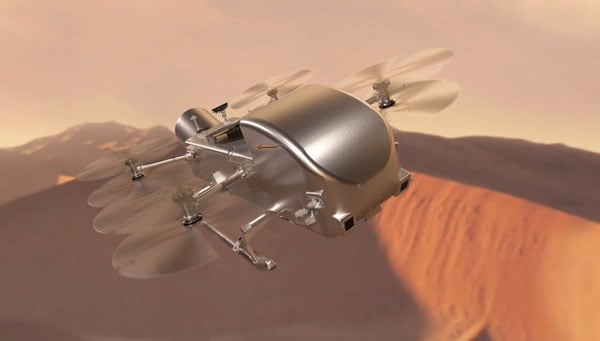
    The next interplanetary unmanned flying system is significantly more complex, replacing the lander and drone approach used on the Red Planet with a complete vehicle capable of flying and conducting the necessary investigative science. With a budget of $3.35 billion, NASA’s work has been underway since 2024, led by John Hopkins Applied Physics Lab, and a host of main and supporting organizations, including Lockheed Martin Space, Malin Space Science Systems (cameras), Honeybee Robotics (Blue Origin subsidiary, moon lander development) and participation by agencies in France, Germany and Japan. While Ingenuity was developed and built by UAV manufacturer AeroVironment with management/support from NASA/Jet Propulsion Labs (JPL), the team for Dragonfly appears to have a few industrial partners and extensive government support – hopefully, this works out!

    Powered by a Radioisotope Thermoelectric Generator (RTG), Dragonfly has four sets of double rotors, landing skids, and, of course, has to be fully autonomous – the radio transit time between Titan and Earth is between 1 hour 10 minutes and 1 hour 40 minutes. Titan’s night is eight Earth days long, so the idea is to fly during the day (throughout 15 Earth days), then land and recharge batteries, and receive NASA’s instructions for the following day’s activities during the long night. The atmosphere is thought to be substantially composed of nitrogen and methane, four times thicker than Earth’s, and gravity is about 1/7, so 4 ft props with enough lift and power could carry the 880 lb to 990 lb UAV up to 10 miles for each flight at altitudes of up to 12,000 ft. But when observing and imaging the terrain, we might guess it would probably mean mostly low-level flights.

    Dragonfly Titan UAV explorer (Credit: NASA/Johns Hopkins APL/Steve Gribben)
    Dragonfly Titan UAV explorer (Credit: NASA/Johns Hopkins APL/Steve Gribben)

    At this weight, we are looking at something quite substantial to be flying around the anticipated sand dunes and frozen methane surface of Titan. Autonomous operations will need to be tight and safe for this big vehicle to operate and survive; it’s not exactly a small car, but quite substantial. Not to mention that landing will need to be somewhat delicate to protect the sensitive onboard instrumentation. 

    A spacecraft is scheduled to launch aboard a SpaceX Falcon Heavy in 2028, embarking on a complex journey that includes a flyby of Venus and a gravity-assist maneuver past Earth to set a direct course for Saturn’s moon Titan. The probe is set to enter Titan’s dense atmosphere directly, protected by a heat shield. After initial deceleration from atmospheric drag, two drogue parachutes will deploy, followed by a powered descent to the equatorial region known as the Shangri-La dune fields.

    The voyage is expected to take six years, with arrival at Titan in 2038. Once on the surface, the Dragonfly mission will begin a 2.7-year exploration of the moon.


    An interesting initial glimpse into a future, really advanced drone are undertaking. Hopefully, NASA will keep to its schedule, the budget holds up, and we start to see hardware in the next few years. Meanwhile, Alpha could be on version 16 of its UAV helicopter by then and achieve massive success with its multi-mission UAV applications.

  • Autonomous fighter drones join the front lines in USAF operations

    Autonomous fighter drones join the front lines in USAF operations

    The U.S. Air Force is increasingly referring to its next generation of unmanned aircraft as “fighter drones,” as the service prepares to integrate these vehicles alongside traditional fighter jets in combat missions. The Air Force’s Collaborative Combat Aircraft (CCA) program includes two separate vehicles under development by General Atomics Aeronautical Systems (GA-ASI) and Anduril, both designed to operate as combat-ready UAVs. These UAVs are being built to complement existing fighter fleets, providing additional capabilities and support during operations. According to Air Force officials, the new aircraft are expected to play a key role in future air combat by flying alongside piloted fighters and taking on a variety of tactical missions.

    One is an all-stealth design for undetected penetration of enemy defenses; the other is a sleek fighting companion.

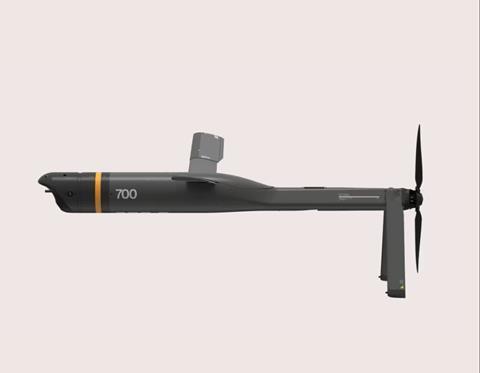
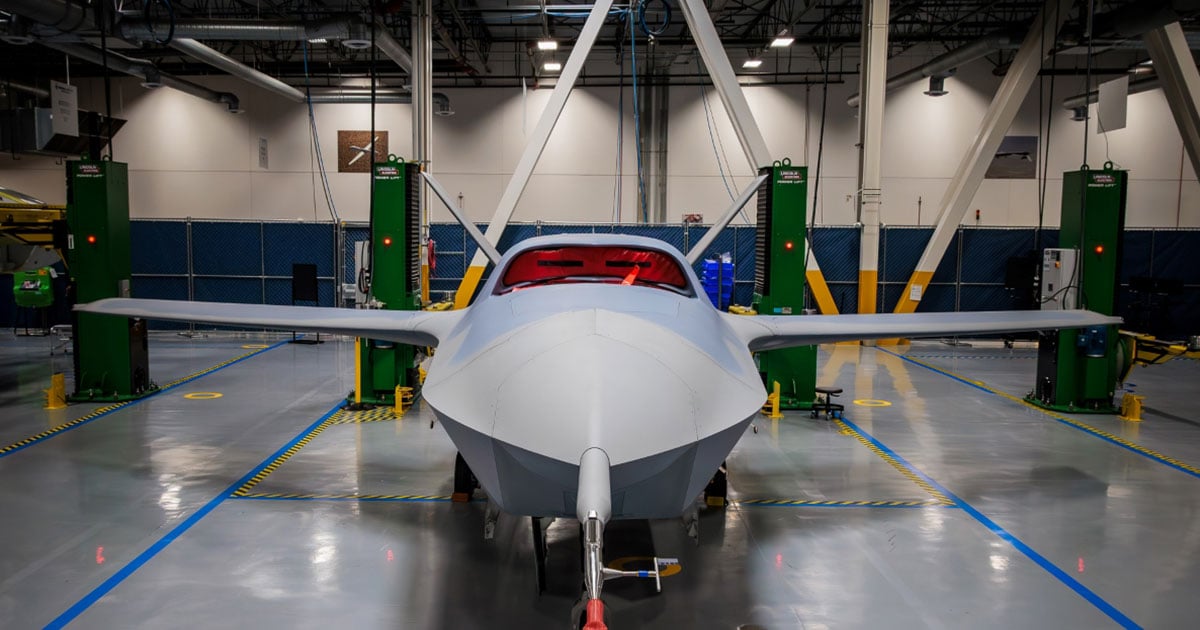
    GA-ASI YFQ-42A fighter drone prototype (Credit: USAF)
    GA-ASI YFQ-42A fighter drone prototype (Credit: USAF)

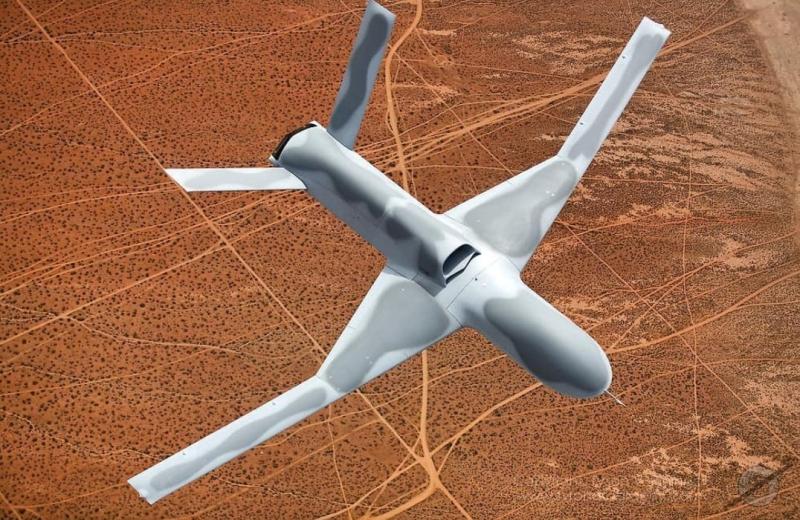
    It appears the General Atomics YFQ-42A/CCA drew inspiration from the earlier stealth capabilities of the Avenger UAV, which has been in flight for more than a decade. This aircraft has a maximum ceiling of over 50,000 ft, flies at 400 mph, has around 15 hours of endurance and is powered by a built-in turbofan engine.

    Avenger UAV (Credit: GA-ASI/Tyson Rininger)
    Avenger UAV (Credit: GA-ASI/Tyson Rininger)

    One notable feature of the CCA version is its split, sloping “tailfin” and rounded design, along with a top fuselage air intake that shields the power plant from potential radar signals – all stealthy characteristics similar to those of its Avenger counterpart. Looking closely at the prototype, the doors on its belly appear to be for an internal weapons bay.

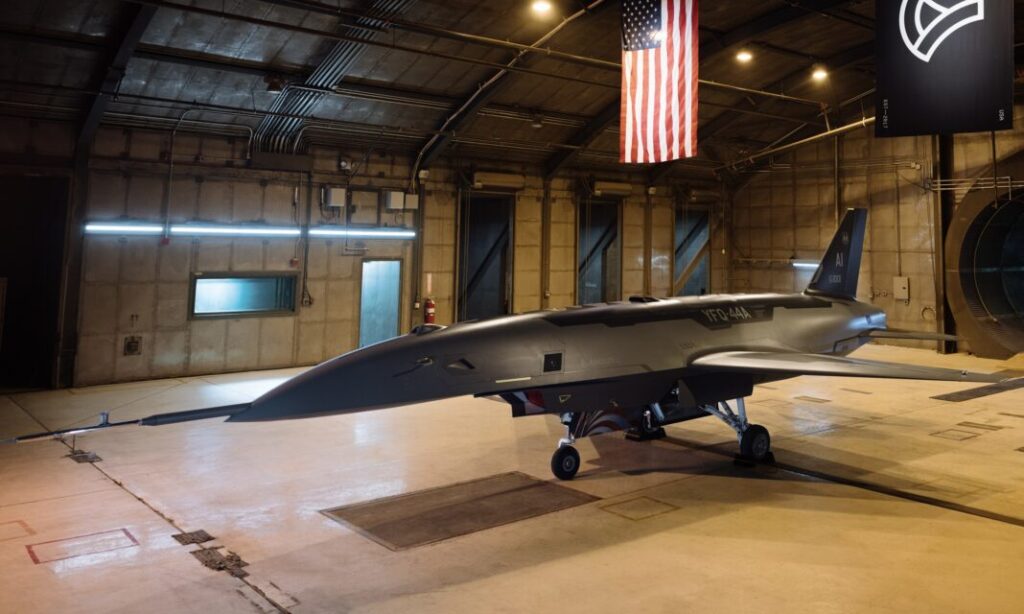
    Another USAF CCA prototype, built by Anduril, has been named the FYQ-44. It features a sleek and fast design, similar to earlier pre-stealth fighters, but also includes an internal weapons bay, rounded contours, and an air intake below the fuselage for a turbofan engine.

    Andruil YFQ-44 undergoes ground testing. (Credit: USAF)
    Anduril YFQ-44 undergoes ground testing. (Credit: USAF)

    The USAF’s release of these two CCA prototype contenders seems to suggest that they could be the fighter aircraft of the future. The CCA program, however, does talk about control of these armed UAVs by accompanying mainline manned fighter aircraft, but with autonomous capability to find and destroy once dispatched to attack a target.

    The intent is that these unmanned fighters will be significantly less costly to acquire than their expensive manned brothers so that high-risk targets may still be attacked and destroyed without potential loss of the flying pilot or their expensive aircraft. The unmanned fighters would be programmed by the manned aircraft and missiles in their internal weapons bay, would then go on to be controlled by onboard CCA weapons systems, which would relay data back continuously to the pilot who would have final go/no-go authority.

    Both prototypes are slated to fly later this year following extensive ground testing campaigns.


    After securing an initial $60 million contract from the USAF in 2021, Hermeus went on to raise $100 million in funding in 2022. This was followed by an investment from Raytheon Technologies’ RTX Ventures later that year. Additionally, the company landed a contract for Hypersonic risk reduction from the Defense Innovation Unit (DIU), allowing Hermeus to maintain its funding and momentum. This enabled the company to build and recently fly its first unmanned aircraft, which is designed to travel at extremely high speeds, according to the company.

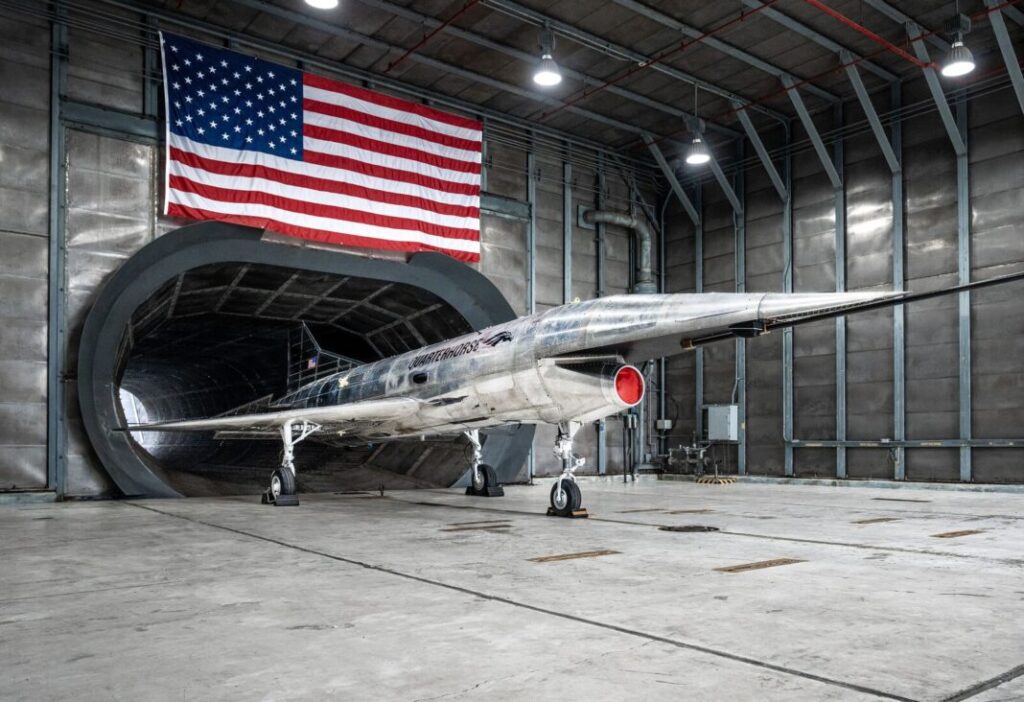
    Hermeus Quarterhorse initial prototype UAV (Credit: Hermeus)
    Hermeus’ Quarterhorse initial prototype UAV (Credit: Hermeus)

    Initially, with an integrated GE J85 engine, Hermeus is now launching the incorporation of the Pratt & Whitney F-100 into its own “Chimera II turbine-based combined cycle (TBCC) propulsion system,” all aimed at taking subsequent iterations of their prototype to hypersonic speeds.

    Quaterhorse has been developed to demonstrate high-speed take-off and landing of a large unmanned aircraft, and is the first in a series of prototypes. And a couple of months ago, on May 27 at Edwards Air Force Base (AFB) in California, Quaterhorse did in fact take off, performed a short overhead circuit and landed! So, more flight tests are now expected to explore the drone’s flight characteristics.

    The TBCC two-phase engine with the Pratt F-100 front-end is slated to take Darkhorse, the next planned drone derivative, to Mach 2.8 on the F-100 and then up to over Mach 5 with the hypersonic back-end section of the engine. It could be said that the whole vehicle is being built around this monster engine!


    It will be interesting to see how flight testing of Quaterhorse progresses, but even more exciting to hopefully see if and when Hermeus gets the next hypersonic version flying. Additionally, we can anticipate the first flights of the USAF CCA prototypes.

    It is amazing how, from the humble beginnings of hobbyist radio-controlled recreational model aircraft, drones have evolved with sophisticated autopilots and are now becoming autonomous vehicles that are taking on front-line air force attack-support. Technological progress is now headed towards hypersonic capability.

  • UAV updates: Approval milestones, new eVOTLs and autonomous warfare

    UAV updates: Approval milestones, new eVOTLs and autonomous warfare

    For anyone out there who has ever worked through a formal process of equipment development for subsequent FAA/military or other national certification, you would likely appreciate the significance of a UAV approval milestone.

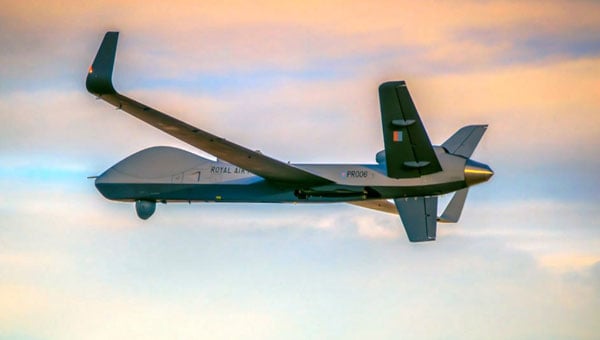
    General Atomics (GA-ASI) has just provided notice that the Royal Air Force (RAF) Protector RG Mk1 — based on the MQ-9A Reaper unmanned aircraft system (UAS) — has been granted a Military Type Certificate, having demonstrated compliance based on the requirements of STANAG 4671, NATO’s UAS airworthiness standard.

    RAF Protector RG Mk-1 (Photo: GA-ASI)
    RAF Protector RG Mk-1 (Photo: GA-ASI)

    This is big news for the RAF and GA-ASI, which enables this large Class III UAS to fly almost anywhere, without restricting flight over cities and other densely populated areas, and most importantly, facilitating flight within civil airspace. New capabilities that have been added include lightning and fire protection, as well as anti-icing systems. The strong airframe is designed to withstand long-term operational stress and exhibit a level of resilience against the effects of multiple airborne combat missions.

    The software and electronic hardware were developed in accordance with current industry standards, which are intended to ensure the safety and reliability of systems. However, overall, GA-ASI has invested more than half a million dollars of its own money over 11 years to achieve this approval. Extensive environmental testing included lengthy, complex static and dynamic load tests, and extensive simulations were undertaken to verify performance over the operating envelope of the aircraft.

    If you have ever seen a static ground test rig for stressing and even over-stressing an airframe, the significant number of hydraulic jacks within a massive steel girder enclosure is something to behold. Just building the structure and tuning the electronic systems which drive it, and fixing things on the rig and the airframe as tests progress over many months this is a significant undertaking and investment.  

    The RAF has so far taken delivery of 11 of the 16 Protector UAS under order, and this certification is a major milestone on the way toward operational deployment. For General Atomics, this initiative hopes to not only lead to further military organizations purchasing an MTC-qualified UAS but also to open the door for civilian qualification options.


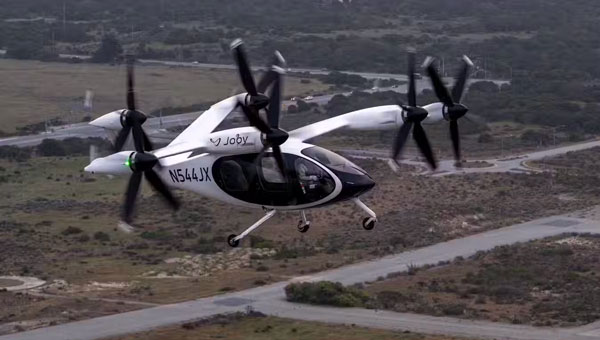
    In the meantime, Joby Aviation in Santa Cruz, California, has just achieved a major milestone on the way to civil certification of its electric Vertical Take Off and Landing (eVTOL) passenger aircraft. With orders and sponsorship from Delta, Toyota, Uber and many others, the company is working toward piloted and autonomous flying taxis.

    Joby’s eVTOL piloted transition from vertical to horizontal (Photo: Joby)
    Joby’s eVTOL piloted transition from vertical to horizontal (Photo: Joby)

    The major event involved an onboard pilot flying the eVTOL from a vertical takeoff through the transition to horizontal, wing-borne flight. This clears a major hurdle along the path to civil certification, enabling FAA pilots to be on board to monitor operations and fly the eVTOL.

    The Joby test pilot first flew this production aircraft on April 22, with all the propellers horizontal and lifted off to about 30ft, just as a helicopter would take off. After a brief pause, the engine nacelles were rotated gradually forward and the eVTOL slowly crept forward. Traveling approximately 500 yards, the transition to wing-borne flight occurred as speed increased, and eventually, the climb-out began.

    After several repetitions with two other test pilots, the piloted transition process was considered ready for operations and the next chapter was on the way to initial validation testing and air-taxi operations, which will be in Dubai.

    Since 2017, Joby has flown a number of its eVTOL aircraft for a total of over 40,000 flight hours, with ground-pilot control, and with an onboard pilot in hover and forward flight. However, the transition phase has never been flown with an onboard pilot in full control. So that means presumably that all previous transitions had been controlled externally from the ground. This puts Joby well on the road to certification — other eVTOL manufacturers have made crewed transitions, but with separate propellers for lift and for forward flight – this is the first with one set of tilting propellers which is a principle operational feature of the Joby eVTOL.


    AeroVironment (AV) supplies a wide variety of UAS to the U.S. and other militaries. Nevertheless, the company has recently released information about a new one-way drone, which features enhanced capabilities, bringing forward “new, innovative solutions and improvements,” according to the release. This latest contender is apparently equipped to accept software upgrades throughout its design lifetime to continuously add more capabilities and specializations.

    The Red Dragon UAV differs in that it is claimed to be fully autonomous (when circumstances require it) and can navigate in GPS-denied environments.

     Red Dragon UAV illustration (Image: AV)
    Red Dragon UAV illustration (Image: AV)

    Given that modern battlefields are an electronic nightmare for GNSS navigation and control/data channels, AV has endowed Red Dragon with a hardened GPS baseline system, augmented by visual navigation, digital scene matching and automatic target recognition, and also using airspeed and laser rangefinder inputs. When necessary, the UAV can continue to track its target without requiring satellite control signals. There is a return link back to the operator, but when that link goes down, Red could proceed alone, or optionally crash-land if targeting doesn’t meet pre-programmed parameters.

    Carrying a 5lb charge, Red is not designed to return to its owner, rather to deliver a penetrating destructive explosion. Even if doesn’t self-destruct, no-one wants this package back, its completely disposable. With a 250-mile range flying at 50 mph to 60 mph, the UAV can accelerate at up to 100 mph in the final phase of its attack.

    Built simply for ready use in the field and to greatly reduce unit volume manufacturing cost, this new one-way munition may be the result of lessons learned during recent battles – possibly just what forces think they need through the use of already combat-proven attack drones such as the AV Puma and Switchblade. It is reported that Red Dragon may have already experienced actual combat.


    To recap, General Atomics’ most recent Reaper variant is now ready to fly almost anywhere with its very own UK MTC certification, Joby’s tilt-rotor eVTOL has cleared the piloted transition hurdle and AeroVironment has released a new kind of loitering munition with autonomy and GPS-denied navigation capability — both military and civilian UAVs at the forefront of unmanned evolution.

  • Meeting the autonomy promise: Advanced navigation for sea, land and air

    Meeting the autonomy promise: Advanced navigation for sea, land and air

    A 2019 RAND report for the U.S. Navy concluded that autonomy could still be in the distant future. The Navy should take care that a number of claimed autonomy applications could be more aspirational than practical, the report stated, with the applications nowhere near to operational capability. The authors wrote that huge investments may be required to achieve autonomous naval weapon systems, not only in autonomy.
    Around the world in recent years, most armed forces and many advanced technology companies, along with government agencies, have been investing in AI and automation. Perhaps now, just six years later in 2025, we already are looking foward to unmanned vehicles that display not just fundamental autonomy, but also quite advanced “auto-capability.”

    In the world’s water

    The U.S. Navy (USN) has been operating a number of unmanned surface vessels (USV) over the past several years. In a 2023/2024 Pacific Fleet exercise, four USV models (Sea Hunter, Sea Hawk, Mariner and Ranger) were mostly operated autonomously. Ranger has a small bridge manned only for harbor maneuvers.
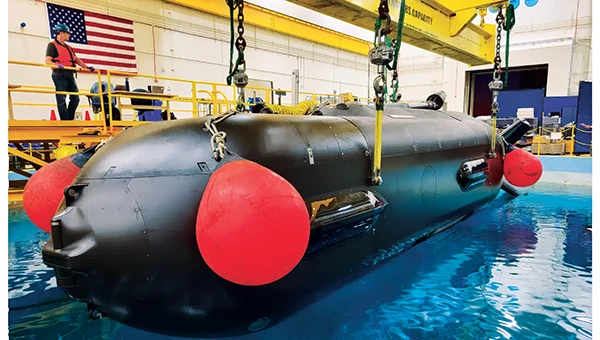
    An Orca extra large UUV (XLUUV) is tested in a tank. With a range of 6,500 nautical miles, the submarine can perform long missions. Its navigation system features a Kalman-filtered inertial unit supported by Doppler velocity logs and depth sensors. Photo: Boeing
    An Orca extra large UUV (XLUUV) is tested in a tank. With a range of 6,500 nautical miles, the submarine can perform long missions. Its navigation system features a Kalman-filtered inertial unit supported by Doppler velocity logs and depth sensors. Photo: Boeing

    The USN has unmanned autonomy programs for large, small and underwater vehicles. The Orca submarine program is slated to consist of five 51-foot-long vehicles, and includes variants fitted with an added 30-foot payload section. To operate for several months underwater, it is likely that a similar degree of autonomy has been incorporated. ORCA surfaces regularly and can be given new routing if required.

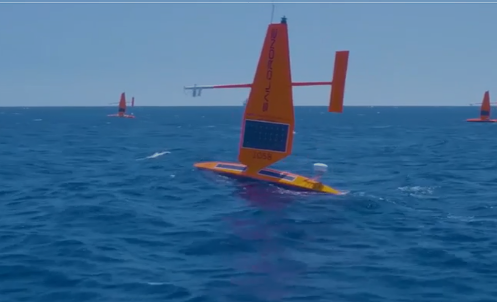
    Saildrone's autonomous research vessel (Photo: Saildrone)
    Saildrone’s autonomous research vessel (Photo: Saildrone)

    Other types of vessels collect ocean and seafloor data. The environmentally friendly Saildrone can operate independently — we could say autonomously — for more than a year. The Saildrone company, based in Alameda, California, contracts out its USVs, providing its technology to agencies and governments and taking on the risks of ocean surveying to acquire valuable data. Saidrones are equipped with satellite communications, GNSS navigation, weather sensors and sub-surface sensors.

    Wheels on the road

    Autonomy applications on land are dominated by commercial self-driving cars, Tesla being the leading manufacturer in the U.S. However, full autonomy is still a considerable way from being ready. At the full-autonomy level, known as Level 6 in the auto industry, the vehicle does all the driving, including obstacle avoidance, under all conditions, without any geographic limitation. Nevertheless, we appear to have progressed from basic manual control (Level 0) to somewhere around Level 3, where the vehicle is largely aware of its environment, and does most of the driving. Even so, human monitoring and control are still required.

    Tesla’s autopilot technology in its Model S and Model X electric vehicles could be referred to as an advanced driver assistance system — or as Tesla calls it, “Full Self-Driving (Supervised)” — and is reported to handle emergency steering and braking, autonomous steering, lane changing, vehicle following, curve negotiation, and automatic parking. Autopilot sensor inputs are provided by 12 ultrasonic sensors and eight cameras providing a 360° field of view.

    Tesla Autopilot intelligence can identify more than 250 traffic signs 50 countries, including turn signs and speed limits. It can identify and interpret traffic lights and road markings, and decide what to do when coming across things such as traffic cones and pedestrians.

    Nevertheless, Tesla’s have been involved in quite a few accidents, the cause of which has been analyzed to be mostly a lack of driver attention (supervision), and in a number of cases, a failure of the autonomous system to recognize unusual road conditions.

    Another company, Leo Drive, specializes in providing scalable software and hardware solutions, offering an end-to-end, one-stop service for integration of autonomous systems. Its mission is to make autonomous technology more accessible and widely adopted across various industries.

    For its autonomous test vehicle, Leo Drive is using the Ellipse-D, a dual-antenna RTK inertial navigation system (INS) from SBG Systems. The company chose the Ellipse-D for its accuracy, reliability, and advanced features — all essential for autonomous vehicle development and testing. The Ellipse-D INS was integrated into Leo Drive’s, a passenger car converted for autonomous operations.

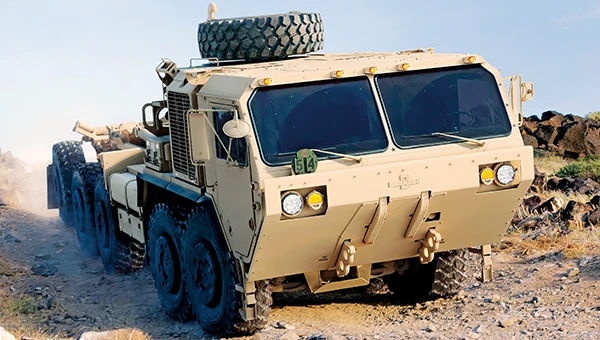
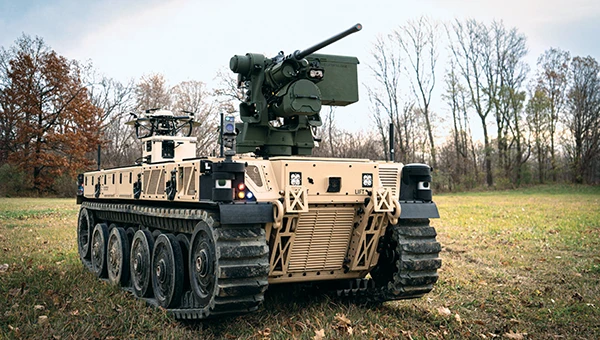
    Oshkosh Defense integrated autonomous technology onto Palletized Load System vehicles as part of the Expedient Leader Follower program. Photo: Oshkosh Defense
    Oshkosh Defense integrated autonomous technology onto Palletized Load System vehicles as part of the Expedient Leader Follower program. Photo: Oshkosh Defense

    The U.S. Army has been using automation in its weapon systems for some time. How much autonomous behavior, of which these systems are truly capable, may be difficult to determine. The General Atomics Reaper unmanned aerial vehicle (UAV) is largely controlled over long-distance satellite links by operators in control stations. It’s possible that the same set up is true of most of the Army’s automated weapons — probably motivated by the need to avoid systems independently determining their own targets and firing without human confirmation.

    It’s difficult to determine just what army programs are underway, other than to acknowledge that programs have been launched in the past. There doesn’t appear to be any open, clear indication of the degree of autonomy to be included. A couple of programs have produced at least visible hardware, but how much or little human control is involved is unclear.

    Taking flight

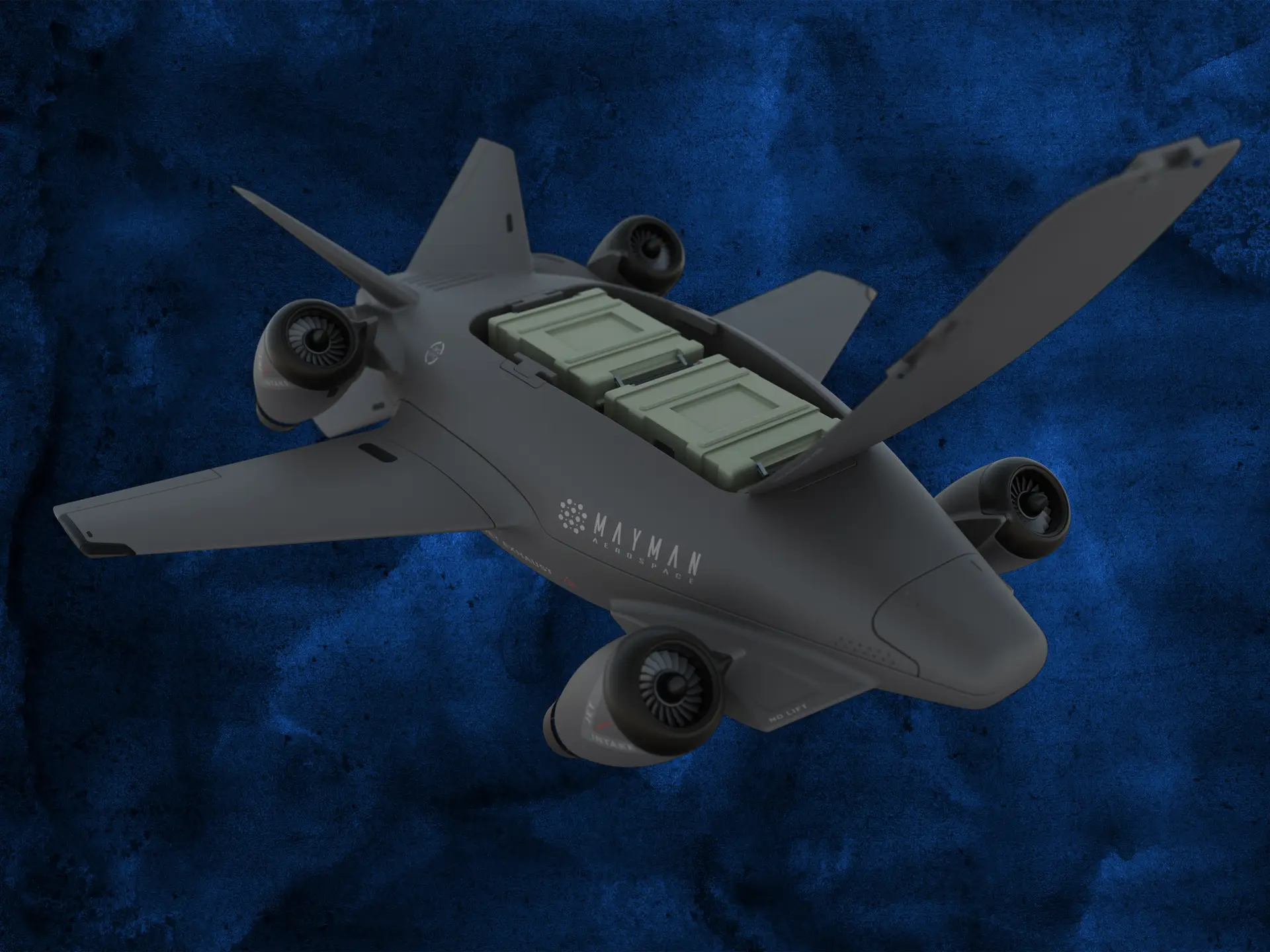
    Up in the air, new autonomy contender Mayman Aerospace is offering the Razor, a jet-powered vertical take-off and landing (VTOL) UAV. Development of Razor is funded by private investment and U.S. Department of Defense contracts.

    The RAZOR VTOL with gimbled jet pods passed tests at a military base in California in September 2024. Photo: Mayman Aerospace
    The RAZOR VTOL with gimbled jet pods passed tests at a military base in California in September 2024. Photo: Mayman Aerospace

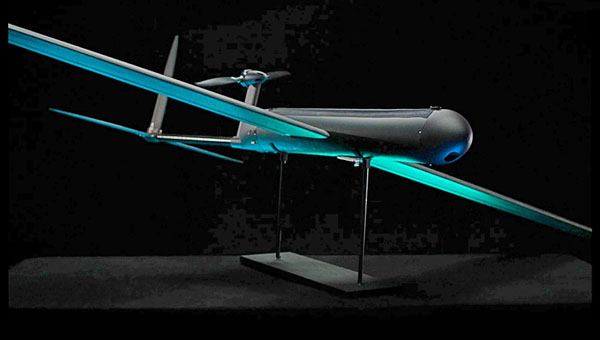
    Razor is imbued with a degree of AI that enables autonomous decision-making, as well as navigation. Its autonomous AI brain — the SkyField flight-control system — navigates independently in a GPS-denied environment, possibly involving ground beacons and eventually integrating with battlefield management systems. With a 5- to 6-foot-long airframe and sculpted shape, the aircraft presents a low radar cross section and has a degree of stealth to assist in the penetration of enemy defenses. Its top speed of 500 mph provides new options for both military and commercial applications, according to Mayman.

    Razor also can aid disaster recovery, rescue operations, and the delivery of urgently needed life-saving cargo.

    Many VTOL unmanned aircraft have struggled with the transition from vertical to horizontal flight. On its first vertical lift-off and climb-out on four jet engines, Razor paused briefly at altitude. Then its jet pods tilted slightly toward horizontal before the aircraft went directly into horizontal flight. An earlier flying testbed may have assisted the development of transition software, perhaps with a boost from machine learning.

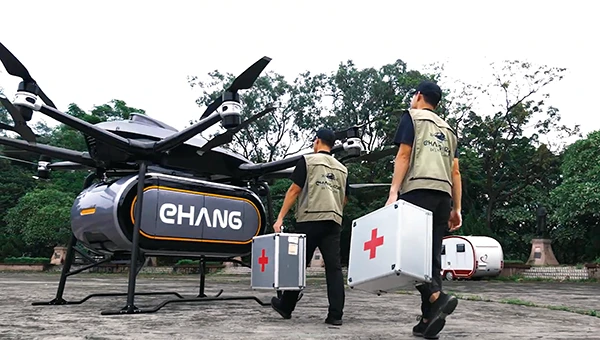
    Designed for deliveries, the EHang 216 heavy cargo, 16-rotor unmanned aircraft can carry a payload of 551 pounds over almost 22 miles with a top speed of 80 mph, according to the EHang company. The UAV is fully autonomously operated while being monitored over a 4G/5G data link at a manned control center. The system has an automatic fail-safe mode in which the UAV will return to base if the communications link goes down or if battery power drops too low.

    EHang also uses a redundant design, with two GPS receivers and double rotors, ensuring a low likelihood of failure during a delivery run.

    More In development

    So while land vehicle autonomy is moving forward — with Tesla cars and Army vehicles that apparently can take control with close human monitoring — we still have some distance to go to achieve fully independent autonomous behavior on the road.

    The Ehang 216 heavy-cargo UAV EHang 216L is designed for deliveries, including life-saving ones. Photo: Ehang video screenshot
    The Ehang 216 heavy-cargo UAV EHang 216L is designed for deliveries, including life-saving ones. Photo: Ehang video screenshot

    Autonomous applications on the sea are more common, with U.S. Navy applications showing substantial progress. Still, precise navigation in crowded harbors remains under human control. Humans are still watching and monitoring, ready to intervene should military or commercial UAV applications make untoward execution errors.

    We will continue to follow developments of significant autonomy programs such as the U.S. Air Force Collaborative Combat Aircraft (CCA), a new type of uncrewed weapon system. The CCA and other programs are maintaining high investment levels, so it’s possible that we may see full autonomy fielded quite soon. Perhaps then our belief in its capability will become fully justified.