A U.K. government report issued on Jan. 30 looks at the vulnerability of all satellite-based positioning systems: GPS, Galileo, GLONASS, BeiDou, QZSS and more. Issued by the Office of the Government Chief Scientific Adviser, Sir Mark Walport, and informally called the Blackett Report, designating the highest level of government scientific studies, named after a UK physicist who won the 1948 Nobel Prize, the review aims to “lay out the breadth, scale and implications of our reliance on ‘the invisible utility’ mainly in terms of existing critical national infrastructure (CNI).”
“Satellite-derived Time and Position: A Study of Critical Dependencies” states in the forward that it “represents a vital step in understanding the UK’s dependency on GNSS and recommends measures to improve our resilience. Importantly, it also recognises that innovation will be key to realising, fully and safely, the economic and societal benefits offered by GNSS.”
The report points to the fragility of satellite positioning signals which can be affected by cheap jammers, spoofers, weather and interference from other radio signals — among other vulnerabilities. The 86-page PDF document is downloadable here.
The review incorporates the results of a separate but related study, issued in April 2017, looking at the fiscal consequences of a GNSS disruption in. “Economic Impact to the U.K. of a Disruption in GNSS” was briefly summarized in a June 2017 column from this magazine (scroll down to “At What Cost Ignorance?”). The report attempted to quantify the cost of a GNSS disruption, should one occur. The authors came up a figure of 5.2 billion pounds ($6 billion) for a 5-day disruption.
David Last, a UK consultant engineer specializing in radio navigation and communications systems, professor emeritus at the University of Bangor, Wales and past president of the Royal Institute of Navigation, consulted on the June 2017 economic impact report, and was a member of the expert panel and co-author of the January 2018 Blackett Report. He was to have given a presentation on them at the ION International Technical Meeting in Reston, Virginia on January, but could not make the trip. The following materials are drawn from his prepared presentation.
Some of the conclusions from the June 2017 economic impact study are:
There are alternatives to GNSS, specific to each application
However, there is no universally-applicable single alternative for positioning and navigation
Among the most salient needs: higher quality (more expensive) oscillators for timing
“The most applicable mitigation strategies for the largest number of applications are eLoran and Satelles.”
“Omnisense and Locata may be preferred for localised applications that require high levels of accuracy.”
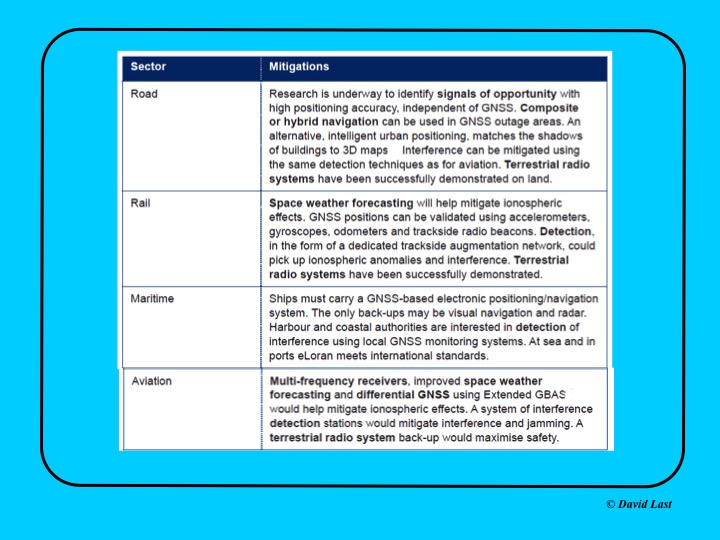
From the just-issued Blackett Report, the first figure displayed above presents recommended mitigations to impacts on GNSS applications in road, rail, maritime and aviation. Alternative options include composite or hybrid navigation, terrestrial radio systems, space weather forecasting, eLoran, various methods of interference detection, multi-frequency receivers and differential GNSS.
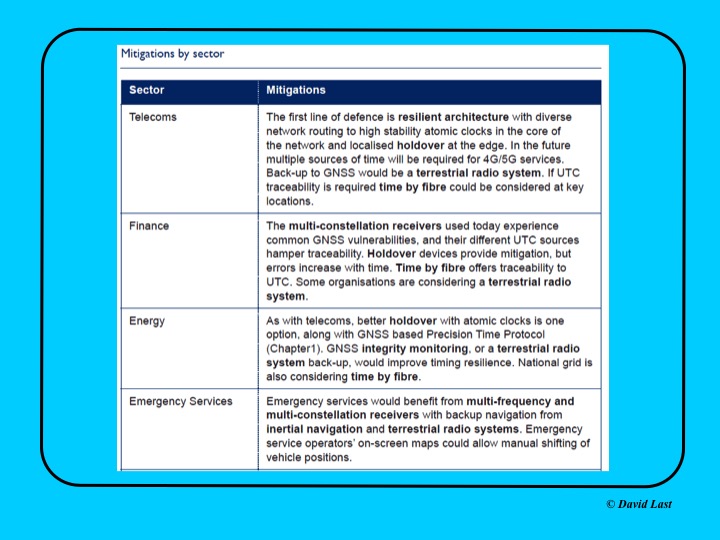
A second figure from Last’s presentation, shown above, covers the mitigations recommended for telecoms, finance, energy, and emergency services sectors. Mitigations for these applications include a resilient architecture with diverse network routing to high-stability atomic clocks, terrestrial radio systems, time-by-fiberoptics, multiconstellation receivers, holdover devices, GNSS integrity monitoring, and inertial navigation.
Concluding recommendations of the Blackett Report:
CNI operators to review and report on their reliance on GNSS. Cabinet Office to assess overall dependence of CNI on GNSS.
Add loss or compromise of GNSS-derived PNT to National Risk Assessment, not just as a dimension of space weather.
In allocating radio spectrum to new services and applications, address the risk of interference to GNSS-dependent users, including CNI.
Review the legality of the sale, ownership and use of devices and software to cause deliberate interference to GNSS receivers or signals.
Assess the need to monitor interference of GNSS at key sites such as ports and share the data with government
Employ GNSS-independent back-up systems.
Cross-government PNT Working Group to report to Cabinet Office on ways to improve national resilience.
Government to facilitate as those procuring GNSS equipment for CNI specify performance standards.
Map PNT testing facilities and explore how industry and critical services can better access them.
Leverage UK academic and industrial expertise in time and geo-location, increasing coordination among existing centres of excellence.
Korea will build its own navigation satellite system by 2034, providing independent positioning and navigation signals over an area spanning a 1,000-kilometer radius from the country’s capital, Seoul.
The Ministry of Science and information and communications technology (ICT) announced that it would finalize a plan for the Korean Positioning System (KPS) at a Space Committee meeting on Feb. 5.
According to a preliminary statement from the Ministry of Science and ICT, the KPS initiative will develop a ground test in 2021, core satellite navigation technology by 2022 and begin actual satellite production in 2024. The system will comprise a total of seven navigation satellites, three of them geostationary above the Korean Peninsula.
Figure from the 2016 paper shows a conceptual view of real-time WADGPS operation. The reference station transmits observation data at 1 Hz frequency to the master station. The master station is operated in real time and creates correction information and basic integrity information thereby configuring a message. A message is sent to the satellite communication simulation device according to its own transmission protocol. The satellite communication simulation device performs broadcasting of WADGPS correction information into the L1 band. A message created in every sec is coded with reserved GPS PRN C/A code and modulated with L1 frequency. Since additional correction information transmission medium such as geostationary orbit satellite or pseudolite is not considered in this study, radio frequency (RF) signals are created using simulation devices and performance was verified while connecting the signal with user receivers via cable. Additionally, a commercial communication network was used to transfer correction messages in order to verify user performance, which is located remotely. (Image: Korean Journal of Positioning, Navigation, and Timing)
Korea currently relies on the U.S. GPS system, which has suffered repeated local area jamming emanating from North Korea.
“As the GPS becomes a necessity in everyday life, broken signals for any reason can set off a nationwide chaos,” said an official for satellite navigation at the Korea Aerospace Research Institute (KARI).
Officials stated the the KPS will also improve available un-aided accuracy of GPS in its service area from about 10 meters now to less than one meter.
“Advanced nations are trying to secure strong GPS capabilities by sending up satellites to prevent a chaos that can take place while they depend on other nations’ satellites,” stated the KARI spokesperson.
The initiative appears to be separate from the Korean Wide Area Differential GPS System, whose development was the subject of a 2011 paper presented at the Institute of Navigation (ION) International Technical Meeting. The abstract for that paper stated:
“[The] project is scheduled for 2010 to 2014 under the contract with the Ministry of Land, Transport and Maritime affairs (MLTM). After that, Korea will launch a geostationary multifunctional satellite with a navigation payload which will be broadcasting augmenting signals for GPS.”
In March 2016, the Korean Journal of Positioning, Navigation, and Timing published a paper titled “Performance Analysis of WADGPS System for Improving Positioning Accuracy,” by Hyoungmin So , Jaegyu Jang, Kihoon Lee, unpyo Park and Kiwon Song. Its conclusion section stated:
“In this paper, configuration of observation reference stations and master station and initial experiment results were presented to verify accuracy correction performance of the WADGPS. The wide area correction algorithm was implemented using eight reference stations and one master station. For the initial performance verification, static and dynamic experiments were conducted. The experiment result showed that the static experiment had a horizontal accuracy performance with a level of 1 m (95 percent). In the dynamic experiment using a vehicle, performance degradation occurred compared to that of static experiment. The reason for this was due to the measured value error at the user receiver caused by multipath and visibility limitation. In summary, the implementation and performance of the algorithm of early stage were verified. For the future study, user operation characteristics will be considered and additional performance analysis on created correction information will be conducted.”
Mayflower Communications Company has delivered its Multi-Platform Anti-Jam GPS Navigation Antenna–Federated (MAGNA-F) to the U.S. Air Force Special Operations Command (AFSOC) in August 2017.
Mayflower’s MAGNA-F anti-jam antenna system.
Mayflowers’ GPS anti-jam system (MAGNA) provides protection for multiple military GPS receiver types (C/A and SAASM). The AFSOC platform has been proven in an operational environment.
MAGNA-F can provide protected GPS signals to different receivers simultaneously. It protects critical mission systems on the platform and provides unwavering position, navigation and timing (PNT).
The MAGNA-F system provides the fixed-wing platform with unsurpassed high-performance anti-jam capability.
“The MAGNA-F is easy to install as a drop in FRPA replacement, provides high-performance GPS anti-jam, and is very reliable,” said Joe Thomas, director of government programs for Mayflower.
The integration and testing of the MAGNA-F began in late January and February of 2017 and was led by the U.S. AFSOC Program Team at U.S. Special Operations Command (USSOCOM).
The flight testing proved the Mayflower MAGNA-F provides the highest level of PNT assurance for size, weight and performance (SWaP) constrained fixed-wing and UAS platforms.
The MAGNA-F is built on an open systems architecture and can be used with multiple military or civilian GPS receivers.
The MAGNA-F enables growth capabilities across a variety SWaP constrained platforms including rotary wing, fixed wing, and small to large unmanned aerial systems (UAS). The MAGNA AJ systems are also adaptable for U.S. Army ground vehicle AJAS requirements.
Over the past five years, Mayflower has delivered anti-jam systems across multiple aircraft (fixed wing, UAS) and U.S. Navy strategic-level submarine platforms.
The Mayflower family of anti-jam systems have a wealth of military live tests (flight and ground) and “real-world” operational experience. The Mayflower SAS (NavGuard 500), SAGE (NavGuard 501) and MAGNA-F (NavGuard 502) assures a Technology Readiness Level (TRL 8/9) product. Each of these systems are software upgradable with capabilities such as direction of arrival, jammer characterization, and operational with U.S. Army pseudolites.
The U.S. Department of Defense (DoD) and Israel’s Ministry of Defense are joining forces for the third time in setting up a startup competition to tap into new technologies to beat terrorism. More than $200,000 in prizes will be awarded to the most promising startups.
“As terrorists become ever more sophisticated, technological innovations become an increasingly critical component of detecting and defeating them,” challenge organizers said.
The challenge is is divided into two tracks.
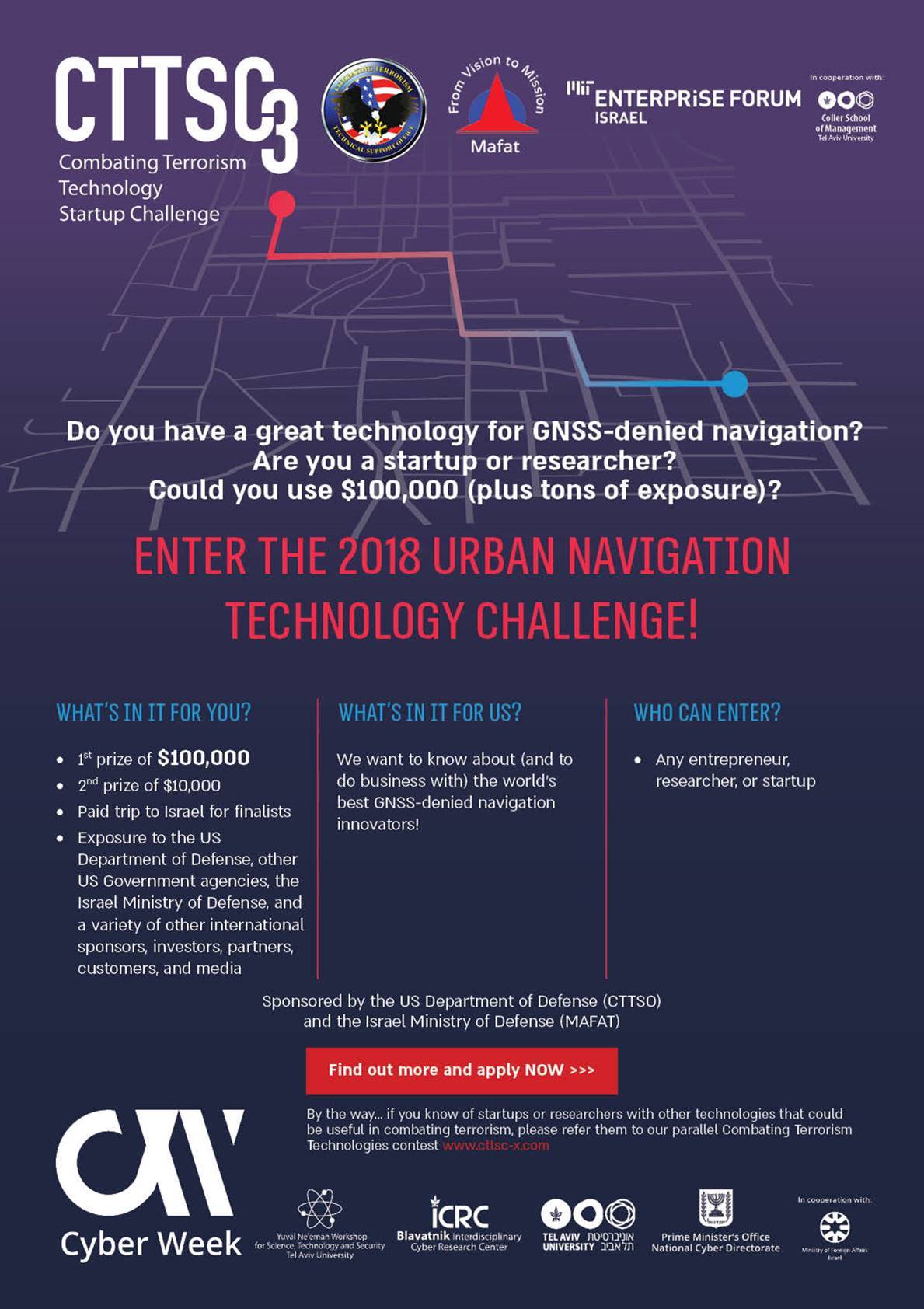
The Urban Navigation Technologies Challenge focuses on navigating without GPS — an increasingly important issue for special forces, law enforcement and other anti-terrorism professionals who need to operate indoors or in environments where GPS is not available. (See more below.)
The General Technologies Challenge includes surveillance, social media analytics, image and video, cybersecurity, drones, robotics, personal protection, biometrics, reconnaissance, and detection of explosives or water contamination.
Both tracks are open to all startups, entrepreneurs, and research groups worldwide, with a deadline of March 9. Entries will be reviewed by an international panel of judges from the DoD, Israel Defense and other organizations.
The most promising startups will be invited to present at the Combating Terrorism Technology Conference in Tel Aviv University on June 17.
Navigation Challenge
Entries in Urban Navigation Challenge might include location services based on beacons, technologies incorporating pre-loaded maps, technologies that estimate a user’s position via dead-reckoning or step-counting, and any other technology for navigating or positioning with no GPS.
Technologies may include: laser, inertial, vision, simultaneous localization and mapping, dead reckoning, pre-installed beacons or other infrastructure, pre-loaded maps, Wi-Fi, cellular or any other solution that operates in a GNSS-denied environment.
The winning startup will receive a $100,000 prize and a runner-up receives $10,000.
In addition, Navigation Challenge finalists will demonstrate their technologies in a dedicated urban navigation test facility in Israel.
By leveraging the Kongsberg Satellite Services (KSAT) polar ground station in Svalbard, Norway, Pléiades and SPOT constellation images are now retrieved at every orbit, resulting in ultra-fast image deliveries after collection, anywhere in the world.
In addition to this advanced reactivity, the 24/7 Service gives customers easy, immediate and round-the-clock access to a dedicated team of satellite experts who provide timely support in case of unplanned events.
“When facing crises, time is critical. With our 24/7 Emergency Service, offering an image delivery time averaging two hours after acquisition, emergency situations can be treated with an even higher priority and our customers and partners will receive their mission critical satellite images much faster,” said François Lombard, Head of the Intelligence Business at Airbus Defence and Space.
The 24/7 Emergency Image Delivery Service, relying on advanced Near-Real Time capability, was developed to answer customers’ specific requirements when facing unplanned events, geopolitical crises, natural or man-made disasters. It provides timely, reliable and accurate satellite images to assess damage and help mitigate the impact on those affected.
The service ensures that satellite resources, such as the wide-swath SPOT or very high-resolution Pléiades constellations, are booked with the highest tasking priority, guaranteeing accelerated access to data worldwide.
The service is also designed to be flexible, providing the possibility of last-minute modifications or cancellations. With this improved performance and capability, Airbus further enhances its ability to deliver timely and accurate satellite images using its smart and complete optical and radar constellations consisting of Pléiades & SPOT 6/7 satellites, DMC Constellation as well as TerraSAR-X and TanDEM-X radar satellites.
The first of four ULS-500 PRO laser scanning systems from 2G Robotics has been shipped to Kongsberg Maritime for integration into the Norwegian Defence Materiel Agency’s (NDMA) newly purchased Hugin autonomous underwater vehicles (AUVs).
The acquisition signifies the Royal Norwegian Navy’s transition to autonomous systems for mine countermeasures. During operations, Hugin AUVs will be used to complete surveys of subsea environments focused specifically on locating and identifying mines.
The Hugin systems enable users to conduct fast and efficient operations with zero surface visibility while additionally improving safety conditions by allowing personnel to remain outside the minefield. In peacetime, the AUVs contribute to hydrographic operations.
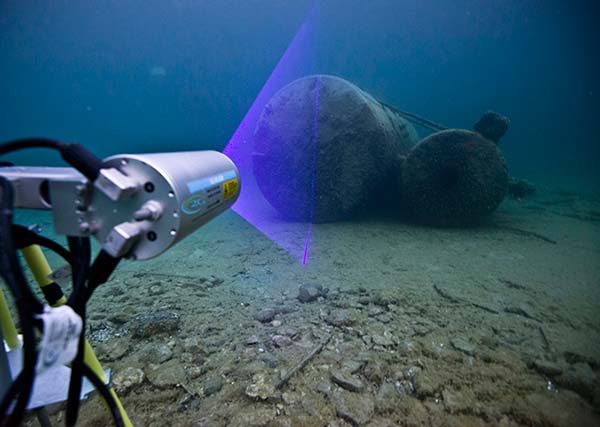
The ULS-500 PRO dynamic underwater laser scanner system will contribute to the detection, classification and assessment of mines. 2G’s system acquires data in real time and provides users with 3D models of targets and environments accurate to the sub-centimeter.
The complete laser scanning system also includes the 2G Observer, an ultra-sensitive stills camera able to capture images at 12 fps, and the 2G Nova, an LED panel designed specifically for AUV integration providing almost 1,000,000 lumens.
The U.S. Air Force has awarded a $48 million contract to Aurora Flight Sciences for the continued development of the Orion unmanned aircraft system (UAS). Aurora Flight is a Boeing company.
Orion is a twin-engine high-performance UAS that can stay aloft over 100 hours at a time with payloads in excess of 1,000 pounds.
Development of the Orion started in 2006 and its first flight was in August 2013. In December 2014, the Orion established the UAS world endurance record with an 80-hour, 2-minute and 52-second flight.
The new contract funds the development of a certified version of Orion that will be suitable for deployment anywhere in the world. The work will be performed in Columbus, Mississippi, and Manassas, Virginia.
Boeing completed the acquisition of Aurora Flight Sciences in November 2017.
The first advanced GPS III satellite successfully established remote connectivity and communicated with the next-generation Operational Control System (OCX), further validating the U.S. Air Force’s modernized GPS is ready to launch its first satellite.
On Nov. 2, GPS III Space Vehicle 01 (GPS III SV01), the first of 10 GPS III satellites designed by Lockheed Martin, and OCX, being developed by Raytheon Corporation, successfully completed Factory Mission Readiness Testing (FMRT).
The FMRT validated the command and control interaction between GPS III and the OCX’s Launch and Checkout System (LCS) through a simulated full launch and early orbit mission event sequence.
During this end-to-end system demonstration, command signals were sent from the latest OCX LCS software installed at Lockheed Martin’s Launch and Check Out Capability node in Denver to Schriever Air Force Base in Colorado Springs, Colorado.
From there, the commands were uplinked back to the GPS III SV01 satellite, currently awaiting a call up for launch at Lockheed Martin.
“During FMRT, GPS III SV01 received and successfully processed OCX commands that are routinely sent during launch, transfer orbit maneuvers, deployments and payload initialization,” said Mark Stewart, Lockheed Martin’s vice president for Navigation Systems. “We thoroughly tested the first GPS III satellite just like we are going to fly it in 2018.”
GPS III SV01 and OCX first “talked” to each other during a link check on October 3, 2017.
“This was the first time the launch and checkout system directly interfaced with the GPS III satellite,” said Bill Sullivan, vice president of Raytheon’s GPS OCX program. “We’re making consistent, steady progress, and that’s driving us toward a successful launch next year.”
The demo further verifies the space-to-ground compatibility between GPS III satellites and OCX. During a 2013 Compatibility & Integration test, Lockheed Martin’s GPS III Nonflight Satellite Testbed (GNST) — a full-sized, functional satellite prototype — also connected with and received commands from an earlier version of Raytheon’s OCX LCS software.
On Sept. 22, the Air Force declared GPS III SV01 “available for launch,” with launch expected in 2018. The successful FMRT was the final validation that GPS III SV01 is ready to be shipped to the launch pad.
GPS III will have three times better accuracy and up to eight times improved anti-jamming capabilities. Spacecraft life will extend to 15 years, 25 percent longer than the newest GPS satellites on-orbit today. GPS III’s new L1C civil signal also will make it the first GPS satellite to be interoperable with other international global navigation satellite systems, like Galileo.
OCX will revolutionize GPS command and control and mission management capabilities. It will control all legacy and new signals, provide protection against evolving cyber threats, and reduce operation and sustainment costs through efficient software architecture, automation and performance-based logistics. OCX represents a quantum leap in capabilities over the current system, providing flexibility and adaptability to meet future GPS mission needs.
The GPS III and OCX teams are led by the Global Positioning Systems Directorate at the U.S. Air Force Space and Missile Systems Center. Air Force Space Command’s 2nd Space Operations Squadron (2SOPS), based at Schriever Air Force Base, Colorado, manages and operates the GPS constellation for both civil and military users.
November has certainly been a busy month, and I’ve been lucky enough to be involved in a number of standout events where defense PNT was discussed.
The National Space-Based Positioning, Navigation, and Timing (PNT) Advisory Board met in California; GPS World hosted a webinar on military PNT technology; and the International Navigation Conference took place in the U.K. Check out a brief roundup of what’s been taking place.
Next-generation GPS takes steps in the right direction
The December issue of GPS World magazine has an excellent update from Col. Steven Whitney. GPS itself is often referred to as the “gold standard” by which other GNSS and PNT solutions are benchmarked. And GPS is undergoing a fairly monumental modernization program, in order to stay current and provide the right services to the military. There are broadly three aspects to this: the next-generation ground segment, the space segment, and the user equipment.
It’s fair to say that the ride hasn’t been a particularly smooth one, and the Next Generation Operational Control System (OCX) has been plagued by delays and challenges. Following a Nunn-McCurdy breach in 2016, the future of the OCX development program looked to be hanging on a knife edge, but the program was recertified and continued.
At the PNT Advisory Board meeting on Nov. 15, Col. Gerry Gleckel (deputy director, GPS Directorate, Space & Missile Systems Center) gave an upbeat presentation on the status of GPS modernization. Describing the current status of OCX as “working through program challenges,” he described how the first integrated launch rehearsal between GPS III and OCX Block 0 had been completed in August.
The GPS III satellites themselves are in full production flow, with five satellites at various stages of assembly.
Figure 1. Five GPS III satellites are in production flow. (Credit: Gerry Gleckel, Nov. 15, 2017).
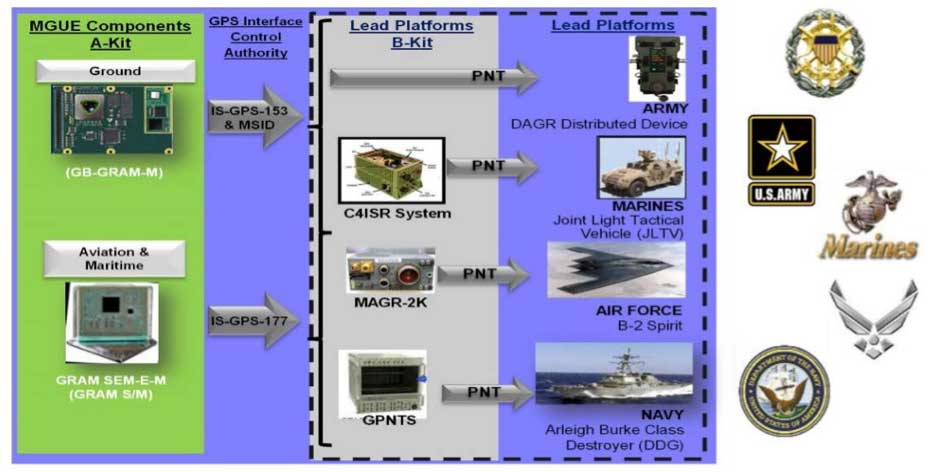
The next-generation military receivers, known as Military GPS User Equipment (MGUE), are also under development by a range of vendors, of which L-3 Technologies was the first vendor to receive security certification in 2016. A number of equipment form factors are being developed to address land, sea and air platforms, and great progress is being made.
Figure 2. Military GPS User Equipment (MGUE) will address a range of platforms. (Credit: Gerry Gleckel, Nov. 15, 2017)
The U.S. Air Force recently completed a number of successful test flights of a prototype M-code receiver on board a B-2 stealth bomber, which marks an important milestone for the GPS modernization effort. Let’s remind ourselves what M-code is, and what it does for us.
The promise of M-code
Until now, the military has relied on the encrypted P(Y) code to provide advantage on the battlefield. Compared to the civilian C/A code, the P(Y) offered improved accuracy, ionospheric correction, resistance to spoofing and a marginal level of jamming resistance.
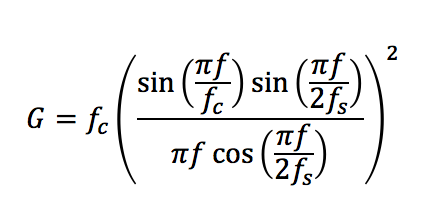
M-code is quite a different picture. Rather than the traditional BPSK modulation schemes used by legacy signals, M-code utilizes a type of binary offset carrier (BOC) signal. In the case of M-code, the signal is a BOCsin(10,5) modulation, which has a power spectral density given by:
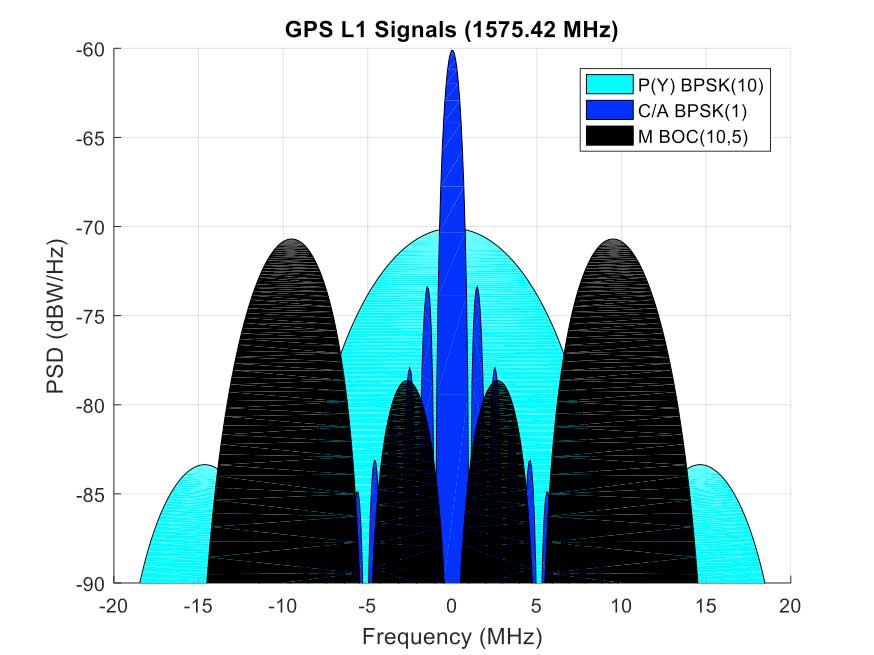
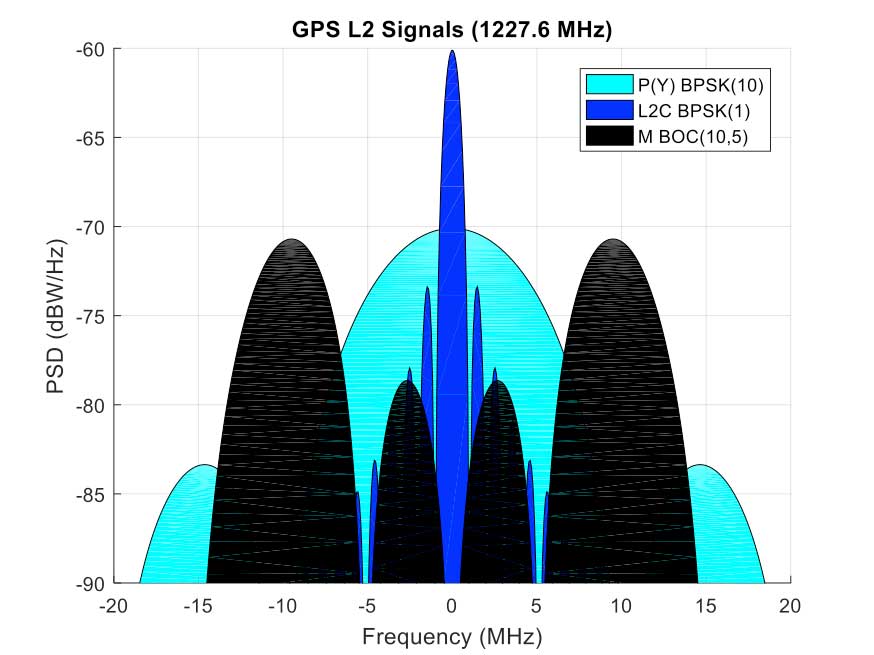
This power spectral density can be seen in the figures below, along with legacy C/A and P(Y) codes (and also the new L2C signal on L2). The M-code BOC signal has a number of important properties; I won’t describe all of them, but I will pick out a couple.
Firstly, the signal is able to support navigation warfare activities. Because the energy in the signal is spread in two lobes away from the center, it allows for the C/A code to be selectively jammed without affecting the military receivers. This is often referred to as “blue force jamming” or “blue on blue jamming,” where friendly forces might wish to perform jamming in an environment in which they are themselves operating. Currently, such blue force jamming is not possible with P(Y) code receivers, without also degrading the friendly force’s receiver.
Another promise of M-code is the ability to use spot-beam transmissions from Block III satellites. This is where a high-gain antenna on the satellites aims the M-code signal at a specific region of the earth, with much greater received satellite power in that region. The received signal from the spot beam is expected to be around 20-dB more powerful than the conventional full-Earth coverage beam. This means that, in a given conflict region, military GPS receivers should be able to benefit from a large increase in jamming resistance.
Figure 3a. M-code signal compared to traditional L1 GPS signal. (Image: Michael Jones)Figure 3b. M-code signal compared to traditional L2 GPS signal. (Image: Michael Jones)
Shortly after the GPS Advisory Board meeting in California, on the other side of the Atlantic a range of defense PNT technologies was also discussed.
International PNT experts gather in the UK
The International Navigation Conference (INC 2017) is now in its third year, and has been steadily growing in prominence. This year’s event, which took place Nov. 27-30, focused on the themes of resilient PNT, autonomy, and sensor and data fusion. As usual, there was a substantial defense presence.
I had the pleasure of chairing a few sessions, including a panel discussion on resilient PNT. The event began with a cross-government meeting, where representatives from across the UK government met to discuss PNT issues concerning defense and national security.
What I loved about this conference is the sheer diversity of PNT topics that were discussed. In the military domain, it wasn’t just the traditional subjects of GNSS, inertial, visual and signals-of-opportunity that were discussed. Also considered was cognitive navigation — how does a soldier’s brain work when in an unfamiliar battlefield? And how will quantum technology benefit defense PNT in the medium to long term?
The promise of quantum
Quantum technology has for some time been touted as the future of PNT: clocks so accurate that you’ll never need to worry about timing again. Inertial measurement units that have so little drift, you’ll never need anything else for navigation.
If you’re not familiar with quantum technology, let me explain. Quantum technology exploits science that cannot be explained by classical physics, such as Newtonian mechanics, thermodynamics and Maxwell’s electromagnetism.
As atoms get colder, they have lower energy levels and move more slowly. Taking this argument all the way down to absolute zero, the atoms would stop moving. By using lasers to cool atoms to very near absolute zero, the atoms are essentially placed under precise control, and hence are sensitive to changes in the local magnetic and gravitational fields. What does this mean for navigation?
An excellent INC 2017 session on quantum navigation revealed some of the answers. Dr. Tim Freegarde of the University of Southampton gave the keynote “Navigator’s Introduction to Quantum Technologies,” which was followed by sessions on quantum/classical combined navigation, and quantum technology for performing gravity gradient map matching.
Quantum sensors rely on a phenomenon known as entanglement, where two physically separated systems are linked in such a way that a measurement of one affects the results of the other. Once atoms have been cooled, they can be made to travel in opposite directions around a loop, where the interference pattern generated allows rotation to be sensed.
But the atoms can also be sensitive to gravitational and magnetic fields, and frequency. So, amongst many other things, quantum technology allows for more accurate atomic clocks, and rotational and gravitational sensors.
A huge amount of money has been poured into quantum research in recent years and, whilst it’s clear there is still a long way to go, progress is certainly being made. At the UK National Quantum Technology Hub in Sensors and Metrology, the focus is on achieving sensors that are useful, and not necessarily to look for the highest possible precision. This is essential if quantum sensors for PNT are to be adopted by governments and industry.
Cyber takes center stage
At the end of the conference, I had the pleasure of chairing a lively panel discussion on resilient PNT, where I put a number of questions to both the panel and the audience.
Coming back to satellite navigation, my first question was, “What is the greatest threat to GNSS over the next three years?” You may be forgiven for thinking that “jamming” or “spoofing” was the top answer because, no, the top answer was in fact “cyber attack”.
Figure 4. At the International Navigation Conference, the audience voted “cyber attack” as the greatest threat to GNSS. (Photo: Michael Jones)
But what exactly do we mean by “cyber attack”? The word “cyber” is a pretty loose word, which is often misused as a catch-all phrase to cover anything that’s not RF related. Let’s quote the NIST definition of cyber attack:
“An attack, via cyberspace, targeting an enterprise’s use of cyberspace for the purpose of disrupting, disabling, destroying or maliciously controlling a computing environment/infrastructure; or destroying the integrity of the data or stealing controlled information.”
How does this apply to military PNT? Well, a key theme from the conference was the trend towards more complex PNT systems. No longer do we have a simple GPS receiver, but an ever-increasing mix of different PNT sensors, and a system more comparable to a computer than a traditional GPS receiver.
What this means is that modern and future military PNT will be susceptible to the full range of cyber attacks currently associated with computing environments. Guy Buesnel from Spirent Communications gave an excellent keynote presentation where he covered this topic. Describing the “attack surface” for GNSS, he noted how many GNSS receivers currently run embedded operating systems such as VxWorks or Linux, and many support standard protocols such as TCP/IP and USB, all of which leaves them vulnerable to cyber attacks.
But let’s not despair. The good news is that there is an awful lot to learn from the computing domain. After all, when computers first became vulnerable to cyber attacks, we quickly learned to make use of virus checkers, firewalls and other such mechanisms available to us. And now the domain of cyber security gives us an arsenal of defensive measures to combat cyber-space risks.
I’ll finish by returning to the PNT Advisory Board meeting in California on Nov. 15, where Harold Martin, director of the National Coordination Office for Space-Based PNT, said “GPS is more computer than radio… GPS receivers lack cyber resilience. This is a national issue.”
Long established as a key component within defense applications, navigation technology from Honeywell is now available to a wide range of new industries that can benefit from the advanced precision and performance of reliable, rugged and easy-to-install inertial measurement units (IMUs).
Honeywell’s newest IMU offering — the HG4930 — applies the principles of reliability, dependability and performance from aerospace and defense. It’s tailored for “straight out of the factory” integration and use in various non-defense and non-aerospace industrial applications, the company said.
Applications include autonomous vehicles, surveying and mapping, ground and underwater robotics, unmanned aerial vehicles and gimbal stabilization.
IMUs help people, vehicles and machines measure motion and calculate changes in position, anywhere in the world, even where GPS signals are intermittent. In industries where automation is taking hold and working conditions where GPS may be out of touch, an IMU can help fill in the moments of disconnect and keep things like an autonomous underwater vehicle or a robot in a factory informed about how they are moving relative to their surroundings.
“For more than a decade, we’ve designed our IMUs to perform in the extremely harsh and demanding environments for our aerospace and defense customers,” said Chris Lund, senior director, industrial IMUs, Honeywell Aerospace. “But there is no shortage of possibilities for how that same IMU technology can support a wealth of markets hungry for the next level of enhanced navigation and control. The HG4930 tactical grade IMU is a highly competitive and cost-efficient variant of our industry-leading navigation technology. Whether helping your industry evolve toward autonomy or augmenting a platform or solution’s precision in domains where GPS is unreliable, the HG4930 delivers the needed performance.”
In addition to the HG4930 IMU being an extremely small, lightweight and low-power product for spearheading new uses or bolstering current navigation capabilities, Honeywell’s HG4930 IMU is not classified under an International Traffic in Arms Regulation category, but instead is free from the burden of an export license for all but a few military-related use cases. This means a broader availability for customers around the world.
With more than 500,000 tactical-grade IMUs produced to date, the HG4930 builds on a proven Honeywell legacy of reliable inertial technologies. According to Honeywell, it is the highest-performing microelectromechanical system (MEMS)-based IMU of its size and price, and benefits from world-class inertial sensor development, calibration and compensation.
The HG4930 has been tailored to provide significantly improved gyroscope and accelerometer performance for the environments and use cases experienced by non-aerospace and non-defense users.
For industries that depend on less reliable MEMS or large, power hungry and expensive fiber-optic gyroscopes for navigation and control capabilities, the HG4930 offers three off-the-shelf performance grades for easy replacement and new capability.
The Government Accountability Office (GAO) recommends the U.S. Department of Defense (DOD) assign responsibility to an organization to collect test data, lessons learned and design solutions in its effort to meet GPS modernization goals.
According to the GAO, “The Secretary of Defense should ensure that the Under Secretary of Defense for Acquisition, Technology and Logistics, as part of M-code receiver card acquisition planning, assign an organization with responsibility for systematically collecting integration test data, lessons learned, and design solutions and making them available to all programs expected to integrate M-code receiver cards.”
DOD concurred with the recommendation.
The GAO presented its findings in a 53-page report issued Dec. 12, “Global Positioning System: Better Planning and Coordination Needed to Improve Prospects for Fielding Modernized Capability.”
According to the GAO, “DOD has made some progress on initial testing of the receiver cards needed to utilize the M-code signal. However, additional development is necessary to make M-code work with over 700 weapon systems that require it.
“DOD has begun initial planning for some weapon systems, but more remains to be done to understand the cost and schedule needed to transition to M-code receivers.
“The preliminary estimate for integrating and testing a fraction of the weapon systems that need the receiver cards is over $2.5 billion through fiscal year 2021 with only 28 fully and 72 partially funded (see below figure). The cost will increase by billions when as yet unfunded weapon systems are included.”
Status of weapon systems that have determined the cost needed to transition to M-code receivers through Fiscal Year 2021, as of February 2017.
In its summary, the GAO wrote “DOD faces risks as it simultaneously develops satellites, a ground system to operate them, and receiver cards that allow use of GPS signals. It will need to install receiver cards on hundreds of systems and, without better coordination, risks paying repeatedly to solve similar problems across the systems.”
The report also assesses the extent to which DOD faces acquisition challenges in sustaining the GPS constellation and developing a new ground control system. The GAO analyzed GPS quarterly acquisition reports and data, acquisition strategies, software and test plans, and other documents, and interviewed DOD and contractor officials.
M-code receiver enhances security, positioning, navigation and timing capabilities
The U.S. Air Force recently completed a series of successful flight tests of its next-generation military-code GPS using a Raytheon Company receiver onboard a B-2 Spirit at Edwards Air Force Base, California.
This first M-code test onboard the B-2 is an important milestone for the U.S. government-led GPS modernization effort to enhance security, positioning, navigation and timing capabilities for U.S. military and civilian applications.
Military GPS user equipment (MGUE) M-code receivers will give military aircraft, ships and ground vehicles access to the modernized GPS network.
“M-code receivers unlock the next-generation GPS network for military users,” said Rick Yuse, president of Raytheon Space and Airborne Systems. “This test demonstrated M-code capability onboard the B-2 for the first time, marking an early milestone for the overall GPS modernization effort.”
The tests verified the integration of an MGUE-equipped risk reduction prototype of Raytheon’s miniaturized GPS airborne MAGR-2K-M receiver with B-2 systems in representative flight and mission profiles.
Raytheon is developing M-code receivers under a contract with the USAF Global Positioning System Directorate GPS User Equipment Division. The company is also under contract with the USAF Joint Service Systems Management Office to qualify and certify the MAGR-2K-M and deliver production representative units to support platform integration and testing.