Category: Machine Control / Agriculture

  • Locata and Leica Geosystems Extend Partnership

    Leica Geosystems Mining and Locata Corporation have announced the extension of their technology partnership in the Mine Machine Automation and Mine Fleet Management Market until June 30, 2014. The extension guarantees the ongoing, commercial provision to the global mining industry of the Leica Jigsaw Positioning System (Jps), powered by Locata technology. 

    The continuance of the technology partnership between Leica Geosystems Mining and Locata Corporation comes on the back of a huge body of work, which has resulted in the first successful operational deployment of the Leica Jps network. The technology at the core of the Leica Jps is a combination of the “Local Constellation” (pioneered by Locata Corporation and adopted by the U.S. Air Force) and Leica Geosystems’ technology portfolio.

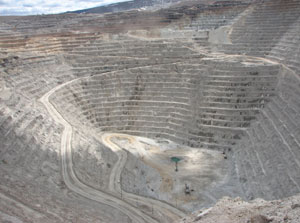
    The co-developed Leica Jps network is a high-precision solution that augments standard RTK GPS/GLONASS signals with Locata signals, ensuring no positioning signal loss or machine down time, even against high walls or in the deepest open pit mines, Leica said.

    “It is with great pleasure that we officially announce our continued alliance with Locata Corporation,” said Haydn Roberts, CEO, Leica Geosystems Mining. “Through this partnership, the Jigsaw Positioning System (Jps) will continue to meet and exceed industry expectations. In being available to augment any GPS/GNSS network on any site, we are truly providing a new capability for mining applications, enabling them to operate with unprecedented signal up time and benefit from the huge associated financial return. And we know it works — we have the data.”

    “Through Jps we offer autonomy from sole reliance on satellite-based positioning networks," Roberts said. "In accordance with Leica Geosystems Mining strategy, our technology for machine automation and now HP RTK positioning is completely OEM independent. No longer will machines stop work while waiting for the elusive satellite signal to reconnect. The Jps will seamlessly augment the signals, no matter on what machine, on what system, in what fleet.”

    Nunzio Gambale, CEO and co-founder of Locata Corporation, said, “Locata is truly delighted to extend, for a further two years, the global exclusive rights Leica Geosystems has to integrate and sell our revolutionary technology into the mining market. They deserve this extension. Mr. Haydn Roberts runs a team that is talented, experienced and motivated. They have proven to us many times over that they are some of the finest GPS engineers in the world.”

    The success of the combined technologies and continued relationship between both parties ensures the Leica Jigsaw Positioning System will be commercially available to the mining industry globally from August this year.

    “This Leica-Locata relationship has blossomed over what is now many years of cooperation, and it is one which we value highly,” said Gambale. “The Locata team is proud to be partnering with such a respected and incredibly innovative company.”

  • Trimble Releases DDS300 Depth Display System for Construction

    Trimble introduced a new version of the Spectra Precision Laser DDS300 Depth Display System, a laser-referenced grade control solution targeted for compact machines. The DDS300 version 3.0 introduces a new environmentally-rated control box and new level of productivity for mini-excavators and backhoe loaders used for excavation and trenching work for basements, footers, utility lines and conduit. Cable-free components, simple installation and an affordable price make the DDS300 system ideal for contractors who want to improve accuracy, fuel usage and safety of their excavation operations.

    According to the announcement, the DDS300 system utilizes wireless communications, a laser receiver and angle sensors to provide dynamic positioning information for the excavator or backhoe bucket at all times. Real-time grade guidance is displayed on the 7-inch in-cab display, allowing the operator to work faster and with better accuracy. Accurate positioning of the bucket also improves the safety of excavation by eliminating the need for a grade checker to work in the trench or machine swing area.

    The new waterproof and sunlight-readable CB310 Control Box display is included in the DDS300 system and is rated IP-64, making it suitable for use in bright sun or inclement weather.

  • Ohio University Team Wins Second ION Autonomous Snow Plow Competition

    IMG_6300
    Photo: Ohio University

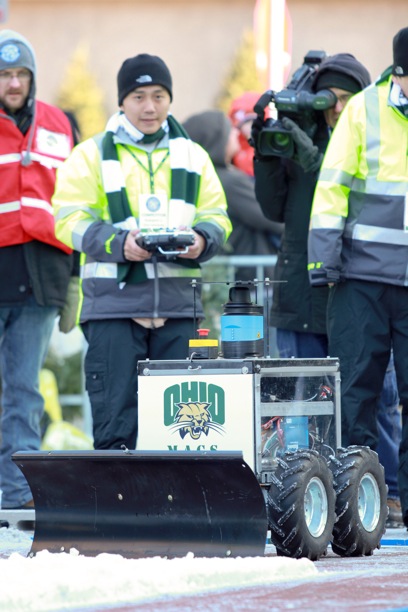
    An Ohio University team won the Institute of Navigation (ION) Satellite Division’s second annual ION Autonomous Snowplow Competition. The competition was held January 26-29, at Rice Park in downtown Saint Paul, Minnesota, in conjunction with the 126th Saint Paul Winter Carnival.

    Sponsored by The Institute of Navigation Satellite Division and held in cooperation with the ION North Star Section, the ION Annual Autonomous Snowplow Competition is a national event open to college and university students, as well as the general public, that challenges teams to design, build, and operate a fully autonomous snowplow using state of the art navigation and control technologies to rapidly, accurately and safely clear a designated path of snow.

    Six teams participated during the four-day competition, each using unique vehicle design approaches.

    Teams included students, partners from private industry and faculty advisors from Dunwoody College of Technology; Miami University (Ohio); Ohio University; The University of Michigan, Dearborn; and The University of Minnesota.

    Teams were judged based upon their cumulative scores earned throughout the competition phases: 75% of the total score was based upon the plowing competition; and 25% of the total score was based upon the presentations and pre-event report.

    First place was awarded to Ohio University students Samantha Craig, Ryan Kollar, Kuangmin Li and Pengfei Duan with support from faculty advisors Frank van Graas, Woulter Pelgrum and Maarten Uijt de Haag. The first place prize included $3,000 and a golden snow globe trophy.

    Second place was awarded to Miami University students Chad Sobota, Mark Carroll, Robert Cole, Mark Stratis, with support from student advisors Steve Taylor, Ryan Wolfarth and Harrison Bourne and faculty advisors Jade Morton, Peter Jamieson and Janet Burge. The second place prize included $2,000 and a silver snow globe trophy.

    Third place was awarded to the University of Michigan (Dearborn) students Angelo Bertani, Zach DeGeorge, Mark Lawrence, Doris Kotori, Alf Williams, with support from student advisors Benjamin Craig,  Jhonatan Ferrer,  and faculty advisor Narasimhamurthi Natarajan. The third place prize included $1,000 and a bronze snow globe trophy.

    In addition, the first place team, Ohio University, will be invited to display their winning snowplow during ION GNSS 2012 Conference September 17-21, 2012 in Nashville, Tennessee.

    Sponsors of the second annual ION Autonomous Snowplow Competition included Lockheed Martin Corporation, ASTER Labs, Inc, Honeywell, Inc., Alliant Techsystems Inc., U.S. Bancorp, Hitching Post Motorsports, Space Exploration Technologies Corp., and The Toro Company.

    The Third Annual ION Autonomous Snowplow Competition will be held in January 2013 at the Saint Paul Carnival, St. Paul, Minnesota.

    The First Place team from Ohio University. Photo: Ohio University
    The First Place team from Ohio University. Photo: Ohio University


  • Expert Advice: Give Us This Day Our Daily Bread

    Headshot: David Last and Sally Basker
    Headshot: David Last and Sally Basker

    David Last and Sally Basker

    Across transportation, agriculture, industry, commerce, and finance, GPS has replaced earlier technologies, opened up innovative applications, and led to new ways of doing old things. GPS now plays a key role in the critical infrastructures of all industrialized nations, from the most sophisticated telecommunications system to the production of a simple loaf of bread.

    Wheat is the world’s second staple food, and bread its main product. Bakers have been around for 30,000 years. GPS, among its manifold other duties, now also helps bring us our breakfast toast and midday sandwich.

    British farmers sow 2 million hectares (5 million acres) of wheat per year, harvest 8 tonnes per hectare (3.6 U.S. tons per acre) and sell it at £150 a tonne ($214 per U.S. ton), making their harvest worth £2.5 billion ($3.9 billion). Nearly a billion pounds-worth ($1.6 billion) goes to make bread.

    We use Britain as an example because we are British, but this same truth holds, at much grander scale, when you consider the United States, Russia, and many other European nations.

    A vital value chain wends its way from farm to mill to bakery to store to home: in the UK, 99 percent of households buy bread, 99 percent of which is made in this country, 80 percent of it from domestic flour. This relatively closed value chain lets us see how GPS is used, and that its loss would increase the price of a loaf and translate into inflation.

    GPS serves as the basis of the precision agriculture, cutting fuel costs and enabling selective and variable rate optimized application of fertilizers. It lets farmers use less manpower, reduces soil compaction, and even minimizes operator fatigue. Farmers now spend much more time on yield monitoring and within-paddock zone management than leaning on gates chewing straws. Though the capital cost of precision agriculture is high, the annual benefits are comparable with the investment. Losing GPS-based precision agriculture would increase the price of bread by at least 2 percent.

    Transport logistics is the glue that joins our value chain together. GPS in fleet management optimizes routings, accelerates dispatching, prevents theft, improves driver behavior, and delivers fuel efficiencies. Loss of GPS in the transport links in our chain would increase fuel costs alone by 13 percent.

    On top of all this, GPS is the ultimate source of precision timing supporting telecommunications links at every stage of the value chain, from wheat futures trading and banking transactions to voice, data, and Internet traffic.

    The sudden loss of GPS in farming, transportation, communications, business management, and retail distribution, would substantially raise the price of bread, hit every household, and impact the national economy.

    What applies to a traditional  and at first glance low-technology product like bread applies across the board. The recent report on GNSS vulnerabilities by the Royal Academy of Engineering says that GPS and other satellite navigation services have applications so pervasive that there is now a real threat to global security if the systems should fail — or be interfered with. The signals are used by almost every industry: rail, road, aviation, space, maritime, agriculture, energy, surveying, construction, law enforcement and communications.

    Dependence on GNSS connects many otherwise independent services into a so-called accidental system — with a single point of failure, the satellite signal. And a satellite signal, says the report, is a weak foundation for important services, since it can fail in dozens of ways.

    GPS is no longer the only GNSS, of course, as many nations, recognizing its political and economic value, have developed their own systems, and augmentations to enhance accuracy and integrity. Over the next few years, the number of navigation satellites may approach 150. This will help reduce vulnerability to the loss of GPS and so will be a benefit in the short term.

    But the long term is a very different matter. All these systems now use, or shortly will use, essentially the same technology. And, crucially, the same radio frequency bands.

    In those frequency bands, GNSS is threatened by rising levels of radio interference. This threat has several strands that are being recognized separately and handled individually, but which taken together will determine the future of GNSS.

    We face a Triple Whammy!

    The First Threat

    The first component of the Triple Whammy comes from the new satellite systems themselves. Each satellite transmitting in the GPS frequency band increases the noise level there. Satellite navigation receivers must find and lock onto the extremely weak signal that reaches the Earth, digging it out from the background noise of the cosmos. And the other GPS satellites add to the noise level.

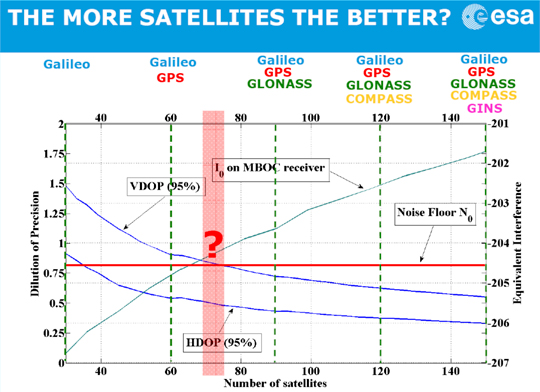
    Günther Hein of the European Space Agency shows this remarkable diagram (Figure 1): as the number of systems increases and the number of satellites heads for that 150, up rises the noise they make, the blue-green line. More than about 70 of them, and satellite noise exceeds the cosmic noise floor in red and becomes the main source of noise. The more satellites, the worse the reception as GNSS interferes with itself. Too many satellites, and you’d pick up none at all! The first threat of the triple whammy is self-inflicted.

    Chart: David Last and Sally Basker
    Chart: David Last and Sally Basker

    Figure 1. The first threat of the Triple Whammy: new satellite systems. Source: Günther Hein.

    The Second Threat

    Conflicts between nations as their new GNSSs compete for radio spectrum also threaten GNSS viability.

    The frequency bands available to satellite navigation are essentially L2, L5, and the principal one we use currently, L1. On L1, the European Galileo system and the Chinese Compass system occupy the same areas. Now, that’s very desirable if the two systems are to share receivers. But they also compete for that spectrum, and there is conflict between Compass and Galileo.

    This battle for spectrum is a highly complex engineering problem. But chiefly, the spectrum wars are political, even emotional.

    Chinese satellites fly across American skies broadcasting signals that interfere with European receivers. Spectrum wars have everything to do with relationships between nations and little to do with battles between engineers. They are developing into a classic tragedy of the commons: a situation in which self-interest determines how a limited resource — here the radio spectrum — is to be shared in a regime in which regulation is weak. The International Telecommunication Union sets standards and registers claims. The UN Office for Outer Space Affairs seeks to mediate. But neither is a policeman; sovereign governments may sometimes be penniless, but they are very powerful.

    The second threat of the Triple Whammy is also self-inflicted.

    The Third Threat

    Communications systems compete with GNSS for spectrum: witness the current LightSquared case of a powerful new broadband system. For existing receivers, including those in government systems and aviation, it seems there is no fix for its devastating interference. LightSquared is driven by rich and powerful commercial forces; it could well win this fight.

    Communication technologies will continue to press upon the satellite navigation spectrum. LightSquared will likely erode spectrum gaps between communications and navigation services, the so-called guard bands.

    Satellite navigation has become highly political. The intense use of GNSS across our economies makes them vulnerable. GNSS is threatened by a Triple Whammy, by jamming, and by spoofing. These increase the risks to our security and our economies, both in probability and impact. The solution of detecting jammers and making ownership illegal will help with local problems in local areas. But the Triple Whammy threats are not local; they are national and international, world-wide.

    Today’s spectrum wars affect us all. That the loss of GPS would increase the price of a loaf — the very trigger for the French Revolution — brings this down to earth.

    These are not technical issues, they determine the price of our food! They constitute a real and present danger to our societies — down to the mundane yet very real level of our daily bread.


    David Last is a past-president of the Royal Institute of Navigation, a consultant and expert witness on radio-navigation and communications systems to companies, governmental and international organizations, and criminal investigators.

    Sally Basker, former director of research and radionavigation at the General Lighthouse Authorities of the UK and Ireland, has opened Traxis Ltd: management, business, and technology advice with expertise in navigation service provision. See www.traxis.co.uk.


    This article is adapted from a presentation at the European Navigation Conference, London, November 2011. A longer version of the talk appears in the Royal institute of Navigation News.

  • On the Edge: Go Big Green

    By Tracy Cozzens

    Nav On Time, a French Company located in Toulouse, has successfully completed a trial campaign of its Mow-By-Sat precision guidance on a commercial lawnmower. In August, the prototype of a GPS-guided robot lawnmower was installed on a golf driving range near Toulouse and tested in real conditions of use, day and night, maintaining a 25,000 square meter lawn since then. In a previous campaign, the mower covered more than 2.2 million yards — equal to1,250 miles or 2,000 kilometers — in 2,100 hours. (See videos of the mower in action at www.youtube.com/DSnavontime.)

    With such a success under its belt, Nav On Time is negotiating with different lawnmower manufacturers to bring a product to market. The autonomous lawnmowers already on the market, including machines commercialized by research partner BelRobotics, use underground wired perimeters for delimiting the lawn by an electromagnetic signal, the strength of which is measured by a mower-embedded sensor to determine its distance to the lawn’s limit. But that wire, and its required installation, are technical barriers for a lot of potential customers. Nav On Time is one of the companies developing solutions to get rid of the perimetric wire yet still be able to guide the mower autonomously with accuracy and efficiency.

    Between January 2009 and June 2010, Nav On Time coordinated the Mow-by-Sat project, a research and development effort that received funding from the European Union’s Seventh Framework Programme (FP7/2007–2013). Partners included Belrobotics of Belgium, a large lawn-maintenance robot manufacturer, and the University of Catania in Sicily, Italy, through its robotics research department.

    The Mow-by-Sat project (www.mow-by-sat.eu) was also undertaken to support development of a GNSS-based navigation and guidance system integrated into an autonomous lawnmower, paving the way for industrialization and commercialization of GNSS applications for a domestic service robot operating outdoors. Beyond this concrete application, the project aimed to increase the adoption of GNSS technologies in robotics applications, studying the benefits of European GNSS (especially EGNOS and Galileo).

    Mow-By-Sat uses a virtual fence to replace the wired boundary traditionally used in robot lawnmowers, which provides better flexibility for defining and modifying a mowing area. Mow-By-Sat enhances the machine’s efficiency by a factor of three, as full steering substitutes for the random operation mode, the company said.

    Built around a European GNSS L1 automotive receiver, the u-blox T, Mow-By-Sat uses L1 fixed / floating real-time kinematic (RTK) techniques. A tight coupling between the RTK positioning firmware and the guidance application software aids the mower’s precision. Nav On Time compared it to the challenges of aviation, where the required navigation performance depends on the flight phase.

    In its patented architecture, the module embedded in the rover is dumb, and the ground-based station acts as a remote control, ensures traffic management between several machines, and serves as a gateway for remote services such as installation, supervision, and surveillance, all accessible from the Internet. Nav On Time developed both the positioning firmware and guidance application software.

    According to Nav On Time CEO Michèle Poncelet, Mow-By-Sat offers significant competitive advantages to the machine manufacturer compared to expensive RTK solutions now on the market. She cited:

    • easy customization because of its open architecture,
    • an affordable solution for small and inexpensive mobile machines,
    • a technology enabler for replacing human-controlled and energy-consuming machines with smaller and cheaper machines that have a smaller carbon footprint.

    With six Engineers, Nav On Time, founded in 2007, is offering a product line dedicated to precision control solutions for small and inexpensive mobile machines, under a business-to-business model through industrial partnerships. According to Poncelet, its market stretches from human controlled machines (precision agriculture or crane collision avoidance) as driver’s assistance, to unmanned machines (autonomous lawnmowers, other unmanned ground vehicles, intelligent vehicles, and more generally service robots) with full steering.

    Other applications envisioned by Nav On Time include a golfball retrieval robot for driving ranges, a beach cleaner robot, and a surveillance robot — any application that requires passing through a pre-determined area in a methodical and systematic way.

    Breaking Ground

    It would seem mowing lawns isn’t a beloved pastime, as autonomous lawn mowers have been the subject of numerous research projects. For the past eight years, the Institute of Navigation has sponsored a Robotic Lawnmower Competition as a way to encourage college students to develop autonomous steering techniques. During the second ION Autonomous Lawnmower competition, Frank Van Graas, who accompanied the winning Ohio University team, told GPS World, “The centimeter-level positioning accuracy required for lawnmowers in the contest is actually more difficult than automatically landing an airplane.”

    One research project, carried out by Navcom Technology in 2005, resulted in an autonomous mower taking on the precise mowing techniques of baseball stadiums, with its checkered patterns. The Navcom project, documented by Michael Zeitzew in his paper “Autonomous Utility Mower,” used a series of beacons to augment GPS. Two off-the-shelf John Deere utility mowers were modified for X-by-wire control, and fixed navigation beacons were mounted around the stadium. Next, the field boundaries were surveyed and input into a map file, used to create the mower’s mission plan.

    “The use of GPS requires good sky visibility,” explained Zeitzew. “In this application, due to the stringent navigation accuracy requirements, an RTK-GPS solution is required, which requires the use of a base station. Because many of the baseball stadiums have high walls and other obstructions around the field, RTK-GPS is inadequate, even with augmentation by (affordable) inertial sensors or odometry sensors. This necessitated the use of alternative technology.”

    Navcom fielded two mower systems into professional baseball stadiums, one major league and one minor league. Both systems were used over the course of several weeks during the spring 2005 baseball season, and received positive reviews from the professional groundskeepers, who quickly grew comfortable using the machines. The project proved not only that autonomous mowers are possible even for large-scale sites such as a stadium, but that there is indeed a market for them.


  • Zoning in on Assets: Cubic Global Tracking Gets Iridium Certification

    By Tracy Cozzens

    A system that tracks and monitors valuable high-risk assets for defense and commercial customers has received certification from Iridium Communications, increasing the system’s accuracy and effectiveness. The Iridium constellation of low-Earth satellites provides voice and data services for areas not served by terrestrial communication networks.

    The Global Sentinel System, by Cubic Global Tracking Solutions, tracks and monitors assets with two-way, redundant encrypted communications. The system provides up to 2,000 unique geozones for each Global Sentinel device to control precise reporting rules along the supply chain. It can monitor asset conditions including temperature, humidity, light sensing, motion, and container door status.

    The latest generation of Cubic’s Global Sentinel System provides continuous global coverage by incorporating the Iridium 9602 short-burst-data transceiver. “As an Iridium partner for the past seven years, we’ve worked closely to integrate the Iridium 9602 transceiver into Cubic’s fifth generation of products,” said Mary Ann Wagner, president of CGTS.

    Wagner said Cubic relies on Iridium to provide real-time low latency reporting on customers’ assets in areas where other modes of communication are unavailable. This capability allows for continuous global coverage for reliable secure reporting of asset position, status, and event alerts. “This is essential because of the critical nature of the assets we are tracking and monitoring for our Department of Defense and commercial customers,” Wagner said.

    Power-Saving GPS. GPS also plays an important role. With the flexibility derived from geozone attributes for GPS, Cubic can provide an optimum balance between position accuracy and power management.

    Cubic’s devices take full advantage of GPS receiver circular error probable (CEP) estimates to set accuracy limits for reporting, explained Randy Shepard, vice president of technology innovations for CGTS. While higher position accuracy may be a challenge for battery-powered units operating for years between servicing, it is often necessary to avoid false alarming for events like route deviation where position accuracy is important.

    “One of the unique features of Cubic’s devices is the aggressive manner in which we manage power for all device functions including GPS,” Shepard said. “Using the geozones that are remotely reconfigurable on the device, GPS accuracy and response time can be controlled as a function of geozone.

    “As an example, for our current GS-5B receiver used for global tracking and monitoring of shipping containers, the initial default dwell time to capture GPS position is 60 seconds. Our experience is that from a cold start we get a normal lock in less than 45 seconds. The maximum acceptable CEP is 100 meters. If a CEP of less than 100 meters is not received, we do not update position. If a CEP of less than 100 meters is received, we wait up to an additional 60 seconds to improve the CEP. Once a CEP of 10 meters or less is received, the position is captured and the GPS receiver turned off. Again, all four of these parameters are remotely reconfigurable for each of the 2,000 user-defined geozones.”

    The other GPS receiver parameter that is configurable as a geozone attribute is whether power is maintained on the receiver to retain satellite ephemeris data. If the position update interval for a geozone is more often than every 15 minutes, data back-up power is usually maintained on the GPS receiver and the satellite ephemeris data is retained. This provides and effective warm start for the GPS and usually results in a much quicker initial position lock, which saves overall power.

    To provide real-time asset tracking worldwide, Cubic’s Global Sentinel System relies on a variety of transmission links to communicate the positioning and status of an asset. Based on the location of the asset, the system selects whichever link is the most cost-effective for data transmission. This includes wireless mesh networking, cellular, or the ubiquitous global two-way coverage of the 66-satellite Iridium constellation. The Global Sentinel System relies on the Iridium network’s ability to eliminate blind spots when the asset is out of range of other routing methods.

  • Sensor Fusion in Forestry

    Sensor Fusion in Forestry

    By Jürgen Rossmann, Petra Krahwinkler, and Markus Emde

    Modern machines such as wood harvesters can automatically cut trees and remove branches, but an expert is still needed to plan a thinning and to mark the trees to be felled. The process can be accelerated if the forest ranger can virtually mark trees to be cut, using geographic coordinates instead of colored crosses sprayed on the stems. This requires the robotic wood harvester to be able to locate itself accurately to enable automatic navigation to the next tree for cutting.

    Absorption of the GPS signal in the forest canopy leads to poor results, however, with errors up to 50 meters and more. Furthermore, the canopy may cause interruptions and signal loss for several seconds. The performance can be even worse on a moving vehicle, where the signal may even get lost until the vehicle reaches an open area or stops.

    Other approaches use differential GPS (DGPS) sensors as their main source of position information. However, our experiments using a high-precision DGPS sensor showed that its accuracy is not even close to sufficient for navigating to a single tree. As the DGPS suffers from the same canopy-related disturbances and shielding, it cannot benefit from its theoretical advantages. In pratice, the DGPS system did not update its position at all when signal reception became too weak.

    A different approach was needed. We found it in the framework of the Virtual Forest, more precisely in the semantic modelling of forests, where techniques are being developed to delineate single trees from remote sensing data, such as airborne laser scanner data. Along with the trees and their geo-coordinates, the height and the diameter at breast-height are determined. This data can be used to generate a tree map, which can be used for navigation. The map has a mean error between 0.5 and 1.5 meters, which is still below the mean tree distance of about 2.5 meters.

    Visual GPS. The idea of Visual GPS is to bring current developments in the field of robotics into the forest and combine them with information on forest inventory so that the result outperforms other navigation approaches. A matching algorithm is run based on a tree map, generated from remote sensing data, and the tree group, which was detected by one or more laser scanners.

    We then implemented a particle filter algorithm, as it enables considering different kinds of distributions. Particles are also called random state samples, and each particle is a hypothesis as to what the true world state might be.

    In the initialization, particles are distributed uniformly. An importance weight wt is calculated for each particle, incorporating the measurements as described below. A sampling step rejects particles with a low importance weight and replaces them with new particles, which are distributed according to the previous map. This process is repeated until the particle distribution concentrates at one point, and the particle with the highest weight is returned as the result (see Figure 1).

    Figure 1. Particle concentration after resampling; wood harvester at center.
    Figure 1. Particle concentration after resampling; wood harvester at center.

    A single tree as a landmark cannot be associated with its corresponding tree in the map. However, patterns of tree positions can be matched. We chose a square area to guarantee even particle distribution and short calculation time. Each particle represents a hypothesis for the position of the vehicle and is tested for its probability to represent that position.

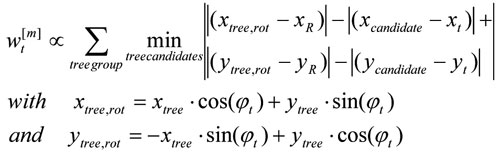
    To make the approach more robust against faulty tree maps, we implemented a rotation variant approach, determining vehicle heading along with its position. This enhanced the probability measure used in the propagation step. Instead of embracing only the distances of the trees to the reference point, their relative position is used, considering the heading wt of the current particle:

    equation-forest

    This approach directly calculates vehicle heading, but the sensitivity towards rotation, which results from the new probability measure, leads to a higher number of particles that must be used during the initialization step.

    Global Search. Experiments on a test area with about 22,700 trees proved that the algorithm worked reliably for tree groups containing 20 or more trees, and for position errors of the magnitude of the mean tree distance. Similar tree groups could not be found within the forest. However, the calculation time was too long to be used for navigation.

    Local Search. To overcome the high calculation time, we reduced the number of particles. The initial position is estimated with an ordinary GPS sensor. Although the GPS measurement is faulty in the forest, it can limit the search to a restricted area. Machines most often start at the edge of a forest stand, at a forest road, or a canopy opening. At these spots the canopy usually is transparent, and GPS sensors work with higher precision. Therefore, they provide a good initialization for the algorithm.

     Robotic wood harvester.
    Robotic wood harvester.

    In the following steps, the previous position can be used instead of the output of the GPS sensor for determining the search area. The previous position provides a better initial pose estimation than the GPS sensor and therefore gives the opportunity to further decrease the search area.

    To reduce the number of trees for which the distance has to be calculated, trees with a distance from the initial pose estimation smaller than the sum of the estimation of the maximal position error and the maximal distance of the trees in the scanned tree group from the reference position are extracted from the tree map.

    Another way to reduce the search area is to estimate vehicle orientation. This is difficult for machines such as wood harvester, which moves slowly and stops frequently when cutting trees. Therefore, small lateral position differences result in large orientation deviances, as the difference vector does not directly point into the direction of the movement any more. Another approach is to use sensor fusion and mount a compass onto the vehicle. During particle initialization, the angle can be restricted to the domain of uncertainty around the compass orientation. However, mounting a compass onto a wood harvester proved to be a serious problem, as the harvester’s massive metal body disturbs the compass measurement.

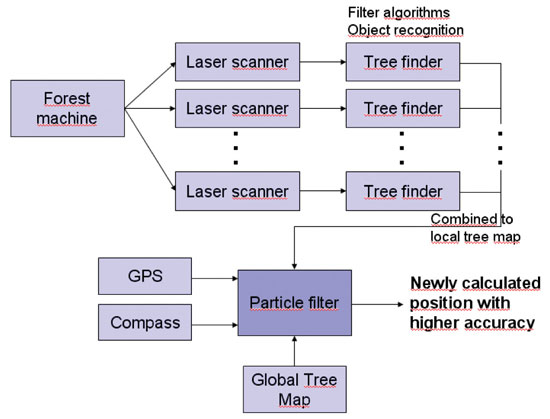
    Figure 2 shows the workflow of the complete system.

    Figure 2. Navigation system components.
    Figure 2. Navigation system components.

    Results

    The simple criterion presented here proved to be reliable in the vast majority of cases. Problems can occur when the tree group contains trees that are not part of the tree map (false positive). This can happen due to missing trees in the tree map or faulty tree cognition in the local laser scanner measurement. In the first case, the understory might not have been detected in the airborne laser scanner data. In the second case, other objects like the harvester’s aggregate might have been mistaken for a tree.

    The case of trees not detected in the local laser scanner measurements but contained in the tree map (false negative) does not create problems in the pose estimation step. The algorithm searches for a corresponding tree for each unit in the tree group. For a false positive, no corresponding tree can be found, whereas a false negative is simply not considered. However, if the size of the tree group is too small, the estimation errors grow. The minimum number of trees depends on the search area radius. A size of 20 trees proved to generate reliable pose estimations even during the global search. Dropping below 15 trees, the number of faulty position increases rapidly as more similar patterns can be found.

    Single faulty positions can be filtered with respect to the movement constraints of a harvester. The velocity is very low, and the orientation cannot jump. In the experiments, cycle times of about 0.5 seconds were reached on a standard PC. As forest machines do not demand very short calculation time, the algorithm proved to run fast enough to allow identification of single felled trees onboard real machines. One application of the algorithm was to support a navigation assistant to the next tree, similar to navigation systems in cars.

    To evaluate system accuracy on a real wood harvester, a surveyor’s office was instructed to measure the vehicle’s position at seven distinct locations. At each position, the sensor input data was written to file for several seconds. This data was evaluated, and for each location more than 45 pose estimations were calculated. The mean value of the position error amounted to approximately 0.55 meters.

    Future Work

    Reliability can be enhanced by using a detailed digital ground model and the cabin tilt in order to detect the area where the laser beams hit the ground, and therefore avoid the detection of false positives. Similarly, the position of the aggregate, which can be measured by integrating sensors in the hydraulic cylinders of the crane, can be cut from the laser scanner measurements and ignored during tree detection, further reducing the amount of false positives in the tree group. With the integration of an outlier rejection step for false positives in the detected tree groups that ignores trees for which no corresponding candidate tree can be found, a more accurate importance factor can be calculated.

    Another task is the integration of the algorithm with a Kalman filter to allow real-time performance of the algorithm. Therefore, the Kalman filter is initialized with the pose estimation of the particle filter algorithm, which is also used for continuous checks of the current position estimate, thereby combining two algorithms with different advantages. The Kalman filter allows real-time execution and therefore speeds up the overall navigation algorithm. The particle filter algorithm can periodically check the position estimated by the Kalman filter and correct it. Furthermore, it provides a strong method to cope with two main problems in mobile robotics: the data association problem and the kidnapped robot problem.

    Simultaneously, a mapping and map-correction algorithm could be integrated into the system so that understory trees, which cannot be detected using remote sensing data, and deciduous trees, which are more difficult to delineate in airborne laser scanner data, can be added to the tree map.


    Jürgen Rossmann is head of the Institute of Man-Machine Interaction at the RWTH Aachen University, where Petra Krahwinkler and Markus Emde are research scientists.

  • Pulling in All Signals

    Pulling in All Signals

    Adding GLONASS to GPS gives a total of about 50 satellites, for a significant improvement in navigation availability, reliability, robustness, and convergence time through a new multi-GNSS precise point positioning (PPP) service. System performance and field results demonstrate that there is no need to await future constellations — better performance is available now.

    By Tor Melgard, Erik Vigen, Ole Ørpen, Fugro Seastar AS, and Jon Helge Ulstein, Bourbon Offshore Norway AS

    Melgard-Open

    Precise point positioning (PPP) stands out as an optimal approach for providing global augmentation services using current and coming GNSS constellations. PPP requires fewer reference stations globally than classic differential approaches, one set of precise orbit and clock data is valid for all users everywhere, and the solution is largely unaffected by individual reference-station failures. There are always many reference stations observing the same satellite because the precise orbits and clocks are calculated from a global network of reference stations. As a result, PPP gives a highly redundant and robust position solution.

    The results presented here represent a significant step forward in PPP GNSS research and development. Using GLONASS improves the availability and reliability of the solution. The G2 system’s horizontal positioning accuracy is at the decimeter level. These results derive from increasing the number of satellites in the constellation by 60 percent, from about 30 to 50 satellites. The outcome of the development of the G2 real-time combined GPS and GLONASS PPP service represents a next-generation GNSS augmentation. Further, the later GLONASS-M satellites have improved performance and lifetime over previous GLONASS satellites, so that results will continue to improve as that constellation is replenished.

    G2 development has benefited from the close cooperation between Fugro and the European Space Operation Centre (ESOC), an establishment of the European Space Agency (ESA). ESOC has contributed its long experience and expertise on precise orbit and clock processing techniques, while the strength of Fugro is real-time positioning and navigation services.

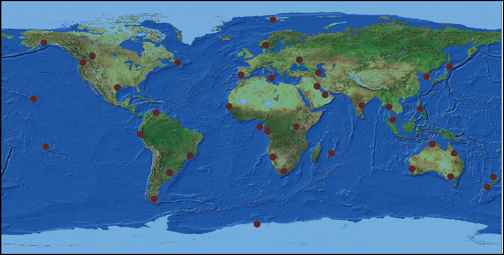
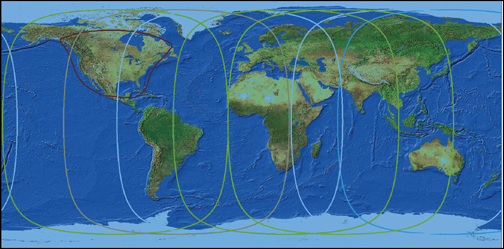
    Based on this work, Fugro has introduced the first real-time GPS and GLONASS precise orbit and clock service. The service utilizes Fugro’s own network of dual-system GNSS reference stations to calculate precise orbits and clocks on a satellite-by-satellite basis for all 50 satellites of the two global navigation satellite systems. The system comprises about 40 dual-frequency GPS and GLONASS reference stations distributed around the world as shown in Figure 1.

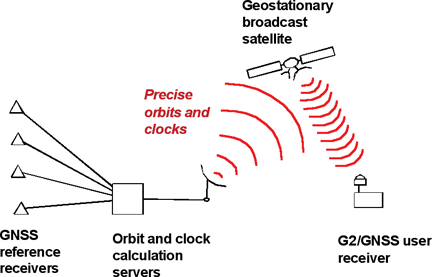
    Raw GNSS measurement data for all satellites are transmitted to processing centers for calculation of the precise orbit and clock of each GPS and GLONASS satellite (Figure 3). The precise data generated is then broadcast to users via geostationary communications satellites with nearly global coverage, as shown in Figure 2.

    FIGURE 1. The G2 reference station network consists currently of 40 GNSS receivers owned and operated by Fugro.
    FIGURE 1. The G2 reference station network consists currently of 40 GNSS receivers owned and operated by Fugro.
    FIGURE 2. The G2 precise orbits and clocks are broadcast over redundant geostationary satellite beams together with the other Fugro services.
    FIGURE 2. The G2 precise orbits and clocks are broadcast over redundant geostationary satellite beams together with the other Fugro services.
    FIGURE 3. Dataflow from the reference stations to the redundant calculation servers producing precise orbits and clocks, then to the satellite uplink stations for broadcast over geostationary satellites to combined G2/GNSS user equipment.
    FIGURE 3. Dataflow from the reference stations to the redundant calculation servers producing precise orbits and clocks, then to the satellite uplink stations for broadcast over geostationary satellites to combined G2/GNSS user equipment.

    Inside the end-user equipment a dual-frequency carrier-phase-based PPP solution gives horizontal positioning accuracy at the decimeter level. The PPP calculation module is provided by Fugro and is embedded in multiple GNSS receiver manufacturers’ products as well as Fugro’s own product line.

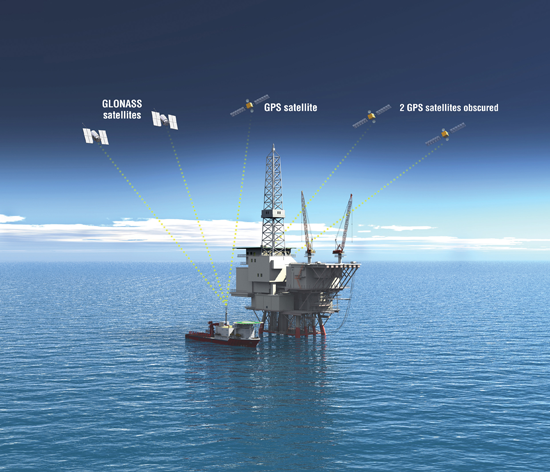
    Like any GNSS technique, PPP is affected by satellite line-of-sight obstructions. Even the most precise orbit and clock data is useless if the user cannot track particular satellites. When satellite visibility is partially obstructed, a best possible service can be ensured by using the full range of satellites from both the GPS and GLONASS systems. This can occur during a survey of a dense urban environment, and for urban positioning in general. It can occur under heavy tree cover, when a cruise ship is in a high-sided fjord, when an offshore vessel is close to an oil rig or platform, or during ionospheric disturbances.

    The trend clearly lies towards increasing availability of GNSS satellites on orbit; many studies predict the future benefits of combining the constellations of GPS and Galileo. There is no need, however, to wait for future constellations to reap the immediate benefits of access to additional GNSS satellites. The current GLONASS constellation may not have all the features of future GNSS systems, but it is available here and now. Recently, the Russian government has proven its commitment to enhancing the GLONASS constellation. Many receiver manufacturers have also acknowledged this fact and now provide combined GPS and GLONASS receivers.

    G2 Accuracy and Statistics

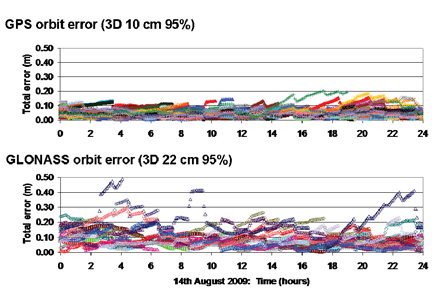
    In Figure 4, time-series plots show the 3D accuracy of GPS and GLONASS G2 real-time orbits on August 14, 2009. In the comparison, final orbit data from the International GNSS Service (IGS) is used as reference. PPP positioning is mainly affected by the radial orbit error, which is significantly less than the total 3D error shown here. The 95 percent 3D accuracy for GLONASS (22 centimeters) is more than double that for GPS (10 centimeters). The graph demonstrates how this difference in this case is mainly caused by a few GLONASS satellites being less accurate. Actually, several GLONASS satellites have orbit accuracy very close to the level of GPS for real-time G2 data.

    FIGURE 4. GPS and GLONASS orbits compared to IGS final orbits.
    FIGURE 4. GPS and GLONASS orbits compared to IGS final orbits.

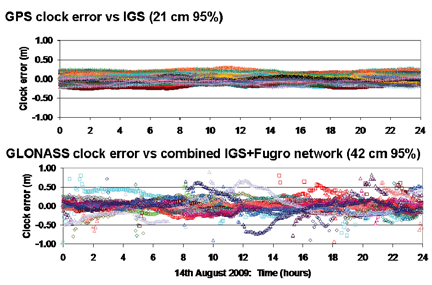
    Figure 5 shows the clock accuracy of the G2 real-time clocks compared to final IGS clocks. A constant bias has been removed to account for the differences in system reference time. Smaller individual clock biases for each satellite can still be observed. Small biases do not affect the final accuracy of the PPP solution, and achievable position accuracy with these clocks are significantly better than the 21-centimeter 95 percent number for GPS may indicate.

    FIGURE 5. GPS clocks compared to IGS final clocks. GLONASS clocks compared to a combined solution based on IGS plus Fugro network to calculate a best possible reference solution.
    FIGURE 5. GPS clocks compared to IGS final clocks. GLONASS clocks compared to a combined solution based on IGS plus Fugro network to calculate a best possible reference solution.

    The lower time series in Figure 5 shows the estimated GLONASS clock accuracy. Currently there is no comparable IGS product with precise GLONASS clocks. A post-processing of all available IGS plus Fugro GNSS stations has been made to establish a reference for the comparison. As shown, the GLONASS clocks are more variable, but still they are stable enough to allow for precise navigation.

    Real-Time Positioning Results

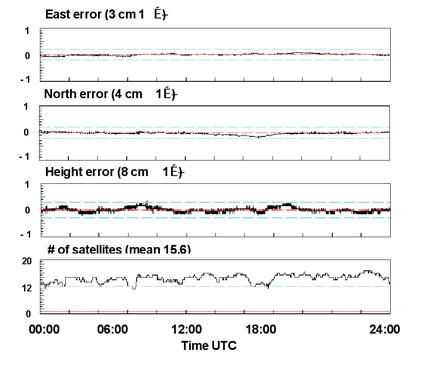
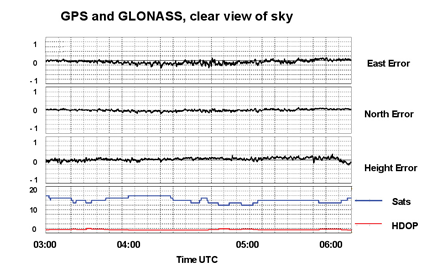
    Real-time position performance is continuously observed at the G2 operation and monitoring center in Oslo, Norway. The graph in Figure 6 shows typical G2 positioning results with the calculation engine running in dynamic mode at a fixed location for a 24-hour period. The blue lines in the north and east time series are at 20 centimeters and the scale is 61 meter. In the height graph the blue lines indicate the 30-centimeter level. The antenna is in a location with clear view of the sky, and in
    dependently calculated reference coordinates are used as reference. 1-sigma accuracy statistics on August 14 are 3, 4, and 8 centimeters in easting, northing and height respectively.

    FIGURE 6. G2 GPS-plus-GLONASS position monitoring results in Oslo on August 14, 2009.
    FIGURE 6. G2 GPS-plus-GLONASS position monitoring results in Oslo on August 14, 2009.

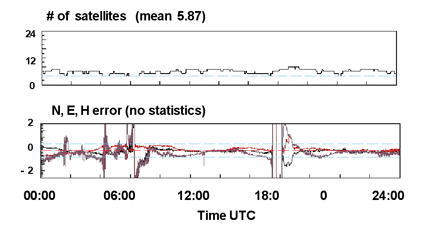
    Figure 7 shows GLONASS-only real-time positioning with clear view of the sky for the same day as in Figure 6 and the same antenna location. The blue line indicates the 50-centimeter level and the scale is 62 meters. For long periods, the GLONASS-only solution works quite nicely. There are, however, shorter periods with fewer than four satellites being tracked, causing the position output to stop, followed by a period of re-convergence.

    FIGURE 7. GLONASS-only real-time PPP solution on August 14, 2009 for a 24-hour period.
    FIGURE 7. GLONASS-only real-time PPP solution on August 14, 2009 for a 24-hour period.

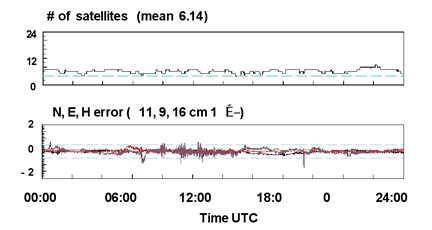
    Figure 8 displays results from May 11, 2009, when there were slightly more satellites available and just enough to have the GLONASS-only solution running for 24 hours without resets. 1-sigma accuracy statistics for this day are 11, 9, and 16 centimeters in easting, northing, and height respectively. Considering the average number of satellites of 6.14 and periods with high DOP values, this is very promising. In early 2010, 20 GLONASS satellites should be available, and by 2011, 24 are expected. In 2010, a performance similar to or better than that of May 11 should generally be expected with the new satellites. By 2011, even better performance is believed to become the norm of GLONASS-only real-time PPP navigation.

    FIGURE 8. GLONASS-only real-time PPP solution on May 11 for a 24-hour period.
    FIGURE 8. GLONASS-only real-time PPP solution on May 11 for a 24-hour period.

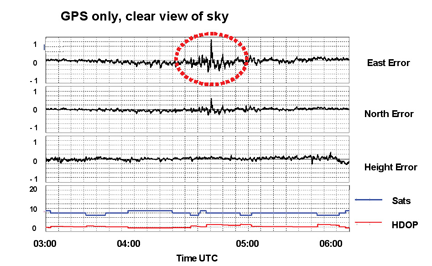
    Even in some clear-view-of-sky situations, the addition of GLONASS may improve the navigation compared to GPS-only solutions. Figure 9 presents an example of such situations. Here the GPS-only solution suffers some multipath-like effects showing up, especially in the east component. Figure 10 shows the combined GPS+GLONASS solution for the same dataset. The distortion in position is practically eliminated. This is an example where adding GLONASS also improves redundancy and accuracy for navigation with clear view of the sky.

    FIGURE 9. GPS-only results for a 3-hour period where some multipath-like effects distort the postition, especially the east component.
    FIGURE 9. GPS-only results for a 3-hour period where some multipath-like effects distort the postition, especially the east component.
    FIGURE 10. Adding GLONASS improves redundancy and accuracy for the same time period as presented in Figure 9.
    FIGURE 10. Adding GLONASS improves redundancy and accuracy for the same time period as presented in Figure 9.

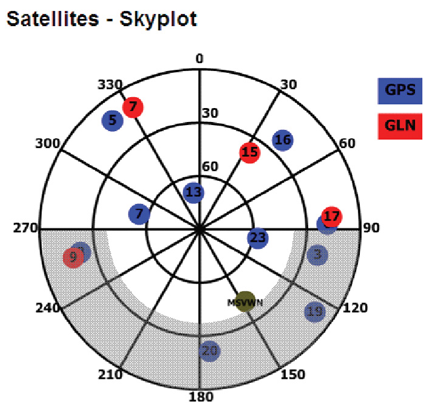
    The next test further analyzes the same dataset as in Figures 9 and 10 by simulating a virtual wall to the south, blocking all satellites below 40 degrees elevation. Figure 11 illustrates this virtual wall blocking both GPS and GLONASS satellites.

    FIGURE 11. GPS and GLONASS satellites blocked between the azimuths 90 and 270 degrees and elevation lower than 40 degrees, effectively establishing virtual wall to the south.
    FIGURE 11. GPS and GLONASS satellites blocked between the azimuths 90 and 270 degrees and elevation lower than 40 degrees, effectively establishing virtual wall to the south.

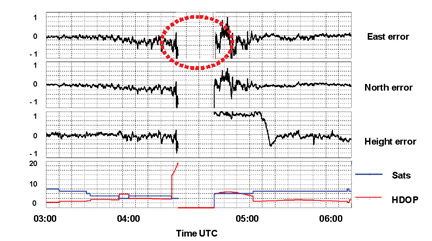
    With such data blockage, the GPS-only solution fails for more than 20 minutes, as seen in Figure 12, simply because the number of satellites goes below four. Then a period with slow convergence follows because of few satellites and high DOP.

    FIGURE 12. GPS-only solution fails when simulating blockage to the south.
    FIGURE 12. GPS-only solution fails when simulating blockage to the south.

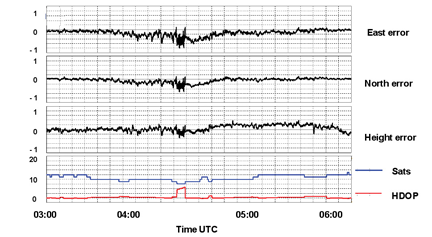
    Again, adding GLONASS greatly improves the performance, as shown in Figure 13. Now a sufficient number of satellites are tracked all the time, and there is a continuous solution with the combined GPS+GLONASS throughout the time window when the GPS-only solution failed.

    FIGURE 13. GPS+GLONASS solution continues working with simulated blockage to the south.
    FIGURE 13. GPS+GLONASS solution continues working with simulated blockage to the south.

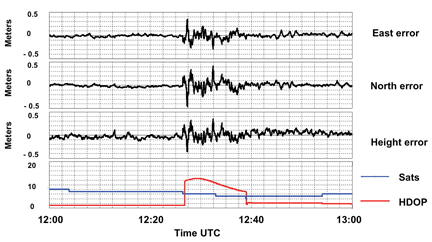
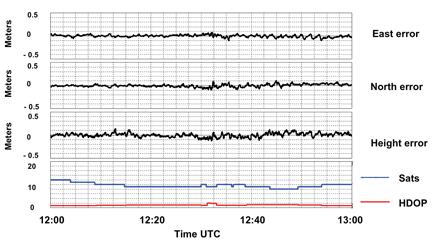
    Even with more than 30 satellites in the GPS constellation, there are situations when the satellite geometry gets poor. This occurred in northwest Europe on February 2, 2010. One of the GPS satellites (PRN17) was not available due to maintenance, and even with five to six usable GPS satellites left, the horizontal dilution of precision (HDOP) was in the range of 7–11 for about 12 minutes (10-degree elevation mask), as shown in figure 14. Such high HDOP values lie above what most user installations are configured to accept, and Fugro received feedback from clients at sea losing positioning. The G2 solution was not affected by the poor GPS geometry and kept the HDOP below 2 during this period, as shown in Figure 15.

    FIGURE 14. GPS-only performance during a period with poor GPS satellite geometry in Oslo, February 2, 2010.
    FIGURE 14. GPS-only performance during a period with poor GPS satellite geometry in Oslo, February 2, 2010.
    FIGURE 15. GPS+GLONASS performance during the same period as in Figure 14 in Oslo, February 2, 2010.
    FIGURE 15. GPS+GLONASS performance during the same period as in Figure 14 in Oslo, February 2, 2010.

    Convergence-Time Analysis

    As will be shown in the following analysis, adding GLONASS not only improves availability and robustness of the solution, it greatly improves convergence time. Real-time high-accuracy PPP solutions use carrier-phase measurements to achieve high-accuracy positioning. To do so, the carrier-phase ambiguities must be determined. This process takes a certain time depending on the observed satellite geometry and is commonly referred to as cold-start convergence time.

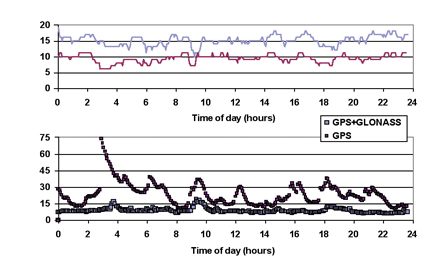
    Figure 16 presents a theoretical study of the expected convergence time for a GPS-only compared to a combined GPS+GLONASS solution. The lower graph shows how the expected convergence time varies significantly for a GPS-only solution throughout the day, with a peak of 75 minutes. The combined solution shows much more consistent performance, with expected 50–60 percent average improvement over GPS-only.

    FIGURE 16. Theoretical study of expected convergence time with actual GPS-and-GLONASS constellation in view of Oslo on June 26, 2009. Adding GLONASS gives a 50–60 percent theoretical convergence time improvement over GPS-only.
    FIGURE 16. Theoretical study of expected convergence time with actual GPS-and-GLONASS constellation in view of Oslo on June 26, 2009. Adding GLONASS gives a 50–60 percent theoretical convergence time improvement over GPS-only.

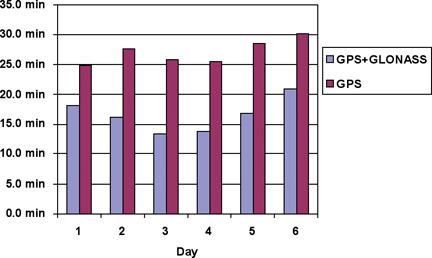
    We compare this theoretical study to results using G2 data produced in real time in Figure 17. A cold start is performed every 5 minutes throughout the day, for six consecutive days, giving a total of 1,728 convergence tests. The convergence criterion is the time when the 3D position arrives within 40 centimeters of the reference position and remains there for a minimum of 10 minutes. The average convergence time improvement achieved in Figure 17 is 39 percent, with some variations from day to day. On the better days, the average improvement is almost 50 percent, and close to the expected performance based on the theoretical study. On other days, there is room for further improvement. Mainly two factors are expected to contribute: more and newer GLONASS satellites, and further improvements of the G2 precise GPS and GLONASS orbit and clock product.

    FIGURE 17. Convergence results for six consecutive days starting June 24, 2009. Average convergence time of GPS-only is 27 minutes, and GPS+GLONASS is 16.5 minutes, a 39 percent improvement.
    FIGURE 17. Convergence results for six consecutive days starting June 24, 2009. Average convergence time of GPS-only is 27 minutes, and GPS+GLONASS is 16.5 minutes, a 39 percent improvement.

    Dynamic Environment Results

    Since late 2008, the G2 system has been installed on the vessel Bourbon Topaz, making frequent trips into the North Sea and back into port in Norway (see BOX).

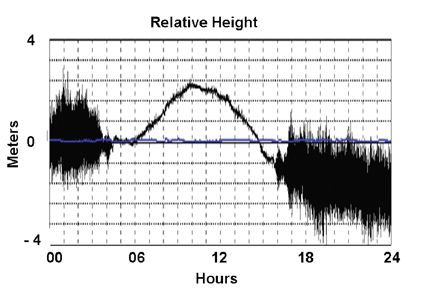
    All positioning data from both the G2 system and the GPS-only reference systems are logged in real time on the vessel. Figure 18 gives an example plot of the relative height estimated by the G2 GPS-GLONASS solution. In the beginning of the plot, the vessel is out at sea, clearly seen as a noise in the graph that actually is the vessel’s movement in the waves. Then the vessel comes into port and the slower tidal variations are observed for the next 12 hours until the vessel again goes back out to sea.

    FIGURE 18. Relative G2 height measurements for a 24 hour period. The vessel is in harbor from 04:00 – 16:00 UTC.
    FIGURE 18. Relative G2 height measurements for a 24 hour period. The vessel is in harbor from 04:00 – 16:00 UTC.

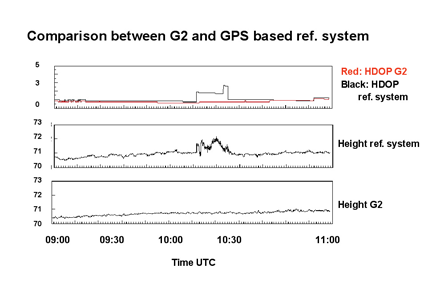
    On June 22, 2009, an incident was recorded where the combined GPS-GLONASS G2 solution improves performance. As seen in Figure 19, there is a period starting at 10:00 UTC where the GPS-only reference systems suffer from poorer DOP values, and this is reflected both in horizontal and vertical components of the calculated position. This particular plot shows how the height drifts off by roughly 1 meter while the G2 combined solution remains unaffected for the entire period. Generally, the G2 solution also shows a smoother height than the reference system even when such problems as shown here are not present.

    FIGURE 19. Height graph from the Bourbon Topaz while in harbor on June 22, 2009. The GPS-only reference system has a period with poor DOP values while the GPS-plus-GLONASS solution is not affected.
    FIGURE 19. Height graph from the Bourbon Topaz while in harbor on June 22, 2009. The GPS-only reference system has a period with poor DOP values while the GPS-plus-GLONASS solution is not affected.

    The Bourbon Topaz carries the G2 system on operations in the North Sea, and continuously compares it with the GPS-only reference systems onboard.
    The Bourbon Topaz carries the G2 system on operations in the North Sea, and continuously compares it with the GPS-only reference systems onboard.

    Test of G2 onboard Bourbon Topaz

    The Bourbon Topaz is a modern supply vessel equipped with the latest dynamic positioning (DP) systems, operating in the North Sea. The North Sea can be a harsh environment in which to operate, and we rely on good tools for maneuvering our vessels.

    Early on, we recognized the need for stable, reliable reference systems, and our fleet is equipped with Kongsberg Seatex DPS700 system as standard. When we were asked to test the G2 onboard the Bourbon Topaz, we saw this as an opportunity to follow the development in the industry of such services. The DPS232 receiver was set up in connection with the vessel’s DPS700 system, and all information was logged and sent to Fugro Seastar.

    We often experience that the vessel has to operate close to offshore installations, which could block good reception of signals. In these cases, the G2 offers a much better and more reliable signal reception. Our experience of the quality of the G2 system is overall positive.

    User Equipment

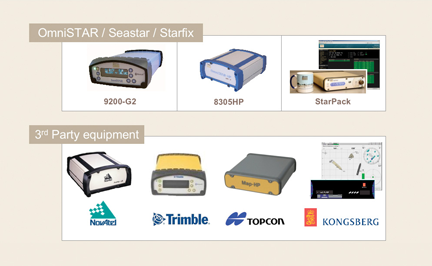
    G2 and the other Fugro services can be received from a variety of different user equipment; both Fugro-branded or manufactured equipment and third-party equipment. In most cases the L-band receiver decoding the data from the geostationary satellites, including Fugro subscription software and position calculation module, is integrated into the same box as the GNSS receiver. Both the GNSS and geostationary satellite signals can be tracked with a single antenna.

    FIGURE 20. Receivers supporting the Fugro services. These are only examples, and not all third-party equipment manufacturers are shown. Fugro L-band data reception receiver and positioning/subscription software reside inside the receiver.
    FIGURE 20. Receivers supporting the Fugro services. These are only examples, and not all third-party equipment manufacturers are shown. Fugro L-band data reception receiver and positioning/subscription software reside inside the receiver.

    Conclusions

    Test results confirm decimeter-level position accuracy in real-time navigation with G2, the first real-time combined GPS and GLONASS PPP service. Several examples show how G2 improves availability, robustness, and convergence time compared to GPS-only positioning.

    More is better. There is no need to wait for future constellations like Galileo to reap the benefits of access to additional GNSS satellites now.

    Manufacturers

    Equipment supporting Fugro services includes receivers from Kongsberg Seatex for marine applications (Seastar), and NovAtel, Trimble, Topcon, Sokkia, Hemisphere GPS, Novariant, and Raven for land applications (Omnistar).


    Tor Melgard is R&D manager at Fugro Seastar in Oslo, Norway. He holds an M.Sc. in electrical engineering from the Norwegian Institute of Technology and wrote his thesis at the Department of Geomatics Engineering, University of Calgary.

    Erik Vigen is a senior developer at Fugro Seastar. He received his M.Sc. in Geodesy from the Norwegian Institute of Technology.

    Ole Ørpen is senior scientist at Fugro Seastar. He received his M.Sc. from the Norwegian Institute of Technology in electrical engineering.

    Jon Helge Ulstein is IT superintendent at Bourbon Offshore Norway AS, a subsidiary of the Bourbon Group, Marseilles, France.

  • Leica Geo, TeeJet Pair Up for Ag Market Efforts

    Leica Geosystems and TeeJet Technologies have embarked on a partnership in which TeeJet will distribute Leica’s No-Drift mojoRTK auto-steer system under its own label, adding RTK-accuracy guidance to TeeJet’s suite of precision agriculture products.

    Under the same agreement Leica will capitalize on TeeJet Technologies’ range of vehicle-specific assisted steering kits to increase the number of tractors the mojoRTK can steer, the companies said. The list of kits offered by TeeJet currently tops more than 50 individual kits, designed to fit approximately 150 individual vehicle models. Initially, Leica will offer TeeJet vehicle kits through its network of resellers, according to the company.

    The companies also plan to work together to develop additional products for the agriculture market.

    Leica’s Virtual Wrench technology, which provides remote service and support, will also be expanded to support products for both companies, allowing technicians from both companies to provide customers with on-demand service and support, according to the companies.

  • Business Outlook – RTK Crops Up in Precision Ag

    Most precision agriculture users have settled for 1-meter accuracy using GPS, made possible with the reliable and convenient corrections provided by WAAS (Wide Area Augmentation System).

    GPS/GNSS is important to key areas in agriculture, including field mapping, yield mapping, and guidance. Companies such as Hemisphere GPS (formerly CSI Wireless) did very well designing single-frequency GPS receivers for the precision ag market. Hemisphere is also a leading designer of radio beacon (Coast Guard) receivers. Radio beacons, in addition to WAAS, are a free source of corrections for 1-meter accuracy.

    Trimble was also an early supplier of precision ag GPS receivers and related equipment, offering single-frequency products such as the AG-132.

    While the real-time kinematic (RTK) technique has been around since the early ’90s, it didn’t gain wide acceptance in the precision ag industry. The accuracy was great, down to approximately 2 centimeters at the time, but the equipment was clunky. The user had to set up a reference station near the field he was working on. The communication link was complicated, and some types needed Federal Communications Commission (FCC) licensing. Consequently, there were several potential points of failure. Lastly, the cost for a complete RTK system (base, rover, and radios) was upwards of $50,000. It just wasn’t cost-effective.

    The term RTK network is ambiguous because it means different things depending on the industry. Essentially, the hardware setup is the same no matter the industry. An RTK network is a series of dual-frequency reference stations spaced optimally within a region to provide RTK corrections to subscribers in that region. The network subscriber is assigned a primary reference station.

    RTK networks for agriculture are single-baseline solutions; the subscriber can only use one reference station at a time. There is no “network solution” or redundancy like there is in RTK networks used in the surveying and construction industries. Therefore, when a single reference station goes down, the subscribers in that area are down also.

    Another major difference between RTK networks for agriculture and RTK networks for surveying and construction is the communication method. The latter primarily use data plans on mobile phones to receive corrections. Either the mobile phone is linked via Bluetooth to the receiver or a cellular modem is built inside the receiver.

    RTK networks for agriculture, on the other hand, primarily use spread spectrum radios (900 Mhz band) to transmit corrections to the receiver. Spread spectrum radios are free to use and don’t require a license from the FCC to operate. They are limited in their broadcast range, however, typically to two to three miles. To solve this problem, radio repeaters are used to extend the distance.


    The Wild, Wild West

    Bill Henning, real-time specialist with the National Geodetic Survey (NGS), said it best: the recent explosion of RTK networks is like the wild, wild West. They are proliferating so quickly that it’s hard to keep track of them. One of his tasks is to help develop guidelines for RTK network operators, and I think NGS is making inroads into the survey/construction industry with its initiative. People are looking for guidance with respect to RTK network setup, as well as monitoring for the networks once they become operational.

    RTK networks for agriculture seem less structured than in other disciplines, though, and administrators rely more heavily on vendor recommendations. For example, some are based on the ITRF reference frame, while others are based on some version of NAD83. Some networks hire land surveyors to establish their reference station locations, while others do it themselves using NGS’s OPUS program or other methods. Very few, I think, realize the resources available from the NGS, such as the Cooperative CORS program.One would think that ag and survey/construction would consolidate their efforts, since an RTK network can cover the same area for both fields, and the equipment is virtually the same. But a farmer isn’t going to pay the same RTK network subscription rate that a surveyor or construction company will. A farmer is hesitant to pay $4,500 annually when he can select a service such as OmniSTAR and pay $1,500 annually. Some industry folks say that aggressive subscription pricing is the reason RTK networks in the agriculture market have expanded rapidly in the past few years.

    The differences between the networks used in agriculture and those in survey/construction are mostly software related. RTK networks for survey/construction offer a true-networked solution, where several reference stations are used to compute a correction, compared to the single-baseline solutions used in ag.

    OmniSTAR (HP/XP), John Deere (Starfire), and Novariant (AutoFarm) offer GPS-based solutions for precision ag. They are not pure-play RTK solutions like RTK networks, but they do have RTK capability. True RTK networks are capable of constantly delivering ~2-centimeter accuracy day in and day out. These companies going after the precision ag market offer primarily decimeter-level services (1 decimeter being the equivalent of 10 centimeters), and then RTK solutions when needed.

    It will be interesting to see how pure-play RTK players respond as RTK networks for agriculture continue to expand — which they most certainly will.