Category: Mapping

  • Ubisense Partners with Google Enterprise Maps

    Ubisense, a location intelligence solutions company, has become an Authorized Partner of solutions based on Google’s Enterprise Maps for Business technologies. This new designation from Google enables customers to more easily assess Ubisense’s expertise advising on and deploying Google products.

    In conjunction with the partnership, Ubisense formally announced Ubisense myWorld 2.0, an intuitive location intelligence platform that integrates Google Maps for Business technologies and provides visibility into an enterprise’s operations, enhancing operational awareness and enabling businesses to operate more effectively.

    Ubisense provides location intelligence solutions that address enterprise visibility challenges, and as an Authorized Partner, Ubisense can now provide Google Maps for Business integration and OEM licenses to its customers in a simple and cost-efficient manner. Ubisense myWorld brings critical enterprise information together into a single application that can be accessed via any standard web browser on any smart device. Ubisense myWorld incorporates network asset data, work orders, customer information, and other critical operational data from a variety of spatial and enterprise systems vendors. Additionally, Ubisense myWorld can be integrated with Google Maps for Business solutions, including Google Maps, Google Search, Google Earth, Google Elevation and Google Street View with Ubisense myWorld.

    “Google Maps give our customers a smart, simple, and fast way to view complex business operations so they can quickly understand the state of operations and make better and more informed business decisions,” said Jay Cadman, vice president of business development, Ubisense. “In, say, an outage caused by a natural disaster, having this detailed view of an organization’s operations in real time enables our customers to respond to safety issues, such as downed power lines, with the right equipment and safety precautions the first time. They can keep their employees and customers safer and restore services faster. Every telecommunications and utility company in the world strives for that and now we’re able to deliver a solution that enables them to achieve both goals.”

    Using Ubisense myWorld with Google Maps technologies, Ubisense customers can realize a number of benefits that can significantly impact an organization’s bottom line and improve customer service. Ubisense myWorld customers gain the ability to react to issues and potentially harmful situations sooner and are better prepared to solve issues faster, work more efficiently, and enhance their customer service and support. Rapidly gaining traction among telecommunications and utility companies, Ubisense myWorld is already used by 26 customers spanning five continents. Ubisense customers are using Ubisense myWorld for many critical business processes, including storm damage assessment, network operations, gas leak surveying, field mobility and customer service.

    Google Maps for Business brings the power of Google Maps to an organization, providing simple, familiar mapping technology to the workplace. Users can layer their data on top of Google’s base map and create their own maps and geospatial applications that can be used by anyone — anytime, anywhere. By using any of Google Maps business solutions, including Google Maps Engine, Google Maps Engine Pro, Google Maps Coordinate or the Google Maps APIs, organizations and their employees can rely on maps that are comprehensive, easy-to-use and always up to date.

    The Google Maps Partner Program includes companies globally that sell, service and customize Google Maps for business solutions for their customers. As a part of the Google Maps Partner Program, Ubisense receives training, support and deployment tools from Google.

  • Ubisense Partners with Google Enterprise Maps

    Ubisense, a location intelligence solutions company, has become an Authorized Partner of solutions based on Google’s Enterprise Maps for Business technologies. This new designation from Google enables customers to more easily assess Ubisense’s expertise advising on and deploying Google products.

    In conjunction with the partnership, Ubisense formally announced Ubisense myWorld 2.0, an intuitive location intelligence platform that integrates Google Maps for Business technologies and provides visibility into an enterprise’s operations, enhancing operational awareness and enabling businesses to operate more effectively.

    Ubisense provides location intelligence solutions that address enterprise visibility challenges, and as an Authorized Partner, Ubisense can now provide Google Maps for Business integration and OEM licenses to its customers in a simple and cost-efficient manner. Ubisense myWorld brings critical enterprise information together into a single application that can be accessed via any standard web browser on any smart device. Ubisense myWorld incorporates network asset data, work orders, customer information, and other critical operational data from a variety of spatial and enterprise systems vendors. Additionally, Ubisense myWorld can be integrated with Google Maps for Business solutions, including Google Maps, Google Search, Google Earth, Google Elevation and Google Street View with Ubisense myWorld.

    “Google Maps give our customers a smart, simple, and fast way to view complex business operations so they can quickly understand the state of operations and make better and more informed business decisions,” said Jay Cadman, vice president of business development, Ubisense. “In, say, an outage caused by a natural disaster, having this detailed view of an organization’s operations in real time enables our customers to respond to safety issues, such as downed power lines, with the right equipment and safety precautions the first time. They can keep their employees and customers safer and restore services faster. Every telecommunications and utility company in the world strives for that and now we’re able to deliver a solution that enables them to achieve both goals.”

    Using Ubisense myWorld with Google Maps technologies, Ubisense customers can realize a number of benefits that can significantly impact an organization’s bottom line and improve customer service. Ubisense myWorld customers gain the ability to react to issues and potentially harmful situations sooner and are better prepared to solve issues faster, work more efficiently, and enhance their customer service and support. Rapidly gaining traction among telecommunications and utility companies, Ubisense myWorld is already used by 26 customers spanning five continents. Ubisense customers are using Ubisense myWorld for many critical business processes, including storm damage assessment, network operations, gas leak surveying, field mobility and customer service.

    Google Maps for Business brings the power of Google Maps to an organization, providing simple, familiar mapping technology to the workplace. Users can layer their data on top of Google’s base map and create their own maps and geospatial applications that can be used by anyone — anytime, anywhere. By using any of Google Maps business solutions, including Google Maps Engine, Google Maps Engine Pro, Google Maps Coordinate or the Google Maps APIs, organizations and their employees can rely on maps that are comprehensive, easy-to-use and always up to date.

    The Google Maps Partner Program includes companies globally that sell, service and customize Google Maps for business solutions for their customers. As a part of the Google Maps Partner Program, Ubisense receives training, support and deployment tools from Google.

  • Scout Goes Global with GPS Navigation Powered by OpenStreetMap

    Telenav-OpenStreetMapTelenav’s free U.S. Scout for iPhone app will use the crowd-sourced and free OpenStreetMap (OSM) for all of its map data. OSM, the “Wikipedia of Maps,” offers users a more accurate and up-to-date map than what is available via commercial maps, the company said.

    The rollout of OSM starts today for some Scout users and will be fully implemented for all users by the end of this week. The company plans to switch to OSM for Scout for Android in the U.S. in June. Scout’s companion website, scout.me, is already using OSM.

    Telenav also announced today that through a rebrand of the popular skobbler GPS Navigation app for iOS and Android, Scout is now available in more than 50 app store markets with maps and navigation for almost 200 countries. skobbler’s GPS Navigation app was the first OSM navigation app in the world. Telenav acquired skobbler in January.

    With this launch, Scout is supporting a growing community of global OSM editors. The OSM community has doubled year over year to more than 1.6 million registered editors, with people mapping every country around the world, ranging from the U.S. to Germany and Lesotho to North Korea.

    The OSM crowd-sourced model enables edits to be published every minute, resulting in maps that are often more detailed and more up to date than commercially available maps. In addition to reporting traffic or accidents, now anyone using Scout can send mapping feedback directly from the app to Scout OSM editors who will let the person know once the data has been reviewed and updated.

    “As a mapping platform, OSM is a credible alternative to proprietary solutions, with the added advantage of instant updates, resulting in a more accurate and up-to-date map,” said Steve Coast, founder of OpenStreetMap and Telenav’s head of OSM. “Roads change, subdivisions are built, and freeways expand so, just like all other maps, it needs updates on an ongoing basis. Today’s launch has effectively added millions of editors to the OSM global community, breathing even more life into an already exploding free and open-sourced project. Compare this to the billions of dollars that Google has spent — and will have to continue to spend — on keeping its maps updated and I think you can understand why we have switched to OSM.”

    “This is a turning point for the mapping industry,” continued Coast. “The amount of effort and investment needed in order to provide high-quality turn-by-turn navigation using OSM crowd-sourced map data cannot be understated. We expect a significant return on our investments to create a better map platform for navigation using the free OSM. It took Telenav years of OSM community engagement, advanced algorithms, technology development, and road testing to reach a point where we felt it was ready for consumers. Now that we are here, we can’t wait for the world to try Scout with OSM. As for the global community of editors, this is true validation that their enthusiasm and passion for making a free, editable map of the world has made a dramatic impact on the evolution of maps and navigation.”

    The OSM rollout is automatic for Scout users and does not require an app update. Separately, Telenav also announced today that it has launched a Scout Maps and Navigation SDK, the first GPS navigation SDK that allows mobile app and developers to integrate OpenStreetMap-based GPS navigation and maps within their own products. The new Scout for Developers program also includes a new Scout Maps API for desktop and mobile websites using OSM, allowing developers to replace Google Maps. More information is available at developer.scout.me.

    Telenav is also sharing in the celebration of its OSM launch by kicking off a map-editing contest at scout.me/osmcontest where map editors have a chance to win various prizes including cash and tablets.

  • Blue Marble Releases Global Mapper v15.2 with New Automation

    A flattened terrain surface model with 3D Vector features using Global Mapper.
    A flattened terrain surface model with 3D Vector features using Global Mapper.

    Blue Marble Geographics has released Global Mapper version 15.2, a minor release that adds functionality to automate the New Feature Creation process, as well as the addition of new online datasources, including OpenStreetMap vector data links via Web Mapping Services (WMS).

    Blue Marble’s geospatial data manipulation, visualization and conversion solutions are used worldwide by GIS analysts at software, oil and gas, mining, civil engineering, surveying, and technology companies, as well as governmental and university organizations.

    The minor release features updates to both the Global Mapper base product and the Global Mapper LiDAR Module. In particular, new functionality has been added to allow the user to automate the New Feature Creation process. Users can now create a series of features that share the same attribute structure, target layer, and other characteristics without having to repeatedly confirm these settings in the Modify Feature Info dialog box. This release also features the addition of free online datasources including full access to the Maine GIS catalog, as well as access to Aviation Charts and OpenStreetMap vector data via WMS.

    Other enhancements include support for creating buffer areas around line features with variable width from beginning to end and for creating buffers on just one side of a selected line feature. New scripting functionality has been added to allow conditional (IF/THEN/ELSE) processing within a script file. 3D models from Collada DAE files have been updated with the option to load BMP, JPG, PNG, and TIFF images with no geo-position information directly, improved 3DPDF support, and enhancements to CityGML.

    “These great new features and functions will streamline the user’s workflow, as well as save them time and money with the ease-of-access to a growing list of cloud based publicly available data,” stated Blue Marble President, Patrick Cunningham “This release is another great example of our mission to deliver a low-cost and easy-to-use GIS solution for everyone.”

    Enhancements to the LiDAR Module in v15.2 include added support for the transformation (shift/rotate/scale) of LiDAR point clouds and the option to filter selected LiDAR points to a certain elevation range and/or set of colors. A new LIDAR_CLASSIFY script command for classifying ground points in a script has been added. Users now have the option to keep the original file offset/scale, or to specify a new one when exporting to LiDAR LAS/LAZ files. They also now have the ability to crop to a selected area when specifying the bounds to import from a LiDAR point cloud and the ability to export point cloud to Esri File Geodatabases (GDB) as normal 3D point features. These LiDAR enhancements are a great addition to an already powerful module for those interested in adding advanced LiDAR functionality to Global Mapper.

  • Applanix, American Aerospace Partner on Mapping for UAVs

    Applanix, American Aerospace Partner on Mapping for UAVs

    AAAI-Applanix-system
    photo: AAAI

    Applanix Corp. and American Aerospace Advisors, Inc. (AAAI), have agreed on an OEM supply agreement that will incorporate Applanix direct georeferencing technology into AAAI’s unmanned aerial platforms. The collaboration creates a commercially available professional-grade mapping UAV system for civilian applications such as pipeline monitoring, power line surveys and emergency-response mapping.

    The availability of the system follows a series of successful test flights of AAAI’s RS-16 Unmanned Aircraft System equipped with Applanix’ DMS-UAV aerial photogrammetry payload with commercially available inertial technology. Joint teams from Applanix and AAAI planned and flew a sequence of missions to evaluate the capabilities, including the ability to provide highly accurate, directly georeferenced and orthorectified aerial imagery without the need for ground control points or aerial triangulation calculations.

    The system — consisting of the airframe, its avionics, mobile ground control station, telemetry systems and the digital mapping payload — performed according to expectations and successfully produced high-quality imagery.

    The announcement was made at AUVSI’s Unmanned Systems 2014 Conference in Orlando Florida, where the most comprehensive collection of unmanned systems for every domain – air, ground and marine – are on display. A video of the system can be watched here.

    “The OEM supply agreement with Applanix formalizes our plans to transform the aerial mapping industry by creating an integrated, professional-grade mapping system for unmanned flight,” David Yoel, CEO of American Aerospace Advisors, said. “For civilian aerial survey projects, this can mean safer operations, lower costs and more efficient deployments while still delivering very high accuracy. We are very pleased to announce the availability of the RS-16 Direct Mapping Solution.”

    “We believe this is a ground-breaking development for the airborne imaging systems market,” Joe Hutton, Director of Inertial Technology and Airborne Products at Applanix, said. “There has been a lot of attention on developing a commercial, directly georeferenced mapping solution for UAVs, and now it is a reality.”

    The RS-16 with the Applanix DMS payload is available through American Aerospace Advisors directly, for sale to jurisdictions where it is permitted to fly civilian UAV systems.

  • Visual Intelligence Releases iOne STKA for UAV Mapping Apps

    Visual Intelligence has announced that its iOne Software Sensor Tool Kit Architecture (iOne STKA) is available for purchase or licensing by manufacturers of unmanned airborne vehicles (UAVs) who want to deliver an integrated UAV/geospatial imaging solution to customers.

    Capturing high-resolution imagery for applications in engineering, construction, urban planning, military missions and other uses is a significant emerging market for UAV manufacturers, and Visual Intelligence’s iOne STKA makes it possible to bring high-resolution geospatial sensors to UAVs, the company said. By purchasing or licensing Visual Intelligence’s geospatial imaging platform, UAV companies can meet emerging demand for geoimaging solutions that combine the benefits of UAVs with the imaging capabilities of a geoimaging platform.

    iOne STKA provides the technology foundation to configure a variety of multi-purpose sensors, including miniaturized 2D/3D applications, for the emerging UVS and mobile/handheld markets. The iOne STKA received the Geospatial Forum 2013 World Technology Innovation in Sensors Award, is the first to be considered for NEANY’s Arrow UAV, and is field-proven by the commercial large-format 2D/oblique/3D multipurpose metric mapping systems iOne IMS, iOne Stereo, and iOne n-Oblique.

    With the iOne STKA, the same UAS/UAV sensor system architecture can be used for agricultural and forestry mapping, pipeline or corridor monitoring, utility assessments, aerial surveys, research, persistence surveillance and other metric 2D/3D professional applications. The iOne STKA is a modular multipurpose sensor platform reconfigurable for UAVs of any size. With the iOne STKA, UAV manufacturers are no longer limited to offer monolithic, single purpose DSLR type cameras. Using the iOne STKA technology, UAV end users can economically collect high-quality color or infrared NADIR, oblique, or video imagery as well as co-mount and co-register e.g., LiDAR and thermal sensors using the same system architecture.

    “By providing UAV manufacturers and end-users with one reliable and performing end-to-end standard digital sensor system solution for MANY applications, we are empowering our customers with a more efficient and standard technology foundation and paradigm to grow their business, enhance their products, and maximize their return,” said Visual Intelligence President and CEO Dr. Armando Guevara.

    At the core of the iOne STKA is Visual Intelligence’s Patented Advanced Retinal Camera Array (ARCA). Developed using open systems and object-oriented software engineering principles, the ARCA is “encapsulated” with a rich set of advanced proprietary software methods that integrate camera components. The ARCA enables the collection of different types of imagery, fused in one pass, producing low-cost, extremely accurate, high-resolution products. It also enables unprecedented array-based collection and functional scalability sensor fusion. The arrays made of these varied imaging devices perform like a single camera, producing one single metric, radiometrically and geometrically correct image, or set of co-registered and fused images; such as a Virtual Frame, of higher accuracy, resolution and quality than DSLR-based monolithic cameras.

    Adds Guevara, “UAV manufacturers can take advantage and offer bundled with the iOne sensors Visual Intelligence’s advanced computing technology for fast cloud-based basic and advanced actionable information product generation. As a fully automated solution (from the sensor to the cloud), the iOne STKA includes processing software that uses streamlined workflows and processes imagery faster with multicore/multithreaded/GPU computing technology, making it easy to quickly produce and analyze products in a device-content eCosystem environment. This technology/business model is designed to provide UAV manufacturers and users recurrent ROI.”

    UAVs built using sensors based on the iOne STKA have the following features and advantages:

    • Strong digital obsolescence resilience, extending the useable life of the system while improving operational efficiencies and reducing operating costs for an even better ROI.
    • In the field:
      • Collection scalability
      • Functional scalability
      • Sensor reconfiguration, e.g. increase collection or functionality as needed or per mission requirements.
    • Large cross-track and FOV collection through smaller aperture (ARCA enabled).
    • Ability to collect different sources of metric imagery that can be fused in one pass.
    • Sensor fusion: Ability to co-mount and co-register in a “small and tight packaging” the EO capability with any other EO or active sensor such as LiDAR, Thermal, IR, etc.

    The iOne STKA software architecture is normative across all ARCA-based products; that is, the software is the same for different array configurations or sizes. This reusable component approach yields economies of scale in the manufacturing and use of multipurpose UAV/sensor configurations.

  • Smart Mapping SuperSurv Available on App Store and Google Play

    SuperSurv-2Supergeo Technologies, a provider of GIS software and solutions, has launched SuperSurv, a mobile GIS app, on the App Store and Google Play.

    SuperSurv contains comprehensive GIS data-collection functions. Designed for both iOS and Android powered devices, it integrates with GIS and GPS technologies to provide functions in field survey, such as Map Display, Query, Measure, etc. With SuperSurv, the collected data can be saved as feature layer (point, line, polygon) in SHP or GEO format in offline mode. SuperSurv supports OpenStreetMap as the base map.

    SuperSurv has been successfully applied in various industries worldwide, including environment protection, pollution prevention, and facility management. The free trial version is now available on Apple App Store and Google Play, allowing users to experience complete functions for seven days before purchase.

    SuperSurv-1For users in North America, Supergeo has released the SuperSurv M3 version to provide easy-to-use and useful data collection and map display functions. SuperSurv M3 supports feature-layer display and offline editing functions. Furthermore, cached maps can be adopted as the base map to facilitate data capture tasks.

    SuperSurv (iOS)

    SuperSur M3 (iOS)

    SuperSurv (Android)

    SuperSurv M3 (Android)


    Screenshot: SuperSurv, Supergeo Technologies

  • Geospatial Corp. Unveils Latest Version of Cloud-Based GeoUnderground

    Geospatial Corporation has unveiled the company’s newest version of GeoUnderground, its proprietary cloud-based GIS platform custom designed around the Google Maps API and Google Maps Engine.

    “The economic and social benefit gained through accurately locating, mapping and managing the world’s underground infrastructure assets in a systematic fashion is huge,” said Mark A. Smith, Geospatial CEO. “To accomplish this, Geospatial has developed a comprehensive suite of technologies capable of gathering accurate 3D positional data on most underground or underwater pipelines. The combination of these data acquisition technologies with our cloud-based GeoUnderground GIS platform provides our clients with a total solution to their underground asset management needs.”

    Geospatial Corporation utilizes integrated technologies to determine the accurate location and position of underground pipelines, conduits and other underground infrastructure data, allowing Geospatial to create accurate three-dimensional digital maps and models of underground infrastructure.

    The company manages the infrastructure data on its cloud-based GIS portal called GeoUnderground, its proprietary GIS platform custom designed around the Google Maps API and Google Maps Engine.

    .

  • On the Edge: Mapping from the Air with a UAV

    On the Edge: Mapping from the Air with a UAV

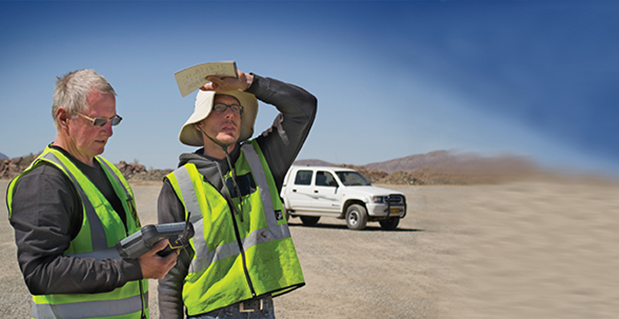
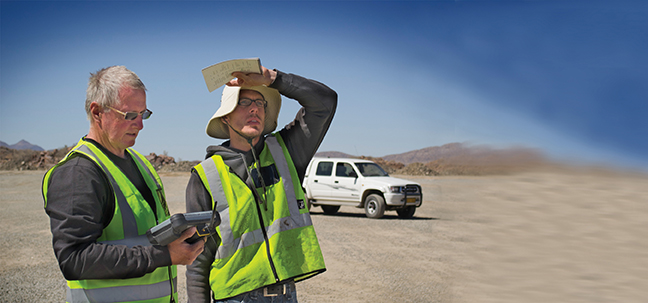
    Dave and Arnold Bansemer prepare the X100 for the survey.
    Dave and Arnold Bansemer prepare the X100 for the survey.

    Surveying an open-pit mine can be a hazardous undertaking. To obtain accurate volume measurements, it is necessary to pick up edges, known in the industry as “toes and crests,” as well as heaps. These are important features, since they provide a way to verify the current shape of a mine; but in light of increasingly stringent safety regulations and penalties, some companies refuse to let the surveyor get too close to such areas. Surveying the site from the air is an effective solution to this challenge.

    It’s also a cost-effective solution. Namibian Mining Survey Services (NMSS) estimates that using an unmanned aerial system (UAS) can save more than 95 percent in mobilization costs, that is, bringing in resources from outside the country to conduct a lidar/photogrammetric survey. Believing UAS to be an important part of the future of surveying, NMSS had been investigating the technology for some time, and a recent project provided the perfect opportunity to try it out.

    NMSS selected the Gatewing X100 for the job based on a demo at a platinum mine, where the results closely tracked those of a previous lidar survey.

    The Project

    The project was to survey a portion of Abenab Mine, a vanadium-lead mine owned by South West Africa Company and located just west of Tsumeb. The mine had been closed in the 1960s, but feasibility studies were underway to see if it would be viable to reopen the operation. Mine management needed to know volumes of all waste and tailings dumps, slimes, dams, and open-pit excavations. The main pit was roughly circular, about 60 meters deep and 120 meters across. Two smaller pits were covered in fairly thick vegetation but had enough ground showing to provide an accurate shape.

    The survey area was approximately 100 hectares. The flying height was set at 150 meters in order to provide a ground separation distance of 5 centimeters. Ground control points (GCPs) were constructed from 1-meter lengths of masonite cut into 10-centimeter-wide strips; painted bright red, the strips were designed to provide 20 x 2 pixel coverage on the images. A total of 10 GCPs were set out in strategic positions covering a wide range of elevations, with points on top of the dumps, on undisturbed ground level, and in the pits. The points were fixed from existing control on the UTM34S coordinate system, by fast static techniques.

    Launching the X100

    The X100 prepares for flight.
    The X100 prepares for flight.

    Based on the Gatewing training received, basic photogrammetry principles and a few trials, NMSS determined that 9 a.m. to 3 p.m. was the best time to fly in order to avoid shadow. The flight area, including a previously surveyed area that would serve as a check, covered 140 hectares. Assuming favorable wind conditions, NMSS expected to cover the area on a single flight.

    Arriving on site at 7 a.m., Dave Bansemer of NMSS started setting out the GCPs while his colleague performed the fast static survey. By 10 a.m., all GCPs had been placed and fixed. Having identified a suitable take-off and landing spot (a farm road), they proceeded through the pre-flight and flight checklist, and then launched the X100 at 11 a.m.. After completing the flight in around 35 minutes, with some turbulence at the 150-meter flying altitude, the X100 landed safely, albeit short of the goal, in an open area.

    Once the data was downloaded, the team returned to Tsumeb to begin the processing. They started with the post-processing of the GCPs, and then moved to the coordinates obtained in the photo-control identification process. NMSS used Gatewing Stretchout Pro software for the photogrammetrical processing.

    After specifying the coordinate system and identifying the GCPs, number-crunching began; the processing ran for around seven hours before the final point cloud and orthomosaics were created. The mean horizontal error was 3 centimeters and the vertical error was 9 centimeters, well within the error budget.

    Results

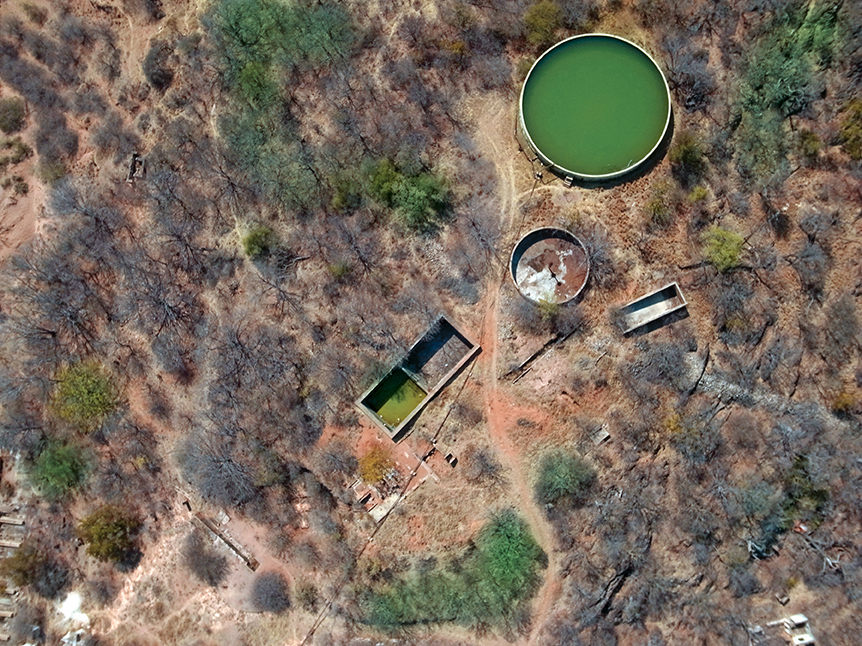
    Aerial image of the X100 survey.
    Aerial image of the X100 survey.

    The first check was to see if all areas had been covered. NMSS then checked the point cloud against the previous survey. The tie-in was perfect. Some gaps in the point cloud seemed to correspond with tree canopy areas; to ensure complete accuracy, the team resurveyed a few areas using a spatial station.

    NMSS learned some important lessons from using UAV technology for survey, which Bansemer lists for the benefit of future users:

    • Make sure you have enough control. It is sometimes difficult to place your control points exactly in the corners of your flight and one in the center, as the actual flight is influenced by wind direction and the shape of the flight may change accordingly. Put down more points than recommended.
    • Make sure that your ground control point size is relevant to your flying height. You will not be able to identify a 10-centimeter wide strip if you fly at 300 meters.
    • Check the completeness of the job before you leave the area.
    • Make sure there is sufficient area for a safe landing. Bansemer recommends at least a 300-meter strip, taking obstacles into account in the event of a short landing.)

    Manufacturers

    The fast static techniques described were carried out with Trimble R6 GPS systems. Re-survey was done with the Trimble VX spatial station. The Gateway X100 is manufactured by Trimble.

  • Launch a River Trip from Your Computer Using Streamer

    Streamer map of the conterminous United States showing water basins, weather radar, and real-time streamflow stations.
    Streamer map of the conterminous United States showing water basins, weather radar, and real-time streamflow stations.

    Field & Stream called it a “…very cool tool and quite a bit of fun.”  MinnPost described it as a “…high-tech illustration of Norman Maclean’s timeless view that, ‘Eventually, all things merge into one, and a river runs through it.” And Popular Science noted that, “There’s something especially satisfying about clicking a stream that…shoots its way across multiple states to empty into the ocean.”

    These publications are all describing Streamer, the popular on-line mapping program from the U.S. Geological Survey. Streamer is a powerful, yet easy way to explore our major waterways. With a simple map click, anyone can trace rivers and streams from a starting point all the way downstream to where a stream drains. Even more impressive, they can click on a stream and trace all others that drain to that point. Streamer also produces a report that includes a map and information about the people and places encountered along the streams traced.

    Streamer map of an upstream trace from a point on Belle Fourche River in South Dakota extending into Wyoming and Montana. Weather radar and real-time streamflow stations are shown on the map.
    Streamer map of an upstream trace from a point on Belle Fourche River in South Dakota extending into Wyoming and Montana. Weather radar and real-time streamflow stations are shown on the map.

    As good as Streamer was when it launched last summer, it just got better. Four major enhancements and dozens of small improvements have been made. These include:

    • A new map layer displays the locations of real-time streamflow stations across the country. Streamer updates this information hourly and symbolizes these stations to illustrate current streamflow conditions compared with each station’s observed mean streamflow on the same day of the year.
    • You can tell at a glance whether conditions are above, below, or at normal levels at each station.
    • Links are provided from Streamer directly to selected stations for additional information and data.
    • Another new map layer has been added that shows weather radar across all 50 States.
    • Useful improvements to Streamer’s detailed reports have been added. One of these lists the names of waterbodies (lakes, reservoirs, etc.) along the path of your trace.
    • Congressional Districts encountered along your trace have been added.
    • A mouse click takes you from the Streamer report to additional information from the Census Bureau about socioeconomic conditions in each District.
    • Searching for locations on Streamer’s map by place name, zip code, geographic coordinates and more is greatly enhanced.

    In its first eight months in service, Streamer users traced more than 2.9 billion river miles.

    The USGS announced in February that it is ending production of the National Atlas on September 30, and that some of its products and services would transition to The National Map. With this release, Streamer becomes the first of these National Atlas products and services that The National Map will offer.  For cartographers and geospatial information professionals, Streamer’s surface water data is available for download at no cost.

    Detail from a Streamer map of an upstream trace from a point on the Arkansas River near Geuda Springs, Kansas, extending into Colorado and New Mexico. Real-time streamflow stations are shown.
    Detail from a Streamer map of an upstream trace from a point on the Arkansas River near Geuda Springs, Kansas, extending into Colorado and New Mexico. Real-time streamflow stations are shown.
  • Launch a River Trip from Your Computer Using Streamer

    Streamer map of the conterminous United States showing water basins, weather radar, and real-time streamflow stations.
    Streamer map of the conterminous United States showing water basins, weather radar, and real-time streamflow stations.

    Field & Stream called it a “…very cool tool and quite a bit of fun.”  MinnPost described it as a “…high-tech illustration of Norman Maclean’s timeless view that, ‘Eventually, all things merge into one, and a river runs through it.” And Popular Science noted that, “There’s something especially satisfying about clicking a stream that…shoots its way across multiple states to empty into the ocean.”

    These publications are all describing Streamer, the popular on-line mapping program from the U.S. Geological Survey. Streamer is a powerful, yet easy way to explore our major waterways. With a simple map click, anyone can trace rivers and streams from a starting point all the way downstream to where a stream drains. Even more impressive, they can click on a stream and trace all others that drain to that point. Streamer also produces a report that includes a map and information about the people and places encountered along the streams traced.

    Streamer map of an upstream trace from a point on Belle Fourche River in South Dakota extending into Wyoming and Montana. Weather radar and real-time streamflow stations are shown on the map.
    Streamer map of an upstream trace from a point on Belle Fourche River in South Dakota extending into Wyoming and Montana. Weather radar and real-time streamflow stations are shown on the map.

    As good as Streamer was when it launched last summer, it just got better. Four major enhancements and dozens of small improvements have been made. These include:

    • A new map layer displays the locations of real-time streamflow stations across the country. Streamer updates this information hourly and symbolizes these stations to illustrate current streamflow conditions compared with each station’s observed mean streamflow on the same day of the year.
    • You can tell at a glance whether conditions are above, below, or at normal levels at each station.
    • Links are provided from Streamer directly to selected stations for additional information and data.
    • Another new map layer has been added that shows weather radar across all 50 States.
    • Useful improvements to Streamer’s detailed reports have been added. One of these lists the names of waterbodies (lakes, reservoirs, etc.) along the path of your trace.
    • Congressional Districts encountered along your trace have been added.
    • A mouse click takes you from the Streamer report to additional information from the Census Bureau about socioeconomic conditions in each District.
    • Searching for locations on Streamer’s map by place name, zip code, geographic coordinates and more is greatly enhanced.

    In its first eight months in service, Streamer users traced more than 2.9 billion river miles.

    The USGS announced in February that it is ending production of the National Atlas on September 30, and that some of its products and services would transition to The National Map. With this release, Streamer becomes the first of these National Atlas products and services that The National Map will offer.  For cartographers and geospatial information professionals, Streamer’s surface water data is available for download at no cost.

    Detail from a Streamer map of an upstream trace from a point on the Arkansas River near Geuda Springs, Kansas, extending into Colorado and New Mexico. Real-time streamflow stations are shown.
    Detail from a Streamer map of an upstream trace from a point on the Arkansas River near Geuda Springs, Kansas, extending into Colorado and New Mexico. Real-time streamflow stations are shown.
  • CompassData Certified by FAA to Collect Data for Aviation Mapping

    CompassData, a worldwide provider of geospatial data and services, has received DO-200A certification by the Federal Aviation Administration (FAA) for collection and processing of survey and ground control data used in the creation of Airport Mapping Database (AMDB) products.

    “DO-200A certification enables CompassData to provide Ground Control Points (GCPs) for generation of digital aeronautical products, such as Airport Moving Maps, used by pilots in the cockpit to navigate on the ground at airports worldwide,” said Hayden Howard, CompassData Vice President. “This certification applies to custom ground control collects and to many of the GCPs that exist in our worldwide archive available off the shelf for immediate purchase.”

    In addition, CompassData has been approved to use its GCPs and Accuracy Analyst map tool to verify the accuracy of satellite or aerial imagery used in creation of AMDB DO-272C aviation products. This means CompassData may orthorectify a high-resolution DigitalGlobe satellite image, verify that the orthoimage accuracy meets sub one- and five-meter specifications, and provide the image to an aeronautical mapping firm or avionics system developer to generate commercial products.

    DO-200A standards were developed by FAA to assure the quality of data used in the preparation of aeronautical mapping, navigation and situational awareness products and systems. Prior to certification, CompassData completed a rigorous examination procedure in which FAA reviewed every step in the firm’s methodologies for collecting, processing and managing GPS-surveyed ground control to ensure the data is accurate, timely, complete, and traceable.

    FAA has granted only six LOAs (Letters of Acceptance) in the Denver ACO Region and only 24 globally. CompassData is the first in the world to receive certification for verification of data sets used to create Airport Moving Map data.

    In March, CompassData purchased the assets of Spatial Information Solutions (SIS) in Starkville, Mississippi, and announced the continued sale and support of the popular Accuracy Analyst and Topo Analyst Map Accuracy Tools. These software applications are relied upon by geospatial end users to automatically verify the accuracy of orthoimagery and digital elevation data sets, often with CompassData GCPs.

    CompassData will discuss the FAA DO-200A certification and demonstrate Accuracy Analyst and Topo Analyst Map Accuracy Tools in booth #2063 at GEOINT 13* being held April 14-17, 2014, in Tampa, Florida.