Omnitracs, LLC, a provider of fleet management solutions to transportation and logistics companies, is making available Omnitracs Tracking powered by Roadnet, a mobile workforce tracking application for smart devices. Omnitracs Tracking offers basic capabilities to help companies track the locations of their mobile workers throughout the day and get additional performance data to help make them safer and more productive, the company said.
“Every transportation company with a mobile workforce wants to know the location and key behaviors of their drivers,” said Dan Speicher, chief technology officer at Omnitracs. “Omnitracs Tracking powered by Roadnet enables companies that have not adopted a fully featured mobile fleet management solution to utilize their existing smart devices in order to track locations of mobile workers, improving safety, productivity and customer satisfaction.”
Benefits of Omnitracs Tracking include:
Location Tracking. By leveraging existing smart device GPS positioning technology, location tracking pinpoints drivers’ locations in real-time using satellite and street maps. Fleet managers access this information through a web-based application, enabling them to provide customers with timely updates on the status of their delivery or service call.
Speed Tracking. The application monitors drivers’ speed throughout the day, allowing fleet managers to take prompt action to help preempt potential safety issues.
Exception Reporting. Users can predefine thresholds for maximum speed allowed, GPS gap, over road speed and stationary position time limits. Exception reporting helps to quickly identify driver behaviors that may lead to unsafe driving and reduced productivity.
“Omnitracs is committed to leveraging the expertise and capabilities of our business units to continuously bring value to our customers. Our newest basic tracking application will give companies the tools they need to better manage their mobile workforce and take fast, appropriate action to improve safety and productivity,” added Speicher.
Omnitracs Tracking is available exclusively through Roadnet and Omnitracs’ resellers. For more information about the application, visit.
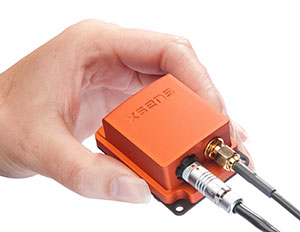
The MTi-G-700 by Xsens is a GPS-aided, IMU-enhanced GPS/INS that offers high-quality orientation and position. It makes use of sensory measurements from magnetometer, barometer, and a high-sensitivity GPS-L1 receiver to provide navigation estimates of position, velocity, and orientation at high data rates under high-dynamic conditions.
The Xsens estimation engine (XEE) sensor-fusion framework enables the motion tracker to take advantage of different aiding sensor measurements and optimally fuse them to get robust tracking estimates. The MTi-G-700 has a u-blox 6 internal 50-channel L1C/A code receiver with 2-meter horizontal accuracy and 5-meter vertical accuracy; SBAS; a 4-Hz update rate; 27-second cold start-up time; and -161 dBM tracking sensitivity.
The MTi is being used by customers for many maritime and oceanographic applications that require 3D orientation, 3D position, 3D velocity, and 3D dynamic data, such as a monitoring system in a barge master vessel where the MTi monitors the movement of a wave-compensated crane.
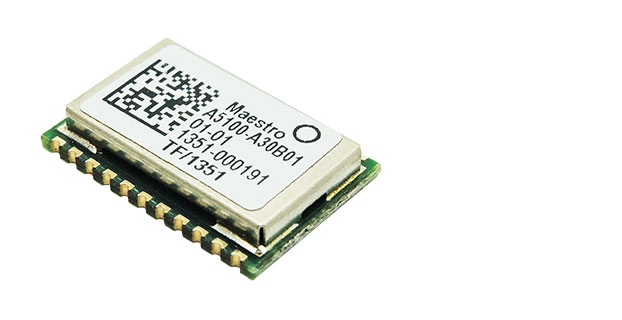
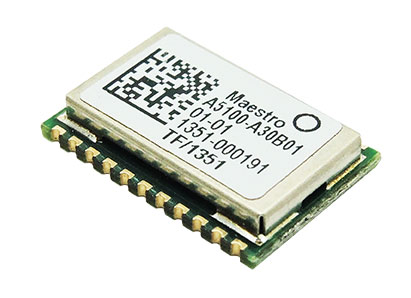
Hong Kong-based Maestro Wireless Solutions, a manufacturer of location receivers, and CSR plc, a global provider of silicon and software solutions for location-aware applications, announce the immediate availability of the A5100-A, a next-generation SiRFstarV GNSS positioning module that combines high-performance GPS and GLONASS receiver technology in a small 10 x 15 mm package.
The A5100-A is designed for a wide range of applications including wearable devices, cameras and automotive trackers.
The A5100-A is the first release within Maestro’s new line of GNSS receivers. It achieves high accuracy with quad-constellation support, up to 30 percent faster time-to-first-fix (TTFF), and up to 20 percent lower power consumption using CSR’s TricklePower and Push-to-Fix (PtF) modes. The module also accelerates customer time to market and reduces development risks by integrating a number of features, including TCXO, SAW filter, RTC, antenna-control mechanism, and flash memory for future-proof upgrades, as well as offering a drop-in replacement capability for Maestro’s previous SiRFstar4 generation modules. The castellated-edge form factor also enables simpler manufacturing and reduces assembly cost, the companies said.
Supporting all currently deployed GNSS, the A5100-A acquires and tracks all visible GPS, GLONASS, QZSS, and SBAS satellites. Concurrent GNSS performance enables the A5100-A to choose the best satellites from different constellations and deliver optimal location information. Immediate benefits are better coverage, enhanced stability, and accuracy in difficult environments, such as urban canyons, and stronger resilience to multipath and signal jamming. This ensures consumers maintain a position fix whether they’re in the middle of a busy city or in a remote rural location, the companies said.
The A5100-A offers a range of other features including:
Direct to Battery connectivity: Connects directly to a rechargeable 1.8V-3.6V Lithium battery enabling system cost reduction and increased power efficiency.
Low Power technology: Optimized for power consumption by incorporating CSR’s PtF technology. PtF rapidly establishes a valid position fix enabling the module to hibernate for longer periods of time, and adaptively changes power depending on the operating environment and motion conditions. Advanced algorithms and a powerful on-chip DSP processor maintain high accuracy (QoS) while achieving the lowest power level possible for the given environmental and motion conditions.
InstantFix Extended Ephemeris (EE): Accelerates TTFF for devices without internet connectivity such as cameras and wearable devices, by autonomously predicting EE for as long as three days and up to 31 days when connected to a network that supports SiRFInstantFix server generated extended ephemeris data (SGEE).
“Maestro Wireless has worked closely with CSR for many years to design and commercialize highly accurate and reliable location products,” said Anthony Murray, senior vice president, Business Group at CSR. “But to win in today’s highly competitive consumer electronics market performance isn’t enough. That’s why we’ve worked with Maestro Wireless to develop a solution that excels in a range of performance metrics but also offers the small form factor essential for today’s compact devices and is highly integrated to help them get to market fast.”
“The A5100-A is perfect for customers designing highly integrated products that need uncompromising performance but are pressured by the speed required to go-to market and lack of development resources,” said Olivier Bernard, EVP of Business Development at Maestro. “By combining low power consumption with high sensitivity, high jamming immunity and concurrent GNSS operation, and with its drop in upgrade path to the A2200-A, the A5100-A creates a fast and convenient route to the latest GNSS offering in the marketplace, to meet these needs quickly.”
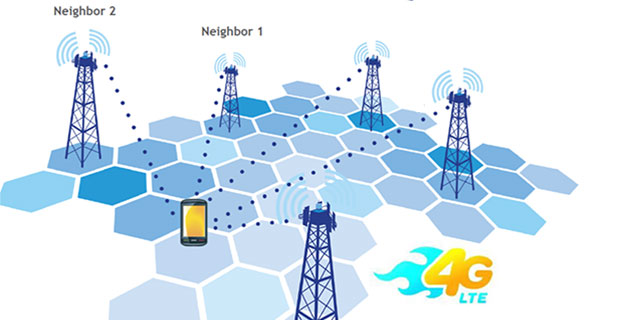
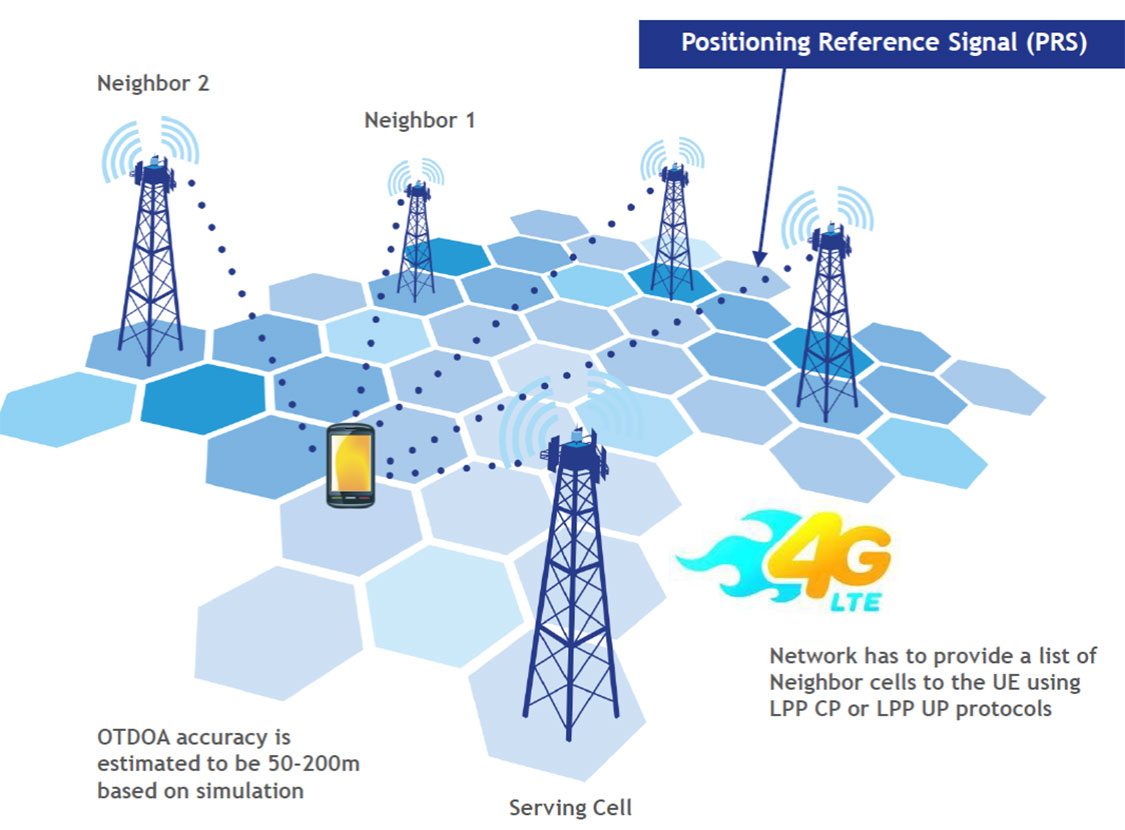
LTE brings a promise of improved location accuracy with new positioning technologies and their integration using hybrid techniques. Although established technologies such as A-GNSS (A-GPS and A-GLONASS) provides excellent performance in environments with a clear view of the sky, performance is often poor indoors, where detection of satellite signals is limited. In LTE, current standards support Observed Time Difference of Arrival (OTDOA), an advanced cellular positioning technology that can augment A-GNSS and provide a more accurate location fix for indoor scenarios.
With large-scale VoLTE rollouts imminent, leading operators are confronted with the need for extensive and complex testing of LTE positioning technologies to ensure VoLTE E911 works well from day one. Additionally, the FCC, whose current E911 regulations apply only to outdoor environments, has proposed stringent indoor requirements as a response to increased mobile usage for emergency calls and lack of accurate positioning information on calls that originate indoors.
“Roughly 70 percent of 911 calls are placed from wireless phones and a majority of these calls originate indoors, so there is a real urgency in providing better location accuracy for mobile users, wherever they are calling from,” said Nigel Wright, vice president at Spirent Communications. “Spirent is currently working with all the key industry players to evaluate OTDOA and its integration with other positioning technologies, and to enable operators to meet the location requirements for VoLTE E911 and the evolving FCC requirements.”
Spirent 8100 LTS has won widespread acceptance as the leading platform for location testing in the wireless industry, and with this latest capability is now able to support OTDOA Position Calculation Function (PCF). Minimum performance testing for OTDOA looks only at the raw measurements from the device, whereas use of OTDOA PCF enables full verification of a device’s position accuracy performance. Recognizing its importance, leading carriers have established their own OTDOA positioning performance requirements beyond bare minimum standards. Ensuring that devices fully meet these requirements as well as the evolving FCC regulations for E911 requires comprehensive testing.
Mitre’s new Time Anomaly Detection Appliqué (TADA) protects modern digital systems from spoofing attacks that can corrupt time source signals.
Successful spoofing attacks could result in navigational systems going haywire and grounding airplanes, jumbling of buying and selling orders, a shutdown of the stock market, or power-grid failures. Infrastructure and defense systems often rely on GPS’s unencrypted position, navigation, and timing (PNT) signal as their source of accurate time, accurate to about 14 nanoseconds.
The TADA system detects and, for certain users, mitigates timing attacks. “Almost every system has a need for precise and accurate time,” said Darrow Leibner, the Mitre TADA project lead. “Because GPS is accurate and ubiquitous, users have gotten away from implementing other time-keeping methods. That’s where the potential vulnerability comes in.”
TADA is designed to provide a cost-effective, reliable, and easy-to-use method for protecting GPS receivers against spoofing attacks. The system defends against spoofing by continuously comparing a trusted input, such as a known frequency or location, with those provided by the GPS receiver. When a difference between these two inputs is detected, TADA alerts the user to the suspected PNT anomaly.
For a trusted input, TADA uses an atomic clock frequency. For each second measured by the incoming GPS timing signal, TADA counts the number of frequency cycles generated by a Cesium clock. If the incoming GPS signal is valid, TADA will count exactly the expected number of Cesium frequency cycles. If TADA measures a higher or lower number of timing signals than expected, it will display the difference. A difference outside the acceptable margin of error will prompt TADA to alert its users that the GPS timing signal is possibly being spoofed.
In the same way it uses a trusted time source, TADA can also use a known location to detect a spoofing attack. To do this, the user inputs the location of a GPS receiver antenna into TADA. TADA monitors the reported position for any changes. Any reported change of the stationary location would most likely be due to spoofing attack and prompt an alert to the user. Once alerted by TADA to a spoofing attack, users can quickly switch to existing backup systems.
“This is not the invention of the lightbulb,” Leibner said. “Rather, it’s a clever use of existing technologies packaged in such a way that users obtain a greatly increased level of protection for a minimum of investment. None of the TADA components on their own are brilliant. But as one manufacturer said after seeing a detailed description of TADA, ‘It’s brilliantly simplistic.’”
The next stage in TADA’s development is to provide it with the capability to not only detect spoofing attacks, but to mitigate its effects and pinpoint their origin. Mitre will also continue to advocate that to bolster the nation’s infrastructure defenses against spoofing, TADA-like monitoring techniques be included within commercial product design.
With fall tradeshow season fast approaching and 2015 vehicles hitting the road, Scott McCormick, President of the Connected Vehicle Trade Association (CVTA), took the time to answer some questions for GPS World about one key conference, CTIA’s Super Mobility Week, and what to expect in the connected vehicle market for the second half of 2014. The CVTA is a nonprofit industry group dedicated to accelerating technologies in the consumer and commercial auto market. CVTA will be well represented at Super Mobility Week, with about a third of its membership comprised of companies involved in the wireless industry. However, McCormick won’t be in attendance in Las Vegas; that’s because he’s a member of the organizing committee and will be moderating sessions at ITS World Congress, being held that same week in Detroit.
Do you think that ITS World Congress will end up cannibalizing the connected vehicle crowd from Super Mobility Week?
Yes, I think it will a lot. Most of the connected vehicle companies don’t work solely in DSRC, they work in cellular and WiFi, too, so it really depends on where their business needs are. The company with the large multinational presence will certainly be at World Congress because that’s where the networking capability is, while CTIA will be most of the cellular providers. It’s about connecting with your channel partners, your supply base and your potential customers. It’s not really about seeing new technologies, but about engaging new customers.
What we are announcing is about doing something that will help benefit collaborative industries. We have our core industries, but there are now insurers, data mining companies, security companies, all these other companies that are not in the automotive space that are doing things related to it. A few years ago we had people in Silicon Valley begin working in the automotive space but they didn’t understand the user interface in the car, where you need to have control and return your attention to driving as quickly as possible. All the devices they knew were designed to focus your attention. It’s the same thing today: The insurers don’t know how to work with the automakers. Neither did the telecoms. They’re completely different business models, but they’re channel partners. This is not just about a company to hire, but where can we gain utility and expertise.
So your announcement will be about reaching into a second tier of companies that just a few years ago were not involved in the connected vehicle space?
That’s a perfect way to characterize these companies; they all have to deal with interoperability issues.
What will be the hottest topics at Super Mobility Week?
There will be three: privacy, data ownership, and security. Security is the only one that’s important, and it’s for simple reasons. The United States has no personal privacy data law and it never will. The issue is one that we’re not going to solve. Everybody wants to talk but nothing ever comes of it.
The same question with data ownership. Why would my privacy or data ownership be device-specific? It should be device-agnostic. Anytime you transfer data, there are two levels of ownership. Of the data in the connected vehicle, an infinitesimally small amount is related to location or driving behavior. Although we talk about privacy and data ownership, nobody’s going to define data ownership.
Security, however, is a huge issue, because once you clear a gateway into the system, it can be breached. I’m not concerned about terrorists, it’s more just teens with nothing to do who want to rock the system. I’m most concerned about the insufficiency of the code. There’s an average of 43 networks in a car, and while they’re not likely going to affect braking, that doesn’t mean if you tinker with things long enough you couldn’t figure it out and remotely control functions. That’s really sophisticated and of very low value to do it to one vehicle.
It’s more important to ask if the overall infrastructure is protected. Systems have to be designed to be secure, detectable, and reparable. It’s incumbent upon cellular companies to take that responsibility.
Will they accept that responsibility?
If they don’t, people won’t use it. Now we understand that when a car is purchased it’s based largely on the perception of quality of service, not just on the quality of the engine or the comfort of the ride … it’s about how long until my connection breaks off and why didn’t I know about that traffic jam or that this road was icy if another guy did in a different make and model car.
How do you think this year’s show will be different from last year’s show?
Last year a lot of industries were still coming off the recession and going back to core competencies. This year I expect to see a lot of innovative companies coming out with much more focused sort of innovation where in the past it was about trying to be everything to everybody. In particular, the connected life stuff is going to be interesting because those are the people that when you look at it you’ll say, this is something I haven’t seen before or wasn’t aware of and it’s new and consequential.
The automakers will be a part of a lot of those discussions. Do you think we’ll hear anything new?
There will be some talk about the aftermarket. The average person keeps cars for 11 years. Now if I just bought a new car and next year someone has something really cool, I can’t just go buy a new car. But if I could add it … now there’s another revenue stream for the OEMs.
What are some innovations you think we’ll see hitting the market in the next year?
The machine-to-machine market is going to have a lot. Also, I just read a report that a lab figured out how to do 1000-times the data transmission speed of the fastest fiber-optic system by running it across copper. We have certain sized pipelines today and a certain time to get data from here to there, and we’re exploring how we can best do that with what we have.
By all estimates the global connected car service market is expected to top $130 billion by 2019. What will fuel that growth the most? Safety and security? Infotainment? And is that growth sustainable?
By 2020 we’re looking at a $200 billion market … and that’s going to be because of security. The problem with the automotive industry is that they have a very difficult time communicating the value proposition, because they’re used to selling business-to-business. But in the cellular industry you don’t question paying several hundred dollars a month for your phone, because they communicate that well to consumers. So the question is really one of both developing the product and service and understanding the consumer.
CTIA has talked a lot about safe driving policy and distracted driving legislation. Where do you see this policy going in the next year?
I see the federal government moving at a glacial pace. They were 2 months late on the vehicle-to-vehicle report, they were supposed to work on the interstate commercial vehicle rule, and they’re struggling with a transportation authorization bill that’s not anywhere near where it should be. There are things that the federal government needs to be involved in and things they have no business being involved in, like setting standards. The automakers will do what the consumers want. Look what happened with backup cameras. Even before there was legislation requiring backup cameras because of kids being hit, the automakers decided to put it on certain models because the consumers wanted it.
What policies will come into play in the next year?
One is very critical. The American Jobs Act is pushing to allow unlicensed devices to use the 5.9 (GHz) spectrum (currently allocated to licensed Intelligent Transportation Systems), and we have conveyed what a bad idea that is. The FCC has tested it in lab conditions, not with hundreds of cars at an actual intersection. This is not like connecting a toaster and refrigerator, this is hundreds of people in the backseats of cars attempting to connect and disconnect (to WiFi). That’s the equivalent of a denial-of-service attack. Unless we deal with this soon, it’s going to be a real safety risk. The problem is once the spectrum gets reallocated, it’s going to be really hard to take it away.
The Mobile Marketing Association (MMA), a global trade association for the mobile marketing industry, is forming a Mobile Location Data Accuracy Group. The focus of the group will be to eliminate any confusion around mobile location data and to improve the trust and confidence brand marketers and agencies have in mobile location advertising and the data that drives it.
Simultaneously, the MMA is forming a Location Leadership Council that will be an industry “think tank” comprised of a merging together of thought leaders from the MMA’s Location and Privacy committees and experts in the various areas of location — marketing, technology, data and policy. Stemming from the council will be a number of working groups, the first of which is the Mobile Location Data Accuracy Group.
The working group will expand on the previously launched Location Terminology Guide, in which the MMA Location Committee identified eight types of location data and signals, and ranked each according to the reach and accuracy of the data. The data and signals to be examined by the working group include (from most accurate to least):
Indoor positioning system
Bluetooth
GPS
Wi-Fi hotspots
Wi-Fi triangulation
Cell tower triangulation
IP address
User reported location
Specifically the Mobile Location Data Accuracy Group will:
Dig deeper into each of these data types and elaborate further on their appropriate uses and limitations.
Develop and issue an RFI (Request for Information) to all location data vendors and validators that will establish criteria with which vendors can be aligned with the data types they use.
Establish strict, standardized definitions with the MRC that vendors will be held accountable to and audited against.
According to an April 2014 BIA/Kelsey study on local media spending, location targeted mobile advertising accounted for 40% of the $7.22 billion mobile ad spend in 2013, and is expected to grow to 52% of the $30.3 billion forecasted for 2018.
“In order to scale mobile marketing specifically driven by location data, it is critical for the industry to come together to develop a common set of definitions of the types of location data available and how they are best used,” said Greg Stuart, CEO, MMA. “By agreeing to and abiding by a common set of best practices and guidelines, MMA members will be instrumental in driving the growth in the industry while assuring brand marketers of the measurable value derived from their mobile efforts.”
With tighter definitions of location data, and the viable uses of such data, measuring results will be more consistent and reliable, the MMA said. These benchmarks will allow buyers to have a much clearer understanding of the data being used, and how it will impact their location-driven mobile advertising campaigns.
Initial members of the group will include:
xAd – Monica Ho, SVP Marketing (co-chair)
Joule – Michael Lieberman, CEO (co-chair)
Factual – Vikas Gupta, Director of Marketing
ThinkNear – Brett Kohn, Director of Marketing
Mobiquity – James Meckley, CMO
Nielsen – Tom Eaton, VP, Client Services
MEC – Bav Panchal, Mobile
OpenX – Rob Kramer, GM, Mobile
Ubimo – Ran Ben-Yair, CEO
Verve – James Smith, CRO
“Having this type of transparency into location data is a huge step forward that will allow us, as buyers, to invest in mobile with increased confidence,” said Michael Lieberman, CEO, Joule North America. “This program will, in large part, allow mobile marketing to truly scale and deliver measurable results for our clients around the world.”
“We are committed to improving clarity and defining auditable standards for location data and ultimately all of location-based services. This will remove the barriers for brands and agencies to leverage the power of this unique mobile value proposition and improve their confidence in how and what to use,” said Monica Ho, SVP Marketing, xAd. “We are excited to work with the MMA and the industry in achieving standards that we believe will be critical for scaling the mobile marketing industry.”
The Mobile Location Data Accuracy Group will be gathering the industry leaders to share initial definitions and use cases at the Location Data Accuracy Panel Session August 26 at the Crowne Plaza Times Square, New York, 6:30-9 p.m. The session will provide an opportunity for brands, agencies and key partners in the location advertising arena to meet and discuss opportunities ahead.
The U.S. Patent and Trademark Office has issued 10 U.S. patents to TeleCommunication Systems, Inc. during the second quarter of 2014. TCS also received two foreign patents during the quarter.
The 10 U.S. patents describe innovations in messaging, location-based services, GIS/mapping and wireless. They include the following three:
TCS reported in the first quarter that it was issued a Prepaid Short Messaging Services patent. In the second quarter, TCS received notice that another prepaid patent was issued to the company that will serve as one of the cornerstone patents in a monetization program that TCS is planning to launch later this year. The prepaid market has grown into a multibillion-dollar per year industry, with 86 million prepaid users comprising 27 percent of all U.S. wireless users, according to a J.P. Morgan 2013 market report. The recently issued Prepaid Short Messaging patent (U.S. 8,738,496) is a continuation of earlier TCS prepaid patents, bringing TCS’ prepaid messaging portfolio to eight, with one additional pending. Most prepaid phone systems allow users a prescribed amount of prepaid messaging and wireless call time. The ‘496 patent describes techniques for determining if a recipient’s account is sufficiently funded to receive a message. If it is not, the system prevents the delivery of messages until the recipient’s account is sufficiently funded, when follow-on messages will be delivered.
A geofence defines a virtual spatial boundary for creating triggers when a mobile device either enters or exits that boundary. Geofences are commonly used in child location services to alert parents when a child’s mobile device leaves the boundary of a school or park, or by enterprises to track the location of a mobile workforce or equipment. Establishing a geofence can be complicated, requiring that the user manually draw the boundary on an electronic map. The recently issued TCS patent covering a Method and System for Identifying and Defining Geofences (U.S. 8,731,813) describes techniques to simply and easily create geofences based on real-world objects or places. Using the map/navigation application on a mobile device, the user simply selects the desired location, using its pre-defined boundary to create the geofence.
Thousands of portable computing platforms have emerged that have the capability of directly connecting to the Internet either through a wireless wide area network (such as cellular network or campus Wi-Fi network) via a front-end built into the device (smartphone, etc.), or, via Bluetooth or other short-range wireless communication, to a wireless proxy device such as a modem or a smartphone. With various low-cost, short-range wireless devices installed in vehicles for navigation or entertainment purposes, it has become increasingly important to provide an easy and efficient method for a motor vehicle manufacturer, parent or other authority to monitor and control access to certain sites when those devices are connected to the Internet. The recently issued Remotely Provisioned Wireless Proxy patent (U.S. 8,712,408) describes techniques to create white lists (allowed URLs) and black lists (disallowed URLs) within a wireless/mobile device acting as a proxy so that access to certain sites can be controlled effectively.
The remaining seven U.S. patents issued in the period are: Integrated, Detachable Ear Bud Device for a Wireless Phone (U.S. 8,688,174); N-Dimensional Affinity Confluencer (U.S. 8,688,087); Login Security with Short Message (U.S. 8,712,453); Intelligent Reverse Geocoding (U.S. 8,731,585); Secure Location Session Manager (U.S. 8,687,511); System and Method for Location Assurance of a Mobile Device (U.S. 8,718,673); and Wireless Network Tour Guide (U.S. 8,744,491).
Tom Coughlin, head coach of the New York Giant football team, has outfitted his players with GPS devices strapped to their backs under their uniforms. The technology can provide the team with information such as top speed, burst and how long the player has run in terms of time and miles, reports the Wall Street Journal.This is the second year the team has used GPS during training.
“We’re getting all kinds of information,” Coughlin said. “It’s player related so we have information coming every day on every player.”
The data can help the coaches structure practices so they know when to do extra stretching or potentially cut down on repetitions. Some of the players use the information as a means of competition, comparing top speeds and workloads.
Where are bets on new technology being placed? Prominent venture capital (VC) firms are investing in companies with indoor location solutions. But with more than 50 companies to choose from and at least ten unique technologies, it is hard to judge who will make it into the winner’s circle. There is no early leader to put money on, and unlike other location-based markets like mapping, I expect this market to support many competitors and not be dominated by a few. The vertical markets that are ripe for indoor location have different needs for accuracy, cost and speed. Promising applications include retail, advertising, manufacturing, asset tracking, gaming, intelligence and public safety, but who knows what other applications will emerge. GPS has infiltrated everyday life in ways unimagined at its start.
With no obvious front-runner technology, many companies hedge their bets and offer multiple technology solutions. With infrastructure already installed throughout the great indoors, the easiest solution may appear to be Wi-Fi triangulation. While the cost may be attractive, the accuracy is not precise enough for many apps. Other solutions include Wi-Fi fingerprinting, Bluetooth, sensors and beacons.
Some companies are offering technologies outside of the mainstream. ByteLight provides a solution based on LED lights mounted in the ceiling that generate fast pulses that can’t be seen by people. A smartphone can detect the pulses and triangulate position by identifying different lights by pulse pattern. Indoor Atlas and Indoo.rs use sensors to detect Earth’s natural magnetic fields for positioning. Camera technology is being used by WhereLab and Omiimii. Object recognition software determines location.
The accuracy requirements of applications will drive the choice of technologies. Low accuracy is more than 11 meters, and medium accuracy is six to ten meters. High accuracy is one to five meters. High-accuracy solutions are generally more expensive and require more infrastructure.
Apple iBeacon Changes to Opt-Out
Anything that Apple does garners attention, including iBeacon for indoor location, which uses low-energy Bluetooth to communicate to phones and computers. Apple has some showcases, including a few Eagle and Safeway grocery stores using the iBeacon to send marketing messages to customers. The Peeble smartwatch added iBeacon support and reportedly can zero in on a lost phone. iBeacon technology at some of the Virgin Atlantic gates can trigger an app to automatically display a boarding pass as a traveler approaches. BeHere automates classroom attendance.
I often write about privacy issues, and so I wonder, where are the techno-privacy advocates challenging Apple on iBeacon? You would think that there would be a tangle of permissions required of users, including turning on the beacon and giving an app permission to locate the user and for receiving notifications. Apparently, Apple thought the permissions were unwieldy. Apple users had to opt-in to turn on iBeacon, but in March with the new iOS release, the default changed to opt-out.
Apple users may be unaware that an app using iBeacon doesn’t need to be open to interact with the phone. If the Safeway app is installed, the user will receive messages from the store, even when the app isn’t running and phone screen is locked. Even though iBeacons don’t track users or collect data from them, I find this functionality to be unsettling.
Advertising in Minority Report was very personal.
Stores are having trouble competing with online shopping and are looking for ways to interact with shoppers when they come through the door. That interaction might be loyalty points, greetings or personalized special offers. Only three percent of retailers currently have the ability to identify customers coming through their doors, according to a survey of top retailers by Boston Retail Partners. ABI Research predicts beacons will be installed at 30,000 locations worldwide by year’s end. If beacons alone can generate such widespread usage so quickly, it is easy to see why indoor positioning technology companies have been a magnet for VCs.
Do you remember the scene in the movie Minority Report when Tom Cruise enters a clothing store? As Cruise passes by advertisements, they address him by name. Indoor location can get creepy.
Proximity and indoor positioning will grow as technology gets better — and consumers value its benefits. Attendees at the recent Place conference in New York had the opportunity to hear from companies who advocated Bluetooth, Wi-Fi and even magnetic positioning technology. In addition, several advertising agencies and retailers attended, showing that the nascent proximity/indoor location niche could be a major market in the next few years.
NEW YORK — The potential for indoor positioning and proximity marketing is huge if even a fraction of overall retail sales are attributed to the information the technology gives to retailers, said panel members at the July 22 Place conference here.
The indoor opportunity is huge as studies have shown that 70 percent to 89 percent of consumers use smartphones in stores to compare prices and shop for coupons, said Greg Sterling, Opus Research senior analyst. “About $20 to $50 billion of purchases were influenced at point-of-sale in stores. $500 billion of retail sales came without any premeditated product selections,” he said. “Even if a small fraction shifts to mobile devices, that’s an enormous amount of money.”
Sterling said that despite consumers’ ambivalence to privacy issues, if they are guaranteed some sort of benefits to being tracked, they will opt-in. “72 percent said they don’t want tracking [without benefits]. That number goes up to 66.4 percent who say ‘yes’ if there are specific benefits — rewards and discounts,” he said. “It is about educating consumers [as to benefits of location-based advertising].”
Technology improvements and retailer awareness in the last two years have made such mobile advertising agencies as Joule interesting in location as a data point beyond geofencing, said Michael Lieberman, company co-president.
“I am biased as we are mobile agency, so for us, most of our clients are using location to identify buyers. Ideally, we see a device in multiple locations, we understand consumers’ behavior,” Lieberman said. “If I see you every morning at a Starbucks, you are a coffee drinker and I should target you that way. However, if you are trying to use location as a national campaign you will only get a percentage of accuracy — you are missing out on other information.”
Right now, retailers have little idea how and why a consumer makes a purchase, Lieberman said. “The [important] point is in [indoor location’s] measurement — what happens in the store environment. You walk in store, make a purchase, right now we have no idea what they did to buy a product,” he said. “We are losing that piece — and it is a big gap in thinking. Everything about consumer path in that store determines a purchase. What’s valuable is the in-store data that gives you the most actionable information.”
Location today is used for targeting, but not for the total consumer measurement that Facebook requires, said Doug Stotland, Facebook product marketing director. “IKEA recently ran a campaign in a local radius, they wanted to see who showed up in their parking lot,” Stotland said. “It’s really compelling when you look at the methodology — you want to see if people actually showed up at the store. The home run is how to tie it to what they actually buy.”
Stotland said Facebook uses location information for targeting, but basically users tell the company where they live and that’s it. “We can do better than that — there is definitely a big opportunity there. The great thing about Facebook is that I am always logged in — there is no value for targeting if I am not.”
In a case study session at Place, Korean telecom provider SK Telecom has been making inroads in indoor positioning markets for several years, said John Kim, SK Telecom senior business development manager. “While we are the number one mobile operator in Korea, like other companies, we were hitting saturation levels,” Kim said. “We found that location-based services for telecos are a key service, basing this on earlier tracking, navigation and security markets.”
SK Telecom ran indoor positioning tests at Seoul National University Hospital, which has 1,360 beds, making it hard to find patients. Kim said younger indoor positioning users liked the service and found it easy to use. “We also found that it was difficult for active marketing — what does a hospital use to promote it? Two-for-one x-rays?” Kim said. “The service was also difficult for remote maintenance and support.
Kim said that SK Telecom is installing the product as a test in a Seoul sports stadium and at the L’Oreal Madrid flagship store. “We are also partnering with [Herndon, Va.-based] APX to work in their Google Glass product to provide location information.”
Overall, the upside of indoor location is huge, said Don Dodge, Google developer advocate. “Imagine if you can look at phone to know exactly what stores your family members are in at the mall. At CES, you have no idea where 15 to 20 of your friends are,” he said. “If my wife gives me a list of groceries, I can find them in certain areas and know what price they are. First responders, fire departments, can find their way around in a burning building — and find a safe way out.”
Privacy: The Attack on Opt-In
In a privacy panel, members put a dark cloud over the ubiquitous answer by many companies that consumer opt-in alleviates all concerns for the location industry.
Amanda Koulousias, a Federal Trade Commission attorney, said Section Five of the FTC Act, which has been expanded to cover tracking users over a certain time, prohibits deceptive practices that are likely to mislead people acting reasonably.
Privacy seems to be a hot topic for reporters. Kate Kaye, a panel member who is a reporter with Advertising Age, said that security issues around beacons and leakages is a story. She also said that the Associated Press recently ran a story critical of the new Verizon rewards program. “The story typifies the balance a lot of marketers are trying to straddle — how much information can we gather, and how do we not [anger] consumers. Verizon Wireless prompts you to join their loyalty rewards program, but you have to opt-in to their location data program,” she said.
Privacy panel moderator Jules Polonetsky, Future of Privacy Forum executive director, said a way some companies get consumers to opt in to being tracked is just to say “download this app.”
The location industry’s privacy issues are not going away — and the path for resolution isn’t clear, said Greg Turetsky, principal engineer in Intel’s wireless communications group. “The privacy issue is so complex legally, economically and socially, that I expect it will not be resolved any time soon,” he said.
In other Place conference news:
Opus Research, the organizer of the conference, published a report on magnetic positioning, which has a unique footprint. The company contends that magnetic positioning, which can be complimented by other technologies, offers six-foot accuracy with 90 percent precision. In comparison, Bluetooth offers proximity, but not the blue dot solution magnetic positioning currently has. In addition, Opus believes that Wi-Fi positioning, which has 40-foot accuracy, needs too much support and is expensive.
InvenSense, Inc., a provider of intelligent sensor solutions, has signed a definitive agreement to acquire Trusted Positioning, Inc. (TPI), a privately held indoor/outdoor tracking company with the vision to provide “Positioning Everywhere.” InvenSense is also acquiring context analysis software company Movea.
TPI’s location tracking technology improves accuracy both indoors and outside by augmenting GNSS and Wi-Fi based location infrastructure. Using inertial sensors such as accelerometers, gyroscopes, magnetometers, and pressure sensors in mobile and wearable devices, TPI’s software platform provides continuous and accurate positioning and also solves the difficult problem of alignment between the user and the mobile device. The TPI platform provides complete inertial navigation software solutions for a variety of industries including smartphones, tablets, wearables, in-vehicle navigation, personnel tracking, and machine guidance and control.
“InvenSense shares our passion for ‘positioning everywhere,’ and they have been a strong supporter of the Trusted Positioning team, technology and vision,” said Chris Goodall, Trusted Positioning’s chief executive officer. “We are pleased to be joining the InvenSense family with the goal of making indoor/outdoor positioning ubiquitous. Together with InvenSense we will now have the required resources and investment to mainstream this technology.”
InvenSense has also signed a definitive agreement to acquire Movea, a privately held company that provides software for ultra-low power location, activity tracking, and context sensing. Movea’s products, technology, and IP cover a broad range of signal-processing and data-fusion technology applied to consumer mobile (smartphones and tablets), TV interaction, and wearable sports and fitness applications.
Movea is dedicated to context analysis using both motion and audio sensors to determine, for example, a person’s state/activity, their energy expenditure, their location, and an athlete’s speed and cadence. Movea’s algorithm and software framework expertise is expected to further scale InvenSense’s leadership in motion software and accelerate InvenSense’s “AlwaysOn” low-power solutions for mobile and the Internet of Things.
“With the addition of Movea and TPI, InvenSense achieves a significant milestone as it transitions to a leading provider of intelligent sensor System on Chips (SoC) for the fast growing mobile market. ‘AlwaysOn’ location and activity tracking are essential to enabling contextually aware products and services,” said Behrooz Abdi, president and chief executive officer, InvenSense. “The tight integration of our low-power, high performance, motion and sound sensors, along with TPI’s advanced location tracking software and Movea’s data fusion algorithms, will position us to deliver on this ‘AlwaysOn’ promise.”
In connection with the acquisition of both companies, InvenSense expects to pay approximately $81 million, net of cash assumed, to acquire all of the outstanding shares of capital stock and other equity rights of Movea and Trusted Positioning, Inc. The purchase price will be paid with $6M of InvenSense common stock and the remainder in cash, except that portion attributable to unvested employee stock options will be paid in stock options exercisable for shares of InvenSense’s common stock.
A portion of the cash consideration payable to the stockholders will be placed into escrow pursuant to the terms of the acquisition agreement. The estimated financial impact of the acquisitions upon the future operating results of InvenSense, which is not expected to be significant, will be discussed during the next regularly scheduled quarterly investors analyst conference call planned for July 29.
The boards of directors of InvenSense and the two companies have approved the mergers. The transactions are expected to close by the end of InvenSense’s second quarter, September 30, and remains subject to the satisfaction of regulatory requirements and other customary closing conditions.