Quanergy Systems, a provider of lidar sensors and smart sensing solutions, is offering a new sensor.
Quanergy’s S3 lidar sensor
The S3-Qi is a miniature solid-state lidar sensor that is 15 percent the size of the previous solid-state model, the S3. Quanergy is displaying the new sensor along with its other products in Booth 767 at AUVSI’s Xponential May 3-5 in New Orleans.
The S3-Qi, offered four months after the original S3, has a smaller 1 inch by 1.5-inch footprint, weighs about 100 grams and has low power consumption. The small form factor, combined with a cost-effective design, makes the S3-Qi well suited for applications such as drones, intelligent robotics, security, smart homes and industrial automation.
Mass production of the S3-Qi is targeted for the first quarter of 2017.
“We are excited to raise the bar, once again, with the expansion of our product portfolio,” said Louay Eldada, Quanergy CEO. “We continue to push the boundaries on behalf of our customers. The S3-Qi is a testament to our focus on the user and our investment in innovation for game-changing smart sensing solutions offered at price points that make their use ubiquitous. In drones, payload and battery runtime benefit greatly from our compact sensors.”
Quanergy’s lidar sensors have applications in more than 30 market verticals including security, transportation, terrestrial and aerial mapping, and industrial automation.
Arcturus UAV reports the Mexican Navy has deployed its T-20 Jump fixed-wing vertical take-off and landing (VTOL) UAV for unspecified operations in Mexico. The customer took delivery of the VTOL system in March.
The T-20 Jump is a VTOL variant of Arcturus UAV’s catapult launched T-20 platform. It operates without any special launch or recovery equipment. Gross payload capacity is 60 pounds.
The Mexican Navy configuration with an electro-optics and infrared (EO/IR) sensor has approximately 15 hours of endurance and a 75-mile data-link range. An EO/IR and EW capable version offers 11 hours of endurance. Mexico has operated a fleet of catapult launch T-20s since 2014.
Arcturus has proposed the T-20 Jump VTOL platform for MEUAS III, the United States Special Operations Command‘s (USSOCOM’s) worldwide UAS services contract. Arcturus has also proposed a heavy fuel version of the T-20 Jump for the Royal Australian Navy’s Tactical Unmanned Aircraft Program.
AT&T’s Fleet Complete, a North American provider of fleet telematics and mobile workforce technology, has upgraded its browser-based mapping to Google Maps.
Fleet Complete with Google Maps includes the ability to visualize real-time asset locations and deliver pertinent vehicle data such as speed, idle time and start/stop times.
The addition of Google Maps allows businesses to track vehicles, assets and mobile workforce with detailed hybrid satellite/street name views, improved traffic reports, terrain views and a powerful zoom feature, helping users make intelligent location-based decisions and maximize efficiencies.
In Northern Idaho, not only is the Silver Valley near Kellogg one of the richest silver mining areas ever, but it is also the focus of an extensive EPA Superfund cleanup. There are more than 600 mine and prospecting sites in Shoshone County alone. So how do we sort through them and figure out where buildings were, and what sites were actually developed?
Photo Credit: United States Forest Service, 1968
Using aerial photography and GIS technology, historians, archaeologists and environmental scientists are able to look into the past and determine what actually occurred at individual sites. The United States Forest Service (USFS) and the United States Department of Agriculture (USDA) took aerial photographs of the entire area in 1937, 1948, 1965 and 1974. Other years, they partially photographed the area. Since then, aerial flyovers have been replaced by satellite imagery. All of this data tells environmental scientists where to look for waste materials.
It also tells archeologists where to look for old structures and other manmade features. Because before a mine site can be cleaned up, it’s history must be documented. Between historic imagery and modern satellite coverage, this task is made simpler.
Archaeologists all over the world are applying these same techniques, so it comes as no surprise that the 2016 TED Prize, awarded annually, went to space archaeologist Dr. Sarah Parcak of the University of Alabama at Birmingham, whose wish is to: “…discover the millions of unknown archaeological sites across the globe. By creating a 21st-century army of global explorers, we’ll find and protect the world’s hidden heritage, which contains humankind’s collective resilience and creativity,” she told the Alabama News Center.
Photo Credit: Wikimedia
Parcak first earned international attention by satellite mapping Egypt using infrared imagery, discovering “17 potential unknown pyramids, 1,000 tombs and 3,100 settlements.” At the heart of her program is an online, citizen scientist, interactive platform that will allow anyone to discover ancient sites from space. The same information and imagery gathered over time will allow her and her teams to monitor looting.
The program works simply: Once users take a quick tutorial, they are “dealt” a series of images from a deck with a general location like Northern Italy. The images are of a 50-meter-square area, and have already been processed to simplify the explorer’s search. The exact GPS location is encrypted similar to the way patient data privacy is preserved in Electronic Medical Records (EMR) to protect the exact location from potential looters and unethical archeological expeditions.
All potential discoveries, once vetted, will be passed along to authorities along with the GIS data, so they can then excavate or protect the sites. This enables archaeologists not only to detect sites, but to find and stop looters in a matter of days or weeks rather than months or years.
GIS can play a huge role in these and other archeological projects, and with the integration of virtual reality, the possibilities are even more exciting.
Georeferencing Maps and Historical Photos
While this is not possible with all sites, historical photos of some areas give archaeologists clues of where to start looking for more recent structures and human activity. Georeferencing ancient maps and photos or drawings where possible show what features have changed, what has remained the same, and what impact modern human activity has had on the site.
Photo Credit: YouTube
“Rebuilding” Structures
Once foundations and other evidence of structures have been found, 3D modeling software such as Esri CityEngine can be used in conjunction with photos to virtually reconstruct buildings, terrain and other features. This gives archeologists and scholars insight to how each site might have been used, and what other evidence to look for.
Virtual Reality
As 360-degree cameras have become more affordable and portable (with the release of several new models like the Nikon KeyMission 360), filming sites once they have been visited in this comprehensive way will allow archaeologists who are unable to physically reach the location to “look” for evidence, and offer advice and insight to those on location.
Explorers in Parcak’s programs who make new discoveries will be able to accompany archaeologists via Periscope, Skype, Google Hangouts and social media, all of which are headed toward 3D video capability, allowing for more immersive and meaningful visits.
Infrared photos from space allow us to see things on the ground not previously visible. Three dimensional modeling allows us to visualize structures no longer there, and 360-degree video and virtual reality allow us to visit these places from far away.
The way we discover new things about our world and the way we explore them is changing, and much of that change is possible due to the blend of GIS and virtual reality.
Troy Lambert is a freelance writer, editor and thriller author living in Boise Idaho. He became interested in using GIS for unique applications while at a museum, and now looks for and writes about unique ways GIS is used and can be used to change our world.
ABI Research, the leader in transformative technology innovation market intelligence, forecasts the global wireless connectivity market, excluding cellular connectivity, to reach more than 10 billion annual integrated circuit (IC) shipments by 2021.
While smartphones will continue to represent the largest market, the introduction of Bluetooth mesh networking, emerging Wi-Fi protocols, enhancements to 802.15.4, such as ZigBee 3.0 and Thread, and the growing trend to develop multiprotocol connectivity system on chips (SoCs), will create new opportunities in various verticals of the IoT market.
Bluetooth will be in 60% of total devices by 2021. The mobile phone market will account for less than 45% total Bluetooth shipments by this time as Bluetooth Smart continues to grow and branch into new verticals. Bluetooth Smart will be in 16% of devices by this time, with strong growth in smart home and beacon applications, in addition to a significant presence in the connected home and wearable space.
Wi-Fi will see its most significant growth in IoT verticals, such as wearables, automotive, the smart home, and other nascent IoT verticals. However, by 2021, mobile phones will still account for 55% of the Wi-Fi-enabled device market. Wi-Fi is also branching out into new frequency bands, including 802.11ad (WiGig) for high-speed wireless data transfer and sub-1GHz Wi-Fi HaLow (802.11ah). This will open up new opportunities for 802.11ad in the networking, mobile device, computing, and peripheral space, and in low power IoT devices and wireless sensor network applications for 802.11ah. By 2021, Wi-Fi will be found in 47% of all devices. Forecasts for each Wi-Fi protocol are provided in the market data.
802.15.4-based technologies, such as ZigBee and Thread, are set to find success in the smart home, achieving a CAGR of 60% between 2016 and 2021. The technology will also see growth in energy management and smart city applications, such as building automation, smart metering, smart lighting, and industrial applications, accounting for more than 28% of devices by this time. However, 802.15.4 will still only be present in less than 9% of the device market by 2021, predominantly due to its absence in the smartphone and consumer electronic markets.
NFC is also targeting new opportunities for mobile payments in smartphones and wearables, as well as secure pairing and provisioning of IoT devices. It is the growing prevalence of combo ICs, though, that will help drive the market forward, particularly in IoT verticals.
“These solutions can help eliminate the need for multiple connectivity ICs, reduce complexity and cost, and give manufacturers greater flexibility in targeting multiple applications and use cases using a single SoC,” says Andrew Zignani, Industry Analyst at ABI Research. “Devices incorporating multiprotocol chipsets will be more future-proof and faster to market. Ultimately, this will enable greater scalability and afford OEMs more flexibility and confidence when designing a connected device.”
ABI Research’s extensive analysis of the wireless connectivity market includes forecasts for technologies ranging from Bluetooth “Classic”, Smart, and Smart Ready to 802.15.4, NFC, and each of the current and future Wi-Fi protocols. Market opportunities for each of these technologies are assessed across more than 15 verticals and 75 end device types.
These findings are part of ABI Research’s Wireless Connectivity Service, which includes research reports, market data, insights, and competitive assessments.
The U.S. Navy’s Naval Air Systems Command and Raytheon have deployed advanced mission control for the MQ-8 Fire Scout, an unmanned helicopter, aboard the Littoral Combat Ship USS Coronado, which is now underway. Navy control hardware and Raytheon control software were combined for robust, flexible command and control of Fire Scout missions in littoral waters.
The USS Coronado is one of the Navy’s newest Littoral Combat Ships, designed to operate close to shorelines. Coronado’s deployment of Fire Scout extends the fleet’s situational awareness.
The Fire Scout, developed for the U.S. Navy by Northrop Grumman, is designed to provide reconnaissance, situational awareness, aerial fire support and precision targeting support for ground, air and sea forces. (Photo: Creative Commons, CC BY-SA 2.5 NL)
“Raytheon’s UAV ground controls help support Navy missions without putting sailors’ lives at risk,” said Todd Probert, vice president of Mission Support and Modernization at Raytheon IIS. “Our innovative technology is helping the U.S. military evolve standards of performance and reliability as they accomplish their critical missions more efficiently and effectively.”
Navy hardware and Raytheon’s software are built with an open architecture, maximizing flexibility to add new technology as needed. Under a related effort, the Navy’s Common Control System, or NCCS, will be able to control any air, ground, surface and subsurface vehicles as they deploy with the fleet. Built on the flexible foundation of Fire Scout MCS, that capability will reduce Navy-wide implementation costs and training requirements for unmanned systems.
“Our new Fire Scout MCS enables Fire Scout to bring more mission to more areas,” said Captain Jeff Dodge, U.S. Navy, Fire Scout program manager. “Fire Scout is a proven capability in dynamic littoral environments, and now provides the potential for multiple platforms to be controlled from a single MCS aboard the ship.”
USS Coronado is the first Littoral Combat Ship to use this upgraded Fire Scout MCS operationally, after logging 600+ hours of testing.
The USS Coronado is a Littoral Combat Ship, designed to operate close to shorelines. (Photo: U.S. Navy)
CMD Flight Solutions has received U.S. Federal Aviation Administration (FAA) approval on its third Collins TDR-94/94D Transponder and GPS pairing, the FreeFlight Systems WAAS 1203C.
CMD Flight Solutions develops, markets and provides FAA-certified modifications to support NextGen avionics mandates and assists service and installation facilities with modification solutions to satisfy FAA-mandated requirements. The company provides Automatic Dependent Surveillance-Broadcast (ADS-B) Out on more than 5,000 business and personal aircraft.
The supplemental type certificate (AML STC) of its ADS-B OUT solution for Part 25 airplanes covers installation of FreeFlight’s 1203C SBAS/GNSS GPS position sensor with Rockwell Collins TDR-94/94D transponders. According to FreeFlight, “The pairing is a cost-effective way to help aircraft owners meet the ADS-B mandate.”
ADS-B OUT compliance is due Jan. 1, 2020, in the United States.The 1203C, a 15-channel GPS sensor, is also an approved position source for NextGen applications such as CPDLC, TAWS/FMS, RNP and others.
TerraStar-L, a new 40-centimeter (cm) precise point positioning (PPP) correction service, is coming next week from NovAtel.
TerraStar-L is a subscription-based correction service that delivers GNSS correction data via satellite to users of precision navigation systems. With position accuracy of 40 cm, TerraStar-L is designed for broad accuracy applications such as agriculture, geospatial information systems (GIS) and unmanned vehicle navigation, particularly where tree lines, buildings and other obstructions can be an impediment to continuous positioning.
With the addition of the TerraStar-L correction service, NovAtel now offers two levels of PPP corrections through its NovAtel CORRECT positioning engine; the new 40-cm accuracy service and a 4-cm service through its TerraStar-C solution.
By offering two diverse accuracy options, customers have the flexibility to choose the performance level best suited to their application. The correction data for both services provides consistent worldwide accuracy and is delivered over satellite which eliminates the need for a local base station.
“The robustness and redundancy built in to the TerraStar network infrastructure makes TerraStar correction data extremely reliable,” said Sara Masterson, business development manager of correction services at NovAtel. “When our customers operate in environments with obstructions that can block GNSS signals, TerraStar-L offers a repeatable 40-cm solution, reducing position drifts or jumps. This maximizes uptime and productivity for our customers by providing fast initialization to a reliable decimetre position.”
NovAtel CORRECT with PPP combines GNSS satellite clock and orbit correction data from TerraStar’s global reference station network service to deliver solutions with high accuracy and instant re-convergence in challenging environments.
TerraStar-L will be available for order from NovAtel starting May 4.
Harxon has introduced an advanced, high-speed, Bluetooth-enabled wireless data link designed for GNSS/RTK (real-time kinematic) surveying and precise positioning.
The HX-DU1603D is a lightweight, ruggedized UHF receiver designed for digital radio communications between 410 and 470 MHz in either 12.5 or 25 kHz channels, which can be widely used in GNSS/RTK surveying and GNSS precise positioning systems.
ThevHX-DU1603D is equipped with a Bluetooth transceiver for cable-free communications with external devices. It features an internal, rechargeable battery for ease of use and portability that allows long operational hours.
The HX-DU1603D rover radio easy to operate and use. It is equipped with a display screen, and its buttons can be used to configuration all parameters, such as frequency, protocols, power display, serial port baud rate and air baud rate. By deploying the technology, users can instantly communicate with GNSS precise positioning receivers that share the same protocols throughout the world.
The rover radio HX-DU1603D joins the line of Harxon products that include 25W base radio HX-DU8602T with simplex and 35W base radio HX-DU8608D with Duplex.
Aerial images from a drone are being evaluated as a method to survey seagrasses scarred by boat propellers.
The Texas Parks & Wildlife Department (TPWD) has partnered with Texas A&M University-Corpus Christi to determine if using unmanned aircraft systems is as effective as using planes.
Seagrasses serve as a refuge and nursery ground for fish, shrimp and crabs. They provide oxygen to the water column and serve as an area for growth of drift algae, a food source for shrimp, fish and crabs.
A law prohibiting the uprooting of seagrasses coast-wide was passed by the Texas Legislature during the 83rd legislative session and has been in effect since September 2013. Motorboats cause propeller scarring when they drift into shallow waters and tear a trough in the bay bottom.
Michael Starek, assistant professor of engineering, has been analyzing the images and data collected from flights in December of a small UAS about 450 feet above Redfish Bay’s seagrasses.
TPWD has conducted aerial surveys since 2007 using piloted aircraft flying at an altitude of about 2,000 feet, said Faye Grubbs, Upper Laguna Madre ecosystem leader with TPWD.
The project will compare the output from each method, and analyze costs of processing and ease of mobilization.
TPWD continues to collect aerial imagery in four areas along the Texas coast to evaluate the effects of the regulation. Based on the outcome of this project, Grubbs said the department may use drones for not only monitoring changes in propeller scarring, but possibly for mapping other habitats as well.
“We are comparing the accuracies of the different imagery sets — manned versus unmanned — and how well we are able to map scar features observed in the imagery,” she said.
UAS-collected imagery has the potential to change environmental monitoring at many scales, not just in coastal regions, Starek said.
The first step is to show drone-captured data is comparable to that collected from manned planes. University researchers have been doing just that for several years, flying along the coast and comparing drone-captured images to data from on-the-ground and in-the-water surveying by traditional means.
One of the biggest challenges with aerial imaging of the sea floor is weather and water clarity, Starek said.
“This experiment showed that with proper flight planning for weather conditions, mapping of prop scars with a small UAS can be a viable alternative to more costly, piloted airborne surveys,” Starek said. “Results from the flights show impressive spatial fidelity in the UAS-collected imagery. Pixel resolutions down to one inch will allow mapping of seagrass impacted by prop scaring at very fine spatial detail previously unattainable.”
Although the results show the capabilities, Starek said UAS technology still has to evolve both in platform endurance and in regulations to allow these systems to fly autonomously over much larger areas, such as an entire bay system. This latter component will evolve as the technology and confidence in its use matures.
“In the not too distant future, I can foresee the day when a fleet of small UAS equipped with cameras can routinely map an entire bay system at a fraction of the cost for traditional piloted airborne surveys,” he said. “The potential for UAS technology is immense.”
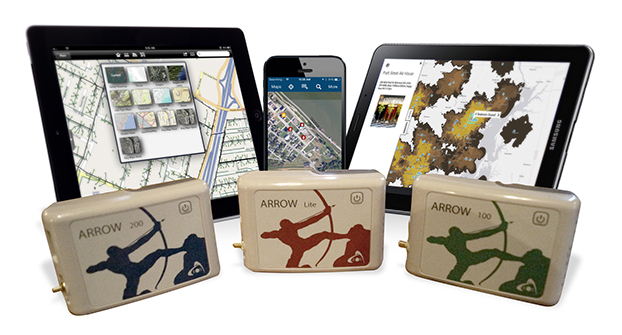
SST Software and Eos Positioning Systems have announced a technology partnership to deliver in-field mobility solutions to precision agricultural service providers. The offering is now available to Sirrus for iPad users.
The new pairing allows agronomists and service providers to have reliable geospatial tools when and where they need it, the companies said in a press release.
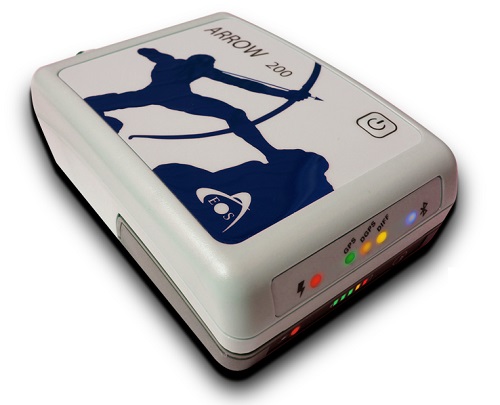
Eos Positioning’s Arrow 200 Bluetooth receiver.
Instead of relying on iOS location updates, Sirrus for iPad users can purchase one of Eos’ Arrow series GNSS products to stay connected anytime, anywhere. This connectivity coupled with real-time kinematic (RTK) or submeter receivers provides the location accuracy and quality needed when creating field boundaries and collecting data. Eos’ Arrow Series real-time positioning creates efficient workflow with universal Bluetooth and multi-frequency capabilities.
Sirrus for iPad users can connect to Eos Positioning devices by doing the following:
Tap the “Tools” at the bottom of the screen
Tap “Setup”
Tap “GPS Info,” then “GPS”
Tap the device to connect.
“We strive to deliver quality convenience and precise data through Sirrus for iPad,” Drew McMahon, SST Software product manager for Sirrus said. “The technology partnership with Eos Positioning Systems will offer the service reliability and real-time accuracy our users depend on while in the field. Sirrus for iPad users will have the capability to come within an inch of accuracy when creating a field boundary.”
“We are happy to team with SST Software in bringing high-precision GPS and GNSS receivers into their workflow,” said Jean-Yves Lauture, chief technology officer, Eos Positioning Systems. “The submeter and centimeter positioning from our Arrow receivers turns Sirrus for iPad into a powerful mapping tool on Apple devices.”
Based in Canada, Eos Positioning Systems specializes in the design and manufacture of high-accuracy GNSS for geographic information system (GIS) mapping and surveying. Eos’ Arrow Series products are waterproof, provide high-accuracy Bluetooth connectivity, advanced real-time accuracy, long battery life and compatibility with all mobile devices.
SST Software is a privately owned company headquartered in Stillwater, Oklahoma, with branch offices in Oklahoma City, Tulsa, Illinois, Iowa, Brazil and Australia.
Fugro has been awarded a supply arrangement by the Canadian Hydrographic Service (CHS) to provide vessel-based hydrographic survey services. Under the contract, CHS will procure hydrographic surveys as needed, anywhere in Canada, to enhance its capacity for data acquisition and processing in support of its nautical charting program.
Hydrographic survey data from ports, harbors, nearshore and offshore regions will be acquired and processed using Fugro’s vessels, equipment and personnel. The resulting data will be used by CHS to update its nautical charts.
The supply arrangement, together with a supply arrangement for airborne lidar bathymetry (ALB) awarded in 2013, will enable Fugro to support Canada in its plans to implement an integrated multi-platform methodology to hydrographic surveying anywhere in Canada, including the Arctic region.
Fugro provides International Hydrographic Organization (IHO) compliant survey services to numerous governments throughout the world.