Category: Applications

  • u-blox Launches u-blox 7 GPS, GLONASS and QZSS Modules

    u-blox, the Swiss positioning and wireless module and chip company, has announced its latest multi-GNSS receiver modules MAX-7, NEO-7 and LEA-7 in u-blox’s form factors. They support all satellite positioning systems in operation today: GPS, GLONASS, QZSS and SBAS. The modules target telematics applications such as asset and fleet management as well as portable tracking devices.

    “Each MAX-7, NEO-7 and LEA-7 variant delivers fast, accurate and reliable GLONASS and GPS positioning with the industry’s lowest power consumption.” said Daniel Ammann, executive VP of positioning product development at u-blox. “Both GPS AND GLONASS modes perform even better than combined GPS/GLONASS solutions available on the market today.”

    All u-blox 7 generation modules are pin-to-pin compatible with previous u-blox 6 and u-blox 5 families allowing easy upgrade from existing designs. Each module is available in cost-effective variants (such as MAX-7C; NEO-7M) as well as performance optimized variants (MAX-7Q, MAX-7W, NEO-7N, LEA-7N).

    u-blox 7 modules use GPS/GNSS chips qualified according to AEC-Q100 and are manufactured at ISO/TS 16949 certified sites. Each module is intensively inspected and tested during production. The modules are fully qualified according to ISO 16750 – “Environmental conditions and electrical testing for electrical and electronic equipment for road vehicles” to provide high durability and reliability.

    All modules comply with green/halogen free standards.

    First variants available will be NEO-7N (November 2012) and MAX-7C (December 2012).

  • LiveViewGPS Vehicle Tracker Supports Verizon CDMA Network

    LiveViewGPS, a GPS tracking company for business, government and individuals, is now shipping its VLS 300VZ GPS vehicle tracker that operates exclusively on Verizon’s CDMA wireless system. The hard-wired unit features a three-wire hookup and can be configured to update vehicle locations at 1-, 2- and 5-minute intervals.

    The VLS 300VZ GPS vehicle tracker is based on LiveViewGPS’ VLS platform, an Internet-based GPS tracking system for small businesses that need powerful monitoring at a lower price, the company said. It includes a fully-featured, real-time, on-demand GPS tracking system with no software and no contracts required.

    Users log on via their web browser or web-enabled mobile device. Once connected, the intuitive, user-friendly interface lets them locate multiple vehicles via a high-resolution satellite map. Users have the option of calling a special phone number instead of using a mobile device. The system automatically texts or emails alerts whenever it detects a vehicle speeding, entering restricted zones, deviating from routes and more. Automated detailed reports include starts/stops, excessive idling, mileage and speeding. State-to-state mileage reporting is also available.

    “The VLS 300VZ GPS vehicle tracker is a low-cost entry device for small fleets, company vehicles and personal vehicles in areas with poor GSM coverage,” said George Karonis, LiveViewGPS CEO, “and it’s even programmed to store and forward information whenever a vehicle loses CDMA coverage, so users never have to worry about data loss.”

  • Hemisphere GPS Offers Vector Compass Products for Marine Applications

    Photo: Hemisphere
    Photo: Hemisphere

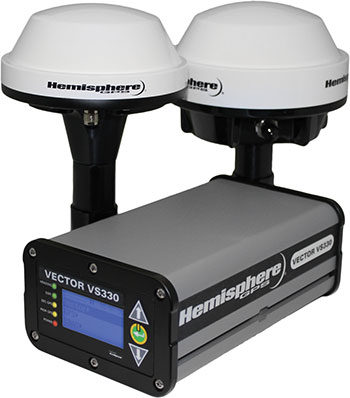
    Today, Hemisphere GPS introduces the Vector VS330 and Vector VS131 GPS compass products that provide high performance heading, position, heave, and attitude data. The new Vector products are designed for professional marine applications such as hydrographic and bathymetric surveys, dredging, oil platform positioning, and buoys that demand a high level of 3D positioning accuracies.

    Based on Hemisphere GPS’ Eclipse GNSS technology, Vector VS330 uses the most accurate differential corrections including RTK, L-band, SBAS, and beacon. The smart intelligence from our MFA firmware  provides differential solutions by automatically switching to the next best differential source if the original source is no longer available, Hemisphere GPS said.

    Vector VS330 is Hemisphere GPS’ flagship receiver and computes heading information with better than 0.01 degrees accuracy when using a 10-meter antenna separation. Positioning accuracy is better than one centimeter in RTK mode or four centimeters when using OmniSTAR HP corrections. Vector VS330 also provides five-centimeter RTK heave and 0.01 degree pitch and roll accuracies.

    Combining Hemisphere GPS’ Crescent Vector and LX-2 receivers with two separate antennas, the Vector VS131 computes heading information with better than 0.03 degrees accuracy when using a five-meter antenna separation and better than 50 centimeter position accuracy when using L-band, SBAS, or beacon corrections. Vector VS131 accepts most differential correction signals for unparalleled flexibility to obtain sub-meter positioning in all regions.

    The ruggedness of the new Vector enclosure also makes it suitable for more harsh environment installations like machine-control applications, including agriculture, heavy construction equipment, mining equipment, unmanned vehicles, cranes, and other machinery or industries that require very accurate heading and positioning solutions. The Vector’s versatility for providing heading, position, heave, and motion makes it directly compatible with the most popular hydrographic and side scan survey packages. Vector VS330 and VS131 include an intuitive and easy-to-follow user interface to facilitate fast installations.

    “Vector VS330 and Vector VS131 are premium additions to Hemisphere GPS’ Vector series product line,” said Phil Gabriel, vice president and general manager, Precision Products, for Hemisphere GPS. “As the demand for more rugged and precise GPS equipment increases, we are meeting this demand by exceeding the accuracy of competitors’ products while being significantly more affordable.”

    Vector VS330 and Vector VS131 will be featured by Hemisphere GPS in hall 9, stand B.62 at the INTERGEO Conference and Trade Fair in Hanover, Germany, from October 9-11. Both products will be available for shipping in November through the Hemisphere GPS Precision Products global dealer network.

  • Trimble Adds Two Handhelds to GIS Data Collection Portfolio

    Trimble introduced today the Trimble Geo 5 and Juno 5 handheld GNSS devices, further extending Trimble’s portfolio for data collection, maintenance and inspection applications. The Geo 5 and Juno 5 series are both optimized for GIS field workflows, including Trimble’s TerraSync field software available on all Trimble GIS platforms.

    Since 1994, the Trimble GeoExplorer line of GNSS handhelds has been used for professional GIS data-collection applications. While the GeoExplorer 6000 series is the most capable Trimble handheld for GIS data collection, not all customers require the larger screen and innovative Floodlight technology of the 6000 series. The Geo 5 provides the essential functions for all day, submeter productivity in a smaller package, Trimble said.

    The Trimble Juno product line is used worldwide for maintenance, inspections and asset management applications. With the addition of the Juno 5 series, Trimble is providing a rugged handheld that delivers the capabilities and convenience of a smartphone, Trimble said. The Juno 5’s slim, ergonomic design is thinner and lighter than other rugged computing products in its class today and provides a more advanced feature set than the Juno 3 series.

    “Whether users are engaged in initial data-collection tasks or inspection of assets, it is critical they have a complete solution they trust,” said Daniel Wallace, general manager of Trimble’s GIS Data Collection Division. “Now with two platforms in both the Geo and Juno families, customers can confidently choose a handheld that best fits their needs. Trimble TerraSync software is the unifying workflow that brings these choices together, so customers can always trust the quality of their data throughout the complete lifecycle of a field management project.”

    Complete with wireless communications options, integrated cameras and bright, sunlight-readable screens, both devices are built for work in the field and rugged enough to withstand shock, vibration, water and dust.

  • Rand McNally GPS for RVers Includes Weather, Rear-View Camera Capability

    Photo: Randy McNally GPS
    Photo: Randy McNally GPS

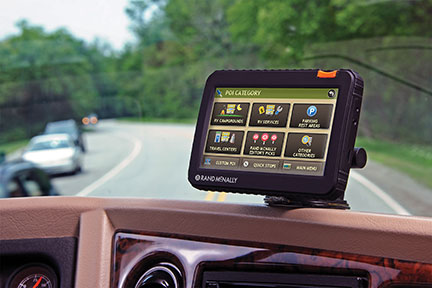
    Rand McNally today introduced the RVND 7720, a 7-inch RV GPS device with Wi-Fi connectivity allowing for real-time weather information and display, and new hardware with rugged casing, video input, and brighter screen.

    The new device — shipping now to stores, online retailers, and RV dealers and distributors — joins Rand McNally’s line of RVND GPS devices for RVers. Rand McNally pioneered RV-specific navigation by launching the first GPS device designed specifically for RVers and campers, the company said.

    RV-specific navigation is necessary to route large vehicles and towables around road restrictions, low bridges and other physical hazards. However, like all Rand McNally RV GPS devices, the RVND 7720 can be used as a car GPS by changing a simple setting.

    One of the key new features of the RVND 7720 is Wi-Fi connectivity, which enables the transmission and display of weather as well as other real-time information. With updated weather information, RVers will be able to anticipate delays and make plans by viewing current and predicted conditions displayed on the map and along the route, the company said. Besides weather, other RV-specific connected services will be coming soon for this device.

    The RVND 7720 has a new hardware platform as well, with a rugged design with ridged casing for added protection, a brighter screen that adjusts for low and strong light, and video input compatible with a range of back-up and rear-view cameras, Rand McNally said.

    The base maps and overlaying content, such as campgrounds, parks, RV service and other RV points of interest, also have been updated for the RVND 7720.

    The new device ships with Lifetime Maps, so owners will be able to update their devices at no additional cost.

    The RVND 7720 GPS includes the following additional new features:

    • Fully updated road data, including RV-specific information such as speed limits, legal and physical restrictions, and all Rand McNally proprietary RV data
    • Fully updated points of interest necessary for safe and convenient routing, including travel centers and RV parking information at rest stops, exits, and other locations
    • Fuel logs, which are accessible from the Virtual Dashboard or via RV Tools; the feature enables drivers to record fuel purchases for a trip
    • Additional routing options such as “Avoid State or Province” and “Avoid Smaller Roads”
    • Address book icon enhancement, which enables unique icons to be created by group and shown on the map for imported locations; address book items can be sorted by name, distance from current location or date added
    • Text-to-speech alert details for user-imported custom points of interest, such as red light cameras, to reduce driver distraction

    The RVND 7720 also has these features: Virtual Dashboard; junction view with lane assist; free downloads of Rand McNally’s proprietary construction information and software updates; Exits Quick View, which shows RV parking and amenities at exits; RV Tools, RV amenities and locations such as campgrounds, RV services, and dumps; Woodall’s Campground information with searchable amenities; Rand McNally exclusive pre-planned trips with photos and video; and routing for 11 types of RVs as well as for cars.

  • Hemisphere GPS Announces RTK Network-Compatible S320 Survey System


    Today, Hemisphere GPS announced the new S320 network rover and XF2 handheld data collector. With support for network RTK corrections, the S320 network rover is an integrated solution that simplifies land surveying applications by eliminating the need for a base station and radio modem, the company said.

    A variety of public and private organizations post RTK network corrections on the Internet. The S320 GSM cellular communication connects users to Internet-based corrections and processes the data to achieve centimeter-level positioning performance. As a result, users do not need to purchase and operate their own RTK base station and radio modem connection. Users also have the option of using satellite-based L-band corrections for high-precision mapping jobs.

    Hemisphere GPS’ XF2 next-generation data collector combined with Carlson SurvCE software provides a familiar and proven interface to the S320. The two products communicate through a Bluetooth wireless connection and attach to a standard survey pole making the system portable and simple to operate, Hemisphere GPS said.

    “Hemisphere GPS’ S320 network rover and new XF2 provide a very powerful and cost-effective surveying and mapping solution,” says Phil Gabriel, vice president and general manager of Precision Products for Hemisphere GPS. “The rugged design and versatile performance of our S320 makes it a great fit for a variety of applications.”

    Launched one year ago, S320 combines the advanced GNSS receiver performance of Hemisphere GPS’ Eclipse technology, precise geodetic antenna, wireless communication and batteries in a portable, rugged unit. Compatible with a variety of existing surveying equipment, S320 is a  multi-GNSS positioning system designed for applications in GIS, mining, construction, mapping, land, and marine surveying.

    The S320 network rover and XF2 will be featured by Hemisphere GPS in hall 9, stand B62 at the INTERGEO Conference and Trade Fair in Hanover, Germany from October 9-11. The products are available through the Hemisphere GPS Precision Products global dealer network.

  • 3D Smartphone Navigation Using Geocoded Images

    3D Smartphone Navigation Using Geocoded Images

    Cover: GPS World
    Cover: GPS World

    By Ruizhi Chen, Yiwu Wang, Ling Pei, Yuwei Chen, and Kirsi Virrantaus.

    A simple and flexible smartphone-based 3D navigation solution uses geocoded images that require neither 3D modeling nor real-time rendering of 3D scenes, making it energy-efficient and cost-effective. Real-world images can be also replaced with screen snapshots of the 3D scenes rendered from existing 3D models. Field tests demonstrate energy efficiency, consuming roughly half the power of a model-based solution with real-time rendering of 3D scenes.

    Download PDF here.

    Published: October 2012 GPS World

  • Letter to the Editor: Using One Part of GPS, Ignoring Another

    The article “Drone Hack” in the August issue of GPS World and Todd Humphreys’ testimony before a House Subcommittee overseeing the Department of Homeland Security cited results of a spoofing experiment Humphreys conducted with University of Texas colleagues, demonstrating that a drone helicopter, navigating principally on the civil GPS signal, could have its vertical channel spoofed, causing it to descend. Reaction, quite strong from some directions, prompted one observer to investigate whether a “sky-is-falling” perception is fully warranted. Partly for that reason, emails started circulating among various individuals, including some directly involved in the design. When first brought into the group I was not expecting to be the one to summarize, but, as events unfolded, I’m called on to act as techno-sleuth.

    Let me first state the conclusion: the sky is not falling. That’s not intended to discourage corrective measures — and it is immediately acknowledged that definitive answers remain unresolved (detailed configuration of the Kalman filter, state estimates, weighting of the baro altimeter). But this much is clear: conditions weren’t 100 percent normal. From here I’ll cover the supporting facts, followed by possible corrective measures. Discussion will be technical, without any hint of administrative authority or approval.

    Key revelations came to light in discussion with the chief scientist of Adaptive Flight, who designed the drone’s nav system software and operator interface.

    “The reason Todd and his team were able to modify the vertical position of the aircraft even though altitude aiding is actually coming from the pressure sensor,” he stated, “is that the GPS vertical velocity was being used. The spoofed GPS position (altitude error) was actually being ignored.”

    We might call that a hybrid mode, using one part of GPS and ignoring another. Selectivity isn’t intrinsically unwise — we need options to reject some data without automatically rejecting other information — but, with GPS-derived altitude ignored for any reason, why not reject all vertical-channel influence from GPS? In fact that’s consistent with normal operation; disabling (again a quote) “GPS vertical velocity as an aid … can be done with a command from the control station (and saved as default for the aircraft).”

    Well, then, the demo doesn’t reflect 100 percent normal procedure. Relief: our drones aren’t as vulnerable as we thought, and the fear expressed in various publications can be reduced.

    For further support of that conclusion, additional major information from that same designer includes a quote that “The baro altimeter is used to provide a vertical position discrete update to the Kalman filter. This is true for both normal and GPS-denied modes. There are no (automatic) divergence tests in this system. There is some outlier detection/rejection on the GPS (which probably was not triggered in the spoofing tests, but I haven’t seen the data). There is nothing on the baro altimeter.” Finally, he says “it is a trivial change from the control station to make the vertical channel ignore GPS in normal mode by turning off the down GPS velocity measurement update; it would still fly fine.”

    The combined weight of all that can justifiably reduce the level of concern — but not all the way down to zero. Now that all this happened, the subject of prevention needs to be addressed.

    As Todd Humphreys correctly noted, without spoofing but with existing errors, GPS position updating cannot adequately mitigate low-cost IMU drift.

    High-end IMUs bring budget issues (and their motion-sensitive errors limit performance anyway). Spectrum and signal quality is seen by many as an important consideration; residual monitoring is another. For the latter to be effective, the existing (loose) coupling needs upgrading (loose coupling wastes information content; the loss is greatest when GPS coverage is marginal). Extent of refinement (tight/ultratight/deep) and usage of carrier phase (while sidestepping its usual traps) open up a subject with much wider scope: cross-checking. I offer just a few fundamentals here.

    • Known data-edit capabilities available with existing provisions (for example, baro altimeter cross-checking), rather than something that “can be done” can always automatically disallow any partial influence from GPS instantly upon spoof detection, regardless of its genesis (Kalman filter bias state traceable to past history or any other source).
    • The step just noted generalizes to include all sensor data extant onboard, including carrier phase. The specter of huge expense for this particular step is nonessential; some receivers output raw measurements that can be put into public domain algorithms.
    • With access to all the raw data, every solution combination — federated and integrated — can be generated for cross-checking. In all cases, thresholds for residual testing are set with conservative assessments of sensor error statistics; this overbounding enables integrity testing to err on the side of caution (sacrificing some valid data to better ensure rejection of bad). Integrity test algorithms are likewise public domain.

    I close by paraphrasing an observation offered by Mitch Narins in a LinkedIn discussion: Deter threats before they happen. With a robust non-GNSS PNT alternative, spoofing will have no affect on safety or security.

     — James L. Farrell
    President, VIGIL, Inc.
    Severna Park, Maryland
  • Apple CEO Apologizes for Faulty Maps App

    After the September 12 launch of the Apple iPhone 5, which comes equipped with Apple’s own Maps application, users soon found their efforts to navigate thwarted by mislabeled cities, misplaced landmarks, lack of’ transit directions, and strange satellite imagery.

    Today, Apple Inc. Chief Executive Tim Cook apologized to customers for the flaws in the Maps app in a letter posted on Apple’s website. The Maps app replaced Google Maps as the standard iPhone mapping application, but Cook is now suggesting customers use the online Google Maps or download other mapping applications while Apple works to fix its application. Google Maps was standard on previous versions of the iPhone. Apple’s newest mobile operating system, iOS 6 doesn’t support Google Maps, so users would have to use that application through the Internet.

    Here is the text of Cook’s letter:

    To our customers,

    At Apple, we strive to make world-class products that deliver the best experience possible to our customers. With the launch of our new Maps last week, we fell short on this commitment. We are extremely sorry for the frustration this has caused our customers and we are doing everything we can to make Maps better.

    We launched Maps initially with the first version of iOS. As time progressed, we wanted to provide our customers with even better Maps including features such as turn-by-turn directions, voice integration, Flyover and vector-based maps. In order to do this, we had to create a new version of Maps from the ground up.

    There are already more than 100 million iOS devices using the new Apple Maps, with more and more joining us every day. In just over a week, iOS users with the new Maps have already searched for nearly half a billion locations. The more our customers use our Maps the better it will get and we greatly appreciate all of the feedback we have received from you.

    While we’re improving Maps, you can try alternatives by downloading map apps from the App Store like Bing, MapQuest and Waze, or use Google or Nokia maps by going to their websites and creating an icon on your home screen to their web app.

    Everything we do at Apple is aimed at making our products the best in the world. We know that you expect that from us, and we will keep working non-stop until Maps lives up to the same incredibly high standard.

    Tim Cook
    Apple’s CEO

  • ‘We Will Find You’ with GPS, Nestlé Tells Candy Bar Customers


    Open a Nestlé candy bar in the United Kingdom — one of six with a GPS tracking device — and you could win a big cash prize. The candy company’s latest marketing campaign involves putting GPS trackers on half-a-dozen bars such as Kit Kat, Aero, and Yorkie.

    A 30-second commercial video shows, in Bond-like fashion, how the bar will activate when opened, with instant response by a “crack team” that will arrive via helicopter to award the lucky customer £10,000.

    The marketing campaign, developed by creative agency JWT London, is part of a promotion involving ads on TV and radio, as well as online, costing Nestlé £4 million ($6.5 million).

    Check out the commercial here:

  • Topcon’s MG-A8 Antenna Designed for Accurate Maritime Applications

    Topcon Positioning Systems announces the MG-A8 antenna for navigation and precise positioning in marine applications. According to Topcon, the new MG-A8 marine antenna provides exemplary GNSS signal tracking while not being susceptible to signal jamming from other sources, such as Inmarsat communications.

    The MG-A8 antenna can be used in DGPS mode for meter-level navigation purposes but can also be used for RTK centimeter level positioning in areas where there is a network of reference stations available to support this level of precision. With its RTK capabilities, the MG-A8 is a “preferred solution for applications such as dredging in inland river channels and waterways,” said Tom Morris, TPS senior product development manager.

    “This antenna is designed with challenging marine applications in mind.  It is accurate, rugged, reliable and affordable.”

  • Trimble Introduces Compact Receiver for Mobile Positioning Applications


    Trimble has introduced at the ION GNSS Conference in Nashville the Trimble BD920-W3G receiver and communication module. As part of Trimble’s GNSS OEM portfolio, the new compact module features centimeter-level, real-time kinematic (RTK) positioning capabilities coupled with Wi-Fi, Bluetooth and cellular that deliver flexible communication options for precise, mobile positioning. The BD920-W3G module’s connectivity and configuration ease allow system integrators and OEMs to easily add GNSS centimeter-level positioning to specialized or custom hardware solutions, Trimble said.

    “The OEM and system integrator communities demand high performance, reliability and support for their positioning solutions,” said Dale Hermann, director of marketing and sales. “The Trimble BD920-W3G delivers the latest in GNSS and communication technology in an easy-to-integrate form factor for demanding conditions and applications such as field computing, port automation, and lightweight robotic or unmanned vehicles.”

    The Trimble BD920-W3G module has been designed for applications requiring centimeter accuracy in a compact package. By integrating wireless communications on the same module, the task of receiving and transmitting data such as RTK corrections is greatly simplified. A single intuitive Web interface allows a variety of use cases to be supported. In addition to GNSS base and rover setups with Wi-Fi or UMTS modem, the module also allows simultaneous customer access to the Internet.

    The dual-frequency GPS/GLONASS BD920-W3G provides customers with a more integrated product that can reduce their integration effort and time to market. Wireless communications and Ethernet connectivity are available on the module to allow high-speed data transfer and configuration via standard Web browsers. USB and RS232 are also supported. By tightly integrating communications and GNSS receiver, integrators can reduce costs and integration complexity, the company said.

    The Trimble BD920-W3G is expected to be available in the first quarter of 2013 through Trimble’s Precision GNSS + Inertial sales channel worldwide. The BD920-W3G can be viewed in 3D on Trimble’s 3D Warehouse by SketchUp. OEMs and integrators can also download a 3D model into their applications. For more information, visit www.trimble.com/gnss-inertial.