On October 21, Jordan will host a Euro-Mediterranean Partnership (EUROMED) regional event focused on the use of GNSS, particularly European GNSS, for freight and road transport. The Euromed GNSS II/MEDUSA meeting will be held in Amman, Jordan, at the Sheraton Al Nabil Hotel.
Organized by the Euromed GNSS II/MEDUSA project, under the auspices of the Ministry of Transport of Jordan, the event will aim to share experiences and best practices, and to discuss strategies and possible ways forward in relation to the use of the satellite navigation for freight and road transport in the region.
At the event, MEDUSA will present the results of its case study, which was conducted with Royal Jordanian Customs and with the aid of the Ministry of Transport of Jordan. Since April, supported by European companies involved in MEDUSA, Royal Jordanian Customs have had the opportunity to test and validate the use of European GNSS, and specifically of EGNOS, for tracking and tracing containers shipped across the Mediterranean Sea and vehicles transporting goods in Jordan.
The case study is one of the technical assistance actions implemented by MEDUSA, and it represents the first life experience of EGNOS services’ usage in areas distant from Europe.
MEDUSA belongs to the EU Euromed Transport Program. Its objective is to promote the adoption of the European GNSS by the Euromed countries, which include Algeria, Egypt, Israel, Jordan, Lebanon, Libya, Morocco, Palestine, Syria (suspended due to political unrest), and Tunisia.
GNSS technology is applied to several user applications, and transport is one of the most important, including aviation, road, maritime, rail, freight transport and logistics. The MEDUSA project includes a program of specific technical assistance actions for the Euromed countries, to facilitate the introduction and exploitation of GNSS services in their markets.
The wide adoption of advanced technology, also including satellite navigation, for freight and road transport applications (such as Intelligent Transport Systems, or ITS) enables the implementation of smart mobility and the enhancement of goods transportation/traffic volumes increasing.
During the event, the participants from the Euromed countries will share lessons learned from the Jordan case study, and learn about relevant best practices in Europe and in the Euromed region, as well as debate strategies and possible ways forward in the light of national interests and common regional perspectives.
Opened by an institutional panel, with representatives of the Jordan Ministry of Transport and the European Commission, the event will consist of a session dedicated to the case study and a session addressing opportunities in other Euromed countries, including the presentation of European success cases as examples of suitable paths to guide the GNSS operational introduction and adoption.
At the conclusion of the event, the participants will elaborate guidelines and recommendations, to be possibly translated into action plans for the Euromed countries.
In the presence of the European Commission, the European GNSS Agency (GSA) and EuroControl have signed a new cooperation agreement to jointly contribute to the implementation of European Union GNSS policies as they apply to the field of aviation.
As Europe’s skies and major airports become increasingly congested, there is need for Air Traffic Management (ATM) technologies to evolve from ground-based infrastructures to more advanced systems based on new technologies. EuroControl and the GSA have a shared objective in developing and exploiting European GNSS technology to improve accessibility, efficiency and safety to European operators, pilots and airports.
To accomplish this objective, the agreement focuses on a range of activities, including:
Definition of aviation user requirements for EGNOS and Galileo
Introduction of European GNSS services for aviation within the European Civil Aviation Conference (ECAC) area
Coordination in aviation research and development
Aviation-specific GNSS performance monitoring
Promotion of European GNSS aviation activities at the international level
“This is another example of European Commission support of the aviation sector,” said Daniel Calleja Crespo, director general of DG Enterprise and Industry at the European Commission. “I am confident that a strong cooperation between the GSA and EuroControl will benefit aviation, the European GNSS Programs and indeed European citizens.”
“The full deployment of GNSS offers unprecedented opportunities to further improve air traffic management safety and capacity, while reducing costs at pan-European level,” said GSA Executive Director Carlo des Dorides. “EuroControl’s activities in this field will complement those of the GSA to ensure that the development and implementation of satellite-based navigation provides an optimal solution for European airspace users.”
“EuroControl and the GSA share a common objective — the secure and safe implementation of European satellite navigation policies in the aviation sector. The enhanced cooperation between our two organizations means that EuroControl will now bring its unequaled capacity to understand, coordinate and represent the needs of the civil and military airspace users to the promotion and development of GNSS,” said Frank Brenner, director general of EuroControl.
EGNOS is Europe’s first venture into satellite navigation and has been providing a certified safety service for aviation users since 2010. EGNOS is owned by the European Union and, since January 1, 2014, the GSA is responsible for its exploitation, ensuring service provision, operations, maintenance and evolution.
When comedian Larry Wilmore started out Day 2 at CTIA Super Mobility Week by reporting from a connected car on the show floor, he was only half joking when he said, “It’s almost like you’re driving in a smart phone, and with smart phones getting bigger it’s not too far off. I think I saw an HTC this size.”
The experts in the keynote Connected Car panel agreed: The car is the new smart phone.
Just ask Ralph de la Vega, CEO of the just-formed AT&T Mobile and Business Solutions Group, who called the Chevy Corvette “the best smart phone I’ve ever gotten to test.” The Corvette was conveniently displayed next to the stage, along with a connected Tesla Model S.
As CTIA CEO Meredith Atwell Baker pointed out, what was once relegated to the CTIA show floor is now in dealerships all across the U.S. The statistics thrown out by de la Vega supported this observation. Thirty-two percent of new cars sold globally (and 60% of new cars sold in the U.S.) by 2017 will be embedded with cellular technology. Seventy-two percent of people would delay a new car purchase one year to buy a connected car by their preferred automaker.
De la Vega co-moderated the panel with Glenn Lurie, his successor as CEO of AT&T Mobility. Panelists representing General Motors/OnStar, Ericsson, VoiceBox and Tesla overwhelmingly agreed that the emphasis on the connected car going forward has to be safety.
“[Drivers are] trying to fill the time and be productive. People naturally want to do that. They’re going to bring the phone in, reach over, grab it and try to do things. And the more capabilities, the more they’ll do it,” said Mike Kennewick, co-founder & CEO of VoiceBox, maker of natural language technology. “It’s imperative as we bring the Internet into the car, there’s a component that allows you to do it safely.”
What that would mean, exactly, though, was a matter of opinion. Each panelist had a chance to discuss their company’s recent and coming advancements.
De la Vega says AT&T’s studies show people prefer a shared family data plan that would allos them to share data across people and across devices, and a belief by the wireless provider that customers should be able to add their cars to their rate plans.
GM has successfully integrated 4G/LTE into 33 different models in the U.S. and Canada and next plans expansion in Europe, Mary Chan, President of Global Connected Consumer at GM shared.
VoiceBox’s Kennewick calls the voice recognition in cars today “just like the movies” but says VoiceBox strives to simplify the apps in cars and make voice activation less about reiterative command-and-control.
Telsa, a leader in over-the-air auto updates, will be launching a mass market car “in a few years” and is now exploring how best to keep the customer experience focused in the car. Tesla CIO Jay Vijayan also said the company is considering opening up its infotainment stystem to other partners.
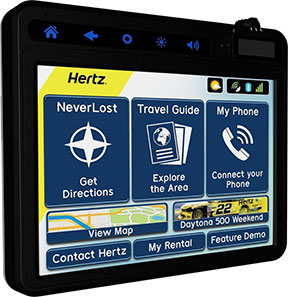
The award-winning in-vehicle system now offers more customization capabilities for travelers along with new navigation tools for convenience and personalization when planning trips. The new system syncs directly with the recently launched Hertz NeverLost Companion app, giving travelers access to more than 10 million U.S. destinations on their mobile devices to plan trips at their leisure, then instantly begin navigation in their Hertz rental.
“Our innovation goes beyond a typical navigation device, offering hands-free calls and instant Bluetooth connection, personal and customizable rental information, exploratory travel guides, weather, flight information, and even access to a concierge to provide the traveler with an enhanced rental experience,” said Mark P. Frissora, Hertz chairman and CEO. “With the latest Hertz NeverLost, customers can experience a new way of trip planning and navigation with a one-of-a-kind travel tool that allows them to see more, do more and discover more.”
Hertz NeverLost is available to rent along with a Hertz vehicle and offers groundbreaking features for rental GPS systems within the car rental industry, including:
Hands-Free Calls – For ease and safety on the road, pair with a smartphone to make and receive calls and access contacts. Phone numbers for points of interest within the device can also be dialed.
Travel Guide – Explore the city and discover local events. Quickly search through thousands of points of interest and get even more out of the trip with accompanying audio, images and descriptions.
Weather, Flights & More – Discover special events and local attractions and get access to weather and flight information.
NeverLost Concierge – Live concierge operators are available to help search for destinations, build custom trips and send route information directly to the NeverLost system.
Companion App – Stay connected with the NeverLost Companion app to sync favorites, explore the area and search for destinations from any location.
My Favorites – Enter download codes or use the USB flash drive to access trips built on NeverLost.com, the Companion app, or excursions built by the NeverLost Concierge team.
Contact Hertz – The device is programmed with all necessary Hertz phone numbers. And with hands-free calling, Hertz can be contacted with a paired smartphone with the press of a button.
Rental Record Info – View current rental record information on the device.
“We’re thrilled to be rolling out the newest version of Hertz NeverLost across the U.S. to offer travelers a sophisticated, yet easy-to-use navigation tool when renting with Hertz,” said Rob Moore, Hertz Chief Technology Officer. “With the instantaneous connection to our new Companion app, the NeverLost system has become a first-of-its-kind within the travel industry, shaping the wave of the future for navigation technology.”
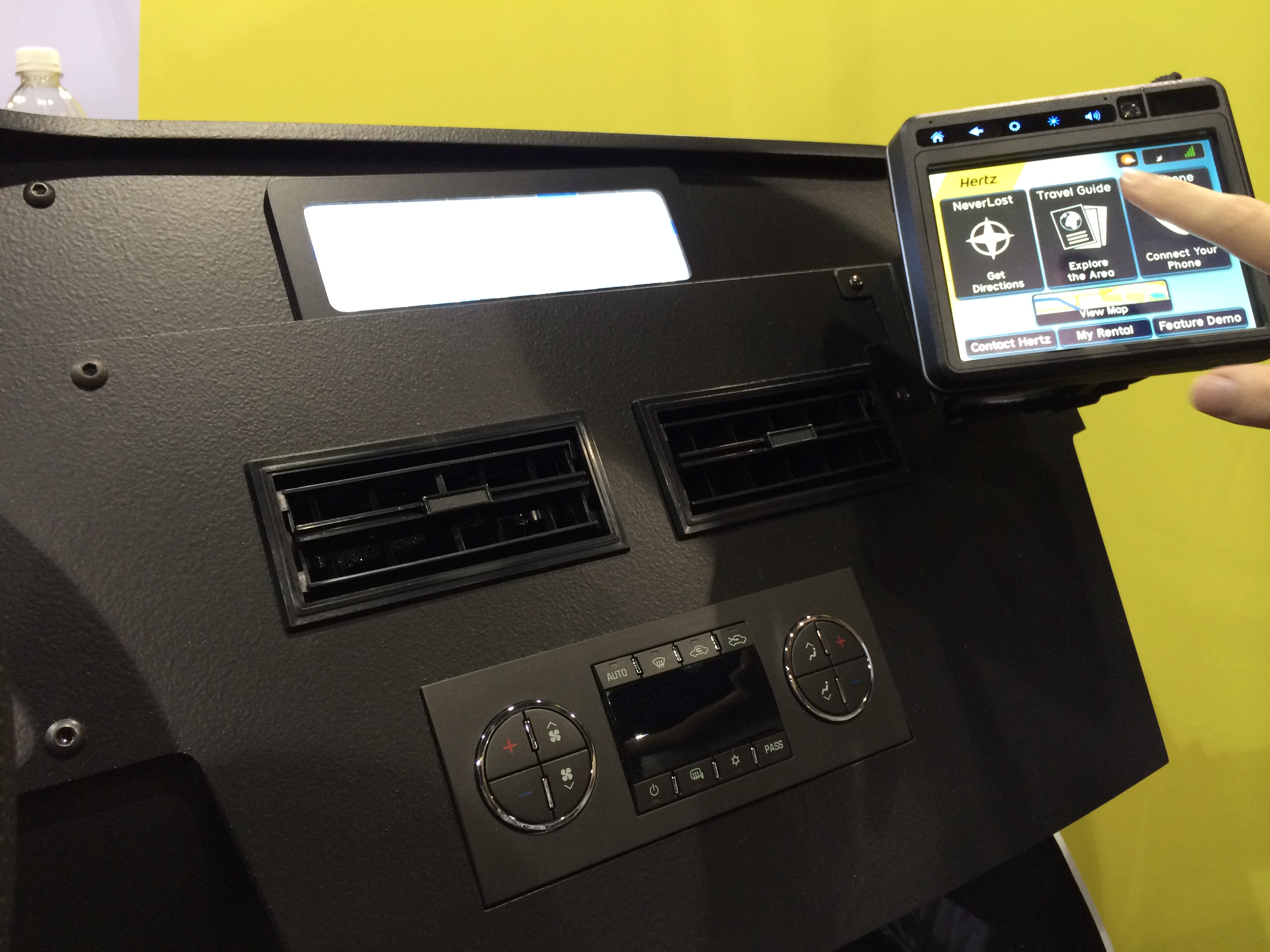
Hertz NeverLost GPS navigation system, demonstrated at CTIA Super Mobility Week, now incorporates Bluetooth connection, hands-free calls, travel guides, weather, flight information and more.
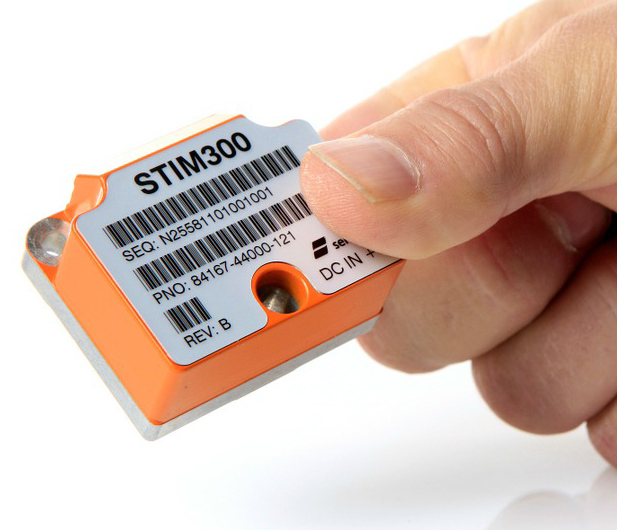
The STIM300 is a small, tactical-grade, low-weight, high-performance non-GPS aided IMU. It contains three highly accurate MEMS gyros, three high-stability accelerometers and three inclinometers. The IMU is factory calibrated and compensated over its temperature operating range.
The STIM series is designed for use below and on the ocean, on land, in the air, and in orbit and space. The STIM300 IMU is well suited for stabilization, guidance and navigation applications in the industrial, aerospace and defense markets. It is a crucial building block for inertial navigation systems in UAVs, AUVs, AGVs, UGVs and ROVs, Sensonor said.
The STIM300 is also used for camera turret stabilization and for use in various handheld devices that require a small IMU to secure operations during GPS outage.
Telematics Update has announced the agenda and speaker line-up for Connected Fleets USA 2014, formerly known as Telematics for Fleet Management USA. The conference and exhibition will take place November 20-21 in Atlanta, Georgia. The early registration discount ends September 26.
As growth is seen in goods movement and driver shortages, integration of the connected fleet in the supply chain, service bays, and transport infrastructure is crucial to maintain growth in the U.S. and abroad. Experts anticipate that there will be more investment, mergers and acquisitions, and consolidation in a rush to deliver the best-in-class solution to drive fleet optimization.
The speakers just announced to take the stage at Connected Fleets USA will be reflecting this change. They include some of the largest fleet rental/leaser, OEMs and companies from across the value chain such as Donlen, Hertz Equipment Rental, ARI, Ryder, Daimler, John Deere, Microsoft, Los Angeles County Metropolitan Transportation Authority and up-and-coming start-ups like Peloton Technology and Metro Tech, Inc.
Connected Fleets USA 2014 will look into ways to capitalize on the integration of solutions in the supply and create solid partnership models that will increase profitability and drive the connected fleets in the mature North American market
“It will be critical that companies evaluate the opportunity present from the integration of connected fleets into the wider enterprise and embrace key breakthroughs in the wider connected ecosystem to create an indispensable connected vehicle service package to add value to fleet operators and carriers,” Daniel Pavey, Connected Fleets USA 2014 project director, said.
Topics and Trends
The trends and topics to be discussed include:
Connectivity is the future of transportation. Explore case studies and the roadmap for autonomous vehicles and V2V/V2I technology that can be leveraged to improve transport infrastructure, mobility, goods movement and traditional fleet manager needs.
Enterprise and telematics converge. Integrate vehicle and telematics data to the wider connected ecosystem, including enterprise resource planning, work order management and maintenance bays to map opportunities where connectivity can ease bottlenecks in the supply chain.
Complete the leasing puzzle. Overcome the complexities of fleet leasing by integrating back-end analytics from embedded and aftermarket solutions for a seamless approach for improved driver performance and vehicle life-cycle to engage government, small local and large long-haul fleets.
The law of connectivity. Review current and potential proposals for data logging and vehicle-to-vehicle communication to assess legal opportunities and challenges for automated and connected vehicle technologies including liability, litigation and privacy to anticipate potential roadblocks.
The investment drive. Investigate the motivation and strategies of private equity, industry players, and government investment, including improving congestion and road safety, widening portfolios and entering new markets to position solutions for investment.
Smarter services through data sharing and analytics. Crack open the OEM platform to create a sandbox of data that combine vehicle, driver and environmental data to offer a more precise service portfolio.
Other sessions will be held on topics such as integration with the advanced connected transport project; commercial data ecosystem, platform and partnerships; and exclusive case studies and panel discussions from Donlen, Hertz Equipment Rental, ARI, Daimler, John Deere and Volvo.
For the complete Connected Fleets USA 2014 conference program and speaker line-up, visit the conference website.
Newly Announced Speaker Line-up
The connected fleet specialists set to speak this year include:
Nick Ehrhart, Vice President Business Development, Donlen
Mike Dennis, Group Director Maintenance Operation, Ryder Systems, Inc.
and many other specialists from across the value chain. The full speaker line-up is available on the website.
For the complete Connected Fleets USA 2014 conference program and speaker line-up, access the e-brochure or contact the Telematics Update team at [email protected]. Register before September 26 to take advantage of a $300 saving on all conference passes.
The most interesting thing in mobile and location in 2014 is the connected vehicle. Back in the early 1990s, a bigger vision of smarter highways began to be explored. The technology was refined, and resulted in successful demos of cars talking to each other and to roadside infrastructure like traffic lights. If you lived in Southern California, you might remember seeing platoons of automated vehicles zipping along a closed section of Route 15.
Since those heady days, the timing and visioning for smart highways and vehicles were tempered by the massive cost of the infrastructure required. Now we are seeing the “connected vehicle” starting to roll out of the doors of dealerships, but with a different and more limited type of connectivity than we started to envision in the 1990s.
Reminiscent of the mission started decades ago, a new year-long “smart car” project and demo will be held in Ann Arbor, Michigan. The objective of the smart car project is to determine whether wireless communication between vehicles can improve safety Three thousand cars, buses and trucks will utilize data recorders and a technology similar to Wi-Fi that can transmit information about accidents or hazardous traffic conditions.
Drivers participating in the demo will be warned of sudden changes in traffic patterns or potential collisions through data transmitted from similarly equipped cars and roadside devices. Eight major automakers will provide vehicles and engineering assistance to the study.
Currently, some new car models are equipped with active safety devices that can alert drivers if they are drifting out of a traffic lane or traveling too close to another car. But the smart car demo differs because will share safety information with other smart cars on the road.
The smart car system can give drivers visual or audio warnings about sudden traffic changes experienced by another connected vehicle. Several cameras installed in the connected vehicles will also capture data on how the drivers respond to accidents and sudden changes in traffic conditions.
Today’s connected vehicle is sometimes referred to as a smartphone on wheels, a limited vision of what can be. Now is the time to determine if the savings of fewer accidents or increased capacity on our roads will outweigh the cost of new infrastructure and added functionality in vehicles.
The European GNSS Agency (GSA) has launched a call for proposals to foster further EGNOS adoption in the European civil aviation sector. The grant aims to support projects that enable users to equip and use their aircraft or rotorcraft fleet with GPS/SBAS-enabled avionics and allow Air Navigation Service Providers and aerodromes/heliports to implement EGNOS-based operations in Europe.
The purpose of the call is to co-fund projects capable of fostering EGNOS operational implementation for regional, business and general aviation and rotorcraft. In addition, commercial operators and original equipment manufacturers (OEMs) interested in benefiting from EGNOS may also apply.
Specifically, the call aims to:
Foster the design, development and operational implementation of EGNOS-based operations, including approach procedures at different European aerodromes and EGNOS based routes.
Develop and install GPS/EGNOS enabled avionics and granting of airworthiness certification for RNP APCH procedures down to LPV minima, including the development of Supplemental Type Certificates (STC) or Service Bulletins (SB).
Approve Air Operator Certificates for LPV operations of aircraft already equipped with SBAS capabilities.
Develop enablers to accelerate EGNOS adoption and preparation for its future capabilities, such as LPV 200.
The deadline for submitting applications is 16:00 CET, October 31.
Applications will be assessed in terms of relevance of the proposal and credibility of the proposed approach, economic and societal impact, and coherence and effectiveness of the work plan.
The total budget of the call is EUR 6,000,000 and maximum EU financing of eligible direct costs is 60 percent. In addition, a flat-rate amount of 7% of the total eligible direct costs of the action is eligible under indirect costs.
Awarding of the grants will happen in December 2014, with each grant agreement having an estimated duration of two years.
Omnitracs, LLC, a provider of fleet management solutions to transportation and logistics companies, is making available Omnitracs Tracking powered by Roadnet, a mobile workforce tracking application for smart devices. Omnitracs Tracking offers basic capabilities to help companies track the locations of their mobile workers throughout the day and get additional performance data to help make them safer and more productive, the company said.
“Every transportation company with a mobile workforce wants to know the location and key behaviors of their drivers,” said Dan Speicher, chief technology officer at Omnitracs. “Omnitracs Tracking powered by Roadnet enables companies that have not adopted a fully featured mobile fleet management solution to utilize their existing smart devices in order to track locations of mobile workers, improving safety, productivity and customer satisfaction.”
Benefits of Omnitracs Tracking include:
Location Tracking. By leveraging existing smart device GPS positioning technology, location tracking pinpoints drivers’ locations in real-time using satellite and street maps. Fleet managers access this information through a web-based application, enabling them to provide customers with timely updates on the status of their delivery or service call.
Speed Tracking. The application monitors drivers’ speed throughout the day, allowing fleet managers to take prompt action to help preempt potential safety issues.
Exception Reporting. Users can predefine thresholds for maximum speed allowed, GPS gap, over road speed and stationary position time limits. Exception reporting helps to quickly identify driver behaviors that may lead to unsafe driving and reduced productivity.
“Omnitracs is committed to leveraging the expertise and capabilities of our business units to continuously bring value to our customers. Our newest basic tracking application will give companies the tools they need to better manage their mobile workforce and take fast, appropriate action to improve safety and productivity,” added Speicher.
Omnitracs Tracking is available exclusively through Roadnet and Omnitracs’ resellers. For more information about the application, visit.
The U.S. Department of Transportation is holding a “GPS Adjacent Band Compatibility Assessment Workshop” on September 18, 10 a.m.–5 p.m. Eastern Daylight Time. Registration for the workshop is required, and closes September 4. The general public can either attend in person or via WebEx.
The workshop is being held to discuss implementation of a GPS Adjacent Band Compatibility Assessment. Discussion will focus on the various implementation steps of the assessment, including development of GPS receiver use cases, identification of representative GPS receivers, and development of a test and analysis program. “In particular, emphasis will be placed on the information needed from GPS receiver and antenna manufacturers, and the logistics of procuring and handling that information to safeguard manufacturer proprietary data,” according to the Federal Register.
The sponsoring agency is the Office of the Assistant Secretary for Research and Technology, Department of Transportation.
• Name
• Organization
• Telephone number
• Mailing and email addresses
• Attendance method (WebEx or on site)
• Country of citizenship
The meeting will be held at the U.S. Department of Transportation, John A. Volpe National Transportation Systems Center, 55 Broadway, Cambridge, MA 02142. ID is required to enter the building.
With fall tradeshow season fast approaching and 2015 vehicles hitting the road, Scott McCormick, President of the Connected Vehicle Trade Association (CVTA), took the time to answer some questions for GPS World about one key conference, CTIA’s Super Mobility Week, and what to expect in the connected vehicle market for the second half of 2014. The CVTA is a nonprofit industry group dedicated to accelerating technologies in the consumer and commercial auto market. CVTA will be well represented at Super Mobility Week, with about a third of its membership comprised of companies involved in the wireless industry. However, McCormick won’t be in attendance in Las Vegas; that’s because he’s a member of the organizing committee and will be moderating sessions at ITS World Congress, being held that same week in Detroit.
Do you think that ITS World Congress will end up cannibalizing the connected vehicle crowd from Super Mobility Week?
Yes, I think it will a lot. Most of the connected vehicle companies don’t work solely in DSRC, they work in cellular and WiFi, too, so it really depends on where their business needs are. The company with the large multinational presence will certainly be at World Congress because that’s where the networking capability is, while CTIA will be most of the cellular providers. It’s about connecting with your channel partners, your supply base and your potential customers. It’s not really about seeing new technologies, but about engaging new customers.
What we are announcing is about doing something that will help benefit collaborative industries. We have our core industries, but there are now insurers, data mining companies, security companies, all these other companies that are not in the automotive space that are doing things related to it. A few years ago we had people in Silicon Valley begin working in the automotive space but they didn’t understand the user interface in the car, where you need to have control and return your attention to driving as quickly as possible. All the devices they knew were designed to focus your attention. It’s the same thing today: The insurers don’t know how to work with the automakers. Neither did the telecoms. They’re completely different business models, but they’re channel partners. This is not just about a company to hire, but where can we gain utility and expertise.
So your announcement will be about reaching into a second tier of companies that just a few years ago were not involved in the connected vehicle space?
That’s a perfect way to characterize these companies; they all have to deal with interoperability issues.
What will be the hottest topics at Super Mobility Week?
There will be three: privacy, data ownership, and security. Security is the only one that’s important, and it’s for simple reasons. The United States has no personal privacy data law and it never will. The issue is one that we’re not going to solve. Everybody wants to talk but nothing ever comes of it.
The same question with data ownership. Why would my privacy or data ownership be device-specific? It should be device-agnostic. Anytime you transfer data, there are two levels of ownership. Of the data in the connected vehicle, an infinitesimally small amount is related to location or driving behavior. Although we talk about privacy and data ownership, nobody’s going to define data ownership.
Security, however, is a huge issue, because once you clear a gateway into the system, it can be breached. I’m not concerned about terrorists, it’s more just teens with nothing to do who want to rock the system. I’m most concerned about the insufficiency of the code. There’s an average of 43 networks in a car, and while they’re not likely going to affect braking, that doesn’t mean if you tinker with things long enough you couldn’t figure it out and remotely control functions. That’s really sophisticated and of very low value to do it to one vehicle.
It’s more important to ask if the overall infrastructure is protected. Systems have to be designed to be secure, detectable, and reparable. It’s incumbent upon cellular companies to take that responsibility.
Will they accept that responsibility?
If they don’t, people won’t use it. Now we understand that when a car is purchased it’s based largely on the perception of quality of service, not just on the quality of the engine or the comfort of the ride … it’s about how long until my connection breaks off and why didn’t I know about that traffic jam or that this road was icy if another guy did in a different make and model car.
How do you think this year’s show will be different from last year’s show?
Last year a lot of industries were still coming off the recession and going back to core competencies. This year I expect to see a lot of innovative companies coming out with much more focused sort of innovation where in the past it was about trying to be everything to everybody. In particular, the connected life stuff is going to be interesting because those are the people that when you look at it you’ll say, this is something I haven’t seen before or wasn’t aware of and it’s new and consequential.
The automakers will be a part of a lot of those discussions. Do you think we’ll hear anything new?
There will be some talk about the aftermarket. The average person keeps cars for 11 years. Now if I just bought a new car and next year someone has something really cool, I can’t just go buy a new car. But if I could add it … now there’s another revenue stream for the OEMs.
What are some innovations you think we’ll see hitting the market in the next year?
The machine-to-machine market is going to have a lot. Also, I just read a report that a lab figured out how to do 1000-times the data transmission speed of the fastest fiber-optic system by running it across copper. We have certain sized pipelines today and a certain time to get data from here to there, and we’re exploring how we can best do that with what we have.
By all estimates the global connected car service market is expected to top $130 billion by 2019. What will fuel that growth the most? Safety and security? Infotainment? And is that growth sustainable?
By 2020 we’re looking at a $200 billion market … and that’s going to be because of security. The problem with the automotive industry is that they have a very difficult time communicating the value proposition, because they’re used to selling business-to-business. But in the cellular industry you don’t question paying several hundred dollars a month for your phone, because they communicate that well to consumers. So the question is really one of both developing the product and service and understanding the consumer.
CTIA has talked a lot about safe driving policy and distracted driving legislation. Where do you see this policy going in the next year?
I see the federal government moving at a glacial pace. They were 2 months late on the vehicle-to-vehicle report, they were supposed to work on the interstate commercial vehicle rule, and they’re struggling with a transportation authorization bill that’s not anywhere near where it should be. There are things that the federal government needs to be involved in and things they have no business being involved in, like setting standards. The automakers will do what the consumers want. Look what happened with backup cameras. Even before there was legislation requiring backup cameras because of kids being hit, the automakers decided to put it on certain models because the consumers wanted it.
What policies will come into play in the next year?
One is very critical. The American Jobs Act is pushing to allow unlicensed devices to use the 5.9 (GHz) spectrum (currently allocated to licensed Intelligent Transportation Systems), and we have conveyed what a bad idea that is. The FCC has tested it in lab conditions, not with hundreds of cars at an actual intersection. This is not like connecting a toaster and refrigerator, this is hundreds of people in the backseats of cars attempting to connect and disconnect (to WiFi). That’s the equivalent of a denial-of-service attack. Unless we deal with this soon, it’s going to be a real safety risk. The problem is once the spectrum gets reallocated, it’s going to be really hard to take it away.
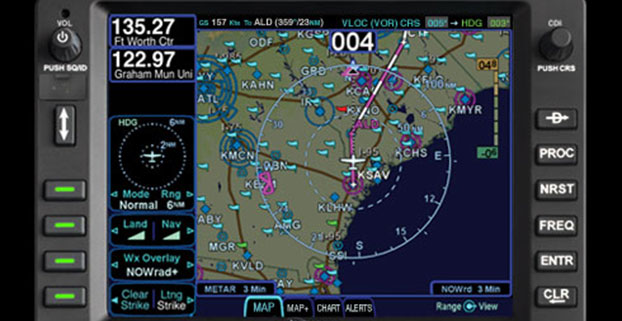
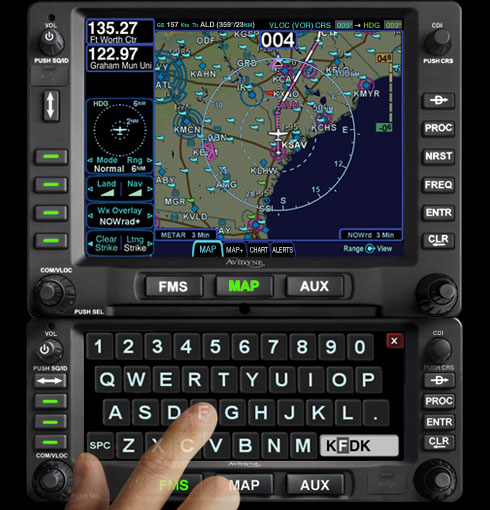
Avidyne Corporation, a provider of integrated avionics and safety systems for general aviation aircraft, has received Technical Standard Order (TSO) approval and an Approved Model List Supplemental Type Certificate (AML-STC) from the Federal Aviation Administration (FAA) for installation of the IFD540 FMS/GPS/NAV/COM system in more than 1,000 aircraft makes and models.
“The IFD540 gives aircraft owners a truly exceptional choice over anything else available today for GPS and VHF NAV/COM capabilities,” said Patrick Herguth, Avidyne’s chief operating officer. “The IFD540 delivers the perfect combination of touchscreen and dedicated-button user interface, making it much easier and more enjoyable for pilots transitioning from previous-generation systems.”
“The IFD540 adds significant improvements in functionality and ease of use, while providing huge cost and time savings for a large number of aircraft owners looking to upgrade their obsolete GPS systems,” said Dan Schwinn, Avidyne’s president and CEO. “Our ‘plug-and-play’ strategy opens up a huge market for aircraft owners who want new features like rubber-band flight plan editing, WAAS and ADS-B, but at a lower cost and with quicker installs.”
The IFD540 is the centerpiece of Avidyne’s previously announced stack of plug-and-play panel-mounted avionics, which also includes the AMX240 Audio Panel and the AXP340 Mode S ADS-B Transponder, both of which are already TSO’d and available now.
A smaller-screen version of the IFD540 called the IFD440 FMS/GPS/NAV/COM is planned for availability later this year.
Rounding out Avidyne’s panel-mounted avionics stack is the DFC90 digital Autopilot with Envelope Protection and Envelope Alerting, which has already been certified on a number of aircraft including Cirrus SR20/22, Piper PA-46, Beech Bonanza series, and Cessna 182 series.
 Organized by the Euromed GNSS II/MEDUSA project, under the auspices of the Ministry of Transport of Jordan, the event will aim to share experiences and best practices, and to discuss strategies and possible ways forward in relation to the use of the satellite navigation for freight and road transport in the region.