Category: Events

  • UAV Pavilion, Hologram Room on Tap at SPAR International

    SPAR International is a platform-neutral conference and exhibition focused on end-to-end business and technology for 3D measurement and imaging for industrial facilities; engineering, architecture and construction; and civil infrastructure. The exhibition will showcase solutions from leading 3D hardware manufacturers, software suppliers and service providers.

    The conference and trade show will be held March 30-April 2 in Houston, Texas.

    Watch a video about the conference:

    At SPAR International, current and emerging 3D technology and lifecycle asset-management solutions will be highlighted. More than 90 experts in 3D data, point-cloud processing, and data delivery will explain how to improve processes, mitigate risk, get the necessary output, and save time and money.

    This year SPAR features a dedicated UAV pavilion, where attendees can learn about the market and discuss solutions with major manufacturers. It also features a hologram room — a taste of the future that puts you inside a 3D scan.

    On the exhibit floor, developers and manufacturers will showcase the latest solutions developed to solve pressing and complex problems in a range of industries. 3D scanners, low-cost handheld devices, mobile mapping solutions, advanced data processing workflows, and more will be featured.

    Learning levels for 2015 include:

    • Business Consideration: Critical topics for asset owners and business leads.
    • 3D Technologies and Applications: In-depth content for 3D pros.
    • Introduction to 3D Tools: Basics for beginners and those new to 3D.

    Other topics covered include:

    • Building Information Modeling (BIM)
    • 3D for asset and facilities management
    • 3D data capture for as-built conditions
    • Point-cloud processing
    • Managing and sharing large data sets
    • 3D/intelligent modeling
    • Augmented reality and visualization tools
    • UAVs/UAS

    Numerous networking events provide opportunities to gain valuable information from other precision-measurement and imaging professionals across disciplinary lines. Attendees can discuss best practices, share project experience, and benefit from the experiences of their peers.

    Registrants include professionals from:

    • BP
    • Burns & McDonnell
    • Chevron
    • Doosan Babcock
    • Ford
    • General Motors
    • Hensel Phelps
    • Jacobs
    • Lockheed Martin Space Systems Co
    • NASA Newport News Shipbuilding
    • Pacific Gas and Electric Company
    • Parsons Brinckerhoff
    • Pepper Construction Company
    • SBM Offshore
    • SNC-Lavalin
    • The Beck Group
    • Whiting-Turner

    Click here to register.

  • New Commercial UAV Expo Set for October 2015

    SPAR Point Group will hold its first Commercial UAV Expo, October 5-7, 2015, at Caesars Palace in Las Vegas, Nevada. The event will feature an exhibit hall of UAV manufacturers, component and sensor manufacturers, software providers and service companies.

    Organizers expect upwards of 1,000 attendees and 80 exhibits in 2015. Las Vegas was selected for proximity to key players on the West Coast and an affordable and accessible location for the entire market. A two-day conference program will feature programming tracks including commercial applications, hardware and software options, cost considerations, the regulatory environment and data management and integration.

    SPAR Point Group are organizers of 3D technology events in North America, Europe and Asia. “We have been listening to our customers and watching the market for some time,” said Lisa Murray, director. “While it is well known that the unmanned aerial vehicle is a game-changing technology, the regulatory environment and concerns over safety have kept commercial growth to a minimum. Given the potential benefits of approved commercial UAV use and global market projections of $12 billion for commercial UAVs over the next decade, the time is right to launch this event.”

    “Moving forward, it is vital that the industry has an event dedicated to commercial UAV use,” saidDave Henderson, Topcon’s director of geospatial sales. “SPAR Point Group is uniquely qualified to host such an event given their history and expertise delivering top-notch business and technology events for 3D precision measurement and imaging. They already have established relationships with providers and potential users in key market sectors eager to integrate UAV systems.”

    “We are excited to connect the UAV community with potential customers in surveying and mapping, civil infrastructure, mining, construction, process, power and utilities, precision agriculture, law enforcement, security and emergency response,” Murray said. “These are natural markets for commercial UAVs, and ones in which we have established contacts. Seasoned professionals in aerial, mobile and terrestrial data capture technology are particularly interested in the business benefits UAVs provide, including potential cost savings, ease of use, immediacy of data delivery and increased accessibility.”

    “In speaking with providers in the UAV sector, it is clear an event focused on industries suited to small UAVs is needed,” Murray said. “While the overall UAV sector is currently dominated by defense and military applications, it is hard to imagine any industry that will not be affected by UAV adoption. Our customers rely on our technology events to deliver the latest innovations on the market. They want to see what’s new and what’s next. Clearly, what’s next is the UAV, and we are excited to showcase this next wave of innovation at Commercial UAV Expo next year.”

  • Unmanned Systems Take Flight at 2015 International CES

    HEXO+, an autonomous flying camera system, by Squadrone Systems will exhibit at CES 2015. Photo: Squadrone Systems
    HEXO+, an autonomous flying camera system, by Squadrone Systems will exhibit at CES 2015. Photo: Squadrone Systems

    The Consumer Electronics Association today announced the debut of the Unmanned Systems Marketplace at the 2015 International Consumer Electronics Show (CES). Owned and produced by CEA, the International CES is a gathering place for those who thrive on the business of consumer technologies. The 2015 CES is scheduled to run January 6-9, 2015, in Las Vegas, Nevada.

    The Unmanned Systems Marketplace highlights the burgeoning technology in drones, unmanned aerial vehicles (UAVs), and other unmanned systems controlled by onboard computers or remotely from the ground. In its first year at the CES, the Unmanned Systems Marketplace is expected to cover 6,500 square feet of exhibit space with room for about 16 high-end commercial and consumer UAV technology companies.

    According to CEA research, the global market for consumer drones will approach $130 million in revenue in 2015, increasing by 55 percent from 2014, with unit sales of consumer drones expected to reach 400,000. The revenue from drone sales is expected to easily exceed $1 billion in just five years.

    “Drones and unmanned systems are being used to assist in a variety of applications, from aerial coverage for sports and real estate, to assistance in search and rescue and disaster relief missions,” said Karen Chupka, senior vice president, International CES and corporate business strategy, CEA. “We’re excited to introduce the Unmanned Systems Marketplace at the 2015 CES and witness how these unique tools are revolutionizing the way we capture and monitor our world.”

    The Unmanned Systems Marketplace will be located at CES Tech East, in the Las Vegas Convention and World Trade Center (LVCC), South Hall 2. Tech East includes the LVCC, the Westgate Las Vegas , and Renaissance Las Vegas. Major exhibitors located within the Unmanned Systems Marketplace include AirDog, Squadrone, Trace, DJI, iRobot, Trace, Torquing Group DBA ZANO, Ecovacs, EHang, Autel, Pelican Products, and other brands.

    The 2015 CES will feature 20 category-specific marketplaces highlighting innovation across diverse product areas. Companies interested in exhibiting in the Unmanned Systems Marketplace should contact Oleg Burdo at [email protected] or 703-907-5257.

    Registration for the 2015 CES is open. For more information on the 2015 CES, visit CESweb.org.

  • Precision Ag Conference Planned for July

    Precision Ag Conference Planned for July

    precisionag-conference

    Attracting more than 400 precision ag experts from 40 countries, the 12th International Conference on Precision Agriculture will be held July 20-23 at the Hyatt Regency in Sacramento, California, USA.

    In the heart of high-value agriculture, the Sacramento setting is fitting to the high-tech talks on the program. The global scale of the conference is apparent from the list of presenters and exhibitors. ICPA brings together a unique mix of researchers, industry, and practitioners.

    ICPA is the premier scientific conference on precision agriculture. “We selected the top research papers from around the world for the conference. With session chairs in precision water management, precision horticulture, unmanned aerial vehicles, precision conservation, precision livestock, remote sensing, and data standards, the oral program reflects the diversity of our members’ interests,” said Dr. John Stafford, President of ISPA. In addition, the program features two poster sessions with over 70 posters on display during the conference.

    The program also features talks on practical applications of the latest technology in crop and livestock production. Through the support of our major sponsors, the conference will feature a track for practitioners in addition to the five tracks on precision ag research. “At ICPA we have continued to appeal to the practitioner in addition to the researcher and academic. It is important that the research work finds its way into practical applications in crop production,” said Quentin Rund, Conference Secretary.

    The schedule provides plenty of time for interaction among attendees. From the Sunday night welcome reception sponsored by E & J Gallo Wineries, to the dedicated time for exhibits and posters during breaks and evening receptions, the program promotes networking and opportunities for in-depth discussion among attendees, presenters, exhibitors, and sponsors.

    For international and domestic visitors to the area the conference has partnered with the University of California-Davis to organize a post-conference tour for Wednesday afternoon after the closing session. The tour will feature area stops on UAVs, high-tech tomato production, precision irrigation, and imaging systems in wine grape production. Other options for exploring the area are available, too.

    The conference is organized by the International Society of Precision Agriculture. More information is available online at www.ispag.org/icpa including program, exhibits, tours, and accommodations. Online registration is open

    The conference is sponsored by E & J Gallo Wineries, Monsanto, DupontPioneer, and Springer.

  • ION International Technical Meeting 2015 Now Accepting Abstracts

    Abstract submissions are now being accepted for The Institute of Navigation’s (ION) International Technical Meeting (ITM), set for January 26-28, 2015, at the Laguna Cliffs Marriott Hotel, Dana Point California. Abstracts are being accepted through October 3, 2014.

    This year’s plenary session will focus on “The Human Factor: Interpreting and Acting on Navigation Data,” and will explore how navigation data is viewed through the lens of human perception and how novel sensing technologies will impact the human experiences.

    This year for the first time, all technical papers for ITM 2015 will be peer reviewed. Manuscripts will be designated as a primary paper, or as an alternate paper, in the onsite program based on the session chairs’ peer review of the full manuscripts.

    ITM 2013 features more than 150 technical papers presented on a diverse array of topics including:

    • Advanced RAIM and Autonomous Integrity
    • Alternative Sensors and Emerging Navigation
    • Technologies
    • Augmentation Systems (SBAS and GBAS)
    • Aviation and Marine Applications
    • Collaborative Sensing and Multisensor Fusion
    • Emerging GNSS and Modernization
    • GNSS Processing and Integration
    • Human-Centered Navigation
    • Interference, Spectrum Management, and
    • Backups to GNSS
    • MEMS, Timing and Micro PNT
    • Quasi-Zenith Satellite System
    • Receivers and Antenna Technology
    • Robot and Autonomous Vehicle Navigation
    • Space and Atmospheric Weather
    • Urban, Indoor and Terrestrial Applications

    For more information about ION’s International Technical Meeting 2015, please visit .


  • Spirent Federal Offers Training Conference in March

    GNSS simulation expert Spirent Federal is inviting users to “a rigorous and thorough” one-and-a-half-day training conference, including a half-day of For Official Use Only (FOUO) sessions, set for March 26-27 in Salt Lake City.

    The 2014 Spirent Federal GNSS Training Conference features hands-on training led by Spirent engineers on its latest GNSS simulation equipment. FOUO sessions will be held on Thursday, March 27, for U.S. citizens only.

    Topics covered include:

    • SVN49 anomaly simulation
    • Utilizing remote control and motion
    • Advanced modeling and simulation techniques
    • Differential GPS and augmentation systems
    • Multi-GNSS constellation testing
    • Integrated GPS/inertial testing (FOUO Session)
    • M-code simulation (FOUO Session)
    • CRPA testing (FOUO Session)

    General sessions will be held Wednesday and Thursday, March 26-27. FOUO sessions will be held Thursday, March 27.

    For information and to register, visit the event website.

  • Registration Opens for Munich Satellite Navigation Summit 2014

    Registration is now open for Munich Satellite Navigation Summit 2014, which will be held March 25-27, 2014, at the Residenz Muenchen in Munich, Germany.

    The summit will have a booth (Booth H) in the exhibit hall at the ION GNSS+ conference next week in Nashville, Tennessee. The conference is offering a special ION rate for those who register no later than October 21.

    The summit has been established as the European and International conference with global impact featuring invited high-ranking worldwide speakers from industry, science and governments dealing with the directions of satellite navigation now and in the future.

    The summit starts on March 25 with the Exhibition Opening and Champagne Reception at 16.30 hrs. The technical programme of the conference starts with the Opening Plenary Panel discussing the topic “GNSS – New Challenges” at 17.15 hrs. Afterward, the Bavarian State Reception in the famous Residenz München provides opportunities for networking.

    The technical program includes plenary discussions among invited speakers and presents a concise update on the main activities in worldwide satellite navigation systems, in particular:

    • Implementation of the European satellite navigation system Galileo
    • Modernization of the U.S. Global Positioning System (GPS IIF, GPS III)
    • Status and modernization of the Russian Global Satellite Navigation System GLONASS
    • Developments of new global and regional systems like the Chinese COMPASS, the Japanese QZSS and the Indian IRNSS
    • Space-Based Augmentation systems (SBAS)
    • Legal issues of privacy devices and GNSS re-transmitters
    • Getting the centimeter on global scale (Precise Point Positioning)
    • Design of future navigation systems: Will autonomous sensors come to the fore
    • GNSS monitoring of the system earth and natural disasters
    • Integrated applications of GNSS and Earth Observation

    The Munich Satellite Navigation Summit will further highlight the creation of new applications and services in satellite navigation, in combination with telecommunication and information technology, in particular geo-information technology.

    Various sessions will feature discussions among invited panellists talking about perspectives and critical issues in various rapidly growing application scenes of satellite navigation, in particular with Galileo. Brief presentations and statements of the panelists are initiating each session. An interactive question and answer period with the auditorium is closing the topic.

    In 2014:

    • An exhibition for industry and institutions is taking place during the conference.
    • The European Satellite Navigation Master competition will be announced.
    • The summit includes a parallel track on Copernicus the European Commission’s Earth Observation Programme. Alongside technical and political updates, the sessions will also give insight into services and applications enabled by the programme.

    The Summit is part of the efforts of the Bavarian government and the cluster on aerospace and satellite navigation to stimulate applications and services in this high-tech field.

    For more information, contact +49-89-6004-3425 or e-mail [email protected].

  • Kickstarter Comes to GPS; Plus, Jammers and Field Technology Conference

    $2,000 for an RTK base and rover? Yes, it’s real. Well, at least it seems real.

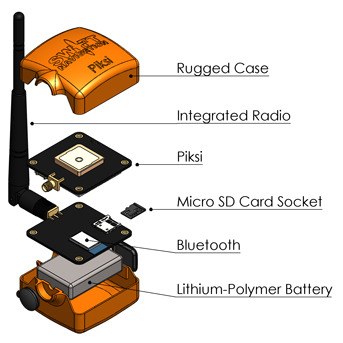
    For $2,000, you can order an RTK base and rover set named Piksi, including radios.
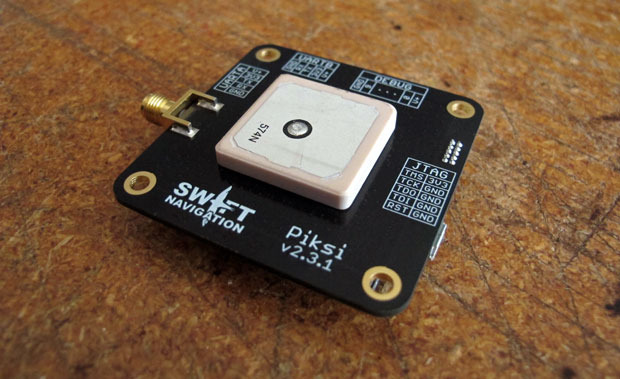
    Photo: Piksi (Swift Navigation)  Piksi_rugged

    It’s an intriguing opportunity, and might be the first brush stroke of the picture I’ve been painting (metaphorically speaking) for the past few years about inexpensive RTK receivers forthcoming. But, before you get really excited, read on.

    Besides the attractive price, something else that makes Piksi interesting is the way the company is financed. The way that a typical company funds new product development is through its own cash flow or financing. The company designs and produces a product, then announces it to potential buyers (you), who then touch, feel and use the product to understand how it performs…all before making the decision to purchase. Piksi (Swift Navigation) doesn’t follow that model.

    Piksi is using a new-age, crowd-sourced funding model called Kickstarter. With Kickstarter, a group of people (creators) offer to design and produce a certain product if they can recruit enough “investors” to fund their endeavor. The “investors” aren’t traditional venture capitalists, nor people who would own stock in said company. The investment is simply a commitment to buy the product based on the specifications provided by the creators, before the product is finished. If the company has enough commitments from “investors,” the creators commit to designing, building and delivering the product.

    Furthermore, there are certain levels of investment available for Piksi, from $7 which will get you a Swift Navigation micro-USB cable, to $2,000, which will get you a ruggedized version of the complete RTK kit, including base, rover, XBee radios, Bluetooth and SD card storage. So far, Swift Navigation has raised $161,369 towards the project with today, September 4, being the last day. That’s far more than the $14,000 goal it set.

    The caveat is that the product is not complete yet, at least the RTK portion. According to Swift Navigation:

    We have already built a small batch of Piksi receivers that are ready to ship and have locked down all part sourcing and manufacturing for further batches, so there are unlikely to be any unanticipated delays in the delivery of Piksi hardware.

    However, it’s difficult to know exactly how long the RTK functionality will take to implement — software development schedules seem to always run over their anticipated delivery dates, even when you take into account Hofstadter’s Law. We feel the goals we’re proposing to accomplish with this campaign are reasonable — adding a new set of software functionality (which we successfully implemented on a previous platform) upon an existing base of stable hardware and software.

    The gamble that the investor takes is that Swift will be able to finish the product, produce it, and meet the performance specifications. However, that’s only part of the battle. I spent better than 10 years of my life managing the design and production (somewhat) of GPS-based hardware and software for mapping and surveying. There are a million details. A major part of developing a hardware/software product like this is making it reliable. What I mean by reliable is that it behaves the same way every time you push the ON button, and works consistently and reliably all day until you press the OFF button. That’s not easy to achieve without a lot of sophisticated testing in different environments, and nothing can fix a poor reliability design (except a redesign).

    The guys behind the Piksi don’t seem to be total GPS-rookies, but do lack substantial real-world experience. Click here and then click on Bios to read about their backgrounds. But who knows? Maybe that’s an advantage, not being conditioned to “follow the rules.”

    One last note, and an important one. It’s only an L1 system, so don’t get too excited. L1 means that you really can’t use an RTK network (practically speaking) and that the baseline distance needs to be pretty short. The RTK initialization and re-initialization times will be measured in minutes, not seconds, and that’s assuming they get the RTK algorithms correct (and reliable).

    Sorry to burst your bubble.

    Actually, the concept of an inexpensive, bootstrapped L1 RTK system is not difficult to envision. The GPS OEM boards are readily available, as well as the GPS antennae, wireless comms and the rest of the components. At the risk of sounding pompous, I could put that kind of project together. The trickiest part of the project would be developing/implementing reliable RTK software.

    No matter what, it will be interesting to hear about what these guys come up with. In the words of the late Steve Jobs, “stay hungry, stay foolish.”

    GPS jammers are cheap, but don’t get caught using one.

    Even though they are illegal to market, sell and operate in the U.S., Americans are buying cheap GPS jammers, via Internet stores, from companies operating outside of the U.S. Operating one of these devices in the U.S. is a risky venture (as you’ll read below).


    Although they don’t seem to be a serious threat yet, they could become a threat as GPS receivers become more ubiquitous and concerns about privacy continue to ramp up.

    The Federal Communications Commission (FCC) is responsible for enforcing the U.S. laws enacted that prohibit the use of GPS jamming devices. If you look at the FCC’s enforcement history here, you’ll see that there isn’t much enforcement activity. However, a recent enforcement action was imposed on a guy in New Jersey who made the mistake of driving by the Newark International airport with his GPS jammer turned on. Uh oh. The FCC tracked down the offender and issued a Notice of Apparent Liability for Forfeiture that included a fine of nearly $32,000. Whoa, that’s a lot of dough. Wonder if he is trying to sue the company he bought it from? Not likely, as they are most certainly outside of the U.S. and out of reach of the U.S. judicial system. Caveat emptor.

    You can be assured that if jamming reports increase, there will be more jamming detection and location equipment deployed to hold people accountable, like this new, handheld GPS jammer detector and locator from Chronos:
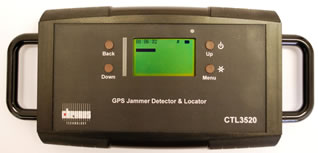
    Chronos_ctl3520

    You might want to visit this GPS.GOV website on GPS jamming. It contains a lot of information about the U.S. regulations surrounding the marketing, sales and use of GPS (and cell phone) jamming devices.

    Third annual Field Technology Conference

    FTC2013_logo

    In 2010, I, along with two colleagues, put together a conference here in Portland, Oregon, and named it the Field Technology Conference. We created the conference to focus on geospatial technology hardware and software used in the field. It’s the essence of what a conference should be, a group of people gathering to share ideas of common interest. It’s mostly devoid of commercial interests, save a few really neat (and valuable) giveaways and a few exhibit booths. You probably haven’t heard about the conference because we have a very small marketing budget, and the organizers (three of us) can only spend a few hours a month brainstorming, finding speakers, and organizing the event.

    This year, our third, will focus on existing and emerging technologies: GPS/GNSS, UAVs, 3D printing, mobile devices, imagery and geospatial software. Our outdoor demonstration area was very popular last year so we’ll offer that again, as well as a UAV demonstration. We’re also planning an on-site demonstration of 3D printing. Can you imagine 3D printing a topographic survey?

    Something new this year is our association with the CGSIC (Civil GPS Service Interface Committee). CGSIC is co-locating a regional event with our conference. What that means is that speakers from the U.S. government (Air Force, State Deptartment, DOT, etc.) will make GPS-centric presentations. CGSIC events are the only live communication channel between the U.S. Air Force GPS operations personnel and civilian GPS users. This is your chance to ask Air Force personnel questions, in person, that you’ve always wanted to know about GPS. If you’re unable to travel to Portland for the conference (October 23-24), GPS World magazine is planning on streaming the CGSIC presentations live over the Internet, as well as posting the recording on its website.

    Although the conference is organized by the Western Forestry and Conservation Association (which organizes a lot of conferences), take a look at the agenda and you’ll see the content will be of interest to anyone involved with geospatial data collection and processing technology, not just foresters and environmental scientists. For conference details, click here.

    Thanks, and see you next month.

    Follow me on Twitter at https://twitter.com/GPSGIS_Eric

  • Registration Opens for ION PTTI 2013 Conference

    Registration is now open for the Institute of Navigation’s (ION) Precise Time and Time Interval Meeting (PTTI) to be held December 2-5, 2013 (Tutorials will be held December 2) at the Hyatt Regency Bellevue, Bellevue, Washington. Registration and program information will be available online only.

    PTTI is an annual conference sponsored by ION with a technical program designed to disseminate and coordinate PTTI information at the user level, review present and future PTTI requirements, inform government and industry engineers, technicians, and managers of precise time and frequency technology and its problems, and provide an opportunity for an active exchange of new technology associated with PTTI.

    This year’s conference will feature a technical program around important PTTI issues including:

    • Advanced Atomic Frequency Standards Applications
    • High Performance Time and Frequency Transfer via Fiber
    • Next Generation PTTI Applications
    • Network Synchronization and IEEE 1588, NTP
    • PTTI in Space
    • PTTI Time and Frequency Laboratory Activities
    • State of the Art GNSS Timing Receiver
    • Metrology and Applications
    • Time and Frequency Transfer Applications –
    • Milliseconds to Picoseconds
    • Time Scales and Algorithms

    In addition to a commercial exhibit, this year’s program includes a Panel Discussion on Near-term GNSS deployments and the impact on PTTI Applications and Performance Current and future status of: GPS, GLONASS, Galileo, BeiDou/Compass, QZSS, WAAS, EGNOS and INRISS.

    This year’s conference will also feature pre-conference tutorials December 2, including

    • Introduction to Precise Time and Frequency
    • Time and Frequency Transfer
    • Two-Way Satellite Time Transfer (TWSTT)
    • Global Navigation Satellite Systems (GNSS) I & II
    • IEEE 1588: The Precision Time Protocol – An Overview
    • Introduction to Atomic Clocks


  • ISGNSS 2013 Issues Call for Papers

    The International Symposium on GNSS 2013 (ISGNSS 2013) will be held in Istanbul from October 22 to 25 at Congress Center in Yildiz Technical University of Istanbul. It is being organized by Bulent Ecevit University of Zonguldak, Yildiz Technical University of Istanbul and Turkish Chamber of Survey and Cadastre Engineers. The symposium has been organized since 1999 by the International Program Committee of International Symposium on GPS/GNSS.

    The theme of ISGNSS 2013 is “Connecting Continents through GNSS where Europe and Asia Meet.” As for all the past symposiums on GNSS, this symposium will provide opportunities to connect scientists, researchers and professional all around the world, as Istanbul connects the continents.

    Organizers invite presenters to submit abstracts and papers until July 21. Paper topics include those listed below, or any other related topic.

    • GNSS Current Status, Organizational and Governance Issues
    • Regional Navigation Satellite Systems
    • Atmospheric Effects on GNSS
    • GNSS Augmentation Systems
    • GNSS-Related Remote Sensing and GIS
    • GNSS Policy, Services and Opportunities
    • CORS
    • Surveying, Mapping and Geodesy
    • Indoor Positioning
    • GNSS Receivers, Antenna, Algorithms and Products
    • Signal Processing, Interference, Multipath
    • Land applications and Intelligent Transport Systems
    • Aviation, Marine and Space Applications
    • Inertial Navigation
    • Sensor Networks
    • Precise Point Positioning
    • RTK and e-GNSS
    • LBS and Telematics
    • Alternatives and Backup to GNSS
    • Timing and Scientific Applications
    • Engineering applications
    • Multisensor Fusion
    • International GNSS Applications and Developments
    • Agriculture, Mining and Rural Industries
    • Consumer and Urban Applications
    • Machine Automation and Control

    For more information, email [email protected]

  • Surveyors Invited to ‘Survey Earth in a Day’

    sealOn the day of the solstice, June 21, geospatial professionals around the world and members of Land Surveyors United (a global support network for land surveyors) will be simultaneously recording survey grade GPS data from thousands of points around the globe, in order to gain a more accurate understanding of the earth’s surface.

    This will be the second Survey Earth in a Day event; in 2012 the first Survey Earth event was held, establishing many new understandings between geospatial and geomatics professionals and the general public on geospatial issues, organizers said. “With a mission not only to learn more about the Earth’s surface but also monitor its changes over time, and the changes in public perspective, as a global community, we may be more capable of assessing our future,” organizers said.

    “Our results will change the knowledge we currently have of the shape of the earth and thus provide new information about our planet’s surface for the benefit of all man-kind. Help the surveying industry and the surveyors in your region of the world by representing your area as we re-measure the entire globe in one single day,” organizers said.

    “If you are a geospatial professional with access to survey grade GPS equipment, you should consider helping us set a world’s record, right from where you live and work. Only a surveyor can provide the kind of precision that will be needed to truly understand the shape of planet earth. Just imagine how much this can help our industry,” organizers said.

  • Pacific PNT: GNSS, SBAS Updates

    The status of world GNSS, and augmentation systems in the Pacific region, highlighted the policy session of the Institute of Navigtion Pacific PNT Conference being held this week in Honolulu, Hawaii. Here are a few highlights:

    BeiDou-Logo-150x142BeiDou. Construction of the second phase of BeiDou has been completed; further launches for the third phase – constellation completion – are on hold until tests of the existing 14-satellite constellation are complete, according to Xiancheng Ding, Senior Advisor, China Satellite Navigation Office. As of December 27, 2012, BeiDou achieved full operational capability for most of the Asia-Pacific region. The full constellation is now expected to be completed by 2020.

    Other accomplishments include releasing the BeiDou Interface Control Document and manufacture of BeiDou chips for end-user applications. By the end of June, some manufacturers will release BeiDou chips in China, Ding said.

    Also in December, BeiDou introduced a new logo (at right).

    Yuanxi Yang (China National Administration of GNSS and Applications) presented statistics showing that BeiDou+GPS provides greater accuracy than GPS alone. For instance, the RMS of BeiDou+GPS kinematic positioning by using differential carrier phase is about 20 percent better than that of GPS alone, Yang said.

    By itself, existing BeiDou constellation system accuracy is better than 10 meters, timing better than 20 nanoseconds, and velocity accuracy is better than 0.2 meters/second.

    In all, BeiDou is composed of 14 satellites: five GEO, five IGSO, and four MEO. The full constellation (by 2020)  will consist of 35 satellites: 5 GEO and 30 non-GEO (a mixture of MEO and IGSO satellites).

    GPS. Keynote speaker David A. Turner (U.S. Department of State) shared his time with surprise GLONASS speaker Sergey Revnivykh (International Committee on GNSS, ICG). In his GNSS Policy and Program Update, Turner provided the dates by which three new civil signals will be on 24 GPS satellites.

    • The L2C signal is a developmental signal broadcasting from 10 GPS Satellites. It began launching in 2005 with GPS Block IIR(M) satellites, and is expected to be available on 24 satellites around 2018.
    • The L5 signal is a developmental signal broadcasting from three GPS satellites. It began launching in 2010 with Block IIF satellites, and is expected to be available on 24 GPS satellites around 2021.
    • The L1C signal begins launching in 2015 with GPS III; available on 24 GPS satellites around 2026.

    “We have an increasing number of signals, increasing capability, and increasing level of service as we continue to evolve the constellation,” Turner said.

    GLONASS. The next GLONASS satellite will be launched this Friday, April 26, Revnivykh said. This will be a GLONASS-M satellite, number 47. The first launch of a new generation GLONASS K satellite is scheduled for 2015.

    Revnivykh stressed GLONASS’ role as a global utility. “We consider international cooperation is essential for all GNSS, and we consider GLONASS an essential part of the international multi-GNSS system,” he said. He stressed the importance of compatibility and interoperability as key to this policy.

    In 2012, GLONASS performed with an average accuracy better than formally required, he said. GLONASS is in worldwide use, and positioning has improved by a factor of 10, from 35 meters to about 3 meters since the first satellites were launched. Using both GPS + GLONASS provides 1.5 times better high-precision measurements, Revnivykh said.

    The new GLONASS program for 2020 for GLONASS sustainment, development, and use includes GLONASS M, K1, and K2 satellites; the positioning accuracy objective is to go from the current 2.8 meters to 0.6 meters.

    Aviation. Chris Hegarty (MITRE) presented an FAA Navigation Programs Overview on behalf of the scheduled speaker Deborah Lawrence (FAA) who was unable to attend. He noted that United Airlines has begun GBAS operations in Houston.

    In answer to a funding question, he said, “The sequestration is not expected to have a positive effect on schedule, but the presented timeline for APNT is the FAA’s current best estimate. Congress has some tough decisions before them, and I wouldn’t want to speculate on potential schedule impacts. In the words of Yogi Berra, predicting is hard, especially when it involves the future.”

    Korean SBAS. Changdon Kee (Seoul National University) shared plans for a Korean SBAS. In South Korea, LPV availability is 49.4% compared to 90.6% in Japan. “Korea needs its own system,” Kee said.

    Phase 3 of the SBAS development could start by the end of September, depending on funding. It will include open service multifunctional GEO satellites interoperable with other SBASs. A pseudolite demonstration system will be completed in 2014, clearing the way for the beginning of Phase 3.

    In all, the system will include five reference stations, two master stations, two ground uplink stations, and two GEO satellites (the main GEO by 2018 and a backup by 2020).

    The Korean SBAS open service system will provide GPS L1 augmentation, begin operation in 2020, and support aviation, land and maritime users. A test operation system will provide GPS L1 and L5 augmentation. The system is expected to be fully operational by 2021, with service available throughout Asia.

    Michibiki-AlanJapan’s QZSS. Hiroyuki Noda (Office of National Space Policy, Japan) said three more satellites for this augmentation system will be launched by the end of the decade, with the service beginning in 2018. In September 2012, the Japan cabinet made the commitment to accelerate development of the system. The first satellite, launched in 2010 (QZS-1, aka Michibiki) is performing as expected.

    QZSS is expected to improve positioning availability from 90% to 99.8% in Japan. QZSS will not only improve positioning in the Asia-Pacific region, but is expected to improve the capacity to respond to natural disasters, Noda said.