Category: Complementary PNT

  • UK Working Group discusses next steps to protect PNT

    UK Working Group discusses next steps to protect PNT

    The UK Hydrographic Office (UKHO) hosted the UK’s first cross-government geodesy, positioning, navigation and timing working group in October. Representatives from 19 government bodies shared insight on the risks, opportunities and interdependencies linked to PNT systems, including GNSS.

    On Nov. 19, the UK announced a £155M investment in PNT. The working group will continue to support collaboration and exchange knowledge as further resilience actions progress, according to the UKHO.

    GNSS supports critical activities across the UK economy. It provides accurate location and timing for communications, maritime and aviation safety, and the smooth running of power and financial networks. As threats to space-based systems grow, improving national resilience is increasingly important.

    “The UKHO’s expertise in geodesy plays a key role in helping the UK understand and protect PNT services. Our specialists provide trusted positioning and timing advice across defense and civil programs, including supporting the safety of navigation in UK waters,” the agency said.

    “It is fantastic to hear that the work with eLoran, GNSS Interference Monitoring Programme, Space Based Time Transfer and the National Timing Centre have received ongoing funding,” said Joe Pearce, senior geodesy and PNT specialist, UKHO. “This funding will assist both our data collection and the mariner. It will protect and assist future geodesy and PNT, improving resilience as these systems come increasingly under threat.”

    The UKHO also provides information on how to protect against GNSS and AIS jamming and spoofing for vessel operators.

  • Tern IDPS selected to accelerate autonomous satellite-free positioning

    Tern IDPS selected to accelerate autonomous satellite-free positioning

    Tern has been named a winner of the U.S. Army’s xTechOverwatch for Unmanned Systems competition. TERN was selected from morethan 600 companies after hands-on Soldier testing at the Bush Combat Development Complex in Bryan, Texas, Oct. 27-29.

    Tern developed an AI-powered Independently Derived Positioning System (IDPS) for position and navigation.

    xTechOverwatch is the Army’s premiere event for accelerating autonomous systems, giving
    soldiers the opportunity to use emerging technologies in real-world training environments and
    provide critical feedback that drives iterative improvement.

    The system has been tested across multiple tactical platforms in both on- and off-road environments, including active conflict zones.

    Tern will now integrate IDPS directly with Army Transformation in Contact formations, where active-duty units will continue to validate the system in operational scenarios in 2026.

    How IDPS works

    IDPS has been proven to deliver uninterrupted, high-accuracy navigation in environments where GPS fails — tunnels, dense urban canyons, remote terrain, and GPS-denied zones. Tested by the U.S. Department of Transportation, it has sustained ±4-meter accuracy over extended distances without any satellite input, completing more than180 continuous miles GPS-free and performing flawlessly under live GPS spoofing in a conflict zone.

    Tern’s IDPS gives the Army the ability to navigate their vehicles without the use of any
    satellites, signals or infrastructure, using only map data and the sensors already on board.
    Designed by former special operators who spent years navigating contested terrain without
    satellite support, and developed with AI experts behind some of the fastest recognition systems
    in the world, IDPS maintains precise, real-time location even when GNSS is jammed or
    spoofed. The system has been tested across multiple tactical platforms in both on- and off-road environments, including active conflict zones.

    Base maps. IDPS has a clear understanding of the roads ahead using preloaded map data — either publicly available or proprietary. This built-in knowledge means it can follow a logical path, even in places where satellites can’t reach, keeping navigation steady from the first turn to the final destination.

    IDPS can stand alone or be configured to power a location manager and integrate with widely used navigation applications such as Google Maps, Waze, OSM, ESRI, ArcGIS and Apple Maps.

    Sensor data. TERN’s IDPS leverages data from sensors already built into modern vehicles, such as wheel speed, steering angle, and  3D motion data , making these existing sensors smarter. Because this information comes directly from the vehicle, it works anywhere the vehicle can operate, making it a reliable foundation for location tracking in any environment, eliminating the need for additional expensive hardware, such as LEO satellites or terrestrial beacons. With a light computing and processing load, IDPS is can be a hardware or software based solution.

    Artificial intelligence. IDPS uses a proprietary AI engine to fuse map data and sensor inputs into a real-time position. TERN’s  advanced adaptive weighting algorithms measure and interpret the data from vehicle sensors and recalibrates those inputs in real-time, applied against the base maps to increase accuracy.  Constantly self-healing, IDPS predicts, confirms, and refines the vehicle’s location, learning from each movement to maintain pinpoint accuracy without satellites.

  • UK announces £155M investment in Timing Centre, eLoran, GNSS warning system

    UK announces £155M investment in Timing Centre, eLoran, GNSS warning system

    The United Kingdom is investing £155 million to safeguard positioning, navigation and timing (PNT) services.

    Research shows that just a 24-hour outage of satellite navigation services could cost the UK economy £1.4 billion. 

    In recent years, hostile actors have jammed or spoofed PNT services, demonstrating potential threats to key services. PNT can also be affected by natural events like solar flares from the sun.

    The £155 million funding was announced Wednesday by Science Minister Lord Vallance at the Royal Institute of Navigation’s annual PNT Leadership Seminar, which brings together researchers, innovators and business leaders from across the sector. 

    The investment includes initial work to provide PNT that is independent of signals from satellites, making it harder to jam or spoof; PNT resilience at the National Physical Laboratory; and a new system to proactively monitor for threats to the UK’s PNT services.

    The £155 million funding consists of: 

    • £71 million to begin work on a UK National Enhanced Long-Range Navigation (eLoran) program, providing PNT across land, air and sea independent of signals from satellites, and hard to jam or spoof.  
    • £68 million for further development of the National Timing Centre (NTC) program. The NTC is being delivered by the National Physical Laboratory to develop the UK’s first nationally distributed time infrastructure. As well as boosting resilience, it could help with innovative new uses of technologies like 5G, satellite communications, and self-driving vehicles. 
    • £13 million for work on a UK GNSS interference monitoring program, to deliver a world-leading capability for the UK to monitor and react to threats to PNT signals, like jamming and spoofing.  
    • £3 million for the Space-Based Time Transfer R&D program. This will develop the technology required to deliver global timing systems independent of GPS and other GNSS. 

    “Having resilient and enduring access to Position, Navigation and Timing Services is a critical part of life in today’s world, and a major plank in the UK’s national security,” Vallance said. “So many of the things we take for granted every day, from using our phones to planning a journey, simply couldn’t happen without it. The UK is a leader in this field, but in an uncertain world we cannot be complacent. The funding we are announcing today will ultimately help protect Britain from the risks posed to PNT, from both accidental outages and hostile acts, safeguarding everyone’s wealth and wellbeing.”

    “Strengthening the UK’s PNT capabilities will give direction to our growing PNT industry, supporting the wider economy and national renewal, whilst cementing the UK’s position as a global PNT leader,” Vallance said.  

    Today’s news comes after a substantial year of progress for UK PNT. The government agreed to closer work with both the US and France around PNT resilience, as part of September’s UK-US Technology Prosperity Deal and July’s UK-France Summit

    DSIT published a Call for Evidence on PNT growth in June, seeking views on the PNT market and R&D landscape in the UK, as well as the barriers to market entry, commercialisation, and user adoption. We will publish a summary of our findings later this year. 

  • VIAVI wins US DOT award to advance complementary PNT for critical infrastructure

    VIAVI wins US DOT award to advance complementary PNT for critical infrastructure

    VIAVI Solutions has received an award from the U.S. Department of Transportation (DOT) through its Complementary Positioning, Navigation and Timing (CPNT) Action Plan Rapid Phase II.

    VIAVI will integrate and test its SecureTime altGNSS GEO-L service and SecurePNT 6200 resilient timing solution at the VIAVI Automated Lab-as-a-Service for Open RAN (VALOR) and the Open RAN Center for Integration and Deployment labs. VALOR and ORCID are funded by the National Telecommunications and Information Administration Public Wireless Supply Chain Innovation Fund.

    Incidents of GNSS signal interference, such as jamming and spoofing, have increased significantly in recent years, emphasizing the need for a resilient PNT ecosystem that can function in denied, degraded and disrupted space operational environments (D3SOE). Complementary to GPS and GNSS, VIAVI’s SecureTime GEO-L service and SecurePNT-6260 switch to a completely GPS-independent, GEO-L satellite-based time service and a precision holdover clock in the event of jamming or spoofing with no interruption perceived by the critical infrastructure system.

    The DOT action plan aims to test systems that augment or replace GPS and GNSS, providing accurate timing services to critical infrastructure ranging from data centers and financial systems to power grids and cellular networks. Data from the VALOR, ORCID and field trials will be used to support widespread adoption of complementary positioning, navigation and timing services to protect the nation’s critical infrastructure.

    “Integration and testing at the VALOR and ORCID labs demonstrate the technology’s readiness in an operational critical infrastructure environment. We look forward to partnering with DOT and NTIA to improve resilience for critical infrastructure and providing vital data to support widespread CPNT adoption,” said Doug Russell, senior vice president and general manager of aerospace and defense at VIAVI.

    In addition to integration and testing at the VALOR and ORCID labs, the VIAVI GEO-L service and user equipment will be tested at an upcoming government field test event that provides live-sky jamming and spoofing of GPS/GNSS.

  • SandboxAQ, Defense Innovation Unit advance quantum navigation for GPS-denied operations

    SandboxAQ, Defense Innovation Unit advance quantum navigation for GPS-denied operations

    SandboxAQ has entered an agreement with the Defense Department’s Defense Innovation Unit (DIU) to join its Transition of Quantum Sensing (TQS) program, focusing on developing and testing advanced magnetic anomaly navigation technologies for the U.S. military’s autonomous systems.

    The program, managed under DIU’s Emerging Technologies portfolio, accelerates adoption of commercial quantum sensing technologies to ensure positioning, navigation and timing resilience in environments where Global Navigation Satellite Systems signals are unreliable or denied. SandboxAQ will deploy its dual-use AQNav software to enable robust navigation capabilities without reliance on external signals, demonstrating the technology’s utility in real-world scenarios and generating a comprehensive dataset to benchmark results against relevant Defense Department use cases.

    “AQNav represents a vital, non-GPS-reliant path for PNT and has proven its readiness for expanded military demonstrations and evaluation across mission-critical platforms,” said Luca Ferrara, general manager of AQNav at SandboxAQ. “We’re demonstrating AQNav’s performance capabilities across DIU-relevant use cases to empower the DOD to solve complex PNT challenges with best-in-class technologies at its disposal.”

    About the Transition of Quantum Sensing Program

    The program is a strategic effort to accelerate adoption of advanced quantum sensors from the laboratory into real-world military applications. Its primary goal is to address critical joint force needs, particularly for resilient positioning, navigation and timing in GPS-denied environments and for next-generation anomaly detection.

    More on Magnetic Navigation

    DIU is addressing the DOD’s urgent need for jam-resistant navigation for aerial platforms operating in challenging environments. The effort focuses on prototyping magnetic navigation systems, which use advanced quantum magnetic sensors to navigate using Earth’s natural geomagnetic variations. The technique provides a resilient source of position data even in GPS-denied scenarios, such as over-ocean operations, reduced visibility and electronic jamming.

  • UAE Space Center, Thales Alenia Space partner on LEO-PNT navigation system

    UAE Space Center, Thales Alenia Space partner on LEO-PNT navigation system

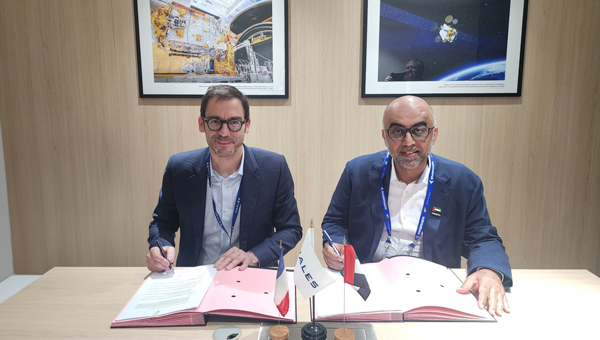
    The National Space Science and Technology Center (NSSTC) and Thales Alenia Space, a joint venture between Thales (67%) and Leonardo (33%), are cooperating to explore opportunities in low-Earth orbit (LEO) space navigation systems.

    The growing dependence of economies and daily lives on Global Navigation Satellite Systems is driving innovation and leading to technologies that deliver enhanced resilience and improved performance. At the forefront, low-Earth orbit positioning, navigation and timing (PNT) is emerging as a game-changer.

    The LEO-PNT satellites seek to provide guaranteed and sovereign centimeter location accuracy, robustness, resistance against jamming and spoofing, and low latency. LEO-PNT will serve emerging applications such as high-level autonomy cars, including persistent coverage in dense urban areas, unmanned aerial and maritime vehicles, and 5G/6G ground telecommunication network synchronization.

    Recognizing the strategic importance of LEO-PNT, the NSSTC is working with Thales Alenia Space to explore opportunities in this domain. The partnership was formalized through the signing of a memorandum of understanding at the Paris Air Show 2025, establishing a framework for cooperation. Building on that foundation, both parties signed an agreement marking the start of joint technical studies and engineering activities focused on regulatory protection and system design elements for LEO-PNT.

    The collaboration reflects a vision to explore pathways that can enhance the robustness and sovereignty of future navigation services while deepening international cooperation and knowledge exchange between the United Arab Emirates and Europe in the field of space technology.

    “This collaboration marks an important step toward building the UAE’s next-generation navigation capabilities,” said Ali Al Shehhi, director of NSSTC. “LEO-PNT will bring a new level of precision and resilience, and working with Thales Alenia Space allows us to accelerate our path toward a sovereign system that supports the UAE’s long-term strategic vision.”

    “LEO-PNT is a game changer in satellite navigation in terms of increased precision, resilience and signal penetration, enabling new applications and economic growth,” said Hervé Derrey, CEO of Thales Alenia Space. “We are proud to offer our expertise in satellite navigation to the NSSTC, thereby strengthening our collaboration with the United Arab Emirates in the space domain.”

  • Opinion: The U.S. needs GPS backup and IoT resilience

    Opinion: The U.S. needs GPS backup and IoT resilience

    America’s dependence on GPS is a matter of national security, economic vitality, and daily life. We all agree: the United States must develop strong, resilient alternatives to satellite-based positioning, navigation and timing (PNT). The question, ironically enough, is how to get where we want to go.

    Z-Wave Alliance, whose members build the smart home, security, and automation devices used in millions of homes and buildings, fully supports the federal effort to harden PNT infrastructure. We have been active contributors to the FCC’s Notice of Inquiry (WT 25-110) and the Department of Transportation’s Complementary PNT (CPNT) research program. We have provided and assessed technical data to help identify which terrestrial and space-based solutions can truly coexist with the technologies Americans already use every day.

    A Known Risk

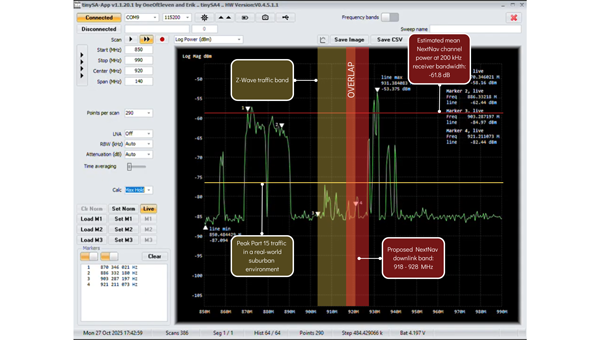
    NextNav has petitioned the FCC to restructure parts of the lower 900 MHzband to host a terrestrial 5G/PNT network—essentially a ground-based GPS complement. The company’s plan would allocate parts of that band for high-power transmissions and relax the long-standing protections that keep low-power (Part 15) devices from destructive interference.

    That same spectrum underpins hundreds of millions of existing systems: connected security sensors, toll-booth readers, smart meters, building automation networks, and the smart home products consumers rely on every day. These devices operate safely and efficiently because the FCC’s Part 15 rules limit interference and prohibit high-power operations in this shared public band.

    Robust technical analysis, most recently the Pericle Communications study commissioned by the Security Industry Association, shows that high-power terrestrial PNT transmissions would block or degrade low-power communications up to 60 percent of the time. In plain terms, that means alarms that fail to trigger, silent sensors, and lost connectivity for devices that safeguard homes, businesses, and infrastructure.

    Evidence indicates these devices could degrade significantly in performance, often to the point of un-usability. Once the band is reclassified, there’s no practical way to “retrofit” the millions of products already deployed. The result would be billions of dollars in stranded hardware, irrecoverable damage to company reputations, and a long, expensive replacement cycle for utilities, business owners, and consumers.

    This isn’t an argument against terrestrial PNT. It’s an argument for evidence-based engineering.

    — Avi Rosenthal

    Multiple Paths to Resilient PNT

    This isn’t an argument against terrestrial PNT. It’s an argument for evidence-based engineering. The Department of Transportation has identified several categories of GPS-complement technologies, including low-Earth orbit (LEO) satellite systems, time-over-fiber distribution, map matching/map tracking, and terrestrial RF. NextNav’s 900 MHz concept falls into the fourth category, but it’s only one of many.

    The FCC recognized this when it opened its broad Notice of Inquiry in March 2025 instead of rushing into rulemaking. Other federally funded trials, such as the Broadcast Positioning System developed by NAB and UrsaNav’s eLoran solution, show that terrestrial PNT can be achieved without displacing unlicensed Part 15 devices.

    Engineering redundancy into national infrastructure demands that we test multiple solutions in parallel, not gamble on a single proprietary approach that risks breaking what already works.

    Coexistence Is the Standard, Not the Exception

    Across every modern wireless domain — Wi-Fi, Bluetooth, Zigbee, Z-Wave, LoRa, Wi-SUN — coexistence testing is standard practice. Before a new technology enters a shared spectrum, it must demonstrate that it can live alongside incumbents. NextNav has not done that. Its coexistence claims rely primarily on simulations using optimistic assumptions about device density and duty cycle. Real-world deployments are far denser and far noisier.

    Z-Wave and our industry partners simply ask for what every responsible engineer would: comprehensive, transparent field testing before the FCC alters the rules of a crowded band. That’s not obstructionism: it’s diligence.

    Building Forward, Not Backward

    Our message is simple: the U.S. needs PNT redundancy, but it must be built on coexistence, not displacement.

    America’s connected infrastructure relies on the lower 900 MHz band precisely because it has been open, unlicensed, and reliable. Allowing a single licensee to flood that band with high-power signals would trade resilience for fragility.

    Z-Wave Alliance stands ready to collaborate with the FCC, DOT, and all research participants to ensure the U.S. gets the GPS backup it deserves: one that strengthens, rather than undermines, the technologies that keep Americans safe, secure, and connected every day. To learn more, follow Z-Wave Alliance on LinkedIn and across social platforms: we are committed to keeping the U.S. technology community up-to-date on key proposal developments and opportunities to make their voices heard.


  • The U.S. needs GPS backup and IoT resilience

    The U.S. needs GPS backup and IoT resilience

    America’s dependence on GPS is a matter of national security, economic vitality, and daily life. We all agree: the United States must develop strong, resilient alternatives to satellite-based positioning, navigation and timing (PNT). The question, ironically enough, is how to get where we want to go.

    Z-Wave Alliance, whose members build the smart home, security, and automation devices used in millions of homes and buildings, fully supports the federal effort to harden PNT infrastructure. We have been active contributors to the FCC’s Notice of Inquiry (WT 25-110) and the Department of Transportation’s Complementary PNT (CPNT) research program. We have provided and assessed technical data to help identify which terrestrial and space-based solutions can truly coexist with the technologies Americans already use every day.

    A Known Risk

    NextNav has petitioned the FCC to restructure parts of the lower 900 MHzband to host a terrestrial 5G/PNT network—essentially a ground-based GPS complement. The company’s plan would allocate parts of that band for high-power transmissions and relax the long-standing protections that keep low-power (Part 15) devices from destructive interference.

    That same spectrum underpins hundreds of millions of existing systems: connected security sensors, toll-booth readers, smart meters, building automation networks, and the smart home products consumers rely on every day. These devices operate safely and efficiently because the FCC’s Part 15 rules limit interference and prohibit high-power operations in this shared public band.

    Robust technical analysis, most recently the Pericle Communications study commissioned by the Security Industry Association, shows that high-power terrestrial PNT transmissions would block or degrade low-power communications up to 60 percent of the time. In plain terms, that means alarms that fail to trigger, silent sensors, and lost connectivity for devices that safeguard homes, businesses, and infrastructure.

    Evidence indicates these devices could degrade significantly in performance, often to the point of un-usability. Once the band is reclassified, there’s no practical way to “retrofit” the millions of products already deployed. The result would be billions of dollars in stranded hardware, irrecoverable damage to company reputations, and a long, expensive replacement cycle for utilities, business owners, and consumers.

    This isn’t an argument against terrestrial PNT. It’s an argument for evidence-based engineering.

    — Avi Rosenthal

    Multiple Paths to Resilient PNT

    This isn’t an argument against terrestrial PNT. It’s an argument for evidence-based engineering. The Department of Transportation has identified several categories of GPS-complement technologies, including low-Earth orbit (LEO) satellite systems, time-over-fiber distribution, map matching/map tracking, and terrestrial RF. NextNav’s 900 MHz concept falls into the fourth category, but it’s only one of many.

    The FCC recognized this when it opened its broad Notice of Inquiry in March 2025 instead of rushing into rulemaking. Other federally funded trials, such as the Broadcast Positioning System developed by NAB and UrsaNav’s eLoran solution, show that terrestrial PNT can be achieved without displacing unlicensed Part 15 devices.

    Engineering redundancy into national infrastructure demands that we test multiple solutions in parallel, not gamble on a single proprietary approach that risks breaking what already works.

    Coexistence Is the Standard, Not the Exception

    Across every modern wireless domain — Wi-Fi, Bluetooth, Zigbee, Z-Wave, LoRa, Wi-SUN — coexistence testing is standard practice. Before a new technology enters a shared spectrum, it must demonstrate that it can live alongside incumbents. NextNav has not done that. Its coexistence claims rely primarily on simulations using optimistic assumptions about device density and duty cycle. Real-world deployments are far denser and far noisier.

    Z-Wave and our industry partners simply ask for what every responsible engineer would: comprehensive, transparent field testing before the FCC alters the rules of a crowded band. That’s not obstructionism: it’s diligence.

    Building Forward, Not Backward

    Our message is simple: the U.S. needs PNT redundancy, but it must be built on coexistence, not displacement.

    America’s connected infrastructure relies on the lower 900 MHz band precisely because it has been open, unlicensed, and reliable. Allowing a single licensee to flood that band with high-power signals would trade resilience for fragility.

    Z-Wave Alliance stands ready to collaborate with the FCC, DOT, and all research participants to ensure the U.S. gets the GPS backup it deserves: one that strengthens, rather than undermines, the technologies that keep Americans safe, secure, and connected every day. To learn more, follow Z-Wave Alliance on LinkedIn and across social platforms: we are committed to keeping the U.S. technology community up-to-date on key proposal developments and opportunities to make their voices heard.

  • Pathfinder provides signal-resilient autonomy in navigation

    Pathfinder provides signal-resilient autonomy in navigation

    Aero Drop Systems (ADS) has developed Pathfinder, a proprietary autonomous navigation framework designed to reduce dependence on GNSS-based positioning. Pathfinder is signal-resilient, capable of maintaining precision even in complete GNSS dead zones and unaffected by deceptive interference.

    At the core of Pathfinder lies an array of sensors and advanced self-regulating logic driven by machine learning. Unlike traditional systems that treat GPS as a singular source of truth, Pathfinder fuses a constant stream of information from multiple internal and external domains and dynamically rebalances itself in real time as it evaluates, cross-verifies, and refines its positional understanding based on an algorithm that classifies the trustworthiness of each data stream.

    The result is a self-correcting navigation intelligence that can anticipate changing conditions, isolate false data, and continue to perform when other systems cannot. This allows Pathfinder to sustain highly accurate navigation during satellite connection or radio frequency outages or when being targeted with jamming or spoofing.

    Designed as a modular framework, Pathfinder can be integrated across a range of fully autonomous platforms operating on land, at sea, or in the air. Its flexible architecture makes it suitable for both commercial logistics and defense applications, where navigation integrity is critical to mission success.

    Currently in the testing phase, Pathfinder is part of ADS’s broader initiative to develop resilient, autonomous logistics technologies capable of performing in contested and complex environments. ADS has confirmed that Pathfinder will serve as the core navigation technology for the platform Aerocrate. Aerocrate is a disposable, autonomous aerial delivery system that enables precise, reliable resupply without requiring recovery operations, staging areas, or active communication with the platform.

  • All.Space awarded €950,000 by ESA’s NAVISP for GNSS-independent tech

    All.Space awarded €950,000 by ESA’s NAVISP for GNSS-independent tech

    All.Space, a provider of multi-orbit, multi-link satcom omplatforms, has been awarded €950,000 by the European Space Agency’s Navigation Innovation and Support Programme (NAVISP). The award is to develop an alternative position, navigation and timing (PNT) capability designed to operate in GNSS-denied environments.

    The project will build a proof of concept for alternative PNT, harnessing All.Space’s multi-orbit terminal technology to generate and analyze signals of opportunity that can deliver position and orientation data independently from traditional GNSS sources.

    The technology is designed to counter rising threats from GNSS jamming and spoofing – scenarios of increasing concern for both defence and commercial operators. Delivered in partnership with UK-based GNSS experts GMV NSL, the project is aimed at embedding a resilient PNT capability directly within the All.Space terminal, forming part of its growing software as a service (SaaS) portfolio.

    “GNSS denial is no longer a hypothetical scenario,” said Paul McCarter, CEO at All.Space. “It’s a growing reality. With this project we’re developing a sovereign alternative that can restore confidence, capability and control in even the most contested environments.”

    Once proven, the technology will be matured and commercialized as an integrated service offering, helping customers achieve operational independence and secure navigation in any domain.

    ESA’s NAVISP programme is designed to spur innovation in navigation technologies and services across its Member States.

  • Microchip’s TimeProvider 4500 v3 grandmaster clock enables terrestrial alternative to GNSS

    Microchip’s TimeProvider 4500 v3 grandmaster clock enables terrestrial alternative to GNSS

    Microchip Technology has released the TimeProvider 4500 v3 grandmaster clock (TP4500) designed to deliver sub-nanosecond accuracy for time distribution across 800 km long-haul optical transmission.

    Most current deployments require GNSS at grandmaster sites, but the TP4500 enables highly resilient synchronization without relying on GNSS, providing critical infrastructure operators with complementary positioning, navigation and timing (PNT). The TP4500 is a resilient, terrestrial solution for the absence of GNSS in precise timing, alleviating physical obstruction, security and signal interference costs associated with GNSS-dependent deployments.

    The TP4500 supports time reference provided by UTC(k) UTC time provided by national labs. It offers a premium capability that delivers High Accuracy Time Transfer (HA-TT) as defined by ITU-T G.8271.1/Y.1366.1 (01/2024) to meet 5 nanoseconds (ns) time delay over 800 km (equating to 500 picoseconds (ps) average per node, assuming 10 nodes), setting a new industry benchmark for accuracy.

    The TP4500 system can be configured with multiple operation modes to form an end-to-end architecture known as virtual PRTC (vPRTC), capable of delivering PRTC accuracy over a long-distance optical network. vPRTC is a carrier-grade architecture for terrestrial distribution of HA-TT, which has been widely deployed in operator networks throughout the world.

    TimeProvider 4500 v3 is a key steppingstone towards support of the ITU-T G.8272.2 standard, which defines a coherent network reference time clock (cnPRTC) in amendment 2 (2024). An cnPRTC architecture ensures highly accurate, resilient, and robust timekeeping throughout a telecom network. This allows stable, network-wide ePRTC time accuracy, even during periods of regional or network-wide GNSS unavailability or other failures and interruptions.

  • Iridium unveils global GPS device protection on a chip

    Iridium unveils global GPS device protection on a chip

    Iridium Communications Inc. has unveiled a dedicated, miniature application-specific integrated circuit (ASIC), the Iridium PNT ASIC. Engineered for seamless integration into a wide range of electronic devices, the Iridium PNT ASIC will deliver authenticated, pole-to-pole positioning, navigation and timing (PNT) data. It will provide a resilient alternative to traditional GNSS, offering protection against spoofing and jamming for consumer, industrial and government applications.

    The Iridium PNT ASIC measures 8 x 8 mm and can be fit into devices ranging in size from consumer products to major infrastructure systems like power grids, transportation systems and telecom networks. When embedded in a device, the Iridium PNT ASIC receives a cryptographically secure time and location data signal from the Iridium satellite network that is 1,000 times more powerful than GPS and capable of working inside buildings. This can help GNSS-dependent applications to not only detect a problem but also maintain operations until it is resolved. The Iridium PNT ASIC will also continuously verify signal integrity, making it a suiitable alternative or primary source of PNT data.

    Iridium showcased the ASIC’s capabilities during September’s Jammertest, an annual event that evaluates the resilience of GNSS and alternative PNT technologies under jamming and spoofing attacks. The Iridium PNT ASIC maintained both timing accuracy and reliable navigation during controlled exercises.

    Iridium is inviting organizations to apply to participate in beta trials, and, if selected, they will receive Iridium PNT ASIC evaluation kits, enabling early integration and testing. The Iridium PNT ASIC is planned for commercial availability in mid-2026.

    Iridium is highlighting the Iridium PNT ASIC at the International Timing and Sync Forum (ITSF) Oct. 27-30 in Prague.