Category: Galileo

  • Galileo Satellites Cleared for Launch

    Photo: Galileo
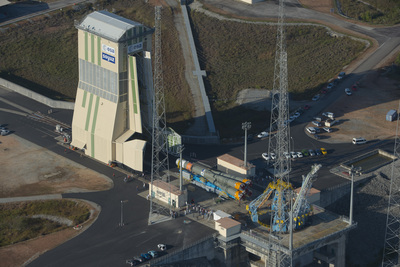
    Soyuz VS03, the third Soyuz flight from Europe’s Spaceport in French Guiana, was transferred to the launch zone on October 8. The vehicle was rolled out horizontally on its erector from the preparation building to the launch zone and then raised into the vertical position, in preparation of the launch of two Galileo satellites.

    Europe’s next two Galileo satellites have received technical clearance for their launch this Friday. They are currently resting in place atop their Soyuz launcher.

    Yesterday saw the three-stage Soyuz ST-B launcher moved horizontally to the launch pad on the 600-meter long railway. It was then lifted into the vertical position to await the attachment of the Upper Composite — the combination of twin Galileo satellites, the dispenser holding them in place, the Fregat-MT upper stage and the protective fairing.  
    Meanwhile, the satellites themselves underwent their formal Launch Readiness Review, after which the Upper Composite joined the Soyuz at the launch pad to be mated to the Soyuz that evening using the mobile gantry. The Soyuz and Upper Composite will undergo a full launch dress rehearsal in the remaining days before the 18:15:00 GMT (20:15:00 CEST) launch on October 12, including preparations for fueling the vehicle, which will begin four and a half hours before liftoff.

    This follow-up launch marks a major step for Europe’s own satellite navigation system. Four is the minimum number of satellites needed to achieve a navigational fix on the ground, with one satellite each to measure latitude, longitude, altitude and provide a time reference. So once this second pair of satellites has been commissioned and tested, the quartet will form a completely operational mini-constellation that will be used to validate the Galileo system.

    The performance of the satellites in space together with the worldwide ground infrastructure serving to maintain Galileo’s service accuracy will be assessed in depth, to prepare the way for the launch of further satellites and then deliver initial services by mid-decade and finally build up to full operational capability.

    These two new satellites are also the first to carry search and rescue antennas to pinpoint aircraft and ships in distress as part of the international Cospas–Sarsat system.

    Photo: Galileo
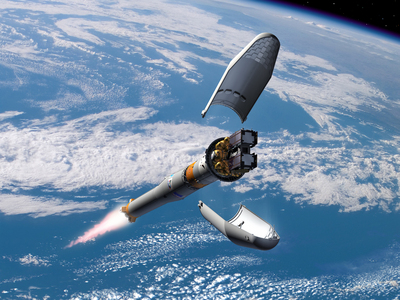
    The two Galileo In-Orbit Validation satellites are protected during their launch by Soyuz by a launch fairing. Once the Soyuz has passed most of the way through the atmosphere, this fairing can then be ejected.


  • Twin Galileo Satellites Fueled and Ready for Launch

    credit: ESA
    Galileo FM3 Fueling (credit: ESA).

    A pair of Galileo satellites are now fully fueled and mated together atop the upper stage that will haul them most of the way up to their final orbit. The launch is planned for the evening of October 12, reports the European Space Agency.

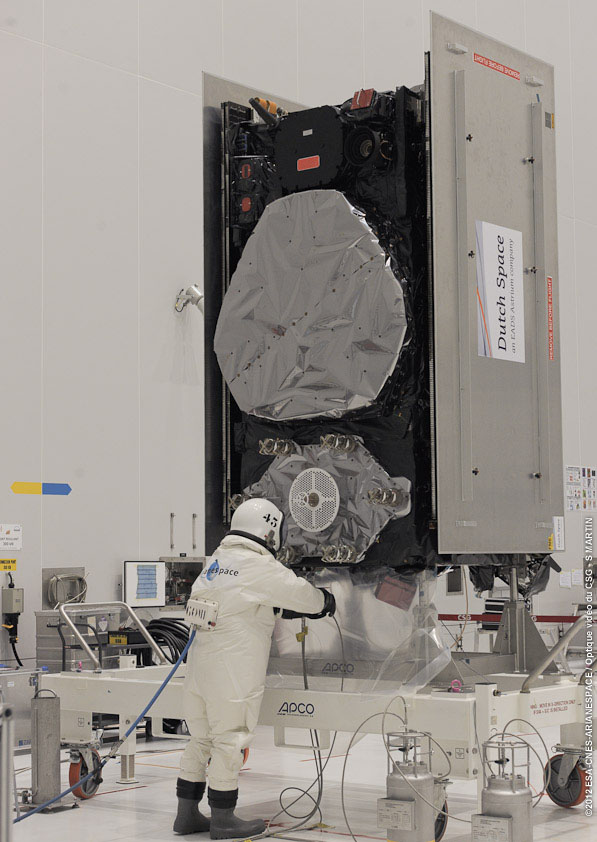
    Technicians donned protective suits to fill the two satellites’ tanks with hydrazine fuel, used to maintain the satellites’ attitude and orbital position during their planned 12-year lifetime.

    Rather than carry a significant amount of extra fuel to insert themselves into their planned orbits – like typical telecommunications satellites or Galileo’s US GPS equivalents – the Galileo satellites are transported to medium orbit by the Fregat fourth stage of their Soyuz ST-B launcher.

    Doing without this extra fuel and orbital thrusters means that Galileo satellites are small enough to be launched in pairs aboard the Soyuz – or in fours by the new Ariane 5 variant currently being prepared.

    The Galileo satellites are attached to a special dispenser that holds them securely in position during launch, before pyrotechnic mechanisms release them sideways in opposite directions once their set 23 222 km altitude is reached.

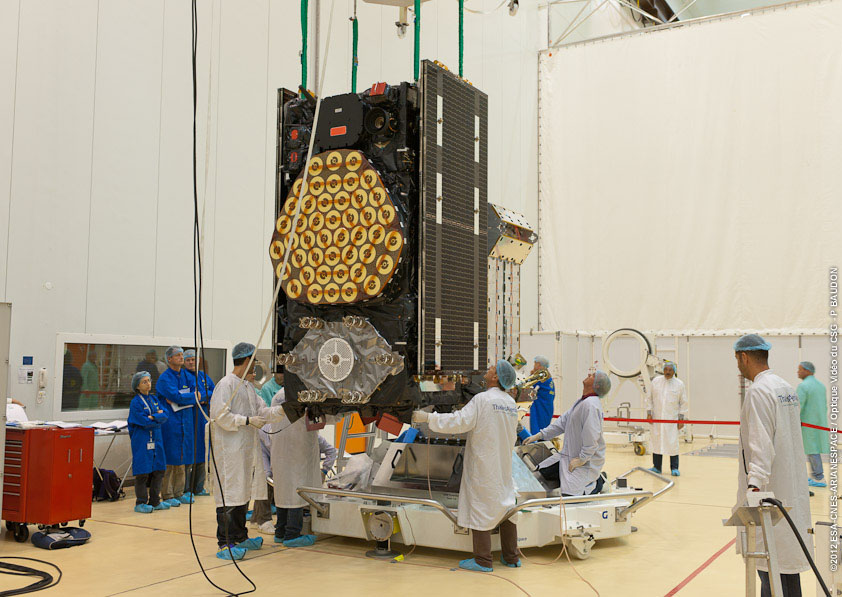
    The aluminum plates on each side of the satellites are temporary additions to protect their delicate solar panels; these will be removed later.

    credit: ESA
    Galileo’s fit-check with dispenser (credit: ESA).

    The combined satellites, dispenser and Fregat upper stage will now be carefully checked ahead of the next major milestone, the fitting of the protective launch fairing on Thursday.

    The mission’s satellite launch readiness review will begin at the start of the following week. If that goes well, the combined ‘Upper Composite’ will be moved from the Fregat Integration Building to the launch pad, where it will be attached to the Soyuz launcher.

    Completing Galileo’s validation phase

    The launch will see these two new Galileo In-Orbit Validation satellites joining the first two that have been orbiting since October 2011.

    This is a significant milestone for Europe’s Galileo programme because four is the minimum number required for navigational fixes, enabling full system testing whenever they are all visible in the sky.

    This validation phase will be followed by the deployment of more satellites and ground segment components to achieve ‘Full Operational Capability’. After that, users on the ground can exploit the services.

    The first four Galileo satellites were built by a consortium led by EADS Astrium, Germany, with Astrium producing the platforms and Astrium UK responsible for the payloads. They were assembled and tested in Rome by Thales Alenia Space.

    credit: ESA
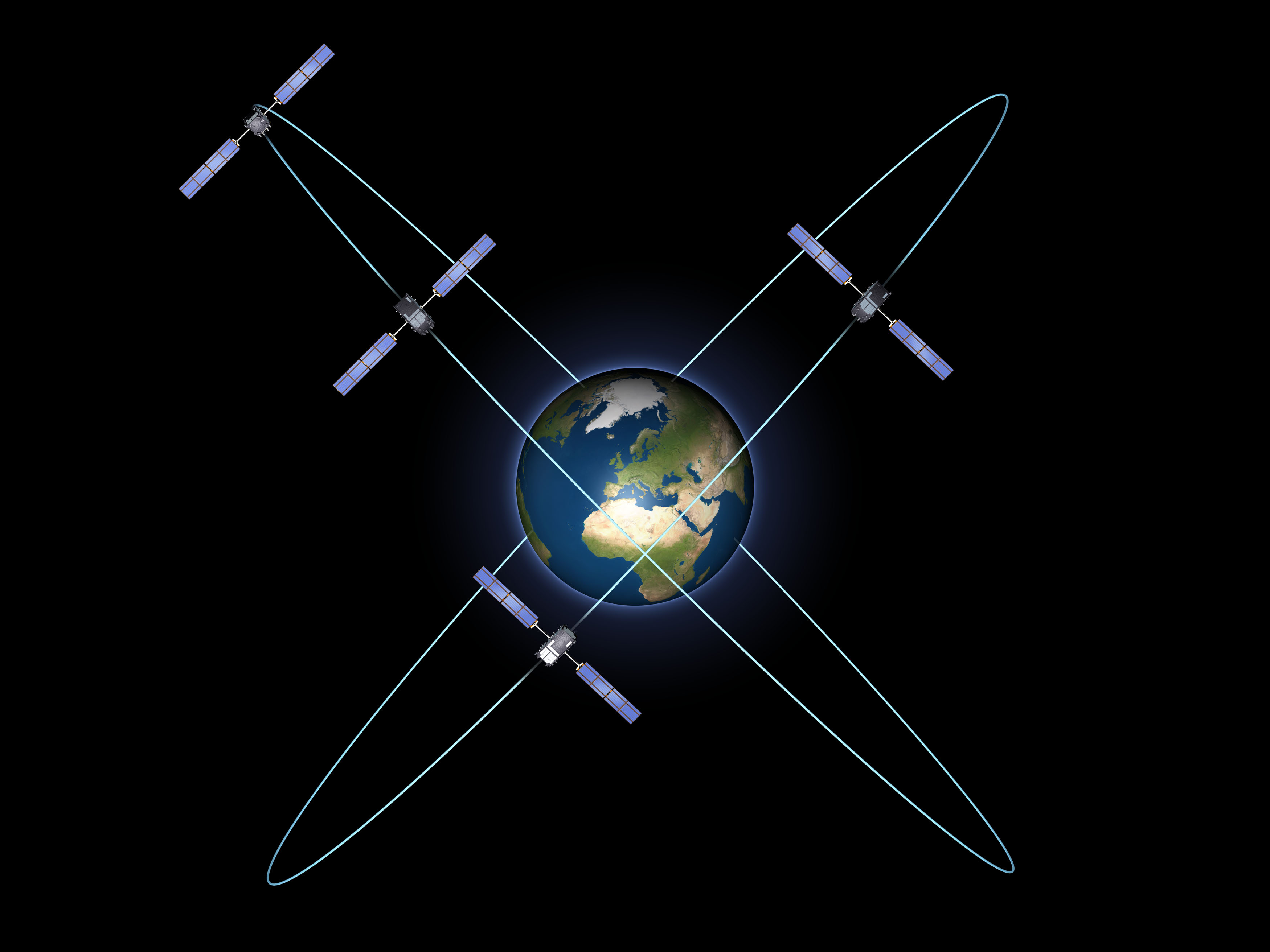
    Galileo IOV in orbit (artist’s rendering, courtesy of ESA.)
  • JAVAD Asserts Filters Protect GPS L1, L2, L5; GLONASS L1, L2; Galileo L1, L5

    Javad Ashjaee, founder and CEO of JAVAD GNSS, has filed a letter with the U.S. Federal Communications Commission (FCC) concerning his company’s development of technical possibilities in GNSS filter designs and components. He states “I hope this will be helpful in establishing realistic guidelines for the characteristics of high-precision GNSS receivers that will be used in critical applications.”

    Below is the full text of the letter.


    September 7, 2012

    The Honorable Julius Genachowski
    Chairman
    Federal Communications Commission
    445 12th Street, S.W.
    Washington, D.C. 20554

    The Honorable Lawrence E. Strickling
    Assistant Secretary for Communications and Information
    National Telecommunications & Information Administration
    United States Department of Commerce
    1401 Constitution Avenue, N.W.
    Washington, D.C. 20230

    Dear Chairman Genachowski and Assistant Secretary Strickling:

    In this communication I want to inform you of the current status of technical possibilities in GNSS filter designs and components. I hope this will be helpful in establishing realistic guidelines for the characteristics of high precision GNSS receivers that will be used in critical applications.

    We have improved our previous L1 filter and have extended the design to include all commercial GNSS bands.

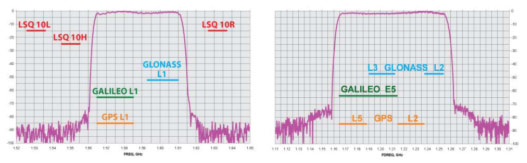
    Javad's FCC filing

    Figure left above is our filter that protects GPS L1, Galileo L1 and GLONASS L1 bands. It brings in all the useful signals intact and rejects out of band signals with the slope of about 12 dB/Mhz. Similarly, Figure right above is our filter that protects GPS L2, GPS L5, GLONASS L2 and Galileo L5 and has slope of about 9 dB/Mhz.

    These filters have been extensively tested with five different innovative tests and prove that the filters also improve the performance of GNSS receivers. These extensive innovative tests are embedded in the receivers that we mass-produce today and every user can test their receivers in all environments. These tests are much more extensive than those previously employed by PNT and other organizations. These embedded tests are not only much more extensive, but it takes only a few minutes to perform these by any novice user by clicking some receiver buttons. Compare that to the limited tests by PNT and others that took weeks to perform and needed experts with very expensive equipment in some laboratories to perform.

    Attached is our 8-page commercial advertisement that has more details on filters and embedded test features.

    These filters not only protect GNSS signals against all LightSquared signals (10L, 10H and 10R handsets) but also from all similar signals that may appear near all commercial GNSS bands in the future. We are proud that our filters help allow better usage of these precious bands, in particular for broadband wireless communication that our country desperately needs.

    These filters apply to wideband high precision GNSS receivers and the cost is even less than earlier conventional filters. The case of narrow-band low precision receivers (e.g. Garmin) is much simpler, as has been demonstrated by GPS receivers in more than 300 million cell phones and mobile devices which are not affected by LightSquared signals. The low precision receivers (L1 C/A code only) require filter slopes 10 times less steep than those presented here and do not necessitate additional costs.

    In summary, the technology exists today of improved filter design and better performing GNSS receivers and can actually be done at a cost lower than current conventional GNSS receiver filter designs. I trust that the information that I have presented can be used in establishing the performance guidelines and requirements for all GNSS receivers used in critical applications.

    I also would like to invite your representatives to ION-2012 GNSS conference where we present details and answer questions at 2:00 PM on September 20.

    Regards,
    Javad Ashjaee, Ph.D.
    Javad Ashjaee, Ph.D.
    CEO, Javad GNSS
    San Jose, California
    USA

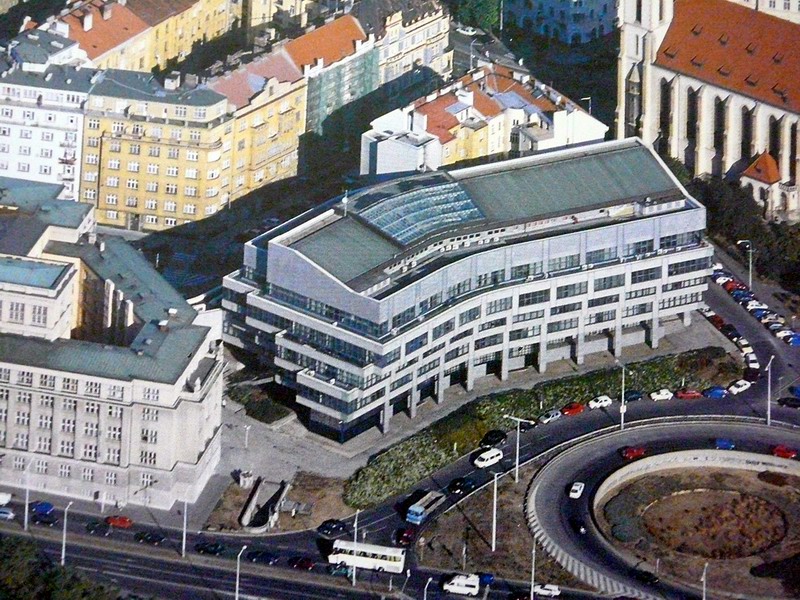
  • Galileo Satellite Navigation Agency Moved to Prague

    Galileo Satellite Navigation Agency Moved to Prague

    Credits: Astrium/Raoul Kieffer
    Credits: Astrium/Raoul Kieffer

    On September 6, the European GNSS Agency (GSA) inaugurated its new premises in Prague, Czech Republic, in the presence of Commission Vice-President Antonio Tajani, in charge of Industry and Enterprise, and Minister of Transport Pavel Dobeš. Previously headquartered provisionally in Brussels, the headquarters of the Galileo program moved its seat to Prague over this summer, as had been agreed by the EU heads of state and government on December 10, 2010.

    Galileo is expected to be partly operational by the end of 2014.

    Tajani said two satellites will be launched in October, and beginning in 2013 four more Galileo satellites will be launched every six months until the network of 30 is completed in 2020.

    Credits: Astrium/Raoul Kieffer
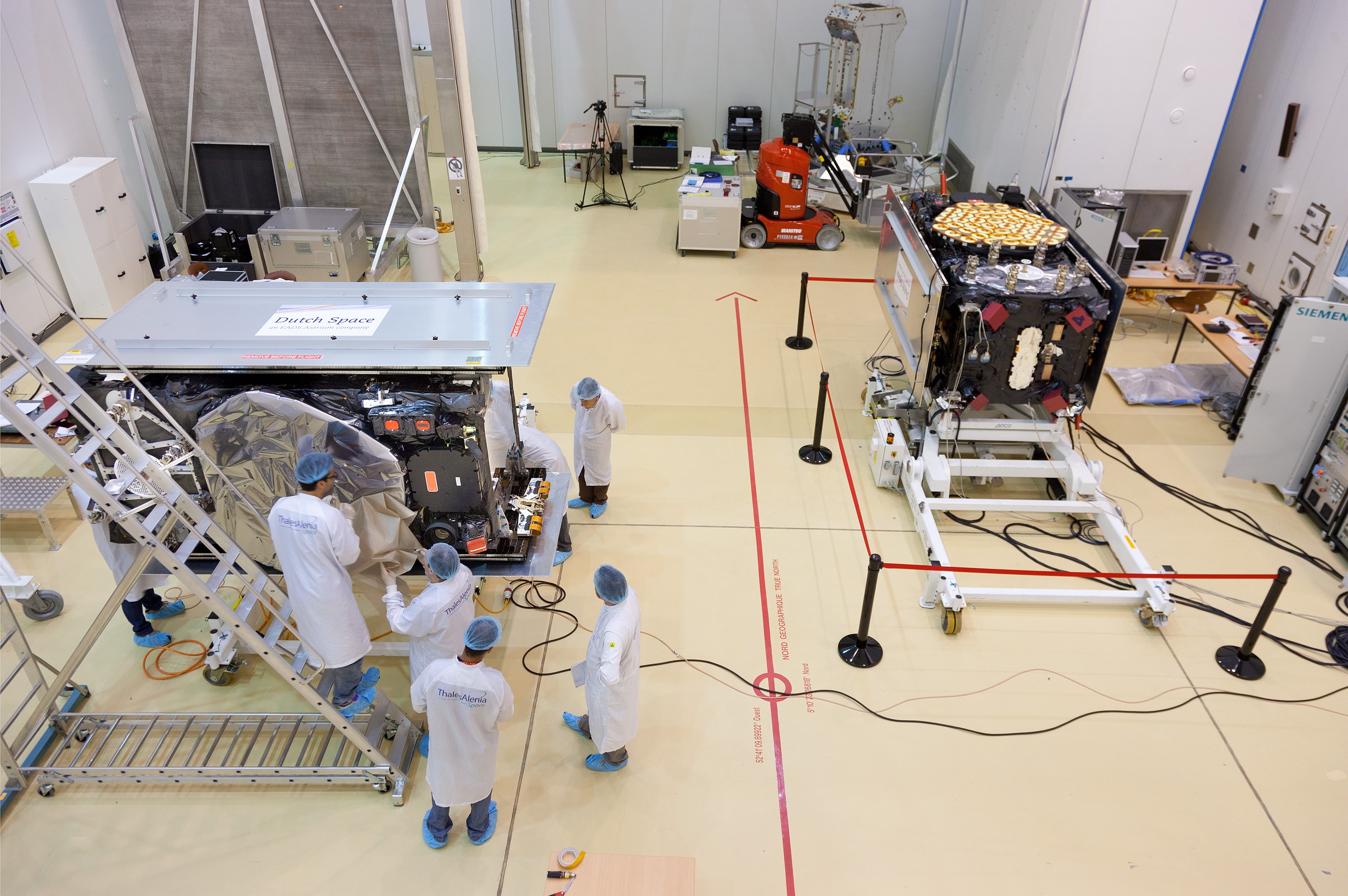
    Galileo In-Orbit Validation satellites Flight Model 3 and 4 being worked on at the Guiana Space Centre on 27 August 2012. Multi-layer insulation is being applied to FM3. (Credits: Astrium/Raoul Kieffer)

    GSA ensures security of satellites and prepares ground for new GNSS products. The agency is responsible for a number of implementation tasks for the European Satellite Navigation programmes Galileo and EGNOS (European Geostationary Navigation Overlay Service), which are managed by the European Commission. Its two main tasks are:

    • Security (security accreditation of satellites, launchers, and sites, and the operation of the Galileo Security Monitoring Centre), and
    • Market Development for the European satellite navigation systems (for example, see MEMO/12/601, New products and services possible using Internet access to satellite navigation data).

    Additionally, the GSA has been assigned other tasks by the commission by delegation, for instance promoting GNSS applications and services, supporting the development of a Public Regulated Service (PRS) and preparing the exploitation of the GNSS systems.

    Security of Galileo Programme. The GSA’s security accreditation activities are of key importance for the satellite launches. After a successful first launch of two satellites on October 21, 2011, the “In-Orbit Validation” phase will be accomplished with a second launch of two satellites on October 10, 2012. From 2013 on, the deployment of the satellite infrastructure will continue faster, with several launches per year until the full constellation of 30 satellites (which includes six in-orbit spares) is reached before the end of the decade.

    Future role of the GSA. A commission proposal for revising the GNSS Regulation, which is now before Parliament and Council, foresees that operational responsibility for the GNSS Programmes will be gradually transferred from the European Commission to the GSA over the next multi-annual financial framework (2014-2020). This process will start with EGNOS in 2014, and already a number of preparatory tasks have been allocated to the GSA, including the procurement for the future operations of EGNOS.

    To carry out these new functions, the GSA’s staff is expected to increase over the coming years from about 60 today to more than 180 by the end of next financial framework in 2020.

    The Budget. The GSA has an annual budget of about €12,750 million (2012). In addition, it manages the budget for activities that are entrusted to it under delegation from the European Commission. These amount to €34.4 million for exploitation activities.

    According to the commission’s calculations, a total budget of € 7000 million is necessary to complete the deployment phase of the Galileo programmes and finance the exploitation phase of the GNSS programmes over the 2014-2020 period. The commission’s proposal for a new GNSS Regulation foresees that the GSA will manage the budget necessary to operate EGNOS and Galileo and ensure service provision. This budget will be assigned under a delegation agreement signed with the commission, a mechanism foreseen under the European Union’s Financial Regulation. Under this arrangement, the commission would remain responsible for the overall political supervision of the GNSS Programmes. However, the GSA would ensure the exploitation of the GNSS systems with the appropriate level of autonomy and authority.

    The Structure of the GSA. The GSA today is composed of a security department, a market development department, and an organizational entity charged with preparing the GSA’s future responsibilities in the management of the GNSS Programmes. In addition to a number of horizontal departments that ensure the agency’s functioning, the Galileo Security Monitoring Centre is an organizational component of the GSA.

  • Upcoming Navigation Satellite Launches Scheduled

    News courtesy of CANSPACE listserv.


    Launch dates this fall for GNSS satellites are as follows, according to various sources:

    Compass M2 and M5: September 18, 18:12 UTC (speculative); Compass G6: No earlier than October 1.

    GSAT-10 (includes a GAGAN SBAS transponder): September 21.

    GPS IIF-3: October 4, 2012. Launch window: 12:10-12:29 UTC.

    Galileo IOV FM3 and FM4: October 10, 18:31 UTC.

    Luch-5B: Originally scheduled for October 15, launch has slipped to no earlier than November 1 due to an issue with the “Briz-M” upper stage, which caused the loss of the Telkom-3 and Ekspress-MD2 communication satellites during their launch on August 6.

    GLONASS-K1 (block K2s): November 14.

  • Preparations Move Forward for Next Galileo Launch


    Galileo Flight Model #3 (FM3) is readied for the satellite’s fit check on the dispenser that will carry it and FM4 in a parallel arrangement on Soyuz’ next launch. The silver-colored dispenser is partly visible behind two mission team members during this activity in the Spaceport’s S1B payload preparation building.


    Both Galileo navigation satellites for Arianespace’s third Soyuz flight from the Spaceport are now in French Guiana, marking a new milestone for this mission scheduled in the second half of 2012, according to Arianespace.

    The Flight Model #4 (FM4) satellite arrived Friday at Félix Eboué International Airport near the capital city of Cayenne, delivered by a chartered Ilyushin Il-76TD cargo jetliner.

    Its FM3 co-passenger remains busy in the Spaceport’s S1B payload preparation building — completing its fit check with the dispenser for the dual-satellite payload arrangement on Soyuz. The dispenser was developed for Arianespace by RUAG Space, and carries the satellites in a parallel arrangement.

    These two spacecraft will join another pair of Galileo satellites launched by Arianespace in October 2011 on Soyuz’ maiden flight from French Guiana. All four are In-Orbit Validation platforms that will enable European industry to validate prototype Galileo-based receivers and services using actual satellite signals, while also allowing performance assessments of the ground system that will maintain the Galileo system’s precision.

    Arianespace is responsible for deploying the entire Galileo constellation, to be composed of 30 satellites in orbit as an independent global satellite navigation system for Europe.

    Galileo launches began with the 2005 and 2008 orbiting of two experimental satellites — GIOVE-A and GIOVE-B — carried on Soyuz vehicles operated from Baikonur Cosmodrome in Kazakhstan by Arianespace’s Starsem affiliate. It was followed by October 2011’s maiden Soyuz launch from French Guiana with the constellation’s first two operational satellites.

    Arianespace is able to use a mix of both its medium-lift Soyuz and heavy-lift Ariane 5 launchers in deploying the full Galileo system, demonstrating the company’s flexibility in orbiting satellite constellations.


    The photo shows FM4’s unloading from the Ilyushin Il-76TD cargo jetliner at Cayenne’s Félix Eboué International Airport.


    The fourth Galileo flight model satellite being unloaded at Cayenne Airport in French Guiana on August 17. (Credits: ESA/EADS Astrium – Raoul Kieffer)

  • GIOVE-B: Lost and Found

    News courtesy of CANSPACE Listserv.


    After more than four years of service as a Galileo test-bed satellite, GIOVE-B was retired on July 23. Its navigation transmitters were switched off and, according to an announcement from the European Space Agency, the satellite’s height was subsequently raised in a series of steps to place it in a so-called “graveyard” orbit where there will be no danger of it interfering with the operational Galileo satellites or other spacecraft.

    After the first delta-V orbit manoeuvre, NORAD/JSpOC lost the satellite — at least NORAD/JSpOC stopped providing updated two-line orbital element sets for it. Eventually, 24 days later, the agency found it and resumed issuing element sets.

    Just before the orbit manoeuvres, GIOVE-B had a mean motion of 1.70959839 orbits per day according to NORAD/JSpOC, which translates to an orbit semi-major axis value of approximately 29,544 kilometres. When NORAD/JSpOC recovered the satellite, its mean motion was 1.65377594 orbits per day with a semi-major axis of 30,205 kilometres, a change of 661 kilometres.

  • The System: Fly the Pilotless Skies: UAS and UAV


    Unmanned aerial vehicles and civil aircraft may co-habit the airspace after September 2015.

     As the U.S. Federal Aviation Administration (FAA) moves ahead with plans for unmanned aerial systems/vehicles (UAS/UAV) to have regular access to U.S. airspace by 2015, it has encountered several barriers. For UAVs to be treated like manned aircraft, their systems likley need to be qualified to the same standards as civil avioncs. This is a challenge, as each UAS has largely unique systems. UAS equipment standards are emerging, but threats to GNSS abound, requiring defense/mitigation.

    Demand for UAS has produced many different types flying in a range of applications. With no apparent standard avionics fit or uniform safety standards, each UAS type is basically configured for specific tasks. Commercial UAS applications continue to emerge, and major market growth is anticipated. One forecast indicates that the UAS market could reach $7.26 billion this year alone. The promise of new and better ways to reduce costs, improve safety, and increase operational efficiency feeds market expansion.

    However, in the United States the FAA currently requires each UAS commercial project desiring access to controlled airspace to obtain an FAA-approved Certificate of Authorization. While the FAA has made efforts to speed up approvals, this process slowed widespread commercial adoption of UAS. Nevertheless, opportunities abound in pipeline and transmission line inspection, crop spraying, law enforcement, security, and surveillance, survey/mapping, remote area mail delivery, and hundreds of other applications. The FAA may have felt some pressure to move forward, because Congress has put in place the Modernization and Reform Act of 2012, which calls on the FAA to fully integrate unmanned systems, including those for commercial use, into the national airspace by September 2015.

    UAS in the NAS. Meanwhile, a project called the Unmanned Aircraft Systems Integration in the National Airspace System (UAS in the NAS), undertaken by NASA’s Dryden Flight Research Center, seeks to reduce technical barriers related to safety and operational challenges associated with enabling routine UAS access to the NAS.

    Europe has also launched a study on the integration of UAS in non-segregated airspace for the future Single European Sky. The ICONUS study will be carried out by a consortium within the European air traffic management program called Single European Sky ATM Research Programme (SESAR). The study will drive the definition of the requirements, capabilities, and equipment which UAS will need to operate safely and efficiently in the coming European SESAR environment.

    The U.S. RTCA SC-203 committee is drafting UAS operational requirements, and there has been significant progress towards publishing Minimum Aviation Performance Standards (MASPS), including requirements for navigation. Europe has similar activities underway aimed at improving UAS access to its airspace.

    MOPS. The big picture is that requirements for unmanned aircraft are being brought into conformance with the standards applied to the performance and behavior of manned aircraft. Navigation requirements for UAS are expected to specify that systems will need to be qualified to Minimum Operational Performance Standards (MOPS). This means that on-board electronics, including GNSS systems, will probably need to be FAA Technical Standard Orders (TSO) qualified, just as they are now for manned aircraft.

    Why do we need to investigate certified avionics now? In the scheme of avionics, more than two years breathing space to certify UAS avionics systems is not a long time, not at all, until the September 2015 deadline. FAA airborne software and hardware qualification will take much time and effort to implement, and re-configuration of systems, interfaces, and operating procedures may take even longer.

    For Manufacturers. UAS makers have the option to move forward in stages. For instance, by selecting a few existing airborne-qualified OEM avionics, they could minimize the internal effort to comply. As the first UAS with certified avionics emerge, they will probably get good support from FAA to adopt U.S. operating rules for the NAS. Embedding an existing certified GPS receiver in UAS avionics will reduce the internal work needed and allow more effort for developing commercial market opportunities that look to quickly adopt UAS.

    Meanwhile, efforts are in full swing to change the U.S. and European navigation landscapes over the next few years. So it would be better to be ready with a capable GNSS receiver that is already built to meet the challenges of NextGen and SESAR.

    GPS III and Galileo. The L5 civil GPS frequency may be operational around the time that UAS unrestricted access becomes possible. GPS L1/L5 dual-frequency operations will enable higher navigation accuracy, reliablity, and integrity. The FAA is already developing NextGen WAAS to include L5, and revisions to the GPS MOPS to include L5 should begin shortly, in time for a usable GPS L5 constellation in 2015/2016. The FAA is already preparing for L5 avionics, and industry investigative work is underway. Its possible that GPS L1/L5 may meet the accuracy and integrity requirements for CAT II/III automated landings. In Europe, Eurocae work is expected to gain momentum for the Galileo E1/E5a MOPS as the Galileo satellite navigation system becomes operational.

    The new GNSS environment also includes WAAS/SBAS precision approach (localizer performance with vertical guidance, or LPV) capability: LPV is available now in the United States and will soon be in wider operation in Europe. Automatic Dependendant Surveillance (ADS-B) is rolling out in the United States and around the world. ADS-B is being mandated within the U.S. NAS as the means for air-traffic control to track all aircraft, so UAS avionics will need to include certified ADS-B Out capability.

    In one commercial instance, the Septentrio AiRx2 receiver comes out of the box as a certified L1 GPS with ADS-B and WAAS LVP, but is also ready for GPS L5 and Galileo E1/E5a.

    Even as greater steps forward enhance how GNSS is used in this wider definition of aviation that will soon include UAS, a team at the University of Texas demonstrated how a UAV could be maliciously side-tracked (see article on page 30 of this issue) —  reminiscent of the Iranian downing of a U.S. surveillance drone in December 2011.

    Admittedly the GPS on the vehicle in the UT test was not a qualified airborne receiver, but how could this happen when there was also an inertial sensor and a radio-altimeter on the UAV? A good question, which UAV manufacturers will need to consider when they implement their on-board Kalman filters, knowing that spoofing is now an additional threat to parry.

    Couldn’t we detect that high-power RF spoofing signal at the front-end of the GPS receiver? Even if only to tell the on-board systems that there could be hazardous misleading information about? Or run separate GPS and GPS/inertial position solutions, detect significant divergence, and set the same warning flag? And multi-constellation, multi-frequency receivers, and even controlled radiation pattern antennas — all things to investigate.  More work for the aviation receiver guys who labor tirelessly to improve GNSS integrity.

    Of course if you hijack a UAV with a high-power spoofer, you are also spoofing civil transports operating in the same airspace, so now there is the potential to trigger a Federal investigation. It will probably be easier to detect this stuff with moving airborne sensors rather than the fixed ground equipment used to find jammers on trucks at Newark airport, and lots of pilots likely providing real-time location information on radios if their GPS goes even a little haywire. All would help to quickly locate and shut down any spoofer. Nevertheless, it’s a threat to be mitigated.

    Fatal Crash. In South Korea, the effects of intermittent North Korean jamming of GPS to disrupt seal, land, and air navigation in the South may have contributed to the recent fatal crash of a Schiebel Camcopter S-100 drone, a 150-kilogram rotorcraft capable of 220 km/h flight. It should have coped with loss of GPS as the Camcopter has multiple inertial measurement units that allow safe operation and recovery in the absence of GPS signals. Emergency procedures to ensure a safe recovery in such a situation do not appear to have been correctly and adequately followed, manufacturer Schiebel alleges.

    NovAtel may have found one way to help mitigate spoofing on UAVs; the company released a combined civil/SAASM GPS receiver, the OEM625S, aimed specifically at UAVs. Granted, the idea is to add SAASM anti-spoofing capability to a number of UAVs which currently use NovAtel commercial receivers, mostly in military systems. That may be motivated by the desire to avoid further Iranian incidents!

    BAE Systems has been thinking of giving GPS a back-up for just those situations where jamming or even spoofing is detected. BAE’s Navigation via Signals of Opportunity (NAVSOP) system was just announced at the Farnborough air show in the UK and is still in research phase, but looks extremely promising. It interrogates the radio environment for the ID and signal strength of local digital TV and radio signals, plus air traffic control radars, with finer grained adjustments coming from cellphone masts and Wi-Fi routers. Mapping the location of all these sources might be quite an undertaking, and given that these are all non-safety-of-life commercial signals, the sources are subject to the vagaries of power outages, regular maintenance, and breakdowns. Nevertheless, with such a multitude of signals, NAVSOP could well turn out to be a viable back-up for GNSS.

    So, shared access to civil airspace, wider applications in commercial operations, and changes in equipment qualification, along with potential solutions for GNSS jamming and spoofing: lots to consider for the UAS industry.


    Taking It to the House

    U.S. House of Representatives Committee on Homeland Security; Subcommittee on Oversight, Investigations, and Management; Hearing, July 19, 2012:  Using Unmanned Aerial Systems Within the Homeland: Security Game Changer?

    Testimony by Todd E. Humphreys, Ph.D.; Assistant Professor, Cockrell School of Engineering, The University of Texas at Austin. [Excerpted. Prof. Humphreys is a co-author of the article “Drone Hack” in the August issue of GPS World.]

    The vulnerability of civil GPS to spoofing has serious implications for civil unmanned aerial vehicles (UAVs), as was recently illustrated by a dramatic remote hijacking of a UAV at White Sands Missile Range.

    Hacking a UAV by GPS spoofing is but one expression of a larger problem: insecure civil GPS technology has over the last two decades been absorbed deeply into critical systems within our national infrastructure. Besides UAVs, civil GPS spoofing also presents a danger to manned aircraft, maritime craft, communications systems, banking and finance institutions, and the national power grid.

    Constructing from scratch a sophisticated GPS spoofer like the one developed by the University of Texas is not easy. It is not within the capability of the average person on the street, or even the average Anonymous hacker. But the emerging tools of software-defined radio and the availability of GPS signal simulators are putting spoofers within reach of ordinary malefactors.

    There is no quick, easy, and cheap fix for the civil GPS spoofing problem. What is more, not even the most effective GPS spoofing defenses are foolproof. But reasonable, cost-effective spoofing defenses exist which, if implemented, will make successful spoofing much harder.

    I recommend that for non-recreational operation in the national airspace civil UAVs exceeding 18 lbs be required to employ navigation systems that are spoof-resistant.

    More broadly, I recommend that GPS-based timing or navigation systems having a non-trivial role in systems designated by DHS as national critical infrastructure be required to be spoof-resistant.

    Finally, I recommend that the DHS commit to funding development and implementation of a cryptographic authentication signature in one of the existing or forthcoming civil GPS signals.

    Complete testimony (PDF) covers:

    • The potential vulnerabilities of U.S. national transportation, communications, banking and finance, and energy distribution infrastructure;
    • What does it take to build a spoofer? Buy a spoofer?
    • Range and required knowledge of target.
    • Fixing the problem:

    •    Jamming-to-noise sensing defense;
    •    Defense based on SSSC or NMA on WAAS signals;
    •    Multi-system multi-grequency defense;
    •    Single-antenna defense;
    •    Defense based on spread-spectrum security codes on L1C;
    •    Defense based on navigation message authentication on L1C, L2C, or L5;
    •    Correlation prole anomaly defense;
    •    Multi-antenna defense;
    •    Defense based on cross-correlation with military signals.

  • First Positioning Results Using Galileo Announced

    A team of Canadian and German researchers have obtained precise three-dimensional positions using measurements from the four prototype Galileo satellites now in orbit.

    The two In-Orbit Validation (IOV) satellites launched in October 2011 joined the two Galileo In-Orbit Validation Element (GIOVE) satellites launched in 2005 and 2008, forming a mini-constellation. For a few hours on certain days, signals from all four satellites could be received by state-of-the-art multi-frequency, multi-constellation GNSS receivers. The researchers used the GIOVE plus IOV satellite observations made by a Trimble Navigation NetR9 receiver operated at the University of New Brunswick in Fredericton, Canada, together with precise orbit and clock data derived from observations collected on the COoperative Network for GIOVE Observation (CONGO) to obtain receiver positions converging to an accuracy of a few centimeters.

    An article describing the researchers’ procedure and results obtained will appear in the September issue of GPS World.

  • SSTL Signs €80M Contract with OHB for Second Batch of Galileo Payloads

    Surrey Satellite Technology Ltd (SSTL) Director of Telecommunications & Navigation, John Paffett, has today signed a contract with Ingo Engeln, member of the Executive Board of OHB System AG at the Farnborough International Airshow, for the construction of a further eight navigation payloads for the European Galileo programme.

    Under the contract, worth approximately €80 million, SSTL will construct the navigation payloads for the second batch of Full Operational Capability satellites (Work Order No. 2), continuing a successful cooperation between the two companies to build the first 14 satellites (Work Order No. 1) under the supervision of the European Space Agency (ESA).

    Matt Perkins, CEO of SSTL, commented, “We value our role in the Galileo programme greatly. SSTL is committed to the FOC programme and together with OHB we are making great strides towards the completion of the first satellites — a momentum which we will carry forward with these next eight payloads.”

    "It is a pleasure to witness this signature, it shows OHB and SSTL are preparing at full speed the building of the additional eight satellites ordered at the beginning of 2012 for the GALILEO constellation. These will complement the order of 14 satellites initiated in 2010," said Giuliano Gatti, head of the ESA Galileo Space Segment Procurement Office.

    Today’s contract formalizes arrangements between the two companies following the award of Work Order No. 2 to the OHB-SSTL team by Antonio Tajani, European Commission vice president in February of this year. Work has already begun on the new batch of payloads and the first is due for delivery in early 2014.

    SSTL is responsible for the navigation payloads that will provide all of Galileo’s services. Assembled and tested at SSTL’s Kepler Technical Facility in the UK, the sophisticated payloads are based on European-sourced equipment, including highly accurate atomic clocks, navigation signal generator, high-power traveling wave tube amplifiers, and antennas.

    The SSTL-OHB team is currently integrating the first of the FOC Work Order No. 1 satellites in at OHB’s facilities in Bremen, Germany, which are scheduled for launch next year.

    The Full Operational Capability phase of the Galileo program is managed and fully funded by the European Union. The Commission and ESA have signed a delegation agreement by which ESA acts as design and procurement agent on behalf of the commission.

  • The System: British Patent Filings Threaten GPS III and Galileo Progress

    Two British technologists backed by the U.K. Ministry of Defense have filed patents on the future interoperable GPS and Galileo signal designs that severely disrupt modernization plans for both systems and suddenly, unexpectedly place receiver manufacturers in a highly uncertain and unfavorable situation. Some of the patents have been granted in the U.K. and in Europe, and applications are pending in U.S. patent court, with a ruling expected at any time.

    Companies in the United States and outside the country are being approached and asked to pay royalties, on the basis of the patent filings, for use of the European E1 Open Service signal and the modernized GPS L1C signal. Should such initiatives prevail, costs would presumably be passed along to end users of GPS and Galileo — the same taxpayers who have already paid once for the systems.

    The purveyor of the royalty solicitations is Jim Ashe, vice president for sales and intellectual property at Ploughshare Innovations Ltd., Hampshire, UK. The patents, if successfully used to collect fees from satellite manufacturers or receiver manufacturers, would have a chilling effect on the use of the new interoperable signals that all parties have labored so hard, for so long, to design. They could quite possibly lead to a return to a BOC(1,1) structure for these signals, losing the benefits of MBOC.

    “There’s quite an argument going on,” said one person familiar with the controversy. “Some of the methods of arguing have not been too kind.”

    The Background. A great deal of work was accomplished cooperatively between the United States and the European Union (EU) to develop the landmark 2004 signal agreement that emerged from the Galileo Signal Task Force, formalizing cooperation on satellite navigation between the United States and more than two dozen European countries, including the U.K. Part of that agreement concerned a common signal structure (spectrum) for the civilian signals for both the E1 Open Service (OS) signal — the Galileo equivalent of GPS L1 — and the new U.S. GPS L1C signal to be implemented on the GPS III satellites, coming as early as 2015.

    The EU said during that process, in effect, “Even though we have agreed on this, Europe wants to be able to optimize the E1 OS signal beyond the agreement on that civilian signal being a binary offset carrier BOC(1,1) signal.” Both international entities had agreed that would be the waveform or the spectrum of the new signal.

    The Europeans began to evaluate methods of optimizing their signal. They had some designs called composite binary coded symbols (CBCS), a mechanism of putting a higher frequency componenent into the signal structure, and also a version called CBCS*, meaning that they found there was a bias generated by that extra signal, and so they had to invert every other one of its repetitions.

    The signal structure that they were playing with was centered on a plus and a minus 5-MHz component. (Actually five times 1.023, because of the inherent clock of GPS, you can think of it as 1.023 MHz. Everyone in doing compatible or interoperable signals agreed upon that; when reference is made to 5 or 10 MHz, or an even 5 or an even 10, it means that number multiplied by 1.023).

    The Europeans were were putting an additional BOC signal on top of the BOC 1,1, and it would have plus or minus 5 MHz as the centers of those two BOC peaks, and then some kind of waveform to modulate that.

    The United States pushed back against that to some degree, and proposed adoption of the so-called MBOC waveform, in which case the U.S. signal was equally optimized with a concept called time-multiplexed BOC (TMBOC). The Europeans used the CBOC approach. So, very different ways of doing this. In the European way, they transmitted a continuous but very low-power BOC(6,1) term. The U.S approach transmits four BOC(6,1) chips out of every 33 chips of code (see “Future Wave” sidebar).

    A chip in this case means a part of the spreading code, so each signal has its spreading codes, just like the C/A code is a spreading code, meaning a pseudorandom code modulating the carrier. L1C and E1 OS have a pseudorandom spreading code.

    The U.S. approach does not put BOC(6,1) components onto the data; that’s what is commonly called MBOC. The U.S. approach is TMBOC, on the pilot carrier only, not on the data component. The European system is like two separate signals, the BOC(1,1) signal having both pilot and data, and a BOC(6,1) signal having both pilot and data. They’ve put the (6,1) into both data and pilot components.

    Cue the Antagonists. Part of the task force from Europe and the United States considering the future signals’ make-up were Tony Pratt and John Owen, who works for the U.K. Ministry of Defense and whose office sponsored Pratt’s work. The two participated heavily in all these signal discussions. They stated in early meetings they planned to file patents in some areas.

    “Frankly,” states one source, “people should have paid more attention when they said that, and asked ‘What do you mean, and how’s it going to work, etcetera?’ And secondly, there probably should have been a written agreement between parties that nobody will take advantage or patent any of these ideas that we are developing.”

    Pratt and Owen filed a number of patents domestically, in the U.K., and and in the European Union, in 2003 and in 2006, and in other places around the world, such as Japan, Canada, and in the United States as well. Some of the U.K. and European patents have been granted. The first of some of those U.S. patents may be issued in the near future.

    The original patent filings were later amended to include new claims. The new claims were much more specifically oriented toward TMBOC and CBOC, whereas the original claims were more generally oriented toward modulated methods. The claims have been modified over the years; this is fairly standard patent practice.

    As a result, the original 2003 patent doesn’t necessarily read on a particular signal, but its early filing date has precedence. The claims have been updated and modified, and if the patent office issues those, as a true patent, then the new claims apply. Plenty of big patent battles have been fought over just such issues.

    Once the patent is issued, a satellite or receiver  manufacturer must assume that it is valid, and has only two responses to make, other than acquiescing to royalty claims. The manufacturer can either say, if building a product, “No, my product does not infringe, and I will prove that it doesn’t.’” The other choice for manufacturers is to go back into the patent office and sue the patent filer (and grantee) in the patent courts and prove that the patent was invalid in the first place that the patentee should not have been granted it.

    The United States and others were taken off-guard when the U.K. company Ploughshare, which is owned and controlled by a part of the British MoD called Defense Science and Technology Laboratory (DSTL), started making claims on manufacturers. The DSTL is similar to the U.S. Defense Advance Research Products Agency (DARPA), which is credited with inventing the Internet. If taxpayer money goes into something new and interesting, it is considered in some circles legitimate to file patents on those and attempt to recover taxpayer money through royalties on that taxpayer investment. That concept is not being challenged. Questions as to whether the patents are legitimate are very much in discussion.

    Ploughshare has contacted companies, saying, “If you use these signals coming from either the European satellites or the U.S. satellites, we will go after companies using these signals.” There are different patents issued, one by the European Patent Office, applying to most of the EU countries, that applies directly to the TMBOC signal, the E1 OS signal, and possibly also to Europe’s E5 signal, which is E5a and E5b; and there is also a patent for GPS III, the L1C signal.

    The Devil. For details on the various patents, see Application 10594128 and Application 12305401. See also European patent specification EP 1 664 827 B1, and International Application WO2007/148081. These are examples; there are other applications as well. It is to be argued in some future court as to how those patents are to be interpreted.

    “If you take the patent that hits TMBOC, and you take the broadest possible interpretation of that patent against receiver companies, it says: if you bring into your antenna and process that signal, whether you use all parts of it or not, for instance if you use the BOC(1,1) and not the BOC(6,1) part — then you infringe the patent. Others argue that if you don’t use both components, you don’t infringe.

    “But the claim is written broadly enough that it would apply to any receiver receiving and processing the signal. Nobody says what processing means. The patent says if you receive and process the TMBOC signal, as defined in the prior claim, you infringe the patent.

    “There is confusion as to whether that will apply or not apply — some people expect that it doesn’t and some people think that it might. That’s up in the air.”

    George Is Getting Upset. Various factions in the United States are upset by and trying to figure out what to do about the impasse. From a government point of view, there are three paths that the U.S. government can follow:

    • Put pressure on the U.K. diplomatically. That would be up to the State Department to put pressure on the EU or the U.K. in particular. The EU and the continental Europeans are equally furious at the British for doing this, as far as parties in the U.S. understand. This can’t be stated as a fact but is widely understood and thought to be the case. The diplomatic approach has its limits, obviously.
    • Go into Europe and fight the patents in European patent court and try to prove them invalid, to invalidate the patents. Companies could do the same thing, go into various courts, whether they be U.S. or European or Japanese, and say: “Our receivers don’t infringe,” and then have to prove that to the court; or say “The whole patent should not have been allowed, and I’ll fight the legitimacy of the patent.”
    • Some believe — and there is controversy and anger on this point — that, just as Galileo’s IOV satellites have the capability to transmit without the BOC(6,1) component, the United States should be able to do that with the GPS III satellites as well. Because if the signal is not there, and if the receivers are therefore not designed to process the signals that are not there, then the patent no longer has any relevance.

    “If we are to turn off the BOC(6,1) term for a period of time until the legal or diplomatic or other approaches worked, then we would be able to turn the BOC(6,10) term back on again, and return to the original agreed MBOC and TMBOC signals. That requires some coordination between the United States and Europe, and it requires some work to make that possible in the GPS III satellites, putting a switch in the GPS III satellites to permit the operators to turn that (6,1)BOC on and off. This is being hotly debated.”

    Some parties object, stating that L1C is too important a signal to mess with, and this proposal runs the risk of slowing down the program, and/or making it more expensive. They believe strongly that the off/on switch is not the best or most far-sighted option: why should the United States be forced to change its signal design due to an illegitimate patent, and in the end wind up with a less capable system?

    It is not publicly known whether the Air Force is or is not looking into that option.

    During the week of June 25 there was Working Group-A meeting in Washington D.C. followed by a plenary meeting between the EU and United States. The patent controversy was presumably discussed in some fashion, but whether formally addressed or lurking in the background is unknown at this time.

    “There is some naivete around this,” said the magazine’s soure. “It’s a serious threat. People think maybe they’ll only go after the high-end receivers, and maybe the royalties won’t be so bad. Ploughshare is trying to lull people into a false sense of security. The impact of this will be great unless it is defeated.”


    Future Wave

    Excerpted from the “Future Wave” article on L1C, GPS World, April 2011:

    “The L1C waveform originally was to have been a pure BOC(1,1) (a 1.023 MHz square wave modulated by a 1.023 MHz spreading code). Negotiations between the U.S. and the European Union (EU) at that time resulted in an agreement that both GPS and Galileo would use a baseline BOC(1,1) signal. However, the EU reserved the right to further optimize their signal within certain bounds. Some of the optimization proposals were known as CBCS and CBCS*. However, in further EU/US discussions it was decided that L1C and the Galileo E1 open service signal should have identically the same spectrum. This was a significant challenge because of different baseline signal structures and existing designs.

    “The breakthrough came when [U.S. representative] John Betz proposed what is called MBOC. The MBOC waveform has 10/11th of its power in BOC(1,1) and 1/11th in BOC(6,1). However, L1C and E1 OS achieve this result in very different ways. The Galileo technique is called CBOC. The GPS technique is called TMBOC. Whereas Galileo has a 50/50 power split between pilot and data and includes the BOC(6,1) component in each, GPS includes the BOC(6,1) waveform only in the pilot component by modulating four of every 33 spreading code chips with a 6 MHz square wave and 31 chips with a 1 MHz square wave. With 75 percent of the power in the pilot, the result is 3/4 x 4/33 or 1/11, as required. It is likely the BOC(6,1) signal component will be ignored by consumer-grade GNSS receivers where a narrow RF bandwidth is preferred. Fortunately that is a loss of only 12 percent (0.56 dB) of the L1C pilot power. However, for commercial and professional grade receivers, the extra waveform transitions (wider Gabor bandwidth) can be used to improve code tracking signal-to-noise ratio, and with certain advanced techniques it should be possible to improve multipath mitigation. This final point depends on careful control or calibration of the transmitted code timing and symmetry.”


    EGNOS and Galileo IOV Satellites Shift Right

    The next EGNOS satellite, originally scheduled for a June 18 launch, now has a rise date of July 7 from Baikonur Cosmodrome in Kazakhstan. The launch was delayed by a problem with a first-stage subsystem on the Proton rocket. SES-5 is also known as Sirius 5, stemming from the development of the Sirius satellite constellation by Nordic Satellite AB, now owned by Luxembourg’s SES.

    The satellite carries a transponder for the European Geostationary Navigation Overlay Service (EGNOS). The transponder is intended to eventually replace or one of those on the currently used EGNOS satellites (Inmarsat 3-F2 at 15.5 degrees west using PRN 120, Artemis at 21.5 degrees east using PRN124, and Inmarsat-4-F2 at 25 degrees east using PRN 126 and designated for industry tests).

    Unlike the present L1-only EGNOS satellites, SES-5 will have transponders on both L1 and E5 frequencies similar to the Wide Area Augmentation System satellites, which broadcast on L1 and L5.

    SES-5 is to be stationed at 5 degrees east longtiude.

    A second SES satellite with EGNOS transponders is under construction. The SES Astra 5B satellite is scheduled for launch in the second quarter of 2013 and will be positioned at SES Astra’s 31.5 degrees east orbital position.

    Role Switch. On March 22 and 23, Inmarsat-4-F2 at 25 degrees east using PRN126 and Artemis at 21.5 degrees east using PRN124 switched roles. PRN126 became an EGNOS operational signal-in-space satellite, while PRN124 became the test satellite, transmitting message type 0. PRN120 and PRN126 returned to service around 17:00 UTC on Tuesday, June 26.

    According to an EGNOS service announcement dated April 3, the switch was due to the aging state of the Artemis satellite.

    Galileo October Birds. According to a usually reliable source, the launch date for the second set of Galileo IOV satellites, previously announced as September 28, has been pushed back a couple of weeks to October 12.
  • Trial by Vacuum Brings Next Galileo Satellites Closer to Launch

    Source: GPS world staff
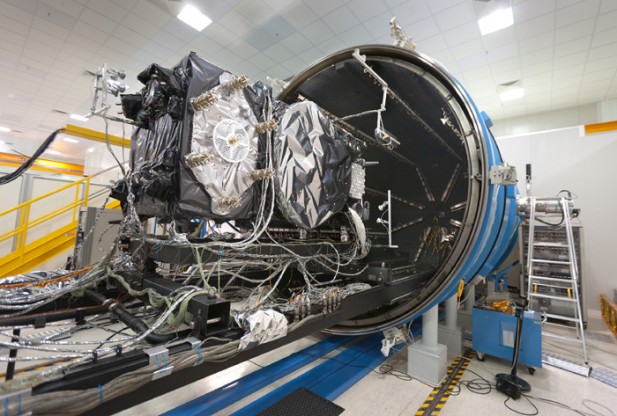
    The fourth Galileo In-Orbit Validation flight model satellite, FM4, pictured at the start of thermal vacuum testing at Thales Alenia Space Italy’s facility in Rome in May 2012. The third Galileo flight model, FM3, had already undergone this testing. Credits: ESA/EADS Astrium – R. Kieffer

    The next two Galileo navigation satellites have now endured the harsh vacuum and temperature extremes of space on the way to their scheduled 28 September launch, according to the European Space Agency. The fourth satellite completed 20 days of thermal vacuum testing at Thales Alenia Space Italy’s plant in Rome at the start of June. The third satellite completed the same tests the previous month.

    “These two satellites are almost identical to the first two Galileo satellites that were launched last 21 October,” explained ESA’s Nigel Watts. “So we don’t need to carry out full-scale qualification tests because we already know from our in-orbit test campaign that the design performs to our expectations. Instead, what we are carrying out is acceptance testing: checking the workmanship, performance and readiness to launch of these new satellites.”

    Thermal vacuum testing involves placing each satellite into a vacuum chamber and pumping out all the air. Its external surfaces are then variously heated and cooled while the satellite is operated. With no air in orbit to moderate temperatures, any part of a satellite in sunlight can become extremely hot, while those parts in shadow or facing deep space grow extremely cold. Critical systems must be kept within a set temperature range, however.
    “To give an idea, Galileo’s laser retroreflector on its exterior reached –110°C during the cold phase of testing,” said Guido Barbagallo, Galileo thermal engineer. “Meanwhile, the navigation high-power amplifiers could be driven to more than +40°C during the hot phase.”

    Like most satellites, Galileo’s uses a variety of methods to maintain its temperature range, including multi-layer insulation, heaters, heat pipes relying on evaporating ammonia to shift heat, and radiators to dump waste heat out to space. Galileo’s passive hydrogen maser atomic clock at the heart of its navigation services is precise to a second in three million years.

    But it requires extremely stable thermal conditions to achieve this. Its operating temperature needs to be regulated within a single degree, though in practice a tenth of that can be achieved.
    “The passive hydrogen maser is mounted on a 3 mm-thick aluminium plate to help hold a uniform temperature, with waste heat finally radiated to space from the external satellite surface,” added Guido.

    The atomic clock and the mounting plate are wrapped in multi-layer insulation and attached to the top panel of the satellite, which is itself kept permanently out of the Sun.