Category: GLONASS

  • The System: Next GPS IIF in October

    Next GPS IIF in October

    The next GPS satellite, Block IIF-3 (SVN65), scheduled to be launched on October 4, will be positioned in orbital slot 1, which is in plane A. This slot is currently occupied by a Block IIA satellite, SVN39, operating as PRN09. SVN39 is one of the oldest operating satellites in the GPS fleet, dating from June 1993. SVN65 will the the third of a projected 12 IIF satellites to attain orbit.

    Galileo IOV Tandem in October, Too

    The previously announced September 28 launch date for the second set of Galileo IOV satellites has reportedly been pushed back to October 10.

    Meanwhile, after more than four years of service as a Galileo testbed satellite, GIOVE-B was retired on July 23. Its navigation transmitters were switched off, according to an announcement from the European Space Agency, and the satellite’s height was raised in a series of steps to a graveyard orbit where there will be no danger of it interfering with the operational Galileo satellites or other spacecraft.

    The SES-5 geostationary communications satellite (also known as Sirius 5 and Astra 4B), launched in July, arrived at its orbital slot of 5 degrees east longitude late that month. The current position is actually about 5.2 degrees. The satellite carries L1 and L5 transponders for the European Geostationary Navigation Overlay Service (EGNOS) satellite-based augmentation system. The GPS Directorate has assigned C/A PRN code 136 and L5 PRN code 136 for use by the satellite.

    GAGAN in September

    India’s GSAT-10 telecommunications satellite — one of two passengers for Arianespace’s upcoming Ariane 5 mission on September 21 — has completed pre-flight preparations at the Spaceport in French Guiana. Aboard GSAT-10 is the GAGAN (GPS and GEO augmented navigation) payload, which will support the Indian government’s implementation of a satellite-based regional capability to assist aircraft navigation over Indian airspace and in adjoining areas. GSAT-10 is expected to be positioned at 83 degrees east longitude and use PRN code 128. It will join the first GAGAN-equipped satellite, GSAT-8, launched in May 2011, and now at 55 degrees east longitude and transmitting test signals on the L1 frequency using C/A PRN code 127. Although GSAT-8 reportedly carries a dual-frequency transponder, no L5 signals from this satellite have yet been detected by International GNSS Service tracking stations.

    GLONASS SBAS in September as Well

    Luch-5B, the second of three geostationary satellites to reactivate Roscosmos’s Luch Multifunctional Space Relay System, is scheduled for launch no earlier than November 1, 2012, to be positioned at 16 degrees west longitude. The system’s multi-functional satellites carry transponders for the System for Differential Correction and Monitoring (SDCM), Russia’s satellite-based augmentation system. The transponders will broadcast GNSS corrections on the standard GPS L1 frequency using C/A PRN codes assigned by DoD’s GPS Directorate.

    Luch-5A, launched in December 2011, has been placed in an orbital slot at 95 degrees east longitude. It began transmitting corrections on July 12, using PRN code 140.

    SVN49 Back on the Air, Unhealthy

    The GPS Block IIR-M satellite, SVN49, briefly resumed transmissions as PRN24 on August 9. The signals were marked unhealthy and the satellite was not included in broadcast almanacs. SVN49 was launched in March 2009, but remains out of service until an L1/L2 satellite multipath issue is resolved. Although not in the almanacs, a number of stations of the International GNSS Service tracked SVN49. See http://gge.unb.ca/test/IGS_stns_tracking_G24_223.pdf. SVN49 stopped transmitting signals as PRN24 on August 22. SVN49 previously operated between March 28, 2009, and May 6, 2011, as PRN01, and between February 2 and March 14, 2012, as PRN24.

    Beidou Begins Testing Network

    China will build a Beidou testing and certification network over the next three years to sharpen the system’s global competitiveness, according to a statement from China’s Certification and Accreditation Administration. By 2015, a national testing center will be set up in Beijing, while seven local sub-centers will be established across the nation, it said. The centers will test the safety and accuracy of products designed for use with Beidou and qualify them for civilian use. China plans to launch 30 satellites to complete the system by 2020.

    The launch of next two Beidou-2/Compass medium-Earth-orbit satellites, M2 and M5, did not occur in August as was previously speculated. A knowledgable source states: “All three active Chinese tracking ships have retreated to their home base Jiangyin, north of Shanghai. (Two ships are required for tracking down-range for a typical Chinese beyond-low-Earth-orbit launch.) The launch was put off for the remaining part of August and at least the first couple of weeks in September. The most recently speculated launch date is September 18.”


  • CSR Debuts First SiRFstarV Chip Optimized for Mobile Devices

    CSR plc has introduced the SiRFstarV 5t tracker, the first SiRFstarV architecture product optimized to deliver continuous, highly accurate location awareness to the latest generation of smartphones, tablets, and other mobile devices. The quad-GNSS SiRFstarV 5t tracker is the first SiRFstarV device to offer exclusive CSR adaptive continuous tracking power management technology, which CSR said offers significant power savings for extended battery life, and also includes MEMS inputs, LTE immunity, enhanced active jammer removal and other SiRFstarV features.

    The SiRFstarV 5t is in use by LG Electronics for its first quad-core smartphone, the LG Optimus 4X HD, which takes advantage of the device’s GLONASS support and high sensitivity, CSR said.

    “With GPS, GLONASS, Galileo, and Compass system capabilities, our new power-saving technology and the other SiRFstarV features, the SiRFstarV 5t tracker is perfect for mobile device OEMs looking to create new products that take location and navigation to the next level for an enhanced user experience,” said Dave Huntingford, director of location product line marketing at CSR. “We believe the SiRFstarV 5t again demonstrates CSR leadership in providing best-in-class location solutions that meet or exceed the demanding requirements of smartphone OEMs and operators.”

    Optimized for size- and power-constrained applications, the SiRFstarV 5t boasts a number of enhanced SiRFstarV architectural features — from quad-GNSS support and MEMS-aiding, to improved sensitivity and interference rejection to small size and low BOM count — that result in location performance and power consumption improvements, reduced package size, easier integration and lower-cost implementation, CSR said. The SiRFstarV 5t supports A-GPS and A-GLONASS in MSA and MSB modes, and has been tested for all major carrier requirements, including SUPL1.0 and SUPL2.0, and offers improved 3GPP acquisition and tracking margins. SiRFInstantFix extended ephemeris technology for GPS and GLONASS is also supported.

    The SiRFstarV 5t supports all four major GNSS. With its 24 additional satellites, GLONASS provides a valuable augmentation to GPS and enables the SiRFstarV 5t to boost location performance, especially in urban canyons, for the most demanding applications by increasing service availability, reducing observation time and making solutions more precise. The SiRFstarV 5t additionally supports Galileo and Compass systems, when they become available, with a software upgrade for even greater performance and ensured compliance to existing and future requirements of the world’s major GNSS systems.

    The SiRFstarV 5t introduces CSR’s exclusive TricklePowerII technology, an improved intelligent power management system that can deliver significant power savings compared to other location solutions for continuous 1-Hz navigation. TricklePowerII continually measures the strength of the available satellite signals and dynamically adjusts the chip’s power consumption to just the right amount to achieve optimal location performance without wasting power. With many new mobile devices including MEMS (micro-electro-mechanical systems) sensors, the SiRFstarV 5t is able to utilize data from these sensors to improve navigation accuracy and reduce power.

    The SiRFstarV 5t has been designed from the ground up to provide superior immunity to interference from LTE (long-term evolution) radio signals, giving mobile device manufacturers confidence in its ability to coexist in their designs with LTE, CSR said. Coexistence of LTE with GPS, GLONASS, and other GNSS signals is critical for continuous location awareness and use of location-based services, and CSR has implemented a number of mechanisms to boost immunity to LTE interference in the SiRFstarV 5t.

    The SiRFstarV 5t also includes improved active jammer removal, a unique CSR technology first introduced with the SiRFstarIV architecture, which improves location performance by continually tracking and eliminating radio interference from up to eight sources, a critical requirement when GNSS devices are in close proximity to other electrically noisy devices like those found in a mobile handset.

    The complete CSR solution includes SiRFNav software running on the host CPU to calculate the precise position, velocity and time and provide complete control of GNSS operation, including navigation, assistance and nav-aiding. The solution requires minimal OS-dependent host system loading during tracking, simplifying system integration, and supports a wide variety of CPUs and operating systems.

  • Tallysman Wireless Introduces Wideband, Low Cost GPS-L1/GLONASS Antenna

    Tallysman Wireless, Inc., has announced the latest addition of the TW4320/4322 to its line of antenna products. The TW4320/TW4322 antennas are small wide-band, high-performance antennas housed in a compact IP67 magnetic mount enclosure, with a three-meter cable and a wide range of connectors.

    “Most small low-cost GPS and GLONASS antenna have narrow-band patch elements tuned mid-way, but which are 2-dB down in both signal bands,” said Gyles Panther, CEO of Tallysman Wireless. “The TW4320/22 antennas feature a patch element with a 40% wider bandwidth and a very low noise amplifier which together allows the full benefits of multi-constellational GNSS to be realized.”

    The TW4320/TW4322 antenna covers the GPS L1, GLONASS L1, and SBAS (WAAS, EGNOS, and MSAS) frequency bands (1575 to 1606 MHz). It features a small patch element with 40 percent wider bandwidth than previously available in this format. It provides both GPS-L1 and GLONASS signals in the 1-dB received power bandwidth.

    The TW4320/TW4322 has a two stage low-noise amplifier with a mid-section SAW (Surface Acoustic Wave). A tight pre-filter is available in the TW4322 to protect against saturation by high-level sub-harmonics and L-band signals.

    Features:
    •    
40% wider bandwidth in the same format
    •    Axial ratio: 6 dB max
    •    Low noise LNA: 1 dB
    •    High rejection mid-section SAW filter
    •    Available pre-filter (TW4322)
    •    High gain: 28 dB typ.
    •    Wide voltage input range: 2.5 to 10 VDC
    •    IP67 weather-proof housing
    Models:
    •   TW4320 – GPS/GLONASS antenna, three-meter cable, SMA Male 32-4320-xx-yyyy
    •   TW4322 – GPS/GLONASS antenna, with pre-filter, three-meter cable, SMA Male 32-4322-xx-yyyy

  • Geneq Bluetooth GNSS Receiver Uses both GPS and GLONASS with SBAS

    Geneq Inc. has announced the SXBlue II GNSS, a GNSS receiver that uses both GPS and GLONASS with SBAS (WAAS/EGNOS/MSAS/GAGAN) to attain 30-cm/1-foot (RMS) accuracy in real-time using free SBAS corrections. It connects wirelessly to any smartphone, handheld, tablet computer, or notebook computer that is Bluetooth-compliant.

    For years, the SXBlue GPS product line has lead the market in squeezing the most out of SBAS for high-precision mapping and surveying users. New technology used in the SXBlue II GNSS allows it to utilize both GPS and GLONASS with SBAS, enabling it to track and use nearly twice as many satellites compared to typical SBAS receiver technology.

    “More satellites means more accurate positioning in tougher environments, such as under tree canopy and near buildings,” said Jean-Yves Lauture, product engineer. “GLONASS has proven itself valuable for RTK, and now we are bringing GLONASS to SBAS, with impressive accuracy and tracking results.”

    The SXBlue II GNSS builds on the success of the proven SXBlue II GPS that was designed to optimize SBAS performance under tree canopy and in rugged terrain. With the ability to track 55 satellites (31 operational GPS, 24 operational GLONASS), the SXBlue II GNSS uses between 12 and 19 satellites in view at any time, providing superior performance when working under and around tree canopy, buildings, and rugged terrain, Geneq said.

    The next-generation SXBlue II GNSS is the same, small, palm-sized unit as the SXBlue II GPS and uses a small 2.7-inch diameter GNSS antenna. The unit is completely waterproof (submersible), dustproof, and ruggedized, with an IP-67 rating. Its Class 1 long-range Bluetooth 2.0 has a typical range of 250 meters. The internal, rechargeable, field replaceable Li-Ion battery has on-board LEDs let the user know how much battery life is left. The operating temperature range of the SXBlue II GNSS is -40°C (-40°F) to 85°C (185°F).

    In addition to the built-in long-range Bluetooth transceiver, the SXBlue II GNSS has a standard DE-9 RS-232 port and a USB Type B port with outputs fully programmable up to 10-Hz standard, with a 20-Hz option. Other optional features are L1 RTK for <2-cm real-time accuracy and base station RTCM output.

    There is no need for post-processing or other sources of differential corrections as the SXBlue II GNSS uses WAAS (North America), EGNOS (Europe), MSAS (Japan), and GAGAN (India) satellite corrections. Users receive real-time, 30-cm/1-foot positioning all day long, Geneq said.

    The SXBlue II GNSS is targeted at GPS/GIS mapping professionals in industries such as forestry, utility, agriculture, and other natural resource industries in addition to local, state, and federal government users.

    Geneq will be showing the SXBlue II GNSS at the Esri International User Conference July 24-26 in San Diego, California, booth #1203.

  • Navilock Offers New u-blox-Based GLONASS Receivers

    Navilock, a trademark of Tragant Handels- und Beteiligungs GmbH, announces a new family of GLONASS receiver products including the NL-662U USB-based receiver, equipped with a u-blox GLONASS chipset.

    Since the end of 2011 the Russian satellite navigation system GLONASS has been available worldwide. Similar in functionality to the US-NAVSTAR GPS system, GLONASS satellites transmit positioning data over distinct frequencies (Frequency Division Multiple Access, or FDMA, versus GPS which uses Code Division Multiple Access, or CDMA).

    The new GLONASS receiver products have internal patch antenna in various configurations to serve different installation requirements. Four housing variants with USB or serial MD6/TTL interfaces are available for installation on vehicles or boats.

    The u-blox GLONASS chipset features high accuracy to support precision location-based applications such as navigation, datalogging or tracking.

    The products provide -158-dBm signal sensitivity with extremely low power consumption to insure reliable performance and long battery life. The u-blox GLONASS chipset facilitates hot starts in less than 3 seconds.

    For more information, visit Navilock’s website and click on “new products.”

  • GLONASS Antenna

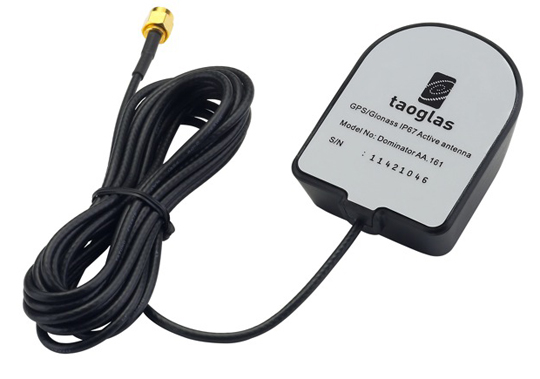
    Taoglas is launching the AA.16X Dominator series of antennas, which have a wider bandwidth to cover the GLONASS operating frequencies up to 1610 MHz, a good axial ratio, and a double resonance design for optimum reception at the center frequencies.

    Taoglas’ GPS antennas are being used in the field by many different M2M solution providers including tracking, telematics, and GPS manufacturers, the company said.

    The AA.161 Dominator is a magnetic mount GPS-GLONASS IP67, external antenna incorporating a 35-millimeter ceramic patch. It is a wide-band active patch antenna product with a large integral ground that delivers a gain up to 35 dB. With the Dominator antenna series, Taoglas has a comprehensive range of GPS-GLONASS active embedded antennas (AGGP series) and passive embedded (CGGP) antennas for automotive first-tier TS16949 and after-market applications.

    “In the coming months, for the first time the true availability of GPS and GLONASS satellites along with the latest generation of GNSS receivers are going to dramatically change the performance of M2M location devices,” said Ronan Quinlan, Director Taoglas. “With close to double the amount of satellites to draw from compared to a stand-alone GPS constellation, we are now going to see quicker time to first fixes with accuracy improving from meters to sub one meter. The ability to view and lock on four or more satellites in traditionally difficult reception areas such as urban canyons, city centers or locations with restricted views of the horizon, will give M2M manufacturers the ability to triangulate and pinpoint locations with greater accuracy and with quicker time to first fix.

    Taoglas’ new Dominator antennas have been rigorously tested and pre-approved by the GNNS receiver companies worldwide and have been shown to display higher and more consistent gain in comparison to competing antennas, the company claimed. Two key components have been engineered from scratch for the Dominator series, a wide-band front-end SAW filter (critical to prevent out of band noise entering on both GPS and GLONASS degrading the signal) and a high-gain 35-mm patch.

    CONTACT INFO

    Company: Taoglas
    Country: United States (USA)
    URL: http://www.taoglas.com

  • New u-blox 7 GNSS Chip Supports GLONASS, Galileo, Compass

    u-blox is launching the u-blox 7, its next-generation core positioning technology platform. Supporting all deployed as well as soon-to-be deployed GNSS, the platform is based on the UBX-G7020 multi-GNSS receiver integrated chip with low power consumption.
     
    With 7 mW power consumption during continuous navigation, u‑blox’ UBX-G7020 is designed for small portable and power-sensitive devices requiring long battery life, high sensitivity, small size, and fast positioning. GPS, GLONASS, Compass, Russian, QZSS, and Galileo satellite positioning systems plus all satellite-based augmentation systems (SBAS) are supported.
     
    “As the satellite systems expand beyond GPS, u-blox 7 is an important step for our customers to design systems that work with all available global navigation standards, particularly GLONASS which is now fully operational. Our multi-GNSS UBX-G7020 integrated circuit does exactly that while achieving two of the most important features that our customers demand: minimum power consumption and small size,” said Andreas Thiel, executive vice president of R&D Hardware and co-founder of u-blox.
     
    The chip has been designed to support the lowest cost stand-alone solution via minimum eBOM; only eight external components are required resulting in a receiver occupying only 30 mm2 on a two-layer PCB. Standard crystal and TCXO are supported. The chip also provides low-power, autonomous log data output of position, velocity, and time. Support for A-GPS and u-blox’ CellLocate hybrid GNSS/cellular positioning technology is embedded to facilitate advanced telematics applications including indoor positioning. Standard and automotive grade are supported.
     
    First samples of the multi-GNSS receiver chip UBX-G7020 are available for customer evaluation. Shortly afterwards, module customers can migrate to the MAX, NEO, and LEA form factors, u-blox’ module series which will all be upgraded to the new u-blox 7 platform.
     
    u-blox 7 maintains software compatibility with u-blox 5 and u-blox 6, and modules provide drop-in compatibility. Both previous generation platforms remain fully supported, the company said. u-blox’ capability of delivering GNSS technology in both integrated circuit and module form provides maximum design flexibility for a wide variety of applications. To evaluate the performance of the u-blox 7 multi-GNSS platform, evaluation kits supporting all u-blox 7 based chips and modules can be ordered.

  • Siberian City Sees Rebirth from GLONASS

    The Siberian city Zheleznogorsk, a hub of Russian space and nuclear technology, fell on hard times in the 1990s. Now, GLONASS has infused a new life and vitality into this once-secret city, as described in a feature by Russia and India Reports.

    The feature discusses the city’s history as attracting young scientists and specialists in the 1950s and 1960s, then its stagnation in the 1990s until its rebirth today, as a hub for GLONASS production. About 40 satellites are in production at the same time, including secret military systems, GLONASS satellites, and telecommunications and geodesy satellites for Russian operators.

    Read more at Glonass Revives Siberian Space Hub.

  • Russia to Increase Number of Space Service Centers to 25

    The number of Russian centers providing services based on data received via GLONASS satellites will reach 25, Deputy Prime Minister Vladislav Surkov said  Tuesday, according to a RIA Novosti report. The space service centers are engaged in satellite monitoring of traffic safety, road planning and cargo transportation on federal highways as well as natural dangers such as landslides, avalanches, and mud flows.

    “Ten space service centers have already been established in Russia, the establishment of another 15 is planned,” Surkov said at a satellite navigation forum in Moscow. So far, there are centers in Moscow, Sochi, Kazan, Kaluga, Ryazan and five more Russian cities.

    Russia has 31 GLONASS satellites in orbit, with 24 operating to provide global coverage, four in reserve, two under maintenance, and one undergoing trials. According to Russia’s space agency Roscosmos, two Glonass satellites are under maintenance, one is on standby, and one recently launched satellite is being integrated into the grouping. The complete Glonass grouping needs 24 functioning and 2-3 reserve satellites to operate with global coverage.

  • Taoglas Offers Dominator Antenna with Wider GLONASS Bandwith

    Taoglas Offers Dominator Antenna with Wider GLONASS Bandwith


    Photo: Taoglas

    Taoglas is launching the AA.16X Dominator series of antennas, which have a wider bandwidth to cover the GLONASS operating frequencies up to 1610 MHz, a good axial ratio, and a double resonance design for optimum reception at the centre frequencies. The company will showcase its line of antennas at CTIA in New Orleans May 8-10.

    Taoglas’ GPS antennas are being used in the field by many different M2M solution providers including tracking, telematics, and GPS manufacturers, the company said.

    The AA.161 Dominator is a magnetic mount GPS-GLONASS IP67, external antenna incorporating a 35-millimeter ceramic patch. It is a wide-band active patch antenna product with a large integral ground that delivers a gain up to 35 dB. With the Dominator antenna series, Taoglas has a comprehensive range of GPS-GLONASS active embedded antennas (AGGP series) and passive embedded (CGGP) antennas for automotive first-tier TS16949 and after-market applications.

    “In the coming months, for the first time the true availability of GPS and GLONASS satellites along with the latest generation of GNSS receivers are going to dramatically change the performance of M2M location devices,” said Ronan Quinlan, Director Taoglas. “With close to double the amount of satellites to draw from compared to a stand-alone GPS constellation, we are now going to see quicker time to first fixes with accuracy improving from meters to sub one meter. The ability to view and lock on four or more satellites in traditionally difficult reception areas such as urban canyons, city centers or locations with restricted views of the horizon, will give M2M manufacturers the ability to triangulate and pinpoint locations with greater accuracy and with quicker time to first fix.”

    Taoglas’ new Dominator antennas have been rigorously tested and pre-approved by the GNNS receiver companies worldwide and have been shown to display higher and more consistent gain in comparison to competing antennas, the company claimed. Two key components have been engineered from scratch for the Dominator series, a wide-band front-end SAW filter (critical to prevent out of band noise entering on both GPS and GLONASS degrading the signal) and a high-gain 35-mm patch.

  • GLONASS 701K Reactivated


    News courtesy of CANSPACE Listserv.

    GLONASS 701K, the first GLONASS-K1 satellite, launched on February 26, 2011, has been reactivated on frequency channel -5. GLONASS 701K, still undergoing flight tests, had previously been active, transmitting legacy FDMA signals on channel -5 between April 8 and October 10, 2011, using almanac slot 4 although the satellite was (and still is) physically in/near orbital slot 21. Transmissions resumed on October 31, 2011, using almanac slot 3, and ceased again on November 30, 2011. During these tests, the satellite was set unhealthy in the broadcast almanac.

    GLONASS 701K does not currently appear in the broadcast almanacs but its broadcast ephemeris gives its designation as 26 or R26 in IGS nomenclature.

    Some receivers may not currently track GLONASS 701K (also known as GLONASS 801 by the IGS to distinguish the satellite from an earlier GLONASS-M satellite also numbered 701) given that it is not in the almanacs and/or has a non-orthodox slot number. Some software providing conversions between receiver data formats and RINEX formats may not recognize the satellite either.

    However, according to reports, at least Javad receivers can successfully track the satellite at the moment.

    The reactivation of GLONASS 701K may be a hint that plans to expand the GLONASS constellation from 24 to 30 satellites, as previously reported, are actually underway.

    Thanks to T.S. Kelso and Javad Ashjaee for information concerning the reactivation of the satellite.

  • u-blox Launches GLONASS/GPS/QZSS Positioning Module

    u-blox, the Swiss positioning and wireless module and chip company, announces an all-in-one satellite positioning receiver module, the LEA-6N. The low-power, cost-effective module delivers fast, high-accuracy positioning, u-blox said. It is targeted at industrial telematics applications in Russia such as vehicle tracking, mobile resource management and the ERA-GLONASS emergency call system.

    The module works with GPS, Russian GLONASS, and Japanese QZSS satellite positioning systems. It also supports all civilian Satellite-Based Augmentation Systems (SBAS).

    “The LEA-6N module delivers clear new benefits for our industrial customers in terms of global support of all available satellite positioning systems, easy to mount LCC form factor, low power consumption and cost effectiveness” said Thomas Nigg, VP Product Marketing at u-blox, “LEA-6N will also support our CellLocateTM hybrid indoor positioning system; when used together with our wireless modules, the location of valuable assets or people can be determined anywhere, indoors and outside.”

    Samples of LEA-6N are available mid-April 2012, with evaluation kit EVK-6N and mass production in June 2012. For more information, contact the u-blox office nearest you, or visit with company representatives at Machine to Machine 2012 stand E21 April 3-5 in Paris.