Category: GPS

  • Space Force awards Lockheed Martin new GPS IIIF contract

    Space Force awards Lockheed Martin new GPS IIIF contract

    Total GPS IIIF commitment now at 14 satellites

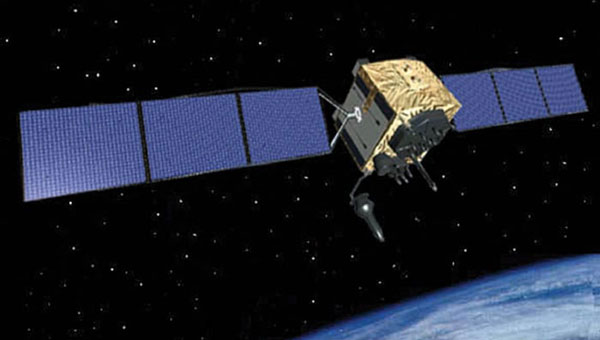
    The U.S. Space Force has awarded Lockheed Martin a $514 million contract to build GPS IIIF Space Vehicles 23 and 24, bringing its total GPS IIIF commitment to 14 spacecraft.

    With legacy spacecraft past their intended design life, the award marks a vital step in continued modernization of the constellation. The 14 upcoming GPS IIIF satellites will deliver advanced, reliable positioning, navigation and timing (PNT) capabilities for both military and civilian users.

    IIIF capabilities include: 

    • The Regional Military Protection capability that provides a 63-fold increase in anti-jam capabilities, allowing warfighters to access strong GPS signals in contested environments
    • Additional M-code-enabled satellites, allowing for secure GPS connection for warfighters
    • A digital navigation payload, increasing accuracy and reliability of IIIF spacecraft.

    “Modernizing the constellation with highly resilient, next-generation space vehicles ensures warfighters have access to the GPS capabilities they require for their missions,” said Christina Mancinelli, vice president of global communications and navigation at Lockheed Martin. “We continue to invest in advanced technology, facilities and the people who are the driving force in the production of this spacecraft that help our military secure peace.”

    Earlier this year, all Lockheed Martin-made GPS III satellites reached orbit. GPS III SV09 and SV10 each launched on accelerated timelines, bringing unprecedented levels of resiliency to the constellation.

    The GPS constellation provides critical positioning, navigation and timing capabilities to key warfighter platforms made by Lockheed Martin. For example, the F‑35 uses GPS to determine its exact location, keep its systems perfectly synchronized, and share real‑time position data with other assets, enabling autonomous navigation and pinpoint strike capabilities.

    Similarly, the UH-60 Black Hawk employs GPS to navigate accurately, deconflict with ground and air forces, and deliver cargo or weapons with high precision, enhancing mission safety and effectiveness.

    For civilians, the GPS constellation underpins banking transactions, telecommunications networks, emergency‑response services, and everyday navigation. The new GPS IIIF satellites broadcast all civil signals — including the interoperable L1C and L5 — at greater accuracy and reliability.

    Advanced design features speed and resiliency

    GPS IIIF satellites are engineered for resiliency. Starting with SV13, these spacecraft are built on the evolved LM2100 Combat Bus, providing increased cyber-hardening, improved spacecraft power, propulsion and electronics. The LM2100 Combat Bus is also outfitted with additional size, weight and power to accommodate future capability insertions.

    The company has already completed the core mate milestone — marking the official “birth” of a satellite — for three GPS IIIF satellites, with all other IIIF satellites in different phases of production. The company was also recently awarded a $105 million contract to continue modernization of the GPS ground segment. With these contracts, Lockheed Martin reaffirms its long-term commitment to a resilient, high-performance GPS constellation that supports billions of users worldwide.

    Lockheed Martin continues to advance GPS IIIF production at its Denver area facilities, employing emerging technologies such as augmented reality and digital twins to accelerate build rates and ensure capabilities are delivered to the warfighter quickly.
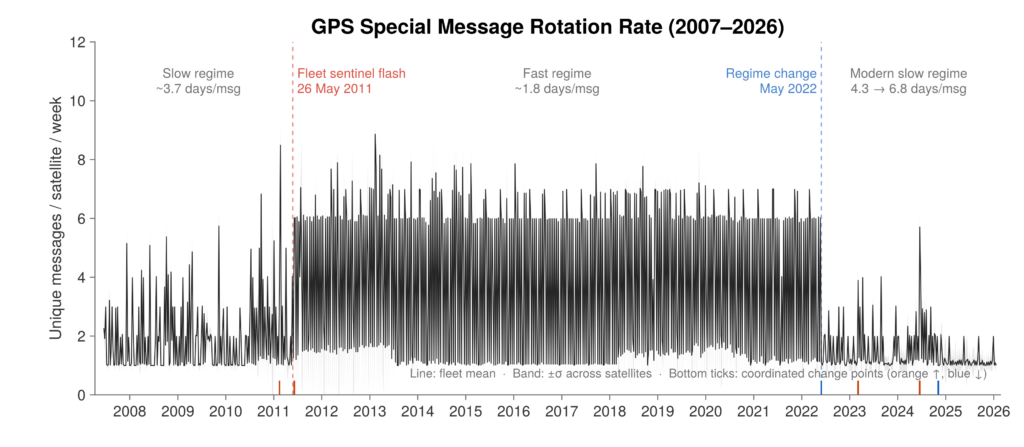
  • Decoding 19 Years of GPS Cryptography

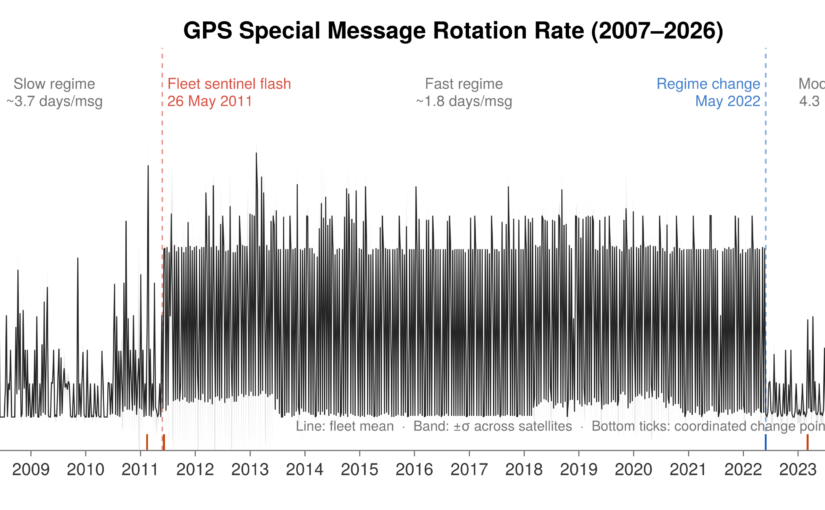
    Decoding 19 Years of GPS Cryptography

    The Information Security researchers at University College London (UCL) analyzed an archive of 12.16 million GPS observations collected between 2007 and early 2026 to understand what the broadcasts actually contain.

    To make processing this massive dataset practical, the researchers built a Julia pipeline to extract the bits directly into a DuckDB database. This setup allowed them to run queries across 19 years of global ground-station data in milliseconds.

    Read the full analysis in the researchers’ blog here.

  • USSF terminates GPS OCX program

    USSF terminates GPS OCX program

    The GPS Next Generation Operational Control System program of the U.S. Space Force has been cancelled by the Defense Acquisition Executive, based upon the recommendation of the acting service acquisition executive.

    OCX was intended to update command and control of the GPS satellite constellation, replacing the current system, known as the Architecture Evolution Plan (AEP), as well as replacing the Launch, Anomaly and Disposal Operations system. However, the program was unable to deliver needed capabilities on an operationally relevant timeline at an acceptable level of risk to meet the GPS constellation modernization needs.

    “It’s important we refine and update acquisition processes to prioritize rapid, incremental capability delivery versus complex ‘all or nothing’ system deliveries,” said Acting Service Acquisition Executive Tom Ainsworth. “The Department of War [Defense] has made clear that we need to deliver warfighting capability at a faster rate. We must continue to work with industry to meet the needs of our warfighters as we focus on delivering the right technology on the right timeline to enhance our capabilities and maintain space superiority.”

    In July 2025, following a multi-year regimen of factory testing, the Space Force contractually accepted OCX from RTX (Raytheon) and began extensive integrated systems testing to resolve liens carried over from factory testing, as well as to ensure the system could operate within the broader GPS enterprise of ground systems, satellites, and user equipment.

    As of January 2026, the program cost was approximately $6.27 billion which included complete Raytheon funding to date and other government costs, such as the cost of government testing and support costs to the OCX acquisition program office.

    “Regrettably, extensive system issues arose during the integrated testing of OCX with the broader GPS enterprise,” said Mission Delta 31 Commander Col. Stephen Hobbs. “Despite repeated collaborative approaches by the entire government and contractor team, the challenges of onboarding the system in an operationally relevant timeline proved insurmountable. We discovered problems across a broad range of capability areas that would put current GPS military and civilian capabilities at risk.”

    Because of past delays on the OCX program, the Space Force has made incremental improvements over the last 10 years to AEP. These successful upgrades provide confidence that further upgrades to GPS ground systems will continue to support the enterprise and deliver new capabilities.

    “Ultimately, we analyzed the work remaining on OCX and compared this with the current GPS control system capability,” Hobbs said. “The analysis revealed additional investment in OCX was no longer the best solution for protecting and advancing GPS capabilities. Instead, we will continue enhancing the current control system to operate the GPS satellite constellation.”

  • Next-gen GPS IIIF satellites take shape

    Next-gen GPS IIIF satellites take shape

    Lockheed Martin has successfully completed the core mate phase of GPS IIIF Space Vehicle 11 ( SV11), a critical production milestone that marks the satellite’s formal “birth.”  

    Continued manufacturing and deployment of these next-generation GPS spacecraft is essential to maintaining reliable global coverage, with the GPS IIIF block introducing a suite of new capabilities that further strengthens the constellation’s resilience. GPS IIIF satellites are equipped with Regional Military Protection, improving anti-jamming capability by more than sixty times, giving warfighters a decisive edge against sophisticated electronic warfare threats. 

    GPS IIIF SV11 is the third GPS IIIF satellite to complete the core mate phase, after SV13 and SV14 completed core mate last year. GPS IIIF SV11 will be the first IIIF satellite to launch. 

    “Core mate of SV11 showcases the production momentum behind the next-generation GPS IIIF satellites as we continue to invest in advanced manufacturing,” said Christina Mancinelli, vice president of Global Communications & Navigation at Lockheed Martin. “With three GPS IIIF satellites past core mate, we’ve taken pivotal steps toward accelerating production, ensuring we’re delivering critical next-generation resiliency capabilities to the GPS constellation at the pace warfighters need to protect our nation.” 

    The SV11 satellite is also M-code-enabled, providing an encrypted, anti-spoofing signal that strengthens positioning, navigation and timing (PNT) capabilities for military users globally. Additionally, SV11 is equipped with a new search-and-rescue payload that will allow first responders to navigate to emergencies in remote locations.  

    With an eye on strengthening GPS, all GPS IIIF satellites starting with SV13 will be built on the evolved LM2100 Combat Bus, which adds additional cyber-hardening and improved spacecraft power, propulsion and electronics. These vehicles are equipped with extra size, weight and power, providing flexibility to integrate additional payloads quickly onto future space vehicles.

    GPS IIIF satellites are manufactured at Lockheed Martin’s Denver, Colorado, facility, where the company is accelerating production through the use of augmented reality and digital twins. Lockheed Martin is currently under contract through GPS IIIF SV22 and recently completed all launches of GPS III space vehicles. 

  • Rohde & Schwarz to highlight UAV-based navigation analyzer at IFIS 2026

    Rohde & Schwarz to highlight UAV-based navigation analyzer at IFIS 2026

    The 23rd International Flight Inspection Symposium (IFIS) will gather experts in San Salvador May 4-8. There, Rohde & Schwarz will demonstrate its test and measurement solutions for ground-based navigation aids. The exhibits address the rising traffic volumes and stricter safety requirements.

    Rohde & Schwarz will take part in the conference’s technical sessions with a presentation on “Challenges for UAV Operations in RF Dense Aerodrome Environments.”

    The aviation sector today faces increasing air traffic density, rapid technological advancements and heightened security concerns, the company explained. Operators need test equipment that delivers laboratory level precision while tolerating the harsh environment of an airport runway or a remote navigation site.

    Among the exhibits at the Rohde & Schwarz booth is the R&S EVSD1000 VHF/UHF Nav/Drone Analyzer, designed to conduct GBAS, ILS and VOR measurements in line with ICAO Doc 8071 and ICAO Annex 10. The receiver delivers laboratory precision, supports an air to ground Wi‑Fi datalink and gapless measurements with improved location accuracy during flight inspections. Customers benefit from a device that can be mounted on a drone, reducing the need for manned flights and lowering operational expenses.

    Rohde & Schwarz gives airlines, airport operators and navigation service providers a reliable way to certify and maintain ground‑based aids under today’s demanding conditions. By combining high measurement accuracy, easy operation and durability, Rohde & Schwarz aims to help the industry keep pace with growth.

  • Lockheed Martin secures $105M contract for GPS IIIF operations

    Lockheed Martin secures $105M contract for GPS IIIF operations

    Lockheed Martin has received a potential $105 million firm-fixed-price task order from the U.S. Space Force’s Space Systems Command to supportGPS IIIF launch and on-orbit testing.

    The award covers services related to the Architecture Evolution Plan (AEP) operational control system. This includes support for launch, early orbit operations and eventual disposal of GPS IIIF satellites (space vehicles SV11-22). The effort is part of ongoing work to sustain and manage next-generation positioning, navigation and timing capabilities for military users.

    Work under the sole-source task order will take place in Colorado Springs, Colorado, through March 2030. The contract is managed by SSC’s satellite communication and PNT office at Peterson Space Force Base. SSC obligated $13.4 million from fiscal 2026 research, development, test and evaluation funds at the time of award.

    Lockheed Martin’s previous contracts supporting the GPS IIIF program include a nine-year, $1.36 billion contract in 2018 to produce the 11th and 12th GPS IIIF satellites, and a $509.8 million contract modification for GPS IIIF space vehicles 21 and 22 granted in May 2025. SV-21 and SV-22 are expected to be delivered by November 2031.

  • GPS III ground control contract held by RTX could be canceled

    The U.S. Space Force is considering canceling the contract held by RTX (formerly Raytheon) to develop the GPS III ground control system, according to a report in Air & Space Forces Magazine.

    GPS OCX, the Next-Generation Operational Control Segment, has long been beleagured by cost overruns and deadline delays. Established in 2010, the GPS OCX program was planned to begin operations in 2016. In 2010, Raytheon (now RTX) was contracted to develop a modernized ground control system to support the upcoming GPS Block III satellite constellation.

    The first GPS III satellite, built by Lockheed Martin, launched in 2018. Eight more have followed, with the 10th satellite awaiting launch on a SpaceX Falcon 9 rocket within the next few months. With 32 GPS satellites on orbit, the Space Force is relying on the OCX software to utilize the advanced GPS III capabilities for jam-resistance and precise navigation.

    In July 2025, RTX began a government-led testing phase, but the tests revealed software defects.

  • Ultra-low-noise amplifiers achieve in-orbit milestone on ESA HydroGNSS mission

    Ultra-low-noise amplifiers achieve in-orbit milestone on ESA HydroGNSS mission

    Ultra-low-noise amplifiers developed by European Engineering Consultancy Ltd. (EECL) are operating in orbit on the European Space Agency’s (ESA’s) HydroGNSS mission, marking a technical milestone for the hardware following the satellites’ launch in November 2025.

    HydroGNSS consists of two small satellites designed to measure hydrological and climate-related variables using GNSS reflectometry. The satellites collect signals transmitted by navigation satellites such as GPS and Galileo and analyze those signals after they reflect from Earth’s surface. The reflected signals provide data on environmental parameters including soil moisture, freeze–thaw conditions in permafrost regions, wetlands and inundation, and above-ground biomass.

    The satellites were launched aboard a SpaceX Falcon 9 rideshare mission from Vandenberg Space Force Base in California on Nov. 28, 2025. The mission is part of the European Space Agency’s Scout program, which focuses on relatively small and cost-effective Earth observation satellites designed to demonstrate new measurement techniques.

    EECL designed and manufactured six multiband ultra-low-noise microwave amplifiers used in the spacecraft payload. The amplifiers are part of the radio-frequency front end of the receiver system and are designed to amplify very weak reflected GNSS signals while minimizing additional noise, helping preserve signal quality for scientific analysis.

    Early on-orbit results indicate the satellites’ payloads are functioning as expected. Both spacecraft have begun collecting delay-Doppler maps of reflected GNSS signals, an early step in commissioning that confirms the receivers are acquiring and processing signals properly.

    The HydroGNSS satellites were built by Surrey Satellite Technology Ltd., which also developed the GNSS receiver used on the mission. The spacecraft operate in low Earth orbit and are phased apart to increase global coverage of the measurements.

    Data from HydroGNSS are expected to support research on the global water cycle and contribute to studies related to climate monitoring, agriculture, flood risk and ecosystem changes.

  • BeaconSat aims to make GNSS attacks visible with Austria’s first military satellite

    BeaconSat aims to make GNSS attacks visible with Austria’s first military satellite

    Austria is breaking new ground in space. BeaconSat is the largest satellite ever developed in Austria and also the country’s first military satellite. The project is being led by Austrian start-up GATE Space, based in Schwechat. Launch is planned for February 2027 aboard a SpaceX Falcon 9 rocket.

    BeaconSat is designed to detect and analyze jamming and spoofing attacks on GNSS — targeted attempts to interfere with and manipulate navigation signals such as GPS or Galileo. Austria is responding to a security policy development that has real implications for aviation, transport, energy supply, and military operations.

    Attacks on critical infrastructure

    Jamming and spoofing incidents are frequent in geopolitically tense regions. In aviation, repeated disruptions have affected civilian aircraft.

    “Space is now a central component of Europe’s and Austria’s security and defense strategy,” said Major General Friedrich Teichmann, head of the ICT and Cybersecurity Center. Navigation signals have long been part of critical infrastructure, and securing them is therefore of great strategic importance.

    However, many of these attacks remain invisible. Countries often do not know where the interference is coming from, how systematic it is, or what pattern lies behind it. This is where BeaconSat comes in.

    Technology demonstrator with strategic dimension

    BeaconSat will systematically detect and analyze GNSS interference signals from orbit for the first time. The aim is to obtain data on when and where navigation systems are being deliberately disrupted. The mission is designed as a multi-year research and development project.

    “It is important that we are able to act independently in terms of communication and navigation when necessary. This is a question of resilience and military capabilities,” emphasized Defense Minister Klaudia Tanner. “Space is an essential part of military capability.”

    The satellite is not intended to be an isolated military project, but rather a demonstrator. Civil space technologies are being further developed for security-related applications and tested under real-world conditions. The findings will be incorporated into the operational processes of the Federal Ministry of Defense (BMVL).

    Austrian industry at the center

    GATE Space has overall responsibility for the project. Founded in 2022, the spin-off from TU Wien develops chemical propulsion systems for satellites and currently employs around 27 people. For BeaconSat, the company is supplying the propulsion system, the satellite structure, and the thermal management system, among other things.

    “With BeaconSat, we are making a direct contribution to Europe’s security. The market for such capabilities is huge,” said Managing Director Moritz Novak.

    The engines were tested in more than 8,000 hot runs at the site near Vienna Airport, both under atmospheric conditions and in one of Europe’s most powerful vacuum chambers.

    GATE Space was supported by the Federal Ministry for Innovation, Mobility, and Infrastructure (BMIMI) through Austria Wirtschaftsservice (aws) with funding of around 750,000 euros.

    Jamming and spoofing detection

    A central contribution to the payload comes from the Graz-based company IGASPIN, which develops systems for the precise detection and analysis of GNSS interference. Additional components, including the on-board computer, are supplied by the Danish company Space Inventor.

    At the European level, the mission is supported and co-financed as a technology demonstration via the European Space Agency’s ESA Marketplace. Off-the-shelf systems are specifically used to test commercially available technologies under security-relevant conditions.

    New space chapter in the Ministry of Defense

    BeaconSat also marks a turning point institutionally. The BMLV is currently setting up its own organizational unit for space services. The focus is on three areas: satellite communication, satellite navigation, and satellite-based reconnaissance.

    “These space services are key to cross-domain operations and make a substantial contribution to the Austrian Armed Forces’ modern reconnaissance, command, and control network,” Teichmann said.

    BeaconSat will provide data that will be directly integrated into military decision-making processes. At the same time, the project contributes to European resilience: those who recognize threats early on can respond diplomatically, politically, or technically.

    Space as a growth area

    The strategic importance of space technologies is growing both in terms of security policy and economics. Austria has recently increased its contribution to the ESA from 260 to 340 million despite budgetary constraints. Space and aviation technologies are anchored in the government’s industrial strategy as one of nine key technology fields.

    Satellites have long been considered critical infrastructure. They enable navigation, communication, Earth observation, climate monitoring, and security applications. At the same time, new markets are emerging in the areas of propulsion systems, data analysis, and dual-use technologies.

    With BeaconSat, Austria is repositioning itself in terms of security policy and industry. The project is an example of how startups, established technology companies, ministries, and European partners can and must work together successfully.

  • GNSS-reflectometry data unlocks new insights into Arctic sea ice

    GNSS-reflectometry data unlocks new insights into Arctic sea ice

    In recent years, scientists have shown that detecting changes in navigation signals from GPS and Galileo after they bounce off Earth’s surface (GNSS reflectometry, or GNSS-R) can deliver valuable information on sea ice. Now research drawing on data from Spire Global has enabled the generation of Arctic-wide sea ice maps, marking a major step forward for the emerging technique.

    Spire Global‘s sea ice freeboard maps use data captured by Spire’s GNSS-reflectometry multipurpose listening constellation.

    The research — enabled by the Third Party Missions (TPM) programme of the European Space Agency (ESA) — suggests that harnessing reflected navigation signals could become an important complement to established ice-monitoring altimetry missions.

    The study leveraged Spire’s GNSS-R data to retrieve sea ice freeboard measurements across an entire winter season. The results show strong alignment with established altimetry datasets, including the ESA’s CryoSat mission, validating the complementary role of commercial satellite data alongside government missions.

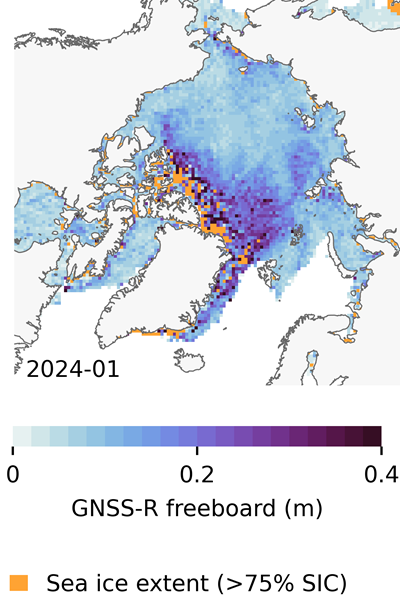
    Arctic-wide sea ice freeboard map for January 2024
Arctic-wide sea ice freeboard map for January 2024. (Credit: ESA)
    Arctic-wide sea ice freeboard map for January 2024. (Credit: ESA)

    The study was led by Felix Müller at the Technical University of Munich (DGFI-TUM) and Robert Ricker at the Norwegian Research Centre, experts in GNSS-R.

    “The primary purpose of signals emitted from GNSS is to fix the location of a device at any point on Earth,” Müller explained. “However, when these signals bounce off Earth’s surface, their properties change. By analyzing these changes, we can infer information about the characteristics of Earth’s surface.”

    “Previous research has shown that this technique works well experimentally,” Ricker added. “Using the Spire constellation, we aimed to demonstrate whether it would hold up on a larger scale by generating an Arctic-wide map of sea ice freeboard, which is a measure of how far ice protrudes above the waterline.”

    Spire’s GNSS-R constellation

    Spire’s constellation was first used to sample the atmosphere for weather forecasting. Then scientists began exploring other applications. Spire started collecting reflected signals arriving at shallow angles using a technique called grazing-angle GNSS-R. This method is particularly well suited for ice monitoring.

    The research team analyzed data detected over the Arctic Ocean and surrounding seas between October 2023 and July 2024. The data was obtained via the TPM program, through which ESA disseminates data from a range of commercial and institutional partners on a free basis for research and development purposes.

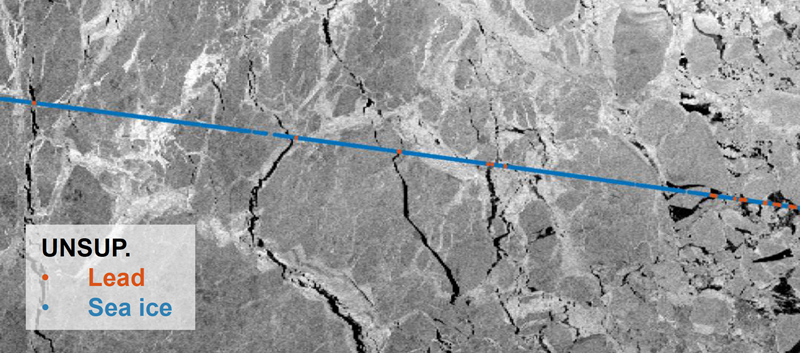
    The team focused on one of the most critical challenges in sea ice altimetry: reliably identifying narrow openings in the ice pack, known as leads. These openings are reference points for determining sea surface height and, ultimately, sea ice freeboard.

    In turn, sea ice freeboard can be used to infer sea ice thickness — an essential parameter for tracking climate change, estimating sea level, and modeling ocean and weather patterns.

    Identifying leads in sea ice with GNSS-R data. (Credit" ESA)
    Identifying leads in sea ice with GNSS-R data. (Credit: ESA)

    Classifying surface properties

    “In the initial phase of the project, we used two complementary methods to identify surface properties based on GNSS-R data, with the aim of identifying leads,” Müller said.

    The first — known as the adaptive threshold technique — involved measuring the power of the reflected navigation signal to classify surface type as either water or ice. This method allows rapid processing of the entire GNSS-R dataset, while remaining robust to changes in signal conditions.

    The second method — known as unsupervised clustering — offers a more complex approach to classifying surface conditions. In addition to signal power, it considers multiple other signal features that tease out more nuanced information on surface type, including identifying thin or refrozen ice.

    Both methods were compared with co-located CryoSat surface-type classifications and Sentinel-1 imagery, confirming that the GNSS-R classifications were largely comparable against conventional satellite products.

    Mapping sea ice freeboard

    “Building on this classification work, we then took the research to the next step by producing Arctic-wide sea ice freeboard maps from GNSS-R data,” Ricker said.

    The team corrected ice surface height measurements generated from GNSS-R data for tidal variations, sea surface height, and atmospheric delays, which is standard practice in altimetry. A refined algorithm then identified where leads in the ice were likely to occur, with the lowest points in these areas revealing estimated sea surface height. Sea surface height estimates were then subtracted from ice surface heights to retrieve freeboard. Using this approach, monthly gridded freeboard products were generated for the full winter season.

    The team reported that the GNSS-R datasets showed strong agreement with CryoSat freeboard datasets across much of the Arctic, confirming that GNSS-R can reproduce large-scale patterns previously observed by dedicated altimetry missions. Independent validation against upward-looking sonar measurements in the Beaufort Sea further supported the accuracy of the retrieved freeboard values.

    However, as expected, the GNSS-R estimates became less reliable during spring, when surface melt alters reflection characteristics. This limitation is consistent with earlier GNSS-R and radar altimetry studies and remains an active area of research.

    The contribution of commercial data

    While GNSS signals have long been used for positioning, this research highlights how reflected signal analysis can extend their value into large-scale Earth observation applications, delivering persistent coverage independent of sunlight or weather conditions, said Theresa Condor, Spire Global CEO.

    “Advances in miniaturization, digital signal processing, and machine learning have fundamentally changed what’s possible in RF sensing,” Condor said. “Commercial constellations can now deliver persistent, high-quality RF data that complements traditional government systems with greater flexibility and cost efficiency.

    “As environmental monitoring requirements intensify, we’re seeing agencies increasingly integrate commercially sourced RF datasets into operational architectures, reflecting the continued maturation of this market and the growing role of commercial infrastructure in government missions.”

    “By producing analysis-ready gridded datasets, this work marks an important milestone in the progress of grazing angle GNSS-R from an experimental method to a reliable technique for mapping Arctic sea ice freeboard at scale,” said Matthieu Talpe, Remote Sensing Product Engineer, Spire Global. “In doing so, it strengthens the case for the grazing angle GNSS-R technique employed by the Spire constellation as a valuable complement to existing ESA and partner missions, helping to close observational gaps in one of Earth’s most rapidly changing regions.”

  • NovAtel joins GPS Innovation Alliance

    NovAtel joins GPS Innovation Alliance

    Hexagon | NovAtel has joined the GPS Innovation Alliance (GPSIA) as its newest member.

    NovAtel develops positioning, navigation and timing (PNT) products for land, sea and air applications, with users in agriculture, defense, autonomous mobility and marine sectors. The company’s portfolio includes high-precision GNSS receivers, correction services, sensor fusion systems, GNSS anti-jam technology and post-processing solutions.

    GPSIA Executive Director Lisa Dyer said the addition comes at a critical time for PNT infrastructure.

    “NovAtel brings world-class expertise in high-precision GNSS, inertial integration, and anti-jam capabilities that help protect critical services people rely on every day, from transportation and public safety to the supply chains and infrastructure that power the world’s economy,” Dyer said. “Their leadership will strengthen GPSIA’s work to protect GPS and complementary PNT technologies from harmful interference and to accelerate the innovation that underpins the decades-long reliability of these systems.”

    Jonathan Auld, president of NovAtel’s Positioning Division at Hexagon, said the company plans to use its membership to raise awareness of PNT’s role in critical industries.

    “From precise positioning and correction services to resilient solutions that help mitigate interference, we support customers operating in mission- and safety-critical environments,” Auld said. “We look forward to working with GPSIA to heighten awareness of the role these technologies play in innovation, critical infrastructure, and economic growth.”

    NovAtel joins existing GPSIA members Apple, Garmin, Deere & Company, Lockheed Martin, Trimble and TrustPoint, along with organizations participating in the alliance’s affiliates program. GPSIA describes its mission as protecting, modernizing and advancing GPS, GNSS and complementary PNT technologies.

  • The Hill: America is dangerously unprepared for a GPS attack

    The Hill: America is dangerously unprepared for a GPS attack

    We just finished the year that marked the 30th anniversary of America’s Global Positioning System (GPS) reaching full operational capacity. What began as a military tool to enable U.S. military forces to navigate more precisely and to support the use of precision strike weapons anywhere in the world has become the invisible infrastructure that powers nearly every aspect of civilian life. So much of our everyday lives, from smartphones and ATMs to aviation, shipping and Wall Street, run on precise timing and location information.

    However, that infrastructure is now under duress. Our adversaries are waging a sophisticated war on GPS signals, and the fallout is both significant and frightening. Reports of navigational issues across the Baltic and the Middle East have become a daily occurrence due to conflicts in the region. The impacts have extended into civilian life, impacting air, land and sea.

    It’s a miracle the regions have avoided a major aviation disaster, given that navigational warfare and space have become new domains of nation-state confrontation. Russia is spoofing and jamming signals across Eastern Europe. Russia and China are also shadowing military and civilian satellites, performing dangerous dogfighting maneuvers in orbit.

    Jamming and spoofing were once rare. Now, they are battle-tested tools in the electronic warfare arsenal, and the U.S. is not immune to their effects. What’s happening in these regions today could happen over Chicago or Atlanta tomorrow.  

    Similar interference has been detected near major U.S. airports, including Dallas and Denver, impacting nearly 350 flights. Nation-states were not responsible for these incidents, but they prove how vulnerable GPS is to disruption.

    This isn’t a Hollywood thriller. A coordinated attack on GPS would ripple across aviation, finance, emergency response, and daily life within minutes, not days. We’ve already seen how quickly systems collapse when digital links are severed.

    In 2022, a volcanic eruption in Tonga severed the country’s only undersea cable and blocked satellite signals, plunging the island into an instant blackout. Commerce broke down, and government emergency coordination collapsed. ATMs couldn’t dispense cash because banks couldn’t confirm account balances. Cargo planes couldn’t file manifests, and supply chains froze. Farms and fisheries couldn’t complete online forms, so produce rotted. Pharmacies couldn’t fill prescriptions because their supply systems were offline. The effects were immediate and took months to normalize.

    If GPS goes down, whether because of jamming, spoofing, a cyberattack or a natural disaster America is dangerously unprepared. Our widespread reliance on a vulnerable technology should be a wake-up call. A single sustained outage could cost the U.S. economy an estimated $1.6 billion per day.

    When I served as commander of U.S. Cyber Command, our team was responsible for ensuring the networks underpinning our military missions were fully operational and secure, and as the director of the National Security Agency, the team was focused on generating deep knowledge of threats to the U.S. and allied operations across land, sea, air, space and cyberspace. In both roles, it became very clear that we needed to protect our positioning, navigation and timing infrastructure, and that one of the keys to doing so was to create layered resilience.

    Solving a problem of this magnitude is a massive challenge. But we don’t need to start from scratch. By leveraging existing infrastructure in space and on the ground, we can accelerate deployment, reduce cost and avoid duplication. Speed and scale are essential. It’s not a question of whether the U.S. experiences a major GPS disruption, but when.

    Fortunately, the technology already exists. American companies are developing methods to provide positioning, navigation and timing backup via terrestrial 5G networks, offering timing and location signals that are independent of satellites. These solutions are scalable, cost-effective and designed to integrate directly into existing telecom infrastructure such as cell towers. If commercial providers are already exploring complementary backup technologies, why are we still lagging behind our adversaries?

    The real barrier isn’t technology — it’s policy. Moving the process forward to make these technical capabilities a reality is the challenge. Getting government bureaucracies to act with urgency is never easy, but the administration and Congress now recognize the stakes.

    The Federal Communications Commission has launched an inquiry into strengthening national positioning, navigation and timing infrastructure, including exploring ground-based alternatives such as 5G-powered systems. Now it’s time to follow through and move from planning to execution.

    The threats are real; the technology is ready; and the cost of inaction grows by the day. Replacing GPS is not a realistic near-term solution, either in terms of cost or the time frame required to do so. Our focus should be on building a layered, resilient system that provides users with multiple options to react to loss or degradation of our current positioning, navigation and timing structure. One layer of that system should be a ground-based component that takes advantage of the existing infrastructure already in place, saving us significant time and money in creating a solution to this critical problem.  


    This piece originally appeared on The Hill.